Nipah Virus
State Surveillance Unit
IDSP - Karnataka
1
Introduction
• Nipah Virus Infection (NIV) is an emerging infectious zoonotic
disease of public health importance in the South-East Asia Region
• Named after the Malaysian village called Kampung sungai Nipah
where it was first discovered
• NIV is a member of the family Paramyxoviridae, genus Henipavirus
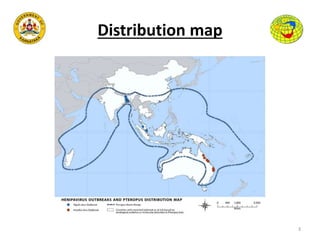
• Nipah virus was first recognized in 1999 during an outbreak among
pig farmers in Malaysia
• Subsequent outbreaks reported in Bangladesh and India in 2001
and 2008
2
Distribution map
3
Outbreaks in India
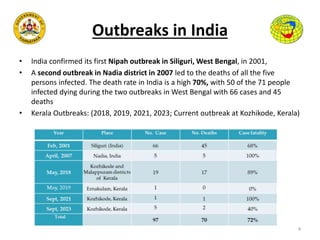
• India confirmed its first Nipah outbreak in Siliguri, West Bengal, in 2001,
• A second outbreak in Nadia district in 2007 led to the deaths of all the five
persons infected. The death rate in India is a high 70%, with 50 of the 71 people
infected dying during the two outbreaks in West Bengal with 66 cases and 45
deaths
• Kerala Outbreaks: (2018, 2019, 2021, 2023; Current outbreak at Kozhikode, Kerala)
4
Transmission
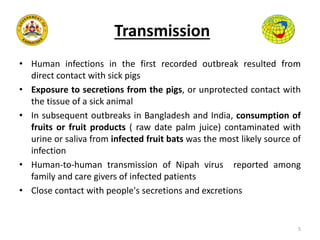
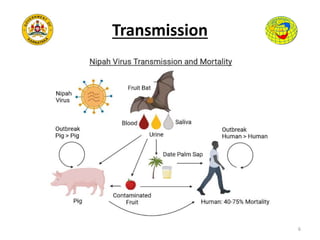
• Human infections in the first recorded outbreak resulted from
direct contact with sick pigs
• Exposure to secretions from the pigs, or unprotected contact with
the tissue of a sick animal
• In subsequent outbreaks in Bangladesh and India, consumption of
fruits or fruit products ( raw date palm juice) contaminated with
urine or saliva from infected fruit bats was the most likely source of
infection
• Human-to-human transmission of Nipah virus reported among
family and care givers of infected patients
• Close contact with people's secretions and excretions
5
Transmission
6
Natural Hosts
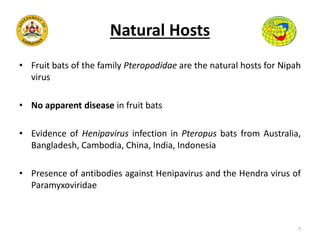
• Fruit bats of the family Pteropodidae are the natural hosts for Nipah
virus
• No apparent disease in fruit bats
• Evidence of Henipavirus infection in Pteropus bats from Australia,
Bangladesh, Cambodia, China, India, Indonesia
• Presence of antibodies against Henipavirus and the Hendra virus of
Paramyxoviridae
7
Nipah virus in domestic animals
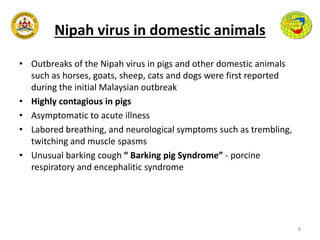
• Outbreaks of the Nipah virus in pigs and other domestic animals
such as horses, goats, sheep, cats and dogs were first reported
during the initial Malaysian outbreak
• Highly contagious in pigs
• Asymptomatic to acute illness
• Labored breathing, and neurological symptoms such as trembling,
twitching and muscle spasms
• Unusual barking cough “ Barking pig Syndrome” - porcine
respiratory and encephalitic syndrome
8
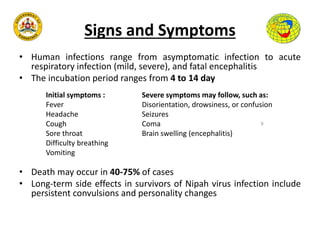
Signs and Symptoms
• Human infections range from asymptomatic infection to acute
respiratory infection (mild, severe), and fatal encephalitis
• The incubation period ranges from 4 to 14 day
• Death may occur in 40-75% of cases
• Long-term side effects in survivors of Nipah virus infection include
persistent convulsions and personality changes
9
Severe symptoms may follow, such as:
Disorientation, drowsiness, or confusion
Seizures
Coma
Brain swelling (encephalitis)
Initial symptoms :
Fever
Headache
Cough
Sore throat
Difficulty breathing
Vomiting
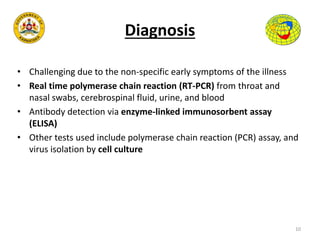
Diagnosis
• Challenging due to the non-specific early symptoms of the illness
• Real time polymerase chain reaction (RT-PCR) from throat and
nasal swabs, cerebrospinal fluid, urine, and blood
• Antibody detection via enzyme-linked immunosorbent assay
(ELISA)
• Other tests used include polymerase chain reaction (PCR) assay, and
virus isolation by cell culture
10
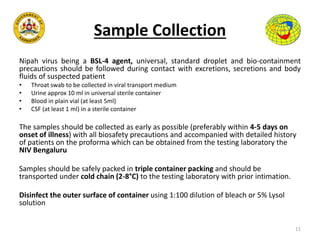
Sample Collection
Nipah virus being a BSL-4 agent, universal, standard droplet and bio-containment
precautions should be followed during contact with excretions, secretions and body
fluids of suspected patient
• Throat swab to be collected in viral transport medium
• Urine approx 10 ml in universal sterile container
• Blood in plain vial (at least 5ml)
• CSF (at least 1 ml) in a sterile container
The samples should be collected as early as possible (preferably within 4-5 days on
onset of illness) with all biosafety precautions and accompanied with detailed history
of patients on the proforma which can be obtained from the testing laboratory the
NIV Bengaluru
Samples should be safely packed in triple container packing and should be
transported under cold chain (2-8°C) to the testing laboratory with prior intimation.
Disinfect the outer surface of container using 1:100 dilution of bleach or 5% Lysol
solution
11
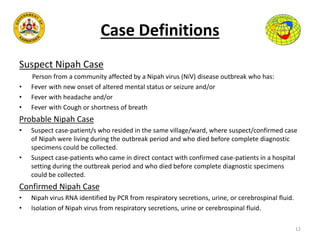
Case Definitions
Suspect Nipah Case
Person from a community affected by a Nipah virus (NiV) disease outbreak who has:
• Fever with new onset of altered mental status or seizure and/or
• Fever with headache and/or
• Fever with Cough or shortness of breath
Probable Nipah Case
• Suspect case-patient/s who resided in the same village/ward, where suspect/confirmed case
of Nipah were living during the outbreak period and who died before complete diagnostic
specimens could be collected.
• Suspect case-patients who came in direct contact with confirmed case-patients in a hospital
setting during the outbreak period and who died before complete diagnostic specimens
could be collected.
Confirmed Nipah Case
• Nipah virus RNA identified by PCR from respiratory secretions, urine, or cerebrospinal fluid.
• Isolation of Nipah virus from respiratory secretions, urine or cerebrospinal fluid.
12
Contact
13
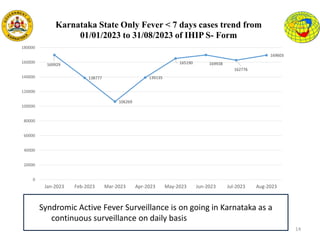
Karnataka State Only Fever < 7 days cases trend from
01/01/2023 to 31/08/2023 of IHIP S- Form
14
169929
138777
106269
139135
165190 169938
162776
169603
0
20000
40000
60000
80000
100000
120000
140000
160000
180000
Jan-2023 Feb-2023 Mar-2023 Apr-2023 May-2023 Jun-2023 Jul-2023 Aug-2023
Syndromic Active Fever Surveillance is on going in Karnataka as a
continuous surveillance on daily basis throughout Karnataka
Treatment
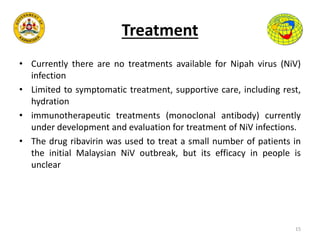
• Currently there are no treatments available for Nipah virus (NiV)
infection
• Limited to symptomatic treatment, supportive care, including rest,
hydration
• immunotherapeutic treatments (monoclonal antibody) currently
under development and evaluation for treatment of NiV infections.
• The drug ribavirin was used to treat a small number of patients in
the initial Malaysian NiV outbreak, but its efficacy in people is
unclear
15
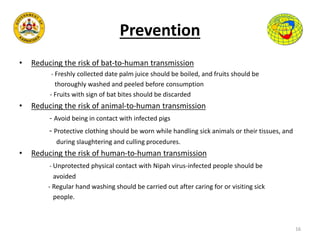
Prevention
• Reducing the risk of bat-to-human transmission
- Freshly collected date palm juice should be boiled, and fruits should be
thoroughly washed and peeled before consumption
- Fruits with sign of bat bites should be discarded
• Reducing the risk of animal-to-human transmission
- Avoid being in contact with infected pigs
- Protective clothing should be worn while handling sick animals or their tissues, and
during slaughtering and culling procedures.
• Reducing the risk of human-to-human transmission
- Unprotected physical contact with Nipah virus-infected people should be
avoided
- Regular hand washing should be carried out after caring for or visiting sick
people.
16
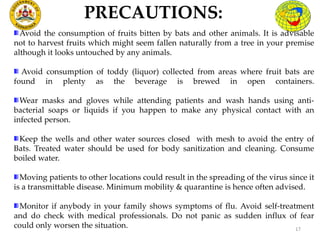
PRECAUTIONS:
17
Avoid the consumption of fruits bitten by bats and other animals. It is advisable
not to harvest fruits which might seem fallen naturally from a tree in your premise
although it looks untouched by any animals.
Avoid consumption of toddy (liquor) collected from areas where fruit bats are
found in plenty as the beverage is brewed in open containers.
Wear masks and gloves while attending patients and wash hands using anti-
bacterial soaps or liquids if you happen to make any physical contact with an
infected person.
Keep the wells and other water sources closed with mesh to avoid the entry of
Bats. Treated water should be used for body sanitization and cleaning. Consume
boiled water.
Moving patients to other locations could result in the spreading of the virus since it
is a transmittable disease. Minimum mobility & quarantine is hence often advised.
Monitor if anybody in your family shows symptoms of flu. Avoid self-treatment
and do check with medical professionals. Do not panic as sudden influx of fear
could only worsen the situation.
18
19
20
21
22
THANK YOU !
23

Nipah Final state ppt.pptx

  • 1.
    Nipah Virus State SurveillanceUnit IDSP - Karnataka 1
  • 2.
    Introduction • Nipah VirusInfection (NIV) is an emerging infectious zoonotic disease of public health importance in the South-East Asia Region • Named after the Malaysian village called Kampung sungai Nipah where it was first discovered • NIV is a member of the family Paramyxoviridae, genus Henipavirus • Nipah virus was first recognized in 1999 during an outbreak among pig farmers in Malaysia • Subsequent outbreaks reported in Bangladesh and India in 2001 and 2008 2
  • 3.
  • 4.
    Outbreaks in India •India confirmed its first Nipah outbreak in Siliguri, West Bengal, in 2001, • A second outbreak in Nadia district in 2007 led to the deaths of all the five persons infected. The death rate in India is a high 70%, with 50 of the 71 people infected dying during the two outbreaks in West Bengal with 66 cases and 45 deaths • Kerala Outbreaks: (2018, 2019, 2021, 2023; Current outbreak at Kozhikode, Kerala) 4
  • 5.
    Transmission • Human infectionsin the first recorded outbreak resulted from direct contact with sick pigs • Exposure to secretions from the pigs, or unprotected contact with the tissue of a sick animal • In subsequent outbreaks in Bangladesh and India, consumption of fruits or fruit products ( raw date palm juice) contaminated with urine or saliva from infected fruit bats was the most likely source of infection • Human-to-human transmission of Nipah virus reported among family and care givers of infected patients • Close contact with people's secretions and excretions 5
  • 6.
  • 7.
    Natural Hosts • Fruitbats of the family Pteropodidae are the natural hosts for Nipah virus • No apparent disease in fruit bats • Evidence of Henipavirus infection in Pteropus bats from Australia, Bangladesh, Cambodia, China, India, Indonesia • Presence of antibodies against Henipavirus and the Hendra virus of Paramyxoviridae 7
  • 8.
    Nipah virus indomestic animals • Outbreaks of the Nipah virus in pigs and other domestic animals such as horses, goats, sheep, cats and dogs were first reported during the initial Malaysian outbreak • Highly contagious in pigs • Asymptomatic to acute illness • Labored breathing, and neurological symptoms such as trembling, twitching and muscle spasms • Unusual barking cough “ Barking pig Syndrome” - porcine respiratory and encephalitic syndrome 8
  • 9.
    Signs and Symptoms •Human infections range from asymptomatic infection to acute respiratory infection (mild, severe), and fatal encephalitis • The incubation period ranges from 4 to 14 day • Death may occur in 40-75% of cases • Long-term side effects in survivors of Nipah virus infection include persistent convulsions and personality changes 9 Severe symptoms may follow, such as: Disorientation, drowsiness, or confusion Seizures Coma Brain swelling (encephalitis) Initial symptoms : Fever Headache Cough Sore throat Difficulty breathing Vomiting
  • 10.
    Diagnosis • Challenging dueto the non-specific early symptoms of the illness • Real time polymerase chain reaction (RT-PCR) from throat and nasal swabs, cerebrospinal fluid, urine, and blood • Antibody detection via enzyme-linked immunosorbent assay (ELISA) • Other tests used include polymerase chain reaction (PCR) assay, and virus isolation by cell culture 10
  • 11.
    Sample Collection Nipah virusbeing a BSL-4 agent, universal, standard droplet and bio-containment precautions should be followed during contact with excretions, secretions and body fluids of suspected patient • Throat swab to be collected in viral transport medium • Urine approx 10 ml in universal sterile container • Blood in plain vial (at least 5ml) • CSF (at least 1 ml) in a sterile container The samples should be collected as early as possible (preferably within 4-5 days on onset of illness) with all biosafety precautions and accompanied with detailed history of patients on the proforma which can be obtained from the testing laboratory the NIV Bengaluru Samples should be safely packed in triple container packing and should be transported under cold chain (2-8°C) to the testing laboratory with prior intimation. Disinfect the outer surface of container using 1:100 dilution of bleach or 5% Lysol solution 11
  • 12.
    Case Definitions Suspect NipahCase Person from a community affected by a Nipah virus (NiV) disease outbreak who has: • Fever with new onset of altered mental status or seizure and/or • Fever with headache and/or • Fever with Cough or shortness of breath Probable Nipah Case • Suspect case-patient/s who resided in the same village/ward, where suspect/confirmed case of Nipah were living during the outbreak period and who died before complete diagnostic specimens could be collected. • Suspect case-patients who came in direct contact with confirmed case-patients in a hospital setting during the outbreak period and who died before complete diagnostic specimens could be collected. Confirmed Nipah Case • Nipah virus RNA identified by PCR from respiratory secretions, urine, or cerebrospinal fluid. • Isolation of Nipah virus from respiratory secretions, urine or cerebrospinal fluid. 12
  • 13.
  • 14.
    Karnataka State OnlyFever < 7 days cases trend from 01/01/2023 to 31/08/2023 of IHIP S- Form 14 169929 138777 106269 139135 165190 169938 162776 169603 0 20000 40000 60000 80000 100000 120000 140000 160000 180000 Jan-2023 Feb-2023 Mar-2023 Apr-2023 May-2023 Jun-2023 Jul-2023 Aug-2023 Syndromic Active Fever Surveillance is on going in Karnataka as a continuous surveillance on daily basis throughout Karnataka
  • 15.
    Treatment • Currently thereare no treatments available for Nipah virus (NiV) infection • Limited to symptomatic treatment, supportive care, including rest, hydration • immunotherapeutic treatments (monoclonal antibody) currently under development and evaluation for treatment of NiV infections. • The drug ribavirin was used to treat a small number of patients in the initial Malaysian NiV outbreak, but its efficacy in people is unclear 15
  • 16.
    Prevention • Reducing therisk of bat-to-human transmission - Freshly collected date palm juice should be boiled, and fruits should be thoroughly washed and peeled before consumption - Fruits with sign of bat bites should be discarded • Reducing the risk of animal-to-human transmission - Avoid being in contact with infected pigs - Protective clothing should be worn while handling sick animals or their tissues, and during slaughtering and culling procedures. • Reducing the risk of human-to-human transmission - Unprotected physical contact with Nipah virus-infected people should be avoided - Regular hand washing should be carried out after caring for or visiting sick people. 16
  • 17.
    PRECAUTIONS: 17 Avoid the consumptionof fruits bitten by bats and other animals. It is advisable not to harvest fruits which might seem fallen naturally from a tree in your premise although it looks untouched by any animals. Avoid consumption of toddy (liquor) collected from areas where fruit bats are found in plenty as the beverage is brewed in open containers. Wear masks and gloves while attending patients and wash hands using anti- bacterial soaps or liquids if you happen to make any physical contact with an infected person. Keep the wells and other water sources closed with mesh to avoid the entry of Bats. Treated water should be used for body sanitization and cleaning. Consume boiled water. Moving patients to other locations could result in the spreading of the virus since it is a transmittable disease. Minimum mobility & quarantine is hence often advised. Monitor if anybody in your family shows symptoms of flu. Avoid self-treatment and do check with medical professionals. Do not panic as sudden influx of fear could only worsen the situation.
  • 18.
  • 19.
  • 20.
  • 21.
  • 22.
  • 23.