A
joint
initiative
of
the
OECD
and
the
EU,
principally
financed
by
the
EU.
Support forImprovement in Governance and Management
A joint initiative of the OECD and EU for over 30 years, principally funded by the
EU
Part of the Directorate for Public Governance and Territorial Development
(GOV), SIGMA contributes to the wider OECD public governance agenda.
Overall objective is to support public governance reforms and strengthen the
capacity of public administrations.
4
SIGMA ?
5.
A
joint
initiative
of
the
OECD
and
the
EU,
principally
financed
by
the
EU.
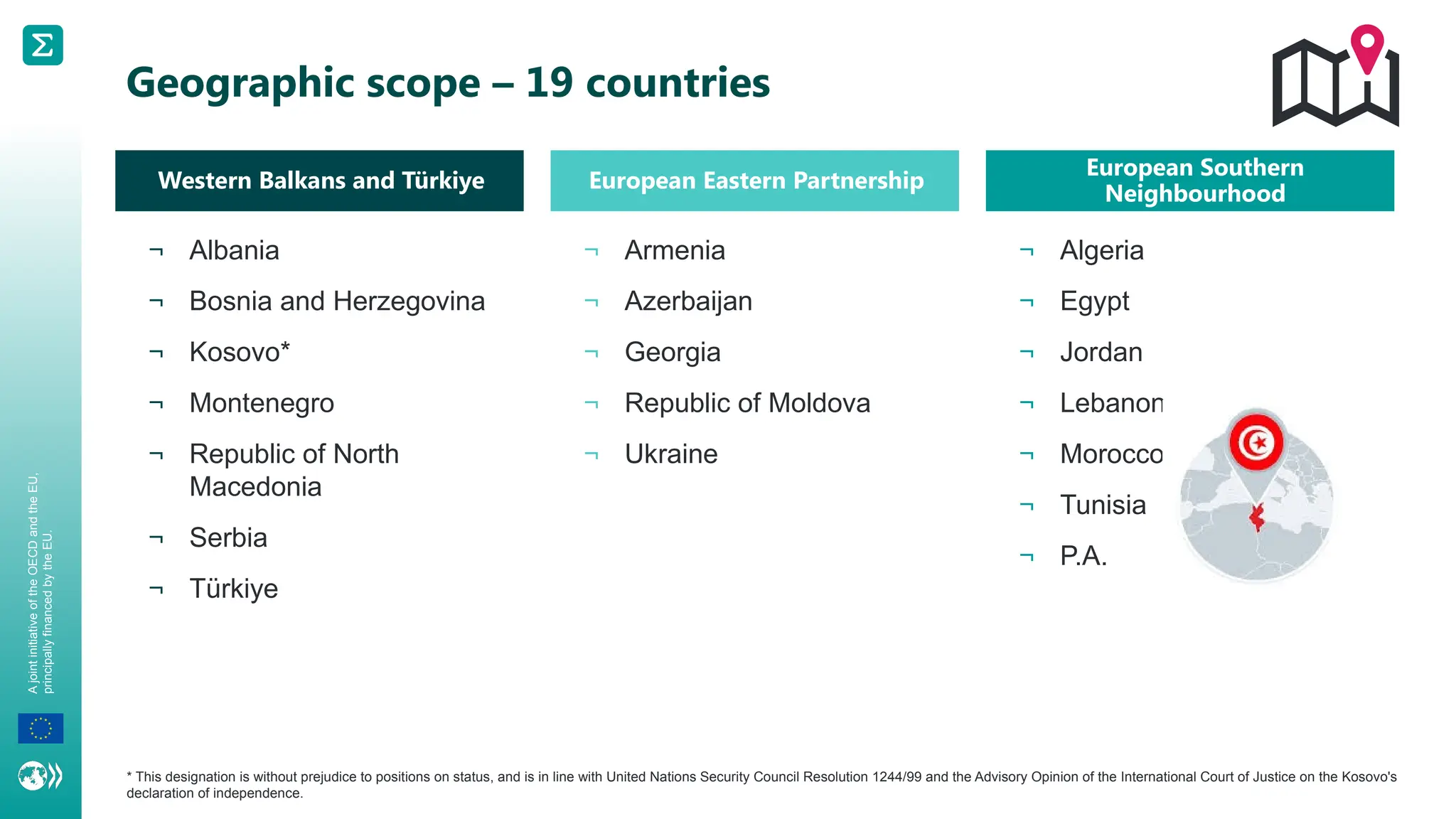
¬ Albania
¬ Bosniaand Herzegovina
¬ Kosovo*
¬ Montenegro
¬ Republic of North
Macedonia
¬ Serbia
¬ Türkiye
¬ Armenia
¬ Azerbaijan
¬ Georgia
¬ Republic of Moldova
¬ Ukraine
Western Balkans and Türkiye European Eastern Partnership
¬ Algeria
¬ Egypt
¬ Jordan
¬ Lebanon
¬ Morocco
¬ Tunisia
¬ P.A.
European Southern
Neighbourhood
Geographic scope – 19 countries
* This designation is without prejudice to positions on status, and is in line with United Nations Security Council Resolution 1244/99 and the Advisory Opinion of the International Court of Justice on the Kosovo's
declaration of independence.
6.
A
joint
initiative
of
the
OECD
and
the
EU,
principally
financed
by
the
EU.
• PAR isnot a sector in its own right but comprises horizontal reform areas (building blocks)
critical for all sectors
• It provides a framework and pre-conditions for implementing reforms in all sectors
(education, health, security, employment, agriculture etc.)
• PAR is complex and challenging but very important for any country. It is about providing the
best possible administration and services to citizens and businesses.
• It also contributes to a fair and open society, competitive markets and inclusive economic
growth.
• A strong public administration is an important means of delivering good public governance
– others include role of Parliament, oversight bodies and an active civil society.
6
Why care about public administration reform (PAR)?
7.
A
joint
initiative
of
the
OECD
and
the
EU,
principally
financed
by
the
EU.
7
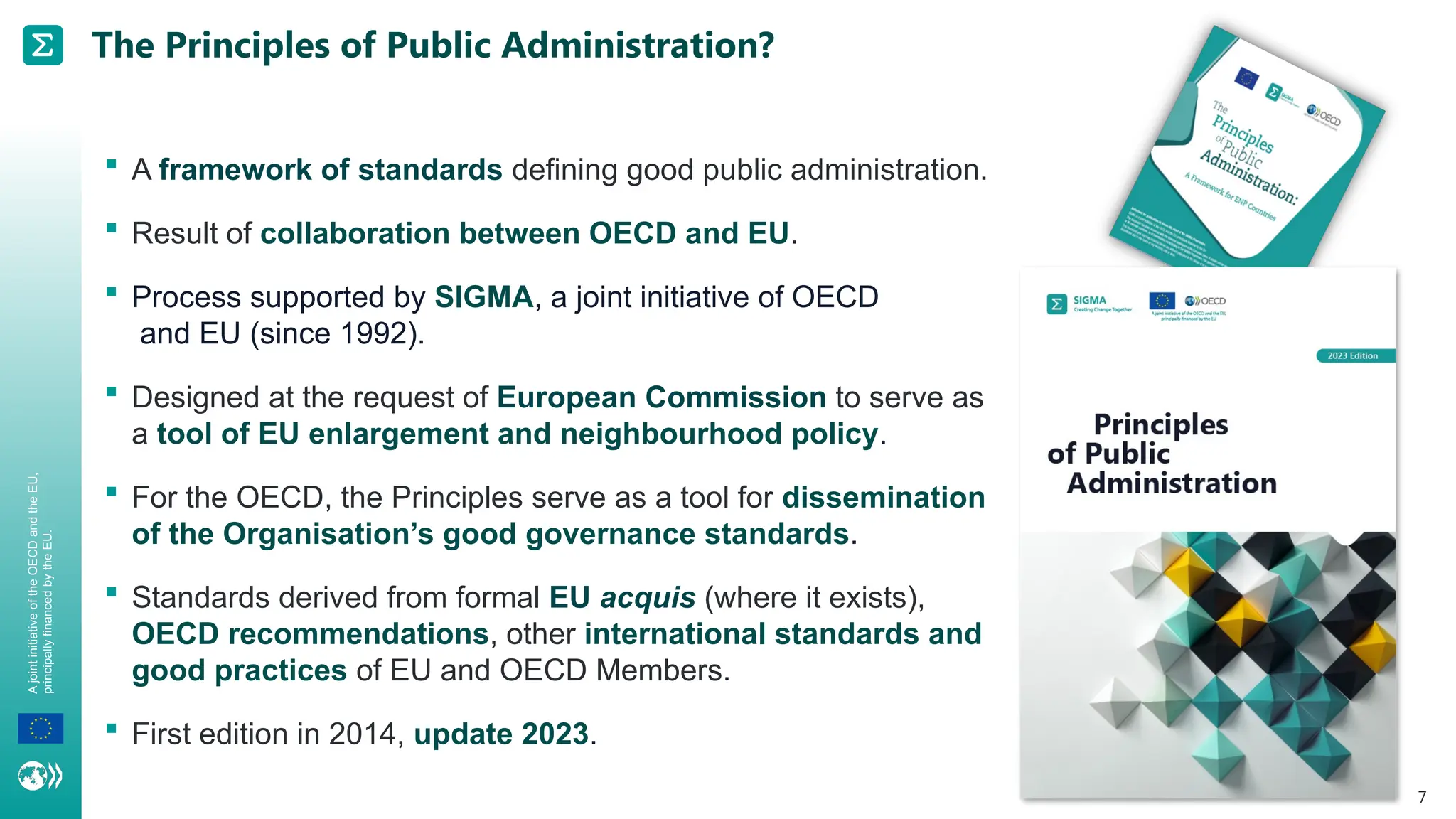
The Principles ofPublic Administration?
A framework of standards defining good public administration.
Result of collaboration between OECD and EU.
Process supported by SIGMA, a joint initiative of OECD
and EU (since 1992).
Designed at the request of European Commission to serve as
a tool of EU enlargement and neighbourhood policy.
For the OECD, the Principles serve as a tool for dissemination
of the Organisation’s good governance standards.
Standards derived from formal EU acquis (where it exists),
OECD recommendations, other international standards and
good practices of EU and OECD Members.
First edition in 2014, update 2023.
A
joint
initiative
of
the
OECD
and
the
EU,
principally
financed
by
the
EU.
9
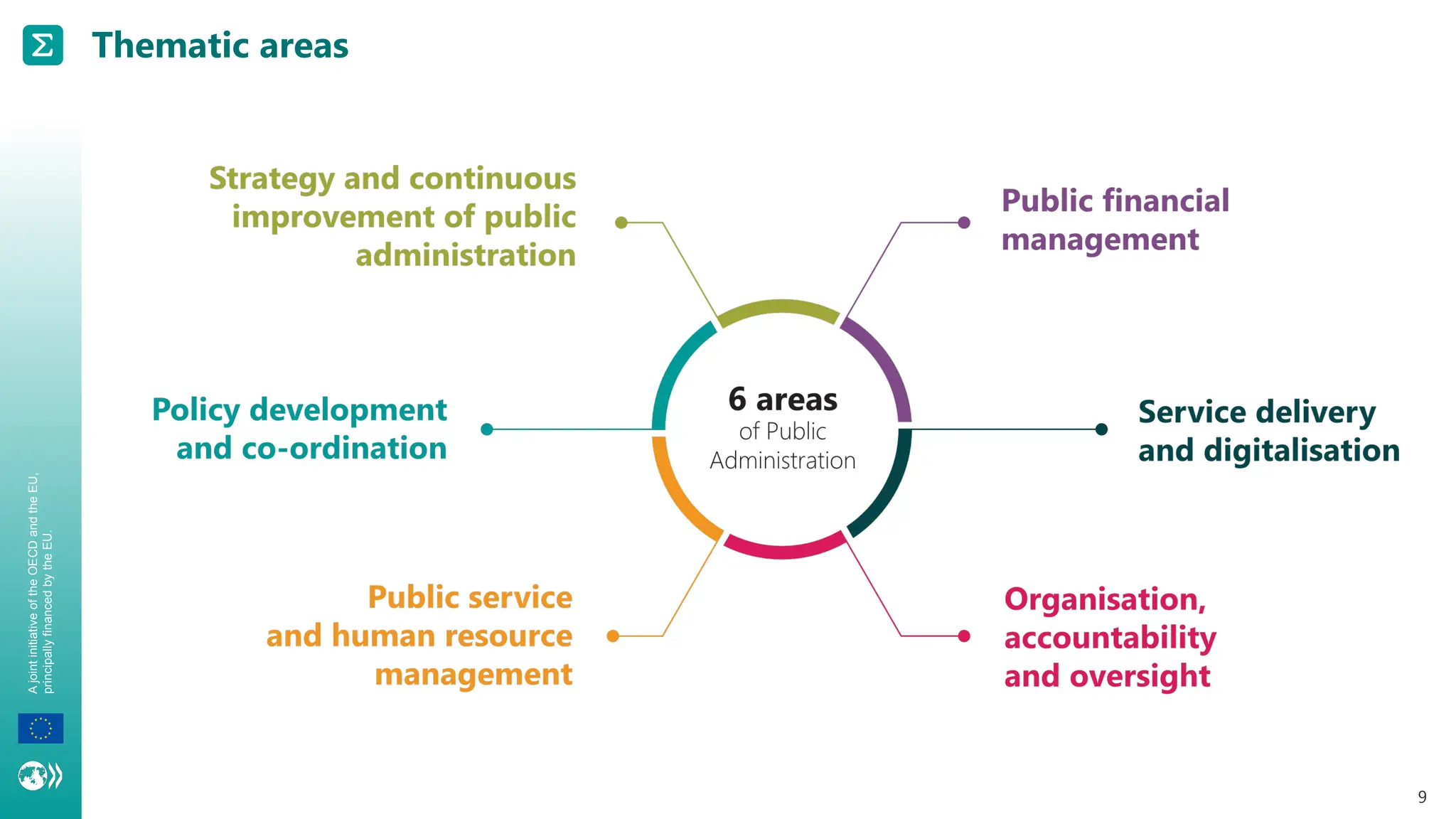
Thematic areas
Strategy ofcontinuous improvement of public administration
Organisation, accountability and oversight
Policy
development and
co-ordination
■ Centre-of-government
■ Policy planning
■ Policy making
■ Consultation
■ Policy implementation and evaluation
■ Parliamentary scrutiny
Public service and human resource
management
■ Employment framework
■ Recruitment
■ Top managers
■ Motivation and working conditions
■ Professional development, performance and
talent management
Public financial management
■ Budget formulation
■ Budget execution
■ Budget reporting
■ Internal audit
■ Internal control
■ Procurement laws
■ Procurement operations
■ PP review
■ External audit
■ MLG-Fiscal autonomy
Service delivery
and digitalisation
■ Users at the centre
■ Streamlined, quality services
■ Accessibility
■ Digitalisation
10.
A
joint
initiative
of
the
OECD
and
the
EU,
principally
financed
by
the
EU.
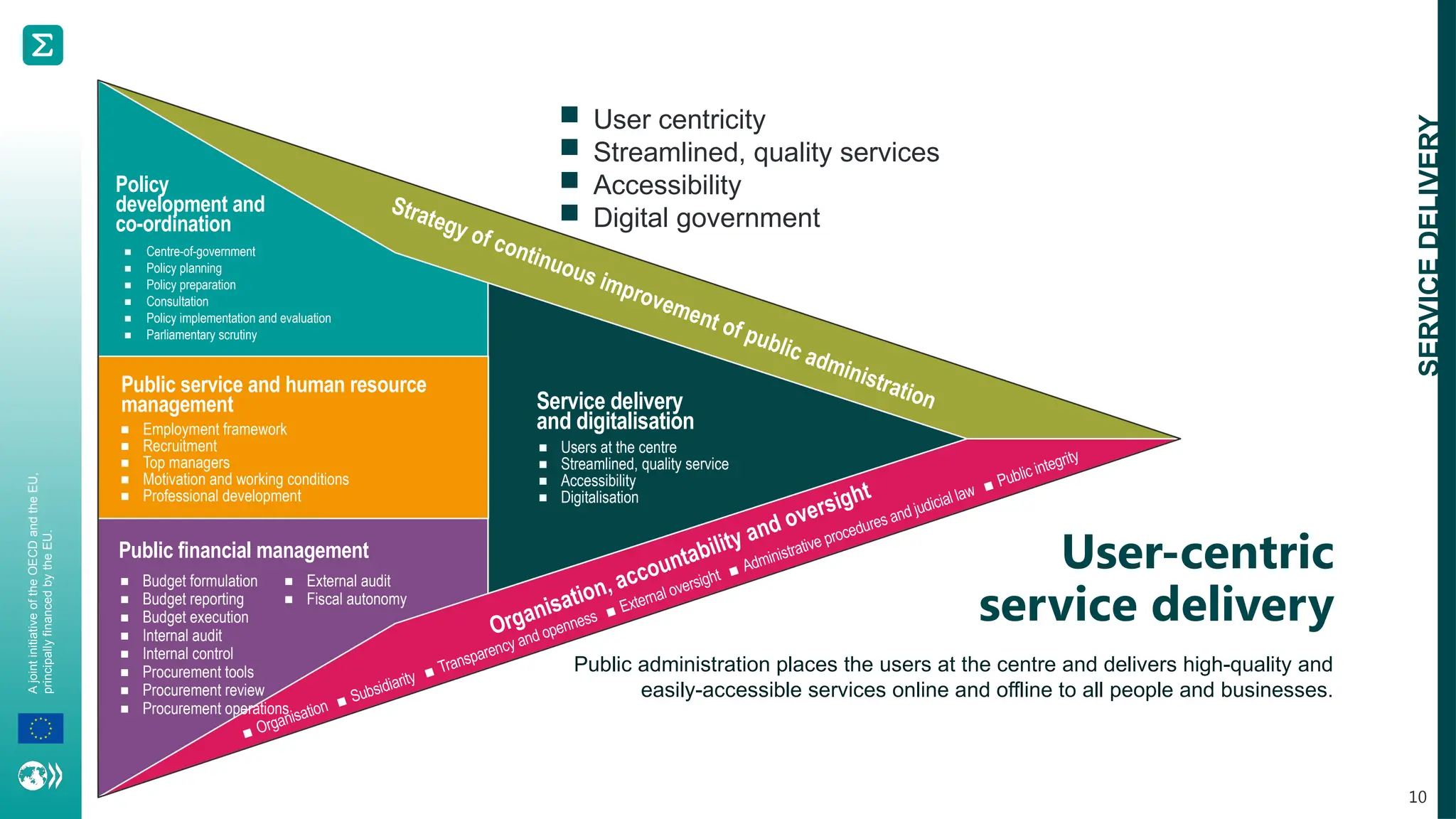
10
SERVICE
DELIVERY
User-centric
service delivery
Public administrationplaces the users at the centre and delivers high-quality and
easily-accessible services online and offline to all people and businesses.
User centricity
Streamlined, quality services
Accessibility
Digital government
Strategy of continuous improvement of public administration
Organisation, accountability and oversight
Policy
development and
co-ordination
■ Centre-of-government
■ Policy planning
■ Policy preparation
■ Consultation
■ Policy implementation and evaluation
■ Parliamentary scrutiny
Public service and human resource
management
■ Employment framework
■ Recruitment
■ Top managers
■ Motivation and working conditions
■ Professional development
Public financial management
■ Budget formulation
■ Budget reporting
■ Budget execution
■ Internal audit
■ Internal control
■ Procurement tools
■ Procurement review
■ Procurement operations
■ External audit
■ Fiscal autonomy
Service delivery
and digitalisation
■ Users at the centre
■ Streamlined, quality service
■ Accessibility
■ Digitalisation
■ Organisation ■ Subsidiarity ■ Transparency and openness ■ External oversight ■ Administrative procedures and judicial law ■ Public integrity
A
joint
initiative
of
the
OECD
and
the
EU,
principally
financed
by
the
EU.
SERVICE
DELIVERY
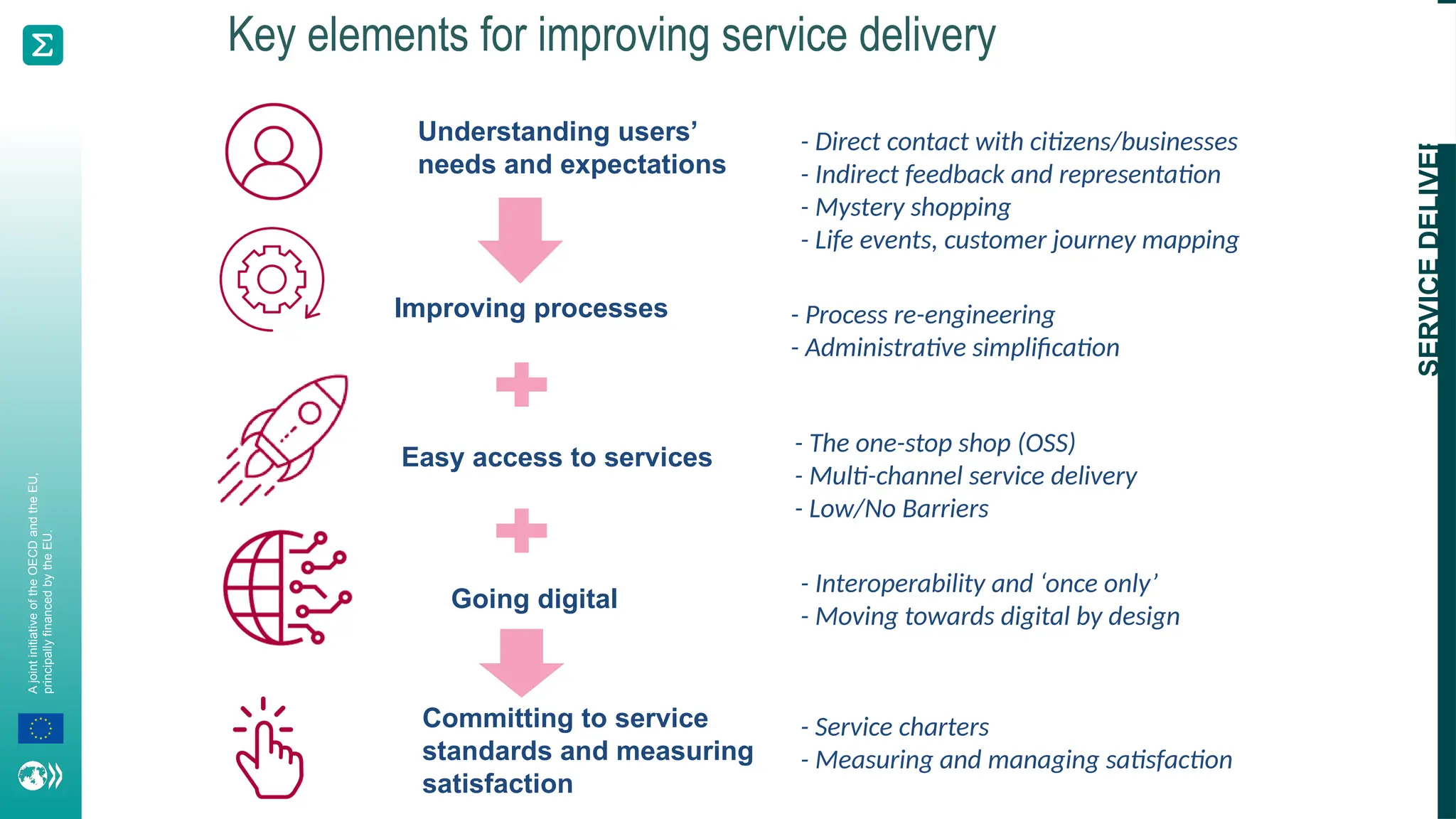
Improving processes -Process re-engineering
- Administrative simplification
Going digital
Easy access to services
- The one-stop shop (OSS)
- Multi-channel service delivery
- Low/No Barriers
- Interoperability and ‘once only’
- Moving towards digital by design
Committing to service
standards and measuring
satisfaction
- Service charters
- Measuring and managing satisfaction
Key elements for improving service delivery
Understanding users’
needs and expectations
- Direct contact with citizens/businesses
- Indirect feedback and representation
- Mystery shopping
- Life events, customer journey mapping