   Childhood
   Early Years
   1st exploration
   Spoiled Alcohol
   Invention of Pasteurization
   Rabies
   Silk worm Disaster
   Conclusion
   Bibliography
Childhood      Lived on rue des Tanners,
                “the street of the tanners.”
               Moved to Marnoz, France at
                two.
               In 1827 the family settled in
                Arbolis, France.
               Had three sisters.
               Was an ordinary student.
               Had no interest in science.
               Showed great skills in art,
                drawing and painting.
   Had a early ambition to become a
                  teacher.
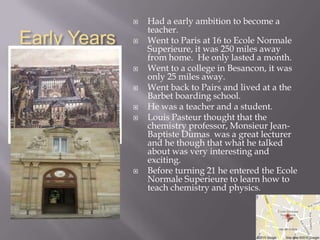
Early Years      Went to Paris at 16 to Ecole Normale
                  Superieure, it was 250 miles away
                  from home. He only lasted a month.
                 Went to a college in Besancon, it was
                  only 25 miles away.
                 Went back to Pairs and lived at a the
                  Barbet boarding school.
                 He was a teacher and a student.
                 Louis Pasteur thought that the
                  chemistry professor, Monsieur Jean-
                  Baptiste Dumas was a great lecturer
                  and he though that what he talked
                  about was very interesting and
                  exciting.
                 Before turning 21 he entered the Ecole
                  Normale Superieure to learn how to
                  teach chemistry and physics.
   When he started, scientist
    only knew about the shapes
    of crystals and that some
    crystals bent light.
   He wondered why only
    some crystals bent light.
   He wondered if the reason
    was because the material and
    shape.
   He began by studying
    tartaric acid and tartrates.
   In the end of the study of
    crystals there was only one
    difference. The difference
    was in the slop facet F. One
    goes in one direction only
    and the other goes in both.
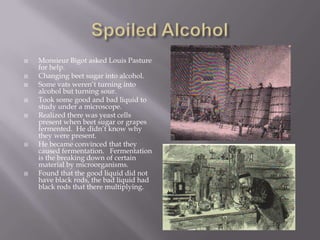
   Monsieur Bigot asked Louis Pasture
    for help.
   Changing beet sugar into alcohol.
   Some vats weren’t turning into
    alcohol but turning sour.
   Took some good and bad liquid to
    study under a microscope.
   Realized there was yeast cells
    present when beet sugar or grapes
    fermented. He didn’t know why
    they were present.
   He became convinced that they
    caused fermentation. Fermentation
    is the breaking down of certain
    material by microorganisms.
   Found that the good liquid did not
    have black rods, the bad liquid had
    black rods that there multiplying.
   Discovered in 1863
   Napoleon the 3rd asked Louis
    Pasture to help wine makers
   Done by heating wine or beer
    to a heat above 135°F so the
    germs die and the wine will
    last longer.
   Heat is used to kill microbes
    in drinks such as beer and
    wine. It is used in milk and
    juice too.
   This discovery saved a wine
    industry in France.
   This teqniqe is named after
    pasture, Pasteurization.
   Without pasteurization wine
    and other foods would
    become sour and spoil.
   Found it out while finding
    a cure of anthrax .
   Done by giving 25/50
    sheep a vaccine and seeing
    if the ones that were given
    the vaccine didn’t die.
   First tested on a boy who
    had been bitten by a rabid
    dog 9 times.
   The results were successful.
   Louis pasture is better
    known for curing rabies
    than anthrax
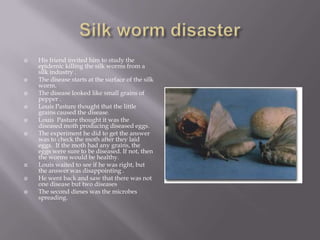
   His friend invited him to study the
    epidemic killing the silk worms from a
    silk industry .
   The disease starts at the surface of the silk
    worm.
   The disease looked like small grains of
    pepper .
   Louis Pasture thought that the little
    grains caused the disease.
   Louis Pasture thought it was the
    diseased moth producing diseased eggs.
   The experiment he did to get the answer
    was to check the moth after they laid
    eggs. If the moth had any grains, the
    eggs were sure to be diseased. If not, then
    the worms would be healthy.
   Louis waited to see if he was right, but
    the answer was disappointing .
   He went back and saw that there was not
    one disease but two diseases
   The second dieses was the microbes
    spreading.
   Ullmann, Anges. "Louis Pasteur." Britannica Online Encyclopedia. N.p., n. d. Web. Web. 22 Jan. 2013.

   Louis Pasteur." 2013. The Biography Channel website. Feb 07 2013

   Parker, Steve. LOUIS PASTEUR and GERMS. Great Brinton: Chelsea House Publishers, 1994. Print

   Angel, Ann, and Beverley Birch. Louis Pasteur. Milwaukee: Gareth Stevens Children's Book, 1992. Print

   Birch, Beverly. Louis Pasteur. Milwaukee: Gareth Stevens Children's Book, 1989. Print.


   Rhee, Seung Yon. "Louis Pasteur (1822-1895)." Access Excellence. N.p., n. d. Web. Web. 22 Jan. 2013.

   Pettinger, T. "Louis Pasteur Biography ." Biography Online. N.p., 01 02 2008. Web. Web. 22 Jan. 2013.
   Dr. Hani, . "Discovery of Pastuerization." EXPLORABLE. N.p., 3 Feb 2010. Web. Web. 3 Feb. 2013

   White,Carol. "How Pasteurization Works." HowStuffWorks. N.p., n. d. Web. Web. 3 Feb. 2013


   Louis Pasteur. Biography SYNOPSIS ." bio. TRUE STORY. N.p., n. d. Web. Web. 22 Jan. 2013
   Thanks to pasteur are not
    many diseases
   Chemist sees the world
    differently
   Less people suffer from
    diseases
   Without him many people
    would be dead do to
    diseases
   Scientist would still be
    working on cures that Louis
    found

Nicholas

  • 2.
    Childhood  Early Years  1st exploration  Spoiled Alcohol  Invention of Pasteurization  Rabies  Silk worm Disaster  Conclusion  Bibliography
  • 4.
    Childhood  Lived on rue des Tanners, “the street of the tanners.”  Moved to Marnoz, France at two.  In 1827 the family settled in Arbolis, France.  Had three sisters.  Was an ordinary student.  Had no interest in science.  Showed great skills in art, drawing and painting.
  • 5.
    Had a early ambition to become a teacher. Early Years  Went to Paris at 16 to Ecole Normale Superieure, it was 250 miles away from home. He only lasted a month.  Went to a college in Besancon, it was only 25 miles away.  Went back to Pairs and lived at a the Barbet boarding school.  He was a teacher and a student.  Louis Pasteur thought that the chemistry professor, Monsieur Jean- Baptiste Dumas was a great lecturer and he though that what he talked about was very interesting and exciting.  Before turning 21 he entered the Ecole Normale Superieure to learn how to teach chemistry and physics.
  • 6.
    When he started, scientist only knew about the shapes of crystals and that some crystals bent light.  He wondered why only some crystals bent light.  He wondered if the reason was because the material and shape.  He began by studying tartaric acid and tartrates.  In the end of the study of crystals there was only one difference. The difference was in the slop facet F. One goes in one direction only and the other goes in both.
  • 7.
    Monsieur Bigot asked Louis Pasture for help.  Changing beet sugar into alcohol.  Some vats weren’t turning into alcohol but turning sour.  Took some good and bad liquid to study under a microscope.  Realized there was yeast cells present when beet sugar or grapes fermented. He didn’t know why they were present.  He became convinced that they caused fermentation. Fermentation is the breaking down of certain material by microorganisms.  Found that the good liquid did not have black rods, the bad liquid had black rods that there multiplying.
  • 9.
    Discovered in 1863  Napoleon the 3rd asked Louis Pasture to help wine makers  Done by heating wine or beer to a heat above 135°F so the germs die and the wine will last longer.  Heat is used to kill microbes in drinks such as beer and wine. It is used in milk and juice too.  This discovery saved a wine industry in France.  This teqniqe is named after pasture, Pasteurization.  Without pasteurization wine and other foods would become sour and spoil.
  • 11.
    Found it out while finding a cure of anthrax .  Done by giving 25/50 sheep a vaccine and seeing if the ones that were given the vaccine didn’t die.  First tested on a boy who had been bitten by a rabid dog 9 times.  The results were successful.  Louis pasture is better known for curing rabies than anthrax
  • 12.
    His friend invited him to study the epidemic killing the silk worms from a silk industry .  The disease starts at the surface of the silk worm.  The disease looked like small grains of pepper .  Louis Pasture thought that the little grains caused the disease.  Louis Pasture thought it was the diseased moth producing diseased eggs.  The experiment he did to get the answer was to check the moth after they laid eggs. If the moth had any grains, the eggs were sure to be diseased. If not, then the worms would be healthy.  Louis waited to see if he was right, but the answer was disappointing .  He went back and saw that there was not one disease but two diseases  The second dieses was the microbes spreading.
  • 13.
    Ullmann, Anges. "Louis Pasteur." Britannica Online Encyclopedia. N.p., n. d. Web. Web. 22 Jan. 2013.  Louis Pasteur." 2013. The Biography Channel website. Feb 07 2013  Parker, Steve. LOUIS PASTEUR and GERMS. Great Brinton: Chelsea House Publishers, 1994. Print  Angel, Ann, and Beverley Birch. Louis Pasteur. Milwaukee: Gareth Stevens Children's Book, 1992. Print  Birch, Beverly. Louis Pasteur. Milwaukee: Gareth Stevens Children's Book, 1989. Print.  Rhee, Seung Yon. "Louis Pasteur (1822-1895)." Access Excellence. N.p., n. d. Web. Web. 22 Jan. 2013.  Pettinger, T. "Louis Pasteur Biography ." Biography Online. N.p., 01 02 2008. Web. Web. 22 Jan. 2013.  Dr. Hani, . "Discovery of Pastuerization." EXPLORABLE. N.p., 3 Feb 2010. Web. Web. 3 Feb. 2013  White,Carol. "How Pasteurization Works." HowStuffWorks. N.p., n. d. Web. Web. 3 Feb. 2013  Louis Pasteur. Biography SYNOPSIS ." bio. TRUE STORY. N.p., n. d. Web. Web. 22 Jan. 2013
  • 14.
    Thanks to pasteur are not many diseases  Chemist sees the world differently  Less people suffer from diseases  Without him many people would be dead do to diseases  Scientist would still be working on cures that Louis found