

Bridging the Gap
       Panel Discussion
Cross Generational Communication and Engagement
                    Take Away
Generations…

“Groups of people born around the same time will have similar characteristics… because 
certain social, cultural, economic and technological environments remain relatively 
consistent for pockets of time..  It is the different perception of the world and the way it 
works, formed in response to our environment, that creates differences between one 
generation and another.“

     Peter Sheahan, Generation Y: Thriving and Surviving with Generation Y at Work, 
     (Australia, 2005)
Defining the Generations
•   Generations are defined not by a formal process but by demographics, 
    the media, popular culture, and market research 

•   Generations are shaped by shared childhood experiences and then 
    defined by early‐adulthood actions

•   The specific cultural impacts that shape the generations vary some by 
    geography, but the resulting traits of each are similar

•   Multiple terms are used to define each generation

•   Ranges of dates may vary a bit

•   Not intended to stereotype, but to understand some predominantly 
    common traits
Baby Boomers (1946‐1964)

•   Key defining events:  End of World War II, Moon Landing, Assassination of 
    JFK, Civil Rights movement, Vietnam War, Television, Korean War and 
    Vietnam, Rock ‘n Roll, Polio Vaccine, Woodstock
•   Many current leaders
•   Optimistic, team players, workaholics, “super”mom/dad
•   Defined by their jobs; Success is visible
•   Divorce becoming more common
•   Tend to be more conservative
•   Passion for personal and social improvement, the civil rights generation
• Will largely begin retiring in 2010
Generation X (1965‐1978)

•   Key Defining Events:  Watergate, AIDS, Energy Crisis, Cold War, Persian Gulf War; 
    Corporate Downsizing, Family TV shows, Movies with G to R ratings, Oil embargo, 
    Inflation and Recession, Women’s Rights Movement, Oral Contraceptives, 
    Political Corruption  
•   Leaders; today’s managers, mentors, and project leads
•   Increased divorce rates – both parents and selves
•   Women enter workforce in mass
•   Former “latchkey kids”, independent
•   Self‐reliant, confident, highly educated, multi‐taskers
•   Cynical and pessimistic
•   “Work hard, play hard” mentality
•   Independent; no strong political affiliations
•   Tech jobs, competitive, hard‐working entrepreneurs
•   Embrace risk and free agency
Gen Y (born since 1979)

•   Key Defining events:  Afghanistan and Iraq War, War on Terror, Fall of the Berlin 
    Wall, Oklahoma City Bombing, Video gaming, Social Networking (mySpace, IM, 
    Text, email), Anthrax, OJ Simpson, School Violence, Widespread Use of 
    Technology (internet, music downloads, cell phones, cable)
•   Strongly impacted by the economic prosperity of the 1990’s
•   Children of Soccer moms and Little League dads; viewed as coddled and 
    confident
•   Parents are strong advocates, including into college and workforce
•   Most medicated generation
•   Highly educated, creative, resourceful, believe they can do anything
•   Technically very savvy
•   Aware – socially, environmentally, ethically
•   Lifestyle very important 
•   Expect purpose and meaning in their life
•   Early half are entering the workforce today
•   Are also referred to as Millennials
A Closer Look at Gen Y
•   Looking for work/life balance, flex work, virtual work; want control 
•   Do not want to be defined by their job
•   Easily bored, impatient
•   At work, expect new challenges, promotion opportunities, constant change, and 
    FUN
•   Like to feel empowered and have real responsibility
•   Want to be coached and nurtured (but not overly directed or controlled)
•   Need expectations to be clear and to be held accountable
•   Need to feel a sense of belonging, to be involved; need a personal connection 
    and to be treated as an individual
•   Need fair compensation, to be treated fairly, recognized and valued
•   Want their employer to increase their employability and invest in development
•   Want to do 'cutting edge' work
•   Place high value on having a competent manager
•   Motivation is very individual, “one size fits all” will not work
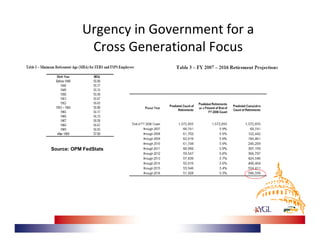
Urgency in Government for a 
            Cross Generational Focus


Source: OPM FedStats
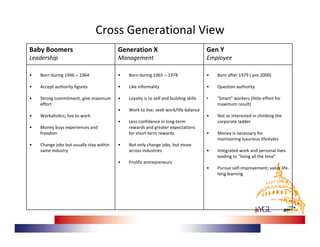
Cross Generational View
Baby Boomers                               Generation X                                 Gen Y
Leadership                                 Management                                   Employee

•   Born during 1946 – 1964                •   Born during 1965 – 1978                  •   Born after 1979 ( pre 2000)

•   Accept authority figures               •   Like informality                         •   Question authority

•   Strong commitment, give maximum        •   Loyalty is to self and building skills   •   “Smart" workers (little effort for 
    effort                                                                                  maximum result)
                                           •   Work to live; seek work/life balance 
•   Workaholics; live to work                                                           •   Not as interested in climbing the 
                                           •   Less confidence in long‐term                 corporate ladder
•   Money buys experiences and                 rewards and greater expectations 
    freedom                                    for short‐term rewards                   •   Money is necessary for      
                                                                                            maintaining luxurious lifestyles
•   Change jobs but usually stay within    •   Not only change jobs, but move
    same industry                              across industries                        •   Integrated work and personal lives 
                                                                                            leading to "living all the time“
                                           •   Prolific entrepreneurs
                                                                                        •   Pursue self‐improvement; value life‐
                                                                                            long learning
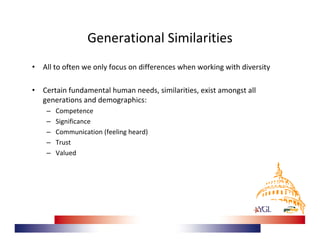
Generational Similarities
•   All to often we only focus on differences when working with diversity

•   Certain fundamental human needs, similarities, exist amongst all
    generations and demographics:
     –   Competence
     –   Significance
     –   Communication (feeling heard)
     –   Trust
     –   Valued
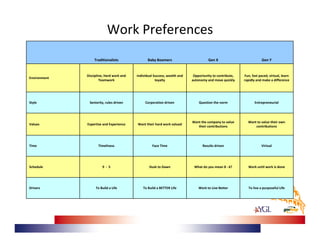
Work Preferences
                  Traditionalists                 Baby Boomers                         Gen X                            Gen Y


              Discipline, Hard work and    Individual Success, wealth and     Opportunity to contribute,    Fun, fast paced, virtual, learn 
Environment
                      Teamwork                         loyalty               autonomy and move quickly      rapidly and make a difference


Style          Seniority, rules driven          Corporation driven               Question the norm                 Entrepreneurial


                                                                             Want the company to value        Want to value their own 
Values        Expertise and Experience     Want their hard work valued
                                                                                their contributions               contributions


Time                 Timeliness                      Face Time                      Results driven                      Virtual               


Schedule                9  ‐ 5                     Dusk to Dawn               What do you mean 8 ‐ 6?          Work until work is done


Drivers            To Build a Life             To Build a BETTER Life            Work to Live Better           To live a purposeful Life
Summary and Recommendations
•   Strive for the positive Recruitment and Retention Lifecycle™ to minimize negative 
    impacts

•   Conduct targeted surveys and focus groups of a cross section of the workforce to 
    obtain additional data on each area of the cycle as relates to your 
    organization/agency

•   Potentially reevaluate your recruitment and retention philosophy (based upon 
    additional data)

•   Review recommendations and implement alternate options to increase 
    engagement, retention, and performance
Summary and Recommendations 
                  Continued
• Conduct targeted cross generational surveys and focus 
  groups employees to obtain additional data

• Reevaluate existing training and delivery methods for Gen Y 
  employees

• Replace some of the existing training:
   – Adapt existing training delivery formats and approaches
   – Provide specific customized training
What Next?

•   Understand and appreciate the differences between the generations
•   Develop cross generational dialogue
•   Provide coaching and training at all levels not just to leaders
•   Understand what drives your people and then tailor what you do 
    (performance feedback, recognition, rewards, mentoring)
•   Leverage what works 
     –   Provide connections with leaders and personal touch
     –   Listen and TAKE ACTION on feedback from surveys or site visits
     –   Offer opportunities to influence outcomes that affect them
     –   Vigorously support flexibility, virtual work, and community involvement
     –   COMMUNICATE!
Gen Y…

"…people want a life and Generation Y are calling for it the 
  loudest.  When they don't get it, they talk with their feet…”
   Generation Y:  Thriving and Surviving with Generation Y at Work by Peter Sheahan, 
     Australia 2005


                     What questions do you have? 
Want to Learn More? 

               Scott H. Span, MSOD
                     President
                 Tolero Solutions
Organizational Development & Change Consulting
         Facilitating Sustainable Growth
           www.tolerosolutions.com
     Email: scott.span@tolerosolutions.com
               Twitter: SSpanTolero
  Blog: http://thetolerothinktank.blogspot.com
 LinkedIn: http://www.linkedin.com/in/scottspan
Want to Read More?

NGG10 Bridging The Generation Gap- Span Take Away

  • 1.
    Bridging the Gap Panel Discussion Cross Generational Communication and Engagement Take Away
  • 2.
  • 3.
    Defining the Generations • Generations are defined not by a formal process but by demographics,  the media, popular culture, and market research  • Generations are shaped by shared childhood experiences and then  defined by early‐adulthood actions • The specific cultural impacts that shape the generations vary some by  geography, but the resulting traits of each are similar • Multiple terms are used to define each generation • Ranges of dates may vary a bit • Not intended to stereotype, but to understand some predominantly  common traits
  • 4.
    Baby Boomers (1946‐1964) • Key defining events:  End of World War II, Moon Landing, Assassination of  JFK, Civil Rights movement, Vietnam War, Television, Korean War and  Vietnam, Rock ‘n Roll, Polio Vaccine, Woodstock • Many current leaders • Optimistic, team players, workaholics, “super”mom/dad • Defined by their jobs; Success is visible • Divorce becoming more common • Tend to be more conservative • Passion for personal and social improvement, the civil rights generation • Will largely begin retiring in 2010
  • 5.
    Generation X (1965‐1978) • Key Defining Events:  Watergate, AIDS, Energy Crisis, Cold War, Persian Gulf War;  Corporate Downsizing, Family TV shows, Movies with G to R ratings, Oil embargo,  Inflation and Recession, Women’s Rights Movement, Oral Contraceptives,  Political Corruption   • Leaders; today’s managers, mentors, and project leads • Increased divorce rates – both parents and selves • Women enter workforce in mass • Former “latchkey kids”, independent • Self‐reliant, confident, highly educated, multi‐taskers • Cynical and pessimistic • “Work hard, play hard” mentality • Independent; no strong political affiliations • Tech jobs, competitive, hard‐working entrepreneurs • Embrace risk and free agency
  • 6.
    Gen Y (born since 1979) • Key Defining events:  Afghanistan and Iraq War, War on Terror, Fall of the Berlin  Wall, Oklahoma City Bombing, Video gaming, Social Networking (mySpace, IM,  Text, email), Anthrax, OJ Simpson, School Violence, Widespread Use of  Technology (internet, music downloads, cell phones, cable) • Strongly impacted by the economic prosperity of the 1990’s • Children of Soccer moms and Little League dads; viewed as coddled and  confident • Parents are strong advocates, including into college and workforce • Most medicated generation • Highly educated, creative, resourceful, believe they can do anything • Technically very savvy • Aware – socially, environmentally, ethically • Lifestyle very important  • Expect purpose and meaning in their life • Early half are entering the workforce today • Are also referred to as Millennials
  • 7.
    A Closer Look at Gen Y • Looking for work/life balance, flex work, virtual work; want control  • Do not want to be defined by their job • Easily bored, impatient • At work, expect new challenges, promotion opportunities, constant change, and  FUN • Like to feel empowered and have real responsibility • Want to be coached and nurtured (but not overly directed or controlled) • Need expectations to be clear and to be held accountable • Need to feel a sense of belonging, to be involved; need a personal connection  and to be treated as an individual • Need fair compensation, to be treated fairly, recognized and valued • Want their employer to increase their employability and invest in development • Want to do 'cutting edge' work • Place high value on having a competent manager • Motivation is very individual, “one size fits all” will not work
  • 8.
    Urgency in Government for a  Cross Generational Focus Source: OPM FedStats
  • 9.
    Cross Generational View Baby Boomers Generation X Gen Y Leadership Management Employee • Born during 1946 – 1964 • Born during 1965 – 1978 • Born after 1979 ( pre 2000) • Accept authority figures • Like informality • Question authority • Strong commitment, give maximum  • Loyalty is to self and building skills • “Smart" workers (little effort for  effort maximum result) • Work to live; seek work/life balance  • Workaholics; live to work • Not as interested in climbing the  • Less confidence in long‐term  corporate ladder • Money buys experiences and  rewards and greater expectations  freedom for short‐term rewards  • Money is necessary for       maintaining luxurious lifestyles • Change jobs but usually stay within  • Not only change jobs, but move same industry across industries • Integrated work and personal lives  leading to "living all the time“ • Prolific entrepreneurs • Pursue self‐improvement; value life‐ long learning
  • 10.
    Generational Similarities • All to often we only focus on differences when working with diversity • Certain fundamental human needs, similarities, exist amongst all generations and demographics: – Competence – Significance – Communication (feeling heard) – Trust – Valued
  • 11.
    Work Preferences Traditionalists Baby Boomers Gen X Gen Y Discipline, Hard work and  Individual Success, wealth and  Opportunity to contribute,  Fun, fast paced, virtual, learn  Environment Teamwork loyalty autonomy and move quickly rapidly and make a difference Style Seniority, rules driven Corporation driven Question the norm Entrepreneurial Want the company to value  Want to value their own  Values Expertise and Experience Want their hard work valued their contributions contributions Time Timeliness Face Time Results driven Virtual                Schedule 9  ‐ 5 Dusk to Dawn What do you mean 8 ‐ 6? Work until work is done Drivers To Build a Life To Build a BETTER Life Work to Live Better To live a purposeful Life
  • 12.
    Summary and Recommendations • Strive for the positive Recruitment and Retention Lifecycle™ to minimize negative  impacts • Conduct targeted surveys and focus groups of a cross section of the workforce to  obtain additional data on each area of the cycle as relates to your  organization/agency • Potentially reevaluate your recruitment and retention philosophy (based upon  additional data) • Review recommendations and implement alternate options to increase  engagement, retention, and performance
  • 13.
    Summary and Recommendations  Continued • Conduct targeted cross generational surveys and focus  groups employees to obtain additional data • Reevaluate existing training and delivery methods for Gen Y  employees • Replace some of the existing training: – Adapt existing training delivery formats and approaches – Provide specific customized training
  • 14.
    What Next? • Understand and appreciate the differences between the generations • Develop cross generational dialogue • Provide coaching and training at all levels not just to leaders • Understand what drives your people and then tailor what you do  (performance feedback, recognition, rewards, mentoring) • Leverage what works  – Provide connections with leaders and personal touch – Listen and TAKE ACTION on feedback from surveys or site visits – Offer opportunities to influence outcomes that affect them – Vigorously support flexibility, virtual work, and community involvement – COMMUNICATE!
  • 15.
    Gen Y… "…people want a life and Generation Y are calling for it the  loudest.  When they don't get it, they talk with their feet…” Generation Y:  Thriving and Surviving with Generation Y at Work by Peter Sheahan,  Australia 2005 What questions do you have? 
  • 16.
    Want to Learn More?  Scott H. Span, MSOD President Tolero Solutions Organizational Development & Change Consulting Facilitating Sustainable Growth www.tolerosolutions.com Email: scott.span@tolerosolutions.com Twitter: SSpanTolero Blog: http://thetolerothinktank.blogspot.com LinkedIn: http://www.linkedin.com/in/scottspan
  • 17.