




Enhancing not-for-profit
annual and financial reporting
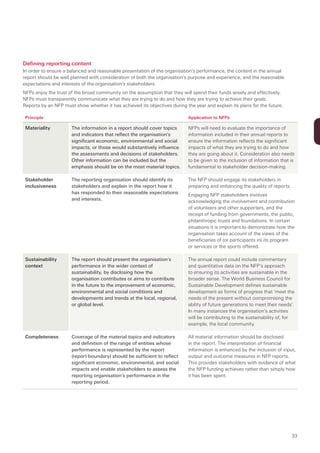
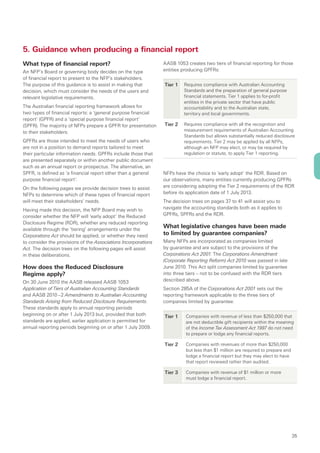
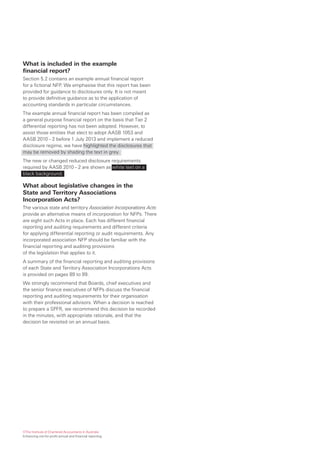
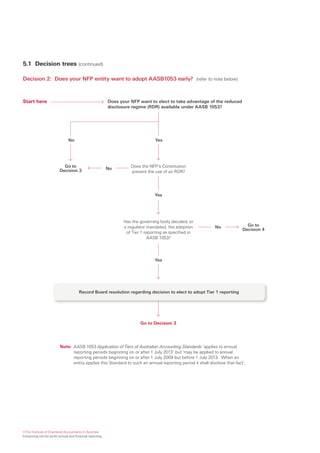
Best practice reporting – March 2011
The Institute of Chartered Accountants in Australia (the Institute) is the professional body
representing Chartered Accountants in Australia. Our reach extends to more than 67,000
of today’s and tomorrow’s business leaders, representing more than 55,000 Chartered
Accountants and 12,000 of Australia’s best accounting graduates currently enrolled in
our world-class Chartered Accountants postgraduate program.
Our members work in diverse roles across commerce and industry, academia, government
and public practice throughout Australia and in 109 countries around the world.
We aim to lead the profession by delivering visionary leadership projects, setting the
benchmark for the highest ethical, professional and educational standards, and enhancing
and promoting the Chartered Accountants brand. We also represent the interests of
members to government, industry, academia and the general public by engaging our
membership and local and international bodies on public policy, government legislation
and regulatory issues.
The Institute can leverage advantages for its members as a founding member of the
Global Accounting Alliance (GAA), an international accounting coalition formed by
the world’s premier accounting bodies. With a membership of over 800,000, the
GAA promotes quality professional services, shares information, and collaborates on
international accounting issues.
Established in 1928, the Institute is constituted by Royal Charter. For further information
about the Institute, visit charteredaccountants.com.au


About this report                                                                       Disclaimer
This report has been prepared by Stewart Leslie and Damian Connellan                    This publication has been prepared for the Institute of Chartered
of Causeway Consulting Pty Ltd. The author would like to thank the                      Accountants in Australia by Causeway Consulting Pty Ltd. While every
Institute’s Kerry Hicks and Karen McWilliams for their contribution to                  effort has been made to ensure that it reflects current legislation and
this paper. The report reflects the findings from the PwC Transparency                  Accounting Standards relevant to the not-for-profit sector, neither the
Awards. The author and the Institute thank PwC for allowing the findings                Institute nor any directors, staff and associates of Causeway Consulting
to be reflected in the report.                                                          Pty Ltd shall be liable on any ground whatsoever to any party in respect of
                                                                                        decisions or actions they may take as a result of using this publication nor
About PwC Transparency Awards                                                           in respect of any errors in, or omissions from it. The information contained
The Institute of Chartered Accountants in Australia is a proud supporter                in this publication is a general commentary only and should not be used,
of PwC Transparency Awards. The Transparency Awards are designed                        relied upon or treated as a substitute for specific professional advice.
to recognise the quality and transparency of reporting in the not-for-
                                                                                        Copyright
profit sector. The winning organisation benefits from raising its profile as
                                                                                        A person or organisation that acquires or purchases this product from
an organisation with a proven commitment to transparent reporting. It
                                                                                        the Institute of Chartered Accountants in Australia may reproduce and
receives $20,000 towards the training and development of its people.
                                                                                        amend these documents for their own use or use within their business.
All submissions are reviewed by a panel of experts and applicants receive
                                                                                        Apart from such use, copyright is strictly reserved, and no part of this
an individual feedback report. The 2010/11 winner will be announced
                                                                                        publication may be reproduced or copied in any form or by any means
on Wednesday, 13 April 2011.
                                                                                        without the written permission of the Institute of Chartered Accountants
For more information visit www.pwc.com.au                                               in Australia.
                                                                                        Enhancing not-for-profit annual and financial reporting
                                                                                        Published March 2011
                                                                                        Published by: The Institute of Chartered Accountants in Australia
                                                                                        33 Erskine Street, Sydney, New South Wales, 2000
                                                                                        Author: Mr Stewart Leslie, Causeway Consulting Pty Ltd.
                                                                                        ISBN 978-1-921245-81-7


ABN 50 084 642 571 The Institute of Chartered Accountants in Australia Incorporated in Australia Members’ Liability Limited. 0311-27
Foreword
Australia is fortunate. It has a vibrant and diverse community sector which provides the foundations of
a strong civil society. More than a third of Australians volunteer each year. Tax Office returns – and the
anecdotal evidence of donor generosity at the times of natural disaster – suggest that charitable giving is
increasing. The introduction of private ancillary funds has significantly increased philanthropy.
We remain a nation of joiners, collectively being members of around 600,000 not-for-profit (NFP)
organisations. Most are small (or smaller) but about 10% are economically significant. Some exist to provide
services to their members but many others have as their mission the creation of public benefit. They support,
provide services for and advocate for a range of cultural, social and environmental goals.
It’s too rarely recognised that these organisations, which focus on social impact rather than economic growth,
operate in an environment marked by dynamic change. The level of innovation is significant. It’s estimated that
20,000 NFPs now operate, at least in part, as social enterprises. They fund their operations largely through
trading, directing their accumulated surplus to social objectives. Many tender to deliver government services.
According to the Productivity Commission, some $26 billion is now paid directly to NFPs by governments
each year. Unfortunately, all too often, they do not get paid for the full cost of their operations.
Their ambitions always constrained by financial pressures, NFPs are increasingly looking to partner with
responsible businesses committed to the creation of shared economic and social value. Increasingly their
language of collaboration is framed around social investment rather than philanthropy. At the same time
nascent signs are emerging of the creation of a capital market for NFPs, in which those who provide funding
can gain both financial and social returns. New investment vehicles, such as social impact bonds and
community development investment funds, are starting to appear. It is becoming ever more important to
measure not just outcome cost-effectiveness but the social returns on financial investment.
In this environment of change and challenge, the continuing work undertaken by the Institute of Chartered
Accountants in Australia is particularly valuable. The Institute has established an enviable reputation as a
source of advice to NFPs on the complexities of financial management and reporting. Its strong commitment
to openness and accountability in annual reports is reflected in its joint sponsorship, with the Centre for
Social Impact, of the PwC Transparency Awards. The Awards have driven good practice and I am delighted
to see the learnings from that process captured in this latest edition of Enhancing not-for-profit annual and
financial reporting.
The publication also makes it clear that the legislative and regulatory framework within which NFPs
work is extraordinarily complex. Record-keeping, reporting and auditing reflect that fact. I hope that the
Commonwealth’s examination of a ‘one-stop shop’ regulator will result in reduced red tape and lower
compliance costs, as the Institute has strongly advocated. I share the Institute’s belief that progressive
implementation of a National Standard Chart of Accounts has the potential to reduce the administrative
burden on NFP organisations and to improve disclosure so that comparative assessment of organisational
performance becomes easier. As so often, however, the proof of the pudding will be in the eating.
In the meantime, this updated guide to NFPs on meeting their reporting responsibilities and, at the same
time, improving their business strategy and organisational capability fulfils a vital need. It is a source of
clear and practical assistance. It is up to date.
As the ‘third sector’ continues to evolve, the Institute will continue to be both a voice of advocacy for NFPs
and a source of advice to them. I wish it well in pursuing those dual objectives.


Peter Shergold
Macquarie Group Foundation Professor
Centre for Social Impact


                                                                                                                  3
©The Institute of Chartered Accountants in Australia
Enhancing not-for-profit annual and financial reporting
           Not-for-Profit annual and financial reporting
Contents
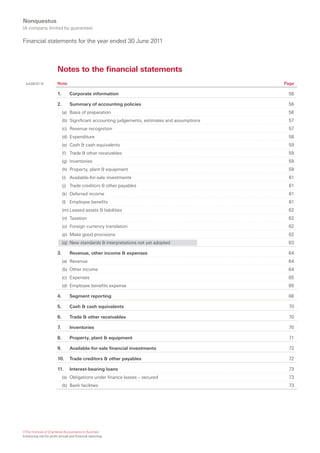
1          Introduction . . . . . . . . . . . . . . . . . . . . . . . . . . . . . . . . . . . . . . . . . . . . . . . . . . . . . . . . . . . . . . . . . . . . . . . . . . . . . . . . . . . . . . . . . . . . . . . . . . . . . . . . 6

2          Future developments. . . . . . . . . . . . . . . . . . . . . . . . . . . . . . . . . . . . . . . . . . . . . . . . . . . . . . . . . . . . . . . . . . . . . . . . . . . . . . . . . . . . . . . . . . . 7

3          Overall recommendations. . . . . . . . . . . . . . . . . . . . . . . . . . . . . . . . . . . . . . . . . . . . . . . . . . . . . . . . . . . . . . . . . . . . . . . . . . . . . . . . . . . . 8
3.1 Recommendations to enhance NFP annual reporting . . . . . . . . . . . . . . . . . . . . . . . . . . . . . . . . . . . . . . . . . . . . . . . . . . . . 8
3.2 Recommendations to enhance NFP financial reporting . . . . . . . . . . . . . . . . . . . . . . . . . . . . . . . . . . . . . . . . . . . . . . . . . 11

4          Guidance when producing an annual report . . . . . . . . . . . . . . . . . . . . . . . . . . . . . . . . . . . . . . . . . . . . . . . . . . . . . . . 13
4.1 The annual report checklist . . . . . . . . . . . . . . . . . . . . . . . . . . . . . . . . . . . . . . . . . . . . . . . . . . . . . . . . . . . . . . . . . . . . . . . . . . . . . . . . . . . . . 13
4.2 Examples of governance statements . . . . . . . . . . . . . . . . . . . . . . . . . . . . . . . . . . . . . . . . . . . . . . . . . . . . . . . . . . . . . . . . . . . . . . . . 23
4.3 Examples of outputs . . . . . . . . . . . . . . . . . . . . . . . . . . . . . . . . . . . . . . . . . . . . . . . . . . . . . . . . . . . . . . . . . . . . . . . . . . . . . . . . . . . . . . . . . . . . . 28
4.4 Examples of outcomes . . . . . . . . . . . . . . . . . . . . . . . . . . . . . . . . . . . . . . . . . . . . . . . . . . . . . . . . . . . . . . . . . . . . . . . . . . . . . . . . . . . . . . . . . . 30
4.5 GRI reporting principles and the not-for-profit sector . . . . . . . . . . . . . . . . . . . . . . . . . . . . . . . . . . . . . . . . . . . . . . . . . . . 32

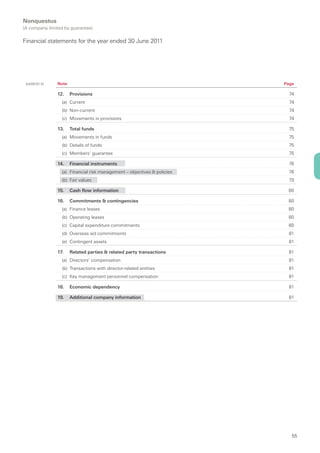
5          Guidance when producing a financial report . . . . . . . . . . . . . . . . . . . . . . . . . . . . . . . . . . . . . . . . . . . . . . . . . . . . . . 35
5.1 Decision trees . . . . . . . . . . . . . . . . . . . . . . . . . . . . . . . . . . . . . . . . . . . . . . . . . . . . . . . . . . . . . . . . . . . . . . . . . . . . . . . . . . . . . . . . . . . . . . . . . . . . . . 37
5.2 Illustrative financial statements . . . . . . . . . . . . . . . . . . . . . . . . . . . . . . . . . . . . . . . . . . . . . . . . . . . . . . . . . . . . . . . . . . . . . . . . . . . . . . . 42


6          Background information . . . . . . . . . . . . . . . . . . . . . . . . . . . . . . . . . . . . . . . . . . . . . . . . . . . . . . . . . . . . . . . . . . . . . . . . . . . . . . . . . . . . 89
6.1 Overview of legislation . . . . . . . . . . . . . . . . . . . . . . . . . . . . . . . . . . . . . . . . . . . . . . . . . . . . . . . . . . . . . . . . . . . . . . . . . . . . . . . . . . . . . . . . . . 89
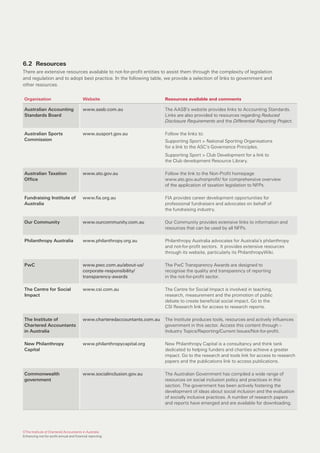
6.2 Resources . . . . . . . . . . . . . . . . . . . . . . . . . . . . . . . . . . . . . . . . . . . . . . . . . . . . . . . . . . . . . . . . . . . . . . . . . . . . . . . . . . . . . . . . . . . . . . . . . . . . . . . . . . 100


                                                                                                                                                                                                                                            5
1. Introduction
The Institute of Chartered Accountants in Australia publishes       transparent reporting and receives $20,000 and $10,000
the essential tool for transparent reporting every two years.       respectively towards the training and development of its
In this third edition of Enhancing not-for-profit annual and        employees. There is also a Most Improved Award for the
financial reporting, we continue our support for the not-for-       organisation showing the most significant improvement in
profit (NFP) sector by providing a tool that will assist not-for-   the quality and transparency of their reporting from their
profits (NFPs) in their efforts to attain best practice in their    prior year submission. Organisations vying for the PwC
annual and financial reports.                                       Transparency Awards are evaluated using criteria developed
Since the second edition of this publication was released           from the guidance in this publication, PwC’s Reporting
in March 2009, we have seen three significant regulatory            Framework and the GRI’s Reporting Guidelines.
changes which affect the nature and extent of NFP financial         Enhancing not-for-profit annual and financial reporting
reporting. These are:                                               comprises five sections:
> Amendments to the Corporations Act 2001 provisions                > Future developments
  applicable to companies limited by guarantee, which               > Overall recommendations for the enhancement of
  introduced a three-tiered reporting structure, streamlined          NFP annual and financial reporting
  requirements for Directors’ reports and permitted                 > Guidance when producing an annual report
  (in some circumstances) a review of a financial report
                                                                    > Guidance when producing a financial report
  rather than a full audit
                                                                    > Background information, including an overview of
> The release on 2 July 2010 of Accounting Standard
                                                                      legislation and resources.
  AASB 1053 Application of Tiers of Australian Accounting
  Standards, which introduced a two-tiered financial                The overall recommendations are based on two categories
  reporting framework that allows for reduced                       of NFP, a charity and a sporting club, but are applicable to
  disclosure requirements                                           all private-sector NFPs.
> The review and amendment of incorporated associations
  legislation and regulations in some states to modify
  the financial reporting requirements of that legislation.

All of these events have been reflected in the guidance
provided in this publication.
In suggesting what is best practice in NFP reporting, the
Institute and the author have considered:
> Recommendations from the 2009 PwC Transparency
  Awards
> The Global Reporting Initiative’s (GRI) Reporting Guidelines
> The results of the Institute’s research into Broad Based
  Business Reporting (BBBR) and the emerging concept
  of integrated reporting.

The Institute supports the PwC Transparency Awards, which
recognise and encourage improvement in the quality and
transparency of reporting in the NFP sector. The winner
and runner-up in each of the two Award categories benefits
from raising its profile as an organisation committed to


©The Institute of Chartered Accountants in Australia
Enhancing not-for-profit annual and financial reporting
2. Future developments
In the Introduction we referred to changes in legislation and           National Standard Chart of Accounts
Accounting Standards that have changed the NFP reporting                The National Standard Chart of Accounts (NSCOA) was
environment. Further changes are just over the horizon.                 developed at the request of the Council of Australian
Discussions and consultations around the governance and                 Governments (COAG) by the Australian Centre for
regulation of the NFP sector are occurring at both the state            Philanthropy and Nonprofit Studies (Queensland University
and federal levels. New developments are at various stages              of Technology).
of implementation. Outlined below are three recent initiatives
likely to impact reporting practices among NFPs over the                It is anticipated that the NSCOA will reduce the administrative
next two to three years. The Institute remains committed                burden on NFP organisations in receipt of government
to providing commentary and policy positions on these                   funding. It aims to do this by providing a financial data
developments as they occur.                                             dictionary for the use of government agencies and NFP
                                                                        organisations so they can record and report financial
Government not-for-profit reforms                                       information in a consistent way to the agency providing
                                                                        the grant.
Many stakeholders in the NFP sector, including the Institute,
believe the current regulatory framework for NFPs is                    New South Wales, Victoria and Queensland adopted the
confusing and not well understood and in some cases                     NSCOA on 1 July 2010, with other jurisdictions planning
places a significant compliance burden on the sector.                   to follow suit from 1 July 2011.
The most recent Federal Government paper seeking views                  Extensive resources have been developed by each state
on the NFP sector was issued by Treasury on 21 January                  adopting the NSCOA. These can be accessed through the
2011 and was entitled Scoping Study for a National Not-for-             Queensland University of Technology website at: wiki.qut.
Profit Regulator.1                                                      edu.au/display/CPNS/Standard+Chart+of+Accounts
When issuing the paper, the Assistant Treasurer, The
                                                                        AASB performance reporting project
Hon Bill Shorten MP, said the paper seeks the views of
NFP sector stakeholders to determine the precise role,                  The Australian Accounting Standards Board (AASB), in
functions, feasibility and design options for a ‘one-stop               conjunction with the New Zealand Financial Reporting
shop‘ regulator for the sector. As highlighted in the media             Standards Board (FRSB), is currently working on a project
release, ‘The consultation paper marks the beginning of a               entitled Disclosures by Private Entity Not-for-Profit Entities.
reform process that will deliver smarter regulation, reduce             The AASB has set up a Project Advisory Panel representing
red tape and improve the transparency and accountability                interests of many stakeholders in the NFP sector, in order
of the sector’.                                                         to solicit comments on the progress of the work. Phase 1
The Institute submission on this paper supports a                       of the project includes consideration of service performance
nationally consistent, tiered reporting system embracing                reporting matters to determine principles and application
all not-for-profits, regardless of their constitution. Further,         guidance of service performance reporting for the private
we support the introduction of Standard Business                        NFP sector.
Reporting (SBR) to help reduce compliance costs in the                  The AASB and the FRSB have broken the project down into
areas of statutory reporting and grant acquittals.                      components and commenced research and consultation
We await the results of the consultation, and stand ready               with the help of the Project Advisory Panel. It is envisaged
to support the sector in policy development to implement                that the AASB will publish an exposure draft for public
the recommendations.                                                    comment in late 2011.
                                                                        The timing for completion of Phase 1 was originally
                                                                        planned for late 2011, but current progress points to a
                                                                        2012 completion.


1. A copy of the paper can be accessed at www.treasury.gov.au/contentitem.asp?NavId=037&ContentID=1934


                                                                                                                                          7
3. Overall recommendations
3.1 Recommendations to enhance NFP annual reporting
The following recommendations are designed to enhance the quality of annual reporting by NFPs. The recommendations
are based on research carried out by the Institute and information gathered in the review of submissions to the 2009 PwC
Transparency Awards summarised in the Awards’ Jury Report, which can be downloaded from www.pwc.com.au/about-us/
corporate-responsibility/transparency-awards/findings/index.htm


 Objectives                        Provide more information about what the NFP is trying to do (its mission), how it operates, its
                                   objectives, explanations of activities to achieve those objectives, and how those activities are funded.

 Strategy                          Provide a summary of strategy to assist readers reviewing an NFP’s performance for the year as well
                                   as how the current year’s strategy links to the longer term strategy of the organisation. NFPs should
                                   include measurable, quantified strategic targets and progress reporting against those targets.
                                   Include a summary of future plans to achieve targets, especially when progress has fallen short
                                   of the original plan.
                                   Make the strategic plan, or at a minimum the strategic goals for the period, available on the
                                   website. Ideally the website should explain how the strategic plan has been developed, noting
                                   how stakeholders are engaged in that activity. A link or cross-reference to the website could be
                                   included in the annual report.

 Governance                        Greater transparency around governance structures and processes through inclusion of a
 structure and                     comprehensive governance statement will:
 processes                         > Initially lead to improved governance reporting as the NFP strives to demonstrate best practice
                                   > Assist Board members in protecting their reputation
                                   > Potentially provide a competitive advantage.

                                   Areas in the statement that could be enhanced include:
                                   > The skills mix required in the Board and senior management
                                   > How the skills mix is sought, renewed, measured and assessed
                                   > Induction and ongoing training of the Board and senior management
                                   > How the interface between the Board/CEO/broader management is managed
                                   > Performance assessment processes and frequency
                                   > Remuneration structure of senior management.

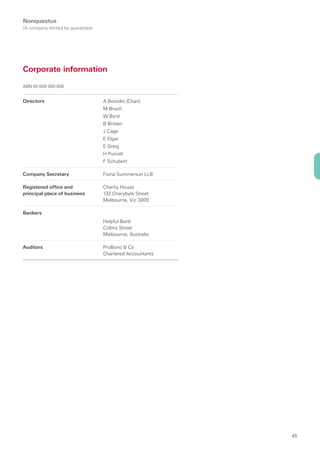
                                   Examples of governance statements can be found in Section 4.2 in this publication. Additionally,
                                   specific guidance exists for sporting body NFPs.2

 Risk management                   Readers of the annual report should be provided with sufficient information to understand the
                                   major risks faced by the NFP and the ongoing management of those risks. This could be achieved
                                   by providing a summary of policies on risk oversight and management of the major risks in the
                                   governance statement.

 Stakeholder                       Identify major stakeholders – people, groups or organisations who impact or could be impacted
 reporting                         by the NFP’s actions – and provide an overview of the relationship with each stakeholder (include
                                   communication forms and frequency, social media use).
                                   Specific attention should be given to paid employees and volunteers. Consider disclosing
                                   employment policies, policies for engaging and deploying volunteers, extent of volunteer
                                   involvement, satisfaction ratings, an overview of the training provided to both employees and
                                   volunteers and recognition of employee and volunteer achievements.


2. Sporting body NFPs can achieve best practice in governance reporting by comparing their structure to the Australian Sporting Commission’s National Sporting
   Organisation Governance Principles of Best Practice. If necessary, they can take remedial action to align their governance structure with this best practice.


©The Institute of Chartered Accountants in Australia
Enhancing not-for-profit annual and financial reporting
Funding             Provide more detail about sources of funds as well as fundraising activities. Although the
                    quantum of funds raised and used by NFPs can be determined from their financial statements,
                    additional information on the sources of funds would enhance transparency.
                    Consideration should be given to providing information regarding:
                    > The processes to secure government funding, the reliance on that funding, if there are any
                      conditions on its use and how those conditions are being met or measured
                    > Policies for public fundraising, application of those funds, costs, targets against actual funds
                      raised and complaint procedures
                    > Information on the revenue models and the NFP’s approach to funding, including how this is
                      evolving to adapt to observed changes in donations and funding
                    > The use of websites to generate donations.

Investments         Provide more insightful reporting of investments and investment policies, including:
                    > Management of investments, including the involvement of any third parties such as
                      investment advisors or managers
                    > Any limitations on investments
                    > The performance of the investment portfolio against short- and long-term targets or
                      performance objectives.

Reporting           Charitable NFPs should identify and include in their annual reports those process key performance
efficiency and      indicators (KPIs) that are relevant to their mission, objectives and activities. At a minimum these
effectiveness –     should include, where applicable:
charitable bodies   > The ratio of total costs of fundraising to gross income obtained from fundraising
                    > The ratio of net surplus from fundraising to gross income obtained from fundraising
                    > The ratio of total costs of services provided by the fundraiser to total expenditure
                    > The ratio of total costs of services provided by the fundraiser to gross income received.

                    For as long as fundraising ratios remain the generally accepted means of reporting process efficiency,
                    the ratios should be separately disclosed.
                    Fluctuations in these ratios from reporting period to reporting period should be explained in the
                    annual report, particularly where the NFP is investing in its funding coterie. Such transparency
                    communicates to the broader community that this investment is required and necessary to support
                    the ongoing operations of the charitable NFP.

Reporting           Sporting body NFPs demonstrate the efficiency of their operations by determining the process KPIs
efficiency and      that are relevant to their mission, objectives and activities, and disclosing them in their annual report.
effectiveness –     Where these KPIs are expressed as numbers or ratios, fluctuations from reporting period to reporting
sporting bodies     period should be explained.


                                                                                                                                 9
Outputs,                          NFPs enhance the effectiveness of their annual reports by portraying what the NFP has done
 outcomes                          (its outputs), what it has achieved (its outcomes), and what difference it has made (its impacts).
 and impacts                       The inclusion of measures of output, outcome and impact will improve completeness of reporting
                                   by demonstrating to the reader of the annual report what the NFP funding achieves rather than how
                                   it is spent.
                                   NFPs can improve their annual reports by including explanations of trends and movements in these
                                   measures. These explanations should not be limited to financial data. Where process KPIs and
                                   outputs, outcomes and impacts are presented, explanations of movements from year to year should
                                   be provided. These explanations should not be limited to successful outcomes, but also include
                                   commentary on unsuccessful outcomes and the steps taken to address the challenges presented.
                                   Impacts can also be demonstrated through case studies and testimonials.
                                   Many NFPs run programs and mount activities that are designed to deliver outputs and achieve
                                   outcomes over the long term. Information regarding trends and movements in quantitative data and
                                   explanations of year-to-year movements would be enhanced by the inclusion of long-term trend data.
                                   The trends and effects of significant economic changes or other external events, such as natural
                                   disasters, should be included. Actual or expected impacts of these events on current or future years’
                                   performance should be disclosed.
                                   Reporting would also benefit from the inclusion of planned performance targets and explanations
                                   for variations of actual performance from those targets.

 Presentation                      NFPs can improve the visual appearance of annual reports. This can be achieved through making
 and clarity of                    better use of summaries, bullets points, graphs, contents pages and tables.
 annual reports

 Online                            Consider online reporting. Adequate policies must be in place to ensure the information is regularly
 presentation                      reviewed and updated. It is also recommended that NFPs have historical reports available for
                                   download off their website.

 Financial result                  NFPs should include an explanation for the current year’s financial result.
                                   The policy for the management and protection of funds raised in excess of stated or operational
                                   requirements should be disclosed.

 Environmental                     Environmental issues are of increasing interest to the community and therefore NFPs could be
 reporting                         more proactive in communicating with stakeholders about the impact of their operations on the
                                   environment and how this is being managed and measured.
                                   Commentary and data should also reflect the organisation’s resource use and activities that impact
                                   the environment – for example, activities that contribute to pollution levels and the efforts made to
                                   reduce those levels.
                                   Where the impact of climate change and limited natural resources could have a significant impact
                                   on the NFP, this should be explained.

 Regulatory                        An overview of the legislation and regulations an NFP must comply with enhances the reader’s
 environment                       understanding of the organisation’s operating environment. An explanation of the processes in place
                                   to ensure compliance with legislation and regulation provides assurance regarding the organisation’s
                                   governance processes.

 International                     Where an Australian NFP has links to an international organisation, the relationship should be
 organisations                     explained in the annual report, including fund allocation, contractual arrangements, staff interchange
                                   and jointly managed projects.


©The Institute of Chartered Accountants in Australia
Enhancing not-for-profit annual and financial reporting
3.2 Recommendations to enhance NFP financial reporting
The following recommendations are designed to enhance the quality of financial reporting by NFPs. The recommendations
are based on research carried out by the Institute.


 Special purpose      NFPs that currently prepare a special purpose financial report (SPFR) for presentation to stakeholders
 or general           should consider whether such a report meets stakeholders needs, with regard to:
 purpose financial    > The number, diversity and location of stakeholders
 report               > The level of direct involvement by stakeholders in the day-to-day management of the NFP
                      > The community impact of NFP activities
                      > The extent to which the NFP is reliant on government or philanthropic grants and donations.

                      It is the author’s and Institute’s opinion that the preparation of an SPFR should be the exception
                      rather than the rule.

 Early adoption       Accounting Standard AASB 1053 Application of Tiers of Australian Accounting Standards applies to
 of AASB 1053         annual reporting periods beginning on or before 1 July 2013, but may be applied to annual reporting
 and reduced          periods beginning on or after 1 July 2009 but before 1 July 2013. NFPs seeking to reduce the
 disclosure           complexity of their general purpose financial reports should consider early adoption of AASB 1053
 regime               and apply the reduced disclosure regime available to NFPs under that standard.

 Segment              Until an NFP-specific segment reporting accounting standard is developed, NFPs should disclose
 reporting            segment information in their financial statements where it would enhance the information presented
                      to the users of the statements by:
                      > Enabling the user to better assess the achievements of an NFP with diversified activities, or
                      > Enabling comparison of the NFP’s performance with that of similar NFPs.

 Recognition of       When considering the application of accounting standards, NFPs should take the opportunity to:
 grant revenue        > Differentiate between ‘reciprocal’ and ‘non-reciprocal’ grants and adopt appropriate revenue
                        recognition policies for each
                      > Revisit the wording of their current revenue recognition accounting policy notes and ensure
                        they clearly explain the conditions that must be satisfied before grant revenue is recognised in
                        profit or loss.

 Goods and            NFPs (in particular, charitable NFPs) should consider the nature and extent of non-reciprocal transfers
 services for no      they are involved in that result in the receipt of goods and services for no consideration. If these
 consideration        transfers are material, an appropriate accounting policy should be developed, and appropriate
                      disclosures made in the NFP’s financial statements describing these transactions.

 Inventories for      NFPs should consider the extent to which they are in receipt of inventories for distribution at no
 distribution         or nominal cost and, if material, develop an appropriate accounting policy and make appropriate
                      disclosures in the NFP’s financial statements.

 Economic             Any NFP in receipt of grants should consider the impact on its financial performance and position if
 dependence           the grants were not received. If the NFP’s financial performance and/or financial position would be
                      adversely affected, the appropriate economic dependence disclosures should be made by way of a
                      note to the financial statements.


                                                                                                                             11
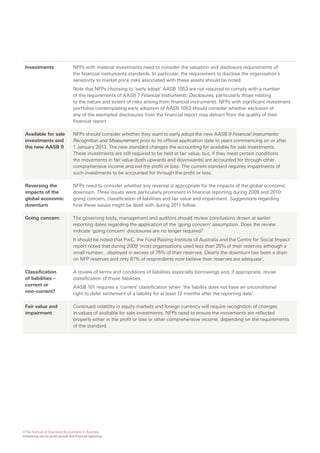
Investments                       NFPs with material investments need to consider the valuation and disclosure requirements of
                                   the financial instruments standards. In particular, the requirement to disclose the organisation’s
                                   sensitivity to market price risks associated with these assets should be noted.
                                   Note that NFPs choosing to ‘early adopt’ AASB 1053 are not required to comply with a number
                                   of the requirements of AASB 7 Financial Instruments: Disclosures, particularly those relating
                                   to the nature and extent of risks arising from financial instruments. NFPs with significant investment
                                   portfolios contemplating early adoption of AASB 1053 should consider whether exclusion of
                                   any of the exempted disclosures from the financial report may detract from the quality of their
                                   financial report.

 Available for sale                NFPs should consider whether they want to early adopt the new AASB 9 Financial Instruments:
 investments and                   Recognition and Measurement prior to its official application date to years commencing on or after
 the new AASB 9                    1 January 2013. The new standard changes the accounting for available for sale investments.
                                   These investments are still required to be held at fair value, but, if they meet certain conditions
                                   the movements in fair value (both upwards and downwards) are accounted for through other
                                   comprehensive income and not the profit or loss. The current standard requires impairments of
                                   such investments to be accounted for through the profit or loss.

 Reversing the                     NFPs need to consider whether any reversal is appropriate for the impacts of the global economic
 impacts of the                    downturn. Three issues were particularly prominent in financial reporting during 2009 and 2010:
 global economic                   going concern, classification of liabilities and fair value and impairment. Suggestions regarding
 downturn                          how these issues might be dealt with during 2011 follow.

 Going concern                     The governing body, management and auditors should review conclusions drawn at earlier
                                   reporting dates regarding the application of the ‘going concern’ assumption. Does the review
                                   indicate ‘going concern’ disclosures are no longer required?
                                   It should be noted that PwC, the Fund Raising Institute of Australia and the Centre for Social Impact
                                   report noted that during 2009 ‘most organisations used less than 25% of their reserves although a
                                   small number…deployed in excess of 75% of their reserves. Clearly the downturn has been a drain
                                   on NFP reserves and only 61% of respondents now believe their reserves are adequate’.

 Classification                    A review of terms and conditions of liabilities especially borrowings and, if appropriate, revise
 of liabilities –                  classification of those liabilities.
 current or                        AASB 101 requires a ‘current’ classification when ‘the liability does not have an unconditional
 non-current?                      right to defer settlement of a liability for at least 12 months after the reporting date’.

 Fair value and                    Continued volatility in equity markets and foreign currency will require recognition of changes
 impairment                        in values of available for sale investments. NFPs need to ensure the movements are reflected
                                   properly either in the profit or loss or other comprehensive income, depending on the requirements
                                   of the standard.


©The Institute of Chartered Accountants in Australia
Enhancing not-for-profit annual and financial reporting
4. Guidance when producing an annual report
The recommendations contained in Section 3 are based on              meets good reporting practices. The checklist reflects the
the Institute’s own research and information gathered in             Institute’s research into NFP annual reporting, matters noted
the review of submissions to the 2009 PwC Transparency               in the review of submissions to the 2009 PwC Transparency
Awards. In this section we take these recommendations and            Awards, all of the annual reporting guidance noted in this
provide guidance on the content of an NFP’s annual report.           publication and certain legislative requirements. As noted
The section commences with our Annual Report Checklist,              in the recommendations, NFPs need to improve in the
designed to assist an NFP assess whether its annual report           clarity and structure of annual reports. This can be achieved
reflects good reporting practice.                                    through making better use of summaries, bullet points,
                                                                     graphs, contents page and tables to ensure the information
The checklist is followed by examples of output and outcome
                                                                     presented is more visually appealing.
measures. NFPs can use these suggestions to develop their
own measures.                                                        The checklist comprises a series of ‘tick the box’ questions
                                                                     and some examples of governance statements that could
Finally, we provide some information on GRI reporting                be included in an NFP’s annual report. We recommend
principles and their application to the NFP sector. The              printing out a copy of the Checklist and completing it. When
GRI principles have been reflected in the guidance provided          reviewing each of the questions, consider whether the
in the checklist.                                                    recommended disclosures are relevant to your organisation
                                                                     and whether your organisation’s annual report would be
4.1 The Annual Report Checklist                                      enhanced by the inclusion of information recommended in
The Annual Report Checklist on the following pages is                the questions. Please note that the Checklist does not cover
designed to assist an NFP assess whether its annual report           financial reporting requirements.


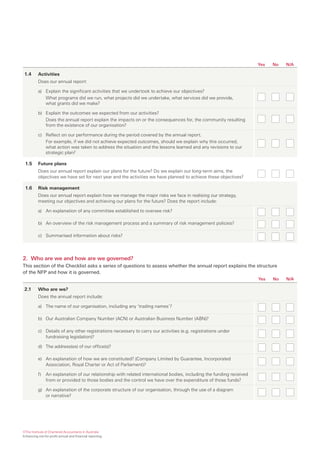
1. Do we explain what we are trying to achieve?
This section of the checklist asks a series of questions to ensure the annual report (the report) explains what the NFP
is trying to achieve.

                                                                                                                 Yes   No    N/A

1.1    Mission statement

       a) Does the annual report include our mission statement – a succinct statement of our core purpose
          and explaining why we exist?

       b) Does the annual report provide information such as statistics, trends or research data on the sector
          in which the organisation operates?

 1.2   Objectives
       Does our annual report:

       a) Include a summary of our objectives as listed in our constitution or governing document?

       b) Include a list of the specific objectives we set for the year covered by the report?

 1.3   Strategy
       Does our annual report:

       a) Explain our approach to the development of our mission and strategic plan, including how we
          engage with stakeholders in developing our strategy?

       b) Include a summary of our strategy that sets the scene for readers and enables them to assess our
          performance in delivering that strategy?

       c) Detail our strategic targets and our progress against those targets?

       d) Include a link to the page on our website where our detailed strategic plan can be found?


                                                                                                                                13
Yes   No   N/A

 1.4      Activities
          Does our annual report:

          a) Explain the significant activities that we undertook to achieve our objectives?
             What programs did we run, what projects did we undertake, what services did we provide,
             what grants did we make?

          b) Explain the outcomes we expected from our activities?
             Does the annual report explain the impacts on or the consequences for, the community resulting
             from the existence of our organisation?

          c) Reflect on our performance during the period covered by the annual report.
             For example, if we did not achieve expected outcomes, should we explain why this occurred,
             what action was taken to address the situation and the lessons learned and any revisions to our
             strategic plan?

 1.5      Future plans
          Does our annual report explain our plans for the future? Do we explain our long-term aims, the
          objectives we have set for next year and the activities we have planned to achieve these objectives?

 1.6      Risk management
          Does our annual report explain how we manage the major risks we face in realising our strategy,
          meeting our objectives and achieving our plans for the future? Does the report include:

          a) An explanation of any committee established to oversee risk?

          b) An overview of the risk management process and a summary of risk management policies?

          c) Summarised information about risks?


2. Who are we and how are we governed?
This section of the Checklist asks a series of questions to assess whether the annual report explains the structure
of the NFP and how it is governed.
                                                                                                                      Yes   No   N/A

 2.1      Who are we?
          Does the annual report include:

          a) The name of our organisation, including any ‘trading names’?

          b) Our Australian Company Number (ACN) or Australian Business Number (ABN)?

          c) Details of any other registrations necessary to carry our activities (e.g. registrations under
             fundraising legislation)?

          d) The address(es) of our office(s)?

          e) An explanation of how we are constituted? (Company Limited by Guarantee, Incorporated
             Association, Royal Charter or Act of Parliament)?

          f)   An explanation of our relationship with related international bodies, including the funding received
               from or provided to those bodies and the control we have over the expenditure of those funds?

          g) An explanation of the corporate structure of our organisation, through the use of a diagram
             or narrative?


©The Institute of Chartered Accountants in Australia
Enhancing not-for-profit annual and financial reporting
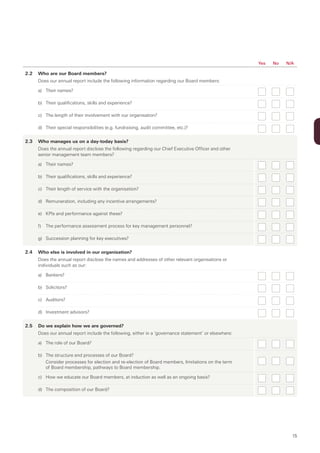
Yes   No   N/A

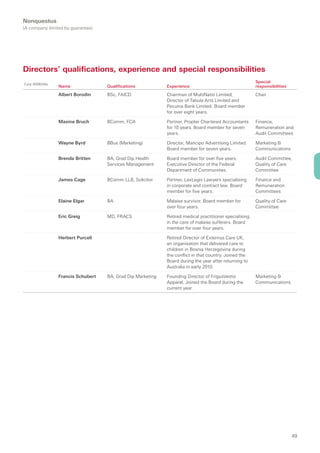
2.2   Who are our Board members?
      Does our annual report include the following information regarding our Board members:

      a) Their names?

      b) Their qualifications, skills and experience?

      c) The length of their involvement with our organisation?

      d) Their special responsibilities (e.g. fundraising, audit committee, etc.)?


2.3   Who manages us on a day-today basis?
      Does the annual report disclose the following regarding our Chief Executive Officer and other
      senior management team members?

      a) Their names?

      b) Their qualifications, skills and experience?

      c) Their length of service with the organisation?

      d) Remuneration, including any incentive arrangements?

      e) KPIs and performance against these?

      f)   The performance assessment process for key management personnel?

      g) Succession planning for key executives?


2.4   Who else is involved in our organisation?
      Does the annual report disclose the names and addresses of other relevant organisations or
      individuals such as our:

      a) Bankers?

      b) Solicitors?

      c) Auditors?

      d) Investment advisors?


2.5   Do we explain how we are governed?
      Does our annual report include the following, either in a ‘governance statement’ or elsewhere:

      a) The role of our Board?

      b) The structure and processes of our Board?
         Consider processes for election and re-election of Board members, limitations on the term
         of Board membership, pathways to Board membership.

      c) How we educate our Board members, at induction as well as an ongoing basis?

      d) The composition of our Board?


                                                                                                                    15
Yes    No   N/A

          e) Our Board committees and their functions?

          f)   How we assess the performance of the Board and how frequently this occurs?

          g) Our ethical standards?

          h) How we deal with conflicts of interest and explain any codes of conduct the organisation
             subscribes to?

          i)   How we ensure compliance with relevant legislation and regulation?

          j)   Information detailing compensation arrangements, including remuneration (if any) for the
               governing body?

          Examples of governance statements can be found on pages 23 to 27


3. Our stakeholders
This section of the checklist asks a series of questions to assess whether the annual report adequately identifies the NFP’s
stakeholders and explains how the NFP has responded to their expectations and interests.
                                                                                                                    Yes    No   N/A

 3.1      Who are our stakeholders?
          Does the annual report identify our major stakeholder groups? Consider:

          a) Donors or sponsors

          b) Volunteers

          c) Employees

          d) The beneficiaries of our programs

          e) Participants in our sport

          f)   Affiliated sporting bodies

          g) The business community

          h) The broader community

          i)   State and federal governments as funders

          j)   State and federal governments as regulators

          k) Partners, including strategic partners

          l)   Suppliers

          m) The media.

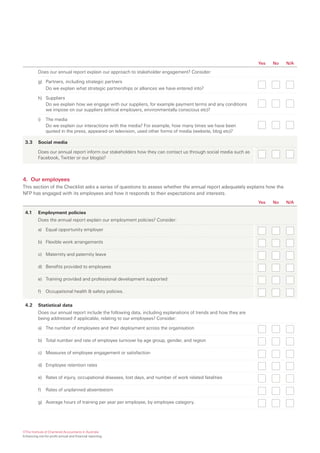
          Would the annual report be enhanced by the inclusion of a ‘stakeholder map’ to provide an overview
          of our stakeholder groups and the relationships between those groups?


©The Institute of Chartered Accountants in Australia
Enhancing not-for-profit annual and financial reporting
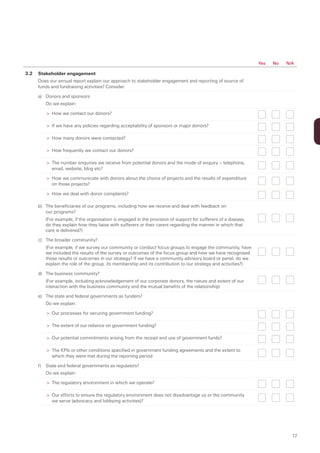
Yes   No   N/A

3.2   Stakeholder engagement
      Does our annual report explain our approach to stakeholder engagement and reporting of source of
      funds and fundraising activities? Consider:

      a) Donors and sponsors
           Do we explain:

           > How we contact our donors?

           > If we have any policies regarding acceptability of sponsors or major donors?

           > How many donors were contacted?

           > How frequently we contact our donors?

           > The number enquiries we receive from potential donors and the mode of enquiry – telephone,
              email, website, blog etc?

           > How we communicate with donors about the choice of projects and the results of expenditure
              on those projects?

           > How we deal with donor complaints?

      b) The beneficiaries of our programs, including how we receive and deal with feedback on
         our programs?
           (For example, if the organisation is engaged in the provision of support for sufferers of a disease,
           do they explain how they liaise with sufferers or their carers regarding the manner in which that
           care is delivered?)

      c) The broader community?
           (For example, if we survey our community or conduct focus groups to engage the community, have
           we included the results of the survey or outcomes of the focus group and how we have recognised
           those results or outcomes in our strategy? If we have a community advisory board or panel, do we
           explain the role of the group, its membership and its contribution to our strategy and activities?)

      d) The business community?
           (For example, including acknowledgement of our corporate donors, the nature and extent of our
           interaction with the business community and the mutual benefits of the relationship)

      e) The state and federal governments as funders?
           Do we explain:

           > Our processes for securing government funding?

           > The extent of our reliance on government funding?

           > Our potential commitments arising from the receipt and use of government funds?

           > The KPIs or other conditions specified in government funding agreements and the extent to
              which they were met during the reporting period

      f)   State and federal governments as regulators?
           Do we explain:

           > The regulatory environment in which we operate?

           > Our efforts to ensure the regulatory environment does not disadvantage us or the community
              we serve (advocacy and lobbying activities)?


                                                                                                                               17
Yes   No   N/A

          Does our annual report explain our approach to stakeholder engagement? Consider:

          g) Partners, including strategic partners
             Do we explain what strategic partnerships or alliances we have entered into?

          h) Suppliers
             Do we explain how we engage with our suppliers, for example payment terms and any conditions
             we impose on our suppliers (ethical employers, environmentally conscious etc)?

          i)   The media
               Do we explain our interactions with the media? For example, how many times we have been
               quoted in the press, appeared on television, used other forms of media (website, blog etc)?

 3.3      Social media

          Does our annual report inform our stakeholders how they can contact us through social media such as
          Facebook, Twitter or our blog(s)?


4. Our employees
This section of the Checklist asks a series of questions to assess whether the annual report adequately explains how the
NFP has engaged with its employees and how it responds to their expectations and interests.
                                                                                                                 Yes   No   N/A

 4.1      Employment policies
          Does the annual report explain our employment policies? Consider:

          a) Equal opportunity employer

          b) Flexible work arrangements

          c) Maternity and paternity leave

          d) Benefits provided to employees

          e) Training provided and professional development supported

          f)   Occupational health & safety policies.


 4.2      Statistical data
          Does our annual report include the following data, including explanations of trends and how they are
          being addressed if applicable, relating to our employees? Consider:

          a) The number of employees and their deployment across the organisation

          b) Total number and rate of employee turnover by age group, gender, and region

          c) Measures of employee engagement or satisfaction

          d) Employee retention rates

          e) Rates of injury, occupational diseases, lost days, and number of work related fatalities

          f)   Rates of unplanned absenteeism

          g) Average hours of training per year per employee, by employee category.


©The Institute of Chartered Accountants in Australia
Enhancing not-for-profit annual and financial reporting
Yes    No        N/A

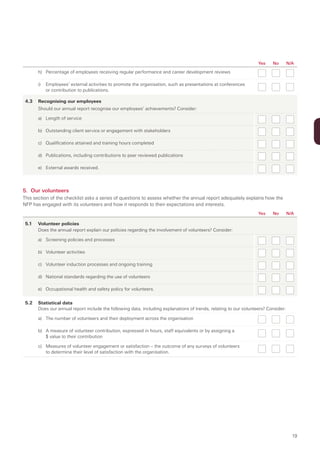
       h) Percentage of employees receiving regular performance and career development reviews

       i)   Employees’ external activities to promote the organisation, such as presentations at conferences
            or contribution to publications.

 4.3   Recognising our employees
       Should our annual report recognise our employees’ achievements? Consider:

       a) Length of service

       b) Outstanding client service or engagement with stakeholders

       c) Qualifications attained and training hours completed

       d) Publications, including contributions to peer reviewed publications

       e) External awards received.


5. Our volunteers
This section of the checklist asks a series of questions to assess whether the annual report adequately explains how the
NFP has engaged with its volunteers and how it responds to their expectations and interests.
                                                                                                                   Yes    No        N/A

 5.1   Volunteer policies
       Does the annual report explain our policies regarding the involvement of volunteers? Consider:

       a) Screening policies and processes

       b) Volunteer activities

       c) Volunteer induction processes and ongoing training

       d) National standards regarding the use of volunteers

       e) Occupational health and safety policy for volunteers.


 5.2   Statistical data
       Does our annual report include the following data, including explanations of trends, relating to our volunteers? Consider:

       a) The number of volunteers and their deployment across the organisation

       b) A measure of volunteer contribution, expressed in hours, staff equivalents or by assigning a
          $ value to their contribution

       c) Measures of volunteer engagement or satisfaction – the outcome of any surveys of volunteers
          to determine their level of satisfaction with the organisation.


                                                                                                                                      19
Yes   No   N/A

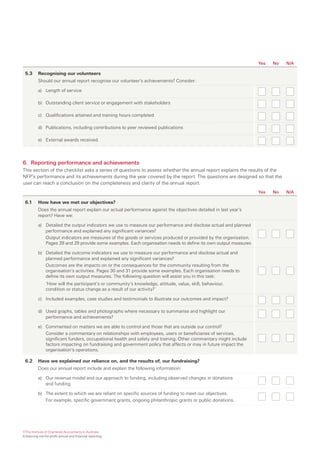
 5.3      Recognising our volunteers
          Should our annual report recognise our volunteer’s achievements? Consider:

          a) Length of service

          b) Outstanding client service or engagement with stakeholders

          c) Qualifications attained and training hours completed

          d) Publications, including contributions to peer reviewed publications

          e) External awards received.


6. Reporting performance and achievements
This section of the checklist asks a series of questions to assess whether the annual report explains the results of the
NFP’s performance and its achievements during the year covered by the report. The questions are designed so that the
user can reach a conclusion on the completeness and clarity of the annual report.
                                                                                                                 Yes   No   N/A

 6.1      How have we met our objectives?
          Does the annual report explain our actual performance against the objectives detailed in last year’s
          report? Have we:

          a) Detailed the output indicators we use to measure our performance and disclose actual and planned
             performance and explained any significant variances?
             Output indicators are measures of the goods or services produced or provided by the organisation.
             Pages 28 and 29 provide some examples. Each organisation needs to define its own output measures

          b) Detailed the outcome indicators we use to measure our performance and disclose actual and
             planned performance and explained any significant variances?
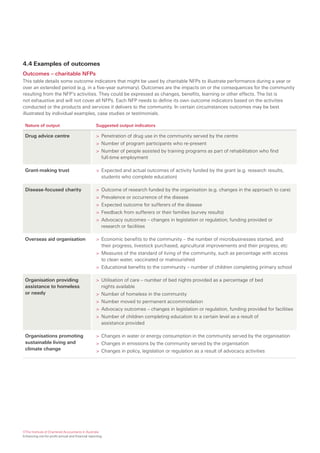
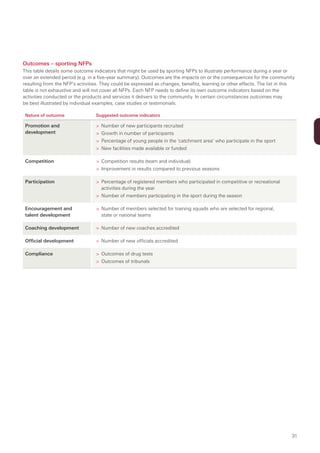
             Outcomes are the impacts on or the consequences for the community resulting from the
             organisation’s activities. Pages 30 and 31 provide some examples. Each organisation needs to
             define its own output measures. The following question will assist you in this task:
               ‘How will the participant’s or community’s knowledge, attitude, value, skill, behaviour,
               condition or status change as a result of our activity?’

          c) Included examples, case studies and testimonials to illustrate our outcomes and impact?

          d) Used graphs, tables and photographs where necessary to summarise and highlight our
             performance and achievements?

          e) Commented on matters we are able to control and those that are outside our control?
             Consider a commentary on relationships with employees, users or beneficiaries of services,
             significant funders, occupational health and safety and training. Other commentary might include
             factors impacting on fundraising and government policy that affects or may in future impact the
             organisation’s operations.

 6.2      Have we explained our reliance on, and the results of, our fundraising?
          Does our annual report include and explain the following information:

          a) Our revenue model and our approach to funding, including observed changes in donations
             and funding

          b) The extent to which we are reliant on specific sources of funding to meet our objectives.
             For example, specific government grants, ongoing philanthropic grants or public donations.


©The Institute of Chartered Accountants in Australia
Enhancing not-for-profit annual and financial reporting
Yes   No   N/A

      c) Actual fundraising against fundraising targets
         Consider separate disclosure of fundraising through public appeals, regular giving programs,
         legacies and bequests, philanthropic grants, government grants, government funding for
         delivery of services

      d) Explanation of our policy for managing and protecting funds raised that are surplus to our needs

      e) The costs of our fundraising efforts, including a clear definition of what is included in
         fundraising costs

      f)   The costs of our fundraising efforts as a percentage of funds raised

      g) A commentary on our ‘investment in fundraising’:
         Where the NFP has incurred significant expenditure relating to future fundraising, commentary
         should include an explanation of the impact on the current year’s return from fundraising and future
         years’ fundraising income

      h) Our treatment of and accounting for in-kind donations, such as time, goods and
         professional services

      i)   The impact on our financial performance as a result of in-kind donations.


6.3   Do we show how efficiently we have used our resources?
      Does our annual report include and explain the following information regarding the
      use of our funds? Consider:

      a) The ratio of funds spent on our primary purpose(s) to total expenditure

      b) The ratio of funds spent on our primary purpose(s) as to total funds received during the year

      c) How each $1 of funds provided by our donors is spent

      d) The performance of our investments during the year compared with the investment objectives
         that were set for the year
         Consider including information on the NFPs investment policy, and how its investments are
         managed, and trend information on the performance of the investment portfolio.

      Does our annual report detail and explain the following information regarding the
      services we provide? Consider:

      a) The ‘outputs’ we have delivered

      b) The outputs delivered per employee or volunteer

      c) The cost per unit of output.


      Does our annual report detail and explain the following information regarding our
      commercial activity? Consider:

      a) Gross profit margin

      b) The commercial activity’s cash contribution to our core activity

      c) The cash contribution per person employed in the commercial activity

      d) The hours of employment provided by the commercial activity to those served by our
         core activities.


                                                                                                                             21
Yes    No    N/A

 6.4      Do we explain our financial performance and position?
          Do we include a financial discussion and analysis?
          Does our annual report include a discussion and analysis of the factors affecting our financial performance, financial
          position and financing and investing activities? For example, does the annual report include commentary on:

          a) Trends in revenues

          b) Key events and their effects of significant economic or other events (such as natural disasters)
             on our operations

          c) The main influences on costs of our operations

          d) Appropriate measures of our financial performance

          e) Changes in the composition of our assets

          f)   Significant movements in our assets, liabilities and reserves

          g) Changes in our cash flows

          h) The financing of our capital expenditure programs

          i)   The purpose of our reserves and any restrictions on the use of our assets

          j)   Any deficiency in the organisation’s current position (excess of current liabilities over
               current assets).

          Have we considered a five year summary?
          Have we included a narrative description and analysis depicting our financial and operational
          performance over the past five years?

 6.5      Environmental and sustainability policies
          Does the annual report provide insight into our approach to sustainability and environmental
          performance and the results of that approach? Consider:

          a) Explaining initiatives to mitigate the environmental impacts of our programs or
             fundraising projects

          b) Explaining initiatives to reduce usage of resources such as paper and energy

          c) Recycling initiatives

          d) Providing insights into targets and measurement of performance against targets.


 6.6      Distributing our annual report

          Have we considered making our annual report available on our website rather than distributing
          hard copies of our report?


©The Institute of Chartered Accountants in Australia
Enhancing not-for-profit annual and financial reporting
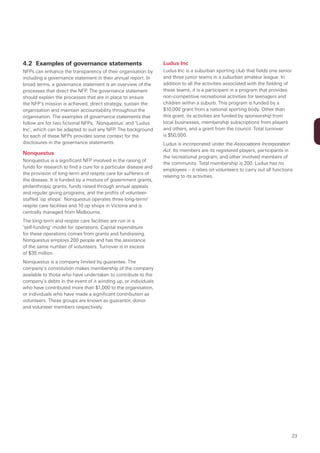
4.2 Examples of governance statements                            Ludus Inc
NFPs can enhance the transparency of their organisation by       Ludus Inc is a suburban sporting club that fields one senior
including a governance statement in their annual report. In      and three junior teams in a suburban amateur league. In
broad terms, a governance statement is an overview of the        addition to all the activities associated with the fielding of
processes that direct the NFP. The governance statement          these teams, it is a participant in a program that provides
should explain the processes that are in place to ensure         non-competitive recreational activities for teenagers and
the NFP’s mission is achieved, direct strategy, sustain the      children within a suburb. This program is funded by a
organisation and maintain accountability throughout the          $10,000 grant from a national sporting body. Other than
organisation. The examples of governance statements that         this grant, its activities are funded by sponsorship from
follow are for two fictional NFPs, ‘Nonquestus’ and ‘Ludus       local businesses, membership subscriptions from players
Inc’, which can be adapted to suit any NFP. The background       and others, and a grant from the council. Total turnover
for each of these NFPs provides some context for the             is $50,000.
disclosures in the governance statements.                        Ludus is incorporated under the Associations Incorporation
                                                                 Act. Its members are its registered players, participants in
Nonquestus
                                                                 the recreational program, and other involved members of
Nonquestus is a significant NFP involved in the raising of
                                                                 the community. Total membership is 200. Ludus has no
funds for research to find a cure for a particular disease and
                                                                 employees – it relies on volunteers to carry out all functions
the provision of long-term and respite care for sufferers of
                                                                 relating to its activities.
the disease. It is funded by a mixture of government grants,
philanthropic grants, funds raised through annual appeals
and regular giving programs, and the profits of volunteer-
staffed ‘op shops’. Nonquestus operates three long-term/
respite care facilities and 10 op shops in Victoria and is
centrally managed from Melbourne.
The long-term and respite care facilities are run in a
‘self-funding’ model for operations. Capital expenditure
for these operations comes from grants and fundraising.
Nonquestus employs 200 people and has the assistance
of the same number of volunteers. Turnover is in excess
of $35 million.
Nonquestus is a company limited by guarantee. The
company’s constitution makes membership of the company
available to those who have undertaken to contribute to the
company’s debts in the event of it winding up, or individuals
who have contributed more than $1,000 to the organisation,
or individuals who have made a significant contribution as
volunteers. These groups are known as guarantor, donor
and volunteer members respectively.


                                                                                                                                  23
Example 1: Nonquestus


          Nonquestus
          (A company limited by guarantee)

          Governance statement
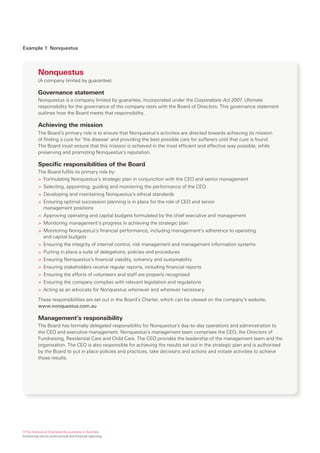
          Nonquestus is a company limited by guarantee, incorporated under the Corporations Act 2001. Ultimate
          responsibility for the governance of the company rests with the Board of Directors. This governance statement
          outlines how the Board meets that responsibility.

          Achieving the mission
          The Board’s primary role is to ensure that Nonquestus’s activities are directed towards achieving its mission
          of finding a cure for ‘the disease’ and providing the best possible care for sufferers until that cure is found.
          The Board must ensure that this mission is achieved in the most efficient and effective way possible, while
          preserving and promoting Nonquestus’s reputation.

          Specific responsibilities of the Board
          The Board fulfils its primary role by:
          > Formulating Nonquestus’s strategic plan in conjunction with the CEO and senior management
          > Selecting, appointing, guiding and monitoring the performance of the CEO
          > Developing and maintaining Nonquestus’s ethical standards
          > Ensuring optimal succession planning is in place for the role of CEO and senior
            management positions
          > Approving operating and capital budgets formulated by the chief executive and management
          > Monitoring management’s progress in achieving the strategic plan
          > Monitoring Nonquestus’s financial performance, including management’s adherence to operating
            and capital budgets
          > Ensuring the integrity of internal control, risk management and management information systems
          > Putting in place a suite of delegations, policies and procedures
          > Ensuring Nonquestus’s financial viability, solvency and sustainability
          > Ensuring stakeholders receive regular reports, including financial reports
          > Ensuring the efforts of volunteers and staff are properly recognised
          > Ensuring the company complies with relevant legislation and regulations
          > Acting as an advocate for Nonquestus whenever and wherever necessary.

          These responsibilities are set out in the Board’s Charter, which can be viewed on the company’s website,
          www.nonquestus.com.au

          Management’s responsibility
          The Board has formally delegated responsibility for Nonquestus’s day-to-day operations and administration to
          the CEO and executive management. Nonquestus’s management team comprises the CEO, the Directors of
          Fundraising, Residential Care and Child Care. The CEO provides the leadership of the management team and the
          organisation. The CEO is also responsible for achieving the results set out in the strategic plan and is authorised
          by the Board to put in place policies and practices, take decisions and actions and initiate activities to achieve
          those results.


©The Institute of Chartered Accountants in Australia
Enhancing not-for-profit annual and financial reporting
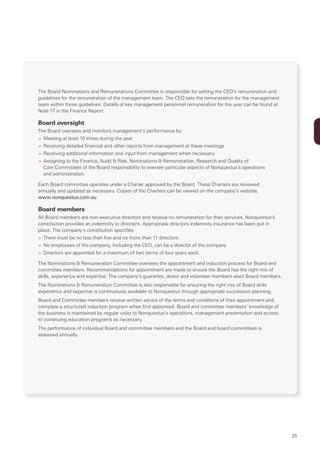
The Board Nominations and Remunerations Committee is responsible for setting the CEO’s remuneration and
guidelines for the remuneration of the management team. The CEO sets the remuneration for the management
team within those guidelines. Details of key management personnel remuneration for the year can be found at
Note 17 in the Finance Report.

Board oversight
The Board oversees and monitors management’s performance by:
> Meeting at least 10 times during the year
> Receiving detailed financial and other reports from management at these meetings
> Receiving additional information and input from management when necessary
> Assigning to the Finance, Audit & Risk, Nominations & Remuneration, Research and Quality of
  Care Committees of the Board responsibility to oversee particular aspects of Nonquestus’s operations
  and administration.

Each Board committee operates under a Charter approved by the Board. These Charters are reviewed
annually and updated as necessary. Copies of the Charters can be viewed on the company’s website,
www.nonquestus.com.au

Board members
All Board members are non-executive directors and receive no remuneration for their services. Nonquestus’s
constitution provides an indemnity to directors. Appropriate directors indemnity insurance has been put in
place. The company’s constitution specifies:
> There must be no less than five and no more than 11 directors
> No employees of the company, including the CEO, can be a director of the company
> Directors are appointed for a maximum of two terms of four years each.

The Nominations & Remuneration Committee oversees the appointment and induction process for Board and
committee members. Recommendations for appointment are made to ensure the Board has the right mix of
skills, experience and expertise. The company’s guarantor, donor and volunteer members elect Board members.
The Nominations & Remuneration Committee is also responsible for ensuring the right mix of Board skills
experience and expertise is continuously available to Nonquestus through appropriate succession planning.
Board and Committee members receive written advice of the terms and conditions of their appointment and
complete a structured induction program when first appointed. Board and committee members’ knowledge of
the business is maintained by regular visits to Nonquestus’s operations, management presentation and access
to continuing education programs as necessary.
The performance of individual Board and committee members and the Board and board committees is
assessed annually.


                                                                                                              25
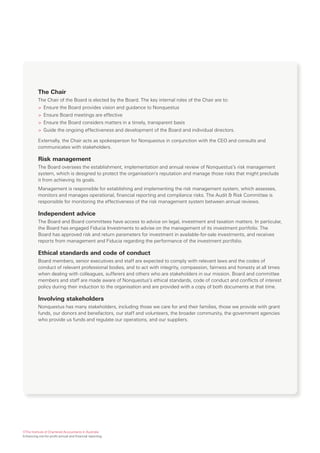
The Chair
          The Chair of the Board is elected by the Board. The key internal roles of the Chair are to:
          > Ensure the Board provides vision and guidance to Nonquestus
          > Ensure Board meetings are effective
          > Ensure the Board considers matters in a timely, transparent basis
          > Guide the ongoing effectiveness and development of the Board and individual directors.

          Externally, the Chair acts as spokesperson for Nonquestus in conjunction with the CEO and consults and
          communicates with stakeholders.

          Risk management
          The Board oversees the establishment, implementation and annual review of Nonquestus’s risk management
          system, which is designed to protect the organisation’s reputation and manage those risks that might preclude
          it from achieving its goals.
          Management is responsible for establishing and implementing the risk management system, which assesses,
          monitors and manages operational, financial reporting and compliance risks. The Audit & Risk Committee is
          responsible for monitoring the effectiveness of the risk management system between annual reviews.

          Independent advice
          The Board and Board committees have access to advice on legal, investment and taxation matters. In particular,
          the Board has engaged Fiducia Investments to advise on the management of its investment portfolio. The
          Board has approved risk and return parameters for investment in available-for-sale investments, and receives
          reports from management and Fiducia regarding the performance of the investment portfolio.

          Ethical standards and code of conduct
          Board members, senior executives and staff are expected to comply with relevant laws and the codes of
          conduct of relevant professional bodies, and to act with integrity, compassion, fairness and honesty at all times
          when dealing with colleagues, sufferers and others who are stakeholders in our mission. Board and committee
          members and staff are made aware of Nonquestus’s ethical standards, code of conduct and conflicts of interest
          policy during their induction to the organisation and are provided with a copy of both documents at that time.

          Involving stakeholders
          Nonquestus has many stakeholders, including those we care for and their families, those we provide with grant
          funds, our donors and benefactors, our staff and volunteers, the broader community, the government agencies
          who provide us funds and regulate our operations, and our suppliers.


©The Institute of Chartered Accountants in Australia
Enhancing not-for-profit annual and financial reporting
Example 2: Ludus Inc


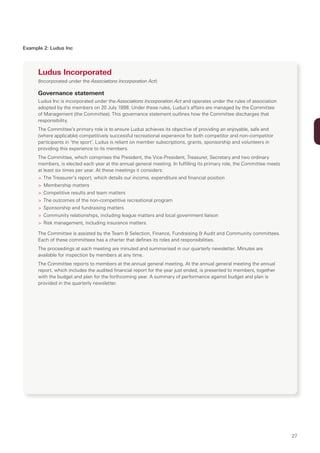
      Ludus Incorporated
      (Incorporated under the Associations Incorporation Act)

      Governance statement
      Ludus Inc is incorporated under the Associations Incorporation Act and operates under the rules of association
      adopted by the members on 20 July 1998. Under these rules, Ludus’s affairs are managed by the Committee
      of Management (the Committee). This governance statement outlines how the Committee discharges that
      responsibility.
      The Committee’s primary role is to ensure Ludus achieves its objective of providing an enjoyable, safe and
      (where applicable) competitively successful recreational experience for both competitor and non-competitor
      participants in ‘the sport’. Ludus is reliant on member subscriptions, grants, sponsorship and volunteers in
      providing this experience to its members.
      The Committee, which comprises the President, the Vice-President, Treasurer, Secretary and two ordinary
      members, is elected each year at the annual general meeting. In fulfilling its primary role, the Committee meets
      at least six times per year. At these meetings it considers:
      > The Treasurer’s report, which details our income, expenditure and financial position
      > Membership matters
      > Competitive results and team matters
      > The outcomes of the non-competitive recreational program
      > Sponsorship and fundraising matters
      > Community relationships, including league matters and local government liaison
      > Risk management, including insurance matters.

      The Committee is assisted by the Team & Selection, Finance, Fundraising & Audit and Community committees.
      Each of these committees has a charter that defines its roles and responsibilities.
      The proceedings at each meeting are minuted and summarised in our quarterly newsletter. Minutes are
      available for inspection by members at any time.
      The Committee reports to members at the annual general meeting. At the annual general meeting the annual
      report, which includes the audited financial report for the year just ended, is presented to members, together
      with the budget and plan for the forthcoming year. A summary of performance against budget and plan is
      provided in the quarterly newsletter.


                                                                                                                         27
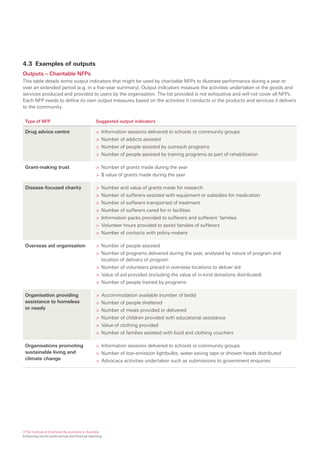
4.3 Examples of outputs
Outputs – Charitable NFPs
This table details some output indicators that might be used by charitable NFPs to illustrate performance during a year or
over an extended period (e.g. in a five-year summary). Output indicators measure the activities undertaken or the goods and
services produced and provided to users by the organisation. The list provided is not exhaustive and will not cover all NFPs.
Each NFP needs to define its own output measures based on the activities it conducts or the products and services it delivers
to the community.

 Type of NFP                                       Suggested output indicators

 Drug advice centre                                > Information sessions delivered to schools or community groups
                                                   > Number of addicts assisted
                                                   > Number of people assisted by outreach programs
                                                   > Number of people assisted by training programs as part of rehabilitation

 Grant-making trust                                > Number of grants made during the year
                                                   > $ value of grants made during the year

 Disease-focused charity                           > Number and value of grants made for research
                                                   > Number of sufferers assisted with equipment or subsidies for medication
                                                   > Number of sufferers transported of treatment
                                                   > Number of sufferers cared for in facilities
                                                   > Information packs provided to sufferers and sufferers’ families
                                                   > Volunteer hours provided to assist families of sufferers
                                                   > Number of contacts with policy-makers

 Overseas aid organisation                         > Number of people assisted
                                                   > Number of programs delivered during the year, analysed by nature of program and
                                                     location of delivery of program
                                                   > Number of volunteers placed in overseas locations to deliver aid
                                                   > Value of aid provided (including the value of in-kind donations distributed)
                                                   > Number of people trained by programs

 Organisation providing                            > Accommodation available (number of beds)
 assistance to homeless                            > Number of people sheltered
 or needy                                          > Number of meals provided or delivered
                                                   > Number of children provided with educational assistance
                                                   > Value of clothing provided
                                                   > Number of families assisted with food and clothing vouchers

 Organisations promoting                           > Information sessions delivered to schools or community groups
 sustainable living and                            > Number of low-emission lightbulbs, water-saving taps or shower heads distributed
 climate change                                    > Advocacy activities undertaken such as submissions to government enquiries


©The Institute of Chartered Accountants in Australia
Enhancing not-for-profit annual and financial reporting
Outputs – sporting NFPs
This table details some output indicators that might be used by sporting NFPs to illustrate performance during a year or
over an extended period (e.g. in a five-year summary). Output indicators measure the activities undertaken or the goods or
services produced or provided to users by the organisation. The list in this table is not exhaustive and will not cover all NFPs.
Each NFP needs to define its own output measures based on the activities it conducts or the products and services it delivers
to the community. The suggested indicators will need to be modified for the specific circumstances of the NFP (local club,
regional or state league or association or national body).

 Nature of output                 Suggested output indicators

 Promotion and                    > Number of promotion events conducted
 development                      > Number of promotion kits distributed
                                  > Media coverage
                                  > Number of contacts with relevant local, state or national government politicians
                                    or officers
                                  > Number of coaching clinics conducted

 Competition                      > Number of events mounted
                                  > Number of events participated in
                                  > Teams fielded

 Participation                    > Number of members registered with the NFP
                                  > Number of members participating during the season

 Encouragement and talent         > Number of development squads conducted
 development                      > Number of members selected for regional, state or national training squads

 Coaching development             > Number of coaching information sessions conducted
                                  > Number of enrolments for coaching education programs
                                  > Number attending accreditation sessions
                                  > Number of new coaches accredited during the year
                                  > Number of coaches retaining accreditation

 Official development             > Number of officials’ information sessions conducted
                                  > Number of update sessions conducted
                                  > Number of enrolments for official education programs
                                  > Number attending accreditation sessions
                                  > Number of new officials accredited during the year
                                  > Number of officials retaining accreditation

 Compliance                       > Number of player education (including anti-doping) workshops conducted
                                  > Number of players subjected to drug tests
                                  > Number of drug tests conducted


                                                                                                                               29
4.4 Examples of outcomes
Outcomes – charitable NFPs
This table details some outcome indicators that might be used by charitable NFPs to illustrate performance during a year or
over an extended period (e.g. in a five-year summary). Outcomes are the impacts on or the consequences for the community
resulting from the NFP’s activities. They could be expressed as changes, benefits, learning or other effects. The list is
not exhaustive and will not cover all NFPs. Each NFP needs to define its own outcome indicators based on the activities
conducted or the products and services it delivers to the community. In certain circumstances outcomes may be best
illustrated by individual examples, case studies or testimonials.

 Nature of output                                  Suggested output indicators

 Drug advice centre                                > Penetration of drug use in the community served by the centre
                                                   > Number of program participants who re-present
                                                   > Number of people assisted by training programs as part of rehabilitation who find
                                                     full-time employment

 Grant-making trust                                > Expected and actual outcomes of activity funded by the grant (e.g. research results,
                                                     students who complete education)

 Disease-focused charity                           > Outcome of research funded by the organisation (e.g. changes in the approach to care)
                                                   > Prevalence or occurrence of the disease
                                                   > Expected outcome for sufferers of the disease
                                                   > Feedback from sufferers or their families (survey results)
                                                   > Advocacy outcomes – changes in legislation or regulation; funding provided or
                                                     research or facilities

 Overseas aid organisation                         > Economic benefits to the community – the number of microbusinesses started, and
                                                     their progress, livestock purchased, agricultural improvements and their progress, etc
                                                   > Measures of the standard of living of the community, such as percentage with access
                                                     to clean water, vaccinated or malnourished
                                                   > Educational benefits to the community – number of children completing primary school

 Organisation providing                            > Utilisation of care – number of bed nights provided as a percentage of bed
 assistance to homeless                              nights available
 or needy                                          > Number of homeless in the community
                                                   > Number moved to permanent accommodation
                                                   > Advocacy outcomes – changes in legislation or regulation, funding provided for facilities
                                                   > Number of children completing education to a certain level as a result of
                                                     assistance provided

 Organisations promoting                           > Changes in water or energy consumption in the community served by the organisation
 sustainable living and                            > Changes in emissions by the community served by the organisation
 climate change                                    > Changes in policy, legislation or regulation as a result of advocacy activities


©The Institute of Chartered Accountants in Australia
Enhancing not-for-profit annual and financial reporting
Outcomes – sporting NFPs
This table details some outcome indicators that might be used by sporting NFPs to illustrate performance during a year or
over an extended period (e.g. in a five-year summary). Outcomes are the impacts on or the consequences for the community
resulting from the NFP’s activities. They could be expressed as changes, benefits, learning or other effects. The list in this
table is not exhaustive and will not cover all NFPs. Each NFP needs to define its own outcome indicators based on the
activities conducted or the products and services it delivers to the community. In certain circumstances outcomes may
be best illustrated by individual examples, case studies or testimonials.

 Nature of outcome               Suggested outcome indicators

 Promotion and                   > Number of new participants recruited
 development                     > Growth in number of participants
                                 > Percentage of young people in the ‘catchment area’ who participate in the sport
                                 > New facilities made available or funded

 Competition                     > Competition results (team and individual)
                                 > Improvement in results compared to previous seasons

 Participation                   > Percentage of registered members who participated in competitive or recreational
                                   activities during the year
                                 > Number of members participating in the sport during the season

 Encouragement and               > Number of members selected for training squads who are selected for regional,
 talent development                state or national teams

 Coaching development            > Number of new coaches accredited

 Official development            > Number of new officials accredited

 Compliance                      > Outcomes of drug tests
                                 > Outcomes of tribunals


                                                                                                                            31
4.5 GRI reporting principles and the not-for-profit sector
What are GRI reporting principles?
The Global Reporting Initiative (GRI) has pioneered the development of the world’s most widely used sustainability
reporting framework and is committed to its continuous improvement and application worldwide. The GRI framework
sets out the principles and indicators that organisations can use to measure and report their economic, environmental,
and social performance. GRI has a vision that ‘disclosure on economic, environmental and social performance becomes
as commonplace and comparable as financial reporting and as important to organisational success’.

Non-government organisation sector supplement
Since the release of this publication’s second edition, the GRI has released its Sustainability Reporting Guidelines &
NGO Sector Supplement. This publication can be downloaded from www.globalreporting.org/ReportingFramework/
SectorSupplements. This publication reflects GRI’s premise that ‘the process of reporting provides opportunities to
assess an organisation’s policies and programs and effectiveness, and the economic, social and environmental impacts
of its activities. More importantly, through the process of reporting an NGO can critically examine its own activities,
benchmark itself with other organisations, learn from experience, and make improvements over time to better serve
the causes it pursues’.

Integrated reporting
‘Integrated reporting’ have become the new buzz words around best practice reporting. In August 2010, the formation of
the International Integrated Reporting Committee (IIRC) was announced. Members of the IIRC include GRI, Accounting for
Sustainability (a Prince of Wales charity) and the International Federation of Accountants (IFAC). The IIRC has been created
to respond to the need for a concise, clear, comprehensive and comparable integrated reporting framework structured
around an organisation’s strategic objectives, its governance and business model and both its material financial and
non-financial information. More information is available at www.integratedreporting.org

Comparison to AASB Framework
The following principles were identified by the GRI for defining report content and quality. The current Australian
Accounting Standards Board (AASB) Framework defines the four principle qualitative characteristics of financial reports
as understandability, relevance, reliability (including completeness and neutrality) and comparability. The Framework
also covers constraints such as timeliness and true and fair presentation, demonstrating clear similarities between
good practice principles for financial reporting and the reporting principles espoused by the GRI.


©The Institute of Chartered Accountants in Australia
Enhancing not-for-profit annual and financial reporting
Defining reporting content
In order to ensure a balanced and reasonable presentation of the organisation’s performance, the content in the annual
report should be well planned with consideration of both the organisation’s purpose and experience, and the reasonable
expectations and interests of the organisation’s stakeholders.
NFPs enjoy the trust of the broad community on the assumption that they will spend their funds wisely and effectively.
NFPs must transparently communicate what they are trying to do and how they are trying to achieve their goals.
Reports by an NFP must show whether it has achieved its objectives during the year and explain its plans for the future.

 Principle                                                                  Application to NFPs

 Materiality          The information in a report should cover topics       NFPs will need to evaluate the importance of
                      and indicators that reflect the organisation’s        information included in their annual reports to
                      significant economic, environmental and social        ensure the information reflects the significant
                      impacts, or those would substantively influence       impacts of what they are trying to do and how
                      the assessments and decisions of stakeholders.        they are going about it. Consideration also needs
                      Other information can be included but the             to be given to the inclusion of information that is
                      emphasis should be on the most material topics.       fundamental to stakeholder decision-making.

 Stakeholder          The reporting organisation should identify its        The NFP should engage its stakeholders in
 inclusiveness        stakeholders and explain in the report how it         preparing and enhancing the quality of reports.
                      has responded to their reasonable expectations        Engaging NFP stakeholders involves
                      and interests.                                        acknowledging the involvement and contribution
                                                                            of volunteers and other supporters, and the
                                                                            receipt of funding from governments, the public,
                                                                            philanthropic trusts and foundations. In certain
                                                                            situations it is important to demonstrate how the
                                                                            organisation takes account of the views of the
                                                                            beneficiaries of (or participants in) its program
                                                                            or services or the sports offered.

 Sustainability       The report should present the organisation’s          The annual report could include commentary
 context              performance in the wider context of                   and quantitative data on the NFP’s approach
                      sustainability, by disclosing how the                 to ensuring its activities are sustainable in the
                      organisation contributes or aims to contribute        broader sense. The World Business Council for
                      in the future to the improvement of economic,         Sustainable Development defines sustainable
                      environmental and social conditions and               development as forms of progress that ’meet the
                      developments and trends at the local, regional,       needs of the present without compromising the
                      or global level.                                      ability of future generations to meet their needs’.
                                                                            In many instances the organisation’s activities
                                                                            will be contributing to the sustainability of, for
                                                                            example, the local community.

 Completeness         Coverage of the material topics and indicators        All material information should be disclosed
                      and definition of the range of entities whose         in the report. The interpretation of financial
                      performance is represented by the report              information is enhanced by the inclusion of input,
                      (report boundary) should be sufficient to reflect     output and outcome measures in NFP reports.
                      significant economic, environmental, and social       This provides stakeholders with evidence of what
                      impacts and enable stakeholders to assess the         the NFP funding achieves rather than simply how
                      reporting organisation’s performance in the           it has been spent.
                      reporting period.


                                                                                                                              33
Defining report quality
The quality of information enables stakeholders to make sound and reasonable assessments of performance, and take
appropriate action. These principles guide choices on ensuring the quality of reported information, including its proper
presentation. Decisions related to the process of preparing information in a report should be consistent with these
principles, as shown below, which are fundamental for effective transparency.

 Principle                                                                           Application to NFPs

 Balance                         The report should reflect positive and              Reports should be neutral and avoid bias.
                                 negative aspects of the organisation’s              NFPs should report honestly on the events,
                                 performance to enable a reasoned                    activities or strategies that have impacted
                                 assessment of overall performance.                  on their performance. The same approach
                                                                                     should be taken with both satisfactory and
                                                                                     unsatisfactory performance.
                                                                                     NFPs should avoid presenting their reports
                                                                                     as public relations documents designed to
                                                                                     elicit donations.

 Comparability                   Issues and information should be selected,          Reports should be consistent and allow
                                 compiled, and reported consistently.                comparison to earlier reports and to other
                                 Reported information should be presented            comparable organisations. The provision of
                                 in a manner that enables stakeholders               comparative information allows comparisons
                                 to analyse changes in the organisation’s            with published plans and the outcomes of
                                 performance over time, and could support            previous periods.
                                 analysis relative to other organisations.

 Accuracy                        The reported information should be sufficiently     Reports should be accurate to enable users to
                                 accurate and detailed for stakeholders to assess    make decisions with confidence. The provision
                                 the reporting organisation’s performance.           of audit reports enhances users’ confidence in
                                                                                     the NFP’s reports.

 Timeliness                      Reporting occurs on a regular schedule and          In addition to issuing their reports on a timely
                                 information is available in time for stakeholders   basis, NFPs need to ensure their reports provide
                                 to make informed decisions.                         an opportunity to explain future plans and
                                                                                     developments in the environment the NFPs
                                                                                     operate in.

 Clarity                         Information should be made available in a           The interpretation of quantitative information
                                 manner that is understandable and accessible        will be enhanced by narrative explanations.
                                 to stakeholders using the report.                   Consideration should also be given to the use
                                                                                     of colour, picture, charts and tables to further
                                                                                     enhance the reader’s understanding of the
                                                                                     information presented in the report.

 Reliability                     Information and processes used in the               The provision of audit reports enhances the
                                 preparation of a report should be gathered,         confidence that can be placed in the information
                                 recorded, compiled, analysed, and disclosed in      included in the NFP’s reports. The external audit
                                 a way that could be subject to examination and      and reporting of the results of that audit (whether
                                 that establishes the quality and materiality of     financial or, for example, quality or compliance)
                                 the information.                                    is encouraged.


©The Institute of Chartered Accountants in Australia
Enhancing not-for-profit annual and financial reporting
5. Guidance when producing a financial report
What type of financial report?                                  AASB 1053 creates two tiers of financial reporting for those
An NFP’s Board or governing body decides on the type            entities producing GPFRs:
of financial report to present to the NFP’s stakeholders.
The purpose of this guidance is to assist in making that        Tier 1   Requires compliance with Australian Accounting
decision, which must consider the needs of the users and                 Standards and the preparation of general purpose
relevant legislative requirements.                                       financial statements. Tier 1 applies to for-profit
                                                                         entities in the private sector that have public
The Australian financial reporting framework allows for                  accountability and to the Australian state,
two types of financial reports: a ‘general purpose financial             territory and local governments.
report’ (GPFR) and a ‘special purpose financial report‘
(SPFR). The majority of NFPs prepare a GPFR for presentation    Tier 2   Requires compliance with all the recognition and
to their stakeholders.                                                   measurement requirements of Australian Accounting
                                                                         Standards but allows substantially reduced disclosure
GPFRs are those intended to meet the needs of users who                  requirements. Tier 2 may be applied by all NFPs,
are not in a position to demand reports tailored to meet                 although an NFP may elect, or may be required by
their particular information needs. GPFRs include those that             regulation or statute, to apply Tier 1 reporting.
are presented separately or within another public document
such as an annual report or prospectus. The alternative, an
SPFR, is defined as ‘a financial report other than a general    NFPs have the choice to ‘early adopt’ the RDR. Based on
purpose financial report’.                                      our observations, many entities currently producing GPFRs
On the following pages we provide decision trees to assist      are considering adopting the Tier 2 requirements of the RDR
NFPs to determine which of these types of financial report      before its application date of 1 July 2013.
will meet their stakeholders’ needs.                            The decision trees on pages 37 to 41 will assist you to
Having made this decision, the NFP Board may wish to            navigate the accounting standards both as it applies to
consider whether the NFP will ‘early adopt’ the Reduced         GPFRs, SPFRs and the RDR.
Disclosure Regime (RDR), whether any reduced reporting
available through the ‘tiering’ arrangements under the
                                                                What legislative changes have been made
Corporations Act should be applied, or whether they need        to limited by guarantee companies?
to consider the provisions of the Associations Incorporations   Many NFPs are incorporated as companies limited
Act. The decision trees on the following pages will assist      by guarantee and are subject to the provisions of the
in these deliberations.                                         Corporations Act 2001. The Corporations Amendment
                                                                (Corporate Reporting Reform) Act 2010 was passed in late
How does the Reduced Disclosure                                 June 2010. This Act split companies limited by guarantee
Regime apply?                                                   into three tiers – not to be confused with the RDR tiers
On 30 June 2010 the AASB released AASB 1053                     described above.
Application of Tiers of Australian Accounting Standards         Section 285A of the Corporations Act 2001 sets out the
and AASB 2010 – 2 Amendments to Australian Accounting           reporting framework applicable to the three tiers of
Standards Arising from Reduced Disclosure Requirements.         companies limited by guarantee:
These standards apply to annual reporting periods
beginning on or after 1 July 2013 but, provided that both       Tier 1    Companies with revenue of less than $250,000 that
standards are applied, earlier application is permitted for               are not deductible gift recipients within the meaning
annual reporting periods beginning on or after 1 July 2009.               of the Income Tax Assessment Act 1997 do not need
                                                                          to prepare or lodge any financial reports.

                                                                Tier 2    Companies with revenues of more than $250,000
                                                                          but less than $1 million are required to prepare and
                                                                          lodge a financial report but they may elect to have
                                                                          that report reviewed rather than audited.

                                                                Tier 3    Companies with revenue of $1 million or more
                                                                          must lodge a financial report.


                                                                                                                                 35
What is included in the example
financial report?
Section 5.2 contains an example annual financial report
for a fictional NFP. We emphasise that this report has been
provided for guidance to disclosures only. It is not meant
to provide definitive guidance as to the application of
accounting standards in particular circumstances.
The example annual financial report has been compiled as
a general purpose financial report on the basis that Tier 2
differential reporting has not been adopted. However, to
assist those entities that elect to adopt AASB 1053 and
AASB 2010 – 2 before 1 July 2013 and implement a reduced
disclosure regime, we have highlighted the disclosures that
may be removed by shading the text in grey.
The new or changed reduced disclosure requirements
required by AASB 2010 – 2 are shown as white text on a
black background.

What about legislative changes in the
State and Territory Associations
Incorporation Acts?
The various state and territory Association Incorporations Acts
provide an alternative means of incorporation for NFPs. There
are eight such Acts in place. Each has different financial
reporting and auditing requirements and different criteria
for applying differential reporting or audit requirements. Any
incorporated association NFP should be familiar with the
financial reporting and auditing provisions
of the legislation that applies to it.
A summary of the financial reporting and auditing provisions
of each State and Territory Association Incorporations Acts
is provided on pages 89 to 99.
We strongly recommend that Boards, chief executives and
the senior finance executives of NFPs discuss the financial
reporting and auditing requirements for their organisation
with their professional advisors. When a decision is reached
to prepare a SPFR, we recommend this decision be recorded
in the minutes, with appropriate rationale, and that the
decision be revisited on an annual basis.


©The Institute of Chartered Accountants in Australia
Enhancing not-for-profit annual and financial reporting
5.1 Decision trees

Decision 1: Are you a reporting entity?


                                                                                                     In answering this question you
                                                                                                     need to consider donors, sponsors
                                                      Who are your stakeholders?                     volunteers,staff, the public, grant
                                                                                                     providers, regulators, suppliers,
                                                                                                     program beneficiaries, interest
                                                                                                     groups and affiliated bodies


 Many stakeholders, operate                                                                          Few stakeholders, operate in a
                                        Widespread                                  Limited spread
 Australia wide and/or                                   How widespread are                          limited geographic area (e.g. in
 internationally                                          your stakeholders?                         one suburb or a country town)


 Whole management team is                                                                            The NFP is managed by the
 employed with little volunteer              Yes                                       No            stakeholders, including volunteers,
                                                      Is management separated
 involvement; professional                                                                           or a small management team is
                                                          from stakeholders?
 workforce involved in delivery of                                                                   employed and supplemented by
 services or running day-to-day                                                                      volunteers; activities conducted by
 activities; governing Board includes                                                                volunteers; governed by a Board of
 ‘outsiders’ with specific skills                                                                    volunteers


 Significant community impact                Yes           Does the NFP have           No            Impact limited to a specific
 and/or representing a number of                         a significant impact on                     community and one group
 communities or affiliated bodies                       the broad community or                       within that community
                                                       represent a broad group?


 If most of your responses fall                                                                      If most of your responses fall on
 on this side of the decision tree,          Yes        Is the NFP in receipt of       No            this side of the decision tree, you
 you are a reporting entity. You                     government or philanthrophic                    may not be a non-reporting entity.
 must prepare a general purpose                         grants and/or reliant on                     You can choose to prepare a
 financial report                                              donations?                            special purpose financial report


       Go to Decision 2                                                                                    Go to Decision 5


                                                                                                                                        37
5.1 Decision trees (continued)

Decision 2: Does your NFP entity want to adopt AASB1053 early? (refer to note below)


Start here                                                Does your NFP want to elect to take advantage of the reduced
                                                          disclosure regime (RDR) available under AASB 1053?


                               No                                                Yes


                           Go to                                    Does the NFP’s Constitution
                         Decision 3                       No
                                                                    prevent the use of an RDR?


                                                                                 Yes


                                                                 Has the governing body decided, or
                                                                 a regulator mandated, the adoption        No               Go to
                                                                                                                          Decision 4
                                                                  of Tier 1 reporting as specified in
                                                                              AASB 1053?


                                                                                 Yes


                                       Record Board resolution regarding decision to elect to adopt Tier 1 reporting


                                                                         Go to Decision 3


                         Note: AASB 1053 Application of Tiers of Australian Accounting Standards ‘applies to annual
                               reporting periods beginning on or after 1 July 2013’ but ‘may be applied to annual
                               reporting periods beginning on or after 1 July 2009 but before 1 July 2013. When an
                               entity applies this Standard to such an annual reporting period it shall disclose that fact’.


©The Institute of Chartered Accountants in Australia
Enhancing not-for-profit annual and financial reporting
5.1 Decision trees (continued)

Decision 3: What do you include in a general purpose financial report or Tier 1 report under AASB 1053?


Start here                                    Determine your basis of incorporation


     Company limited by guarantee –                   Incorporated association                    Other – royal charter, specific
          a public company                                                                           legislation trust deed


    Make sure you comply with the reporting         Make sure you comply with the                 Make sure you comply with the
     requirements of the Corporations Act           reporting requirements of the               reporting requirements of the trust
     2001 having regard to the ‘tiering’ of          Associations Incorporations                    deed, charter or legislation
      companies limited by guarantee, as                 legislation (Note 2)
         summarised in Note 1 below


                                               Apply all relevant Accounting Standards


                                 If your activities are subject to fundraising legislation, include
                                    in your financial report information required by legislation


                     If you subscribe to the Australian Council for International Development (ACFID) Code,
                   include in your financial report information necessary to satisfy requirements of that code


                                                        Finalise report and
                                                       send to stakeholders


                Note 1: Section 285A of the Corporations Act specifies that a company limited by guarantee:
                        > That has less than $250,000 revenue and is not a deductible gift recipient may elect
                          not to prepare or lodge any financial reports
                        > That has annual revenue of between $250,000 and $1 million must prepare and lodge
                          a financial report but may elect to have it reviewed rather than audited
                        > That has annual revenue exceeding $1 million must lodge an audited financial report.

                Note 2: Refer to Section 6 for the financial reporting requirements of the various state and
                        territory Associations Incorporations legislation.


                                                                                                                                      39
5.1 Decision trees (continued)

Decision 4: What do you include in a Tier 2 general purpose financial report under AASB 1053?


Start here                                                Determine your basis of incorporation


         Company limited by guarantee –                           Incorporated association                    Other – royal charter, specific
              a public company                                                                                   legislation trust deed


       Make sure you comply with the reporting                  Make sure you comply with the                 Make sure you comply with the
        requirements of the Corporations Act                    reporting requirements of the               reporting requirements of the trust
        2001 having regard to the ‘tiering’ of                   Associations Incorporations                    deed, charter or legislation
         companies limited by guarantee, as                          legislation (Note 2)
            summarised in Note 1 below


                               Apply all relevant recognition, measurement, disclosures and presentation requirements
                                                  of Accounting Standards as required by AASB 1053


                                 If your activities are subject to fundraising legislation, include in your financial report
                                                             information required by legislation


                               If you subscribe to the Australian Council for International Development (ACFID) Code,
                             include in your financial report information necessary to satisfy requirements of that code


                                                                    Finalise report and
                                                                   send to stakeholders


                         Note 1: Section 285A of the Corporations Act specifies that a company limited by guarantee:
                                 > That has less than $250,000 revenue and is not a deductible gift recipient may elect
                                   not to prepare or lodge any financial reports
                                 > That has annual revenue of between $250,000 and $1 million must prepare and lodge
                                   a financial report but may elect to have it reviewed rather than audited
                                 > That has annual revenue exceeding $1 million must lodge an audited financial report.

                         Note 2: Refer to Section 6 for the financial reporting requirements of the various state and
                                 territory Associations Incorporations legislation.


©The Institute of Chartered Accountants in Australia
Enhancing not-for-profit annual and financial reporting
5.1 Decision trees (continued)

Decision 5: What do you include in a special purpose financial report?


Start here                                    Determine your basis of incorporation


     Company limited by guarantee –                                                               Other – royal charter, specific
                                                      Incorporated association
          a public company                                                                           legislation trust deed


    Make sure you comply with the reporting            Understand the reporting                      Understand the reporting
     requirements of the Corporations Act          requirements of the Associations               requirements of the trust deed,
     2001 having regard to the ‘tiering’ of        Incorporation legislation (Note 2)                  charter or legislation
      companies limited by guarantee, as
         summarised in Note 1 below


                  Adopt the following as minimum reporting standards:
                  > Accrual accounting
                  > Compliance with classification, recognition and measurement guidance of Accounting Standards
                    and other mandatory reporting requirements
                  > Disclosure necessary to give a ‘true and fair view’ or ‘present fairly’ so as to ensure financial
                    statements are not misleading.


                  Record Board resolution regarding the basis of preparing financial statements, including all
                             aspects of accounting standards that have not been complied with


                                Ensure basis of preparation note included in financial statements


                                 If your activities are subject to fundraising legislation, include
                             in your financial report information required by fundraising legislation


                 If you subscribe to the Australian Council for International Development (ACFID) Code, include
                        in your financial report information necessary to satisfy requirements of that code


                                                        Finalise report and
                                                       send to stakeholders


                Note 1: Section 285A of the Corporations Act specifies that a company limited by guarantee:
                        > That has less than $250,000 revenue and is not a deductible gift recipient may elect
                          not to prepare or lodge any financial reports
                        > That has annual revenue of between $250,000 and $1 million must prepare and lodge
                          a financial report but may elect to have it reviewed rather than audited
                        > That has annual revenue exceeding $1 million must lodge an audited financial report.

                Note 2: Refer to Section 6 for the financial reporting requirements of the various state and
                        territory Associations Incorporations legislation.


                                                                                                                                    41
5.2 Illustrative financial statements

Example financial report – the Nonquestus charity
The following example financial report for the year ended         Expenditure on activities
30 June 2011 is that of a fictional charitable NFP, The           Nonquestus dissects its expenditure into costs associated
Nonquestus charity. This background information is                with the generation of funds, expenditure on its charitable
provided to assist in the interpretation of the report.           activities, and support and administration costs.
Nonquestus is incorporated under the Corporations Act 2001        Costs of generating funds include fundraising and building
as a company limited by guarantee. Its activities involve:        appeal costs, costs of goods sold (costs of sales) and
> The provision of residential, day and respite care to the       investment management fees. Nonquestus pays close
  sufferers of a disease, malaise                                 attention to the ratio of fundraising costs to funds raised. As
> The provision of emergency overseas aid to children             noted above, the charity has been investing in its fundraising
  in areas experiencing famine or war who are suffering           activities and considers that there is a time lag between
  from malaise                                                    this investment and increased income from donations and
                                                                  gifts. Note 4 to the financial statements discloses ratios to
> Advocacy and information on causes supported
                                                                  demonstrate the effectiveness of fundraising activities.
  by Nonquestus.
                                                                  Expenditure on charitable activities includes costs associated
Funding and income                                                with the provision of residential, day and respite care,
Nonquestus’s activities are funded by gifts and donations         childcare and emergency costs, and costs incurred in
and legacies from deceased estates and charitable                 providing information and education on causes supported
foundations. During 2009 and 2010, Nonquestus invested in         by Nonquestus.
its fundraising activities, the results of which can be seen in
                                                                  As a company limited by guarantee, Nonquestus is required
the 20% increase in donation income during 2011. Particular
                                                                  to comply with the reporting provisions of the Corporations
emphasis has been placed on developing a corporate giving
                                                                  Act 2001. The example report therefore includes a directors’
program, which has contributed $1.1 million to Nonquestus’s
                                                                  report, directors’ declaration and auditors’ report.
funding in 2011, up from $800,000 in 2010.
                                                                  The example annual financial report has been compiled
Residential, day and respite care activities are supported
                                                                  on the basis that Tier 2 differential reporting has not been
by grants from the federal, state and local governments.
                                                                  adopted. To assist those entities that elect to adopt AASB
Fees charged to residents and users of day and respite
                                                                  1053 and AASB 2010 – 2 before 1 July 2013 and implement
care facilities are based on their capacity to pay.
                                                                  a reduced disclosure regime, we have highlighted the
A building appeal has been active for the last two years          disclosures that may be removed by adopting entities by
to raise funds for a new residential care facility. The           shading the text in grey.
appeal raised $1.3 million in 2010 and 2011 specifically
                                                                  The new or changed reduced disclosure requirements
for this purpose.
                                                                  required by AASB 2010 – 2 are shown as white text on a
In addition to its fundraising activities, Nonquestus operates    black background.
a trading enterprise which employs a number of the people
it assists. This enterprise is conducted through a mail order
operation and shops that sell both donated goods and goods
purchased for sale.
Nonquestus’s investment funds are managed by an
investment manager under a mandate that includes a risk
profile and target return.


©The Institute of Chartered Accountants in Australia
Enhancing not-for-profit annual and financial reporting
Notes to example annual financial report                          The following abbreviations have been used in the
The example financial report is based on Australian               explanatory notes and citations included in the report:
Accounting Standards that were on issue at 1 July 2010
                                                                  AASB 136.9 Australian Accounting Standard AASB 136,
and which apply to annual reporting periods beginning on
                                                                             paragraph 9
or after 1 January 2010. Other than as noted below, this
financial report does not include changes arising from new        AASB 101      Australian Accounting Standard AASB 101,
and amending standards and interpretations effective for                        issued 26 November 2010 and applicable for
periods commencing after 1 July 2010, with the exception                        reporting periods commencing on or after
of highlighting the impact of differential reporting arising                    1 January 2011
as a result of the application of AASB 1053. For a discussion     Int 1031.7    AASB & UIG Interpretation No. 1031,
of differential reporting, refer to page 35.                                    paragraph 7
The example financial report is provided for illustrative         Corp 300B     Corporations Act 2001, section 300B
purposes only, dealing with the most likely disclosure
                                                                  Note          An explanation of how the accounting
requirements of a not-for-profit entity. It does not purport to
                                                                                standards have been interpreted in arriving
show all possible accounting and disclosure requirements
                                                                                at the illustrative disclosure. These can be
and should not be regarded as a comprehensive checklist
                                                                                found at the end of the financial report.
of accounting and disclosure requirements. In particular,
it should be noted that the example financial report has
been prepared in accordance with Accounting Standard
AASB 101 Presentation of Financial Statements as issued on
26 November 2010 and incorporating relevant amendments
made up to and including 27 October 2010. It should also
be noted that there are no defined benefit superannuation
fund note disclosures included in the example financial
report. Any not-for-profit entity contributing to a defined
benefit superannuation fund should be aware that substantial
additional disclosures are required in respect of the fund.
Refer to AASB 119 Employee Benefits for further guidance.
The information contained herein is of a general nature and is
not intended to address the circumstances of any particular
not-for-profit entity. Although every attempt has been made
to provide accurate and timely information, there can be no
guarantee that such information is accurate as of the date
it is received or that it will continue to be accurate in the
future. No-one should act upon such information without
appropriate professional advice after a thorough examination
of the particular situation.


                                                                                                                               43
Nonquestus
(A company limited by guarantee)


Annual financial report
For the year ended 30 June 2011


Contents to financial report
Corporate information . . . . . . . . . . . . . . . . . . . . . . . . . . . . . . . . . . . . . . . . . . . . . . . . . . . . . . . . . . . . . . . . . . . . . . . . . . . . . . . . . . . . . . . . . . . . . . . . . . 45

Directors’ report . . . . . . . . . . . . . . . . . . . . . . . . . . . . . . . . . . . . . . . . . . . . . . . . . . . . . . . . . . . . . . . . . . . . . . . . . . . . . . . . . . . . . . . . . . . . . . . . . . . . . . . . . 46

Auditors’ declaration of independence . . . . . . . . . . . . . . . . . . . . . . . . . . . . . . . . . . . . . . . . . . . . . . . . . . . . . . . . . . . . . . . . . . . . . . . . . . . . 48

Directors’ qualifications, experience and special responsibilities . . . . . . . . . . . . . . . . . . . . . . . . . . . . . . . . . . . . . . . . . . 49

Statement of comprehensive income . . . . . . . . . . . . . . . . . . . . . . . . . . . . . . . . . . . . . . . . . . . . . . . . . . . . . . . . . . . . . . . . . . . . . . . . . . . . . . 50

Statement of financial position . . . . . . . . . . . . . . . . . . . . . . . . . . . . . . . . . . . . . . . . . . . . . . . . . . . . . . . . . . . . . . . . . . . . . . . . . . . . . . . . . . . . . . . 51

Statement of changes in funds . . . . . . . . . . . . . . . . . . . . . . . . . . . . . . . . . . . . . . . . . . . . . . . . . . . . . . . . . . . . . . . . . . . . . . . . . . . . . . . . . . . . . . 52

Statement of cash flows . . . . . . . . . . . . . . . . . . . . . . . . . . . . . . . . . . . . . . . . . . . . . . . . . . . . . . . . . . . . . . . . . . . . . . . . . . . . . . . . . . . . . . . . . . . . . . . 53

Notes to the financial statements . . . . . . . . . . . . . . . . . . . . . . . . . . . . . . . . . . . . . . . . . . . . . . . . . . . . . . . . . . . . . . . . . . . . . . . . . . . . . . . . . . . 54

Directors’ declaration. . . . . . . . . . . . . . . . . . . . . . . . . . . . . . . . . . . . . . . . . . . . . . . . . . . . . . . . . . . . . . . . . . . . . . . . . . . . . . . . . . . . . . . . . . . . . . . . . . . 82

Independent audit report . . . . . . . . . . . . . . . . . . . . . . . . . . . . . . . . . . . . . . . . . . . . . . . . . . . . . . . . . . . . . . . . . . . . . . . . . . . . . . . . . . . . . . . . . . . . . . 83


©The Institute of Chartered Accountants in Australia
Enhancing not-for-profit annual and financial reporting
Nonquestus
(A company limited by guarantee)


Corporate information

ABN 00 000 000 000


Directors                          A Borodin (Chair)
                                   M Bruch
                                   W Byrd
                                   B Britten
                                   J Cage
                                   E Elgar
                                   E Greig
                                   H Purcell
                                   F Schubert

Company Secretary                  Fiona Summersun LLB

Registered office and              Charity House
principal place of business        132 Charybyle Street
                                   Melbourne, Vic 3000

Bankers
                                   Helpful Bank
                                   Collins Street
                                   Melbourne, Australia

Auditors                           ProBono & Co
                                   Chartered Accountants


                                                           45
Nonquestus
(A company limited by guarantee)


Directors’ report
Corp 300B(2)             Your directors present this report to the members of the Nonquestus charity (the company) for the
                         year ended 30 June 2011.

                         Directors
Corp 300B(3)(a)          The names of each person who has been a director during the year and to the date of this report are:
Corp 300B (3)(c)
                                                                                                                                                  Board
                                                                                    Date appointed          Date of cessation              A              B
                         A Borodin (Chair)                                             15 Dec 01                       –                   11             11
                         M Bruch                                                       19 Jun 02                       –                   11             11
                         W Byrd                                                        19 Jun 02                       –                    8             11
                         B Britten                                                     31 Oct 03                       –                   10             11
                         J Cage                                                        30 May 04                       –                    9             11
                         E Elgar                                                       10 Dec 04                       –                    9             11
                         E Greig                                                       31 May 05                       –                    7             11
                         H Purcell                                                     27 Jul 08                       –                    9             10
                         F Schubert                                                    27 Oct 08                       –                    8              8
                         R Wagner                                                      16 Feb 00                   27 Jul 10                –              1
                         R V Williams                                                  17 May 99                   27 Jul 10                –              1

                         A – Number of meetings attended   B – Number of meetings held during the time the director held office during the year

Corp 300B (3)(b)         Details of directors’ qualifications, experience and special responsibilities can be found on page 5 of this report.

Corp 300B (1)(a) & (b)   Short- and long-term objectives and strategy
                         The company’s short- and long-term objectives are to:
                         > Alleviate the disease malaise in Australia
                         > Alleviate malaise in children experiencing famine or war
                         > Find a cure for the disease.

                         The company’s strategy for achieving these objectives includes:
                         > The provision of residential, day and respite care to sufferers of malaise in Australia
                         > The provision of emergency overseas aid to children suffering malaise in areas experiencing famine or war
                         > Funding of disease research
                         > Providing an advocacy and information service to improve outcomes for Australian malaise sufferers and for
                           child malaise sufferers’ subject to famine or war.
Corp 300B(1)(c) & (d)    Principal activities
                         The company’s principal activities during the year were:
                         > Fundraising through grants from Commonwealth, State and Local Governments, gifts, donations, legacies,
                           philanthropic grants, annual appeals and regular giving programs
                         > The provision of long-term residential and day and respite facilities on a fee-per-resident and user basis
                         > The provision of emergency overseas aid
                         > Conducting a building appeal
                         > Operating a trading enterprise that comprises a mail order operation and a number of ‘op shops’ which are
                           staffed by volunteers.
                         These activities have assisted the company in achieving its objectives by enabling it to:
                         > Fund research into a cure for malaise
                         > Provide specialised long-term residential and day and respite care to sufferers of malaise
                         > Raise $1.3 million over the 2010 and 2011 years for the building fund that has allowed planning and design to
                           commence for a new residential care facility for Australian malaise sufferers
                         > Target its overseas aid to malaise suffering children in areas experiencing famine or war
                         > Maintain a website providing information about malaise and support to sufferers of malaise
                         > Advocate on behalf of the sufferers of malaise
                         > Provide employment to some malaise sufferers through the trading enterprise.


©The Institute of Chartered Accountants in Australia
Enhancing not-for-profit annual and financial reporting
Nonquestus
(A company limited by guarantee)


Corp 300B(1)(e)         Performance measures
                        The company measures performance through the establishment and monitoring of benchmarks:
                        > To assess the cost-effectiveness of fundraising activities
                        > To assess control over the company’s administrative and other indirect costs
                        > To ensure that revenue derived is effectively being directed towards assisting malaise patients treatment in
                          Australia and towards aiding child malaise sufferers in famine and war zones
                        > To assess the effectiveness of overseas emergency aid
                        > To assess the effectiveness of Australian residential care.

                        The performance against these key performance indicators is as follows:
                                                                                            2011                        2010
                                                                                  Benchmark         Actual     Benchmark        Actual

                        Cost as % of activity revenues:
                          Fundraising                                                   7.0%         7.4%            7.0%         8.0%
                          Commercial                                                  75.0%        76.3%            75.0%       78.9%
                        Overhead cost as a % of total expenditure                       5.8%         6.8%            7.5%         6.5%
                        Expenditure on activities as % of total income:
                          Care                                                        60.0%         58.4%           60.0%       34.0%
                          Emergency aid                                               50.0%         36.1%           50.0%       44.0%
                        The number of overseas aid projects:
                          Initiated                                                      100           95             100           75
                          Completed                                                      100          110             100           80
                        The number of Australian care patients:
                          New admissions                                                  60           60              50           45
                          Long-term residencies                                           50           55              60           60
                          Successful discharges                                           70           65              60           65


Corp 300B(3)(d) & (e)   Members’ guarantee
                        In accordance with the company’s constitution, each member is liable to contribute $20 in the event that the
                        company is wound up. The total amount members would contribute is $2,500.

Corp 307C               Auditors’ independence
                        The auditors’ declaration of independence appears on page 4 and forms part of the Directors’ report for the
                        year ended 30 June 2011

ASIC CO 98/100          Rounding
                        The company is of a kind referred to in ASIC Class Order 98/100 dated 10 July 1998 and, in accordance with
                        that Class Order, amounts in the financial report and director’s report have been rounded off to the nearest
                        thousand dollars, unless otherwise stated.
Corp 298(2)             Signed in accordance with a resolution of the directors made pursuant to s. 298(2) of the Corporations Act.
                        On behalf of the directors:

                        A Borodin
                        Melbourne, 23 September 2011


                                                                                                                                         47
Nonquestus
(A company limited by guarantee)


Auditors’ declaration of independence
Corp 307C(3)(c)         To the directors of Nonquestus Limited
                        I declare that, to the best of my knowledge and belief, there have been no contraventions of:
                        (i) The auditor independence requirements of the Corporations Act 2001 in relation to the audit
                        (ii) Any applicable code of professional conduct in relation to the audit.

                        ProBono & Co
                        Chartered Accountants

                        Gary Goodfellow
                        Partner
                        Melbourne, 23 September 2011


©The Institute of Chartered Accountants in Australia
Enhancing not-for-profit annual and financial reporting
Nonquestus
(A company limited by guarantee)


Directors’ qualifications, experience and special responsibilities
Corp 300B(3)(b)
                                                                                                          Special
                  Name               Qualifications           Experience                                  responsibilities

                  Albert Borodin     BSc, FAICD               Chairman of MultiNatio Limited;             Chair
                                                              Director of Tabula Arts Limited and
                                                              Pecunia Bank Limited. Board member
                                                              for over eight years.

                  Maxine Bruch       BComm, FCA               Partner, Propter Chartered Accountants      Finance,
                                                              for 10 years. Board member for seven        Remuneration and
                                                              years.                                      Audit Committees

                  Wayne Byrd         BBus (Marketing)         Director, Mancipo Advertising Limited.      Marketing &
                                                              Board member for seven years.               Communications

                  Brenda Britten     BA, Grad Dip Health      Board member for over five years.           Audit Committee,
                                     Services Management      Executive Director of the Federal           Quality of Care
                                                              Department of Communities.                  Committee

                  James Cage         BComm LLB, Solicitor     Partner, LexLegis Lawyers specialising      Finance and
                                                              in corporate and contract law. Board        Remuneration
                                                              member for five years.                      Committees

                  Elaine Elgar       BA                       Malaise survivor. Board member for          Quality of Care
                                                              over four years.                            Committee

                  Eric Greig         MD, FRACS                Retired medical practitioner specialising
                                                              in the care of malaise sufferers. Board
                                                              member for over four years.

                  Herbert Purcell                             Retired Director of Externus Care UK,
                                                              an organisation that delivered care to
                                                              children in Bosnia Herzegovina during
                                                              the conflict in that country. Joined the
                                                              Board during the year after returning to
                                                              Australia in early 2010.

                  Francis Schubert   BA, Grad Dip Marketing   Founding Director of FrigusVestis           Marketing &
                                                              Apparel. Joined the Board during the        Communications
                                                              current year.


                                                                                                                             49
Nonquestus
(A company limited by guarantee)

Financial statements for the year ended 30 June 2011


AASB 101.10(b),
.81(b), .82, Note 1     Statement of comprehensive income
AASB 101.51(c),(e                                                                                                      2011     2010
AASB 101.113                                                                                    Note                  $’000    $’000


AASB 101.82(a)          Revenue and other income
AASB 101.85             Fundraising:                                                            2(c)
                              Donations & gifts                                                 3(a)                  7,330    6,000
                              Legacies                                                                                2,150    1,330
                              Building appeal                                                                          400      900
                        Residential care:
                              Government funding                                                                       700      400
                              Fees from residents                                                                     1,200    1,000
                        Sales of goods                                                                                1,140     900
                        Investment income                                                       2(c), 3(a)             380       475
                        Net gain on foreign exchange                                            2(c)                    20         –
                        Net gain on disposal of available-for-sale investments                  2(c)                   500       115
                        Net gain on disposal of fixed assets                                    2(c)                    20       30
AASB 101.82(a)          Revenue & other income                                                  3(a), (b)        13,840       11,150

AASB 101.99             Fundraising expenses                                                    2(d)                   690      550
                        Building appeal costs                                                                           45       110
                        Costs of sales                                                                                 870       710
                        Residential care costs                                                                        2,430    2,545
                        Research grants                                                         2(d)                  1,500    1,250
                        Childcare & emergency costs                                             2(d)                  5,000    4,900
                        Support costs                                                           2(d)                   190      180
                        Management & administration expenses                                    2(d)                   258       216
                        Other expenses                                                          2(d)                   190       410
AASB 101.85, .87        Expenditure                                                             3(c)              11,185      10,885

AASB 101.82(f)          Net surplus for the year                                                                      2,655     265

AASB 101.82(g)          Other comprehensive income
AASB 101.82(g)          Revaluation of property plant and equipment                             8                         –     670
AASB 7.20(a)(ii)

AASB 139 .55(b)         Net changes in fair value of available-for-sale financial assets        9                      100       20
                        Other comprehensive income for the year                                                        100      690

AASB 101.82(i)          Total comprehensive income for the year                                                       2,755     955


                         The statement of comprehensive income is to be read in conjunction with the attached notes


©The Institute of Chartered Accountants in Australia
Enhancing not-for-profit annual and financial reporting
Nonquestus
(A company limited by guarantee)

Financial statements for the year ended 30 June 2011


AASB 101.10(a)      Statement of financial position
AASB 101.51(c),(e                                                                                                2011     2010
AASB 101.113                                                                                  Note              $’000    $’000


                    Assets
                    Current assets
AASB 101.54(i)          Cash & cash equivalents                                               5                 4,490    3,200
AASB 101.54(h)          Trade & other receivables                                             6                 1,765    1,000
AASB 101.54(g)          Inventories                                                           7                  300      400
                    Total current assets                                                                       6,555    4,600

                    Non-current assets
AASB 101.54(a)          Property plant & equipment                                            8                 5,500    4,000
AASB 101.54(d)          Available-for-sale financial investments                              9                 2,615    3,115
                    Total non-current assets                                                                    8,115    7,115

                    Total assets                                                                               14,670   11,715

                    Liabilities
                    Current liabilities
AASB 101.54(k)          Trade creditors & other payables                                      10                1,105     905
AASB 101.54(m)          Interest bearing loans                                                11                  40       40
AASB 101.54(l)          Provisions                                                            12(a)              155       115
                    Total current liabilities                                                                  1,300    1,060

                    Non-current liabilities
AASB 101.54(m)          Interest bearing loans                                                11                 100      140
AASB 101.54(l)          Provisions                                                            12(b)              200      200
                    Total non-current liabilities                                                                300      340
                    Total liabilities                                                                           1,600   1,400

                    Net assets                                                                                 13,070   10,315

AASB 101.5          Funds                                                                     13
                    General funds                                                                               7,845    4,425
                    Designated funds                                                                             350      300
                    Restricted funds                                                                            3,065    3,880
                    Asset revaluation reserve                                                                   1,670    1,670
                    Net unrealised gains reserve                                                                 140       40
                    Total funds                                                                                13,070   10,315


                    The statement of financial position is to be read in conjunction with the attached notes


                                                                                                                             51
AASB101.106
                                                                               Statement of changes in funds
                                                                                                                                   Cyclical     Asset    Unrealised       Total              Residential     Child        Total
                                                                                                                        General     Repair Revaluation       Gains Unrestricted   Building         Care      Care    Restricted      Total
                                                                                                                          Fund       Fund     Reserve      Reserve      Funds        Fund         Fund       Fund       Funds       Funds
                                                                                                                                                                                                                                                                                                                                       Nonquestus


                                                          AASB101.51(c)                                         Note      $’000      $’000      $’000        $’000       $’000      $’000         $’000     $’000        $’000      $’000


                                                          AASB101.106(d)(i)    Balance at 30 June 2009                   6,045       300       1,000           20       7,365        110           310     1,575        1,995      9,360
                                                          AASB101.106(d)(ii)   Net surplus/(deficit)                    (1,620)         –           –           –       (1,620)      790           165       930        1,885        265
                                                          AASB101.106(d)       Other comprehensive income       8, 9         –          –        670           20         690           –             –         –            –       690
                                                                                                                                                                                                                                                                                                    (A company limited by guarantee)


                                                                               Total comprehensive income


©The Institute of Chartered Accountants in Australia
                                                          AASB101.106(a)       for the year                             (1,620)         –        670           20        (930)       790           165       930        1,885        955


Enhancing not-for-profit annual and financial reporting
                                                          AASB101.106(d)(i)    Balance at 30 June 2010                  4,425        300       1,670           40       6,435       900           475      2,505       3,880      10,315

                                                          AASB101.106(d)(ii)   Net surplus/(deficit)                     3,500        (45)          –           –       3,455        370          (160)    (1,010)       (800)     2,655
                                                          AASB101.106(d)       Other comprehensive income       9            –          –           –         100            –          –             –         –            –       100
                                                                               Total comprehensive income
                                                          AASB101.106(a)       for the year                              3,500        (45)          –         100       3,555        370          (160)    (1,010)       (800)     2,755
                                                          AASB101.106(d)       Transfers                                   (80)        95           –           –           15          –             –       (15)         (15)         –
                                                          AASB101.106(d)       Balance at 30 June 2011                  7,845        350       1,670         140      10,005      1,270           315      1,480       3,065      13,070
                                                                                                                                                                                                                                             Financial statements for the year ended 30 June 2011


                                                                               Details of the purpose of each reserve and fund are included in Note 13.
                                                                               The statement of changes in funds is to be read in conjunction with the attached notes
Nonquestus
(A company limited by guarantee)

Financial statements for the year ended 30 June 2011


AASB 101.10(d),
.11, .51              Statement of cash flows
AASB 101.10


                                                                                                           2011      2010
                                                                                               Note       $’000     $’000
AASB 107.6, .
10, .18, .20.2        Cash flows from operating activities
AASB 107.14           Receipts from:
                         Donations and gifts                                                              7,330     6,000
                         Legacies                                                                         1,565      1,160
                         Building appeal                                                                    400       900
                         Residential fees received                                                        1,200     1,000
                         Government grants                                                                  700       400
                         Merchandise sales                                                                1,085       610
AASB 107.31              Dividend income                                                                    100       120
AASB 107.31              Interest income                                                                    175       235
AASB 107.14           Payments to suppliers & employees                                                  (10,465)   (9,830)
                      Net cash flows from operating activities                                 15         2,090       595

AASB107.6, .10, .21   Cash flows from investing activities
AASB 107.16(b)        Proceeds from sales of property plant & equipment                                     130       170
AASB 107.16(a)        Purchase of property plant & equipment                                              (1,990)   (1,000)
AASB 107.16(c)        Purchase of available-for-sale investments                                          (1,200)    (865)
AASB 107.16(d)        Proceeds from disposal of available-for-sale investments                            2,300       915
                      Net cash flows used in investing activities                                          (760)     (780)

AASB107.6, .10,
.17, .21              Cash flows from financing activities
AASB 107.17(e)        Finance lease payments                                                                 (40)      (40)
                      Net cash flows used in financing activities                                           (40)      (40)

                      Net increase (decrease) in cash and cash equivalents                                1,290      (225)
                      Cash and cash equivalents at beginning of year                                      3,200     3,425
                      Cash and cash equivalents at end of year                                 2(e), 5    4,490     3,200


                      The statement of cash flows is to be read in conjunction with the attached notes


                                                                                                                         53
Nonquestus
(A company limited by guarantee)

Financial statements for the year ended 30 June 2011


                        Notes to the financial statements
  AASB101.51            Note                                                                    Page

                        1.       Corporate information                                           56

                        2.       Summary of accounting policies                                  56
                             (a) Basis of preparation                                            56
                             (b) Significant accounting judgements, estimates and assumptions    57
                             (c) Revenue recognition                                             57
                             (d) Expenditure                                                     58
                             (e) Cash & cash equivalents                                         59
                             (f) Trade & other receivables                                       59
                             (g) Inventories                                                     59
                             (h) Property, plant & equipment                                     59
                             (i) Available-for-sale investments                                  61
                             (j) Trade creditors & other payables                                61
                             (k) Deferred income                                                 61
                             (l) Employee benefits                                               61
                             (m) Leased assets & liabilities                                     62
                             (n) Taxation                                                        62
                             (o) Foreign currency translation                                    62
                             (p) Make good provisions                                            62
                             (q) New standards & interpretations not yet adopted                 63

                        3.       Revenue, other income & expenses                                64
                             (a) Revenue                                                         64
                             (b) Other income                                                    64
                             (c) Expenses                                                        65
                             (d) Employee benefits expense                                       65

                        4.       Segment reporting                                               66

                        5.       Cash & cash equivalents                                         70

                        6.       Trade & other receivables                                       70

                        7.       Inventories                                                     70

                        8.       Property, plant & equipment                                      71

                        9.       Available-for-sale financial investments                        72

                        10.      Trade creditors & other payables                                72

                        11.      Interest-bearing loans                                          73
                             (a) Obligations under finance leases – secured                      73
                             (b) Bank facilities                                                 73


©The Institute of Chartered Accountants in Australia
Enhancing not-for-profit annual and financial reporting
Nonquestus
(A company limited by guarantee)

Financial statements for the year ended 30 June 2011


 AASB101.51    Note                                                      Page

               12.    Provisions                                           74
                 (a) Current                                               74
                 (b) Non-current                                           74
                 (c) Movements in provisions                               74

               13.    Total funds                                         75
                 (a) Movements in funds                                   75
                 (b) Details of funds                                     75
                 (c) Members’ guarantee                                   75

               14.    Financial instruments                               76
                 (a) Financial risk management – objectives & policies    76
                 (b) Fair values                                          79

               15.    Cash flow information                               80

               16.    Commitments & contingencies                         80
                 (a) Finance leases                                       80
                 (b) Operating leases                                     80
                 (c) Capital expenditure commitments                      80
                 (d) Overseas aid commitments                             81
                 (e) Contingent assets                                    81

               17.    Related parties & related party transactions        81
                 (a) Directors’ compensation                              81
                 (b) Transactions with director-related entities          81
                 (c) Key management personnel compensation                81

               18.    Economic dependency                                 81

               19.    Additional company information                      81


                                                                            55
Nonquestus
(A company limited by guarantee)

Financial statements for the year ended 30 June 2011


                       Notes to the financial statements
                       1.     Corporate information
AASB 110.17                   The financial statements of The Nonquestus Charity (the company) for the year ended 30 June 2011 were
                              authorised for issue in accordance with a resolution of the directors on 23 September 2011.

AASB 101.138(a)               The Nonquestus Charity is a company limited by guarantee, incorporated and domiciled in Australia.

AASB 101.138(b)               The nature of the operations and principal activities of the company are described in Note 4.


                       2.     Summary of accounting policies
AASB 101.119           (a)    Basis of preparation
AASB 101.112,                 These general purpose financial statements have been prepared in accordance with the requirements of
AASB 101 (Aus 15.2)           the Corporations Act 2001, Australian Accounting Standards – Reduced Disclosure Requirements, other
to (Aus 15.4)
AASB 101 RDR16.1              authoritative pronouncements of the Australian Accounting Standards Board and Urgent Issues Group
                              interpretations.

AASB 108.28                   The directors have elected under Section 334(5) of the Corporations Act 2001 to apply the following
                              Accounting Standards in advance of their effective dates:
                              > AASB 1053 Application of Tiers of Australian Accounting Standards; and
                              > AASB 2010 – 2 Amendments to Australian Accounting Standards arising from Reduced
                                Disclosure Requirements.
                              These Accounting Standards are not required to be applied until annual reporting periods beginning on
                              or after 1 July 2013.
                              AASB 1053 establishes a differential financial reporting framework consisting of two tiers of reporting
                              requirements for general purpose financial statements:
                              > Tier 1 – Australian Accounting Standards
                              > Tier 2 – Australian Accounting Standards – Reduced Disclosure Requirements.
                              AASB 2010-2 makes amendments to each Standard and Interpretation indicating the disclosures not required
                              to be made by Tier 2 entities or inserting RDR paragraphs requiring simplified disclosures for Tier 2 entities.

Note 2                        The company complies with Australian Accounting Standards – Reduced Disclosure Requirements as issued
                              by the Australian Accounting Standards Board.

AASB 101.41                   The adoption of these Standards has resulted in significantly reduced disclosures in respect of related parties
                              and financial instruments. There was no other impact on the current or prior year financial statements.

AASB 101.117                  Historical cost convention
                              The financial statements have been prepared on the basis of historical cost except for the following:
                              > Land and buildings are measured at fair value less accumulated depreciation on buildings and any
                                  impairment losses
                              > Available for sale financial assets are measured at fair value.
                              The methods used to measure the fair values of these assets are discussed in notes 2(h) and 2(i). Cost is
                              based on the fair values of the consideration given in exchange for assets.

AASB 101.51(d),(e)            Currency and rounding of amounts
                              The financial statements are presented in Australian dollars, which is the company’s functional currency. The
ASIC Clas Order
98/100                        company is an entity to which ASIC Class Order 98/100 applies. Under the option available to the company
                              under that Class Order, all values are rounded to the nearest thousand dollars ($’000) unless otherwise stated.


©The Institute of Chartered Accountants in Australia
Enhancing not-for-profit annual and financial reporting
Nonquestus
(A company limited by guarantee)

Financial statements for the year ended 30 June 2011


AASB 101.119          (b) Significant accounting judgements, estimates and assumptions
                            The preparation of financial statements requires management to make judgements, estimates and assumptions
AASB 101.116, .122,
.125                        that affect the application of policies and reported amounts of assets, liabilities, income and expenses. The
                            estimates and associated assumptions are based on historical experience and other various factors that
                            are believed to be reasonable under the circumstances, the results of which form the basis of making the
                            judgements. Actual results may differ from these estimates.
                            The estimates and underlying assumptions are reviewed on an ongoing basis. Revisions to accounting
                            estimates are recognised in the period in which the estimate is revised if the revision affects only that period
                            or in the period of the revision and future periods if the revision affects both current and future periods.

                            Significant accounting judgements
                            The company has entered into leases of premises and office equipment as disclosed in Note 16(b).
                            Management has determined that all of the risks and rewards of ownership of these premises and equipment
                            remain with the lessor and has therefore classified the leases as operating leases.

Note 3                      Significant accounting estimates and assumptions
                            The key estimates and assumptions that have a significant risk of causing a material adjustment to the
                            carrying amounts of certain assets and liabilities within the next annual reporting period are:

                            Make good provisions
                            Provisions for future costs to return certain leased premises to their original condition are based on the
                            company’s past experience with similar premises and estimates of likely restoration costs determined by the
                            company’s property manager. These estimates may vary from the actual costs incurred as a result of conditions
                            existing at the date the premises are vacated.

                            Provisions for employee benefits
                            Provisions for employee benefits payable after 12 months from the reporting date are based on future wage and
                            salary levels, experience of employee departures and periods of service, as discussed in Note 2(l).
                            The amount of these provisions would change should any of these factors change in the next 12 months.

AASB 101.119          (c)   Revenue recognition
                            Revenue is recognised when the company is legally entitled to the income and the amount can be quantified
AASB 118.35(a)
                            with reasonable accuracy. Revenues are recognised net of the amounts of goods and services tax (GST)
                            payable to the Australian Taxation Office.

                            Revenue from fundraising
AASB 1004.11 & 12           Donations
                            Donations collected, including cash and goods for resale, are recognised as revenue when the company
                            gains control, economic benefits are probable and the amount of the donation can be measured reliably.

AASB 1004.12                Legacies
AASB 1004.11
                            Legacies are recognised when the company is notified of an impending distribution or the legacy is received,
                            whichever occurs earlier.
                            Revenue from legacies comprising bequests of shares or other property are recognised at fair value, being
                            the market value of the shares or property at the date the company becomes legally entitled to the shares
                            or property.
                            Building appeal
                            Donations to the Building Appeal are recognised when received.


                                                                                                                                               57
Nonquestus
(A company limited by guarantee)

Financial statements for the year ended 30 June 2011


Notes to the financial statements (continued)

                              Revenue from residential care
AASB 1004.12                  Government funding
Note 4
                              The company’s residential care activity is supported by grants received from the federal, state and local
                              governments. Grants received on the condition that specified services are delivered, or conditions are fulfilled,
                              are considered reciprocal. Such grants are initially recognised as a liability and revenue is recognised as
                              services are performed or conditions fulfilled. Revenue from non-reciprocal grants is recognised when the
                              company obtains control of the funds.

                              Fees from residents
                              Fees charged for care provided to residents are recognised when the service is provided.

AASB 118.14(a) & (c)          Sales of goods
                              Revenue from sales of goods comprises revenue earned (net of returns, discounts and allowances) from
                              the sale of goods purchased for resale and gifts donated for resale. Sales revenue is recognised when the
                              control of goods passes to the customer.

AASB 118.30(a)                Investment income
                              Investment income comprises interest and dividends. Interest income is recognised as it accrues, using
                              the effective interest method.
AASB 118.30(c)                Dividends from listed entities are recognised when the right to receive a dividend has been established.

AASB 116.71                   Asset sales
                              The gain or loss on disposal of all non-current assets and available-for-sale financial investments is determined
                              as the difference between the carrying amount of the asset at the time of the disposal and the net proceeds
                              on disposal.

                              In-kind donations
                              Facilities donated for occupancy by residents or children in care are included at the fair value to the company
                              where this can be quantified and a third party is bearing the cost.
Note 5                        No amounts are included in the financial statements for services donated by volunteers.

AASB101.119            (d) Expenditure
Note 6                        All expenditure is accounted for on an accruals basis and has been classified under headings that aggregate all
                              costs related to the category. Where costs cannot be directly attributed to a particular category they have been
                              allocated to activities on a basis consistent with use of the resources. Premises overheads have been allocated
                              on a floor area basis and other overheads have been allocated on the basis of the head count.
                              Fundraising costs are those incurred in seeking voluntary contributions by donation and do not include costs of
                              disseminating information relating to the activities carried on by the company.
                              Support costs are those costs directly incurred in supporting the objects of the company and include project
                              management carried out by central administration.
                              Management and administration costs are those incurred in connection with administration of the company
                              and compliance with constitutional and statutory requirements.
                              Research grants are amounts granted to institutions in Australia that specialise in research into the causes
                              and treatment of malaise. Grants are recognised when paid to the institution or when there is an obligation
                              to make payment under a contract.
                              Childcare and emergency costs comprise amounts paid to overseas aid organisations to assist in the
                              provision of emergency overseas aid to children in areas experiencing famine or war and who are
                              suffering from malaise.
                              Other costs comprise investment management fees, information and education costs.


©The Institute of Chartered Accountants in Australia
Enhancing not-for-profit annual and financial reporting
Nonquestus
(A company limited by guarantee)

Financial statements for the year ended 30 June 2011


AASB101.119           (e)   Cash and cash equivalents
AASB 107.6, .8, .46         Cash and cash equivalents in the balance sheet comprise cash at bank and in hand and short-term deposits
                            with an original maturity of three months or less. For the purposes of the cash flow statement, cash and cash
                            equivalents consist of cash and cash equivalents as defined above, net of any outstanding bank overdrafts.

AASB101.119           (f)   Trade and other receivables
AASB 139.46(a)              Trade receivables, which comprise amounts due from sales of merchandise and from services provided
AASB 7.27, .29(a)           to residents, are recognised and carried at original invoice amount less an allowance for any uncollectible
AASB 7.RDR27.1              amounts. Normal terms of settlement vary from seven to 90 days. The carrying amount of the receivable is
                            deemed to reflect fair value.
AASB 139.58, .63            An allowance for doubtful debts is made when there is objective evidence that the company will not be able
                            to collect the debts. Bad debts are written off when identified.

AASB101.119           (g) Inventories
                            Inventories comprise goods for resale and goods for distribution at no or nominal consideration as part of
                            the company’s charitable activities. Inventories may be purchased or received by way of donation.

AASB 102.9,                 Goods for resale
.10,.36(a).
                            Inventories of goods purchased for resale are valued at the lower of cost and net realisable value. No value
                            is ascribed to goods for resale that have been donated to the company where the fair value cannot be reliably
                            determined. The cost of bringing each item to its present location and condition is determined on a first-in,
                            first-out basis. Net realisable value is the estimated selling price in the ordinary course of business, less
                            estimated costs necessary to make the sale.

AASB 102.Aus9.1,            Goods held for distribution
.Aus10.1,
.Aus36.1(a) & (h)           Donated goods and goods purchased for nominal consideration held for distribution are initially recognised at
                            their current replacement cost at date of acquisition. Inventories of goods purchased and held for distribution
                            are initially recognised at cost. The cost of bringing each product to its present location and condition is
                            determined on a first-in, first-out basis. Cost is adjusted, when applicable, for any loss of service potential.
                            Loss of service potential may be indicated by a current replacement cost lower than the original acquisition
                            cost or obsolescence of goods held for distribution. Current replacement cost is the cost the company would
                            incur to acquire the goods held for distribution at balance date.

AASB101.119           (h) Property, plant and equipment
                          Bases of measurement of carrying amount
AASB 116 .17,               Land and buildings are measured at fair value less accumulated depreciation on buildings and less any
.30, .31, .73(a)
                            impairment losses recognised after the date of the revaluation. Plant and equipment is stated at cost less
                            accumulated depreciation and any accumulated impairment losses.

AASB 116 .Aus15.1           Any property, plant and equipment donated to the company or acquired for nominal cost are recognised at
                            fair value at the date the company obtains control of the assets.


                                                                                                                                            59
Nonquestus
(A company limited by guarantee)

Financial statements for the year ended 30 June 2011


Notes to the financial statements (continued)
                              Revaluation of land and buildings
AASB 116.31, .35(b)           Following initial recognition at cost, land and buildings are carried at a revalued amount which is the fair value
                              at the date of the revaluation less any subsequent accumulated depreciation on buildings and any subsequent
                              accumulated impairment losses.
AASB 116.6, .32               Fair value is determined by reference to market-based evidence, which is the amount for which the assets could
                              be exchanged between a knowledgeable willing buyer and a knowledgeable willing seller in an arm’s length
                              transaction as at the valuation date. Fair values are confirmed by independent valuations which are obtained
                              with sufficient regularity to ensure that the carrying amounts do not differ materially from the assets’ fair values
                              at the balance sheet date.
AASB 116                      Land and buildings are treated as a class of assets. When the carrying amount of this class of assets is
.Aus39.1,
.Aus40.1,                     increased as a result of a revaluation, the increase is credited directly to the revaluation reserve, except where
.Aus40.2                      it reverses a revaluation decrement previously recognised in the statement of comprehensive income, in which
                              case it is credited to that statement.
AASB 116.Aus40.1              When the carrying amount of land and buildings is decreased as a result of a revaluation, the decrease is
                              recognised in the statement of comprehensive income, except where a credit balance exists in the revaluation
                              reserve, in which case it is debited to that reserve.

                              Depreciation
AASB 116.73(b)                Items of property, plant and equipment (other than land) are depreciated over their useful lives to the company
                              commencing from the time the asset is held ready for use. Depreciation is calculated on a straight line basis
                              over the expected useful economic lives of the assets as follows:
                                                                                                       2011                   2010
AASB 116.73(c)                                                                                         % pa                   % pa
                                   Freehold buildings                                                        2                    2
                                   Project & office equipment                                            20                     20
                                   Computer equipment                                                  33 ⁄3
                                                                                                         1
                                                                                                                              331⁄3
                                   Motor vehicles                                                        25                     25
                                   Equipment held under finance leases                         Life of lease          Life of lease

                              Impairment
AASB 136.9                    The carrying values of plant and equipment are reviewed for impairment at each reporting date, with
                              recoverable amount being estimated when events or changes in circumstances indicate that the carrying value
                              may be impaired.
AASB 136. .Aus6.1,            The recoverable amount of plant and equipment is the higher of fair value less costs to sell and value in use.
Aus32.1
                              Depreciated replacement cost is used to determine value in use. Depreciated replacement cost is the current
                              replacement cost of an item of plant and equipment less, where applicable, accumulated depreciation to date,
                              calculated on the basis of such cost.
AASB 136.59                   Impairment exists when the carrying value of an asset exceeds its estimated recoverable amount. The asset is
                              then written down to its recoverable amount.
AASB 136.60                   For plant and equipment, impairment losses are recognised in the statement of comprehensive income.
                              However, because land and buildings are measured at revalued amounts, impairment losses on land and
                              buildings are treated as a revaluation decrement.

AASB 116.67, .68, .70         Derecognition and disposal
AASB 116.41                   An item of property, plant and equipment is derecognised upon disposal when the item is no longer used in the
                              operations of the company or when it has no sale value. Any gain or loss arising on derecognition of the asset
                              (calculated as the difference between the net disposal proceeds and the carrying amount of the asset)
                              is included in profit or loss in the year the asset is derecognised.
                              Any part of the asset revaluation reserve attributable to the asset disposed of or derecognised is transferred
                              to general funds at the date of disposal.


©The Institute of Chartered Accountants in Australia
Enhancing not-for-profit annual and financial reporting
Nonquestus
(A company limited by guarantee)

Financial statements for the year ended 30 June 2011


AASB101.119           (i)   Available-for-sale financial investments
AASB 139.9                  Available-for-sale investments are those financial assets that are designated as available-for-sale. When
AASB 1004.11
                            available-for-sale financial investments are recognised initially, they are measured at fair value. Any available-
                            for-sale financial investments donated to the company are recognised at fair value at the date the company
                            obtains control of the asset.
AASB 139.55(b), .67         After initial recognition available-for-sale financial investments are measured at fair value with gains or losses
to .70
                            being recognised in other comprehensive income until the investment is derecognised or until the investment
                            is determined to be impaired, at which time the cumulative gain or loss previously recognised in other
                            comprehensive income is reclassified to the statement of comprehensive income.
AASB 139.48                 The fair value of investments that are actively traded in organised financial markets is determined by reference
AASB 7.27
AASB 7.RDR27.1
                            to quoted market bid prices at the close of business on the reporting date. For investments with no active
                            market, fair value is determined using valuation techniques. Such techniques include using recent arm’s length
                            market transactions, reference to the current market value of another instrument that is substantially the same,
                            discounted cash flow analysis, and option pricing models.

AASB101.119           (j)   Trade creditors and other payables
AASB 7.29(a)                Trade payables and other payables represent liabilities for goods and services provided to the company prior to
AASB 7.27 & 29
AASB 7.RDR27.1
                            the end of the financial year that are unpaid. These amounts are usually settled in 30 days. The carrying amount
                            of the creditors and payables is deemed to reflect fair value.

AASB101.119           (k) Deferred income
                            The liability for deferred income is the unutilised amounts of grants received on the condition that specified
                            services are delivered or conditions are fulfilled. The services are usually provided or the conditions usually
                            fulfilled within 12 months of receipt of the grant. Where the amount received is in respect of services to be
                            provided over a period that exceeds 12 months after the reporting date or the conditions will only be satisfied
                            more than 12 months after the reporting date, the liability is discounted and presented as non-current.

AASB101.119           (l)   Employee benefits
AASB 119.4                  Employee benefits comprise wages and salaries, annual, non-accumulating sick and long service leave,
                            and contributions to superannuation plans.
AASB 119.10, .11            Liabilities for wages and salaries expected to be settled within 12 months of balance date are recognised in
                            other payables in respect of employees’ services up to the reporting date. Liabilities for annual leave in respect
                            of employees’ services up to the reporting date which are expected to be settled within 12 months after the
                            end of the period in which the employees render the related services are recognised in the provision for annual
                            leave. Both liabilities are measured at the amounts expected to be paid when the liabilities are settled. Liabilities
                            for non-accumulating sick leave are recognised when the leave is taken and are measured at the rates paid or
                            payable.
AASB 119.128                The liability for long service leave is recognised in the provision for employee benefits and measured as the
                            present value of expected future payments to be made in respect of services provided by employees up to
                            the reporting date using the projected unit credit method. Consideration is given to anticipated future wage
                            and salary levels, experience of employee departures, and periods of service. Expected future payments are
                            discounted using market yields at the reporting date on national government bonds with terms to maturity
                            and currencies that match, as closely as possible, the estimated future cash outflows.
AASB 119.43, .44            The company pays contributions to certain defined contribution superannuation plans. Contributions are
Note 7
                            recognised in the income statement when they are due. The company has no obligation to pay further
                            contributions to these plans if the plans do not hold sufficient assets to pay all employee benefits relating
                            to employee service in current and prior periods.


                                                                                                                                                 61
Nonquestus
(A company limited by guarantee)

Financial statements for the year ended 30 June 2011


Notes to the financial statements (continued)
AASB101.119            (m) Leased assets and liabilities
                              Operating leases
AASB 117.33                   Operating lease payments are recognised as an expense in the income statement on a straight-line basis
                              over the lease term.

                              Finance leases
AASB 117.8, 20, .2            Finance leases, which transfer to the company substantially all the risks and benefits incidental to ownership of
                              the leased item, are capitalised at the inception of the lease at the fair value of the leased property or, if lower,
                              at the present value of the minimum lease payments. Lease payments are apportioned between the finance
                              charges and reduction of the lease liability so as to achieve a constant rate of interest on the remaining balance
                              of the liability. Finance charges are recognised as an expense in the income statement. The fair value of the
                              leases is estimated as the present value of future cash flows, discounted at market interest rates. The carrying
                              value of the leases is considered a reasonable reflection of fair value.
AASB 117.27                   Capitalised leased assets are depreciated over the estimated useful life of the asset.
AASB101.119, .120      (n) Taxation
Note 8                     Income tax
                              The company is a charitable institution for the purposes of Australian taxation legislation and is therefore
                              exempt from income tax. This exemption has been confirmed by the Australian Taxation Office. The company
                              holds deductible gift recipient status.

AASB101.119                   Goods and services tax (GST)
Int 1031.7                    Revenues, expenses and assets are recognised net of the amount of GST except where the amount of GST
                              incurred is not recoverable from the Australian Taxation Office, in which case it is recognised as part of the cost
                              of acquisition of an asset or as part of an item of expense.
Int 1031.8                    Receivables and payables are recognised inclusive of GST.

Int 1031.9                    The net amount of GST recoverable from or payable to the Australian Taxation Office is included as part of
                              receivables or payables.
Int 1031.10, .11              Cash flows are included in the statement of cash flows on a gross basis. The GST component of cash flows
                              arising from investing and financing activities which is recoverable from or payable to the Australian Taxation
                              Office is classified as operating cash flows.

AASB101.119            (o) Foreign currency translation
AASB 121.21,                  Transactions in foreign currencies are initially recorded by applying the exchange rates ruling at the date of
.28, .32
                              the transaction. Monetary assets and liabilities denominated in foreign currencies are translated at the rate of
                              exchange ruling at the balance sheet date. Foreign currency differences arising on retranslation are recognised
                              in profit or loss.

AASB101.119            (p) Make good provisions
AASB 137.85                   Costs required to return certain leased premises to their original condition as set out in the lease agreements
AASB 116.16(c)
                              are recognised as a provision in the financial statements. The provision has been calculated as an estimate of
                              future costs and discounted to a present value.


©The Institute of Chartered Accountants in Australia
Enhancing not-for-profit annual and financial reporting
Nonquestus
(A company limited by guarantee)

Financial statements for the year ended 30 June 2011


AASB101.119    (q) New standards and interpretations not yet adopted
AASB 108.30
Note 9              The following standards, amendments to standards and interpretations have been identified as those which
                    may impact the company in the period of initial application:
                    > AASB 9 Financial Instruments
                    > AASB 2010-7 Amendments to Australian Accounting arising from AASB 9 (December 2010).
                    Both these standards are mandatory for accounting periods beginning on or after 1 January 2013, with
                    early adoption permissible. The only impact upon adoption will be on the accounting for the company’s
                    available-for-sale debt investments, since AASB 9 requires such financial assets to be fair valued through
                    profit or loss. In the current reporting period, the company recognised $22,000 of such gains in other
                    comprehensive income.
                    The company has not decided when to adopt the following standards:
                    > AASB 1053 Application of Tiers of Australian Accounting Standards and AASB 2010-2 Amendments to
                      Australian Accounting Standards arising from Reduced Disclosure Requirements.
                    Both these standards are mandatory for accounting periods beginning on or after 1 July 2013, with early
                    adoption permissible. As a not-for-profit entity, the company will be eligible to apply the Tier 2 reporting
                    requirements that are provided in these standards. If the company should decide to do so, this will reduce
                    some disclosure in the notes to the financial statements but will not affect the statements of financial
                    position or comprehensive income.


                                                                                                                                   63
Nonquestus
(A company limited by guarantee)

Financial statements for the year ended 30 June 2011


                        Notes to the financial statements (continued)
                                                                                               2011     2010
                                                                                              $’000    $’000


                          3. Revenue, other income and expenses
AASB 101.97               (a) Revenue
AASB 118.35(b)(i)         Sale of goods                                                       1,140     900
AASB 118.35(b)(ii)        Rendering of services                                               1,200    1,000
                               Sales revenue                                                  2,340    1,900
                          Government grants                                                    700      400
                          Donations & gifts
                               Individuals                                                    2,106    1,678
                               Charitable foundations                                         4,100    3,500
                               Corporate donors                                               1,100     800
                               Gifts in kind                                                     24      22
                          Building appeal                                                      400      900
                          Legacies                                                            2,150    1,330
                          Investment income
AASB 118.35(b)(iii)            Interest                                                        250      300
AASB 118.35(b)(v)              Dividends                                                        130     175
                          Total revenue                                                      13,300   11,005


                          (b) Other income
AASB 121.52(a)            Net gain on foreign exchange                                          20         –
AASB 7.20(a)(ii)          Net gain on disposal of available-for-sale financial investments     500       115
AASB 101.97, .98(c)       Net gain on disposal of property, plant & equipment                   20       30
                          Total other income                                                   540      145

                          Total revenue and other income                                     13,840   11,150


©The Institute of Chartered Accountants in Australia
Enhancing not-for-profit annual and financial reporting
Nonquestus
(A company limited by guarantee)

Financial statements for the year ended 30 June 2011


                                                                                                     2011    2010
                                                                                            Note    $’000   $’000

AASB 101.97           (c) Expenses
AASB 7.20(b)          Finance charges included in finance lease payments                               12      14
AASB 101.97
AASB 101.104          Depreciation                                                                   380     270
                      Impairment loss on trade receivables                                             3        –
                      Cost of sales includes the following items recognised as an expense
AASB 102.36(d)           Goods for sale                                                              550     480
AASB 102.Aus36.1(c)      Goods for distribution                                                      150     140
AASB 117.35(c)        Operating lease payments
                         Land & buildings                                                             110     110
                         Plant & equipment                                                            70      70
                      Total operating lease payments                                                 180     180
AASB 101.Aus138.1     Auditors’ remuneration
                      Amounts paid to ProBono & Co for:
                         The audit of the financial statements                                        14       13
                         Taxation compliance services                                                  6       9

AASB 101.97
AASB 101.104          (d) Employee benefits expense                                          2(l)
                      Wages and salaries                                                            6,050   5,820
                      Workers compensation insurance & payroll taxes                                 700     650
AASB 119.46           Defined contribution superannuation plan expense                               500     480
                      Movements in employee benefits provisions                                       35      22
                      Total employee benefits expense                                               7,285   6,972


                                                                                                                65
Nonquestus
(A company limited by guarantee)

Financial statements for the year ended 30 June 2011


                       Notes to the financial statements (continued)
Note 10
                       4.     Segment reporting
                       (a)    Operating segments
                              The company identifies its operating segments on the basis of internal reports about components of the
                              company that are regularly reviewed by the chief operating decision-maker in order to allocate resources to
                              the segments and to assess their performance. The company’s reportable segments are therefore as follows:

                              Fundraising
                              Fundraising involves the collection of voluntary donations from individuals, charitable foundations and
                              corporate donors for the company’s general activities or specific purposes. Fundraising also involves seeking
                              legacies and bequests to support general activities or specific purposes.

                              Commercial
                              Commercial operations involve the sale through the company’s shops and mail order business of donated
                              and purchased goods.

                              Care
                              The company’s care activities involve the provision of residential, day and respite care sufferers of malaise.
                              The difference between government funding and cost incurred in providing this care is sourced from the
                              fundraising and commercial segments.
                              Care activities also include the provision of grants to support research into the causes and treatment
                              of malaise.

                              Emergency aid
                              The company’s emergency aid activities involve the provision of emergency overseas aid to children in areas
                              experiencing famine or war who are suffering from malaise. During the current and previous year the company
                              provided aid to children in communities in Africa. Funding for this activity is sourced from the fundraising and
                              commercial segments.

                              Investment & administration
                              The investment & administration segment provides treasury management and an administrative service to the
                              company’s other segments. Revenue and costs that are not considered part of the core operations of the other
                              segments are allocated to this segment.
                              Information regarding each of these operating segments is detailed below. The financial performance of the
                              fundraising and commercial segments is measured by the surplus generated from the segments’ activities.
                              The financial performance of the care, emergency aid and investment & administration segments is measured
                              by adherence to budgeted and forecast results.
AASB8 .22                     Information regarding the company’s reportable segments follows.


©The Institute of Chartered Accountants in Australia
Enhancing not-for-profit annual and financial reporting
Nonquestus
(A company limited by guarantee)

Financial statements for the year ended 30 June 2011


                                                                                   Segment revenue         Segment profit/(loss)
                                                                                 2011          2010          2011          2010
                                                                                $’000         $’000         $’000         $’000

AASB8 .23       (b) Segment revenues and results
                The following is an analysis of the company’s revenue and results by reportable segment.

                Fundraising                                                     9,880          8,230        9,145         7,570
                Commercial                                                       1,140          900           270           190
                Care                                                             1,920         1,400       (2,030)       (2,395)
                Emergency aid                                                        –             –       (5,000)       (4,900)
                Investment & administration                                       900           620           270          (200)

AASB8 .28(a)    Total                                                          13,840        11,150         2,655           265
                Unallocated income & expenses                                                                   –              –

AASB8 .28(b)    Net surplus for the year                                                                    2,655           265

AASB8 .23(b)    Revenue reported above represents revenue generated from external customers. There were no inter-segment
                sales in the year (2010: Nil).
AASB8 .27       The above are the measures reported to the chief operating decision-maker for the purposes of resource
                allocation and assessment of segment performance. The accounting policies of the reportable segments are the
                same as the company’s accounting policies described in Note 2.

                                                                                                             2011          2010
                                                                                                            $’000         $’000

                (c) Segment assets and liabilities

AASB8 .28(c)    Segment assets
                Fundraising                                                                                 5,245         3,770
                Commercial                                                                                   860            905
                Care                                                                                        4,319         3,120
                Emergency aid                                                                                873            633
                Investment & administration                                                                 3,373         3,287
                Total segment assets                                                                       14,670        11,715
                Unallocated                                                                                     –              –
                Total assets                                                                               14,670        11,715

ASSB8 .28(d)    Segment liabilities
                Fundraising                                                                                     –              –
                Commercial                                                                                    315           380
                Care                                                                                         844            552
                Emergency aid                                                                                   –              –
                Investment & administration                                                                  441            468

                Total segment liabilities                                                                   1,600        1,400
                Unallocated                                                                                     –              –
                Total liabilities                                                                           1,600        1,400


                                                                                                                               67
Nonquestus
(A company limited by guarantee)

Financial statements for the year ended 30 June 2011


Notes to the financial statements (continued)

                        For the purposes of monitoring segment performance and allocating resources between segments:
                        > All assets are allocated to reportable segments. Assets used jointly by reportable segments are allocated on the
AASB 8.27
                            basis of the revenues earned by individual reportable segments
                        > All liabilities are allocated to reportable segments. Liabilities for which reportable segments are jointly liable are
                            allocated in proportion to segment assets.

                         (d) Other segment information
                                                                                                Depreciation and                   Additions to
                                                                                                   amortisation              non-current assets
                                                                                              2011           2010           2011           2010
AASB 8.23(e), .24(b)
                                                                                             $’000          $’000          $’000          $’000
                        Fundraising                                                               –              –              –              –
                        Commercial                                                                –              –              –              –
                        Care                                                                   280            180          1,600          1,000
                        Emergency aid                                                          100             90            380               –
                        Investment & administration                                               –              –             10              –
                        Total                                                                  380            270          1,990          1,000

AASB 8.23(i)            Other than depreciation and amortisation reported above, there were no other non cash items that were material.

                                                                                                                            2011           2010
                                                                                                                           $’000          $’000

AASB 8.23(c) & (d)      Investment & administration segment:
                              Interest income                                                                                250            300
                              Interest expense                                                                                 12             14


AASB 8.32               (e) Revenue and other income from major products and services
                        The following is an analysis of the company’s revenue.

                        Donations and gifts                                                                                9,880          8,230
                        Opportunity shop sales                                                                              1,140           900
                        Residential care fees                                                                              1,200          1,000
                        Government grants                                                                                    700            400
                        Investment income                                                                                    380            475
                        Gains on disposal of available for sale assets                                                       500             115
                        Other                                                                                                 40              30
                        Total                                                                                            13,840          11,150

AASB 8.33               (f) Geographical information
                        The company operates in one geographic area – Australia (country of domicile). Although the company provides
                        emergency overseas aid, this is provided through the funding of independent malaise care agencies in affected
                        countries and, as such, the company does not operate outside Australia.

AASB 8.34               (g) Information about major customers
                        Included in revenues (see Note 4 (b)) are revenues of $700,000 (2010: $400,000) which were grants from the
                        Australian and State governments. In addition to this the company also receives a significant part of its recurring
                        fees charged to long-term, day and respite care residents from health insurance providers.


©The Institute of Chartered Accountants in Australia
Enhancing not-for-profit annual and financial reporting
Nonquestus
(A company limited by guarantee)

Financial statements for the year ended 30 June 2011


                                                                                      2011   2010
                                                                                        %      %
Note 11
                (h) Performance analysis
                (i) Costs as a % of segment revenue
                Fundraising                                                            7.4    8.0
                Commercial                                                            76.3   78.9
                Care                                                                     –      –
                Emergency aid                                                            –      –
                Investment & administration                                              –      –

                (ii) Surplus as a % of segment revenue
                Fundraising                                                           92.6   92.0
                Commercial                                                            23.7   21.1
                Care                                                                     –      –
                Emergency aid                                                            –      –
                Investment & administration                                              –      –

                (iii) Funds applied to activities as a % of total expenditure
                Fundraising                                                            6.6    6.1
                Commercial                                                             7.8    6.5
                Care                                                                  35.1   34.8
                Emergency aid                                                         44.7   45.0
                Investment & administration                                              –      –
                Total                                                                 94.2   92.3

                (iv) Funds applied to investment and administration costs as a % of
                     total expenditure
                Investment & administration                                            5.8    7.5
                Total                                                                  5.8    7.5

                (v) Funds applied to activities as a % of total income
                Care                                                                  58.4   34.0
                Emergency aid                                                         36.1   44.0
                Total                                                                 64.5   78.0


                                                                                                69
Nonquestus
(A company limited by guarantee)

Financial statements for the year ended 30 June 2011


                      Notes to the financial statements (continued)
                                                                                                                            2011            2010
                                                                                                     Note                  $’000           $’000

AASB 107.45
AASB 101.77             5. Cash and cash equivalents
Note 12
                        Cash at bank and in hand                                                                           1,090            200
                        Short-term deposits                                                                                3,400           3,000
                                                                                                      2(e)                 4,490           3,200

AASB 7.7                Cash at bank earns interest at floating rates based on daily deposit rates. Short-term deposits are made for varying
                        periods of between one day and three months, depending on the company’s cash requirements. These deposits
                        earn interest at market rates.
                        The company’s exposure to interest rate risk and a sensitivity analysis for financial assets and liabilities are
                        disclosed in Note 14.


AASB 101.78(b)
                        6. Trade and other receivables
AASB 101.77             Trade debtors                                                                 2(f)                   580             522

AASB 139.63             Less: Provision for doubtful debts                                            6(a)                    (20)           (17)
                                                                                                                             560             505

AASB 101.77             Legacies                                                                      2(c)                    755            170

AASB 101.77             Other debtors                                                                                         225            205

AASB 101.77             Prepayments & other accrued income                                            2(c)                    225            120
                                                                                                                           1,765           1,000

                        (a) Provision for doubtful debts
AASB7.37(b)             Past experience indicates that no impairment allowance is necessary in respect of trade debtors ‘not past due’
                        and ‘past due 0 – 30 days’. Impairment allowances recognised at the reporting dates have been determined after
                        a review of amounts outstanding at those dates and comprise amounts due from individual residents at the
                        company’s residential care facilities. No individual balance due exceeds $1,000 and no collateral is held as security
                        for these amounts. The movement in the allowance for impairment in respect of trade debtors during the year was
                        as follows:

AASB7.16                Balance at 1 July                                                                                      17             17

AASB7.20(e)             Impairment losses recognised                                                                            3              –
                        Balance at 30 June                                                                                    20             17

                        The company’s exposure to credit risk and impairment losses related to trade debtors and other receivables is
                        disclosed in Note 14.


                                                                                                                            2011            2010
Note 13
                                                                                                     Note                  $’000           $’000
AASB 102.36(b)
AASB 101.77             7. Inventories
                        Goods purchased for resale                                                    2(g)                   240            320
AASB 102.Aus36.1(b)     Donated goods held for distribution                                           2(g)                     60            80
                                                                                                                             300            400


©The Institute of Chartered Accountants in Australia
Enhancing not-for-profit annual and financial reporting
Nonquestus
(A company limited by guarantee)

Financial statements for the year ended 30 June 2011


                                                                            Freehold       Project
AASB 116.73
                                                                              land &      & office     Computer        Motor
AASB 101.77
                                                                            buildings   equipment     equipment      vehicles        Total
                                                                               $’000        $’000        $’000         $’000        $’000


                        8. Property, plant and equipment
                        Cost or fair value

AASB 116.73(d)          At 1 July 2009                                         3,010          390          110          220         3,730

AASB 116.73(e)(i)       Additions                                               770            60          140           30         1,000

AASB 116.73(e)(iv)      Revaluation increment                                   670             –             –            –          670

AASB 116.73(e)(ix)      Disposals                                               (100)         (50)            –          (50)        (200)

AASB 116.73(d)          At 30 June 2010                                       4,350          400           250          200        5,200

AASB 116.73(e)(i)       Additions                                              1,700          180          100            10        1,990

AASB 116.73(e)(ix)      Disposals                                               (300)           –             –            –         (300)

AASB 116.73(d)          At 30 June 2011                                       5,750          580           350          210        6,890

                        Accumulated depreciation

AASB 116.73(d)          At 1 July 2009                                          660           165          125           40          990

AASB 116.73(e)(vii)     Charge for year                                          170           50           25           25           270

AASB 116.73(e)(ix)      Disposals                                                (30)         (15)                       (15)         (60)

AASB 116.73(d)          At 30 June 2010                                         800          200           150           50        1,200

AASB 116.73(e)(vii)     Charge for year                                           90          150           88           52          380

AASB 116.73(e)(ix)      Disposals                                               (190)           –             –            –         (190)

AASB 116.73(d)          At 30 June 2011                                         700          350           238          102        1,390

                        Net carrying amount
AASB 116.73(e)          At 30 June 2011                                       5,050          230           112          108        5,500

                        At 30 June 2010                                       3,550          200           100          150        4,000


AASB 116.77(a) to (d)   Revaluation of land and buildings
                        The company engages Perlustro & Co, independent accredited valuers, to determine the fair value of its land and
                        buildings. Fair value is determined directly by reference to market-based evidence, which is the amount for which
                        the assets could be exchanged between a knowledgeable willing buyer and a knowledgeable willing seller in an
                        arm’s length transaction as at the valuation date. The effective date of the revaluation was 1 October 2009. Based
                        on updated information provided by Perlustro & Co in the current year, the directors have determined that the
                        carrying amount does not differ materially from that which would be determined using fair value at reporting date.

AASB 117.31(a)          Leased plant & equipment
AASB 116.74(a)          The company leases computer equipment and motor vehicles under finance lease agreements. At the end of each
                        of the leases the company can, at its option, purchase the equipment at a favourable price. At 30 June 2011 the
                        net carrying amount of the leased computer equipment and motor vehicles was $140,000 (2010: $180,000). The
                        leased equipment secures the obligations under the leases. Refer to Note 11.


                                                                                                                                         71
Nonquestus
(A company limited by guarantee)

Financial statements for the year ended 30 June 2011


AASB 7.8(d), .
25,.31
                        Notes to the financial statements (continued)
AASB 101.77
                                                                                                                        2011          2010
                                                                                                 Note                  $’000         $’000


                        9. Available-for-sale financial investments
                        Listed investments at fair value in:                                       2(i)
                              Fixed interest securities                                                                  900           1,600
                              Shares                                                                                   1,235             695
                              Investment trusts                                                                          480             820
                                                                                                                       2,615           3,115
                        Movement in available-for-sale financial investments
                        Balance at 1 July                                                                              3,115         3,030
                        Purchases                                                                                      1,200             865
                        Disposals                                                                                     (1,800)            (800)
                        Revaluation increment                                                                            100              20
                        Balance at 30 June                                                                             2,615           3,115


AASB 7.7                All available-for-sale investments are quoted on the Australian Stock Exchange.
Note 14                 Shares have no fixed maturity date or coupon rate.
                        Fixed interest securities include corporate bonds, convertible notes and hybrid securities which have coupon
                        rates varying from 5% to 7% and maturity dates ranging from September 2011 to October 2013.
                        The market value of these securities fluctuates from time to time.
                        Investment trusts are managed by third parties on behalf of the company and other investors. The trusts hold
                        a variety of investments which generate a return based on income from those investments and changes in the
                        market value of the investments. The company’s investments in trusts can be redeemed on an at call basis at
                        the market value of the investment at the date of redemption less certain fees and charges.
                        The company’s exposure to credit, currency and market price risks related to available-for-sale investments is
                        disclosed in Note 14.
                                                                                                                        2011          2010
                                                                                                 Note                  $’000         $’000


AASB 101.60, .74        10. Trade creditors and other payables
AASB101.77              Trade creditors                                                            2(j)                  525             580

AASB101.77              Other creditors                                                                                  190             125

AASB101.77              Accruals and deferred income                                               2(c), 2(k)            390             200
                                                                                                                       1,105             905

                        The company’s exposure to currency and liquidity risks related to trade creditors and other payables is disclosed
                        in Note 14.


©The Institute of Chartered Accountants in Australia
Enhancing not-for-profit annual and financial reporting
Nonquestus
(A company limited by guarantee)

Financial statements for the year ended 30 June 2011


                                                                                                                       2011         2010
                                                                                                Note                  $’000        $’000


                      11. Interest-bearing loans
 AASB 117.31(a),
 .31(e)(ii)           (a) Obligations under secured finance leases                               2(m)
                      Current                                                                                            40             40
                      Non-current                                                                                       100             140
                                                                                                                       140          180

                      The company leases computer equipment and motor vehicles under finance lease agreements. At the end of each
                      of the leases the company can, at its option, purchase the equipment at a favourable price. At 30 June 2011 the
                      net carrying amount of the leased computer equipment and motor vehicles was $140,000 (2010: $180,000). The
                      leased equipment secures the obligations under the leases.
                      Future minimum lease payments and the present value of the minimum lease payments are:

 AASB 117.31(b)(i),   Due within one year                                                                                52             54

 AASB 117.31(a)(ii)   Due after one year but not more than five years                                                   125             177
                      Total minimum lease payments                                                                      177             231
                      Less: Future finance charges                                                                      (37)            (51)

 AASB 117.31(b)       Present value of minimum lease payments                                                          140          180

                      For more information about the company’s exposure to interest rate and liquidity risk, refer to Note 14.


                      (b) Bank facilities

 AASB107.50           The company has in place an unsecured bank overdraft facility of $500,000. The facility was not utilised during
                      2010 and 2011 and remains unutilised at the reporting date.


                                                                                                                                          73
Nonquestus
(A company limited by guarantee)

Financial statements for the year ended 30 June 2011


                        Notes to the financial statements (continued)

                                                                                 2011        2010
                                                                        Note    $’000       $’000


AASB101.77              12. Provisions
AASB101.60, .61         (a) Current                                      2(l)
                        Long service leave                                        45           35
                        Annual leave                                             110           80
                        Total current provisions                                 155          115

AASB101.60, .61         (b) Non-current
                        Long service leave                               2(l)    175          180
                        Make good provision under leases                 2(p)     25           20
                        Total non-current provisions                             200          200


                                                                                        Make good
                                                                                         provision
                                                                                            under
                                                                                             lease
AASB 137.84             (c) Movements in provisions                                         $’000

AASB 137.84(a)          Balance at 1 July 2010                                                 20
AASB 137.84(b)          Charge for the year                                                     5
AASB 137.84(c)          Utilised during the year                                                –
AASB 137.84(d), (e)     Adjustments                                                             –
AASB 137.84(a)          Balance at 30 June 2011                                                25


©The Institute of Chartered Accountants in Australia
Enhancing not-for-profit annual and financial reporting
Nonquestus
(A company limited by guarantee)

Financial statements for the year ended 30 June 2011


Note 10
                    13. Total funds
AASB 101.77         (a)   Movements in funds
AASB 101.106(d)
                          Details of the movement in each reserve and fund are provided in the Statement of Changes in Funds.

AASB 101.79(b)      (b)   Details of reserves and funds included in statement of changes in funds
                          General reserve
                          The general reserve represents the funds of the charity that are not designated for particular purposes.

                          Net unrealised gains reserve
                          This reserve records fair value changes in available-for-sale investments.
AASB 116.Aus39.1,         Asset revaluation reserve
Aus40.1, Aus40.2.
                          This reserve is used to record increases in the fair value of land and buildings and decreases to the extent that
                          such decreases relate to an increase in the value of that class of assets previously recognised in the reserve.

                          Cyclical Repair Fund
                          The Cyclical Repair Fund has been established to meet the costs of major refurbishments and repairs at
                          residential care properties. It is expected that these will be carried out in 2012 and 2013.

                          Building Appeal Fund
                          The Building Appeal Fund comprises those amounts collected for the construction of new residential care
                          facilities in Heathcote.

                          Residential Care Fund
                          The Residential Care Fund comprises funds raised by the Friends of Nonquestus for use at the company’s
                          residential care facilities.

                          Child Care Fund
                          The Child Care Fund was established in 1994 by a gift from the Liberalis Foundation to be used solely
                          for childcare projects. Since then sundry restricted gifts for childcare have been added to the Fund.
                          During the year an unexpended balance of $15,000 was transferred to the General Reserve with the
                          permission of the donor.

Note 15             (c)   Members’ guarantee
                          The company is limited by guarantee. In the event of the company being wound up, the constitution states
                          that each member is required to contribute a maximum of $20 towards meeting any outstanding obligations
                          of the company. At 30 June 2011 the number of members was 125 (2010: 120).


                                                                                                                                          75
Nonquestus
(A company limited by guarantee)

Financial statements for the year ended 30 June 2011


                       Notes to the financial statements (continued)

                       14. Financial instruments
AASB 7.31, .32
                        (a)    Financial risk management – objectives and policies
                               The company’s financial instruments comprise cash and cash equivalents, available-for-sale financial
                               investments and finance lease liabilities. In addition the company also has amounts receivable in respect
                               of residents at its long-term residential and day and respite care centres and amounts payable to trade and
                               other creditors. Certain trade creditors arising from the provision of overseas aid are denominated in foreign
                               currencies, principally USD.
                               The main risks arising from the company’s financial instruments are liquidity risk, credit risk and market
                               price risk. The company does not use derivative instruments to manage risks associated with its financial
                               instruments.
                               The directors have overall responsibility for risk management, including risks associated with financial
                               instruments. Risk management policies are established to identify and analyse the risks associated with
                               the company’s financial instruments, to set appropriate risk limits and controls and to monitor the risks and
                               adherence to limits. The Board Audit Committee is responsible for the monitoring the effectiveness of the
                               company’s risk management policies and processes and to regularly review risk management policies and
                               systems, taking into account changes in market conditions and the company’s activities. The Board Finance
                               Committee is responsible for developing and monitoring investment policies.

AASB 7.33
                               This note presents information about the company’s exposure to liquidity, credit and market price risk and
                               its objectives, policies and processes for measuring and managing risk. Further quantitative disclosures are
                               included throughout these financial statements.

AASB 7.33                      Liquidity risk
                               Liquidity risk is the risk that the company will not be able to fund its obligations as they fall due.

AASB 7.39(c)
                               The company manages liquidity risk by monitoring forecast cash flows and ensuring that adequate liquid
                               funds or unused overdraft facilities are available to meet normal operating expenses for 120 days. When
                               necessary, cash for unforeseen events such as relief activities following natural disasters is sourced from
                               liquidation of available-for-sale financial investments.

AASB 7.39(a)
                               The following are the contractual maturities of financial liabilities including estimated interest payments:

                                                                                                                                               More
                                                                      Carrying Contractual 6 months          6 –12        1–2        2–5      than 5
                                                                       amount cash flows      or less       months      years      years       years
                                                                        $’000       $’000      $’000         $’000      $’000      $’000       $’000

                                At 30 June 2011
                                ($’000)
                                Finance lease liabilities (Note 11)        140           180           25        25         52           78       –
                                Trade & other payables (Note 10)         1,105          1,105         910       195          –            –       –
                                Total financial liabilities              1,245         1,285         935        220        52           78        –

                                At 30 June 2010
                                ($’000)
                                Finance lease liabilities (Note 11)        180           235           26        26         52          105      26
                                Trade & other payables (Note 10)           905           905         805        100          –            –       –
                                Total financial liabilities              1,085         1,140         831        126        52           105      26


©The Institute of Chartered Accountants in Australia
Enhancing not-for-profit annual and financial reporting
Nonquestus
(A company limited by guarantee)

Financial statements for the year ended 30 June 2011


AASB 7.33           Credit risk
                    Credit risk is the risk of financial loss to the company if a customer or counterparty to a financial instrument
                    fails to meet its contractual obligations. The company is exposed to two sources of credit risk: amounts
                    receivable in respect of residents at its long-term residential and day and respite care centres, and
                    counterparty risk in respect of funds deposited with banks and other financial institutions.
                    The majority of amounts receivable in respect of residents at long-term residential and day and respite care
                    centres are due from government departments or health insurance providers. All arrangements to provide
                    residential care are subject to contractual arrangements, which include settlement terms. Any amounts
                    outstanding beyond the contracted period are followed up. Credit is only extended to residents not covered
                    by these arrangements after credit evaluations are carried out.
                    Funds are deposited only with those banks and financial institutions approved by the Board. Such approval
                    is only given in respect of banks that hold AA ratings from Standard & Poor’s or an equivalent rating from
                    another reputable ratings agency. At the reporting date, the company did not have any material credit risk
                    exposures to any single receivable or group of receivables or any bank or financial institution.

AASB 7.36(a)        Exposure to credit risk
                    The carrying amount of the company’s financial assets best represents its maximum credit risk exposure.
                    The company’s maximum exposure to credit risk at the reporting date was:

AASB 7.34(a)
                                                                                          Carrying amount
                                                                                           2011            2010
                                                                          Note            $’000           $’000

                        Cash & cash equivalents                             5             4,490           3,200
                        Trade debtors                                       6                  580         522
                        Other current receivables                           6              1,205           495
                        Fixed interest securities                           9                  900        3,115
                                                                                           7,175          7,332

                    Other current receivables are analysed in Note 6. None of the amounts comprising this total is ‘past due’ at
                    the reporting date. Trade debtors comprise amounts due in respect of residents at long-term residential and
                    day and respite care centres, all of which are located in Australia. The ageing of these debtors at reporting
                    date was as follows:


AASB 7.37(a)
                                                                                        2011                            2010
                                                                                Gross    Impairment           Gross       Impairment
                                                                                $’000          $’000          $’000             $’000

                        Not past due                                             348                  –           340              –
                        Past due 0 – 30 days                                     180                  –           104              –
                        Past due 31 – 120 days                                    52                 20            78             17
                        Past due 121 days to one year                               –                 –             –              –
                                                                                 580                 20           522             17

AASB 7.33           Market price risk
                    Market price risk is the risk that changes in market prices such as foreign exchange rates, interest rates
                    and equity prices will affect the company’s income or the value of its holdings of financial instruments.
                    The company is exposed to three sources of market price risk: fluctuations in interest and foreign
                    exchange rates applicable to liabilities designated in foreign currencies and fluctuations in the value
                    of its available-for-sale investments.


                                                                                                                                        77
Nonquestus
(A company limited by guarantee)

Financial statements for the year ended 30 June 2011


Notes to the financial statements (continued)

AASB 7.33                      Interest rate risk
                               Interest rate risk refers to the risk that the value of financial instruments or cash flows associated with the
                               instrument will fluctuate due to changes in market interest rates.
                               The company is exposed to interest rate fluctuations on its cash at bank and cash on deposit and on fixed
                               interest securities included in its available-for-sale financial investments. It does not have a material risk in
                               relation to its interest-bearing loans. The company actively monitors interest rates for cash at bank and on
                               deposit to maximise interest income. The company accepts the risk in relation to fixed interest securities as
                               they are held to generate income on surplus funds.

AASB 7.40                      The following table summarises the interest rate profile of the company’s interest bearing financial
                               instruments:

                                                                                                    Carrying amount
                                                                                                     2011        2010
                                                                                   Note             $’000       $’000

                                    Fixed rate instruments
                                    Fixed interest securities                      9                  900       1,600
                                    Finance lease liabilities                      11                (140)        (180)
                                                                                                      760       1,420

                                    Variable rate instruments
                                    Cash at bank and in hand                       5                1,090         200
                                    Short-term deposits                            5                3,400       3,000
                                                                                                    4,490       3,200

AASB 7.34                      Sensitivity analysis
                               A change of 100 basis points or 1% in interest rates at the reporting date would, with all other variables held
                               constant, have increased or decreased the company’s surplus and funds by the amounts shown below. The
                               1% assumption has been determined to be a reasonably possible movement in interest rates over a 12-month
                               period based on information from various financial institutions, review of movements over the last two years
                               and economic forecasters’ expectations.

                                                                                          Surplus                         Funds
                                                                                        1%            1%             1%             1%
                                                                                   increase    (decrease)       increase     (decrease)

                                    Variable rate instruments                             45          (45)            45           (45)


©The Institute of Chartered Accountants in Australia
Enhancing not-for-profit annual and financial reporting
Nonquestus
(A company limited by guarantee)

Financial statements for the year ended 30 June 2011


AASB 7.34            Currency risks
                     Currency risk is the risk that the fair value or future cash flows of a financial instrument will fluctuate because
                     of changes in foreign exchange rates
                     The company is exposed to currency risks in respect of its undertakings to support emergency overseas aid
                     to children suffering malaise in areas experiencing famine or war. At reporting date, trade creditors and other
                     payables include an amount of USD250,000, which has been converted to AUD at rates ruling at reporting date
                     (2010: Nil). At the reporting date the AUD equivalent of this liability was AUD367,647.
                     A 10% strengthening of the AUD against the USD at reporting date would have increased the surplus for
                     the year and the funds at reporting date by $33,422. A 10% weakening in the AUD against the USD at
                     reporting date would have decreased the surplus for the year and the funds at reporting date by $40,850.
                     The 10% assumption has been determined to be a reasonably possible movement in exchange rates over a
                     12-month period based on the review of the last two years’ historical movements and economic forecasters’
                     expectations.
                     In addition, as disclosed in Note 16(d), the company has entered into undertakings to provide USD1 million to
                     support care to be provided to children in the Democratic Republic of Congo suffering malaise. As explained
                     in Note 16(d), these amounts have not been recognised in the financial statements, as payment is conditional
                     on the aid agency providing the care meeting certain conditions. The ultimate amount to be paid in respect of
                     these undertakings is dependent on exchange rate ruling on the date the undertaking is settled.

AASB 7.33            The company has adopted a policy not to hedge against any fluctuations in foreign currency exchange rates.

AASB 7.33            Equity price risk
                     Equity price risk arises from fluctuations in the market values of available-for-sale securities.
                     It is company policy to hold only those investments quoted on the Australian Stock Exchange. The company
                     has engaged Fiducia Investments to advise on the management of its investment portfolio. The Board has
                     approved risk and return parameters for investment in available-for-sale investments and receives reports
                     from management and Fiducia on a bi-monthly basis regarding the performance of the investment portfolio.
                     Buy, sell and portfolio rebalancing decisions are based on recommendations from Fiducia Investments and
                     approved by the Finance Committee and/or the Board.

AASB 7.40(a)         At the reporting date the market value of available-for-sale investments and the impact of a 10% movement in
                     the market value of the investments was:

                                                                          Market value    +10% Impact         -10% Impact
                                                                                 $’000           $’000               $’000

                        Fixed interest securities                                  900               90                   (90)
                        Shares                                                   1,235              124                  (124)
                        Investment trusts                                          480               48                   (48)
                                                                                 2,615              262                  (262)

                     It should be noted that the full impact of movements in market value would not necessarily be immediately
                     reflected in the statement of comprehensive income and the company’s funds as these investments are
                     deemed to be ‘available-for-sale’ investments. The impact of market movements would only be recognised
                     in the income statement and company funds if the investments were sold or if an impairment loss was
                     recognised.

AASB 7.25      (b)   Fair values
AASB 7.27B           Carrying amounts of financial assets and liabilities recorded in the financial statements represent their net fair
Note 16
                     values, as determined in accordance with the accounting policies disclosed in Notes 2(f), 2(h), 2(i) and 2(j).
                     Given that all available for sale investments held are quoted on the Australian Stock Exchange, the fair value
                     hierarchy level used is level 1 (quoted prices in active markets).


                                                                                                                                       79
Nonquestus
(A company limited by guarantee)

Financial statements for the year ended 30 June 2011


Notes to the financial statements (continued)
AASB 107.Aus20.1,
Aus20.2
                        15. Cash flow information
Note 17                        Reconciliation of net surplus for the year to net cash flows from operations

                                                                                                                       2011          2010
                                                                                                     Note             $’000         $’000

                                    Net surplus for the year                                                          2,655          265
                                    Profit from sale of available-for-sale financial investments                       (500)         (115)
                                    Profit on sale of property, plant and equipment                                     (20)          (30)
                                    Depreciation of property, plant and equipment                    3(c)               380          270

                                    (Increase)/decrease in assets
                                    Inventories                                                                         100          450
                                    Trade and other receivables                                                        (765)         (725)

                                    Increase/(decrease) in liabilities
                                    Trade creditors                                                                     (55)          (20)
                                    Provisions for employee benefits and make good costs                                 40           60
                                    Other liabilities                                                                   255          440
                                    Net cash flow from operations                                                    2,090           595


                        16. Commitment and contingencies
                        (a) Finance leases
AASB 117.31                    The company has entered into finance leases for various items of equipment. Details can be found at Note 11.

AASB 117.35             (b) Operating leases
                            The company has entered into commercial leases of land and buildings and office equipment. These leases
                            have an average life of between three and seven years with no renewal option included in the contracts. There
                            are no restrictions placed upon the lessee upon entering into these leases. Future minimum rentals payable
                            under non-cancellable operating leases as at the reporting date are:
                                                                                                                       2011          2010
                                                                                                                      $’000         $’000

                                    Within one year                                                                     110           110
AASB117.35                          After one year but not more than five years                                         300           400
AASB117.35                          More than five years                                                                   –            –
AASB117.35
                                    Total commitments under operating leases                                            410           510


AASB 116.74(c)          (c) Capital expenditure commitments
AASB 101.Aus138.6
                               At reporting date the company has entered into contracts for capital expenditure of $250,000 (2010: $190,000)
                               which have not been provided for in the financial statements. The amounts are payable:

                                                                                                                        2011         2010
                                                                                                                       $’000        $’000

                                    Within one year                                                                      110           90
                                    One year or later and no later than five years                                       140          100
                                    Later than five years                                                                  –             –
                                                                                                                        250           190


©The Institute of Chartered Accountants in Australia
Enhancing not-for-profit annual and financial reporting
Nonquestus
(A company limited by guarantee)

Financial statements for the year ended 30 June 2011


                      (d)   Overseas aid commitments
                            The company has entered into undertakings to provide USD1 million (2010: Nil) to support care to be provided
                            to children suffering malaise in the Democratic Republic of Congo by another not-for-profit aid agency. These
                            amounts have not been recognised in these financial statements, as payment is conditional on that aid agency
                            meeting certain terms and conditions. The ultimate amount to be paid in respect of these undertakings is
                            dependent on exchange rate ruling on the date the undertaking is settled.
AASB 137.89           (e)   Contingent assets
                            Legacies with a probate value of $1,600,000 (2010: Nil) have not been included in the financial statements, as
                            no notification of impending distribution has been received.


AASB 124.             17. Related parties and related-party transactions
AASB 124.17           (a)   Directors’ compensation
                            The directors act in an honorary capacity and receive no compensation for their services. During the year
                            travel expenses totalling $6,233 (2010: $5,500) incurred by the directors in fulfilling their role were reimbursed.

AASB 124.18           (b)   Transactions with Director-related entities
                            During the year payments of $8,000 (2010: $7,500) were made to Leviculus Printers for the printing of the
                            annual report. Mrs R Wagner, a director of the company, is also a director of Leviculus Printers. This service
                            was provided under normal commercial terms and conditions. No amounts are payable to or receivable from
                            directors or director related entities at the reporting date.

AASB 124.16           (c)   Key management personnel compensation
Note 18
                            The names and positions of those having authority for planning, directing and controlling the company’s
                            activities, directly or indirectly (other than directors), are:
                               Cheryl Watson, Chief Executive Officer
                               Ian W Smith, Fundraising Director
                               Stella Judkins, Director of Residential Care
                               Norma Ware, Director of Child Care
                               Mark Whelan, Chief Finance Officer

                            The compensation paid to the key management personnel noted above is as follows:

                                                                                                                           2011          2010
                                                                                                                          $’000         $’000

                             Short-term employee benefits                                                              676,086       635,782
                             Post-employment benefits                                                                   60,000         60,000
                             Total compensation                                                                       736,086        695,782


Note 19
                      18. Economic dependency
                            The company is dependent upon the ongoing receipt of grants from the Federal Department of Health and
                            Ageing and State Departments of Human Services to ensure the continuance of its residential, day and respite
                            care services.

AASB 101.138(a)–(c)
                      19. Additional company information
                            The Nonquestus Charity is a company limited by guarantee, incorporated and operating in Australia.
                            The registered office of the company and its principal place of business is:
                               Charity House
                               132 Charybyle Street
                               Melbourne Vic 3000


                                                                                                                                             81
Nonquestus
(A company limited by guarantee)

Financial statements for the year ended 30 June 2011


Directors’ declaration
                       The directors declare that in their opinion:

Corp 295(1), (4)           a) The attached financial statements and notes thereto comply with accounting standards

Corp 295(4)(d)             b) The attached financial statements and notes thereto give a true and fair view of the financial position and
                              performance of the company

Corp 295(4)(d)             c) The attached financial statements and notes thereto are in accordance with the Corporations Act 2001
                              and the Corporations Regulations 2001

Corp 295(4)(c)             d) There are reasonable grounds to believe the company will be able to pay its debts as and when they
                              become due and payable.

Corp 295(5)(a)         Signed in accordance with a resolution of the directors made pursuant to s. 295(5) of the Corporations Act 2001.
                       On behalf of the directors


                       A Borodin
                       Melbourne, 23 September 2011


©The Institute of Chartered Accountants in Australia
Enhancing not-for-profit annual and financial reporting
Nonquestus
(A company limited by guarantee)

Financial statements for the year ended 30 June 2011


Independent audit report
To the members of the Nonquestus charity

We have audited the accompanying financial report of The Nonquestus, which comprises the statement of financial position as
at 30 June 2011, and the statement of comprehensive income, statement of changes in equity and statement of cash flows for
the year then ended, notes comprising a summary of significant accounting policies and other explanatory information, and the
directors’ declaration.

Directors’ responsibility for the financial report
The directors of the company are responsible for the preparation of a financial report that gives a true and fair view in accordance
with Australian Accounting Standards and the Corporations Act 2001 and for such internal control as the directors determine is
necessary to enable the preparation of the financial report that is free from material misstatement, whether due to fraud or error.

Auditor’s responsibility
Our responsibility is to express an opinion on the financial report based on our audit. Except as discussed in the qualification
paragraph, we conducted our audit in accordance with Australian Auditing Standards. Those standards require that we comply
with relevant ethical requirements relating to audit engagements and plan and perform the audit to obtain reasonable assurance
whether the financial report is free from material misstatement.
An audit involves performing procedures to obtain audit evidence about the amounts and disclosures in the financial report. The
procedures selected depend on the auditor’s judgement, including the assessment of the risks of material misstatement of the
financial report, whether due to fraud or error. In making those risk assessments, the auditor considers internal control relevant to
the entity’s preparation of the financial report that gives a true and fair view in order to design audit procedures that are appropriate
in the circumstances, but not for the purpose of expressing an opinion on the effectiveness of the entity’s internal control. An audit
also includes evaluating the appropriateness of accounting policies used and the reasonableness of accounting estimates made by
the directors, as well as evaluating the overall presentation of the financial report.
We believe that the audit evidence we have obtained is sufficient and appropriate to provide a basis for our audit opinion.

Independence
In conducting our audit, we have complied with the independence requirements of the Corporations Act 2001. We confirm that
the independence declaration required by the Corporations Act 2001, provided to the directors of the Nonquestus charity on
23 September 2011, would be in the same terms if provided to the directors as at the date of this auditor’s report.

Basis for qualified auditor’s opinion
Proceeds from appeals are a significant source of revenue for the company. The company has determined that it is impracticable to
establish control over the collection of proceeds from appeals prior to entry into its financial records. Accordingly, as the evidence
available to us regarding revenue from this source was limited, our audit procedures with respect to proceeds from appeals had to
be restricted to the amounts recorded in the financial records. We therefore are unable to express an opinion whether proceeds of
appeals the company obtained are complete.

Qualified auditor’s opinion
In our opinion, except for the effects of the matter described in the ‘basis for qualified auditor’s opinion’ paragraph above, the
financial report of The Nonquestus Charity is in accordance with the Corporations Act 2001, including:
(a) Giving a true and fair view of the company’s financial position as at 30 June 2011 and of its performance for the year ended
    on that date
(b) Complying with Australian Accounting Standards (including the Australian Accounting Interpretations) and the Corporations
    Regulations 2001.


Gary Goodfellow
Partner


ProBono & Co
Chartered Accountants

Melbourne, 23 September 2011


                                                                                                                                        83
Nonquestus
(A company limited by guarantee)

Financial statements for the year ended 30 June 2011


Explanatory notes
1. Paragraph 5 of AASB 101 Presentation of Financial Statements states ‘This Standard uses terminology that is suitable for profit-
   oriented entities, including public sector business entities. Entities with not-for-profit activities in the private sector…applying
   this Standard may need to amend the descriptions used for particular line items in the financial statements and for the financial
   statements themselves’.

2. Aus Para 16.3 of AASB 101 specifies, ‘not-for-profit entities need not comply with the paragraph 16 requirement to make an
   explicit and unreserved statement of compliance with IFRSs’.
     However, AASB 2010-2, by including paragraph RDR16.1 in AASB 101, requires:
     ‘An entity whose financial statements comply with Australian Accounting Standards – Reduced Disclosure Requirements
     shall make an explicit and unreserved statement of such compliance in the notes. An entity shall not describe financial
     statements as complying with Australian Accounting Standards – Reduced Disclosure Requirements unless they comply with
     all the requirements of Australian Accounting Standards – Reduced Disclosure Requirements. Entities applying Australian
     Accounting Standards – Reduced Disclosure Requirements would not be able to state compliance with IFRSs.’ (Emphasis added)

3. The following note is an example of what to include in circumstances where a decline in the fair value of available for sale
   investments has occurred but an impairment loss has not been recognised in the Statement of Comprehensive Income.
     The company holds a number of available for sale financial instruments and follows the requirements of AASB 139 Financial
     Instruments: Recognition and Measurement in determining when an available for sale asset is impaired. For the year ended
     30 June 2011 the company has determined that the decline in value of the available for sale investments was not considered
     significant or prolonged. In making this judgement the company assessed the duration and extent to which the fair value is less
     than cost. If the decline in fair value below cost was considered significant or prolonged the company would have incurred a loss
     of $XXX, being the reclassification of the accumulated fair value adjustments recognised in equity on the impaired available for
     sale financial assets to the statement of comprehensive income.

4. AASB 120 Accounting for Government Grants and Disclosure of Government Assistance does not apply to not-for-profit entities.
   NFPs should apply paragraphs 11 to 18 of AASB 1004 Contributions when recognising income from contributions.

5. Difficulties in the reliable measurement of the value of hours contributed by volunteers preclude the inclusion of such amounts
   in the financial statements. However, NFPs should disclose such information in annual reports to provide the reader with a better
   understanding of the their activities. The value of volunteer contributions could be expressed in terms of staff equivalents and an
   indicative value of the hours provided.

6. In the interests of transparency, it is recommended the notes explain the basis of apportionment of costs between activities.
   Where the organisation operates under the auspices of any organisation that mandates the manner in which costs are
   apportioned (e.g. the Australian Council for International Development), this should be disclosed with an appropriate explanation.

7. These example financial statements do not deal with the situation where an NFP contributes to a defined benefit superannuation
   fund on behalf of its employees. Any NFP contributing to a defined benefit fund should seek specific advice on the recognition
   and substantial additional disclosure requirements of AASB 119 Employee Benefits applicable to
   such a fund.

8. The taxation status of the organisation should be disclosed.
     The example financial report is that of a charity. It is recommended that the financial report of a charity disclose whether:
     > The charity is a charitable institution or a charitable fund for the purposes of Australian taxation legislation
     > The charity holds deductible gift recipient status.
     Australian taxation legislation provides tax exempt status to a number of different types of organisations, including community
     service, cultural, educational, employment, health, religious, resource development, scientific and sporting organisations and
     friendly societies. Such organisations which are not also charities can self-assess their tax status.
     It is recommended that organisations other than charities disclose their taxation status, whether that status is self-assessed
     or endorsed by the Australian Taxation Office, and whether the organisation holds deductible recipient gift status.

9. The disclosure relating to the AASB 1053 and AASB 2010-2 only needs to be included if the entity has not decided to early
   adopt the reduced disclosure regime.
     For the most up-to-date table of standards, refer to the table contained on the AASB website using the following link:
     www.aasb.gov.au/pronouncements/current-standards.aspx


©The Institute of Chartered Accountants in Australia
Enhancing not-for-profit annual and financial reporting
Nonquestus
(A company limited by guarantee)

Financial statements for the year ended 30 June 2011


10. AASB 8 Operating Segments specifies that ‘the Standard does not apply to not-for-profit entities’. Furthermore, the Standard
    specifies (at paragraph 3) ‘If an entity that is not required to apply this Standard chooses to disclose information about segments
    that does not comply with this Standard, it shall not describe the information as segment information’.
   The Institute recommends that NFPs adopt AASB 8.
   The adoption of the standard, together with the ratio analysis included in Note 4 to the financial statements, should satisfy the
   requirements of the various fundraising legislation that applies in Australia.
   AASB 107 Cash Flow Statements encourages but does not require the amount of cash flows arising from the operating, investing
   and financing activities of each reported segment. Such cash flows have not been disclosed in the example financial statements.

11. The inclusion of the suggested ratio analysis serves a twofold purpose – to provide the reader with further insight into the NFP’s
    activities and to satisfy the requirements of Australian fundraising legislation. In particular, the suggested disclosures should
    satisfy the requirements of the Charitable Fundraising Act 1991 (NSW), which requires the following information be disclosed:
    > Comparisons in monetary terms and ratios or percentages of:
       – Total costs of fundraising to gross income obtained from fundraising
       – Net surplus from fundraising to gross income obtained from fundraising
       – Total costs of services provided by the fundraiser to total expenditure
       – Total costs of services provided by the fundraiser to gross income received

   > The financial performance for fundraising appeals, showing:
      – The aggregate gross income received
      – The total expenditure associated with all fundraising appeals
      – The net operating surplus or deficit.

12. AASB 107.48 requires an entity to disclose, together with commentary by management, the amount of significant cash and
    cash equivalents balances held by the entity that are not available for use by the company. This is not applicable to the
    Nonquestus charity.

13. The following disclosure required by paragraphs AASB 102.Aus36.1(d) and (e) have not been illustrated because it is not
    applicable to The Nonquestus Charity:
    > The amount of any write-down of inventories held for distribution recognised as an expense in the period in accordance
      with paragraph Aus34.1
    > The amount of any reversal of any write-down that is recognised as a reduction in the amount of inventories held for
      distribution recognised as expense in the period in accordance with paragraph Aus34.1.

14. The following disclosure is not illustrated as it is not applicable to The Nonquestus Charity, since an impairment of available
    for sale assets has not been identified (AASB 7.20(e))
   When financial assets are impaired the following should be disclosed:
   > The amount of any impairment loss recognised in profit or loss separately for each significant class of financial asset
   Other impairment disclosures not illustrated that do not apply to RDR entities are AASB 7 paragraphs 20(d), 37(b) and 37(c).

15. Disclosures regarding the amount members have undertaken to contribute in the event of a company limited by guarantee being
    wound up assist the user of the financial statements in understanding the financial position of the company. Note that Sections
    300B(3)(d) and (e) of the Corporations Act 2001 also require similar disclosures in respect of companies limited by guarantee.
    Refer to the Directors’ Report.

16. AASB 7.27B requires further disclosures when level 3 of the fair value hierarchy is used to value financial instruments. This has
    not been illustrated as it does not apply to The Nonquestus Charity.

17. AASB107 Aus20.2 requires NFPs that highlight the net cost of services in their income statement to include a reconciliation of
    cash flows arising from operating activities to the net cost of services as reported in the income statement.

18. This form of disclosure is recommended as best practice and is not mandatory. Paragraph Aus25.1 of AASB 124 Related Party
    Disclosures requires this disclosure in respect of disclosing entities only. Disclosing entities are defined by the Corporations Act
    2001 and include those entities whose securities are included in the official list of a prescribed Australian financial market and
    those which have securities to which a lodged or deemed prospectus relates. Not-for-profits are not disclosing entities. However,
    the disclosure of the names and positions of each key management person enhances the transparency of reporting.

19. This disclosure is not mandatory but is recommended as best practice.


                                                                                                                                        85
Nonquestus
(A company limited by guarantee)

Financial statements for the year ended 30 June 2011


Attachment – revised presentation 1 January 2011
AASB 101.81 gives a choice as to whether the statement of comprehensive income for a period is presented in a single statement
or in two statements. A single statement approach (combining the income statement and comprehensive income information)
has been selected as the preferred presentation in this financial report. Alternatively a two-statement approach (presenting both
an income statement and a statement of comprehensive income) can be selected and this is illustrated on the following pages.
It should be noted:
> Entities can choose to use statement titles other than those prescribed in AASB 101
> Not-for-profit entities are permitted to amend descriptions used for particular line items in the financial statements and for
   the financial statements themselves.


©The Institute of Chartered Accountants in Australia
Enhancing not-for-profit annual and financial reporting
Nonquestus
(A company limited by guarantee)

Financial statements for the year ended 30 June 2011


AASB 101.10(b),
                    Income statement
.81(b)              (two-statement approach)
                                                                                                          2011      2010
                                                                                           Note          $’000     $’000

                    Revenue and other income
AASB 101.85         Fundraising:                                                            2(c)
                       Donations & gifts                                                    3(a)          7,330    6,000
                       Legacies                                                                           2,150    1,330
                       Building appeal                                                                     400      900

                    Residential care:
                       Government funding                                                                  700      400
                       Fees from residents                                                                1,200    1,000
                    Sales of goods                                                                        1,140     900
                    Investment income                                                       2(c), 3(a)     380       475
                    Net gain on foreign exchange                                            2(c)             20       0
                    Net gain on disposal of available-for-sale investments                  2(c)           500       115
                    Net gain on disposal of fixed assets                                    2(c)             20      30
AASB 101.82(a)      Revenue & other income                                                  3(a), (b)    13,840   11,150

AASB 101.99; .103   Fundraising expenses                                                    2(d)           690      550
                    Building appeal costs                                                                    45      110
                    Costs of sales                                                                          870      710
                    Residential care costs                                                                2,430    2,545
                    Research grants                                                         2(d)          1,500    1,250
                    Childcare & emergency costs                                             2(d)          5,000    4,900
                    Support costs                                                           2(d)            190     180
                    Management & administration expenses                                    2(d)           258       216
                    Other expenses                                                          2(d)            190      410
                    Expenditure                                                             3(c)         11,185   10,885

AASB 101.82(f)      Net surplus for the year                                                              2,655     265

                    The income statement is to be read in conjunction with the attached notes


                                                                                                                       87
Nonquestus
(A company limited by guarantee)

Financial statements for the year ended 30 June 2011


                         Statement of comprehensive income
AASB101.81(b)            (two-statement approach)
                                                                                                                   2011      2010
                                                                                              Note                $’000     $’000

                         Net surplus for the period                                                               2,655      265

AASB 101.82(g)           Other comprehensive income
AASB 101.82(g)           Revaluation of property plant & equipment                                                      –    670
AASB 7.20(a)(ii)
AASB 139 .55(b)          Net change in fair value of available-for-sale financial assets                              100     20
                         Other comprehensive income for the year                                                      100    690
AASB 101.82(i)           Total comprehensive income for the year                                                 2,755       955

                         The statement of comprehensive income is to be read in conjunction with the attached notes


©The Institute of Chartered Accountants in Australia
Enhancing not-for-profit annual and financial reporting
6. Background Information
6.1 Overview of legislation                                        territory with a single national law. It is planned that New
Australia’s NFPs are subject to a myriad of legislation.           South Wales will enact the national law first. Other states and
This includes all the legislation a business is expected           territories will then have 12 months to apply the national law
to understand and comply with – the various taxation               or enact consistent legislation.
legislation, occupational health and safety, environmental,
                                                                   The record-keeping, reporting and auditing
and so on. In this section of the guidance we provide an
                                                                   requirements of the Corporations Act 2001
overview of the legislated financial reporting provisions
applicable to the NFP sector.                                      Record-keeping
                                                                   Those NFPs that are companies limited by guarantee are
The legal form of the NFP and the activities it undertakes         required to comply with the financial records provisions of
determine the legislation under which a NFP reports.               sections 286 to 289 of the Corporations Act 2001, which
Reporting by companies limited by guarantee is governed
                                                                   require companies to keep written financial records that:
by the Corporations Act 2001, incorporated associations
                                                                   > Correctly record and explain its transactions and financial
by the Associations Incorporation Act in their state of
                                                                     position and performance
incorporation, co-operatives by various state legislation (soon
to be nationalised), while others that are constituted under       > Enable true and fair financial statements to be prepared
Royal Charters or Acts of Parliament must comply with the            and audited.
reporting requirements of their constituting document.             The financial records can be kept:
An overview of the record-keeping, reporting and auditing          > In any language, but must be capable of translation into
provisions of the Corporations Act 2001 that apply to all            English if required
companies limited by guarantee is provided below. These            > In electronic form, but must be convertible into hard copy
provisions apply, no matter which state or territory the
                                                                   > At any place, including outside Australia, as long as
company limited by guarantee operates in.
                                                                     sufficient information is available in Australia to enable
This is followed by a summary of those requirements                  true and fair financial statements to be prepared.
applicable to incorporated associations under their relevant
state legislation. We have not covered the requirements            Reporting requirements
in relation to co-operatives as we understand that a Co-           A three tier differential reporting framework has been
operatives National law is proposed for all states and             introduced for the majority of companies limited by
territories. The proposed Co-operatives National Law will          guarantee from 30 June 2010. The three tiers are:
replace separate co-operatives legislation in each state and


Tier   Criteria                                                        Financial statements                Audit or review

 1     Small companies limited by guarantee with annual revenue        Exempt unless required to do so     N/A
       < $250,000 which do not have deductible gift recipient status   under member direction (s294A)
                                                                       or ASIC direction (s294B)

 2     Annual revenue between $250,000 and $1,000,000 or annual        Required                            Can elect to have a review
       revenue < $250,000 with deductible gift recipient status                                            rather than an audit

 3     Annual revenue of $1,000,000 or more                            Required                            Audit required


                                                                                                                                  89
Entities excluded by the changes included Commonwealth
companies or subsidiaries of Commonwealth companies
and Commonwealth authorities, as well as entities permitted
to use the expressions ‘building society’, ‘credit society’ or
‘credit union’ under section 77 of the Banking Act 1959.
Where financial statements are required, they comprise:
> The financial statements for the year
> The notes to the financial statements
> The directors’ declaration about the statements and notes.

The financial report must comply with accounting standards.
The financial statements and notes for a financial year
must give a true and fair view of the financial position and
performance of the company. (If consolidated financial
statements are required, they must give a true and fair
view of the financial position and performance of the
consolidated entity.)
Audit/Review
Companies limited by guarantee that are required to have an
auditor must comply with the provisions of the Corporations
Act 2001 dealing with the appointment and removal of
auditors. These provisions, which cover almost 70 pages
of this Act, are too extensive to be covered in detail in
this guidance. It should be noted that the person, firm or
company appointed as auditor of a company limited by
guarantee must (among other things):
> Be a registered company auditor
> Comply with the auditor independence provisions
  of the Corporations Act 2001.

However, as noted above, Tier 2 companies can elect to
have a review rather than an audit, depending on their
constitution, the requirements of any other legislation
or funding agreements. Where a second tier limited by
guarantee company chooses to have a review, this can be
performed by a member of the three accounting bodies
who is registered company auditor or who holds a public
practice certificate and complies with relevant professional
requirements if they are not a registered company auditor.


©The Institute of Chartered Accountants in Australia
Enhancing not-for-profit annual and financial reporting
Table 1: Incorporated associations legislation

State or territory        Title of legislation          Regulations                      Supporting material

Australian Capital        Associations Incorporation    Associations Incorporation       www.ors.act.gov.au/BIL/WebPages/
Territory                 Act 1991                      Regulation 1991 (Effective       Assocns/associations.html
                                                        1 December 2010)

Northern Territory        Associations Act              Associations Regulations         www.nt.gov.au/justice/licenreg/baal/club_
                                                                                         assoc.shtml
                                                        Associations (Model
                                                        Constitution) Regulation

New South Wales           Associations Incorporation    Associations Incorporation       www.fairtrading.nsw.gov.au/Cooperatives_
                          Act 2009                      Regulation 2010                  and_associations/Associations.html

Queensland                Associations Incorporation    Associations Incorporation       www.fairtrading.qld.gov.au/incorporated-
                          Act 1981                                                       associations.htm
                                                        Regulation 1999 (Effective
                                                        1 July 2010)

South Australia           Associations Incorporation    Associations Incorporation       www.ocba.sa.gov.au/Associations
                          Act 1985                      Regulations 2008

Tasmania                  Associations Incorporation    Associations Incorporation       www.consumer.tas.gov.au/business_
                          Act 1964                      Regulations 2007                 affairs/incorporated_associations
                                                        Associations Incorporation
                                                        (Model Rules) Regulations 2007
                                                        Associations Incorporations
                                                        Direction 1999

Victoria                  Associations                  Associations Incorporation       www.consumer.vic.gov.au Incorporated
                          Incorporation Act 1981        Regulations 2009                 Associations
                          (version incorporating
                          amendments as at
                          1 January 2011)

Western Australia         Associations Incorporation    Associations Incorporation       www.commerce.wa.gov.au/
                          Act 1987                      Regulations 1988                 ConsumerProtection/Content/Business/
                                                                                         Associations/index.htm
                                                                                         www.commerce.wa.gov.au/
                                                                                         associationsguide/

Note: All links current at January 2011. Changes may have occurred since publication.


                                                                                                                                     91
Table 2: Record-keeping requirements of incorporated associations

 Provision                                                ACT         NT          NSW         Qld             SA1                Tas             Vic          WA

 An incorporated association shall:

 Keep accounting records that                             71(a)       41(a)       50(1)(a)2   Regulation      35(1)              23A(1)(a)       30A          25(a)
 correctly record and explain                                                                 9(5)(a)         & Section
 the transactions (including any                                                                              39C
 transactions as trustee) and the
 financial position of the association.

 Keep its accounting records in
 such a way that:
 > True and fair accounts of the                          71(b)(i)    41(b)(i)       –        Regulation      35(1)(a)           23A(1)              –        25(b)
    association can be prepared                                                               9(5)(B)3                           (b)(i)
    from time to time

 > A statement of the accounts of                         71(b)(ii)   41(b)(ii)      –        Regulation      35(1)(b)           23A(1)              –        25(c)
    the association can conveniently                                                          9(5)(c)                            (b)(ii)
    and properly be audited in
    accordance with the legislation.

 Retain its accounting records                            71(c)       41(c)          –        Regulation Regulation 7            23A(3)          30B(3)           –
 for at least seven years after the                                                           Schedule 5,                                        30BA(4)
 transactions to which they relate                                                            Para. 8
 were completed.

 1. Applies to a Prescribed Association only
 2. The NSW legislation requires ‘an association to keep records that correctly record and explain the transactions of the association and its financial position’.
    Where the incorporated association is a fundraiser within the meaning of the Charitable Fundraising Act 1991, there are additional requirements.
 3. Queensland’s Associations Incorporation Regulations 1999 does not specify that the ‘statement’ be true and fair.


©The Institute of Chartered Accountants in Australia
Enhancing not-for-profit annual and financial reporting
Table 3: What is a ‘prescribed association’?
The term ‘prescribed association’ is used in two jurisdictions. The term is important because it determines the financial
reporting and auditing responsibilities of incorporated associations in those jurisdictions.

               Section(s) of
Jurisdiction   legislation     Summary                                        Criteria/Definition

 ACT           74(3)           The committee of ‘prescribed association’      Section 74(3) of the Associations Incorporation
                               for the purposes of this section of the ACT    Act 1991 and Regulation 12 of the Associations
                               Associations Incorporation Act 1991 must       Incorporations Regulations 1991 combine to
                               ‘ensure that the association’s accounts        render any association with gross receipts or
                               are audited by a person who is a member        gross assets in excess of $150,000 or with more
                               of the Institute of Chartered Accountants      than 1,000 members or that holds a licence
                               in Australia, the National Institute of        issued under the Liquor Act 2010 a ‘prescribed
                               Accountants, or CPA Australia, or who          association’ for the purposes of Section 74(3).
                               is a registered as an auditor under the
                               Corporations Act’.

               76              A ‘prescribed association’ for the purposes    Regulation 13 of the Associations Incorporations
                               of this section of the ACT Associations        Regulations 1991 specifies ‘an incorporated
                               Incorporation Act 1991 must appoint ‘an        association that has gross receipts exceeding
                               auditor who is registered as an auditor        $500,000 for a financial year of that association
                               under the Corporations Act’. The section       is prescribed for the Act, section 76’.
                               goes on to specify the duties and
                               responsibilities of the auditor.

 SA            Division 2      This division of the SA Associations           Section 3 of the Act defines a ‘prescribed
               (ss. 35 & 36)   Incorporation Act 1985 deals with:             association’ as ‘an incorporated association:
                               > The manner in which a prescribed             a) That had gross receipts in that associations
                                  association must keep its accounting           previous financial year in excess of –
                                  records                                        i) $200,000
                               > The preparation, auditing of and reporting       ii) Such greater amount as is prescribed
                                  upon accounts for a financial year                  by regulation
                               > The holding of and annual general meeting
                                                                              b) That is prescribed or of a class prescribed
                               > The lodgement of periodic returns.              by regulation’.
               39              This section deals with the annual general     The current regulations specify that ‘for the
                               meeting of a prescribed association.           purposes of paragraph (a) (ii) of the definition of
                                                                              prescribed in section 3(1) of the Act, the amount
                                                                              prescribed is $500,000’.


                                                                                                                                    93
Table 4: Financial reporting and auditing incorporated associations
The following table summarises the provisions of the state and territory legislation dealing with the financial reporting and
audit requirements for incorporated associations.

                        Section(s) of
  Jurisdiction          legislation             Provision

  ACT                   74(1)                   The committee of an incorporated association must take reasonable steps to ensure that the audit
                                                of the association’s accounts is completed at least 14 days before the audited statement of the
                                                accounts is required to be presented at the annual general meeting of the association under s. 73.

                        74(2)                   The statement of accounts must not be misleading and must give a true and fair account of:
                                                (a) The income and expenditure of the association
                                                (b) The assets and liabilities of the association
                                                (c) Any mortgages, charges or other securities of any description affecting any property of
                                                    the association.

  NT                    43(1)                   At each annual general meeting of an incorporated association, the committee must present
                                                the following documents for the consideration of the meeting:
                                                > The audited statement of the association’s accounts in relation to the last financial year
                                                   of the association
                                                > A copy of the auditor’s report to the association in relation to the association’s accounts
                                                   for that financial year.

                        42(2)                   The statement of accounts must not be misleading and must give a true and fair account of:
                                                (a) the income and expenditure of the association.
                                                (b) the assets and liabilities of the association.
                                                (c) any mortgages, charges or other securities of any description affecting any property of
                                                    the association.

  NSW                                           The NSW legislation splits incorporated associations into two Tiers as shown in the following table.
                                                Note that an organisation is considered a Tier 1 association when either the gross receipts OR
                                                current assets thresholds are exceeded. The financial statements of a Tier 1 association must be
                                                audited. There is no requirement for a Tier 2 entity to be audited.

                        43(1)                    Tier       Gross Receipts              Current Assets           Other Audit Requirements
                                                 Tier 1     >$250,000                   >$500,000                Charitable Fundraising Act 1991
                                                 Tier 2     <$250,000                   <$500,000                (section 24)


                        43(2)                   Tier 1 associations must prepare accounts in accordance with Australian Accounting Standards
                                                and include details of any mortgages, charges or other securities affecting any property owned
                                                by the Association.

                        47(2)                   Tier 2 associations must prepare an income and expenditure statement and a balance sheet that
                                                sets out appropriately classified individual sources of income and individual expenses incurred in
                                                the operation of the Association and the assets and liabilities of the association, as well as details
                                                of any mortgages, charges or other securities affecting any property owned by the Association.


©The Institute of Chartered Accountants in Australia
Enhancing not-for-profit annual and financial reporting
Section(s) of
Jurisdiction   legislation     Provision

Tasmania       24(1) and       The Tasmanian Associations Incorporation Act 1964 specifies that unless an incorporated
               24B             association is exempted the Committee of an incorporated association shall, as soon as practicable
                               after the end of its financial year, cause the financial affairs of the association to be audited.
                               The Tasmanian Office of Consumer Affairs and Fair Trading has issued a publication entitled
                               A Guide to Audit Exemption under the Association Incorporation Act 1964 which indicates that
                               associations with total revenue in any financial year of $40,000 or less and total assets
                               (other than real property) of $40,000 or less can seek exemption. Section 24B(1A) indicates
                               that accounts, in the form of an income and expenditure statement, will still be required if
                               audit exemption is granted.
                               Section 24B of the Act deals with associations’ Annual Returns. This section of the Act requires
                               the lodgement of an Annual Return with six months of the end of the financial year that includes
                               (inter alia) ‘such statements as in the opinion of the auditor are adequate to explain its financial
                               transactions for the financial year and its financial position at the end of that financial year‘.

Qld            59(1) and (2)   Associations incorporated under Queensland’s Associations Incorporations Act are required to
                               have their financial statement audited if they satisfy any of the criteria specified in the table below.
                               The members of the management committee of the incorporated association must ensure the
                               association, within 6 months after the end of each financial year, prepares a financial statement
                               for its last reportable financial year and has the statement audited.

               58              Level       Current assets               Revenue                    Audit requirement under
               59(1)(b)        Level 1     > $100,000                   > $100,000                 n/a
               and (c)
                               Level 2     $20,001 – $100,000           $20,001 – $100,000         Collections Act 1966
                               Level 3     < $20,000                    < $20,000                  Gaming Machine Act 1991

                               Associations at all levels must prepare an annual financial statement, which is defined as a
                               statement containing particulars of the association’s income and expenditure, assets and liabilities,
                               and details of any mortgages, charges or securities affecting the association’s property.

SA             35(2)           A prescribed association must, after the end of a financial year of the association:
                               (a) Cause accounts in respect of the financial year to be prepared
                               (b) Cause the accounts to be audited.

               35(6)           The committee of a prescribed association must cause the audited accounts, the statement
                               prepared in accordance with subsection (2)(c) and the auditor’s report on the accounts to be
                               laid before the association’s members at the association’s annual general meeting.
                               Accounts of an incorporated association means:
                               (a) A combination of:
                                   (i) an account of receipts and payments recording the total receipts and payments based
                                       on the cash method of accounting
                                  (ii) a statement of assets and liabilities
                               (b) A combination of:
                                   (i) an account of income and expenditure recording the total income and expenditure based
                                        on the accrual method of accounting
                                   (ii) a balance sheet,
                               together with such statements, reports and notes, other than auditors’ reports, as are attached
                               to and intended to be read with the account, statement or balance sheet, as the case may be.


                                                                                                                                      95
Section(s) of
 Jurisdiction          legislation             Provision

 WA                                            The WA Department of Commerce (Office of Consumer Protection) publication INC – a Guide
                                               for Incorporated Associations in Western Australia notes (on pages 68 et seq.):
                                               ‘There are only two things incorporated associations must do to comply with the accounting
                                               requirements of the Act:
                                               > Keep true and accurate accounting records that explain the financial transactions and the
                                                  financial position of the association in a manner that can be conveniently and properly audited;
                                                  and
                                               > Submit accounts at each AGM, showing the financial position of the association at the end
                                                   of the immediately preceding financial year.
                                               The Act does not require accounts to be audited, but the association itself may require an audit
                                               to be carried out. This requirement would normally be specified in the rules of the association.
                                               Consideration is being given to requiring certain associations to have their annual financial
                                               statements audited or examined by a bookkeeper. The extent of the audit requirement would
                                               probably depend upon the extent of the association’s financial transactions and assets. There
                                               would also be some flexibility given in regard to the qualifications required of an auditor.’

 Vic                   30AB                    The revised Victorian legislation provides for three Tiers of incorporated associations based on
                                               revenue and specifies differential reporting and auditing requirements based on those tiers.

                       30AB(2)(a)              Tier 1 associations have revenue of less than $250,000. Tier 1 associations must provide a signed
                       30(4)                   annual statement to Consumer Affairs Victoria. Their accounts are not required to be audited
                       30BB(1)                 or reviewed unless requested by a member or the Registrar of Incorporated Associations (the
                       30BB(2)                 Registrar)

                       30AB(3)(a)              Tier 2 associations are those with revenue between $250,000 and $1,000,000. These associations
                       30BA(1)                 must have at least a review of their accounts. An audit may be requested by a member or the
                       30BB(2)                 Registrar of Incorporated Associations (the Registrar)

                       30AB(4)                 Tier 3 associations are those with revenue in excess of $1,000,000. The accounts of a Tier 3
                       30B(1)                  association must be audited.

                       3                       The Victorian legislation defines ‘accounts’ to mean
                                               (a) A combination of:
                                                   i) an account of receipts and payments recording the total receipts and payments based
                                                       on the cash method of accounting; and
                                                   ii) a statement of assets and liabilities; or
                                               (b) A combination of
                                                   i) an account of income and expenditure recording the total income and expenditure based
                                                       on the accrual method of accounting; and
                                                   ii) a balance sheet
                                               together with any statements, reports and notes, other than auditors’ reports, that are attached to
                                               and intended to be read with the account, statement or balance sheet, as the case may be.


©The Institute of Chartered Accountants in Australia
Enhancing not-for-profit annual and financial reporting
Table 5: Appointment of auditors
The requirement to appoint auditors, and the prescribed qualifications of those who may be appointed, vary from jurisdiction
to jurisdiction. The relevant provisions are summarised in the following table.

                Section(s) of
 Jurisdiction   legislation     Provision

 ACT            74(2)           The accounts of an incorporated association must be audited by a person who:
                An              a) Is not an officer of the association
                association     b) Has not prepared or assisted with the preparation of those accounts.
                that is not a
                prescribed
                association

                74(3)           An association that is a prescribed must be audited by a person who is a member of the
                                Institute of Chartered Accountants in Australia, the National Institute of Accountants, or CPA
                                Australia, or who is registered as an auditor under the Corporations Act 2001, being a person
                                who is not:
                                a) An officer of the association
                                b) A partner, employer or employee of an officer of the association
                                c) A partner or employee of an employee of an officer of the association.

 Northern                       The Northern Territory’s Association Act has adopted a tiering of associations, based on the gross
 Territory                      annual receipts, gross assets and activities of the association.
                                Note that only one of the criteria needs to be satisfied for an association to be classified in a tier.
                                Tier        Annual Gross Receipts    Gross Assets              Activity
                                Tier 1      <$25,000                 <$50,000                  n/a
                                Tier 2      $25,000 – $250,000       $50,000 – $500,000        Gaming machine licence
                                Tier 3      >$250,000                >$500,000                 Performing local government functions


                46(1)           A Tier 1 incorporated association must ensure its accounts are audited by a person who:
                Tier 1          a) Is not a member of the association
                                b) Is not the spouse or de facto partner or a business partner, employer or employee of a
                                    member of the association, or
                                c) Is not the spouse or de facto partner or a business partner of an employee of a member
                                    of the association.

                47(2)           The association must ensure its accounts are audited by:
                Tier 2          a) A person who is a member of an accountants body
                                b) A person who holds qualifications in a prescribed class of qualifications, or
                                c) A person who is, or is a member of a class of persons, approved by the Commissioner.

                48(2)           The association must ensure its accounts are audited by:
                Tier 3          a) A person who holds a public practice certificate issued by an accountants body
                                b) A person who is, or is a member of a class of persons, approved by the Commissioner, or
                                c) A person who is registered as an auditor under the Corporations Act 2001.


                                                                                                                                          97
Section(s) of
 Jurisdiction          legislation             Provision

 NSW                   Tier 1                  The financial statements of a Tier 1 association must be audited in time for submission to the
                       43(1)(b)                annual general meeting. The audit must be carried out by:
                       52                      a) A registered company auditor within the meaning of the Corporations Act 2001
                                               b) A person approved by the Director-General.

                                               Any person who is, or who has art any time within the last two years been, a member of the
                                               association or an employer of a provider of professional services (other than audit services) to
                                               the association or to a committee member or public officer of the association may not carry
                                               out the audit.

                                               A class order dated 3 August, 2010 was issued relieving associations, the committee members
                                               and auditors from complying with section 52 (1) to have the financial statements of an association
                                               audited by a registered company auditor on condition that:
                                               (a) The person appointed to audit the financial statements is
                                                   (i) a member of the three accounting bodies and holds a public practice certificate
                                                   (ii) the Auditor-General of the Commonwealth or of a state or territory
                                               (b) The auditor’s report records the details in (a) above.

                       Tier 2                  Financial statements of Tier 2 associations do not need to be audited.
                       47(1)

                       Charitable              The accounts of any organisation that holds an authority to conduct a fundraising appeal must
                       Fundraising             be audited annually by a person qualified to audit accounts for the purposes of the Corporations
                       Act 1991                Act 2001 or having other qualifications or experience approved by the Minister.
                       Section 24

 Qld                   59(2)(b)                The members of the management committee of the incorporated association must ensure the
                                               financial statement prepared under section 59(2)(a) is audited by an auditor or an accountant
                                               (In the case of a level 1 incorporated association) or an auditor, an accountant, or an approved
                                               person (in the case of a level 2 or level 3 incorporated association)

                       58                      Queensland’s Associations Incorporations Act defines the terms ‘accountant’ and ‘auditor’
                                               as follows:
                                               ‘Accountant’ means:
                                               > A member of CPA Australia who is entitled to use the letters ‘CPA’ or ‘FCPA’
                                               > A member of The Institute of Chartered Accountants in Australia who is entitled to
                                                  use the letters ‘CA’ or ‘FCA’
                                               > A member of the National Institute of Accountants who is entitled to use the letters
                                                  ‘MNIA’, ‘FNIA’, ‘PNA’ or ‘FPNA’.
                                               ‘Auditor’ means a person registered as an auditor under the Corporations Act.

 SA                    35(2)(b)                The accounts are to be audited by a registered company auditor, a firm of registered company
                                               auditors, a person who is a member of the Australian Society of Certified Practising Accountants
                                               or the Institute of Chartered Accountants in Australia or such other person who may be approved
                                               by the commission as an auditor of the accounts of the association for the purposes of the Act.


©The Institute of Chartered Accountants in Australia
Enhancing not-for-profit annual and financial reporting
Section(s) of
Jurisdiction   legislation     Provision

Tasmania       24(1)           The financial affairs of the association can be audited by:
                               a) A person who is a registered company auditor within the meaning of the Corporations Act 2001,
                                  or
                               b) Such other person as the commissioner, having regard to the complexity of the financial
                                  affairs of the association, may approve.

               24(1)           Unless an incorporated association is exempted under subs. (1B), the committee of an incorporated
                               association shall, as soon as practicable after the end of its financial year, and at such other times
                               (if any) as the rules of the association provide, cause the financial affairs of the association to
                               be audited. The Tasmanian Office of Consumer Affairs and Fair Trading has issued a publication
                               entitled A Guide to Audit Exemption under the Association Incorporation Act 1964 which indicates
                               that associations with total revenue in any financial year of $40,000 or less and total assets (other
                               than real property) of $40,000 or less can seek exemption.

Victoria       30BA(1)         The accounts of a Tier 2 association can be reviewed by:
                               a) A person who is a member of, and holds a current practising certificate from, CPA Australia or
                                  The Institute of Chartered Accountants in Australia, or The National Institute of Accountants; or
                               b) Any other person who is approved by the Registrar to provide such a statement.

               30B(1)          A Tier 3 association must, after the end of each financial year cause its accounts to be audited by:
                               a) A registered company auditor, or
                               b) A firm of registered company auditors, or
                               c) A person who is a member of, and holds a current practising certificate from, CPA Australia or
                                   The Institute of Chartered Accountants in Australia, or The National Institute of Accountants, or
                               d) Any other person who is approved by the Registrar as an auditor of the accounts of the
                                   incorporated association for the purposes of this section.


                                                                                                                                  99
6.2 Resources
There are extensive resources available to not-for-profit entities to assist them through the complexity of legislation
and regulation and to adopt best practice. In the following table, we provide a selection of links to government and
other resources.

 Organisation                            Website                           Resources available and comments

 Australian Accounting                   www.aasb.com.au                   The AASB’s website provides links to Accounting Standards.
 Standards Board                                                           Links are also provided to resources regarding Reduced
                                                                           Disclosure Requirements and the Differential Reporting Project.

 Australian Sports                       www.ausport.gov.au                Follow the links to:
 Commission                                                                Supporting Sport > National Sporting Organisations
                                                                           for a link to the ASC’s Governance Principles.
                                                                           Supporting Sport > Club Development for a link to
                                                                           the Club development Resource Library.

 Australian Taxation                     www.ato.gov.au                    Follow the link to the Non-Profit homepage
 Office                                                                    www.ato.gov.au/nonprofit/ for comprehensive overview
                                                                           of the application of taxation legislation to NFPs.

 Fundraising Institute of                www.fia.org.au                    FIA provides career development opportunities for
 Australia                                                                 professional fundraisers and advocates on behalf of
                                                                           the fundraising industry.

 Our Community                           www.ourcommunity.com.au           Our Community provides extensive links to information and
                                                                           resources that can be used by all NFPs.

 Philanthropy Australia                  www.philanthropy.org.au           Philanthropy Australia advocates for Australia’s philanthropy
                                                                           and not-for-profit sectors. It provides extensive resources
                                                                           through its website, particularly its PhilanthropyWiki.

 PwC                                     www.pwc.com.au/about-us/          The PwC Transparency Awards are designed to
                                         corporate-responsibility/         recognise the quality and transparency of reporting
                                         transparency-awards               in the not-for-profit sector.

 The Centre for Social                   www.csi.com.au                    The Centre for Social Impact is involved in teaching,
 Impact                                                                    research, measurement and the promotion of public
                                                                           debate to create beneficial social impact. Go to the
                                                                           CSI Research link for access to research reports.

 The Institute of                        www.charteredaccountants.com.au   The Institute produces tools, resources and actively influences
 Chartered Accountants                                                     government in this sector. Access this content through –
 in Australia                                                              Industry Topics/Reporting/Current Issues/Not-for-profit.

 New Philanthropy                        www.philanthropycapital.org       New Philanthropy Capital is a consultancy and think tank
 Capital                                                                   dedicated to helping funders and charities achieve a greater
                                                                           impact. Go to the research and tools link for access to research
                                                                           papers and the publications link to access publications.

 Commonwealth                            www.socialinclusion.gov.au        The Australian Government has compiled a wide range of
 government                                                                resources on social inclusion policy and practices in this
                                                                           section. The government has been actively fostering the
                                                                           development of ideas about social inclusion and the evaluation
                                                                           of socially inclusive practices. A number of research papers
                                                                           and reports have emerged and are available for downloading.


©The Institute of Chartered Accountants in Australia
Enhancing not-for-profit annual and financial reporting
Organisation            Website                      Resources available and comments

Victoria
Department of Justice                                Refer to Incorporated Associations for extensive guidance
                                                     regarding incorporated associations in Victoria. Refer to
                                                     Fundraising > Fundraisers for information about who should
                                                     register and obligations that arise when raising funds and the
                                                     requirements of the Fundraising Act 1998.

Consumer and            www.consumer.vic.gov.au      Refer to Associations and non-profits for extensive information
Business Affairs                                     regarding incorporated associations. Refer to Associations
Victoria                                             and non-profits > Charities for information about the
                                                     Collections Act 1966, registering a charity, rules for fundraising
                                                     in Queensland and reporting and audit requirements.


Queensland
Department of           www.fairtrading.qld.gov.au   Refer to Associations and non-profits for extensive information
Employment, Economic                                 regarding incorporated associations. Refer to Associations
Development &                                        and non-profits > Charities for information about the
Innovation                                           Collections Act 1966, registering a charity, rules for fundraising
                                                     in Queensland and reporting and audit requirements.


South Australia
Office of Consumer      www.ocba.sa.gov.au           Go to Incorporated Associations link for extensive information
and Business Affairs                                 regarding legislation and guidance regarding the operation of
                                                     the Incorporated Association legislation and compliance with
                                                     legislation and regulations.

Office of the Liquor    www.olgc.sa.gov.au           Refer to About the Office > Charities > Collections for
and Gambling                                         Charitable Purposes for information about fundraising
Commissioner                                         within South Australia. This includes information about
Lottery Licensing                                    the Collections for Charitable Purposes Act 1939, licences
                                                     required, forms to be completed and contacts within
                                                     the department.


Western Australia
Department of           www.commerce.wa.gov.au       Refer to Consumer Protection > Business > Charities for
Commerce                                             information about codes of practice, links to the Charitable
                                                     Collections Act 1946, forms and running a commercial
                                                     fundraiser.


New South Wales
Fair Trading NSW        www.fairtrading.nsw.gov.au   Go to Cooperatives and Associations > Associations for
                                                     extensive information regarding legislation and guidance
                                                     regarding the operation of the Incorporated Associations
                                                     legislation and compliance with legislation and regulations.

Office of Liquor        www.olgr.nsw.gov.au          Refer to Charitable Fundraising link for information about
Gaming & Racing                                      the Charitable Fundraising Act 1991, obtaining authority to
                                                     fundraise, and controls that exist over charities including
                                                     expenses, record-keeping, disclosure, financial reporting
                                                     and audit and lodgement of returns.


                                                                                                                    101
Organisation                            Website                  Resources available and comments


 Australian Capital Territory
 Department of Justice                   www.ors.act.gov.au       Refer to Business & Industry Licensing > Charitable Collections
 and Community Safety                                             for information about the Charitable Collections Act 2003,
                                                                  Charitable Collection Practice Manual and other information.
 Office of Regulatory
 Services                                                         Refer to Business & Industry Licensing > Incorporated
                                                                  Associations for Incorporated Associations Practice Manual.


 Tasmania
 Department of Justice                   www.justice.tas.gov.au   Refer Consumer Affairs and Fair Trading > Business Affairs >
 Office of Consumer                                               Incorporated Associations for extensive information regarding
 Affairs and Fair Trading                                         legislation and guidance regarding the operation of the
                                                                  Incorporated Associations legislation and compliance with
                                                                  legislation and regulations.

                                                                  Refer Consumer Affairs and Fair Trading > Business Affairs >
                                                                  Charities for information about the Collections for Charities Act
                                                                  2001 and Collections for Charities Regulations 2001, forms to
                                                                  be filled out, requirements of various forms of fundraising,
                                                                  and being allocated a fundraising day within the state.


 Northern Territory

 Department of Justice                   www.nt.gov.au/justice    Go to
                                                                  www.nt.gov.au/justice/licenreg/baal/club_assoc.shtml
                                                                  for extensive information regarding legislation and guidance
                                                                  regarding the operation of the Incorporated Associations
                                                                  legislation and compliance with legislation and regulations.

                                                                  Refer to justice>licenreg>gaming>community gaming
                                                                  regulation for information regarding the Gaming Control
                                                                  (Community Gaming) Regulations.


 Information current at January 2011.


©The Institute of Chartered Accountants in Australia
Enhancing not-for-profit annual and financial reporting
Contact details
Customer Service Centre 1300 137 322                        South Australia / Northern Territory
                                                            Westpac Building
National Office / New South Wales                           Level 29, 91 King William Street
33 Erskine Street                                           Adelaide SA 5000
Sydney NSW 2000                                             GPO Box 9985
GPO Box 9985, Sydney NSW 2001                               Adelaide SA 5001
Phone 02 9290 1344                                          Phone 08 8113 5500
Fax      02 9262 1512                                       Fax      08 8231 1982

Australian Capital Territory                                Victoria / Tasmania
Level 10, 60 Marcus Clarke Street                           Level 3, 600 Bourke Street
Canberra ACT 2601                                           Melbourne Vic 3000
GPO Box 9985, Canberra ACT 2601                             GPO Box 9985, Melbourne Vic 3001
Phone 02 6122 6100                                          Phone 03 9641 7400
Fax      02 6122 6122                                       Fax    03 9670 3143

Queensland                                                  Western Australia
Level 32, Central Plaza One                                 Ground Floor, BGC Centre
345 Queen Street, Brisbane Qld 4000                         28 The Esplanade, Perth WA 6000
GPO Box 9985, Brisbane Qld 4001                             GPO Box 9985, Perth WA 6848
Phone 07 3233 6500                                          Phone 08 9420 0400
Fax      07 3233 6555                                       Fax    08 9321 5141


       Printed on ecoStar – a 100 per cent recycled paper
       supporting responsible use of forest resources.

Enhancing not-for-profit annual and financial reporting

  • 1.
    Enhancing not-for-profit annual andfinancial reporting Best practice reporting – March 2011
  • 2.
    The Institute ofChartered Accountants in Australia (the Institute) is the professional body representing Chartered Accountants in Australia. Our reach extends to more than 67,000 of today’s and tomorrow’s business leaders, representing more than 55,000 Chartered Accountants and 12,000 of Australia’s best accounting graduates currently enrolled in our world-class Chartered Accountants postgraduate program. Our members work in diverse roles across commerce and industry, academia, government and public practice throughout Australia and in 109 countries around the world. We aim to lead the profession by delivering visionary leadership projects, setting the benchmark for the highest ethical, professional and educational standards, and enhancing and promoting the Chartered Accountants brand. We also represent the interests of members to government, industry, academia and the general public by engaging our membership and local and international bodies on public policy, government legislation and regulatory issues. The Institute can leverage advantages for its members as a founding member of the Global Accounting Alliance (GAA), an international accounting coalition formed by the world’s premier accounting bodies. With a membership of over 800,000, the GAA promotes quality professional services, shares information, and collaborates on international accounting issues. Established in 1928, the Institute is constituted by Royal Charter. For further information about the Institute, visit charteredaccountants.com.au About this report Disclaimer This report has been prepared by Stewart Leslie and Damian Connellan This publication has been prepared for the Institute of Chartered of Causeway Consulting Pty Ltd. The author would like to thank the Accountants in Australia by Causeway Consulting Pty Ltd. While every Institute’s Kerry Hicks and Karen McWilliams for their contribution to effort has been made to ensure that it reflects current legislation and this paper. The report reflects the findings from the PwC Transparency Accounting Standards relevant to the not-for-profit sector, neither the Awards. The author and the Institute thank PwC for allowing the findings Institute nor any directors, staff and associates of Causeway Consulting to be reflected in the report. Pty Ltd shall be liable on any ground whatsoever to any party in respect of decisions or actions they may take as a result of using this publication nor About PwC Transparency Awards in respect of any errors in, or omissions from it. The information contained The Institute of Chartered Accountants in Australia is a proud supporter in this publication is a general commentary only and should not be used, of PwC Transparency Awards. The Transparency Awards are designed relied upon or treated as a substitute for specific professional advice. to recognise the quality and transparency of reporting in the not-for- Copyright profit sector. The winning organisation benefits from raising its profile as A person or organisation that acquires or purchases this product from an organisation with a proven commitment to transparent reporting. It the Institute of Chartered Accountants in Australia may reproduce and receives $20,000 towards the training and development of its people. amend these documents for their own use or use within their business. All submissions are reviewed by a panel of experts and applicants receive Apart from such use, copyright is strictly reserved, and no part of this an individual feedback report. The 2010/11 winner will be announced publication may be reproduced or copied in any form or by any means on Wednesday, 13 April 2011. without the written permission of the Institute of Chartered Accountants For more information visit www.pwc.com.au in Australia. Enhancing not-for-profit annual and financial reporting Published March 2011 Published by: The Institute of Chartered Accountants in Australia 33 Erskine Street, Sydney, New South Wales, 2000 Author: Mr Stewart Leslie, Causeway Consulting Pty Ltd. ISBN 978-1-921245-81-7 ABN 50 084 642 571 The Institute of Chartered Accountants in Australia Incorporated in Australia Members’ Liability Limited. 0311-27
  • 3.
    Foreword Australia is fortunate.It has a vibrant and diverse community sector which provides the foundations of a strong civil society. More than a third of Australians volunteer each year. Tax Office returns – and the anecdotal evidence of donor generosity at the times of natural disaster – suggest that charitable giving is increasing. The introduction of private ancillary funds has significantly increased philanthropy. We remain a nation of joiners, collectively being members of around 600,000 not-for-profit (NFP) organisations. Most are small (or smaller) but about 10% are economically significant. Some exist to provide services to their members but many others have as their mission the creation of public benefit. They support, provide services for and advocate for a range of cultural, social and environmental goals. It’s too rarely recognised that these organisations, which focus on social impact rather than economic growth, operate in an environment marked by dynamic change. The level of innovation is significant. It’s estimated that 20,000 NFPs now operate, at least in part, as social enterprises. They fund their operations largely through trading, directing their accumulated surplus to social objectives. Many tender to deliver government services. According to the Productivity Commission, some $26 billion is now paid directly to NFPs by governments each year. Unfortunately, all too often, they do not get paid for the full cost of their operations. Their ambitions always constrained by financial pressures, NFPs are increasingly looking to partner with responsible businesses committed to the creation of shared economic and social value. Increasingly their language of collaboration is framed around social investment rather than philanthropy. At the same time nascent signs are emerging of the creation of a capital market for NFPs, in which those who provide funding can gain both financial and social returns. New investment vehicles, such as social impact bonds and community development investment funds, are starting to appear. It is becoming ever more important to measure not just outcome cost-effectiveness but the social returns on financial investment. In this environment of change and challenge, the continuing work undertaken by the Institute of Chartered Accountants in Australia is particularly valuable. The Institute has established an enviable reputation as a source of advice to NFPs on the complexities of financial management and reporting. Its strong commitment to openness and accountability in annual reports is reflected in its joint sponsorship, with the Centre for Social Impact, of the PwC Transparency Awards. The Awards have driven good practice and I am delighted to see the learnings from that process captured in this latest edition of Enhancing not-for-profit annual and financial reporting. The publication also makes it clear that the legislative and regulatory framework within which NFPs work is extraordinarily complex. Record-keeping, reporting and auditing reflect that fact. I hope that the Commonwealth’s examination of a ‘one-stop shop’ regulator will result in reduced red tape and lower compliance costs, as the Institute has strongly advocated. I share the Institute’s belief that progressive implementation of a National Standard Chart of Accounts has the potential to reduce the administrative burden on NFP organisations and to improve disclosure so that comparative assessment of organisational performance becomes easier. As so often, however, the proof of the pudding will be in the eating. In the meantime, this updated guide to NFPs on meeting their reporting responsibilities and, at the same time, improving their business strategy and organisational capability fulfils a vital need. It is a source of clear and practical assistance. It is up to date. As the ‘third sector’ continues to evolve, the Institute will continue to be both a voice of advocacy for NFPs and a source of advice to them. I wish it well in pursuing those dual objectives. Peter Shergold Macquarie Group Foundation Professor Centre for Social Impact 3
  • 4.
    ©The Institute ofChartered Accountants in Australia Enhancing not-for-profit annual and financial reporting Not-for-Profit annual and financial reporting
  • 5.
    Contents 1 Introduction . . . . . . . . . . . . . . . . . . . . . . . . . . . . . . . . . . . . . . . . . . . . . . . . . . . . . . . . . . . . . . . . . . . . . . . . . . . . . . . . . . . . . . . . . . . . . . . . . . . . . . . . 6 2 Future developments. . . . . . . . . . . . . . . . . . . . . . . . . . . . . . . . . . . . . . . . . . . . . . . . . . . . . . . . . . . . . . . . . . . . . . . . . . . . . . . . . . . . . . . . . . . 7 3 Overall recommendations. . . . . . . . . . . . . . . . . . . . . . . . . . . . . . . . . . . . . . . . . . . . . . . . . . . . . . . . . . . . . . . . . . . . . . . . . . . . . . . . . . . . 8 3.1 Recommendations to enhance NFP annual reporting . . . . . . . . . . . . . . . . . . . . . . . . . . . . . . . . . . . . . . . . . . . . . . . . . . . . 8 3.2 Recommendations to enhance NFP financial reporting . . . . . . . . . . . . . . . . . . . . . . . . . . . . . . . . . . . . . . . . . . . . . . . . . 11 4 Guidance when producing an annual report . . . . . . . . . . . . . . . . . . . . . . . . . . . . . . . . . . . . . . . . . . . . . . . . . . . . . . . 13 4.1 The annual report checklist . . . . . . . . . . . . . . . . . . . . . . . . . . . . . . . . . . . . . . . . . . . . . . . . . . . . . . . . . . . . . . . . . . . . . . . . . . . . . . . . . . . . . 13 4.2 Examples of governance statements . . . . . . . . . . . . . . . . . . . . . . . . . . . . . . . . . . . . . . . . . . . . . . . . . . . . . . . . . . . . . . . . . . . . . . . . 23 4.3 Examples of outputs . . . . . . . . . . . . . . . . . . . . . . . . . . . . . . . . . . . . . . . . . . . . . . . . . . . . . . . . . . . . . . . . . . . . . . . . . . . . . . . . . . . . . . . . . . . . . 28 4.4 Examples of outcomes . . . . . . . . . . . . . . . . . . . . . . . . . . . . . . . . . . . . . . . . . . . . . . . . . . . . . . . . . . . . . . . . . . . . . . . . . . . . . . . . . . . . . . . . . . 30 4.5 GRI reporting principles and the not-for-profit sector . . . . . . . . . . . . . . . . . . . . . . . . . . . . . . . . . . . . . . . . . . . . . . . . . . . 32 5 Guidance when producing a financial report . . . . . . . . . . . . . . . . . . . . . . . . . . . . . . . . . . . . . . . . . . . . . . . . . . . . . . 35 5.1 Decision trees . . . . . . . . . . . . . . . . . . . . . . . . . . . . . . . . . . . . . . . . . . . . . . . . . . . . . . . . . . . . . . . . . . . . . . . . . . . . . . . . . . . . . . . . . . . . . . . . . . . . . . 37 5.2 Illustrative financial statements . . . . . . . . . . . . . . . . . . . . . . . . . . . . . . . . . . . . . . . . . . . . . . . . . . . . . . . . . . . . . . . . . . . . . . . . . . . . . . . 42 6 Background information . . . . . . . . . . . . . . . . . . . . . . . . . . . . . . . . . . . . . . . . . . . . . . . . . . . . . . . . . . . . . . . . . . . . . . . . . . . . . . . . . . . . 89 6.1 Overview of legislation . . . . . . . . . . . . . . . . . . . . . . . . . . . . . . . . . . . . . . . . . . . . . . . . . . . . . . . . . . . . . . . . . . . . . . . . . . . . . . . . . . . . . . . . . . 89 6.2 Resources . . . . . . . . . . . . . . . . . . . . . . . . . . . . . . . . . . . . . . . . . . . . . . . . . . . . . . . . . . . . . . . . . . . . . . . . . . . . . . . . . . . . . . . . . . . . . . . . . . . . . . . . . . 100 5
  • 6.
    1. Introduction The Instituteof Chartered Accountants in Australia publishes transparent reporting and receives $20,000 and $10,000 the essential tool for transparent reporting every two years. respectively towards the training and development of its In this third edition of Enhancing not-for-profit annual and employees. There is also a Most Improved Award for the financial reporting, we continue our support for the not-for- organisation showing the most significant improvement in profit (NFP) sector by providing a tool that will assist not-for- the quality and transparency of their reporting from their profits (NFPs) in their efforts to attain best practice in their prior year submission. Organisations vying for the PwC annual and financial reports. Transparency Awards are evaluated using criteria developed Since the second edition of this publication was released from the guidance in this publication, PwC’s Reporting in March 2009, we have seen three significant regulatory Framework and the GRI’s Reporting Guidelines. changes which affect the nature and extent of NFP financial Enhancing not-for-profit annual and financial reporting reporting. These are: comprises five sections: > Amendments to the Corporations Act 2001 provisions > Future developments applicable to companies limited by guarantee, which > Overall recommendations for the enhancement of introduced a three-tiered reporting structure, streamlined NFP annual and financial reporting requirements for Directors’ reports and permitted > Guidance when producing an annual report (in some circumstances) a review of a financial report > Guidance when producing a financial report rather than a full audit > Background information, including an overview of > The release on 2 July 2010 of Accounting Standard legislation and resources. AASB 1053 Application of Tiers of Australian Accounting Standards, which introduced a two-tiered financial The overall recommendations are based on two categories reporting framework that allows for reduced of NFP, a charity and a sporting club, but are applicable to disclosure requirements all private-sector NFPs. > The review and amendment of incorporated associations legislation and regulations in some states to modify the financial reporting requirements of that legislation. All of these events have been reflected in the guidance provided in this publication. In suggesting what is best practice in NFP reporting, the Institute and the author have considered: > Recommendations from the 2009 PwC Transparency Awards > The Global Reporting Initiative’s (GRI) Reporting Guidelines > The results of the Institute’s research into Broad Based Business Reporting (BBBR) and the emerging concept of integrated reporting. The Institute supports the PwC Transparency Awards, which recognise and encourage improvement in the quality and transparency of reporting in the NFP sector. The winner and runner-up in each of the two Award categories benefits from raising its profile as an organisation committed to ©The Institute of Chartered Accountants in Australia Enhancing not-for-profit annual and financial reporting
  • 7.
    2. Future developments Inthe Introduction we referred to changes in legislation and National Standard Chart of Accounts Accounting Standards that have changed the NFP reporting The National Standard Chart of Accounts (NSCOA) was environment. Further changes are just over the horizon. developed at the request of the Council of Australian Discussions and consultations around the governance and Governments (COAG) by the Australian Centre for regulation of the NFP sector are occurring at both the state Philanthropy and Nonprofit Studies (Queensland University and federal levels. New developments are at various stages of Technology). of implementation. Outlined below are three recent initiatives likely to impact reporting practices among NFPs over the It is anticipated that the NSCOA will reduce the administrative next two to three years. The Institute remains committed burden on NFP organisations in receipt of government to providing commentary and policy positions on these funding. It aims to do this by providing a financial data developments as they occur. dictionary for the use of government agencies and NFP organisations so they can record and report financial Government not-for-profit reforms information in a consistent way to the agency providing the grant. Many stakeholders in the NFP sector, including the Institute, believe the current regulatory framework for NFPs is New South Wales, Victoria and Queensland adopted the confusing and not well understood and in some cases NSCOA on 1 July 2010, with other jurisdictions planning places a significant compliance burden on the sector. to follow suit from 1 July 2011. The most recent Federal Government paper seeking views Extensive resources have been developed by each state on the NFP sector was issued by Treasury on 21 January adopting the NSCOA. These can be accessed through the 2011 and was entitled Scoping Study for a National Not-for- Queensland University of Technology website at: wiki.qut. Profit Regulator.1 edu.au/display/CPNS/Standard+Chart+of+Accounts When issuing the paper, the Assistant Treasurer, The AASB performance reporting project Hon Bill Shorten MP, said the paper seeks the views of NFP sector stakeholders to determine the precise role, The Australian Accounting Standards Board (AASB), in functions, feasibility and design options for a ‘one-stop conjunction with the New Zealand Financial Reporting shop‘ regulator for the sector. As highlighted in the media Standards Board (FRSB), is currently working on a project release, ‘The consultation paper marks the beginning of a entitled Disclosures by Private Entity Not-for-Profit Entities. reform process that will deliver smarter regulation, reduce The AASB has set up a Project Advisory Panel representing red tape and improve the transparency and accountability interests of many stakeholders in the NFP sector, in order of the sector’. to solicit comments on the progress of the work. Phase 1 The Institute submission on this paper supports a of the project includes consideration of service performance nationally consistent, tiered reporting system embracing reporting matters to determine principles and application all not-for-profits, regardless of their constitution. Further, guidance of service performance reporting for the private we support the introduction of Standard Business NFP sector. Reporting (SBR) to help reduce compliance costs in the The AASB and the FRSB have broken the project down into areas of statutory reporting and grant acquittals. components and commenced research and consultation We await the results of the consultation, and stand ready with the help of the Project Advisory Panel. It is envisaged to support the sector in policy development to implement that the AASB will publish an exposure draft for public the recommendations. comment in late 2011. The timing for completion of Phase 1 was originally planned for late 2011, but current progress points to a 2012 completion. 1. A copy of the paper can be accessed at www.treasury.gov.au/contentitem.asp?NavId=037&ContentID=1934 7
  • 8.
    3. Overall recommendations 3.1Recommendations to enhance NFP annual reporting The following recommendations are designed to enhance the quality of annual reporting by NFPs. The recommendations are based on research carried out by the Institute and information gathered in the review of submissions to the 2009 PwC Transparency Awards summarised in the Awards’ Jury Report, which can be downloaded from www.pwc.com.au/about-us/ corporate-responsibility/transparency-awards/findings/index.htm Objectives Provide more information about what the NFP is trying to do (its mission), how it operates, its objectives, explanations of activities to achieve those objectives, and how those activities are funded. Strategy Provide a summary of strategy to assist readers reviewing an NFP’s performance for the year as well as how the current year’s strategy links to the longer term strategy of the organisation. NFPs should include measurable, quantified strategic targets and progress reporting against those targets. Include a summary of future plans to achieve targets, especially when progress has fallen short of the original plan. Make the strategic plan, or at a minimum the strategic goals for the period, available on the website. Ideally the website should explain how the strategic plan has been developed, noting how stakeholders are engaged in that activity. A link or cross-reference to the website could be included in the annual report. Governance Greater transparency around governance structures and processes through inclusion of a structure and comprehensive governance statement will: processes > Initially lead to improved governance reporting as the NFP strives to demonstrate best practice > Assist Board members in protecting their reputation > Potentially provide a competitive advantage. Areas in the statement that could be enhanced include: > The skills mix required in the Board and senior management > How the skills mix is sought, renewed, measured and assessed > Induction and ongoing training of the Board and senior management > How the interface between the Board/CEO/broader management is managed > Performance assessment processes and frequency > Remuneration structure of senior management. Examples of governance statements can be found in Section 4.2 in this publication. Additionally, specific guidance exists for sporting body NFPs.2 Risk management Readers of the annual report should be provided with sufficient information to understand the major risks faced by the NFP and the ongoing management of those risks. This could be achieved by providing a summary of policies on risk oversight and management of the major risks in the governance statement. Stakeholder Identify major stakeholders – people, groups or organisations who impact or could be impacted reporting by the NFP’s actions – and provide an overview of the relationship with each stakeholder (include communication forms and frequency, social media use). Specific attention should be given to paid employees and volunteers. Consider disclosing employment policies, policies for engaging and deploying volunteers, extent of volunteer involvement, satisfaction ratings, an overview of the training provided to both employees and volunteers and recognition of employee and volunteer achievements. 2. Sporting body NFPs can achieve best practice in governance reporting by comparing their structure to the Australian Sporting Commission’s National Sporting Organisation Governance Principles of Best Practice. If necessary, they can take remedial action to align their governance structure with this best practice. ©The Institute of Chartered Accountants in Australia Enhancing not-for-profit annual and financial reporting
  • 9.
    Funding Provide more detail about sources of funds as well as fundraising activities. Although the quantum of funds raised and used by NFPs can be determined from their financial statements, additional information on the sources of funds would enhance transparency. Consideration should be given to providing information regarding: > The processes to secure government funding, the reliance on that funding, if there are any conditions on its use and how those conditions are being met or measured > Policies for public fundraising, application of those funds, costs, targets against actual funds raised and complaint procedures > Information on the revenue models and the NFP’s approach to funding, including how this is evolving to adapt to observed changes in donations and funding > The use of websites to generate donations. Investments Provide more insightful reporting of investments and investment policies, including: > Management of investments, including the involvement of any third parties such as investment advisors or managers > Any limitations on investments > The performance of the investment portfolio against short- and long-term targets or performance objectives. Reporting Charitable NFPs should identify and include in their annual reports those process key performance efficiency and indicators (KPIs) that are relevant to their mission, objectives and activities. At a minimum these effectiveness – should include, where applicable: charitable bodies > The ratio of total costs of fundraising to gross income obtained from fundraising > The ratio of net surplus from fundraising to gross income obtained from fundraising > The ratio of total costs of services provided by the fundraiser to total expenditure > The ratio of total costs of services provided by the fundraiser to gross income received. For as long as fundraising ratios remain the generally accepted means of reporting process efficiency, the ratios should be separately disclosed. Fluctuations in these ratios from reporting period to reporting period should be explained in the annual report, particularly where the NFP is investing in its funding coterie. Such transparency communicates to the broader community that this investment is required and necessary to support the ongoing operations of the charitable NFP. Reporting Sporting body NFPs demonstrate the efficiency of their operations by determining the process KPIs efficiency and that are relevant to their mission, objectives and activities, and disclosing them in their annual report. effectiveness – Where these KPIs are expressed as numbers or ratios, fluctuations from reporting period to reporting sporting bodies period should be explained. 9
  • 10.
    Outputs, NFPs enhance the effectiveness of their annual reports by portraying what the NFP has done outcomes (its outputs), what it has achieved (its outcomes), and what difference it has made (its impacts). and impacts The inclusion of measures of output, outcome and impact will improve completeness of reporting by demonstrating to the reader of the annual report what the NFP funding achieves rather than how it is spent. NFPs can improve their annual reports by including explanations of trends and movements in these measures. These explanations should not be limited to financial data. Where process KPIs and outputs, outcomes and impacts are presented, explanations of movements from year to year should be provided. These explanations should not be limited to successful outcomes, but also include commentary on unsuccessful outcomes and the steps taken to address the challenges presented. Impacts can also be demonstrated through case studies and testimonials. Many NFPs run programs and mount activities that are designed to deliver outputs and achieve outcomes over the long term. Information regarding trends and movements in quantitative data and explanations of year-to-year movements would be enhanced by the inclusion of long-term trend data. The trends and effects of significant economic changes or other external events, such as natural disasters, should be included. Actual or expected impacts of these events on current or future years’ performance should be disclosed. Reporting would also benefit from the inclusion of planned performance targets and explanations for variations of actual performance from those targets. Presentation NFPs can improve the visual appearance of annual reports. This can be achieved through making and clarity of better use of summaries, bullets points, graphs, contents pages and tables. annual reports Online Consider online reporting. Adequate policies must be in place to ensure the information is regularly presentation reviewed and updated. It is also recommended that NFPs have historical reports available for download off their website. Financial result NFPs should include an explanation for the current year’s financial result. The policy for the management and protection of funds raised in excess of stated or operational requirements should be disclosed. Environmental Environmental issues are of increasing interest to the community and therefore NFPs could be reporting more proactive in communicating with stakeholders about the impact of their operations on the environment and how this is being managed and measured. Commentary and data should also reflect the organisation’s resource use and activities that impact the environment – for example, activities that contribute to pollution levels and the efforts made to reduce those levels. Where the impact of climate change and limited natural resources could have a significant impact on the NFP, this should be explained. Regulatory An overview of the legislation and regulations an NFP must comply with enhances the reader’s environment understanding of the organisation’s operating environment. An explanation of the processes in place to ensure compliance with legislation and regulation provides assurance regarding the organisation’s governance processes. International Where an Australian NFP has links to an international organisation, the relationship should be organisations explained in the annual report, including fund allocation, contractual arrangements, staff interchange and jointly managed projects. ©The Institute of Chartered Accountants in Australia Enhancing not-for-profit annual and financial reporting
  • 11.
    3.2 Recommendations toenhance NFP financial reporting The following recommendations are designed to enhance the quality of financial reporting by NFPs. The recommendations are based on research carried out by the Institute. Special purpose NFPs that currently prepare a special purpose financial report (SPFR) for presentation to stakeholders or general should consider whether such a report meets stakeholders needs, with regard to: purpose financial > The number, diversity and location of stakeholders report > The level of direct involvement by stakeholders in the day-to-day management of the NFP > The community impact of NFP activities > The extent to which the NFP is reliant on government or philanthropic grants and donations. It is the author’s and Institute’s opinion that the preparation of an SPFR should be the exception rather than the rule. Early adoption Accounting Standard AASB 1053 Application of Tiers of Australian Accounting Standards applies to of AASB 1053 annual reporting periods beginning on or before 1 July 2013, but may be applied to annual reporting and reduced periods beginning on or after 1 July 2009 but before 1 July 2013. NFPs seeking to reduce the disclosure complexity of their general purpose financial reports should consider early adoption of AASB 1053 regime and apply the reduced disclosure regime available to NFPs under that standard. Segment Until an NFP-specific segment reporting accounting standard is developed, NFPs should disclose reporting segment information in their financial statements where it would enhance the information presented to the users of the statements by: > Enabling the user to better assess the achievements of an NFP with diversified activities, or > Enabling comparison of the NFP’s performance with that of similar NFPs. Recognition of When considering the application of accounting standards, NFPs should take the opportunity to: grant revenue > Differentiate between ‘reciprocal’ and ‘non-reciprocal’ grants and adopt appropriate revenue recognition policies for each > Revisit the wording of their current revenue recognition accounting policy notes and ensure they clearly explain the conditions that must be satisfied before grant revenue is recognised in profit or loss. Goods and NFPs (in particular, charitable NFPs) should consider the nature and extent of non-reciprocal transfers services for no they are involved in that result in the receipt of goods and services for no consideration. If these consideration transfers are material, an appropriate accounting policy should be developed, and appropriate disclosures made in the NFP’s financial statements describing these transactions. Inventories for NFPs should consider the extent to which they are in receipt of inventories for distribution at no distribution or nominal cost and, if material, develop an appropriate accounting policy and make appropriate disclosures in the NFP’s financial statements. Economic Any NFP in receipt of grants should consider the impact on its financial performance and position if dependence the grants were not received. If the NFP’s financial performance and/or financial position would be adversely affected, the appropriate economic dependence disclosures should be made by way of a note to the financial statements. 11
  • 12.
    Investments NFPs with material investments need to consider the valuation and disclosure requirements of the financial instruments standards. In particular, the requirement to disclose the organisation’s sensitivity to market price risks associated with these assets should be noted. Note that NFPs choosing to ‘early adopt’ AASB 1053 are not required to comply with a number of the requirements of AASB 7 Financial Instruments: Disclosures, particularly those relating to the nature and extent of risks arising from financial instruments. NFPs with significant investment portfolios contemplating early adoption of AASB 1053 should consider whether exclusion of any of the exempted disclosures from the financial report may detract from the quality of their financial report. Available for sale NFPs should consider whether they want to early adopt the new AASB 9 Financial Instruments: investments and Recognition and Measurement prior to its official application date to years commencing on or after the new AASB 9 1 January 2013. The new standard changes the accounting for available for sale investments. These investments are still required to be held at fair value, but, if they meet certain conditions the movements in fair value (both upwards and downwards) are accounted for through other comprehensive income and not the profit or loss. The current standard requires impairments of such investments to be accounted for through the profit or loss. Reversing the NFPs need to consider whether any reversal is appropriate for the impacts of the global economic impacts of the downturn. Three issues were particularly prominent in financial reporting during 2009 and 2010: global economic going concern, classification of liabilities and fair value and impairment. Suggestions regarding downturn how these issues might be dealt with during 2011 follow. Going concern The governing body, management and auditors should review conclusions drawn at earlier reporting dates regarding the application of the ‘going concern’ assumption. Does the review indicate ‘going concern’ disclosures are no longer required? It should be noted that PwC, the Fund Raising Institute of Australia and the Centre for Social Impact report noted that during 2009 ‘most organisations used less than 25% of their reserves although a small number…deployed in excess of 75% of their reserves. Clearly the downturn has been a drain on NFP reserves and only 61% of respondents now believe their reserves are adequate’. Classification A review of terms and conditions of liabilities especially borrowings and, if appropriate, revise of liabilities – classification of those liabilities. current or AASB 101 requires a ‘current’ classification when ‘the liability does not have an unconditional non-current? right to defer settlement of a liability for at least 12 months after the reporting date’. Fair value and Continued volatility in equity markets and foreign currency will require recognition of changes impairment in values of available for sale investments. NFPs need to ensure the movements are reflected properly either in the profit or loss or other comprehensive income, depending on the requirements of the standard. ©The Institute of Chartered Accountants in Australia Enhancing not-for-profit annual and financial reporting
  • 13.
    4. Guidance whenproducing an annual report The recommendations contained in Section 3 are based on meets good reporting practices. The checklist reflects the the Institute’s own research and information gathered in Institute’s research into NFP annual reporting, matters noted the review of submissions to the 2009 PwC Transparency in the review of submissions to the 2009 PwC Transparency Awards. In this section we take these recommendations and Awards, all of the annual reporting guidance noted in this provide guidance on the content of an NFP’s annual report. publication and certain legislative requirements. As noted The section commences with our Annual Report Checklist, in the recommendations, NFPs need to improve in the designed to assist an NFP assess whether its annual report clarity and structure of annual reports. This can be achieved reflects good reporting practice. through making better use of summaries, bullet points, graphs, contents page and tables to ensure the information The checklist is followed by examples of output and outcome presented is more visually appealing. measures. NFPs can use these suggestions to develop their own measures. The checklist comprises a series of ‘tick the box’ questions and some examples of governance statements that could Finally, we provide some information on GRI reporting be included in an NFP’s annual report. We recommend principles and their application to the NFP sector. The printing out a copy of the Checklist and completing it. When GRI principles have been reflected in the guidance provided reviewing each of the questions, consider whether the in the checklist. recommended disclosures are relevant to your organisation and whether your organisation’s annual report would be 4.1 The Annual Report Checklist enhanced by the inclusion of information recommended in The Annual Report Checklist on the following pages is the questions. Please note that the Checklist does not cover designed to assist an NFP assess whether its annual report financial reporting requirements. 1. Do we explain what we are trying to achieve? This section of the checklist asks a series of questions to ensure the annual report (the report) explains what the NFP is trying to achieve. Yes No N/A 1.1 Mission statement a) Does the annual report include our mission statement – a succinct statement of our core purpose and explaining why we exist? b) Does the annual report provide information such as statistics, trends or research data on the sector in which the organisation operates? 1.2 Objectives Does our annual report: a) Include a summary of our objectives as listed in our constitution or governing document? b) Include a list of the specific objectives we set for the year covered by the report? 1.3 Strategy Does our annual report: a) Explain our approach to the development of our mission and strategic plan, including how we engage with stakeholders in developing our strategy? b) Include a summary of our strategy that sets the scene for readers and enables them to assess our performance in delivering that strategy? c) Detail our strategic targets and our progress against those targets? d) Include a link to the page on our website where our detailed strategic plan can be found? 13
  • 14.
    Yes No N/A 1.4 Activities Does our annual report: a) Explain the significant activities that we undertook to achieve our objectives? What programs did we run, what projects did we undertake, what services did we provide, what grants did we make? b) Explain the outcomes we expected from our activities? Does the annual report explain the impacts on or the consequences for, the community resulting from the existence of our organisation? c) Reflect on our performance during the period covered by the annual report. For example, if we did not achieve expected outcomes, should we explain why this occurred, what action was taken to address the situation and the lessons learned and any revisions to our strategic plan? 1.5 Future plans Does our annual report explain our plans for the future? Do we explain our long-term aims, the objectives we have set for next year and the activities we have planned to achieve these objectives? 1.6 Risk management Does our annual report explain how we manage the major risks we face in realising our strategy, meeting our objectives and achieving our plans for the future? Does the report include: a) An explanation of any committee established to oversee risk? b) An overview of the risk management process and a summary of risk management policies? c) Summarised information about risks? 2. Who are we and how are we governed? This section of the Checklist asks a series of questions to assess whether the annual report explains the structure of the NFP and how it is governed. Yes No N/A 2.1 Who are we? Does the annual report include: a) The name of our organisation, including any ‘trading names’? b) Our Australian Company Number (ACN) or Australian Business Number (ABN)? c) Details of any other registrations necessary to carry our activities (e.g. registrations under fundraising legislation)? d) The address(es) of our office(s)? e) An explanation of how we are constituted? (Company Limited by Guarantee, Incorporated Association, Royal Charter or Act of Parliament)? f) An explanation of our relationship with related international bodies, including the funding received from or provided to those bodies and the control we have over the expenditure of those funds? g) An explanation of the corporate structure of our organisation, through the use of a diagram or narrative? ©The Institute of Chartered Accountants in Australia Enhancing not-for-profit annual and financial reporting
  • 15.
    Yes No N/A 2.2 Who are our Board members? Does our annual report include the following information regarding our Board members: a) Their names? b) Their qualifications, skills and experience? c) The length of their involvement with our organisation? d) Their special responsibilities (e.g. fundraising, audit committee, etc.)? 2.3 Who manages us on a day-today basis? Does the annual report disclose the following regarding our Chief Executive Officer and other senior management team members? a) Their names? b) Their qualifications, skills and experience? c) Their length of service with the organisation? d) Remuneration, including any incentive arrangements? e) KPIs and performance against these? f) The performance assessment process for key management personnel? g) Succession planning for key executives? 2.4 Who else is involved in our organisation? Does the annual report disclose the names and addresses of other relevant organisations or individuals such as our: a) Bankers? b) Solicitors? c) Auditors? d) Investment advisors? 2.5 Do we explain how we are governed? Does our annual report include the following, either in a ‘governance statement’ or elsewhere: a) The role of our Board? b) The structure and processes of our Board? Consider processes for election and re-election of Board members, limitations on the term of Board membership, pathways to Board membership. c) How we educate our Board members, at induction as well as an ongoing basis? d) The composition of our Board? 15
  • 16.
    Yes No N/A e) Our Board committees and their functions? f) How we assess the performance of the Board and how frequently this occurs? g) Our ethical standards? h) How we deal with conflicts of interest and explain any codes of conduct the organisation subscribes to? i) How we ensure compliance with relevant legislation and regulation? j) Information detailing compensation arrangements, including remuneration (if any) for the governing body? Examples of governance statements can be found on pages 23 to 27 3. Our stakeholders This section of the checklist asks a series of questions to assess whether the annual report adequately identifies the NFP’s stakeholders and explains how the NFP has responded to their expectations and interests. Yes No N/A 3.1 Who are our stakeholders? Does the annual report identify our major stakeholder groups? Consider: a) Donors or sponsors b) Volunteers c) Employees d) The beneficiaries of our programs e) Participants in our sport f) Affiliated sporting bodies g) The business community h) The broader community i) State and federal governments as funders j) State and federal governments as regulators k) Partners, including strategic partners l) Suppliers m) The media. Would the annual report be enhanced by the inclusion of a ‘stakeholder map’ to provide an overview of our stakeholder groups and the relationships between those groups? ©The Institute of Chartered Accountants in Australia Enhancing not-for-profit annual and financial reporting
  • 17.
    Yes No N/A 3.2 Stakeholder engagement Does our annual report explain our approach to stakeholder engagement and reporting of source of funds and fundraising activities? Consider: a) Donors and sponsors Do we explain: > How we contact our donors? > If we have any policies regarding acceptability of sponsors or major donors? > How many donors were contacted? > How frequently we contact our donors? > The number enquiries we receive from potential donors and the mode of enquiry – telephone, email, website, blog etc? > How we communicate with donors about the choice of projects and the results of expenditure on those projects? > How we deal with donor complaints? b) The beneficiaries of our programs, including how we receive and deal with feedback on our programs? (For example, if the organisation is engaged in the provision of support for sufferers of a disease, do they explain how they liaise with sufferers or their carers regarding the manner in which that care is delivered?) c) The broader community? (For example, if we survey our community or conduct focus groups to engage the community, have we included the results of the survey or outcomes of the focus group and how we have recognised those results or outcomes in our strategy? If we have a community advisory board or panel, do we explain the role of the group, its membership and its contribution to our strategy and activities?) d) The business community? (For example, including acknowledgement of our corporate donors, the nature and extent of our interaction with the business community and the mutual benefits of the relationship) e) The state and federal governments as funders? Do we explain: > Our processes for securing government funding? > The extent of our reliance on government funding? > Our potential commitments arising from the receipt and use of government funds? > The KPIs or other conditions specified in government funding agreements and the extent to which they were met during the reporting period f) State and federal governments as regulators? Do we explain: > The regulatory environment in which we operate? > Our efforts to ensure the regulatory environment does not disadvantage us or the community we serve (advocacy and lobbying activities)? 17
  • 18.
    Yes No N/A Does our annual report explain our approach to stakeholder engagement? Consider: g) Partners, including strategic partners Do we explain what strategic partnerships or alliances we have entered into? h) Suppliers Do we explain how we engage with our suppliers, for example payment terms and any conditions we impose on our suppliers (ethical employers, environmentally conscious etc)? i) The media Do we explain our interactions with the media? For example, how many times we have been quoted in the press, appeared on television, used other forms of media (website, blog etc)? 3.3 Social media Does our annual report inform our stakeholders how they can contact us through social media such as Facebook, Twitter or our blog(s)? 4. Our employees This section of the Checklist asks a series of questions to assess whether the annual report adequately explains how the NFP has engaged with its employees and how it responds to their expectations and interests. Yes No N/A 4.1 Employment policies Does the annual report explain our employment policies? Consider: a) Equal opportunity employer b) Flexible work arrangements c) Maternity and paternity leave d) Benefits provided to employees e) Training provided and professional development supported f) Occupational health & safety policies. 4.2 Statistical data Does our annual report include the following data, including explanations of trends and how they are being addressed if applicable, relating to our employees? Consider: a) The number of employees and their deployment across the organisation b) Total number and rate of employee turnover by age group, gender, and region c) Measures of employee engagement or satisfaction d) Employee retention rates e) Rates of injury, occupational diseases, lost days, and number of work related fatalities f) Rates of unplanned absenteeism g) Average hours of training per year per employee, by employee category. ©The Institute of Chartered Accountants in Australia Enhancing not-for-profit annual and financial reporting
  • 19.
    Yes No N/A h) Percentage of employees receiving regular performance and career development reviews i) Employees’ external activities to promote the organisation, such as presentations at conferences or contribution to publications. 4.3 Recognising our employees Should our annual report recognise our employees’ achievements? Consider: a) Length of service b) Outstanding client service or engagement with stakeholders c) Qualifications attained and training hours completed d) Publications, including contributions to peer reviewed publications e) External awards received. 5. Our volunteers This section of the checklist asks a series of questions to assess whether the annual report adequately explains how the NFP has engaged with its volunteers and how it responds to their expectations and interests. Yes No N/A 5.1 Volunteer policies Does the annual report explain our policies regarding the involvement of volunteers? Consider: a) Screening policies and processes b) Volunteer activities c) Volunteer induction processes and ongoing training d) National standards regarding the use of volunteers e) Occupational health and safety policy for volunteers. 5.2 Statistical data Does our annual report include the following data, including explanations of trends, relating to our volunteers? Consider: a) The number of volunteers and their deployment across the organisation b) A measure of volunteer contribution, expressed in hours, staff equivalents or by assigning a $ value to their contribution c) Measures of volunteer engagement or satisfaction – the outcome of any surveys of volunteers to determine their level of satisfaction with the organisation. 19
  • 20.
    Yes No N/A 5.3 Recognising our volunteers Should our annual report recognise our volunteer’s achievements? Consider: a) Length of service b) Outstanding client service or engagement with stakeholders c) Qualifications attained and training hours completed d) Publications, including contributions to peer reviewed publications e) External awards received. 6. Reporting performance and achievements This section of the checklist asks a series of questions to assess whether the annual report explains the results of the NFP’s performance and its achievements during the year covered by the report. The questions are designed so that the user can reach a conclusion on the completeness and clarity of the annual report. Yes No N/A 6.1 How have we met our objectives? Does the annual report explain our actual performance against the objectives detailed in last year’s report? Have we: a) Detailed the output indicators we use to measure our performance and disclose actual and planned performance and explained any significant variances? Output indicators are measures of the goods or services produced or provided by the organisation. Pages 28 and 29 provide some examples. Each organisation needs to define its own output measures b) Detailed the outcome indicators we use to measure our performance and disclose actual and planned performance and explained any significant variances? Outcomes are the impacts on or the consequences for the community resulting from the organisation’s activities. Pages 30 and 31 provide some examples. Each organisation needs to define its own output measures. The following question will assist you in this task: ‘How will the participant’s or community’s knowledge, attitude, value, skill, behaviour, condition or status change as a result of our activity?’ c) Included examples, case studies and testimonials to illustrate our outcomes and impact? d) Used graphs, tables and photographs where necessary to summarise and highlight our performance and achievements? e) Commented on matters we are able to control and those that are outside our control? Consider a commentary on relationships with employees, users or beneficiaries of services, significant funders, occupational health and safety and training. Other commentary might include factors impacting on fundraising and government policy that affects or may in future impact the organisation’s operations. 6.2 Have we explained our reliance on, and the results of, our fundraising? Does our annual report include and explain the following information: a) Our revenue model and our approach to funding, including observed changes in donations and funding b) The extent to which we are reliant on specific sources of funding to meet our objectives. For example, specific government grants, ongoing philanthropic grants or public donations. ©The Institute of Chartered Accountants in Australia Enhancing not-for-profit annual and financial reporting
  • 21.
    Yes No N/A c) Actual fundraising against fundraising targets Consider separate disclosure of fundraising through public appeals, regular giving programs, legacies and bequests, philanthropic grants, government grants, government funding for delivery of services d) Explanation of our policy for managing and protecting funds raised that are surplus to our needs e) The costs of our fundraising efforts, including a clear definition of what is included in fundraising costs f) The costs of our fundraising efforts as a percentage of funds raised g) A commentary on our ‘investment in fundraising’: Where the NFP has incurred significant expenditure relating to future fundraising, commentary should include an explanation of the impact on the current year’s return from fundraising and future years’ fundraising income h) Our treatment of and accounting for in-kind donations, such as time, goods and professional services i) The impact on our financial performance as a result of in-kind donations. 6.3 Do we show how efficiently we have used our resources? Does our annual report include and explain the following information regarding the use of our funds? Consider: a) The ratio of funds spent on our primary purpose(s) to total expenditure b) The ratio of funds spent on our primary purpose(s) as to total funds received during the year c) How each $1 of funds provided by our donors is spent d) The performance of our investments during the year compared with the investment objectives that were set for the year Consider including information on the NFPs investment policy, and how its investments are managed, and trend information on the performance of the investment portfolio. Does our annual report detail and explain the following information regarding the services we provide? Consider: a) The ‘outputs’ we have delivered b) The outputs delivered per employee or volunteer c) The cost per unit of output. Does our annual report detail and explain the following information regarding our commercial activity? Consider: a) Gross profit margin b) The commercial activity’s cash contribution to our core activity c) The cash contribution per person employed in the commercial activity d) The hours of employment provided by the commercial activity to those served by our core activities. 21
  • 22.
    Yes No N/A 6.4 Do we explain our financial performance and position? Do we include a financial discussion and analysis? Does our annual report include a discussion and analysis of the factors affecting our financial performance, financial position and financing and investing activities? For example, does the annual report include commentary on: a) Trends in revenues b) Key events and their effects of significant economic or other events (such as natural disasters) on our operations c) The main influences on costs of our operations d) Appropriate measures of our financial performance e) Changes in the composition of our assets f) Significant movements in our assets, liabilities and reserves g) Changes in our cash flows h) The financing of our capital expenditure programs i) The purpose of our reserves and any restrictions on the use of our assets j) Any deficiency in the organisation’s current position (excess of current liabilities over current assets). Have we considered a five year summary? Have we included a narrative description and analysis depicting our financial and operational performance over the past five years? 6.5 Environmental and sustainability policies Does the annual report provide insight into our approach to sustainability and environmental performance and the results of that approach? Consider: a) Explaining initiatives to mitigate the environmental impacts of our programs or fundraising projects b) Explaining initiatives to reduce usage of resources such as paper and energy c) Recycling initiatives d) Providing insights into targets and measurement of performance against targets. 6.6 Distributing our annual report Have we considered making our annual report available on our website rather than distributing hard copies of our report? ©The Institute of Chartered Accountants in Australia Enhancing not-for-profit annual and financial reporting
  • 23.
    4.2 Examples ofgovernance statements Ludus Inc NFPs can enhance the transparency of their organisation by Ludus Inc is a suburban sporting club that fields one senior including a governance statement in their annual report. In and three junior teams in a suburban amateur league. In broad terms, a governance statement is an overview of the addition to all the activities associated with the fielding of processes that direct the NFP. The governance statement these teams, it is a participant in a program that provides should explain the processes that are in place to ensure non-competitive recreational activities for teenagers and the NFP’s mission is achieved, direct strategy, sustain the children within a suburb. This program is funded by a organisation and maintain accountability throughout the $10,000 grant from a national sporting body. Other than organisation. The examples of governance statements that this grant, its activities are funded by sponsorship from follow are for two fictional NFPs, ‘Nonquestus’ and ‘Ludus local businesses, membership subscriptions from players Inc’, which can be adapted to suit any NFP. The background and others, and a grant from the council. Total turnover for each of these NFPs provides some context for the is $50,000. disclosures in the governance statements. Ludus is incorporated under the Associations Incorporation Act. Its members are its registered players, participants in Nonquestus the recreational program, and other involved members of Nonquestus is a significant NFP involved in the raising of the community. Total membership is 200. Ludus has no funds for research to find a cure for a particular disease and employees – it relies on volunteers to carry out all functions the provision of long-term and respite care for sufferers of relating to its activities. the disease. It is funded by a mixture of government grants, philanthropic grants, funds raised through annual appeals and regular giving programs, and the profits of volunteer- staffed ‘op shops’. Nonquestus operates three long-term/ respite care facilities and 10 op shops in Victoria and is centrally managed from Melbourne. The long-term and respite care facilities are run in a ‘self-funding’ model for operations. Capital expenditure for these operations comes from grants and fundraising. Nonquestus employs 200 people and has the assistance of the same number of volunteers. Turnover is in excess of $35 million. Nonquestus is a company limited by guarantee. The company’s constitution makes membership of the company available to those who have undertaken to contribute to the company’s debts in the event of it winding up, or individuals who have contributed more than $1,000 to the organisation, or individuals who have made a significant contribution as volunteers. These groups are known as guarantor, donor and volunteer members respectively. 23
  • 24.
    Example 1: Nonquestus Nonquestus (A company limited by guarantee) Governance statement Nonquestus is a company limited by guarantee, incorporated under the Corporations Act 2001. Ultimate responsibility for the governance of the company rests with the Board of Directors. This governance statement outlines how the Board meets that responsibility. Achieving the mission The Board’s primary role is to ensure that Nonquestus’s activities are directed towards achieving its mission of finding a cure for ‘the disease’ and providing the best possible care for sufferers until that cure is found. The Board must ensure that this mission is achieved in the most efficient and effective way possible, while preserving and promoting Nonquestus’s reputation. Specific responsibilities of the Board The Board fulfils its primary role by: > Formulating Nonquestus’s strategic plan in conjunction with the CEO and senior management > Selecting, appointing, guiding and monitoring the performance of the CEO > Developing and maintaining Nonquestus’s ethical standards > Ensuring optimal succession planning is in place for the role of CEO and senior management positions > Approving operating and capital budgets formulated by the chief executive and management > Monitoring management’s progress in achieving the strategic plan > Monitoring Nonquestus’s financial performance, including management’s adherence to operating and capital budgets > Ensuring the integrity of internal control, risk management and management information systems > Putting in place a suite of delegations, policies and procedures > Ensuring Nonquestus’s financial viability, solvency and sustainability > Ensuring stakeholders receive regular reports, including financial reports > Ensuring the efforts of volunteers and staff are properly recognised > Ensuring the company complies with relevant legislation and regulations > Acting as an advocate for Nonquestus whenever and wherever necessary. These responsibilities are set out in the Board’s Charter, which can be viewed on the company’s website, www.nonquestus.com.au Management’s responsibility The Board has formally delegated responsibility for Nonquestus’s day-to-day operations and administration to the CEO and executive management. Nonquestus’s management team comprises the CEO, the Directors of Fundraising, Residential Care and Child Care. The CEO provides the leadership of the management team and the organisation. The CEO is also responsible for achieving the results set out in the strategic plan and is authorised by the Board to put in place policies and practices, take decisions and actions and initiate activities to achieve those results. ©The Institute of Chartered Accountants in Australia Enhancing not-for-profit annual and financial reporting
  • 25.
    The Board Nominationsand Remunerations Committee is responsible for setting the CEO’s remuneration and guidelines for the remuneration of the management team. The CEO sets the remuneration for the management team within those guidelines. Details of key management personnel remuneration for the year can be found at Note 17 in the Finance Report. Board oversight The Board oversees and monitors management’s performance by: > Meeting at least 10 times during the year > Receiving detailed financial and other reports from management at these meetings > Receiving additional information and input from management when necessary > Assigning to the Finance, Audit & Risk, Nominations & Remuneration, Research and Quality of Care Committees of the Board responsibility to oversee particular aspects of Nonquestus’s operations and administration. Each Board committee operates under a Charter approved by the Board. These Charters are reviewed annually and updated as necessary. Copies of the Charters can be viewed on the company’s website, www.nonquestus.com.au Board members All Board members are non-executive directors and receive no remuneration for their services. Nonquestus’s constitution provides an indemnity to directors. Appropriate directors indemnity insurance has been put in place. The company’s constitution specifies: > There must be no less than five and no more than 11 directors > No employees of the company, including the CEO, can be a director of the company > Directors are appointed for a maximum of two terms of four years each. The Nominations & Remuneration Committee oversees the appointment and induction process for Board and committee members. Recommendations for appointment are made to ensure the Board has the right mix of skills, experience and expertise. The company’s guarantor, donor and volunteer members elect Board members. The Nominations & Remuneration Committee is also responsible for ensuring the right mix of Board skills experience and expertise is continuously available to Nonquestus through appropriate succession planning. Board and Committee members receive written advice of the terms and conditions of their appointment and complete a structured induction program when first appointed. Board and committee members’ knowledge of the business is maintained by regular visits to Nonquestus’s operations, management presentation and access to continuing education programs as necessary. The performance of individual Board and committee members and the Board and board committees is assessed annually. 25
  • 26.
    The Chair The Chair of the Board is elected by the Board. The key internal roles of the Chair are to: > Ensure the Board provides vision and guidance to Nonquestus > Ensure Board meetings are effective > Ensure the Board considers matters in a timely, transparent basis > Guide the ongoing effectiveness and development of the Board and individual directors. Externally, the Chair acts as spokesperson for Nonquestus in conjunction with the CEO and consults and communicates with stakeholders. Risk management The Board oversees the establishment, implementation and annual review of Nonquestus’s risk management system, which is designed to protect the organisation’s reputation and manage those risks that might preclude it from achieving its goals. Management is responsible for establishing and implementing the risk management system, which assesses, monitors and manages operational, financial reporting and compliance risks. The Audit & Risk Committee is responsible for monitoring the effectiveness of the risk management system between annual reviews. Independent advice The Board and Board committees have access to advice on legal, investment and taxation matters. In particular, the Board has engaged Fiducia Investments to advise on the management of its investment portfolio. The Board has approved risk and return parameters for investment in available-for-sale investments, and receives reports from management and Fiducia regarding the performance of the investment portfolio. Ethical standards and code of conduct Board members, senior executives and staff are expected to comply with relevant laws and the codes of conduct of relevant professional bodies, and to act with integrity, compassion, fairness and honesty at all times when dealing with colleagues, sufferers and others who are stakeholders in our mission. Board and committee members and staff are made aware of Nonquestus’s ethical standards, code of conduct and conflicts of interest policy during their induction to the organisation and are provided with a copy of both documents at that time. Involving stakeholders Nonquestus has many stakeholders, including those we care for and their families, those we provide with grant funds, our donors and benefactors, our staff and volunteers, the broader community, the government agencies who provide us funds and regulate our operations, and our suppliers. ©The Institute of Chartered Accountants in Australia Enhancing not-for-profit annual and financial reporting
  • 27.
    Example 2: LudusInc Ludus Incorporated (Incorporated under the Associations Incorporation Act) Governance statement Ludus Inc is incorporated under the Associations Incorporation Act and operates under the rules of association adopted by the members on 20 July 1998. Under these rules, Ludus’s affairs are managed by the Committee of Management (the Committee). This governance statement outlines how the Committee discharges that responsibility. The Committee’s primary role is to ensure Ludus achieves its objective of providing an enjoyable, safe and (where applicable) competitively successful recreational experience for both competitor and non-competitor participants in ‘the sport’. Ludus is reliant on member subscriptions, grants, sponsorship and volunteers in providing this experience to its members. The Committee, which comprises the President, the Vice-President, Treasurer, Secretary and two ordinary members, is elected each year at the annual general meeting. In fulfilling its primary role, the Committee meets at least six times per year. At these meetings it considers: > The Treasurer’s report, which details our income, expenditure and financial position > Membership matters > Competitive results and team matters > The outcomes of the non-competitive recreational program > Sponsorship and fundraising matters > Community relationships, including league matters and local government liaison > Risk management, including insurance matters. The Committee is assisted by the Team & Selection, Finance, Fundraising & Audit and Community committees. Each of these committees has a charter that defines its roles and responsibilities. The proceedings at each meeting are minuted and summarised in our quarterly newsletter. Minutes are available for inspection by members at any time. The Committee reports to members at the annual general meeting. At the annual general meeting the annual report, which includes the audited financial report for the year just ended, is presented to members, together with the budget and plan for the forthcoming year. A summary of performance against budget and plan is provided in the quarterly newsletter. 27
  • 28.
    4.3 Examples ofoutputs Outputs – Charitable NFPs This table details some output indicators that might be used by charitable NFPs to illustrate performance during a year or over an extended period (e.g. in a five-year summary). Output indicators measure the activities undertaken or the goods and services produced and provided to users by the organisation. The list provided is not exhaustive and will not cover all NFPs. Each NFP needs to define its own output measures based on the activities it conducts or the products and services it delivers to the community. Type of NFP Suggested output indicators Drug advice centre > Information sessions delivered to schools or community groups > Number of addicts assisted > Number of people assisted by outreach programs > Number of people assisted by training programs as part of rehabilitation Grant-making trust > Number of grants made during the year > $ value of grants made during the year Disease-focused charity > Number and value of grants made for research > Number of sufferers assisted with equipment or subsidies for medication > Number of sufferers transported of treatment > Number of sufferers cared for in facilities > Information packs provided to sufferers and sufferers’ families > Volunteer hours provided to assist families of sufferers > Number of contacts with policy-makers Overseas aid organisation > Number of people assisted > Number of programs delivered during the year, analysed by nature of program and location of delivery of program > Number of volunteers placed in overseas locations to deliver aid > Value of aid provided (including the value of in-kind donations distributed) > Number of people trained by programs Organisation providing > Accommodation available (number of beds) assistance to homeless > Number of people sheltered or needy > Number of meals provided or delivered > Number of children provided with educational assistance > Value of clothing provided > Number of families assisted with food and clothing vouchers Organisations promoting > Information sessions delivered to schools or community groups sustainable living and > Number of low-emission lightbulbs, water-saving taps or shower heads distributed climate change > Advocacy activities undertaken such as submissions to government enquiries ©The Institute of Chartered Accountants in Australia Enhancing not-for-profit annual and financial reporting
  • 29.
    Outputs – sportingNFPs This table details some output indicators that might be used by sporting NFPs to illustrate performance during a year or over an extended period (e.g. in a five-year summary). Output indicators measure the activities undertaken or the goods or services produced or provided to users by the organisation. The list in this table is not exhaustive and will not cover all NFPs. Each NFP needs to define its own output measures based on the activities it conducts or the products and services it delivers to the community. The suggested indicators will need to be modified for the specific circumstances of the NFP (local club, regional or state league or association or national body). Nature of output Suggested output indicators Promotion and > Number of promotion events conducted development > Number of promotion kits distributed > Media coverage > Number of contacts with relevant local, state or national government politicians or officers > Number of coaching clinics conducted Competition > Number of events mounted > Number of events participated in > Teams fielded Participation > Number of members registered with the NFP > Number of members participating during the season Encouragement and talent > Number of development squads conducted development > Number of members selected for regional, state or national training squads Coaching development > Number of coaching information sessions conducted > Number of enrolments for coaching education programs > Number attending accreditation sessions > Number of new coaches accredited during the year > Number of coaches retaining accreditation Official development > Number of officials’ information sessions conducted > Number of update sessions conducted > Number of enrolments for official education programs > Number attending accreditation sessions > Number of new officials accredited during the year > Number of officials retaining accreditation Compliance > Number of player education (including anti-doping) workshops conducted > Number of players subjected to drug tests > Number of drug tests conducted 29
  • 30.
    4.4 Examples ofoutcomes Outcomes – charitable NFPs This table details some outcome indicators that might be used by charitable NFPs to illustrate performance during a year or over an extended period (e.g. in a five-year summary). Outcomes are the impacts on or the consequences for the community resulting from the NFP’s activities. They could be expressed as changes, benefits, learning or other effects. The list is not exhaustive and will not cover all NFPs. Each NFP needs to define its own outcome indicators based on the activities conducted or the products and services it delivers to the community. In certain circumstances outcomes may be best illustrated by individual examples, case studies or testimonials. Nature of output Suggested output indicators Drug advice centre > Penetration of drug use in the community served by the centre > Number of program participants who re-present > Number of people assisted by training programs as part of rehabilitation who find full-time employment Grant-making trust > Expected and actual outcomes of activity funded by the grant (e.g. research results, students who complete education) Disease-focused charity > Outcome of research funded by the organisation (e.g. changes in the approach to care) > Prevalence or occurrence of the disease > Expected outcome for sufferers of the disease > Feedback from sufferers or their families (survey results) > Advocacy outcomes – changes in legislation or regulation; funding provided or research or facilities Overseas aid organisation > Economic benefits to the community – the number of microbusinesses started, and their progress, livestock purchased, agricultural improvements and their progress, etc > Measures of the standard of living of the community, such as percentage with access to clean water, vaccinated or malnourished > Educational benefits to the community – number of children completing primary school Organisation providing > Utilisation of care – number of bed nights provided as a percentage of bed assistance to homeless nights available or needy > Number of homeless in the community > Number moved to permanent accommodation > Advocacy outcomes – changes in legislation or regulation, funding provided for facilities > Number of children completing education to a certain level as a result of assistance provided Organisations promoting > Changes in water or energy consumption in the community served by the organisation sustainable living and > Changes in emissions by the community served by the organisation climate change > Changes in policy, legislation or regulation as a result of advocacy activities ©The Institute of Chartered Accountants in Australia Enhancing not-for-profit annual and financial reporting
  • 31.
    Outcomes – sportingNFPs This table details some outcome indicators that might be used by sporting NFPs to illustrate performance during a year or over an extended period (e.g. in a five-year summary). Outcomes are the impacts on or the consequences for the community resulting from the NFP’s activities. They could be expressed as changes, benefits, learning or other effects. The list in this table is not exhaustive and will not cover all NFPs. Each NFP needs to define its own outcome indicators based on the activities conducted or the products and services it delivers to the community. In certain circumstances outcomes may be best illustrated by individual examples, case studies or testimonials. Nature of outcome Suggested outcome indicators Promotion and > Number of new participants recruited development > Growth in number of participants > Percentage of young people in the ‘catchment area’ who participate in the sport > New facilities made available or funded Competition > Competition results (team and individual) > Improvement in results compared to previous seasons Participation > Percentage of registered members who participated in competitive or recreational activities during the year > Number of members participating in the sport during the season Encouragement and > Number of members selected for training squads who are selected for regional, talent development state or national teams Coaching development > Number of new coaches accredited Official development > Number of new officials accredited Compliance > Outcomes of drug tests > Outcomes of tribunals 31
  • 32.
    4.5 GRI reportingprinciples and the not-for-profit sector What are GRI reporting principles? The Global Reporting Initiative (GRI) has pioneered the development of the world’s most widely used sustainability reporting framework and is committed to its continuous improvement and application worldwide. The GRI framework sets out the principles and indicators that organisations can use to measure and report their economic, environmental, and social performance. GRI has a vision that ‘disclosure on economic, environmental and social performance becomes as commonplace and comparable as financial reporting and as important to organisational success’. Non-government organisation sector supplement Since the release of this publication’s second edition, the GRI has released its Sustainability Reporting Guidelines & NGO Sector Supplement. This publication can be downloaded from www.globalreporting.org/ReportingFramework/ SectorSupplements. This publication reflects GRI’s premise that ‘the process of reporting provides opportunities to assess an organisation’s policies and programs and effectiveness, and the economic, social and environmental impacts of its activities. More importantly, through the process of reporting an NGO can critically examine its own activities, benchmark itself with other organisations, learn from experience, and make improvements over time to better serve the causes it pursues’. Integrated reporting ‘Integrated reporting’ have become the new buzz words around best practice reporting. In August 2010, the formation of the International Integrated Reporting Committee (IIRC) was announced. Members of the IIRC include GRI, Accounting for Sustainability (a Prince of Wales charity) and the International Federation of Accountants (IFAC). The IIRC has been created to respond to the need for a concise, clear, comprehensive and comparable integrated reporting framework structured around an organisation’s strategic objectives, its governance and business model and both its material financial and non-financial information. More information is available at www.integratedreporting.org Comparison to AASB Framework The following principles were identified by the GRI for defining report content and quality. The current Australian Accounting Standards Board (AASB) Framework defines the four principle qualitative characteristics of financial reports as understandability, relevance, reliability (including completeness and neutrality) and comparability. The Framework also covers constraints such as timeliness and true and fair presentation, demonstrating clear similarities between good practice principles for financial reporting and the reporting principles espoused by the GRI. ©The Institute of Chartered Accountants in Australia Enhancing not-for-profit annual and financial reporting
  • 33.
    Defining reporting content Inorder to ensure a balanced and reasonable presentation of the organisation’s performance, the content in the annual report should be well planned with consideration of both the organisation’s purpose and experience, and the reasonable expectations and interests of the organisation’s stakeholders. NFPs enjoy the trust of the broad community on the assumption that they will spend their funds wisely and effectively. NFPs must transparently communicate what they are trying to do and how they are trying to achieve their goals. Reports by an NFP must show whether it has achieved its objectives during the year and explain its plans for the future. Principle Application to NFPs Materiality The information in a report should cover topics NFPs will need to evaluate the importance of and indicators that reflect the organisation’s information included in their annual reports to significant economic, environmental and social ensure the information reflects the significant impacts, or those would substantively influence impacts of what they are trying to do and how the assessments and decisions of stakeholders. they are going about it. Consideration also needs Other information can be included but the to be given to the inclusion of information that is emphasis should be on the most material topics. fundamental to stakeholder decision-making. Stakeholder The reporting organisation should identify its The NFP should engage its stakeholders in inclusiveness stakeholders and explain in the report how it preparing and enhancing the quality of reports. has responded to their reasonable expectations Engaging NFP stakeholders involves and interests. acknowledging the involvement and contribution of volunteers and other supporters, and the receipt of funding from governments, the public, philanthropic trusts and foundations. In certain situations it is important to demonstrate how the organisation takes account of the views of the beneficiaries of (or participants in) its program or services or the sports offered. Sustainability The report should present the organisation’s The annual report could include commentary context performance in the wider context of and quantitative data on the NFP’s approach sustainability, by disclosing how the to ensuring its activities are sustainable in the organisation contributes or aims to contribute broader sense. The World Business Council for in the future to the improvement of economic, Sustainable Development defines sustainable environmental and social conditions and development as forms of progress that ’meet the developments and trends at the local, regional, needs of the present without compromising the or global level. ability of future generations to meet their needs’. In many instances the organisation’s activities will be contributing to the sustainability of, for example, the local community. Completeness Coverage of the material topics and indicators All material information should be disclosed and definition of the range of entities whose in the report. The interpretation of financial performance is represented by the report information is enhanced by the inclusion of input, (report boundary) should be sufficient to reflect output and outcome measures in NFP reports. significant economic, environmental, and social This provides stakeholders with evidence of what impacts and enable stakeholders to assess the the NFP funding achieves rather than simply how reporting organisation’s performance in the it has been spent. reporting period. 33
  • 34.
    Defining report quality Thequality of information enables stakeholders to make sound and reasonable assessments of performance, and take appropriate action. These principles guide choices on ensuring the quality of reported information, including its proper presentation. Decisions related to the process of preparing information in a report should be consistent with these principles, as shown below, which are fundamental for effective transparency. Principle Application to NFPs Balance The report should reflect positive and Reports should be neutral and avoid bias. negative aspects of the organisation’s NFPs should report honestly on the events, performance to enable a reasoned activities or strategies that have impacted assessment of overall performance. on their performance. The same approach should be taken with both satisfactory and unsatisfactory performance. NFPs should avoid presenting their reports as public relations documents designed to elicit donations. Comparability Issues and information should be selected, Reports should be consistent and allow compiled, and reported consistently. comparison to earlier reports and to other Reported information should be presented comparable organisations. The provision of in a manner that enables stakeholders comparative information allows comparisons to analyse changes in the organisation’s with published plans and the outcomes of performance over time, and could support previous periods. analysis relative to other organisations. Accuracy The reported information should be sufficiently Reports should be accurate to enable users to accurate and detailed for stakeholders to assess make decisions with confidence. The provision the reporting organisation’s performance. of audit reports enhances users’ confidence in the NFP’s reports. Timeliness Reporting occurs on a regular schedule and In addition to issuing their reports on a timely information is available in time for stakeholders basis, NFPs need to ensure their reports provide to make informed decisions. an opportunity to explain future plans and developments in the environment the NFPs operate in. Clarity Information should be made available in a The interpretation of quantitative information manner that is understandable and accessible will be enhanced by narrative explanations. to stakeholders using the report. Consideration should also be given to the use of colour, picture, charts and tables to further enhance the reader’s understanding of the information presented in the report. Reliability Information and processes used in the The provision of audit reports enhances the preparation of a report should be gathered, confidence that can be placed in the information recorded, compiled, analysed, and disclosed in included in the NFP’s reports. The external audit a way that could be subject to examination and and reporting of the results of that audit (whether that establishes the quality and materiality of financial or, for example, quality or compliance) the information. is encouraged. ©The Institute of Chartered Accountants in Australia Enhancing not-for-profit annual and financial reporting
  • 35.
    5. Guidance whenproducing a financial report What type of financial report? AASB 1053 creates two tiers of financial reporting for those An NFP’s Board or governing body decides on the type entities producing GPFRs: of financial report to present to the NFP’s stakeholders. The purpose of this guidance is to assist in making that Tier 1 Requires compliance with Australian Accounting decision, which must consider the needs of the users and Standards and the preparation of general purpose relevant legislative requirements. financial statements. Tier 1 applies to for-profit entities in the private sector that have public The Australian financial reporting framework allows for accountability and to the Australian state, two types of financial reports: a ‘general purpose financial territory and local governments. report’ (GPFR) and a ‘special purpose financial report‘ (SPFR). The majority of NFPs prepare a GPFR for presentation Tier 2 Requires compliance with all the recognition and to their stakeholders. measurement requirements of Australian Accounting Standards but allows substantially reduced disclosure GPFRs are those intended to meet the needs of users who requirements. Tier 2 may be applied by all NFPs, are not in a position to demand reports tailored to meet although an NFP may elect, or may be required by their particular information needs. GPFRs include those that regulation or statute, to apply Tier 1 reporting. are presented separately or within another public document such as an annual report or prospectus. The alternative, an SPFR, is defined as ‘a financial report other than a general NFPs have the choice to ‘early adopt’ the RDR. Based on purpose financial report’. our observations, many entities currently producing GPFRs On the following pages we provide decision trees to assist are considering adopting the Tier 2 requirements of the RDR NFPs to determine which of these types of financial report before its application date of 1 July 2013. will meet their stakeholders’ needs. The decision trees on pages 37 to 41 will assist you to Having made this decision, the NFP Board may wish to navigate the accounting standards both as it applies to consider whether the NFP will ‘early adopt’ the Reduced GPFRs, SPFRs and the RDR. Disclosure Regime (RDR), whether any reduced reporting available through the ‘tiering’ arrangements under the What legislative changes have been made Corporations Act should be applied, or whether they need to limited by guarantee companies? to consider the provisions of the Associations Incorporations Many NFPs are incorporated as companies limited Act. The decision trees on the following pages will assist by guarantee and are subject to the provisions of the in these deliberations. Corporations Act 2001. The Corporations Amendment (Corporate Reporting Reform) Act 2010 was passed in late How does the Reduced Disclosure June 2010. This Act split companies limited by guarantee Regime apply? into three tiers – not to be confused with the RDR tiers On 30 June 2010 the AASB released AASB 1053 described above. Application of Tiers of Australian Accounting Standards Section 285A of the Corporations Act 2001 sets out the and AASB 2010 – 2 Amendments to Australian Accounting reporting framework applicable to the three tiers of Standards Arising from Reduced Disclosure Requirements. companies limited by guarantee: These standards apply to annual reporting periods beginning on or after 1 July 2013 but, provided that both Tier 1 Companies with revenue of less than $250,000 that standards are applied, earlier application is permitted for are not deductible gift recipients within the meaning annual reporting periods beginning on or after 1 July 2009. of the Income Tax Assessment Act 1997 do not need to prepare or lodge any financial reports. Tier 2 Companies with revenues of more than $250,000 but less than $1 million are required to prepare and lodge a financial report but they may elect to have that report reviewed rather than audited. Tier 3 Companies with revenue of $1 million or more must lodge a financial report. 35
  • 36.
    What is includedin the example financial report? Section 5.2 contains an example annual financial report for a fictional NFP. We emphasise that this report has been provided for guidance to disclosures only. It is not meant to provide definitive guidance as to the application of accounting standards in particular circumstances. The example annual financial report has been compiled as a general purpose financial report on the basis that Tier 2 differential reporting has not been adopted. However, to assist those entities that elect to adopt AASB 1053 and AASB 2010 – 2 before 1 July 2013 and implement a reduced disclosure regime, we have highlighted the disclosures that may be removed by shading the text in grey. The new or changed reduced disclosure requirements required by AASB 2010 – 2 are shown as white text on a black background. What about legislative changes in the State and Territory Associations Incorporation Acts? The various state and territory Association Incorporations Acts provide an alternative means of incorporation for NFPs. There are eight such Acts in place. Each has different financial reporting and auditing requirements and different criteria for applying differential reporting or audit requirements. Any incorporated association NFP should be familiar with the financial reporting and auditing provisions of the legislation that applies to it. A summary of the financial reporting and auditing provisions of each State and Territory Association Incorporations Acts is provided on pages 89 to 99. We strongly recommend that Boards, chief executives and the senior finance executives of NFPs discuss the financial reporting and auditing requirements for their organisation with their professional advisors. When a decision is reached to prepare a SPFR, we recommend this decision be recorded in the minutes, with appropriate rationale, and that the decision be revisited on an annual basis. ©The Institute of Chartered Accountants in Australia Enhancing not-for-profit annual and financial reporting
  • 37.
    5.1 Decision trees Decision1: Are you a reporting entity? In answering this question you need to consider donors, sponsors Who are your stakeholders? volunteers,staff, the public, grant providers, regulators, suppliers, program beneficiaries, interest groups and affiliated bodies Many stakeholders, operate Few stakeholders, operate in a Widespread Limited spread Australia wide and/or How widespread are limited geographic area (e.g. in internationally your stakeholders? one suburb or a country town) Whole management team is The NFP is managed by the employed with little volunteer Yes No stakeholders, including volunteers, Is management separated involvement; professional or a small management team is from stakeholders? workforce involved in delivery of employed and supplemented by services or running day-to-day volunteers; activities conducted by activities; governing Board includes volunteers; governed by a Board of ‘outsiders’ with specific skills volunteers Significant community impact Yes Does the NFP have No Impact limited to a specific and/or representing a number of a significant impact on community and one group communities or affiliated bodies the broad community or within that community represent a broad group? If most of your responses fall If most of your responses fall on on this side of the decision tree, Yes Is the NFP in receipt of No this side of the decision tree, you you are a reporting entity. You government or philanthrophic may not be a non-reporting entity. must prepare a general purpose grants and/or reliant on You can choose to prepare a financial report donations? special purpose financial report Go to Decision 2 Go to Decision 5 37
  • 38.
    5.1 Decision trees(continued) Decision 2: Does your NFP entity want to adopt AASB1053 early? (refer to note below) Start here Does your NFP want to elect to take advantage of the reduced disclosure regime (RDR) available under AASB 1053? No Yes Go to Does the NFP’s Constitution Decision 3 No prevent the use of an RDR? Yes Has the governing body decided, or a regulator mandated, the adoption No Go to Decision 4 of Tier 1 reporting as specified in AASB 1053? Yes Record Board resolution regarding decision to elect to adopt Tier 1 reporting Go to Decision 3 Note: AASB 1053 Application of Tiers of Australian Accounting Standards ‘applies to annual reporting periods beginning on or after 1 July 2013’ but ‘may be applied to annual reporting periods beginning on or after 1 July 2009 but before 1 July 2013. When an entity applies this Standard to such an annual reporting period it shall disclose that fact’. ©The Institute of Chartered Accountants in Australia Enhancing not-for-profit annual and financial reporting
  • 39.
    5.1 Decision trees(continued) Decision 3: What do you include in a general purpose financial report or Tier 1 report under AASB 1053? Start here Determine your basis of incorporation Company limited by guarantee – Incorporated association Other – royal charter, specific a public company legislation trust deed Make sure you comply with the reporting Make sure you comply with the Make sure you comply with the requirements of the Corporations Act reporting requirements of the reporting requirements of the trust 2001 having regard to the ‘tiering’ of Associations Incorporations deed, charter or legislation companies limited by guarantee, as legislation (Note 2) summarised in Note 1 below Apply all relevant Accounting Standards If your activities are subject to fundraising legislation, include in your financial report information required by legislation If you subscribe to the Australian Council for International Development (ACFID) Code, include in your financial report information necessary to satisfy requirements of that code Finalise report and send to stakeholders Note 1: Section 285A of the Corporations Act specifies that a company limited by guarantee: > That has less than $250,000 revenue and is not a deductible gift recipient may elect not to prepare or lodge any financial reports > That has annual revenue of between $250,000 and $1 million must prepare and lodge a financial report but may elect to have it reviewed rather than audited > That has annual revenue exceeding $1 million must lodge an audited financial report. Note 2: Refer to Section 6 for the financial reporting requirements of the various state and territory Associations Incorporations legislation. 39
  • 40.
    5.1 Decision trees(continued) Decision 4: What do you include in a Tier 2 general purpose financial report under AASB 1053? Start here Determine your basis of incorporation Company limited by guarantee – Incorporated association Other – royal charter, specific a public company legislation trust deed Make sure you comply with the reporting Make sure you comply with the Make sure you comply with the requirements of the Corporations Act reporting requirements of the reporting requirements of the trust 2001 having regard to the ‘tiering’ of Associations Incorporations deed, charter or legislation companies limited by guarantee, as legislation (Note 2) summarised in Note 1 below Apply all relevant recognition, measurement, disclosures and presentation requirements of Accounting Standards as required by AASB 1053 If your activities are subject to fundraising legislation, include in your financial report information required by legislation If you subscribe to the Australian Council for International Development (ACFID) Code, include in your financial report information necessary to satisfy requirements of that code Finalise report and send to stakeholders Note 1: Section 285A of the Corporations Act specifies that a company limited by guarantee: > That has less than $250,000 revenue and is not a deductible gift recipient may elect not to prepare or lodge any financial reports > That has annual revenue of between $250,000 and $1 million must prepare and lodge a financial report but may elect to have it reviewed rather than audited > That has annual revenue exceeding $1 million must lodge an audited financial report. Note 2: Refer to Section 6 for the financial reporting requirements of the various state and territory Associations Incorporations legislation. ©The Institute of Chartered Accountants in Australia Enhancing not-for-profit annual and financial reporting
  • 41.
    5.1 Decision trees(continued) Decision 5: What do you include in a special purpose financial report? Start here Determine your basis of incorporation Company limited by guarantee – Other – royal charter, specific Incorporated association a public company legislation trust deed Make sure you comply with the reporting Understand the reporting Understand the reporting requirements of the Corporations Act requirements of the Associations requirements of the trust deed, 2001 having regard to the ‘tiering’ of Incorporation legislation (Note 2) charter or legislation companies limited by guarantee, as summarised in Note 1 below Adopt the following as minimum reporting standards: > Accrual accounting > Compliance with classification, recognition and measurement guidance of Accounting Standards and other mandatory reporting requirements > Disclosure necessary to give a ‘true and fair view’ or ‘present fairly’ so as to ensure financial statements are not misleading. Record Board resolution regarding the basis of preparing financial statements, including all aspects of accounting standards that have not been complied with Ensure basis of preparation note included in financial statements If your activities are subject to fundraising legislation, include in your financial report information required by fundraising legislation If you subscribe to the Australian Council for International Development (ACFID) Code, include in your financial report information necessary to satisfy requirements of that code Finalise report and send to stakeholders Note 1: Section 285A of the Corporations Act specifies that a company limited by guarantee: > That has less than $250,000 revenue and is not a deductible gift recipient may elect not to prepare or lodge any financial reports > That has annual revenue of between $250,000 and $1 million must prepare and lodge a financial report but may elect to have it reviewed rather than audited > That has annual revenue exceeding $1 million must lodge an audited financial report. Note 2: Refer to Section 6 for the financial reporting requirements of the various state and territory Associations Incorporations legislation. 41
  • 42.
    5.2 Illustrative financialstatements Example financial report – the Nonquestus charity The following example financial report for the year ended Expenditure on activities 30 June 2011 is that of a fictional charitable NFP, The Nonquestus dissects its expenditure into costs associated Nonquestus charity. This background information is with the generation of funds, expenditure on its charitable provided to assist in the interpretation of the report. activities, and support and administration costs. Nonquestus is incorporated under the Corporations Act 2001 Costs of generating funds include fundraising and building as a company limited by guarantee. Its activities involve: appeal costs, costs of goods sold (costs of sales) and > The provision of residential, day and respite care to the investment management fees. Nonquestus pays close sufferers of a disease, malaise attention to the ratio of fundraising costs to funds raised. As > The provision of emergency overseas aid to children noted above, the charity has been investing in its fundraising in areas experiencing famine or war who are suffering activities and considers that there is a time lag between from malaise this investment and increased income from donations and gifts. Note 4 to the financial statements discloses ratios to > Advocacy and information on causes supported demonstrate the effectiveness of fundraising activities. by Nonquestus. Expenditure on charitable activities includes costs associated Funding and income with the provision of residential, day and respite care, Nonquestus’s activities are funded by gifts and donations childcare and emergency costs, and costs incurred in and legacies from deceased estates and charitable providing information and education on causes supported foundations. During 2009 and 2010, Nonquestus invested in by Nonquestus. its fundraising activities, the results of which can be seen in As a company limited by guarantee, Nonquestus is required the 20% increase in donation income during 2011. Particular to comply with the reporting provisions of the Corporations emphasis has been placed on developing a corporate giving Act 2001. The example report therefore includes a directors’ program, which has contributed $1.1 million to Nonquestus’s report, directors’ declaration and auditors’ report. funding in 2011, up from $800,000 in 2010. The example annual financial report has been compiled Residential, day and respite care activities are supported on the basis that Tier 2 differential reporting has not been by grants from the federal, state and local governments. adopted. To assist those entities that elect to adopt AASB Fees charged to residents and users of day and respite 1053 and AASB 2010 – 2 before 1 July 2013 and implement care facilities are based on their capacity to pay. a reduced disclosure regime, we have highlighted the A building appeal has been active for the last two years disclosures that may be removed by adopting entities by to raise funds for a new residential care facility. The shading the text in grey. appeal raised $1.3 million in 2010 and 2011 specifically The new or changed reduced disclosure requirements for this purpose. required by AASB 2010 – 2 are shown as white text on a In addition to its fundraising activities, Nonquestus operates black background. a trading enterprise which employs a number of the people it assists. This enterprise is conducted through a mail order operation and shops that sell both donated goods and goods purchased for sale. Nonquestus’s investment funds are managed by an investment manager under a mandate that includes a risk profile and target return. ©The Institute of Chartered Accountants in Australia Enhancing not-for-profit annual and financial reporting
  • 43.
    Notes to exampleannual financial report The following abbreviations have been used in the The example financial report is based on Australian explanatory notes and citations included in the report: Accounting Standards that were on issue at 1 July 2010 AASB 136.9 Australian Accounting Standard AASB 136, and which apply to annual reporting periods beginning on paragraph 9 or after 1 January 2010. Other than as noted below, this financial report does not include changes arising from new AASB 101 Australian Accounting Standard AASB 101, and amending standards and interpretations effective for issued 26 November 2010 and applicable for periods commencing after 1 July 2010, with the exception reporting periods commencing on or after of highlighting the impact of differential reporting arising 1 January 2011 as a result of the application of AASB 1053. For a discussion Int 1031.7 AASB & UIG Interpretation No. 1031, of differential reporting, refer to page 35. paragraph 7 The example financial report is provided for illustrative Corp 300B Corporations Act 2001, section 300B purposes only, dealing with the most likely disclosure Note An explanation of how the accounting requirements of a not-for-profit entity. It does not purport to standards have been interpreted in arriving show all possible accounting and disclosure requirements at the illustrative disclosure. These can be and should not be regarded as a comprehensive checklist found at the end of the financial report. of accounting and disclosure requirements. In particular, it should be noted that the example financial report has been prepared in accordance with Accounting Standard AASB 101 Presentation of Financial Statements as issued on 26 November 2010 and incorporating relevant amendments made up to and including 27 October 2010. It should also be noted that there are no defined benefit superannuation fund note disclosures included in the example financial report. Any not-for-profit entity contributing to a defined benefit superannuation fund should be aware that substantial additional disclosures are required in respect of the fund. Refer to AASB 119 Employee Benefits for further guidance. The information contained herein is of a general nature and is not intended to address the circumstances of any particular not-for-profit entity. Although every attempt has been made to provide accurate and timely information, there can be no guarantee that such information is accurate as of the date it is received or that it will continue to be accurate in the future. No-one should act upon such information without appropriate professional advice after a thorough examination of the particular situation. 43
  • 44.
    Nonquestus (A company limitedby guarantee) Annual financial report For the year ended 30 June 2011 Contents to financial report Corporate information . . . . . . . . . . . . . . . . . . . . . . . . . . . . . . . . . . . . . . . . . . . . . . . . . . . . . . . . . . . . . . . . . . . . . . . . . . . . . . . . . . . . . . . . . . . . . . . . . . 45 Directors’ report . . . . . . . . . . . . . . . . . . . . . . . . . . . . . . . . . . . . . . . . . . . . . . . . . . . . . . . . . . . . . . . . . . . . . . . . . . . . . . . . . . . . . . . . . . . . . . . . . . . . . . . . . 46 Auditors’ declaration of independence . . . . . . . . . . . . . . . . . . . . . . . . . . . . . . . . . . . . . . . . . . . . . . . . . . . . . . . . . . . . . . . . . . . . . . . . . . . . 48 Directors’ qualifications, experience and special responsibilities . . . . . . . . . . . . . . . . . . . . . . . . . . . . . . . . . . . . . . . . . . 49 Statement of comprehensive income . . . . . . . . . . . . . . . . . . . . . . . . . . . . . . . . . . . . . . . . . . . . . . . . . . . . . . . . . . . . . . . . . . . . . . . . . . . . . . 50 Statement of financial position . . . . . . . . . . . . . . . . . . . . . . . . . . . . . . . . . . . . . . . . . . . . . . . . . . . . . . . . . . . . . . . . . . . . . . . . . . . . . . . . . . . . . . . 51 Statement of changes in funds . . . . . . . . . . . . . . . . . . . . . . . . . . . . . . . . . . . . . . . . . . . . . . . . . . . . . . . . . . . . . . . . . . . . . . . . . . . . . . . . . . . . . . 52 Statement of cash flows . . . . . . . . . . . . . . . . . . . . . . . . . . . . . . . . . . . . . . . . . . . . . . . . . . . . . . . . . . . . . . . . . . . . . . . . . . . . . . . . . . . . . . . . . . . . . . . 53 Notes to the financial statements . . . . . . . . . . . . . . . . . . . . . . . . . . . . . . . . . . . . . . . . . . . . . . . . . . . . . . . . . . . . . . . . . . . . . . . . . . . . . . . . . . . 54 Directors’ declaration. . . . . . . . . . . . . . . . . . . . . . . . . . . . . . . . . . . . . . . . . . . . . . . . . . . . . . . . . . . . . . . . . . . . . . . . . . . . . . . . . . . . . . . . . . . . . . . . . . . 82 Independent audit report . . . . . . . . . . . . . . . . . . . . . . . . . . . . . . . . . . . . . . . . . . . . . . . . . . . . . . . . . . . . . . . . . . . . . . . . . . . . . . . . . . . . . . . . . . . . . . 83 ©The Institute of Chartered Accountants in Australia Enhancing not-for-profit annual and financial reporting
  • 45.
    Nonquestus (A company limitedby guarantee) Corporate information ABN 00 000 000 000 Directors A Borodin (Chair) M Bruch W Byrd B Britten J Cage E Elgar E Greig H Purcell F Schubert Company Secretary Fiona Summersun LLB Registered office and Charity House principal place of business 132 Charybyle Street Melbourne, Vic 3000 Bankers Helpful Bank Collins Street Melbourne, Australia Auditors ProBono & Co Chartered Accountants 45
  • 46.
    Nonquestus (A company limitedby guarantee) Directors’ report Corp 300B(2) Your directors present this report to the members of the Nonquestus charity (the company) for the year ended 30 June 2011. Directors Corp 300B(3)(a) The names of each person who has been a director during the year and to the date of this report are: Corp 300B (3)(c) Board Date appointed Date of cessation A B A Borodin (Chair) 15 Dec 01 – 11 11 M Bruch 19 Jun 02 – 11 11 W Byrd 19 Jun 02 – 8 11 B Britten 31 Oct 03 – 10 11 J Cage 30 May 04 – 9 11 E Elgar 10 Dec 04 – 9 11 E Greig 31 May 05 – 7 11 H Purcell 27 Jul 08 – 9 10 F Schubert 27 Oct 08 – 8 8 R Wagner 16 Feb 00 27 Jul 10 – 1 R V Williams 17 May 99 27 Jul 10 – 1 A – Number of meetings attended B – Number of meetings held during the time the director held office during the year Corp 300B (3)(b) Details of directors’ qualifications, experience and special responsibilities can be found on page 5 of this report. Corp 300B (1)(a) & (b) Short- and long-term objectives and strategy The company’s short- and long-term objectives are to: > Alleviate the disease malaise in Australia > Alleviate malaise in children experiencing famine or war > Find a cure for the disease. The company’s strategy for achieving these objectives includes: > The provision of residential, day and respite care to sufferers of malaise in Australia > The provision of emergency overseas aid to children suffering malaise in areas experiencing famine or war > Funding of disease research > Providing an advocacy and information service to improve outcomes for Australian malaise sufferers and for child malaise sufferers’ subject to famine or war. Corp 300B(1)(c) & (d) Principal activities The company’s principal activities during the year were: > Fundraising through grants from Commonwealth, State and Local Governments, gifts, donations, legacies, philanthropic grants, annual appeals and regular giving programs > The provision of long-term residential and day and respite facilities on a fee-per-resident and user basis > The provision of emergency overseas aid > Conducting a building appeal > Operating a trading enterprise that comprises a mail order operation and a number of ‘op shops’ which are staffed by volunteers. These activities have assisted the company in achieving its objectives by enabling it to: > Fund research into a cure for malaise > Provide specialised long-term residential and day and respite care to sufferers of malaise > Raise $1.3 million over the 2010 and 2011 years for the building fund that has allowed planning and design to commence for a new residential care facility for Australian malaise sufferers > Target its overseas aid to malaise suffering children in areas experiencing famine or war > Maintain a website providing information about malaise and support to sufferers of malaise > Advocate on behalf of the sufferers of malaise > Provide employment to some malaise sufferers through the trading enterprise. ©The Institute of Chartered Accountants in Australia Enhancing not-for-profit annual and financial reporting
  • 47.
    Nonquestus (A company limitedby guarantee) Corp 300B(1)(e) Performance measures The company measures performance through the establishment and monitoring of benchmarks: > To assess the cost-effectiveness of fundraising activities > To assess control over the company’s administrative and other indirect costs > To ensure that revenue derived is effectively being directed towards assisting malaise patients treatment in Australia and towards aiding child malaise sufferers in famine and war zones > To assess the effectiveness of overseas emergency aid > To assess the effectiveness of Australian residential care. The performance against these key performance indicators is as follows: 2011 2010 Benchmark Actual Benchmark Actual Cost as % of activity revenues: Fundraising 7.0% 7.4% 7.0% 8.0% Commercial 75.0% 76.3% 75.0% 78.9% Overhead cost as a % of total expenditure 5.8% 6.8% 7.5% 6.5% Expenditure on activities as % of total income: Care 60.0% 58.4% 60.0% 34.0% Emergency aid 50.0% 36.1% 50.0% 44.0% The number of overseas aid projects: Initiated 100 95 100 75 Completed 100 110 100 80 The number of Australian care patients: New admissions 60 60 50 45 Long-term residencies 50 55 60 60 Successful discharges 70 65 60 65 Corp 300B(3)(d) & (e) Members’ guarantee In accordance with the company’s constitution, each member is liable to contribute $20 in the event that the company is wound up. The total amount members would contribute is $2,500. Corp 307C Auditors’ independence The auditors’ declaration of independence appears on page 4 and forms part of the Directors’ report for the year ended 30 June 2011 ASIC CO 98/100 Rounding The company is of a kind referred to in ASIC Class Order 98/100 dated 10 July 1998 and, in accordance with that Class Order, amounts in the financial report and director’s report have been rounded off to the nearest thousand dollars, unless otherwise stated. Corp 298(2) Signed in accordance with a resolution of the directors made pursuant to s. 298(2) of the Corporations Act. On behalf of the directors: A Borodin Melbourne, 23 September 2011 47
  • 48.
    Nonquestus (A company limitedby guarantee) Auditors’ declaration of independence Corp 307C(3)(c) To the directors of Nonquestus Limited I declare that, to the best of my knowledge and belief, there have been no contraventions of: (i) The auditor independence requirements of the Corporations Act 2001 in relation to the audit (ii) Any applicable code of professional conduct in relation to the audit. ProBono & Co Chartered Accountants Gary Goodfellow Partner Melbourne, 23 September 2011 ©The Institute of Chartered Accountants in Australia Enhancing not-for-profit annual and financial reporting
  • 49.
    Nonquestus (A company limitedby guarantee) Directors’ qualifications, experience and special responsibilities Corp 300B(3)(b) Special Name Qualifications Experience responsibilities Albert Borodin BSc, FAICD Chairman of MultiNatio Limited; Chair Director of Tabula Arts Limited and Pecunia Bank Limited. Board member for over eight years. Maxine Bruch BComm, FCA Partner, Propter Chartered Accountants Finance, for 10 years. Board member for seven Remuneration and years. Audit Committees Wayne Byrd BBus (Marketing) Director, Mancipo Advertising Limited. Marketing & Board member for seven years. Communications Brenda Britten BA, Grad Dip Health Board member for over five years. Audit Committee, Services Management Executive Director of the Federal Quality of Care Department of Communities. Committee James Cage BComm LLB, Solicitor Partner, LexLegis Lawyers specialising Finance and in corporate and contract law. Board Remuneration member for five years. Committees Elaine Elgar BA Malaise survivor. Board member for Quality of Care over four years. Committee Eric Greig MD, FRACS Retired medical practitioner specialising in the care of malaise sufferers. Board member for over four years. Herbert Purcell Retired Director of Externus Care UK, an organisation that delivered care to children in Bosnia Herzegovina during the conflict in that country. Joined the Board during the year after returning to Australia in early 2010. Francis Schubert BA, Grad Dip Marketing Founding Director of FrigusVestis Marketing & Apparel. Joined the Board during the Communications current year. 49
  • 50.
    Nonquestus (A company limitedby guarantee) Financial statements for the year ended 30 June 2011 AASB 101.10(b), .81(b), .82, Note 1 Statement of comprehensive income AASB 101.51(c),(e 2011 2010 AASB 101.113 Note $’000 $’000 AASB 101.82(a) Revenue and other income AASB 101.85 Fundraising: 2(c) Donations & gifts 3(a) 7,330 6,000 Legacies 2,150 1,330 Building appeal 400 900 Residential care: Government funding 700 400 Fees from residents 1,200 1,000 Sales of goods 1,140 900 Investment income 2(c), 3(a) 380 475 Net gain on foreign exchange 2(c) 20 – Net gain on disposal of available-for-sale investments 2(c) 500 115 Net gain on disposal of fixed assets 2(c) 20 30 AASB 101.82(a) Revenue & other income 3(a), (b) 13,840 11,150 AASB 101.99 Fundraising expenses 2(d) 690 550 Building appeal costs 45 110 Costs of sales 870 710 Residential care costs 2,430 2,545 Research grants 2(d) 1,500 1,250 Childcare & emergency costs 2(d) 5,000 4,900 Support costs 2(d) 190 180 Management & administration expenses 2(d) 258 216 Other expenses 2(d) 190 410 AASB 101.85, .87 Expenditure 3(c) 11,185 10,885 AASB 101.82(f) Net surplus for the year 2,655 265 AASB 101.82(g) Other comprehensive income AASB 101.82(g) Revaluation of property plant and equipment 8 – 670 AASB 7.20(a)(ii) AASB 139 .55(b) Net changes in fair value of available-for-sale financial assets 9 100 20 Other comprehensive income for the year 100 690 AASB 101.82(i) Total comprehensive income for the year 2,755 955 The statement of comprehensive income is to be read in conjunction with the attached notes ©The Institute of Chartered Accountants in Australia Enhancing not-for-profit annual and financial reporting
  • 51.
    Nonquestus (A company limitedby guarantee) Financial statements for the year ended 30 June 2011 AASB 101.10(a) Statement of financial position AASB 101.51(c),(e 2011 2010 AASB 101.113 Note $’000 $’000 Assets Current assets AASB 101.54(i) Cash & cash equivalents 5 4,490 3,200 AASB 101.54(h) Trade & other receivables 6 1,765 1,000 AASB 101.54(g) Inventories 7 300 400 Total current assets 6,555 4,600 Non-current assets AASB 101.54(a) Property plant & equipment 8 5,500 4,000 AASB 101.54(d) Available-for-sale financial investments 9 2,615 3,115 Total non-current assets 8,115 7,115 Total assets 14,670 11,715 Liabilities Current liabilities AASB 101.54(k) Trade creditors & other payables 10 1,105 905 AASB 101.54(m) Interest bearing loans 11 40 40 AASB 101.54(l) Provisions 12(a) 155 115 Total current liabilities 1,300 1,060 Non-current liabilities AASB 101.54(m) Interest bearing loans 11 100 140 AASB 101.54(l) Provisions 12(b) 200 200 Total non-current liabilities 300 340 Total liabilities 1,600 1,400 Net assets 13,070 10,315 AASB 101.5 Funds 13 General funds 7,845 4,425 Designated funds 350 300 Restricted funds 3,065 3,880 Asset revaluation reserve 1,670 1,670 Net unrealised gains reserve 140 40 Total funds 13,070 10,315 The statement of financial position is to be read in conjunction with the attached notes 51
  • 52.
    AASB101.106 Statement of changes in funds Cyclical Asset Unrealised Total Residential Child Total General Repair Revaluation Gains Unrestricted Building Care Care Restricted Total Fund Fund Reserve Reserve Funds Fund Fund Fund Funds Funds Nonquestus AASB101.51(c) Note $’000 $’000 $’000 $’000 $’000 $’000 $’000 $’000 $’000 $’000 AASB101.106(d)(i) Balance at 30 June 2009 6,045 300 1,000 20 7,365 110 310 1,575 1,995 9,360 AASB101.106(d)(ii) Net surplus/(deficit) (1,620) – – – (1,620) 790 165 930 1,885 265 AASB101.106(d) Other comprehensive income 8, 9 – – 670 20 690 – – – – 690 (A company limited by guarantee) Total comprehensive income ©The Institute of Chartered Accountants in Australia AASB101.106(a) for the year (1,620) – 670 20 (930) 790 165 930 1,885 955 Enhancing not-for-profit annual and financial reporting AASB101.106(d)(i) Balance at 30 June 2010 4,425 300 1,670 40 6,435 900 475 2,505 3,880 10,315 AASB101.106(d)(ii) Net surplus/(deficit) 3,500 (45) – – 3,455 370 (160) (1,010) (800) 2,655 AASB101.106(d) Other comprehensive income 9 – – – 100 – – – – – 100 Total comprehensive income AASB101.106(a) for the year 3,500 (45) – 100 3,555 370 (160) (1,010) (800) 2,755 AASB101.106(d) Transfers (80) 95 – – 15 – – (15) (15) – AASB101.106(d) Balance at 30 June 2011 7,845 350 1,670 140 10,005 1,270 315 1,480 3,065 13,070 Financial statements for the year ended 30 June 2011 Details of the purpose of each reserve and fund are included in Note 13. The statement of changes in funds is to be read in conjunction with the attached notes
  • 53.
    Nonquestus (A company limitedby guarantee) Financial statements for the year ended 30 June 2011 AASB 101.10(d), .11, .51 Statement of cash flows AASB 101.10 2011 2010 Note $’000 $’000 AASB 107.6, . 10, .18, .20.2 Cash flows from operating activities AASB 107.14 Receipts from: Donations and gifts 7,330 6,000 Legacies 1,565 1,160 Building appeal 400 900 Residential fees received 1,200 1,000 Government grants 700 400 Merchandise sales 1,085 610 AASB 107.31 Dividend income 100 120 AASB 107.31 Interest income 175 235 AASB 107.14 Payments to suppliers & employees (10,465) (9,830) Net cash flows from operating activities 15 2,090 595 AASB107.6, .10, .21 Cash flows from investing activities AASB 107.16(b) Proceeds from sales of property plant & equipment 130 170 AASB 107.16(a) Purchase of property plant & equipment (1,990) (1,000) AASB 107.16(c) Purchase of available-for-sale investments (1,200) (865) AASB 107.16(d) Proceeds from disposal of available-for-sale investments 2,300 915 Net cash flows used in investing activities (760) (780) AASB107.6, .10, .17, .21 Cash flows from financing activities AASB 107.17(e) Finance lease payments (40) (40) Net cash flows used in financing activities (40) (40) Net increase (decrease) in cash and cash equivalents 1,290 (225) Cash and cash equivalents at beginning of year 3,200 3,425 Cash and cash equivalents at end of year 2(e), 5 4,490 3,200 The statement of cash flows is to be read in conjunction with the attached notes 53
  • 54.
    Nonquestus (A company limitedby guarantee) Financial statements for the year ended 30 June 2011 Notes to the financial statements AASB101.51 Note Page 1. Corporate information 56 2. Summary of accounting policies 56 (a) Basis of preparation 56 (b) Significant accounting judgements, estimates and assumptions 57 (c) Revenue recognition 57 (d) Expenditure 58 (e) Cash & cash equivalents 59 (f) Trade & other receivables 59 (g) Inventories 59 (h) Property, plant & equipment 59 (i) Available-for-sale investments 61 (j) Trade creditors & other payables 61 (k) Deferred income 61 (l) Employee benefits 61 (m) Leased assets & liabilities 62 (n) Taxation 62 (o) Foreign currency translation 62 (p) Make good provisions 62 (q) New standards & interpretations not yet adopted 63 3. Revenue, other income & expenses 64 (a) Revenue 64 (b) Other income 64 (c) Expenses 65 (d) Employee benefits expense 65 4. Segment reporting 66 5. Cash & cash equivalents 70 6. Trade & other receivables 70 7. Inventories 70 8. Property, plant & equipment 71 9. Available-for-sale financial investments 72 10. Trade creditors & other payables 72 11. Interest-bearing loans 73 (a) Obligations under finance leases – secured 73 (b) Bank facilities 73 ©The Institute of Chartered Accountants in Australia Enhancing not-for-profit annual and financial reporting
  • 55.
    Nonquestus (A company limitedby guarantee) Financial statements for the year ended 30 June 2011 AASB101.51 Note Page 12. Provisions 74 (a) Current 74 (b) Non-current 74 (c) Movements in provisions 74 13. Total funds 75 (a) Movements in funds 75 (b) Details of funds 75 (c) Members’ guarantee 75 14. Financial instruments 76 (a) Financial risk management – objectives & policies 76 (b) Fair values 79 15. Cash flow information 80 16. Commitments & contingencies 80 (a) Finance leases 80 (b) Operating leases 80 (c) Capital expenditure commitments 80 (d) Overseas aid commitments 81 (e) Contingent assets 81 17. Related parties & related party transactions 81 (a) Directors’ compensation 81 (b) Transactions with director-related entities 81 (c) Key management personnel compensation 81 18. Economic dependency 81 19. Additional company information 81 55
  • 56.
    Nonquestus (A company limitedby guarantee) Financial statements for the year ended 30 June 2011 Notes to the financial statements 1. Corporate information AASB 110.17 The financial statements of The Nonquestus Charity (the company) for the year ended 30 June 2011 were authorised for issue in accordance with a resolution of the directors on 23 September 2011. AASB 101.138(a) The Nonquestus Charity is a company limited by guarantee, incorporated and domiciled in Australia. AASB 101.138(b) The nature of the operations and principal activities of the company are described in Note 4. 2. Summary of accounting policies AASB 101.119 (a) Basis of preparation AASB 101.112, These general purpose financial statements have been prepared in accordance with the requirements of AASB 101 (Aus 15.2) the Corporations Act 2001, Australian Accounting Standards – Reduced Disclosure Requirements, other to (Aus 15.4) AASB 101 RDR16.1 authoritative pronouncements of the Australian Accounting Standards Board and Urgent Issues Group interpretations. AASB 108.28 The directors have elected under Section 334(5) of the Corporations Act 2001 to apply the following Accounting Standards in advance of their effective dates: > AASB 1053 Application of Tiers of Australian Accounting Standards; and > AASB 2010 – 2 Amendments to Australian Accounting Standards arising from Reduced Disclosure Requirements. These Accounting Standards are not required to be applied until annual reporting periods beginning on or after 1 July 2013. AASB 1053 establishes a differential financial reporting framework consisting of two tiers of reporting requirements for general purpose financial statements: > Tier 1 – Australian Accounting Standards > Tier 2 – Australian Accounting Standards – Reduced Disclosure Requirements. AASB 2010-2 makes amendments to each Standard and Interpretation indicating the disclosures not required to be made by Tier 2 entities or inserting RDR paragraphs requiring simplified disclosures for Tier 2 entities. Note 2 The company complies with Australian Accounting Standards – Reduced Disclosure Requirements as issued by the Australian Accounting Standards Board. AASB 101.41 The adoption of these Standards has resulted in significantly reduced disclosures in respect of related parties and financial instruments. There was no other impact on the current or prior year financial statements. AASB 101.117 Historical cost convention The financial statements have been prepared on the basis of historical cost except for the following: > Land and buildings are measured at fair value less accumulated depreciation on buildings and any impairment losses > Available for sale financial assets are measured at fair value. The methods used to measure the fair values of these assets are discussed in notes 2(h) and 2(i). Cost is based on the fair values of the consideration given in exchange for assets. AASB 101.51(d),(e) Currency and rounding of amounts The financial statements are presented in Australian dollars, which is the company’s functional currency. The ASIC Clas Order 98/100 company is an entity to which ASIC Class Order 98/100 applies. Under the option available to the company under that Class Order, all values are rounded to the nearest thousand dollars ($’000) unless otherwise stated. ©The Institute of Chartered Accountants in Australia Enhancing not-for-profit annual and financial reporting
  • 57.
    Nonquestus (A company limitedby guarantee) Financial statements for the year ended 30 June 2011 AASB 101.119 (b) Significant accounting judgements, estimates and assumptions The preparation of financial statements requires management to make judgements, estimates and assumptions AASB 101.116, .122, .125 that affect the application of policies and reported amounts of assets, liabilities, income and expenses. The estimates and associated assumptions are based on historical experience and other various factors that are believed to be reasonable under the circumstances, the results of which form the basis of making the judgements. Actual results may differ from these estimates. The estimates and underlying assumptions are reviewed on an ongoing basis. Revisions to accounting estimates are recognised in the period in which the estimate is revised if the revision affects only that period or in the period of the revision and future periods if the revision affects both current and future periods. Significant accounting judgements The company has entered into leases of premises and office equipment as disclosed in Note 16(b). Management has determined that all of the risks and rewards of ownership of these premises and equipment remain with the lessor and has therefore classified the leases as operating leases. Note 3 Significant accounting estimates and assumptions The key estimates and assumptions that have a significant risk of causing a material adjustment to the carrying amounts of certain assets and liabilities within the next annual reporting period are: Make good provisions Provisions for future costs to return certain leased premises to their original condition are based on the company’s past experience with similar premises and estimates of likely restoration costs determined by the company’s property manager. These estimates may vary from the actual costs incurred as a result of conditions existing at the date the premises are vacated. Provisions for employee benefits Provisions for employee benefits payable after 12 months from the reporting date are based on future wage and salary levels, experience of employee departures and periods of service, as discussed in Note 2(l). The amount of these provisions would change should any of these factors change in the next 12 months. AASB 101.119 (c) Revenue recognition Revenue is recognised when the company is legally entitled to the income and the amount can be quantified AASB 118.35(a) with reasonable accuracy. Revenues are recognised net of the amounts of goods and services tax (GST) payable to the Australian Taxation Office. Revenue from fundraising AASB 1004.11 & 12 Donations Donations collected, including cash and goods for resale, are recognised as revenue when the company gains control, economic benefits are probable and the amount of the donation can be measured reliably. AASB 1004.12 Legacies AASB 1004.11 Legacies are recognised when the company is notified of an impending distribution or the legacy is received, whichever occurs earlier. Revenue from legacies comprising bequests of shares or other property are recognised at fair value, being the market value of the shares or property at the date the company becomes legally entitled to the shares or property. Building appeal Donations to the Building Appeal are recognised when received. 57
  • 58.
    Nonquestus (A company limitedby guarantee) Financial statements for the year ended 30 June 2011 Notes to the financial statements (continued) Revenue from residential care AASB 1004.12 Government funding Note 4 The company’s residential care activity is supported by grants received from the federal, state and local governments. Grants received on the condition that specified services are delivered, or conditions are fulfilled, are considered reciprocal. Such grants are initially recognised as a liability and revenue is recognised as services are performed or conditions fulfilled. Revenue from non-reciprocal grants is recognised when the company obtains control of the funds. Fees from residents Fees charged for care provided to residents are recognised when the service is provided. AASB 118.14(a) & (c) Sales of goods Revenue from sales of goods comprises revenue earned (net of returns, discounts and allowances) from the sale of goods purchased for resale and gifts donated for resale. Sales revenue is recognised when the control of goods passes to the customer. AASB 118.30(a) Investment income Investment income comprises interest and dividends. Interest income is recognised as it accrues, using the effective interest method. AASB 118.30(c) Dividends from listed entities are recognised when the right to receive a dividend has been established. AASB 116.71 Asset sales The gain or loss on disposal of all non-current assets and available-for-sale financial investments is determined as the difference between the carrying amount of the asset at the time of the disposal and the net proceeds on disposal. In-kind donations Facilities donated for occupancy by residents or children in care are included at the fair value to the company where this can be quantified and a third party is bearing the cost. Note 5 No amounts are included in the financial statements for services donated by volunteers. AASB101.119 (d) Expenditure Note 6 All expenditure is accounted for on an accruals basis and has been classified under headings that aggregate all costs related to the category. Where costs cannot be directly attributed to a particular category they have been allocated to activities on a basis consistent with use of the resources. Premises overheads have been allocated on a floor area basis and other overheads have been allocated on the basis of the head count. Fundraising costs are those incurred in seeking voluntary contributions by donation and do not include costs of disseminating information relating to the activities carried on by the company. Support costs are those costs directly incurred in supporting the objects of the company and include project management carried out by central administration. Management and administration costs are those incurred in connection with administration of the company and compliance with constitutional and statutory requirements. Research grants are amounts granted to institutions in Australia that specialise in research into the causes and treatment of malaise. Grants are recognised when paid to the institution or when there is an obligation to make payment under a contract. Childcare and emergency costs comprise amounts paid to overseas aid organisations to assist in the provision of emergency overseas aid to children in areas experiencing famine or war and who are suffering from malaise. Other costs comprise investment management fees, information and education costs. ©The Institute of Chartered Accountants in Australia Enhancing not-for-profit annual and financial reporting
  • 59.
    Nonquestus (A company limitedby guarantee) Financial statements for the year ended 30 June 2011 AASB101.119 (e) Cash and cash equivalents AASB 107.6, .8, .46 Cash and cash equivalents in the balance sheet comprise cash at bank and in hand and short-term deposits with an original maturity of three months or less. For the purposes of the cash flow statement, cash and cash equivalents consist of cash and cash equivalents as defined above, net of any outstanding bank overdrafts. AASB101.119 (f) Trade and other receivables AASB 139.46(a) Trade receivables, which comprise amounts due from sales of merchandise and from services provided AASB 7.27, .29(a) to residents, are recognised and carried at original invoice amount less an allowance for any uncollectible AASB 7.RDR27.1 amounts. Normal terms of settlement vary from seven to 90 days. The carrying amount of the receivable is deemed to reflect fair value. AASB 139.58, .63 An allowance for doubtful debts is made when there is objective evidence that the company will not be able to collect the debts. Bad debts are written off when identified. AASB101.119 (g) Inventories Inventories comprise goods for resale and goods for distribution at no or nominal consideration as part of the company’s charitable activities. Inventories may be purchased or received by way of donation. AASB 102.9, Goods for resale .10,.36(a). Inventories of goods purchased for resale are valued at the lower of cost and net realisable value. No value is ascribed to goods for resale that have been donated to the company where the fair value cannot be reliably determined. The cost of bringing each item to its present location and condition is determined on a first-in, first-out basis. Net realisable value is the estimated selling price in the ordinary course of business, less estimated costs necessary to make the sale. AASB 102.Aus9.1, Goods held for distribution .Aus10.1, .Aus36.1(a) & (h) Donated goods and goods purchased for nominal consideration held for distribution are initially recognised at their current replacement cost at date of acquisition. Inventories of goods purchased and held for distribution are initially recognised at cost. The cost of bringing each product to its present location and condition is determined on a first-in, first-out basis. Cost is adjusted, when applicable, for any loss of service potential. Loss of service potential may be indicated by a current replacement cost lower than the original acquisition cost or obsolescence of goods held for distribution. Current replacement cost is the cost the company would incur to acquire the goods held for distribution at balance date. AASB101.119 (h) Property, plant and equipment Bases of measurement of carrying amount AASB 116 .17, Land and buildings are measured at fair value less accumulated depreciation on buildings and less any .30, .31, .73(a) impairment losses recognised after the date of the revaluation. Plant and equipment is stated at cost less accumulated depreciation and any accumulated impairment losses. AASB 116 .Aus15.1 Any property, plant and equipment donated to the company or acquired for nominal cost are recognised at fair value at the date the company obtains control of the assets. 59
  • 60.
    Nonquestus (A company limitedby guarantee) Financial statements for the year ended 30 June 2011 Notes to the financial statements (continued) Revaluation of land and buildings AASB 116.31, .35(b) Following initial recognition at cost, land and buildings are carried at a revalued amount which is the fair value at the date of the revaluation less any subsequent accumulated depreciation on buildings and any subsequent accumulated impairment losses. AASB 116.6, .32 Fair value is determined by reference to market-based evidence, which is the amount for which the assets could be exchanged between a knowledgeable willing buyer and a knowledgeable willing seller in an arm’s length transaction as at the valuation date. Fair values are confirmed by independent valuations which are obtained with sufficient regularity to ensure that the carrying amounts do not differ materially from the assets’ fair values at the balance sheet date. AASB 116 Land and buildings are treated as a class of assets. When the carrying amount of this class of assets is .Aus39.1, .Aus40.1, increased as a result of a revaluation, the increase is credited directly to the revaluation reserve, except where .Aus40.2 it reverses a revaluation decrement previously recognised in the statement of comprehensive income, in which case it is credited to that statement. AASB 116.Aus40.1 When the carrying amount of land and buildings is decreased as a result of a revaluation, the decrease is recognised in the statement of comprehensive income, except where a credit balance exists in the revaluation reserve, in which case it is debited to that reserve. Depreciation AASB 116.73(b) Items of property, plant and equipment (other than land) are depreciated over their useful lives to the company commencing from the time the asset is held ready for use. Depreciation is calculated on a straight line basis over the expected useful economic lives of the assets as follows: 2011 2010 AASB 116.73(c) % pa % pa Freehold buildings 2 2 Project & office equipment 20 20 Computer equipment 33 ⁄3 1 331⁄3 Motor vehicles 25 25 Equipment held under finance leases Life of lease Life of lease Impairment AASB 136.9 The carrying values of plant and equipment are reviewed for impairment at each reporting date, with recoverable amount being estimated when events or changes in circumstances indicate that the carrying value may be impaired. AASB 136. .Aus6.1, The recoverable amount of plant and equipment is the higher of fair value less costs to sell and value in use. Aus32.1 Depreciated replacement cost is used to determine value in use. Depreciated replacement cost is the current replacement cost of an item of plant and equipment less, where applicable, accumulated depreciation to date, calculated on the basis of such cost. AASB 136.59 Impairment exists when the carrying value of an asset exceeds its estimated recoverable amount. The asset is then written down to its recoverable amount. AASB 136.60 For plant and equipment, impairment losses are recognised in the statement of comprehensive income. However, because land and buildings are measured at revalued amounts, impairment losses on land and buildings are treated as a revaluation decrement. AASB 116.67, .68, .70 Derecognition and disposal AASB 116.41 An item of property, plant and equipment is derecognised upon disposal when the item is no longer used in the operations of the company or when it has no sale value. Any gain or loss arising on derecognition of the asset (calculated as the difference between the net disposal proceeds and the carrying amount of the asset) is included in profit or loss in the year the asset is derecognised. Any part of the asset revaluation reserve attributable to the asset disposed of or derecognised is transferred to general funds at the date of disposal. ©The Institute of Chartered Accountants in Australia Enhancing not-for-profit annual and financial reporting
  • 61.
    Nonquestus (A company limitedby guarantee) Financial statements for the year ended 30 June 2011 AASB101.119 (i) Available-for-sale financial investments AASB 139.9 Available-for-sale investments are those financial assets that are designated as available-for-sale. When AASB 1004.11 available-for-sale financial investments are recognised initially, they are measured at fair value. Any available- for-sale financial investments donated to the company are recognised at fair value at the date the company obtains control of the asset. AASB 139.55(b), .67 After initial recognition available-for-sale financial investments are measured at fair value with gains or losses to .70 being recognised in other comprehensive income until the investment is derecognised or until the investment is determined to be impaired, at which time the cumulative gain or loss previously recognised in other comprehensive income is reclassified to the statement of comprehensive income. AASB 139.48 The fair value of investments that are actively traded in organised financial markets is determined by reference AASB 7.27 AASB 7.RDR27.1 to quoted market bid prices at the close of business on the reporting date. For investments with no active market, fair value is determined using valuation techniques. Such techniques include using recent arm’s length market transactions, reference to the current market value of another instrument that is substantially the same, discounted cash flow analysis, and option pricing models. AASB101.119 (j) Trade creditors and other payables AASB 7.29(a) Trade payables and other payables represent liabilities for goods and services provided to the company prior to AASB 7.27 & 29 AASB 7.RDR27.1 the end of the financial year that are unpaid. These amounts are usually settled in 30 days. The carrying amount of the creditors and payables is deemed to reflect fair value. AASB101.119 (k) Deferred income The liability for deferred income is the unutilised amounts of grants received on the condition that specified services are delivered or conditions are fulfilled. The services are usually provided or the conditions usually fulfilled within 12 months of receipt of the grant. Where the amount received is in respect of services to be provided over a period that exceeds 12 months after the reporting date or the conditions will only be satisfied more than 12 months after the reporting date, the liability is discounted and presented as non-current. AASB101.119 (l) Employee benefits AASB 119.4 Employee benefits comprise wages and salaries, annual, non-accumulating sick and long service leave, and contributions to superannuation plans. AASB 119.10, .11 Liabilities for wages and salaries expected to be settled within 12 months of balance date are recognised in other payables in respect of employees’ services up to the reporting date. Liabilities for annual leave in respect of employees’ services up to the reporting date which are expected to be settled within 12 months after the end of the period in which the employees render the related services are recognised in the provision for annual leave. Both liabilities are measured at the amounts expected to be paid when the liabilities are settled. Liabilities for non-accumulating sick leave are recognised when the leave is taken and are measured at the rates paid or payable. AASB 119.128 The liability for long service leave is recognised in the provision for employee benefits and measured as the present value of expected future payments to be made in respect of services provided by employees up to the reporting date using the projected unit credit method. Consideration is given to anticipated future wage and salary levels, experience of employee departures, and periods of service. Expected future payments are discounted using market yields at the reporting date on national government bonds with terms to maturity and currencies that match, as closely as possible, the estimated future cash outflows. AASB 119.43, .44 The company pays contributions to certain defined contribution superannuation plans. Contributions are Note 7 recognised in the income statement when they are due. The company has no obligation to pay further contributions to these plans if the plans do not hold sufficient assets to pay all employee benefits relating to employee service in current and prior periods. 61
  • 62.
    Nonquestus (A company limitedby guarantee) Financial statements for the year ended 30 June 2011 Notes to the financial statements (continued) AASB101.119 (m) Leased assets and liabilities Operating leases AASB 117.33 Operating lease payments are recognised as an expense in the income statement on a straight-line basis over the lease term. Finance leases AASB 117.8, 20, .2 Finance leases, which transfer to the company substantially all the risks and benefits incidental to ownership of the leased item, are capitalised at the inception of the lease at the fair value of the leased property or, if lower, at the present value of the minimum lease payments. Lease payments are apportioned between the finance charges and reduction of the lease liability so as to achieve a constant rate of interest on the remaining balance of the liability. Finance charges are recognised as an expense in the income statement. The fair value of the leases is estimated as the present value of future cash flows, discounted at market interest rates. The carrying value of the leases is considered a reasonable reflection of fair value. AASB 117.27 Capitalised leased assets are depreciated over the estimated useful life of the asset. AASB101.119, .120 (n) Taxation Note 8 Income tax The company is a charitable institution for the purposes of Australian taxation legislation and is therefore exempt from income tax. This exemption has been confirmed by the Australian Taxation Office. The company holds deductible gift recipient status. AASB101.119 Goods and services tax (GST) Int 1031.7 Revenues, expenses and assets are recognised net of the amount of GST except where the amount of GST incurred is not recoverable from the Australian Taxation Office, in which case it is recognised as part of the cost of acquisition of an asset or as part of an item of expense. Int 1031.8 Receivables and payables are recognised inclusive of GST. Int 1031.9 The net amount of GST recoverable from or payable to the Australian Taxation Office is included as part of receivables or payables. Int 1031.10, .11 Cash flows are included in the statement of cash flows on a gross basis. The GST component of cash flows arising from investing and financing activities which is recoverable from or payable to the Australian Taxation Office is classified as operating cash flows. AASB101.119 (o) Foreign currency translation AASB 121.21, Transactions in foreign currencies are initially recorded by applying the exchange rates ruling at the date of .28, .32 the transaction. Monetary assets and liabilities denominated in foreign currencies are translated at the rate of exchange ruling at the balance sheet date. Foreign currency differences arising on retranslation are recognised in profit or loss. AASB101.119 (p) Make good provisions AASB 137.85 Costs required to return certain leased premises to their original condition as set out in the lease agreements AASB 116.16(c) are recognised as a provision in the financial statements. The provision has been calculated as an estimate of future costs and discounted to a present value. ©The Institute of Chartered Accountants in Australia Enhancing not-for-profit annual and financial reporting
  • 63.
    Nonquestus (A company limitedby guarantee) Financial statements for the year ended 30 June 2011 AASB101.119 (q) New standards and interpretations not yet adopted AASB 108.30 Note 9 The following standards, amendments to standards and interpretations have been identified as those which may impact the company in the period of initial application: > AASB 9 Financial Instruments > AASB 2010-7 Amendments to Australian Accounting arising from AASB 9 (December 2010). Both these standards are mandatory for accounting periods beginning on or after 1 January 2013, with early adoption permissible. The only impact upon adoption will be on the accounting for the company’s available-for-sale debt investments, since AASB 9 requires such financial assets to be fair valued through profit or loss. In the current reporting period, the company recognised $22,000 of such gains in other comprehensive income. The company has not decided when to adopt the following standards: > AASB 1053 Application of Tiers of Australian Accounting Standards and AASB 2010-2 Amendments to Australian Accounting Standards arising from Reduced Disclosure Requirements. Both these standards are mandatory for accounting periods beginning on or after 1 July 2013, with early adoption permissible. As a not-for-profit entity, the company will be eligible to apply the Tier 2 reporting requirements that are provided in these standards. If the company should decide to do so, this will reduce some disclosure in the notes to the financial statements but will not affect the statements of financial position or comprehensive income. 63
  • 64.
    Nonquestus (A company limitedby guarantee) Financial statements for the year ended 30 June 2011 Notes to the financial statements (continued) 2011 2010 $’000 $’000 3. Revenue, other income and expenses AASB 101.97 (a) Revenue AASB 118.35(b)(i) Sale of goods 1,140 900 AASB 118.35(b)(ii) Rendering of services 1,200 1,000 Sales revenue 2,340 1,900 Government grants 700 400 Donations & gifts Individuals 2,106 1,678 Charitable foundations 4,100 3,500 Corporate donors 1,100 800 Gifts in kind 24 22 Building appeal 400 900 Legacies 2,150 1,330 Investment income AASB 118.35(b)(iii) Interest 250 300 AASB 118.35(b)(v) Dividends 130 175 Total revenue 13,300 11,005 (b) Other income AASB 121.52(a) Net gain on foreign exchange 20 – AASB 7.20(a)(ii) Net gain on disposal of available-for-sale financial investments 500 115 AASB 101.97, .98(c) Net gain on disposal of property, plant & equipment 20 30 Total other income 540 145 Total revenue and other income 13,840 11,150 ©The Institute of Chartered Accountants in Australia Enhancing not-for-profit annual and financial reporting
  • 65.
    Nonquestus (A company limitedby guarantee) Financial statements for the year ended 30 June 2011 2011 2010 Note $’000 $’000 AASB 101.97 (c) Expenses AASB 7.20(b) Finance charges included in finance lease payments 12 14 AASB 101.97 AASB 101.104 Depreciation 380 270 Impairment loss on trade receivables 3 – Cost of sales includes the following items recognised as an expense AASB 102.36(d) Goods for sale 550 480 AASB 102.Aus36.1(c) Goods for distribution 150 140 AASB 117.35(c) Operating lease payments Land & buildings 110 110 Plant & equipment 70 70 Total operating lease payments 180 180 AASB 101.Aus138.1 Auditors’ remuneration Amounts paid to ProBono & Co for: The audit of the financial statements 14 13 Taxation compliance services 6 9 AASB 101.97 AASB 101.104 (d) Employee benefits expense 2(l) Wages and salaries 6,050 5,820 Workers compensation insurance & payroll taxes 700 650 AASB 119.46 Defined contribution superannuation plan expense 500 480 Movements in employee benefits provisions 35 22 Total employee benefits expense 7,285 6,972 65
  • 66.
    Nonquestus (A company limitedby guarantee) Financial statements for the year ended 30 June 2011 Notes to the financial statements (continued) Note 10 4. Segment reporting (a) Operating segments The company identifies its operating segments on the basis of internal reports about components of the company that are regularly reviewed by the chief operating decision-maker in order to allocate resources to the segments and to assess their performance. The company’s reportable segments are therefore as follows: Fundraising Fundraising involves the collection of voluntary donations from individuals, charitable foundations and corporate donors for the company’s general activities or specific purposes. Fundraising also involves seeking legacies and bequests to support general activities or specific purposes. Commercial Commercial operations involve the sale through the company’s shops and mail order business of donated and purchased goods. Care The company’s care activities involve the provision of residential, day and respite care sufferers of malaise. The difference between government funding and cost incurred in providing this care is sourced from the fundraising and commercial segments. Care activities also include the provision of grants to support research into the causes and treatment of malaise. Emergency aid The company’s emergency aid activities involve the provision of emergency overseas aid to children in areas experiencing famine or war who are suffering from malaise. During the current and previous year the company provided aid to children in communities in Africa. Funding for this activity is sourced from the fundraising and commercial segments. Investment & administration The investment & administration segment provides treasury management and an administrative service to the company’s other segments. Revenue and costs that are not considered part of the core operations of the other segments are allocated to this segment. Information regarding each of these operating segments is detailed below. The financial performance of the fundraising and commercial segments is measured by the surplus generated from the segments’ activities. The financial performance of the care, emergency aid and investment & administration segments is measured by adherence to budgeted and forecast results. AASB8 .22 Information regarding the company’s reportable segments follows. ©The Institute of Chartered Accountants in Australia Enhancing not-for-profit annual and financial reporting
  • 67.
    Nonquestus (A company limitedby guarantee) Financial statements for the year ended 30 June 2011 Segment revenue Segment profit/(loss) 2011 2010 2011 2010 $’000 $’000 $’000 $’000 AASB8 .23 (b) Segment revenues and results The following is an analysis of the company’s revenue and results by reportable segment. Fundraising 9,880 8,230 9,145 7,570 Commercial 1,140 900 270 190 Care 1,920 1,400 (2,030) (2,395) Emergency aid – – (5,000) (4,900) Investment & administration 900 620 270 (200) AASB8 .28(a) Total 13,840 11,150 2,655 265 Unallocated income & expenses – – AASB8 .28(b) Net surplus for the year 2,655 265 AASB8 .23(b) Revenue reported above represents revenue generated from external customers. There were no inter-segment sales in the year (2010: Nil). AASB8 .27 The above are the measures reported to the chief operating decision-maker for the purposes of resource allocation and assessment of segment performance. The accounting policies of the reportable segments are the same as the company’s accounting policies described in Note 2. 2011 2010 $’000 $’000 (c) Segment assets and liabilities AASB8 .28(c) Segment assets Fundraising 5,245 3,770 Commercial 860 905 Care 4,319 3,120 Emergency aid 873 633 Investment & administration 3,373 3,287 Total segment assets 14,670 11,715 Unallocated – – Total assets 14,670 11,715 ASSB8 .28(d) Segment liabilities Fundraising – – Commercial 315 380 Care 844 552 Emergency aid – – Investment & administration 441 468 Total segment liabilities 1,600 1,400 Unallocated – – Total liabilities 1,600 1,400 67
  • 68.
    Nonquestus (A company limitedby guarantee) Financial statements for the year ended 30 June 2011 Notes to the financial statements (continued) For the purposes of monitoring segment performance and allocating resources between segments: > All assets are allocated to reportable segments. Assets used jointly by reportable segments are allocated on the AASB 8.27 basis of the revenues earned by individual reportable segments > All liabilities are allocated to reportable segments. Liabilities for which reportable segments are jointly liable are allocated in proportion to segment assets. (d) Other segment information Depreciation and Additions to amortisation non-current assets 2011 2010 2011 2010 AASB 8.23(e), .24(b) $’000 $’000 $’000 $’000 Fundraising – – – – Commercial – – – – Care 280 180 1,600 1,000 Emergency aid 100 90 380 – Investment & administration – – 10 – Total 380 270 1,990 1,000 AASB 8.23(i) Other than depreciation and amortisation reported above, there were no other non cash items that were material. 2011 2010 $’000 $’000 AASB 8.23(c) & (d) Investment & administration segment: Interest income 250 300 Interest expense 12 14 AASB 8.32 (e) Revenue and other income from major products and services The following is an analysis of the company’s revenue. Donations and gifts 9,880 8,230 Opportunity shop sales 1,140 900 Residential care fees 1,200 1,000 Government grants 700 400 Investment income 380 475 Gains on disposal of available for sale assets 500 115 Other 40 30 Total 13,840 11,150 AASB 8.33 (f) Geographical information The company operates in one geographic area – Australia (country of domicile). Although the company provides emergency overseas aid, this is provided through the funding of independent malaise care agencies in affected countries and, as such, the company does not operate outside Australia. AASB 8.34 (g) Information about major customers Included in revenues (see Note 4 (b)) are revenues of $700,000 (2010: $400,000) which were grants from the Australian and State governments. In addition to this the company also receives a significant part of its recurring fees charged to long-term, day and respite care residents from health insurance providers. ©The Institute of Chartered Accountants in Australia Enhancing not-for-profit annual and financial reporting
  • 69.
    Nonquestus (A company limitedby guarantee) Financial statements for the year ended 30 June 2011 2011 2010 % % Note 11 (h) Performance analysis (i) Costs as a % of segment revenue Fundraising 7.4 8.0 Commercial 76.3 78.9 Care – – Emergency aid – – Investment & administration – – (ii) Surplus as a % of segment revenue Fundraising 92.6 92.0 Commercial 23.7 21.1 Care – – Emergency aid – – Investment & administration – – (iii) Funds applied to activities as a % of total expenditure Fundraising 6.6 6.1 Commercial 7.8 6.5 Care 35.1 34.8 Emergency aid 44.7 45.0 Investment & administration – – Total 94.2 92.3 (iv) Funds applied to investment and administration costs as a % of total expenditure Investment & administration 5.8 7.5 Total 5.8 7.5 (v) Funds applied to activities as a % of total income Care 58.4 34.0 Emergency aid 36.1 44.0 Total 64.5 78.0 69
  • 70.
    Nonquestus (A company limitedby guarantee) Financial statements for the year ended 30 June 2011 Notes to the financial statements (continued) 2011 2010 Note $’000 $’000 AASB 107.45 AASB 101.77 5. Cash and cash equivalents Note 12 Cash at bank and in hand 1,090 200 Short-term deposits 3,400 3,000 2(e) 4,490 3,200 AASB 7.7 Cash at bank earns interest at floating rates based on daily deposit rates. Short-term deposits are made for varying periods of between one day and three months, depending on the company’s cash requirements. These deposits earn interest at market rates. The company’s exposure to interest rate risk and a sensitivity analysis for financial assets and liabilities are disclosed in Note 14. AASB 101.78(b) 6. Trade and other receivables AASB 101.77 Trade debtors 2(f) 580 522 AASB 139.63 Less: Provision for doubtful debts 6(a) (20) (17) 560 505 AASB 101.77 Legacies 2(c) 755 170 AASB 101.77 Other debtors 225 205 AASB 101.77 Prepayments & other accrued income 2(c) 225 120 1,765 1,000 (a) Provision for doubtful debts AASB7.37(b) Past experience indicates that no impairment allowance is necessary in respect of trade debtors ‘not past due’ and ‘past due 0 – 30 days’. Impairment allowances recognised at the reporting dates have been determined after a review of amounts outstanding at those dates and comprise amounts due from individual residents at the company’s residential care facilities. No individual balance due exceeds $1,000 and no collateral is held as security for these amounts. The movement in the allowance for impairment in respect of trade debtors during the year was as follows: AASB7.16 Balance at 1 July 17 17 AASB7.20(e) Impairment losses recognised 3 – Balance at 30 June 20 17 The company’s exposure to credit risk and impairment losses related to trade debtors and other receivables is disclosed in Note 14. 2011 2010 Note 13 Note $’000 $’000 AASB 102.36(b) AASB 101.77 7. Inventories Goods purchased for resale 2(g) 240 320 AASB 102.Aus36.1(b) Donated goods held for distribution 2(g) 60 80 300 400 ©The Institute of Chartered Accountants in Australia Enhancing not-for-profit annual and financial reporting
  • 71.
    Nonquestus (A company limitedby guarantee) Financial statements for the year ended 30 June 2011 Freehold Project AASB 116.73 land & & office Computer Motor AASB 101.77 buildings equipment equipment vehicles Total $’000 $’000 $’000 $’000 $’000 8. Property, plant and equipment Cost or fair value AASB 116.73(d) At 1 July 2009 3,010 390 110 220 3,730 AASB 116.73(e)(i) Additions 770 60 140 30 1,000 AASB 116.73(e)(iv) Revaluation increment 670 – – – 670 AASB 116.73(e)(ix) Disposals (100) (50) – (50) (200) AASB 116.73(d) At 30 June 2010 4,350 400 250 200 5,200 AASB 116.73(e)(i) Additions 1,700 180 100 10 1,990 AASB 116.73(e)(ix) Disposals (300) – – – (300) AASB 116.73(d) At 30 June 2011 5,750 580 350 210 6,890 Accumulated depreciation AASB 116.73(d) At 1 July 2009 660 165 125 40 990 AASB 116.73(e)(vii) Charge for year 170 50 25 25 270 AASB 116.73(e)(ix) Disposals (30) (15) (15) (60) AASB 116.73(d) At 30 June 2010 800 200 150 50 1,200 AASB 116.73(e)(vii) Charge for year 90 150 88 52 380 AASB 116.73(e)(ix) Disposals (190) – – – (190) AASB 116.73(d) At 30 June 2011 700 350 238 102 1,390 Net carrying amount AASB 116.73(e) At 30 June 2011 5,050 230 112 108 5,500 At 30 June 2010 3,550 200 100 150 4,000 AASB 116.77(a) to (d) Revaluation of land and buildings The company engages Perlustro & Co, independent accredited valuers, to determine the fair value of its land and buildings. Fair value is determined directly by reference to market-based evidence, which is the amount for which the assets could be exchanged between a knowledgeable willing buyer and a knowledgeable willing seller in an arm’s length transaction as at the valuation date. The effective date of the revaluation was 1 October 2009. Based on updated information provided by Perlustro & Co in the current year, the directors have determined that the carrying amount does not differ materially from that which would be determined using fair value at reporting date. AASB 117.31(a) Leased plant & equipment AASB 116.74(a) The company leases computer equipment and motor vehicles under finance lease agreements. At the end of each of the leases the company can, at its option, purchase the equipment at a favourable price. At 30 June 2011 the net carrying amount of the leased computer equipment and motor vehicles was $140,000 (2010: $180,000). The leased equipment secures the obligations under the leases. Refer to Note 11. 71
  • 72.
    Nonquestus (A company limitedby guarantee) Financial statements for the year ended 30 June 2011 AASB 7.8(d), . 25,.31 Notes to the financial statements (continued) AASB 101.77 2011 2010 Note $’000 $’000 9. Available-for-sale financial investments Listed investments at fair value in: 2(i) Fixed interest securities 900 1,600 Shares 1,235 695 Investment trusts 480 820 2,615 3,115 Movement in available-for-sale financial investments Balance at 1 July 3,115 3,030 Purchases 1,200 865 Disposals (1,800) (800) Revaluation increment 100 20 Balance at 30 June 2,615 3,115 AASB 7.7 All available-for-sale investments are quoted on the Australian Stock Exchange. Note 14 Shares have no fixed maturity date or coupon rate. Fixed interest securities include corporate bonds, convertible notes and hybrid securities which have coupon rates varying from 5% to 7% and maturity dates ranging from September 2011 to October 2013. The market value of these securities fluctuates from time to time. Investment trusts are managed by third parties on behalf of the company and other investors. The trusts hold a variety of investments which generate a return based on income from those investments and changes in the market value of the investments. The company’s investments in trusts can be redeemed on an at call basis at the market value of the investment at the date of redemption less certain fees and charges. The company’s exposure to credit, currency and market price risks related to available-for-sale investments is disclosed in Note 14. 2011 2010 Note $’000 $’000 AASB 101.60, .74 10. Trade creditors and other payables AASB101.77 Trade creditors 2(j) 525 580 AASB101.77 Other creditors 190 125 AASB101.77 Accruals and deferred income 2(c), 2(k) 390 200 1,105 905 The company’s exposure to currency and liquidity risks related to trade creditors and other payables is disclosed in Note 14. ©The Institute of Chartered Accountants in Australia Enhancing not-for-profit annual and financial reporting
  • 73.
    Nonquestus (A company limitedby guarantee) Financial statements for the year ended 30 June 2011 2011 2010 Note $’000 $’000 11. Interest-bearing loans AASB 117.31(a), .31(e)(ii) (a) Obligations under secured finance leases 2(m) Current 40 40 Non-current 100 140 140 180 The company leases computer equipment and motor vehicles under finance lease agreements. At the end of each of the leases the company can, at its option, purchase the equipment at a favourable price. At 30 June 2011 the net carrying amount of the leased computer equipment and motor vehicles was $140,000 (2010: $180,000). The leased equipment secures the obligations under the leases. Future minimum lease payments and the present value of the minimum lease payments are: AASB 117.31(b)(i), Due within one year 52 54 AASB 117.31(a)(ii) Due after one year but not more than five years 125 177 Total minimum lease payments 177 231 Less: Future finance charges (37) (51) AASB 117.31(b) Present value of minimum lease payments 140 180 For more information about the company’s exposure to interest rate and liquidity risk, refer to Note 14. (b) Bank facilities AASB107.50 The company has in place an unsecured bank overdraft facility of $500,000. The facility was not utilised during 2010 and 2011 and remains unutilised at the reporting date. 73
  • 74.
    Nonquestus (A company limitedby guarantee) Financial statements for the year ended 30 June 2011 Notes to the financial statements (continued) 2011 2010 Note $’000 $’000 AASB101.77 12. Provisions AASB101.60, .61 (a) Current 2(l) Long service leave 45 35 Annual leave 110 80 Total current provisions 155 115 AASB101.60, .61 (b) Non-current Long service leave 2(l) 175 180 Make good provision under leases 2(p) 25 20 Total non-current provisions 200 200 Make good provision under lease AASB 137.84 (c) Movements in provisions $’000 AASB 137.84(a) Balance at 1 July 2010 20 AASB 137.84(b) Charge for the year 5 AASB 137.84(c) Utilised during the year – AASB 137.84(d), (e) Adjustments – AASB 137.84(a) Balance at 30 June 2011 25 ©The Institute of Chartered Accountants in Australia Enhancing not-for-profit annual and financial reporting
  • 75.
    Nonquestus (A company limitedby guarantee) Financial statements for the year ended 30 June 2011 Note 10 13. Total funds AASB 101.77 (a) Movements in funds AASB 101.106(d) Details of the movement in each reserve and fund are provided in the Statement of Changes in Funds. AASB 101.79(b) (b) Details of reserves and funds included in statement of changes in funds General reserve The general reserve represents the funds of the charity that are not designated for particular purposes. Net unrealised gains reserve This reserve records fair value changes in available-for-sale investments. AASB 116.Aus39.1, Asset revaluation reserve Aus40.1, Aus40.2. This reserve is used to record increases in the fair value of land and buildings and decreases to the extent that such decreases relate to an increase in the value of that class of assets previously recognised in the reserve. Cyclical Repair Fund The Cyclical Repair Fund has been established to meet the costs of major refurbishments and repairs at residential care properties. It is expected that these will be carried out in 2012 and 2013. Building Appeal Fund The Building Appeal Fund comprises those amounts collected for the construction of new residential care facilities in Heathcote. Residential Care Fund The Residential Care Fund comprises funds raised by the Friends of Nonquestus for use at the company’s residential care facilities. Child Care Fund The Child Care Fund was established in 1994 by a gift from the Liberalis Foundation to be used solely for childcare projects. Since then sundry restricted gifts for childcare have been added to the Fund. During the year an unexpended balance of $15,000 was transferred to the General Reserve with the permission of the donor. Note 15 (c) Members’ guarantee The company is limited by guarantee. In the event of the company being wound up, the constitution states that each member is required to contribute a maximum of $20 towards meeting any outstanding obligations of the company. At 30 June 2011 the number of members was 125 (2010: 120). 75
  • 76.
    Nonquestus (A company limitedby guarantee) Financial statements for the year ended 30 June 2011 Notes to the financial statements (continued) 14. Financial instruments AASB 7.31, .32 (a) Financial risk management – objectives and policies The company’s financial instruments comprise cash and cash equivalents, available-for-sale financial investments and finance lease liabilities. In addition the company also has amounts receivable in respect of residents at its long-term residential and day and respite care centres and amounts payable to trade and other creditors. Certain trade creditors arising from the provision of overseas aid are denominated in foreign currencies, principally USD. The main risks arising from the company’s financial instruments are liquidity risk, credit risk and market price risk. The company does not use derivative instruments to manage risks associated with its financial instruments. The directors have overall responsibility for risk management, including risks associated with financial instruments. Risk management policies are established to identify and analyse the risks associated with the company’s financial instruments, to set appropriate risk limits and controls and to monitor the risks and adherence to limits. The Board Audit Committee is responsible for the monitoring the effectiveness of the company’s risk management policies and processes and to regularly review risk management policies and systems, taking into account changes in market conditions and the company’s activities. The Board Finance Committee is responsible for developing and monitoring investment policies. AASB 7.33 This note presents information about the company’s exposure to liquidity, credit and market price risk and its objectives, policies and processes for measuring and managing risk. Further quantitative disclosures are included throughout these financial statements. AASB 7.33 Liquidity risk Liquidity risk is the risk that the company will not be able to fund its obligations as they fall due. AASB 7.39(c) The company manages liquidity risk by monitoring forecast cash flows and ensuring that adequate liquid funds or unused overdraft facilities are available to meet normal operating expenses for 120 days. When necessary, cash for unforeseen events such as relief activities following natural disasters is sourced from liquidation of available-for-sale financial investments. AASB 7.39(a) The following are the contractual maturities of financial liabilities including estimated interest payments: More Carrying Contractual 6 months 6 –12 1–2 2–5 than 5 amount cash flows or less months years years years $’000 $’000 $’000 $’000 $’000 $’000 $’000 At 30 June 2011 ($’000) Finance lease liabilities (Note 11) 140 180 25 25 52 78 – Trade & other payables (Note 10) 1,105 1,105 910 195 – – – Total financial liabilities 1,245 1,285 935 220 52 78 – At 30 June 2010 ($’000) Finance lease liabilities (Note 11) 180 235 26 26 52 105 26 Trade & other payables (Note 10) 905 905 805 100 – – – Total financial liabilities 1,085 1,140 831 126 52 105 26 ©The Institute of Chartered Accountants in Australia Enhancing not-for-profit annual and financial reporting
  • 77.
    Nonquestus (A company limitedby guarantee) Financial statements for the year ended 30 June 2011 AASB 7.33 Credit risk Credit risk is the risk of financial loss to the company if a customer or counterparty to a financial instrument fails to meet its contractual obligations. The company is exposed to two sources of credit risk: amounts receivable in respect of residents at its long-term residential and day and respite care centres, and counterparty risk in respect of funds deposited with banks and other financial institutions. The majority of amounts receivable in respect of residents at long-term residential and day and respite care centres are due from government departments or health insurance providers. All arrangements to provide residential care are subject to contractual arrangements, which include settlement terms. Any amounts outstanding beyond the contracted period are followed up. Credit is only extended to residents not covered by these arrangements after credit evaluations are carried out. Funds are deposited only with those banks and financial institutions approved by the Board. Such approval is only given in respect of banks that hold AA ratings from Standard & Poor’s or an equivalent rating from another reputable ratings agency. At the reporting date, the company did not have any material credit risk exposures to any single receivable or group of receivables or any bank or financial institution. AASB 7.36(a) Exposure to credit risk The carrying amount of the company’s financial assets best represents its maximum credit risk exposure. The company’s maximum exposure to credit risk at the reporting date was: AASB 7.34(a) Carrying amount 2011 2010 Note $’000 $’000 Cash & cash equivalents 5 4,490 3,200 Trade debtors 6 580 522 Other current receivables 6 1,205 495 Fixed interest securities 9 900 3,115 7,175 7,332 Other current receivables are analysed in Note 6. None of the amounts comprising this total is ‘past due’ at the reporting date. Trade debtors comprise amounts due in respect of residents at long-term residential and day and respite care centres, all of which are located in Australia. The ageing of these debtors at reporting date was as follows: AASB 7.37(a) 2011 2010 Gross Impairment Gross Impairment $’000 $’000 $’000 $’000 Not past due 348 – 340 – Past due 0 – 30 days 180 – 104 – Past due 31 – 120 days 52 20 78 17 Past due 121 days to one year – – – – 580 20 522 17 AASB 7.33 Market price risk Market price risk is the risk that changes in market prices such as foreign exchange rates, interest rates and equity prices will affect the company’s income or the value of its holdings of financial instruments. The company is exposed to three sources of market price risk: fluctuations in interest and foreign exchange rates applicable to liabilities designated in foreign currencies and fluctuations in the value of its available-for-sale investments. 77
  • 78.
    Nonquestus (A company limitedby guarantee) Financial statements for the year ended 30 June 2011 Notes to the financial statements (continued) AASB 7.33 Interest rate risk Interest rate risk refers to the risk that the value of financial instruments or cash flows associated with the instrument will fluctuate due to changes in market interest rates. The company is exposed to interest rate fluctuations on its cash at bank and cash on deposit and on fixed interest securities included in its available-for-sale financial investments. It does not have a material risk in relation to its interest-bearing loans. The company actively monitors interest rates for cash at bank and on deposit to maximise interest income. The company accepts the risk in relation to fixed interest securities as they are held to generate income on surplus funds. AASB 7.40 The following table summarises the interest rate profile of the company’s interest bearing financial instruments: Carrying amount 2011 2010 Note $’000 $’000 Fixed rate instruments Fixed interest securities 9 900 1,600 Finance lease liabilities 11 (140) (180) 760 1,420 Variable rate instruments Cash at bank and in hand 5 1,090 200 Short-term deposits 5 3,400 3,000 4,490 3,200 AASB 7.34 Sensitivity analysis A change of 100 basis points or 1% in interest rates at the reporting date would, with all other variables held constant, have increased or decreased the company’s surplus and funds by the amounts shown below. The 1% assumption has been determined to be a reasonably possible movement in interest rates over a 12-month period based on information from various financial institutions, review of movements over the last two years and economic forecasters’ expectations. Surplus Funds 1% 1% 1% 1% increase (decrease) increase (decrease) Variable rate instruments 45 (45) 45 (45) ©The Institute of Chartered Accountants in Australia Enhancing not-for-profit annual and financial reporting
  • 79.
    Nonquestus (A company limitedby guarantee) Financial statements for the year ended 30 June 2011 AASB 7.34 Currency risks Currency risk is the risk that the fair value or future cash flows of a financial instrument will fluctuate because of changes in foreign exchange rates The company is exposed to currency risks in respect of its undertakings to support emergency overseas aid to children suffering malaise in areas experiencing famine or war. At reporting date, trade creditors and other payables include an amount of USD250,000, which has been converted to AUD at rates ruling at reporting date (2010: Nil). At the reporting date the AUD equivalent of this liability was AUD367,647. A 10% strengthening of the AUD against the USD at reporting date would have increased the surplus for the year and the funds at reporting date by $33,422. A 10% weakening in the AUD against the USD at reporting date would have decreased the surplus for the year and the funds at reporting date by $40,850. The 10% assumption has been determined to be a reasonably possible movement in exchange rates over a 12-month period based on the review of the last two years’ historical movements and economic forecasters’ expectations. In addition, as disclosed in Note 16(d), the company has entered into undertakings to provide USD1 million to support care to be provided to children in the Democratic Republic of Congo suffering malaise. As explained in Note 16(d), these amounts have not been recognised in the financial statements, as payment is conditional on the aid agency providing the care meeting certain conditions. The ultimate amount to be paid in respect of these undertakings is dependent on exchange rate ruling on the date the undertaking is settled. AASB 7.33 The company has adopted a policy not to hedge against any fluctuations in foreign currency exchange rates. AASB 7.33 Equity price risk Equity price risk arises from fluctuations in the market values of available-for-sale securities. It is company policy to hold only those investments quoted on the Australian Stock Exchange. The company has engaged Fiducia Investments to advise on the management of its investment portfolio. The Board has approved risk and return parameters for investment in available-for-sale investments and receives reports from management and Fiducia on a bi-monthly basis regarding the performance of the investment portfolio. Buy, sell and portfolio rebalancing decisions are based on recommendations from Fiducia Investments and approved by the Finance Committee and/or the Board. AASB 7.40(a) At the reporting date the market value of available-for-sale investments and the impact of a 10% movement in the market value of the investments was: Market value +10% Impact -10% Impact $’000 $’000 $’000 Fixed interest securities 900 90 (90) Shares 1,235 124 (124) Investment trusts 480 48 (48) 2,615 262 (262) It should be noted that the full impact of movements in market value would not necessarily be immediately reflected in the statement of comprehensive income and the company’s funds as these investments are deemed to be ‘available-for-sale’ investments. The impact of market movements would only be recognised in the income statement and company funds if the investments were sold or if an impairment loss was recognised. AASB 7.25 (b) Fair values AASB 7.27B Carrying amounts of financial assets and liabilities recorded in the financial statements represent their net fair Note 16 values, as determined in accordance with the accounting policies disclosed in Notes 2(f), 2(h), 2(i) and 2(j). Given that all available for sale investments held are quoted on the Australian Stock Exchange, the fair value hierarchy level used is level 1 (quoted prices in active markets). 79
  • 80.
    Nonquestus (A company limitedby guarantee) Financial statements for the year ended 30 June 2011 Notes to the financial statements (continued) AASB 107.Aus20.1, Aus20.2 15. Cash flow information Note 17 Reconciliation of net surplus for the year to net cash flows from operations 2011 2010 Note $’000 $’000 Net surplus for the year 2,655 265 Profit from sale of available-for-sale financial investments (500) (115) Profit on sale of property, plant and equipment (20) (30) Depreciation of property, plant and equipment 3(c) 380 270 (Increase)/decrease in assets Inventories 100 450 Trade and other receivables (765) (725) Increase/(decrease) in liabilities Trade creditors (55) (20) Provisions for employee benefits and make good costs 40 60 Other liabilities 255 440 Net cash flow from operations 2,090 595 16. Commitment and contingencies (a) Finance leases AASB 117.31 The company has entered into finance leases for various items of equipment. Details can be found at Note 11. AASB 117.35 (b) Operating leases The company has entered into commercial leases of land and buildings and office equipment. These leases have an average life of between three and seven years with no renewal option included in the contracts. There are no restrictions placed upon the lessee upon entering into these leases. Future minimum rentals payable under non-cancellable operating leases as at the reporting date are: 2011 2010 $’000 $’000 Within one year 110 110 AASB117.35 After one year but not more than five years 300 400 AASB117.35 More than five years – – AASB117.35 Total commitments under operating leases 410 510 AASB 116.74(c) (c) Capital expenditure commitments AASB 101.Aus138.6 At reporting date the company has entered into contracts for capital expenditure of $250,000 (2010: $190,000) which have not been provided for in the financial statements. The amounts are payable: 2011 2010 $’000 $’000 Within one year 110 90 One year or later and no later than five years 140 100 Later than five years – – 250 190 ©The Institute of Chartered Accountants in Australia Enhancing not-for-profit annual and financial reporting
  • 81.
    Nonquestus (A company limitedby guarantee) Financial statements for the year ended 30 June 2011 (d) Overseas aid commitments The company has entered into undertakings to provide USD1 million (2010: Nil) to support care to be provided to children suffering malaise in the Democratic Republic of Congo by another not-for-profit aid agency. These amounts have not been recognised in these financial statements, as payment is conditional on that aid agency meeting certain terms and conditions. The ultimate amount to be paid in respect of these undertakings is dependent on exchange rate ruling on the date the undertaking is settled. AASB 137.89 (e) Contingent assets Legacies with a probate value of $1,600,000 (2010: Nil) have not been included in the financial statements, as no notification of impending distribution has been received. AASB 124. 17. Related parties and related-party transactions AASB 124.17 (a) Directors’ compensation The directors act in an honorary capacity and receive no compensation for their services. During the year travel expenses totalling $6,233 (2010: $5,500) incurred by the directors in fulfilling their role were reimbursed. AASB 124.18 (b) Transactions with Director-related entities During the year payments of $8,000 (2010: $7,500) were made to Leviculus Printers for the printing of the annual report. Mrs R Wagner, a director of the company, is also a director of Leviculus Printers. This service was provided under normal commercial terms and conditions. No amounts are payable to or receivable from directors or director related entities at the reporting date. AASB 124.16 (c) Key management personnel compensation Note 18 The names and positions of those having authority for planning, directing and controlling the company’s activities, directly or indirectly (other than directors), are: Cheryl Watson, Chief Executive Officer Ian W Smith, Fundraising Director Stella Judkins, Director of Residential Care Norma Ware, Director of Child Care Mark Whelan, Chief Finance Officer The compensation paid to the key management personnel noted above is as follows: 2011 2010 $’000 $’000 Short-term employee benefits 676,086 635,782 Post-employment benefits 60,000 60,000 Total compensation 736,086 695,782 Note 19 18. Economic dependency The company is dependent upon the ongoing receipt of grants from the Federal Department of Health and Ageing and State Departments of Human Services to ensure the continuance of its residential, day and respite care services. AASB 101.138(a)–(c) 19. Additional company information The Nonquestus Charity is a company limited by guarantee, incorporated and operating in Australia. The registered office of the company and its principal place of business is: Charity House 132 Charybyle Street Melbourne Vic 3000 81
  • 82.
    Nonquestus (A company limitedby guarantee) Financial statements for the year ended 30 June 2011 Directors’ declaration The directors declare that in their opinion: Corp 295(1), (4) a) The attached financial statements and notes thereto comply with accounting standards Corp 295(4)(d) b) The attached financial statements and notes thereto give a true and fair view of the financial position and performance of the company Corp 295(4)(d) c) The attached financial statements and notes thereto are in accordance with the Corporations Act 2001 and the Corporations Regulations 2001 Corp 295(4)(c) d) There are reasonable grounds to believe the company will be able to pay its debts as and when they become due and payable. Corp 295(5)(a) Signed in accordance with a resolution of the directors made pursuant to s. 295(5) of the Corporations Act 2001. On behalf of the directors A Borodin Melbourne, 23 September 2011 ©The Institute of Chartered Accountants in Australia Enhancing not-for-profit annual and financial reporting
  • 83.
    Nonquestus (A company limitedby guarantee) Financial statements for the year ended 30 June 2011 Independent audit report To the members of the Nonquestus charity We have audited the accompanying financial report of The Nonquestus, which comprises the statement of financial position as at 30 June 2011, and the statement of comprehensive income, statement of changes in equity and statement of cash flows for the year then ended, notes comprising a summary of significant accounting policies and other explanatory information, and the directors’ declaration. Directors’ responsibility for the financial report The directors of the company are responsible for the preparation of a financial report that gives a true and fair view in accordance with Australian Accounting Standards and the Corporations Act 2001 and for such internal control as the directors determine is necessary to enable the preparation of the financial report that is free from material misstatement, whether due to fraud or error. Auditor’s responsibility Our responsibility is to express an opinion on the financial report based on our audit. Except as discussed in the qualification paragraph, we conducted our audit in accordance with Australian Auditing Standards. Those standards require that we comply with relevant ethical requirements relating to audit engagements and plan and perform the audit to obtain reasonable assurance whether the financial report is free from material misstatement. An audit involves performing procedures to obtain audit evidence about the amounts and disclosures in the financial report. The procedures selected depend on the auditor’s judgement, including the assessment of the risks of material misstatement of the financial report, whether due to fraud or error. In making those risk assessments, the auditor considers internal control relevant to the entity’s preparation of the financial report that gives a true and fair view in order to design audit procedures that are appropriate in the circumstances, but not for the purpose of expressing an opinion on the effectiveness of the entity’s internal control. An audit also includes evaluating the appropriateness of accounting policies used and the reasonableness of accounting estimates made by the directors, as well as evaluating the overall presentation of the financial report. We believe that the audit evidence we have obtained is sufficient and appropriate to provide a basis for our audit opinion. Independence In conducting our audit, we have complied with the independence requirements of the Corporations Act 2001. We confirm that the independence declaration required by the Corporations Act 2001, provided to the directors of the Nonquestus charity on 23 September 2011, would be in the same terms if provided to the directors as at the date of this auditor’s report. Basis for qualified auditor’s opinion Proceeds from appeals are a significant source of revenue for the company. The company has determined that it is impracticable to establish control over the collection of proceeds from appeals prior to entry into its financial records. Accordingly, as the evidence available to us regarding revenue from this source was limited, our audit procedures with respect to proceeds from appeals had to be restricted to the amounts recorded in the financial records. We therefore are unable to express an opinion whether proceeds of appeals the company obtained are complete. Qualified auditor’s opinion In our opinion, except for the effects of the matter described in the ‘basis for qualified auditor’s opinion’ paragraph above, the financial report of The Nonquestus Charity is in accordance with the Corporations Act 2001, including: (a) Giving a true and fair view of the company’s financial position as at 30 June 2011 and of its performance for the year ended on that date (b) Complying with Australian Accounting Standards (including the Australian Accounting Interpretations) and the Corporations Regulations 2001. Gary Goodfellow Partner ProBono & Co Chartered Accountants Melbourne, 23 September 2011 83
  • 84.
    Nonquestus (A company limitedby guarantee) Financial statements for the year ended 30 June 2011 Explanatory notes 1. Paragraph 5 of AASB 101 Presentation of Financial Statements states ‘This Standard uses terminology that is suitable for profit- oriented entities, including public sector business entities. Entities with not-for-profit activities in the private sector…applying this Standard may need to amend the descriptions used for particular line items in the financial statements and for the financial statements themselves’. 2. Aus Para 16.3 of AASB 101 specifies, ‘not-for-profit entities need not comply with the paragraph 16 requirement to make an explicit and unreserved statement of compliance with IFRSs’. However, AASB 2010-2, by including paragraph RDR16.1 in AASB 101, requires: ‘An entity whose financial statements comply with Australian Accounting Standards – Reduced Disclosure Requirements shall make an explicit and unreserved statement of such compliance in the notes. An entity shall not describe financial statements as complying with Australian Accounting Standards – Reduced Disclosure Requirements unless they comply with all the requirements of Australian Accounting Standards – Reduced Disclosure Requirements. Entities applying Australian Accounting Standards – Reduced Disclosure Requirements would not be able to state compliance with IFRSs.’ (Emphasis added) 3. The following note is an example of what to include in circumstances where a decline in the fair value of available for sale investments has occurred but an impairment loss has not been recognised in the Statement of Comprehensive Income. The company holds a number of available for sale financial instruments and follows the requirements of AASB 139 Financial Instruments: Recognition and Measurement in determining when an available for sale asset is impaired. For the year ended 30 June 2011 the company has determined that the decline in value of the available for sale investments was not considered significant or prolonged. In making this judgement the company assessed the duration and extent to which the fair value is less than cost. If the decline in fair value below cost was considered significant or prolonged the company would have incurred a loss of $XXX, being the reclassification of the accumulated fair value adjustments recognised in equity on the impaired available for sale financial assets to the statement of comprehensive income. 4. AASB 120 Accounting for Government Grants and Disclosure of Government Assistance does not apply to not-for-profit entities. NFPs should apply paragraphs 11 to 18 of AASB 1004 Contributions when recognising income from contributions. 5. Difficulties in the reliable measurement of the value of hours contributed by volunteers preclude the inclusion of such amounts in the financial statements. However, NFPs should disclose such information in annual reports to provide the reader with a better understanding of the their activities. The value of volunteer contributions could be expressed in terms of staff equivalents and an indicative value of the hours provided. 6. In the interests of transparency, it is recommended the notes explain the basis of apportionment of costs between activities. Where the organisation operates under the auspices of any organisation that mandates the manner in which costs are apportioned (e.g. the Australian Council for International Development), this should be disclosed with an appropriate explanation. 7. These example financial statements do not deal with the situation where an NFP contributes to a defined benefit superannuation fund on behalf of its employees. Any NFP contributing to a defined benefit fund should seek specific advice on the recognition and substantial additional disclosure requirements of AASB 119 Employee Benefits applicable to such a fund. 8. The taxation status of the organisation should be disclosed. The example financial report is that of a charity. It is recommended that the financial report of a charity disclose whether: > The charity is a charitable institution or a charitable fund for the purposes of Australian taxation legislation > The charity holds deductible gift recipient status. Australian taxation legislation provides tax exempt status to a number of different types of organisations, including community service, cultural, educational, employment, health, religious, resource development, scientific and sporting organisations and friendly societies. Such organisations which are not also charities can self-assess their tax status. It is recommended that organisations other than charities disclose their taxation status, whether that status is self-assessed or endorsed by the Australian Taxation Office, and whether the organisation holds deductible recipient gift status. 9. The disclosure relating to the AASB 1053 and AASB 2010-2 only needs to be included if the entity has not decided to early adopt the reduced disclosure regime. For the most up-to-date table of standards, refer to the table contained on the AASB website using the following link: www.aasb.gov.au/pronouncements/current-standards.aspx ©The Institute of Chartered Accountants in Australia Enhancing not-for-profit annual and financial reporting
  • 85.
    Nonquestus (A company limitedby guarantee) Financial statements for the year ended 30 June 2011 10. AASB 8 Operating Segments specifies that ‘the Standard does not apply to not-for-profit entities’. Furthermore, the Standard specifies (at paragraph 3) ‘If an entity that is not required to apply this Standard chooses to disclose information about segments that does not comply with this Standard, it shall not describe the information as segment information’. The Institute recommends that NFPs adopt AASB 8. The adoption of the standard, together with the ratio analysis included in Note 4 to the financial statements, should satisfy the requirements of the various fundraising legislation that applies in Australia. AASB 107 Cash Flow Statements encourages but does not require the amount of cash flows arising from the operating, investing and financing activities of each reported segment. Such cash flows have not been disclosed in the example financial statements. 11. The inclusion of the suggested ratio analysis serves a twofold purpose – to provide the reader with further insight into the NFP’s activities and to satisfy the requirements of Australian fundraising legislation. In particular, the suggested disclosures should satisfy the requirements of the Charitable Fundraising Act 1991 (NSW), which requires the following information be disclosed: > Comparisons in monetary terms and ratios or percentages of: – Total costs of fundraising to gross income obtained from fundraising – Net surplus from fundraising to gross income obtained from fundraising – Total costs of services provided by the fundraiser to total expenditure – Total costs of services provided by the fundraiser to gross income received > The financial performance for fundraising appeals, showing: – The aggregate gross income received – The total expenditure associated with all fundraising appeals – The net operating surplus or deficit. 12. AASB 107.48 requires an entity to disclose, together with commentary by management, the amount of significant cash and cash equivalents balances held by the entity that are not available for use by the company. This is not applicable to the Nonquestus charity. 13. The following disclosure required by paragraphs AASB 102.Aus36.1(d) and (e) have not been illustrated because it is not applicable to The Nonquestus Charity: > The amount of any write-down of inventories held for distribution recognised as an expense in the period in accordance with paragraph Aus34.1 > The amount of any reversal of any write-down that is recognised as a reduction in the amount of inventories held for distribution recognised as expense in the period in accordance with paragraph Aus34.1. 14. The following disclosure is not illustrated as it is not applicable to The Nonquestus Charity, since an impairment of available for sale assets has not been identified (AASB 7.20(e)) When financial assets are impaired the following should be disclosed: > The amount of any impairment loss recognised in profit or loss separately for each significant class of financial asset Other impairment disclosures not illustrated that do not apply to RDR entities are AASB 7 paragraphs 20(d), 37(b) and 37(c). 15. Disclosures regarding the amount members have undertaken to contribute in the event of a company limited by guarantee being wound up assist the user of the financial statements in understanding the financial position of the company. Note that Sections 300B(3)(d) and (e) of the Corporations Act 2001 also require similar disclosures in respect of companies limited by guarantee. Refer to the Directors’ Report. 16. AASB 7.27B requires further disclosures when level 3 of the fair value hierarchy is used to value financial instruments. This has not been illustrated as it does not apply to The Nonquestus Charity. 17. AASB107 Aus20.2 requires NFPs that highlight the net cost of services in their income statement to include a reconciliation of cash flows arising from operating activities to the net cost of services as reported in the income statement. 18. This form of disclosure is recommended as best practice and is not mandatory. Paragraph Aus25.1 of AASB 124 Related Party Disclosures requires this disclosure in respect of disclosing entities only. Disclosing entities are defined by the Corporations Act 2001 and include those entities whose securities are included in the official list of a prescribed Australian financial market and those which have securities to which a lodged or deemed prospectus relates. Not-for-profits are not disclosing entities. However, the disclosure of the names and positions of each key management person enhances the transparency of reporting. 19. This disclosure is not mandatory but is recommended as best practice. 85
  • 86.
    Nonquestus (A company limitedby guarantee) Financial statements for the year ended 30 June 2011 Attachment – revised presentation 1 January 2011 AASB 101.81 gives a choice as to whether the statement of comprehensive income for a period is presented in a single statement or in two statements. A single statement approach (combining the income statement and comprehensive income information) has been selected as the preferred presentation in this financial report. Alternatively a two-statement approach (presenting both an income statement and a statement of comprehensive income) can be selected and this is illustrated on the following pages. It should be noted: > Entities can choose to use statement titles other than those prescribed in AASB 101 > Not-for-profit entities are permitted to amend descriptions used for particular line items in the financial statements and for the financial statements themselves. ©The Institute of Chartered Accountants in Australia Enhancing not-for-profit annual and financial reporting
  • 87.
    Nonquestus (A company limitedby guarantee) Financial statements for the year ended 30 June 2011 AASB 101.10(b), Income statement .81(b) (two-statement approach) 2011 2010 Note $’000 $’000 Revenue and other income AASB 101.85 Fundraising: 2(c) Donations & gifts 3(a) 7,330 6,000 Legacies 2,150 1,330 Building appeal 400 900 Residential care: Government funding 700 400 Fees from residents 1,200 1,000 Sales of goods 1,140 900 Investment income 2(c), 3(a) 380 475 Net gain on foreign exchange 2(c) 20 0 Net gain on disposal of available-for-sale investments 2(c) 500 115 Net gain on disposal of fixed assets 2(c) 20 30 AASB 101.82(a) Revenue & other income 3(a), (b) 13,840 11,150 AASB 101.99; .103 Fundraising expenses 2(d) 690 550 Building appeal costs 45 110 Costs of sales 870 710 Residential care costs 2,430 2,545 Research grants 2(d) 1,500 1,250 Childcare & emergency costs 2(d) 5,000 4,900 Support costs 2(d) 190 180 Management & administration expenses 2(d) 258 216 Other expenses 2(d) 190 410 Expenditure 3(c) 11,185 10,885 AASB 101.82(f) Net surplus for the year 2,655 265 The income statement is to be read in conjunction with the attached notes 87
  • 88.
    Nonquestus (A company limitedby guarantee) Financial statements for the year ended 30 June 2011 Statement of comprehensive income AASB101.81(b) (two-statement approach) 2011 2010 Note $’000 $’000 Net surplus for the period 2,655 265 AASB 101.82(g) Other comprehensive income AASB 101.82(g) Revaluation of property plant & equipment – 670 AASB 7.20(a)(ii) AASB 139 .55(b) Net change in fair value of available-for-sale financial assets 100 20 Other comprehensive income for the year 100 690 AASB 101.82(i) Total comprehensive income for the year 2,755 955 The statement of comprehensive income is to be read in conjunction with the attached notes ©The Institute of Chartered Accountants in Australia Enhancing not-for-profit annual and financial reporting
  • 89.
    6. Background Information 6.1Overview of legislation territory with a single national law. It is planned that New Australia’s NFPs are subject to a myriad of legislation. South Wales will enact the national law first. Other states and This includes all the legislation a business is expected territories will then have 12 months to apply the national law to understand and comply with – the various taxation or enact consistent legislation. legislation, occupational health and safety, environmental, The record-keeping, reporting and auditing and so on. In this section of the guidance we provide an requirements of the Corporations Act 2001 overview of the legislated financial reporting provisions applicable to the NFP sector. Record-keeping Those NFPs that are companies limited by guarantee are The legal form of the NFP and the activities it undertakes required to comply with the financial records provisions of determine the legislation under which a NFP reports. sections 286 to 289 of the Corporations Act 2001, which Reporting by companies limited by guarantee is governed require companies to keep written financial records that: by the Corporations Act 2001, incorporated associations > Correctly record and explain its transactions and financial by the Associations Incorporation Act in their state of position and performance incorporation, co-operatives by various state legislation (soon to be nationalised), while others that are constituted under > Enable true and fair financial statements to be prepared Royal Charters or Acts of Parliament must comply with the and audited. reporting requirements of their constituting document. The financial records can be kept: An overview of the record-keeping, reporting and auditing > In any language, but must be capable of translation into provisions of the Corporations Act 2001 that apply to all English if required companies limited by guarantee is provided below. These > In electronic form, but must be convertible into hard copy provisions apply, no matter which state or territory the > At any place, including outside Australia, as long as company limited by guarantee operates in. sufficient information is available in Australia to enable This is followed by a summary of those requirements true and fair financial statements to be prepared. applicable to incorporated associations under their relevant state legislation. We have not covered the requirements Reporting requirements in relation to co-operatives as we understand that a Co- A three tier differential reporting framework has been operatives National law is proposed for all states and introduced for the majority of companies limited by territories. The proposed Co-operatives National Law will guarantee from 30 June 2010. The three tiers are: replace separate co-operatives legislation in each state and Tier Criteria Financial statements Audit or review 1 Small companies limited by guarantee with annual revenue Exempt unless required to do so N/A < $250,000 which do not have deductible gift recipient status under member direction (s294A) or ASIC direction (s294B) 2 Annual revenue between $250,000 and $1,000,000 or annual Required Can elect to have a review revenue < $250,000 with deductible gift recipient status rather than an audit 3 Annual revenue of $1,000,000 or more Required Audit required 89
  • 90.
    Entities excluded bythe changes included Commonwealth companies or subsidiaries of Commonwealth companies and Commonwealth authorities, as well as entities permitted to use the expressions ‘building society’, ‘credit society’ or ‘credit union’ under section 77 of the Banking Act 1959. Where financial statements are required, they comprise: > The financial statements for the year > The notes to the financial statements > The directors’ declaration about the statements and notes. The financial report must comply with accounting standards. The financial statements and notes for a financial year must give a true and fair view of the financial position and performance of the company. (If consolidated financial statements are required, they must give a true and fair view of the financial position and performance of the consolidated entity.) Audit/Review Companies limited by guarantee that are required to have an auditor must comply with the provisions of the Corporations Act 2001 dealing with the appointment and removal of auditors. These provisions, which cover almost 70 pages of this Act, are too extensive to be covered in detail in this guidance. It should be noted that the person, firm or company appointed as auditor of a company limited by guarantee must (among other things): > Be a registered company auditor > Comply with the auditor independence provisions of the Corporations Act 2001. However, as noted above, Tier 2 companies can elect to have a review rather than an audit, depending on their constitution, the requirements of any other legislation or funding agreements. Where a second tier limited by guarantee company chooses to have a review, this can be performed by a member of the three accounting bodies who is registered company auditor or who holds a public practice certificate and complies with relevant professional requirements if they are not a registered company auditor. ©The Institute of Chartered Accountants in Australia Enhancing not-for-profit annual and financial reporting
  • 91.
    Table 1: Incorporatedassociations legislation State or territory Title of legislation Regulations Supporting material Australian Capital Associations Incorporation Associations Incorporation www.ors.act.gov.au/BIL/WebPages/ Territory Act 1991 Regulation 1991 (Effective Assocns/associations.html 1 December 2010) Northern Territory Associations Act Associations Regulations www.nt.gov.au/justice/licenreg/baal/club_ assoc.shtml Associations (Model Constitution) Regulation New South Wales Associations Incorporation Associations Incorporation www.fairtrading.nsw.gov.au/Cooperatives_ Act 2009 Regulation 2010 and_associations/Associations.html Queensland Associations Incorporation Associations Incorporation www.fairtrading.qld.gov.au/incorporated- Act 1981 associations.htm Regulation 1999 (Effective 1 July 2010) South Australia Associations Incorporation Associations Incorporation www.ocba.sa.gov.au/Associations Act 1985 Regulations 2008 Tasmania Associations Incorporation Associations Incorporation www.consumer.tas.gov.au/business_ Act 1964 Regulations 2007 affairs/incorporated_associations Associations Incorporation (Model Rules) Regulations 2007 Associations Incorporations Direction 1999 Victoria Associations Associations Incorporation www.consumer.vic.gov.au Incorporated Incorporation Act 1981 Regulations 2009 Associations (version incorporating amendments as at 1 January 2011) Western Australia Associations Incorporation Associations Incorporation www.commerce.wa.gov.au/ Act 1987 Regulations 1988 ConsumerProtection/Content/Business/ Associations/index.htm www.commerce.wa.gov.au/ associationsguide/ Note: All links current at January 2011. Changes may have occurred since publication. 91
  • 92.
    Table 2: Record-keepingrequirements of incorporated associations Provision ACT NT NSW Qld SA1 Tas Vic WA An incorporated association shall: Keep accounting records that 71(a) 41(a) 50(1)(a)2 Regulation 35(1) 23A(1)(a) 30A 25(a) correctly record and explain 9(5)(a) & Section the transactions (including any 39C transactions as trustee) and the financial position of the association. Keep its accounting records in such a way that: > True and fair accounts of the 71(b)(i) 41(b)(i) – Regulation 35(1)(a) 23A(1) – 25(b) association can be prepared 9(5)(B)3 (b)(i) from time to time > A statement of the accounts of 71(b)(ii) 41(b)(ii) – Regulation 35(1)(b) 23A(1) – 25(c) the association can conveniently 9(5)(c) (b)(ii) and properly be audited in accordance with the legislation. Retain its accounting records 71(c) 41(c) – Regulation Regulation 7 23A(3) 30B(3) – for at least seven years after the Schedule 5, 30BA(4) transactions to which they relate Para. 8 were completed. 1. Applies to a Prescribed Association only 2. The NSW legislation requires ‘an association to keep records that correctly record and explain the transactions of the association and its financial position’. Where the incorporated association is a fundraiser within the meaning of the Charitable Fundraising Act 1991, there are additional requirements. 3. Queensland’s Associations Incorporation Regulations 1999 does not specify that the ‘statement’ be true and fair. ©The Institute of Chartered Accountants in Australia Enhancing not-for-profit annual and financial reporting
  • 93.
    Table 3: Whatis a ‘prescribed association’? The term ‘prescribed association’ is used in two jurisdictions. The term is important because it determines the financial reporting and auditing responsibilities of incorporated associations in those jurisdictions. Section(s) of Jurisdiction legislation Summary Criteria/Definition ACT 74(3) The committee of ‘prescribed association’ Section 74(3) of the Associations Incorporation for the purposes of this section of the ACT Act 1991 and Regulation 12 of the Associations Associations Incorporation Act 1991 must Incorporations Regulations 1991 combine to ‘ensure that the association’s accounts render any association with gross receipts or are audited by a person who is a member gross assets in excess of $150,000 or with more of the Institute of Chartered Accountants than 1,000 members or that holds a licence in Australia, the National Institute of issued under the Liquor Act 2010 a ‘prescribed Accountants, or CPA Australia, or who association’ for the purposes of Section 74(3). is a registered as an auditor under the Corporations Act’. 76 A ‘prescribed association’ for the purposes Regulation 13 of the Associations Incorporations of this section of the ACT Associations Regulations 1991 specifies ‘an incorporated Incorporation Act 1991 must appoint ‘an association that has gross receipts exceeding auditor who is registered as an auditor $500,000 for a financial year of that association under the Corporations Act’. The section is prescribed for the Act, section 76’. goes on to specify the duties and responsibilities of the auditor. SA Division 2 This division of the SA Associations Section 3 of the Act defines a ‘prescribed (ss. 35 & 36) Incorporation Act 1985 deals with: association’ as ‘an incorporated association: > The manner in which a prescribed a) That had gross receipts in that associations association must keep its accounting previous financial year in excess of – records i) $200,000 > The preparation, auditing of and reporting ii) Such greater amount as is prescribed upon accounts for a financial year by regulation > The holding of and annual general meeting b) That is prescribed or of a class prescribed > The lodgement of periodic returns. by regulation’. 39 This section deals with the annual general The current regulations specify that ‘for the meeting of a prescribed association. purposes of paragraph (a) (ii) of the definition of prescribed in section 3(1) of the Act, the amount prescribed is $500,000’. 93
  • 94.
    Table 4: Financialreporting and auditing incorporated associations The following table summarises the provisions of the state and territory legislation dealing with the financial reporting and audit requirements for incorporated associations. Section(s) of Jurisdiction legislation Provision ACT 74(1) The committee of an incorporated association must take reasonable steps to ensure that the audit of the association’s accounts is completed at least 14 days before the audited statement of the accounts is required to be presented at the annual general meeting of the association under s. 73. 74(2) The statement of accounts must not be misleading and must give a true and fair account of: (a) The income and expenditure of the association (b) The assets and liabilities of the association (c) Any mortgages, charges or other securities of any description affecting any property of the association. NT 43(1) At each annual general meeting of an incorporated association, the committee must present the following documents for the consideration of the meeting: > The audited statement of the association’s accounts in relation to the last financial year of the association > A copy of the auditor’s report to the association in relation to the association’s accounts for that financial year. 42(2) The statement of accounts must not be misleading and must give a true and fair account of: (a) the income and expenditure of the association. (b) the assets and liabilities of the association. (c) any mortgages, charges or other securities of any description affecting any property of the association. NSW The NSW legislation splits incorporated associations into two Tiers as shown in the following table. Note that an organisation is considered a Tier 1 association when either the gross receipts OR current assets thresholds are exceeded. The financial statements of a Tier 1 association must be audited. There is no requirement for a Tier 2 entity to be audited. 43(1) Tier Gross Receipts Current Assets Other Audit Requirements Tier 1 >$250,000 >$500,000 Charitable Fundraising Act 1991 Tier 2 <$250,000 <$500,000 (section 24) 43(2) Tier 1 associations must prepare accounts in accordance with Australian Accounting Standards and include details of any mortgages, charges or other securities affecting any property owned by the Association. 47(2) Tier 2 associations must prepare an income and expenditure statement and a balance sheet that sets out appropriately classified individual sources of income and individual expenses incurred in the operation of the Association and the assets and liabilities of the association, as well as details of any mortgages, charges or other securities affecting any property owned by the Association. ©The Institute of Chartered Accountants in Australia Enhancing not-for-profit annual and financial reporting
  • 95.
    Section(s) of Jurisdiction legislation Provision Tasmania 24(1) and The Tasmanian Associations Incorporation Act 1964 specifies that unless an incorporated 24B association is exempted the Committee of an incorporated association shall, as soon as practicable after the end of its financial year, cause the financial affairs of the association to be audited. The Tasmanian Office of Consumer Affairs and Fair Trading has issued a publication entitled A Guide to Audit Exemption under the Association Incorporation Act 1964 which indicates that associations with total revenue in any financial year of $40,000 or less and total assets (other than real property) of $40,000 or less can seek exemption. Section 24B(1A) indicates that accounts, in the form of an income and expenditure statement, will still be required if audit exemption is granted. Section 24B of the Act deals with associations’ Annual Returns. This section of the Act requires the lodgement of an Annual Return with six months of the end of the financial year that includes (inter alia) ‘such statements as in the opinion of the auditor are adequate to explain its financial transactions for the financial year and its financial position at the end of that financial year‘. Qld 59(1) and (2) Associations incorporated under Queensland’s Associations Incorporations Act are required to have their financial statement audited if they satisfy any of the criteria specified in the table below. The members of the management committee of the incorporated association must ensure the association, within 6 months after the end of each financial year, prepares a financial statement for its last reportable financial year and has the statement audited. 58 Level Current assets Revenue Audit requirement under 59(1)(b) Level 1 > $100,000 > $100,000 n/a and (c) Level 2 $20,001 – $100,000 $20,001 – $100,000 Collections Act 1966 Level 3 < $20,000 < $20,000 Gaming Machine Act 1991 Associations at all levels must prepare an annual financial statement, which is defined as a statement containing particulars of the association’s income and expenditure, assets and liabilities, and details of any mortgages, charges or securities affecting the association’s property. SA 35(2) A prescribed association must, after the end of a financial year of the association: (a) Cause accounts in respect of the financial year to be prepared (b) Cause the accounts to be audited. 35(6) The committee of a prescribed association must cause the audited accounts, the statement prepared in accordance with subsection (2)(c) and the auditor’s report on the accounts to be laid before the association’s members at the association’s annual general meeting. Accounts of an incorporated association means: (a) A combination of: (i) an account of receipts and payments recording the total receipts and payments based on the cash method of accounting (ii) a statement of assets and liabilities (b) A combination of: (i) an account of income and expenditure recording the total income and expenditure based on the accrual method of accounting (ii) a balance sheet, together with such statements, reports and notes, other than auditors’ reports, as are attached to and intended to be read with the account, statement or balance sheet, as the case may be. 95
  • 96.
    Section(s) of Jurisdiction legislation Provision WA The WA Department of Commerce (Office of Consumer Protection) publication INC – a Guide for Incorporated Associations in Western Australia notes (on pages 68 et seq.): ‘There are only two things incorporated associations must do to comply with the accounting requirements of the Act: > Keep true and accurate accounting records that explain the financial transactions and the financial position of the association in a manner that can be conveniently and properly audited; and > Submit accounts at each AGM, showing the financial position of the association at the end of the immediately preceding financial year. The Act does not require accounts to be audited, but the association itself may require an audit to be carried out. This requirement would normally be specified in the rules of the association. Consideration is being given to requiring certain associations to have their annual financial statements audited or examined by a bookkeeper. The extent of the audit requirement would probably depend upon the extent of the association’s financial transactions and assets. There would also be some flexibility given in regard to the qualifications required of an auditor.’ Vic 30AB The revised Victorian legislation provides for three Tiers of incorporated associations based on revenue and specifies differential reporting and auditing requirements based on those tiers. 30AB(2)(a) Tier 1 associations have revenue of less than $250,000. Tier 1 associations must provide a signed 30(4) annual statement to Consumer Affairs Victoria. Their accounts are not required to be audited 30BB(1) or reviewed unless requested by a member or the Registrar of Incorporated Associations (the 30BB(2) Registrar) 30AB(3)(a) Tier 2 associations are those with revenue between $250,000 and $1,000,000. These associations 30BA(1) must have at least a review of their accounts. An audit may be requested by a member or the 30BB(2) Registrar of Incorporated Associations (the Registrar) 30AB(4) Tier 3 associations are those with revenue in excess of $1,000,000. The accounts of a Tier 3 30B(1) association must be audited. 3 The Victorian legislation defines ‘accounts’ to mean (a) A combination of: i) an account of receipts and payments recording the total receipts and payments based on the cash method of accounting; and ii) a statement of assets and liabilities; or (b) A combination of i) an account of income and expenditure recording the total income and expenditure based on the accrual method of accounting; and ii) a balance sheet together with any statements, reports and notes, other than auditors’ reports, that are attached to and intended to be read with the account, statement or balance sheet, as the case may be. ©The Institute of Chartered Accountants in Australia Enhancing not-for-profit annual and financial reporting
  • 97.
    Table 5: Appointmentof auditors The requirement to appoint auditors, and the prescribed qualifications of those who may be appointed, vary from jurisdiction to jurisdiction. The relevant provisions are summarised in the following table. Section(s) of Jurisdiction legislation Provision ACT 74(2) The accounts of an incorporated association must be audited by a person who: An a) Is not an officer of the association association b) Has not prepared or assisted with the preparation of those accounts. that is not a prescribed association 74(3) An association that is a prescribed must be audited by a person who is a member of the Institute of Chartered Accountants in Australia, the National Institute of Accountants, or CPA Australia, or who is registered as an auditor under the Corporations Act 2001, being a person who is not: a) An officer of the association b) A partner, employer or employee of an officer of the association c) A partner or employee of an employee of an officer of the association. Northern The Northern Territory’s Association Act has adopted a tiering of associations, based on the gross Territory annual receipts, gross assets and activities of the association. Note that only one of the criteria needs to be satisfied for an association to be classified in a tier. Tier Annual Gross Receipts Gross Assets Activity Tier 1 <$25,000 <$50,000 n/a Tier 2 $25,000 – $250,000 $50,000 – $500,000 Gaming machine licence Tier 3 >$250,000 >$500,000 Performing local government functions 46(1) A Tier 1 incorporated association must ensure its accounts are audited by a person who: Tier 1 a) Is not a member of the association b) Is not the spouse or de facto partner or a business partner, employer or employee of a member of the association, or c) Is not the spouse or de facto partner or a business partner of an employee of a member of the association. 47(2) The association must ensure its accounts are audited by: Tier 2 a) A person who is a member of an accountants body b) A person who holds qualifications in a prescribed class of qualifications, or c) A person who is, or is a member of a class of persons, approved by the Commissioner. 48(2) The association must ensure its accounts are audited by: Tier 3 a) A person who holds a public practice certificate issued by an accountants body b) A person who is, or is a member of a class of persons, approved by the Commissioner, or c) A person who is registered as an auditor under the Corporations Act 2001. 97
  • 98.
    Section(s) of Jurisdiction legislation Provision NSW Tier 1 The financial statements of a Tier 1 association must be audited in time for submission to the 43(1)(b) annual general meeting. The audit must be carried out by: 52 a) A registered company auditor within the meaning of the Corporations Act 2001 b) A person approved by the Director-General. Any person who is, or who has art any time within the last two years been, a member of the association or an employer of a provider of professional services (other than audit services) to the association or to a committee member or public officer of the association may not carry out the audit. A class order dated 3 August, 2010 was issued relieving associations, the committee members and auditors from complying with section 52 (1) to have the financial statements of an association audited by a registered company auditor on condition that: (a) The person appointed to audit the financial statements is (i) a member of the three accounting bodies and holds a public practice certificate (ii) the Auditor-General of the Commonwealth or of a state or territory (b) The auditor’s report records the details in (a) above. Tier 2 Financial statements of Tier 2 associations do not need to be audited. 47(1) Charitable The accounts of any organisation that holds an authority to conduct a fundraising appeal must Fundraising be audited annually by a person qualified to audit accounts for the purposes of the Corporations Act 1991 Act 2001 or having other qualifications or experience approved by the Minister. Section 24 Qld 59(2)(b) The members of the management committee of the incorporated association must ensure the financial statement prepared under section 59(2)(a) is audited by an auditor or an accountant (In the case of a level 1 incorporated association) or an auditor, an accountant, or an approved person (in the case of a level 2 or level 3 incorporated association) 58 Queensland’s Associations Incorporations Act defines the terms ‘accountant’ and ‘auditor’ as follows: ‘Accountant’ means: > A member of CPA Australia who is entitled to use the letters ‘CPA’ or ‘FCPA’ > A member of The Institute of Chartered Accountants in Australia who is entitled to use the letters ‘CA’ or ‘FCA’ > A member of the National Institute of Accountants who is entitled to use the letters ‘MNIA’, ‘FNIA’, ‘PNA’ or ‘FPNA’. ‘Auditor’ means a person registered as an auditor under the Corporations Act. SA 35(2)(b) The accounts are to be audited by a registered company auditor, a firm of registered company auditors, a person who is a member of the Australian Society of Certified Practising Accountants or the Institute of Chartered Accountants in Australia or such other person who may be approved by the commission as an auditor of the accounts of the association for the purposes of the Act. ©The Institute of Chartered Accountants in Australia Enhancing not-for-profit annual and financial reporting
  • 99.
    Section(s) of Jurisdiction legislation Provision Tasmania 24(1) The financial affairs of the association can be audited by: a) A person who is a registered company auditor within the meaning of the Corporations Act 2001, or b) Such other person as the commissioner, having regard to the complexity of the financial affairs of the association, may approve. 24(1) Unless an incorporated association is exempted under subs. (1B), the committee of an incorporated association shall, as soon as practicable after the end of its financial year, and at such other times (if any) as the rules of the association provide, cause the financial affairs of the association to be audited. The Tasmanian Office of Consumer Affairs and Fair Trading has issued a publication entitled A Guide to Audit Exemption under the Association Incorporation Act 1964 which indicates that associations with total revenue in any financial year of $40,000 or less and total assets (other than real property) of $40,000 or less can seek exemption. Victoria 30BA(1) The accounts of a Tier 2 association can be reviewed by: a) A person who is a member of, and holds a current practising certificate from, CPA Australia or The Institute of Chartered Accountants in Australia, or The National Institute of Accountants; or b) Any other person who is approved by the Registrar to provide such a statement. 30B(1) A Tier 3 association must, after the end of each financial year cause its accounts to be audited by: a) A registered company auditor, or b) A firm of registered company auditors, or c) A person who is a member of, and holds a current practising certificate from, CPA Australia or The Institute of Chartered Accountants in Australia, or The National Institute of Accountants, or d) Any other person who is approved by the Registrar as an auditor of the accounts of the incorporated association for the purposes of this section. 99
  • 100.
    6.2 Resources There areextensive resources available to not-for-profit entities to assist them through the complexity of legislation and regulation and to adopt best practice. In the following table, we provide a selection of links to government and other resources. Organisation Website Resources available and comments Australian Accounting www.aasb.com.au The AASB’s website provides links to Accounting Standards. Standards Board Links are also provided to resources regarding Reduced Disclosure Requirements and the Differential Reporting Project. Australian Sports www.ausport.gov.au Follow the links to: Commission Supporting Sport > National Sporting Organisations for a link to the ASC’s Governance Principles. Supporting Sport > Club Development for a link to the Club development Resource Library. Australian Taxation www.ato.gov.au Follow the link to the Non-Profit homepage Office www.ato.gov.au/nonprofit/ for comprehensive overview of the application of taxation legislation to NFPs. Fundraising Institute of www.fia.org.au FIA provides career development opportunities for Australia professional fundraisers and advocates on behalf of the fundraising industry. Our Community www.ourcommunity.com.au Our Community provides extensive links to information and resources that can be used by all NFPs. Philanthropy Australia www.philanthropy.org.au Philanthropy Australia advocates for Australia’s philanthropy and not-for-profit sectors. It provides extensive resources through its website, particularly its PhilanthropyWiki. PwC www.pwc.com.au/about-us/ The PwC Transparency Awards are designed to corporate-responsibility/ recognise the quality and transparency of reporting transparency-awards in the not-for-profit sector. The Centre for Social www.csi.com.au The Centre for Social Impact is involved in teaching, Impact research, measurement and the promotion of public debate to create beneficial social impact. Go to the CSI Research link for access to research reports. The Institute of www.charteredaccountants.com.au The Institute produces tools, resources and actively influences Chartered Accountants government in this sector. Access this content through – in Australia Industry Topics/Reporting/Current Issues/Not-for-profit. New Philanthropy www.philanthropycapital.org New Philanthropy Capital is a consultancy and think tank Capital dedicated to helping funders and charities achieve a greater impact. Go to the research and tools link for access to research papers and the publications link to access publications. Commonwealth www.socialinclusion.gov.au The Australian Government has compiled a wide range of government resources on social inclusion policy and practices in this section. The government has been actively fostering the development of ideas about social inclusion and the evaluation of socially inclusive practices. A number of research papers and reports have emerged and are available for downloading. ©The Institute of Chartered Accountants in Australia Enhancing not-for-profit annual and financial reporting
  • 101.
    Organisation Website Resources available and comments Victoria Department of Justice Refer to Incorporated Associations for extensive guidance regarding incorporated associations in Victoria. Refer to Fundraising > Fundraisers for information about who should register and obligations that arise when raising funds and the requirements of the Fundraising Act 1998. Consumer and www.consumer.vic.gov.au Refer to Associations and non-profits for extensive information Business Affairs regarding incorporated associations. Refer to Associations Victoria and non-profits > Charities for information about the Collections Act 1966, registering a charity, rules for fundraising in Queensland and reporting and audit requirements. Queensland Department of www.fairtrading.qld.gov.au Refer to Associations and non-profits for extensive information Employment, Economic regarding incorporated associations. Refer to Associations Development & and non-profits > Charities for information about the Innovation Collections Act 1966, registering a charity, rules for fundraising in Queensland and reporting and audit requirements. South Australia Office of Consumer www.ocba.sa.gov.au Go to Incorporated Associations link for extensive information and Business Affairs regarding legislation and guidance regarding the operation of the Incorporated Association legislation and compliance with legislation and regulations. Office of the Liquor www.olgc.sa.gov.au Refer to About the Office > Charities > Collections for and Gambling Charitable Purposes for information about fundraising Commissioner within South Australia. This includes information about Lottery Licensing the Collections for Charitable Purposes Act 1939, licences required, forms to be completed and contacts within the department. Western Australia Department of www.commerce.wa.gov.au Refer to Consumer Protection > Business > Charities for Commerce information about codes of practice, links to the Charitable Collections Act 1946, forms and running a commercial fundraiser. New South Wales Fair Trading NSW www.fairtrading.nsw.gov.au Go to Cooperatives and Associations > Associations for extensive information regarding legislation and guidance regarding the operation of the Incorporated Associations legislation and compliance with legislation and regulations. Office of Liquor www.olgr.nsw.gov.au Refer to Charitable Fundraising link for information about Gaming & Racing the Charitable Fundraising Act 1991, obtaining authority to fundraise, and controls that exist over charities including expenses, record-keeping, disclosure, financial reporting and audit and lodgement of returns. 101
  • 102.
    Organisation Website Resources available and comments Australian Capital Territory Department of Justice www.ors.act.gov.au Refer to Business & Industry Licensing > Charitable Collections and Community Safety for information about the Charitable Collections Act 2003, Charitable Collection Practice Manual and other information. Office of Regulatory Services Refer to Business & Industry Licensing > Incorporated Associations for Incorporated Associations Practice Manual. Tasmania Department of Justice www.justice.tas.gov.au Refer Consumer Affairs and Fair Trading > Business Affairs > Office of Consumer Incorporated Associations for extensive information regarding Affairs and Fair Trading legislation and guidance regarding the operation of the Incorporated Associations legislation and compliance with legislation and regulations. Refer Consumer Affairs and Fair Trading > Business Affairs > Charities for information about the Collections for Charities Act 2001 and Collections for Charities Regulations 2001, forms to be filled out, requirements of various forms of fundraising, and being allocated a fundraising day within the state. Northern Territory Department of Justice www.nt.gov.au/justice Go to www.nt.gov.au/justice/licenreg/baal/club_assoc.shtml for extensive information regarding legislation and guidance regarding the operation of the Incorporated Associations legislation and compliance with legislation and regulations. Refer to justice>licenreg>gaming>community gaming regulation for information regarding the Gaming Control (Community Gaming) Regulations. Information current at January 2011. ©The Institute of Chartered Accountants in Australia Enhancing not-for-profit annual and financial reporting
  • 104.
    Contact details Customer ServiceCentre 1300 137 322 South Australia / Northern Territory Westpac Building National Office / New South Wales Level 29, 91 King William Street 33 Erskine Street Adelaide SA 5000 Sydney NSW 2000 GPO Box 9985 GPO Box 9985, Sydney NSW 2001 Adelaide SA 5001 Phone 02 9290 1344 Phone 08 8113 5500 Fax 02 9262 1512 Fax 08 8231 1982 Australian Capital Territory Victoria / Tasmania Level 10, 60 Marcus Clarke Street Level 3, 600 Bourke Street Canberra ACT 2601 Melbourne Vic 3000 GPO Box 9985, Canberra ACT 2601 GPO Box 9985, Melbourne Vic 3001 Phone 02 6122 6100 Phone 03 9641 7400 Fax 02 6122 6122 Fax 03 9670 3143 Queensland Western Australia Level 32, Central Plaza One Ground Floor, BGC Centre 345 Queen Street, Brisbane Qld 4000 28 The Esplanade, Perth WA 6000 GPO Box 9985, Brisbane Qld 4001 GPO Box 9985, Perth WA 6848 Phone 07 3233 6500 Phone 08 9420 0400 Fax 07 3233 6555 Fax 08 9321 5141 Printed on ecoStar – a 100 per cent recycled paper supporting responsible use of forest resources.