Design a new innovative concept for
Next Generation Gallery Experience of
Smartphones. (Jelly Bean OS)

CONCEPT :

NEXT GENERATION GALLERY FOR SMARTPHONES
Gallery Structure
Typical gallery has consists of content such as
Photo taken from phone camera
Videos - Personally shot, stored Music videos
PDF’s and other documents
Downloads
Bluetooth shares
Wallpapers
Screen captures
Instant Messenger folders such as
Whatsapp Images
Whatsapp Videos
Hike Images
Networking site downloads
Pins saved from Pinterest
Scenario

Ravish, 27,
Works in an MNC, Techie,
Owns Smart phone, Social network buff and Blogger.
Does multitasking on his smart phone - on the go especially while travelling.
He is an early adopter of technology.
Keeps in touch with the loved ones and his friends via Facebook,
Gmail, Gtalk, Whatsapp, Viber, Hike, Skype, Google Hangout,
Dropbox, Picasa, Instagram, Flicker, etc.
Scenario

On a typical day while facebooking,
Ravish remembers one of his photos which a friend had clicked with his
Costume play at the COMICON, an year back.
He vaguely remembers that his friend had shared it with him over a chat/ IM
but cannot recall where is it stored in the gallery. So lets see how does he go
about looking for his photo in the gallery.

“ I’m looking for an Image that my friend
sent to me over a chat.”
“ But I hazily remeber the conversation we
had that day.”
“ I guess it was either Facebook Messenger
or Whatsapp that we were talking on.”
“ I have some 450+ Whatsapp images saved
and I need to check my chat history if its
on Facebook Messenger.”
“ Going through the whole lot of photos
takes me a lot of time and patience. I’ll
check this over weekend”
“ I wish this was easier.”
Design Concerns

If gallery has all my content, why can’t it manage it?
With ever increasing data which is stored on phones, sorting data is of equal priority.
Irrespective of a Social Conversation, Productivity and Media utilities or even buying decisions
are made on phones
“Search” is an integral part of our gadget behaviour, but the phone which is the most
personalized device of all doesn’t integrate this behaviour.
A customizable “Adaptive Search” experience based on existing parameters which are discretely
placed on the phone, can be the basis of a “Whole New Gallery Experience.”
Design Concerns

How do we remember data on our gallery
Using a few cues/ factors such as the person, place, time, occasion, type of document,
platform, etc. enable us to recall the details.
We always recall/remember things with a context around it and seldom as a solitary entity.
This needs to be reflected in our digital interactions/behaviour as well.
Currently, these options are available as discrete entities but they do not help filtering of data in
a holistic manner which aligns to our physical world mental model of remembering things.
Solution

Lets consider Ravish is looking for an image which was shared by Karthik.
So in the Contact list, Ravish will look for his name.
Once his name is being selected, he would have to mention the kind of file
he is looking for.
Solution

The media shared between two people could be classified as:
Instant Messenger such as Whats App, Hike, Viber, Facebook, Twitter,etc.
Cloud Storage utilities such as Dropbox, Picasa, etc
Video Call Utilities such as Skype, Google Hangout etc.
Rather than the usual Contact Manager functions such as Calling
and Text messaging, the Phone is also syncing and listing the media
which is being exchanged between two parties.
Solution

Ravish has selected Whatsapp and Facebook Messenger here.
Solution

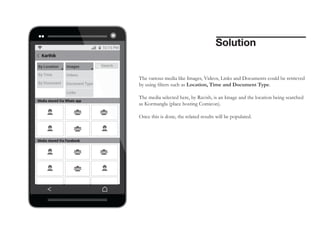
The various media like Images, Videos, Links and Documents could be retrieved
by using filters such as Location, Time and Document Type.
The media selected here, by Ravish, is an Image and the location being searched
as Kormangla (place hosting Comicon).
Once this is done, the related results will be populated.
Solution

If Ravish were to select Media History, a tree map would appear.
This visualises the Media shared between the two people depending
upon the weightage, represented spatially.

Nextgen gallery

  • 1.
    Design a newinnovative concept for Next Generation Gallery Experience of Smartphones. (Jelly Bean OS) CONCEPT : NEXT GENERATION GALLERY FOR SMARTPHONES
  • 2.
    Gallery Structure Typical galleryhas consists of content such as Photo taken from phone camera Videos - Personally shot, stored Music videos PDF’s and other documents Downloads Bluetooth shares Wallpapers Screen captures Instant Messenger folders such as Whatsapp Images Whatsapp Videos Hike Images Networking site downloads Pins saved from Pinterest
  • 3.
    Scenario Ravish, 27, Works inan MNC, Techie, Owns Smart phone, Social network buff and Blogger. Does multitasking on his smart phone - on the go especially while travelling. He is an early adopter of technology. Keeps in touch with the loved ones and his friends via Facebook, Gmail, Gtalk, Whatsapp, Viber, Hike, Skype, Google Hangout, Dropbox, Picasa, Instagram, Flicker, etc.
  • 4.
    Scenario On a typicalday while facebooking, Ravish remembers one of his photos which a friend had clicked with his Costume play at the COMICON, an year back. He vaguely remembers that his friend had shared it with him over a chat/ IM but cannot recall where is it stored in the gallery. So lets see how does he go about looking for his photo in the gallery. “ I’m looking for an Image that my friend sent to me over a chat.” “ But I hazily remeber the conversation we had that day.” “ I guess it was either Facebook Messenger or Whatsapp that we were talking on.” “ I have some 450+ Whatsapp images saved and I need to check my chat history if its on Facebook Messenger.” “ Going through the whole lot of photos takes me a lot of time and patience. I’ll check this over weekend” “ I wish this was easier.”
  • 5.
    Design Concerns If galleryhas all my content, why can’t it manage it? With ever increasing data which is stored on phones, sorting data is of equal priority. Irrespective of a Social Conversation, Productivity and Media utilities or even buying decisions are made on phones “Search” is an integral part of our gadget behaviour, but the phone which is the most personalized device of all doesn’t integrate this behaviour. A customizable “Adaptive Search” experience based on existing parameters which are discretely placed on the phone, can be the basis of a “Whole New Gallery Experience.”
  • 6.
    Design Concerns How dowe remember data on our gallery Using a few cues/ factors such as the person, place, time, occasion, type of document, platform, etc. enable us to recall the details. We always recall/remember things with a context around it and seldom as a solitary entity. This needs to be reflected in our digital interactions/behaviour as well. Currently, these options are available as discrete entities but they do not help filtering of data in a holistic manner which aligns to our physical world mental model of remembering things.
  • 7.
    Solution Lets consider Ravishis looking for an image which was shared by Karthik. So in the Contact list, Ravish will look for his name. Once his name is being selected, he would have to mention the kind of file he is looking for.
  • 8.
    Solution The media sharedbetween two people could be classified as: Instant Messenger such as Whats App, Hike, Viber, Facebook, Twitter,etc. Cloud Storage utilities such as Dropbox, Picasa, etc Video Call Utilities such as Skype, Google Hangout etc. Rather than the usual Contact Manager functions such as Calling and Text messaging, the Phone is also syncing and listing the media which is being exchanged between two parties.
  • 9.
    Solution Ravish has selectedWhatsapp and Facebook Messenger here.
  • 10.
    Solution The various medialike Images, Videos, Links and Documents could be retrieved by using filters such as Location, Time and Document Type. The media selected here, by Ravish, is an Image and the location being searched as Kormangla (place hosting Comicon). Once this is done, the related results will be populated.
  • 11.
    Solution If Ravish wereto select Media History, a tree map would appear. This visualises the Media shared between the two people depending upon the weightage, represented spatially.