1
Next generation
opportunities in
utility-scale solar
June 2017
2
CONTACT
QVARTZ Sweden
Birger Jarlsgatan 7
SE-111 45 Stockholm
Tel + 46 (0)8 614 19 00
QVARTZ Norway
Wergelandsveien 21
NO-0167 Oslo
Tel +47 22 59 36 00
QVARTZ Denmark
Ryesgade 3A
DK-2200 Copenhagen N
Tel +45 33 17 00 00
QVARTZ Germany
Neuer Wall 40
DE-20354 Hamburg
Tel +49 40 298 13 470
QVARTZ USA
Suite 213
1185 Avenue of the Americas
New York, NY 10036, USA
Tel +1 646 492 9913
3
Foreword
This document discusses the development of
utility-scale solar and provides a perspective on
opportunities and challenges for energy incumbents.
It is a starting point for a discussion that many incum-
bents are currently engaged in – is there a viable role
for us to play in utility-scale solar, and what should
the strategy be?
4
Utility-scale solar is expanding fast and its cost-
competitiveness is improving accordingly. The
pressure on costs, margins and speed is intense,
and pure-play solar companies have dominated
the industry so far. Will this trend continue, or does
utility-scale solar hold viable opportunities for energy
incumbents going forward? In this knowledge per-
spective, QVARTZ takes stock of utility-scale solar
and outlines some opportunities and challenges for
energy incumbents.
From fringe to mainstream: Utility-scale
solar is winning the cost race
The solar industry is steaming ahead, and 2016 was
another record year with a global market of around
74 GW installed, up 30% from 2015 (Figure 1). The
current projection is that the total installed capacity
will more than double from today's 320 GW to some
680 GW by 2020 (21% annual growth), and reach
1,300 GW by 2025. At this rate, solar will overtake
wind by 2020 in terms of annual capacity added,
and by 2022 have more total capacity installed. Solar
will then be placed right at the top across all energy
sources in terms of new capacity added, represent-
ing a third of all new capacity in 2020. Remarkably,
80% of all new capacity in California in 2016 was so-
lar energy (39% for the US as a whole), 28% in China
and 15% in Germany. Still, solar's share of global pow-
er production is only around 1%. In leading markets
like Germany, it is around 7%, while in California – a
major solar market – the share is now 13%.
Next generation
opportunities in
utility-scale solar
Figure 1: Development of PV solar installations
Global Solar PV Capacity
(annual addition and cumulative)
GW
Sources:	 Bloomberg New Energy Finance for 2010-2018 (GW); MAKE Global Outlook 2016 (wind numbers); Sources for the share
		 numbers:	 SolarPower Europe Global Market Outlook 2016-2020 (solar); Global wind report by GWEC (wind); Bloomberg New 	
	 Energy Finance Outlook (2016) (conventional); IEA World Energy Outlook; MEC+ analysis; QVARTZ analysis
Solar's share of
new additions
200
300
400
500
600
700
800
900
1000
1100
1200
1300
100 43
72
29
30
43
45
56
74
79
89
88
101
108
114
122
125
129
102
145
191
247
320
399
489
577
678
786
900
1,022
1,148
1,276
0
20
10
20
11
20
12
20
13
20
14
20
15
20
16
20
17
20
18
20
19
2020
2021
2022
2023
2024
2025
+40%
+21%
+13%
2011 2015 2020
Conventional
Added
Wind
Installed
Solar
100 100
54%
100
38%
18%
25%
29%
21%14%
33%
68%
750
1,070
5
Figure 2: Solar segments and main technologies
Source:	Fraunhofer ISE: Photovoltaics report, updated 17 November 2016 (for the technology shares); QVARTZ analysis
Photovoltaic CSP
~68%
Multi
Mono
Thin
film
CPV CSP
(trough/
tower/
dish)
~24%
~8%
~1%
Centralised
utility scale
• Large ground-mount projects
• Transmission grid connection
• Power sold under PPA/FIT
• Land availability and permits
tend to be challenging
•	Ground-mount projects
	 located closer to loads
•	Typically distribution grid
	connection
• Power sold under PPA/FIT
• Less land needed, permitting
tends to be simpler
•	Rooftop installations
•	Self consumption of power
(net metering) or sell to the
grid (feed-in tariff)
•	Financed by rooftop owner or
through third party ownership
(leasing)
Commercial
& Industrial
Residential
Distributed
utility scale
~20–200+
MW
~1-20 MW
~98% ~2%
~10kW-3 MW
~1-8 kW
Segments and typical size Characteristics Solar technologies deployed
UtilityDistributed
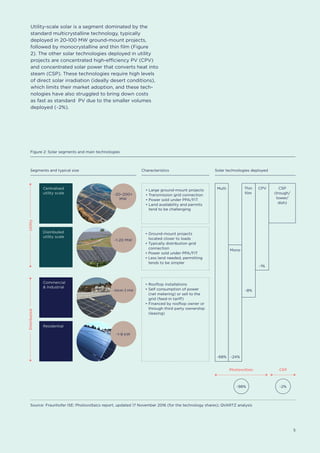
Utility-scale solar is a segment dominated by the
standard multicrystalline technology, typically
deployed in 20-100 MW ground-mount projects,
followed by monocrystalline and thin film (Figure
2). The other solar technologies deployed in utility
projects are concentrated high-efficiency PV (CPV)
and concentrated solar power that converts heat into
steam (CSP). These technologies require high levels
of direct solar irradiation (ideally desert conditions),
which limits their market adoption, and these tech-
nologies have also struggled to bring down costs
as fast as standard PV due to the smaller volumes
deployed (~2%).
6
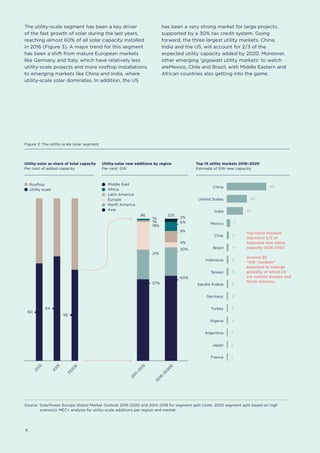
The utility-scale segment has been a key driver
of the fast growth of solar during the last years,
reaching almost 60% of all solar capacity installed
in 2016 (Figure 3). A major trend for this segment
has been a shift from mature European markets
like Germany and Italy, which have relatively less
utility-scale projects and more rooftop installations,
to emerging markets like China and India, where
utility-scale solar dominates. In addition, the US
has been a very strong market for large projects,
supported by a 30% tax credit system. Going
forward, the three largest utility markets, China,
India and the US, will account for 2/3 of the
expected utility capacity added by 2020. Moreover,
other emerging 'gigawatt utility markets' to watch
areMexico, Chile and Brazil, with Middle Eastern and
African countries also getting into the game.
Figure 3: The utility-scale solar segment
Source:	SolarPower Europe Global Market Outlook 2016-2020 and 2014-2018 for segment split (note: 2020 segment split based on high
	 scenario); MEC+ analysis for utility-scale additions per region and market
China 85
United States 43
India 35
Mexico 7
Chile 4
Brazil 4
Indonesia 4
Taiwan 3
Saudia Arabia 3
Germany 3
Turkey 3
Algeria 3
Argentina 2
France 2
Japan 2
20
13
20
15
2020
E
20
11–20
15
20
16–2020
E
86 225
Asia
North America
Middle East
Europe
Africa
1% 2%
6%
8%
4%
20%
1%
19%
21%
57%
60%
Latin America
Utility-solar as share of total capacity
Per cent of added capacity
Utility-solar new additions by region
Per cent; GW
Top-15 utility markets 2016–2020
Estimate of GW new capacity
Top-three markets
represent 2/3 of
expected new utility
capacity 2016-2020
Around 30
"GW- markets"
expected to emerge
globally, of which 24
are outside Europe and
North America
Rooftop
Utility scale
60
64
56
7
Figure 4: Falling costs across the value chain
* 	 Metal grade silicon
**	 Based on multicrystalline modules and spot price
Source:	PV Insight; expert interviews; QVARTZ analysis
•	Fairly consolidated
•	New capacity in China
•	New technologies (FBR, MGS*)
• 	Price and margin pressure
• 	Trade conflicts impact pricing
•	Capacity investments (China)
•	Integrated with cells/modules
•	Technology improvements
(diamond wiring, thinner wafers,
kerfless concepts)
•	Dominated by China/Taiwan
•	Multi technology leading,
	 mono growing
•	Higher efficiency cells
	 (e.g. PERC)
•	Cost-out on design/sourcing
•	Higher watt effect per module
•	Lower efficiency losses
•	Emerging regional
	manufacturing
USD/kgUSD/waferUSD/WUSD/W
USD/W
Value chain
Price development
2010 vs 2016**Drivers and trends
Total system cost
"Best practice" cost
for utility project
Polysilicon
Wafers
Cells
Modules
-83%
-83%
X%
-67%
-65%
75.0
3.0
0.6
1.3
12.6
0.5
0.2
0.5
0.3 (current)
52%
43%
33%
31%
20
10
20
16
20
17
2020
E
2.50
Variations across
markets exist
1.15
0.90
0.80
1.30
1.20
0.50
0.65
0.30
0.60
0.25
0.55
Solar
module
share
What is fuelling the strong growth of solar is of
course a Moore's law-like drop in solar panel prices,
compounded by falling financing costs and more
cost-efficient installation and operations. Currently,
the lowest contracted cost to build a turn-key project
(over 10 MW) is around USD 0.85-0.90/W, down
some 65% from 2010 (figure 4). And panel prices
continue to plummet: Over the last 12 months, prices
have fallen by another 45%, putting the suppliers un-
der immense pressure. This rapid cost-out trend has
been driven mainly by scale and the shift of produc-
tion capacity to lower-cost countries, primarily China
and Taiwan, where 75% of the global capacity is now
located. At the same time, the industry struggles
with overcapacity and remains fragmented. The larg-
est cells/module producers, like Jinko and Trina, hold
less than 10% market share, and each player is vying
to grab market share by adding new capacity rather
than taking over old capacity in order to stay ahead
of the cost curve. As a result, prices are never far
from cash costs, and on a one-way, downward tra-
jectory. Looking ahead, we expect costs to continue
to decline in line with the historic learning curve, i.e.
panel prices to decline by another ~22-23% between
2016 and 2020 (-5.5% p.a.), and total system costs to
reach USD 0.80/W by 2020, and likely USD 0.75/W
for the lowest-cost projects.
8
While the value chain margins will remain tight, the
market for new solar installations is opening up,
placing solar in direct competition with both wind
and conventional resources. Already, Power Purchase
Agreement (PPA) price bids in auctions continue to
break new ground, with the current records below
USD 30/MWh (Chile/UAE) for projects coming online
in 2019/2020. While subsidies play a part in these
low PPAs, the unsubsidised levellised cost of energy
(LCoE) of utility-scale solar is making great strides
(Figure 5). In optimal conditions that combine a lot
of sun and low cost of capital (e.g., California and
Australia), LCoE is already as low as USD ~40/MWh
without subsidies. In mature markets like Germany,
where cost of capital is very low but the sun hours
fewer, the LCoE is around USD 70/MWh – putting it
at a disadvantage to wind and wholesale prices
(although competitive in the rooftop segment).
In (sunny) emerging markets, the cost of capital is
typically somewhat higher, but solar is becoming
highly competitive in markets like Mexico and India,
and also Brazil and China. By 2020, we expect – all
else equal – that the lowest unsubsidised LCoE levels
will move close to USD 30/MWh, making it one of
the cheapest energy sources around. Furthermore,
bringing down the cost of capital in emerging mar-
kets will be a key driver to unlock new markets.
In short, we are entering new territory where solar
is becoming the cheapest energy source available in
sunny regions – and within reach in most markets.
This opens up a completely new set of questions,
challenges and opportunities.
9
>1,800
(>21%)
1,500-1,800
(17-21%)
<1,400
(<16%)
Germany
United States
Australia
United States (CA)
Chile
Northern Italy
China
Mexico
Brazil
India
Solar output
kWh/kWp
(CF**)
Mature markets
(~4-5% CoC***)
Moderate market risk
(~6-7% CoC)
Emerging market risk
(~9-11% CoC)
80 72
62
62
51
31
46
58
52
44
36 39
65
58
49
55
47
51
41
46
39
65
5556
47
80
80 80 80
60 60
60 60 60
40 40
40 40 40
20 20
20 20 20
0 0
0 0 0
80 80
60 60
40 40
20 20
0 0
80
60
40
20
0
20
17
2020
2025
20
17
2020
2025
20
17
2020
2025
20
17
2020
2025
20
17
2020
2025
20
17
2020
2025
20
17
2020
2025
20
17
2020
2025
Indicative LCoE levels USD/MWh*
Figure 5: Solar cost competitiveness
Higher market risk and financing costs
Higherproduction
*	 Assumptions: CAPEX USD 0.90/W in 2017, USD 0.80/W in 2020, USD 0.66/W in 2025;
OPEX at USD 15/kW/year in 2017, falling by 2% p.a. by 2025. 0.3% annual degradation factor.
**	 Capacity factor based on theoretical max.
***	 CoC: Cost of capital, i.e. the discount rate used
Source:	Bloomberg New Energy Finance for the wind LCoE numbers; QVARTZ analysis
Wind LCOE, 2016 Range wholesale electricity prices
10
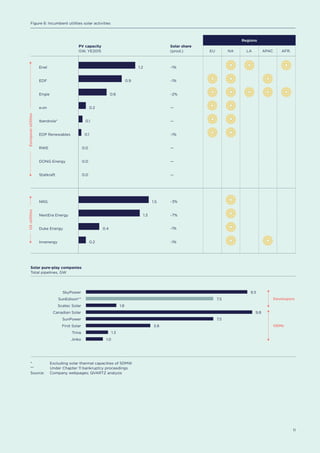
Incumbents on the sideline
Despite the growth of utility-scale solar, incumbents
appear hesitant to enter the market. Most European
utilities have less than 1% of production coming from
solar. Of the major European utilities, ENEL is argua-
bly the leading company in incorporating utility-solar
firmly into its strategy, followed by ENGIE and EDF,
but still at modest levels (Figure 6). The situation is
similar in the US. Under RPS requirements, US utili-
ties are mandated to sell a certain share of renewable
energy. For example, Californian regulated utilities
need to reach 33% renewable energy by 2020, and a
company like PG&E is already at 30%. However, these
levels have been met mainly by entering into PPAs
with solar developers through highly competitive
tenders. Leading owners of solar assets, like NRG
and NextEra, have only around 7% and 3% respec-
tively of their production from solar. This is starting
to change, however, and US utilities are increasing-
ly taking a more active role in owning solar assets.
Similarly, the major oil companies and industrial
OEMs – for example GE, Siemens, Shell and Statoil –
are actively pursuing wind energy, but not solar in a
serious manner. French Total is perhaps an exception
with its ownership in SunPower since 2011 (and a
recent investment in the storage company Saft), but
it remains unclear how strategic the solar segment is
to Total.
Instead, the leading project development players are
solar manufacturers and pure-play solar developers
with tailored project-financing solutions. The US
manufacturers SunPower and First Solar have led
this trend, and together, they have more than 10 GW
in utility-scale pipeline, while Canadian Solar (of
China) claims a 9.8 GW pipeline. These companies
often follow a Build-Sell-Operate model, i.e. they use
the projects as a channel for their equipment sales,
tie in O&M revenues, and earn equity uplift when sell-
ing the assets to financial institutions (or to yieldcos)
at lower return levels. Pure-play solar developers
include companies such as SkyPower, FRV, Scatec
and BioTherm – all with gigawatt pipelines.
While the profitability of the utility-scale project
business is less transparent and comparing apples
to apples in regards to risks is notoriously difficult,
the fact that leading solar players have pursued
this segment aggressively suggests the rewards
have been substantial. First Solar, originally a pure
panel manufacturer, had by the end of 2016 grown its
project business to around half of its revenues, with
a similar picture for SunPower. Enel, one of the
utilities that strategically pursues utility-scale solar,
reports a solid 12-14% equity IRR on its Mexico solar
projects. Scatec, the pure-play solar developer and
power producer with a global presence, went public
in 2014 and has doubled its share price since on the
back of a growing pipeline and a proven business
model. Scatec has also communicated a target of
15% gross margin across development and construc-
tion, and 15% equity IRR on its power plant holdings.
Overall, the successful players have shown that there
is money to be made from utility-scale solar projects.
However, there are also signs indicating that the
pressure on margins is increasing. Indeed, SunPower
has started a refocus away from the project business
due to falling PPA prices, more competition, and
increased margin pressure.
There have been several structural reasons why the
incumbents have been hesitant, and why pure-play
companies and panel producers dominate. First, the
scale has simply been too small and fragmented for
utilities to prioritise solar over for example wind.
Second, the simplicity of solar makes many of the
capabilities of the incumbents, such as engineering
and complex project management, less valuable and
too expensive. Third, the low entry barriers combined
with rapidly falling costs have led to some degree
of speculative bidding in auctions that incumbents
struggle to match. Fourth, utilities have tended to
limit themselves to home markets, struggling to
'follow the market' into new regions where pure-play
companies are willing to go. Finally, the price curve
of solar has simply outpaced the expectations of
incumbents, putting them on the back foot com-
pared to those better plugged into the value chain
and willing to take a more aggressive perspective
on forward prices. By looking at these factors com-
bined, it becomes understandable that incumbents
have been hesitant – and so far found themselves left
on the sideline".
11
Solar share
(prod.)
PV capacity
GW, YE2015 EU NA LA APAC AFR.
Solar pure-play companies
Total pipelines, GW
Regions
Figure 6: Incumbent utilities solar activities
USutilitiesEuropeanutilities
Developers
OEMs
*	 	 Excluding solar thermal capacities of 50MW
** 		 Under Chapter 11 bankruptcy proceedings
Source:		 Company webpages; QVARTZ analysis
SkyPower
SunEdison**
Scatec Solar
Canadian Solar
SunPower
First Solar
Trina
Jinko 1.0
1.3
3.8
7.5
7.5
9.5
9.8 9.8
1.8
1.2Enel
EDF
Engie
e.on
Iberdrola*
EDP Renewables
RWE
DONG Energy
Statkraft
NRG
NextEra Energy
Duke Energy
Invenergy
1.5
1.3
0.4
0.2
~1%
~1%
~2%
—
~3%
~7%
~1%
~1%
—
~1%
—
—
—
0.9
0.6
0.2
0.1
0.1
0.0
0.0
0.0
12
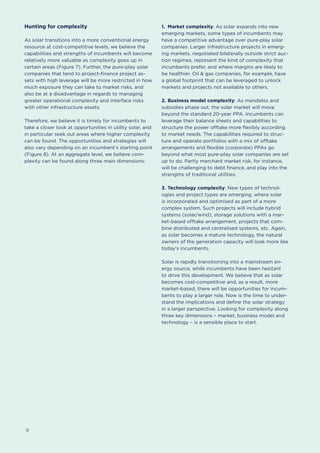
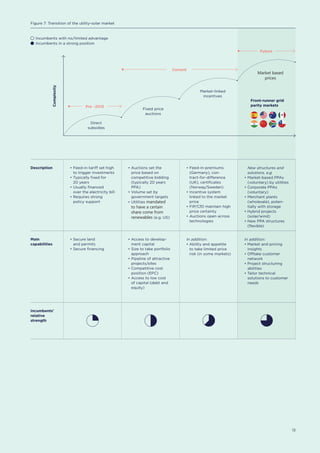
Hunting for complexity
As solar transitions into a more conventional energy
resource at cost-competitive levels, we believe the
capabilities and strengths of incumbents will become
relatively more valuable as complexity goes up in
certain areas (Figure 7). Further, the pure-play solar
companies that tend to project-finance project as-
sets with high leverage will be more restricted in how
much exposure they can take to market risks, and
also be at a disadvantage in regards to managing
greater operational complexity and interface risks
with other infrastructure assets.
Therefore, we believe it is timely for incumbents to
take a closer look at opportunities in utility solar, and
in particular seek out areas where higher complexity
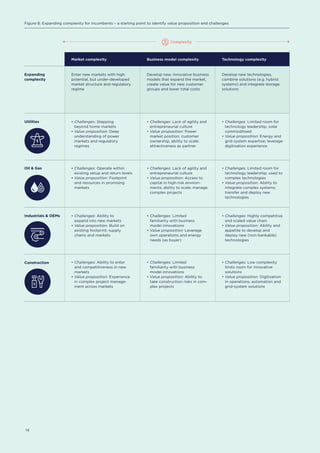
can be found. The opportunities and strategies will
also vary depending on an incumbent's starting point
(Figure 8). At an aggregate level, we believe com-
plexity can be found along three main dimensions:
1.	 Market complexity: As solar expands into new
emerging markets, some types of incumbents may
have a competitive advantage over pure-play solar
companies. Larger infrastructure projects in emerg-
ing markets, negotiated bilaterally outside strict auc-
tion regimes, represent the kind of complexity that
incumbents prefer, and where margins are likely to
be healthier. Oil & gas companies, for example, have
a global footprint that can be leveraged to unlock
markets and projects not available to others.
2.	Business model complexity: As mandates and
subsidies phase out, the solar market will move
beyond the standard 20-year PPA. Incumbents can
leverage their balance sheets and capabilities to
structure the power offtake more flexibly according
to market needs. The capabilities required to struc-
ture and operate portfolios with a mix of offtake
arrangements and flexible (corporate) PPAs go
beyond what most pure-play solar companies are set
up to do. Partly merchant market risk, for instance,
will be challenging to debt finance, and play into the
strengths of traditional utilities.
3.	Technology complexity: New types of technol-
ogies and project types are emerging, where solar
is incorporated and optimised as part of a more
complex system. Such projects will include hybrid
systems (solar/wind), storage solutions with a mar-
ket-based offtake arrangement, projects that com-
bine distributed and centralised systems, etc. Again,
as solar becomes a mature technology, the natural
owners of the generation capacity will look more like
today's incumbents.
Solar is rapidly transitioning into a mainstream en-
ergy source, while incumbents have been hesitant
to drive this development. We believe that as solar
becomes cost-competitive and, as a result, more
market-based, there will be opportunities for incum-
bents to play a larger role. Now is the time to under-
stand the implications and define the solar strategy
in a larger perspective. Looking for complexity along
three key dimensions – market, business model and
technology – is a sensible place to start.
13
Description
Complexity
Main
capabilities
Incumbents'
relative
strength
•	Feed-in-tariff set high
to trigger investments
•	Typically fixed for
	 20 years
•	Usually financed
	 over the electricity bill
•	Requires strong
	 policy support
•	Secure land
	 and permits
•	Secure financing
•	Auctions set the
	 price based on
competitive bidding
(typically 20 years
PPA)
•	Volume set by
government targets
•	Utilities mandated
to have a certain
share come from
renewables (e.g. US)
•	Access to develop-
ment capital
•	Size to take portfolio
approach
•	Pipeline of attractive
projects/sites
•	Competitive cost
position (EPC)
•	Access to low cost
of capital (debt and
equity)
In addition:
• Ability and appetite
to take limited price
risk (in some markets)
In addition:
• Market and pricing
insights
• Offtake customer
network
• Project structuring
abilities
• Tailor technical
solutions to customer
needs
•	Feed-in-premiums
(Germany), con-
tract-for-difference
(UK), certificates
(Norway/Sweden)
•	Incentive system
linked to the market
price
•	FIP/CfD maintain high
price certainty
•	Auctions open across
technologies
	 New structures and
solutions, e.g.
•	Market-based PPAs
(voluntary) by utilities
•	Corporate PPAs
(voluntary)
•	Merchant plants
(wholesale), poten-
tially with storage
• Hybrid projects
	(solar/wind)
•	New PPA structures
(flexible)
Figure 7: Transition of the utility-solar market
Pre ~2012
Future
Current
Direct
subsidies
Fixed price
auctions
Market-linked
incentives
Front-runner grid
parity markets
Market based
prices
Incumbents with no/limited advantage
Incumbents in a strong position
14
Construction
Expanding
complexity
Utilities
Oil & Gas
Industrials & OEMs
Market complexity
Enter new markets with high
potential, but under-developed
market structure and regulatory
regime
Develop new, innovative business
models that expand the market,
create value for new customer
groups and lower total costs
Develop new technologies,
combine solutions (e.g. hybrid
systems) and integrate storage
solutions
•	Challenges: Stepping
beyond home markets
•	Value proposition: Deep
understanding of power
markets and regulatory
regimes
•	Challenges: Lack of agility and
entrepreneurial culture
•	Value proposition: Power
market position; customer
ownership, ability to scale;
attractiveness as partner
•	Challenges: Limited room for
technology leadership, solar
commoditised
•	Value proposition: Energy and
grid system expertise; leverage
digitisation experience
•	Challenges: Operate within
existing setup and return levels
•	Value proposition: Footprint
and resources in promising
markets
•	Challenges: Lack of agility and
entrepreneurial culture
•	Value proposition: Access to
capital in high-risk environ-
ments; ability to scale; manage
complex projects
•	Challenges: Limited room for
technology leadership; used to
complex technologies
•	Value proposition: Ability to
integrate complex systems;
transfer and deploy new
	technologies
•	Challenges: Ability to
expand into new markets
•	Value proposition: Build on
	 existing footprint; supply
chains and markets
•	Challenges: Limited
familiarity with business
model innovations
•	Value proposition: Leverage
own operations and energy
needs (as buyer)
•	Challenges: Highly competitive
and scaled value chain
•	Value proposition: Ability and
appetite to develop and
	 deploy new (non-bankable)
technologies
•	Challenges: Ability to enter
and competitiveness in new
markets
•	Value proposition: Experience
in complex project manage-
ment across markets
•	Challenges: Limited
familiarity with business
model innovations
•	Value proposition: Ability to
take construction risks in com-
plex projects
•	Challenges: Low complexity
limits room for innovative
	solutions
•	Value proposition: Digitisation
in operations; automation and
grid-system solutions
Figure 8: Expanding complexity for incumbents – a starting point to identify value proposition and challenges
Business model complexity Technology complexity
Complexity
15
Are you interested in discussing where solar energy is heading
and what the strategic implications may be for your company?
Please contact Thomas or Anders directly for a discussion
Anders Roed Bruhn
anders.roed.bruhn@qvartz.com
+45 29 69 69 33
Thomas Nyheim
thomas.nyheim@qvartz.com
+47 901 80 355
www.qvartz.com

Next generation opportunities in utility scale solar

  • 1.
  • 2.
    2 CONTACT QVARTZ Sweden Birger Jarlsgatan7 SE-111 45 Stockholm Tel + 46 (0)8 614 19 00 QVARTZ Norway Wergelandsveien 21 NO-0167 Oslo Tel +47 22 59 36 00 QVARTZ Denmark Ryesgade 3A DK-2200 Copenhagen N Tel +45 33 17 00 00 QVARTZ Germany Neuer Wall 40 DE-20354 Hamburg Tel +49 40 298 13 470 QVARTZ USA Suite 213 1185 Avenue of the Americas New York, NY 10036, USA Tel +1 646 492 9913
  • 3.
    3 Foreword This document discussesthe development of utility-scale solar and provides a perspective on opportunities and challenges for energy incumbents. It is a starting point for a discussion that many incum- bents are currently engaged in – is there a viable role for us to play in utility-scale solar, and what should the strategy be?
  • 4.
    4 Utility-scale solar isexpanding fast and its cost- competitiveness is improving accordingly. The pressure on costs, margins and speed is intense, and pure-play solar companies have dominated the industry so far. Will this trend continue, or does utility-scale solar hold viable opportunities for energy incumbents going forward? In this knowledge per- spective, QVARTZ takes stock of utility-scale solar and outlines some opportunities and challenges for energy incumbents. From fringe to mainstream: Utility-scale solar is winning the cost race The solar industry is steaming ahead, and 2016 was another record year with a global market of around 74 GW installed, up 30% from 2015 (Figure 1). The current projection is that the total installed capacity will more than double from today's 320 GW to some 680 GW by 2020 (21% annual growth), and reach 1,300 GW by 2025. At this rate, solar will overtake wind by 2020 in terms of annual capacity added, and by 2022 have more total capacity installed. Solar will then be placed right at the top across all energy sources in terms of new capacity added, represent- ing a third of all new capacity in 2020. Remarkably, 80% of all new capacity in California in 2016 was so- lar energy (39% for the US as a whole), 28% in China and 15% in Germany. Still, solar's share of global pow- er production is only around 1%. In leading markets like Germany, it is around 7%, while in California – a major solar market – the share is now 13%. Next generation opportunities in utility-scale solar Figure 1: Development of PV solar installations Global Solar PV Capacity (annual addition and cumulative) GW Sources: Bloomberg New Energy Finance for 2010-2018 (GW); MAKE Global Outlook 2016 (wind numbers); Sources for the share numbers: SolarPower Europe Global Market Outlook 2016-2020 (solar); Global wind report by GWEC (wind); Bloomberg New Energy Finance Outlook (2016) (conventional); IEA World Energy Outlook; MEC+ analysis; QVARTZ analysis Solar's share of new additions 200 300 400 500 600 700 800 900 1000 1100 1200 1300 100 43 72 29 30 43 45 56 74 79 89 88 101 108 114 122 125 129 102 145 191 247 320 399 489 577 678 786 900 1,022 1,148 1,276 0 20 10 20 11 20 12 20 13 20 14 20 15 20 16 20 17 20 18 20 19 2020 2021 2022 2023 2024 2025 +40% +21% +13% 2011 2015 2020 Conventional Added Wind Installed Solar 100 100 54% 100 38% 18% 25% 29% 21%14% 33% 68% 750 1,070
  • 5.
    5 Figure 2: Solarsegments and main technologies Source: Fraunhofer ISE: Photovoltaics report, updated 17 November 2016 (for the technology shares); QVARTZ analysis Photovoltaic CSP ~68% Multi Mono Thin film CPV CSP (trough/ tower/ dish) ~24% ~8% ~1% Centralised utility scale • Large ground-mount projects • Transmission grid connection • Power sold under PPA/FIT • Land availability and permits tend to be challenging • Ground-mount projects located closer to loads • Typically distribution grid connection • Power sold under PPA/FIT • Less land needed, permitting tends to be simpler • Rooftop installations • Self consumption of power (net metering) or sell to the grid (feed-in tariff) • Financed by rooftop owner or through third party ownership (leasing) Commercial & Industrial Residential Distributed utility scale ~20–200+ MW ~1-20 MW ~98% ~2% ~10kW-3 MW ~1-8 kW Segments and typical size Characteristics Solar technologies deployed UtilityDistributed Utility-scale solar is a segment dominated by the standard multicrystalline technology, typically deployed in 20-100 MW ground-mount projects, followed by monocrystalline and thin film (Figure 2). The other solar technologies deployed in utility projects are concentrated high-efficiency PV (CPV) and concentrated solar power that converts heat into steam (CSP). These technologies require high levels of direct solar irradiation (ideally desert conditions), which limits their market adoption, and these tech- nologies have also struggled to bring down costs as fast as standard PV due to the smaller volumes deployed (~2%).
  • 6.
    6 The utility-scale segmenthas been a key driver of the fast growth of solar during the last years, reaching almost 60% of all solar capacity installed in 2016 (Figure 3). A major trend for this segment has been a shift from mature European markets like Germany and Italy, which have relatively less utility-scale projects and more rooftop installations, to emerging markets like China and India, where utility-scale solar dominates. In addition, the US has been a very strong market for large projects, supported by a 30% tax credit system. Going forward, the three largest utility markets, China, India and the US, will account for 2/3 of the expected utility capacity added by 2020. Moreover, other emerging 'gigawatt utility markets' to watch areMexico, Chile and Brazil, with Middle Eastern and African countries also getting into the game. Figure 3: The utility-scale solar segment Source: SolarPower Europe Global Market Outlook 2016-2020 and 2014-2018 for segment split (note: 2020 segment split based on high scenario); MEC+ analysis for utility-scale additions per region and market China 85 United States 43 India 35 Mexico 7 Chile 4 Brazil 4 Indonesia 4 Taiwan 3 Saudia Arabia 3 Germany 3 Turkey 3 Algeria 3 Argentina 2 France 2 Japan 2 20 13 20 15 2020 E 20 11–20 15 20 16–2020 E 86 225 Asia North America Middle East Europe Africa 1% 2% 6% 8% 4% 20% 1% 19% 21% 57% 60% Latin America Utility-solar as share of total capacity Per cent of added capacity Utility-solar new additions by region Per cent; GW Top-15 utility markets 2016–2020 Estimate of GW new capacity Top-three markets represent 2/3 of expected new utility capacity 2016-2020 Around 30 "GW- markets" expected to emerge globally, of which 24 are outside Europe and North America Rooftop Utility scale 60 64 56
  • 7.
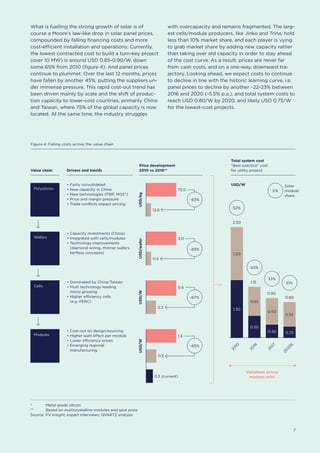
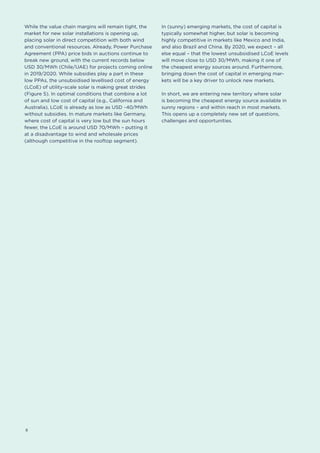
    7 Figure 4: Fallingcosts across the value chain * Metal grade silicon ** Based on multicrystalline modules and spot price Source: PV Insight; expert interviews; QVARTZ analysis • Fairly consolidated • New capacity in China • New technologies (FBR, MGS*) • Price and margin pressure • Trade conflicts impact pricing • Capacity investments (China) • Integrated with cells/modules • Technology improvements (diamond wiring, thinner wafers, kerfless concepts) • Dominated by China/Taiwan • Multi technology leading, mono growing • Higher efficiency cells (e.g. PERC) • Cost-out on design/sourcing • Higher watt effect per module • Lower efficiency losses • Emerging regional manufacturing USD/kgUSD/waferUSD/WUSD/W USD/W Value chain Price development 2010 vs 2016**Drivers and trends Total system cost "Best practice" cost for utility project Polysilicon Wafers Cells Modules -83% -83% X% -67% -65% 75.0 3.0 0.6 1.3 12.6 0.5 0.2 0.5 0.3 (current) 52% 43% 33% 31% 20 10 20 16 20 17 2020 E 2.50 Variations across markets exist 1.15 0.90 0.80 1.30 1.20 0.50 0.65 0.30 0.60 0.25 0.55 Solar module share What is fuelling the strong growth of solar is of course a Moore's law-like drop in solar panel prices, compounded by falling financing costs and more cost-efficient installation and operations. Currently, the lowest contracted cost to build a turn-key project (over 10 MW) is around USD 0.85-0.90/W, down some 65% from 2010 (figure 4). And panel prices continue to plummet: Over the last 12 months, prices have fallen by another 45%, putting the suppliers un- der immense pressure. This rapid cost-out trend has been driven mainly by scale and the shift of produc- tion capacity to lower-cost countries, primarily China and Taiwan, where 75% of the global capacity is now located. At the same time, the industry struggles with overcapacity and remains fragmented. The larg- est cells/module producers, like Jinko and Trina, hold less than 10% market share, and each player is vying to grab market share by adding new capacity rather than taking over old capacity in order to stay ahead of the cost curve. As a result, prices are never far from cash costs, and on a one-way, downward tra- jectory. Looking ahead, we expect costs to continue to decline in line with the historic learning curve, i.e. panel prices to decline by another ~22-23% between 2016 and 2020 (-5.5% p.a.), and total system costs to reach USD 0.80/W by 2020, and likely USD 0.75/W for the lowest-cost projects.
  • 8.
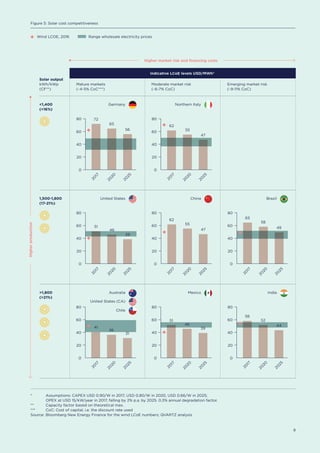
    8 While the valuechain margins will remain tight, the market for new solar installations is opening up, placing solar in direct competition with both wind and conventional resources. Already, Power Purchase Agreement (PPA) price bids in auctions continue to break new ground, with the current records below USD 30/MWh (Chile/UAE) for projects coming online in 2019/2020. While subsidies play a part in these low PPAs, the unsubsidised levellised cost of energy (LCoE) of utility-scale solar is making great strides (Figure 5). In optimal conditions that combine a lot of sun and low cost of capital (e.g., California and Australia), LCoE is already as low as USD ~40/MWh without subsidies. In mature markets like Germany, where cost of capital is very low but the sun hours fewer, the LCoE is around USD 70/MWh – putting it at a disadvantage to wind and wholesale prices (although competitive in the rooftop segment). In (sunny) emerging markets, the cost of capital is typically somewhat higher, but solar is becoming highly competitive in markets like Mexico and India, and also Brazil and China. By 2020, we expect – all else equal – that the lowest unsubsidised LCoE levels will move close to USD 30/MWh, making it one of the cheapest energy sources around. Furthermore, bringing down the cost of capital in emerging mar- kets will be a key driver to unlock new markets. In short, we are entering new territory where solar is becoming the cheapest energy source available in sunny regions – and within reach in most markets. This opens up a completely new set of questions, challenges and opportunities.
  • 9.
    9 >1,800 (>21%) 1,500-1,800 (17-21%) <1,400 (<16%) Germany United States Australia United States(CA) Chile Northern Italy China Mexico Brazil India Solar output kWh/kWp (CF**) Mature markets (~4-5% CoC***) Moderate market risk (~6-7% CoC) Emerging market risk (~9-11% CoC) 80 72 62 62 51 31 46 58 52 44 36 39 65 58 49 55 47 51 41 46 39 65 5556 47 80 80 80 80 60 60 60 60 60 40 40 40 40 40 20 20 20 20 20 0 0 0 0 0 80 80 60 60 40 40 20 20 0 0 80 60 40 20 0 20 17 2020 2025 20 17 2020 2025 20 17 2020 2025 20 17 2020 2025 20 17 2020 2025 20 17 2020 2025 20 17 2020 2025 20 17 2020 2025 Indicative LCoE levels USD/MWh* Figure 5: Solar cost competitiveness Higher market risk and financing costs Higherproduction * Assumptions: CAPEX USD 0.90/W in 2017, USD 0.80/W in 2020, USD 0.66/W in 2025; OPEX at USD 15/kW/year in 2017, falling by 2% p.a. by 2025. 0.3% annual degradation factor. ** Capacity factor based on theoretical max. *** CoC: Cost of capital, i.e. the discount rate used Source: Bloomberg New Energy Finance for the wind LCoE numbers; QVARTZ analysis Wind LCOE, 2016 Range wholesale electricity prices
  • 10.
    10 Incumbents on thesideline Despite the growth of utility-scale solar, incumbents appear hesitant to enter the market. Most European utilities have less than 1% of production coming from solar. Of the major European utilities, ENEL is argua- bly the leading company in incorporating utility-solar firmly into its strategy, followed by ENGIE and EDF, but still at modest levels (Figure 6). The situation is similar in the US. Under RPS requirements, US utili- ties are mandated to sell a certain share of renewable energy. For example, Californian regulated utilities need to reach 33% renewable energy by 2020, and a company like PG&E is already at 30%. However, these levels have been met mainly by entering into PPAs with solar developers through highly competitive tenders. Leading owners of solar assets, like NRG and NextEra, have only around 7% and 3% respec- tively of their production from solar. This is starting to change, however, and US utilities are increasing- ly taking a more active role in owning solar assets. Similarly, the major oil companies and industrial OEMs – for example GE, Siemens, Shell and Statoil – are actively pursuing wind energy, but not solar in a serious manner. French Total is perhaps an exception with its ownership in SunPower since 2011 (and a recent investment in the storage company Saft), but it remains unclear how strategic the solar segment is to Total. Instead, the leading project development players are solar manufacturers and pure-play solar developers with tailored project-financing solutions. The US manufacturers SunPower and First Solar have led this trend, and together, they have more than 10 GW in utility-scale pipeline, while Canadian Solar (of China) claims a 9.8 GW pipeline. These companies often follow a Build-Sell-Operate model, i.e. they use the projects as a channel for their equipment sales, tie in O&M revenues, and earn equity uplift when sell- ing the assets to financial institutions (or to yieldcos) at lower return levels. Pure-play solar developers include companies such as SkyPower, FRV, Scatec and BioTherm – all with gigawatt pipelines. While the profitability of the utility-scale project business is less transparent and comparing apples to apples in regards to risks is notoriously difficult, the fact that leading solar players have pursued this segment aggressively suggests the rewards have been substantial. First Solar, originally a pure panel manufacturer, had by the end of 2016 grown its project business to around half of its revenues, with a similar picture for SunPower. Enel, one of the utilities that strategically pursues utility-scale solar, reports a solid 12-14% equity IRR on its Mexico solar projects. Scatec, the pure-play solar developer and power producer with a global presence, went public in 2014 and has doubled its share price since on the back of a growing pipeline and a proven business model. Scatec has also communicated a target of 15% gross margin across development and construc- tion, and 15% equity IRR on its power plant holdings. Overall, the successful players have shown that there is money to be made from utility-scale solar projects. However, there are also signs indicating that the pressure on margins is increasing. Indeed, SunPower has started a refocus away from the project business due to falling PPA prices, more competition, and increased margin pressure. There have been several structural reasons why the incumbents have been hesitant, and why pure-play companies and panel producers dominate. First, the scale has simply been too small and fragmented for utilities to prioritise solar over for example wind. Second, the simplicity of solar makes many of the capabilities of the incumbents, such as engineering and complex project management, less valuable and too expensive. Third, the low entry barriers combined with rapidly falling costs have led to some degree of speculative bidding in auctions that incumbents struggle to match. Fourth, utilities have tended to limit themselves to home markets, struggling to 'follow the market' into new regions where pure-play companies are willing to go. Finally, the price curve of solar has simply outpaced the expectations of incumbents, putting them on the back foot com- pared to those better plugged into the value chain and willing to take a more aggressive perspective on forward prices. By looking at these factors com- bined, it becomes understandable that incumbents have been hesitant – and so far found themselves left on the sideline".
  • 11.
    11 Solar share (prod.) PV capacity GW,YE2015 EU NA LA APAC AFR. Solar pure-play companies Total pipelines, GW Regions Figure 6: Incumbent utilities solar activities USutilitiesEuropeanutilities Developers OEMs * Excluding solar thermal capacities of 50MW ** Under Chapter 11 bankruptcy proceedings Source: Company webpages; QVARTZ analysis SkyPower SunEdison** Scatec Solar Canadian Solar SunPower First Solar Trina Jinko 1.0 1.3 3.8 7.5 7.5 9.5 9.8 9.8 1.8 1.2Enel EDF Engie e.on Iberdrola* EDP Renewables RWE DONG Energy Statkraft NRG NextEra Energy Duke Energy Invenergy 1.5 1.3 0.4 0.2 ~1% ~1% ~2% — ~3% ~7% ~1% ~1% — ~1% — — — 0.9 0.6 0.2 0.1 0.1 0.0 0.0 0.0
  • 12.
    12 Hunting for complexity Assolar transitions into a more conventional energy resource at cost-competitive levels, we believe the capabilities and strengths of incumbents will become relatively more valuable as complexity goes up in certain areas (Figure 7). Further, the pure-play solar companies that tend to project-finance project as- sets with high leverage will be more restricted in how much exposure they can take to market risks, and also be at a disadvantage in regards to managing greater operational complexity and interface risks with other infrastructure assets. Therefore, we believe it is timely for incumbents to take a closer look at opportunities in utility solar, and in particular seek out areas where higher complexity can be found. The opportunities and strategies will also vary depending on an incumbent's starting point (Figure 8). At an aggregate level, we believe com- plexity can be found along three main dimensions: 1. Market complexity: As solar expands into new emerging markets, some types of incumbents may have a competitive advantage over pure-play solar companies. Larger infrastructure projects in emerg- ing markets, negotiated bilaterally outside strict auc- tion regimes, represent the kind of complexity that incumbents prefer, and where margins are likely to be healthier. Oil & gas companies, for example, have a global footprint that can be leveraged to unlock markets and projects not available to others. 2. Business model complexity: As mandates and subsidies phase out, the solar market will move beyond the standard 20-year PPA. Incumbents can leverage their balance sheets and capabilities to structure the power offtake more flexibly according to market needs. The capabilities required to struc- ture and operate portfolios with a mix of offtake arrangements and flexible (corporate) PPAs go beyond what most pure-play solar companies are set up to do. Partly merchant market risk, for instance, will be challenging to debt finance, and play into the strengths of traditional utilities. 3. Technology complexity: New types of technol- ogies and project types are emerging, where solar is incorporated and optimised as part of a more complex system. Such projects will include hybrid systems (solar/wind), storage solutions with a mar- ket-based offtake arrangement, projects that com- bine distributed and centralised systems, etc. Again, as solar becomes a mature technology, the natural owners of the generation capacity will look more like today's incumbents. Solar is rapidly transitioning into a mainstream en- ergy source, while incumbents have been hesitant to drive this development. We believe that as solar becomes cost-competitive and, as a result, more market-based, there will be opportunities for incum- bents to play a larger role. Now is the time to under- stand the implications and define the solar strategy in a larger perspective. Looking for complexity along three key dimensions – market, business model and technology – is a sensible place to start.
  • 13.
    13 Description Complexity Main capabilities Incumbents' relative strength • Feed-in-tariff set high totrigger investments • Typically fixed for 20 years • Usually financed over the electricity bill • Requires strong policy support • Secure land and permits • Secure financing • Auctions set the price based on competitive bidding (typically 20 years PPA) • Volume set by government targets • Utilities mandated to have a certain share come from renewables (e.g. US) • Access to develop- ment capital • Size to take portfolio approach • Pipeline of attractive projects/sites • Competitive cost position (EPC) • Access to low cost of capital (debt and equity) In addition: • Ability and appetite to take limited price risk (in some markets) In addition: • Market and pricing insights • Offtake customer network • Project structuring abilities • Tailor technical solutions to customer needs • Feed-in-premiums (Germany), con- tract-for-difference (UK), certificates (Norway/Sweden) • Incentive system linked to the market price • FIP/CfD maintain high price certainty • Auctions open across technologies New structures and solutions, e.g. • Market-based PPAs (voluntary) by utilities • Corporate PPAs (voluntary) • Merchant plants (wholesale), poten- tially with storage • Hybrid projects (solar/wind) • New PPA structures (flexible) Figure 7: Transition of the utility-solar market Pre ~2012 Future Current Direct subsidies Fixed price auctions Market-linked incentives Front-runner grid parity markets Market based prices Incumbents with no/limited advantage Incumbents in a strong position
  • 14.
    14 Construction Expanding complexity Utilities Oil & Gas Industrials& OEMs Market complexity Enter new markets with high potential, but under-developed market structure and regulatory regime Develop new, innovative business models that expand the market, create value for new customer groups and lower total costs Develop new technologies, combine solutions (e.g. hybrid systems) and integrate storage solutions • Challenges: Stepping beyond home markets • Value proposition: Deep understanding of power markets and regulatory regimes • Challenges: Lack of agility and entrepreneurial culture • Value proposition: Power market position; customer ownership, ability to scale; attractiveness as partner • Challenges: Limited room for technology leadership, solar commoditised • Value proposition: Energy and grid system expertise; leverage digitisation experience • Challenges: Operate within existing setup and return levels • Value proposition: Footprint and resources in promising markets • Challenges: Lack of agility and entrepreneurial culture • Value proposition: Access to capital in high-risk environ- ments; ability to scale; manage complex projects • Challenges: Limited room for technology leadership; used to complex technologies • Value proposition: Ability to integrate complex systems; transfer and deploy new technologies • Challenges: Ability to expand into new markets • Value proposition: Build on existing footprint; supply chains and markets • Challenges: Limited familiarity with business model innovations • Value proposition: Leverage own operations and energy needs (as buyer) • Challenges: Highly competitive and scaled value chain • Value proposition: Ability and appetite to develop and deploy new (non-bankable) technologies • Challenges: Ability to enter and competitiveness in new markets • Value proposition: Experience in complex project manage- ment across markets • Challenges: Limited familiarity with business model innovations • Value proposition: Ability to take construction risks in com- plex projects • Challenges: Low complexity limits room for innovative solutions • Value proposition: Digitisation in operations; automation and grid-system solutions Figure 8: Expanding complexity for incumbents – a starting point to identify value proposition and challenges Business model complexity Technology complexity Complexity
  • 15.
  • 17.
    Are you interestedin discussing where solar energy is heading and what the strategic implications may be for your company? Please contact Thomas or Anders directly for a discussion Anders Roed Bruhn anders.roed.bruhn@qvartz.com +45 29 69 69 33 Thomas Nyheim thomas.nyheim@qvartz.com +47 901 80 355
  • 18.