GLOBAL RENEWABLES TRANSITION
REQUIRES DEDICATED ETRM
CAPABILITIES
WHITE PAPER
Sponsored by
Global Renewables Transition Requires Dedicated ETRM Capabilities A ComTechAdvisory Whitepaper
© Commodity Technology Advisory LLC, 2021, All Rights Reserved.
INTRODUCTION
Renewable energy resource development is accelerating around the globe as the push to reduce
carbon emissions continues to gain momentum.
The Energy Information Administration (EIA) estimates
that:
•	 Wind and photovoltaic (PV) energy capacity will
double from 1226 GW to approximately 2349 GW
by 2025.
•	 Global renewable capacity additions grew by more
than 45% from 2019, with 110 GW of new onshore
wind capacity added and 135 GW of new solar PV
installed.
•	 The share of renewables in the U.S. electricity
generation mix will increase from 21% to 42%
by 2050, while wind energy development is
projected to be the main driver until 2025 and
solar generation will see 80% growth from 2025
through 2050 after the production tax credit (PTC)
for wind expires.
As the pace of renewable energy expansion quickens,
market participants will continue to adjust to the
commercial and financial implications as well as
production variability and intermittency, reliability, and
grid stability. In this white paper we will explore the
changing nature of power markets, the complexities
that will challenge utilities, power off-takers and traders,
and the critical ETRM systems they rely on to ensure
profitability.
2
Global Renewables Transition Requires Dedicated ETRM Capabilities A ComTechAdvisory Whitepaper
© Commodity Technology Advisory LLC, 2021, All Rights Reserved.
The continuing global push to decarbonize power generation is attracting increased investment
funding by both traditional sources as well as new entrants that invest in green projects. Also,
many of the large European banks are shifting their focus to green energy development and
reducing funding for hydrocarbon-focused projects.
RENEWABLES ARE ATTRACTING NEW
PLAYERS AND CHANGING INVESTMENT
APPROACHES
Spurred in part by this significant shift in investment,
many traditional energy producers are urgently seeking
to diversify their businesses, find new sources of capital,
and adopt carbon neutrality to better ensure their
continuing survival during this challenging transition
period. These firms, including global oil and gas
producers and large utilities are now joining the ranks
of new energy investors.
These pivots toward carbon-neutrality and green
energy are changing the funding of assets and the
types of assets in development, with more wind farms,
batteries, solar farms, vehicle charging stations, and
biofuels coming online. Many are now directly investing
in green project development or executing power
purchase agreements (PPAs) in existing and new-build
renewables generation.
Untilrecently,renewableshavebeenfarmoreexpensive
to develop than traditional generation, and construction
of new projects relied heavily on the availability of feed
in tariffs. These government tariffs ensured renewable
projects received higher than market rates to help
secure their profitability.
The International Renewable Energy Agency (IRENA)
reports that the cost of constructing new renewable
facilities has fallen sharply over the past decade due to
improvedtechnologies,economiesofscale,increasingly
competitive supply chains, and growing developer
experience. The group’s most recent report on global
renewables development notes that utility-scale solar
PV power has shown the sharpest cost decline at 82%,
followed by concentrating solar power (CSP) at 47%,
onshore wind at 39% and offshore wind at 29%. That
report also notes that costs for solar and wind power
continue to drop year-over-year, with electricity costs
from utility-scale solar PV seeing a 13% decrease in
2019, and reaching a global average of 6.8 cents per
kilowatt-hour (kWh). Onshore and offshore wind both
declined about 9%, reaching 5.3 cents/kWh and 11.5
cents/kWh, respectively.
As renewable project costs decline, feed in tariffs
have fallen out of favor and have been allowed to
lapse or have been discontinued in some markets.
3
Global Renewables Transition Requires Dedicated ETRM Capabilities A ComTechAdvisory Whitepaper
© Commodity Technology Advisory LLC, 2021, All Rights Reserved. 4
Without this financing mechanism, some renewable
facilities developers in the U.S. and Europe are moving
increasingly to long-term power purchase agreements
(PPAs) that ensure their projects have sufficient
commercial support to finance, build, and operate.
The IEA estimates the use of PPAs for commercial
consumers has increased from 0.3 GW in 2009 to
almost 19 GW in 2019. The rapid growth is expected
to accelerate as renewables development continues.1
Aiding the development of new renewable sources,
regulators have mandated or encouraged the growth
of carbon offset products. These include various state
and regional-level emission trading programs in the
U.S., and the European Union’s Emissions Trading
Scheme (ETS). These authorities are also encouraging,
and in some cases mandating, the development and
deploymentoftoolsandproductsthatensurerenewable
energy sources are appropriately tracked and traced for
consumers wishing to purchase green energy products,
or companies seeking to offset emissions.
This includes:
•	 Renewable Identification Numbers (RINs) for
biofuels
•	 Renewable Energy Certificates (RECs) for wind or
solar power generation in the U.S.
•	 RenewableEnergyGuaranteesofOrigincertificates
(REGOs / GoOs)
•	 Renewable Obligation Certificates (ROCs) that are
now in use in the United Kingdom
With the growth of renewable power resources,
regulators and market operators in the U.S., Europe,
and Asia-Pacific have increased the tenor of their
intraday physical power trading markets. These new
half-hour (and even 5-minute) markets help facilitate
the integration of wind and solar generation assets.
Almost all these renewable power sources are non-
dispatchable (meaning always on as long as the wind
blows or the sun shines) and can be highly variable in
their output. Sub-hourly intraday trading markets help
ensure grid stability by encouraging development and
maintenance of conventional peaking facilities that can
be quickly brought online as wind declines, or cloud
cover reduces solar output.
For all market participants, whether merchant power
generators, utilities, traders, marketers, or even
commercial and industrial consumers, the increasing
complexity of global power markets presents serious
challenges. These markets have varying rules,
processes, and types and attributes of environmental
products. As such, significant operational and
commercial challenges include the ability to identify
the most profitable or lowest cost opportunities from
asset development, origination, trading, and marketing,
the need to model complex energy agreements
such as PPAs, manage the numerous risks across
these markets, and interface and interact with a
diverse array of external systems. Addressing these
challenges requires a modern technical infrastructure
of sophisticated and agile software.
1
https://www.iea.org/data-and-statistics/charts/global-ppa-volumes-by-sector-2009-2019
Global Renewables Transition Requires Dedicated ETRM Capabilities A ComTechAdvisory Whitepaper
© Commodity Technology Advisory LLC, 2021, All Rights Reserved. 5
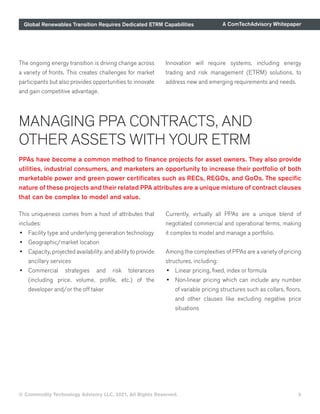
PPAs have become a common method to finance projects for asset owners. They also provide
utilities, industrial consumers, and marketers an opportunity to increase their portfolio of both
marketable power and green power certificates such as RECs, REGOs, and GoOs. The specific
nature of these projects and their related PPA attributes are a unique mixture of contract clauses
that can be complex to model and value.
MANAGING PPA CONTRACTS, AND
OTHER ASSETS WITH YOUR ETRM
This uniqueness comes from a host of attributes that
includes:
•	 Facility type and underlying generation technology
•	 Geographic/market location
•	 Capacity, projected availability, and ability to provide
ancillary services
•	 Commercial strategies and risk tolerances
(including price, volume, profile, etc.) of the
developer and/or the off taker
Currently, virtually all PPAs are a unique blend of
negotiated commercial and operational terms, making
it complex to model and manage a portfolio.
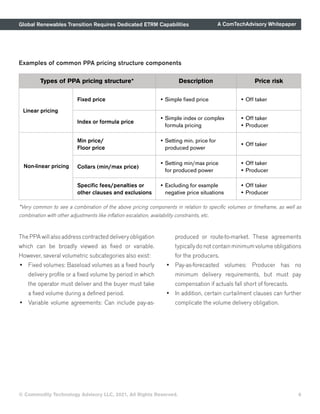
Among the complexities of PPAs are a variety of pricing
structures, including:
•	 Linear pricing, fixed, index or formula
•	 Non-linear pricing which can include any number
of variable pricing structures such as collars, floors,
and other clauses like excluding negative price
situations
The ongoing energy transition is driving change across
a variety of fronts. This creates challenges for market
participants but also provides opportunities to innovate
and gain competitive advantage.
Innovation will require systems, including energy
trading and risk management (ETRM) solutions, to
address new and emerging requirements and needs.
Global Renewables Transition Requires Dedicated ETRM Capabilities A ComTechAdvisory Whitepaper
Examples of common PPA pricing structure components
*Very common to see a combination of the above pricing components in relation to specific volumes or timeframe, as well as
combination with other adjustments like inflation escalation, availability constraints, etc.
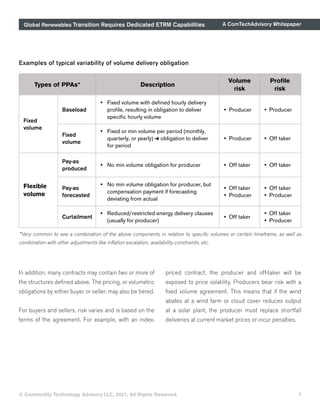
ThePPAwillalsoaddresscontracteddeliveryobligation
which can be broadly viewed as fixed or variable.
However, several volumetric subcategories also exist:
•	 Fixed volumes: Baseload volumes as a fixed hourly
delivery profile or a fixed volume by period in which
the operator must deliver and the buyer must take
a fixed volume during a defined period.
•	 Variable volume agreements: Can include pay-as-
produced or route-to-market. These agreements
typicallydonotcontainminimumvolumeobligations
for the producers.
•	 Pay-as-forecasted volumes: Producer has no
minimum delivery requirements, but must pay
compensation if actuals fall short of forecasts.
•	 In addition, certain curtailment clauses can further
complicate the volume delivery obligation.
© Commodity Technology Advisory LLC, 2021, All Rights Reserved. 6
Global Renewables Transition Requires Dedicated ETRM Capabilities A ComTechAdvisory Whitepaper
In addition, many contracts may contain two or more of
the structures defined above. The pricing, or volumetric
obligations by either buyer or seller, may also be tiered.
For buyers and sellers, risk varies and is based on the
terms of the agreement. For example, with an index-
priced contract, the producer and off-taker will be
exposed to price volatility. Producers bear risk with a
fixed volume agreement. This means that if the wind
abates at a wind farm or cloud cover reduces output
at a solar plant, the producer must replace shortfall
deliveries at current market prices or incur penalties.
Examples of typical variability of volume delivery obligation
*Very common to see a combination of the above components in relation to specific volumes or certain timeframe, as well as
combination with other adjustments like inflation escalation, availability constraints, etc.
© Commodity Technology Advisory LLC, 2021, All Rights Reserved. 7
Global Renewables Transition Requires Dedicated ETRM Capabilities A ComTechAdvisory Whitepaper
© Commodity Technology Advisory LLC, 2021, All Rights Reserved. 8
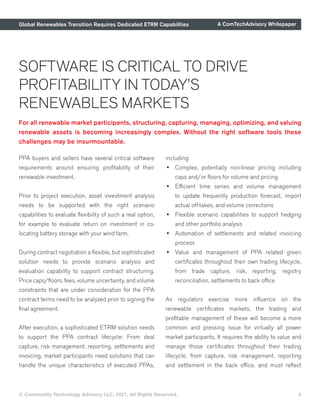
For all renewable market participants, structuring, capturing, managing, optimizing, and valuing
renewable assets is becoming increasingly complex. Without the right software tools these
challenges may be insurmountable.
SOFTWARE IS CRITICAL TO DRIVE
PROFITABILITY IN TODAY’S
RENEWABLES MARKETS
PPA buyers and sellers have several critical software
requirements around ensuring profitability of their
renewable investment.
Prior to project execution, asset investment analysis
needs to be supported with the right scenario
capabilities to evaluate flexibility of such a real option,
for example to evaluate return on investment in co-
locating battery storage with your wind farm.
During contract negotiation a flexible, but sophisticated
solution needs to provide scenario analysis and
evaluation capability to support contract structuring.
Price caps/floors, fees, volume uncertainty, and volume
constraints that are under consideration for the PPA
contract terms need to be analyzed prior to signing the
final agreement.
After execution, a sophisticated ETRM solution needs
to support the PPA contract lifecycle: From deal
capture, risk management, reporting, settlements and
invoicing, market participants need solutions that can
handle the unique characteristics of executed PPAs,
including:
•	 Complex, potentially non-linear pricing including
caps and/or floors for volume and pricing
•	 Efficient time series and volume management
to update frequently production forecast, import
actual off-takes, and volume corrections
•	 Flexible scenario capabilities to support hedging
and other portfolio analysis
•	 Automation of settlements and related invoicing
process
•	 Value and management of PPA related green
certificates throughout their own trading lifecycle,
from trade capture, risk, reporting, registry
reconciliation, settlements to back office
As regulators exercise more influence on the
renewable certificates markets, the trading and
profitable management of these will become a more
common and pressing issue for virtually all power
market participants. It requires the ability to value and
manage those certificates throughout their trading
lifecycle, from capture, risk management, reporting
and settlement in the back office, and must reflect
Global Renewables Transition Requires Dedicated ETRM Capabilities A ComTechAdvisory Whitepaper
© Commodity Technology Advisory LLC, 2021, All Rights Reserved. 9
A robust ETRM that brings together traditional and renewables related trading and risk
management activities is necessary to support companies in their energy transition. The ETRM
must also provide the right level of sophistication to support the complexities of renewables
and cover asset classes like power and certificates, support variability in contract terms, long-
lived agreements, and significant increases in trading activities and related data volumes.
ION SOLUTIONS FOR POWER AND
RENEWABLES
ION Commodities leverages their comprehensive,
market-leading ETRM portfolio, and couples it with
enhanced functionality to address the complexities
of the evolving energy and renewables market. This
approach ensures users have comprehensive front-to-
back-office capabilities to address the most difficult
challengestheymightfacewhenmanagingrenewables
as part of a larger portfolio of energy products. ION
Commodities also provides prebuilt interfaces for
ensuring renewables market participants can quickly
integrate with both internal and external systems such
as ERPs, algo trading systems, and TSOs, to ensure
efficiency and profitability.
ION solutions focused on power and renewables:
Best suited for global diversified
companies in multiple commodities with
advanced risk management requiring
flexibility and scalability
•	 Best-in-class capabilities for power
& renewables with full lifecycle
coverage
•	 Strong power & utility client base with
active user group for collaboration,
innovation and roadmap direction
•	 Packaged solutions for certificates
their unique characteristics. As more certificates are
linked with PPAs, additional needs will arise. This
includes integrating with the appropriate certificate
registries, inventory management (including registry
account management and reporting with appropriate
identification numbers, quantities, dates, etc.).
Given their variable generation output, renewable
resources generally require balancing trading activities.
This increases both the number of trades and traded
volumes in intraday markets, and significantly burdens
trading and support staff and the systems they utilize in
terms of processing time and number of transactions.
For companies that utilize algorithmic trading tools,
such as those that operate across many of the European
markets, these renewable resources and the ETRM
solutions that manage them will need to be integrated
with the algo solutions (providing input and digesting
resulting trading volumes), which will in turn increase
the volume of data movements significantly.
Global Renewables Transition Requires Dedicated ETRM Capabilities A ComTechAdvisory Whitepaper
ION Commodities’ dedicated renewables capabilities:
•	 Asset/contract evaluation for analyzing structured
agreements, asset and investment pricing, and
scenario analytics
•	 Trading and hedging capabilities for physical and
financial power and RECs, GoOs and Carbon
certificates
•	 Asset and contract modeling for capturing
complex PPAs, offer management, time-series
management, linking certificates, and complex
pricing
•	 Middle-office evaluation and analytics including
complex pricing models, results engine, and
scenario and stress testing
•	 Dedicated time series capability to streamline
volume management
•	 Advanced inventory management capabilities
for registry accounts, forecasting, evaluations,
actualization, and reconciliations of all traded
certificates
•	 Automation of settlement processes and
correction payments
ION Commodities has invested heavily in ensuring
their customers can operate successfully in the
changing energy markets. New time series data
tool ensures clients can easily upload volumes and
manipulate these directly in the ETRM. PPA contracts
often exhibit extended invoicing cycles. Correction
payments and volume reconciliations, a typical pain
point for PPAs invoicing, have been improved to
allow full automation of PPAs settlements and keep
oversight in these long invoicing cycles. A new intraday
trading module supports growing trading activity
around renewables and reduces data load within the
CTRM by up to 90%.
The robust risk and financial management tools drive
profitably, improve decision making and quickly help
firms pivot and manage the changing dynamics of
the energy market. ION continuously innovates in
close cooperation with its user groups to ensure the
roadmap addresses the emerging needs of its users as
they continue to grow and adapt to a rapidly changing
market.
trading, data series management and
intraday trading
Best suited for regional and multi-
regional utilities that are diversifying
their power generation to renewables
•	 Best-in-class capabilities for power
& renewables with full lifecycle
coverage
•	 Strong power & utility client base in
North America and Europe
•	 Dedicated modules environmental
products, intraday trading and
standard FEA integration
Asset and investment optimization,
structuring analytics and decision
support for companies investing and
contracting in renewables
•	 FEA standalone or as a
complementary solution with
Openlink and Allegro
© Commodity Technology Advisory LLC, 2021, All Rights Reserved. 10
Global Renewables Transition Requires Dedicated ETRM Capabilities A ComTechAdvisory Whitepaper
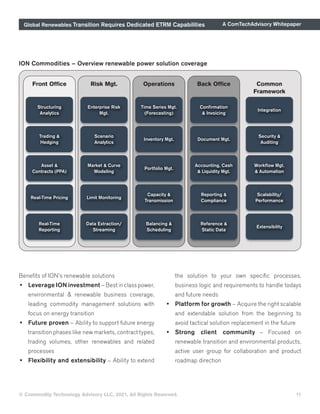
Benefits of ION’s renewable solutions
•	 Leverage ION investment –Bestinclasspower,
environmental & renewable business coverage,
leading commodity management solutions with
focus on energy transition
•	 Future proven – Ability to support future energy
transition phases like new markets, contract types,
trading volumes, other renewables and related
processes
•	 Flexibility and extensibility – Ability to extend
the solution to your own specific processes,
business logic and requirements to handle todays
and future needs
•	 Platform for growth – Acquire the right scalable
and extendable solution from the beginning to
avoid tactical solution replacement in the future
•	 Strong client community – Focused on
renewable transition and environmental products,
active user group for collaboration and product
roadmap direction
ION Commodities – Overview renewable power solution coverage
© Commodity Technology Advisory LLC, 2021, All Rights Reserved. 11
ABOUT ION COMMODITIES
We’re transforming the world of commodities through
innovation. Our mission is to understand the diverse
and changing needs of your energy and commodities
business and meet those needs with advanced
technology. Wherever you are, and whatever industry
you’re in, ION Commodities solutions put you in
complete control. With decades of knowledge and
experience, we can provide proven solutions to the
challenges you’re facing. That’s why over 30,000
users worldwide have partnered with ION to sharpen
their decision-making and boost their productivity.
Want to know more? Contact us at:
commodities@iongroup.com
commodities.iongroup.com
ABOUT
Commodity
Technology
Advisory
LLC
Commodity Technology Advisory is the leading analyst organization covering the ETRM and
CTRM markets. We provide the invaluable insights into the issues and trends affecting the
users and providers of the technologies that are crucial for success in the constantly evolving
global commodities markets.
Patrick Reames and Gary Vasey head our team, whose combined 60-plus years in the energy
and commodities markets, provides depth of understanding of the market and its issues that is
unmatched and unrivaled by any analyst group.
For more information, please visit:
www.comtechadvisory.com
ComTech Advisory also hosts the CTRMCenter, your online portal with news and views about
commodity markets and technology as well as a comprehensive online directory of software
and services providers.
Please visit the CTRMCenter at:
www.ctrmcenter.com
19901 Southwest Freeway
Sugar Land TX 77479
+1 281 207 5412
Prague, Czech Republic
+420 775 718 112
ComTechAdvisory.com
Email: info@comtechadvisory.com

Global Renewables Transition Requires Dedicated ETRM Capabilities

  • 1.
    GLOBAL RENEWABLES TRANSITION REQUIRESDEDICATED ETRM CAPABILITIES WHITE PAPER Sponsored by
  • 2.
    Global Renewables TransitionRequires Dedicated ETRM Capabilities A ComTechAdvisory Whitepaper © Commodity Technology Advisory LLC, 2021, All Rights Reserved. INTRODUCTION Renewable energy resource development is accelerating around the globe as the push to reduce carbon emissions continues to gain momentum. The Energy Information Administration (EIA) estimates that: • Wind and photovoltaic (PV) energy capacity will double from 1226 GW to approximately 2349 GW by 2025. • Global renewable capacity additions grew by more than 45% from 2019, with 110 GW of new onshore wind capacity added and 135 GW of new solar PV installed. • The share of renewables in the U.S. electricity generation mix will increase from 21% to 42% by 2050, while wind energy development is projected to be the main driver until 2025 and solar generation will see 80% growth from 2025 through 2050 after the production tax credit (PTC) for wind expires. As the pace of renewable energy expansion quickens, market participants will continue to adjust to the commercial and financial implications as well as production variability and intermittency, reliability, and grid stability. In this white paper we will explore the changing nature of power markets, the complexities that will challenge utilities, power off-takers and traders, and the critical ETRM systems they rely on to ensure profitability. 2
  • 3.
    Global Renewables TransitionRequires Dedicated ETRM Capabilities A ComTechAdvisory Whitepaper © Commodity Technology Advisory LLC, 2021, All Rights Reserved. The continuing global push to decarbonize power generation is attracting increased investment funding by both traditional sources as well as new entrants that invest in green projects. Also, many of the large European banks are shifting their focus to green energy development and reducing funding for hydrocarbon-focused projects. RENEWABLES ARE ATTRACTING NEW PLAYERS AND CHANGING INVESTMENT APPROACHES Spurred in part by this significant shift in investment, many traditional energy producers are urgently seeking to diversify their businesses, find new sources of capital, and adopt carbon neutrality to better ensure their continuing survival during this challenging transition period. These firms, including global oil and gas producers and large utilities are now joining the ranks of new energy investors. These pivots toward carbon-neutrality and green energy are changing the funding of assets and the types of assets in development, with more wind farms, batteries, solar farms, vehicle charging stations, and biofuels coming online. Many are now directly investing in green project development or executing power purchase agreements (PPAs) in existing and new-build renewables generation. Untilrecently,renewableshavebeenfarmoreexpensive to develop than traditional generation, and construction of new projects relied heavily on the availability of feed in tariffs. These government tariffs ensured renewable projects received higher than market rates to help secure their profitability. The International Renewable Energy Agency (IRENA) reports that the cost of constructing new renewable facilities has fallen sharply over the past decade due to improvedtechnologies,economiesofscale,increasingly competitive supply chains, and growing developer experience. The group’s most recent report on global renewables development notes that utility-scale solar PV power has shown the sharpest cost decline at 82%, followed by concentrating solar power (CSP) at 47%, onshore wind at 39% and offshore wind at 29%. That report also notes that costs for solar and wind power continue to drop year-over-year, with electricity costs from utility-scale solar PV seeing a 13% decrease in 2019, and reaching a global average of 6.8 cents per kilowatt-hour (kWh). Onshore and offshore wind both declined about 9%, reaching 5.3 cents/kWh and 11.5 cents/kWh, respectively. As renewable project costs decline, feed in tariffs have fallen out of favor and have been allowed to lapse or have been discontinued in some markets. 3
  • 4.
    Global Renewables TransitionRequires Dedicated ETRM Capabilities A ComTechAdvisory Whitepaper © Commodity Technology Advisory LLC, 2021, All Rights Reserved. 4 Without this financing mechanism, some renewable facilities developers in the U.S. and Europe are moving increasingly to long-term power purchase agreements (PPAs) that ensure their projects have sufficient commercial support to finance, build, and operate. The IEA estimates the use of PPAs for commercial consumers has increased from 0.3 GW in 2009 to almost 19 GW in 2019. The rapid growth is expected to accelerate as renewables development continues.1 Aiding the development of new renewable sources, regulators have mandated or encouraged the growth of carbon offset products. These include various state and regional-level emission trading programs in the U.S., and the European Union’s Emissions Trading Scheme (ETS). These authorities are also encouraging, and in some cases mandating, the development and deploymentoftoolsandproductsthatensurerenewable energy sources are appropriately tracked and traced for consumers wishing to purchase green energy products, or companies seeking to offset emissions. This includes: • Renewable Identification Numbers (RINs) for biofuels • Renewable Energy Certificates (RECs) for wind or solar power generation in the U.S. • RenewableEnergyGuaranteesofOrigincertificates (REGOs / GoOs) • Renewable Obligation Certificates (ROCs) that are now in use in the United Kingdom With the growth of renewable power resources, regulators and market operators in the U.S., Europe, and Asia-Pacific have increased the tenor of their intraday physical power trading markets. These new half-hour (and even 5-minute) markets help facilitate the integration of wind and solar generation assets. Almost all these renewable power sources are non- dispatchable (meaning always on as long as the wind blows or the sun shines) and can be highly variable in their output. Sub-hourly intraday trading markets help ensure grid stability by encouraging development and maintenance of conventional peaking facilities that can be quickly brought online as wind declines, or cloud cover reduces solar output. For all market participants, whether merchant power generators, utilities, traders, marketers, or even commercial and industrial consumers, the increasing complexity of global power markets presents serious challenges. These markets have varying rules, processes, and types and attributes of environmental products. As such, significant operational and commercial challenges include the ability to identify the most profitable or lowest cost opportunities from asset development, origination, trading, and marketing, the need to model complex energy agreements such as PPAs, manage the numerous risks across these markets, and interface and interact with a diverse array of external systems. Addressing these challenges requires a modern technical infrastructure of sophisticated and agile software. 1 https://www.iea.org/data-and-statistics/charts/global-ppa-volumes-by-sector-2009-2019
  • 5.
    Global Renewables TransitionRequires Dedicated ETRM Capabilities A ComTechAdvisory Whitepaper © Commodity Technology Advisory LLC, 2021, All Rights Reserved. 5 PPAs have become a common method to finance projects for asset owners. They also provide utilities, industrial consumers, and marketers an opportunity to increase their portfolio of both marketable power and green power certificates such as RECs, REGOs, and GoOs. The specific nature of these projects and their related PPA attributes are a unique mixture of contract clauses that can be complex to model and value. MANAGING PPA CONTRACTS, AND OTHER ASSETS WITH YOUR ETRM This uniqueness comes from a host of attributes that includes: • Facility type and underlying generation technology • Geographic/market location • Capacity, projected availability, and ability to provide ancillary services • Commercial strategies and risk tolerances (including price, volume, profile, etc.) of the developer and/or the off taker Currently, virtually all PPAs are a unique blend of negotiated commercial and operational terms, making it complex to model and manage a portfolio. Among the complexities of PPAs are a variety of pricing structures, including: • Linear pricing, fixed, index or formula • Non-linear pricing which can include any number of variable pricing structures such as collars, floors, and other clauses like excluding negative price situations The ongoing energy transition is driving change across a variety of fronts. This creates challenges for market participants but also provides opportunities to innovate and gain competitive advantage. Innovation will require systems, including energy trading and risk management (ETRM) solutions, to address new and emerging requirements and needs.
  • 6.
    Global Renewables TransitionRequires Dedicated ETRM Capabilities A ComTechAdvisory Whitepaper Examples of common PPA pricing structure components *Very common to see a combination of the above pricing components in relation to specific volumes or timeframe, as well as combination with other adjustments like inflation escalation, availability constraints, etc. ThePPAwillalsoaddresscontracteddeliveryobligation which can be broadly viewed as fixed or variable. However, several volumetric subcategories also exist: • Fixed volumes: Baseload volumes as a fixed hourly delivery profile or a fixed volume by period in which the operator must deliver and the buyer must take a fixed volume during a defined period. • Variable volume agreements: Can include pay-as- produced or route-to-market. These agreements typicallydonotcontainminimumvolumeobligations for the producers. • Pay-as-forecasted volumes: Producer has no minimum delivery requirements, but must pay compensation if actuals fall short of forecasts. • In addition, certain curtailment clauses can further complicate the volume delivery obligation. © Commodity Technology Advisory LLC, 2021, All Rights Reserved. 6
  • 7.
    Global Renewables TransitionRequires Dedicated ETRM Capabilities A ComTechAdvisory Whitepaper In addition, many contracts may contain two or more of the structures defined above. The pricing, or volumetric obligations by either buyer or seller, may also be tiered. For buyers and sellers, risk varies and is based on the terms of the agreement. For example, with an index- priced contract, the producer and off-taker will be exposed to price volatility. Producers bear risk with a fixed volume agreement. This means that if the wind abates at a wind farm or cloud cover reduces output at a solar plant, the producer must replace shortfall deliveries at current market prices or incur penalties. Examples of typical variability of volume delivery obligation *Very common to see a combination of the above components in relation to specific volumes or certain timeframe, as well as combination with other adjustments like inflation escalation, availability constraints, etc. © Commodity Technology Advisory LLC, 2021, All Rights Reserved. 7
  • 8.
    Global Renewables TransitionRequires Dedicated ETRM Capabilities A ComTechAdvisory Whitepaper © Commodity Technology Advisory LLC, 2021, All Rights Reserved. 8 For all renewable market participants, structuring, capturing, managing, optimizing, and valuing renewable assets is becoming increasingly complex. Without the right software tools these challenges may be insurmountable. SOFTWARE IS CRITICAL TO DRIVE PROFITABILITY IN TODAY’S RENEWABLES MARKETS PPA buyers and sellers have several critical software requirements around ensuring profitability of their renewable investment. Prior to project execution, asset investment analysis needs to be supported with the right scenario capabilities to evaluate flexibility of such a real option, for example to evaluate return on investment in co- locating battery storage with your wind farm. During contract negotiation a flexible, but sophisticated solution needs to provide scenario analysis and evaluation capability to support contract structuring. Price caps/floors, fees, volume uncertainty, and volume constraints that are under consideration for the PPA contract terms need to be analyzed prior to signing the final agreement. After execution, a sophisticated ETRM solution needs to support the PPA contract lifecycle: From deal capture, risk management, reporting, settlements and invoicing, market participants need solutions that can handle the unique characteristics of executed PPAs, including: • Complex, potentially non-linear pricing including caps and/or floors for volume and pricing • Efficient time series and volume management to update frequently production forecast, import actual off-takes, and volume corrections • Flexible scenario capabilities to support hedging and other portfolio analysis • Automation of settlements and related invoicing process • Value and management of PPA related green certificates throughout their own trading lifecycle, from trade capture, risk, reporting, registry reconciliation, settlements to back office As regulators exercise more influence on the renewable certificates markets, the trading and profitable management of these will become a more common and pressing issue for virtually all power market participants. It requires the ability to value and manage those certificates throughout their trading lifecycle, from capture, risk management, reporting and settlement in the back office, and must reflect
  • 9.
    Global Renewables TransitionRequires Dedicated ETRM Capabilities A ComTechAdvisory Whitepaper © Commodity Technology Advisory LLC, 2021, All Rights Reserved. 9 A robust ETRM that brings together traditional and renewables related trading and risk management activities is necessary to support companies in their energy transition. The ETRM must also provide the right level of sophistication to support the complexities of renewables and cover asset classes like power and certificates, support variability in contract terms, long- lived agreements, and significant increases in trading activities and related data volumes. ION SOLUTIONS FOR POWER AND RENEWABLES ION Commodities leverages their comprehensive, market-leading ETRM portfolio, and couples it with enhanced functionality to address the complexities of the evolving energy and renewables market. This approach ensures users have comprehensive front-to- back-office capabilities to address the most difficult challengestheymightfacewhenmanagingrenewables as part of a larger portfolio of energy products. ION Commodities also provides prebuilt interfaces for ensuring renewables market participants can quickly integrate with both internal and external systems such as ERPs, algo trading systems, and TSOs, to ensure efficiency and profitability. ION solutions focused on power and renewables: Best suited for global diversified companies in multiple commodities with advanced risk management requiring flexibility and scalability • Best-in-class capabilities for power & renewables with full lifecycle coverage • Strong power & utility client base with active user group for collaboration, innovation and roadmap direction • Packaged solutions for certificates their unique characteristics. As more certificates are linked with PPAs, additional needs will arise. This includes integrating with the appropriate certificate registries, inventory management (including registry account management and reporting with appropriate identification numbers, quantities, dates, etc.). Given their variable generation output, renewable resources generally require balancing trading activities. This increases both the number of trades and traded volumes in intraday markets, and significantly burdens trading and support staff and the systems they utilize in terms of processing time and number of transactions. For companies that utilize algorithmic trading tools, such as those that operate across many of the European markets, these renewable resources and the ETRM solutions that manage them will need to be integrated with the algo solutions (providing input and digesting resulting trading volumes), which will in turn increase the volume of data movements significantly.
  • 10.
    Global Renewables TransitionRequires Dedicated ETRM Capabilities A ComTechAdvisory Whitepaper ION Commodities’ dedicated renewables capabilities: • Asset/contract evaluation for analyzing structured agreements, asset and investment pricing, and scenario analytics • Trading and hedging capabilities for physical and financial power and RECs, GoOs and Carbon certificates • Asset and contract modeling for capturing complex PPAs, offer management, time-series management, linking certificates, and complex pricing • Middle-office evaluation and analytics including complex pricing models, results engine, and scenario and stress testing • Dedicated time series capability to streamline volume management • Advanced inventory management capabilities for registry accounts, forecasting, evaluations, actualization, and reconciliations of all traded certificates • Automation of settlement processes and correction payments ION Commodities has invested heavily in ensuring their customers can operate successfully in the changing energy markets. New time series data tool ensures clients can easily upload volumes and manipulate these directly in the ETRM. PPA contracts often exhibit extended invoicing cycles. Correction payments and volume reconciliations, a typical pain point for PPAs invoicing, have been improved to allow full automation of PPAs settlements and keep oversight in these long invoicing cycles. A new intraday trading module supports growing trading activity around renewables and reduces data load within the CTRM by up to 90%. The robust risk and financial management tools drive profitably, improve decision making and quickly help firms pivot and manage the changing dynamics of the energy market. ION continuously innovates in close cooperation with its user groups to ensure the roadmap addresses the emerging needs of its users as they continue to grow and adapt to a rapidly changing market. trading, data series management and intraday trading Best suited for regional and multi- regional utilities that are diversifying their power generation to renewables • Best-in-class capabilities for power & renewables with full lifecycle coverage • Strong power & utility client base in North America and Europe • Dedicated modules environmental products, intraday trading and standard FEA integration Asset and investment optimization, structuring analytics and decision support for companies investing and contracting in renewables • FEA standalone or as a complementary solution with Openlink and Allegro © Commodity Technology Advisory LLC, 2021, All Rights Reserved. 10
  • 11.
    Global Renewables TransitionRequires Dedicated ETRM Capabilities A ComTechAdvisory Whitepaper Benefits of ION’s renewable solutions • Leverage ION investment –Bestinclasspower, environmental & renewable business coverage, leading commodity management solutions with focus on energy transition • Future proven – Ability to support future energy transition phases like new markets, contract types, trading volumes, other renewables and related processes • Flexibility and extensibility – Ability to extend the solution to your own specific processes, business logic and requirements to handle todays and future needs • Platform for growth – Acquire the right scalable and extendable solution from the beginning to avoid tactical solution replacement in the future • Strong client community – Focused on renewable transition and environmental products, active user group for collaboration and product roadmap direction ION Commodities – Overview renewable power solution coverage © Commodity Technology Advisory LLC, 2021, All Rights Reserved. 11
  • 12.
    ABOUT ION COMMODITIES We’retransforming the world of commodities through innovation. Our mission is to understand the diverse and changing needs of your energy and commodities business and meet those needs with advanced technology. Wherever you are, and whatever industry you’re in, ION Commodities solutions put you in complete control. With decades of knowledge and experience, we can provide proven solutions to the challenges you’re facing. That’s why over 30,000 users worldwide have partnered with ION to sharpen their decision-making and boost their productivity. Want to know more? Contact us at: commodities@iongroup.com commodities.iongroup.com
  • 13.
    ABOUT Commodity Technology Advisory LLC Commodity Technology Advisoryis the leading analyst organization covering the ETRM and CTRM markets. We provide the invaluable insights into the issues and trends affecting the users and providers of the technologies that are crucial for success in the constantly evolving global commodities markets. Patrick Reames and Gary Vasey head our team, whose combined 60-plus years in the energy and commodities markets, provides depth of understanding of the market and its issues that is unmatched and unrivaled by any analyst group. For more information, please visit: www.comtechadvisory.com ComTech Advisory also hosts the CTRMCenter, your online portal with news and views about commodity markets and technology as well as a comprehensive online directory of software and services providers. Please visit the CTRMCenter at: www.ctrmcenter.com 19901 Southwest Freeway Sugar Land TX 77479 +1 281 207 5412 Prague, Czech Republic +420 775 718 112 ComTechAdvisory.com Email: info@comtechadvisory.com