ANZ Testing Symposium 2015
What it means to deliver at
the speed of the Digital Age
Next Generation IT Delivery
ANZ Testing
Symposium 2015
Mirco HeringPresenter Bio
2Copyright © 2015 Accenture All rights reserved.
Follow me on Twitter: @mircohering
Or read my blog: http://notafactoryanymore.com
• DevOps and Agile Lead in APAC
• Over 10 years of experience improving IT delivery
through automation, methodology and innovation
• Mainly worked on very large clients
• Certified CSM, SAFe Agilist, Master Technology Architect
• Conference Speaker and Blogger
• Massive football (European) fan
• Outside of work: Travel, Tennis, Triathlon
Mirco Hering
APAC lead DevOps
Advanced Technologies & Architectures
Tel. 0416930210
Email: mirco.hering@accenture.com
ANZ Testing
Symposium 2015
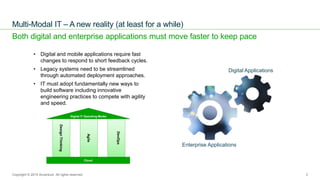
Both digital and enterprise applications must move faster to keep pace
Multi-Modal IT – A new reality (at least for a while)
• Digital and mobile applications require fast
changes to respond to short feedback cycles.
• Legacy systems need to be streamlined
through automated deployment approaches.
• IT must adopt fundamentally new ways to
build software including innovative
engineering practices to compete with agility
and speed.
Enterprise Applications
Digital Applications
3Copyright © 2015 Accenture All rights reserved.
ANZ Testing
Symposium 2015
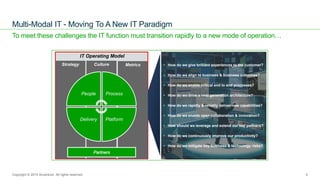
To meet these challenges the IT function must transition rapidly to a new mode of operation…
Multi-Modal IT - Moving To A New IT Paradigm
4
• How do we give brilliant experiences to the customer?
• How do we align to business & business outcomes?
• How do we enable critical end to end processes?
• How do we drive a next generation architecture?
• How do we rapidly & reliably deliver new capabilities?
• How do we enable open collaboration & innovation?
• How should we leverage and extend our key partners?
• How do we continuously improve our productivity?
• How do we mitigate key business & technology risks?
Strategy Culture Metrics
Partners
People Process
PlatformDelivery
IT Operating Model
Copyright © 2015 Accenture All rights reserved.
ANZ Testing
Symposium 2015
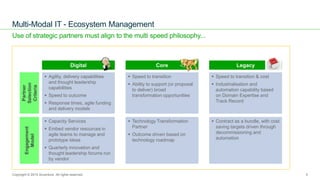
Use of strategic partners must align to the multi speed philosophy...
Multi-Modal IT - Ecosystem Management
5
Partner
Selection
Criteria
Digital Core Legacy
 Agility, delivery capabilities
and thought leadership
capabilities
 Speed to outcome
 Response times, agile funding
and delivery models
 Speed to transition
 Ability to support (or proposal
to deliver) broad
transformation opportunities
 Speed to transition & cost
 Industrialisation and
automation capability based
on Domain Expertise and
Track Record
 Capacity Services
 Embed vendor resources in
agile teams to manage and
prototype ideas
 Quarterly innovation and
thought leadership forums run
by vendor
 Technology Transformation
Partner
 Outcome driven based on
technology roadmap
 Contract as a bundle, with cost
saving targets driven through
decommissioning and
automation
Engagement
Model
Copyright © 2015 Accenture All rights reserved.
ANZ Testing
Symposium 2015
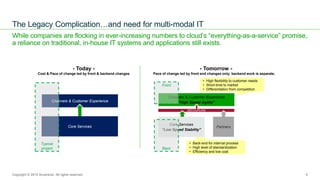
While companies are flocking in ever-increasing numbers to cloud’s “everything-as-a-service” promise,
a reliance on traditional, in-house IT systems and applications still exists.
Channels & Customer Experience
“High Speed Agility”
DECOUPLING
Core Services
“Low Speed Stability”
Partners
Channels & Customer Experience
Core Services
Typical
project
Front
Back
- Today -
Cost & Pace of change led by front & backend changes
- Tomorrow -
Pace of change led by front end changes only; backend work is separate.
• High flexibility to customer needs
• Short-time to market
• Differentiation from competition
• Back-end for internal process
• High level of standardization
• Efficiency and low cost
The Legacy Complication…and need for multi-modal IT
Copyright © 2015 Accenture All rights reserved. 6
ANZ Testing
Symposium 2015
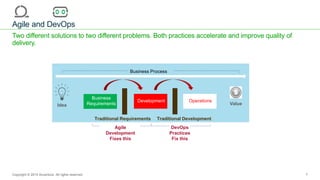
Business Process
Development Operations
Traditional DevelopmentTraditional Requirements
Business
Requirements
Agile
Development
Fixes this
DevOps
Practices
Fix this
Agile and DevOps
Two different solutions to two different problems. Both practices accelerate and improve quality of
delivery.
Idea Value
Copyright © 2015 Accenture All rights reserved. 7
ANZ Testing
Symposium 2015
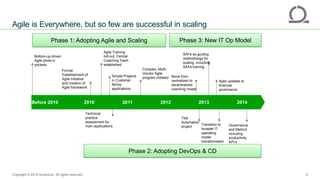
Agile is Everywhere, but so few are successful in scaling
8Copyright © 2015 Accenture All rights reserved.
Formal
Establishment of
Agile Initiative
and creation of
Agile framework
2010Before 2010
Agile Training
roll-out, Central
Coaching Team
established
Simple Projects
in Customer
facing
applications
Complex, Multi-
Vendor Agile
program initiated
Test
Automation
project
Move from
centralized to
decentralized
coaching model
Governance
and Metrics
including
productivity
KPI’s
2011 2012 2013 2014
Bottom-up driven
Agile pilots in
pockets
2010Before 2010
Technical
practice
assessment for
main applications
SAFe as guiding
methodology for
scaling, including
SAFe training
Agile updates to
financial
governance
Transition to
broader IT
operating
model
transformation
2011 2012 2013 2014
Phase 1: Adopting Agile and Scaling
Phase 2: Adopting DevOps & CD
Phase 3: New IT Op Model
ANZ Testing
Symposium 2015
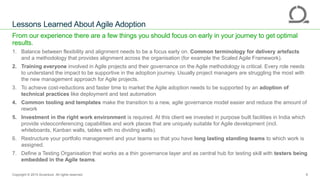
From our experience there are a few things you should focus on early in your journey to get optimal
results.
1. Balance between flexibility and alignment needs to be a focus early on. Common terminology for delivery artefacts
and a methodology that provides alignment across the organisation (for example the Scaled Agile Framework).
2. Training everyone involved in Agile projects and their governance on the Agile methodology is critical. Every role needs
to understand the impact to be supportive in the adoption journey. Usually project managers are struggling the most with
the new management approach for Agile projects.
3. To achieve cost-reductions and faster time to market the Agile adoption needs to be supported by an adoption of
technical practices like deployment and test automation
4. Common tooling and templates make the transition to a new, agile governance model easier and reduce the amount of
rework
5. Investment in the right work environment is required. At this client we invested in purpose built facilities in India which
provide videoconferencing capabilities and work places that are uniquely suitable for Agile development (incl.
whiteboards, Kanban walls, tables with no dividing walls).
6. Restructure your portfolio management and your teams so that you have long lasting standing teams to which work is
assigned.
7. Define a Testing Organisation that works as a thin governance layer and as central hub for testing skill with testers being
embedded in the Agile teams.
Lessons Learned About Agile Adoption
Copyright © 2015 Accenture All rights reserved. 9
ANZ Testing
Symposium 2015
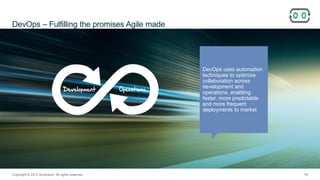
DevOps – Fulfilling the promises Agile made
10Copyright © 2015 Accenture All rights reserved.
DevOps uses automation
techniques to optimize
collaboration across
development and
operations, enabling
faster, more predictable
and more frequent
deployments to market
ANZ Testing
Symposium 2015
7
6
5
4
3
2
1
0
Project Management Tooling
(Agile Management, Requirements,
Designs )
Software Configuration Management
Build & Deployment Automation
Test Automation
Environment Management
& Monitoring
Cloud Environment Provisioning
Continuous Delivery
Cultural Change & Organization Alignment: Agile
Business Mindset
Development
(Software
Eng.)
Quality
Assurance
(QA)
Technology
Operations
DevOps
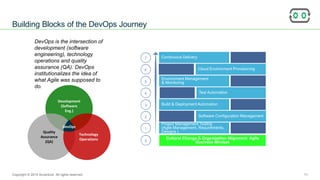
DevOps is the intersection of
development (software
engineering), technology
operations and quality
assurance (QA). DevOps
institutionalizes the idea of
what Agile was supposed to
do.
Building Blocks of the DevOps Journey
Copyright © 2015 Accenture All rights reserved. 11
ANZ Testing
Symposium 2015
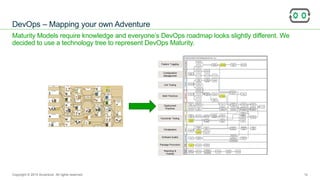
Maturity Models require knowledge and everyone’s DevOps roadmap looks slightly different. We
decided to use a technology tree to represent DevOps Maturity.
DevOps – Mapping your own Adventure
Copyright © 2015 Accenture All rights reserved. 12
ANZ Testing
Symposium 2015
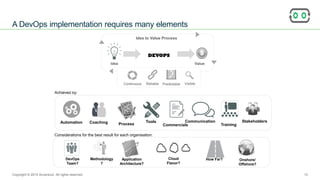
A DevOps implementation requires many elements
Tools
Training
Coaching Communication
Commercials
$
Idea Value
Continuous Reliable VisiblePredictable
Idea to Value Process
DEVOPS
StakeholdersAutomation
DevOps
Team?
Methodology
?
Application
Architecture?
Cloud
Flavor?
How Far? Onshore/
Offshore?
Process
Achieved by:
Considerations for the best result for each organisation:
Copyright © 2015 Accenture All rights reserved. 13
ANZ Testing
Symposium 2015
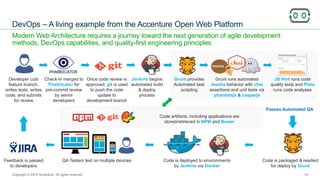
Modern Web Architecture requires a journey toward the next generation of agile development
methods, DevOps capabilities, and quality-first engineering principles
DevOps – A living example from the Accenture Open Web Platform
14
Developer cuts
feature branch,
writes tests, writes
code, and submits
for review
Grunt runs automated
mocha behavior with chai
assertions and unit tests via
phantomjs & casperjs
Grunt provides
Automated task
scripting
Jenkins begins
automated build
& deploy
process
JS Hint runs code
quality tests and Plato
runs code analyses
Feedback is passed
to developers
QA Testers test on multiple devices
mocha
Code is packaged & readied
for deploy by Grunt
Check-in merged to
Phabricator for
pre-commit review
by senior
developers
Code is deployed to environments
by Jenkins via Docker
Once code review is
approved, git is used
to push the code
update to
development branch
Code artifacts, including applications are
stored/retrieved in NPM and Bower
Passes Automated QA
Copyright © 2015 Accenture All rights reserved.
ANZ Testing
Symposium 2015
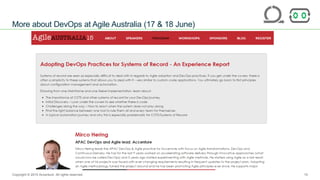
More about DevOps at Agile Australia (17 & 18 June)
Copyright © 2015 Accenture All rights reserved. 15

Next Generation IT Delivery - What it means to deliver atthe speed of the Digital Age

  • 1.
    ANZ Testing Symposium2015 What it means to deliver at the speed of the Digital Age Next Generation IT Delivery
  • 2.
    ANZ Testing Symposium 2015 MircoHeringPresenter Bio 2Copyright © 2015 Accenture All rights reserved. Follow me on Twitter: @mircohering Or read my blog: http://notafactoryanymore.com • DevOps and Agile Lead in APAC • Over 10 years of experience improving IT delivery through automation, methodology and innovation • Mainly worked on very large clients • Certified CSM, SAFe Agilist, Master Technology Architect • Conference Speaker and Blogger • Massive football (European) fan • Outside of work: Travel, Tennis, Triathlon Mirco Hering APAC lead DevOps Advanced Technologies & Architectures Tel. 0416930210 Email: mirco.hering@accenture.com
  • 3.
    ANZ Testing Symposium 2015 Bothdigital and enterprise applications must move faster to keep pace Multi-Modal IT – A new reality (at least for a while) • Digital and mobile applications require fast changes to respond to short feedback cycles. • Legacy systems need to be streamlined through automated deployment approaches. • IT must adopt fundamentally new ways to build software including innovative engineering practices to compete with agility and speed. Enterprise Applications Digital Applications 3Copyright © 2015 Accenture All rights reserved.
  • 4.
    ANZ Testing Symposium 2015 Tomeet these challenges the IT function must transition rapidly to a new mode of operation… Multi-Modal IT - Moving To A New IT Paradigm 4 • How do we give brilliant experiences to the customer? • How do we align to business & business outcomes? • How do we enable critical end to end processes? • How do we drive a next generation architecture? • How do we rapidly & reliably deliver new capabilities? • How do we enable open collaboration & innovation? • How should we leverage and extend our key partners? • How do we continuously improve our productivity? • How do we mitigate key business & technology risks? Strategy Culture Metrics Partners People Process PlatformDelivery IT Operating Model Copyright © 2015 Accenture All rights reserved.
  • 5.
    ANZ Testing Symposium 2015 Useof strategic partners must align to the multi speed philosophy... Multi-Modal IT - Ecosystem Management 5 Partner Selection Criteria Digital Core Legacy  Agility, delivery capabilities and thought leadership capabilities  Speed to outcome  Response times, agile funding and delivery models  Speed to transition  Ability to support (or proposal to deliver) broad transformation opportunities  Speed to transition & cost  Industrialisation and automation capability based on Domain Expertise and Track Record  Capacity Services  Embed vendor resources in agile teams to manage and prototype ideas  Quarterly innovation and thought leadership forums run by vendor  Technology Transformation Partner  Outcome driven based on technology roadmap  Contract as a bundle, with cost saving targets driven through decommissioning and automation Engagement Model Copyright © 2015 Accenture All rights reserved.
  • 6.
    ANZ Testing Symposium 2015 Whilecompanies are flocking in ever-increasing numbers to cloud’s “everything-as-a-service” promise, a reliance on traditional, in-house IT systems and applications still exists. Channels & Customer Experience “High Speed Agility” DECOUPLING Core Services “Low Speed Stability” Partners Channels & Customer Experience Core Services Typical project Front Back - Today - Cost & Pace of change led by front & backend changes - Tomorrow - Pace of change led by front end changes only; backend work is separate. • High flexibility to customer needs • Short-time to market • Differentiation from competition • Back-end for internal process • High level of standardization • Efficiency and low cost The Legacy Complication…and need for multi-modal IT Copyright © 2015 Accenture All rights reserved. 6
  • 7.
    ANZ Testing Symposium 2015 BusinessProcess Development Operations Traditional DevelopmentTraditional Requirements Business Requirements Agile Development Fixes this DevOps Practices Fix this Agile and DevOps Two different solutions to two different problems. Both practices accelerate and improve quality of delivery. Idea Value Copyright © 2015 Accenture All rights reserved. 7
  • 8.
    ANZ Testing Symposium 2015 Agileis Everywhere, but so few are successful in scaling 8Copyright © 2015 Accenture All rights reserved. Formal Establishment of Agile Initiative and creation of Agile framework 2010Before 2010 Agile Training roll-out, Central Coaching Team established Simple Projects in Customer facing applications Complex, Multi- Vendor Agile program initiated Test Automation project Move from centralized to decentralized coaching model Governance and Metrics including productivity KPI’s 2011 2012 2013 2014 Bottom-up driven Agile pilots in pockets 2010Before 2010 Technical practice assessment for main applications SAFe as guiding methodology for scaling, including SAFe training Agile updates to financial governance Transition to broader IT operating model transformation 2011 2012 2013 2014 Phase 1: Adopting Agile and Scaling Phase 2: Adopting DevOps & CD Phase 3: New IT Op Model
  • 9.
    ANZ Testing Symposium 2015 Fromour experience there are a few things you should focus on early in your journey to get optimal results. 1. Balance between flexibility and alignment needs to be a focus early on. Common terminology for delivery artefacts and a methodology that provides alignment across the organisation (for example the Scaled Agile Framework). 2. Training everyone involved in Agile projects and their governance on the Agile methodology is critical. Every role needs to understand the impact to be supportive in the adoption journey. Usually project managers are struggling the most with the new management approach for Agile projects. 3. To achieve cost-reductions and faster time to market the Agile adoption needs to be supported by an adoption of technical practices like deployment and test automation 4. Common tooling and templates make the transition to a new, agile governance model easier and reduce the amount of rework 5. Investment in the right work environment is required. At this client we invested in purpose built facilities in India which provide videoconferencing capabilities and work places that are uniquely suitable for Agile development (incl. whiteboards, Kanban walls, tables with no dividing walls). 6. Restructure your portfolio management and your teams so that you have long lasting standing teams to which work is assigned. 7. Define a Testing Organisation that works as a thin governance layer and as central hub for testing skill with testers being embedded in the Agile teams. Lessons Learned About Agile Adoption Copyright © 2015 Accenture All rights reserved. 9
  • 10.
    ANZ Testing Symposium 2015 DevOps– Fulfilling the promises Agile made 10Copyright © 2015 Accenture All rights reserved. DevOps uses automation techniques to optimize collaboration across development and operations, enabling faster, more predictable and more frequent deployments to market
  • 11.
    ANZ Testing Symposium 2015 7 6 5 4 3 2 1 0 ProjectManagement Tooling (Agile Management, Requirements, Designs ) Software Configuration Management Build & Deployment Automation Test Automation Environment Management & Monitoring Cloud Environment Provisioning Continuous Delivery Cultural Change & Organization Alignment: Agile Business Mindset Development (Software Eng.) Quality Assurance (QA) Technology Operations DevOps DevOps is the intersection of development (software engineering), technology operations and quality assurance (QA). DevOps institutionalizes the idea of what Agile was supposed to do. Building Blocks of the DevOps Journey Copyright © 2015 Accenture All rights reserved. 11
  • 12.
    ANZ Testing Symposium 2015 MaturityModels require knowledge and everyone’s DevOps roadmap looks slightly different. We decided to use a technology tree to represent DevOps Maturity. DevOps – Mapping your own Adventure Copyright © 2015 Accenture All rights reserved. 12
  • 13.
    ANZ Testing Symposium 2015 ADevOps implementation requires many elements Tools Training Coaching Communication Commercials $ Idea Value Continuous Reliable VisiblePredictable Idea to Value Process DEVOPS StakeholdersAutomation DevOps Team? Methodology ? Application Architecture? Cloud Flavor? How Far? Onshore/ Offshore? Process Achieved by: Considerations for the best result for each organisation: Copyright © 2015 Accenture All rights reserved. 13
  • 14.
    ANZ Testing Symposium 2015 ModernWeb Architecture requires a journey toward the next generation of agile development methods, DevOps capabilities, and quality-first engineering principles DevOps – A living example from the Accenture Open Web Platform 14 Developer cuts feature branch, writes tests, writes code, and submits for review Grunt runs automated mocha behavior with chai assertions and unit tests via phantomjs & casperjs Grunt provides Automated task scripting Jenkins begins automated build & deploy process JS Hint runs code quality tests and Plato runs code analyses Feedback is passed to developers QA Testers test on multiple devices mocha Code is packaged & readied for deploy by Grunt Check-in merged to Phabricator for pre-commit review by senior developers Code is deployed to environments by Jenkins via Docker Once code review is approved, git is used to push the code update to development branch Code artifacts, including applications are stored/retrieved in NPM and Bower Passes Automated QA Copyright © 2015 Accenture All rights reserved.
  • 15.
    ANZ Testing Symposium 2015 Moreabout DevOps at Agile Australia (17 & 18 June) Copyright © 2015 Accenture All rights reserved. 15