Newton’s Laws
Brianna Behrens and Lerna Girgin
Newton’s First Law
An object will remain in its current state of motion, either
constant speed or at rest, until it enters the presence of an
unbalanced force to change its motion.
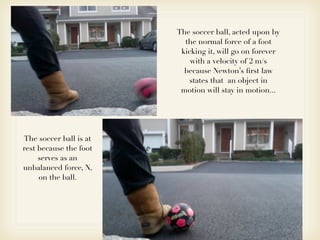
The soccer ball, acted upon by
                          the normal force of a foot
                         kicking it, will go on forever
                            with a velocity of 2 m/s
                          because Newton’s first law
                           states that an object in
                         motion will stay in motion...


The soccer ball is at
rest because the foot
     serves as an
unbalanced force, N,
     on the ball.
Newton’s Second Law

The net force acting on an object is a
result of the object’s mass multiplied by its
acceleration.
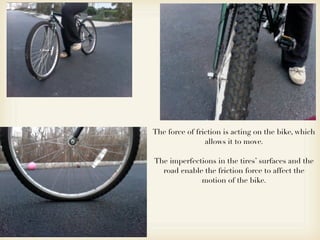
The force of friction is acting on the bike, which
                allows it to move.

The imperfections in the tires’ surfaces and the
  road enable the friction force to affect the
             motion of the bike.
Newton’s Third Law
 Every action or force has an equal and
 opposite reaction and force. The forces are
 equal and opposite of each other at the
 point of contact.
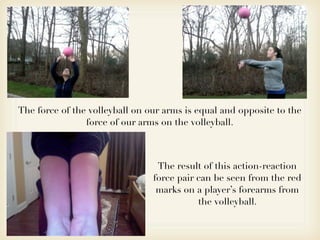
The force of the volleyball on our arms is equal and opposite to the
                force of our arms on the volleyball.


                                 The result of this action-reaction
                                force pair can be seen from the red
                                 marks on a player’s forearms from
                                           the volleyball.

Newton's laws project lerna, brianna

  • 1.
  • 2.
    Newton’s First Law Anobject will remain in its current state of motion, either constant speed or at rest, until it enters the presence of an unbalanced force to change its motion.
  • 3.
    The soccer ball,acted upon by the normal force of a foot kicking it, will go on forever with a velocity of 2 m/s because Newton’s first law states that an object in motion will stay in motion... The soccer ball is at rest because the foot serves as an unbalanced force, N, on the ball.
  • 4.
    Newton’s Second Law Thenet force acting on an object is a result of the object’s mass multiplied by its acceleration.
  • 5.
    The force offriction is acting on the bike, which allows it to move. The imperfections in the tires’ surfaces and the road enable the friction force to affect the motion of the bike.
  • 6.
    Newton’s Third Law Every action or force has an equal and opposite reaction and force. The forces are equal and opposite of each other at the point of contact.
  • 7.
    The force ofthe volleyball on our arms is equal and opposite to the force of our arms on the volleyball. The result of this action-reaction force pair can be seen from the red marks on a player’s forearms from the volleyball.

Editor's Notes