50 | FrogLog 22 (3), Number 111 (July 2014)
S
ince 2012 a small but dedicated group of conservationists are
helping five species of amphibians to cross the bicycle path
during their spring migration in an urban environment in the
North of the Netherlands (Leeuwarden). Last year in Froglog 107
(page 30-34) we reported the results and actions of 2012 and 2013.
This year we are back and the results have never been better! A
short review of the project follows.
In Leeuwarden, a small river (the Potmarge) flows from down-
town to the edge of the city (see figure 1). Alongside this river a nar-
row strip of vegetation, canals and ponds exist but are completely
surrounded by buildings. This narrow and relatively small area is
home to an assemblage of five species of amphibians; Common
newts (Lissotriton vulgaris), Common toads (Bufo bufo), Common
frogs (Rana temporaria), Edible frogs (Pelophylax klepton esculentus)
and Marsh frogs (Pelophylax ridibundus). Alongside the river a bicy-
cle path connects the city centre to several neighbourhoods making
it a very busy road throughout the year. Outside the period in early
spring when the amphibians are migrating to their breeding wa-
ters this poses little threat to the animals. However, during spring
migration lots of animals (mostly Common newts and Common
toads) get run over by cyclist. To help the animals cross the road
drift fences and pitfalls are placed on both sides of the road. The
drift fences function as an obstacle for the animals and guides them
to and in the pitfalls. These are emptied twice a day (in the morning
and evening). In the first year no less than 539 animals were trans-
ferred and in the second 540. This year will shatter those records!
This third season a new management team was ready to carry
out the task of helping the amphibians out. The new team consisted
By Tariq Stark, Carlijn Laurijssens and Jeff Peereboom
A Newt Crossed the Road: Three Years of a Road
Mitigation Project in Leeuwarden, the Netherlands
The location of the project area in the Netherlands. Map: Koen van Lieshout.
A Common newt (Lissotriton vulgaris) crossing the bicycle path! Photo: Tariq Stark.
Working on the transect. The inner city is really close to the project area! Photo: Tariq
Stark.
The location of the project area in the city of Leeuwarden. This map clearly depicts how
surrounded the area is by houses, buildings and infrastructure. Map: Koen van Lieshout.
FrogLog 22 (3), Number 111 (July 2014) | 51
of Jeff Peereboom (Project Manager) and Xandra Sleeuwenhoek
(Communication). Project founders Carlijn Laurijssens and Tariq
Stark advised and helped out wherever they could. The season
started at the end of February when temperatures became favor-
able and humidity and rainfall increased. This kick started the an-
nual spring migration and marked the start for the project to set
up and to help them cross the road! This year no less than sixteen
volunteers, the municipality of Leeuwarden, supported the project
and the Van Hall Larenstein University of applied Sciences. With-
out the support and help of these three groups this project would
not have been possible.
RESULTS OF THE THIRD SEASON
In northern countries, like the Netherlands, conditions during
winter become too harsh for populations of ectotherms: the tem-
perature drops too low and prey availability is at its lowest (1).
Amphibians in the Netherlands avoid these conditions by bur-
rowing themselves into the ground or at the bottom of a water
body (submersed), depending on the species and go into a state of
hibernation. Amphibians then wait until the conditions improve
sufficiently, in a combination of increasing temperatures, rainfall
and humidity and a daylight time of at least nine hours (2,3). In
our project area, the common newts are the first to start migrat-
ing around mid- end of February and are closely followed by the
Common toads and Common frogs. Later in the season the Edible-
and Marsh frogs begin their migration, which is a more vertical
migration from the bottom of the pond, where they hibernate, to
the waters’ surface (4). Thus, very few water frogs (Pelophylax sp.)
species are encountered in our pitfalls.
This season held some amazing nights, with counts up to 80 am-
phibians and also yielded
the highest total number
of amphibians with almost
1,000 animals—almost as
much animals as the previ-
ous two seasons combined.
The project started record-
ing the number of animals
that migrated throughout
the annual migration from
the beginning to gain some
insight of the population
numbers and development of the populations over the course of
several years.
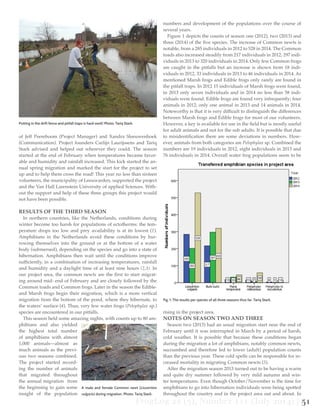
Figure 1 depicts the counts of season one (2012), two (2013) and
three (2014) of the five species. The increase of Common newts is
notable, from a 285 individuals in 2012 to 528 in 2014. The Common
toads also increased steadily from 217 individuals in 2012, 297 indi-
viduals in 2013 to 320 individuals in 2014. Only few Common frogs
are caught in the pitfalls but an increase is shown from 18 indi-
viduals in 2012, 33 individuals in 2013 to 46 individuals in 2014. As
mentioned Marsh frogs and Edible frogs only rarely are found in
the pitfall traps. In 2012 15 individuals of Marsh frogs were found,
in 2013 only seven individuals and in 2014 no less than 58 indi-
viduals were found. Edible frogs are found very infrequently; four
animals in 2012, only one animal in 2013 and 14 animals in 2014.
Noteworthy is that it is very difficult to distinguish the differences
between Marsh frogs and Edible frogs for most of our volunteers.
However, a key is available for use in the field but is mostly useful
for adult animals and not for the sub adults. It is possible that due
to misidentification there are some deviations in numbers. How-
ever, animals from both categories are Pelophylax sp. Combined the
numbers are 19 individuals in 2012, eight individuals in 2013 and
76 individuals in 2014. Overall water frog populations seem to be
rising in the project area.
NOTES ON SEASON TWO AND THREE
Season two (2013) had an usual migration start near the end of
February until it was interrupted in March by a period of harsh,
cold weather. It is possible that because these conditions began
during the migration a lot of amphibians, notably common newts,
succumbed and therefore led to lower (adult) population counts
than the previous year. These cold spells can be responsible for in-
creased mortality in migrating Common newts (5).
After the migration season 2013 turned out to be having a warm
and quite dry summer followed by very mild autumn and win-
ter temperatures. Even though October/November is the time for
amphibians to go into hibernation individuals were being spotted
throughout the country and in the project area out and about. In
Fig. 1: The results per species of all three seasons thus far. Tariq Stark.
A male and female Common newt (Lissotriton
vulgaris) during migration. Photo: Tariq Stark.
Putting in the drift fence and pitfall traps is hard work! Photo: Tariq Stark.
52 | FrogLog 22 (3), Number 111 (July 2014)
December and January, having unusual high temperatures, am-
phibians were also seen outside of their hibernation sites. Activity
during warm winter intervals is a known phenomena and for sev-
eral species including Rana temporaria and Lissotriton vulgaris (5,6,7).
How relatively warm winters and warm winter intervals influence
body condition and fecundity remains largely unknown. In an area
just outside Leeuwarden male and female Common newts were
found in the water in November and December 2013 (8). Common
newts that stay in the water during winter after breeding do occur
occasionally (9).
Because of 2014 ‘s very mild winter it was no surprise that last
season’s migration, mainly Common newts, began about a week
earlier than usual. It is known that median common newt arrival
times at the breeding waters are becoming earlier in the season in
Southern England, maybe due to climate change (10,11).
Curiously, despite the seemingly unpleasant conditions of the
spring of 2013 most populations seem to have thrived during this
year resulting in quite high numbers during the spring migration
of 2014 (966 amphibians counted).
Hot and dry summers have a negative effect on the condition of
Common toads, just as mild winters have (12). Our group didn’t
measure body the condition of the animals but Tariq Stark made
the notion about smaller body sizes in comparison with other more
southern parts of the country and in comparison of populations on
soils comprised out of sand and loam. Some of the individuals in
the project area also seemed to be slimmer than usual in the spring
of 2014.
EDUCATION
Incorporating education in this project has been an important
topic for us since the beginning. Unfortunately we didn’t have the
resources and manpower to make this happen. We did however
have the so-called “Tag-along” shifts in season one and two where
people that were interested (from the neighbourhood or otherwise)
tagged along with the morning or evening shift. We continued to
offer these tag-along shifts into the third season. In the last season
we did however had the means to extend our educational projects.
Below a short summary of the educational activities we offered this
season:
Tag-along shifts: these were especially reserved nightshifts where
locals could join in and help the volunteers with their shift. This
would give people an insight in the work that is being performed
during a nightshift and gave them an excellent moment to gain a
close-encounter experience with the amphibians. These days were
selected on weather forecast, to give people as much opportunity
to see amphibians as possible, and on the volunteers performing
the shift.Carlijn Laurijssens checking a pitfall trap for amphibians. Photo: Tariq Stark.
Jeff Peereboom and Xandra Sleeuwenhoek checking a pitfall trap. Photo: Tariq Stark.
FrogLog 22 (3), Number 111 (July 2014) | 53
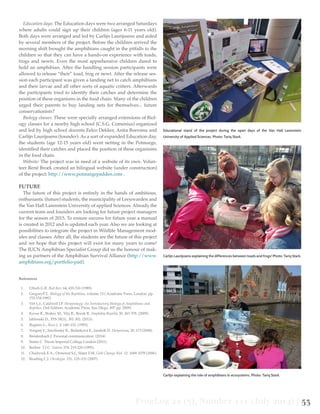
Education days: The Education days were two arranged Saturdays
where adults could sign up their children (ages 6-11 years old).
Both days were arranged and led by Carlijn Laurijssens and aided
by several members of the project. Before the children arrived the
morning shift brought the amphibians caught in the pitfalls to the
children so that they can have a hands-on experience with toads,
frogs and newts. Even the most apprehensive children dared to
hold an amphibian. After the handling session participants were
allowed to release “their” toad, frog or newt. After the release ses-
sion each participant was given a landing net to catch amphibians
and their larvae and all other sorts of aquatic critters. Afterwards
the participants tried to identify their catches and determine the
position of these organisms in the food chain. Many of the children
urged their parents to buy landing nets for themselves... future
conservationists?
Biology classes: These were specially arranged extensions of Biol-
ogy classes for a nearby high school (C.S.G. Comenius) organized
and led by high school docents Eelco Dekker, Anita Boersma and
Carlijn Laurijssens (founder). As a sort of expanded Education day,
the students (age 12-15 years old) went netting in the Potmarge,
identified their catches and placed the position of these organisms
in the food chain.
Website: The project was in need of a website of its own. Volun-
teer René Broek created an bilingual website (under construction)
of the project: http://www.potmargepadden.com .
FUTURE
The future of this project is entirely in the hands of ambitious,
enthusiastic (future) students, the municipality of Leeuwarden and
the Van Hall Larenstein University of applied Sciences. Already the
current team and founders are looking for future project managers
for the season of 2015. To ensure success for future year a manual
is created in 2012 and is updated each year. Also we are looking at
possibilities to integrate the project in Wildlife Management mod-
ules and classes. After all, the students are the future of this project
and we hope that this project will exist for many years to come!
The IUCN Amphibian Specialist Group did us the honour of mak-
ing us partners of the Amphibian Survival Alliance (http://www.
amphibians.org/portfolio-pad).
References
1.	 Ultsch G.R. Biol Rev. 64, 435-516 (1989).
2.	 GregoryP.T, Biology of the Reptilian, volume 13.( Academic Press, London. pp.
153-154.1982)
3.	 Vitt L.J., Caldwell J.P. Herpetology: An Introductory Biology of Amphibians and
Reptiles; (3rd Edition. Academic Press, San Diego. 697 pp. 2009).
4.	 Kovar R., Brabec M., Vita R., Bocek R. Amphibia Reptilia 30, 367-378. (2009).
5.	 Jablonski D., FFS 18(3):, 301-302. (2013).
6.	 Rugiero L., Russ J. 2: 148–152. (1995).
7.	 Vongrej V., Smolinský R., Bulánková E., Jandzík D. Herpetozoa, 20: 173 (2008).
8.	 Breidenbach J. Personal communication. (2014)
9.	 Simm C. Thesis Imperial College London (2011).
10.	 Beebee T.J.C. Nature 374: 219-220 (1995).
11.	 Chadwick E.A., Ormerod S.J., Slater F.M. Glob Change Biol. 12: 1069-1078 (2006).
12.	 Reading C.J. Oecologia. 151, 125–131 (2007).
	
Educational stand of the project during the open days of the Van Hall Larenstein
University of Applied Sciences. Photo: Tariq Stark.
Carlijn Laurijssens explaining the differences between toads and frogs! Photo: Tariq Stark.
Carlijn explaining the role of amphibians in ecosystems. Photo: Tariq Stark.
54 | FrogLog 22 (3), Number 111 (July 2014)
A Common frog (Rana temporaria) being held during an educational presentation. Photo: Tariq Stark.
Carlijn Laurijssens educating a group of high school students about the wonders of
amphibians in their own backyard! Photo: Tariq Stark.
Children releasing amphibians from the pitfall traps in the breeding water. Photo: Tariq
Stark.

newtcrossedteroad_website

  • 1.
    50 | FrogLog22 (3), Number 111 (July 2014) S ince 2012 a small but dedicated group of conservationists are helping five species of amphibians to cross the bicycle path during their spring migration in an urban environment in the North of the Netherlands (Leeuwarden). Last year in Froglog 107 (page 30-34) we reported the results and actions of 2012 and 2013. This year we are back and the results have never been better! A short review of the project follows. In Leeuwarden, a small river (the Potmarge) flows from down- town to the edge of the city (see figure 1). Alongside this river a nar- row strip of vegetation, canals and ponds exist but are completely surrounded by buildings. This narrow and relatively small area is home to an assemblage of five species of amphibians; Common newts (Lissotriton vulgaris), Common toads (Bufo bufo), Common frogs (Rana temporaria), Edible frogs (Pelophylax klepton esculentus) and Marsh frogs (Pelophylax ridibundus). Alongside the river a bicy- cle path connects the city centre to several neighbourhoods making it a very busy road throughout the year. Outside the period in early spring when the amphibians are migrating to their breeding wa- ters this poses little threat to the animals. However, during spring migration lots of animals (mostly Common newts and Common toads) get run over by cyclist. To help the animals cross the road drift fences and pitfalls are placed on both sides of the road. The drift fences function as an obstacle for the animals and guides them to and in the pitfalls. These are emptied twice a day (in the morning and evening). In the first year no less than 539 animals were trans- ferred and in the second 540. This year will shatter those records! This third season a new management team was ready to carry out the task of helping the amphibians out. The new team consisted By Tariq Stark, Carlijn Laurijssens and Jeff Peereboom A Newt Crossed the Road: Three Years of a Road Mitigation Project in Leeuwarden, the Netherlands The location of the project area in the Netherlands. Map: Koen van Lieshout. A Common newt (Lissotriton vulgaris) crossing the bicycle path! Photo: Tariq Stark. Working on the transect. The inner city is really close to the project area! Photo: Tariq Stark. The location of the project area in the city of Leeuwarden. This map clearly depicts how surrounded the area is by houses, buildings and infrastructure. Map: Koen van Lieshout.
  • 2.
    FrogLog 22 (3),Number 111 (July 2014) | 51 of Jeff Peereboom (Project Manager) and Xandra Sleeuwenhoek (Communication). Project founders Carlijn Laurijssens and Tariq Stark advised and helped out wherever they could. The season started at the end of February when temperatures became favor- able and humidity and rainfall increased. This kick started the an- nual spring migration and marked the start for the project to set up and to help them cross the road! This year no less than sixteen volunteers, the municipality of Leeuwarden, supported the project and the Van Hall Larenstein University of applied Sciences. With- out the support and help of these three groups this project would not have been possible. RESULTS OF THE THIRD SEASON In northern countries, like the Netherlands, conditions during winter become too harsh for populations of ectotherms: the tem- perature drops too low and prey availability is at its lowest (1). Amphibians in the Netherlands avoid these conditions by bur- rowing themselves into the ground or at the bottom of a water body (submersed), depending on the species and go into a state of hibernation. Amphibians then wait until the conditions improve sufficiently, in a combination of increasing temperatures, rainfall and humidity and a daylight time of at least nine hours (2,3). In our project area, the common newts are the first to start migrat- ing around mid- end of February and are closely followed by the Common toads and Common frogs. Later in the season the Edible- and Marsh frogs begin their migration, which is a more vertical migration from the bottom of the pond, where they hibernate, to the waters’ surface (4). Thus, very few water frogs (Pelophylax sp.) species are encountered in our pitfalls. This season held some amazing nights, with counts up to 80 am- phibians and also yielded the highest total number of amphibians with almost 1,000 animals—almost as much animals as the previ- ous two seasons combined. The project started record- ing the number of animals that migrated throughout the annual migration from the beginning to gain some insight of the population numbers and development of the populations over the course of several years. Figure 1 depicts the counts of season one (2012), two (2013) and three (2014) of the five species. The increase of Common newts is notable, from a 285 individuals in 2012 to 528 in 2014. The Common toads also increased steadily from 217 individuals in 2012, 297 indi- viduals in 2013 to 320 individuals in 2014. Only few Common frogs are caught in the pitfalls but an increase is shown from 18 indi- viduals in 2012, 33 individuals in 2013 to 46 individuals in 2014. As mentioned Marsh frogs and Edible frogs only rarely are found in the pitfall traps. In 2012 15 individuals of Marsh frogs were found, in 2013 only seven individuals and in 2014 no less than 58 indi- viduals were found. Edible frogs are found very infrequently; four animals in 2012, only one animal in 2013 and 14 animals in 2014. Noteworthy is that it is very difficult to distinguish the differences between Marsh frogs and Edible frogs for most of our volunteers. However, a key is available for use in the field but is mostly useful for adult animals and not for the sub adults. It is possible that due to misidentification there are some deviations in numbers. How- ever, animals from both categories are Pelophylax sp. Combined the numbers are 19 individuals in 2012, eight individuals in 2013 and 76 individuals in 2014. Overall water frog populations seem to be rising in the project area. NOTES ON SEASON TWO AND THREE Season two (2013) had an usual migration start near the end of February until it was interrupted in March by a period of harsh, cold weather. It is possible that because these conditions began during the migration a lot of amphibians, notably common newts, succumbed and therefore led to lower (adult) population counts than the previous year. These cold spells can be responsible for in- creased mortality in migrating Common newts (5). After the migration season 2013 turned out to be having a warm and quite dry summer followed by very mild autumn and win- ter temperatures. Even though October/November is the time for amphibians to go into hibernation individuals were being spotted throughout the country and in the project area out and about. In Fig. 1: The results per species of all three seasons thus far. Tariq Stark. A male and female Common newt (Lissotriton vulgaris) during migration. Photo: Tariq Stark. Putting in the drift fence and pitfall traps is hard work! Photo: Tariq Stark.
  • 3.
    52 | FrogLog22 (3), Number 111 (July 2014) December and January, having unusual high temperatures, am- phibians were also seen outside of their hibernation sites. Activity during warm winter intervals is a known phenomena and for sev- eral species including Rana temporaria and Lissotriton vulgaris (5,6,7). How relatively warm winters and warm winter intervals influence body condition and fecundity remains largely unknown. In an area just outside Leeuwarden male and female Common newts were found in the water in November and December 2013 (8). Common newts that stay in the water during winter after breeding do occur occasionally (9). Because of 2014 ‘s very mild winter it was no surprise that last season’s migration, mainly Common newts, began about a week earlier than usual. It is known that median common newt arrival times at the breeding waters are becoming earlier in the season in Southern England, maybe due to climate change (10,11). Curiously, despite the seemingly unpleasant conditions of the spring of 2013 most populations seem to have thrived during this year resulting in quite high numbers during the spring migration of 2014 (966 amphibians counted). Hot and dry summers have a negative effect on the condition of Common toads, just as mild winters have (12). Our group didn’t measure body the condition of the animals but Tariq Stark made the notion about smaller body sizes in comparison with other more southern parts of the country and in comparison of populations on soils comprised out of sand and loam. Some of the individuals in the project area also seemed to be slimmer than usual in the spring of 2014. EDUCATION Incorporating education in this project has been an important topic for us since the beginning. Unfortunately we didn’t have the resources and manpower to make this happen. We did however have the so-called “Tag-along” shifts in season one and two where people that were interested (from the neighbourhood or otherwise) tagged along with the morning or evening shift. We continued to offer these tag-along shifts into the third season. In the last season we did however had the means to extend our educational projects. Below a short summary of the educational activities we offered this season: Tag-along shifts: these were especially reserved nightshifts where locals could join in and help the volunteers with their shift. This would give people an insight in the work that is being performed during a nightshift and gave them an excellent moment to gain a close-encounter experience with the amphibians. These days were selected on weather forecast, to give people as much opportunity to see amphibians as possible, and on the volunteers performing the shift.Carlijn Laurijssens checking a pitfall trap for amphibians. Photo: Tariq Stark. Jeff Peereboom and Xandra Sleeuwenhoek checking a pitfall trap. Photo: Tariq Stark.
  • 4.
    FrogLog 22 (3),Number 111 (July 2014) | 53 Education days: The Education days were two arranged Saturdays where adults could sign up their children (ages 6-11 years old). Both days were arranged and led by Carlijn Laurijssens and aided by several members of the project. Before the children arrived the morning shift brought the amphibians caught in the pitfalls to the children so that they can have a hands-on experience with toads, frogs and newts. Even the most apprehensive children dared to hold an amphibian. After the handling session participants were allowed to release “their” toad, frog or newt. After the release ses- sion each participant was given a landing net to catch amphibians and their larvae and all other sorts of aquatic critters. Afterwards the participants tried to identify their catches and determine the position of these organisms in the food chain. Many of the children urged their parents to buy landing nets for themselves... future conservationists? Biology classes: These were specially arranged extensions of Biol- ogy classes for a nearby high school (C.S.G. Comenius) organized and led by high school docents Eelco Dekker, Anita Boersma and Carlijn Laurijssens (founder). As a sort of expanded Education day, the students (age 12-15 years old) went netting in the Potmarge, identified their catches and placed the position of these organisms in the food chain. Website: The project was in need of a website of its own. Volun- teer René Broek created an bilingual website (under construction) of the project: http://www.potmargepadden.com . FUTURE The future of this project is entirely in the hands of ambitious, enthusiastic (future) students, the municipality of Leeuwarden and the Van Hall Larenstein University of applied Sciences. Already the current team and founders are looking for future project managers for the season of 2015. To ensure success for future year a manual is created in 2012 and is updated each year. Also we are looking at possibilities to integrate the project in Wildlife Management mod- ules and classes. After all, the students are the future of this project and we hope that this project will exist for many years to come! The IUCN Amphibian Specialist Group did us the honour of mak- ing us partners of the Amphibian Survival Alliance (http://www. amphibians.org/portfolio-pad). References 1. Ultsch G.R. Biol Rev. 64, 435-516 (1989). 2. GregoryP.T, Biology of the Reptilian, volume 13.( Academic Press, London. pp. 153-154.1982) 3. Vitt L.J., Caldwell J.P. Herpetology: An Introductory Biology of Amphibians and Reptiles; (3rd Edition. Academic Press, San Diego. 697 pp. 2009). 4. Kovar R., Brabec M., Vita R., Bocek R. Amphibia Reptilia 30, 367-378. (2009). 5. Jablonski D., FFS 18(3):, 301-302. (2013). 6. Rugiero L., Russ J. 2: 148–152. (1995). 7. Vongrej V., Smolinský R., Bulánková E., Jandzík D. Herpetozoa, 20: 173 (2008). 8. Breidenbach J. Personal communication. (2014) 9. Simm C. Thesis Imperial College London (2011). 10. Beebee T.J.C. Nature 374: 219-220 (1995). 11. Chadwick E.A., Ormerod S.J., Slater F.M. Glob Change Biol. 12: 1069-1078 (2006). 12. Reading C.J. Oecologia. 151, 125–131 (2007). Educational stand of the project during the open days of the Van Hall Larenstein University of Applied Sciences. Photo: Tariq Stark. Carlijn Laurijssens explaining the differences between toads and frogs! Photo: Tariq Stark. Carlijn explaining the role of amphibians in ecosystems. Photo: Tariq Stark.
  • 5.
    54 | FrogLog22 (3), Number 111 (July 2014) A Common frog (Rana temporaria) being held during an educational presentation. Photo: Tariq Stark. Carlijn Laurijssens educating a group of high school students about the wonders of amphibians in their own backyard! Photo: Tariq Stark. Children releasing amphibians from the pitfall traps in the breeding water. Photo: Tariq Stark.