-------------------UTTAR PRADESH-------------------
Annexure ‘‘AAB-CD-01’
*L – Lecture *T – Tutorial *P – Practical *FW – Field Work
*PSDA – Professional Skill Development Activities)
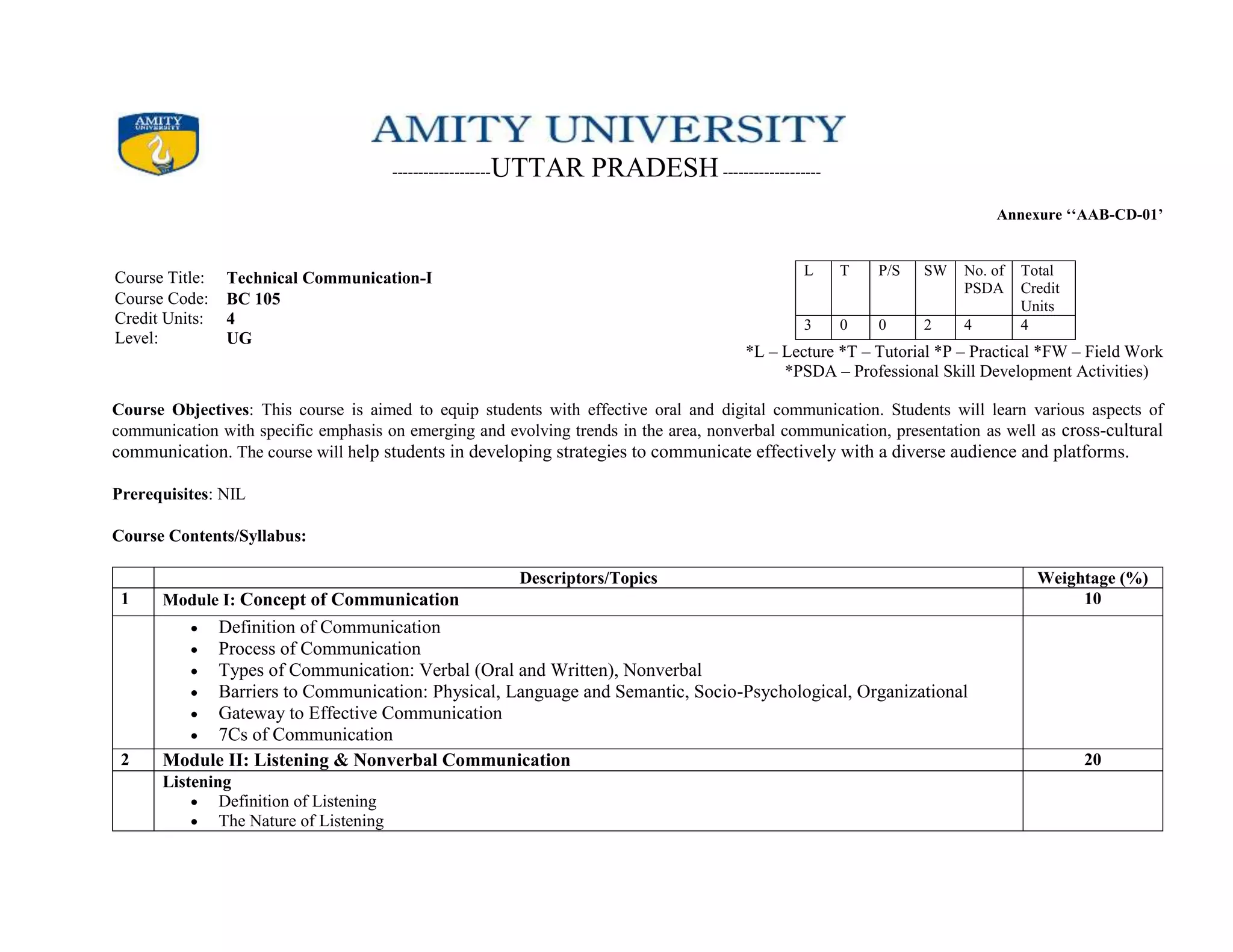
Course Objectives: This course is aimed to equip students with effective oral and digital communication. Students will learn various aspects of
communication with specific emphasis on emerging and evolving trends in the area, nonverbal communication, presentation as well as cross-cultural
communication. The course will help students in developing strategies to communicate effectively with a diverse audience and platforms.
Prerequisites: NIL
Course Contents/Syllabus:
Descriptors/Topics Weightage (%)
1 Module I: Concept of Communication 10
 Definition of Communication
 Process of Communication
 Types of Communication: Verbal (Oral and Written), Nonverbal
 Barriers to Communication: Physical, Language and Semantic, Socio-Psychological, Organizational
 Gateway to Effective Communication
 7Cs of Communication
2 Module II: Listening & Nonverbal Communication 20
Listening
 Definition of Listening
 The Nature of Listening
L T P/S SW No. of
PSDA
Total
Credit
Units
3 0 0 2 4 4
Course Title: Technical Communication-I
Course Code: BC 105
Credit Units: 4
Level: UG
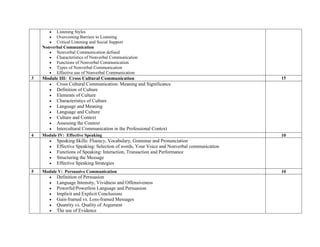
 Listening Styles
 Overcoming Barriers to Listening
 Critical Listening and Social Support
Nonverbal Communication
 Nonverbal Communication defined
 Characteristics of Nonverbal Communication
 Functions of Nonverbal Communication
 Types of Nonverbal Communication
 Effective use of Nonverbal Communication
3 Module III: Cross Cultural Communication 15
 Cross Cultural Communication: Meaning and Significance
 Definition of Culture
 Elements of Culture
 Characteristics of Culture
 Language and Meaning
 Language and Culture
 Culture and Context
 Assessing the Context
 Intercultural Communication in the Professional Context
4 Module IV: Effective Speaking 10
 Speaking Skills: Fluency, Vocabulary, Grammar and Pronunciation
 Effective Speaking: Selection of words, Your Voice and Nonverbal communication
 Functions of Speaking: Interaction, Transaction and Performance
 Structuring the Message
 Effective Speaking Strategies
5 Module V: Persuasive Communication 10
 Definition of Persuasion
 Language Intensity, Vividness and Offensiveness
 Powerful/Powerless Language and Persuasion
 Implicit and Explicit Conclusions
 Gain-framed vs. Loss-framed Messages
 Quantity vs. Quality of Argument
 The use of Evidence
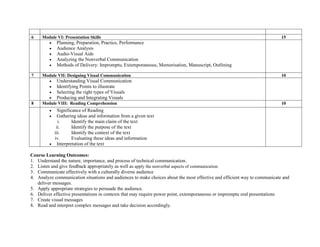
6 Module VI: Presentation Skills 15
 Planning, Preparation, Practice, Performance
 Audience Analysis
 Audio-Visual Aids
 Analyzing the Nonverbal Communication
 Methods of Delivery: Impromptu, Extemporaneous, Memorisation, Manuscript, Outlining
7 Module VII: Designing Visual Communication 10
 Understanding Visual Communication
 Identifying Points to illustrate
 Selecting the right types of Visuals
 Producing and Integrating Visuals
8 Module VIII: Reading Comprehension 10
 Significance of Reading
 Gathering ideas and information from a given text
i. Identify the main claim of the text
ii. Identify the purpose of the text
iii. Identify the context of the text
iv. Evaluating these ideas and information
 Interpretation of the text
Course Learning Outcomes:
1. Understand the nature, importance, and process of technical communication.
2. Listen and give feedback appropriately as well as apply the nonverbal aspects of communication.
3. Communicate effectively with a culturally diverse audience
4. Analyze communication situations and audiences to make choices about the most effective and efficient way to communicate and
deliver messages.
5. Apply appropriate strategies to persuade the audience.
6. Deliver effective presentations in contexts that may require power point, extemporaneous or impromptu oral presentations
7. Create visual messages
8. Read and interpret complex messages and take decision accordingly.
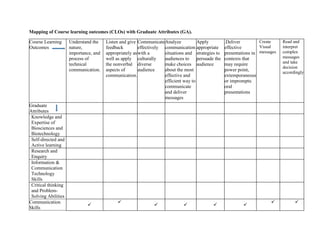
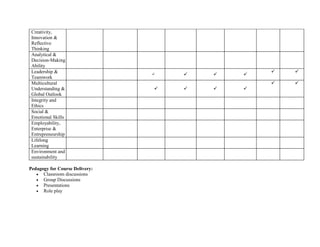
Mapping of Course learning outcomes (CLOs) with Graduate Attributes (GA).
Course Learning
Outcomes
Understand the
nature,
importance, and
process of
technical
communication.
Listen and give
feedback
appropriately as
well as apply
the nonverbal
aspects of
communication.
Communicate
effectively
with a
culturally
diverse
audience
Analyze
communication
situations and
audiences to
make choices
about the most
effective and
efficient way to
communicate
and deliver
messages
Apply
appropriate
strategies to
persuade the
audience
.Deliver
effective
presentations in
contexts that
may require
power point,
extemporaneous
or impromptu
oral
presentations
Create
Visual
messages
Read and
interpret
complex
messages
and take
decision
accordingly
Graduate
Attributes
Knowledge and
Expertise of
Biosciences and
Biotechnology
Self-directed and
Active learning
Research and
Enquiry
Information &
Communication
Technology
Skills
Critical thinking
and Problem-
Solving Abilities
Communication
Skills


   
 
Creativity,
Innovation &
Reflective
Thinking
Analytical &
Decision-Making
Ability
Leadership &
Teamwork
   
 
Multicultural
Understanding &
Global Outlook
   
 
Integrity and
Ethics
Social &
Emotional Skills
Employability,
Enterprise &
Entrepreneurship
Lifelong
Learning
Environment and
sustainability
Pedagogy for Course Delivery:
 Classroom discussions
 Group Discussions
 Presentations
 Role play
List of Professional Skill Development Activities (PSDA):
 Quiz
 Case Study
 Group Discussion
 Group Presentation
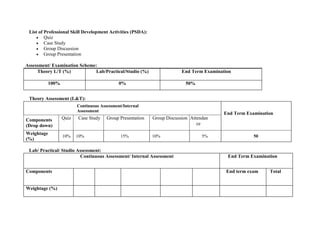
Assessment/ Examination Scheme:
Theory L/T (%) Lab/Practical/Studio (%) End Term Examination
100% 0% 50%
Theory Assessment (L&T):
Continuous Assessment/Internal
Assessment
End Term Examination
Components
(Drop down)
Quiz Case Study Group Presentation Group Discussion Attendan
ce
Weightage
(%)
10% 10% 15% 10% 5% 50
Lab/ Practical/ Studio Assessment:
Continuous Assessment/ Internal Assessment End Term Examination
Components End term exam Total
Weightage (%)
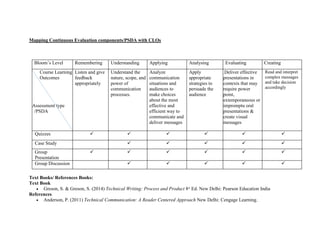
Mapping Continuous Evaluation components/PSDA with CLOs
Bloom’s Level Remembering Understanding Applying Analysing Evaluating Creating
Course Learning
Outcomes
Assessment type
/PSDA
Listen and give
feedback
appropriately
Understand the
nature, scope, and
power of
communication
processes.
Analyze
communication
situations and
audiences to
make choices
about the most
effective and
efficient way to
communicate and
deliver messages
Apply
appropriate
strategies to
persuade the
audience
.Deliver effective
presentations in
contexts that may
require power
point,
extemporaneous or
impromptu oral
presentations &
create visual
messages
Read and interpret
complex messages
and take decision
accordingly
Quizzes      
Case Study     
Group
Presentation
     
Group Discussion      
Text Books/ References Books:
Text Book
 Greson, S. & Greson, S. (2014) Technical Writing: Process and Product 8th
Ed. New Delhi: Pearson Education India
References
 Anderson, P. (2011) Technical Communication: A Reader Centered Approach New Delhi: Cengage Learning.
NewSyllabus_9402116c-3e80-4080-b8bd-f5affdd2a2b5 (1).docx

NewSyllabus_9402116c-3e80-4080-b8bd-f5affdd2a2b5 (1).docx

  • 1.
    -------------------UTTAR PRADESH------------------- Annexure ‘‘AAB-CD-01’ *L– Lecture *T – Tutorial *P – Practical *FW – Field Work *PSDA – Professional Skill Development Activities) Course Objectives: This course is aimed to equip students with effective oral and digital communication. Students will learn various aspects of communication with specific emphasis on emerging and evolving trends in the area, nonverbal communication, presentation as well as cross-cultural communication. The course will help students in developing strategies to communicate effectively with a diverse audience and platforms. Prerequisites: NIL Course Contents/Syllabus: Descriptors/Topics Weightage (%) 1 Module I: Concept of Communication 10  Definition of Communication  Process of Communication  Types of Communication: Verbal (Oral and Written), Nonverbal  Barriers to Communication: Physical, Language and Semantic, Socio-Psychological, Organizational  Gateway to Effective Communication  7Cs of Communication 2 Module II: Listening & Nonverbal Communication 20 Listening  Definition of Listening  The Nature of Listening L T P/S SW No. of PSDA Total Credit Units 3 0 0 2 4 4 Course Title: Technical Communication-I Course Code: BC 105 Credit Units: 4 Level: UG
  • 2.
     Listening Styles Overcoming Barriers to Listening  Critical Listening and Social Support Nonverbal Communication  Nonverbal Communication defined  Characteristics of Nonverbal Communication  Functions of Nonverbal Communication  Types of Nonverbal Communication  Effective use of Nonverbal Communication 3 Module III: Cross Cultural Communication 15  Cross Cultural Communication: Meaning and Significance  Definition of Culture  Elements of Culture  Characteristics of Culture  Language and Meaning  Language and Culture  Culture and Context  Assessing the Context  Intercultural Communication in the Professional Context 4 Module IV: Effective Speaking 10  Speaking Skills: Fluency, Vocabulary, Grammar and Pronunciation  Effective Speaking: Selection of words, Your Voice and Nonverbal communication  Functions of Speaking: Interaction, Transaction and Performance  Structuring the Message  Effective Speaking Strategies 5 Module V: Persuasive Communication 10  Definition of Persuasion  Language Intensity, Vividness and Offensiveness  Powerful/Powerless Language and Persuasion  Implicit and Explicit Conclusions  Gain-framed vs. Loss-framed Messages  Quantity vs. Quality of Argument  The use of Evidence
  • 3.
    6 Module VI:Presentation Skills 15  Planning, Preparation, Practice, Performance  Audience Analysis  Audio-Visual Aids  Analyzing the Nonverbal Communication  Methods of Delivery: Impromptu, Extemporaneous, Memorisation, Manuscript, Outlining 7 Module VII: Designing Visual Communication 10  Understanding Visual Communication  Identifying Points to illustrate  Selecting the right types of Visuals  Producing and Integrating Visuals 8 Module VIII: Reading Comprehension 10  Significance of Reading  Gathering ideas and information from a given text i. Identify the main claim of the text ii. Identify the purpose of the text iii. Identify the context of the text iv. Evaluating these ideas and information  Interpretation of the text Course Learning Outcomes: 1. Understand the nature, importance, and process of technical communication. 2. Listen and give feedback appropriately as well as apply the nonverbal aspects of communication. 3. Communicate effectively with a culturally diverse audience 4. Analyze communication situations and audiences to make choices about the most effective and efficient way to communicate and deliver messages. 5. Apply appropriate strategies to persuade the audience. 6. Deliver effective presentations in contexts that may require power point, extemporaneous or impromptu oral presentations 7. Create visual messages 8. Read and interpret complex messages and take decision accordingly.
  • 4.
    Mapping of Courselearning outcomes (CLOs) with Graduate Attributes (GA). Course Learning Outcomes Understand the nature, importance, and process of technical communication. Listen and give feedback appropriately as well as apply the nonverbal aspects of communication. Communicate effectively with a culturally diverse audience Analyze communication situations and audiences to make choices about the most effective and efficient way to communicate and deliver messages Apply appropriate strategies to persuade the audience .Deliver effective presentations in contexts that may require power point, extemporaneous or impromptu oral presentations Create Visual messages Read and interpret complex messages and take decision accordingly Graduate Attributes Knowledge and Expertise of Biosciences and Biotechnology Self-directed and Active learning Research and Enquiry Information & Communication Technology Skills Critical thinking and Problem- Solving Abilities Communication Skills        
  • 5.
    Creativity, Innovation & Reflective Thinking Analytical & Decision-Making Ability Leadership& Teamwork       Multicultural Understanding & Global Outlook       Integrity and Ethics Social & Emotional Skills Employability, Enterprise & Entrepreneurship Lifelong Learning Environment and sustainability Pedagogy for Course Delivery:  Classroom discussions  Group Discussions  Presentations  Role play
  • 6.
    List of ProfessionalSkill Development Activities (PSDA):  Quiz  Case Study  Group Discussion  Group Presentation Assessment/ Examination Scheme: Theory L/T (%) Lab/Practical/Studio (%) End Term Examination 100% 0% 50% Theory Assessment (L&T): Continuous Assessment/Internal Assessment End Term Examination Components (Drop down) Quiz Case Study Group Presentation Group Discussion Attendan ce Weightage (%) 10% 10% 15% 10% 5% 50 Lab/ Practical/ Studio Assessment: Continuous Assessment/ Internal Assessment End Term Examination Components End term exam Total Weightage (%)
  • 7.
    Mapping Continuous Evaluationcomponents/PSDA with CLOs Bloom’s Level Remembering Understanding Applying Analysing Evaluating Creating Course Learning Outcomes Assessment type /PSDA Listen and give feedback appropriately Understand the nature, scope, and power of communication processes. Analyze communication situations and audiences to make choices about the most effective and efficient way to communicate and deliver messages Apply appropriate strategies to persuade the audience .Deliver effective presentations in contexts that may require power point, extemporaneous or impromptu oral presentations & create visual messages Read and interpret complex messages and take decision accordingly Quizzes       Case Study      Group Presentation       Group Discussion       Text Books/ References Books: Text Book  Greson, S. & Greson, S. (2014) Technical Writing: Process and Product 8th Ed. New Delhi: Pearson Education India References  Anderson, P. (2011) Technical Communication: A Reader Centered Approach New Delhi: Cengage Learning.