Introduction
• Vector-borne diseases(VBDs) include malaria,
dengue, chikungunya, Zika, etc.
• Major public health concern due to morbidity,
mortality and economic loss.
3.
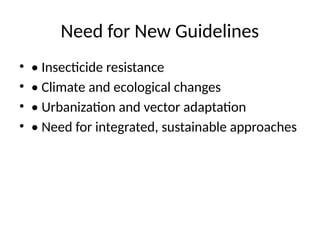
Need for NewGuidelines
• • Insecticide resistance
• • Climate and ecological changes
• • Urbanization and vector adaptation
• • Need for integrated, sustainable approaches
4.
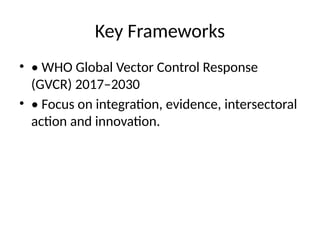
Key Frameworks
• •WHO Global Vector Control Response
(GVCR) 2017–2030
• • Focus on integration, evidence, intersectoral
action and innovation.
5.
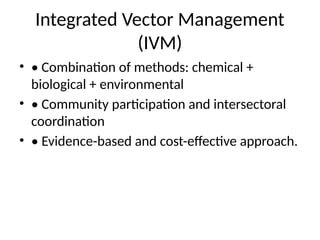
Integrated Vector Management
(IVM)
•• Combination of methods: chemical +
biological + environmental
• • Community participation and intersectoral
coordination
• • Evidence-based and cost-effective approach.
Surveillance & Resistance
Management
•• Continuous monitoring of vector density and
insecticide resistance
• • Adaptive management: rotation, mosaic
strategy
• • Data-driven interventions.
8.
Innovations in VectorControl
• • Wolbachia and Sterile Insect Technique (SIT)
• • GIS and AI-based vector mapping
• • New insecticides and biopesticides.
9.
Challenges
• • Limitedentomology capacity
• • Funding and logistics issues
• • Insecticide resistance and community
barriers.
10.
Way Forward
• •Strengthen capacity and financing
• • Promote intersectoral collaboration
• • Enhance surveillance and research
• • Encourage community participation.
11.
Conclusion
• Newer guidelinesemphasize integration,
innovation and sustainability.
• Multi-sectoral cooperation is essential to
reduce disease burden.
12.
References
• 1. WHOGVCR 2017–2030
• 2. WHO IRS Guidance 2024
• 3. WHO Vector Control Strategy
• 4. PAHO 2023 Ethics Guidance
• 5. PMC articles on VBD control
![Newer Guidelines for Vector Borne
Disease Control
• Seminar Presentation
• By: [Your Name]
• Institution: [Your Institute]
• Date: [Insert Date]](https://image.slidesharecdn.com/newerguidelinesforvectorbornediseasecontrol-251229122118-272c35aa/85/Newer_Guidelines_for_Vector_Borne_Disease_Control-pptx-1-320.jpg)
![Newer Guidelines for Vector Borne
Disease Control
• Seminar Presentation
• By: [Your Name]
• Institution: [Your Institute]
• Date: [Insert Date]](https://image.slidesharecdn.com/newerguidelinesforvectorbornediseasecontrol-251229122118-272c35aa/75/Newer_Guidelines_for_Vector_Borne_Disease_Control-pptx-1-2048.jpg)