Industrial Engineering Letters www.iiste.org 
ISSN 2224-6096 (Paper) ISSN 2225-0581 (online) 
Vol.4, No.8, 2014 
New Mixed Integer Programming for Facility Layout Design 
without Loss of Department Area 
Songwut Deechongkit Rawinkhan Srinon* 
School of Engineering, the University of the Thai Chamber of Commerce 
126/1 Vibhavadee-Rangsit Rd., Dindaeng, Bangkok 10400 Thailand 
* E-mail of the corresponding author: Rawinkhan_sri@utcc.ac.th 
Abstract 
This paper proposes a New Mixed Integer Programming (NMIP) for solving facility layout problem (FLP). The 
formulation is extensively tested on problems from literature to minimize material handling cost when addresses 
on the shop floor. Every department and shop floor in tested problem were fixed dimension of length and width. 
Classic Mixed Integer Programming (MIP) solves FLP with fixed layout area and preset each department’s 
lower-upper limit of length and width. As a result, there might be some departments with 5-10% area less than 
initial layout design requirements which leads to problem in design and construction process. It is infeasible to 
address the department on the actual shop floor thus adjustment of result from MIP is required. The main 
purpose of NMIP is to eliminate such infeasibility and show the efficiency of this model. 
Keywords: mixed integer programing, facility layout design, facility layout problem, heuristics 
1. Introduction 
FLP is one of classical facility problems. One of the reasons is due to its contribution to saving 20–50% of the 
total operating cost and 15–70% of the total manufacturing cost when shop floor is well designed (Tompkins 
2010; Sims 1991). In the real world environment, common framework for facility layout design starts from 
formulating each department then addressing all departments on the shop floor by taking smooth flow network 
into account to optimize material handling cost (Ioannou 2007). 
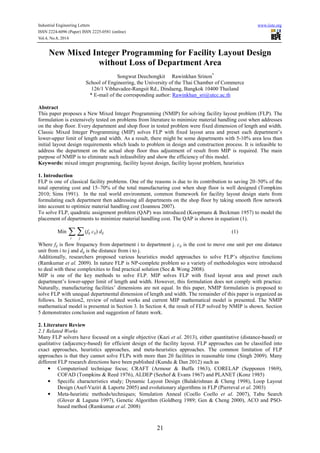
To solve FLP, quadratic assignment problem (QAP) was introduced (Koopmans & Beckman 1957) to model the 
placement of departments to minimize material handling cost. The QAP is shown in equation (1). 
21 
Min Σ 
i 
Σ 
j 
(fij cij) dij (1) 
Where fij is flow frequency from department i to department j. cij is the cost to move one unit per one distance 
unit from i to j and dij is the distance from i to j. 
Additionally, researchers proposed various heuristics model approaches to solve FLP’s objective functions 
(Ramkumar et al. 2009). In nature FLP is NP-complete problem so a variety of methodologies were introduced 
to deal with these complexities to find practical solution (See & Wong 2008). 
MIP is one of the key methods to solve FLP. MIP solves FLP with fixed layout area and preset each 
department’s lower-upper limit of length and width. However, this formulation does not comply with practice. 
Naturally, manufacturing facilities’ dimensions are not equal. In this paper, NMIP formulation is proposed to 
solve FLP with unequal departmental dimension of length and width. The remainder of this paper is organized as 
follows. In Section2, review of related works and current MIP mathematical model is presented. The NMIP 
mathematical model is presented in Section 3. In Section 4, the result of FLP solved by NMIP is shown. Section 
5 demonstrates conclusion and suggestion of future work. 
2. Literature Review 
2.1 Related Works 
Many FLP solvers have focused on a single objective (Kazi et al. 2013), either quantitative (distance-based) or 
qualitative (adjacency-based) for efficient design of the facility layout. FLP approaches can be classified into 
exact approaches, heuristics approaches, and meta-heuristics approaches. The common limitation of FLP 
approaches is that they cannot solve FLPs with more than 20 facilities in reasonable time (Singh 2009). Many 
different FLP research directions have been published (Kundu & Dan 2012) such as 
• Computerised technique focus; CRAFT (Armour & Buffa 1963), CORELAP (Sepponen 1969), 
COFAD (Tompkins & Reed 1976), ALDEP (Seehof & Evans 1967) and PLANET (Konz 1985) 
• Specific characteristics study; Dynamic Layout Design (Balakrishnan & Cheng 1998), Loop Layout 
Design (Asef-Vaziri & Laporte 2005) and evolutionary algorithms in FLP (Pierreval et al. 2003) 
• Meta-heuristic methods/techniques; Simulation Anneal (Coello Coello et al. 2007), Tabu Search 
(Glover & Laguna 1997), Genetic Algorithm (Goldberg 1989; Gen & Cheng 2000), ACO and PSO-based 
method (Ramkumar et al. 2008)
Industrial Engineering Letters www.iiste.org 
ISSN 2224-6096 (Paper) ISSN 2225-0581 (online) 
Vol.4, No.8, 2014 
In the recent years, unequal area-multi-objective FLP solving is gaining interest in research world. Researchers 
have been trying to develop algorithms/models to find the optimal layout that is possible for practical use. 
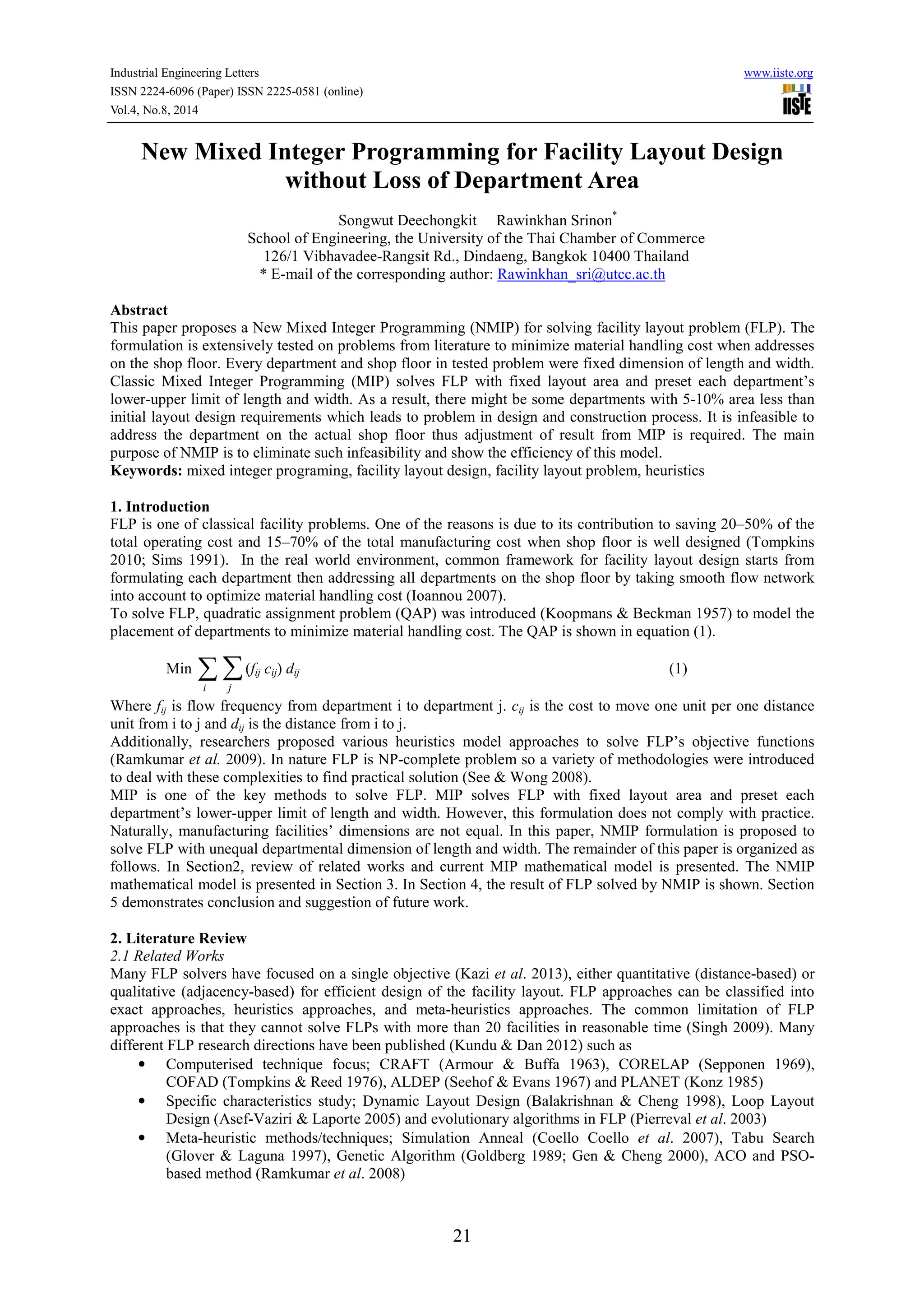
2.2 Mixed-Integer Programming (MIP) 
Last two decades, MIP formulation was presented (Montreuil 1990). This model used a distance-based algorithm. 
The advantages of MIP are as follows; all departments are rectangular in shape, no need to enter an initial layout, 
Inter-department is guaranteed non-overlapping and high reliability by computerized simulation. Konak et al. 
(2006) developed MIP formulation to solve unequal area FLPs based on the flexible bay structure (FBS), which 
can solve FLP with upto14 facilities only. MIP utilized mathematic formulation to find decision variables that 
can minimize objective function as shown below; 
Parameter, let: 
Bx be the shop floor length (x-axis), 
By be the shop floor width (y-axis), 
Ai be the area of department i, 
Lli be the lower limit on the length of department i, 
Lui be the upper limit on the length of department i, 
Wli be the lower limit on the width of department i, 
Wui be the upper limit on the width of department i, 
fij be the flow frequency from department i to department j, 
cij be the cost to move one unit per one distance unit from department i to department j, 
M is a large number. 
− 
b ) (2) 
− 
a for all i and j, i ≠ j (10) 
− 
b for all i and j, i ≠ j (11) 
− 
b ≥ 0 for all i and j, i ≠ j (16) 
22 
Decision variable, let: 
αi be the x-coordinate of the centroid of department i, 
βi be the y-coordinate of the centroid of department i, 
x’i be the x-coordinate of the left (west) side of department i, 
x”i be the x-coordinate of the right (east) side of department i, 
y’i be the y-coordinate of the bottom (south) side of department i, 
y”i be the y-coordinate of the top (north) side of department i. 
Binary variable, let: 
zxij be equal 1 if department i positions strictly to the east of department j, otherwise 0, 
zyij be equal 1 if department i positions strictly to the north of department j, otherwise 0. 
Non-negative variable, let: 
+ 
a , 
ij 
− 
a , 
ij 
+ 
b , 
ij 
− 
b . 
ij 
Objective function: 
Min Σ 
i 
Σ 
j 
+ 
a + 
fij cij ( 
ij 
− 
a + 
ij 
+ 
b + 
ij 
ij 
Subject to: 
Lli < (x”i - x’i) < Lui for all i (3) 
Wli < (y”i - y’i) < Wui for all i (4) 
(x”i - x’i) * (y”i - y’i) = Ai for all i (5) 
0 < x”i < x’i < Bx for all i (6) 
0 < y”i < y’i < By for all i (7) 
αi = 0.5 x’i + 0.5x”i for all i (8) 
βi = 0.5 y’i + 0.5y”i for all i (9) 
αi - αj = 
+ 
a - 
ij 
ij 
βi - βj = 
+ 
b - 
ij 
ij 
x”j < x’i + M ( 1 - zxij ) for all i and j, i ≠ j (12) 
y”j < y’i + M ( 1 - zyij ) for all i and j, i ≠ j (13) 
zxij + zxji + zyij + zyji ≥ 1 for all i and j, i < j (14) 
αi, βi, x’I, x”I, y’I, y”i ≥ 0 for all i (15) 
+ 
a , 
ij 
− 
a , 
ij 
+ 
b , 
ij 
ij
Industrial Engineering Letters www.iiste.org 
ISSN 2224-6096 (Paper) ISSN 2225-0581 (online) 
Vol.4, No.8, 2014 
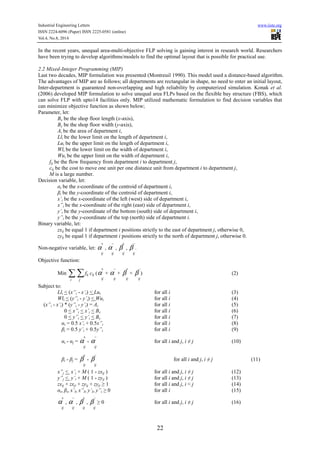
zxij , zyij 0/1 integer for all i and j, i ≠ j (17) 
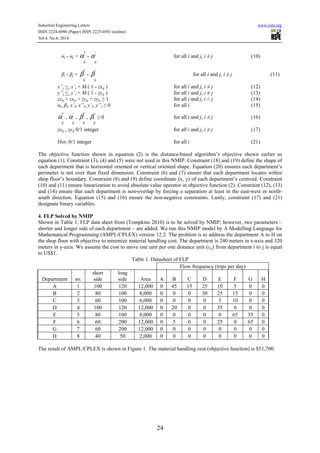
The objective function given by equation (2) is the distance-based algorithm’s objective shown earlier as 
equation (1). Constraint (3) and (4) ensure that each department’s length-width is within specified bounds. 
Equation (5) expresses each department’s area. Constraint (6) and (7) ensure that each department locates within 
shop floor’s bound. Constraint (8) and (9) define coordinate (x, y) of each department’s centroid. Constraint (10) 
and (11) help for linearization to avoid absolute value operator in objective function (2). Constraint (12), (13) 
and (14) ensure that each department is non-overlap by forcing a separation at least in the east-west or north-south 
direction. Equation (15) and (16) ensure the non-negative constraints. Lastly constraint (17) designates 
− 
b ) (2) 
23 
binary variables. 
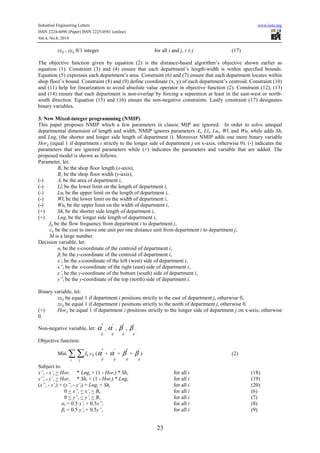
3. New Mixed-integer programming (NMIP) 
This paper proposes NMIP which a few parameters in classic MIP are ignored. In order to solve unequal 
departmental dimension of length and width, NMIP ignores parameters Ai, Lli, Lui, Wli and Wui while adds Shi 
and Lngi (the shorter and longer side length of department i). Moreover NMIP adds one more binary variable 
Horij (equal 1 if department i strictly to the longer side of department j on x-axis, otherwise 0). (-) indicates the 
parameters that are ignored parameters while (+) indicates the parameters and variable that are added. The 
proposed model is shown as follows: 
Parameter, let: 
Bx be the shop floor length (x-axis), 
By be the shop floor width (y-axis), 
(-) Ai be the area of department i, 
(-) Lli be the lower limit on the length of department i, 
(-) Lui be the upper limit on the length of department i, 
(-) Wli be the lower limit on the width of department i, 
(-) Wui be the upper limit on the width of department i, 
(+) Shi be the shorter side length of department i, 
(+) Lngi be the longer side length of department i, 
fij be the flow frequency from department i to department j, 
cij be the cost to move one unit per one distance unit from department i to department j, 
M is a large number. 
Decision variable, let: 
αi be the x-coordinate of the centroid of department i, 
βi be the y-coordinate of the centroid of department i, 
x’i be the x-coordinate of the left (west) side of department i, 
x”i be the x-coordinate of the right (east) side of department i, 
y’i be the y-coordinate of the bottom (south) side of department i, 
y”i be the y-coordinate of the top (north) side of department i. 
Binary variable, let: 
zxij be equal 1 if department i positions strictly to the east of department j, otherwise 0, 
zyij be equal 1 if department i positions strictly to the north of department j, otherwise 0. 
(+) Horij be equal 1 if department i positions strictly to the longer side of department j on x-axis, otherwise 
0. 
Non-negative variable, let: 
+ 
a , 
ij 
− 
a , 
ij 
+ 
b , 
ij 
− 
b . 
ij 
Objective function: 
Min Σ 
i 
Σ 
j 
+ 
a + 
fij cij ( 
ij 
− 
a + 
ij 
+ 
b + 
ij 
ij 
Subject to: 
x”i - x’i > Hori * Lngi + (1 - Hori) * Shi for all i (18) 
y”i - y’i > Hori * Shi + (1 - Hori) * Lngi for all i (19) 
(x”i - x’i) + (y”i - y’i) = Lngi + Shi for all i (20) 
0 < x”i < x’i < Bx for all i (6) 
0 < y”i < y’i < By for all i (7) 
αi = 0.5 x’i + 0.5x”i for all i (8) 
βi = 0.5 y’i + 0.5y”i for all i (9)
Industrial Engineering Letters www.iiste.org 
ISSN 2224-6096 (Paper) ISSN 2225-0581 (online) 
Vol.4, No.8, 2014 
− 
a for all i and j, i ≠ j (10) 
− 
b for all i and j, i ≠ j (11) 
− 
b ≥ 0 for all i and j, i ≠ j (16) 
24 
αi - αj = 
+ 
a - 
ij 
ij 
βi - βj = 
+ 
b - 
ij 
ij 
x”j < x’i + M ( 1 - zxij ) for all i and j, i ≠ j (12) 
y”j < y’i + M ( 1 - zyij ) for all i and j, i ≠ j (13) 
zxij + zxji + zyij + zyji ≥ 1 for all i and j, i < j (14) 
αi, βi, x’I, x”I, y’I, y”i ≥ 0 for all i (15) 
+ 
a , 
ij 
− 
a , 
ij 
+ 
b , 
ij 
ij 
zxij , zyij 0/1 integer for all i and j, i ≠ j (17) 
Hori 0/1 integer for all i (21) 
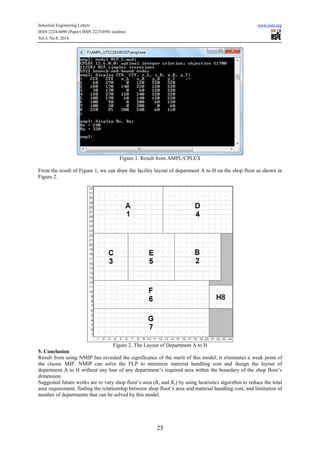
The objective function shown in equation (2) is the distance-based algorithm’s objective shown earlier as 
equation (1). Constraint (3), (4) and (5) were not used in this NMIP. Constraint (18) and (19) define the shape of 
each department that is horizontal oriented or vertical oriented shape. Equation (20) ensures each department’s 
perimeter is not over than fixed dimension. Constraint (6) and (7) ensure that each department locates within 
shop floor’s boundary. Constraint (8) and (9) define coordinate (x, y) of each department’s centroid. Constraint 
(10) and (11) ensure linearization to avoid absolute value operator in objective function (2). Constraint (12), (13) 
and (14) ensure that each department is non-overlap by forcing a separation at least in the east-west or north-south 
direction. Equation (15) and (16) ensure the non-negative constraints. Lastly, constraint (17) and (21) 
designate binary variables. 
4. FLP Solved by NMIP 
Shown in Table 1, FLP data sheet from (Tompkins 2010) is to be solved by NMIP; however, two parameters – 
shorter and longer side of each department – are added. We run this NMIP model by A Modelling Language for 
Mathematical Programming (AMPL/CPLEX) version 12.2. The problem is to address the department A to H on 
the shop floor with objective to minimize material handling cost. The department is 240 meters in x-axis and 320 
meters in y-axis. We assume the cost to move one unit per one distance unit (cij) from department i to j is equal 
to US$1. 
Table 1. Datasheet of FLP 
Flow frequency (trips per day) 
Department no. 
short 
side 
long 
side Area A B C D E F G H 
A 1 100 120 12,000 0 45 15 25 10 5 0 0 
B 2 80 100 8,000 0 0 0 30 25 15 0 0 
C 3 60 100 6,000 0 0 0 0 5 10 0 0 
D 4 100 120 12,000 0 20 0 0 35 0 0 0 
E 5 80 100 8,000 0 0 0 0 0 65 35 0 
F 6 60 200 12,000 0 5 0 0 25 0 65 0 
G 7 60 200 12,000 0 0 0 0 0 0 0 0 
H 8 40 50 2,000 0 0 0 0 0 0 0 0 
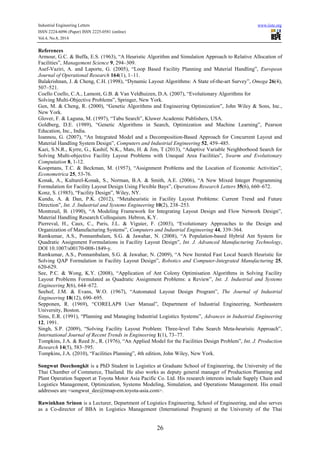
The result of AMPL/CPLEX is shown in Figure 1. The material handling cost (objective function) is $51,700.
Industrial Engineering Letters www.iiste.org 
ISSN 2224-6096 (Paper) ISSN 2225-0581 (online) 
Vol.4, No.8, 2014 
Figure 1. Result from AMPL/CPLEX 
From the result of Figure 1, we can draw the facility layout of department A to H on the shop floor as shown in 
Figure 2. 
Figure 2. The Layout of Department A to H 
5. Conclusion 
Result from using NMIP has revealed the significance of the merit of this model; it eliminates a weak point of 
the classic MIP. NMIP can solve the FLP to minimize material handling cost and design the layout of 
department A to H without any loss of any department’s required area within the boundary of the shop floor’s 
dimension. 
Suggested future works are to vary shop floor’s area (Bx and By) by using heuristics algorithm to reduce the total 
area requirement, finding the relationship between shop floor’s area and material handling cost, and limitation of 
number of departments that can be solved by this model. 
25
Industrial Engineering Letters www.iiste.org 
ISSN 2224-6096 (Paper) ISSN 2225-0581 (online) 
Vol.4, No.8, 2014 
References 
Armour, G.C. & Buffa, E.S. (1963), “A Heuristic Algorithm and Simulation Approach to Relative Allocation of 
Facilities”, Management Science 9, 294–309. 
Asef-Vaziri, A. and Laporte, G. (2005), “Loop Based Facility Planning and Material Handling”, European 
Journal of Operational Research 164(1), 1–11. 
Balakrishnan, J. & Cheng, C.H. (1998), “Dynamic Layout Algorithms: A State of-the-art Survey”, Omega 26(4), 
507–521. 
Coello Coello, C.A., Lamont, G.B. & Van Veldhuizen, D.A. (2007), “Evolutionary Algorithms for 
Solving Multi-Objective Problems”, Springer, New York. 
Gen, M. & Cheng, R. (2000), “Genetic Algorithms and Engineering Optimization”, John Wiley & Sons, Inc., 
New York. 
Glover, F. & Laguna, M. (1997), “Tabu Search”, Kluwer Academic Publishers, USA. 
Goldberg, D.E. (1989), “Genetic Algorithms in Search, Optimization and Machine Learning”, Pearson 
Education, Inc., India. 
Ioannou, G. (2007), “An Integrated Model and a Decomposition-Based Approach for Concurrent Layout and 
Material Handling System Design”, Computers and Industrial Engineering 52, 459–485. 
Kazi, S.N.R., Kyrre, G., Kashif, N.K., Mats, H. & Jim, T (2013), “Adaptive Variable Neighborhood Search for 
Solving Multi-objective Facility Layout Problems with Unequal Area Facilities”, Swarm and Evolutionary 
Computation 8, 1-12. 
Koopmans, T.C. & Beckman, M. (1957), “Assignment Problems and the Location of Economic Activities”, 
Econometrica 25, 53-76. 
Konak, A., Kulturel-Konak, S., Norman, B.A. & Smith, A.E. (2006), “A New Mixed Integer Programming 
Formulation for Facility Layout Design Using Flexible Bays”, Operations Research Letters 35(6), 660–672. 
Konz, S. (1985), “Facility Design”, Wiley, NY. 
Kundu, A. & Dan, P.K. (2012), “Metaheuristic in Facility Layout Problems: Current Trend and Future 
Direction”, Int. J. Industrial and Systems Engineering 10(2), 238–253. 
Montreuil, B. (1990), “A Modeling Framework for Integrating Layout Design and Flow Network Design”, 
Material Handling Research Colloquium. Hebron, K.Y. 
Pierreval, H., Caux, C., Paris, J.L. & Viguier, F. (2003), “Evolutionary Approaches to the Design and 
Organization of Manufacturing Systems”, Computers and Industrial Engineering 44, 339–364. 
Ramkumar, A.S., Ponnambalam, S.G. & Jawahar, N. (2008), “A Population-based Hybrid Ant System for 
Quadratic Assignment Formulations in Facility Layout Design”, Int. J. Advanced Manufacturing Technology, 
DOI 10.1007/s00170-008-1849-y. 
Ramkumar, A.S., Ponnambalam, S.G. & Jawahar, N. (2009), “A New Iterated Fast Local Search Heuristic for 
Solving QAP Formulation in Facility Layout Design”, Robotics and Computer-Integrated Manufacturing 25, 
620-629. 
See, P.C. & Wong, K.Y. (2008), “Application of Ant Colony Optimisation Algorithms in Solving Facility 
Layout Problems Formulated as Quadratic Assignment Problems: a Review”, Int. J. Industrial and Systems 
Engineering 3(6), 644–672. 
Seehof, J.M. & Evans, W.O. (1967), “Automated Layout Design Program”, The Journal of Industrial 
Engineering 18(12), 690–695. 
Sepponen, R. (1969), “CORELAP8 User Manual”, Department of Industrial Engineering, Northeastern 
University, Boston. 
Sims, E.R. (1991), “Planning and Managing Industrial Logistics Systems”, Advances in Industrial Engineering 
12, 1991. 
Singh, S.P. (2009), “Solving Facility Layout Problem: Three-level Tabu Search Meta-heuristic Approach”, 
International Journal of Recent Trends in Engineering 1(1), 73–77. 
Tompkins, J.A. & Reed Jr., R. (1976), “An Applied Model for the Facilities Design Problem”, Int. J. Production 
Research 14(5), 583–595. 
Tompkins, J.A. (2010), “Facilities Planning”, 4th edition, John Wiley, New York. 
Songwut Deechongkit is a PhD Student in Logistics at Graduate School of Engineering, the University of the 
Thai Chamber of Commerce, Thailand. He also works as deputy general manager of Production Planning and 
Plant Operation Support at Toyota Motor Asia Pacific Co. Ltd. His research interests include Supply Chain and 
Logistics Management, Optimization, Systems Modeling, Simulation, and Operations Management. His email 
addresses are <songwut_dee@tmap-em.toyota-asia.com>. 
Rawinkhan Srinon is a Lecturer, Department of Logistics Engineering, School of Engineering, and also serves 
as a Co-director of BBA in Logistics Management (International Program) at the University of the Thai 
26
Industrial Engineering Letters www.iiste.org 
ISSN 2224-6096 (Paper) ISSN 2225-0581 (online) 
Vol.4, No.8, 2014 
Chamber of Commerce, Thailand. She received her Doctoral Degree from School of Engineering at Missouri 
University of Science and Technology (formerly University of Missouri-Rolla), USA. Her teaching and research 
interests include Logistics and Supply Chain Management, System of Systems Engineering, Inventory 
Management, Decision Support Systems, and Operations Management and Strategy. Her email address is < 
Rawinkhan_sri@utcc.ac.th, rawinkhan@gmail.com >. 
27
The IISTE is a pioneer in the Open-Access hosting service and academic event 
management. The aim of the firm is Accelerating Global Knowledge Sharing. 
More information about the firm can be found on the homepage: 
http://www.iiste.org 
CALL FOR JOURNAL PAPERS 
There are more than 30 peer-reviewed academic journals hosted under the hosting 
platform. 
Prospective authors of journals can find the submission instruction on the 
following page: http://www.iiste.org/journals/ All the journals articles are available 
online to the readers all over the world without financial, legal, or technical barriers 
other than those inseparable from gaining access to the internet itself. Paper version 
of the journals is also available upon request of readers and authors. 
MORE RESOURCES 
Book publication information: http://www.iiste.org/book/ 
IISTE Knowledge Sharing Partners 
EBSCO, Index Copernicus, Ulrich's Periodicals Directory, JournalTOCS, PKP Open 
Archives Harvester, Bielefeld Academic Search Engine, Elektronische 
Zeitschriftenbibliothek EZB, Open J-Gate, OCLC WorldCat, Universe Digtial 
Library , NewJour, Google Scholar

New mixed integer programming for facility layout design without loss of department area

  • 1.
    Industrial Engineering Letterswww.iiste.org ISSN 2224-6096 (Paper) ISSN 2225-0581 (online) Vol.4, No.8, 2014 New Mixed Integer Programming for Facility Layout Design without Loss of Department Area Songwut Deechongkit Rawinkhan Srinon* School of Engineering, the University of the Thai Chamber of Commerce 126/1 Vibhavadee-Rangsit Rd., Dindaeng, Bangkok 10400 Thailand * E-mail of the corresponding author: Rawinkhan_sri@utcc.ac.th Abstract This paper proposes a New Mixed Integer Programming (NMIP) for solving facility layout problem (FLP). The formulation is extensively tested on problems from literature to minimize material handling cost when addresses on the shop floor. Every department and shop floor in tested problem were fixed dimension of length and width. Classic Mixed Integer Programming (MIP) solves FLP with fixed layout area and preset each department’s lower-upper limit of length and width. As a result, there might be some departments with 5-10% area less than initial layout design requirements which leads to problem in design and construction process. It is infeasible to address the department on the actual shop floor thus adjustment of result from MIP is required. The main purpose of NMIP is to eliminate such infeasibility and show the efficiency of this model. Keywords: mixed integer programing, facility layout design, facility layout problem, heuristics 1. Introduction FLP is one of classical facility problems. One of the reasons is due to its contribution to saving 20–50% of the total operating cost and 15–70% of the total manufacturing cost when shop floor is well designed (Tompkins 2010; Sims 1991). In the real world environment, common framework for facility layout design starts from formulating each department then addressing all departments on the shop floor by taking smooth flow network into account to optimize material handling cost (Ioannou 2007). To solve FLP, quadratic assignment problem (QAP) was introduced (Koopmans & Beckman 1957) to model the placement of departments to minimize material handling cost. The QAP is shown in equation (1). 21 Min Σ i Σ j (fij cij) dij (1) Where fij is flow frequency from department i to department j. cij is the cost to move one unit per one distance unit from i to j and dij is the distance from i to j. Additionally, researchers proposed various heuristics model approaches to solve FLP’s objective functions (Ramkumar et al. 2009). In nature FLP is NP-complete problem so a variety of methodologies were introduced to deal with these complexities to find practical solution (See & Wong 2008). MIP is one of the key methods to solve FLP. MIP solves FLP with fixed layout area and preset each department’s lower-upper limit of length and width. However, this formulation does not comply with practice. Naturally, manufacturing facilities’ dimensions are not equal. In this paper, NMIP formulation is proposed to solve FLP with unequal departmental dimension of length and width. The remainder of this paper is organized as follows. In Section2, review of related works and current MIP mathematical model is presented. The NMIP mathematical model is presented in Section 3. In Section 4, the result of FLP solved by NMIP is shown. Section 5 demonstrates conclusion and suggestion of future work. 2. Literature Review 2.1 Related Works Many FLP solvers have focused on a single objective (Kazi et al. 2013), either quantitative (distance-based) or qualitative (adjacency-based) for efficient design of the facility layout. FLP approaches can be classified into exact approaches, heuristics approaches, and meta-heuristics approaches. The common limitation of FLP approaches is that they cannot solve FLPs with more than 20 facilities in reasonable time (Singh 2009). Many different FLP research directions have been published (Kundu & Dan 2012) such as • Computerised technique focus; CRAFT (Armour & Buffa 1963), CORELAP (Sepponen 1969), COFAD (Tompkins & Reed 1976), ALDEP (Seehof & Evans 1967) and PLANET (Konz 1985) • Specific characteristics study; Dynamic Layout Design (Balakrishnan & Cheng 1998), Loop Layout Design (Asef-Vaziri & Laporte 2005) and evolutionary algorithms in FLP (Pierreval et al. 2003) • Meta-heuristic methods/techniques; Simulation Anneal (Coello Coello et al. 2007), Tabu Search (Glover & Laguna 1997), Genetic Algorithm (Goldberg 1989; Gen & Cheng 2000), ACO and PSO-based method (Ramkumar et al. 2008)
  • 2.
    Industrial Engineering Letterswww.iiste.org ISSN 2224-6096 (Paper) ISSN 2225-0581 (online) Vol.4, No.8, 2014 In the recent years, unequal area-multi-objective FLP solving is gaining interest in research world. Researchers have been trying to develop algorithms/models to find the optimal layout that is possible for practical use. 2.2 Mixed-Integer Programming (MIP) Last two decades, MIP formulation was presented (Montreuil 1990). This model used a distance-based algorithm. The advantages of MIP are as follows; all departments are rectangular in shape, no need to enter an initial layout, Inter-department is guaranteed non-overlapping and high reliability by computerized simulation. Konak et al. (2006) developed MIP formulation to solve unequal area FLPs based on the flexible bay structure (FBS), which can solve FLP with upto14 facilities only. MIP utilized mathematic formulation to find decision variables that can minimize objective function as shown below; Parameter, let: Bx be the shop floor length (x-axis), By be the shop floor width (y-axis), Ai be the area of department i, Lli be the lower limit on the length of department i, Lui be the upper limit on the length of department i, Wli be the lower limit on the width of department i, Wui be the upper limit on the width of department i, fij be the flow frequency from department i to department j, cij be the cost to move one unit per one distance unit from department i to department j, M is a large number. − b ) (2) − a for all i and j, i ≠ j (10) − b for all i and j, i ≠ j (11) − b ≥ 0 for all i and j, i ≠ j (16) 22 Decision variable, let: αi be the x-coordinate of the centroid of department i, βi be the y-coordinate of the centroid of department i, x’i be the x-coordinate of the left (west) side of department i, x”i be the x-coordinate of the right (east) side of department i, y’i be the y-coordinate of the bottom (south) side of department i, y”i be the y-coordinate of the top (north) side of department i. Binary variable, let: zxij be equal 1 if department i positions strictly to the east of department j, otherwise 0, zyij be equal 1 if department i positions strictly to the north of department j, otherwise 0. Non-negative variable, let: + a , ij − a , ij + b , ij − b . ij Objective function: Min Σ i Σ j + a + fij cij ( ij − a + ij + b + ij ij Subject to: Lli < (x”i - x’i) < Lui for all i (3) Wli < (y”i - y’i) < Wui for all i (4) (x”i - x’i) * (y”i - y’i) = Ai for all i (5) 0 < x”i < x’i < Bx for all i (6) 0 < y”i < y’i < By for all i (7) αi = 0.5 x’i + 0.5x”i for all i (8) βi = 0.5 y’i + 0.5y”i for all i (9) αi - αj = + a - ij ij βi - βj = + b - ij ij x”j < x’i + M ( 1 - zxij ) for all i and j, i ≠ j (12) y”j < y’i + M ( 1 - zyij ) for all i and j, i ≠ j (13) zxij + zxji + zyij + zyji ≥ 1 for all i and j, i < j (14) αi, βi, x’I, x”I, y’I, y”i ≥ 0 for all i (15) + a , ij − a , ij + b , ij ij
  • 3.
    Industrial Engineering Letterswww.iiste.org ISSN 2224-6096 (Paper) ISSN 2225-0581 (online) Vol.4, No.8, 2014 zxij , zyij 0/1 integer for all i and j, i ≠ j (17) The objective function given by equation (2) is the distance-based algorithm’s objective shown earlier as equation (1). Constraint (3) and (4) ensure that each department’s length-width is within specified bounds. Equation (5) expresses each department’s area. Constraint (6) and (7) ensure that each department locates within shop floor’s bound. Constraint (8) and (9) define coordinate (x, y) of each department’s centroid. Constraint (10) and (11) help for linearization to avoid absolute value operator in objective function (2). Constraint (12), (13) and (14) ensure that each department is non-overlap by forcing a separation at least in the east-west or north-south direction. Equation (15) and (16) ensure the non-negative constraints. Lastly constraint (17) designates − b ) (2) 23 binary variables. 3. New Mixed-integer programming (NMIP) This paper proposes NMIP which a few parameters in classic MIP are ignored. In order to solve unequal departmental dimension of length and width, NMIP ignores parameters Ai, Lli, Lui, Wli and Wui while adds Shi and Lngi (the shorter and longer side length of department i). Moreover NMIP adds one more binary variable Horij (equal 1 if department i strictly to the longer side of department j on x-axis, otherwise 0). (-) indicates the parameters that are ignored parameters while (+) indicates the parameters and variable that are added. The proposed model is shown as follows: Parameter, let: Bx be the shop floor length (x-axis), By be the shop floor width (y-axis), (-) Ai be the area of department i, (-) Lli be the lower limit on the length of department i, (-) Lui be the upper limit on the length of department i, (-) Wli be the lower limit on the width of department i, (-) Wui be the upper limit on the width of department i, (+) Shi be the shorter side length of department i, (+) Lngi be the longer side length of department i, fij be the flow frequency from department i to department j, cij be the cost to move one unit per one distance unit from department i to department j, M is a large number. Decision variable, let: αi be the x-coordinate of the centroid of department i, βi be the y-coordinate of the centroid of department i, x’i be the x-coordinate of the left (west) side of department i, x”i be the x-coordinate of the right (east) side of department i, y’i be the y-coordinate of the bottom (south) side of department i, y”i be the y-coordinate of the top (north) side of department i. Binary variable, let: zxij be equal 1 if department i positions strictly to the east of department j, otherwise 0, zyij be equal 1 if department i positions strictly to the north of department j, otherwise 0. (+) Horij be equal 1 if department i positions strictly to the longer side of department j on x-axis, otherwise 0. Non-negative variable, let: + a , ij − a , ij + b , ij − b . ij Objective function: Min Σ i Σ j + a + fij cij ( ij − a + ij + b + ij ij Subject to: x”i - x’i > Hori * Lngi + (1 - Hori) * Shi for all i (18) y”i - y’i > Hori * Shi + (1 - Hori) * Lngi for all i (19) (x”i - x’i) + (y”i - y’i) = Lngi + Shi for all i (20) 0 < x”i < x’i < Bx for all i (6) 0 < y”i < y’i < By for all i (7) αi = 0.5 x’i + 0.5x”i for all i (8) βi = 0.5 y’i + 0.5y”i for all i (9)
  • 4.
    Industrial Engineering Letterswww.iiste.org ISSN 2224-6096 (Paper) ISSN 2225-0581 (online) Vol.4, No.8, 2014 − a for all i and j, i ≠ j (10) − b for all i and j, i ≠ j (11) − b ≥ 0 for all i and j, i ≠ j (16) 24 αi - αj = + a - ij ij βi - βj = + b - ij ij x”j < x’i + M ( 1 - zxij ) for all i and j, i ≠ j (12) y”j < y’i + M ( 1 - zyij ) for all i and j, i ≠ j (13) zxij + zxji + zyij + zyji ≥ 1 for all i and j, i < j (14) αi, βi, x’I, x”I, y’I, y”i ≥ 0 for all i (15) + a , ij − a , ij + b , ij ij zxij , zyij 0/1 integer for all i and j, i ≠ j (17) Hori 0/1 integer for all i (21) The objective function shown in equation (2) is the distance-based algorithm’s objective shown earlier as equation (1). Constraint (3), (4) and (5) were not used in this NMIP. Constraint (18) and (19) define the shape of each department that is horizontal oriented or vertical oriented shape. Equation (20) ensures each department’s perimeter is not over than fixed dimension. Constraint (6) and (7) ensure that each department locates within shop floor’s boundary. Constraint (8) and (9) define coordinate (x, y) of each department’s centroid. Constraint (10) and (11) ensure linearization to avoid absolute value operator in objective function (2). Constraint (12), (13) and (14) ensure that each department is non-overlap by forcing a separation at least in the east-west or north-south direction. Equation (15) and (16) ensure the non-negative constraints. Lastly, constraint (17) and (21) designate binary variables. 4. FLP Solved by NMIP Shown in Table 1, FLP data sheet from (Tompkins 2010) is to be solved by NMIP; however, two parameters – shorter and longer side of each department – are added. We run this NMIP model by A Modelling Language for Mathematical Programming (AMPL/CPLEX) version 12.2. The problem is to address the department A to H on the shop floor with objective to minimize material handling cost. The department is 240 meters in x-axis and 320 meters in y-axis. We assume the cost to move one unit per one distance unit (cij) from department i to j is equal to US$1. Table 1. Datasheet of FLP Flow frequency (trips per day) Department no. short side long side Area A B C D E F G H A 1 100 120 12,000 0 45 15 25 10 5 0 0 B 2 80 100 8,000 0 0 0 30 25 15 0 0 C 3 60 100 6,000 0 0 0 0 5 10 0 0 D 4 100 120 12,000 0 20 0 0 35 0 0 0 E 5 80 100 8,000 0 0 0 0 0 65 35 0 F 6 60 200 12,000 0 5 0 0 25 0 65 0 G 7 60 200 12,000 0 0 0 0 0 0 0 0 H 8 40 50 2,000 0 0 0 0 0 0 0 0 The result of AMPL/CPLEX is shown in Figure 1. The material handling cost (objective function) is $51,700.
  • 5.
    Industrial Engineering Letterswww.iiste.org ISSN 2224-6096 (Paper) ISSN 2225-0581 (online) Vol.4, No.8, 2014 Figure 1. Result from AMPL/CPLEX From the result of Figure 1, we can draw the facility layout of department A to H on the shop floor as shown in Figure 2. Figure 2. The Layout of Department A to H 5. Conclusion Result from using NMIP has revealed the significance of the merit of this model; it eliminates a weak point of the classic MIP. NMIP can solve the FLP to minimize material handling cost and design the layout of department A to H without any loss of any department’s required area within the boundary of the shop floor’s dimension. Suggested future works are to vary shop floor’s area (Bx and By) by using heuristics algorithm to reduce the total area requirement, finding the relationship between shop floor’s area and material handling cost, and limitation of number of departments that can be solved by this model. 25
  • 6.
    Industrial Engineering Letterswww.iiste.org ISSN 2224-6096 (Paper) ISSN 2225-0581 (online) Vol.4, No.8, 2014 References Armour, G.C. & Buffa, E.S. (1963), “A Heuristic Algorithm and Simulation Approach to Relative Allocation of Facilities”, Management Science 9, 294–309. Asef-Vaziri, A. and Laporte, G. (2005), “Loop Based Facility Planning and Material Handling”, European Journal of Operational Research 164(1), 1–11. Balakrishnan, J. & Cheng, C.H. (1998), “Dynamic Layout Algorithms: A State of-the-art Survey”, Omega 26(4), 507–521. Coello Coello, C.A., Lamont, G.B. & Van Veldhuizen, D.A. (2007), “Evolutionary Algorithms for Solving Multi-Objective Problems”, Springer, New York. Gen, M. & Cheng, R. (2000), “Genetic Algorithms and Engineering Optimization”, John Wiley & Sons, Inc., New York. Glover, F. & Laguna, M. (1997), “Tabu Search”, Kluwer Academic Publishers, USA. Goldberg, D.E. (1989), “Genetic Algorithms in Search, Optimization and Machine Learning”, Pearson Education, Inc., India. Ioannou, G. (2007), “An Integrated Model and a Decomposition-Based Approach for Concurrent Layout and Material Handling System Design”, Computers and Industrial Engineering 52, 459–485. Kazi, S.N.R., Kyrre, G., Kashif, N.K., Mats, H. & Jim, T (2013), “Adaptive Variable Neighborhood Search for Solving Multi-objective Facility Layout Problems with Unequal Area Facilities”, Swarm and Evolutionary Computation 8, 1-12. Koopmans, T.C. & Beckman, M. (1957), “Assignment Problems and the Location of Economic Activities”, Econometrica 25, 53-76. Konak, A., Kulturel-Konak, S., Norman, B.A. & Smith, A.E. (2006), “A New Mixed Integer Programming Formulation for Facility Layout Design Using Flexible Bays”, Operations Research Letters 35(6), 660–672. Konz, S. (1985), “Facility Design”, Wiley, NY. Kundu, A. & Dan, P.K. (2012), “Metaheuristic in Facility Layout Problems: Current Trend and Future Direction”, Int. J. Industrial and Systems Engineering 10(2), 238–253. Montreuil, B. (1990), “A Modeling Framework for Integrating Layout Design and Flow Network Design”, Material Handling Research Colloquium. Hebron, K.Y. Pierreval, H., Caux, C., Paris, J.L. & Viguier, F. (2003), “Evolutionary Approaches to the Design and Organization of Manufacturing Systems”, Computers and Industrial Engineering 44, 339–364. Ramkumar, A.S., Ponnambalam, S.G. & Jawahar, N. (2008), “A Population-based Hybrid Ant System for Quadratic Assignment Formulations in Facility Layout Design”, Int. J. Advanced Manufacturing Technology, DOI 10.1007/s00170-008-1849-y. Ramkumar, A.S., Ponnambalam, S.G. & Jawahar, N. (2009), “A New Iterated Fast Local Search Heuristic for Solving QAP Formulation in Facility Layout Design”, Robotics and Computer-Integrated Manufacturing 25, 620-629. See, P.C. & Wong, K.Y. (2008), “Application of Ant Colony Optimisation Algorithms in Solving Facility Layout Problems Formulated as Quadratic Assignment Problems: a Review”, Int. J. Industrial and Systems Engineering 3(6), 644–672. Seehof, J.M. & Evans, W.O. (1967), “Automated Layout Design Program”, The Journal of Industrial Engineering 18(12), 690–695. Sepponen, R. (1969), “CORELAP8 User Manual”, Department of Industrial Engineering, Northeastern University, Boston. Sims, E.R. (1991), “Planning and Managing Industrial Logistics Systems”, Advances in Industrial Engineering 12, 1991. Singh, S.P. (2009), “Solving Facility Layout Problem: Three-level Tabu Search Meta-heuristic Approach”, International Journal of Recent Trends in Engineering 1(1), 73–77. Tompkins, J.A. & Reed Jr., R. (1976), “An Applied Model for the Facilities Design Problem”, Int. J. Production Research 14(5), 583–595. Tompkins, J.A. (2010), “Facilities Planning”, 4th edition, John Wiley, New York. Songwut Deechongkit is a PhD Student in Logistics at Graduate School of Engineering, the University of the Thai Chamber of Commerce, Thailand. He also works as deputy general manager of Production Planning and Plant Operation Support at Toyota Motor Asia Pacific Co. Ltd. His research interests include Supply Chain and Logistics Management, Optimization, Systems Modeling, Simulation, and Operations Management. His email addresses are <songwut_dee@tmap-em.toyota-asia.com>. Rawinkhan Srinon is a Lecturer, Department of Logistics Engineering, School of Engineering, and also serves as a Co-director of BBA in Logistics Management (International Program) at the University of the Thai 26
  • 7.
    Industrial Engineering Letterswww.iiste.org ISSN 2224-6096 (Paper) ISSN 2225-0581 (online) Vol.4, No.8, 2014 Chamber of Commerce, Thailand. She received her Doctoral Degree from School of Engineering at Missouri University of Science and Technology (formerly University of Missouri-Rolla), USA. Her teaching and research interests include Logistics and Supply Chain Management, System of Systems Engineering, Inventory Management, Decision Support Systems, and Operations Management and Strategy. Her email address is < Rawinkhan_sri@utcc.ac.th, rawinkhan@gmail.com >. 27
  • 8.
    The IISTE isa pioneer in the Open-Access hosting service and academic event management. The aim of the firm is Accelerating Global Knowledge Sharing. More information about the firm can be found on the homepage: http://www.iiste.org CALL FOR JOURNAL PAPERS There are more than 30 peer-reviewed academic journals hosted under the hosting platform. Prospective authors of journals can find the submission instruction on the following page: http://www.iiste.org/journals/ All the journals articles are available online to the readers all over the world without financial, legal, or technical barriers other than those inseparable from gaining access to the internet itself. Paper version of the journals is also available upon request of readers and authors. MORE RESOURCES Book publication information: http://www.iiste.org/book/ IISTE Knowledge Sharing Partners EBSCO, Index Copernicus, Ulrich's Periodicals Directory, JournalTOCS, PKP Open Archives Harvester, Bielefeld Academic Search Engine, Elektronische Zeitschriftenbibliothek EZB, Open J-Gate, OCLC WorldCat, Universe Digtial Library , NewJour, Google Scholar