New Face of Banking
Sector 1http://indiansarkarijobs.com
Introduction
 An industry that's tightly protected by regulations has finally opened up. But this has
introduced many new challenges. Technology can help overcome these challenges
and address the new set of issues associated with modern day banking.
 The Banking sector in India has experienced a
rapid transformation. Just about a decade back
this sector was limited to the sarkari
(read nationalized) and co-operative banks.
 In past, every branch of the same bank acted as an independent information silo,
and multi-channel banking (ATMs, Net banking, tele-banking, etc) was almost non-
existent.
2http://indiansarkarijobs.com
Introduction
 With the entry of private players into retail banking and with multi-nationals
focusing on the individual consumer in a big way, the banking system underwent a
phenomenal change.
 For the first time consumers got the choice of conducting transactions either the
traditional way (through the bank branch), through ATMs, the telephone or through
the internet. Technology played a key role in providing this multi-service platform.
 The entry of private players combined with new RBI guidelines forced nationalized
banks to redefine their core banking strategy. And technology was central to this
change.
3http://indiansarkarijobs.com
Traditional Branch Banking
 With the emergence of various channels for banking, all over have been predicting
the end of traditional branch banking, at least in the metros and other upwardly
urban areas.
 But despite the benefits offered by other technologies in terms of lower costs or
better reach, it looks like branch banking is very much here to stay.
 Traditional banking is great because you can develop relationships with your bank
representatives. This is helpful when you’re borrowing money, looking for sound
advice or just like to know the people who are managing your money.
 Traditional banking also offers the convenience of easy deposits and withdrawals.
You know that your deposit will be in your account the same day or the next day.
And you can withdraw money during regular banking hours.
 The downside to traditional banks is that you have to stick to their business hours,
which aren’t always convenient. You cannot access your bank account when you’re
out of town, and every time you need to process a transaction you have to go to the
bank. 4http://indiansarkarijobs.com
Electronic banking
 The first Automated Teller Machines (ATM) were used in the 1960s in New
York City. Since then, advancements in technology have created a complete
electronic banking system available to consumers 24/7.
 In the 1990s, the banking sector in India saw greater emphasis being placed
on technology and innovation. Banks began to use technology to provide
better quality of services at greater speed.
 Electronic banking systems consist of a service that allows you to conduct
transactions without physically being in a bank branch. This includes
ATMs, Internet banking, pay-by-phone banking and direct deposit accounts.
 Internet banking and mobile banking made it convenient for customers to do
their banking from geographically diverse places.
5http://indiansarkarijobs.com
Electronic banking
 In May 2004, the curtain was finally lifted on the much discussed Real Time
Gross Settlement (RTGS) system, which many analysts considered, would
revolutionize funds transfer in the Indian banking sector.
 RTGS is an electronic funds transfer system designed to allow the real time
settlement of inter bank payments in a fully secure environment.
 Some of the systems implemented earlier included the electronic clearing
service (1995), electronic funds transfer (EFT) facility (1997) and special
electronic funds transfer system (2003).
6http://indiansarkarijobs.com
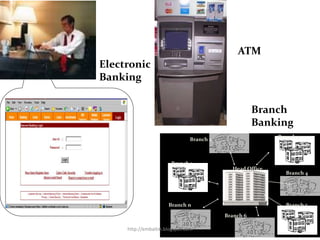
Electronic
Banking
ATM
Head Office
Branch
Banking
g
Branch 1
Branch 2
Branch 3
Branch 4
Branch 5
Branch 6
Branch n
7http://embaitm.blogspot.com
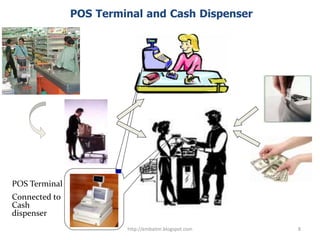
POS Terminal and Cash Dispenser
POS Terminal
Connected to
Cash
dispenser
8http://embaitm.blogspot.com
Banking channels
Banks offer many different channels to access their banking and other services:
 ATM is a machine that dispenses cash and sometimes takes deposits without the
need for a human bank teller. Some ATMs provide additional services.
 A branch is a retail location
 Call center
 Mail: most banks accept check deposits via mail and use mail to communicate to
their customers, e.g. by sending out statements
 Mobile banking is a method of using one's mobile phone to conduct banking
transactions
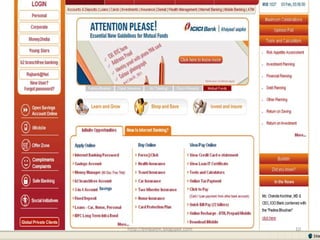
 Online banking is a term used for performing transactions, payments etc. over the
Internet
 Relationship Managers mostly for private banking or business banking, often
visiting customers at their homes or businesses
 Telephone banking is a service which allows its customers to perform transactions
over the telephone without speaking to a human
9http://indiansarkarijobs.com
10http://embaitm.blogspot.com
NEFT Process
Meaning : National Electronic Funds Transfer (NEFT) system is a nation wide funds
transfer system to facilitate transfer of funds from any bank branch to any other bank
branch.
The National Electronic Funds Transfer (NEFT) system has been successfully handling
significant volumes, ever since its launch in November 2005. More than 6 million
transactions were processed by the system during the month of January 2010 alone.
The coverage has also increased substantially with the participation of over
63,000 bank branches spread across the length and breadth of the country.
11http://indiansarkarijobs.com
NEFT Process
Step-1: The remitter fills in the NEFT Application form giving the following particulars of
the beneficiary and authorises the branch to remit the specified amount to
the beneficiary by raising a debit to the remitter’s account. (This can also be done by
using net banking services offered by some of the banks.)
Beneficiary's name
Beneficiary's bank name
Beneficiary's branch name
Beneficiary's account type
Beneficiary's account No.
Beneficiary's Branch IFSC
Step-2: The remitting branch prepares a Structured Financial Messaging Solution
(SFMS) message and sends it to its Service Centre for NEFT.
12http://indiansarkarijobs.com
NEFT Process
Step-3: The Service Centre forwards the same to the local RBI (National Clearing Cell,
Mumbai) to be included for the next available settlement. Presently, NEFT is settled in
six batches at 0930, 1030, 1200, 1300, 1500 and 1600 hours on weekdays and 0930,
1030 and 1200 hours on Saturdays
Step-4: The RBI at the clearing centre sorts the transactions bank-wise and prepares
accounting entries of net debit or credit for passing on to the banks participating in the
system. Thereafter, bank-wise remittance messages are transmitted to banks.
Step-5: The receiving banks process the remittance messages received from RBI and
effect the credit to the beneficiaries’ accounts.
13http://indiansarkarijobs.com
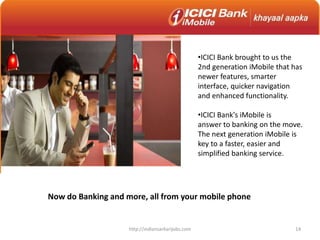
•ICICI Bank brought to us the
2nd generation iMobile that has
newer features, smarter
interface, quicker navigation
and enhanced functionality.
•ICICI Bank's iMobile is
answer to banking on the move.
The next generation iMobile is
key to a faster, easier and
simplified banking service.
Now do Banking and more, all from your mobile phone
14http://indiansarkarijobs.com
I Mobile
•iMobile offers a range of services in a simple consolidated menu. Now we can make
banking transactions like funds transfer, bill payment, balance enquiry, locate a branch,
view your last 5 transactions and much more.
•Using GPRS enabled mobile handset or through SMS, iMobile helps us to connect
directly to our bank account. This rich client based application needs to be installed on
your mobile thereby enabling a single click access to your account
Benefits of using iMobile:
•Secure access to bank accounts anytime, anywhere
•Convenient menu based features designed for easy access
•Enjoy financial transactions worth Rs 50,000 per day for funds transfer to any account,
bill payment and prepaid mobile recharge
Services available with iMobile:
•Payment of utility bills and credit card bills
•Transfer of funds to any bank account
•Payment of insurance premium
•Placement of service request such us ordering of cheque books, bank account
statements, cheque status and balance enquiry
•Book movie tickets and recharge your pre-paid mobile 15http://indiansarkarijobs.com
Future Banking
Banking is one of the Indian Sectors which is truly consumer oriented and technically
advanced.
Reserve Bank of India (RBI) is behind the scenes in getting Indian Banking domain to the
word class and highly competitive with many new systems and continues to play an
important role in introducing customer service initiatives.
The recent steps taken in various payment system segments include;
• Verified card payments (increasing card security),
• ATM payments (increasing accessibility to the public, Bringing transparency and
reasonableness in charges),
• Rationalising charges for electronic payments (NEFT / RTGS) and Collection of outstation
cheques, Mobile payments, Pre-paid payment instruments, etc.
16http://indiansarkarijobs.com
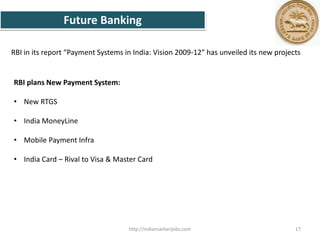
RBI plans New Payment System:
• New RTGS
• India MoneyLine
• Mobile Payment Infra
• India Card – Rival to Visa & Master Card
Future Banking
RBI in its report “Payment Systems in India: Vision 2009-12″ has unveiled its new projects
17http://indiansarkarijobs.com
1. Implementing a new and feature rich RTGS system :
For scaling the existing the RTS facility with latest technologies for more flexibility in
operations and better liquidity saving features.
2. India MoneyLine – A 24×7 system for one-to-one funds transfers:
The existing NEFT system operates during weekdays from 9 am to 5 pm and on Saturdays
from 9 am to 12 noon. With “India MoneyLine”, RBI is considering to extend NEFT to function
on a 24×7 basis or to develop a new system akin to the Faster Payments Service in the UK
which operates on a 24×7 basis.
3. India Card – A domestic card initiative:
RBI is actively looking at introducing a domestic payment card (India Card) and a POS (Point of
Sales) switch network for issuance and acceptance of payment cards. The need for such a
system arises from two major considerations
Future Banking
18http://indiansarkarijobs.com
(a) The high cost borne by the Indian Banks for affiliation with international card
associations in the absence of a domestic price setter
(b) The connection with international card associations resulting in the need for routing
even domestic transactions, which account for more than 90% of the total, through a switch
located outside the country
The value of credit card transactions were Rs.65,356/- crores in 2008-09, a 100 per cent
jump in the last three years.
This means almost Rs 60,000 crore was settled outside India through Visa and Mastercard
which act as the payment link on behalf of the bank, merchant and card holder. Debit card
transactions amounted to Rs 18,547 crore in 2008-09.
So, this new initiative by RBI makes high sense and its very timely. The Indian Banks
Association is also in favour of setting up a payment card. If everything has to go as planned,
then we might see this new RBI card as a major rivalry to the existing Visa and MasterCards.
Future Banking
19http://indiansarkarijobs.com
4. Redesigning ECS (Electronic Clearing Service) to function as a true Automated Clearing
House (ACH) for bulk transactions:
Currently, Local ECS (to facilitate bulk electronic transactions with one-to-many and many-
to-one variants) is operational at 76 centres.
Centralisation of this process is already underway.
RBI is building a technology and feature-rich ACH network by totally redesigning the existing
ECS to provide end-to-end processing in a straight-through manner.
5. Mobile Payments Settlement Network
Mobile phones are expected to emerge as an important channel for transmission of
payment instructions. Efficient mobile payments would require real time transfer of funds
with adequate security. Currently all inter-bank mobile transfers are payment instructions
for settling funds through existing payment systems. So, RBI is building a new national
infrastructure for facilitating real time mobile payments.
Future Banking
20http://indiansarkarijobs.com
•Developing country’s own payment system seems to be a developing trend.
Europe has the Monnet debit scheme which is scheduled for 2010 launch.
•The Russian Finance Ministry announced plans to investigate the potential benefits
involved with creating their own payment system.
The main reason being to eliminate foreign systems (like visa, mastercard, american express)
to cash in the country’s local transactions.
•We be prepared for major new systems drive in the Indian Banking System and we
consumers are going to be benefited the most.
Future Banking
21http://indiansarkarijobs.com
Thank you……
The future will not be more
of the same…
… we need to be ready..
22http://indiansarkarijobs.com

new indian banking system part-3

  • 1.
    New Face ofBanking Sector 1http://indiansarkarijobs.com
  • 2.
    Introduction  An industrythat's tightly protected by regulations has finally opened up. But this has introduced many new challenges. Technology can help overcome these challenges and address the new set of issues associated with modern day banking.  The Banking sector in India has experienced a rapid transformation. Just about a decade back this sector was limited to the sarkari (read nationalized) and co-operative banks.  In past, every branch of the same bank acted as an independent information silo, and multi-channel banking (ATMs, Net banking, tele-banking, etc) was almost non- existent. 2http://indiansarkarijobs.com
  • 3.
    Introduction  With theentry of private players into retail banking and with multi-nationals focusing on the individual consumer in a big way, the banking system underwent a phenomenal change.  For the first time consumers got the choice of conducting transactions either the traditional way (through the bank branch), through ATMs, the telephone or through the internet. Technology played a key role in providing this multi-service platform.  The entry of private players combined with new RBI guidelines forced nationalized banks to redefine their core banking strategy. And technology was central to this change. 3http://indiansarkarijobs.com
  • 4.
    Traditional Branch Banking With the emergence of various channels for banking, all over have been predicting the end of traditional branch banking, at least in the metros and other upwardly urban areas.  But despite the benefits offered by other technologies in terms of lower costs or better reach, it looks like branch banking is very much here to stay.  Traditional banking is great because you can develop relationships with your bank representatives. This is helpful when you’re borrowing money, looking for sound advice or just like to know the people who are managing your money.  Traditional banking also offers the convenience of easy deposits and withdrawals. You know that your deposit will be in your account the same day or the next day. And you can withdraw money during regular banking hours.  The downside to traditional banks is that you have to stick to their business hours, which aren’t always convenient. You cannot access your bank account when you’re out of town, and every time you need to process a transaction you have to go to the bank. 4http://indiansarkarijobs.com
  • 5.
    Electronic banking  Thefirst Automated Teller Machines (ATM) were used in the 1960s in New York City. Since then, advancements in technology have created a complete electronic banking system available to consumers 24/7.  In the 1990s, the banking sector in India saw greater emphasis being placed on technology and innovation. Banks began to use technology to provide better quality of services at greater speed.  Electronic banking systems consist of a service that allows you to conduct transactions without physically being in a bank branch. This includes ATMs, Internet banking, pay-by-phone banking and direct deposit accounts.  Internet banking and mobile banking made it convenient for customers to do their banking from geographically diverse places. 5http://indiansarkarijobs.com
  • 6.
    Electronic banking  InMay 2004, the curtain was finally lifted on the much discussed Real Time Gross Settlement (RTGS) system, which many analysts considered, would revolutionize funds transfer in the Indian banking sector.  RTGS is an electronic funds transfer system designed to allow the real time settlement of inter bank payments in a fully secure environment.  Some of the systems implemented earlier included the electronic clearing service (1995), electronic funds transfer (EFT) facility (1997) and special electronic funds transfer system (2003). 6http://indiansarkarijobs.com
  • 7.
    Electronic Banking ATM Head Office Branch Banking g Branch 1 Branch2 Branch 3 Branch 4 Branch 5 Branch 6 Branch n 7http://embaitm.blogspot.com
  • 8.
    POS Terminal andCash Dispenser POS Terminal Connected to Cash dispenser 8http://embaitm.blogspot.com
  • 9.
    Banking channels Banks offermany different channels to access their banking and other services:  ATM is a machine that dispenses cash and sometimes takes deposits without the need for a human bank teller. Some ATMs provide additional services.  A branch is a retail location  Call center  Mail: most banks accept check deposits via mail and use mail to communicate to their customers, e.g. by sending out statements  Mobile banking is a method of using one's mobile phone to conduct banking transactions  Online banking is a term used for performing transactions, payments etc. over the Internet  Relationship Managers mostly for private banking or business banking, often visiting customers at their homes or businesses  Telephone banking is a service which allows its customers to perform transactions over the telephone without speaking to a human 9http://indiansarkarijobs.com
  • 10.
  • 11.
    NEFT Process Meaning :National Electronic Funds Transfer (NEFT) system is a nation wide funds transfer system to facilitate transfer of funds from any bank branch to any other bank branch. The National Electronic Funds Transfer (NEFT) system has been successfully handling significant volumes, ever since its launch in November 2005. More than 6 million transactions were processed by the system during the month of January 2010 alone. The coverage has also increased substantially with the participation of over 63,000 bank branches spread across the length and breadth of the country. 11http://indiansarkarijobs.com
  • 12.
    NEFT Process Step-1: Theremitter fills in the NEFT Application form giving the following particulars of the beneficiary and authorises the branch to remit the specified amount to the beneficiary by raising a debit to the remitter’s account. (This can also be done by using net banking services offered by some of the banks.) Beneficiary's name Beneficiary's bank name Beneficiary's branch name Beneficiary's account type Beneficiary's account No. Beneficiary's Branch IFSC Step-2: The remitting branch prepares a Structured Financial Messaging Solution (SFMS) message and sends it to its Service Centre for NEFT. 12http://indiansarkarijobs.com
  • 13.
    NEFT Process Step-3: TheService Centre forwards the same to the local RBI (National Clearing Cell, Mumbai) to be included for the next available settlement. Presently, NEFT is settled in six batches at 0930, 1030, 1200, 1300, 1500 and 1600 hours on weekdays and 0930, 1030 and 1200 hours on Saturdays Step-4: The RBI at the clearing centre sorts the transactions bank-wise and prepares accounting entries of net debit or credit for passing on to the banks participating in the system. Thereafter, bank-wise remittance messages are transmitted to banks. Step-5: The receiving banks process the remittance messages received from RBI and effect the credit to the beneficiaries’ accounts. 13http://indiansarkarijobs.com
  • 14.
    •ICICI Bank broughtto us the 2nd generation iMobile that has newer features, smarter interface, quicker navigation and enhanced functionality. •ICICI Bank's iMobile is answer to banking on the move. The next generation iMobile is key to a faster, easier and simplified banking service. Now do Banking and more, all from your mobile phone 14http://indiansarkarijobs.com
  • 15.
    I Mobile •iMobile offersa range of services in a simple consolidated menu. Now we can make banking transactions like funds transfer, bill payment, balance enquiry, locate a branch, view your last 5 transactions and much more. •Using GPRS enabled mobile handset or through SMS, iMobile helps us to connect directly to our bank account. This rich client based application needs to be installed on your mobile thereby enabling a single click access to your account Benefits of using iMobile: •Secure access to bank accounts anytime, anywhere •Convenient menu based features designed for easy access •Enjoy financial transactions worth Rs 50,000 per day for funds transfer to any account, bill payment and prepaid mobile recharge Services available with iMobile: •Payment of utility bills and credit card bills •Transfer of funds to any bank account •Payment of insurance premium •Placement of service request such us ordering of cheque books, bank account statements, cheque status and balance enquiry •Book movie tickets and recharge your pre-paid mobile 15http://indiansarkarijobs.com
  • 16.
    Future Banking Banking isone of the Indian Sectors which is truly consumer oriented and technically advanced. Reserve Bank of India (RBI) is behind the scenes in getting Indian Banking domain to the word class and highly competitive with many new systems and continues to play an important role in introducing customer service initiatives. The recent steps taken in various payment system segments include; • Verified card payments (increasing card security), • ATM payments (increasing accessibility to the public, Bringing transparency and reasonableness in charges), • Rationalising charges for electronic payments (NEFT / RTGS) and Collection of outstation cheques, Mobile payments, Pre-paid payment instruments, etc. 16http://indiansarkarijobs.com
  • 17.
    RBI plans NewPayment System: • New RTGS • India MoneyLine • Mobile Payment Infra • India Card – Rival to Visa & Master Card Future Banking RBI in its report “Payment Systems in India: Vision 2009-12″ has unveiled its new projects 17http://indiansarkarijobs.com
  • 18.
    1. Implementing anew and feature rich RTGS system : For scaling the existing the RTS facility with latest technologies for more flexibility in operations and better liquidity saving features. 2. India MoneyLine – A 24×7 system for one-to-one funds transfers: The existing NEFT system operates during weekdays from 9 am to 5 pm and on Saturdays from 9 am to 12 noon. With “India MoneyLine”, RBI is considering to extend NEFT to function on a 24×7 basis or to develop a new system akin to the Faster Payments Service in the UK which operates on a 24×7 basis. 3. India Card – A domestic card initiative: RBI is actively looking at introducing a domestic payment card (India Card) and a POS (Point of Sales) switch network for issuance and acceptance of payment cards. The need for such a system arises from two major considerations Future Banking 18http://indiansarkarijobs.com
  • 19.
    (a) The highcost borne by the Indian Banks for affiliation with international card associations in the absence of a domestic price setter (b) The connection with international card associations resulting in the need for routing even domestic transactions, which account for more than 90% of the total, through a switch located outside the country The value of credit card transactions were Rs.65,356/- crores in 2008-09, a 100 per cent jump in the last three years. This means almost Rs 60,000 crore was settled outside India through Visa and Mastercard which act as the payment link on behalf of the bank, merchant and card holder. Debit card transactions amounted to Rs 18,547 crore in 2008-09. So, this new initiative by RBI makes high sense and its very timely. The Indian Banks Association is also in favour of setting up a payment card. If everything has to go as planned, then we might see this new RBI card as a major rivalry to the existing Visa and MasterCards. Future Banking 19http://indiansarkarijobs.com
  • 20.
    4. Redesigning ECS(Electronic Clearing Service) to function as a true Automated Clearing House (ACH) for bulk transactions: Currently, Local ECS (to facilitate bulk electronic transactions with one-to-many and many- to-one variants) is operational at 76 centres. Centralisation of this process is already underway. RBI is building a technology and feature-rich ACH network by totally redesigning the existing ECS to provide end-to-end processing in a straight-through manner. 5. Mobile Payments Settlement Network Mobile phones are expected to emerge as an important channel for transmission of payment instructions. Efficient mobile payments would require real time transfer of funds with adequate security. Currently all inter-bank mobile transfers are payment instructions for settling funds through existing payment systems. So, RBI is building a new national infrastructure for facilitating real time mobile payments. Future Banking 20http://indiansarkarijobs.com
  • 21.
    •Developing country’s ownpayment system seems to be a developing trend. Europe has the Monnet debit scheme which is scheduled for 2010 launch. •The Russian Finance Ministry announced plans to investigate the potential benefits involved with creating their own payment system. The main reason being to eliminate foreign systems (like visa, mastercard, american express) to cash in the country’s local transactions. •We be prepared for major new systems drive in the Indian Banking System and we consumers are going to be benefited the most. Future Banking 21http://indiansarkarijobs.com
  • 22.
    Thank you…… The futurewill not be more of the same… … we need to be ready.. 22http://indiansarkarijobs.com