Republic of thePhilippines
SULTAN KUDARAT STATE UNIVERSITY
Isulan Campus, Isulan Sultan Kudarat
College of Industrial Technology
ELX 111- ELECTRONIC DEVICES 1
UNIVERSITY VISION INSTITUTIONAL OUTCOMES (IO)
A leading University in advancing scholarly innovation, multi-cultural convergence, and
responsive public service in a borderless Region.
a. Enhance competency development, commitment, professionalism, unity and
true spirit of service for public accountability, transparency and delivery of
quality services
b. Provide relevant programs and professional trainings that will respond to the
development needs of the region
c. Strengthen local and international collaborations and partnerships for
borderless programs
d. Develop a research culture among faculty and students
e. Develop and promote environmentally-sound and market-driven knowledge
and technologies at par with international standards
f. Promote research-based information and technologies for sustainable
development
g. Enhance resource generation and mobilization to sustain financial viability of
the university
UNIVERSITY MISSION
The University shall primarily provide advanced instruction and professional training in
science and technology, agriculture, fisheries, education and other related fields of study.
It shall also undertake research and extension services, and provide progressive
leadership in its areas of specialization.
UNIVERSITY STRATEGIC GOALS
a. Deliver quality service to stakeholders to address current and future needs in
instruction, research, extension, and production
b. Observe strict implementation of the laws as well as the policies and regulations of the
University
c. Acquire with urgency state-of-the-art resources for its service areas
d. Bolster the relationship of the University with its local and international customers and
partners
e. Leverage the qualifications and competences in personnel action and staffing
f. Evaluate the efficiency and responsiveness of the University systems and processes
PROGRAM OUTCOMES (PO) COMMON TO ALL PROGRAMS AND ITS RELATIONSHIPS TO INSTITUTIONAL OUTCOMES
A graduate of the BIndTech program can: INSTITUTIONAL OUTCOMES (IO)
a b c d e f g
a. Analyze broadly defined industrial technology processes by using analytical tools that
enhance creativity, innovativeness, and intellectual curiosity to improve methods,
processes, and systems that meet the industry standards;
b. Design and implement broadly defined industrial systems, components, products, or
processes to meet specific industry needs with proficiency and flexibility in the area of
2.
specialization in accordancewith global standards;
c. Apply appropriate techniques, resources, and state-of-the-art industrial technology tools
to meet current industry needs and use these modern tools and processes to improve
and increase entrepreneurial activities upholding the safety and health standards of
business and industry;
d. Communicate with diverse groups of clienteles the appropriate cultural language with
clarity and persuasion, in both oral and written forms, including understanding and giving
of clear instructions, high comprehension level, effectiveness in delivering presentations
and writing documents, and articulating technological innovation outputs;
e. Develop leadership and management skills in a team-based environment by making
informed decisions, keeping the team motivated, acting and delegating responsibility, and
inspiring positive changes in the organization by exercising responsibility with integrity
and accountability in the practice of one's profession;
f. Practice the moral responsibilities of an industrial technologist to manage and balance
wider public interest and uphold the norms and safety standards of the industrial
technology profession;
g. Demonstrate enthusiasm and passion for continuous personal and professional
development in broadly defined industrial technology and effecting positive changes in
the entrepreneurial and industrial endeavor; and
h. Recognize the need for, and an ability to engage in lifelong learning.
1 COURSE CODE ELX 111 5 COURSE DESCRIPTION
2 COURSE TITLE Electronic Devices 1 This course includes an introduction to theories and applications of passive electronic devices involving electronic
accessories, tools and instruments. It also covers the principles governing electrical quantities which include
Ohm’s Law and other fundamental basic electronic circuit analysis..
3 PREREQUISITE None
4 CREDITS 5 units
6 COURSE LEARNING OUTCOMES (CLO) AND ITS RELATIONSHIPS TO PROGRAM OUTCOMES
Course Learning Outcomes (CLO) Program Outcomes
At the end of the course, a student can: a b c d e f g h
a. Understand SKSU-VGMO, Classroom Policies, Course Overview, Course Requirements and Grading System;
b. Explain the Principles of electricity and electronics.
c. Demonstrate the usage of tools, instruments, shop equipment commonly used in electronics technology.
d. Interpret and analyze electronics circuits.
PAGE 6
3.
e. Understand thedifferent application of passive components in a circuit.
f. Understand the relationship of ohm’s law
g. Perform the testing method of the individual components.
h. Design an assemble electronic circuit.
7 COURSE CONTENTS
WEEK CONTENT INTENDED LEARNING
OUTCOMES( (ILOs)
TEACHING AND LEARNING
ACTIVITIES (TLA)
OUTCOMES-BASED
ASSESSMENT (OBA)
COURSE
LEARNING
OUTCOME
S (CLOs)
1 Course Orientation
SKSU VMGO, Classroom
Policies, Course
Overview, Course
Requirements, Grading
System
At the end of the week, the student can:
a. Discuss the University’s VMGO,
classroom policies, course overview,
requirements and grading system
Discuss the VMGO of the University, the
classroom policies, scope of the course,
course requirements and grading system
a. Participation in discussions abcdefg
2 Theories, principles, and
nature of Electricity and
Electronics
At the end of the week, the students can:
a. Explained the operating principles of
electrical and electronics system, their
components parts and functions.
b. Discussed the various procedure in
serving electronics electrical system
components
used the most appropriate measuring
tools / instruments.
c. Describe the principles of electronic
components such as resistors,
capacitors, inductors;
d. Performed the different operation
involved in various measuring tools
instruments
a. Video/power point presentation
b. Individual participation in
discussions
c. Quiz
d. Activity/ Measuring tools
instruments
a. Quiz
b. participation
c. activity outputs
abcdefg
3 Fundamentals of
Electricity and
Magnetism
a. Atomic structure and
At the end of the week, the students can:
a. explained and discussed atomic
a. Quiz a. Quiz
b. participation
abcdefg
PAGE 6
4.
conductivity
b. Electrical conductors
andinsulators
c. Electrical circuits
d. electrical values
e. electrical measurement
f. magnetism and electro-
magnetism
g. Basic electrical
component
structures
b. explained and discussed electrical
conductors and insulators
c. identified electrical circuits
d. explained electrical values
e. discussed and compute electrical
measurement
f. discussed magnetism and electro-
magnetism
g. identified electrical symbols
h. identified basic electrical
components
b. Video/power point presentation
c. Individual participation in class
discussions
d. Activity 2.1 Symbol
identification
c. activity outputs
4 Ohms Law
a. the relationship of
voltage, current and
resistance
b. unit of measurement
c. factors affecting
resistance
d. circuit analysis
e. series and parallel
circuits
f. voltage, current and
resistance
measurement
At the end of the week, the students can:
a. Explain the relationship of voltage
current and resistance
b. explain the statement of ohms law
c. Explain the significance of Ohm’s Law
in analyzing electrical circuits
d. Describe the units of measurement for
voltage (volts), current (amperes), and
resistance (ohms)
d. Understand the factors affecting
resistance, including material, length,
cross-sectional area, and temperature
e. Apply Ohm’s Law to calculate voltage,
current, or resistance in simple circuits
f. Analyze series and parallel circuits
using Ohm’s Law
g. Execute how to measure voltage
current and resistance.
a. Students participation in discussions.
b. PowerPoint and video presentation.
c. Quiz
d. Activity/ voltage, current and
resistance measurement using
multimeter
a. Quiz
b. participation
c. activity outputs
abcdefg
5
MIDTERM EXAM
6 Passive Components
a. How passive
components differ from
active components.
b. Function of resistors,
At the end of the week, the students can:
a. Define passive components and
distinguish them from active components
b. Describe the characteristics and
a. Students participation in
discussions.
b. PowerPoint and video presentation.
c. Quiz
a. Quiz
b. participation
c. activity outputs
abcdefg
PAGE 6
5.
capacitors, and inductors
andits characteristics
c. How passive
components affect
electrical signals
d. Types and application
e. How to measure
passive components using
multimeter
f. Diagnose fault and
troubleshoot.
functions of resistors, capacitors, and
inductors in electronic circuits.
c. Explain how resistance, capacitance,
and inductance affect electrical signals in
AC and DC circuits.
d. Identify different types of resistors,
capacitors, and inductors based on their
specifications and applications
e. Measure resistance, capacitance, and
inductance using appropriate instruments
f. Troubleshoot common issues in
passive component circuits, such as
open/short circuits and incorrect values
d. Activity Troubleshoot incorrect
values in passive components
7 Transformers
a. function of transformer
in electronic circuit
b. How transformer works
c. Difference of step up
and step up transformer
d, relationship of primary
and secondary winding
e. voltage measurement
f. transformer faults, how
to diagnose.
At the end of the week, the students can:
a. Define transformers and explain their
role in electrical and electronic systems.
b. Describe the working principle of
transformers based on Faraday’s Law
of Electromagnetic Induction
c. Differentiate between step-up and
step-down transformers based on their
voltage transformation
d. Explain the relationship between
primary and secondary windings,
voltage, current, and turns ratio
e. Measure primary and secondary
voltage and current using appropriate
measuring instruments
f. Troubleshoot common transformer
faults, such as overheating, short
circuits, and insulation failure.
a. Students participation in
discussions.
b. PowerPoint and video presentation.
c. Quiz
d. Hands on
a. Quiz
b. participation
c. activity outputs
abcdefg
8 PCB Designing
a. Definition and purpose
of PCBs
b. Evolution and history of
PCB technology
At the end of the week, the students can:
a. Explain the role of PCB in an
electronic circuit.
b. Describe the types of PCB
c. Explain the basic materials used in
a. Students participation in discussions.
b. PowerPoint and video presentation.
c. Quiz
d. Activity -Design and lay-out PCB .
a. Written Assignments: Students
will write short essays discussing
how food symbolizes cultural
identity and the impact of
acculturation.
abcdefg
PAGE 6
6.
c. Advantages ofPCBs
over traditional wiring
d. Types of PCB’s
e. PCB Materials &
Components
Substrate materials
Copper cladding and
Solder mask,
f. Common electronic
components used in PCBs
g. PCB Design & Layout,
Process
h. PCB fabrication steps
(etching, drilling, plating,
solder mask application)
i. Soldering techniques:
PCB manufacturing
d. Understand the PCB design process,
including schematic creation, layout
design, and fabrication.
e. Identify common PCB components
and their placement techniques
b. Group Presentation: Groups
will present cultural food habits,
including core and
complementary food models.
9
FINAL EXAMINATION
Total No. of Hours : 54
8 COURSE REQUIREMENTS AND COURSE POLICIES
COURSE
REQUIREMENTS
Each student is required to:
1. submit accomplished assignments, and activities;
2. make a PowerPoint presentation, and a written summary of the assigned report;
3. participate actively in all discussion;
4. discuss an assigned topic to report and participate in class discussions; and
5. pass the major exams (midterm and final)
COURSE POLICIES
Attendance: A student will be marked late if he/she enters the class 5 minutes after start of class period. Any student who comes to class 15
minutes after the scheduled time or always late for three consecutive meetings shall be marked absent.
Missed work or exam: Any student who missed to submit a work assignment or to take a test should consult the concerned instructor for
PAGE 6
7.
immediate compliance
Cheating andPlagiarism: Any student who committed any form of academic dishonesty (e.g., copy-paste plagiarism) shall be given disciplinary
action provided in the SKSU Student’s Handbook
Use of Technology: Cell phones should be turned off while the session is in progress. Using laptops, notebook PCs, smart phones, and tablets
shall be allowed only when needed. A scientific calculator (e.g. Casio fx-991ES) shall be utilized in solving.
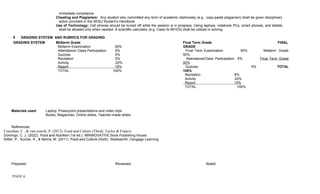
9 GRADING SYSTEM AND RUBRICS FOR GRADING
GRADING SYSTEM Midterm Grade
Midterm Examination 50%
Attendance/ Class Participation 5%
Quizzes 5%
Recitation 5%
Activity 20%
Report 15%
TOTAL 100%
Final Term Grade FINAL
GRADE
Final Term Examination 50% Midterm Grade
50%
Attendance/Class Participation 5% Final Term Grade
50%
Quizzes 5% TOTAL
100%
Recitation 5%
Activity 20%
Report 15%
TOTAL 100%
Materials used: Laptop, Powerpoint presentations and video clips
Books, Magazines, Online slides, Teacher-made slides
References:
Counihan, C., & van esterik, P. (2013). Food and Culture (Third). Taylor & Francis.
Domingo, C. J. (2022). Food and Nutrition (1st ed.). IMINNOVATIVE Book Publishing House.
Kittler, P., Sucher, K., & Nelms, M. (2011). Food and Culture (Sixth). Wadsworth, Cengage Learning.
Prepared: Reviewed: Noted:
PAGE 6
8.
CIRILO EVANGELISTA, JR,MPS ENGR. GLEN F. TALUA, M CHARLIE J. MAGHANOY, EdD Faculty
Program Chairman, BSIT/BTVTE Dean, College of Industrial Technology
PAGE 6