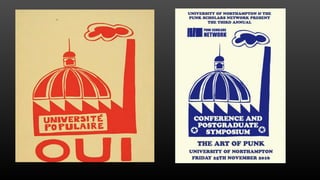
Never Mind the Paradox
“Situationists” the Sorbonne and ongoing influence of “Atelier Populaire” on Punk art and culture
Paul Hollins November 2016
To reconstruct Life Itself
“The commodity can be understood in its undistorted essence only when it
becomes the universal category of society as a whole. Only in this context
does the reification produced by commodity relations assume decisive
importance both for the objective evolution of society and for the attitudes
that people adopt toward it, as it subjugates their consciousness to the
forms in which this reification finds expression… As labour is increasingly
rationalised and mechanised this subjugation is reinforced by the fact that
people’s activity becomes less and less active and more and more
contemplative.” (Debord )The Society of the Spectacle (1967)
The (graffiti) language of the Situationists
• “In the décor of the spectacle the eye meets only things and their prices”
• “Boredom is counter revolutionary “
• “Live in the Moment”
• “Don’t change bosses change Life”
• “Never work”
• “Occupy the Factories”
• “The passion of destruction is creative joy “
• “Concrete breeds apathy”
• “We are all undesirables”
• “Art is dead Goddard can’t change that”
• “Anarchy is me”
• “Don’t consume Marx, live it”
• “Be realistic demand the impossible”
• “Burn commodities”
And 40 years
on…
#burnpunklondon
Joe Corre burns his collection of punk
memorabilia in protest at planned 40th
anniversary ”celebrations” organised by the
establishment.
• Meaningless gesture ?
• Or “situationist” “spectacle” ?
What did the Situationists ever do for us ?
•Shaped the aesthetic of punk
•Provided the language of punk
• Instigated the “Philosophy of punk” (if it
exists?)
•Stimulated the punk protagonists (McLaren/
Reid et al)
• Totally Redefined the ART OF DISSENT
References ….
• Considine,L. 'Screen Politics: Pop Art and the Atelier Populaire', Tate
Papers, no.24, Autumn 2015,
http://www.tate.org.uk/research/publications/tate-papers/24/screen-
politics-pop-art-and-the-atelier-populaire, accessed 13 September 2016.
• Debord, G. (1967) The Society of The Spectacle Bureau of Public Secrets
Canada
• Gray, C. (1974) Leaving the 20th Century The incomplete works of
Situationist International Rebel Press London
• Knabb,k.(edt) (1981) Situationist International Anthology Bureau of Public
Secrets Canada
• Kugelberg, J. (edt) (2011) Beauty is in the Street Four corner Books London
• Kugelberg,J. Savage,J.& Terry,G. () God Save the Sex Pistols Rizzoli New York
• Savage ,J. ( 1991 ) Englands Dreaming Faber and Faber London
• Savage, J. (2009) The Englands Dreaming Tapes Faber and Faber London
Workers , French, Immigrant
Unite …
Thank you for listening …
Email - Paulanthonyhollins@googlemail.com
Twitter - @paulhollins

Never mind the paradox

  • 1.
    Never Mind theParadox “Situationists” the Sorbonne and ongoing influence of “Atelier Populaire” on Punk art and culture Paul Hollins November 2016
  • 2.
  • 4.
    “The commodity canbe understood in its undistorted essence only when it becomes the universal category of society as a whole. Only in this context does the reification produced by commodity relations assume decisive importance both for the objective evolution of society and for the attitudes that people adopt toward it, as it subjugates their consciousness to the forms in which this reification finds expression… As labour is increasingly rationalised and mechanised this subjugation is reinforced by the fact that people’s activity becomes less and less active and more and more contemplative.” (Debord )The Society of the Spectacle (1967)
  • 6.
    The (graffiti) languageof the Situationists • “In the décor of the spectacle the eye meets only things and their prices” • “Boredom is counter revolutionary “ • “Live in the Moment” • “Don’t change bosses change Life” • “Never work” • “Occupy the Factories” • “The passion of destruction is creative joy “ • “Concrete breeds apathy” • “We are all undesirables” • “Art is dead Goddard can’t change that” • “Anarchy is me” • “Don’t consume Marx, live it” • “Be realistic demand the impossible” • “Burn commodities”
  • 24.
    And 40 years on… #burnpunklondon JoeCorre burns his collection of punk memorabilia in protest at planned 40th anniversary ”celebrations” organised by the establishment. • Meaningless gesture ? • Or “situationist” “spectacle” ?
  • 25.
    What did theSituationists ever do for us ? •Shaped the aesthetic of punk •Provided the language of punk • Instigated the “Philosophy of punk” (if it exists?) •Stimulated the punk protagonists (McLaren/ Reid et al) • Totally Redefined the ART OF DISSENT
  • 26.
    References …. • Considine,L.'Screen Politics: Pop Art and the Atelier Populaire', Tate Papers, no.24, Autumn 2015, http://www.tate.org.uk/research/publications/tate-papers/24/screen- politics-pop-art-and-the-atelier-populaire, accessed 13 September 2016. • Debord, G. (1967) The Society of The Spectacle Bureau of Public Secrets Canada • Gray, C. (1974) Leaving the 20th Century The incomplete works of Situationist International Rebel Press London • Knabb,k.(edt) (1981) Situationist International Anthology Bureau of Public Secrets Canada • Kugelberg, J. (edt) (2011) Beauty is in the Street Four corner Books London • Kugelberg,J. Savage,J.& Terry,G. () God Save the Sex Pistols Rizzoli New York • Savage ,J. ( 1991 ) Englands Dreaming Faber and Faber London • Savage, J. (2009) The Englands Dreaming Tapes Faber and Faber London
  • 27.
    Workers , French,Immigrant Unite … Thank you for listening … Email - Paulanthonyhollins@googlemail.com Twitter - @paulhollins

Editor's Notes

  • #2 NEVER MIND THE PARDOX (Or perhaps it should be Paradoxes as there are number)   Welcome to my presentation great to be here! By way of an introduction incidentally on the picture in the flyer for this conference I’m not the one on the left I didn’t work in Seditionnaires, I wasn’t the bass player for the Sex Pistols and I wasn’t kicked out of the band although I do share a liking of the Small Faces with Glen Matlock. I am Paul Hollins, old first wave punk, (not one of the arty London crowd suburban, regional Leeds and the Fford Greene in 1976) academic at the University of Bolton and Chair of a museums and art gallery Trust. In my case the lunatics have certainly taken over the asylum…   When I first came across this conference I was attracted by the poster (which I love B.T.W) adapted from an original of the “Atelier Populaire” workshops in 1968 and that’s what I’m planning to talk about today. In 2016 The images of 68 still resonate they still have currency and influence.   I will apologise in advance for my appalling French pronunciation (I never advanced from singing “le chat a la promenade “in my early 1970’s comprehensive school) but I’m going to argue that the ethos, visual aesthetic and language of punk emerged from the streets of Paris in 1968 as much as west London in 1976.
  • #3 My first question… Who here is aware of the situationists or situationist philosophy? They (The situationists) would get very touchy if we described them or their philosophy as an “ism” so I won’t ! I’m guessing most of you here have but for those that may not here’s a brief history   Building on the artistic and political spirit of the Dada and Surrealist movements in 1957, concerned with what they saw as the “degradation of human life”, a number of avant-garde groups came together to form Situationist International (SI) in an attempt to challenge what they perceived as peoples “passive conditioning” through the mass media and culture of the time they posited a challenge to the dominant global commodity system and fetishism (sound familiar)of the commodity . "To Reconstruct life itself".
  • #4 The revolution of everyday life and the The Society of the Spectacle The movement , if you can call it that reached its zenith in the mid 1960’s with the seminal texts , The Society of the Spectacle by Guy Debord (who was a founder member of Situationist International and The Revolution of Everyday Life by Raoul Vaneigem . Vaneigem articulates the disquiet he equates to modern city life - isolation, humiliation, mis-communication and dis empowerment…
  • #5 The Situationists viewed the Situation (or spectacle) as a tool for liberation and for challenging existing capitalist structures , you might arguably describe them as “proto anarchists” and the art of Ateleir Populaire emerged to support their activities , This was the spark in the tinder box to ignite action... It was an essential element underpinning the movement that manifested in the riots of Paris in 1968. For Background Let’s take ourselves back to Paris in 1968 via Pathe’s quirky all be it patriarchal and establishment commentary on events…
  • #6 Most of you attending I am sure will be aware Malcolm McLaren often espoused his association with the situationists and the Paris 1968 riots he claimed to be there and they were undoubtedly an influence I’d argue The model that perpetuated his own self delusional rewriting of the History of the “making” of the Sex Pistols was structured around situationist principles appropriating the language and philosophy. On the occasions when I met Malcolm I challenged him about this and each time my challenge received a somewhat different responses , Malcolm was ever the showman and was never short when intellectualising on his own fiction I have to say say each time we discussed it he genuinely believed with conviction his own rhetorical response Was he physically there ? Or was he there more in "spirit” I’m more comfortable with the latter but I guess we will never know. Certainly long time collaborator the artist Jamie Reid was and still is heavily influenced by the situationist movement as Ill cover later … The spontinaity of the spectacle of the 1968 riots was responsible for the emergent language of Punk the graffiti daubed on the walls of Paris re-emerged eight years later semantically as the language of punk .   
  • #7  There was no organisation behind the riots, no leaders or agitators (those were already incarcerated) just the spectacle.. “In the décor of the spectacle the eye meets only things and their prices”   “Boredom is counter revolutionary “   “Live in the Moment”   “Don’t change bosses change Life”   “Never work”   “Occupy the Factories”   “The passion of destruction is creative joy “   “Concrete breeds apathy”   “We are all undesirables”   “Art is dead Goddard can’t change that”   “Anarchy is me”   “Don’t consume Marx, live it”   “Be realistic demand the impossible”   “Burn commodities”
  • #8 Doesn’t our conference flyer look remarkebly familiar ? The People’s University Yes … Unapologetically, I suggest it is directly stolen from the presses of “Atelier Populaire” ( and BTW I’m sure they’d approve of us using it !) So what was the Atelier Populaire or in English the peoples workshop ?
  • #9  From a cocktail of disquiet , police brutality and siuationist philosophy emerged a small group of Marxist students in the Ecole des beux Arts (School of fine arts) their legacy (though I suspect this was not contrived or planned) was to design, document, illustrate and help instigate the riots of 1968. They applied the tools of the establishment , the aggressor (mass media) to incite and effect real social change. Paradoxically (number one) the deployment of pop art style production techniques such as silk screen-printing and the opaque projector , were artistic techniques employed in the pop art movement that emerged in western culture in the early nineteen sixties. Yes pop art could be viewed as a celebration of superficial consumerist (USA) culture , as anti-art and this of course was the very focus of critique and attack for the rioters. They assumed an : anti-consumerist (capitalist ) anti “Gaullist” (The French Government under Gaul in power at the time) stance . As we might agree this would not be the last time the mass media & tools of authority would be turned against them in anger as Johnny Rotten would later snarl (I use the NME I use Anarchy (As Glenn would have it a cringe worthy line) Were these artworks anything more than merely neo-Dada provocation ? The peoples workshop pitted the artisan against mechanical representation, and collective practice against specialised tools and skills and the beugoise. The initial output of the studio used graphics in unconventional ways and later their work developed into to re-using and re-purposing images both photographic and drawn the first example of which was … Factories , Universities Union was an initial run of 30 screen printed DIY posters that were intended for sale (yes I know) to support striking students and workers) allegedly the posters were grabbed by students and strikers and pasted on to walls before they able to deliver them to sympathetic galleries for sale.  
  • #10 “We are the Power “ another early example of output. Produced by a collective the art of atelier populaire filled the void left by official culture and mass media during the riots in mimicking /mocking them and challenging the fine art mediums. Academics have questioned weather are the posters were artworks or merely political ephemera ? Paradoxically many members and workers of the Atelier populaire collective were fine artists in their own right painters and sculptors affiliated with the fine arts and fine art schools such as the Salon de la Jeune Peinture and Figuration Narrative
  • #11 More images… In particular the image on the left as you look We intoxicate you was sporadic outburst “we have just had enough” (of mass media indoctrination) a sentiment that would later echo through Notting Hill (pre gentrified) and the Kings Road in the 1970’s and through the cities of London and New York during the occupy campaigns of 2012 . The visceral qualities of the image on the right could have been and probably were a template for subsequent street artists such as Blek Le Rat and Banksy.
  • #12 The elections will not stop our action
  • #13 Light wages and Heavy tanks
  • #14 information Free Support for occupied factories for the victory of the people how did this approach manifest itself moving forward to the punk explosion of the mid 1970’s…
  • #15  It is not difficult to connect the concrete links with the situationst movement Space Travel An official Guide for San Francisco commuters … (Jacobs) 1973 Pretty Vacant sleeve design (Reid) 1977 On the left The situationist pamphlet designed by David Jacobs Berkeley 1973 appropriated by Jamie Reid for the artwork used and on the right for the Sex Pistols Pretty Vacant single sleeve in the UK …
  • #16 And the sleeve design (ironically or not ? the Barclay French release pictured here) is influenced semantically, aesthetically in technique , style and reminacant of “Atelier Populaire.” But punk borrowed much more than the aesthetic, technique and style it adopted the ethos of Do It Yourself. There is no better example than The Spiral Scratch the first independent release by the Buzzcocks , our keynote speakers will no doubt refer to this in their presentations.
  • #17  This was arguably the most important early punk release for many reasons whilst not the first punk single release, The Damned’s New Rose lays claim to that, It broke new ground musically stylistically , graphically and most significantly for the DIY ethic in terms of production and distribution. The cover was Black and white simple and uncomplicated. Production and distribution bypassed the mainstream labels and industry , initially the single (well technically the EP) was only available in limited selected outlets and via mail order. The ETHOS being : Anyone can release a record The Buzzcocks and “New Hormones” certainly did . This ethos and aesthetic approach was embraced and adopted by the punk movement and with no better example than the medium of the fanzine …
  • #18 Examples covers from 1976 and 1977 of the fanzines … Ripped and Torn Produced by Tony Drayton adopted the DIY ethic of production ; they used re-purposed imagery ,unstructured text and was no more than a photocopied “rag” emerging as a publication from “ a chat at the bar”. and it’s much more famous cousin Sniffin Glue produced by Mark (I was just a right drip into my art) Perry. Shown here is the first issue cover with the legendary one, two three chords now form a band… (How fitting) Both fanzines and many others drew their inspiration from Atelier Populair .
  • #19 And back to the The Buzzcocks, who incidentally played their first performance at my University , Our keynote speaker today Malcolm Garrett was collaboratively responsible with Linder Sterling for the design of the follow up Buzzcocks release “Orgasm addict “. A design comprising of an image of an iron appropriated from an Argos catalogue combined with that of a torso appropriated from a magazine .neither were copyright cleared at the time so I don’t feel too uncomfortable using them here. Graphically and aesthetically (though produced for the “establishment” united artists) the image is ,I would argue, very much in the spirit of Atelier Populaire perhaps Malcolm G would comment ?. Certainly Malcolm’s peer and associate Jamie Ried was heavily influenced by his engagement with the situationist movement and the DIY ethic…
  • #20 This is evident in his work of the time here in an anti Nazi league poster and continues to this day…
  • #21  “Folk the Banks “What is it? if it isn’t an extension of the spirt of 68 or of 76 Jamie produced the “Folk the Banks” artwork to raise funds for the protesters camped out at St Paul’s as part of the occupy movement supported by money raised through kickstarter (In the spirit of using the tools of the establishment) We see the influence of situationist art ,and Atelier populaire on street art by Blek le rat and Banksie and many others ...
  • #22 in digital online protest art and anti capitalist graphics
  • #23 and in ongoing protest... And the art of dissent… Another Paradox… The Atelier Populaire artists did not intend or wish their art ever to be exhibited publically this, in their view, would devalue its meaning, its power in a situationist context. They vehemently opposed the commodifation of their collective art and whilst there have been retrospective books covering the outputs Posters, graphics of Atelier Populaire there has never been a formal exhibition.. The posters and ephemera were left to the French nation for keeping in via Bibliothèque nationale de France .. The art was a call to arms, was of its moment and to exhibit it ,to attribute it or commodify it with some kind of financial value would be at odds. However …
  • #24 Paradoxically (again) The ephemra of its bastard offspring first wave punk has not managed to retain its integrity … Just last week trawling through e-bay a (not complete) collection of Perry's "Sniffin glue' achieved an auction sale price of nearly £1500 indeed the ephemera of punk is currently achieving record prices... My A&M version of God Save the Queen is valued on Disocogs at about £10,000, an acetate copy of Anarchy was withdrawn from sale on ebay at £65,000 (There is a story there) I could go on… The establishment has arguably neutered the impact of first punk and subsumed its energy. The establishment propose to glorify the punk movement by, as we speak ,celebrating its 40th anniversary. What next will they be seeling “god save the Queen mugs” at Buckingham Palace But is there hope ?
  • #25  In an act of defiance his father would have loved and in the spirit of the situationists via a live webcast Joe Corre (Malcolm and Vivian’s son) will burn his collection of punk memorabilia (“valued at 5million GBP ) This is in protest at planned 40th anniversary ”celebrations” organised by the “establishment.” (remember Burn commodities) … Is it meaningless and no more than a futile gesture ? Or a “situationist” “spectacle” ?
  • #26 In summary…. There are criticisms of the situationst or at least situationist international (SI) Were they subconsciously doing no more than aiming to “control” ? I don’t agree with this suggestion.if so then what did the situationists and through association Ateleier Popoulaire ever do for us?   I’d argue that they were instrumental in shaping the aesthetic of punk through the first wave in the 1970’s to the work of Malcolm Maclaren, Jamie Ried and Malcom Garrett et al.   I’d argue that the situationsists were instrumental in establishing the language of punk, the slogans daubed on the walls of 1960’s Europe were repurposed, and reused providing a semantic template for subsequent generations   I’d argue that the situationusts were instrumental in establishing if there is such a think the philosophy of punk. chaos, DIY …   I’d argue that the situationists were instrumental in igniting the key protagonists of punk And I’d argue the situationists totally redefined the art of dissent   Phillippe Vermes co-founder of Atelier populaire described (and I quote) it as “A working space for ordinary people whose voice could be heard loud and clear, graphically, visually throughout the streets of Paris and around the occupied factories simple direct and striking  going on to suggest if a similar movement emerged in 2016… (somehting like the Arab spring) it would be expressed through contemporary media such as Twitter, snapcaht and Facebook… none of which existed in 1968 Situationist International was dissolved in 1972 but I suggests that its legacy has lived on in every protest movement (in the West) since then.. The grass roots of of Punk were sown and nurtured on the streets or more accurately in the basements of Paris in 1968 and the work of Atelier Populaire still seems as, no even more relevant in 2016 …  
  • #28 Workers, French and Immigrant Unite!   Thank you … and Thank you to our French cousins.