ABOUT MYSELF
I am Limpho Moiloa, a third year student teacher at Lesotho College of
Education. l am going to present about neuroendocrine system.
NEUROENDOCRINE SYSTEM
 It is described as a network of cells that produce and release
hormones in response to signals from the nervous system. The
hypothalamus and pituitary gland are the main organs of the
neuroendocrine system.
 It is made up of nervous and endocrine system
WHAT IS NERVOUS SYSTEM?
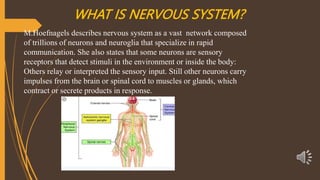
M.Hoefnagels describes nervous system as a vast network composed
of trillions of neurons and neuroglia that specialize in rapid
communication. She also states that some neurons are sensory
receptors that detect stimuli in the environment or inside the body:
Others relay or interpreted the sensory input. Still other neurons carry
impulses from the brain or spinal cord to muscles or glands, which
contract or secrete products in response.
WHAT IS ENDOCRINE SYSTEM?
M.Hoefnagels states that endocrine system is a system that includes
glands that secrete hormones, which are communication biochemical
that affect development , reproduction, mental health , metabolism and
many other functions. Again she states that hormones travel within
circulatory system and stimulate a characteristic response in a target
organs. For example, the pituitary gland in the brain produces and
secretes the hormone prolactin into the blood stream. Prolactin binds to
target cells in the breasts of a new mother and promotes milk
secretion.
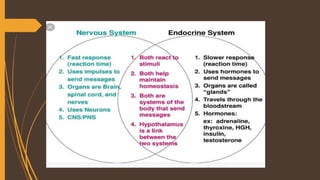
ALTHOUGH NERVOUS AND ENDOCRINE SYSTEM
BOTH SPECIALIZE IN COMMUNICATION, THEY
DIFFER IN MANY WAYS. BELOW ARE THE
DIFFERENCES BETWEEN THESE SYSTEMS
NERVOUS SYSTEM
 Neurons use action potentials and
neurotransmitters to send messages.
 Each neuron influences only a few
cells at a time .
 Nervous system communicates faster.
 A nervous impulse is virtually
instantaneous and its effects
disappear as soon as the stimulus
vanishes
ENDOCRINE SYSTEM
 Endocrine system employs hormones
 Hormones circulate throughout the
body in the blood and may affect
many different cells.
 Endocrine system communicates
slower.
 Hormones take minutes, hours or
even days to exert their effects, which
are generally prolonged.
RELATIONSHIP BETWEEN NERVOUS AND
ENDOCRINE SYSTEM
Despite their differences, the nervous and endocrine systems are tightly
integrated hence the name neuroendocrine system. The most obvious
connection is a physical one the hypothalamus. This region of the brain
is clearly part of the central nervous system, yet the hypothalamus
contains neurons called neurosectory cells that release hormones
directly into the bloodstream. Moreover, the hypothalamus directly
controls the action of many endocrine glands
CONTINUATION OF SLIDE 7
 The nervous and endocrine systems also share chemical links. For
example, some chemicals, such as epinephrine and norepinephrine,
can act as neurotransmitters (if released from a neuron)and
hormones(if released from an endocrine gland). In addition,
neurotransmitters and hormones share some target cells.
CONCLUSION
Neuroendocrine system is a network of cells that produce and release
hormones in response to signals from the nervous system.
Neuroendocrine system is a combination of nervous and endocrine
system and these systems communicate with each other through the
hypothalamus, which controls basic drives such as hunger and thirst.
The hypothalamus also regulates the pituitary gland, which governs the
release by the body’s other glands.
REFERENCES
 M.Hoefnagels “Biology concepts and investigation”2nd Edn (2012)
McGraw-Hill Companies New York
 http//biology.stackxchange.com
 http//verywellmind.com

NEUROENDROCRINE.pptx

  • 2.
    ABOUT MYSELF I amLimpho Moiloa, a third year student teacher at Lesotho College of Education. l am going to present about neuroendocrine system.
  • 3.
    NEUROENDOCRINE SYSTEM  Itis described as a network of cells that produce and release hormones in response to signals from the nervous system. The hypothalamus and pituitary gland are the main organs of the neuroendocrine system.  It is made up of nervous and endocrine system
  • 5.
    WHAT IS NERVOUSSYSTEM? M.Hoefnagels describes nervous system as a vast network composed of trillions of neurons and neuroglia that specialize in rapid communication. She also states that some neurons are sensory receptors that detect stimuli in the environment or inside the body: Others relay or interpreted the sensory input. Still other neurons carry impulses from the brain or spinal cord to muscles or glands, which contract or secrete products in response.
  • 6.
    WHAT IS ENDOCRINESYSTEM? M.Hoefnagels states that endocrine system is a system that includes glands that secrete hormones, which are communication biochemical that affect development , reproduction, mental health , metabolism and many other functions. Again she states that hormones travel within circulatory system and stimulate a characteristic response in a target organs. For example, the pituitary gland in the brain produces and secretes the hormone prolactin into the blood stream. Prolactin binds to target cells in the breasts of a new mother and promotes milk secretion.
  • 7.
    ALTHOUGH NERVOUS ANDENDOCRINE SYSTEM BOTH SPECIALIZE IN COMMUNICATION, THEY DIFFER IN MANY WAYS. BELOW ARE THE DIFFERENCES BETWEEN THESE SYSTEMS NERVOUS SYSTEM  Neurons use action potentials and neurotransmitters to send messages.  Each neuron influences only a few cells at a time .  Nervous system communicates faster.  A nervous impulse is virtually instantaneous and its effects disappear as soon as the stimulus vanishes ENDOCRINE SYSTEM  Endocrine system employs hormones  Hormones circulate throughout the body in the blood and may affect many different cells.  Endocrine system communicates slower.  Hormones take minutes, hours or even days to exert their effects, which are generally prolonged.
  • 8.
    RELATIONSHIP BETWEEN NERVOUSAND ENDOCRINE SYSTEM Despite their differences, the nervous and endocrine systems are tightly integrated hence the name neuroendocrine system. The most obvious connection is a physical one the hypothalamus. This region of the brain is clearly part of the central nervous system, yet the hypothalamus contains neurons called neurosectory cells that release hormones directly into the bloodstream. Moreover, the hypothalamus directly controls the action of many endocrine glands
  • 9.
    CONTINUATION OF SLIDE7  The nervous and endocrine systems also share chemical links. For example, some chemicals, such as epinephrine and norepinephrine, can act as neurotransmitters (if released from a neuron)and hormones(if released from an endocrine gland). In addition, neurotransmitters and hormones share some target cells.
  • 10.
    CONCLUSION Neuroendocrine system isa network of cells that produce and release hormones in response to signals from the nervous system. Neuroendocrine system is a combination of nervous and endocrine system and these systems communicate with each other through the hypothalamus, which controls basic drives such as hunger and thirst. The hypothalamus also regulates the pituitary gland, which governs the release by the body’s other glands.
  • 11.
    REFERENCES  M.Hoefnagels “Biologyconcepts and investigation”2nd Edn (2012) McGraw-Hill Companies New York  http//biology.stackxchange.com  http//verywellmind.com