Strength in Neurodiversity:
Creating a
Workplace Where Everyone Can
Belong
Daniel Wendler, PsyD
June 29 2023, 1 PM
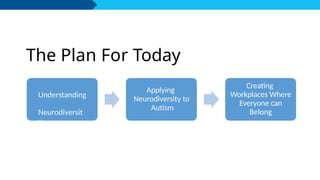
The Plan For Today
Understanding
Neurodiversit
y
Applying
Neurodiversity to
Autism
Creating
Workplaces Where
Everyone can
Belong
Understanding Neurodiversity
Useful Definitions
• Neurodivergent – Someone whose brain
performs differently than what society
considers the norm
• Neurotypical – Someone whose brain
functions in the way expected by society
• Neurodiverse – A group with both
neurodivergent and neurotypical people
• Neurodiversity movement– A grassroots
effort advocating for improvements in how
neurodivergent people are viewed and
treated in society
A Quick Word On Inclusive Language
• Neurodivergent NOT “abnormal”
• Neurotypical NOT “normal”
• Neurotype NOT “disorder”
• Autistic NOT “person with autism”
• When in doubt – ask!
What is Neurodiversity?
• Neurodiversity is a natural part of human
diversity: Brains work in different ways, and
that’s okay.
• Typical is not better: People whose brains
work in less common ways have unique
strengths, not just challenges
• Our environment affects our abilities – A
“disability” might simply be a person in an
environment that isn’t set up to
accommodate them
• We can design environments that allow
everyone to flourish– Instead of creating
environments that meet typical needs, we
can meet all needs.
The Social Model of Disability
• Disability is not caused by a condition.
• It is caused when society fails to
accommodate the needs of
that condition.
• Society automatically meets the typical
needs, but people with less typical
needs get left out.
MIKE OLIVER (23 July 1990). "THE INDIVIDUAL AND
SOCIAL MODELS OF DISABILITY"
The Social Model of Disability
• A Deaf person is fully able to enjoy a
movie – if the theater provides subtitles
• An Autistic person is fully able to
understand a conversation – if the
speaker uses explicit verbal
communication.
• A person with two left feet is fully able
to enjoy the dance floor – if the DJ plays
the Macarena
MIKE OLIVER (23 July 1990). "THE INDIVIDUAL AND
SOCIAL MODELS OF DISABILITY"
Understanding Autism Through Neurodiversity
What is Autism?
The DSM says…
• Persistent difficulty in social
interaction
• Restricted & repetitive patterns
of behavior, interest or activities
• Present since early life
What is Autism?
But autism means much more …
• Unique perspectives
• Innovative thinking
• Deep joy from special interests
What is Autism?
In different environments, autism
could bring strengths…
• Fresh ideas
• Deep knowledge on area of
interest
• Commitment to ethics
What is Autism?
And it can bring challenges…
• Miscommunication
• Stress from sensory overload
• Difficulty with change or adaptation
What is Autism?
People with autism need
• Understanding
• Acceptance
• Customized supports
What is Autism?
All people need
• Understanding
• Acceptance
• Customized supports
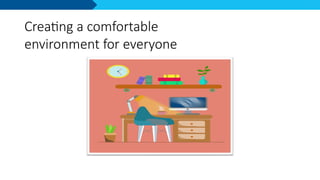
Creating a comfortable
environment for everyone
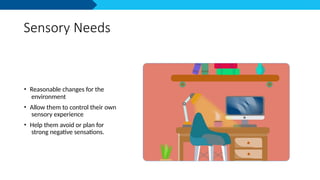
Sensory Needs
• Reasonable changes for the
environment
• Allow them to control their own
sensory experience
• Help them avoid or plan for
strong negative sensations.
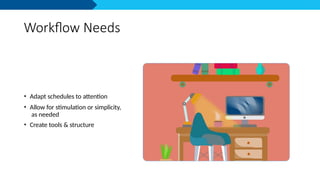
Workflow Needs
• Adapt schedules to attention
• Allow for stimulation or simplicity,
as needed
• Create tools & structure
Communication Needs
• Direct and explicit
communication
• Invite clarification
• Document expectations and
instructions
• Write down “unwritten”
rules
When in doubt…
• Assume good intentions unless
proven otherwise
• Identify & accommodate
unmet needs
• Allow different paths to the
same goal
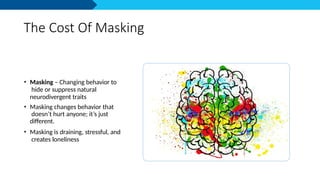
The Cost Of Masking
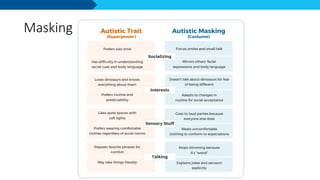
• Masking – Changing behavior to
hide or suppress natural
neurodivergent traits
• Masking changes behavior that
doesn’t hurt anyone; it’s just
different.
• Masking is draining, stressful, and
creates loneliness
Masking
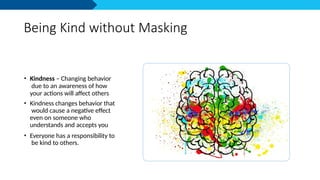
Being Kind without Masking
• Kindness – Changing behavior
due to an awareness of how
your actions will affect others
• Kindness changes behavior that
would cause a negative effect
even on someone who
understands and accepts you
• Everyone has a responsibility to
be kind to others.
QUESTIONS & ANSWERS
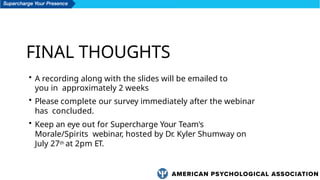
FINAL THOUGHTS
• A recording along with the slides will be emailed to
you in approximately 2 weeks
• Please complete our survey immediately after the webinar
has concluded.
• Keep an eye out for Supercharge Your Team's
Morale/Spirits webinar, hosted by Dr. Kyler Shumway on
July 27th at 2pm ET.
Supercharge Your
Presence
THANK YOU
For more webinars, visit
apa.org/ members
APA |
Webinar

neurodiversity-slidesnnn .pptx

  • 1.
    Strength in Neurodiversity: Creatinga Workplace Where Everyone Can Belong Daniel Wendler, PsyD June 29 2023, 1 PM
  • 2.
    The Plan ForToday Understanding Neurodiversit y Applying Neurodiversity to Autism Creating Workplaces Where Everyone can Belong
  • 3.
  • 4.
    Useful Definitions • Neurodivergent– Someone whose brain performs differently than what society considers the norm • Neurotypical – Someone whose brain functions in the way expected by society • Neurodiverse – A group with both neurodivergent and neurotypical people • Neurodiversity movement– A grassroots effort advocating for improvements in how neurodivergent people are viewed and treated in society
  • 5.
    A Quick WordOn Inclusive Language • Neurodivergent NOT “abnormal” • Neurotypical NOT “normal” • Neurotype NOT “disorder” • Autistic NOT “person with autism” • When in doubt – ask!
  • 6.
    What is Neurodiversity? •Neurodiversity is a natural part of human diversity: Brains work in different ways, and that’s okay. • Typical is not better: People whose brains work in less common ways have unique strengths, not just challenges • Our environment affects our abilities – A “disability” might simply be a person in an environment that isn’t set up to accommodate them • We can design environments that allow everyone to flourish– Instead of creating environments that meet typical needs, we can meet all needs.
  • 7.
    The Social Modelof Disability • Disability is not caused by a condition. • It is caused when society fails to accommodate the needs of that condition. • Society automatically meets the typical needs, but people with less typical needs get left out. MIKE OLIVER (23 July 1990). "THE INDIVIDUAL AND SOCIAL MODELS OF DISABILITY"
  • 8.
    The Social Modelof Disability • A Deaf person is fully able to enjoy a movie – if the theater provides subtitles • An Autistic person is fully able to understand a conversation – if the speaker uses explicit verbal communication. • A person with two left feet is fully able to enjoy the dance floor – if the DJ plays the Macarena MIKE OLIVER (23 July 1990). "THE INDIVIDUAL AND SOCIAL MODELS OF DISABILITY"
  • 9.
  • 10.
    What is Autism? TheDSM says… • Persistent difficulty in social interaction • Restricted & repetitive patterns of behavior, interest or activities • Present since early life
  • 11.
    What is Autism? Butautism means much more … • Unique perspectives • Innovative thinking • Deep joy from special interests
  • 12.
    What is Autism? Indifferent environments, autism could bring strengths… • Fresh ideas • Deep knowledge on area of interest • Commitment to ethics
  • 13.
    What is Autism? Andit can bring challenges… • Miscommunication • Stress from sensory overload • Difficulty with change or adaptation
  • 14.
    What is Autism? Peoplewith autism need • Understanding • Acceptance • Customized supports
  • 15.
    What is Autism? Allpeople need • Understanding • Acceptance • Customized supports
  • 16.
  • 17.
    Sensory Needs • Reasonablechanges for the environment • Allow them to control their own sensory experience • Help them avoid or plan for strong negative sensations.
  • 18.
    Workflow Needs • Adaptschedules to attention • Allow for stimulation or simplicity, as needed • Create tools & structure
  • 19.
    Communication Needs • Directand explicit communication • Invite clarification • Document expectations and instructions • Write down “unwritten” rules
  • 20.
    When in doubt… •Assume good intentions unless proven otherwise • Identify & accommodate unmet needs • Allow different paths to the same goal
  • 21.
    The Cost OfMasking • Masking – Changing behavior to hide or suppress natural neurodivergent traits • Masking changes behavior that doesn’t hurt anyone; it’s just different. • Masking is draining, stressful, and creates loneliness
  • 22.
  • 23.
    Being Kind withoutMasking • Kindness – Changing behavior due to an awareness of how your actions will affect others • Kindness changes behavior that would cause a negative effect even on someone who understands and accepts you • Everyone has a responsibility to be kind to others.
  • 24.
  • 25.
    FINAL THOUGHTS • Arecording along with the slides will be emailed to you in approximately 2 weeks • Please complete our survey immediately after the webinar has concluded. • Keep an eye out for Supercharge Your Team's Morale/Spirits webinar, hosted by Dr. Kyler Shumway on July 27th at 2pm ET.
  • 27.
    Supercharge Your Presence THANK YOU Formore webinars, visit apa.org/ members APA | Webinar