Korean J. Chem. Eng., 22(6), 813-821 (2005)
813
†
To whom correspondence should be addressed.
E-mail: paisan.k@chula.ac.th
Dynamic Neural Network Modeling for Hydrochloric Acid Recovery Process
Paisan Kittisupakorn
†
, Pantapong Tangteerasunun and Piyanuch Thitiyasook
Department of Chemical Engineering, Chulalongkorn University, Bangkok 10330, Thailand
(Received 7 March 2005 • accepted 18 July 2005)
Abstract−This paper describes neural network models for the prediction of the concentration profile of a hydrochloric
acid recovery process consisting of double fixed-bed ion exchange columns. The process is used to remove the Fe2+
and Fe3+
ion from the pickling liquor, resulting in increasing the acid concentration for reusing in the pickling process.
Due to the complexity and highly nonlinearity of the process, the modeling of the process based on the first principle
is difficult and involve too many unknown parameters. Therefore, an attractive alternative technique, neural network
modeling, has been applied to model this system because of its ability to model a complex nonlinear process, even
when process understanding is limited. The process data sets are gathered from a real hydrochloric acid recovery pilot
plant and used for neural network training and validation. Backpropagation and Lenvenberg-Marquardt techniques
are used to train various neural network architectures, and the accuracy of the obtained models have been examined
by using test data set. The optimal neural network architectures of this process can be determined by MSE minimization
technique. The simulation results have shown that multilayer feedforward neural network models with two hidden
layers provide sufficiently accurate prediction of the concentration profile of the process.
Key words: Neural Network Modeling, Pickling Process, Hydrochloric Acid Recovery Process, Ion Exchange Resin
INTRODUCTION
The iron and steel industry is one of the industries that causes
numerous pollution problems due to its wastewater released from
asteel pickling processcontaining oil and grease, metal scraps,acid
and steel ion. Steel pickling is part of the finishing processes in the
production of steel products in which oxides and scale are removed
from the surface of strip steel, steel wire, and some other forms of
steel, by immersing the steel in acidic solution. A solution of either
hydrochloric acid (HCl) or sulphuric acid is generally used to treat
steelproducts.
Almost all the iron and steel pickling processes in Thailand use
hydrochloric acid as a pickling agent. The used acid consisting of
ferrousand ferricionsin apickling bath thusbecomesahighly pol-
luted residue. The government has strictly regulated the waste fer-
rous and ferric solution properly treated before direct discharge to
natural water streams [Thailand: Bureau of Industrial Environment
Technology, Ministry of Industry]. The steel industry’s concerns
about this waste acid solution stem from the fact that the ferrous
and ferric ions in aqueous solution can be readily separated or re-
moved; then, the used acid with less concentration of the ferrous
and ferric ions can be reused in the pickling process. At present,
theacidrecoverytechniquesarechemicalprecipitation-theclassical
treatment is neutralization with lime, but this has certain disadvan-
tages:theacidcannotberecycledandahighvolumeofsludgecon-
taining the precipitated metal is obtained; and evaporation [Oswald,
1996] - the concept of this technique is to evaporate both acid and
water in the pickling liquor into acid vapour and steam using an
evaporator. Cooling and condensing these vapours can subsequently
recover the acid solution. The residue of the evaporator is the con-
centrated solution of ferrous chloride that has to be further neutral-
ized.Thedisadvantageofthistechniqueisthathigh-energydemand
is needed. Alternatively, ion exchange and adsorption have com-
monly been employed for the removal of steel ions. Among these,
adsorption has been thought to be efficient and economically feasi-
bleasawasteacid treatmentoperation.So an ionexchangeand ad-
sorption technique becomes a popular technique that has received
muchattentioninrecentyears.Maranonetal.[1999,2000]described
twoionexchangeresinstoremoveironandzincfrompicklingliquor.
Lin et al. [2002] used an ion exchange process for chromic acid
recovery from waste acid solution. Rengaraj et al. [2003] used ion
exchange resins to remove copper from aqueous solution. Juang et
al. [2003] discussed the fixed-bed adsorption to remove metal ions
(CO2+
, Ni2+
, Mn2+
, Sr2+
) from waste acid solution using strong acid
resins.
Over thepast decade,ion exchangeprocesses have been increas-
inglyapplied in awide rangeof diversefields,mostof which usea
fixed-bed ion exchange cylinder column. The study of the dynamic
behavior of afixed-bedadsorptioncolumnisthehistoryofeffluent
concentrationreferredtoastheconcentration-timeprofile.Theoreti-
cal models are developed for the prediction of the concentration
profile of the fixed-bed column. The models consider axial disper-
sion in the direction of waste acid flow, film diffusion resistance,
intra-particle diffusion resistance which may include both pore and
surface diffusion, and sorption kinetics at the adsorbent surface. Al-
ternatively,simplifiedmodelingapproachesrequireanumericalmeth-
odthathasbeenusedbyanumberofinvestigators.Wongetal.[1982]
appliedasimplifiedmodeltopredicttheconcentrationprofile.Ruth-
ven et al. [1983] used a method of orthogonal to solve PDE for the
predictionofthedynamicbehaviorof thefixedbedadsorptioncol-
umn.
The ultimate goal of this work is to develop an advanced control
technique to control a system consisting of steel pickling baths and
814 P. Kittisupakorn et al.
November, 2005
acid recovery columns. To achieve this, two researches focus on
the control of the steel pickling baths and the control of the acid
recovery columns by neural network inverse models. In this paper,
a hydrochloric acid recovery process consisting of two columns
that contain different resins is used to remove Fe2+
and Fe3+
from
the pickling liquor. Due to its highly nonlinear dynamic behavior,
experimental data are then used to develop neural network models
to predict the concentration profile of the system. In addition, the
prediction of the system’s concentration profile of the neural net-
work models is compared with that of the numerical solution of its
firstprinciplemodels.
CASE STUDY
1.The Steel Pickling Process
The pickling process is one of most common chemical proce-
duresusedtoremoveoxidesandironcontaminationduring thehot
rolling of steel in the air. This oxide has to be removed before sub-
sequent forming or processing operations. The process consists of
twomajorsteps:picklingandrinsing[KittisupakornandKaewpra-
dit, 2003]. The pickling step is used to remove surface oxides and
other contaminants out of metals by an immersion of the metals
into normallyan aqueousacid solution containing 5-15vol%hydro-
chloricacid(HCl).Foralloysteelslikestainlesssteels,scaleremoval
may require the use of acid mixture containing 8-20vol% nitric
acid and 0.5-5vol% hydrofluoric acid (HF). The pickling process
in this work consists of three pickling baths, containing 5%, 10%
and 15% by weight of hydrochloric acid (HCl), respectively. The
metalsmovecountercurrentlytotheacidstream.Thechemicalreac-
tionsinvolvedinthepicklingprocessareasfollows:
FeO+2HCl⇒FeCl2+H2O (1)
Fe2O3+6HCl⇒2FeCl3+3H2O (2)
Fe+2HCl⇒FeCl2+H2 (3)
FeCl3+½H2⇒FeCl2+HCl (4)
Inthesteelpicklingprocess(Fig.1),mostofthewastewatergen-
erated from the pickling process contains pickling acids, steel ion
(Fe2+
/Fe3+
)andsomeoftheusedchemicalinthecleaningbaths.
Before the wastewater (pickling liquor) is discharged to a natu-
ral water stream, it is fed into a hydrochloric acid recovery process
shown in Fig.2 consisting of ion exchangecolumns for recovering
anyunreactedacid[Atron,2002].Theprocedureofthehydrochloric
acidrecoveryprocesswillbedescribedinthenextsection.
2.Hydrochloric Acid Recovery System by Ion Exchange
The objective of the acid recovery system is to recover as much
as possible unreacted acid in the wastewater by separating free acid
outofsteel(Fe2+
/Fe3+
)ions.Atpresent,availableacidrecoverytech-
niquesareevaporation,retardationacidadsorption,retardationironad-
sorption and pyrohydrolysis with various efficiency [Oswald, 1996].
DetailsandcomparisonsofthesetechniquesaregivenintheTable1.
For a waste acid treatment operation, adsorption is considered to
bemoreefficientandeconomicallyfeasiblethanothertechniques.
3.Adsorption Model
Fig.1.Process diagram of pickling process.
Fig.2.Doublefixedbedionexchangeresincolumn[Atron,2002].
Table1.Comparison of acid recovery systems [Oswald, 1996]
Type Available
for How its works
Evaporation HCl EvaporationofHClandH2Ofrom
spent pickling acid bath
Retardation
acid adsorption
HCl Adsorption of free acid on ion
exchangeresin,FeCl2 passthrough,
adsorbed free acid regenerated
with water
Retardation
iron adsorption
HCl Oxidation Fe(II) to Fe(III) with
H2O2, adsorption of FeCl4
−
anion
complex by the ion exchange An-
ionresinregeneratedwithwater
Pyrohydrolysis HCl Heating,roasting,oxidationFe(II)
to Fe(III), condensation of chlo-
rides as free acid and chemically
fixed acid
Dynamic Neural Network Modeling for Hydrochloric Acid Recovery Process 815
Korean J. Chem. Eng.(Vol. 22, No. 6)
An adsorption fixed-bed consists of a vertical cylindrical pipe
filled or packed with an ion exchange resin. Macroscopic conser-
vationequationsoftheionexchangecolumnarecomplexandhighly
nonlinear.Concentrationprofileofthebedcanbecalculatedbysev-
eralnumericalmethodswithinitialandboundaryconditions[Duong
etal.,2001].RaghavanandRuthven[1983]usedanorthogonalcol-
location method to simulate and predict the transient response of
an adsorption column. Hand et al. [1996] used this method to pre-
dict the performance of fixed bed columns. Alternatively, Brain et
al. [1987] used the method of Line to predict the response of the
columns. Here,thefollowing assumptions made to set up the model
equationsare
(i)Thesystem operatesunderanisothermalcondition.
(ii)Theflowpatterninthecolumnisaxial dispersion;radial dis-
persionisnegligible.
(ii)Themacroporousadsorbentparticlesaresphericalandhomo-
geneousinsizeanddensity.
Theadsorptionmodelis:
(5)
where, ε is an external void fraction of the bed; FL is the flow rate;
Ac isacircularcross-sectionarea;cistheconcentrationofsolutein
solution; q is the concentration of solute in adsorbent; DL is solu-
tion phase dispersion coefficient, m2
/s; t is time; and z is the col-
umn height. The first term represents an accumulation of solute in
the liquid. The second term is an accumulation of the solute in the
solid. The third term represents the amount of solute flowing in and
out by convection to the section dz of the bed. The last term repre-
sentsaxialdispersionofsoluteinthebed.
Masstransferresistanceofadsorbentparticlesis
(6)
where, kf is a mass transfer rate coefficient; cp is the pore concen-
tration at the resin surface; Rp is the resin bead radius. Substituting
Eq.(6)intoEq.(5)gives:
(7)
From this equation, the concentration profile of the column can
bedeterminedbysolvingpartialdifferentialequationsproblemusing
availablenumericalmethod.
NEURAL NETWORK MODELING
Neural network is emerging as a promising tool in process iden-
tification and control owing to its ability to model processes with
accuracy[HussainandRahman,1999;HussainandKershenbaum,
2000]. It also offers a cost-effective method in developing useful
relationshipsbetween variables,whenthe experimental dataof these
variables are available. Neural network is a universal function ap-
proximator that typically works much better in practical applications
than a traditional (polynomial) function approximation method. A
typical neuron takes in a set of inputs, sums them together, takes
some function of them, and passes the output through a weighted
connection to another neuron. The neuron is thus just a predictor
variable, or a function of a nonlinear combination of predictor vari-
ables.Theconnectionweightsserveasadjustableparameters,which
aresetbyatrainingmethod,thatis,they areestimated from part of
thedata.
Neuralnetworkbuildsaclassof veryflexiblemodelswhich can
be used in various applications. Unfortunately, the neural network
is not uniquely defined; it can be configured in many different net-
work types and models. Here, the multilayer feedforward network
with backpropagation shown in Fig.3 is used to model the system.
Thecomponentoftheneuralnetworkmodelsofthisprocessisshown
inTable2.
1.Neural Network Inputs and Outputs Data Set
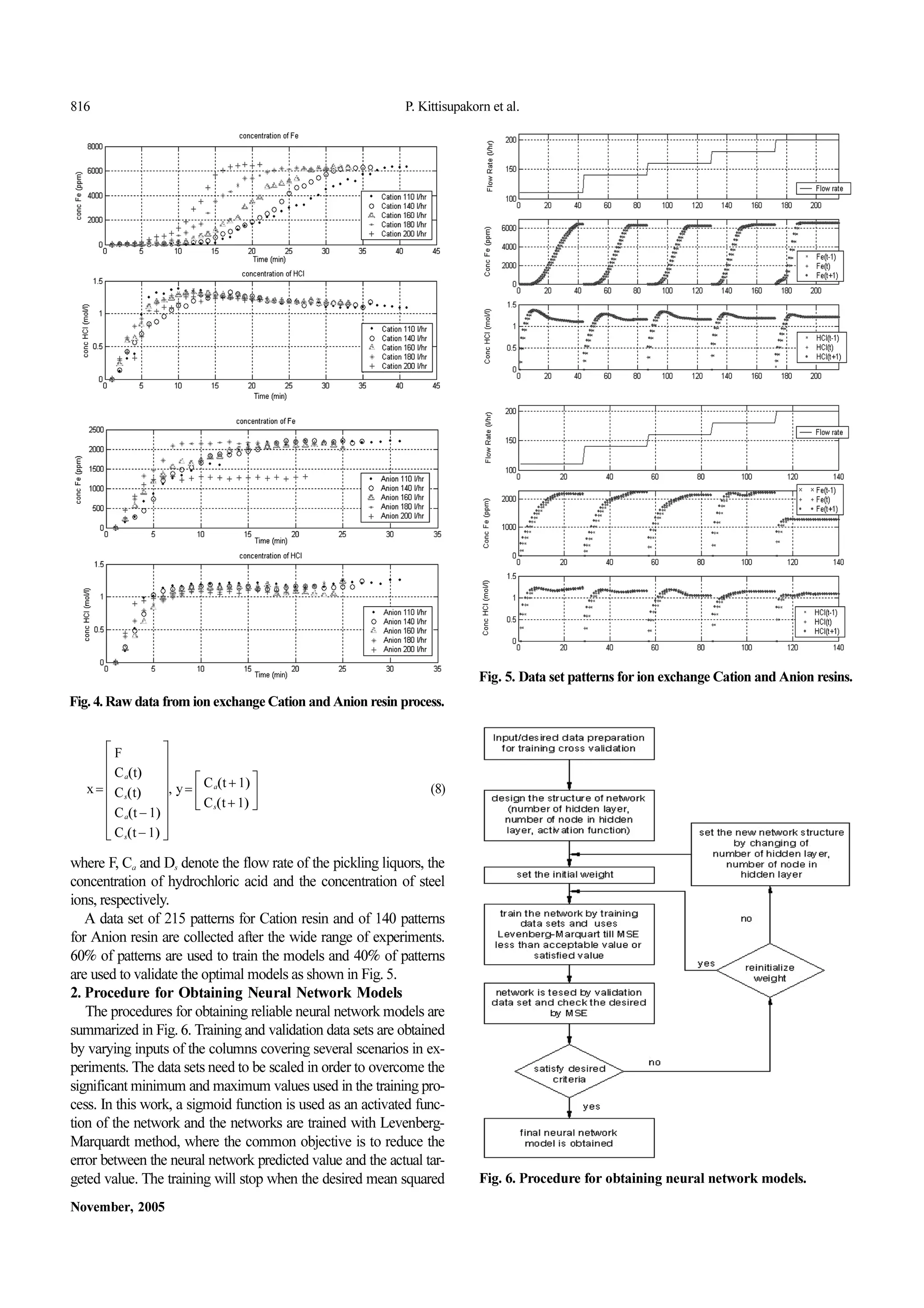
In Fig.4 the dynamic behavior data of the double fixed-bed ion
exchange resin pilot plant (Fig.2) are gathered from several exper-
iments covering a wide range of scenarios. The flow rates of the
wasteacidfedintothecolumnareadjustedbyamanualdiaphragm
valve with accurate flow meter. Experimental data used in the neural
network data sets are collected with a frequency of 1 minute sam-
plingtime.
Processinputsandoutputsarechosenas:
∂c
∂t
----- +
1−ε
ε
---------⎝ ⎠
⎛ ⎞∂q
∂t
------= −
FL
εAc
--------∂c
∂z
----- + DL
∂
2
c
∂z2
-------
∂q
∂t
------ =
3
Rp
-----kf
c−cp
( )
∂c
∂t
----- +
1−ε
ε
---------⎝ ⎠
⎛ ⎞ 3
Rp
-----kf
c−cp
( ) =−
FL
εAc
--------∂c
∂z
----- + DL
∂
2
c
∂z2
-------
Fig.3.The multilayer feedforward neural network.
Table2.The components of neural network models
Training Algorithm : Back Propagation Algorithm
Basis Function : Linear Basis Function
Transfer Function : Sigmoid Function
Input Signals Data : Flow Rate
Steel Ion Concentration
Hydrochloric Concentration
Output Signals Data : Steel Ion Concentration
Hydrochloric Concentration
To Predict : Concentration Profile
Hydrochloric Concentration
816 P. Kittisupakorn et al.
November, 2005
(8)
where F, Ca and Ds denote the flow rate of the pickling liquors, the
concentration of hydrochloric acid and the concentration of steel
ions,respectively.
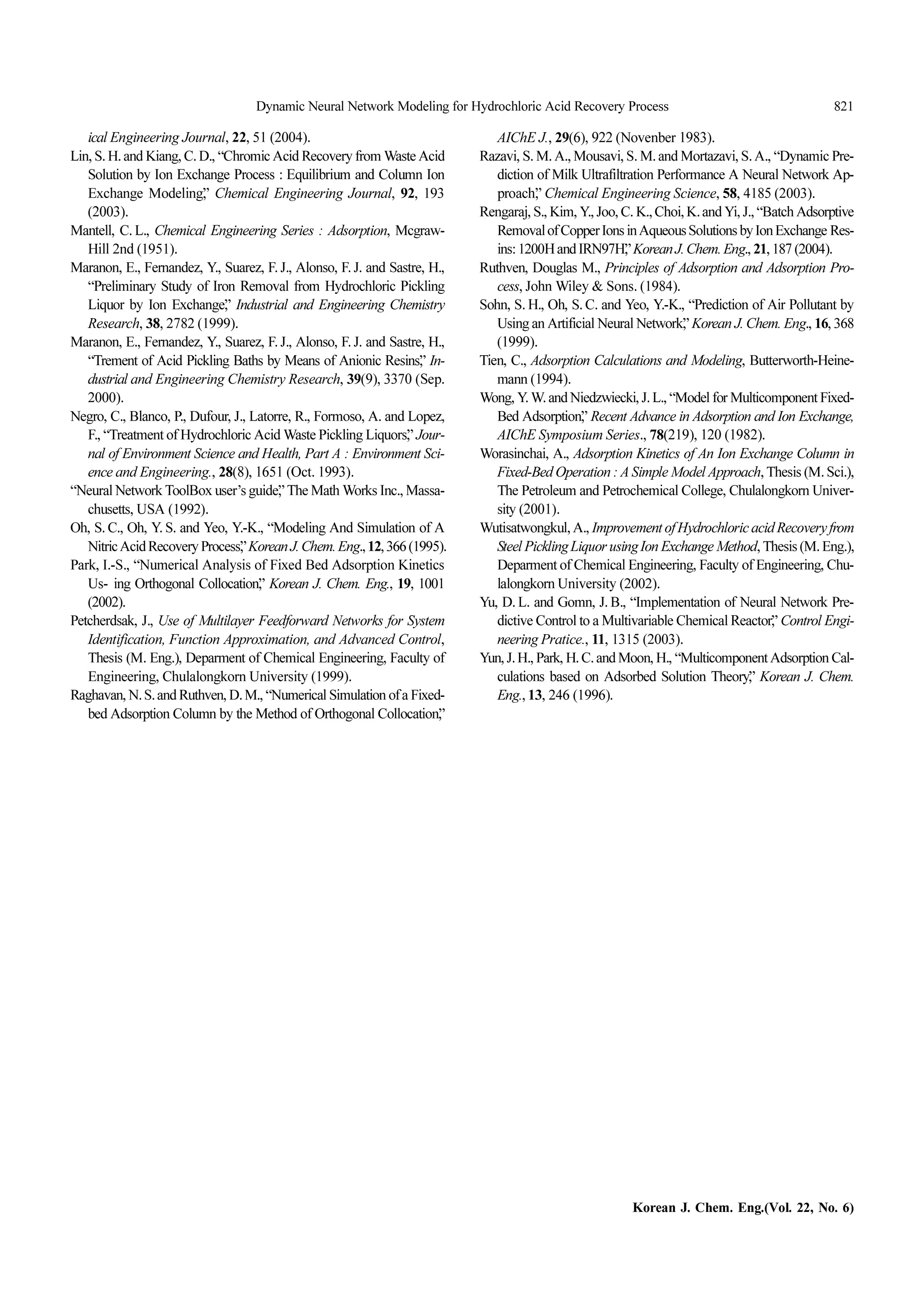
A data set of 215 patterns for Cation resin and of 140 patterns
for Anion resin are collected after the wide range of experiments.
60% of patterns are used to train the models and 40% of patterns
areusedtovalidatetheoptimalmodelsasshowninFig.5.
2.Procedure for Obtaining Neural Network Models
Theproceduresfor obtainingreliableneuralnetworkmodelsare
summarizedinFig.6.Trainingandvalidationdatasetsareobtained
by varying inputs of the columns covering several scenarios in ex-
periments.Thedatasetsneedtobescaledinordertoovercomethe
significantminimum andmaximum valuesusedinthetrainingpro-
cess. In this work, a sigmoid function is used as an activated func-
tion of the network and the networks are trained with Levenberg-
Marquardt method, where the common objective is to reduce the
error between the neural network predicted value and the actual tar-
geted value. The training will stop when the desired mean squared
x=
F
Ca
t( )
Cs
t( )
Ca
t−1( )
Cs
t− 1( )
, y= Ca
t+ 1( )
Cs
t+ 1( )
Fig.4.RawdatafromionexchangeCationandAnionresinprocess.
Fig.5.DatasetpatternsforionexchangeCationandAnionresins.
Fig.6.Procedure for obtaining neural network models.
Dynamic Neural Network Modeling for Hydrochloric Acid Recovery Process 817
Korean J. Chem. Eng.(Vol. 22, No. 6)
error(MSE)reachesthespecifiedvalueof0.001.
The optimum structures varying hidden nodes are selected by
the MSE minimization method. The hidden node that corresponds
totheminimum MSEvalueisselected.
EXPERIMENTAL STUDY
Thissectiondescribestheexperimentalstudyof theionexchange
columnpilotplant.Theexperimentaldataarecollectedevery1minute
sampling time. The data are then used for neural network training
andvalidation.
1.Ion Exchange Resin
The resin of this process can be divided into two types, which
arePuroliteC-150(cationicresin)andPuroliteA-500(anionicresin)
with their characteristic properties given in Table3. The first type,
the Purolite C-150 in Sodium form (Na+
), is a polystyrene macro-
porous strong acid cation exchange crosslinked with divinybenzene.
TheC-150resinisfirstlywashedwithdeionizedwatertoeliminate
impurities remaining after a manufacturing process. After that it is
regenerated by 10%HCl to obtain hydrogen from (H+
) [Maranon,
1999].Thereactionsofthesestepsareshownasfollows:
Cationexchangeloading: R−H+Fe2+
⇒R2Fe+2H+
Regeneration: R2Fe+HCl⇒2R−H+Fe2+
(9)
Thesecondtype,PuroliteA-500inChlorineform (Cl−
),isapoly-
styrene macroporous strong base anion exchange crosslinked with
divinybenzene. The A-500 resin is firstly washed with deionized
water to eliminate impurities remaining after a production process.
After that it is regenerated by 9%NaCl to obtain (Cl−
) from [Mara-
non,1999].Thereactionsofthesestepsare:
Cationexchangeloading: R−Cl+FeCl4
−
⇒R−FeCl4+Cl−
Regeneration: R−FeCl4
−
+H2O⇒FeCl3+R−Cl (10)
2.Double Fixed-bed Ion Exchange Resin Columns
Thedoublefixed-bedionexchangeresin column pilotplant con-
sists of two PVC columns (80cm height×24cm internal diameter).
The first column contains 13liter Cation C-150 and the other con-
tains 13liter Anion A-500. The flow rate of the waste acid is con-
trolledbyamanualdiaphragm valvewithaccurateflowmeter.
The waste acid is prepared by the immersion of steel pieces in
pickling bath (5% by weight HCl) to obtain the concentration of
steelionsintherangeof3-6g/l.Theconditioninthepicklingbath,
the acid concentration in the bath, is decreased from 5%by weight
HCl (1.4mol/l) to 2%by weight HCl (0.8mol/l). The relation be-
tween saturated steel and acid ions concentration is shown as Fig.
3.The waste acid or pickling liquor is then fed into the first column
whereFe(II)ioninthepicklingliquorisadsorbedbytheCationC-
150 resin.Next,Fe(II) ion is oxidized by hydrogen peroxide (H2O2)
to be Fe(III) ion form. After that the liquor is fed into the second
columnwhereFe(III)ionisadsorbedbytheAnionA-500resin.
3.Chemicals and Analysis Methods
The concentration of steel ions (g/l) in the acid solution is deter-
mined by an atomic absorption spectrophotometer using a Varian
Spectro model AA-300 spectrometer. The concentration of hydro-
chloric acid (mol/l) is determined by basic titration with NaOH 0.5
mol/L.
RESULTS AND DISCUSSION
In this work, neural network models are developed to predict the
concentrations of the Fe and HCl acid in each column of the ion
exchange process. To develop neural network models for the pre-
diction of the concentrations, five inputs and two outputs are used
in one or two hidden layer(s) network structure of each resin col-
umn. The numbers of neural nodes of each hidden layer are varied
to3,5,7,8,9,11,13,15,17and19,respectively.Eachdefinedneural
network is trained with Levenberg-Marquardt method using two
data sets.The common objective is to reduce the error between the
neural network predicted value and the actual targeted value. The
concentrationofFeionsinpicklingliquorisabout6,000ppm.There-
Table3.Characteristic properties of the resins
Purolite C-150 Cation Resin
Matrix Polystyrene divinylbenzene
Appearance Spherical beads
Functional groups R−SO3
−
Ionic form as ship Sodium - Na+
Total exchange capacity 1.8 eq/l minimum
Moisture Retention 48-53%
Screen Size Range 16-50 US Standard Mesh
Max reversible swelling Na+
⇒H+
5%
pH Limitations None
Purolite A-500 Anion Resin
Matrix Polystyrene divinylbenzene
Appearance Opaque, spherical beads
Functional groups R−N(CH3)3
+
Ionic form as ship Chloride - Cl−
Total exchange capacity 1.15 eq./l minimum
Moisture Retention 53-58%
Screen Size Range 16-50 US Standard Mesh
Max reversible swelling Cl−
⇒OH−
15%
pH Limitations 0-14
Fig.7.The saturated steel concentration in acid concentration.
818 P. Kittisupakorn et al.
November, 2005
fore, three neural network models for 0-3,000ppm of Fe ions con-
centration (Range#1), 3,000-6,000ppm of Fe ions concentration
(Range#2) in the cation resin column and 0-2,000ppm of Fe ions
concentrationintheanionresincolumnaredeveloped.
1.Training and Validation Neural Network Models
The values of MSE and RMS for various neural network struc-
tures are shown graphically in Figs.8-10.The minimum MSE crite-
rion is considered for neural network selection. From the figures it
isindicatedthat[5-11-13-2]NNstructure,[5-8-9-2]NNstructureand
[5-13-13-2] NN structure are the optimal structures for Range#1,
Range#2 of Fe ions concentration in the cation resin column and
0-2,000ppm of Fe ions concentration in the anion resin column.
respectively; these structures give the least MSE values after vali-
dation.
2.Neural Network Prediction
Fig.11showstheresultsofconcentrationprofilepredictionwith
a flow rate of 200liters per hour of the pickling liquor in the cation
column. It was found that in the range of 0-3,000ppm of Fe ions
concentration,the[5-11-13-2]NNmodelgivesgood prediction for
HCl concentration but with less accurate prediction in Fe concen-
tration. For 3,000-6,000ppm of Fe ions concentration, the [5-8-9-
2] NN model gives good prediction for the both of concentrations.
In the range of 0-3,000ppm of Fe ions concentration, the neural
network model gives less accurate prediction of the concentrations
Fig.8.Two hidden layer for cation Range#1.
Fig.9.Two hidden layer for cation Range#2.
Fig.10.Two hidden layer for anion.
Fig.11.ThepredictionofFeandHClconcentrationprofileinthe
cation resin column using [5-11-13-2] and [5-8-9-2] NN
models at the flow rate of pickling liquor 200l/hr.
Fig.12.TheerrorofpredictionofFeandHClconcentrationpro-
file in the cation resin column using [5-11-13-2] and [5-8-
9-2]NNmodelattheflowrateofpicklingliquor200l/hr.
Dynamic Neural Network Modeling for Hydrochloric Acid Recovery Process 819
Korean J. Chem. Eng.(Vol. 22, No. 6)
because it was developed based on the training input-output data.
However, the experiments were carried out with thelimitations such
as the range of flow rate, sampling time, resolution of instruments
etc. Therefore, in the cases where the trained data set are not avail-
able, the neural network model cannot provide good prediction in
thesecases.
Fig.12 shows the error in MSE, RMS, RMSP and MP indices
of the concentration profile prediction with a flow rate of 200liters
perhourofpicklingliquorinthecationcolumn.
Fig.13showstheresultsof concentration profilepredictionwith
a flow rate of 200liters per hour of pickling liquor in the anion
column. From the figure, it was found that the [5-13-13-2] NN
model gives good prediction for the both of concentrations. The
errorsofthepredictionareshowninFig.14.
Figs.15 and 16 show a comparison of Fe ion concentration pro-
file in the cation and anion resin columns obtained from numerical
solution (Eq. (7)), experiments and neural network models. These
figures show that the concentration profile predictions by the NN
models are better than those obtained from numerical solution in
bothcolumns.
CONCLUSIONS
A hydrochloric acid recovery process is a complex and highly
nonlinear system, which makes it difficult to identify by the first
principle approach. Alternatively, modeling of the process can be
carried out via neural network configuration. In this work, a neural
network has been used to provide the prediction of HCl acid and
Feionsconcentrationprofilesinthehydrochloricacidrecoverypro-
cess.It wasobservedthattheobtainedoptimalstructureneuralnet-
works can be successfully used to predict the effluent concentra-
tion profile of HCl acid and Fe ions as long as the neural network
models have been trained covering such scenarios. The simulation
results have shown that the dynamic behavior of concentration pro-
file of HCl acid and Fe ions can be well-predicted in all ranges of
operatingconditions.Thefurtherworkwillbethecontroloftheacid
recoverycolumnsbyneural networkinversemodels.Thenthecon-
Fig.13.ThepredictionofFeandHClconcentrationprofileinthe
anionresincolumnusing[5-13-13-2]NNmodelattheflow
rate of pickling liquor 200l/hr.
Fig.14.The error of the prediction of Fe and HCl concentration
profile in the anion resin column using [5-13-13-2] NN
model at the flow rate of pickling liquor 200l/hr.
Fig.15.ThecomparisonofFeionsconcentrationprofileintheca-
tion resin column obtained from numerical solution, ex-
periments and neural network models.
Fig.16.ThecomparisonofFeionsconcentrationprofileinthean-
ion resin columnobtained from numerical solution, ex-
periments and neural network models.
820 P. Kittisupakorn et al.
November, 2005
trol of the system by neural network inverse models approach will
bestudied.Theultimategoalof thisworkisto developanadvanced
control technique to control a system consisting of steel pickling
baths and acid recovery columns. This whole work will show the
applicability of the neural network inverse models approach in the
controlofthesystem reducingtheuseofthepicklingliquorandre-
movingFeionsinthepicklingliquorandthenreusingofthepickling
liquorinthepicklingbaths.
NOMENCLATURE
ε : external void fraction of the bed
σx : standard deviation of the training inputs
σy : standard deviation of the training outputs
σp : standard deviation of process outputs data
Ac : circular cross-section area [m2
]
Ca : the concentration of hydrochloric acid [mol/l]
Cs : the concentration of steel ion[mol/l]
c : the concentration of solution phase[mol/l]
cp : the pore concentration at the resin surface[mol/l]
DL : solution phase dispersion coefficient [m2
/s]
FL : flow rate [m3
/min]
kf : mass transfer rate coefficient [mm/s]
p : process outputs
pnor : process outputs (normalized)
: mean of process outputs data
q : resin phase solution [mol/g]
Rp : the resin bead radius [mm]
t : time [min]
w : network weight
x : network inputs to a neuron
xnor : network inputs (normalized)
: mean of the network inputs
y : network outputs from neuron
ynor : network outputs (normalized)
: mean of network outputs
z : column distance[mm]
MSE : Mean Square Error
RMS : Root Mean Square Error
RMSP : Root Mean Square Percent Error Index
MP : Maximum Percent Error Index
REFERENCES
Ahmad, I. and Berzins, M., “MOL Solvers for Hyperbolic PDEs with
Source Terms,” Mathematics and Computers in Simulation, 56, 115
(2001).
Anderson,D.andMcNeill,G.,ArtificialNeuralNetworksTechology,A
DACS State-of-the Art Report Kaman Sciences Corporation, 258
Genesse Street Utica, NY (Aug. 1992).
Basu, S., Henshaw, P.F., Biswas, N. and Kwan, H.K., “Prediction of
Gas-Phase Adsorption Isotherms Using Neural Nets,” The Cana-
dian Journal Chemical Engineering, 80(August 2002).
Ben F.BrianIII.and Imre Zwiebel, “Numerical Simulation ofa Fixed-
bedAdsorptionDynamicsbytheMethodofLine,”RecentProgress
inAdsorptionandIonExchange,”AIChESymposiumSeries.,83,80
(Number 259).
BureauofIndustrialEnvironmentTechnology.DeparmentofIndustrial
Works. Ministry ofIndustrial Works, Environment Management
Gudeline for The Steel Processing Industry Pickling Process (April
1999).
Cooney, D.O., “The Importance of Axial Dispersion in Liquid-phase
Fixed-bed Adsorption Operation,” Chem. Eng. Comm., 110, 217
(1991).
David, P.B.T.B. Strik, Alexander M. Domnanovich, Loredana Zani,
Rudolf and Peter Holubar, “Prediction of Trace Compound in Bio-
gasfromAnaerobicDigestionusingtheMATLABNeuralNetwork
Toolbox,”EnvironmentalModelling& Software,20,803(2005).
Davis,MarkE.,NumericalMethodsandModelingforChemicalEngi-
neers, John Wiley& Sons. (1984).
Duong,HaiM.andShallcross,DavidC.,“IonExchangeColumnPer-
formance Model Incorporating Intra-Particle and Solution Phase
Mass Transfer Phenomena,” Department of Chemical Engineering,
Universityof Melbourne.
Ha,K.-S.,“RemovalandRecoveryofAmmoniumionfromWastewa-
terbyAdsorptiononNaturalZeolite,”KoreanJ.Chem.Eng.,4,149
(1987).
Henry,T.,“ChromicAcidRecoveryfrom ChromePlatingRinseWater
byIonExchange,”JournalofTheChineseInstituteofChemicalEng-
ineers, 26(4), 253 (Jul. 1995).
Henry, T., “Treatment of Chromium Plating Rinse Water by Ion Ex-
change,” Journal of The Chinese Institute of Chemical Engineers,
25(2), 77 (Mar. 1994).
Himmelblau,David M.,“Application ofArtificialNeural Networks in
Chemical Engineering,” Korean J. Chem. Eng., 17, 373 (2000).
Hussain,M.A.,Kittisupakorn,P.andDaosud,W.,“Implementationof
Neural-Network-BasedInverse-ModelControlStrategiesonanEx-
othermicReactor,”JournaloftheScienceSocietyofThailand.,27(1),
41 (2001).
Hussain,M.A.,NeuralNetworkTechniquesandApplicationinChem-
ical Process Control System,” CRC Press (2003).
KhalidAlhumaizi.,RedhouaneHendaandMostafaSoliman,“Numer-
icalAnalysisofaReaction-diffusion-convectionSystem,”Computer
& Chemical Engineering., 27, 579 (2003).
Kim,C.M.,Kang,J.H.andMoon,H.,“IntraparticleTransportofAmino
AcidinACationExchange,”KoreanJ.Chem.Eng.,12,72(1995)
Kim, M.-B.,Moon, J.H., Lee, C.-H.,Ahn, H. and Cho, W., “Effect of
Heat on the Transient Dynamics of temperature Swing Adsorption
Process,” Korean J. Chem. Eng., 21, 703 (2004).
Kim,S.-J.,Lim,K.-H.,Joo,K.-H.,Lee,M.-J.,Kil,S.-G.andCho,S.-Y.,
“Removal of Heavy Metal-Cyanide Complexes by Ion Exchange,”
Korean J. Chem. Eng., 19, 1078 (2002).
Kittisupakorn, P. and Kaewpradit, P., “Integrated Data Reconciliation
withGenericModelControlfortheSteelPicklingProcess,”Korean
J. Chem. Eng., 20, 985 (2003).
Kittisupakorn,P.,Polruksa,N.andDaosud,W.,NeuralNetworksModel
for the Estimation of Melt Flow Rate and Density of Polymers, 9th
APCChE Congress and CHEMECA (2002).
Lee, H.S., Matthews, C.J., Braddock, R.D., Sander, G.C. and Gan-
dola, F., “A MATLAB method of Lones Template for Transport
Equations,”EnvironmentalModelling&Software.,19,603(2004).
LeiZhi Chen, Sing Kiong Nguang, Xiao Dong Chen and Xue Mei Li,
“Modelling and Optimization of Fed-batch Fermentation Process
usingDynamicNeuralNetworksandGeneticAlgorithms,”Biochem-
p
x
y
Dynamic Neural Network Modeling for Hydrochloric Acid Recovery Process 821
Korean J. Chem. Eng.(Vol. 22, No. 6)
icalEngineering Journal, 22, 51 (2004).
Lin,S.H.andKiang,C.D.,“ChromicAcidRecoveryfromWasteAcid
Solution by Ion Exchange Process : Equilibrium and Column Ion
Exchange Modeling,” Chemical Engineering Journal, 92, 193
(2003).
Mantell, C.L., Chemical Engineering Series : Adsorption, Mcgraw-
Hill 2nd (1951).
Maranon, E., Fernandez, Y., Suarez, F.J., Alonso, F.J. and Sastre, H.,
“Preliminary Study of Iron Removal from Hydrochloric Pickling
Liquor by Ion Exchange,” Industrial and Engineering Chemistry
Research, 38, 2782 (1999).
Maranon, E., Fernandez, Y., Suarez, F.J., Alonso, F.J. and Sastre, H.,
“Trement of Acid Pickling Baths by Means of Anionic Resins,” In-
dustrial and Engineering Chemistry Research, 39(9), 3370 (Sep.
2000).
Negro, C., Blanco, P., Dufour, J., Latorre, R., Formoso, A. and Lopez,
F.,“TreatmentofHydrochloricAcidWastePicklingLiquors,”Jour-
nal of Environment Science and Health, Part A : Environment Sci-
ence and Engineering., 28(8), 1651 (Oct. 1993).
“NeuralNetworkToolBoxuser’sguide,”TheMathWorksInc.,Massa-
chusetts, USA (1992).
Oh, S.C., Oh, Y.S. and Yeo, Y.-K., “Modeling And Simulation of A
NitricAcidRecoveryProcess,”KoreanJ.Chem.Eng.,12,366(1995).
Park, I.-S., “Numerical Analysis of Fixed Bed Adsorption Kinetics
Us- ing Orthogonal Collocation,” Korean J. Chem. Eng., 19, 1001
(2002).
Petcherdsak, J., Use of Multilayer Feedforward Networks for System
Identification, Function Approximation, and Advanced Control,
Thesis (M. Eng.), Deparment of Chemical Engineering, Faculty of
Engineering, Chulalongkorn University (1999).
Raghavan,N.S.andRuthven,D.M.,“NumericalSimulationofaFixed-
bedAdsorptionColumnbytheMethodofOrthogonalCollocation,”
AIChE J., 29(6), 922 (Novenber 1983).
Razavi,S.M.A.,Mousavi,S.M.andMortazavi,S.A.,“DynamicPre-
diction of Milk Ultrafiltration Performance A Neural Network Ap-
proach,” Chemical Engineering Science, 58, 4185 (2003).
Rengaraj,S.,Kim,Y.,Joo,C.K.,Choi,K.andYi,J.,“BatchAdsorptive
RemovalofCopperIonsinAqueousSolutionsbyIonExchangeRes-
ins:1200HandIRN97H,”KoreanJ.Chem.Eng.,21,187(2004).
Ruthven, Douglas M., Principles of Adsorption and Adsorption Pro-
cess,John Wiley& Sons. (1984).
Sohn, S.H., Oh, S.C. and Yeo, Y.-K., “Prediction of Air Pollutant by
UsinganArtificialNeuralNetwork,”KoreanJ.Chem.Eng.,16,368
(1999).
Tien, C., Adsorption Calculations and Modeling, Butterworth-Heine-
mann(1994).
Wong,Y.W.andNiedzwiecki,J.L.,“ModelforMulticomponentFixed-
Bed Adsorption,” Recent Advance in Adsorption and Ion Exchange,
AIChE Symposium Series., 78(219), 120 (1982).
Worasinchai, A., Adsorption Kinetics of An Ion Exchange Column in
Fixed-BedOperation:ASimpleModelApproach,Thesis(M.Sci.),
ThePetroleum andPetrochemicalCollege,ChulalongkornUniver-
sity(2001).
Wutisatwongkul,A.,ImprovementofHydrochloricacidRecoveryfrom
SteelPicklingLiquorusingIonExchangeMethod,Thesis(M.Eng.),
DeparmentofChemicalEngineering,FacultyofEngineering,Chu-
lalongkornUniversity (2002).
Yu, D.L. and Gomn, J.B., “Implementation of Neural Network Pre-
dictiveControltoaMultivariableChemicalReactor,”ControlEngi-
neering Pratice., 11, 1315 (2003).
Yun,J.H.,Park,H.C.andMoon,H.,“MulticomponentAdsorptionCal-
culations based on Adsorbed Solution Theory,” Korean J. Chem.
Eng.,13, 246 (1996).

Neural network model for HCl recovery process

  • 1.
    Korean J. Chem.Eng., 22(6), 813-821 (2005) 813 † To whom correspondence should be addressed. E-mail: paisan.k@chula.ac.th Dynamic Neural Network Modeling for Hydrochloric Acid Recovery Process Paisan Kittisupakorn † , Pantapong Tangteerasunun and Piyanuch Thitiyasook Department of Chemical Engineering, Chulalongkorn University, Bangkok 10330, Thailand (Received 7 March 2005 • accepted 18 July 2005) Abstract−This paper describes neural network models for the prediction of the concentration profile of a hydrochloric acid recovery process consisting of double fixed-bed ion exchange columns. The process is used to remove the Fe2+ and Fe3+ ion from the pickling liquor, resulting in increasing the acid concentration for reusing in the pickling process. Due to the complexity and highly nonlinearity of the process, the modeling of the process based on the first principle is difficult and involve too many unknown parameters. Therefore, an attractive alternative technique, neural network modeling, has been applied to model this system because of its ability to model a complex nonlinear process, even when process understanding is limited. The process data sets are gathered from a real hydrochloric acid recovery pilot plant and used for neural network training and validation. Backpropagation and Lenvenberg-Marquardt techniques are used to train various neural network architectures, and the accuracy of the obtained models have been examined by using test data set. The optimal neural network architectures of this process can be determined by MSE minimization technique. The simulation results have shown that multilayer feedforward neural network models with two hidden layers provide sufficiently accurate prediction of the concentration profile of the process. Key words: Neural Network Modeling, Pickling Process, Hydrochloric Acid Recovery Process, Ion Exchange Resin INTRODUCTION The iron and steel industry is one of the industries that causes numerous pollution problems due to its wastewater released from asteel pickling processcontaining oil and grease, metal scraps,acid and steel ion. Steel pickling is part of the finishing processes in the production of steel products in which oxides and scale are removed from the surface of strip steel, steel wire, and some other forms of steel, by immersing the steel in acidic solution. A solution of either hydrochloric acid (HCl) or sulphuric acid is generally used to treat steelproducts. Almost all the iron and steel pickling processes in Thailand use hydrochloric acid as a pickling agent. The used acid consisting of ferrousand ferricionsin apickling bath thusbecomesahighly pol- luted residue. The government has strictly regulated the waste fer- rous and ferric solution properly treated before direct discharge to natural water streams [Thailand: Bureau of Industrial Environment Technology, Ministry of Industry]. The steel industry’s concerns about this waste acid solution stem from the fact that the ferrous and ferric ions in aqueous solution can be readily separated or re- moved; then, the used acid with less concentration of the ferrous and ferric ions can be reused in the pickling process. At present, theacidrecoverytechniquesarechemicalprecipitation-theclassical treatment is neutralization with lime, but this has certain disadvan- tages:theacidcannotberecycledandahighvolumeofsludgecon- taining the precipitated metal is obtained; and evaporation [Oswald, 1996] - the concept of this technique is to evaporate both acid and water in the pickling liquor into acid vapour and steam using an evaporator. Cooling and condensing these vapours can subsequently recover the acid solution. The residue of the evaporator is the con- centrated solution of ferrous chloride that has to be further neutral- ized.Thedisadvantageofthistechniqueisthathigh-energydemand is needed. Alternatively, ion exchange and adsorption have com- monly been employed for the removal of steel ions. Among these, adsorption has been thought to be efficient and economically feasi- bleasawasteacid treatmentoperation.So an ionexchangeand ad- sorption technique becomes a popular technique that has received muchattentioninrecentyears.Maranonetal.[1999,2000]described twoionexchangeresinstoremoveironandzincfrompicklingliquor. Lin et al. [2002] used an ion exchange process for chromic acid recovery from waste acid solution. Rengaraj et al. [2003] used ion exchange resins to remove copper from aqueous solution. Juang et al. [2003] discussed the fixed-bed adsorption to remove metal ions (CO2+ , Ni2+ , Mn2+ , Sr2+ ) from waste acid solution using strong acid resins. Over thepast decade,ion exchangeprocesses have been increas- inglyapplied in awide rangeof diversefields,mostof which usea fixed-bed ion exchange cylinder column. The study of the dynamic behavior of afixed-bedadsorptioncolumnisthehistoryofeffluent concentrationreferredtoastheconcentration-timeprofile.Theoreti- cal models are developed for the prediction of the concentration profile of the fixed-bed column. The models consider axial disper- sion in the direction of waste acid flow, film diffusion resistance, intra-particle diffusion resistance which may include both pore and surface diffusion, and sorption kinetics at the adsorbent surface. Al- ternatively,simplifiedmodelingapproachesrequireanumericalmeth- odthathasbeenusedbyanumberofinvestigators.Wongetal.[1982] appliedasimplifiedmodeltopredicttheconcentrationprofile.Ruth- ven et al. [1983] used a method of orthogonal to solve PDE for the predictionofthedynamicbehaviorof thefixedbedadsorptioncol- umn. The ultimate goal of this work is to develop an advanced control technique to control a system consisting of steel pickling baths and
  • 2.
    814 P. Kittisupakornet al. November, 2005 acid recovery columns. To achieve this, two researches focus on the control of the steel pickling baths and the control of the acid recovery columns by neural network inverse models. In this paper, a hydrochloric acid recovery process consisting of two columns that contain different resins is used to remove Fe2+ and Fe3+ from the pickling liquor. Due to its highly nonlinear dynamic behavior, experimental data are then used to develop neural network models to predict the concentration profile of the system. In addition, the prediction of the system’s concentration profile of the neural net- work models is compared with that of the numerical solution of its firstprinciplemodels. CASE STUDY 1.The Steel Pickling Process The pickling process is one of most common chemical proce- duresusedtoremoveoxidesandironcontaminationduring thehot rolling of steel in the air. This oxide has to be removed before sub- sequent forming or processing operations. The process consists of twomajorsteps:picklingandrinsing[KittisupakornandKaewpra- dit, 2003]. The pickling step is used to remove surface oxides and other contaminants out of metals by an immersion of the metals into normallyan aqueousacid solution containing 5-15vol%hydro- chloricacid(HCl).Foralloysteelslikestainlesssteels,scaleremoval may require the use of acid mixture containing 8-20vol% nitric acid and 0.5-5vol% hydrofluoric acid (HF). The pickling process in this work consists of three pickling baths, containing 5%, 10% and 15% by weight of hydrochloric acid (HCl), respectively. The metalsmovecountercurrentlytotheacidstream.Thechemicalreac- tionsinvolvedinthepicklingprocessareasfollows: FeO+2HCl⇒FeCl2+H2O (1) Fe2O3+6HCl⇒2FeCl3+3H2O (2) Fe+2HCl⇒FeCl2+H2 (3) FeCl3+½H2⇒FeCl2+HCl (4) Inthesteelpicklingprocess(Fig.1),mostofthewastewatergen- erated from the pickling process contains pickling acids, steel ion (Fe2+ /Fe3+ )andsomeoftheusedchemicalinthecleaningbaths. Before the wastewater (pickling liquor) is discharged to a natu- ral water stream, it is fed into a hydrochloric acid recovery process shown in Fig.2 consisting of ion exchangecolumns for recovering anyunreactedacid[Atron,2002].Theprocedureofthehydrochloric acidrecoveryprocesswillbedescribedinthenextsection. 2.Hydrochloric Acid Recovery System by Ion Exchange The objective of the acid recovery system is to recover as much as possible unreacted acid in the wastewater by separating free acid outofsteel(Fe2+ /Fe3+ )ions.Atpresent,availableacidrecoverytech- niquesareevaporation,retardationacidadsorption,retardationironad- sorption and pyrohydrolysis with various efficiency [Oswald, 1996]. DetailsandcomparisonsofthesetechniquesaregivenintheTable1. For a waste acid treatment operation, adsorption is considered to bemoreefficientandeconomicallyfeasiblethanothertechniques. 3.Adsorption Model Fig.1.Process diagram of pickling process. Fig.2.Doublefixedbedionexchangeresincolumn[Atron,2002]. Table1.Comparison of acid recovery systems [Oswald, 1996] Type Available for How its works Evaporation HCl EvaporationofHClandH2Ofrom spent pickling acid bath Retardation acid adsorption HCl Adsorption of free acid on ion exchangeresin,FeCl2 passthrough, adsorbed free acid regenerated with water Retardation iron adsorption HCl Oxidation Fe(II) to Fe(III) with H2O2, adsorption of FeCl4 − anion complex by the ion exchange An- ionresinregeneratedwithwater Pyrohydrolysis HCl Heating,roasting,oxidationFe(II) to Fe(III), condensation of chlo- rides as free acid and chemically fixed acid
  • 3.
    Dynamic Neural NetworkModeling for Hydrochloric Acid Recovery Process 815 Korean J. Chem. Eng.(Vol. 22, No. 6) An adsorption fixed-bed consists of a vertical cylindrical pipe filled or packed with an ion exchange resin. Macroscopic conser- vationequationsoftheionexchangecolumnarecomplexandhighly nonlinear.Concentrationprofileofthebedcanbecalculatedbysev- eralnumericalmethodswithinitialandboundaryconditions[Duong etal.,2001].RaghavanandRuthven[1983]usedanorthogonalcol- location method to simulate and predict the transient response of an adsorption column. Hand et al. [1996] used this method to pre- dict the performance of fixed bed columns. Alternatively, Brain et al. [1987] used the method of Line to predict the response of the columns. Here,thefollowing assumptions made to set up the model equationsare (i)Thesystem operatesunderanisothermalcondition. (ii)Theflowpatterninthecolumnisaxial dispersion;radial dis- persionisnegligible. (ii)Themacroporousadsorbentparticlesaresphericalandhomo- geneousinsizeanddensity. Theadsorptionmodelis: (5) where, ε is an external void fraction of the bed; FL is the flow rate; Ac isacircularcross-sectionarea;cistheconcentrationofsolutein solution; q is the concentration of solute in adsorbent; DL is solu- tion phase dispersion coefficient, m2 /s; t is time; and z is the col- umn height. The first term represents an accumulation of solute in the liquid. The second term is an accumulation of the solute in the solid. The third term represents the amount of solute flowing in and out by convection to the section dz of the bed. The last term repre- sentsaxialdispersionofsoluteinthebed. Masstransferresistanceofadsorbentparticlesis (6) where, kf is a mass transfer rate coefficient; cp is the pore concen- tration at the resin surface; Rp is the resin bead radius. Substituting Eq.(6)intoEq.(5)gives: (7) From this equation, the concentration profile of the column can bedeterminedbysolvingpartialdifferentialequationsproblemusing availablenumericalmethod. NEURAL NETWORK MODELING Neural network is emerging as a promising tool in process iden- tification and control owing to its ability to model processes with accuracy[HussainandRahman,1999;HussainandKershenbaum, 2000]. It also offers a cost-effective method in developing useful relationshipsbetween variables,whenthe experimental dataof these variables are available. Neural network is a universal function ap- proximator that typically works much better in practical applications than a traditional (polynomial) function approximation method. A typical neuron takes in a set of inputs, sums them together, takes some function of them, and passes the output through a weighted connection to another neuron. The neuron is thus just a predictor variable, or a function of a nonlinear combination of predictor vari- ables.Theconnectionweightsserveasadjustableparameters,which aresetbyatrainingmethod,thatis,they areestimated from part of thedata. Neuralnetworkbuildsaclassof veryflexiblemodelswhich can be used in various applications. Unfortunately, the neural network is not uniquely defined; it can be configured in many different net- work types and models. Here, the multilayer feedforward network with backpropagation shown in Fig.3 is used to model the system. Thecomponentoftheneuralnetworkmodelsofthisprocessisshown inTable2. 1.Neural Network Inputs and Outputs Data Set In Fig.4 the dynamic behavior data of the double fixed-bed ion exchange resin pilot plant (Fig.2) are gathered from several exper- iments covering a wide range of scenarios. The flow rates of the wasteacidfedintothecolumnareadjustedbyamanualdiaphragm valve with accurate flow meter. Experimental data used in the neural network data sets are collected with a frequency of 1 minute sam- plingtime. Processinputsandoutputsarechosenas: ∂c ∂t ----- + 1−ε ε ---------⎝ ⎠ ⎛ ⎞∂q ∂t ------= − FL εAc --------∂c ∂z ----- + DL ∂ 2 c ∂z2 ------- ∂q ∂t ------ = 3 Rp -----kf c−cp ( ) ∂c ∂t ----- + 1−ε ε ---------⎝ ⎠ ⎛ ⎞ 3 Rp -----kf c−cp ( ) =− FL εAc --------∂c ∂z ----- + DL ∂ 2 c ∂z2 ------- Fig.3.The multilayer feedforward neural network. Table2.The components of neural network models Training Algorithm : Back Propagation Algorithm Basis Function : Linear Basis Function Transfer Function : Sigmoid Function Input Signals Data : Flow Rate Steel Ion Concentration Hydrochloric Concentration Output Signals Data : Steel Ion Concentration Hydrochloric Concentration To Predict : Concentration Profile Hydrochloric Concentration
  • 4.
    816 P. Kittisupakornet al. November, 2005 (8) where F, Ca and Ds denote the flow rate of the pickling liquors, the concentration of hydrochloric acid and the concentration of steel ions,respectively. A data set of 215 patterns for Cation resin and of 140 patterns for Anion resin are collected after the wide range of experiments. 60% of patterns are used to train the models and 40% of patterns areusedtovalidatetheoptimalmodelsasshowninFig.5. 2.Procedure for Obtaining Neural Network Models Theproceduresfor obtainingreliableneuralnetworkmodelsare summarizedinFig.6.Trainingandvalidationdatasetsareobtained by varying inputs of the columns covering several scenarios in ex- periments.Thedatasetsneedtobescaledinordertoovercomethe significantminimum andmaximum valuesusedinthetrainingpro- cess. In this work, a sigmoid function is used as an activated func- tion of the network and the networks are trained with Levenberg- Marquardt method, where the common objective is to reduce the error between the neural network predicted value and the actual tar- geted value. The training will stop when the desired mean squared x= F Ca t( ) Cs t( ) Ca t−1( ) Cs t− 1( ) , y= Ca t+ 1( ) Cs t+ 1( ) Fig.4.RawdatafromionexchangeCationandAnionresinprocess. Fig.5.DatasetpatternsforionexchangeCationandAnionresins. Fig.6.Procedure for obtaining neural network models.
  • 5.
    Dynamic Neural NetworkModeling for Hydrochloric Acid Recovery Process 817 Korean J. Chem. Eng.(Vol. 22, No. 6) error(MSE)reachesthespecifiedvalueof0.001. The optimum structures varying hidden nodes are selected by the MSE minimization method. The hidden node that corresponds totheminimum MSEvalueisselected. EXPERIMENTAL STUDY Thissectiondescribestheexperimentalstudyof theionexchange columnpilotplant.Theexperimentaldataarecollectedevery1minute sampling time. The data are then used for neural network training andvalidation. 1.Ion Exchange Resin The resin of this process can be divided into two types, which arePuroliteC-150(cationicresin)andPuroliteA-500(anionicresin) with their characteristic properties given in Table3. The first type, the Purolite C-150 in Sodium form (Na+ ), is a polystyrene macro- porous strong acid cation exchange crosslinked with divinybenzene. TheC-150resinisfirstlywashedwithdeionizedwatertoeliminate impurities remaining after a manufacturing process. After that it is regenerated by 10%HCl to obtain hydrogen from (H+ ) [Maranon, 1999].Thereactionsofthesestepsareshownasfollows: Cationexchangeloading: R−H+Fe2+ ⇒R2Fe+2H+ Regeneration: R2Fe+HCl⇒2R−H+Fe2+ (9) Thesecondtype,PuroliteA-500inChlorineform (Cl− ),isapoly- styrene macroporous strong base anion exchange crosslinked with divinybenzene. The A-500 resin is firstly washed with deionized water to eliminate impurities remaining after a production process. After that it is regenerated by 9%NaCl to obtain (Cl− ) from [Mara- non,1999].Thereactionsofthesestepsare: Cationexchangeloading: R−Cl+FeCl4 − ⇒R−FeCl4+Cl− Regeneration: R−FeCl4 − +H2O⇒FeCl3+R−Cl (10) 2.Double Fixed-bed Ion Exchange Resin Columns Thedoublefixed-bedionexchangeresin column pilotplant con- sists of two PVC columns (80cm height×24cm internal diameter). The first column contains 13liter Cation C-150 and the other con- tains 13liter Anion A-500. The flow rate of the waste acid is con- trolledbyamanualdiaphragm valvewithaccurateflowmeter. The waste acid is prepared by the immersion of steel pieces in pickling bath (5% by weight HCl) to obtain the concentration of steelionsintherangeof3-6g/l.Theconditioninthepicklingbath, the acid concentration in the bath, is decreased from 5%by weight HCl (1.4mol/l) to 2%by weight HCl (0.8mol/l). The relation be- tween saturated steel and acid ions concentration is shown as Fig. 3.The waste acid or pickling liquor is then fed into the first column whereFe(II)ioninthepicklingliquorisadsorbedbytheCationC- 150 resin.Next,Fe(II) ion is oxidized by hydrogen peroxide (H2O2) to be Fe(III) ion form. After that the liquor is fed into the second columnwhereFe(III)ionisadsorbedbytheAnionA-500resin. 3.Chemicals and Analysis Methods The concentration of steel ions (g/l) in the acid solution is deter- mined by an atomic absorption spectrophotometer using a Varian Spectro model AA-300 spectrometer. The concentration of hydro- chloric acid (mol/l) is determined by basic titration with NaOH 0.5 mol/L. RESULTS AND DISCUSSION In this work, neural network models are developed to predict the concentrations of the Fe and HCl acid in each column of the ion exchange process. To develop neural network models for the pre- diction of the concentrations, five inputs and two outputs are used in one or two hidden layer(s) network structure of each resin col- umn. The numbers of neural nodes of each hidden layer are varied to3,5,7,8,9,11,13,15,17and19,respectively.Eachdefinedneural network is trained with Levenberg-Marquardt method using two data sets.The common objective is to reduce the error between the neural network predicted value and the actual targeted value. The concentrationofFeionsinpicklingliquorisabout6,000ppm.There- Table3.Characteristic properties of the resins Purolite C-150 Cation Resin Matrix Polystyrene divinylbenzene Appearance Spherical beads Functional groups R−SO3 − Ionic form as ship Sodium - Na+ Total exchange capacity 1.8 eq/l minimum Moisture Retention 48-53% Screen Size Range 16-50 US Standard Mesh Max reversible swelling Na+ ⇒H+ 5% pH Limitations None Purolite A-500 Anion Resin Matrix Polystyrene divinylbenzene Appearance Opaque, spherical beads Functional groups R−N(CH3)3 + Ionic form as ship Chloride - Cl− Total exchange capacity 1.15 eq./l minimum Moisture Retention 53-58% Screen Size Range 16-50 US Standard Mesh Max reversible swelling Cl− ⇒OH− 15% pH Limitations 0-14 Fig.7.The saturated steel concentration in acid concentration.
  • 6.
    818 P. Kittisupakornet al. November, 2005 fore, three neural network models for 0-3,000ppm of Fe ions con- centration (Range#1), 3,000-6,000ppm of Fe ions concentration (Range#2) in the cation resin column and 0-2,000ppm of Fe ions concentrationintheanionresincolumnaredeveloped. 1.Training and Validation Neural Network Models The values of MSE and RMS for various neural network struc- tures are shown graphically in Figs.8-10.The minimum MSE crite- rion is considered for neural network selection. From the figures it isindicatedthat[5-11-13-2]NNstructure,[5-8-9-2]NNstructureand [5-13-13-2] NN structure are the optimal structures for Range#1, Range#2 of Fe ions concentration in the cation resin column and 0-2,000ppm of Fe ions concentration in the anion resin column. respectively; these structures give the least MSE values after vali- dation. 2.Neural Network Prediction Fig.11showstheresultsofconcentrationprofilepredictionwith a flow rate of 200liters per hour of the pickling liquor in the cation column. It was found that in the range of 0-3,000ppm of Fe ions concentration,the[5-11-13-2]NNmodelgivesgood prediction for HCl concentration but with less accurate prediction in Fe concen- tration. For 3,000-6,000ppm of Fe ions concentration, the [5-8-9- 2] NN model gives good prediction for the both of concentrations. In the range of 0-3,000ppm of Fe ions concentration, the neural network model gives less accurate prediction of the concentrations Fig.8.Two hidden layer for cation Range#1. Fig.9.Two hidden layer for cation Range#2. Fig.10.Two hidden layer for anion. Fig.11.ThepredictionofFeandHClconcentrationprofileinthe cation resin column using [5-11-13-2] and [5-8-9-2] NN models at the flow rate of pickling liquor 200l/hr. Fig.12.TheerrorofpredictionofFeandHClconcentrationpro- file in the cation resin column using [5-11-13-2] and [5-8- 9-2]NNmodelattheflowrateofpicklingliquor200l/hr.
  • 7.
    Dynamic Neural NetworkModeling for Hydrochloric Acid Recovery Process 819 Korean J. Chem. Eng.(Vol. 22, No. 6) because it was developed based on the training input-output data. However, the experiments were carried out with thelimitations such as the range of flow rate, sampling time, resolution of instruments etc. Therefore, in the cases where the trained data set are not avail- able, the neural network model cannot provide good prediction in thesecases. Fig.12 shows the error in MSE, RMS, RMSP and MP indices of the concentration profile prediction with a flow rate of 200liters perhourofpicklingliquorinthecationcolumn. Fig.13showstheresultsof concentration profilepredictionwith a flow rate of 200liters per hour of pickling liquor in the anion column. From the figure, it was found that the [5-13-13-2] NN model gives good prediction for the both of concentrations. The errorsofthepredictionareshowninFig.14. Figs.15 and 16 show a comparison of Fe ion concentration pro- file in the cation and anion resin columns obtained from numerical solution (Eq. (7)), experiments and neural network models. These figures show that the concentration profile predictions by the NN models are better than those obtained from numerical solution in bothcolumns. CONCLUSIONS A hydrochloric acid recovery process is a complex and highly nonlinear system, which makes it difficult to identify by the first principle approach. Alternatively, modeling of the process can be carried out via neural network configuration. In this work, a neural network has been used to provide the prediction of HCl acid and Feionsconcentrationprofilesinthehydrochloricacidrecoverypro- cess.It wasobservedthattheobtainedoptimalstructureneuralnet- works can be successfully used to predict the effluent concentra- tion profile of HCl acid and Fe ions as long as the neural network models have been trained covering such scenarios. The simulation results have shown that the dynamic behavior of concentration pro- file of HCl acid and Fe ions can be well-predicted in all ranges of operatingconditions.Thefurtherworkwillbethecontroloftheacid recoverycolumnsbyneural networkinversemodels.Thenthecon- Fig.13.ThepredictionofFeandHClconcentrationprofileinthe anionresincolumnusing[5-13-13-2]NNmodelattheflow rate of pickling liquor 200l/hr. Fig.14.The error of the prediction of Fe and HCl concentration profile in the anion resin column using [5-13-13-2] NN model at the flow rate of pickling liquor 200l/hr. Fig.15.ThecomparisonofFeionsconcentrationprofileintheca- tion resin column obtained from numerical solution, ex- periments and neural network models. Fig.16.ThecomparisonofFeionsconcentrationprofileinthean- ion resin columnobtained from numerical solution, ex- periments and neural network models.
  • 8.
    820 P. Kittisupakornet al. November, 2005 trol of the system by neural network inverse models approach will bestudied.Theultimategoalof thisworkisto developanadvanced control technique to control a system consisting of steel pickling baths and acid recovery columns. This whole work will show the applicability of the neural network inverse models approach in the controlofthesystem reducingtheuseofthepicklingliquorandre- movingFeionsinthepicklingliquorandthenreusingofthepickling liquorinthepicklingbaths. NOMENCLATURE ε : external void fraction of the bed σx : standard deviation of the training inputs σy : standard deviation of the training outputs σp : standard deviation of process outputs data Ac : circular cross-section area [m2 ] Ca : the concentration of hydrochloric acid [mol/l] Cs : the concentration of steel ion[mol/l] c : the concentration of solution phase[mol/l] cp : the pore concentration at the resin surface[mol/l] DL : solution phase dispersion coefficient [m2 /s] FL : flow rate [m3 /min] kf : mass transfer rate coefficient [mm/s] p : process outputs pnor : process outputs (normalized) : mean of process outputs data q : resin phase solution [mol/g] Rp : the resin bead radius [mm] t : time [min] w : network weight x : network inputs to a neuron xnor : network inputs (normalized) : mean of the network inputs y : network outputs from neuron ynor : network outputs (normalized) : mean of network outputs z : column distance[mm] MSE : Mean Square Error RMS : Root Mean Square Error RMSP : Root Mean Square Percent Error Index MP : Maximum Percent Error Index REFERENCES Ahmad, I. and Berzins, M., “MOL Solvers for Hyperbolic PDEs with Source Terms,” Mathematics and Computers in Simulation, 56, 115 (2001). Anderson,D.andMcNeill,G.,ArtificialNeuralNetworksTechology,A DACS State-of-the Art Report Kaman Sciences Corporation, 258 Genesse Street Utica, NY (Aug. 1992). Basu, S., Henshaw, P.F., Biswas, N. and Kwan, H.K., “Prediction of Gas-Phase Adsorption Isotherms Using Neural Nets,” The Cana- dian Journal Chemical Engineering, 80(August 2002). Ben F.BrianIII.and Imre Zwiebel, “Numerical Simulation ofa Fixed- bedAdsorptionDynamicsbytheMethodofLine,”RecentProgress inAdsorptionandIonExchange,”AIChESymposiumSeries.,83,80 (Number 259). BureauofIndustrialEnvironmentTechnology.DeparmentofIndustrial Works. Ministry ofIndustrial Works, Environment Management Gudeline for The Steel Processing Industry Pickling Process (April 1999). Cooney, D.O., “The Importance of Axial Dispersion in Liquid-phase Fixed-bed Adsorption Operation,” Chem. Eng. Comm., 110, 217 (1991). David, P.B.T.B. Strik, Alexander M. Domnanovich, Loredana Zani, Rudolf and Peter Holubar, “Prediction of Trace Compound in Bio- gasfromAnaerobicDigestionusingtheMATLABNeuralNetwork Toolbox,”EnvironmentalModelling& Software,20,803(2005). Davis,MarkE.,NumericalMethodsandModelingforChemicalEngi- neers, John Wiley& Sons. (1984). Duong,HaiM.andShallcross,DavidC.,“IonExchangeColumnPer- formance Model Incorporating Intra-Particle and Solution Phase Mass Transfer Phenomena,” Department of Chemical Engineering, Universityof Melbourne. Ha,K.-S.,“RemovalandRecoveryofAmmoniumionfromWastewa- terbyAdsorptiononNaturalZeolite,”KoreanJ.Chem.Eng.,4,149 (1987). Henry,T.,“ChromicAcidRecoveryfrom ChromePlatingRinseWater byIonExchange,”JournalofTheChineseInstituteofChemicalEng- ineers, 26(4), 253 (Jul. 1995). Henry, T., “Treatment of Chromium Plating Rinse Water by Ion Ex- change,” Journal of The Chinese Institute of Chemical Engineers, 25(2), 77 (Mar. 1994). Himmelblau,David M.,“Application ofArtificialNeural Networks in Chemical Engineering,” Korean J. Chem. Eng., 17, 373 (2000). Hussain,M.A.,Kittisupakorn,P.andDaosud,W.,“Implementationof Neural-Network-BasedInverse-ModelControlStrategiesonanEx- othermicReactor,”JournaloftheScienceSocietyofThailand.,27(1), 41 (2001). Hussain,M.A.,NeuralNetworkTechniquesandApplicationinChem- ical Process Control System,” CRC Press (2003). KhalidAlhumaizi.,RedhouaneHendaandMostafaSoliman,“Numer- icalAnalysisofaReaction-diffusion-convectionSystem,”Computer & Chemical Engineering., 27, 579 (2003). Kim,C.M.,Kang,J.H.andMoon,H.,“IntraparticleTransportofAmino AcidinACationExchange,”KoreanJ.Chem.Eng.,12,72(1995) Kim, M.-B.,Moon, J.H., Lee, C.-H.,Ahn, H. and Cho, W., “Effect of Heat on the Transient Dynamics of temperature Swing Adsorption Process,” Korean J. Chem. Eng., 21, 703 (2004). Kim,S.-J.,Lim,K.-H.,Joo,K.-H.,Lee,M.-J.,Kil,S.-G.andCho,S.-Y., “Removal of Heavy Metal-Cyanide Complexes by Ion Exchange,” Korean J. Chem. Eng., 19, 1078 (2002). Kittisupakorn, P. and Kaewpradit, P., “Integrated Data Reconciliation withGenericModelControlfortheSteelPicklingProcess,”Korean J. Chem. Eng., 20, 985 (2003). Kittisupakorn,P.,Polruksa,N.andDaosud,W.,NeuralNetworksModel for the Estimation of Melt Flow Rate and Density of Polymers, 9th APCChE Congress and CHEMECA (2002). Lee, H.S., Matthews, C.J., Braddock, R.D., Sander, G.C. and Gan- dola, F., “A MATLAB method of Lones Template for Transport Equations,”EnvironmentalModelling&Software.,19,603(2004). LeiZhi Chen, Sing Kiong Nguang, Xiao Dong Chen and Xue Mei Li, “Modelling and Optimization of Fed-batch Fermentation Process usingDynamicNeuralNetworksandGeneticAlgorithms,”Biochem- p x y
  • 9.
    Dynamic Neural NetworkModeling for Hydrochloric Acid Recovery Process 821 Korean J. Chem. Eng.(Vol. 22, No. 6) icalEngineering Journal, 22, 51 (2004). Lin,S.H.andKiang,C.D.,“ChromicAcidRecoveryfromWasteAcid Solution by Ion Exchange Process : Equilibrium and Column Ion Exchange Modeling,” Chemical Engineering Journal, 92, 193 (2003). Mantell, C.L., Chemical Engineering Series : Adsorption, Mcgraw- Hill 2nd (1951). Maranon, E., Fernandez, Y., Suarez, F.J., Alonso, F.J. and Sastre, H., “Preliminary Study of Iron Removal from Hydrochloric Pickling Liquor by Ion Exchange,” Industrial and Engineering Chemistry Research, 38, 2782 (1999). Maranon, E., Fernandez, Y., Suarez, F.J., Alonso, F.J. and Sastre, H., “Trement of Acid Pickling Baths by Means of Anionic Resins,” In- dustrial and Engineering Chemistry Research, 39(9), 3370 (Sep. 2000). Negro, C., Blanco, P., Dufour, J., Latorre, R., Formoso, A. and Lopez, F.,“TreatmentofHydrochloricAcidWastePicklingLiquors,”Jour- nal of Environment Science and Health, Part A : Environment Sci- ence and Engineering., 28(8), 1651 (Oct. 1993). “NeuralNetworkToolBoxuser’sguide,”TheMathWorksInc.,Massa- chusetts, USA (1992). Oh, S.C., Oh, Y.S. and Yeo, Y.-K., “Modeling And Simulation of A NitricAcidRecoveryProcess,”KoreanJ.Chem.Eng.,12,366(1995). Park, I.-S., “Numerical Analysis of Fixed Bed Adsorption Kinetics Us- ing Orthogonal Collocation,” Korean J. Chem. Eng., 19, 1001 (2002). Petcherdsak, J., Use of Multilayer Feedforward Networks for System Identification, Function Approximation, and Advanced Control, Thesis (M. Eng.), Deparment of Chemical Engineering, Faculty of Engineering, Chulalongkorn University (1999). Raghavan,N.S.andRuthven,D.M.,“NumericalSimulationofaFixed- bedAdsorptionColumnbytheMethodofOrthogonalCollocation,” AIChE J., 29(6), 922 (Novenber 1983). Razavi,S.M.A.,Mousavi,S.M.andMortazavi,S.A.,“DynamicPre- diction of Milk Ultrafiltration Performance A Neural Network Ap- proach,” Chemical Engineering Science, 58, 4185 (2003). Rengaraj,S.,Kim,Y.,Joo,C.K.,Choi,K.andYi,J.,“BatchAdsorptive RemovalofCopperIonsinAqueousSolutionsbyIonExchangeRes- ins:1200HandIRN97H,”KoreanJ.Chem.Eng.,21,187(2004). Ruthven, Douglas M., Principles of Adsorption and Adsorption Pro- cess,John Wiley& Sons. (1984). Sohn, S.H., Oh, S.C. and Yeo, Y.-K., “Prediction of Air Pollutant by UsinganArtificialNeuralNetwork,”KoreanJ.Chem.Eng.,16,368 (1999). Tien, C., Adsorption Calculations and Modeling, Butterworth-Heine- mann(1994). Wong,Y.W.andNiedzwiecki,J.L.,“ModelforMulticomponentFixed- Bed Adsorption,” Recent Advance in Adsorption and Ion Exchange, AIChE Symposium Series., 78(219), 120 (1982). Worasinchai, A., Adsorption Kinetics of An Ion Exchange Column in Fixed-BedOperation:ASimpleModelApproach,Thesis(M.Sci.), ThePetroleum andPetrochemicalCollege,ChulalongkornUniver- sity(2001). Wutisatwongkul,A.,ImprovementofHydrochloricacidRecoveryfrom SteelPicklingLiquorusingIonExchangeMethod,Thesis(M.Eng.), DeparmentofChemicalEngineering,FacultyofEngineering,Chu- lalongkornUniversity (2002). Yu, D.L. and Gomn, J.B., “Implementation of Neural Network Pre- dictiveControltoaMultivariableChemicalReactor,”ControlEngi- neering Pratice., 11, 1315 (2003). Yun,J.H.,Park,H.C.andMoon,H.,“MulticomponentAdsorptionCal- culations based on Adsorbed Solution Theory,” Korean J. Chem. Eng.,13, 246 (1996).