Artificial Neural Networks
• Computational models inspired by the human brain:
• Algorithms that try to mimic the brain.
• Massively parallel, distributed system, made up of simple processing units
(neurons)
• Synaptic connection strengths among neurons are used to store the acquired
knowledge.
• Knowledge is acquired by the network from its environment through a
learning process
Applications of ANNs
• ANNs have been widely used in various domains for:
• Pattern recognition
• Function approximation
• Associative memory
Properties
• Inputs are flexible
• any real values
• Highly correlated or independent
• Target function may be discrete-valued, real-valued, or
vectors of discrete or real values
• Outputs are real numbers between 0 and 1
• Resistant to errors in the training data
• Long training time
• Fast evaluation
• The function produced can be difficult for humans to
interpret
When to consider neural networks
• Input is high-dimensional discrete or raw-valued
• Output is discrete or real-valued
• Output is a vector of values
• Possibly noisy data
• Form of target function is unknown
• Human readability of the result is not important
Examples:
• Speech phoneme recognition
• Image classification
• Financial prediction
February 15, 2024 Data Mining: Concepts and Techniques 6
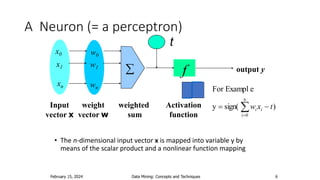
A Neuron (= a perceptron)
• The n-dimensional input vector x is mapped into variable y by
means of the scalar product and a nonlinear function mapping
t
-
f
weighted
sum
Input
vector x
output y
Activation
function
weight
vector w

w0
w1
wn
x0
x1
xn
)
sign(
y
e
For Exampl
n
0
i
t
x
w i
i 
 

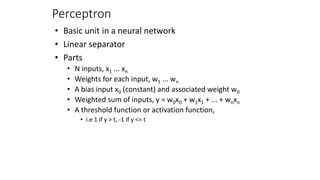
Perceptron
• Basic unit in a neural network
• Linear separator
• Parts
• N inputs, x1 ... xn
• Weights for each input, w1 ... wn
• A bias input x0 (constant) and associated weight w0
• Weighted sum of inputs, y = w0x0 + w1x1 + ... + wnxn
• A threshold function or activation function,
• i.e 1 if y > t, -1 if y <= t
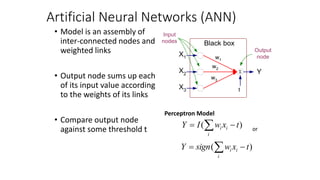
Artificial Neural Networks (ANN)
• Model is an assembly of
inter-connected nodes and
weighted links
• Output node sums up each
of its input value according
to the weights of its links
• Compare output node
against some threshold t

X1
X2
X3
Y
Black box
w1
t
Output
node
Input
nodes
w2
w3
)
( t
x
w
I
Y
i
i
i 
 
Perceptron Model
)
( t
x
w
sign
Y
i
i
i 
 
or
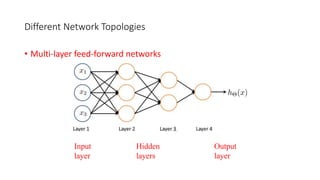
Different Network Topologies
• Multi-layer feed-forward networks
Input Hidden Output
layer layers layer
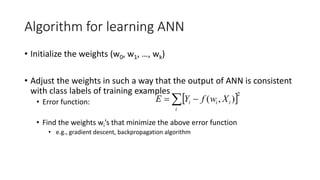
Algorithm for learning ANN
• Initialize the weights (w0, w1, …, wk)
• Adjust the weights in such a way that the output of ANN is consistent
with class labels of training examples
• Error function:
• Find the weights wi’s that minimize the above error function
• e.g., gradient descent, backpropagation algorithm
 2
)
,
(
 

i
i
i
i X
w
f
Y
E
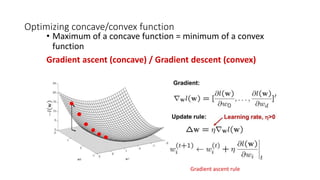
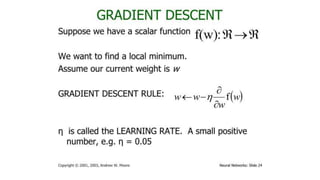
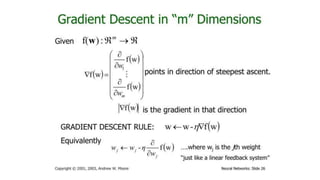
Optimizing concave/convex function
• Maximum of a concave function = minimum of a convex
function
Gradient ascent (concave) / Gradient descent (convex)
Gradient ascent rule
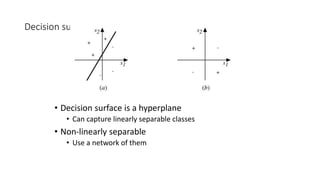
Decision surface of a perceptron
• Decision surface is a hyperplane
• Can capture linearly separable classes
• Non-linearly separable
• Use a network of them
February 15, 2024 Data Mining: Concepts and Techniques 19
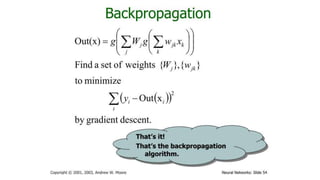
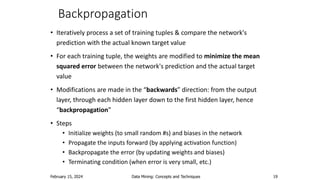
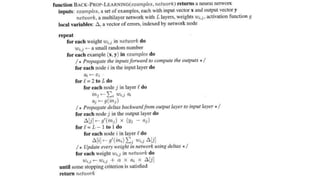
Backpropagation
• Iteratively process a set of training tuples & compare the network's
prediction with the actual known target value
• For each training tuple, the weights are modified to minimize the mean
squared error between the network's prediction and the actual target
value
• Modifications are made in the “backwards” direction: from the output
layer, through each hidden layer down to the first hidden layer, hence
“backpropagation”
• Steps
• Initialize weights (to small random #s) and biases in the network
• Propagate the inputs forward (by applying activation function)
• Backpropagate the error (by updating weights and biases)
• Terminating condition (when error is very small, etc.)
February 15, 2024 Data Mining: Concepts and Techniques 21
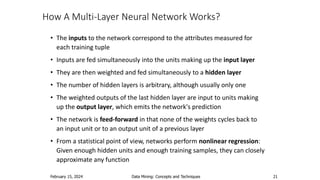
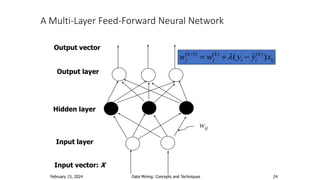
How A Multi-Layer Neural Network Works?
• The inputs to the network correspond to the attributes measured for
each training tuple
• Inputs are fed simultaneously into the units making up the input layer
• They are then weighted and fed simultaneously to a hidden layer
• The number of hidden layers is arbitrary, although usually only one
• The weighted outputs of the last hidden layer are input to units making
up the output layer, which emits the network's prediction
• The network is feed-forward in that none of the weights cycles back to
an input unit or to an output unit of a previous layer
• From a statistical point of view, networks perform nonlinear regression:
Given enough hidden units and enough training samples, they can closely
approximate any function
February 15, 2024 Data Mining: Concepts and Techniques 22
Backpropagation and Interpretability
• Efficiency of backpropagation: Each epoch (one interation through the
training set) takes O(|D| * w), with |D| tuples and w weights, but # of
epochs can be exponential to n, the number of inputs, in the worst case
• Rule extraction from networks: network pruning
• Simplify the network structure by removing weighted links that have the
least effect on the trained network
• Then perform link, unit, or activation value clustering
• The set of input and activation values are studied to derive rules
describing the relationship between the input and hidden unit layers
• Sensitivity analysis: assess the impact that a given input variable has on a
network output. The knowledge gained from this analysis can be
represented in rules
February 15, 2024 Data Mining: Concepts and Techniques 23
Neural Network as a Classifier
• Weakness
• Long training time
• Require a number of parameters typically best determined empirically,
e.g., the network topology or “structure.”
• Poor interpretability: Difficult to interpret the symbolic meaning behind
the learned weights and of “hidden units” in the network
• Strength
• High tolerance to noisy data
• Ability to classify untrained patterns
• Well-suited for continuous-valued inputs and outputs
• Successful on a wide array of real-world data
• Algorithms are inherently parallel
• Techniques have recently been developed for the extraction of rules from
trained neural networks
February 15, 2024 Data Mining: Concepts and Techniques 24
A Multi-Layer Feed-Forward Neural Network
Output layer
Input layer
Hidden layer
Output vector
Input vector: X
wij
ij
k
i
i
k
j
k
j x
y
y
w
w )
ˆ
( )
(
)
(
)
1
(





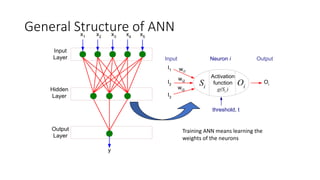
General Structure of ANN
Activation
function
g(Si )
Si
Oi
I1
I2
I3
wi1
wi2
wi3
Oi
Neuron i
Input Output
threshold, t
Input
Layer
Hidden
Layer
Output
Layer
x1 x2 x3 x4 x5
y
Training ANN means learning the
weights of the neurons

NEURAL NETWORK IN MACHINE LEARNING FOR STUDENTS

  • 2.
    Artificial Neural Networks •Computational models inspired by the human brain: • Algorithms that try to mimic the brain. • Massively parallel, distributed system, made up of simple processing units (neurons) • Synaptic connection strengths among neurons are used to store the acquired knowledge. • Knowledge is acquired by the network from its environment through a learning process
  • 3.
    Applications of ANNs •ANNs have been widely used in various domains for: • Pattern recognition • Function approximation • Associative memory
  • 4.
    Properties • Inputs areflexible • any real values • Highly correlated or independent • Target function may be discrete-valued, real-valued, or vectors of discrete or real values • Outputs are real numbers between 0 and 1 • Resistant to errors in the training data • Long training time • Fast evaluation • The function produced can be difficult for humans to interpret
  • 5.
    When to considerneural networks • Input is high-dimensional discrete or raw-valued • Output is discrete or real-valued • Output is a vector of values • Possibly noisy data • Form of target function is unknown • Human readability of the result is not important Examples: • Speech phoneme recognition • Image classification • Financial prediction
  • 6.
    February 15, 2024Data Mining: Concepts and Techniques 6 A Neuron (= a perceptron) • The n-dimensional input vector x is mapped into variable y by means of the scalar product and a nonlinear function mapping t - f weighted sum Input vector x output y Activation function weight vector w  w0 w1 wn x0 x1 xn ) sign( y e For Exampl n 0 i t x w i i    
  • 7.
    Perceptron • Basic unitin a neural network • Linear separator • Parts • N inputs, x1 ... xn • Weights for each input, w1 ... wn • A bias input x0 (constant) and associated weight w0 • Weighted sum of inputs, y = w0x0 + w1x1 + ... + wnxn • A threshold function or activation function, • i.e 1 if y > t, -1 if y <= t
  • 8.
    Artificial Neural Networks(ANN) • Model is an assembly of inter-connected nodes and weighted links • Output node sums up each of its input value according to the weights of its links • Compare output node against some threshold t  X1 X2 X3 Y Black box w1 t Output node Input nodes w2 w3 ) ( t x w I Y i i i    Perceptron Model ) ( t x w sign Y i i i    or
  • 9.
    Different Network Topologies •Multi-layer feed-forward networks Input Hidden Output layer layers layer
  • 10.
    Algorithm for learningANN • Initialize the weights (w0, w1, …, wk) • Adjust the weights in such a way that the output of ANN is consistent with class labels of training examples • Error function: • Find the weights wi’s that minimize the above error function • e.g., gradient descent, backpropagation algorithm  2 ) , (    i i i i X w f Y E
  • 11.
    Optimizing concave/convex function •Maximum of a concave function = minimum of a convex function Gradient ascent (concave) / Gradient descent (convex) Gradient ascent rule
  • 15.
    Decision surface ofa perceptron • Decision surface is a hyperplane • Can capture linearly separable classes • Non-linearly separable • Use a network of them
  • 19.
    February 15, 2024Data Mining: Concepts and Techniques 19 Backpropagation • Iteratively process a set of training tuples & compare the network's prediction with the actual known target value • For each training tuple, the weights are modified to minimize the mean squared error between the network's prediction and the actual target value • Modifications are made in the “backwards” direction: from the output layer, through each hidden layer down to the first hidden layer, hence “backpropagation” • Steps • Initialize weights (to small random #s) and biases in the network • Propagate the inputs forward (by applying activation function) • Backpropagate the error (by updating weights and biases) • Terminating condition (when error is very small, etc.)
  • 21.
    February 15, 2024Data Mining: Concepts and Techniques 21 How A Multi-Layer Neural Network Works? • The inputs to the network correspond to the attributes measured for each training tuple • Inputs are fed simultaneously into the units making up the input layer • They are then weighted and fed simultaneously to a hidden layer • The number of hidden layers is arbitrary, although usually only one • The weighted outputs of the last hidden layer are input to units making up the output layer, which emits the network's prediction • The network is feed-forward in that none of the weights cycles back to an input unit or to an output unit of a previous layer • From a statistical point of view, networks perform nonlinear regression: Given enough hidden units and enough training samples, they can closely approximate any function
  • 22.
    February 15, 2024Data Mining: Concepts and Techniques 22 Backpropagation and Interpretability • Efficiency of backpropagation: Each epoch (one interation through the training set) takes O(|D| * w), with |D| tuples and w weights, but # of epochs can be exponential to n, the number of inputs, in the worst case • Rule extraction from networks: network pruning • Simplify the network structure by removing weighted links that have the least effect on the trained network • Then perform link, unit, or activation value clustering • The set of input and activation values are studied to derive rules describing the relationship between the input and hidden unit layers • Sensitivity analysis: assess the impact that a given input variable has on a network output. The knowledge gained from this analysis can be represented in rules
  • 23.
    February 15, 2024Data Mining: Concepts and Techniques 23 Neural Network as a Classifier • Weakness • Long training time • Require a number of parameters typically best determined empirically, e.g., the network topology or “structure.” • Poor interpretability: Difficult to interpret the symbolic meaning behind the learned weights and of “hidden units” in the network • Strength • High tolerance to noisy data • Ability to classify untrained patterns • Well-suited for continuous-valued inputs and outputs • Successful on a wide array of real-world data • Algorithms are inherently parallel • Techniques have recently been developed for the extraction of rules from trained neural networks
  • 24.
    February 15, 2024Data Mining: Concepts and Techniques 24 A Multi-Layer Feed-Forward Neural Network Output layer Input layer Hidden layer Output vector Input vector: X wij ij k i i k j k j x y y w w ) ˆ ( ) ( ) ( ) 1 (     
  • 25.
    General Structure ofANN Activation function g(Si ) Si Oi I1 I2 I3 wi1 wi2 wi3 Oi Neuron i Input Output threshold, t Input Layer Hidden Layer Output Layer x1 x2 x3 x4 x5 y Training ANN means learning the weights of the neurons