Network audio transmission
Analog audio transmission
 Sound is made of compressional waves moving as vibrations
through the medium of air, transmitted just like the ripples on the
surface of a pond if you throw a pebble into it. These waves are
what we perceive as sound.
 Analogue signals are sound transmitted as vibrations in the air converted
directly into electronic signals. Broadly speaking, the amplitude expresses
the volume of the sound, while the wavelengths express its pitch.
Analogue signals are continuous signals that transmit audio.
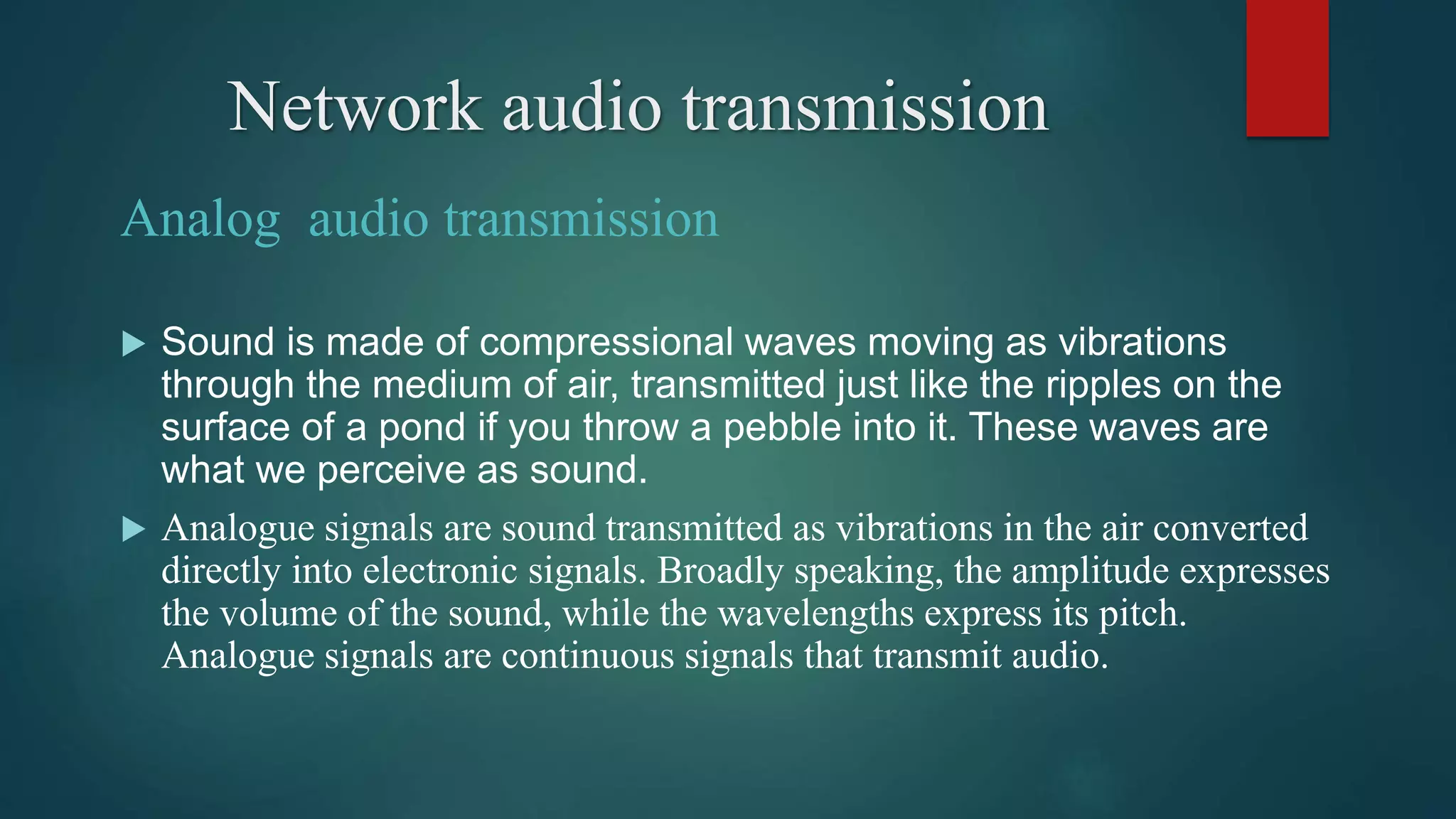
 Analogue transmissions convert audio into analogue signals and send them to the
transmission channel, after which the analogue signals received are converted back to
the sound that was originally sent.
 In order to communicate audio via networks, standard analogue signals need to be
changed into the form of “audio packets.” The term “packet” might remind you of the
packet switching used in mobile phones. This technology is also used in IP phones and
the packet audio technology we will explain below.
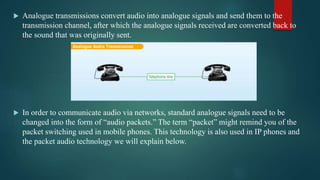
 Signals sent and received by ordinary phones are analogue signals with audio
converted directly into electrical signals. Analogue signals used to transmit audio over
IP phone and other networks (generated by converting audio into an electronic signal)
are converted into digital signals, which are then broken down into smaller subunits.
Data broken down into such evenly sized amounts is an audio packet. Audio packets
are sent to the network from the sending side.
 The receiving side picks up the audio packet and integrates the finely segmented
digital signals to turn it back into an analogue signal. Turning this back into audio
enables the original audio to be heard.
TOA NETWORK AUDIO TRANSMISSION
 Network audio adaptors, IP intercom systems, and other products incorporating Packet
Audio, TOA’s original network audio transmission technology, transmit audio through
networks for telephone calls or public addresses.
 Packet Audio has the following characteristics.
 Real Time Transmission
Audio can be sent / received with low delay.
 High-quality Transmission
Enables high-quality sending and receiving of audio through an audio compression
system that faithfully reproduces the waveforms of the original sound.
 Low Cost
Allows conversation / broadcasting via networks, whether existing onsite LAN, company
intranets or other local networks, reducing deployment and operational costs for wiring work or
call charges.
 Onboard Packet Loss Compensation Function
If packets are missing due to the condition of the network in use, Packet Audio
selects from following three systems for compensating for the loss packets.
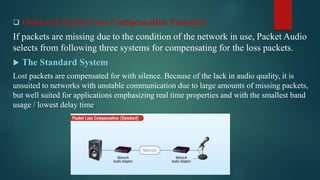
 The Standard System
Lost packets are compensated for with silence. Because of the lack in audio quality, it is
unsuited to networks with unstable communication due to large amounts of missing packets,
but well suited for applications emphasizing real time properties and with the smallest band
usage / lowest delay time.
 Error Correction System
The lost packets are recovered using redundant data. This is only able to make up for small amounts of time lost,
hence it is unsuited to networks with unstable communication due to large amounts of missing packets, but is
well suited to applications requiring high audio quality in networks like LAN with low amounts of packet loss
 Retransmission System
Compensates for lost packets by automatically retransmitting them. Due to the long delay
time, it is unsuited to applications emphasizing real time properties, but it is able to
compensate fully for packet losses within the delay time configuration values. It can maintain
high audio quality even in networks like the Internet with unstable communication due to
large amounts of missing packets.

Network audio transmission

  • 1.
    Network audio transmission Analogaudio transmission  Sound is made of compressional waves moving as vibrations through the medium of air, transmitted just like the ripples on the surface of a pond if you throw a pebble into it. These waves are what we perceive as sound.  Analogue signals are sound transmitted as vibrations in the air converted directly into electronic signals. Broadly speaking, the amplitude expresses the volume of the sound, while the wavelengths express its pitch. Analogue signals are continuous signals that transmit audio.
  • 2.
     Analogue transmissionsconvert audio into analogue signals and send them to the transmission channel, after which the analogue signals received are converted back to the sound that was originally sent.  In order to communicate audio via networks, standard analogue signals need to be changed into the form of “audio packets.” The term “packet” might remind you of the packet switching used in mobile phones. This technology is also used in IP phones and the packet audio technology we will explain below.
  • 3.
     Signals sentand received by ordinary phones are analogue signals with audio converted directly into electrical signals. Analogue signals used to transmit audio over IP phone and other networks (generated by converting audio into an electronic signal) are converted into digital signals, which are then broken down into smaller subunits. Data broken down into such evenly sized amounts is an audio packet. Audio packets are sent to the network from the sending side.  The receiving side picks up the audio packet and integrates the finely segmented digital signals to turn it back into an analogue signal. Turning this back into audio enables the original audio to be heard.
  • 4.
    TOA NETWORK AUDIOTRANSMISSION  Network audio adaptors, IP intercom systems, and other products incorporating Packet Audio, TOA’s original network audio transmission technology, transmit audio through networks for telephone calls or public addresses.  Packet Audio has the following characteristics.  Real Time Transmission Audio can be sent / received with low delay.  High-quality Transmission Enables high-quality sending and receiving of audio through an audio compression system that faithfully reproduces the waveforms of the original sound.  Low Cost Allows conversation / broadcasting via networks, whether existing onsite LAN, company intranets or other local networks, reducing deployment and operational costs for wiring work or call charges.
  • 5.
     Onboard PacketLoss Compensation Function If packets are missing due to the condition of the network in use, Packet Audio selects from following three systems for compensating for the loss packets.  The Standard System Lost packets are compensated for with silence. Because of the lack in audio quality, it is unsuited to networks with unstable communication due to large amounts of missing packets, but well suited for applications emphasizing real time properties and with the smallest band usage / lowest delay time.
  • 6.
     Error CorrectionSystem The lost packets are recovered using redundant data. This is only able to make up for small amounts of time lost, hence it is unsuited to networks with unstable communication due to large amounts of missing packets, but is well suited to applications requiring high audio quality in networks like LAN with low amounts of packet loss  Retransmission System Compensates for lost packets by automatically retransmitting them. Due to the long delay time, it is unsuited to applications emphasizing real time properties, but it is able to compensate fully for packet losses within the delay time configuration values. It can maintain high audio quality even in networks like the Internet with unstable communication due to large amounts of missing packets.