NestedCase
Control
Presentedby:
Mr.Siddhesh Kolambkar(MSc.Epidemiology,HIMS,SRHU)
Moderatorby:
Dr.NehaVerma(AssistantProf.,Dept.ofCommunityMedicine,
HIMS,SRHU)
Seminar on
Our Key Discussion Points
Agenda
Introduction
Study design
Interpretation
Advantages & Disadvantages
Comparison with other study designs
Research study
Seminar
“The study of the occurence and distribution of
health related events, states and processes in a
specified populations, including the study of
determinants influencing such processes, and
application of this knowledge to control relevant
healthproblems.”
Back to Agenda Page
(1)
Dr. John
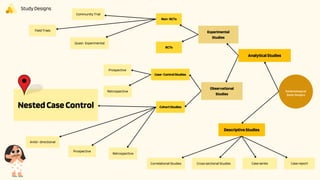
Epidemiological
Study Designs
Observational
Studies
AnalyticalStudies
DescriptiveStudies
Experimental
Studies
CohortStudies
Ambi- directional
Quasi- Experimental
Case-ControlStudies
Case series Case report
Correlational Studies Cross sectional Studies
Study Designs
Prospective
Retrospective
NestedCaseControl
Retrospective
Prospective
Field Trials
Non-RCTs
RCTs
Community Trial
Cohort
Study
Nodiseased
Exposed
Non-Exposed
Diseased
Diseased
Nodiseased
Cohort Study
Designs
Time
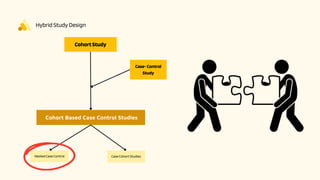
Cohort Based Case Control Studies
Case-Control
Study
CohortStudy
Hybrid Study Design
Case Cohort Studies
Nested Case Control
NestedCaseControl
Back to Agenda Page
(2)
StudyDesign(2)
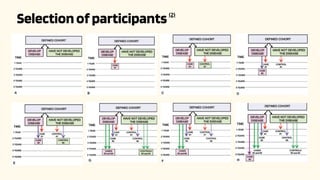
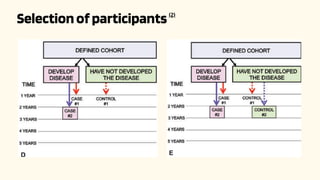
Selectionofparticipants(2)
Nested Case
Control
ContingencyTable(2)
OR>1 Exposureisariskfactor
fordisease
OR=1Exposurehasnoeffecton
disease
OR<1Exposureisaprotective
factoragainstdisease.
Nested Control Case
Interpretation
a x d
b x c
Odd ratio =
Back to Agenda Page
Advantages
Nested case control
Back to Agenda Page
Recall Bias & True association of abnormalities
(2)
Nested case control
Advantages
Cost effectiveness
Nested case control
Advantages
Enhances comparability between case & controls.
Cohort
Cases Controls
Nested case control
Disadvantages
Reliability of records.
Selection bias.
Large cohorts must be enrolled in a study to ensure that enough cases
develop by the end of the study period to permit valid analyses and
conclusions.
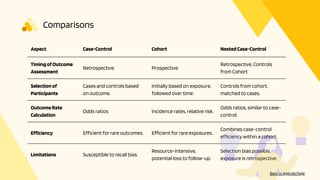
Aspect Case-Control Cohort NestedCase-Control
TimingofOutcome
Assessment
Retrospective Prospective
Retrospective, Controls
from Cohort
Selectionof
Participants
Cases and controls based
on outcome.
Initially based on exposure,
followed over time.
Controls from cohort,
matched to cases.
OutcomeRate
Calculation
Odds ratios Incidence rates, relative risk.
Odds ratios, similar to case-
control.
Efficiency Efficient for rare outcomes. Efficient for rare exposures.
Combines case-control
efficiency within a cohort.
Limitations Susceptible to recall bias.
Resource-intensive,
potential loss to follow-up.
Selection bias possible,
exposure is retrospective.
Comparisons
Back to Agenda Page
Risk factors for SARS-CoV-2 infection among health workers in India: a
casecontrolstudy
casecontrolstudy
Nested Case Control
Back to Agenda Page
(3)
Patterns of filled prescriptions and the association with risk ofdrug-
induceddeath.Apopulation-basednestedcase-controlregisterstudy
Factors associated with death, hospitalization, resignation, and sick
leave from work among patients with schizophrenia in Japan: a nested
case–controlstudyusingalargeclaimsdatabase
(4)
(5)
​​1. Park. K. Park’s Textbook of Preventive and Social Medicine. 27th
ed.BanarsidasBhanot;2023.60p.
​2. Celentano David D, Szklo Moyses. Gordis Epidemiology. In: 6th
ed.Elsevier,Inc.;2019.p.187–90.
​3.GeorgeLS,TomyC,RetnakumarC,NarlawarU,BhardwajP,
KrishnanJ,etal.RiskfactorsforSARS-CoV-2infectionamong
healthworkersinIndia:acasecontrolstudy.FrontPublicHealth.
2023;11.
4. InadaK,SaitoY,BabaK,FukuiD,MasudaY,InoueS,etal.Factors
associated with death, hospitalization, resignation, and sick leave
from work among patients with schizophrenia in Japan: a nested
case–control study using a large claims database. BMC Psychiatry.
2024Dec1;24(1).
5. Amundsen EJ, Odsbu I, Skurtveit SO, Gjersing L. Patterns of
filled prescriptions and the association with risk of drug-induced
death. A population-based nested case-control register study.
PharmacoepidemiolDrugSaf.2024Feb1;33(2):e5763.
Resourcepage
Thankyoufor
listening!
Any questions!
Back to Agenda Page

Nested Case Control Study Design Concept Ppt