Nepali Consonant Character
Classification Using Artificial Neural
Network
Team:
Ashok Subedi
Giridhari Paudel
Indra Paudel
Pitambar Mahato
1
Contents
1) Introduction
2) Literature Review
3) Requirement Analysis and Feasibility study
4) Methodology
5) Structuring System Requirements
6) Testing
7) Result and Analysis
2
Introduction
• Nepali Character is one of the most spoken language in Nepal.
• Artificial Neural Network provides classification and regression
capabilities to the machine.
• Backpropagation is the algorithm that was used during the training of
the neural networks.
3
Problem Statement
• To change the hardcopy into softcopy form is the time consuming task.
• Without the classification or recognition of the characters it is not
possible to make the OCR system.
• So we are here to classify the nepali characters
4
Objective
• To build a neural network model that can classify the scanned or
handwritten isolated Nepali characters.
• To classify the Nepali consonant characters.
5
Project Questions
• Does ANN gives the optimum result for the classification of nepali
characters?
• What is the main purpose of that project?
• What methods is going to be used for the achievement of the results
in this project?
6
Scope and Limitations
• Our system recognizes the nepali isolated scanned or handwritten
character but in case of the joined set of characters our system can’t
work.
• Our system only works for the images of size 32×32 but in case of the
images greater than that the system can’t work.
7
Applications
• Banking
• Legal
• HealthCare
• Other sectors
8
Literature Review
• Related Works
Character Recognition (CR) is somewhat limited until 1980 due to lack of
powerful hardware and data perception devices.
The periods from 1980-1990 witness a growth in CR system development due
to rapid growth in information technology.
 Research progress on the offline and on-line recognition during 1980 -1990.
After 1990, image processing technique and pattern recognition were
combined using artificial intelligence.
9
Requirement Analysis and Feasibility
Analysis
• Operational Feasibility Analysis
• Technical Feasibility Analysis
• Economic Feasibility Analysis
• Schedule Feasibility Analysis
10
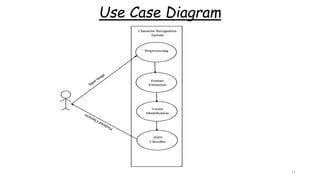
Use Case Diagram
11
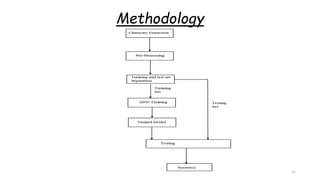
Methodology
12
Model Training
• Input nodes: 1024 input neurons
• Output nodes: 36 output nodes
• Activation Function: Sigmoid
• Number of Hidden layer: 1 hidden layer with 340 nodes
• Learning Rate: 0.075
• Training algorithm: Error Back Propagation(Mean Squared Error)
13
Algorithm of The System
Step 1: Start
Step 2: Train the Neural Network Model
Step 3: Load the model into the system
Step 4: Draw the character into the canvas
Step 5: Save the Drawn character into the .png(image) format
Step 6: Input the saved image into the system
Step 7: Feed the character to the Neural Network Model
Step 8: Display Output
Step 9: Stop
14
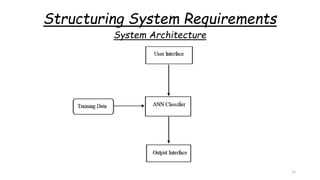
Structuring System Requirements
15
System Architecture
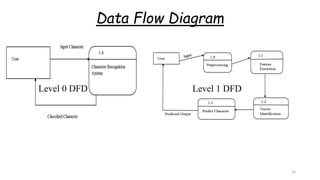
Data Flow Diagram
Level 0 DFD Level 1 DFD
16
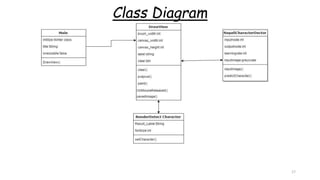
Class Diagram
17
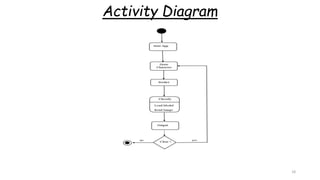
Activity Diagram
18
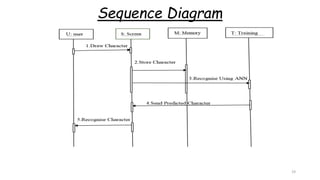
Sequence Diagram
19
Testing
Unit Testing
20
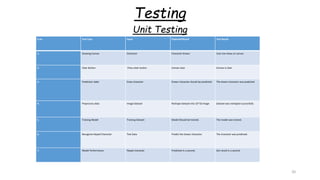
S.no. Test Case Input Expected Result Test Result
1. Drawing Canvas Character Character Drawn User Can draw on canvas
2. Clear Button Press clear button Canvas clear Canvas is clear
3. Prediction label Draw character Drawn character should be predicted The drawn character was predicted
4. Preprocess data Image Dataset Reshape Dataset into 32*32 Image Dataset was reshaped successfully
5. Training Model Training Dataset Model Should be trained. The model was trained.
6. Recognize Nepali Character Test Data Predict the drawn character. The character was predicted.
7. Model Performance Nepali character Predicted in a second. Got result in a second.
Integration Testing
System Testing
21
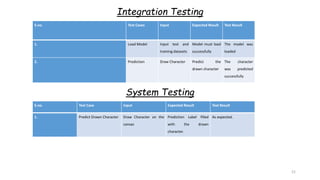
S.no. Test Cases Input Expected Result Test Result
1. Load Model Input test and
training datasets
Model must load
successfully
The model was
loaded
2. Prediction Draw Character Predict the
drawn character
The character
was predicted
successfully
S.no. Test Case Input Expected Result Test Result
1. Predict Drawn Character Draw Character on the
canvas
Prediction Label filled
with the drawn
character.
As expected.
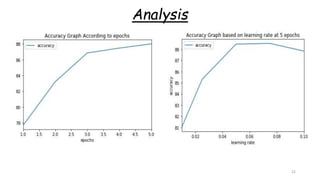
Analysis
22
23
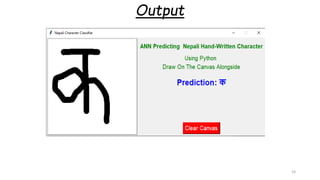
Output
24
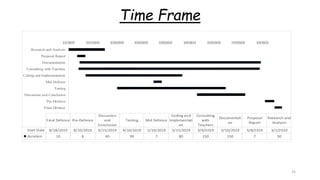
Time Frame
25
3/1/2019 3/21/2019 4/10/2019 4/30/2019 5/20/2019 6/9/2019 6/29/2019 7/19/2019 8/8/2019
Research and Analysis
Proposal Report
Documentation
Consulting with Teachers
Coding and Implementation
Mid Defence
Testing
Discussion and Conclusion
Pre-Defence
Final Defence
Research and
Analysis
Proposal
Report
Documentati
on
Consulting
with
Teachers
Coding and
Implementati
on
Mid DefenceTesting
Discussion
and
Conclusion
Pre-DefenceFinal Defence
Start Date 3/1/20193/8/20193/10/20193/9/20193/15/20195/10/20194/10/20196/15/20198/10/20198/18/2019
duration 3071501508079040810
References
[1] S. Acharya, "Deep Learning Based Large Scale Handwritten Devnagari Character Recognition,"
Kathmandu, 2015.
[2] Pranjali Pohankar, Namrata Taralkar, Snehalate Karmare, Smita Kulkarni, "Character Recognition using
Artificial Neural Network," April, 2014.
[3] Anna Tigunova, "Detection of Textual Information Using Convolutional Neural Networks," November 10,
2017.
[4] Azmi Can Ozgen, "Text Detection in Natural and Computer-Generated Images," Istanbul, Turkey, 2011.
[5] "Skymind," [Online]. Available: https://skymind.ai/wiki/backpropagation.
[6] "MachineLearningMastery,"[Online].Available: https://machinelearningmastery.com/learning-rate-for-deep-
learning-neuralnetworks/.
[7] Bal Krishna Bal, Rajesh Pandey, Samir Tuladhar, Shanti Shakya, "INTERIM REPORT ON NEPALI OCR,"
Kathmandu, Nepal.
[8] S. Shakya, A. Basnet, S. Sharma, A. Gurung, "Optical Character Recognition for Nepli, English Character
and Simple Sketch Using Neural Network," Kathmandu, Nepal, 2016.
[9] Ahmed Muaz, "Urdu Optical Character Recognition System," Lahore, Pakistan .
[10] Chris J Maddison, Aja Huang, IIya Sutskever, David Silver, "Move evaluation in go using deep
convolutional neural networks," 2014.
[11] Vasu Negi, Suman Mann, Vivek Chauhan, "Devanagari Character Recognition Using Artificial Neural
Network".
26
27
Thank You

Nepali character classification

  • 1.
    Nepali Consonant Character ClassificationUsing Artificial Neural Network Team: Ashok Subedi Giridhari Paudel Indra Paudel Pitambar Mahato 1
  • 2.
    Contents 1) Introduction 2) LiteratureReview 3) Requirement Analysis and Feasibility study 4) Methodology 5) Structuring System Requirements 6) Testing 7) Result and Analysis 2
  • 3.
    Introduction • Nepali Characteris one of the most spoken language in Nepal. • Artificial Neural Network provides classification and regression capabilities to the machine. • Backpropagation is the algorithm that was used during the training of the neural networks. 3
  • 4.
    Problem Statement • Tochange the hardcopy into softcopy form is the time consuming task. • Without the classification or recognition of the characters it is not possible to make the OCR system. • So we are here to classify the nepali characters 4
  • 5.
    Objective • To builda neural network model that can classify the scanned or handwritten isolated Nepali characters. • To classify the Nepali consonant characters. 5
  • 6.
    Project Questions • DoesANN gives the optimum result for the classification of nepali characters? • What is the main purpose of that project? • What methods is going to be used for the achievement of the results in this project? 6
  • 7.
    Scope and Limitations •Our system recognizes the nepali isolated scanned or handwritten character but in case of the joined set of characters our system can’t work. • Our system only works for the images of size 32×32 but in case of the images greater than that the system can’t work. 7
  • 8.
    Applications • Banking • Legal •HealthCare • Other sectors 8
  • 9.
    Literature Review • RelatedWorks Character Recognition (CR) is somewhat limited until 1980 due to lack of powerful hardware and data perception devices. The periods from 1980-1990 witness a growth in CR system development due to rapid growth in information technology.  Research progress on the offline and on-line recognition during 1980 -1990. After 1990, image processing technique and pattern recognition were combined using artificial intelligence. 9
  • 10.
    Requirement Analysis andFeasibility Analysis • Operational Feasibility Analysis • Technical Feasibility Analysis • Economic Feasibility Analysis • Schedule Feasibility Analysis 10
  • 11.
  • 12.
  • 13.
    Model Training • Inputnodes: 1024 input neurons • Output nodes: 36 output nodes • Activation Function: Sigmoid • Number of Hidden layer: 1 hidden layer with 340 nodes • Learning Rate: 0.075 • Training algorithm: Error Back Propagation(Mean Squared Error) 13
  • 14.
    Algorithm of TheSystem Step 1: Start Step 2: Train the Neural Network Model Step 3: Load the model into the system Step 4: Draw the character into the canvas Step 5: Save the Drawn character into the .png(image) format Step 6: Input the saved image into the system Step 7: Feed the character to the Neural Network Model Step 8: Display Output Step 9: Stop 14
  • 15.
  • 16.
    Data Flow Diagram Level0 DFD Level 1 DFD 16
  • 17.
  • 18.
  • 19.
  • 20.
    Testing Unit Testing 20 S.no. TestCase Input Expected Result Test Result 1. Drawing Canvas Character Character Drawn User Can draw on canvas 2. Clear Button Press clear button Canvas clear Canvas is clear 3. Prediction label Draw character Drawn character should be predicted The drawn character was predicted 4. Preprocess data Image Dataset Reshape Dataset into 32*32 Image Dataset was reshaped successfully 5. Training Model Training Dataset Model Should be trained. The model was trained. 6. Recognize Nepali Character Test Data Predict the drawn character. The character was predicted. 7. Model Performance Nepali character Predicted in a second. Got result in a second.
  • 21.
    Integration Testing System Testing 21 S.no.Test Cases Input Expected Result Test Result 1. Load Model Input test and training datasets Model must load successfully The model was loaded 2. Prediction Draw Character Predict the drawn character The character was predicted successfully S.no. Test Case Input Expected Result Test Result 1. Predict Drawn Character Draw Character on the canvas Prediction Label filled with the drawn character. As expected.
  • 22.
  • 23.
  • 24.
  • 25.
    Time Frame 25 3/1/2019 3/21/20194/10/2019 4/30/2019 5/20/2019 6/9/2019 6/29/2019 7/19/2019 8/8/2019 Research and Analysis Proposal Report Documentation Consulting with Teachers Coding and Implementation Mid Defence Testing Discussion and Conclusion Pre-Defence Final Defence Research and Analysis Proposal Report Documentati on Consulting with Teachers Coding and Implementati on Mid DefenceTesting Discussion and Conclusion Pre-DefenceFinal Defence Start Date 3/1/20193/8/20193/10/20193/9/20193/15/20195/10/20194/10/20196/15/20198/10/20198/18/2019 duration 3071501508079040810
  • 26.
    References [1] S. Acharya,"Deep Learning Based Large Scale Handwritten Devnagari Character Recognition," Kathmandu, 2015. [2] Pranjali Pohankar, Namrata Taralkar, Snehalate Karmare, Smita Kulkarni, "Character Recognition using Artificial Neural Network," April, 2014. [3] Anna Tigunova, "Detection of Textual Information Using Convolutional Neural Networks," November 10, 2017. [4] Azmi Can Ozgen, "Text Detection in Natural and Computer-Generated Images," Istanbul, Turkey, 2011. [5] "Skymind," [Online]. Available: https://skymind.ai/wiki/backpropagation. [6] "MachineLearningMastery,"[Online].Available: https://machinelearningmastery.com/learning-rate-for-deep- learning-neuralnetworks/. [7] Bal Krishna Bal, Rajesh Pandey, Samir Tuladhar, Shanti Shakya, "INTERIM REPORT ON NEPALI OCR," Kathmandu, Nepal. [8] S. Shakya, A. Basnet, S. Sharma, A. Gurung, "Optical Character Recognition for Nepli, English Character and Simple Sketch Using Neural Network," Kathmandu, Nepal, 2016. [9] Ahmed Muaz, "Urdu Optical Character Recognition System," Lahore, Pakistan . [10] Chris J Maddison, Aja Huang, IIya Sutskever, David Silver, "Move evaluation in go using deep convolutional neural networks," 2014. [11] Vasu Negi, Suman Mann, Vivek Chauhan, "Devanagari Character Recognition Using Artificial Neural Network". 26
  • 27.