



EXAMINATION OF NEWBORNS
Reference:
PERINATAL and PEDIATRIC RESPIRATORY CARE
3rd Edition Brian K. Walsh
NEWBORN ASSESSMENT
• A newborn should be thoroughly evaluated within 24hours of
birth.
• HISTORY
 Review of present pregnancy, labour and delivery
including screening tests and risk factors for sepsis
 Review of past pregnancy including a history of congenital
anomalies, still births.
GESTATIONAL AGE (GA)
• It is measured in weeks, from the first day of the woman's
last menstrual cycle to the current date. A normal
pregnancy can range from 38 to 42 weeks.
• Classification based on GA
 Preterm ˂ 37 Weeks
 Term 37-42 Weeks
 Post term ˃ 42 Weeks
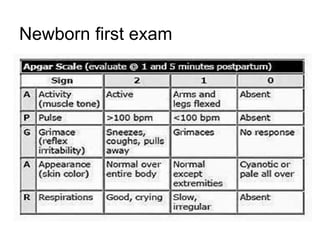
Newborn first exam
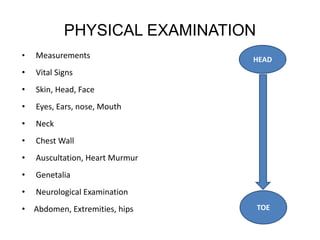
PHYSICAL EXAMINATION
• Measurements
• Vital Signs
• Skin, Head, Face
• Eyes, Ears, nose, Mouth
• Neck
• Chest Wall
• Auscultation, Heart Murmur
• Genetalia
• Neurological Examination
• Abdomen, Extremities, hips
HEAD
TOE
Examination precaution
• Thermoneutral environment
• Light and noise
HAND WASHING,HAND
WASHING ,HAND WASHING
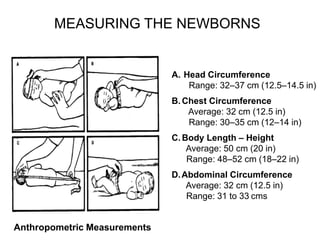
Anthropometric Measurements
MEASURING THE NEWBORNS
A. Head Circumference
Range: 32–37 cm (12.5–14.5 in)
B.Chest Circumference
Average: 32 cm (12.5 in)
Range: 30–35 cm (12–14 in)
C.Body Length – Height
Average: 50 cm (20 in)
Range: 48–52 cm (18–22 in)
D.Abdominal Circumference
Average: 32 cm (12.5 in)
Range: 31 to 33 cms
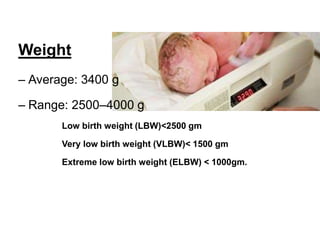
Weight
– Average: 3400 g
– Range: 2500–4000 g
Low birth weight (LBW)˂2500 gm
Very low birth weight (VLBW)˂ 1500 gm
Extreme low birth weight (ELBW) < 1000gm.
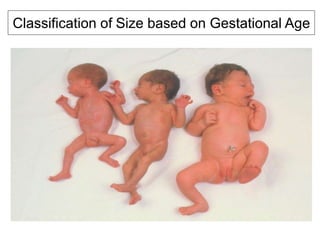
Classification of Size based on Gestational Age
• SGA - Small for
gestational age-weight
below 10th percentile
• AGA - Weight between 10
and 90th percentiles
• LGA - Weight above
90th percentile
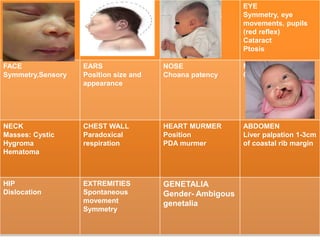
SKIN
Neurocutaneous
lesions
Milia
Mangolian spots
HEAD
Microcephaly,
SUTURE
(sagittal, coronal,
lambdoid, and
metopic)
Molding
EYE
Symmetry, eye
movements, pupils
(red reflex)
Cataract
Ptosis
FACE
Symmetry,Sensory
EARS
Position size and
appearance
NOSE
Choana patency
MOUTH
Cleft palate
NECK
Masses: Cystic
Hygroma
Hematoma
CHEST WALL
Paradoxical
respiration
HEART MURMER
Position
PDA murmer
ABDOMEN
Liver palpation 1-3cm
of coastal rib margin
HIP
Dislocation
EXTREMITIES
Spontaneous
movement
Symmetry
GENETALIA
Gender- Ambigous
genetalia
Chest and Abdomen
Chest - Distress signs
• Grunting
• Tachypnea
• Nasal Flaring
• Asymetric Chest Rise
• Supra-sternal
• Intercostal
• Sub Costal Retraction
Deformities
 Pectus Excavatum-funnel Shaped
 Pectus Carinatum- Protruding
Auscultate
 Air entry, symmetry
 Early crepitation sound is transmitted upper sound
 Late inspiratory crepitation
Respiratory function
• Periodic breathing: Irregular breathing pattern of
intermittent respiratory pauses longer than 5 sec.
• Apnea: cessation of breathing for more than 20 sec.
associated with cyanosis, bradycardia
• Abnormal breath sounds: Rhonchi,Wheeze, Stridor
,Crackles
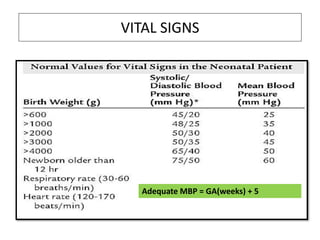
VITAL SIGNS
Adequate MBP = GA(weeks) + 5
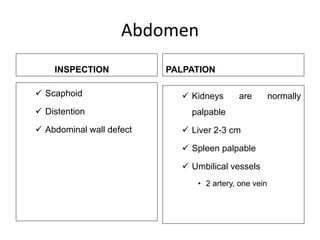
Abdomen
INSPECTION
 Scaphoid
 Distention
 Abdominal wall defect
PALPATION
 Kidneys are normally
palpable
 Liver 2-3 cm
 Spleen palpable
 Umbilical vessels
• 2 artery, one vein
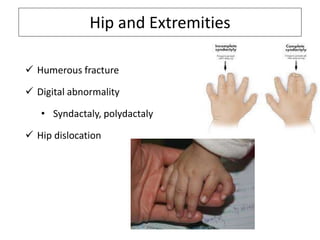
Hip and Extremities
 Humerous fracture
 Digital abnormality
• Syndactaly, polydactaly
 Hip dislocation
Neurological Reflexes
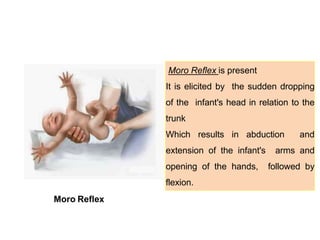
Moro Reflex is present
It is elicited by the sudden dropping
of the infant's head in relation to the
trunk
Which results in abduction and
extension of the infant's arms and
opening of the hands, followed by
flexion.
Moro Reflex
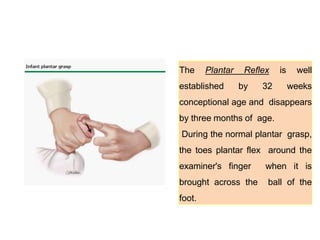
The Plantar Reflex is well
established by 32 weeks
conceptional age and disappears
by three months of age.
During the normal plantar grasp,
the toes plantar flex around the
examiner's finger when it is
brought across the ball of the
foot.
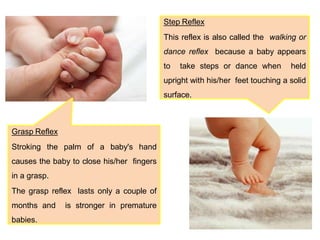
Grasp Reflex
Stroking the palm of a baby's hand
causes the baby to close his/her fingers
in a grasp.
The grasp reflex lasts only a couple of
months and is stronger in premature
babies.
Step Reflex
This reflex is also called the walking or
dance reflex because a baby appears
to take steps or dance when held
upright with his/her feet touching a solid
surface.
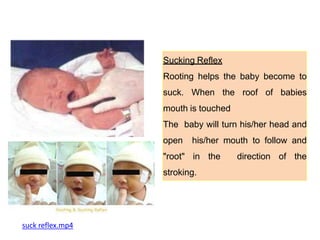
Sucking Reflex
Rooting helps the baby become to
suck. When the roof of babies
mouth is touched
The baby will turn his/her head and
open his/her mouth to follow and
"root" in the direction of the
stroking.
suck reflex.mp4
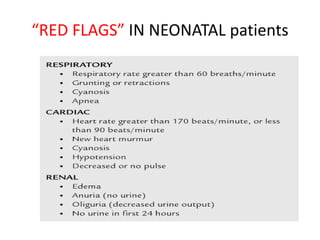
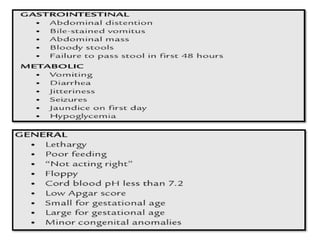
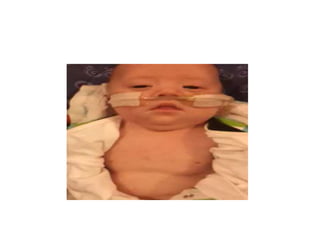
“RED FLAGS” IN NEONATAL patients
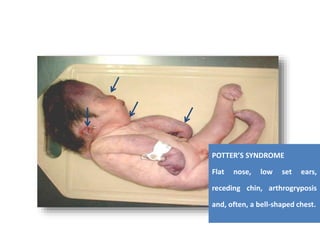
POTTER’S SYNDROME
Flat nose, low set ears,
receding chin, arthrogryposis
and, often, a bell-shaped chest.
THANK YOU

Neonatal assessment

  • 1.
    EXAMINATION OF NEWBORNS Reference: PERINATALand PEDIATRIC RESPIRATORY CARE 3rd Edition Brian K. Walsh
  • 2.
  • 3.
    • A newbornshould be thoroughly evaluated within 24hours of birth. • HISTORY  Review of present pregnancy, labour and delivery including screening tests and risk factors for sepsis  Review of past pregnancy including a history of congenital anomalies, still births.
  • 4.
    GESTATIONAL AGE (GA) •It is measured in weeks, from the first day of the woman's last menstrual cycle to the current date. A normal pregnancy can range from 38 to 42 weeks. • Classification based on GA  Preterm ˂ 37 Weeks  Term 37-42 Weeks  Post term ˃ 42 Weeks
  • 5.
  • 6.
    PHYSICAL EXAMINATION • Measurements •Vital Signs • Skin, Head, Face • Eyes, Ears, nose, Mouth • Neck • Chest Wall • Auscultation, Heart Murmur • Genetalia • Neurological Examination • Abdomen, Extremities, hips HEAD TOE
  • 7.
    Examination precaution • Thermoneutralenvironment • Light and noise HAND WASHING,HAND WASHING ,HAND WASHING
  • 8.
    Anthropometric Measurements MEASURING THENEWBORNS A. Head Circumference Range: 32–37 cm (12.5–14.5 in) B.Chest Circumference Average: 32 cm (12.5 in) Range: 30–35 cm (12–14 in) C.Body Length – Height Average: 50 cm (20 in) Range: 48–52 cm (18–22 in) D.Abdominal Circumference Average: 32 cm (12.5 in) Range: 31 to 33 cms
  • 9.
    Weight – Average: 3400g – Range: 2500–4000 g Low birth weight (LBW)˂2500 gm Very low birth weight (VLBW)˂ 1500 gm Extreme low birth weight (ELBW) < 1000gm.
  • 10.
    Classification of Sizebased on Gestational Age • SGA - Small for gestational age-weight below 10th percentile • AGA - Weight between 10 and 90th percentiles • LGA - Weight above 90th percentile
  • 11.
    SKIN Neurocutaneous lesions Milia Mangolian spots HEAD Microcephaly, SUTURE (sagittal, coronal, lambdoid,and metopic) Molding EYE Symmetry, eye movements, pupils (red reflex) Cataract Ptosis FACE Symmetry,Sensory EARS Position size and appearance NOSE Choana patency MOUTH Cleft palate NECK Masses: Cystic Hygroma Hematoma CHEST WALL Paradoxical respiration HEART MURMER Position PDA murmer ABDOMEN Liver palpation 1-3cm of coastal rib margin HIP Dislocation EXTREMITIES Spontaneous movement Symmetry GENETALIA Gender- Ambigous genetalia
  • 12.
  • 13.
    Chest - Distresssigns • Grunting • Tachypnea • Nasal Flaring • Asymetric Chest Rise • Supra-sternal • Intercostal • Sub Costal Retraction
  • 14.
    Deformities  Pectus Excavatum-funnelShaped  Pectus Carinatum- Protruding Auscultate  Air entry, symmetry  Early crepitation sound is transmitted upper sound  Late inspiratory crepitation
  • 15.
    Respiratory function • Periodicbreathing: Irregular breathing pattern of intermittent respiratory pauses longer than 5 sec. • Apnea: cessation of breathing for more than 20 sec. associated with cyanosis, bradycardia • Abnormal breath sounds: Rhonchi,Wheeze, Stridor ,Crackles
  • 16.
    VITAL SIGNS Adequate MBP= GA(weeks) + 5
  • 17.
    Abdomen INSPECTION  Scaphoid  Distention Abdominal wall defect PALPATION  Kidneys are normally palpable  Liver 2-3 cm  Spleen palpable  Umbilical vessels • 2 artery, one vein
  • 18.
    Hip and Extremities Humerous fracture  Digital abnormality • Syndactaly, polydactaly  Hip dislocation
  • 19.
  • 20.
    Moro Reflex ispresent It is elicited by the sudden dropping of the infant's head in relation to the trunk Which results in abduction and extension of the infant's arms and opening of the hands, followed by flexion. Moro Reflex
  • 21.
    The Plantar Reflexis well established by 32 weeks conceptional age and disappears by three months of age. During the normal plantar grasp, the toes plantar flex around the examiner's finger when it is brought across the ball of the foot.
  • 22.
    Grasp Reflex Stroking thepalm of a baby's hand causes the baby to close his/her fingers in a grasp. The grasp reflex lasts only a couple of months and is stronger in premature babies. Step Reflex This reflex is also called the walking or dance reflex because a baby appears to take steps or dance when held upright with his/her feet touching a solid surface.
  • 23.
    Sucking Reflex Rooting helpsthe baby become to suck. When the roof of babies mouth is touched The baby will turn his/her head and open his/her mouth to follow and "root" in the direction of the stroking. suck reflex.mp4
  • 24.
    “RED FLAGS” INNEONATAL patients
  • 27.
    POTTER’S SYNDROME Flat nose,low set ears, receding chin, arthrogryposis and, often, a bell-shaped chest.
  • 28.