ELEMENTS TO CONSIDER FOR
PROPER SUPPORT OF LOW-INCOME
BEEF FARMERS TO ACHIEVE HERD
PRODUCTIVITY AND PROFIT
 
 
Baldwin Nengovhela
Baldwin@arc.agric.za
25-28 October, Addis Ababa, Ethiopia
Introduction: South Africa Beef Industry 
Introduction
Typical Performance
Traits Developing
Sector
Commercial Stud or elite
Calving rate
%
40 65 85
Pre weaning
mortality %
50 2 2
Post weaning
mortality %
15 2 2
Market price
%
50 100 >130%
Beef Market
off-take %
5 85 10
The Problem
The Problem (Cont)
• Lack of success through R&D&E 
interventions (1994 – to date)
• Beef Sector System = Biophysical + Social 
Sub -System
The Objective
• Design an intervention model that address
the whole system in the South African
beef industry
• Adopt or design soft technologies to use in
interventions by R&D&E
Methods
• Social Science Research
• Grounded theory
• Focus groups
• In-depth Interviews
• Log field journal
• Participant observation
Methods :Informants
Results & Discussion: Farmers
Results & Discussion: Support
Results & Discussion: Comparison
Results & Discussion: Farmers Assessment
Discussion:Disconnect & Disinvestment
Discussion: Leverage point
Psychological Capital
Natural Capital
Wellbeing of
Low-income
farmer
Financial
Capital
Physical
Capital
Social
Capital
Human
Capital
Knowledge
Capitals
Culture
Capital
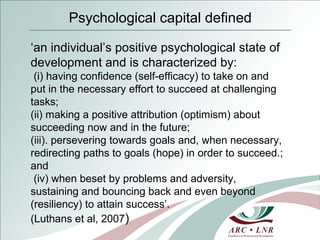
Psychological capital defined
‘an individual’s positive psychological state of
development and is characterized by:
(i) having confidence (self-efficacy) to take on and
put in the necessary effort to succeed at challenging
tasks;
(ii) making a positive attribution (optimism) about
succeeding now and in the future;
(iii). persevering towards goals and, when necessary,
redirecting paths to goals (hope) in order to succeed.;
and
(iv) when beset by problems and adversity,
sustaining and bouncing back and even beyond
(resiliency) to attain success’.
(Luthans et al, 2007)
Intervention Model
Building Psychological Capital
STEP 1: Self Situation Analysis
STEP 4: Confidence Building
Stage
STEP 3: Evidence Building for
Self Efficacy Stage
STEP 2: Self Impact Analysis
Improvement in Effort to
Access other Capitals
Improvement in
Psychological Capital
Conclusions
• Give a social subsystem in your hard
science attention
• R&D&E focus at specific situations and
localities
• Proposed intervention model and tool
need to be open for continual
improvement and a stimuli for more work
on development of soft technologies
THANK YOU
not my job......
Acknowledgements
•Australian Centre for International Research Funding
•Department of Science and Technology Funding
•A. Prof RJS Beeton University of Queensland
•Dr Richard Clark
Queensland Department of Primary Industries and Fisheries
•Limpopo Department of Agriculture

Elements to consider for proper support of low-income beef farmers to achieve herd productivity and profit