The 5The 5thth
A l l A fr ica Confer ence on A nim al A gr icuA l l A fr ica Confer ence on A nim al A gr icu
Com m er ci al i zati on of L i v estock A gr i cu l tu r e i n A fr i c
Chal l enges and oppor tu ni ti es
October 25-28, 2010.
CHARACTERISATION OF
ZULU (NGUNI) SHEEP FOR
UTILIZATION,
IMPROVEMENT AND
CONSERVATION
The 5The 5thth
A l l A fr ica Confer ence on A nim al A gr icuA l l A fr ica Confer ence on A nim al A gr icu
Com m er ci al i zati on of L i v estock A gr i cu l tu r e i n A fr i c
Chal l enges and oppor tu ni ti es
October 25-28, 2010.
Kunene NW, Bezuidenhout CC,
Nesamvuni EA, Nsahlai IV
University of Zululand
North-West University, Potchefstroom
Limpopo Department of Agriculture
University of KwaZulu-Natal, Pietermaritzburg
The 5The 5thth
A l l A fr ica Confer ence on A nim al A gr icuA l l A fr ica Confer ence on A nim al A gr icu
Com m er ci al i zati on of L i v estock A gr i cu l tu r e i n A fr i c
Chal l enges and oppor tu ni ti es
October 25-28, 2010.
INTRODUCTION
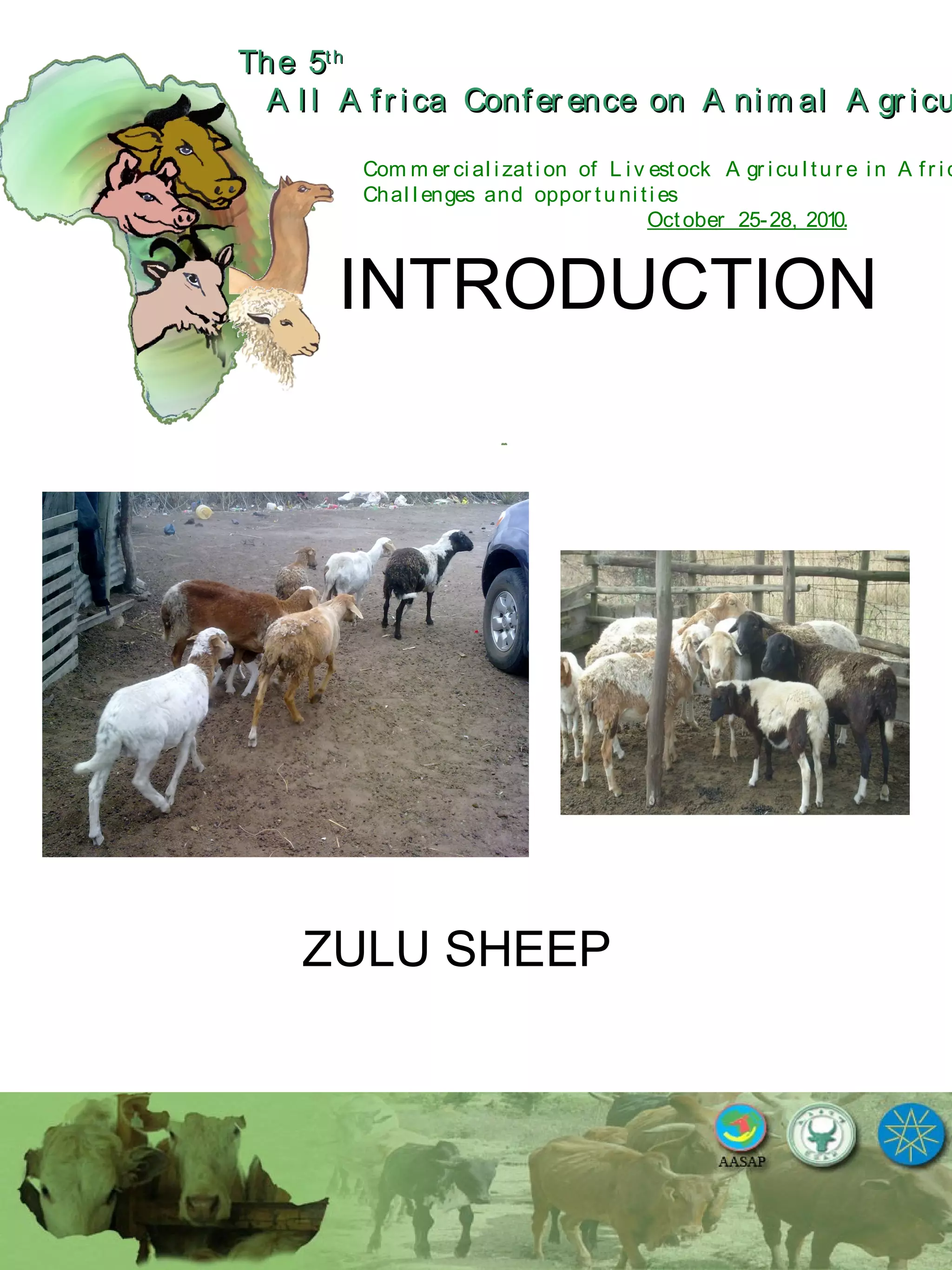
ZULU SHEEP
The 5The 5thth
A l l A fr ica Confer ence on A nim al A gr icuA l l A fr ica Confer ence on A nim al A gr icu
Com m er ci al i zati on of L i v estock A gr i cu l tu r e i n A fr i c
Chal l enges and oppor tu ni ti es
October 25-28, 2010.
INTRODUCTION
• Between the third and second
centuries, migrators brought early
Iron Age communities into the
eastern parts of South Africa
• One group of the Iron Age people
came down the east coast to
Natal.
• Brought sheep and cattle which
are suspected to be the ancestors
of the Nguni breeds
The 5The 5thth
A l l A fr ica Confer ence on A nim al A gr icuA l l A fr ica Confer ence on A nim al A gr icu
Com m er ci al i zati on of L i v estock A gr i cu l tu r e i n A fr i c
Chal l enges and oppor tu ni ti es
October 25-28, 2010.
INTRODUCTION
• The Nguni sheep of Zululand are
called Zulu sheep
• Swaziland: Swazi sheep
• Zulu sheep are found in the
communal areas of KwaZulu-
Natal
• Research flocks: Makhathini
Research Station and at the
University of Zululand
The 5The 5thth
A l l A fr ica Confer ence on A nim al A gr icuA l l A fr ica Confer ence on A nim al A gr icu
Com m er ci al i zati on of L i v estock A gr i cu l tu r e i n A fr i c
Chal l enges and oppor tu ni ti es
October 25-28, 2010.
INTRODUCTION
• For many decades, indigenous
genetic resources have been
perceived as unproductive and
inherently inferior to high
performance or improved breeds
• Consequently: subjected to cross-
breeding or even replacement
with exotic breeds
• Rapid decline in numbers of the
indigenous breeds
The 5The 5thth
A l l A fr ica Confer ence on A nim al A gr icuA l l A fr ica Confer ence on A nim al A gr icu
Com m er ci al i zati on of L i v estock A gr i cu l tu r e i n A fr i c
Chal l enges and oppor tu ni ti es
October 25-28, 2010.
INTRODUCTION
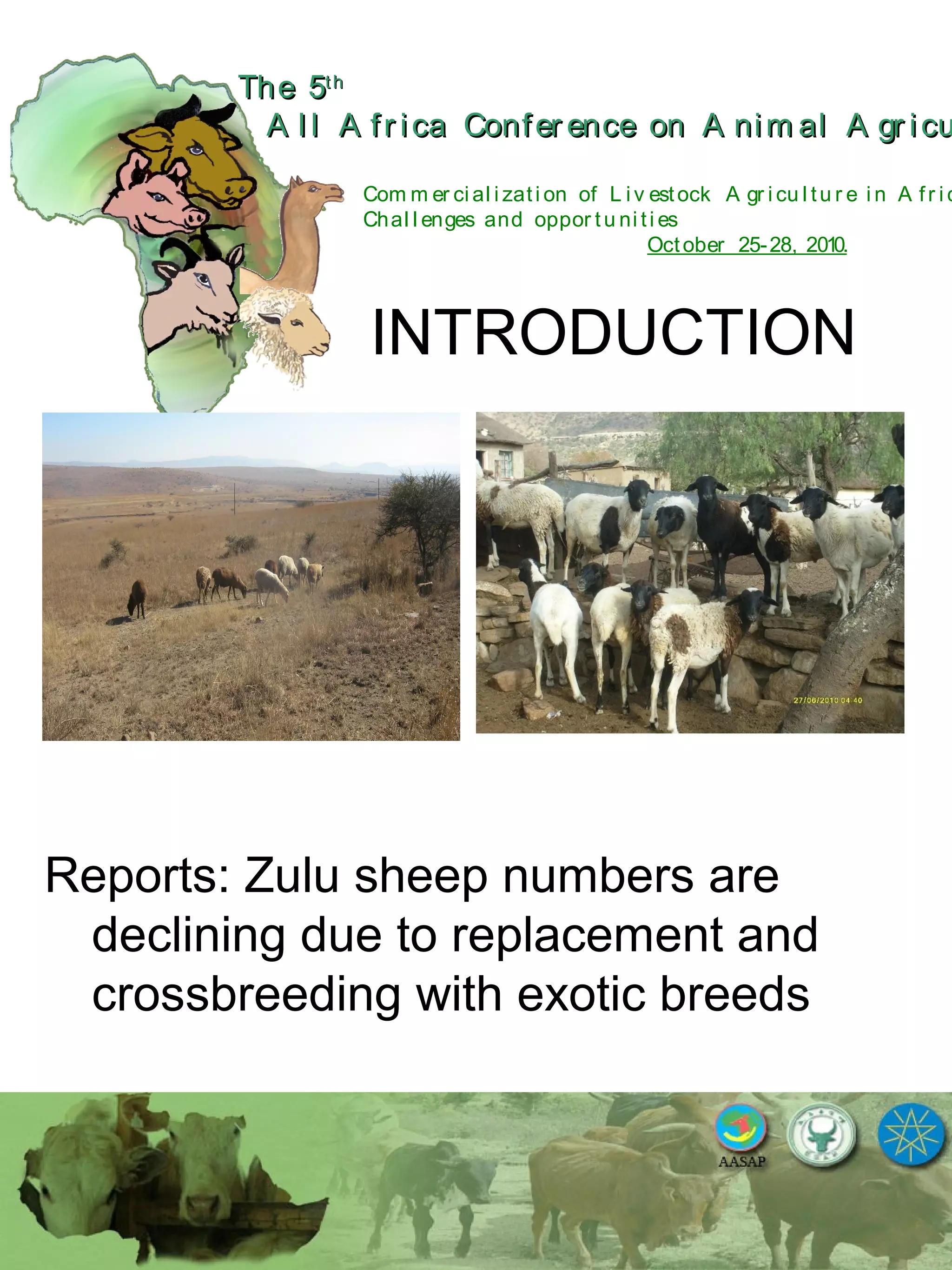
Reports: Zulu sheep numbers are
declining due to replacement and
crossbreeding with exotic breeds
The 5The 5thth
A l l A fr ica Confer ence onA l l A fr ica Confer ence on
A nim al A gr icu l tu r eA nim al A gr icu l tu r e
Com m er ci al i zati on of
L i v estock A gr i cu l tu r e i n A fr i ca:
Chal l enges and oppor tu ni ti es
October 25-28, 2010.
INTRODUCTION
Not enough information available on
characteristics of Zulu sheep
Need to document Zulu sheep
genetic and phenotypic resources
and to design and implement
strategies for their sustainable
conservation.
Traditional farmers in developing
countries manage their livestock
according to their indigenous
knowledge.
The 5The 5thth
A l l A fr ica Confer ence onA l l A fr ica Confer ence on
A nim al A gr icu l tu r eA nim al A gr icu l tu r e
Com m er ci al i zati on of
L i v estock A gr i cu l tu r e i n A fr i ca:
Chal l enges and oppor tu ni ti es
October 25-28, 2010.
INTRODUCTION
Maintenance of the remaining livestock
diversity in communal farming require:
• Support for research on indigenous
knowledge and
• Capacity building at grassroots and at
national level
The 5The 5thth
A l l A fr ica Confer ence onA l l A fr ica Confer ence on
A nim al A gr icu l tu r eA nim al A gr icu l tu r e
Com m er ci al i zati on of
L i v estock A gr i cu l tu r e i n A fr i ca:
Chal l enges and oppor tu ni ti es
October 25-28, 2010.
INTRODUCTION
The objectives of the present study were:
• To obtain information on the utilization, socio-
economic and cultural values by the farmers
using the Zulu sheep breed;
• To preliminary characterise and estimate
phenotypic variation within the Zulu sheep
breed using six morphological characteristics;
• To estimate the live weight prediction
equations of the Zulu sheep breed using
some body linear measurements and;
• To assess the genetic variation within this
breed.
The 5The 5thth
A l l A fr ica Confer ence onA l l A fr ica Confer ence on
A nim al A gr icu l tu r eA nim al A gr icu l tu r e
Com m er ci al i zati on of
L i v estock A gr i cu l tu r e i n A fr i ca:
Chal l enges and oppor tu ni ti es
October 25-28, 2010.
INTRODUCTION
The aim:
• Preliminary characterisation for
utilization, improvement and
conservation.
A nim al A gr icu l tu r eA nim al A gr icu l tu r e
Com m er ci al i zati on of
L i v estock A gr i cu l tu r e i n A fr i ca:
Chal l enges and oppor tu ni ti es
October 25-28, 2010.
MATERIALS AND METHODS
1. Interviewed 76 farmers in the rural north
of KwaZulu-Natal:
• Utilization
• Socio economic status on keeping
livestock including Zulu sheep
• Management patterns including
indigenous knowledge
The 5The 5thth
A l l A fr ica Confer ence onA l l A fr ica Confer ence on
A nim al A gr icu l tu r eA nim al A gr icu l tu r e
Com m er ci al i zati on of
L i v estock A gr i cu l tu r e i n A fr i ca:
Chal l enges and oppor tu ni ti es
October 25-28, 2010.
MATERIALS AND METHODS
2. Three populations of Zulu sheep under
extensive management
• Two populations from research stations
(250 km apart)
1. UNIZULU
2. Makhathini Research Station
• One population from the community at
Enqutshini-KwaMthethwa: 40km from
UNIZULU
The 5The 5thth
A l l A fr ica Confer ence onA l l A fr ica Confer ence on
A nim al A gr icu l tu r eA nim al A gr icu l tu r e
Com m er ci al i zati on of
L i v estock A gr i cu l tu r e i n A fr i ca:
Chal l enges and oppor tu ni ti es
October 25-28, 2010.
MATERIALS AND METHODS
Measurements of heart girth (HG) wither
height (WH), live weight (LW) , Scrotum
circumference (SC) for 2½ years
Some parameters of reproductive
performance: birth weight, parity and
litter size
Ear length (El) and Colour
The age of sheep was estimated using
dentition.
The 5The 5
A l l A fr ica Confer ence onA l l A fr ica Confer ence on
A nim al A gr icu l tu r eA nim al A gr icu l tu r e
Com m er ci al i zati on of
L i v estock A gr i cu l tu r e i n A fr i ca:
Chal l enges and oppor tu ni ti es
October 25-28, 2010.
MATERIALS AND METHODS
3. Random amplified
polymorphic DNA
Polymerase Chain Reaction
(RAPD-PCR) analysis was
carried out using DNA of 52
Zulu sheep from the three
populations.
The 5The 5thth
A l l A fr ica Confer ence onA l l A fr ica Confer ence on
A nim al A gr icu l tu r eA nim al A gr icu l tu r e
Com m er ci al i zati on of
L i v estock A gr i cu l tu r e i n A fr i ca:
Chal l enges and oppor tu ni ti es
October 25-28, 2010.
MATERIALS AND METHODS
1. Intra and inter- population
phenotypic and genetic
diversity was expressed as
dendograms using complete
linkage of Minitab (1998)
2. The regression and Pearson
coefficients procedures of
Minitab Inc. (1998) were used
for the analysis
3. ANOVA: GLM of Minitab
(1998)
RESULTS AND DISCUSSION
• 20% total income per annum:
generated from livestock
• 3.5 % of the total income from
livestock was obtained from
sheep sales
Use of sheep:
i) Source of food
ii) Sometimes given to relatives as
presents
iii) Payments of penalties
iv) Sales when there is need
The 5The 5thth
A l l A fr ica Confer ence onA l l A fr ica Confer ence on
A nim al A gr icu l tu r eA nim al A gr icu l tu r e
Com m er ci al i zati on of
L i v estock A gr i cu l tu r e i n A fr i ca:
Chal l enges and oppor tu ni ti es
October 25-28, 2010.
RESULTS AND DISCUSSION
• 30 % of farmers keep sheep
• Sheep are 3% of total livestock
• All sheep owners reported to
keep Zulu sheep
Different survey in four districts of
KZN: 4031 Zulu goats, 2424
cattle and 433 Zulu sheep
The 5The 5thth
A l l A fr ica Confer ence onA l l A fr ica Confer ence on
A nim al A gr icu l tu r eA nim al A gr icu l tu r e
Com m er ci al i zati on of
L i v estock A gr i cu l tu r e i n A fr i ca:
Chal l enges and oppor tu ni ti es
October 25-28, 2010.
RESULTS AND DISCUSSION
Adaptability traits reported:
i) Resistance to diseases
ii) Good meat quality
iii) Ability to flourish in the hot and
humid climate of KZN
No dipping in these areas
Dewormed only if there is sign of
internal parasite i.e. mucus
The 5The 5
A l l A fr ica Confer ence onA l l A fr ica Confer ence on
A nim al A gr icu l tu r eA nim al A gr icu l tu r e
Com m er ci al i zati on of
L i v estock A gr i cu l tu r e i n A fr i ca:
Chal l enges and oppor tu ni ti es
October 25-28, 2010.
RESULTS AND DISCUSSION
Supplements:
Groundnuts and some leaves
of certain species like
Sarcostemma viminale,
Crinum macowanii which
increase milk production
The 5The 5
A l l A fr ica Confer ence onA l l A fr ica Confer ence on
A nim al A gr icu l tu r eA nim al A gr icu l tu r e
Com m er ci al i zati on of
L i v estock A gr i cu l tu r e i n A fr i ca:
Chal l enges and oppor tu ni ti es
October 25-28, 2010.
RESULTS AND DISCUSSION
Main constraint mentioned:
• Lack of knowledge on animal
husbandry
Solution:
• Government could intervene
with more extension officers
A nim al A gr icu l tu r eA nim al A gr icu l tu r e
Com m er ci al i zati on of
L i v estock A gr i cu l tu r e i n A fr i ca:
Chal l enges and oppor tu ni ti es
October 25-28, 2010.
RESULTS AND DISCUSSION
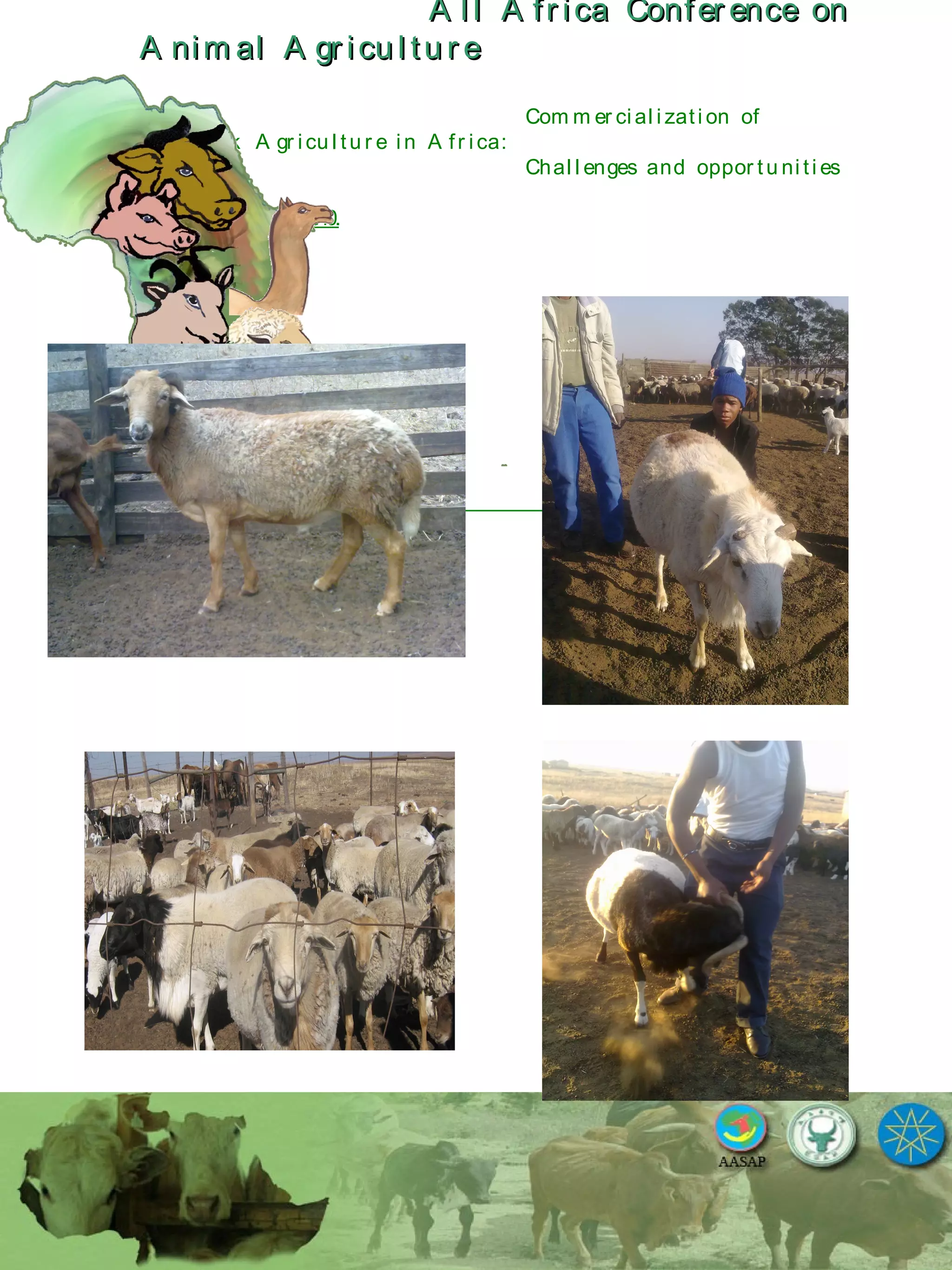
PHENOTYPIC CHARACTERISTICS
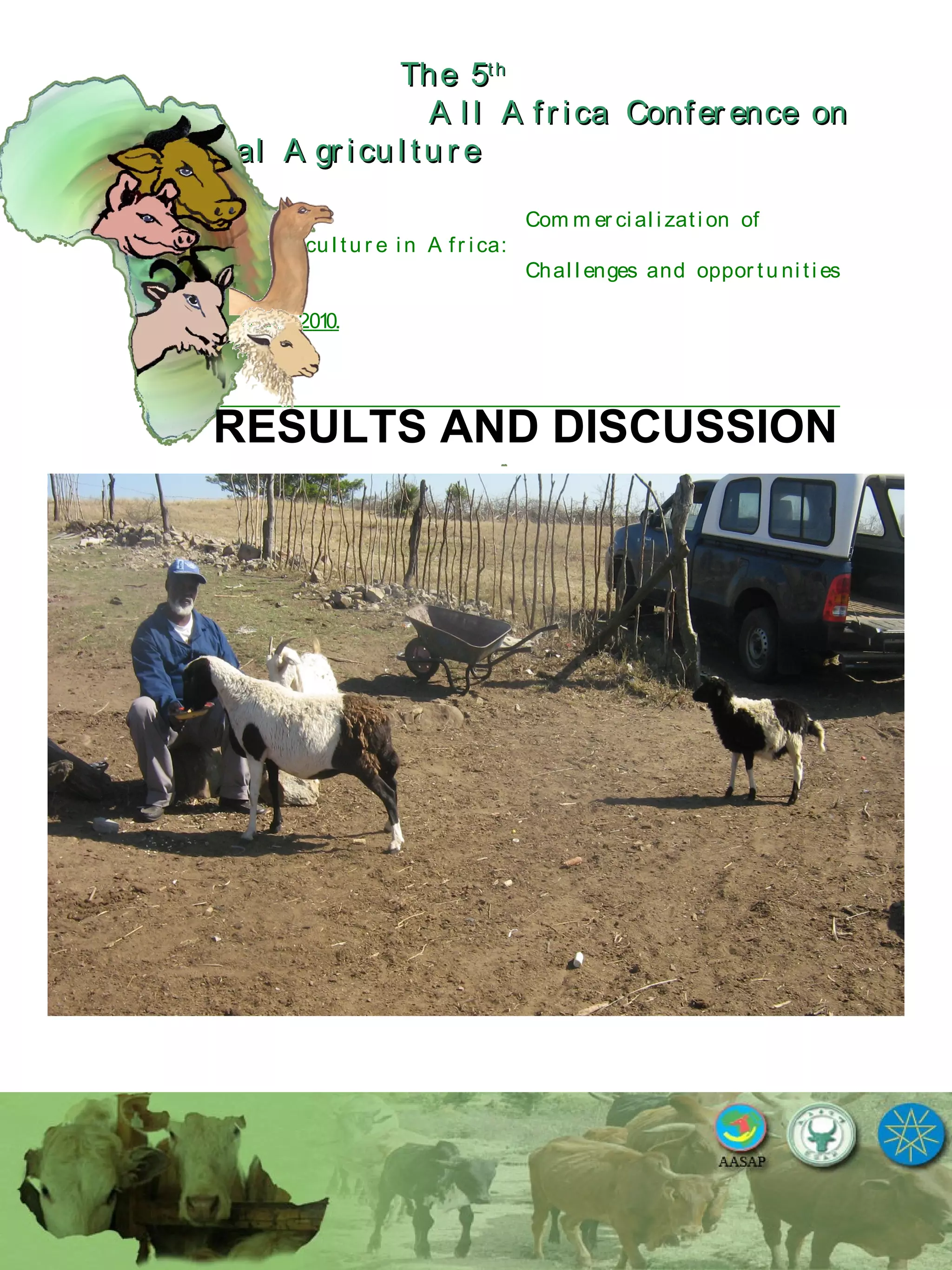
Dominant colours:
• Brown and a white colour
combination
Brown or dark brown are born as
black lambs and gradually
change to brown or dark brown as
the lambs grow
The 5The 5thth
A l l A fr ica Confer ence onA l l A fr ica Confer ence on
A nim al A gr icu l tu r eA nim al A gr icu l tu r e
Com m er ci al i zati on of
L i v estock A gr i cu l tu r e i n A fr i ca:
Chal l enges and oppor tu ni ti es
October 25-28, 2010.
RESULTS AND DISCUSSION
The 5The 5thth
A l l A fr ica Confer ence onA l l A fr ica Confer ence on
A nim al A gr icu l tu r eA nim al A gr icu l tu r e
Com m er ci al i zati on of
L i v estock A gr i cu l tu r e i n A fr i ca:
Chal l enges and oppor tu ni ti es
October 25-28, 2010.
RESULTS AND DISCUSSION
1. 32 kg for females and 38 kg for
males
2. LW and LBM of Zulu sheep
were significantly affected by
change of season
3. Similar for summer and autumn
and for winter and spring
4. Differences of 2.58 kg, 3.90 cm
and 1.52 cm for LW, HG and
WH, respectively were realized
The 5The 5thth
A l l A fr ica Confer ence onA l l A fr ica Confer ence on
A nim al A gr icu l tu r eA nim al A gr icu l tu r e
Com m er ci al i zati on of
L i v estock A gr i cu l tu r e i n A fr i ca:
Chal l enges and oppor tu ni ti es
October 25-28, 2010.
RESULTS AND DISCUSSION
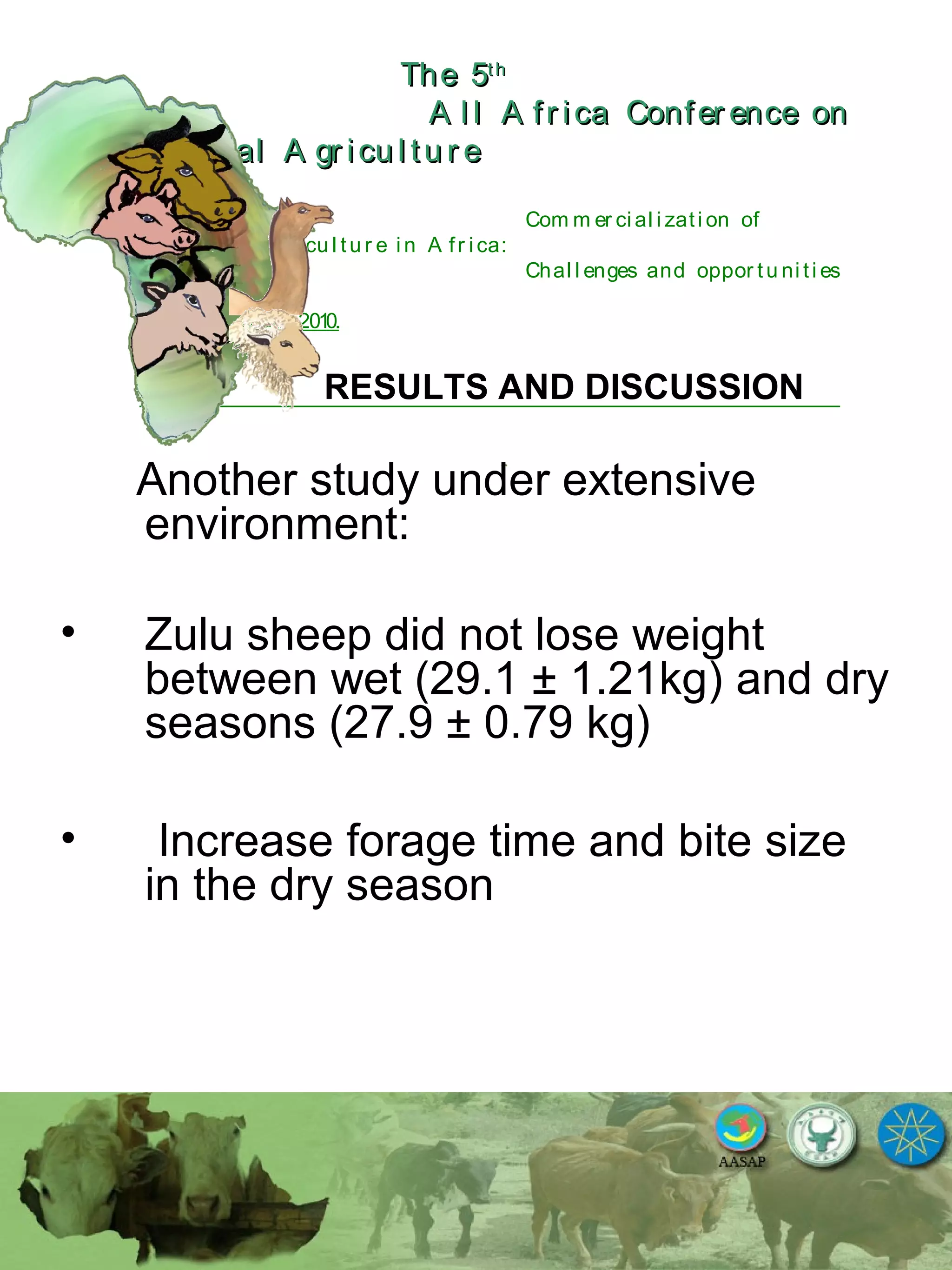
Another study under extensive
environment:
• Zulu sheep did not lose weight
between wet (29.1 ± 1.21kg) and dry
seasons (27.9 ± 0.79 kg)
• Increase forage time and bite size
in the dry season
The 5The 5thth
A l l A fr ica Confer ence onA l l A fr ica Confer ence on
A nim al A gr icu l tu r eA nim al A gr icu l tu r e
Com m er ci al i zati on of
L i v estock A gr i cu l tu r e i n A fr i ca:
Chal l enges and oppor tu ni ti es
October 25-28, 2010.
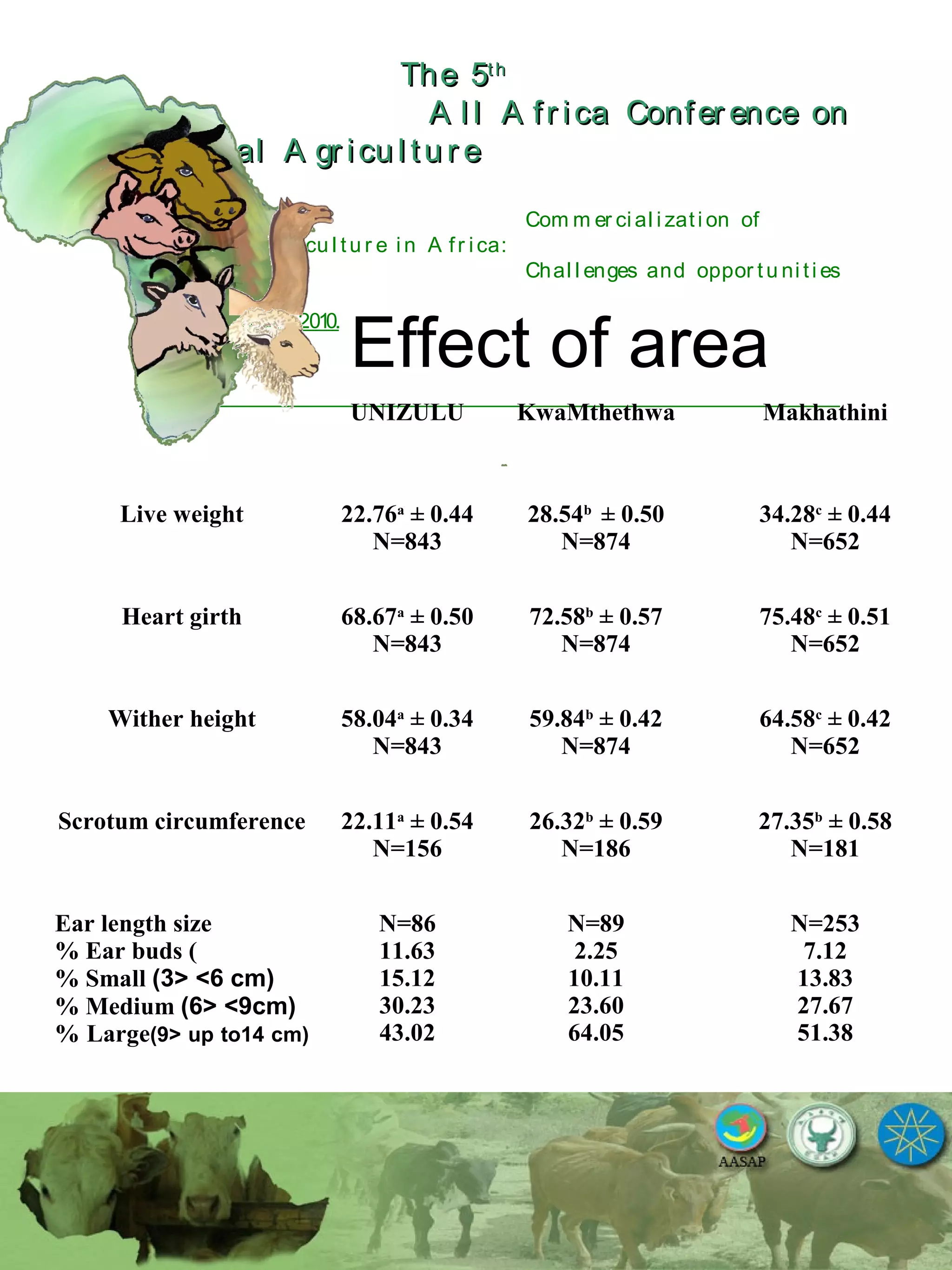
Effect of area
UNIZULU KwaMthethwa Makhathini
Live weight 22.76a
± 0.44
N=843
28.54b
± 0.50
N=874
34.28c
± 0.44
N=652
Heart girth 68.67a
± 0.50
N=843
72.58b
± 0.57
N=874
75.48c
± 0.51
N=652
Wither height 58.04a
± 0.34
N=843
59.84b
± 0.42
N=874
64.58c
± 0.42
N=652
Scrotum circumference 22.11a
± 0.54
N=156
26.32b
± 0.59
N=186
27.35b
± 0.58
N=181
Ear length size
% Ear buds (
% Small (3> <6 cm)
% Medium (6> <9cm)
% Large(9> up to14 cm)
N=86
11.63
15.12
30.23
43.02
N=89
2.25
10.11
23.60
64.05
N=253
7.12
13.83
27.67
51.38
The 5The 5thth
A l l A fr ica Confer ence onA l l A fr ica Confer ence on
A nim al A gr icu l tu r eA nim al A gr icu l tu r e
Com m er ci al i zati on of
L i v estock A gr i cu l tu r e i n A fr i ca:
Chal l enges and oppor tu ni ti es
October 25-28, 2010.
RESULTS AND DISCUSSION
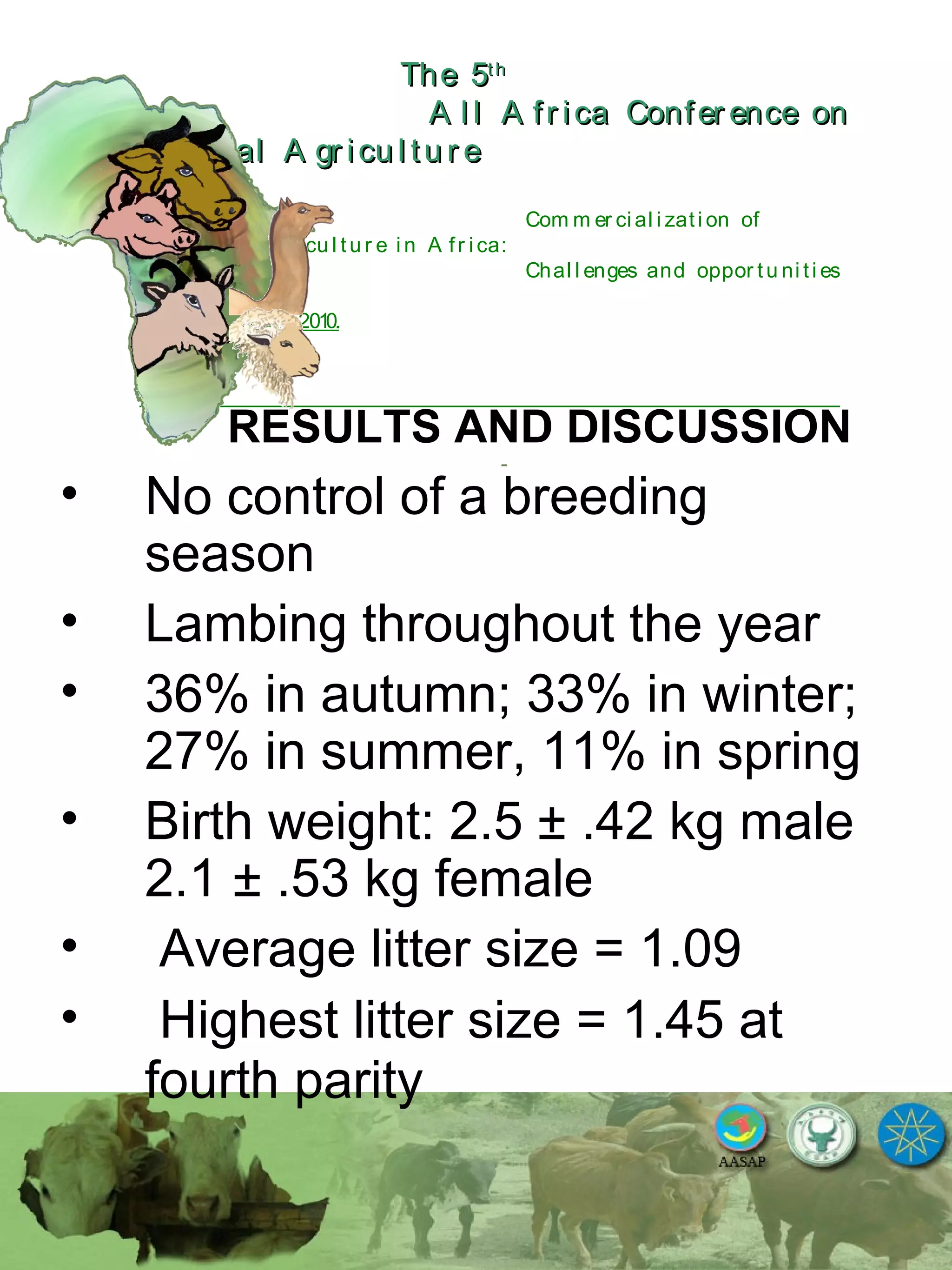
• No control of a breeding
season
• Lambing throughout the year
• 36% in autumn; 33% in winter;
27% in summer, 11% in spring
• Birth weight: 2.5 ± .42 kg male
2.1 ± .53 kg female
• Average litter size = 1.09
• Highest litter size = 1.45 at
fourth parity
The 5The 5thth
A l l A fr ica Confer ence onA l l A fr ica Confer ence on
A nim al A gr icu l tu r eA nim al A gr icu l tu r e
Com m er ci al i zati on of
L i v estock A gr i cu l tu r e i n A fr i ca:
Chal l enges and oppor tu ni ti es
October 25-28, 2010.
RESULTS AND DISCUSSION
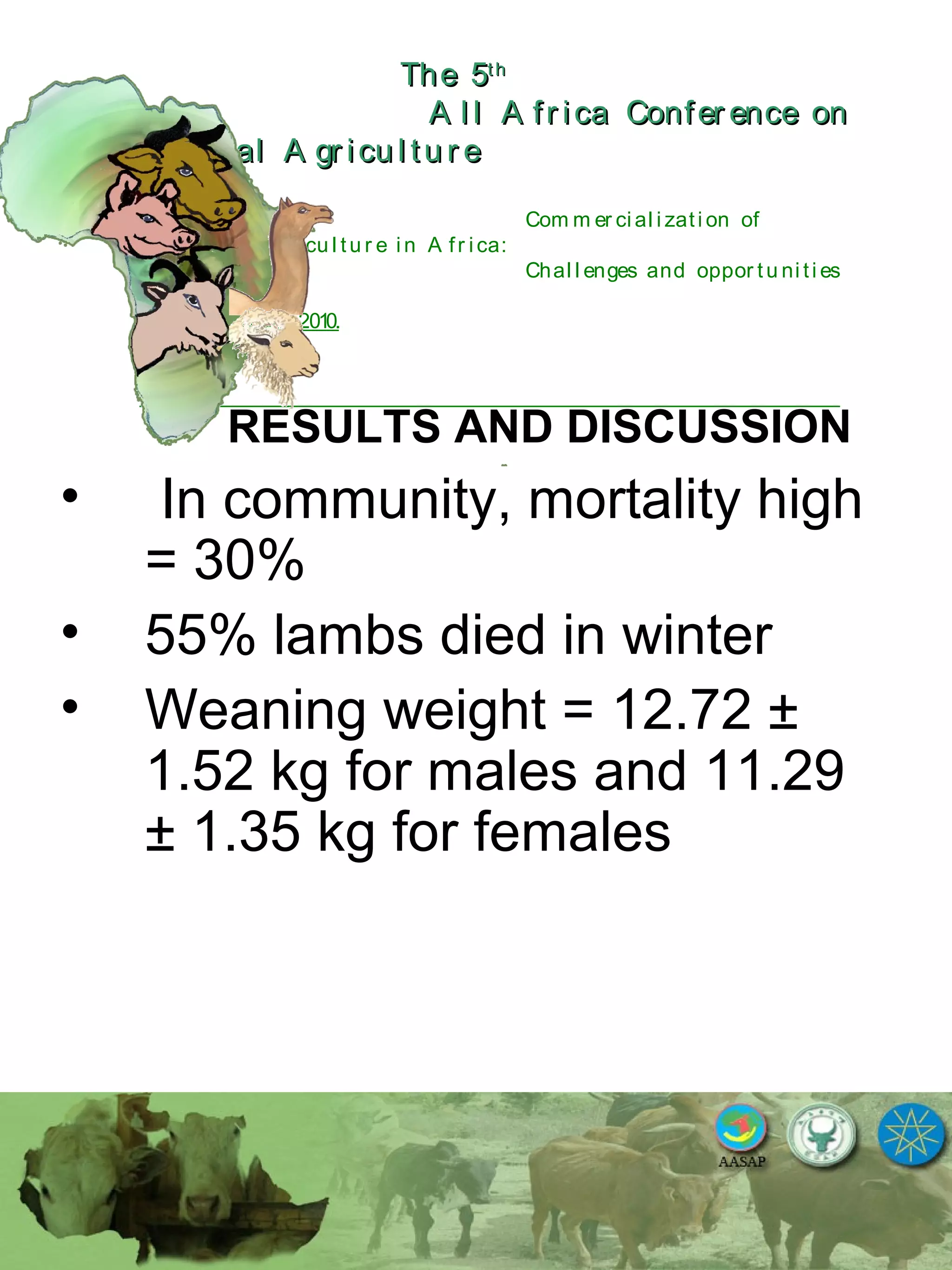
• In community, mortality high
= 30%
• 55% lambs died in winter
• Weaning weight = 12.72 ±
1.52 kg for males and 11.29
± 1.35 kg for females
The 5The 5thth
A l l A fr ica Confer ence onA l l A fr ica Confer ence on
A nim al A gr icu l tu r eA nim al A gr icu l tu r e
Com m er ci al i zati on of
L i v estock A gr i cu l tu r e i n A fr i ca:
Chal l enges and oppor tu ni ti es
October 25-28, 2010.
RESULTS AND DISCUSSION
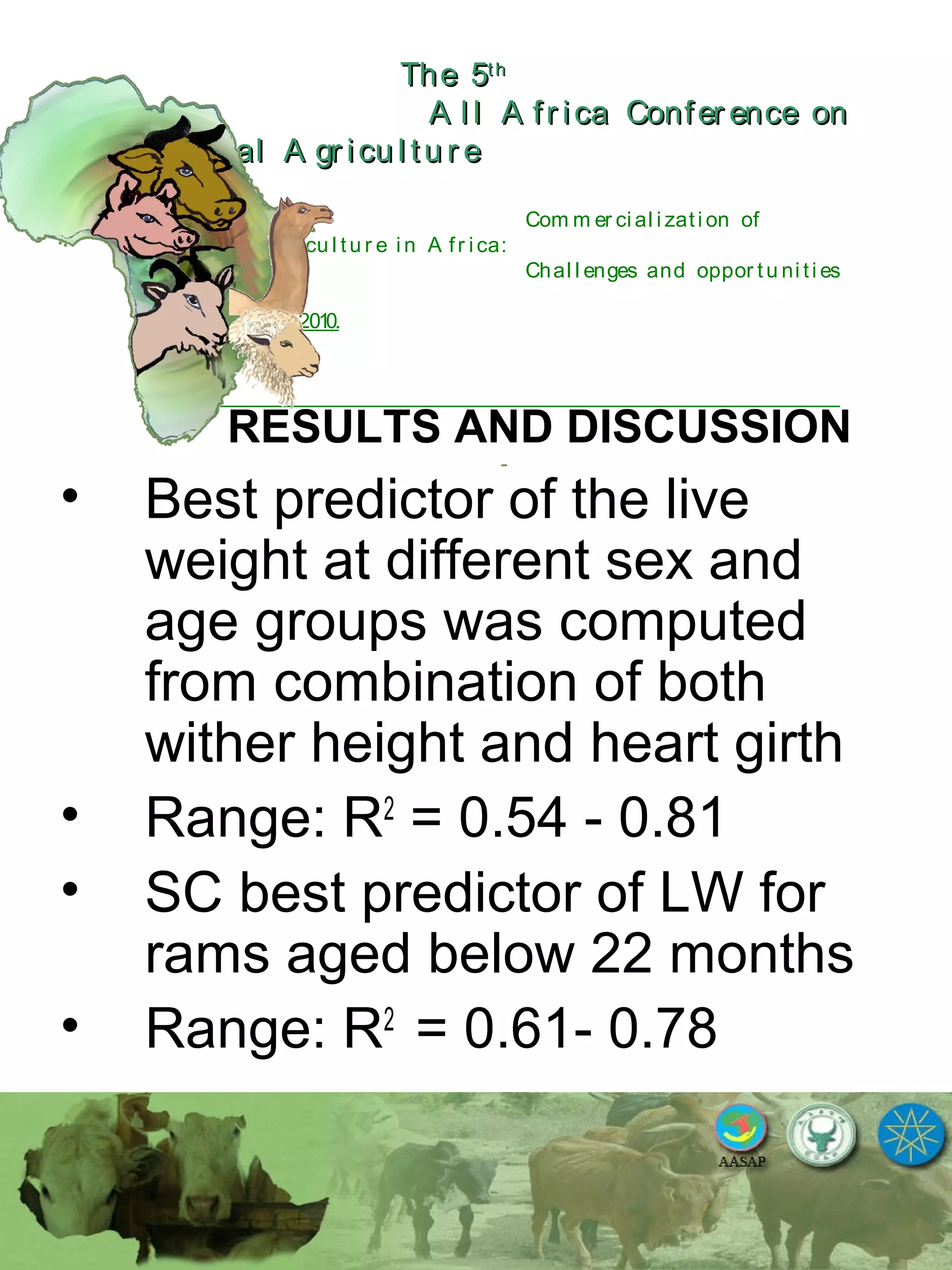
• Best predictor of the live
weight at different sex and
age groups was computed
from combination of both
wither height and heart girth
• Range: R2
= 0.54 - 0.81
• SC best predictor of LW for
rams aged below 22 months
• Range: R2
= 0.61- 0.78
The 5The 5thth
A l l A fr ica Confer ence onA l l A fr ica Confer ence on
A nim al A gr icu l tu r eA nim al A gr icu l tu r e
Com m er ci al i zati on of
L i v estock A gr i cu l tu r e i n A fr i ca:
Chal l enges and oppor tu ni ti es
October 25-28, 2010.
RESULTS AND DISCUSSION
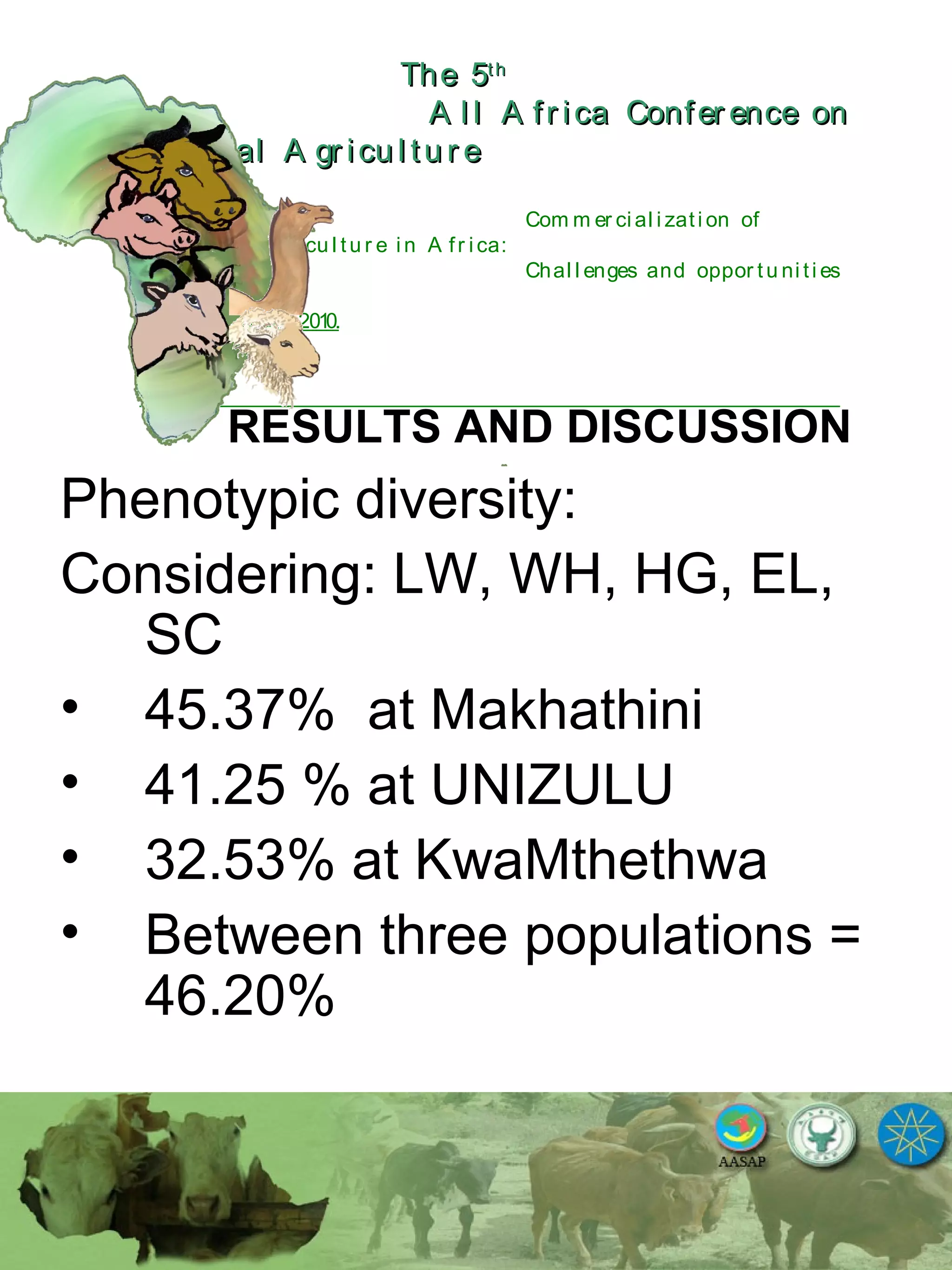
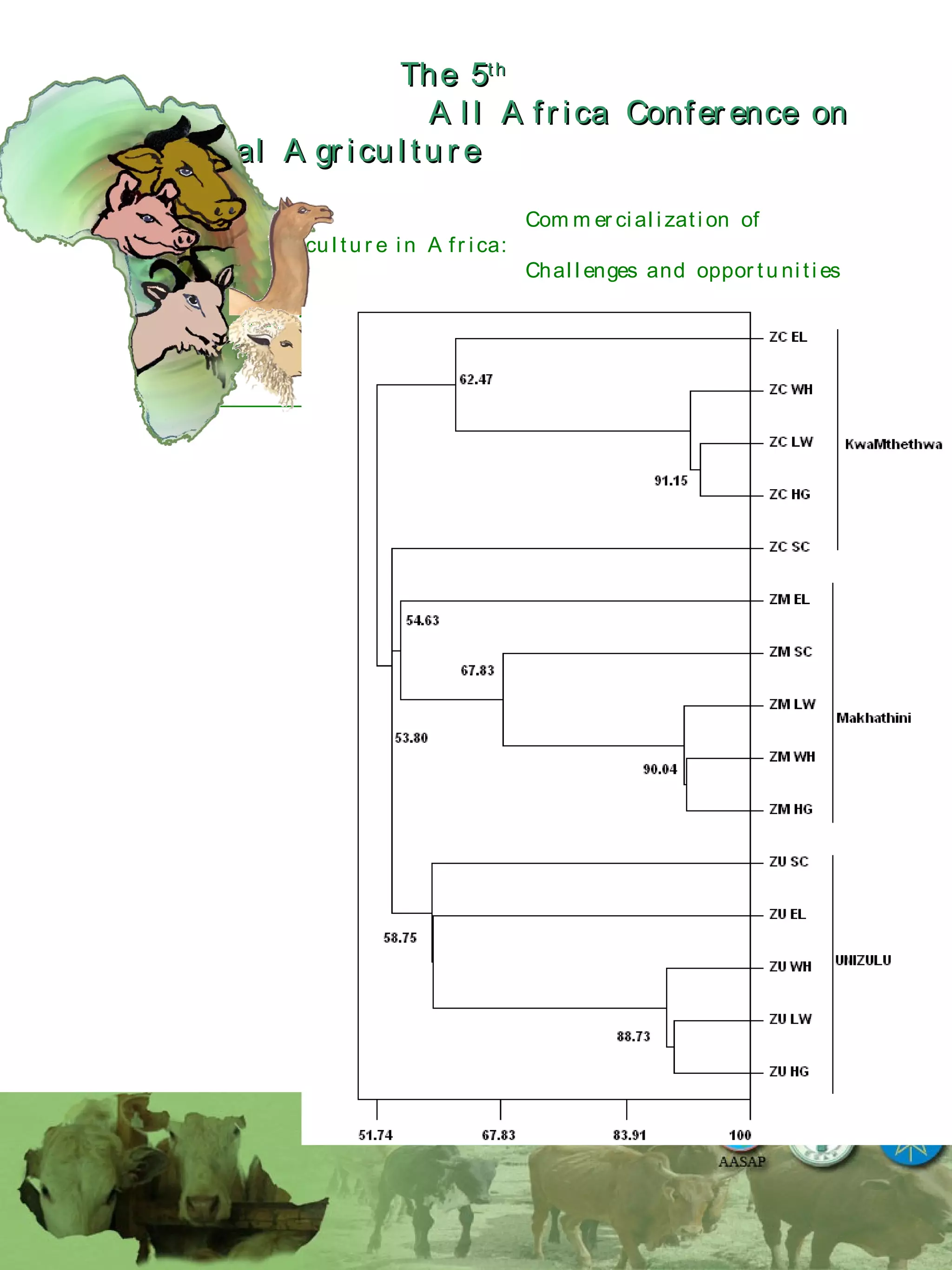
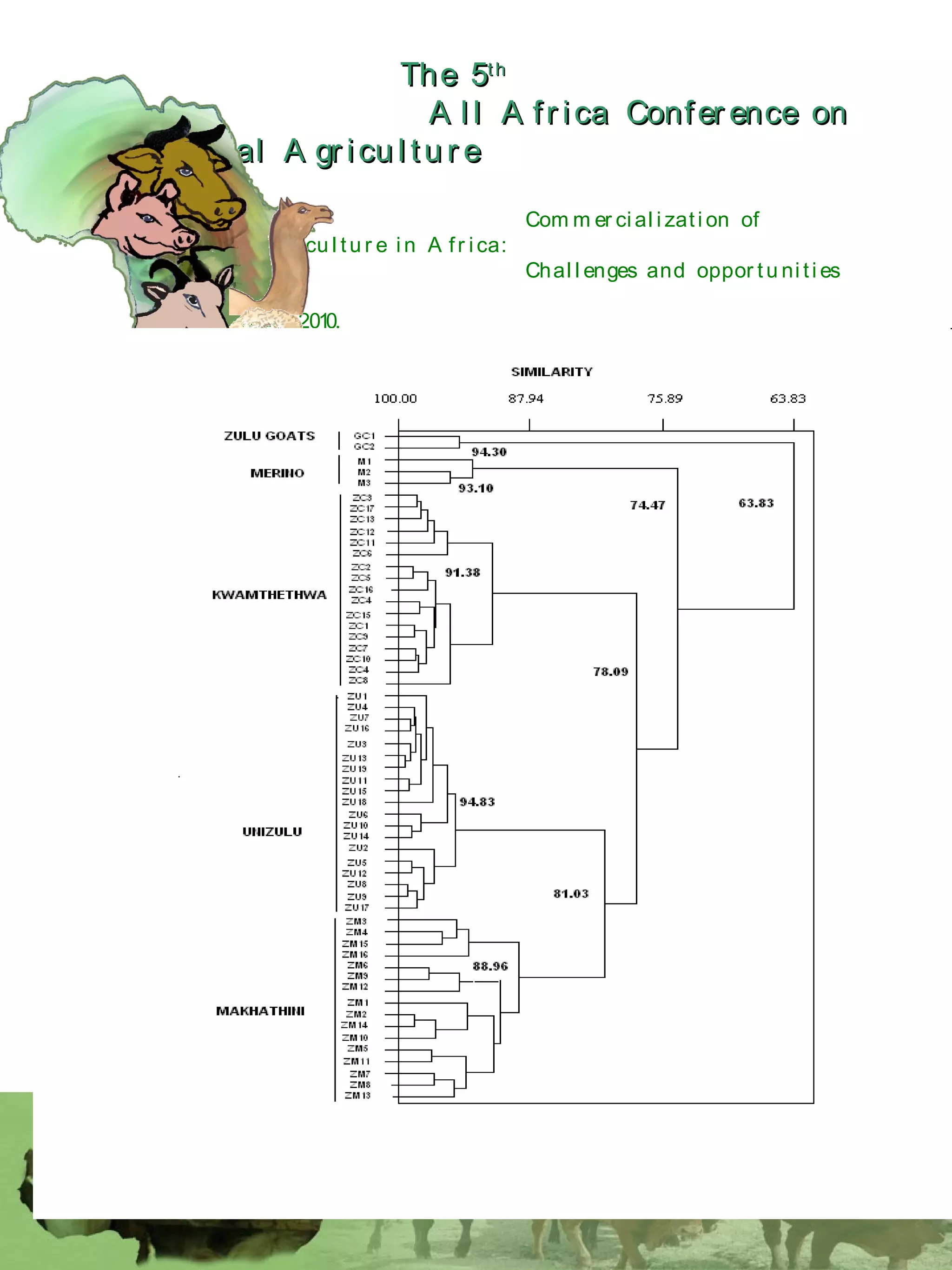
Phenotypic diversity:
Considering: LW, WH, HG, EL,
SC
• 45.37% at Makhathini
• 41.25 % at UNIZULU
• 32.53% at KwaMthethwa
• Between three populations =
46.20%
The 5The 5thth
A l l A fr ica Confer ence onA l l A fr ica Confer ence on
A nim al A gr icu l tu r eA nim al A gr icu l tu r e
Com m er ci al i zati on of
L i v estock A gr i cu l tu r e i n A fr i ca:
Chal l enges and oppor tu ni ti es
October 25-28, 2010.
The 5The 5thth
A l l A fr ica Confer ence onA l l A fr ica Confer ence on
A nim al A gr icu l tu r eA nim al A gr icu l tu r e
Com m er ci al i zati on of
L i v estock A gr i cu l tu r e i n A fr i ca:
Chal l enges and oppor tu ni ti es
October 25-28, 2010.
RESULTS AND DISCUSSION
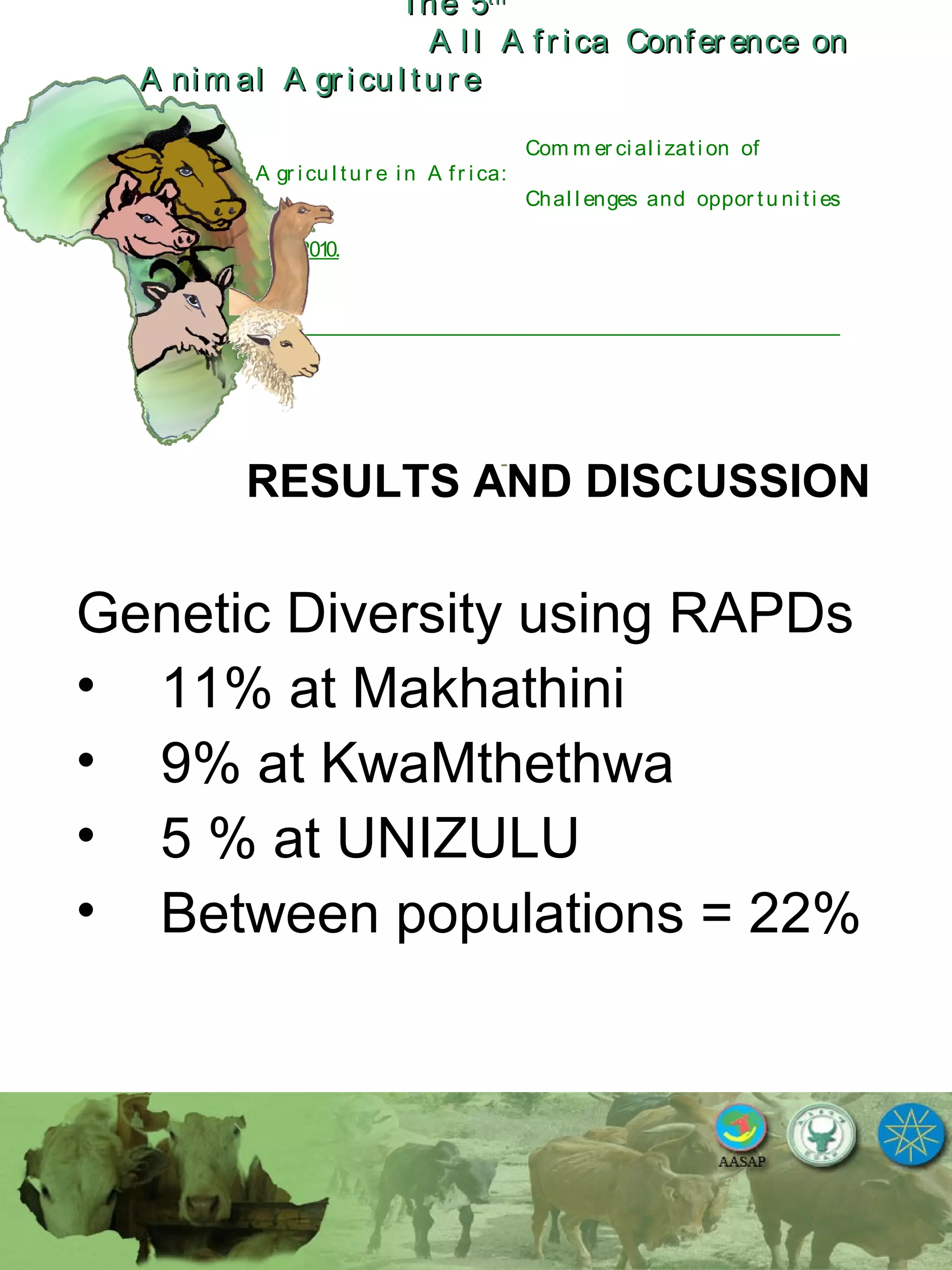
Genetic Diversity using RAPDs
• 11% at Makhathini
• 9% at KwaMthethwa
• 5 % at UNIZULU
• Between populations = 22%
The 5The 5thth
A l l A fr ica Confer ence onA l l A fr ica Confer ence on
A nim al A gr icu l tu r eA nim al A gr icu l tu r e
Com m er ci al i zati on of
L i v estock A gr i cu l tu r e i n A fr i ca:
Chal l enges and oppor tu ni ti es
October 25-28, 2010.
A nim al A gr icu l tu r eA nim al A gr icu l tu r e
Com m er ci al i zati on of
L i v estock A gr i cu l tu r e i n A fr i ca:
Chal l enges and oppor tu ni ti es
October 25-28, 2010.
CONCLUSION
• Farmers appreciate the value
of the Nguni sheep
• Not aware of how the breed
can be utilized to bring
sustained income
• Interested to learn
A nim al A gr icu l tu r eA nim al A gr icu l tu r e
Com m er ci al i zati on of
L i v estock A gr i cu l tu r e i n A fr i ca:
Chal l enges and oppor tu ni ti es
October 25-28, 2010.
CONCLUSION
• Zulu sheep: not a large breed
but have good characteristics
which make them suitable for
rural farming
• There is good indication of
genetic diversity between
populations
A l l A fr ica Confer ence onA l l A fr ica Confer ence on
A nim al A gr icu l tu r eA nim al A gr icu l tu r e
Com m er ci al i zati on of
L i v estock A gr i cu l tu r e i n A fr i ca:
Chal l enges and oppor tu ni ti es
October 25-28, 2010.
A l l A fr ica Confer ence onA l l A fr ica Confer ence on
A nim al A gr icu l tu r eA nim al A gr icu l tu r e
Com m er ci al i zati on of
L i v estock A gr i cu l tu r e i n A fr i ca:
Chal l enges and oppor tu ni ti es
October 25-28, 2010.
RECOMMENDATION
• Improvement and
conservation program
• To include training that builds
on indigenous knowledge
concepts as well as
appropriate relevant modern
technologies
• Animals may improve in LW if
a supplementary program is
applied
A l l A fr ica Confer ence onA l l A fr ica Confer ence on
A nim al A gr icu l tu r eA nim al A gr icu l tu r e
Com m er ci al i zati on of
L i v estock A gr i cu l tu r e i n A fr i ca:
Chal l enges and oppor tu ni ti es
October 25-28, 2010.
RECOMMENDATION
• Open nucleus: three tier
system of flocks with three
phases:
• nucleus, sub-nucleus and
village flocks is
recommended.
• A nucleus flock would have to
be established within the
governmental ranches
A l l A fr ica Confer ence onA l l A fr ica Confer ence on
A nim al A gr icu l tu r eA nim al A gr icu l tu r e
Com m er ci al i zati on of
L i v estock A gr i cu l tu r e i n A fr i ca:
Chal l enges and oppor tu ni ti es
October 25-28, 2010.
RECOMMENDATION
• Genetic research using
appropriate genetic markers
especially mtDNA and
microsatellites between more
populations in KZN
• Possibly SNPs
• Phenotypic characterisation
for populations across KZN
A l l A fr ica Confer ence onA l l A fr ica Confer ence on
A nim al A gr icu l tu r eA nim al A gr icu l tu r e
Com m er ci al i zati on of
L i v estock A gr i cu l tu r e i n A fr i ca:
Chal l enges and oppor tu ni ti es
October 25-28, 2010.

Characterisation of zulu (Nguni) sheep for utilization, improvement and conservation

  • 1.
    The 5The 5thth Al l A fr ica Confer ence on A nim al A gr icuA l l A fr ica Confer ence on A nim al A gr icu Com m er ci al i zati on of L i v estock A gr i cu l tu r e i n A fr i c Chal l enges and oppor tu ni ti es October 25-28, 2010. CHARACTERISATION OF ZULU (NGUNI) SHEEP FOR UTILIZATION, IMPROVEMENT AND CONSERVATION
  • 2.
    The 5The 5thth Al l A fr ica Confer ence on A nim al A gr icuA l l A fr ica Confer ence on A nim al A gr icu Com m er ci al i zati on of L i v estock A gr i cu l tu r e i n A fr i c Chal l enges and oppor tu ni ti es October 25-28, 2010. Kunene NW, Bezuidenhout CC, Nesamvuni EA, Nsahlai IV University of Zululand North-West University, Potchefstroom Limpopo Department of Agriculture University of KwaZulu-Natal, Pietermaritzburg
  • 3.
    The 5The 5thth Al l A fr ica Confer ence on A nim al A gr icuA l l A fr ica Confer ence on A nim al A gr icu Com m er ci al i zati on of L i v estock A gr i cu l tu r e i n A fr i c Chal l enges and oppor tu ni ti es October 25-28, 2010. INTRODUCTION ZULU SHEEP
  • 4.
    The 5The 5thth Al l A fr ica Confer ence on A nim al A gr icuA l l A fr ica Confer ence on A nim al A gr icu Com m er ci al i zati on of L i v estock A gr i cu l tu r e i n A fr i c Chal l enges and oppor tu ni ti es October 25-28, 2010. INTRODUCTION • Between the third and second centuries, migrators brought early Iron Age communities into the eastern parts of South Africa • One group of the Iron Age people came down the east coast to Natal. • Brought sheep and cattle which are suspected to be the ancestors of the Nguni breeds
  • 5.
    The 5The 5thth Al l A fr ica Confer ence on A nim al A gr icuA l l A fr ica Confer ence on A nim al A gr icu Com m er ci al i zati on of L i v estock A gr i cu l tu r e i n A fr i c Chal l enges and oppor tu ni ti es October 25-28, 2010. INTRODUCTION • The Nguni sheep of Zululand are called Zulu sheep • Swaziland: Swazi sheep • Zulu sheep are found in the communal areas of KwaZulu- Natal • Research flocks: Makhathini Research Station and at the University of Zululand
  • 6.
    The 5The 5thth Al l A fr ica Confer ence on A nim al A gr icuA l l A fr ica Confer ence on A nim al A gr icu Com m er ci al i zati on of L i v estock A gr i cu l tu r e i n A fr i c Chal l enges and oppor tu ni ti es October 25-28, 2010. INTRODUCTION • For many decades, indigenous genetic resources have been perceived as unproductive and inherently inferior to high performance or improved breeds • Consequently: subjected to cross- breeding or even replacement with exotic breeds • Rapid decline in numbers of the indigenous breeds
  • 7.
    The 5The 5thth Al l A fr ica Confer ence on A nim al A gr icuA l l A fr ica Confer ence on A nim al A gr icu Com m er ci al i zati on of L i v estock A gr i cu l tu r e i n A fr i c Chal l enges and oppor tu ni ti es October 25-28, 2010. INTRODUCTION Reports: Zulu sheep numbers are declining due to replacement and crossbreeding with exotic breeds
  • 8.
    The 5The 5thth Al l A fr ica Confer ence onA l l A fr ica Confer ence on A nim al A gr icu l tu r eA nim al A gr icu l tu r e Com m er ci al i zati on of L i v estock A gr i cu l tu r e i n A fr i ca: Chal l enges and oppor tu ni ti es October 25-28, 2010. INTRODUCTION Not enough information available on characteristics of Zulu sheep Need to document Zulu sheep genetic and phenotypic resources and to design and implement strategies for their sustainable conservation. Traditional farmers in developing countries manage their livestock according to their indigenous knowledge.
  • 9.
    The 5The 5thth Al l A fr ica Confer ence onA l l A fr ica Confer ence on A nim al A gr icu l tu r eA nim al A gr icu l tu r e Com m er ci al i zati on of L i v estock A gr i cu l tu r e i n A fr i ca: Chal l enges and oppor tu ni ti es October 25-28, 2010. INTRODUCTION Maintenance of the remaining livestock diversity in communal farming require: • Support for research on indigenous knowledge and • Capacity building at grassroots and at national level
  • 10.
    The 5The 5thth Al l A fr ica Confer ence onA l l A fr ica Confer ence on A nim al A gr icu l tu r eA nim al A gr icu l tu r e Com m er ci al i zati on of L i v estock A gr i cu l tu r e i n A fr i ca: Chal l enges and oppor tu ni ti es October 25-28, 2010. INTRODUCTION The objectives of the present study were: • To obtain information on the utilization, socio- economic and cultural values by the farmers using the Zulu sheep breed; • To preliminary characterise and estimate phenotypic variation within the Zulu sheep breed using six morphological characteristics; • To estimate the live weight prediction equations of the Zulu sheep breed using some body linear measurements and; • To assess the genetic variation within this breed.
  • 11.
    The 5The 5thth Al l A fr ica Confer ence onA l l A fr ica Confer ence on A nim al A gr icu l tu r eA nim al A gr icu l tu r e Com m er ci al i zati on of L i v estock A gr i cu l tu r e i n A fr i ca: Chal l enges and oppor tu ni ti es October 25-28, 2010. INTRODUCTION The aim: • Preliminary characterisation for utilization, improvement and conservation.
  • 12.
    A nim alA gr icu l tu r eA nim al A gr icu l tu r e Com m er ci al i zati on of L i v estock A gr i cu l tu r e i n A fr i ca: Chal l enges and oppor tu ni ti es October 25-28, 2010. MATERIALS AND METHODS 1. Interviewed 76 farmers in the rural north of KwaZulu-Natal: • Utilization • Socio economic status on keeping livestock including Zulu sheep • Management patterns including indigenous knowledge
  • 13.
    The 5The 5thth Al l A fr ica Confer ence onA l l A fr ica Confer ence on A nim al A gr icu l tu r eA nim al A gr icu l tu r e Com m er ci al i zati on of L i v estock A gr i cu l tu r e i n A fr i ca: Chal l enges and oppor tu ni ti es October 25-28, 2010. MATERIALS AND METHODS 2. Three populations of Zulu sheep under extensive management • Two populations from research stations (250 km apart) 1. UNIZULU 2. Makhathini Research Station • One population from the community at Enqutshini-KwaMthethwa: 40km from UNIZULU
  • 14.
    The 5The 5thth Al l A fr ica Confer ence onA l l A fr ica Confer ence on A nim al A gr icu l tu r eA nim al A gr icu l tu r e Com m er ci al i zati on of L i v estock A gr i cu l tu r e i n A fr i ca: Chal l enges and oppor tu ni ti es October 25-28, 2010. MATERIALS AND METHODS Measurements of heart girth (HG) wither height (WH), live weight (LW) , Scrotum circumference (SC) for 2½ years Some parameters of reproductive performance: birth weight, parity and litter size Ear length (El) and Colour The age of sheep was estimated using dentition.
  • 15.
    The 5The 5 Al l A fr ica Confer ence onA l l A fr ica Confer ence on A nim al A gr icu l tu r eA nim al A gr icu l tu r e Com m er ci al i zati on of L i v estock A gr i cu l tu r e i n A fr i ca: Chal l enges and oppor tu ni ti es October 25-28, 2010. MATERIALS AND METHODS 3. Random amplified polymorphic DNA Polymerase Chain Reaction (RAPD-PCR) analysis was carried out using DNA of 52 Zulu sheep from the three populations.
  • 16.
    The 5The 5thth Al l A fr ica Confer ence onA l l A fr ica Confer ence on A nim al A gr icu l tu r eA nim al A gr icu l tu r e Com m er ci al i zati on of L i v estock A gr i cu l tu r e i n A fr i ca: Chal l enges and oppor tu ni ti es October 25-28, 2010. MATERIALS AND METHODS 1. Intra and inter- population phenotypic and genetic diversity was expressed as dendograms using complete linkage of Minitab (1998) 2. The regression and Pearson coefficients procedures of Minitab Inc. (1998) were used for the analysis 3. ANOVA: GLM of Minitab (1998)
  • 17.
    RESULTS AND DISCUSSION •20% total income per annum: generated from livestock • 3.5 % of the total income from livestock was obtained from sheep sales Use of sheep: i) Source of food ii) Sometimes given to relatives as presents iii) Payments of penalties iv) Sales when there is need
  • 18.
    The 5The 5thth Al l A fr ica Confer ence onA l l A fr ica Confer ence on A nim al A gr icu l tu r eA nim al A gr icu l tu r e Com m er ci al i zati on of L i v estock A gr i cu l tu r e i n A fr i ca: Chal l enges and oppor tu ni ti es October 25-28, 2010. RESULTS AND DISCUSSION • 30 % of farmers keep sheep • Sheep are 3% of total livestock • All sheep owners reported to keep Zulu sheep Different survey in four districts of KZN: 4031 Zulu goats, 2424 cattle and 433 Zulu sheep
  • 19.
    The 5The 5thth Al l A fr ica Confer ence onA l l A fr ica Confer ence on A nim al A gr icu l tu r eA nim al A gr icu l tu r e Com m er ci al i zati on of L i v estock A gr i cu l tu r e i n A fr i ca: Chal l enges and oppor tu ni ti es October 25-28, 2010. RESULTS AND DISCUSSION Adaptability traits reported: i) Resistance to diseases ii) Good meat quality iii) Ability to flourish in the hot and humid climate of KZN No dipping in these areas Dewormed only if there is sign of internal parasite i.e. mucus
  • 20.
    The 5The 5 Al l A fr ica Confer ence onA l l A fr ica Confer ence on A nim al A gr icu l tu r eA nim al A gr icu l tu r e Com m er ci al i zati on of L i v estock A gr i cu l tu r e i n A fr i ca: Chal l enges and oppor tu ni ti es October 25-28, 2010. RESULTS AND DISCUSSION Supplements: Groundnuts and some leaves of certain species like Sarcostemma viminale, Crinum macowanii which increase milk production
  • 21.
    The 5The 5 Al l A fr ica Confer ence onA l l A fr ica Confer ence on A nim al A gr icu l tu r eA nim al A gr icu l tu r e Com m er ci al i zati on of L i v estock A gr i cu l tu r e i n A fr i ca: Chal l enges and oppor tu ni ti es October 25-28, 2010. RESULTS AND DISCUSSION Main constraint mentioned: • Lack of knowledge on animal husbandry Solution: • Government could intervene with more extension officers
  • 22.
    A nim alA gr icu l tu r eA nim al A gr icu l tu r e Com m er ci al i zati on of L i v estock A gr i cu l tu r e i n A fr i ca: Chal l enges and oppor tu ni ti es October 25-28, 2010. RESULTS AND DISCUSSION PHENOTYPIC CHARACTERISTICS Dominant colours: • Brown and a white colour combination Brown or dark brown are born as black lambs and gradually change to brown or dark brown as the lambs grow
  • 23.
    The 5The 5thth Al l A fr ica Confer ence onA l l A fr ica Confer ence on A nim al A gr icu l tu r eA nim al A gr icu l tu r e Com m er ci al i zati on of L i v estock A gr i cu l tu r e i n A fr i ca: Chal l enges and oppor tu ni ti es October 25-28, 2010. RESULTS AND DISCUSSION
  • 24.
    The 5The 5thth Al l A fr ica Confer ence onA l l A fr ica Confer ence on A nim al A gr icu l tu r eA nim al A gr icu l tu r e Com m er ci al i zati on of L i v estock A gr i cu l tu r e i n A fr i ca: Chal l enges and oppor tu ni ti es October 25-28, 2010. RESULTS AND DISCUSSION 1. 32 kg for females and 38 kg for males 2. LW and LBM of Zulu sheep were significantly affected by change of season 3. Similar for summer and autumn and for winter and spring 4. Differences of 2.58 kg, 3.90 cm and 1.52 cm for LW, HG and WH, respectively were realized
  • 25.
    The 5The 5thth Al l A fr ica Confer ence onA l l A fr ica Confer ence on A nim al A gr icu l tu r eA nim al A gr icu l tu r e Com m er ci al i zati on of L i v estock A gr i cu l tu r e i n A fr i ca: Chal l enges and oppor tu ni ti es October 25-28, 2010. RESULTS AND DISCUSSION Another study under extensive environment: • Zulu sheep did not lose weight between wet (29.1 ± 1.21kg) and dry seasons (27.9 ± 0.79 kg) • Increase forage time and bite size in the dry season
  • 26.
    The 5The 5thth Al l A fr ica Confer ence onA l l A fr ica Confer ence on A nim al A gr icu l tu r eA nim al A gr icu l tu r e Com m er ci al i zati on of L i v estock A gr i cu l tu r e i n A fr i ca: Chal l enges and oppor tu ni ti es October 25-28, 2010. Effect of area UNIZULU KwaMthethwa Makhathini Live weight 22.76a ± 0.44 N=843 28.54b ± 0.50 N=874 34.28c ± 0.44 N=652 Heart girth 68.67a ± 0.50 N=843 72.58b ± 0.57 N=874 75.48c ± 0.51 N=652 Wither height 58.04a ± 0.34 N=843 59.84b ± 0.42 N=874 64.58c ± 0.42 N=652 Scrotum circumference 22.11a ± 0.54 N=156 26.32b ± 0.59 N=186 27.35b ± 0.58 N=181 Ear length size % Ear buds ( % Small (3> <6 cm) % Medium (6> <9cm) % Large(9> up to14 cm) N=86 11.63 15.12 30.23 43.02 N=89 2.25 10.11 23.60 64.05 N=253 7.12 13.83 27.67 51.38
  • 27.
    The 5The 5thth Al l A fr ica Confer ence onA l l A fr ica Confer ence on A nim al A gr icu l tu r eA nim al A gr icu l tu r e Com m er ci al i zati on of L i v estock A gr i cu l tu r e i n A fr i ca: Chal l enges and oppor tu ni ti es October 25-28, 2010. RESULTS AND DISCUSSION • No control of a breeding season • Lambing throughout the year • 36% in autumn; 33% in winter; 27% in summer, 11% in spring • Birth weight: 2.5 ± .42 kg male 2.1 ± .53 kg female • Average litter size = 1.09 • Highest litter size = 1.45 at fourth parity
  • 28.
    The 5The 5thth Al l A fr ica Confer ence onA l l A fr ica Confer ence on A nim al A gr icu l tu r eA nim al A gr icu l tu r e Com m er ci al i zati on of L i v estock A gr i cu l tu r e i n A fr i ca: Chal l enges and oppor tu ni ti es October 25-28, 2010. RESULTS AND DISCUSSION • In community, mortality high = 30% • 55% lambs died in winter • Weaning weight = 12.72 ± 1.52 kg for males and 11.29 ± 1.35 kg for females
  • 29.
    The 5The 5thth Al l A fr ica Confer ence onA l l A fr ica Confer ence on A nim al A gr icu l tu r eA nim al A gr icu l tu r e Com m er ci al i zati on of L i v estock A gr i cu l tu r e i n A fr i ca: Chal l enges and oppor tu ni ti es October 25-28, 2010. RESULTS AND DISCUSSION • Best predictor of the live weight at different sex and age groups was computed from combination of both wither height and heart girth • Range: R2 = 0.54 - 0.81 • SC best predictor of LW for rams aged below 22 months • Range: R2 = 0.61- 0.78
  • 30.
    The 5The 5thth Al l A fr ica Confer ence onA l l A fr ica Confer ence on A nim al A gr icu l tu r eA nim al A gr icu l tu r e Com m er ci al i zati on of L i v estock A gr i cu l tu r e i n A fr i ca: Chal l enges and oppor tu ni ti es October 25-28, 2010. RESULTS AND DISCUSSION Phenotypic diversity: Considering: LW, WH, HG, EL, SC • 45.37% at Makhathini • 41.25 % at UNIZULU • 32.53% at KwaMthethwa • Between three populations = 46.20%
  • 31.
    The 5The 5thth Al l A fr ica Confer ence onA l l A fr ica Confer ence on A nim al A gr icu l tu r eA nim al A gr icu l tu r e Com m er ci al i zati on of L i v estock A gr i cu l tu r e i n A fr i ca: Chal l enges and oppor tu ni ti es October 25-28, 2010.
  • 32.
    The 5The 5thth Al l A fr ica Confer ence onA l l A fr ica Confer ence on A nim al A gr icu l tu r eA nim al A gr icu l tu r e Com m er ci al i zati on of L i v estock A gr i cu l tu r e i n A fr i ca: Chal l enges and oppor tu ni ti es October 25-28, 2010. RESULTS AND DISCUSSION Genetic Diversity using RAPDs • 11% at Makhathini • 9% at KwaMthethwa • 5 % at UNIZULU • Between populations = 22%
  • 33.
    The 5The 5thth Al l A fr ica Confer ence onA l l A fr ica Confer ence on A nim al A gr icu l tu r eA nim al A gr icu l tu r e Com m er ci al i zati on of L i v estock A gr i cu l tu r e i n A fr i ca: Chal l enges and oppor tu ni ti es October 25-28, 2010.
  • 34.
    A nim alA gr icu l tu r eA nim al A gr icu l tu r e Com m er ci al i zati on of L i v estock A gr i cu l tu r e i n A fr i ca: Chal l enges and oppor tu ni ti es October 25-28, 2010. CONCLUSION • Farmers appreciate the value of the Nguni sheep • Not aware of how the breed can be utilized to bring sustained income • Interested to learn
  • 35.
    A nim alA gr icu l tu r eA nim al A gr icu l tu r e Com m er ci al i zati on of L i v estock A gr i cu l tu r e i n A fr i ca: Chal l enges and oppor tu ni ti es October 25-28, 2010. CONCLUSION • Zulu sheep: not a large breed but have good characteristics which make them suitable for rural farming • There is good indication of genetic diversity between populations
  • 36.
    A l lA fr ica Confer ence onA l l A fr ica Confer ence on A nim al A gr icu l tu r eA nim al A gr icu l tu r e Com m er ci al i zati on of L i v estock A gr i cu l tu r e i n A fr i ca: Chal l enges and oppor tu ni ti es October 25-28, 2010.
  • 37.
    A l lA fr ica Confer ence onA l l A fr ica Confer ence on A nim al A gr icu l tu r eA nim al A gr icu l tu r e Com m er ci al i zati on of L i v estock A gr i cu l tu r e i n A fr i ca: Chal l enges and oppor tu ni ti es October 25-28, 2010. RECOMMENDATION • Improvement and conservation program • To include training that builds on indigenous knowledge concepts as well as appropriate relevant modern technologies • Animals may improve in LW if a supplementary program is applied
  • 38.
    A l lA fr ica Confer ence onA l l A fr ica Confer ence on A nim al A gr icu l tu r eA nim al A gr icu l tu r e Com m er ci al i zati on of L i v estock A gr i cu l tu r e i n A fr i ca: Chal l enges and oppor tu ni ti es October 25-28, 2010. RECOMMENDATION • Open nucleus: three tier system of flocks with three phases: • nucleus, sub-nucleus and village flocks is recommended. • A nucleus flock would have to be established within the governmental ranches
  • 39.
    A l lA fr ica Confer ence onA l l A fr ica Confer ence on A nim al A gr icu l tu r eA nim al A gr icu l tu r e Com m er ci al i zati on of L i v estock A gr i cu l tu r e i n A fr i ca: Chal l enges and oppor tu ni ti es October 25-28, 2010. RECOMMENDATION • Genetic research using appropriate genetic markers especially mtDNA and microsatellites between more populations in KZN • Possibly SNPs • Phenotypic characterisation for populations across KZN
  • 40.
    A l lA fr ica Confer ence onA l l A fr ica Confer ence on A nim al A gr icu l tu r eA nim al A gr icu l tu r e Com m er ci al i zati on of L i v estock A gr i cu l tu r e i n A fr i ca: Chal l enges and oppor tu ni ti es October 25-28, 2010.