Negotiation
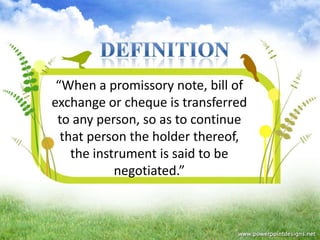
“When a promissory note, bill of
exchange or cheque is transferred
 to any person, so as to continue
  that person the holder thereof,
    the instrument is said to be
            negotiated.”
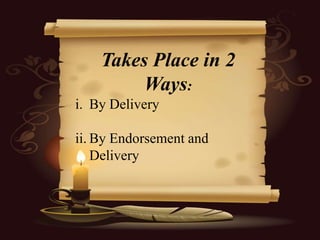
Takes Place in 2
         Ways:
i. By Delivery

ii. By Endorsement and
    Delivery
Endorsement
Section 15 defines:-
  “when    the maker or holder of a
negotiable instrument signs the same,
otherwise than as such maker, for the
purpose of negotiation, on the back or face
there of or on a slip of paper annexed there
to , or so signs for the same purpose a
stamped paper intended to be completed as
a negotiation instrument, he is said to
endorse the same, and is called an
“endorser”. the person to whom the
instrument is endorsed is called the
“endorsee”.”
Essentials
i. The holder writes and/or signs
    on the face or back or on a
    separate paper or stamp paper.
ii. The instrument is delivered to
    the endorsee.
iii.The instrument is endorsed and
    delivered to the endorsee.
iv.Endorsement must be genuine
    and not forged.
Who may endorse ?

 i. The holder of the instrument
 ii. The maker signing it
      otherwise than as such
      maker.
 iii. Every maker, drawer or
      endorsee
 iv. The payee of an instrument
Effect

      On endorsement, the
endorsee acquires the
property therein of the
negotiable instrument. The
endorsee gets the right to
further negotiation unless
specifically excluded or
restricted.
Kinds of Endorsement
i. Endorsement in blank
ii. Endorsement in full
iii. Restrictive Endorsement
iv. Partial Emdorsement
v. Conditional Endorsement
vi. Endorsement Sans Resource
vii.Facultative Endorsement
Negotiation Back is when
the transferor again becomes the
 holder. In case of dishonor only
 parties prior to his first position
    are liable. This is to avoid
          circuit of action.
Discharge from Liability
Definition
    Whenever a valid negotiable
instrument is created, the parties are liable
to pay the amount due on the instrument.
So long as the instrument is there , there
are certain rights of actions available.
However, when this rights come to end,
the instrument is discharged and is not
negotiable. Thus termination of liability of
the parties is called ‘discharge from
liability’.
two meanings


1.Discharge of negotiable
  instruments
2.Discharge of party or
  parties
1.By cancellation

2.By discharge as a simple contract

3.By renunciation

4.By payment in due course

5.By the party primarily liable becoming
  the holder
Modes of Discharge of a Party or
             Parties
  By Qualified acceptance
  By payment
  By release
  By allowing drawee more than 48
   hours for deliberation
  By non-presentment of cheque
Modes of Discharge of a Party or
             Parties
   By acceptor becoming a holder
   Alteration not apparent
   Material alteration
   By payment of cheque
   By cancellation
   By operation of law
Modes of Discharge of
    a Party or Parties


(QP RAN HAM PCO)
Material
Alteration
         Its an alteration which affects the
        rights and liabilities of parties. The
         instrument becomes void against
       those parties who are liable prior to
        alteration. Material alteration does
              not affect the liabilities of
       persons, who become liable after the
                      alteration.
By:-
    Priya Bute
  Sheetal Kambli
Pranali Chandivade
  Varsha Sawant
   Prachi Pawle
  Lavina Sandor

Negotiation & Discharge from liability

  • 2.
  • 3.
    “When a promissorynote, bill of exchange or cheque is transferred to any person, so as to continue that person the holder thereof, the instrument is said to be negotiated.”
  • 4.
    Takes Place in2 Ways: i. By Delivery ii. By Endorsement and Delivery
  • 5.
    Endorsement Section 15 defines:- “when the maker or holder of a negotiable instrument signs the same, otherwise than as such maker, for the purpose of negotiation, on the back or face there of or on a slip of paper annexed there to , or so signs for the same purpose a stamped paper intended to be completed as a negotiation instrument, he is said to endorse the same, and is called an “endorser”. the person to whom the instrument is endorsed is called the “endorsee”.”
  • 6.
    Essentials i. The holderwrites and/or signs on the face or back or on a separate paper or stamp paper. ii. The instrument is delivered to the endorsee. iii.The instrument is endorsed and delivered to the endorsee. iv.Endorsement must be genuine and not forged.
  • 7.
    Who may endorse? i. The holder of the instrument ii. The maker signing it otherwise than as such maker. iii. Every maker, drawer or endorsee iv. The payee of an instrument
  • 8.
    Effect On endorsement, the endorsee acquires the property therein of the negotiable instrument. The endorsee gets the right to further negotiation unless specifically excluded or restricted.
  • 9.
    Kinds of Endorsement i.Endorsement in blank ii. Endorsement in full iii. Restrictive Endorsement iv. Partial Emdorsement v. Conditional Endorsement vi. Endorsement Sans Resource vii.Facultative Endorsement
  • 10.
    Negotiation Back iswhen the transferor again becomes the holder. In case of dishonor only parties prior to his first position are liable. This is to avoid circuit of action.
  • 11.
  • 12.
    Definition Whenever a valid negotiable instrument is created, the parties are liable to pay the amount due on the instrument. So long as the instrument is there , there are certain rights of actions available. However, when this rights come to end, the instrument is discharged and is not negotiable. Thus termination of liability of the parties is called ‘discharge from liability’.
  • 13.
    two meanings 1.Discharge ofnegotiable instruments 2.Discharge of party or parties
  • 14.
    1.By cancellation 2.By dischargeas a simple contract 3.By renunciation 4.By payment in due course 5.By the party primarily liable becoming the holder
  • 15.
    Modes of Dischargeof a Party or Parties By Qualified acceptance By payment By release By allowing drawee more than 48 hours for deliberation By non-presentment of cheque
  • 16.
    Modes of Dischargeof a Party or Parties By acceptor becoming a holder Alteration not apparent Material alteration By payment of cheque By cancellation By operation of law
  • 17.
    Modes of Dischargeof a Party or Parties (QP RAN HAM PCO)
  • 18.
    Material Alteration Its an alteration which affects the rights and liabilities of parties. The instrument becomes void against those parties who are liable prior to alteration. Material alteration does not affect the liabilities of persons, who become liable after the alteration.
  • 20.
    By:- Priya Bute Sheetal Kambli Pranali Chandivade Varsha Sawant Prachi Pawle Lavina Sandor