Negotiation 7th EditionLewicki Test Bank
install download
https://testbankfan.com/product/negotiation-7th-edition-lewicki-
test-bank/
Download more testbank from https://testbankfan.com
2.
We believe theseproducts will be a great fit for you. Click
the link to download now, or visit testbankfan.com
to discover even more!
Negotiation 7th Edition Lewicki Solutions Manual
https://testbankfan.com/product/negotiation-7th-edition-lewicki-
solutions-manual/
Negotiation Readings Exercises and Cases 7th Edition
Lewicki Solutions Manual
https://testbankfan.com/product/negotiation-readings-exercises-
and-cases-7th-edition-lewicki-solutions-manual/
Essentials of Negotiation 5th Edition Lewicki Test Bank
https://testbankfan.com/product/essentials-of-negotiation-5th-
edition-lewicki-test-bank/
Essentials of Negotiation 6th Edition Lewicki Test Bank
https://testbankfan.com/product/essentials-of-negotiation-6th-
edition-lewicki-test-bank/
3.
Essentials of NegotiationCanadian 3rd Edition Lewicki
Test Bank
https://testbankfan.com/product/essentials-of-negotiation-
canadian-3rd-edition-lewicki-test-bank/
Essentials of Negotiation 6th Edition Lewicki Solutions
Manual
https://testbankfan.com/product/essentials-of-negotiation-6th-
edition-lewicki-solutions-manual/
Negotiation Readings Exercises and Cases 6th Edition
Lewicki Test Bank
https://testbankfan.com/product/negotiation-readings-exercises-
and-cases-6th-edition-lewicki-test-bank/
Essentials of Negotiation Canadian 3rd Edition Lewicki
Solutions Manual
https://testbankfan.com/product/essentials-of-negotiation-
canadian-3rd-edition-lewicki-solutions-manual/
Microeconomics 7th Edition Pindyck Test Bank
https://testbankfan.com/product/microeconomics-7th-edition-
pindyck-test-bank/
was especially theseaman’s patron saint. The Danes naturally preferred
to bury their dead in this church, which was their proper parish church.
The Danes and Norwegians also possessed an important place of
trade on the southern shore of the Thames, opposite the city—in
Southwark, as it is called, which was first incorporated with London, as
part of the city, in the middle ages. The very name of Southwark, which
is unmistakably of Danish or Norwegian origin, is evidence of this. The
Sagas relate that, in the time of King Svend Tveskjæg, the Danes
fortified this trading place; which, evidently on account of its situation to
the south of the Thames and London, was called “Sydvirke” (Sudrvirki),
or the southern fortification. From Sudrvirki, which in Anglo-Saxon was
called Suð-geweorc, but which in the middle ages obtained the name of
Suthwerk or Suwerk, arose the present form, Southwark, through small
and gradual changes in the pronunciation. The Northmen had a church
in Sydvirke dedicated to the Norwegian king, Olaf the Saint. Olaf, who
fell in the battle of Stiklestad, in 1030, was so celebrated a saint that
churches were built in his honour, not only in Norway, where he became
the patron saint of the kingdom, and in the rest of Scandinavia, but also
in almost every place where the Northmen established themselves; nay,
even in distant Constantinople the Varangians had a church called after
him. There is still a street in Southwark, close by London Bridge and the
Thames, which bears the significant name of Tooley Street, a corruption
of St. Olave’s Street. On the northern side stands a church, called St.
Olave’s Church, and which is found mentioned by that name as early as
the close of the thirteenth century.
Within the city, in what may be strictly called ancient London, where
the Sagas already mention a St. Olaf’s Church, there are to be found at
this day no fewer than three churches consecrated to St. Olave: namely,
in Silver Street; at the north-west corner of Seething Lane, Tower
Street; and in the Old Jewry (St. Olave’s Upwell). The two last-named
stand in the eastern extremities of the city, yet within its ancient
boundaries. In the same neighbourhood, near London Bridge, there is
also a church dedicated to St. Magnus the Martyr, which likewise
undoubtedly owes its origin to the Northmen, either the Norwegians or
Danes. St. Magnus was a Norwegian jarl, who was killed in the twelfth
century in Orkney, where the cathedral in Kirkwall is also consecrated to
him.
36.
That so manychurches in London should be named after these
Norwegian saints, Olaf and Magnus, who, moreover, were not canonized
till after the death of Canute the Great, and the overthrow of the Danish
dominion in England, furnishes no mean evidence of the influence of the
Northmen in London. It confirms in a remarkable manner the truth of
the old statements, that the Danes who dwelt in London could at times
even turn the scales at the election of a king; as, for instance, after the
death of Canute the Great. An English chronicler, speaking of the power
of the Danes at that period, adds, that the citizens of London had, by
reason of their frequent intercourse with “the barbarians” (the Danes),
almost adopted their manners and customs. And it was, indeed, natural
that the long voyages of the Northmen, and the important commerce
carried on between the countries of Scandinavia and England, should
have long secured to the northern merchants an influential position in a
city like London, which was in the highest degree a commercial city, and
particularly when these merchants had once been established there in
great numbers.
But the most striking and remarkable memorial of the early power of
the Danes and other Northmen in London is this—that the highest
tribunal in the city has retained to our days its pure old northern name
“Husting.” The word Thing, whereby, as is well known, both deliberative
and judicial assemblies were designated in the north from the earliest
times, does not seem to have been employed by the Anglo-Saxons in
that signification, or at all events not before the Danish expeditions and
Danish immigrations into England. The Anglo-Saxons used in that sense
the term gemót, as in “Witena-gemót,” which was the name of their
parliament. Husthings are also especially mentioned in the Sagas as
having been held in the north, particularly by kings, jarls, and other
powerful individuals. The Husthing in London was originally established
in order to protect and guard the laws and liberties of the city and the
customs of the courts of judicature; and the principal magistrates were
judges. In the Latin of the middle ages it is said of a person who
attended there—“Comparuit in Hustingo.” A similar Husting was also
formerly found in the Isle of Sheppey, at the mouth of the Thames.
London, beneath whose walls and gates the Danes have fought
numerous battles with various success, contains within it memorials
both of their greatest power and of the decay of their dominion. On the
37.
same side ofthe Thames as Sydvirke, or Southwark, but somewhat
higher up, lies Lambeth (formerly Lambythe, Lambgathre), which is now
a part of London, and the residence of the Primate of England, but
which in olden times was a village outside the capital. At a country-
house there a Danish jarl celebrated his marriage in the year 1042. King
Hardicanute, with a number of his followers, was present at the
banquet; but just as he was drinking to the bride, he suddenly fell to the
ground, in a fit of apoplexy, and shortly afterwards breathed his last at
the age of only twenty-six years.
Hardicanute was the last Danish king in England.
38.
Section IV.
Watlinga-Stræt.—South England.—Legendsabout the Danes.—The
graves of Canute the Great and Hardicanute.
In the heart of the city of London, near St. Paul’s Cathedral, is a street
called “Watling Street.” Anciently it was connected with the great high
road of the same name (or more properly Watlinga-Stræt), which had
been made by the Britons from the Channel and London through the
midst of England to the north-east of Wales, Chester, and the Irish
Channel. On account of the importance of this road, as communicating
with the interior of England as well as with Ireland, the Romans
improved it. But, like most of the high roads of ancient times, it was
carried over heights, with the constant view of avoiding streams which
would require the erection of bridges. It followed, as nearly as possible,
the natural division of the watercourse in England, or the ridge of the
land watershed whence rivers take their course in all directions.
About the year 1000 this road not only showed the natural boundary
between the northern and southern river-valleys, but likewise indicated
in the clearest possible manner a political boundary between the
inhabitants of different extraction, and different manners and customs.
The districts to the north and east of this road belonged for the most
part to the so-called “Dena-lagu,” or “Dane-lagh,” that is, the Dane’s
community (from lag, whence in the north itself, in Norway, for instance,
Thröndelagen, and in Sweden, Roslagen). For here the Danes, and other
conquerors or immigrants of Scandinavian origin, had gradually subdued
and expelled the Anglo-Saxons, and here the Danish laws, habits, and
customs, chiefly prevailed.
In the districts to the south, on the contrary, the repulsed Anglo-
Saxons had concentrated the last remnants of their former power. A
great number of wealthy and leading Danes were indeed also settled
here, either in the country, or, with a view to commerce, in the principal
towns on the coast; as in Winchester, which, like London, long had its
“Husting;” Exeter, where a church was in later times dedicated to St.
Olave; and Bristol. But, out of London, the Danes scarcely formed at
39.
that time anyreally strong and united power in the south of England.
The predominating people was the Anglo-Saxon, and in general the old
Saxon characteristics had been preserved.
To the south of Watlinga-Stræt, which had already often been agreed
upon between the Danish conquerors and the Anglo-Saxon kings as the
boundary between the Danish and Anglo-Saxon kingdoms, Edmund
Ironsides received his share of England by agreement with Canute. It
was in these districts that the Anglo-Saxon kings had always found their
truest and most numerous adherents, and they had therefore generally
been the theatre of the more important battles between the Anglo-
Saxons and the Danes. Near Wareham, in Dorsetshire, Alfred purchased
peace with a host of the latter, who swore on their armlets to observe it;
but, though this oath was regarded by the Danes as very sacred, they
are said to have broken it immediately. During his exile Alfred concealed
himself for a long time at Athelney, in Somersetshire; and near
Eddington he again beat the Danes. In the neighbourhood of Athelney,
Alfred also induced Gudrun (Gorm), the king of the Danish Vikings, to
receive baptism. The oppressed inhabitants were in these parts scarcely
ever free from the devastating attacks of the Vikings and conquerors.
The Danes frequently established themselves in castles near the coast,
as at Exeter, in Devonshire; Dorchester and Wareham, in Dorsetshire;
Winchester, in Hampshire; and Chichester, in Sussex. At Southampton,
in Hampshire, and under the Isle of Wight, they generally wintered with
large fleets. Thence they made incursions into the land of the Anglo-
Saxons; and if they could not entirely expel them, and colonize the
south of England in their stead, they at least endeavoured to weaken
and exhaust it as much as possible.
On the whole, it would not have been very easy for the Danes to
settle themselves entirely in any parts of the south, or south-west, of
England; not even on the coasts near the harbours, though regularly
visited by the ships of the Norwegian Vikings. The inhabitants in these
parts were mostly of pure Saxon descent, and consequently already
prejudiced against the Danes, on account of the old disputes between
the Scandinavian and Saxon races; at all events, they somewhat differed
from the Danes in character, manners, and customs. These districts
were, besides, too remote from Denmark; and in case of an attack from
the Anglo-Saxons, which might naturally be expected to take place,
40.
assistance might cometoo late. The Danes were not so safe there as on
the east coast of England, which lay opposite to Jutland, and where, if
any danger threatened them, a ship could easily be sent with a message
to their friends over the sea, so that, with a tolerably favourable wind, a
strong fleet could be speedily brought within sight of the Anglo-Saxons.
The Angles, whose descendants inhabited these eastern and northern
districts, seem too, with regard to language and national manners, to
have borne a greater resemblance to the Danes than the inhabitants of
any other part of England, so that it was by no means difficult for the
Danes speedily to amalgamate with them. In addition to this, the
eastern coasts offered much the same allurements to the Danes as the
more southern provinces. They were remarkable for their fertility and for
the riches of their inhabitants, acquired as well by agriculture as by
trade with Saxony, Belgium, and Gaul. Precisely on the east coast,
indeed, were situated at that time some of the largest commercial towns
in England.
It is not surprising, therefore, that, with the exception of London and
its environs, there are not found in the south of England, as is the case
farther north, many names of places of well-defined Danish or
Norwegian origin, which have preserved the old northern forms down to
the present day, and which thus clearly testify that a genuine
Scandinavian population must long have lived there. It is only at the
extremities of the coasts that an occasional promontory, or “Næs,” and
small islands whose names end in ey and holm, remind one of the
Northmen; as Flatholmes (Dan., Fladholmene) and Steepholmes in the
Severn, where there are said to be remains of Danish fortifications;
Grasholm (Dan., Græsholm), to the west of Pembrokeshire; Bardsey,
west of Caernarvonshire; Priestholm (Dan., Præsteholm), near the
northern inlet of the Menai Straits; and several others.
In the south of England one cannot discover any striking resemblance
to the Danes either in the language, features, or frame of body of the
people. What they have chiefly left behind them here is a name, which
will certainly never be entirely eradicated from the people’s memory.
Centuries after the Danish dominion was overthrown in England, the
dread of the Danes was handed down from one generation to another,
and even to this day they occupy a considerable share in the
remembrance of the English nation. Throughout England the common
41.
people—nay, even agreat number of the more educated classes—know
of no other inhabitants of the north of Europe than “the Danes;” and as
they include under this name both Swedes and Norwegians, the idea of
the unity of Scandinavia has unconsciously taken root amongst them.
That they have so implicitly awarded the first place in Scandinavia to the
Danes, has not originated solely from the fact that, anciently, the Danes
were really regarded as the leading people in the north—whence also
the old Norwegian language was often called “dönsk tunga” (Danish
tongue); nor because the Danes at that time undoubtedly exercised a
more important influence on the British Isles than the other inhabitants
of the north; it may, likewise, have arisen from the circumstance that,
partly in consequence of its situation, Denmark has continued to stand,
even down to our time, in much closer relations both of peace and war
with England, than Sweden has; and that the separation of Norway from
Denmark is still too recent an event to have completely penetrated to
the knowledge of the less informed part of the English people. Even had
the remembrance of the Danes in England lain slumbering there, such
events as the battle in Copenhagen roads in 1801, and the seizure of
the Danish fleet in 1807, must at once have brought all the old tales
respecting the doings of the Danes in England to the lips of the English
people.
Legends about “the Danes” are very much disseminated among the
people, even in the south of England. There is scarce a parish that has
not in some way or another preserved the remembrance of them.
Sometimes they are recorded to have burnt churches and castles, and
to have destroyed towns, whose inhabitants were put to the sword;
sometimes they are said to have burnt or cut down forests; here are
shown the remains of large earthen mounds and fortifications which
they erected; there, again, places are pointed out where bloody battles
were fought with them. To this must be added the names of places; as,
the Danes-walls, the Danish forts, the Dane-field, the Dane-forest, the
Danes-banks, and many others of the like kind. Traces of Danish castles
and ramparts are not only found in the southern and south-eastern
parts of England, but also quite in the south-west, in Devonshire and
Cornwall, where, under the name of Castelton Danis, they are
particularly found on the sea coast. In the chalk cliffs, near Uffington, in
Berkshire, is carved an enormous figure of a horse, more than 300 feet
42.
in length; which,the common people say, was executed in
commemoration of a victory that King Alfred gained over the Danes in
that neighbourhood. On the heights, near Eddington, were shown not
long since the entrenchments, which, it was asserted, the Danes had
thrown up in the battle with Alfred. On the plain near Ashdon, in Essex,
where it was formerly thought that the battle of Ashingdon had taken
place, are to be seen some large Danish barrows, which were long, but
erroneously, said to contain the bones of the Danes who had fallen in it.
The so-called dwarf-alder (Sambucus ebulus), which has red buds, and
bears red berries, is said in England to have germinated from the blood
of the fallen Danes. It is therefore also called Daneblood and Danewort,
and flourishes principally in the neighbourhood of Warwick; where it is
said to have sprung from, and been dyed by, the blood shed there,
when Canute the Great took and destroyed the town.
Monuments, the origin of which is in reality unknown, are, in the
popular traditions, almost constantly attributed to the Danes. If the
spade or the plough brings ancient arms and pieces of armour to light, it
is rare that the labourer does not suppose them to have belonged to
that people. But particularly if bones or joints of unusual size are found,
they are at once concluded to be the remains of the gigantic Danes,
whose immense bodily strength and never-failing courage had so often
inspired their forefathers with terror. For though the Englishman has
stories about the cruelties of the ancient Danes, their barbarousness,
their love of drinking, and other vices, he has still preserved no slight
degree of respect for Danish bravery and Danish achievements. “As
brave as a Dane” is said to have been an old phrase in England; just as
“to strike like a Dane” was, not long since, a proverb at Rome. Even in
our days Englishmen readily acknowledge that the Danes are “the best
sailors on the Continent;” nay even that, themselves of course excepted,
they are “the best and bravest sailors in all the world.” It is, therefore,
doubly natural that English legends should dwell with singular partiality
on the memorials of the Danes’ overthrow. Even the popular ballads
revived and glorified the victories of the English. Down to the very latest
times was heard in Holmesdale, in Surrey, on the borders of Kent, a
song about a battle which the Danes had lost there in the tenth century.
Amidst the many memorials of “the bloody Danes,” the name of
Canute the Great lives in glorious remembrance amongst the English
43.
people. It issignificant that later times have ascribed to Canute the
honour of important public undertakings for the common benefit, which,
however, at most, he can only have continued and forwarded. In the
once marshy districts towards the middle of the east coast of England,
there is a ditch several miles long, called the Devil’s dyke (in
Cambridgeshire), the formation of which is by some attributed to
Canute, although it existed in the time of Edward the Elder. Canute’s
name is also given to a very long road over the morasses near
Peterborough (Kinges or Cnutsdelfe), although it was made before his
reign. Canute’s name is also preserved in Canewdon (Canuti domus),
near London, and close by the battle-field of Ashingdon, in Essex, where
he is said to have frequently resided. In like manner a bird, said to have
been brought into England from Denmark, has been called after him
Knot (Lat., Tringa Canutus seu Islandica).
It may be asserted, with truth, that not many English kings have left a
better name behind them than Canute. He does not owe this only to the
favour he showed the clergy, the authors of most of the chronicles of
ancient times. He acquired it by his numerous and excellent laws, by the
power he exerted in restoring order and tranquillity in the kingdom, by
his wisdom in suppressing the ancient animosities between the Danes
and Anglo-Saxons, as well as by the care he took to promote the
knowledge and piety of his people. He issued severe laws against
heathenism, and endeavoured to wipe out the traces of his forefathers’
devastations by re-building convents and churches. He even caused the
corpse of Archbishop Elfeg, so cruelly murdered by the followers of
Thorkel the Tall, to be conveyed with great solemnity from London to
Canterbury, and deposited in the cathedral. To these traits may be
added his many excellent personal qualities, his sincere repentance for
the acts of violence which he committed in the heat of passion, and his
profound humility before God. The story of his shaming some of his
courtiers, who flattered him when walking on the seashore whilst the
tide was flowing, is, if possible, still better known in England than in
Denmark. It would be difficult to find any one who is not acquainted
with all the particulars of it, and who has not heard it stated that
Canute, from that very day, placed his golden crown on the altar of
Winchester cathedral, and never wore it more. This is one of those traits
44.
of true nobilityand greatness of soul that are imperishable in all times
and ages.
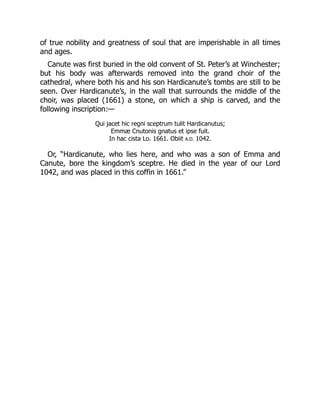
Canute was first buried in the old convent of St. Peter’s at Winchester;
but his body was afterwards removed into the grand choir of the
cathedral, where both his and his son Hardicanute’s tombs are still to be
seen. Over Hardicanute’s, in the wall that surrounds the middle of the
choir, was placed (1661) a stone, on which a ship is carved, and the
following inscription:—
Qui jacet hic regni sceptrum tulit Hardicanutus;
Emmæ Cnutonis gnatus et ipse fuit.
In hac cista Lo. 1661. Obiit A.D. 1042.
Or, “Hardicanute, who lies here, and who was a son of Emma and
Canute, bore the kingdom’s sceptre. He died in the year of our Lord
1042, and was placed in this coffin in 1661.”
45.
[++] Hardicanute’s Tombstone,ship
The form of the ship on the tombstone shows it to be of no older date
than the seventeenth century; but it was possibly carved there because
a ship of war had previously adorned the tomb of Hardicanute. At all
events, it indicates his relationship with the powerful Scandinavian sea-
kings, and his descent from those Northmen who for centuries were
absolute on the ocean.
Above the before-mentioned wall, in the grand choir, there stands to
the left of the entrance a rather plain wooden coffin, decorated with a
gilt crown, half fallen off, with the inscription:—
“In this and another coffin, directly opposite, repose the remains
of Kings Canute and Rufus, of Queen Emma, and of the Archbishops
46.
Winde and Alfvin.”
[++]Canute’s Tomb
In Cromwell’s time, the coffins of the kings in the grand choir of
Winchester cathedral were broken open, and the bones dispersed; but
they were afterwards collected together, as far as this could be done,
and again placed in the grand choir in coffins like the one just
mentioned. Thus Canute the Great, whose ambition could not be
bounded even by three kingdoms, has not retained so much as a grave
for himself and his beloved Emma. The presentiment of the
perishableness of all earthly power that seized him when he deposited
his golden crown in the same place has, in truth, been fulfilled!
The other royal coffins that surround the grand choir in Winchester
contain the bones of several old Saxon kings. That the Danish kings
Canute and Hardicanute should be entombed among them, in the midst
of Anglo-Saxon south England, is a sufficient proof of the immense
change that had taken place with regard to the Danes in England since
their first appearance there as barbarous heathen Vikings. Instead of
their kings seeking renown by the destruction of churches and convents,
and by murdering or maltreating the clergy; instead of their despising
any other kind of burial than that in the open fields, on hills under large
cairns, or monumental stones, their successors were now regarded as
47.
the benefactors andprotectors of the Church, and as such worthy to
repose in the most important ecclesiastical edifices, even in the principal
district of their former mortal enemies. Nay, the clergy there were
indefatigable in handing down their glory to the latest ages; and thus a
statue of Canute the Great was long to be seen in the cathedral of
Winchester.
But this also affords a striking proof that the Danes and Anglo-Saxons
no longer regarded each other so much in the light of strangers, or with
such mutual feelings of enmity as before; and that Canute had thus
happily broken through the strong barrier which had hitherto separated
Saxon south England from Danish north England.
48.
Section V.
The Wash.—TheFive Burghs.—The Humber.—York.—Northumberland.—Stamford
Bridge.
The Thames certainly brought many Danes in ancient times to the
country south of Watlinga Stræt; but the large bay on the eastern coast
of England, called the “Wash,” and the rivers Humber, Tees, and Tyne,
attracted still more of them to the eastern and northern districts. The
Wash especially seems to have been one of the landing places most in
favour with them. Whether it were its situation, directly opposite to
Jutland on the one side, and on the other, on a line with the fruitful
midland districts of England; or whether it were rather the rapid current
which sets in there that attracted the ships of the Vikings, is a point that
we must leave undecided. This much, however, is certain, that the first
and richest settlements of the Danes were around this bay; and from it
afterwards extended itself quite up to the frontiers of Scotland, the so-
called “Danelagh;” which was a district so considerable as to comprise
fifteen of the thirty-two counties, or shires, then existing in England, and
amongst them the extensive county of Northumberland.
South of the Wash, and extending towards the Thames, lay East
Anglia (Norfolk and Suffolk); which, a century after the commencement
of the Vikings’ expeditions, was already in the hands of the Danes.
Alfred the Great was compelled to cede it, together with several
adjacent tracts of country, by formal treaty, to the Danish King Gudrun,
or Gorm. It is certain that it had at that time, like Kent, received many
Danish settlers, particularly from the neighbouring Jutland, and their
number continually increased. Yet in East Anglia they seem to have
been scarcely more in a condition to compete with the Anglo-Saxons, in
regard to population and power, than in Kent. It was only on the coast,
and indeed only on that of Norfolk, that they had any settlements, as
the Scandinavian names of places still preserved there show. These
districts lay too near to the main strength of the Anglo-Saxons. The
Saxon inhabitants did not easily suffer themselves to be expelled, and
49.
the Danish dominionthere could not, consequently, become of
permanent importance.
But to the north and west of the Wash the Danes obtained a very
different footing. In the province called Mercia (or the Marches), which
formed the centre of England, and in that of Lindisse (or, in old Norsk,
Lindisey), which extended from the Wash to the Humber, they were not
only in possession of a great number of villages and landed estates,
which they had selected to settle on, but had likewise made themselves
masters of several towns, and particularly the five strong fortresses of
Stamford, Leicester, Derby, Nottingham, and Lincoln. These places,
which as early as Alfred’s reign belonged to the Danes, and which were
distinguished by their size, their commerce, and their wealth, obtained
the name of “The Five Burghs” (Femborgene). They formed, as it were,
a little separate state, and possessed in common their own courts of
judicature, and other peculiar municipal institutions. The hostile and
dangerous neighbourhood of the Saxons naturally compelled them to
coalesce together as much as possible; and for a very long period they
formed the chief support of the Danish power in England. Protected by
them from all attacks from the south, the Scandinavian settlers were
enabled securely to continue establishing themselves in the more
northern districts. To arrest the sudden attacks of the Britons in the
west, the Danes also had, on the north-eastern frontier of Wales, the
city of Chester, whose name (Anglo-Saxon, Lægeceaster, from the Latin
castra, a camp) shows that it had been a fortified place still earlier,
under the Romans.
Chester formed one of the principal entrances from Wales into the
midland parts of England, as well as into what was then called
Northumberland: under which name was comprised, at least by the
Danes and Norwegians, all the country to the north of the rivers Mersey
and Humber, from sea to sea, and up to the Scottish frontier. Covered by
the “Five Burghs,” it was here that the greater part of Danish England
lay. It was a country filled, particularly in the north-west, with
mountains, and intersected by numerous rivers. Near these, valleys
opened themselves in every direction, of which the largest and most
considerable lay around the tributary streams of the Humber, in what is
now Yorkshire. A separate kingdom had existed here from the oldest
times; and here the Danes, like the Britons, the Romans, and the Anglo-
50.
Saxons before them,possessed the most important city in the north of
England. Built on the river Ouse, which falls into the Humber, it carried
on an extensive trade; and, as the principal seat of the Northumbrian
kings and chiefs, was doubly important. The Britons called it “Caer
Eabhroig,” or “Eabhruc,” the Romans “Eboracum,” the Anglo-Saxons
“Eoforwic,” and the Danes “Jorvik;” whence it is plain that the form
“York,” now in use, is derived.
The Humber and York were for the north of England much what the
Thames and London were for the south. It is not therefore surprising
that York came to possess within its walls the largest and most splendid
cathedral in England, which still towers aloft, a proud and awe-inspiring
monument of the power and religious enthusiasm of the middle ages;
nor that the history of York comprises, so to speak, the whole of that of
Northumberland.
The soil of south England received the dust of the Christian Danish
kings, and of Canute the Great, the hero of Christendom. But the north
of England held the bones of many a mighty Danish chieftain, who had
never renounced his belief in the ancient gods; and, in the
neighbourhood of York, one of the most renowned of heathen heroes,
King Regner Lodbrog, met his death. The names of Regner and his sons
were reverenced and feared in England from their earlier Viking
expeditions. When about to invade England, he suffered shipwreck, and
together with only a few of his men saved himself on the coast of
Northumberland. The Saxon king, Ella, advanced against him from York;
a battle ensued, and, after the bravest resistance, Regner was overcome
and made a prisoner. With true northern pride he would not make
himself known to Ella, who caused him to be thrown into a pen filled
with snakes; and it was not till the dying Regner had sung his swan’s-
song, “Grynte vilde Grisene, kjendte de Galtens Skjebne” (How the
young pigs would grunt if they knew the old boar’s fate), that Ella too
late observed to his terror that he had exposed himself to the fearful
vengeance of the king’s sons; who, guided by the shrewd Ivar Beenlöse,
had long been silently preparing for the conquest of Ella’s kingdom. Ella
was vanquished and made prisoner; and, according to the Norwegian
legend, Regner’s sons, to avenge their father’s miserable death, caused
a blood-eagle to be carved on Ella’s back. The place of Ella’s death is
said by some to have been near the town of “Ellescroft,” or Ella’s Grave.
51.
The English accountsmake Regner’s sons, Ingvar and Ubbe, revenge
their father’s death in the year 870, by murdering in a most horrible
manner King Edmund (who was afterwards canonized) at the castle of
Æglesdon, in East Anglia. They shot at him as at a mark, then cut off his
head, and lastly laid the body among thorns, in the same forest where
their father had been put to death.
Ivar Beenlöse (the Boneless) succeeded to the kingdom of
Northumberland after Ella; where also such names of subsequent kings
as Sigtryg, Regnald, Godfred, Anlaf (Olaf), and Heric (Erik),
unmistakably show their Scandinavian origin. In Olaf’s time, at the
beginning of the tenth century, the Anglo-Saxon king Athelstane
(Adelsteen) succeeded in subjecting Northumberland, whilst Denmark
and Norway, as before mentioned, were prevented by internal
distractions from sending any effectual assistance to the Danes in
England. Olaf fled to Ireland, and Godfred to Scotland, to assemble the
Scandinavian warriors in those parts, and Athelstane in the mean time
destroyed the Danish castle in York. It is related that Olaf returned with
more than six hundred ships, and again took possession of York. He had
with him a great number of Northmen and Danes from Ireland and
Scotland, together with a great many Celtic Cymri and Britons, and the
Scottish King Constantine was also in his army. Athelstane and this
brother Edmund arrayed a mighty force against them at Brunanborg
(Bromford?), where, in the year 937, a battle was fought; which, though
unfavourable to the Danes, afforded the old northern bards matter for
enthusiastic song, of which the Sagas have still preserved some
remains. Subsequently a treaty with King Edmund, in 941, gave Olaf the
dominion over the country east and north of Watlinga-Stræt; but the
dispute soon broke out afresh. After the death of the Northumbrian King
Erik in 951, Northumberland ceased to be a kingdom. From this time it
became an earldom (Jarledömme), which was, however, for the most
part, almost entirely independent of the Anglo-Saxon kings, and
governed by Norwegian chieftains. For a long time it constantly received
fresh inhabitants from the mother countries, Denmark and Norway.
Many Norwegians came over; nay, even the King Erik just mentioned
may possibly have been the renowned Norwegian King Erik Blodöxe, a
son of Harald Haarfager, the first absolute sovereign of Norway. After
the death of Harald, Erik became chief sovereign in Norway; but he and
52.
his queen, thenotorious Gunhilde, ruled here with so much cruelty, that
the Norwegians gave Erik the surname of Blodöxe (Blood-axe). Driven
from his kingdom, he at length repaired to Northumberland, where King
Athelstane is said to have made him a tributary king, and where, after
many vicissitudes of fortune, he met his death.
Between the Northumbrian Jarledömme—whence the dignity of the
Northern “Jarls” began to extend itself to the rest of England, which has
still preserved it in the title of “Earl”—as well as between the Danish
part of England and the proper kingdom of the Anglo-Saxons in general,
disputes must naturally have prevailed of a more or less sanguinary
kind. As a necessary consequence of this, the Danish kings, in their later
expeditions against the Anglo-Saxons for the purpose of conquest,
resorted to, and sought support in, the Danish part of the north of
England, in the districts near the Humber. In the year 1013, King Svend
Tveskjæg anchored in this river with a powerful fleet, when he came
over to conquer England. In conjunction with his son Canute, who
afterwards completed the conquest, he had previously lain at anchor at
Sandvik (Sandwich), in Kent. From the Humber he anchored in the river
Trent, at Gegnesburgh (or Gainsborough), in Lincolnshire; whence he
harried the whole of eastern, and part of southern England. The Old
Danish land to the north of Watlinga-Stræt was the first to pay him
homage; the rest of England soon yielded to him, and King Ethelred was
obliged to fly to Normandy. But just as Svend, in the midst of his
victorious career, had returned to Gainsborough—just as he was fleecing
and levying contributions both on laity and clergy—he suddenly fell from
his horse at an assize, or Thing, in a fit of illness, and died the following
night, the 3rd of February, 1014. Monkish chronicles relate that it was
St. Edmund who killed him. Ethelred, who now returned to England, in
vain ordered a strict search to be made for the body of Svend, with the
view of wreaking a cowardly vengeance on the impotent corpse of the
man who, when alive, had been so terrible an antagonist to him. But the
body had been secretly conveyed to York, where it was kept concealed
during the winter (but scarcely in the cathedral, although that church
had been founded long before, and was, perhaps, even considerably
enlarged by the Norwegian princes who resided at York). Towards the
spring it was brought over to Denmark by some Englishwomen, who
53.
were probably ofScandinavian extraction, and placed in the cathedral of
Roeskilde, in one of the pillars in the grand choir.
Under the Danish rule, the Danish-Norwegian population in the north
of England increased considerably, both in strength and numbers;
although Christianity, by the wise arrangements of Canute, and
particularly by his severe laws against heathenism, was almost
completely disseminated there. Even after the Danish dominion had
come to an end by the death of Hardicanute in 1042, and the Anglo-
Saxon kings had again taken the helm, the old warlike spirit of the north
continued, in spite of Christianity, to stir in the Northumbrian people.
The successors of the Vikings still preferred, to a natural death, a
glorious one on the field of battle; but Christian tenets no longer
permitted them to be marked, when on the bed of sickness, with the
point of a spear, in order to consecrate themselves to Odin, according to
the heathen custom. The mighty Danish jarl Sivard (Sigeward or Siwerd)
reigned over them at that time, who had fought in many battles both in
England and Scotland, whereby his name became immortalized in
Shakspeare’s “Macbeth.” When the news was brought to him that his
son had fallen in battle, he inquired whether he had received his death
wound in front or behind. Being answered, “Before;”—“In that case,” he
exclaimed, “I have reason to rejoice, for no other death was befitting
my son, or me.” When Siward himself afterwards lay on his death-bed,
and felt the approach of dissolution, an old chronicler (Henry of
Huntingdon) represents him as breaking out into sorrowful complaints,
and exclaiming, “How shameful it is for me, that I have never been able
to meet death in my numerous battles, but have been reserved to die
with disgrace like an old cow. Clothe me at least in my impenetrable
armour, gird me with my sword, cover my head with my helmet, place
my shield in my left, and my gilded axe in my right hand, that I, the
bold warrior, may also die like one.” Attired in full armour, he passed
gladly to his fathers in the year 1055, and doubtless with the secret
hope of enjoying in Valhalla a continuation of that proud martial life for
which there would soon have been no longer room either in
Northumberland or in the parent lands of Scandinavia.
Shortly after the death of Siward, the country near York also became
the theatre where one of the last celebrated Vikings of the north fell.
Harald Haardraade was indeed a Christian, and a king in Norway; but
54.
with him, aswith many of his cotemporaries, Christianity dwelt only on
his lips. In his heart he was still the bold Viking, who valued Hildur’s
bloody game more than holy psalms, and who preferred conquest on
foreign shores to the peaceful government of an hereditary kingdom.
Whilst still young he had distinguished himself in expeditions in the East,
and in the Greek Empire. It seemed to him disgraceful that those lands,
particularly in the north of England, which had once belonged to his
forefathers, should for ever be wrested from Norway. He therefore
agreed to assist Toste Godvinsön against his brother, the English King
Harald Godvinsön; but on the condition that he himself, if he succeeded
in conquering Harald, should have the dominion of England, whilst Toste
was to have the half of it as jarl, or earl. They landed in the Humber;
but in the battle which shortly afterwards took place (in 1066) at
Stamford Bridge, a little to the east of York, both Toste and Harald fell.
Thus the latter gained no more of England’s soil than the English King
Harald had offered him before the battle, namely, “seven feet of earth,
or as much as he was taller than other men.”
This was one of the last serious attempts on the part of Denmark or
Norway to reconquer England; and in the same year the Normans, after
the battle of Hastings, in which King Harald fell, seized the kingdom
which their Danish kinsmen had formerly possessed. William the
Conqueror went in person against the Northumbrians; but before he
disembarked he is said to have broken up the tumulus on the coast (by
the Humber?) in which, according to the legend, Regner Lodbrog’s son,
Ivar Beenlöse, had ordered himself to be buried, in order to avert the
attacks of foreigners. William had to combat long before he could
reduce Northumberland; but, as we shall afterwards see, he never
succeeded in subduing that spirit of freedom and independence which
the Danes and Norwegians had planted there.
55.
Section VI.
Danish-Norwegian Memorialsin the North of England.—Coins.—The
Raven.—The Danish Flag.
If even the old Saxon south England is distinguished by its richness in
legends and still-existing memorials of the Danes, it is natural that they
should be met with in still greater numbers in the old Danish districts to
the north and east of Watlinga-Stræt.
Here also the Norwegian saint, “St. Olave,” has been zealously
worshipped, both in the country and in the towns. In Norfolk (East
Anglia) there is a bridge called “St. Olave’s Bridge.” In itself it is a
remarkable monument of a time when bridges over rivers were
regarded as such considerable and important structures that, like
churches, they were named after, or dedicated to saints; in ancient
Scandinavia they even built bridges, as several runic stones testify, “for
their souls’ salvation.” In the city of Chester, on the northern frontier of
Wales, there is to be found in the southern outskirts, opposite the old
castle and close to the river Dee, a church and parish which still bear
the name of St. Olave. By the church runs a street called “St. Olave’s
Lane.” In the north-west part of York there is likewise a St. Olave’s
church, said to be the remains of a monastery founded by the powerful
Danish Jarl Siward, who was himself buried there in the year 1055.
There can be no doubt that similar churches dedicated to St. Olave were
scattered about in other towns of north England, where further
researches might possibly yet discover at least some of them.
These traces of the importance formerly conferred on St. Olave in the
towns of north England lead one to conjecture that, even after the
Danish ascendancy in England was annihilated, a great number of
Northmen must have continued to reside there, as was the case in
London. This is so much the more natural, as, long before the Norman
Conquest, the Northmen preponderated in many, perhaps in most,
mercantile towns of the north of England, and particularly in the fortified
towns occupied by the Danes. At the time of the Conquest, the
population in some of the largest and most important cities towards the
56.
east coast, suchas Lincoln and York, is said to have been almost
exclusively of Scandinavian extraction; hence it was that Lincoln and
York, at least, preserved their original Scandinavian “husting”
throughout the middle ages, and even later.
In and about the last-named city, which was the chief place in Danish
north England, are numerous Scandinavian memorials. The names of
several streets in York end in gate. In London, where the same
termination of the names of streets frequently occurs, some have,
indeed, endeavoured to derive this gate from the gates which these
streets adjoined; and, as far as regards London, this explanation may
probably in most cases be correct. But in York, where formerly there
were at least a score of such streets, it is certainly by no means a
probable conjecture that twenty gates existed from which their names
were derived; and it therefore becomes a question whether these gates
should not be derived from the old Scandinavian “gata” (a street),
particularly when they appear in compound names, such as Petersgate
(Petersgade), Marygate (Mariegade), Fishergate (Fiskergade), Stonegate
(Steengade), Micklegate (from the old Scandinavian “mykill,” signifying
great); which have a striking resemblance with Scandinavian names of
streets; nay, there is even a legend respecting Godram, or Guthramgate,
that it was named after a Danish chieftain, Guthrum or Gorm, who is
said to have dwelt there. The historical accounts of the number and
influence of the Northmen in York cannot but strengthen these
suppositions in a high degree.
North-east of York, on the coast towards the German ocean, is a
promontory called “Flamborough-head.” It is separated from the main
land by an immense rampart said to have been raised by the Danes,
and called on that account “the Danes’ Dyke,” behind which they
intrenched themselves on landing. At no great distance, near Great
Driffield, is “the Danes’ Dale,” and “the Danes’ Graves,” where remains
of the Danes who fell in a battle are said to have been dug up. South of
York, on the Humber, between Richal and Skipwith, human bones and
pieces of iron have likewise been found in several barrows, or tumuli,
ascribed to the Danes. It is supposed that the Danes and Norwegians
landed in this neighbourhood at different times, when proceeding up the
Humber on their warlike expeditions.






![[++] Hardicanute’s Tombstone, ship
The form of the ship on the tombstone shows it to be of no older date
than the seventeenth century; but it was possibly carved there because
a ship of war had previously adorned the tomb of Hardicanute. At all
events, it indicates his relationship with the powerful Scandinavian sea-
kings, and his descent from those Northmen who for centuries were
absolute on the ocean.
Above the before-mentioned wall, in the grand choir, there stands to
the left of the entrance a rather plain wooden coffin, decorated with a
gilt crown, half fallen off, with the inscription:—
“In this and another coffin, directly opposite, repose the remains
of Kings Canute and Rufus, of Queen Emma, and of the Archbishops](https://image.slidesharecdn.com/17998-250422191550-2284c7cc/85/Negotiation-7th-Edition-Lewicki-Test-Bank-45-320.jpg)
![Winde and Alfvin.”
[++] Canute’s Tomb
In Cromwell’s time, the coffins of the kings in the grand choir of
Winchester cathedral were broken open, and the bones dispersed; but
they were afterwards collected together, as far as this could be done,
and again placed in the grand choir in coffins like the one just
mentioned. Thus Canute the Great, whose ambition could not be
bounded even by three kingdoms, has not retained so much as a grave
for himself and his beloved Emma. The presentiment of the
perishableness of all earthly power that seized him when he deposited
his golden crown in the same place has, in truth, been fulfilled!
The other royal coffins that surround the grand choir in Winchester
contain the bones of several old Saxon kings. That the Danish kings
Canute and Hardicanute should be entombed among them, in the midst
of Anglo-Saxon south England, is a sufficient proof of the immense
change that had taken place with regard to the Danes in England since
their first appearance there as barbarous heathen Vikings. Instead of
their kings seeking renown by the destruction of churches and convents,
and by murdering or maltreating the clergy; instead of their despising
any other kind of burial than that in the open fields, on hills under large
cairns, or monumental stones, their successors were now regarded as](https://image.slidesharecdn.com/17998-250422191550-2284c7cc/85/Negotiation-7th-Edition-Lewicki-Test-Bank-46-320.jpg)