“The National Council on U.S‐Arab Relations is responsible for where I am today ‐‐ it was my National
Council scholarship to study in the region that not only caused me to fall in love with the Arab world, but
also introduced me to the Foreign Service, thanks to an event at the American Ambassador's house on
the 4th of July. As the Ambassador talked to us about his career, I thought to myself, "People get PAID to
do that?!?"
After college and an internship with the National Council, I joined the Foreign Service at twenty‐three
determined to specialize in the Arab world, and that is precisely what I have done. I've now been in the
Foreign Service for well over a decade, and I still wake up every morning thinking, "People get PAID to do
this?!?"
Foreign Service Officer, U.S. Department of State
Dear Friends of the National Council on U.S.‐Arab Relations:
The words above were written only a few weeks ago, though they relate to a student’s experiences with
the National Council − traveling in the Middle East as a student and working in the Washington office as
an intern – more than two decades ago. These recollections of the importance of the National Council
programs in shaping the transformation of a young person from an enthralled high school student
traveler, to an engaged learner at university seriously encountering the history, culture, and language of
the Arab world, into a perceptive, responsible, experienced foreign affairs professional are gratifying.
But, these same words also constitute a challenge: is the metamorphosis of one young person described
here a unique occurrence, or can the National Council offer similar challenging and transformative
experiences to succeeding generations of students and emerging leaders?
I am pleased to share with you this record of the activities of our Summer 2008 interns. Participation in
the National Council’s summer internship program is competitive and highly selective. Each intern
worked full‐time in an organization whose focus was United States foreign policy and whose concerns
dealt frequently with the Arab‐U.S. relations. In addition, the interns met in academic seminars two
evenings a week and met on‐site with foreign affairs professionals, who modeled a wide‐variety of
possible career directions, on a weekly basis. This document is a record of those activities.
The National Council describes its mission as educational outreach, and leadership development is a
large part of that agenda. Here you will meet an exceptional group of young people whose college
studies, international interests, and personal experience brought them to a point where they were
willing to devote a summer to working and studying in Washington, D.C. in order to better understand
the complexities and the nuances of U.S.‐Arab relations. These pages tell the story of their experience,
demonstrate evidence of their growth, and offer proof that such internship experiences can and do
change lives.
You’ll find the reflections of this summer’s interns throughout this document. I will let those words
attest to the power and the impact of this experience on their intellectual and professional lives.
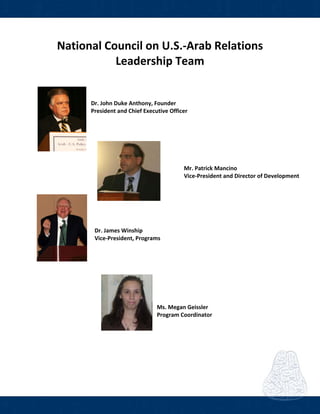
President and CEO
National Council on U.S.‐Arab Relations
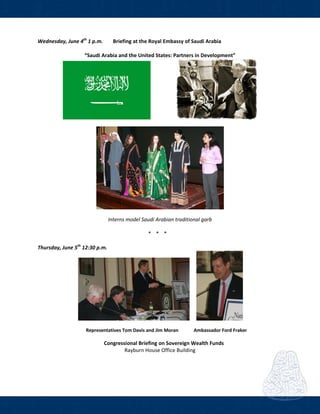
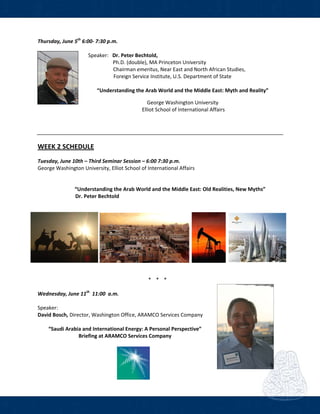
Thursday, June 5th
6:00‐ 7:30 p.m.
Speaker: Dr. Peter Bechtold,
Ph.D. (double), MA Princeton University
Chairman emeritus, Near East and North African Studies,
Foreign Service Institute, U.S. Department of State
“Understanding the Arab World and the Middle East: Myth and Reality”
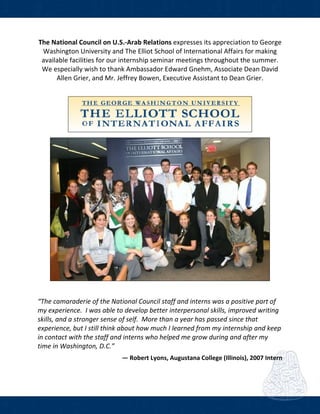
George Washington University
Elliot School of International Affairs
WEEK 2 SCHEDULE
Tuesday, June 10th – Third Seminar Session – 6:00 7:30 p.m.
George Washington University, Elliot School of International Affairs
“Understanding the Arab World and the Middle East: Old Realities, New Myths”
Dr. Peter Bechtold
* * *
Wednesday, June 11th
11:00 a.m.
Speaker:
David Bosch, Director, Washington Office, ARAMCO Services Company
“Saudi Arabia and International Energy: A Personal Perspective”
Briefing at ARAMCO Services Company
6.
Thursday, June 12th
6:00‐ 7:30 p.m.
Speaker: Dr. Peter Bechtold
“U.S. Foreign Policy Toward the Middle East: From GW to GW”
George Washington University
Elliot School of International Affairs
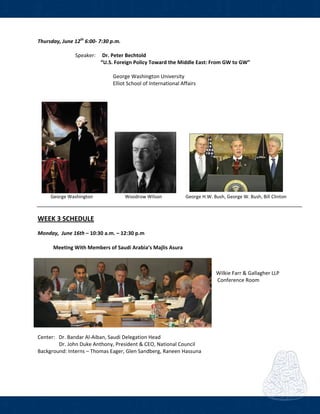
George Washington Woodrow Wilson George H.W. Bush, George W. Bush, Bill Clinton
WEEK 3 SCHEDULE
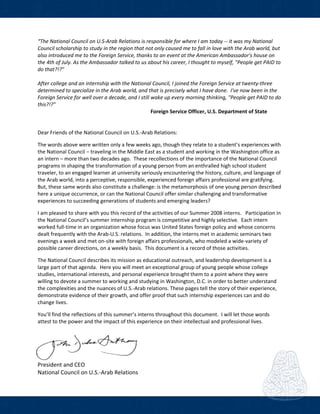
Monday, June 16th – 10:30 a.m. – 12:30 p.m
Meeting With Members of Saudi Arabia’s Majlis Asura
Wilkie Farr & Gallagher LLP
Conference Room
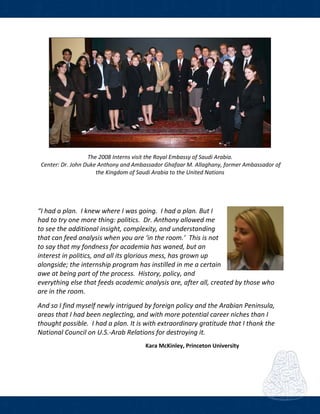
Center: Dr. Bandar Al‐Aiban, Saudi Delegation Head
Dr. John Duke Anthony, President & CEO, National Council
Background: Interns – Thomas Eager, Glen Sandberg, Raneen Hassuna
Wednesday, June 18th
12:00 Noon George Washington University
Elliot School of International Affairs
“Representing ConocoPhillips: From the Arab World to Inside the Beltway”
M. Kay Larcom, Manager, Federal and International Affairs ConocoPhillips Company
* * *
Thursday, June 12th
6:00‐ 7:30 p.m. Elliot School of International Affairs
“Arab Regional Organizations: Context, Background, Perspective”
Dr. John Duke Anthony, President and CEO, National Council on U.S.‐Arab Relations
* * *
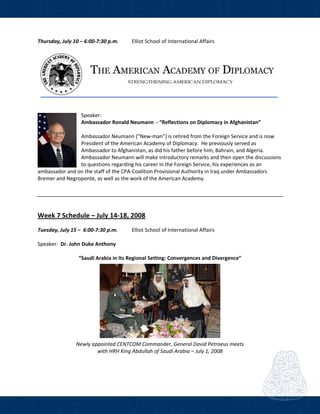
Thursday, July 3 – 1:00‐2:30 p.m. Museum Tour ‐ Sackler and Freer Galleries
Smithsonian Museum
“Arts of the Islamic World” Tour
"Arts of the Islamic world" or "Islamic art" are relatively recent terms coined in reference to the
different artistic traditions that have flourished since the advent of Islam in the seventh century over a
vast geographic area extending from Morocco and Spain to the islands of Southeast Asia. As heirs to the
rich visual cultures of the Byzantine empire of the eastern Mediterranean world (342–1453) and the
Sasanian Empire of Iran (ca. 224–651), the arts emerged as a powerful, creative force in Islamic
communities, capable of highlighting secular and religious objectives as well as human impulses.
Calligraphy, or beautiful writing, is the most revered form of artistic
expression in the Islamic world, for it was through the act of writing that
the Koran, the word of God revealed in a series of revelations to the
Prophet Muhammad, was recorded and given visual form. Consequently,
the Arabic script was continuously refined and imaginatively embellished
to become the most recognizable and ubiquitous symbol of Islam.
Contrary to the assumption that the Koran prohibits figurative
representation, it only warns against the creation and worship of idols to
prevent idolatry. Fueled by more orthodox interpretations of Islam,
however, religious disapproval of figural representation took hold shortly
after the Prophet's death in 632. In general, Korans, religious structures,
and the furnishings for these spaces are devoid of figural imagery and
adorned primarily with abstract motifs and calligraphy. In part, the religious prohibitions encouraged the
development of a distinct abstract decorative language that became another principle feature of the
arts of the Islamic world.
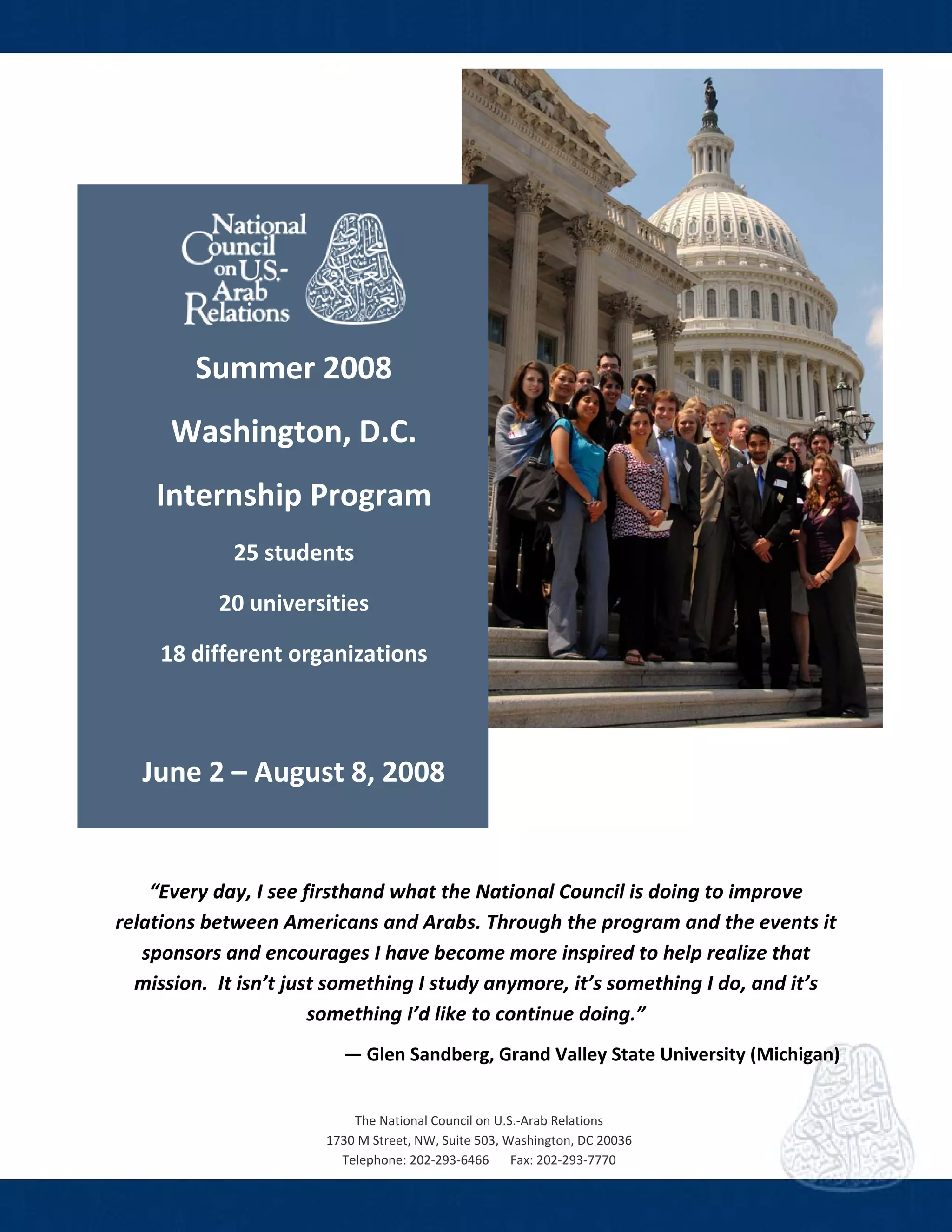
The National Council on U.S.‐Arab Relations arranged so many
events for us, giving us access to places in D.C. – such as foreign
embassies and Congressional hearings – that might otherwise
been unavailable to us. I believe that the National Council’s
programming enriched my experience in D.C. in a way that
wouldn’t have been possible had I simply found an internship
independently.
Veronica Corsaro, New York University
14.
Week 6 Schedule – July 7‐11, 2008
Monday, July 7 – 6:00‐7:30 p.m. Elliot School of International Affairs
Speaker: Dr. Peter Bechtold, “Understanding Islam”
This session is REQUIRED of all interns in preparation for our visit to the Islamic Center on
Wednesday, July 9th
.
* * *
Tuesday, July 8 ‐ 5:00 Reception, 5:30‐7:00 p.m. Keynote Speech and Roundtable Discussion
Center for Strategic and International Studies,
“A New Vision for America’s Future: Young Leaders Shaping an International Future”
http://nextamerica.csis.org/
Speaker:
General (ret.) Colin L. Powell, 65th
United States Secretary of State
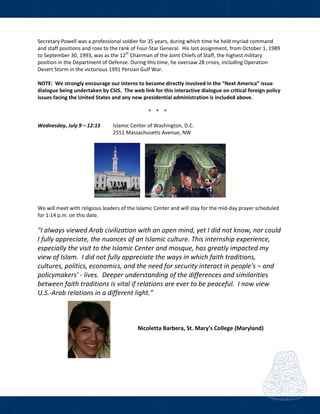
Colin L. Powell was nominated by President Bush on December 16, 2000 as Secretary
of State. After being unanimously confirmed by the U.S. Senate, he was sworn in as
the 65th
Secretary of State on January 20, 2001.
Prior to his appointment, Secretary Powell was the chairman of America’s Promise ‐ The Alliance for
Youth, a national nonprofit organization dedicated to mobilizing people from every sector of American
life to build the character and competence of young people.
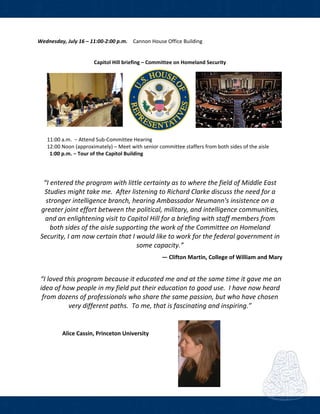
Wednesday, July 16 – 11:00‐2:00 p.m. Cannon House Office Building
Capitol Hill briefing – Committee on Homeland Security
11:00 a.m. − Attend Sub‐Committee Hearing
12:00 Noon (approximately) – Meet with senior committee staffers from both sides of the aisle
1:00 p.m. − Tour of the Capitol Building
“I entered the program with little certainty as to where the field of Middle East
Studies might take me. After listening to Richard Clarke discuss the need for a
stronger intelligence branch, hearing Ambassador Neumann's insistence on a
greater joint effort between the political, military, and intelligence communities,
and an enlightening visit to Capitol Hill for a briefing with staff members from
both sides of the aisle supporting the work of the Committee on Homeland
Security, I am now certain that I would like to work for the federal government in
some capacity.”
― Clifton Martin, College of William and Mary
“I loved this program because it educated me and at the same time it gave me an
idea of how people in my field put their education to good use. I have now heard
from dozens of professionals who share the same passion, but who have chosen
very different paths. To me, that is fascinating and inspiring.”
Alice Cassin, Princeton University
18.
Thursday, July 17 – 6:00‐7:30 p.m. Elliot School of International Affairs
“Saudi Arabia’s Domestic Dynamics: Elites, Interest Groups, and National Development Processes”
Dr. John Duke Anthony
Week 8 Schedule – July 21‐25, 2008
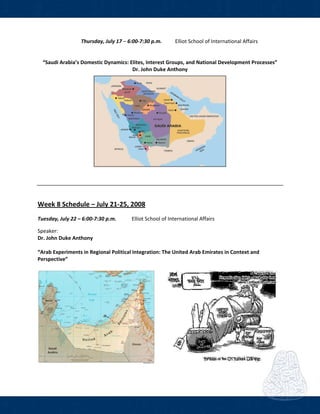
Tuesday, July 22 – 6:00‐7:30 p.m. Elliot School of International Affairs
Speaker:
Dr. John Duke Anthony
“Arab Experiments in Regional Political Integration: The United Arab Emirates in Context and
Perspective”
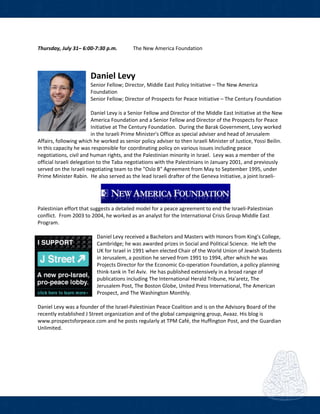
Thursday, July 31– 6:00‐7:30 p.m. The New America Foundation
Daniel Levy
Senior Fellow; Director, Middle East Policy Initiative – The New America
Foundation
Senior Fellow; Director of Prospects for Peace Initiative – The Century Foundation
Daniel Levy is a Senior Fellow and Director of the Middle East Initiative at the New
America Foundation and a Senior Fellow and Director of the Prospects for Peace
Initiative at The Century Foundation. During the Barak Government, Levy worked
in the Israeli Prime Minister's Office as special adviser and head of Jerusalem
Affairs, following which he worked as senior policy adviser to then Israeli Minister of Justice, Yossi Beilin.
In this capacity he was responsible for coordinating policy on various issues including peace
negotiations, civil and human rights, and the Palestinian minority in Israel. Levy was a member of the
official Israeli delegation to the Taba negotiations with the Palestinians in January 2001, and previously
served on the Israeli negotiating team to the "Oslo B" Agreement from May to September 1995, under
Prime Minister Rabin. He also served as the lead Israeli drafter of the Geneva Initiative, a joint Israeli‐
Palestinian effort that suggests a detailed model for a peace agreement to end the Israeli‐Palestinian
conflict. From 2003 to 2004, he worked as an analyst for the International Crisis Group Middle East
Program.
Daniel Levy received a Bachelors and Masters with Honors from King's College,
Cambridge; he was awarded prizes in Social and Political Science. He left the
UK for Israel in 1991 when elected Chair of the World Union of Jewish Students
in Jerusalem, a position he served from 1991 to 1994, after which he was
Projects Director for the Economic Co‐operation Foundation, a policy planning
think‐tank in Tel Aviv. He has published extensively in a broad range of
publications including The International Herald Tribune, Ha'aretz, The
Jerusalem Post, The Boston Globe, United Press International, The American
Prospect, and The Washington Monthly.
Daniel Levy was a founder of the Israel‐Palestinian Peace Coalition and is on the Advisory Board of the
recently established J Street organization and of the global campaigning group, Avaaz. His blog is
www.prospectsforpeace.com and he posts regularly at TPM Café, the Huffington Post, and the Guardian
Unlimited.
23.
Week 10 Schedule – August 4‐8, 2008
Tuesday, August 5 – 6:00‐7:30 p.m. Elliot School of International Affairs
Association of Professional Schools of International Affairs www.idealist.org
www.apsia.org
“Life After Washington Internships, or Now What Do I Do? – Careers, Graduate
School, Voluntary Service”
Panel Presentation:
Dr. James Winship Vice‐President, Programs
National Council on U.S.‐Arab Relations
Ms. Jenna Beveridge Academic Programs Coordinator
Center for Contemporary Arab Studies, Georgetown University
Ms. Bonnie Wilson Associate Dean for Student Affairs
Nitze School of Advanced International Studies, Johns Hopkins University
Mr. Jason Richards MA Candidate and Graduate Admissions Counselor
Elliot School of International Affairs, George Washington University
* * *
"The internship at the National Council has cemented my interest in
international relations with the Middle East and introduced me to
the unbelievable number of opportunities and career paths open to
me within this field. I had no idea so many organizations and
different jobs existed, but through going to different programs and
working with the database at the Women’s Foreign Policy Group, I
have been exposed to a remarkable range of opportunities."
― Andrea Gordon, Boston College
“As part of the National Council’s internship program, I’ve gained
knowledge of the Near East, North Africa, and the Gulf Arab states
unprecedented in any textbook or study abroad experience. “
− Pamela El‐Safy, College of St. Catherine (Minnesota)
24.
Wednesday, August 6 ‐ 10:00 a.m. Visit to the United States Department of State
The Middle East
Partnership Initiative
"America will stand with the allies of freedom to support
democratic movements in the Middle East and beyond ... Our aim is
to build and preserve a community of free and independent
nations, with governments that answer to their citizens, and reflect their own cultures. And because
democracies respect their own people and their neighbors, the advance of freedom will lead to peace."
‐ President George W. Bush, State of the Union Speech, February 2, 2005
Meeting with:
Mr. Walter Douglas, Director of the Office of Press and Public Diplomacy for the Bureau of Near
Eastern Affairs, U.S. Department of State
Ms. Shahira Tewfik, Public Affairs Special Assistant, Office of the Middle East Partnership Initiative
Ms. Trudie Thompson, Foreign Service Recruitment Officer.
Thursday, August 7 – 6:00‐7:30 p.m. Elliot School of International Affairs
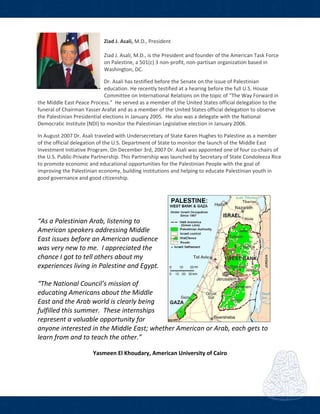
ATFP advocates the following six principles towards a fair and lasting solution to the Israeli‐Palestinian
conflict:
1. Two sovereign states—Israel and Palestine—living side by side in peace and security based on the
borders of June 4, 1967 with mutually agreed upon territorial adjustments.
2. An end to the Israeli occupation and the evacuation of all Israeli settlements, save for equitable
arrangements mutually agreed upon by the negotiating parties.
3. A just solution for the Palestinian refugee problem, in accordance with international legality and the
relevant UN resolutions.
4. A shared Jerusalem open to all faiths, serving as the capital of two states, providing for the fulfillment
of the political aspirations of both the Palestinian and Israeli peoples.
5. Full acceptance of Israel by all Arab states, and normalized diplomatic and economic relations
throughout the region.
6. A "Marshall Plan" style package of aid and investment for Palestine and the new Middle East.
National Council on U.S.‐Arab Relations
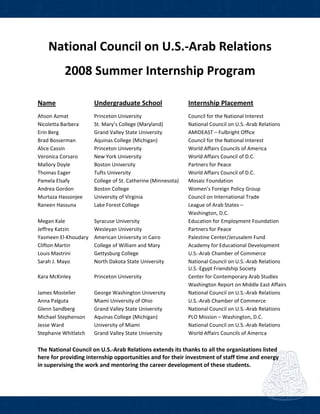
2008 Summer Internship Program
Name Undergraduate School Internship Placement
Ahson Azmat Princeton University Council for the National Interest
Nicoletta Barbera St. Mary’s College (Maryland) National Council on U.S.‐Arab Relations
Erin Berg Grand Valley State University AMIDEAST – Fulbright Office
Brad Bosserman Aquinas College (Michigan) Council for the National Interest
Alice Cassin Princeton University World Affairs Councils of America
Veronica Corsaro New York University World Affairs Council of D.C.
Mallory Doyle Boston University Partners for Peace
Thomas Eager Tufts University World Affairs Council of D.C.
Pamela Elsafy College of St. Catherine (Minnesota) Mosaic Foundation
Andrea Gordon Boston College Women’s Foreign Policy Group
Murtaza Hassonjee University of Virginia Council on International Trade
Raneen Hassuna Lake Forest College League of Arab States –
Washington, D.C.
Megan Kale Syracuse University Education for Employment Foundation
Jeffrey Katzin Wesleyan University Partners for Peace
Yasmeen El‐Khoudary American University in Cairo Palestine Center/Jerusalem Fund
Clifton Martin College of William and Mary Academy for Educational Development
Louis Mastrini Gettysburg College U.S.‐Arab Chamber of Commerce
Sarah J. Mayo North Dakota State University National Council on U.S.‐Arab Relations
U.S.‐Egypt Friendship Society
Kara McKinley Princeton University Center for Contemporary Arab Studies
Washington Report on Middle East Affairs
James Mosteller George Washington University National Council on U.S.‐Arab Relations
Anna Palguta Miami University of Ohio U.S.‐Arab Chamber of Commerce
Glenn Sandberg Grand Valley State University National Council on U.S.‐Arab Relations
Michael Stephenson Aquinas College (Michigan) PLO Mission – Washington, D.C.
Jesse Ward University of Miami National Council on U.S.‐Arab Relations
Stephanie Whitlatch Grand Valley State University World Affairs Councils of America
The National Council on U.S.‐Arab Relations extends its thanks to all the organizations listed
here for providing internship opportunities and for their investment of staff time and energy
in supervising the work and mentoring the career development of these students.



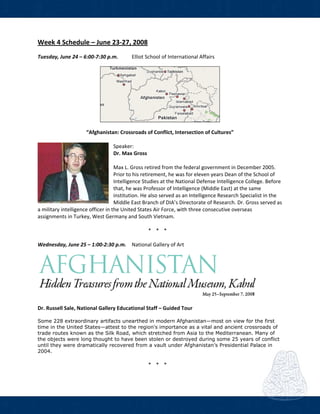
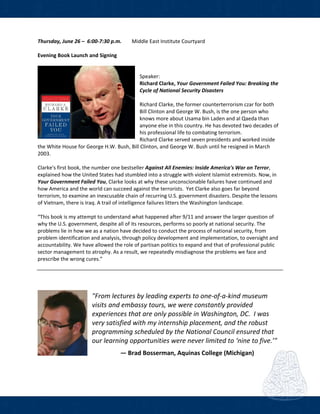
![Week 5 Schedule – June 30‐July 4, 2008
Tuesday, July 1 – 6:00‐7:30 p.m. Elliot School of International Affairs
Speaker:
Dr. John Duke Anthony
“Yemen: Domestic Dynamics, International Positions and Roles”
Please read the following background pieces on Yemen:
www.yemenembassy.org [See especially the “Issues of Interest” section.]
www.state.gov [See “Country Background Notes” on Yemen]
Wednesday, July 2 ‐ 12:15 p.m. Lunch and briefing at Embassy of Qatar
Please read the following background pieces on Qatar:
www.qatarembassy.net [See menu at left‐hand side of
home page.]
www.state.gov [See “Country Background Notes” on
Qatar.]
Map: on‐ and off‐shore oil and natural gas fields as well as
pipelines located in Qatar’s Exclusive Economic Zone [EEZ].](https://image.slidesharecdn.com/be6adfba-06ee-45b2-8ce0-4ec5de901d2d-150909145314-lva1-app6891/85/NCUSAR-08-SUMMER-INTERN-PROGRAM-SCHEDULE-12-320.jpg)
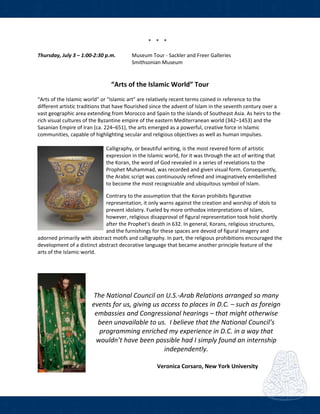
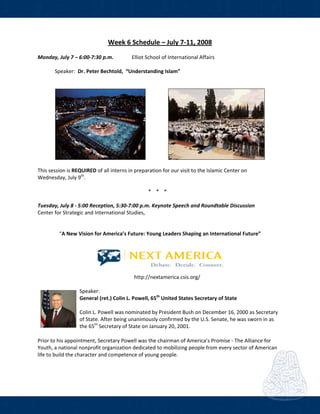
![Tuesday, July 29 – 6:00‐7:30 p.m. Elliot School of International Affairs
Speaker:
Edward W. Gnehm, Jr.
Kuwait Professor of Gulf and Arabian Peninsula Affairs
Ambassador Gnehm was born on November 10, 1944 in Carrollton,
Georgia. He attended The George Washington University,
graduating with a B.A. in International Affairs in 1966 and a M.A. in
1968. From 1966‐1967, he attended The American University in
Cairo, Egypt, under a post‐graduate Rotary International
Fellowship. Subsequent to university, Ambassador Gnehm worked for the United States Navy.
Ambassador Gnehm joined the faculty of the Elliott School of International Affairs at The
George Washington University in August 2004 as the J.B. and Maurice C. Shapiro Visiting
Professor of International Affairs. He was appointed to his present position as Kuwait Professor
of Gulf and Arabian Peninsula Affairs in August 2006. Prior to coming to the Elliott School,
Ambassador Gnehm had a distinguished 36‐year career in the United States Foreign Service. He
was a member of the Senior Foreign Service and held the rank of Career Minister.
2001‐2004, U.S. Ambassador to the Hashemite Kingdom of Jordan
2000‐2001, U.S. Ambassador to Australia
1997‐2000, Director General of the Foreign Service and Director of Personnel for the
Department of State
1994‐1997, Deputy Permanent Representative of the United States to the United
Nations (New York)
1991‐1994, U.S. Ambassador to Kuwait
1989‐1990, Deputy Assistant Secretary of State, Bureau of New East and South Asian
Affairs
1987‐1989, Deputy Assistant Secretary of Defense for the Near East and South Asia
1984‐1987, Deputy Chief of Mission, American Embassy, Amman, Jordan
* * *
Wednesday, July 30 – 12:00‐1:30 p.m. Elliot School of International Affairs
Speaker:
Mr. Jameel Aalim‐Johnson,
Associate Vice‐President of Government Relations NASDAQ Stock Market, Inc.
[Formerly Chief of Staff for Congressman Gregory W. Meeks [D‐NY], House Foreign Affairs Committee]
“International Relations in the Private Sector”](https://image.slidesharecdn.com/be6adfba-06ee-45b2-8ce0-4ec5de901d2d-150909145314-lva1-app6891/85/NCUSAR-08-SUMMER-INTERN-PROGRAM-SCHEDULE-21-320.jpg)