Apple scab- Biology,Epidemiology
and Management
Nazia Manzar
PhD(ID-47067)
plant pathology
Overview
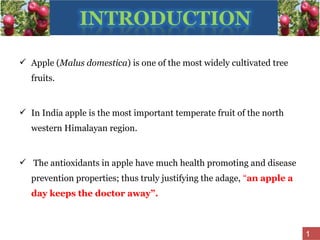
 Apple (Malus domestica) is one of the most widely cultivated tree
fruits.
 In India apple is the most important temperate fruit of the north
western Himalayan region.
 The antioxidants in apple have much health promoting and disease
prevention properties; thus truly justifying the adage, “an apple a
day keeps the doctor away”.
1
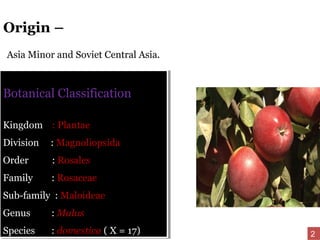
Botanical Classification
Kingdom : Plantae
Division : Magnoliopsida
Order : Rosales
Family : Rosaceae
Sub-family : Maloideae
Genus : Malus
Species : domestica ( X = 17)
Botanical Classification
Kingdom : Plantae
Division : Magnoliopsida
Order : Rosales
Family : Rosaceae
Sub-family : Maloideae
Genus : Malus
Species : domestica ( X = 17)
Origin –
Asia Minor and Soviet Central Asia.
2
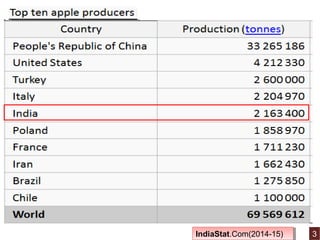
IndiaStat.Com(2014-15)IndiaStat.Com(2014-15) 3
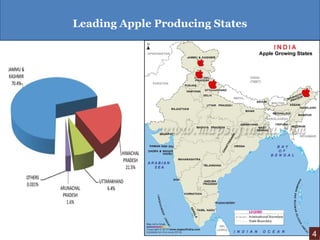
Leading Apple Producing States
4
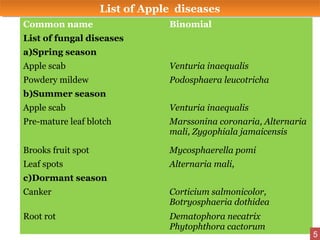
Common name Binomial
List of fungal diseases
a)Spring season
Apple scab Venturia inaequalis
Powdery mildew Podosphaera leucotricha
b)Summer season
Apple scab Venturia inaequalis
Pre-mature leaf blotch Marssonina coronaria, Alternaria
mali, Zygophiala jamaicensis
Brooks fruit spot Mycosphaerella pomi
Leaf spots Alternaria mali,
c)Dormant season
Canker Corticium salmonicolor,
Botryosphaeria dothidea
Root rot Dematophora necatrix
Phytophthora cactorum
List of Apple diseasesList of Apple diseases
5
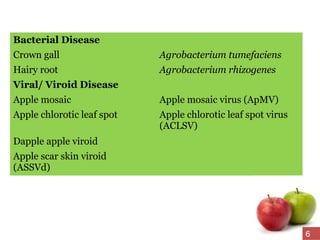
Bacterial Disease
Crown gall Agrobacterium tumefaciens
Hairy root Agrobacterium rhizogenes
Viral/ Viroid Disease
Apple mosaic Apple mosaic virus (ApMV)
Apple chlorotic leaf spot Apple chlorotic leaf spot virus
(ACLSV)
Dapple apple viroid
Apple scar skin viroid
(ASSVd)
6
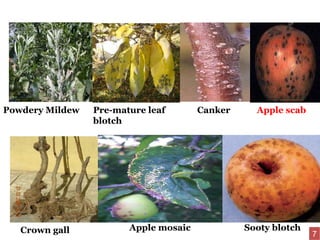
Powdery Mildew
Crown gall
Apple scab
Sooty blotchApple mosaic
Pre-mature leaf
blotch
Canker
7
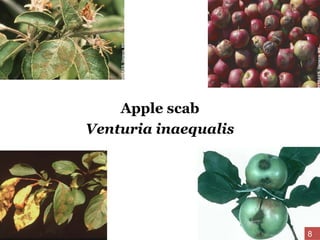
Apple scab
Venturia inaequalis
8
Apple scab in India
 In India-First detected in 1930 on the native cultivar Ambri in
Kashmir Valley.
 1973- Apple scab appeared in epidemic. 70,000 acres orchard area
got infected. Yield losses up to 70 per cent .
 1996 and 2008- Epidemic in the Gangotri valley (Uttarakashi) of
Uttarakhand. Loss up to Rs. 1.25 crores .
9
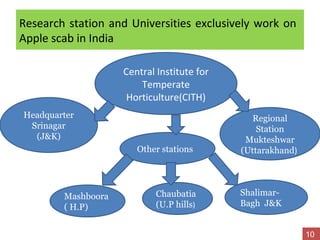
Research station and Universities exclusively work on
Apple scab in India
Central Institute for
Temperate
Horticulture(CITH)
Headquarter
Srinagar
(J&K)
Regional
Station
Mukteshwar
(Uttarakhand)Other stations
Shalimar-
Bagh J&K
Mashboora
( H.P)
Chaubatia
(U.P hills)
10
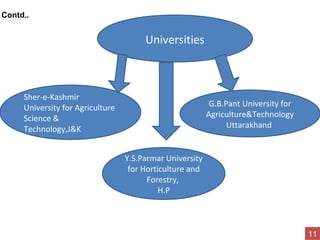
Contd..
Universities
Sher-e-Kashmir
University for Agriculture
Science &
Technology,J&K
Y.S.Parmar University
for Horticulture and
Forestry,
H.P
G.B.Pant University for
Agriculture&Technology
Uttarakhand
11
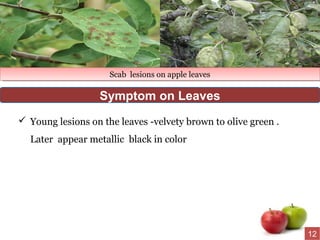
 Young lesions on the leaves -velvety brown to olive green .
Later appear metallic black in color
Scab lesions on apple leavesScab lesions on apple leaves
Symptom on Leaves
12
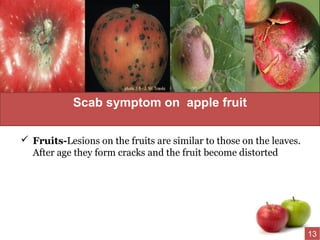
 Fruits-Lesions on the fruits are similar to those on the leaves.
After age they form cracks and the fruit become distorted
Scab symptom on apple fruit
13
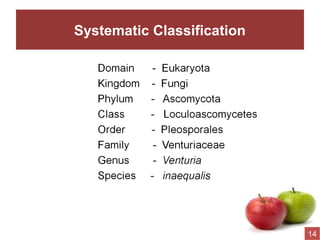
Systematic Classification
14
Characteristic of Venturia inaequalis
 Perfect stage - Venturia inaequalis
 Imperfect stage - Spilocaea pomi
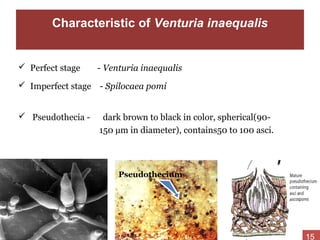
 Pseudothecia - dark brown to black in color, spherical(90-
150 µm in diameter), contains50 to 100 asci.
Pseudothecium
15
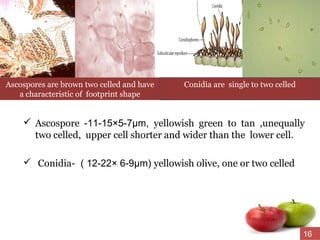
 Ascospore -11-15×5-7µm, yellowish green to tan ,unequally
two celled, upper cell shorter and wider than the lower cell.
 Conidia- ( 12-22× 6-9µm) yellowish olive, one or two celled
Ascospores are brown two celled and have
a characteristic of footprint shape
Conidia are single to two celled
16
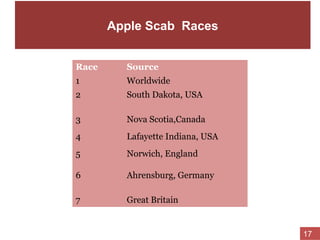
Apple Scab Races
Race Source
1 Worldwide
2 South Dakota, USA
3 Nova Scotia,Canada
4 Lafayette Indiana, USA
5 Norwich, England
6 Ahrensburg, Germany
7 Great Britain
17
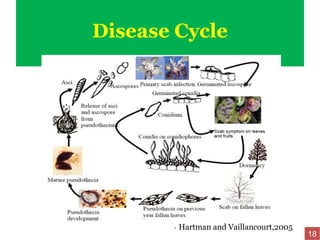
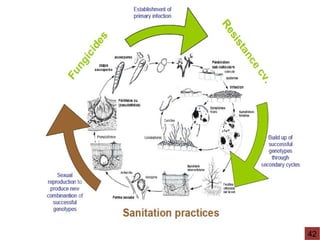
Disease Cycle
Hartman and Vaillancourt,2005
18
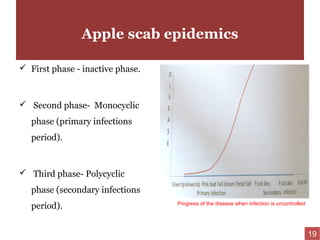
Apple scab epidemics
 First phase - inactive phase.
 Second phase- Monocyclic
phase (primary infections
period).
 Third phase- Polycyclic
phase (secondary infections
period). Progress of the disease when infection is uncontrolled
19
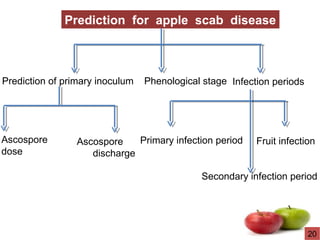
Prediction for apple scab disease
Prediction of primary inoculum Phenological stage Infection periods
Ascospore
dose
Ascospore
discharge
Primary infection period
Secondary infection period
Fruit infection
20
Ascospore dose
 Ascospore dose=number of spore / volume air.
 The rate at which ascospore mature in the pseudothecial
population in an orchard is determined mainly by temperature.
 Temperature is determined by degree days(DD).
DD=[(maxT+minT)/2]-32
21
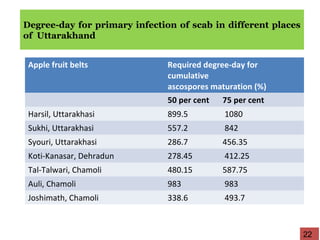
Degree-day for primary infection of scab in different places
of Uttarakhand
Apple fruit belts Required degree-day for
cumulative
ascospores maturation (%)
50 per cent 75 per cent
Harsil, Uttarakhasi 899.5 1080
Sukhi, Uttarakhasi 557.2 842
Syouri, Uttarakhasi 286.7 456.35
Koti-Kanasar, Dehradun 278.45 412.25
Tal-Talwari, Chamoli 480.15 587.75
Auli, Chamoli 983 983
Joshimath, Chamoli 338.6 493.7
22
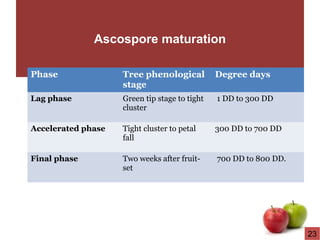
Ascospore maturation
Phase Tree phenological
stage
Degree days
Lag phase Green tip stage to tight
cluster
1 DD to 300 DD
Accelerated phase Tight cluster to petal
fall
300 DD to 700 DD
Final phase Two weeks after fruit-
set
700 DD to 800 DD.
23
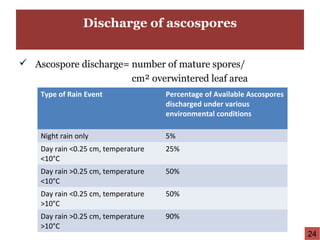
Discharge of ascospores
 Ascospore discharge= number of mature spores/
cm² overwintered leaf area
Type of Rain Event Percentage of Available Ascospores
discharged under various
environmental conditions
Night rain only 5%
Day rain <0.25 cm, temperature
<10°C
25%
Day rain >0.25 cm, temperature
<10°C
50%
Day rain <0.25 cm, temperature
>10°C
50%
Day rain >0.25 cm, temperature
>10°C
90%
24
25
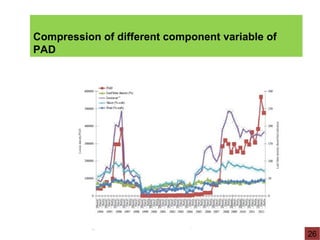
Compression of different component variable of
PAD
26
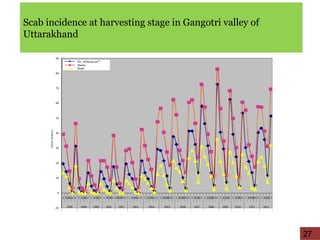
Scab incidence at harvesting stage in Gangotri valley of
Uttarakhand
27
28
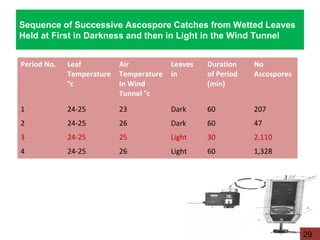
Sequence of Successive Ascospore Catches from Wetted Leaves
Held at First in Darkness and then in Light in the Wind Tunnel
Period No. Leaf
Temperature
°c
Air
Temperature
In Wind
Tunnel °c
Leaves
in
Duration
of Period
(min)
No
Ascospores
1 24-25 23 Dark 60 207
2 24-25 26 Dark 60 47
3 24-25 25 Light 30 2,110
4 24-25 26 Light 60 1,328
29
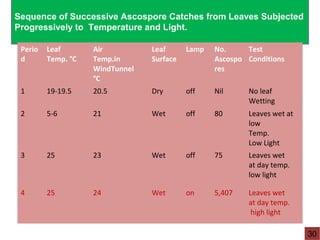
Sequence of Successive Ascospore Catches from Leaves Subjected
Progressively to Temperature and Light.
Perio
d
Leaf
Temp. °C
Air
Temp.in
WindTunnel
°C
Leaf
Surface
Lamp No.
Ascospo
res
Test
Conditions
1 19-19.5 20.5 Dry off Nil No leaf
Wetting
2 5-6 21 Wet off 80 Leaves wet at
low
Temp.
Low Light
3 25 23 Wet off 75 Leaves wet
at day temp.
low light
4 25 24 Wet on 5,407 Leaves wet
at day temp.
high light
30
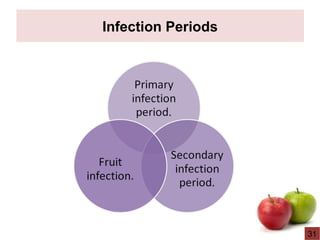
Infection Periods
31
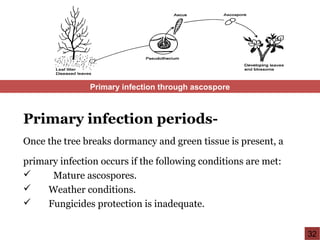
Primary infection periods-
Once the tree breaks dormancy and green tissue is present, a
primary infection occurs if the following conditions are met:
 Mature ascospores.
 Weather conditions.
 Fungicides protection is inadequate.
Primary infection through ascospore
32
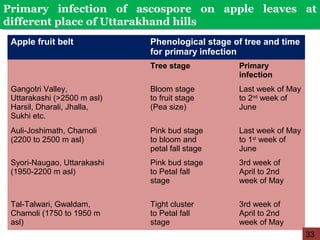
Primary infection of ascospore on apple leaves at
different place of Uttarakhand hills
Primary infection of ascospore on apple leaves at
different place of Uttarakhand hills
Apple fruit belt Phenological stage of tree and time
for primary infection
Tree stage Primary
infection
Gangotri Valley,
Uttarakashi (>2500 m asl)
Harsil, Dharali, Jhalla,
Sukhi etc.
Bloom stage
to fruit stage
(Pea size)
Last week of May
to 2nd
week of
June
Auli-Joshimath, Chamoli
(2200 to 2500 m asl)
Pink bud stage
to bloom and
petal fall stage
Last week of May
to 1st
week of
June
Syori-Naugao, Uttarakashi
(1950-2200 m asl)
Pink bud stage
to Petal fall
stage
3rd week of
April to 2nd
week of May
Tal-Talwari, Gwaldam,
Chamoli (1750 to 1950 m
asl)
Tight cluster
to Petal fall
stage
3rd week of
April to 2nd
week of May
33
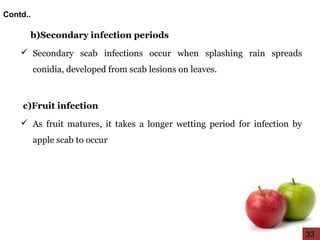
b)Secondary infection periods
 Secondary scab infections occur when splashing rain spreads
conidia, developed from scab lesions on leaves.
c)Fruit infection
 As fruit matures, it takes a longer wetting period for infection by
apple scab to occur
Contd..
33
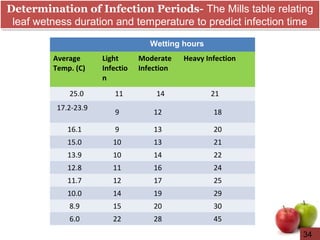
Determination of Infection Periods- The Mills table relating
leaf wetness duration and temperature to predict infection time
Determination of Infection Periods- The Mills table relating
leaf wetness duration and temperature to predict infection time
Wetting hours
Average
Temp. (C)
Light
Infectio
n
Moderate
Infection
Heavy Infection
25.0 11 14 21
17.2-23.9
9 12 18
16.1 9 13 20
15.0 10 13 21
13.9 10 14 22
12.8 11 16 24
11.7 12 17 25
10.0 14 19 29
8.9 15 20 30
6.0 22 28 45
34
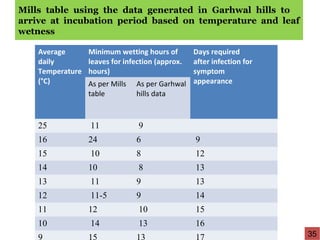
Mills table using the data generated in Garhwal hills to
arrive at incubation period based on temperature and leaf
wetness
Average
daily
Temperature
(°C)
Minimum wetting hours of
leaves for infection (approx.
hours)
Days required
after infection for
symptom
appearanceAs per Mills
table
As per Garhwal
hills data
25 11 9
16 24 6 9
15 10 8 12
14 10 8 13
13 11 9 13
12 11-5 9 14
11 12 10 15
10 14 13 16
35
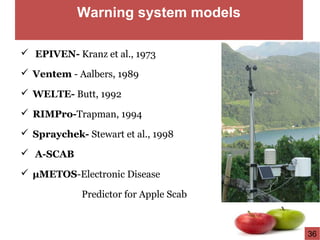
Warning system models
 EPIVEN- Kranz et al., 1973
 Ventem - Aalbers, 1989
 WELTE- Butt, 1992
 RIMPro-Trapman, 1994
 Spraychek- Stewart et al., 1998
 A-SCAB
 µMETOS-Electronic Disease
Predictor for Apple Scab
36
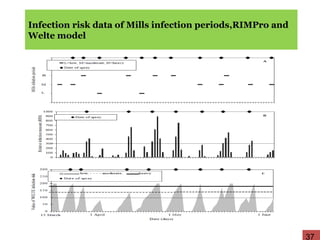
Infection risk data of Mills infection periods,RIMPro and
Welte model
37
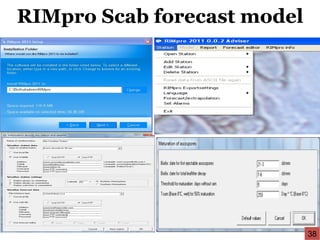
RIMpro Scab forecast model
38
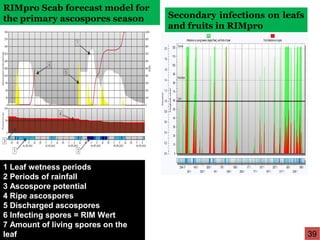
RIMpro Scab forecast model for
the primary ascospores season
1 Leaf wetness periods
2 Periods of rainfall
3 Ascospore potential
4 Ripe ascospores
5 Discharged ascospores
6 Infecting spores = RIM Wert
7 Amount of living spores on the
leaf
Secondary infections on leafs
and fruits in RIMpro
39
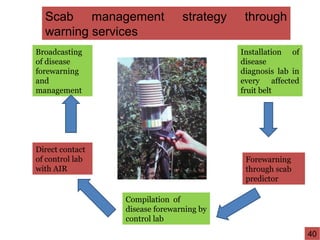
Broadcasting
of disease
forewarning
and
management
Direct contact
of control lab
with AIR
Installation of
disease
diagnosis lab in
every affected
fruit belt
Forewarning
through scab
predictor
Compilation of
disease forewarning by
control lab
Scab management strategy through
warning services
40
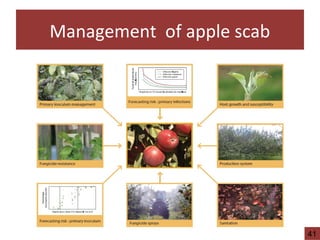
Management of apple scab
41
42
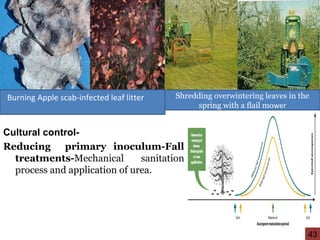
Cultural control-
Reducing primary inoculum-Fall
treatments-Mechanical sanitation
process and application of urea.
Burning Apple scab-infected leaf litter Shredding overwintering leaves in the
spring with a flail mower
43
44
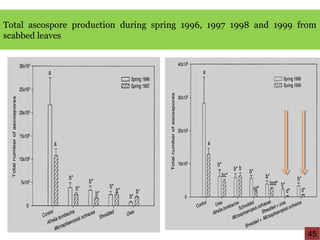
Total ascospore production during spring 1996, 1997 1998 and 1999 from
scabbed leaves
45
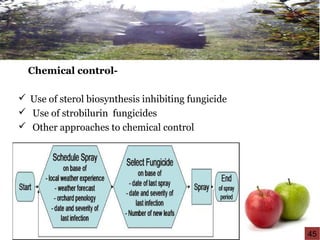
Chemical control-
 Use of sterol biosynthesis inhibiting fungicide
 Use of strobilurin fungicides
 Other approaches to chemical control
45
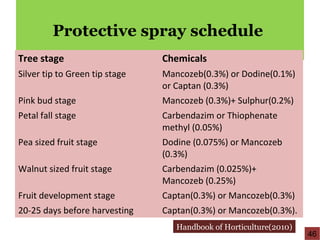
Protective spray schedule
Tree stage Chemicals
Silver tip to Green tip stage Mancozeb(0.3%) or Dodine(0.1%)
or Captan (0.3%)
Pink bud stage Mancozeb (0.3%)+ Sulphur(0.2%)
Petal fall stage Carbendazim or Thiophenate
methyl (0.05%)
Pea sized fruit stage Dodine (0.075%) or Mancozeb
(0.3%)
Walnut sized fruit stage Carbendazim (0.025%)+
Mancozeb (0.25%)
Fruit development stage Captan(0.3%) or Mancozeb(0.3%)
20-25 days before harvesting Captan(0.3%) or Mancozeb(0.3%).
Handbook of Horticulture(2010)
46
47
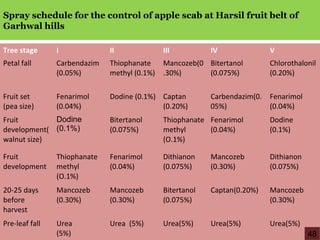
Spray schedule for the control of apple scab at Harsil fruit belt of
Garhwal hills
Tree stage I II III IV V
Petal fall Carbendazim
(0.05%)
Thiophanate
methyl (0.1%)
Mancozeb(0
.30%)
Bitertanol
(0.075%)
Chlorothalonil
(0.20%)
Fruit set
(pea size)
Fenarimol
(0.04%)
Dodine (0.1%) Captan
(0.20%)
Carbendazim(0.
05%)
Fenarimol
(0.04%)
Fruit
development(
walnut size)
Dodine
(0.1%)
Bitertanol
(0.075%)
Thiophanate
methyl
(O.1%)
Fenarimol
(0.04%)
Dodine
(0.1%)
Fruit
development
Thiophanate
methyl
(O.1%)
Fenarimol
(0.04%)
Dithianon
(0.075%)
Mancozeb
(0.30%)
Dithianon
(0.075%)
20-25 days
before
harvest
Mancozeb
(0.30%)
Mancozeb
(0.30%)
Bitertanol
(0.075%)
Captan(0.20%) Mancozeb
(0.30%)
Pre-leaf fall Urea
(5%)
Urea (5%) Urea(5%) Urea(5%) Urea(5%)
48
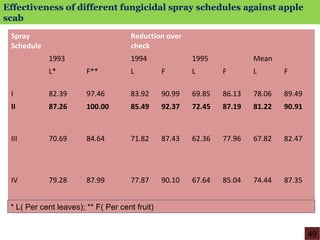
Effectiveness of different fungicidal spray schedules against apple
scab
Spray
Schedule
Reduction over
check
1993 1994 1995 Mean
L* F** L F L F L F
I 82.39 97.46 83.92 90.99 69.85 86.13 78.06 89.49
II 87.26 100.00 85.49 92.37 72.45 87.19 81.22 90.91
III 70.69 84.64 71.82 87.43 62.36 77.96 67.82 82.47
IV 79.28 87.99 77.87 90.10 67.64 85.04 74.44 87.35
V 75.87 83.37 74.24 89.21 64.48 83.66 71.08 85.73
* L( Per cent leaves); ** F( Per cent fruit)
49
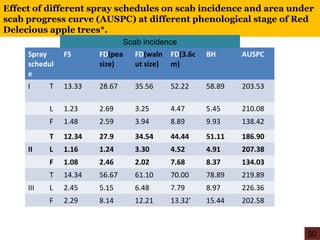
Effect of different spray schedules on scab incidence and area under
scab progress curve (AUSPC) at different phenological stage of Red
Delecious apple trees*.
Spray
schedul
e
FS FD(pea
size)
FD(waln
ut size)
FD(3.6c
m)
BH AUSPC
I T 13.33 28.67 35.56 52.22 58.89 203.53
L 1.23 2.69 3.25 4.47 5.45 210.08
F 1.48 2.59 3.94 8.89 9.93 138.42
T 12.34 27.9 34.54 44.44 51.11 186.90
II L 1.16 1.24 3.30 4.52 4.91 207.38
F 1.08 2.46 2.02 7.68 8.37 134.03
T 14.34 56.67 61.10 70.00 78.89 219.89
III L 2.45 5.15 6.48 7.79 8.97 226.36
F 2.29 8.14 12.21 13.32' 15.44 202.58
Scab incidence
50
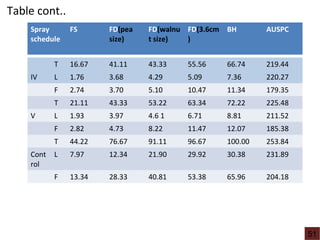
Table cont..
T 16.67 41.11 43.33 55.56 66.74 219.44
IV L 1.76 3.68 4.29 5.09 7.36 220.27
F 2.74 3.70 5.10 10.47 11.34 179.35
T 21.11 43.33 53.22 63.34 72.22 225.48
V L 1.93 3.97 4.6 1 6.71 8.81 211.52
F 2.82 4.73 8.22 11.47 12.07 185.38
T 44.22 76.67 91.11 96.67 100.00 253.84
Cont
rol
L 7.97 12.34 21.90 29.92 30.38 231.89
F 13.34 28.33 40.81 53.38 65.96 204.18
Spray
schedule
FS FD(pea
size)
FD(walnu
t size)
FD(3.6cm
)
BH AUSPC
51
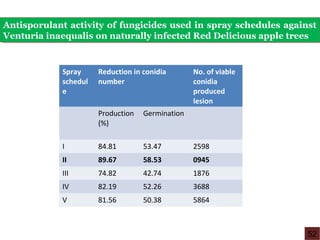
Spray
schedul
e
Reduction in conidia
number
No. of viable
conidia
produced
lesion
Production
(%)
Germination
I 84.81 53.47 2598
II 89.67 58.53 0945
III 74.82 42.74 1876
IV 82.19 52.26 3688
V 81.56 50.38 5864
Antisporulant activity of fungicides used in spray schedules against
Venturia inaequalis on naturally infected Red Delicious apple trees
Antisporulant activity of fungicides used in spray schedules against
Venturia inaequalis on naturally infected Red Delicious apple trees
52
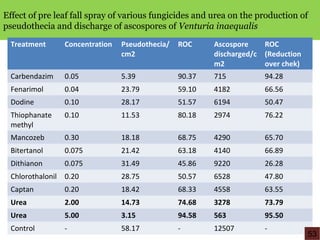
Effect of pre leaf fall spray of various fungicides and urea on the production of
pseudothecia and discharge of ascospores of Venturia inaequalis
Treatment Concentration Pseudothecia/
cm2
ROC Ascospore
discharged/c
m2
ROC
(Reduction
over chek)
Carbendazim 0.05 5.39 90.37 715 94.28
Fenarimol 0.04 23.79 59.10 4182 66.56
Dodine 0.10 28.17 51.57 6194 50.47
Thiophanate
methyl
0.10 11.53 80.18 2974 76.22
Mancozeb 0.30 18.18 68.75 4290 65.70
Bitertanol 0.075 21.42 63.18 4140 66.89
Dithianon 0.075 31.49 45.86 9220 26.28
Chlorothalonil 0.20 28.75 50.57 6528 47.80
Captan 0.20 18.42 68.33 4558 63.55
Urea 2.00 14.73 74.68 3278 73.79
Urea 5.00 3.15 94.58 563 95.50
Control - 58.17 - 12507 -
53
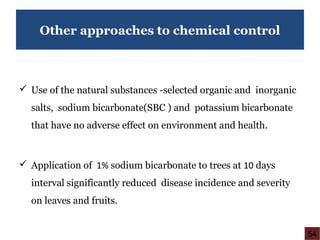
Other approaches to chemical control
 Use of the natural substances -selected organic and inorganic
salts, sodium bicarbonate(SBC ) and potassium bicarbonate
that have no adverse effect on environment and health.
 Application of 1% sodium bicarbonate to trees at 10 days
interval significantly reduced disease incidence and severity
on leaves and fruits.
54
Biological control
 Microsphaeropsis ochracea
 Athalia bombacina
 Chaetomium globosum
55
56
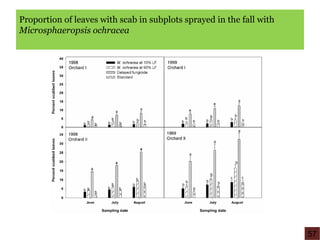
Proportion of leaves with scab in subplots sprayed in the fall with
Microsphaeropsis ochracea
57
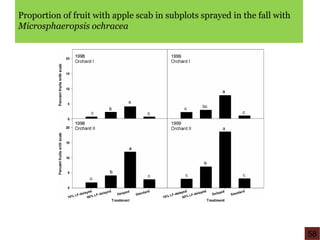
Proportion of fruit with apple scab in subplots sprayed in the fall with
Microsphaeropsis ochracea
58
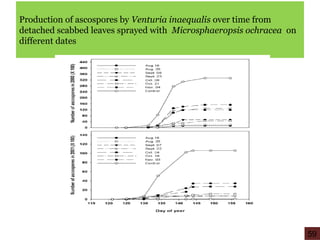
Production of ascospores by Venturia inaequalis over time from
detached scabbed leaves sprayed with Microsphaeropsis ochracea on
different dates
59
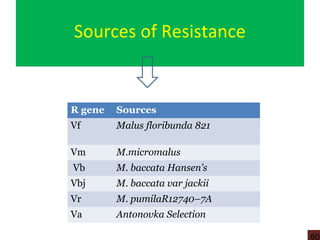
Sources of Resistance
R gene Sources
Vf Malus floribunda 821
Vm M.micromalus
Vb M. baccata Hansen’s
Vbj M. baccata var jackii
Vr M. pumilaR12740–7A
Va Antonovka Selection
60
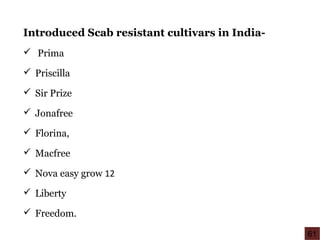
Introduced Scab resistant cultivars in India-
 Prima
 Priscilla
 Sir Prize
 Jonafree
 Florina,
 Macfree
 Nova easy grow 12
 Liberty
 Freedom.
61
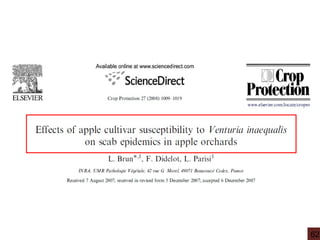
62
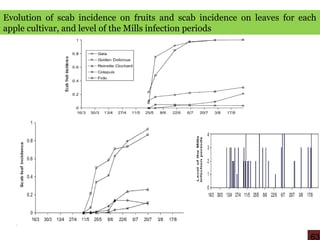
Evolution of scab incidence on fruits and scab incidence on leaves for each
apple cultivar, and level of the Mills infection periods
63
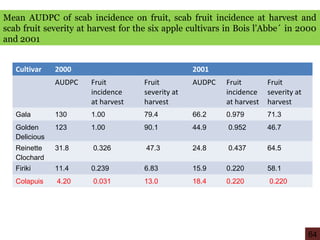
Mean AUDPC of scab incidence on fruit, scab fruit incidence at harvest and
scab fruit severity at harvest for the six apple cultivars in Bois l’Abbe´ in 2000
and 2001
Cultivar 2000 2001
AUDPC Fruit
incidence
at harvest
Fruit
severity at
harvest
AUDPC Fruit
incidence
at harvest
Fruit
severity at
harvest
Gala 130 1.00 79.4 66.2 0.979 71.3
Golden
Delicious
123 1.00 90.1 44.9 0.952 46.7
Reinette
Clochard
31.8 0.326 47.3 24.8 0.437 64.5
Firiki 11.4 0.239 6.83 15.9 0.220 58.1
Colapuis 4.20 0.031 13.0 18.4 0.220 0.220
64
65
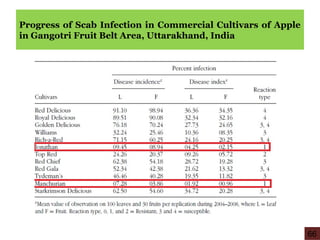
Progress of Scab Infection in Commercial Cultivars of Apple
in Gangotri Fruit Belt Area, Uttarakhand, India
66
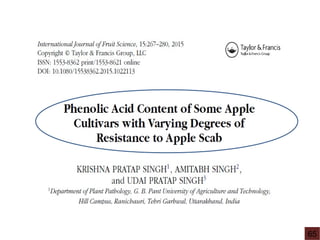
Variability of Phenolic Acids in Leaves and Fruits of Apple Cultivars
Infected by Apple Scab [Venturia inaequalis (Cheq) Wint.]
67
68
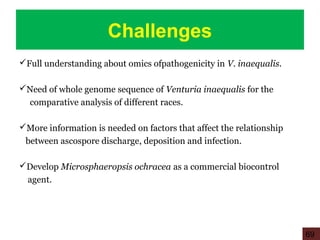
Challenges
Full understanding about omics ofpathogenicity in V. inaequalis.
Need of whole genome sequence of Venturia inaequalis for the
comparative analysis of different races.
More information is needed on factors that affect the relationship
between ascospore discharge, deposition and infection.
Develop Microsphaeropsis ochracea as a commercial biocontrol
agent.
69
Apple diseases by Nazia Manzar

Apple diseases by Nazia Manzar

  • 2.
    Apple scab- Biology,Epidemiology andManagement Nazia Manzar PhD(ID-47067) plant pathology
  • 3.
  • 4.
     Apple (Malusdomestica) is one of the most widely cultivated tree fruits.  In India apple is the most important temperate fruit of the north western Himalayan region.  The antioxidants in apple have much health promoting and disease prevention properties; thus truly justifying the adage, “an apple a day keeps the doctor away”. 1
  • 5.
    Botanical Classification Kingdom :Plantae Division : Magnoliopsida Order : Rosales Family : Rosaceae Sub-family : Maloideae Genus : Malus Species : domestica ( X = 17) Botanical Classification Kingdom : Plantae Division : Magnoliopsida Order : Rosales Family : Rosaceae Sub-family : Maloideae Genus : Malus Species : domestica ( X = 17) Origin – Asia Minor and Soviet Central Asia. 2
  • 6.
  • 7.
  • 8.
    Common name Binomial Listof fungal diseases a)Spring season Apple scab Venturia inaequalis Powdery mildew Podosphaera leucotricha b)Summer season Apple scab Venturia inaequalis Pre-mature leaf blotch Marssonina coronaria, Alternaria mali, Zygophiala jamaicensis Brooks fruit spot Mycosphaerella pomi Leaf spots Alternaria mali, c)Dormant season Canker Corticium salmonicolor, Botryosphaeria dothidea Root rot Dematophora necatrix Phytophthora cactorum List of Apple diseasesList of Apple diseases 5
  • 9.
    Bacterial Disease Crown gallAgrobacterium tumefaciens Hairy root Agrobacterium rhizogenes Viral/ Viroid Disease Apple mosaic Apple mosaic virus (ApMV) Apple chlorotic leaf spot Apple chlorotic leaf spot virus (ACLSV) Dapple apple viroid Apple scar skin viroid (ASSVd) 6
  • 10.
    Powdery Mildew Crown gall Applescab Sooty blotchApple mosaic Pre-mature leaf blotch Canker 7
  • 11.
  • 12.
    Apple scab inIndia  In India-First detected in 1930 on the native cultivar Ambri in Kashmir Valley.  1973- Apple scab appeared in epidemic. 70,000 acres orchard area got infected. Yield losses up to 70 per cent .  1996 and 2008- Epidemic in the Gangotri valley (Uttarakashi) of Uttarakhand. Loss up to Rs. 1.25 crores . 9
  • 13.
    Research station andUniversities exclusively work on Apple scab in India Central Institute for Temperate Horticulture(CITH) Headquarter Srinagar (J&K) Regional Station Mukteshwar (Uttarakhand)Other stations Shalimar- Bagh J&K Mashboora ( H.P) Chaubatia (U.P hills) 10
  • 14.
    Contd.. Universities Sher-e-Kashmir University for Agriculture Science& Technology,J&K Y.S.Parmar University for Horticulture and Forestry, H.P G.B.Pant University for Agriculture&Technology Uttarakhand 11
  • 15.
     Young lesionson the leaves -velvety brown to olive green . Later appear metallic black in color Scab lesions on apple leavesScab lesions on apple leaves Symptom on Leaves 12
  • 16.
     Fruits-Lesions onthe fruits are similar to those on the leaves. After age they form cracks and the fruit become distorted Scab symptom on apple fruit 13
  • 17.
  • 18.
    Characteristic of Venturiainaequalis  Perfect stage - Venturia inaequalis  Imperfect stage - Spilocaea pomi  Pseudothecia - dark brown to black in color, spherical(90- 150 µm in diameter), contains50 to 100 asci. Pseudothecium 15
  • 19.
     Ascospore -11-15×5-7µm,yellowish green to tan ,unequally two celled, upper cell shorter and wider than the lower cell.  Conidia- ( 12-22× 6-9µm) yellowish olive, one or two celled Ascospores are brown two celled and have a characteristic of footprint shape Conidia are single to two celled 16
  • 20.
    Apple Scab Races RaceSource 1 Worldwide 2 South Dakota, USA 3 Nova Scotia,Canada 4 Lafayette Indiana, USA 5 Norwich, England 6 Ahrensburg, Germany 7 Great Britain 17
  • 21.
    Disease Cycle Hartman andVaillancourt,2005 18
  • 22.
    Apple scab epidemics First phase - inactive phase.  Second phase- Monocyclic phase (primary infections period).  Third phase- Polycyclic phase (secondary infections period). Progress of the disease when infection is uncontrolled 19
  • 23.
    Prediction for applescab disease Prediction of primary inoculum Phenological stage Infection periods Ascospore dose Ascospore discharge Primary infection period Secondary infection period Fruit infection 20
  • 24.
    Ascospore dose  Ascosporedose=number of spore / volume air.  The rate at which ascospore mature in the pseudothecial population in an orchard is determined mainly by temperature.  Temperature is determined by degree days(DD). DD=[(maxT+minT)/2]-32 21
  • 25.
    Degree-day for primaryinfection of scab in different places of Uttarakhand Apple fruit belts Required degree-day for cumulative ascospores maturation (%) 50 per cent 75 per cent Harsil, Uttarakhasi 899.5 1080 Sukhi, Uttarakhasi 557.2 842 Syouri, Uttarakhasi 286.7 456.35 Koti-Kanasar, Dehradun 278.45 412.25 Tal-Talwari, Chamoli 480.15 587.75 Auli, Chamoli 983 983 Joshimath, Chamoli 338.6 493.7 22
  • 26.
    Ascospore maturation Phase Treephenological stage Degree days Lag phase Green tip stage to tight cluster 1 DD to 300 DD Accelerated phase Tight cluster to petal fall 300 DD to 700 DD Final phase Two weeks after fruit- set 700 DD to 800 DD. 23
  • 27.
    Discharge of ascospores Ascospore discharge= number of mature spores/ cm² overwintered leaf area Type of Rain Event Percentage of Available Ascospores discharged under various environmental conditions Night rain only 5% Day rain <0.25 cm, temperature <10°C 25% Day rain >0.25 cm, temperature <10°C 50% Day rain <0.25 cm, temperature >10°C 50% Day rain >0.25 cm, temperature >10°C 90% 24
  • 28.
  • 29.
    Compression of differentcomponent variable of PAD 26
  • 30.
    Scab incidence atharvesting stage in Gangotri valley of Uttarakhand 27
  • 31.
  • 32.
    Sequence of SuccessiveAscospore Catches from Wetted Leaves Held at First in Darkness and then in Light in the Wind Tunnel Period No. Leaf Temperature °c Air Temperature In Wind Tunnel °c Leaves in Duration of Period (min) No Ascospores 1 24-25 23 Dark 60 207 2 24-25 26 Dark 60 47 3 24-25 25 Light 30 2,110 4 24-25 26 Light 60 1,328 29
  • 33.
    Sequence of SuccessiveAscospore Catches from Leaves Subjected Progressively to Temperature and Light. Perio d Leaf Temp. °C Air Temp.in WindTunnel °C Leaf Surface Lamp No. Ascospo res Test Conditions 1 19-19.5 20.5 Dry off Nil No leaf Wetting 2 5-6 21 Wet off 80 Leaves wet at low Temp. Low Light 3 25 23 Wet off 75 Leaves wet at day temp. low light 4 25 24 Wet on 5,407 Leaves wet at day temp. high light 30
  • 34.
  • 35.
    Primary infection periods- Oncethe tree breaks dormancy and green tissue is present, a primary infection occurs if the following conditions are met:  Mature ascospores.  Weather conditions.  Fungicides protection is inadequate. Primary infection through ascospore 32
  • 36.
    Primary infection ofascospore on apple leaves at different place of Uttarakhand hills Primary infection of ascospore on apple leaves at different place of Uttarakhand hills Apple fruit belt Phenological stage of tree and time for primary infection Tree stage Primary infection Gangotri Valley, Uttarakashi (>2500 m asl) Harsil, Dharali, Jhalla, Sukhi etc. Bloom stage to fruit stage (Pea size) Last week of May to 2nd week of June Auli-Joshimath, Chamoli (2200 to 2500 m asl) Pink bud stage to bloom and petal fall stage Last week of May to 1st week of June Syori-Naugao, Uttarakashi (1950-2200 m asl) Pink bud stage to Petal fall stage 3rd week of April to 2nd week of May Tal-Talwari, Gwaldam, Chamoli (1750 to 1950 m asl) Tight cluster to Petal fall stage 3rd week of April to 2nd week of May 33
  • 37.
    b)Secondary infection periods Secondary scab infections occur when splashing rain spreads conidia, developed from scab lesions on leaves. c)Fruit infection  As fruit matures, it takes a longer wetting period for infection by apple scab to occur Contd.. 33
  • 38.
    Determination of InfectionPeriods- The Mills table relating leaf wetness duration and temperature to predict infection time Determination of Infection Periods- The Mills table relating leaf wetness duration and temperature to predict infection time Wetting hours Average Temp. (C) Light Infectio n Moderate Infection Heavy Infection 25.0 11 14 21 17.2-23.9 9 12 18 16.1 9 13 20 15.0 10 13 21 13.9 10 14 22 12.8 11 16 24 11.7 12 17 25 10.0 14 19 29 8.9 15 20 30 6.0 22 28 45 34
  • 39.
    Mills table usingthe data generated in Garhwal hills to arrive at incubation period based on temperature and leaf wetness Average daily Temperature (°C) Minimum wetting hours of leaves for infection (approx. hours) Days required after infection for symptom appearanceAs per Mills table As per Garhwal hills data 25 11 9 16 24 6 9 15 10 8 12 14 10 8 13 13 11 9 13 12 11-5 9 14 11 12 10 15 10 14 13 16 35
  • 40.
    Warning system models EPIVEN- Kranz et al., 1973  Ventem - Aalbers, 1989  WELTE- Butt, 1992  RIMPro-Trapman, 1994  Spraychek- Stewart et al., 1998  A-SCAB  µMETOS-Electronic Disease Predictor for Apple Scab 36
  • 41.
    Infection risk dataof Mills infection periods,RIMPro and Welte model 37
  • 42.
  • 43.
    RIMpro Scab forecastmodel for the primary ascospores season 1 Leaf wetness periods 2 Periods of rainfall 3 Ascospore potential 4 Ripe ascospores 5 Discharged ascospores 6 Infecting spores = RIM Wert 7 Amount of living spores on the leaf Secondary infections on leafs and fruits in RIMpro 39
  • 44.
    Broadcasting of disease forewarning and management Direct contact ofcontrol lab with AIR Installation of disease diagnosis lab in every affected fruit belt Forewarning through scab predictor Compilation of disease forewarning by control lab Scab management strategy through warning services 40
  • 45.
  • 46.
  • 47.
    Cultural control- Reducing primaryinoculum-Fall treatments-Mechanical sanitation process and application of urea. Burning Apple scab-infected leaf litter Shredding overwintering leaves in the spring with a flail mower 43
  • 48.
  • 49.
    Total ascospore productionduring spring 1996, 1997 1998 and 1999 from scabbed leaves 45
  • 50.
    Chemical control-  Useof sterol biosynthesis inhibiting fungicide  Use of strobilurin fungicides  Other approaches to chemical control 45
  • 51.
    Protective spray schedule Treestage Chemicals Silver tip to Green tip stage Mancozeb(0.3%) or Dodine(0.1%) or Captan (0.3%) Pink bud stage Mancozeb (0.3%)+ Sulphur(0.2%) Petal fall stage Carbendazim or Thiophenate methyl (0.05%) Pea sized fruit stage Dodine (0.075%) or Mancozeb (0.3%) Walnut sized fruit stage Carbendazim (0.025%)+ Mancozeb (0.25%) Fruit development stage Captan(0.3%) or Mancozeb(0.3%) 20-25 days before harvesting Captan(0.3%) or Mancozeb(0.3%). Handbook of Horticulture(2010) 46
  • 52.
  • 53.
    Spray schedule forthe control of apple scab at Harsil fruit belt of Garhwal hills Tree stage I II III IV V Petal fall Carbendazim (0.05%) Thiophanate methyl (0.1%) Mancozeb(0 .30%) Bitertanol (0.075%) Chlorothalonil (0.20%) Fruit set (pea size) Fenarimol (0.04%) Dodine (0.1%) Captan (0.20%) Carbendazim(0. 05%) Fenarimol (0.04%) Fruit development( walnut size) Dodine (0.1%) Bitertanol (0.075%) Thiophanate methyl (O.1%) Fenarimol (0.04%) Dodine (0.1%) Fruit development Thiophanate methyl (O.1%) Fenarimol (0.04%) Dithianon (0.075%) Mancozeb (0.30%) Dithianon (0.075%) 20-25 days before harvest Mancozeb (0.30%) Mancozeb (0.30%) Bitertanol (0.075%) Captan(0.20%) Mancozeb (0.30%) Pre-leaf fall Urea (5%) Urea (5%) Urea(5%) Urea(5%) Urea(5%) 48
  • 54.
    Effectiveness of differentfungicidal spray schedules against apple scab Spray Schedule Reduction over check 1993 1994 1995 Mean L* F** L F L F L F I 82.39 97.46 83.92 90.99 69.85 86.13 78.06 89.49 II 87.26 100.00 85.49 92.37 72.45 87.19 81.22 90.91 III 70.69 84.64 71.82 87.43 62.36 77.96 67.82 82.47 IV 79.28 87.99 77.87 90.10 67.64 85.04 74.44 87.35 V 75.87 83.37 74.24 89.21 64.48 83.66 71.08 85.73 * L( Per cent leaves); ** F( Per cent fruit) 49
  • 55.
    Effect of differentspray schedules on scab incidence and area under scab progress curve (AUSPC) at different phenological stage of Red Delecious apple trees*. Spray schedul e FS FD(pea size) FD(waln ut size) FD(3.6c m) BH AUSPC I T 13.33 28.67 35.56 52.22 58.89 203.53 L 1.23 2.69 3.25 4.47 5.45 210.08 F 1.48 2.59 3.94 8.89 9.93 138.42 T 12.34 27.9 34.54 44.44 51.11 186.90 II L 1.16 1.24 3.30 4.52 4.91 207.38 F 1.08 2.46 2.02 7.68 8.37 134.03 T 14.34 56.67 61.10 70.00 78.89 219.89 III L 2.45 5.15 6.48 7.79 8.97 226.36 F 2.29 8.14 12.21 13.32' 15.44 202.58 Scab incidence 50
  • 56.
    Table cont.. T 16.6741.11 43.33 55.56 66.74 219.44 IV L 1.76 3.68 4.29 5.09 7.36 220.27 F 2.74 3.70 5.10 10.47 11.34 179.35 T 21.11 43.33 53.22 63.34 72.22 225.48 V L 1.93 3.97 4.6 1 6.71 8.81 211.52 F 2.82 4.73 8.22 11.47 12.07 185.38 T 44.22 76.67 91.11 96.67 100.00 253.84 Cont rol L 7.97 12.34 21.90 29.92 30.38 231.89 F 13.34 28.33 40.81 53.38 65.96 204.18 Spray schedule FS FD(pea size) FD(walnu t size) FD(3.6cm ) BH AUSPC 51
  • 57.
    Spray schedul e Reduction in conidia number No.of viable conidia produced lesion Production (%) Germination I 84.81 53.47 2598 II 89.67 58.53 0945 III 74.82 42.74 1876 IV 82.19 52.26 3688 V 81.56 50.38 5864 Antisporulant activity of fungicides used in spray schedules against Venturia inaequalis on naturally infected Red Delicious apple trees Antisporulant activity of fungicides used in spray schedules against Venturia inaequalis on naturally infected Red Delicious apple trees 52
  • 58.
    Effect of preleaf fall spray of various fungicides and urea on the production of pseudothecia and discharge of ascospores of Venturia inaequalis Treatment Concentration Pseudothecia/ cm2 ROC Ascospore discharged/c m2 ROC (Reduction over chek) Carbendazim 0.05 5.39 90.37 715 94.28 Fenarimol 0.04 23.79 59.10 4182 66.56 Dodine 0.10 28.17 51.57 6194 50.47 Thiophanate methyl 0.10 11.53 80.18 2974 76.22 Mancozeb 0.30 18.18 68.75 4290 65.70 Bitertanol 0.075 21.42 63.18 4140 66.89 Dithianon 0.075 31.49 45.86 9220 26.28 Chlorothalonil 0.20 28.75 50.57 6528 47.80 Captan 0.20 18.42 68.33 4558 63.55 Urea 2.00 14.73 74.68 3278 73.79 Urea 5.00 3.15 94.58 563 95.50 Control - 58.17 - 12507 - 53
  • 59.
    Other approaches tochemical control  Use of the natural substances -selected organic and inorganic salts, sodium bicarbonate(SBC ) and potassium bicarbonate that have no adverse effect on environment and health.  Application of 1% sodium bicarbonate to trees at 10 days interval significantly reduced disease incidence and severity on leaves and fruits. 54
  • 60.
    Biological control  Microsphaeropsisochracea  Athalia bombacina  Chaetomium globosum 55
  • 61.
  • 62.
    Proportion of leaveswith scab in subplots sprayed in the fall with Microsphaeropsis ochracea 57
  • 63.
    Proportion of fruitwith apple scab in subplots sprayed in the fall with Microsphaeropsis ochracea 58
  • 64.
    Production of ascosporesby Venturia inaequalis over time from detached scabbed leaves sprayed with Microsphaeropsis ochracea on different dates 59
  • 65.
    Sources of Resistance Rgene Sources Vf Malus floribunda 821 Vm M.micromalus Vb M. baccata Hansen’s Vbj M. baccata var jackii Vr M. pumilaR12740–7A Va Antonovka Selection 60
  • 66.
    Introduced Scab resistantcultivars in India-  Prima  Priscilla  Sir Prize  Jonafree  Florina,  Macfree  Nova easy grow 12  Liberty  Freedom. 61
  • 67.
  • 68.
    Evolution of scabincidence on fruits and scab incidence on leaves for each apple cultivar, and level of the Mills infection periods 63
  • 69.
    Mean AUDPC ofscab incidence on fruit, scab fruit incidence at harvest and scab fruit severity at harvest for the six apple cultivars in Bois l’Abbe´ in 2000 and 2001 Cultivar 2000 2001 AUDPC Fruit incidence at harvest Fruit severity at harvest AUDPC Fruit incidence at harvest Fruit severity at harvest Gala 130 1.00 79.4 66.2 0.979 71.3 Golden Delicious 123 1.00 90.1 44.9 0.952 46.7 Reinette Clochard 31.8 0.326 47.3 24.8 0.437 64.5 Firiki 11.4 0.239 6.83 15.9 0.220 58.1 Colapuis 4.20 0.031 13.0 18.4 0.220 0.220 64
  • 70.
  • 71.
    Progress of ScabInfection in Commercial Cultivars of Apple in Gangotri Fruit Belt Area, Uttarakhand, India 66
  • 72.
    Variability of PhenolicAcids in Leaves and Fruits of Apple Cultivars Infected by Apple Scab [Venturia inaequalis (Cheq) Wint.] 67
  • 73.
  • 74.
    Challenges Full understanding aboutomics ofpathogenicity in V. inaequalis. Need of whole genome sequence of Venturia inaequalis for the comparative analysis of different races. More information is needed on factors that affect the relationship between ascospore discharge, deposition and infection. Develop Microsphaeropsis ochracea as a commercial biocontrol agent. 69