Week 1; Lesson 1: Nature of
Communication
KETH A. VILLANUEVA
LEARNING OBJECTIVES
Define communication;
Explain the nature and process of communication
Differentiate verbal from non-verbal communication
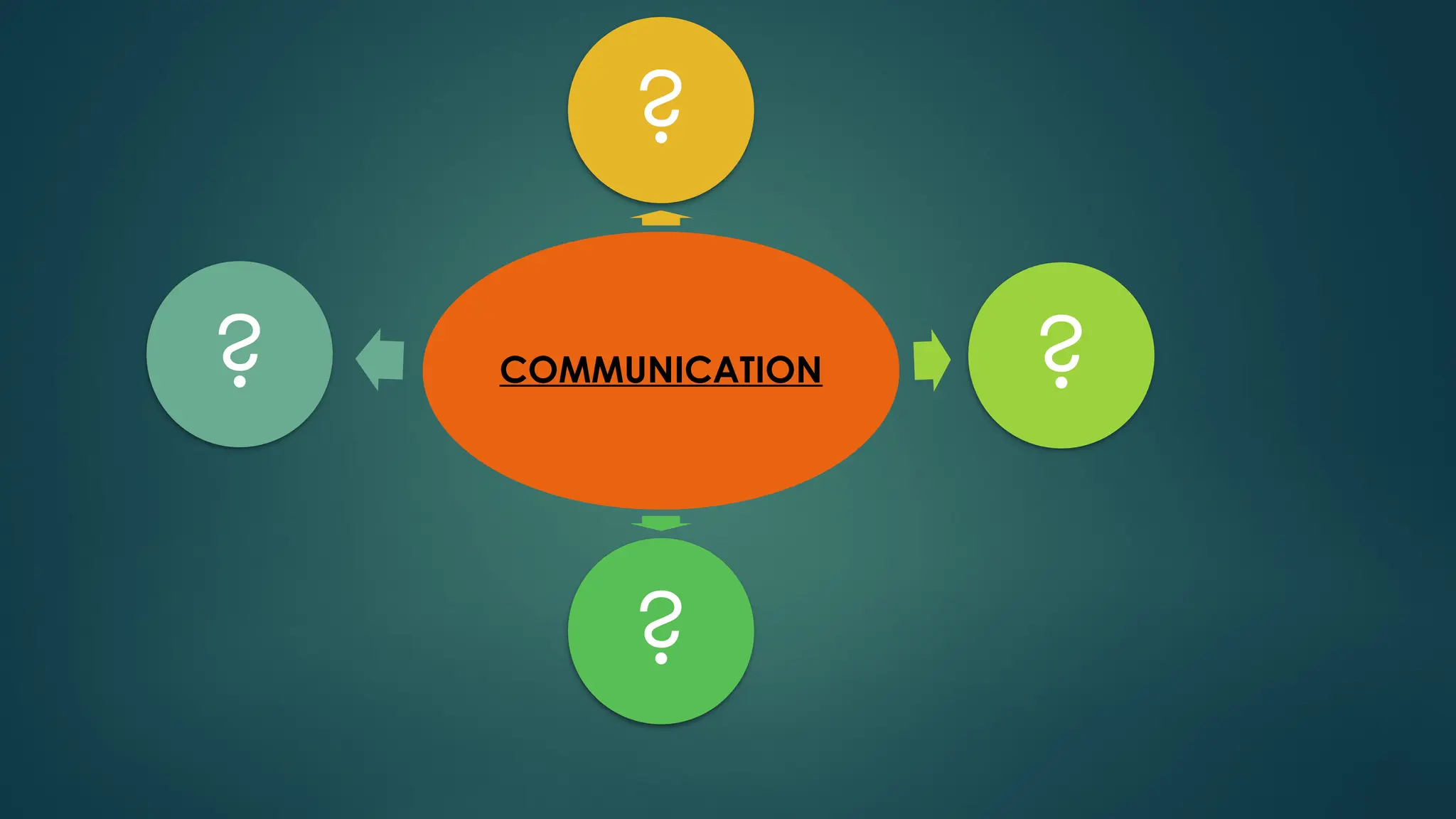
COMMUNICATION
?
?
?
?
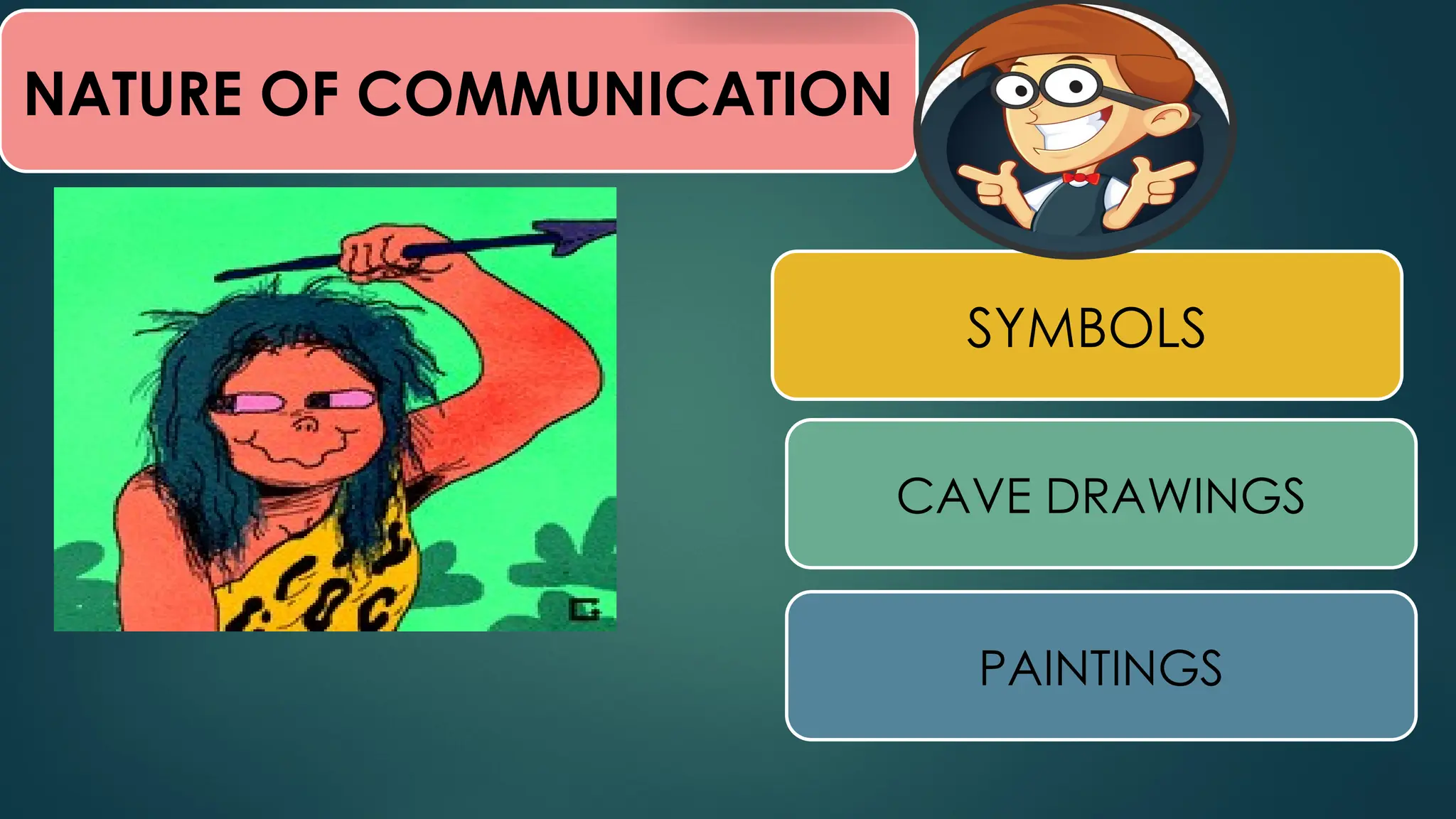
NATURE OF COMMUNICATION
SYMBOLS
CAVE DRAWINGS
PAINTINGS
DEFINITION OF
COMMUNICATION
Communication came from the LATIN word
communicare, meaning “to share” or “to make
common”, which is the exchange of ideas from one
person to another. Its aim is to express or send a
thought or message to a single person, a small group,
a big audience, or the mass.
DEFINITION OF
COMMUNICATION
Communication is very vital to our everyday
lives. We cannot live without communicating
because we need to share thoughts, impart
information, persuade others in our beliefs, and
show our love and affection.
DEFINITION OF
COMMUNICATION
According to Wood (2004), communication is a
systemic process in which individuals interact
with and through symbols to create and
interpret meanings.
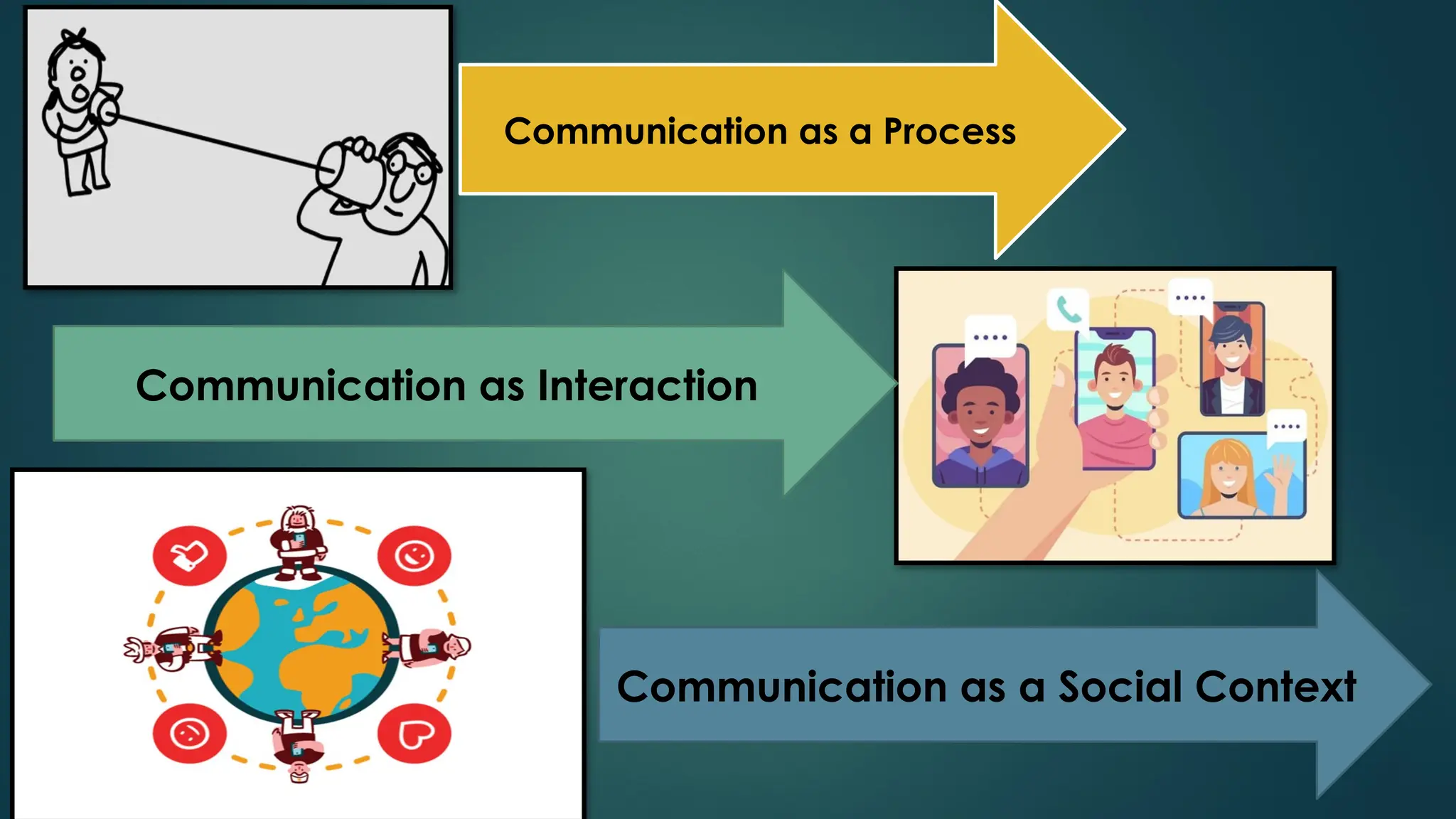
Communication as a Process
Communication as Interaction
Communication as a Social Context
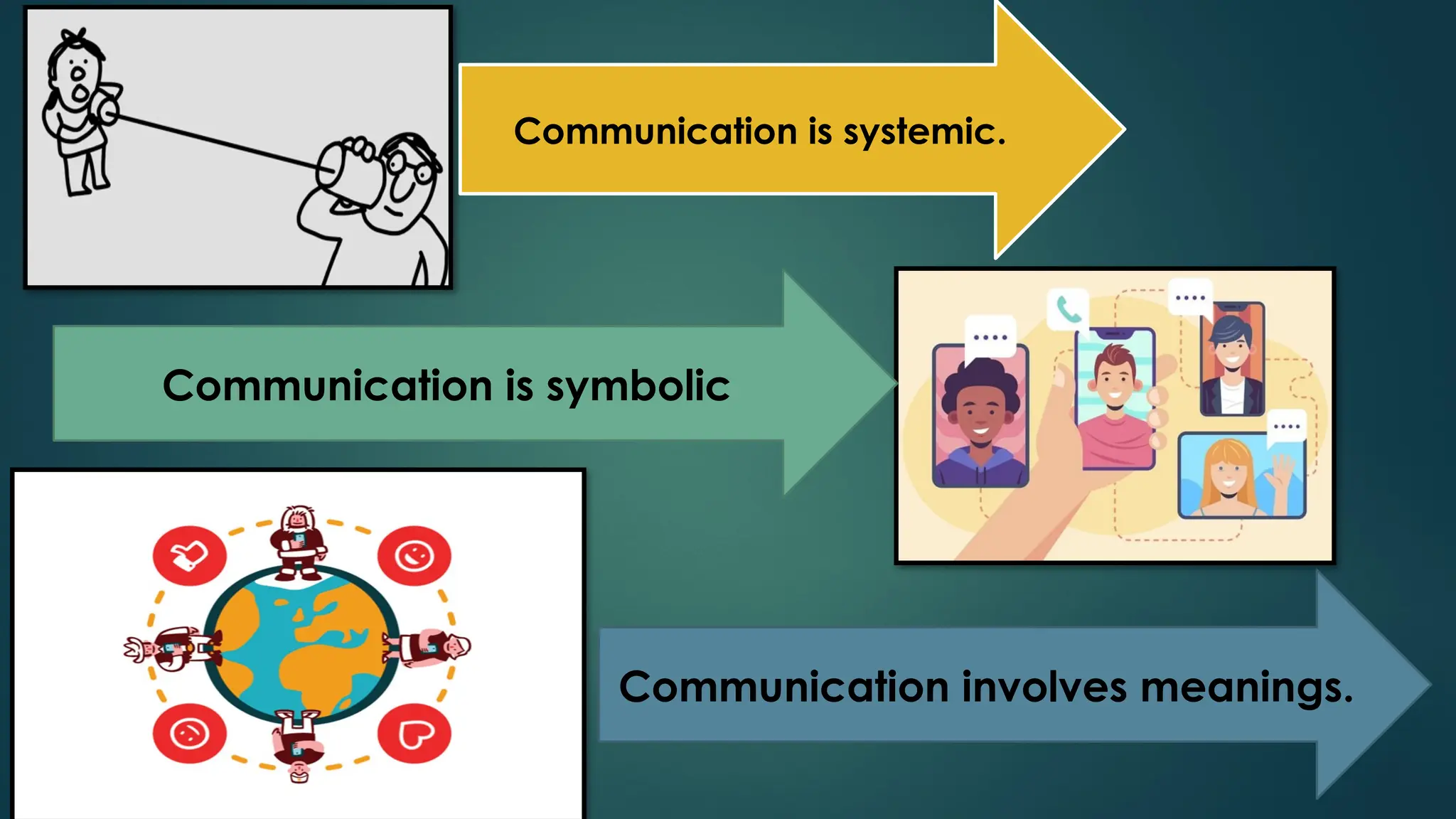
Communication is systemic.
Communication is symbolic
Communication involves meanings.
QUALITIES OF
COMMUNICATION
1.Communication is a process.
2.Communication is systemic.
3.Communication is symbolic.
4.Communication involves meanings.
PROCESS
It is a dynamic, creative, continuing
condition of life, a process that changes as
the communicators’ environments and
needs change.
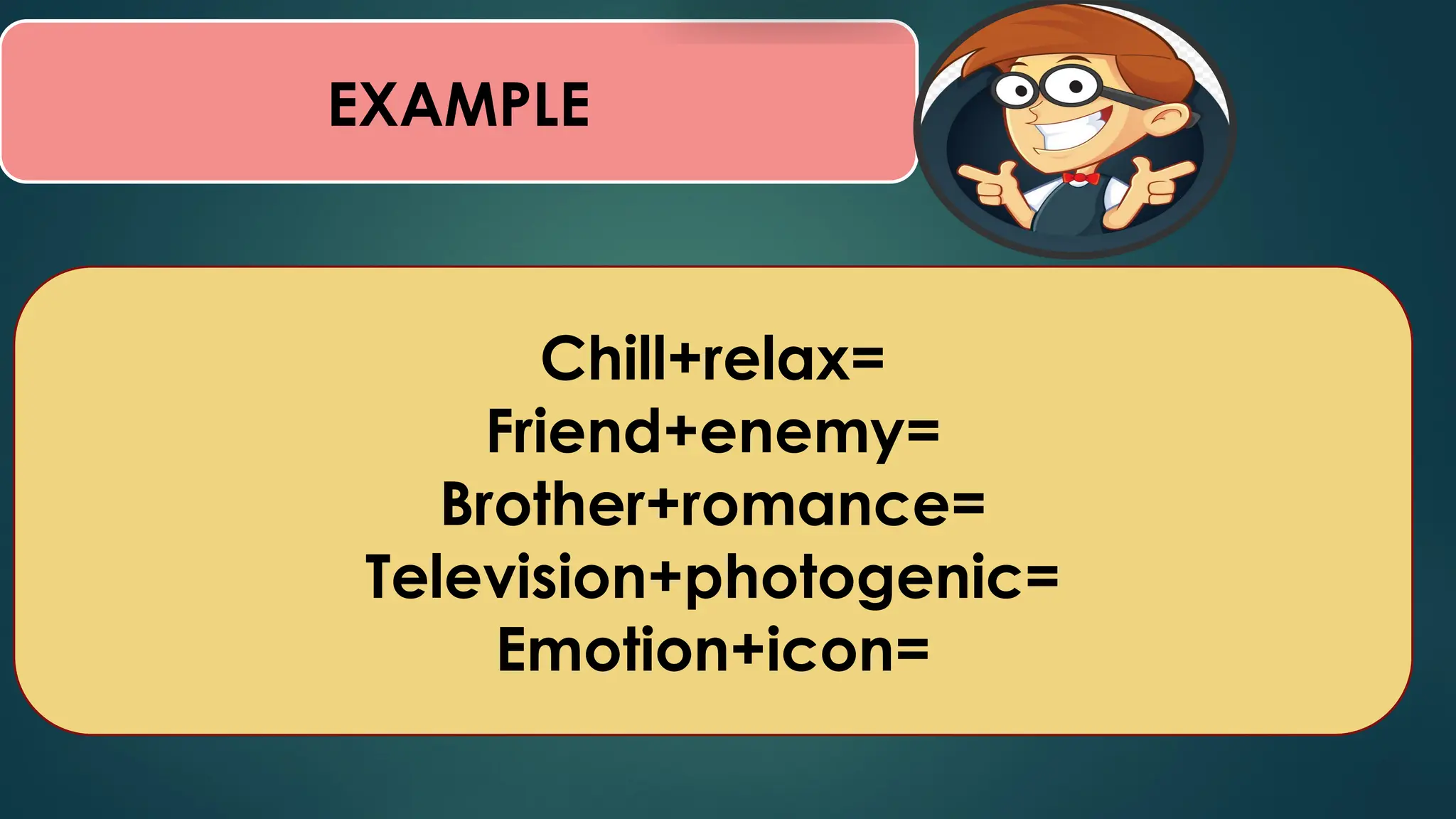
EXAMPLE
Chill+relax=
Friend+enemy=
Brother+romance=
Television+photogenic=
Emotion+icon=
SYSTEMIC
It occurs within systems of
interrelated and interacting parts.
EXAMPLE
The various components of
communication, speaker/sender,
listener/receiver, message, channel,
feedback, content, and noise are
linked to one another.
SYMBOLIC
Verbal and Non-Verbal
EXAMPLE
• Verbal symbols are spoken
• Nonverbal symbols are
perceived through our body
language.
MEANINGS
Meanings are assigned, given or
invented not received.
EXAMPLE
We invent meanings in countless
social situations when we talk with
people who share or oppose our
purpose.
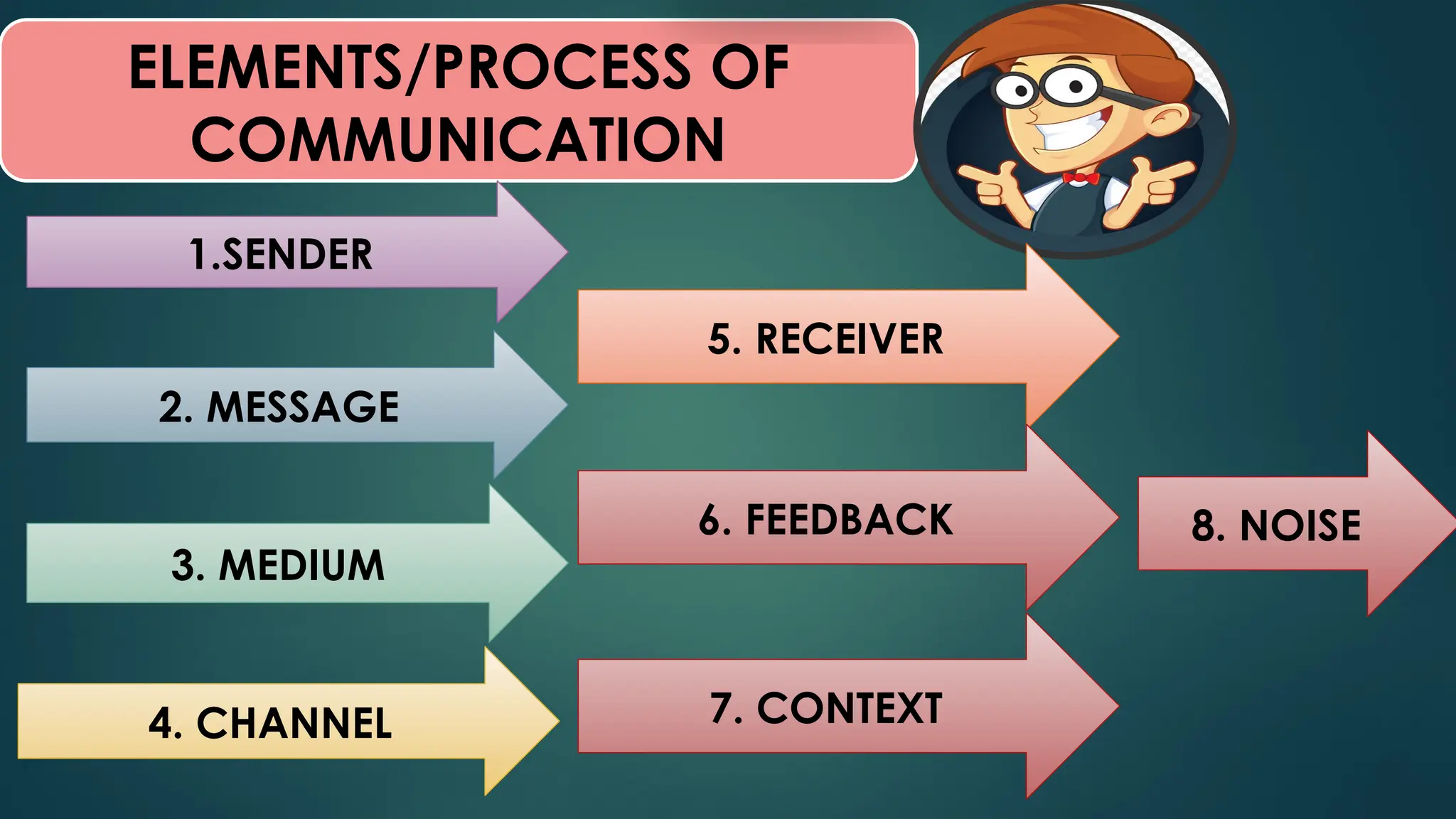
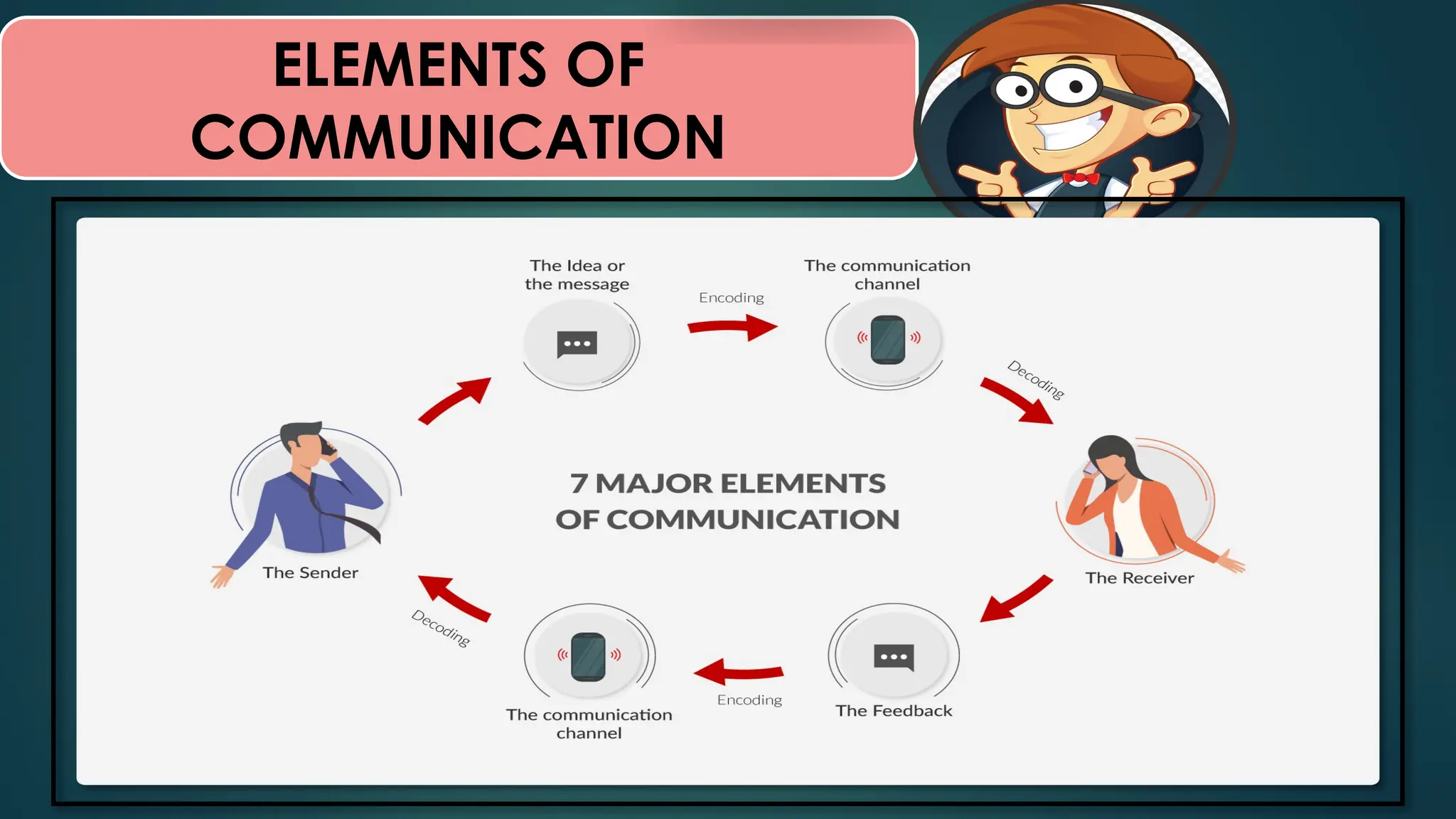
ELEMENTS/PROCESS OF
COMMUNICATION
1.SENDER
2. MESSAGE
3. MEDIUM
4. CHANNEL
5. RECEIVER
6. FEEDBACK
7. CONTEXT
8. NOISE
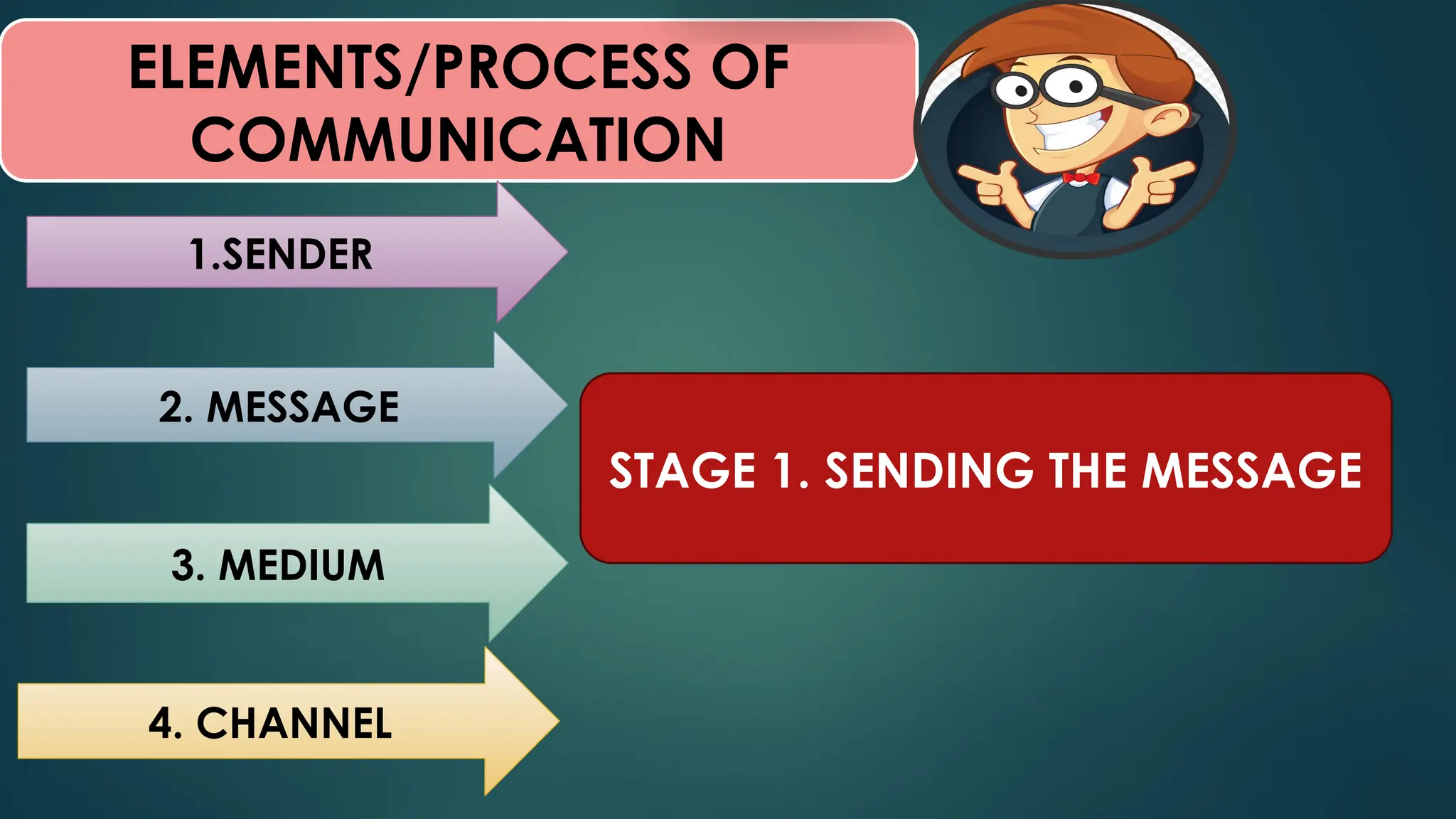
ELEMENTS/PROCESS OF
COMMUNICATION
1.SENDER
2. MESSAGE
3. MEDIUM
4. CHANNEL
STAGE 1. SENDING THE MESSAGE
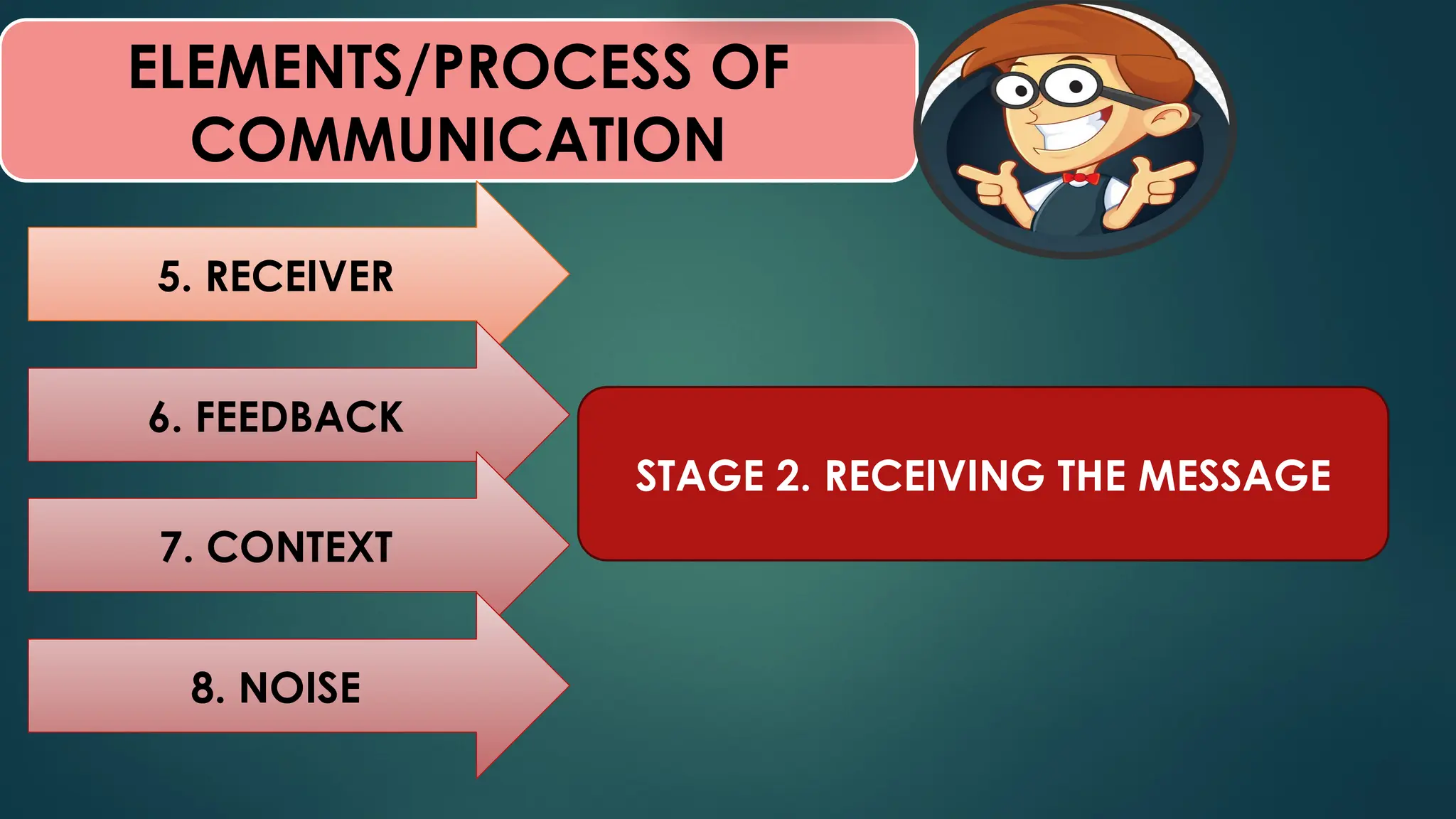
ELEMENTS/PROCESS OF
COMMUNICATION
5. RECEIVER
6. FEEDBACK
7. CONTEXT
8. NOISE
STAGE 2. RECEIVING THE MESSAGE
1. SPEAKER/SENDER
It is the source of the message that is
encoded into symbols that are verbal (with
words) and/or nonverbal (without words).
2. MESSAGE
It is any information or anything the
speaker/sender wants to communicate by
using a medium.
3. MEDIUM
It is the form in which the speaker/sender
conveys the message, which may probably
be speech, conversation, letter, email,
blog, newspaper, book, and the like.
4. CHANNEL
It is the mode, method, or means of sending
or expressing the message, which may
perhaps be through any of the five senses.
The channel may also be sound and light
waves or digital audio.
5. LISTENER/RECEIVER
Gets the message in the medium desired
through the chosen channel, and decodes
the message.
6. FEEDBACK
It is the receiver’s response, verbally or
non-verbally- silence included, to the
message sent. It is affected by one’s frame
of reference. Feedback varies from person
to person. Therefore, there is no such thing
as “zero feedback.”
7. CONTEXT
It is the situation or environment in which
communication takes place, which
includes time, place, and event, as well as
sender’s and receiver’s feelings,
perceptions, beliefs, attitudes, and
relationships.
8. NOISE
It is also known as interference, distraction,
and barriers. It is anything that impedes or
gets in the way of accurately sending,
receiving, and interpreting the message,
whether it be internal- from the sender or
receiver, or external from the env
ELEMENTS OF
COMMUNICATION
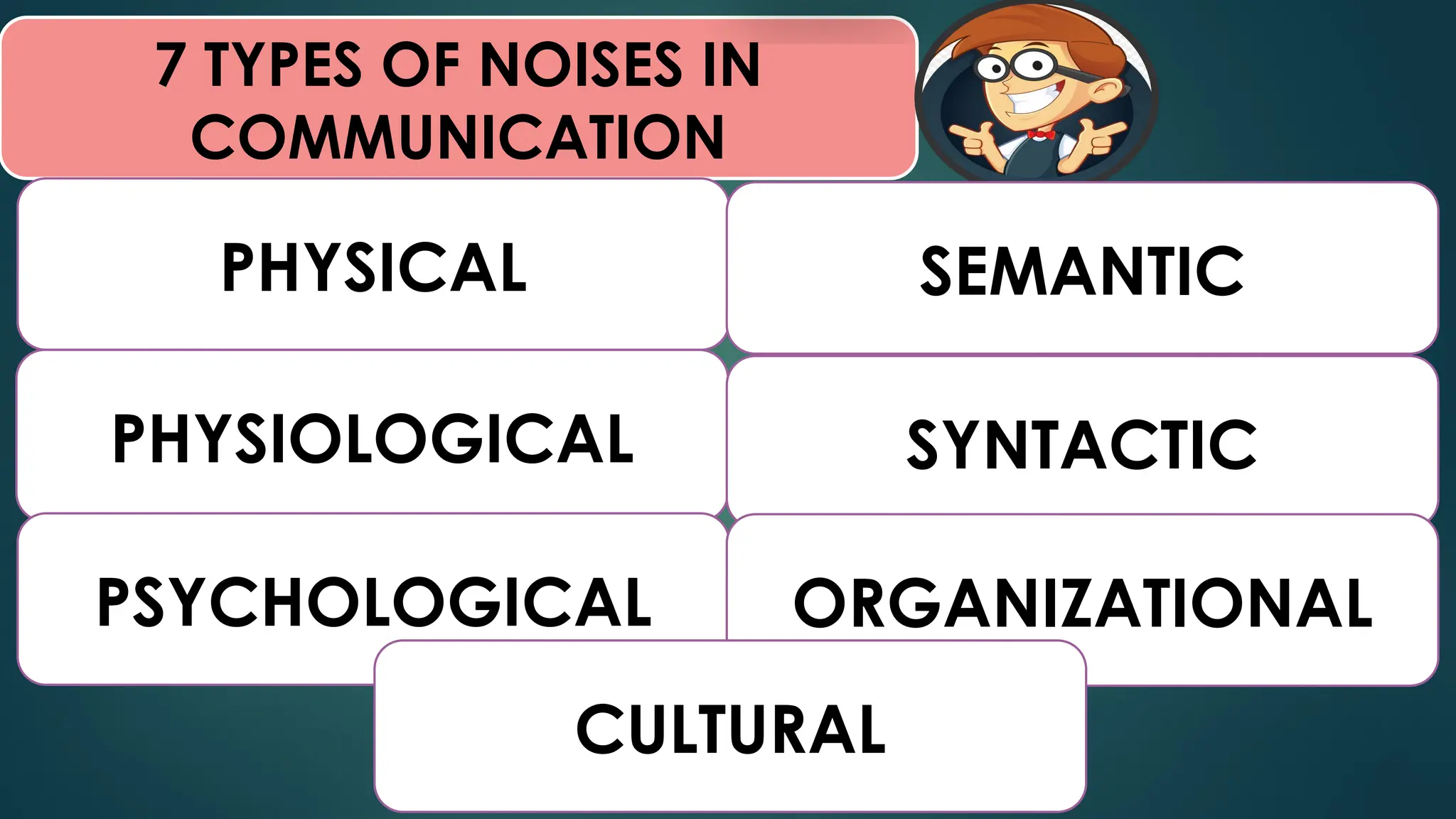
7 TYPES OF NOISES IN
COMMUNICATION
PHYSICAL
PHYSIOLOGICAL
PSYCHOLOGICAL
SEMANTIC
SYNTACTIC
ORGANIZATIONAL
CULTURAL
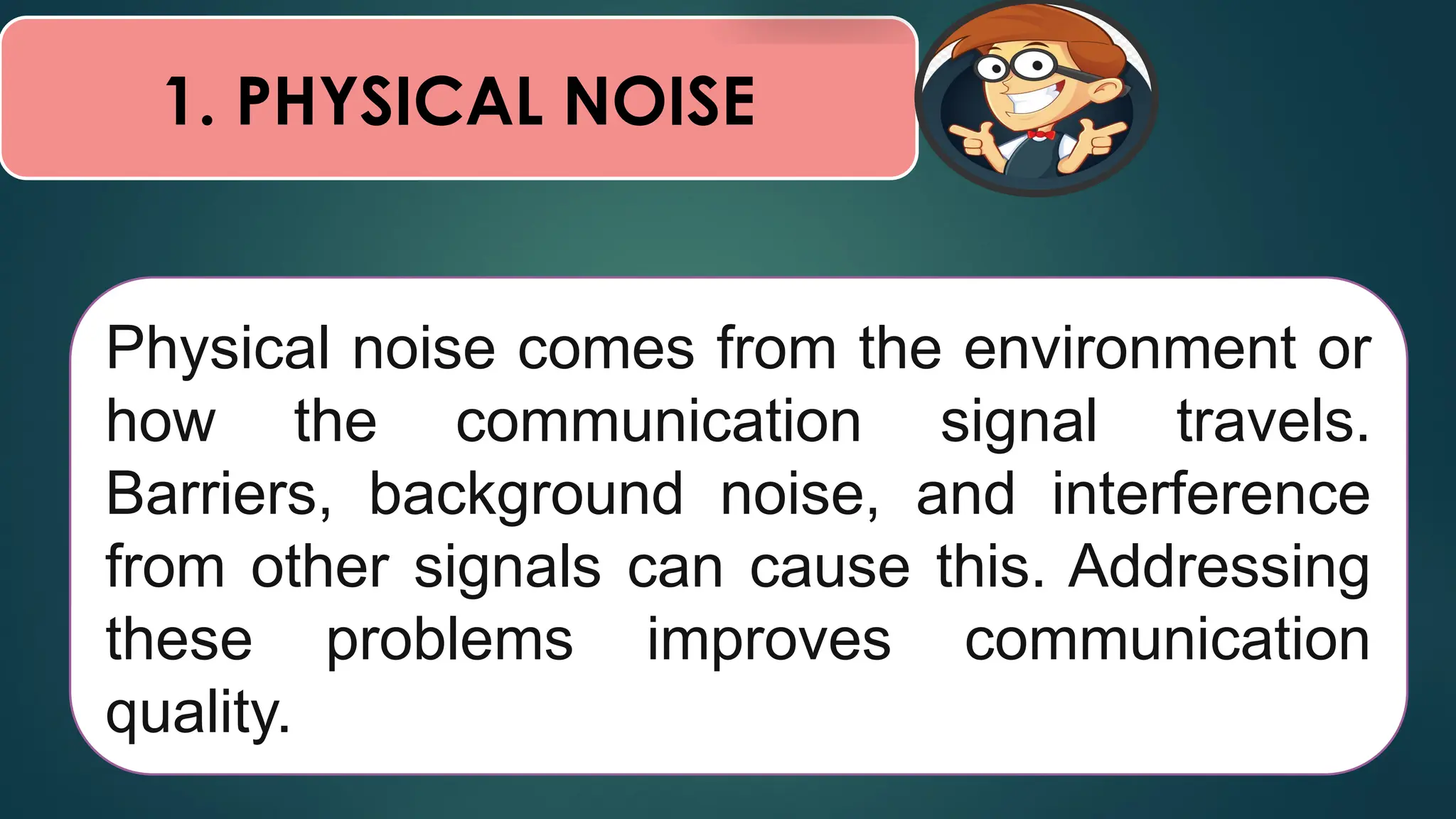
1. PHYSICAL NOISE
Physical noise comes from the environment or
how the communication signal travels.
Barriers, background noise, and interference
from other signals can cause this. Addressing
these problems improves communication
quality.
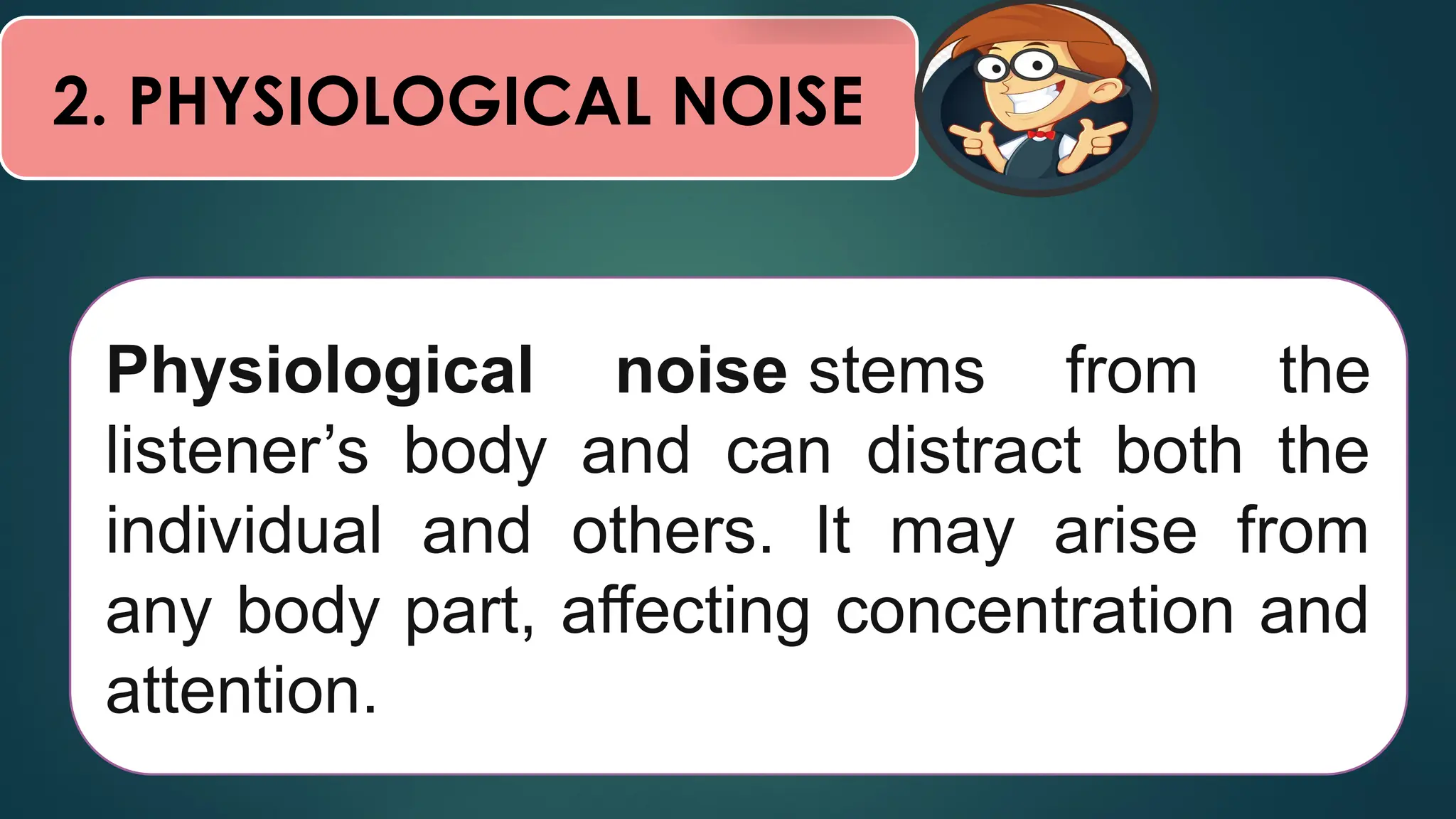
2. PHYSIOLOGICAL NOISE
Physiological noise stems from the
listener’s body and can distract both the
individual and others. It may arise from
any body part, affecting concentration and
attention.
3. PSYCHOLOGICAL NOISE
Psychological noise often disrupts
communication. Stress, emotional states,
and personal biases usually cause it. This
noise can block the flow of information or
change its meaning.
4. SEMANTIC NOISE
Semantic noise occurs when the receiver
doesn’t grasp the speaker’s meaning.
Causes include ambiguous words, the
receiver’s lack of knowledge, or incorrect
assumptions by either side.
5. SYNTACTIC NOISE
Syntactic noise refers to grammatically
incorrect sentences or syntax within a
programming language that makes it
difficult to understand and read for
humans.
6. ORGANIZATIONAL NOISE
Organizational noise arises from the
communication environment. It can be
either internal or external to the
organization.
7. CULTURAL NOISE
Cultural noise arises from differences in
culture. It can block effective
communication between people from
diverse backgrounds.
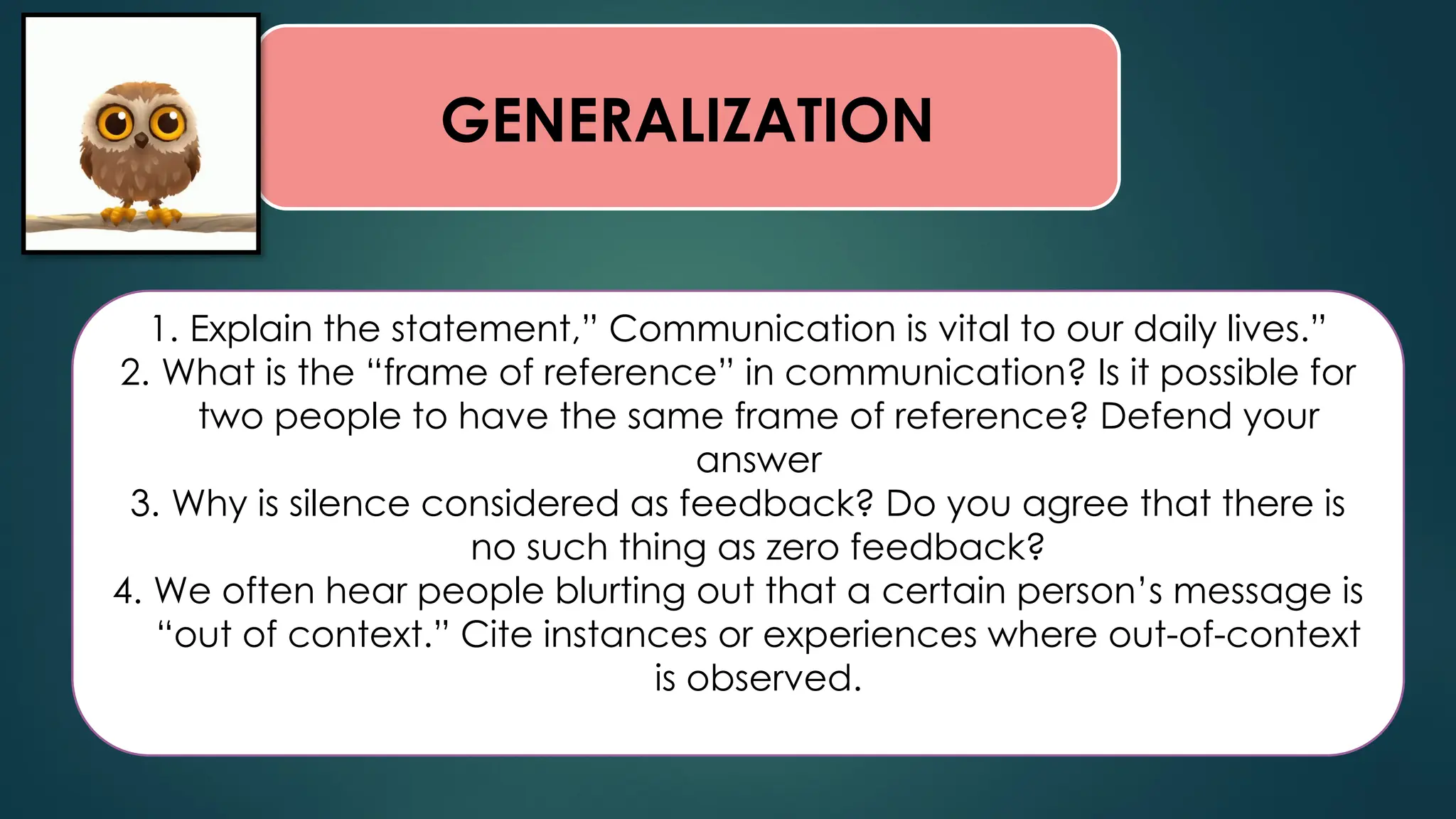
GENERALIZATION
1. Explain the statement,” Communication is vital to our daily lives.”
2. What is the “frame of reference” in communication? Is it possible for
two people to have the same frame of reference? Defend your
answer
3. Why is silence considered as feedback? Do you agree that there is
no such thing as zero feedback?
4. We often hear people blurting out that a certain person’s message is
“out of context.” Cite instances or experiences where out-of-context
is observed.
The biggest communication problem is
we do not listen to understand. We listen
to reply
REFERENCES
Dapat, et. Al (2016). Oral Communication in Process, Lorimar Publishing, Inc.
776 Aurora Blvd., cor. Boston street, Cubao, Quezon City, Metro Manila
Zoleta, MA and Javier, TP, (2016). Oral Communication for Senior High School,
MINDSHAPERS CO., INC. 61 Muralla St., Intramuros, Manila
Oral Communication in Context Lesson 1- Midterm

Oral Communication in Context Lesson 1- Midterm

  • 1.
    Week 1; Lesson1: Nature of Communication KETH A. VILLANUEVA
  • 2.
    LEARNING OBJECTIVES Define communication; Explainthe nature and process of communication Differentiate verbal from non-verbal communication
  • 3.
  • 4.
  • 5.
    DEFINITION OF COMMUNICATION Communication camefrom the LATIN word communicare, meaning “to share” or “to make common”, which is the exchange of ideas from one person to another. Its aim is to express or send a thought or message to a single person, a small group, a big audience, or the mass.
  • 6.
    DEFINITION OF COMMUNICATION Communication isvery vital to our everyday lives. We cannot live without communicating because we need to share thoughts, impart information, persuade others in our beliefs, and show our love and affection.
  • 7.
    DEFINITION OF COMMUNICATION According toWood (2004), communication is a systemic process in which individuals interact with and through symbols to create and interpret meanings.
  • 8.
    Communication as aProcess Communication as Interaction Communication as a Social Context
  • 9.
    Communication is systemic. Communicationis symbolic Communication involves meanings.
  • 10.
    QUALITIES OF COMMUNICATION 1.Communication isa process. 2.Communication is systemic. 3.Communication is symbolic. 4.Communication involves meanings.
  • 11.
    PROCESS It is adynamic, creative, continuing condition of life, a process that changes as the communicators’ environments and needs change.
  • 12.
  • 13.
    SYSTEMIC It occurs withinsystems of interrelated and interacting parts.
  • 14.
    EXAMPLE The various componentsof communication, speaker/sender, listener/receiver, message, channel, feedback, content, and noise are linked to one another.
  • 15.
  • 16.
    EXAMPLE • Verbal symbolsare spoken • Nonverbal symbols are perceived through our body language.
  • 17.
    MEANINGS Meanings are assigned,given or invented not received.
  • 18.
    EXAMPLE We invent meaningsin countless social situations when we talk with people who share or oppose our purpose.
  • 19.
    ELEMENTS/PROCESS OF COMMUNICATION 1.SENDER 2. MESSAGE 3.MEDIUM 4. CHANNEL 5. RECEIVER 6. FEEDBACK 7. CONTEXT 8. NOISE
  • 20.
    ELEMENTS/PROCESS OF COMMUNICATION 1.SENDER 2. MESSAGE 3.MEDIUM 4. CHANNEL STAGE 1. SENDING THE MESSAGE
  • 21.
    ELEMENTS/PROCESS OF COMMUNICATION 5. RECEIVER 6.FEEDBACK 7. CONTEXT 8. NOISE STAGE 2. RECEIVING THE MESSAGE
  • 22.
    1. SPEAKER/SENDER It isthe source of the message that is encoded into symbols that are verbal (with words) and/or nonverbal (without words).
  • 23.
    2. MESSAGE It isany information or anything the speaker/sender wants to communicate by using a medium.
  • 24.
    3. MEDIUM It isthe form in which the speaker/sender conveys the message, which may probably be speech, conversation, letter, email, blog, newspaper, book, and the like.
  • 25.
    4. CHANNEL It isthe mode, method, or means of sending or expressing the message, which may perhaps be through any of the five senses. The channel may also be sound and light waves or digital audio.
  • 26.
    5. LISTENER/RECEIVER Gets themessage in the medium desired through the chosen channel, and decodes the message.
  • 27.
    6. FEEDBACK It isthe receiver’s response, verbally or non-verbally- silence included, to the message sent. It is affected by one’s frame of reference. Feedback varies from person to person. Therefore, there is no such thing as “zero feedback.”
  • 28.
    7. CONTEXT It isthe situation or environment in which communication takes place, which includes time, place, and event, as well as sender’s and receiver’s feelings, perceptions, beliefs, attitudes, and relationships.
  • 29.
    8. NOISE It isalso known as interference, distraction, and barriers. It is anything that impedes or gets in the way of accurately sending, receiving, and interpreting the message, whether it be internal- from the sender or receiver, or external from the env
  • 31.
  • 32.
    7 TYPES OFNOISES IN COMMUNICATION PHYSICAL PHYSIOLOGICAL PSYCHOLOGICAL SEMANTIC SYNTACTIC ORGANIZATIONAL CULTURAL
  • 33.
    1. PHYSICAL NOISE Physicalnoise comes from the environment or how the communication signal travels. Barriers, background noise, and interference from other signals can cause this. Addressing these problems improves communication quality.
  • 34.
    2. PHYSIOLOGICAL NOISE Physiologicalnoise stems from the listener’s body and can distract both the individual and others. It may arise from any body part, affecting concentration and attention.
  • 35.
    3. PSYCHOLOGICAL NOISE Psychologicalnoise often disrupts communication. Stress, emotional states, and personal biases usually cause it. This noise can block the flow of information or change its meaning.
  • 36.
    4. SEMANTIC NOISE Semanticnoise occurs when the receiver doesn’t grasp the speaker’s meaning. Causes include ambiguous words, the receiver’s lack of knowledge, or incorrect assumptions by either side.
  • 37.
    5. SYNTACTIC NOISE Syntacticnoise refers to grammatically incorrect sentences or syntax within a programming language that makes it difficult to understand and read for humans.
  • 38.
    6. ORGANIZATIONAL NOISE Organizationalnoise arises from the communication environment. It can be either internal or external to the organization.
  • 39.
    7. CULTURAL NOISE Culturalnoise arises from differences in culture. It can block effective communication between people from diverse backgrounds.
  • 40.
    GENERALIZATION 1. Explain thestatement,” Communication is vital to our daily lives.” 2. What is the “frame of reference” in communication? Is it possible for two people to have the same frame of reference? Defend your answer 3. Why is silence considered as feedback? Do you agree that there is no such thing as zero feedback? 4. We often hear people blurting out that a certain person’s message is “out of context.” Cite instances or experiences where out-of-context is observed.
  • 41.
    The biggest communicationproblem is we do not listen to understand. We listen to reply
  • 42.
    REFERENCES Dapat, et. Al(2016). Oral Communication in Process, Lorimar Publishing, Inc. 776 Aurora Blvd., cor. Boston street, Cubao, Quezon City, Metro Manila Zoleta, MA and Javier, TP, (2016). Oral Communication for Senior High School, MINDSHAPERS CO., INC. 61 Muralla St., Intramuros, Manila