Artificial
Intelligence
Unit 5
AI Applications
Information retrieval
Information extraction
Natural language
processing Applications of
NLP
Role of NLP and Phases in AI
Machine Translation Approaches
Process of Machine Translation
Speech recognition Algorithms
Speech recognition
Applications Robot vs Robotics
Robot locomotion and
Types Motion of Mobile
Robot Happy Ending!
Topics to be
covered...
AI Applications
AI Applications
AI in Healthcare: Faster diagnosis than
humans.
AI in Gaming
AI in
Finance
AI in Data Security
AI in Social Media
AI in Travel & Transport
AI in Robotics
AI in Entertainment
AI in Speech
recognition
AI in Natural Language
Processing
Information
retrieval
Information
retrieval
Information Retrieval (IR) can be defined as a software program that deals with the
organization, storage, retrieval, and evaluation of information from document
repositories, particularly textual information.
The main goal of IR research is to develop a model for retrieving information
from the repositories of documents.
In ad-hoc retrieval, the user must enter a query in natural language that describes the
required information. Then the IR system will return the required documents related

to the desired information.
IR is widely used in popular search engine like google, yahoo, bing etc.
Characteristics:
A huge data/document collection
A format of query with standard query
language The generated result model
Displaying results model
Information extraction
Information
extraction
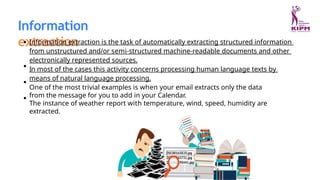
Information extraction is the task of automatically extracting structured information
from unstructured and/or semi-structured machine-readable documents and other
electronically represented sources.
In most of the cases this activity concerns processing human language texts by
means of natural language processing.
One of the most trivial examples is when your email extracts only the data
from the message for you to add in your Calendar.
The instance of weather report with temperature, wind, speed, humidity are
extracted.
Natural language
processing
Natural language processing
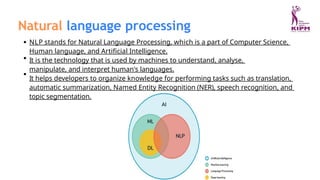
NLP stands for Natural Language Processing, which is a part of Computer Science,
Human language, and Artificial Intelligence.
It is the technology that is used by machines to understand, analyse,
manipulate, and interpret human's languages.
It helps developers to organize knowledge for performing tasks such as translation,
automatic summarization, Named Entity Recognition (NER), speech recognition, and
topic segmentation.
Advantages of
NLP
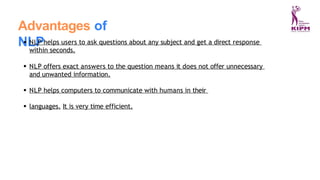
NLP helps users to ask questions about any subject and get a direct response
within seconds.
NLP offers exact answers to the question means it does not offer unnecessary
and unwanted information.
NLP helps computers to communicate with humans in their
languages. It is very time efficient.
Disdvantages of NLP
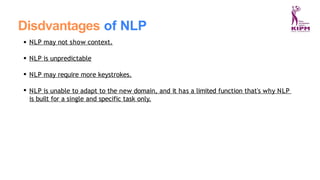
NLP may not show context.
NLP is unpredictable
NLP may require more keystrokes.
NLP is unable to adapt to the new domain, and it has a limited function that's why NLP
is built for a single and specific task only.
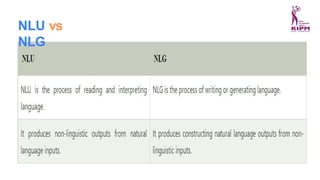
NLU vs
NLG
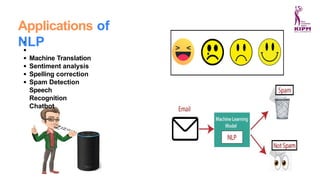
Applications of
NLP
Machine Translation
Sentiment analysis
Spelling correction
Spam Detection
Speech
Recognition
Chatbot
Role of NLP in
AI
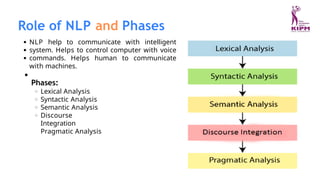
Role of NLP and Phases
NLP help to communicate with intelligent
system. Helps to control computer with voice
commands. Helps human to communicate
with machines.
Phases:
Lexical Analysis
Syntactic Analysis
Semantic Analysis
Discourse
Integration
Pragmatic Analysis
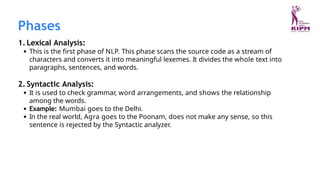
1. Lexical Analysis:
This is the first phase of NLP. This phase scans the source code as a stream of
characters and converts it into meaningful lexemes. It divides the whole text into
paragraphs, sentences, and words.
2. Syntactic Analysis:
It is used to check grammar, word arrangements, and shows the relationship
among the words.
Example: Mumbai goes to the Delhi.
In the real world, Agra goes to the Poonam, does not make any sense, so this
sentence is rejected by the Syntactic analyzer.
Phases
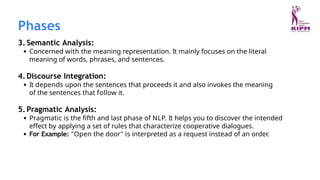
3. Semantic Analysis:
Concerned with the meaning representation. It mainly focuses on the literal
meaning of words, phrases, and sentences.
4.Discourse Integration:
It depends upon the sentences that proceeds it and also invokes the meaning
of the sentences that follow it.
5.Pragmatic Analysis:
Pragmatic is the fifth and last phase of NLP. It helps you to discover the intended
effect by applying a set of rules that characterize cooperative dialogues.
For Example: "Open the door" is interpreted as a request instead of an order.
Phases
Machine
translation
Machine translation is the process of using artificial intelligence to automatically
translate text from one language to another without human involvement.
Modern machine translation goes beyond simple word-to-word translation to
communicate the full meaning of the original language text in the target language.
Types of MT Systems:
Bilingual MT System
Multilingual MT
System
Machine
translation
Approaches Machine
translation
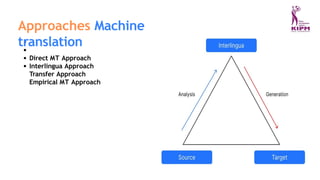
Direct MT Approach
Interlingua Approach
Transfer Approach
Empirical MT Approach
Approaches Machine
translation
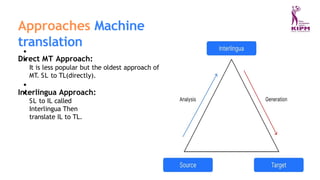
Direct MT Approach:
It is less popular but the oldest approach of
MT. SL to TL(directly).
Interlingua Approach:
SL to IL called
Interlingua Then
translate IL to TL.
Approaches Machine translation
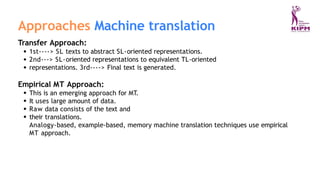
Transfer Approach:
1st----> SL texts to abstract SL-oriented representations.
2nd---> SL-oriented representations to equivalent TL-oriented
representations. 3rd----> Final text is generated.
Empirical MT Approach:
This is an emerging approach for MT.
It uses large amount of data.
Raw data consists of the text and
their translations.
Analogy-based, example-based, memory machine translation techniques use empirical
MT approach.
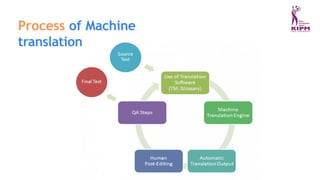
Process of Machine
translation
Speech
recognition
Speech recognition speech recognition is the process that enables a computer to
recognize and responds to its spoken words and then convert them in a format that
the machine understands.
Speech recognition is widely used in digital assistants, smart speaker, smart
homes and automation for a variety of services, products and solutions.
Speech
recognition
Algorithms for Speech recognition
Natural language processing(NLP)
Hidden Markov models
Markov chain model is useful for observable events such as text inputs.
Hidden Markov models allow us to incorporate hidden events, such as part of
speech tags into a probabilistic model.
Neural networks
A neural network is a series of algorithms that endeavors to recognize
underlying relationships in a set of data through a process that mimics the way
the human brain operates.
In this sense, neural networks refer to systems of neurons, either organic or
artificial in nature.
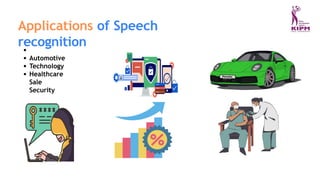
Applications of Speech
recognition
Automotive
Technology
Healthcare
Sale
Security
Robot
Robot
Robot are the artificial agents acting in real world environment.
Robots are aimed at manipulating the objects by perceiving moving and doing
repetitive functions without getting bored, distracted.
Robotics
Robotics is a branch of AI which is composed of electrical engineering,
mechanical engineering and computer science for designing, construction and
application of robots.
Components of
Robot
Power
supply
Actuators
Electric motors
(AC/DC) Pneumatic air
muscles Muscle wires
Piezo Motors and ultrasonic
motors Sensors.
Robot Locomotion and Types
Locomotion is the mechanism that makes a robot capable of moving in its
environment.
There are various types of locomotion:
1. Legged the locomotion
2. Wheeled the locomotion
3. Slip locomotion
Motion of
Mobile
Robot
Terrestrial:
Terrestrial robots move on the ground.
Wheeled robots are most common type of robots in this category.
Airborne
Robotic helicopters, robotically controlled parachutes have been deployed.
Aquatic
This type of robots operates in water, either at the surface or underwater.
Space
Robots are designed to operate in the microgravity of outer space, typically for
space station maintenance.
Motion of Mobile
Robot
Happy
Ending!

AI Unit 5 Notes of articificial intelligence

  • 1.
  • 2.
    AI Applications Information retrieval Informationextraction Natural language processing Applications of NLP Role of NLP and Phases in AI Machine Translation Approaches Process of Machine Translation Speech recognition Algorithms Speech recognition Applications Robot vs Robotics Robot locomotion and Types Motion of Mobile Robot Happy Ending! Topics to be covered...
  • 3.
  • 4.
    AI Applications AI inHealthcare: Faster diagnosis than humans. AI in Gaming AI in Finance AI in Data Security AI in Social Media AI in Travel & Transport AI in Robotics AI in Entertainment AI in Speech recognition AI in Natural Language Processing
  • 5.
  • 6.
    Information retrieval Information Retrieval (IR)can be defined as a software program that deals with the organization, storage, retrieval, and evaluation of information from document repositories, particularly textual information. The main goal of IR research is to develop a model for retrieving information from the repositories of documents. In ad-hoc retrieval, the user must enter a query in natural language that describes the required information. Then the IR system will return the required documents related to the desired information. IR is widely used in popular search engine like google, yahoo, bing etc. Characteristics: A huge data/document collection A format of query with standard query language The generated result model Displaying results model
  • 7.
  • 8.
    Information extraction Information extraction isthe task of automatically extracting structured information from unstructured and/or semi-structured machine-readable documents and other electronically represented sources. In most of the cases this activity concerns processing human language texts by means of natural language processing. One of the most trivial examples is when your email extracts only the data from the message for you to add in your Calendar. The instance of weather report with temperature, wind, speed, humidity are extracted.
  • 9.
  • 10.
    Natural language processing NLPstands for Natural Language Processing, which is a part of Computer Science, Human language, and Artificial Intelligence. It is the technology that is used by machines to understand, analyse, manipulate, and interpret human's languages. It helps developers to organize knowledge for performing tasks such as translation, automatic summarization, Named Entity Recognition (NER), speech recognition, and topic segmentation.
  • 11.
    Advantages of NLP NLP helpsusers to ask questions about any subject and get a direct response within seconds. NLP offers exact answers to the question means it does not offer unnecessary and unwanted information. NLP helps computers to communicate with humans in their languages. It is very time efficient.
  • 12.
    Disdvantages of NLP NLPmay not show context. NLP is unpredictable NLP may require more keystrokes. NLP is unable to adapt to the new domain, and it has a limited function that's why NLP is built for a single and specific task only.
  • 13.
  • 14.
    Applications of NLP Machine Translation Sentimentanalysis Spelling correction Spam Detection Speech Recognition Chatbot
  • 15.
  • 16.
    Role of NLPand Phases NLP help to communicate with intelligent system. Helps to control computer with voice commands. Helps human to communicate with machines. Phases: Lexical Analysis Syntactic Analysis Semantic Analysis Discourse Integration Pragmatic Analysis
  • 17.
    1. Lexical Analysis: Thisis the first phase of NLP. This phase scans the source code as a stream of characters and converts it into meaningful lexemes. It divides the whole text into paragraphs, sentences, and words. 2. Syntactic Analysis: It is used to check grammar, word arrangements, and shows the relationship among the words. Example: Mumbai goes to the Delhi. In the real world, Agra goes to the Poonam, does not make any sense, so this sentence is rejected by the Syntactic analyzer. Phases
  • 18.
    3. Semantic Analysis: Concernedwith the meaning representation. It mainly focuses on the literal meaning of words, phrases, and sentences. 4.Discourse Integration: It depends upon the sentences that proceeds it and also invokes the meaning of the sentences that follow it. 5.Pragmatic Analysis: Pragmatic is the fifth and last phase of NLP. It helps you to discover the intended effect by applying a set of rules that characterize cooperative dialogues. For Example: "Open the door" is interpreted as a request instead of an order. Phases
  • 19.
  • 20.
    Machine translation isthe process of using artificial intelligence to automatically translate text from one language to another without human involvement. Modern machine translation goes beyond simple word-to-word translation to communicate the full meaning of the original language text in the target language. Types of MT Systems: Bilingual MT System Multilingual MT System Machine translation
  • 21.
    Approaches Machine translation Direct MTApproach Interlingua Approach Transfer Approach Empirical MT Approach
  • 22.
    Approaches Machine translation Direct MTApproach: It is less popular but the oldest approach of MT. SL to TL(directly). Interlingua Approach: SL to IL called Interlingua Then translate IL to TL.
  • 23.
    Approaches Machine translation TransferApproach: 1st----> SL texts to abstract SL-oriented representations. 2nd---> SL-oriented representations to equivalent TL-oriented representations. 3rd----> Final text is generated. Empirical MT Approach: This is an emerging approach for MT. It uses large amount of data. Raw data consists of the text and their translations. Analogy-based, example-based, memory machine translation techniques use empirical MT approach.
  • 24.
  • 25.
  • 26.
    Speech recognition speechrecognition is the process that enables a computer to recognize and responds to its spoken words and then convert them in a format that the machine understands. Speech recognition is widely used in digital assistants, smart speaker, smart homes and automation for a variety of services, products and solutions. Speech recognition
  • 27.
    Algorithms for Speechrecognition Natural language processing(NLP) Hidden Markov models Markov chain model is useful for observable events such as text inputs. Hidden Markov models allow us to incorporate hidden events, such as part of speech tags into a probabilistic model. Neural networks A neural network is a series of algorithms that endeavors to recognize underlying relationships in a set of data through a process that mimics the way the human brain operates. In this sense, neural networks refer to systems of neurons, either organic or artificial in nature.
  • 28.
  • 29.
  • 30.
    Robot Robot are theartificial agents acting in real world environment. Robots are aimed at manipulating the objects by perceiving moving and doing repetitive functions without getting bored, distracted. Robotics Robotics is a branch of AI which is composed of electrical engineering, mechanical engineering and computer science for designing, construction and application of robots.
  • 31.
    Components of Robot Power supply Actuators Electric motors (AC/DC)Pneumatic air muscles Muscle wires Piezo Motors and ultrasonic motors Sensors.
  • 32.
    Robot Locomotion andTypes Locomotion is the mechanism that makes a robot capable of moving in its environment. There are various types of locomotion: 1. Legged the locomotion 2. Wheeled the locomotion 3. Slip locomotion
  • 33.
  • 34.
    Terrestrial: Terrestrial robots moveon the ground. Wheeled robots are most common type of robots in this category. Airborne Robotic helicopters, robotically controlled parachutes have been deployed. Aquatic This type of robots operates in water, either at the surface or underwater. Space Robots are designed to operate in the microgravity of outer space, typically for space station maintenance. Motion of Mobile Robot
  • 35.