Native Interfaces for R

           Seth Falcon

Fred Hutchinson Cancer Research Center


         20-21 May, 2010
Outline


   The .Call Native Interface

   R types at the C-level

   Memory management in R

   Self-Study Exercises

   Odds and Ends

   Resources
which   as implemented in R prior to R-2.11


   which <- function(x) {
       seq_along(x)[x & !is.na(x)]
   }
which   as implemented in R prior to R-2.11


   which <- function(x) {
       seq_along(x)[x & !is.na(x)]
   }

        1. is.na
        2. !
        3. &
        4. seq_along
        5. [
which   in C


    1 SEXP nid_which(SEXP v) {
    2     SEXP ans;
    3     int i, j = 0, len = Rf_length(v), *buf, *tf;
    4     buf = (int *) R_alloc(len, sizeof(int));
    5     tf = LOGICAL(v);
    6     for (i = 0; i < len; i++) {
    7         if (tf[i] == TRUE) buf[j] = i + 1; j++;
    8     }
    9     ans = Rf_allocVector(INTSXP, j);
   10     memcpy(INTEGER(ans), buf, sizeof(int) * j);
   11     return ans;
   }
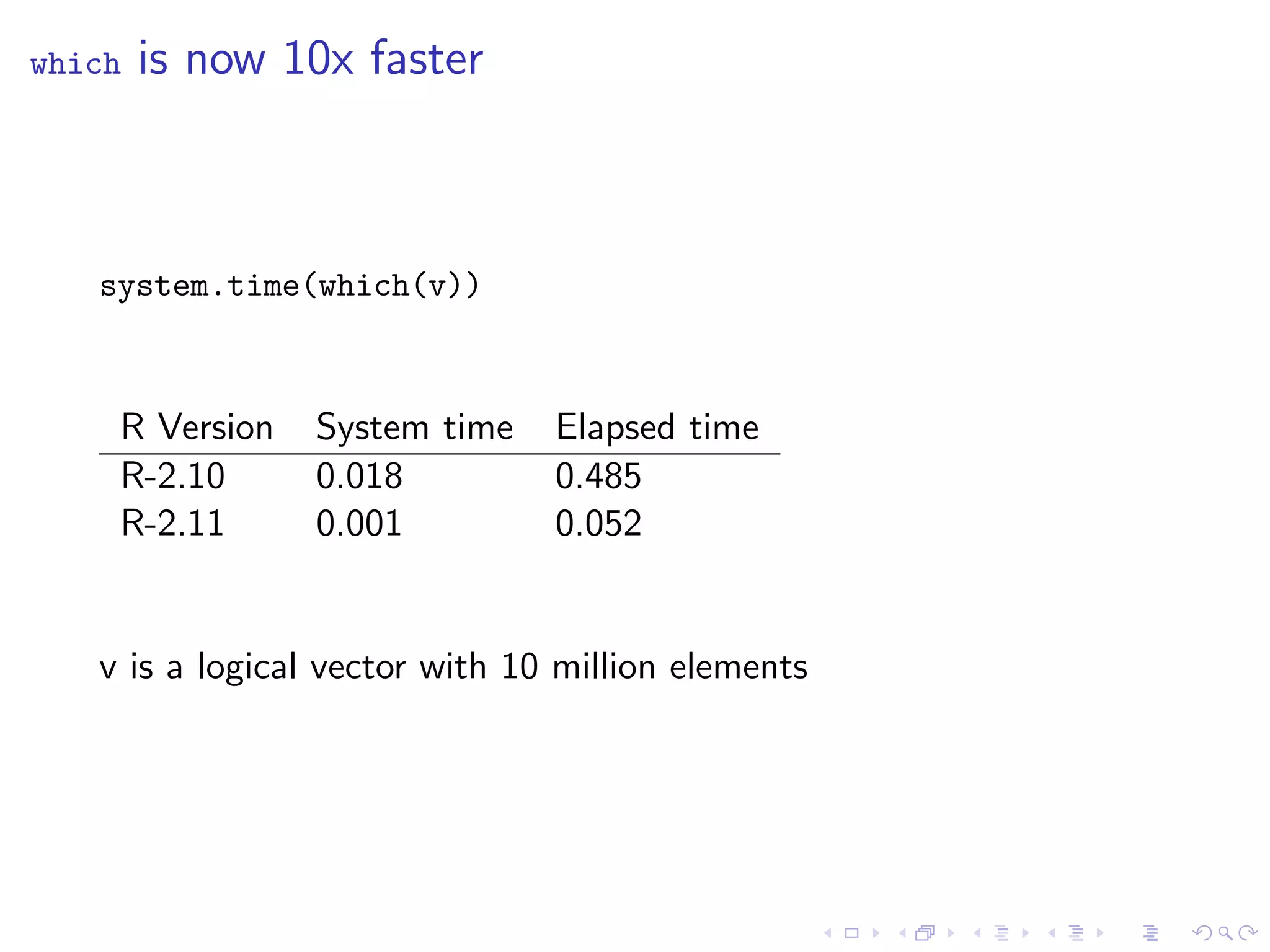
which   is now 10x faster


   system.time(which(v))


    R Version    System time    Elapsed time
    R-2.10       0.018          0.485
    R-2.11       0.001          0.052


   v is a logical vector with 10 million elements
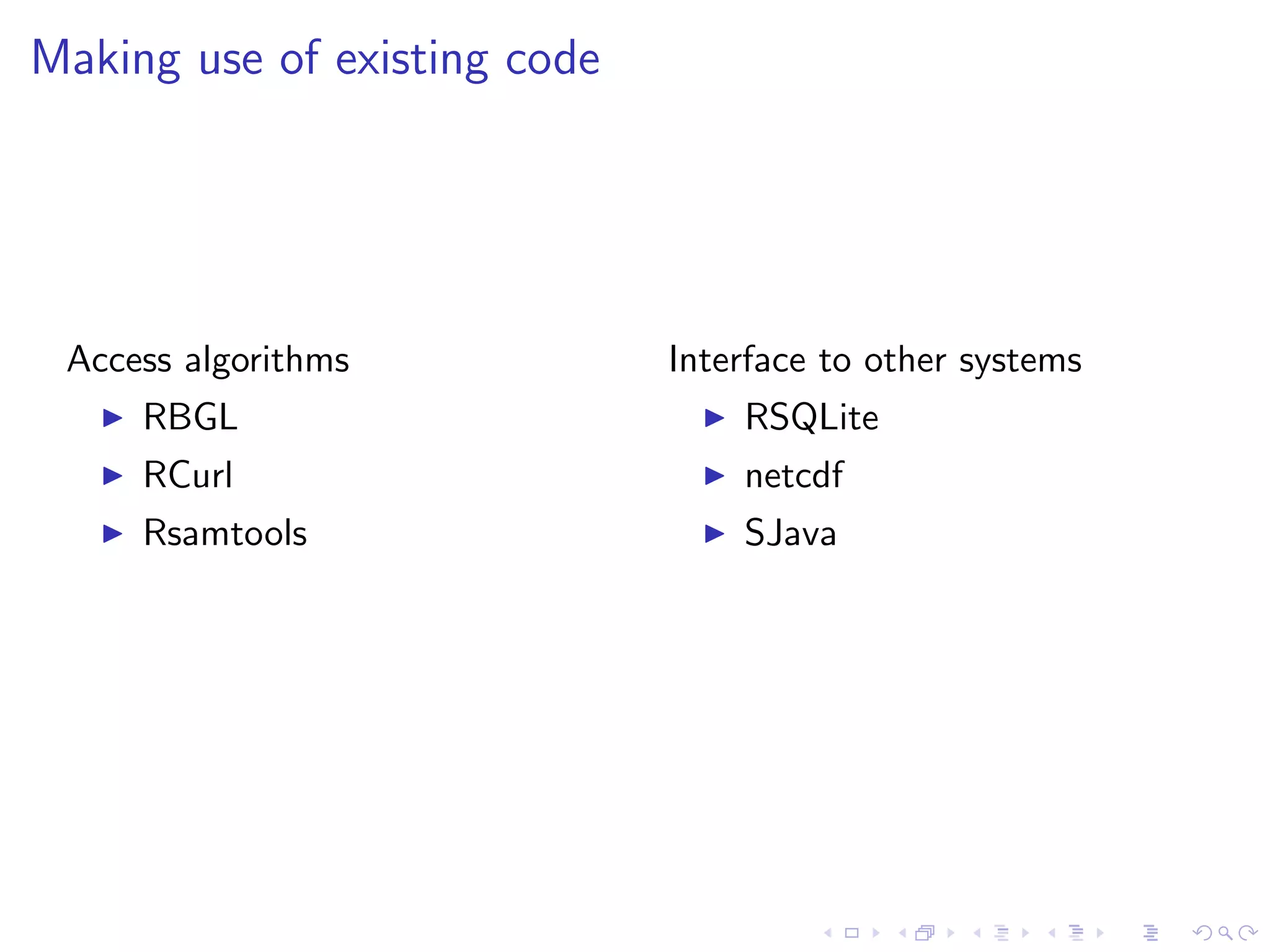
Making use of existing code


 Access algorithms            Interface to other systems
     RBGL                         RSQLite
     RCurl                        netcdf
     Rsamtools                    SJava
Review of C

   #include <stdio.h>
   double _nid_avg(int *data, int len) {
       int i;
       double ans = 0.0;
       for (i = 0; i < len; i++) {
         ans += data[i];
       }
       return ans / len;
   }
   main() {
       int ex_data[5] = {1, 2, 3, 4, 5};
       double m = _nid_avg(ex_data, 5);
       printf("%fn", m);
   }
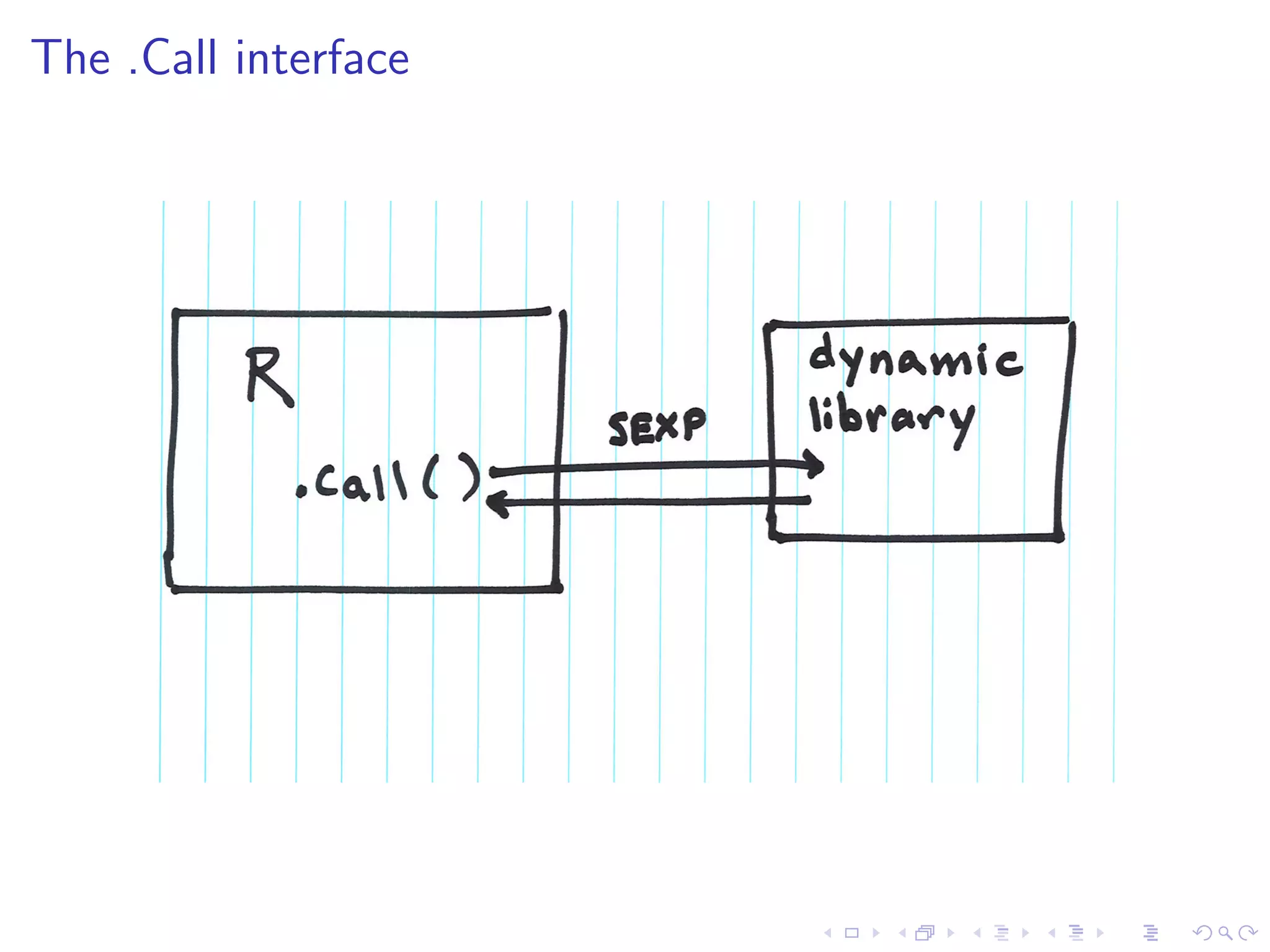
The .Call interface
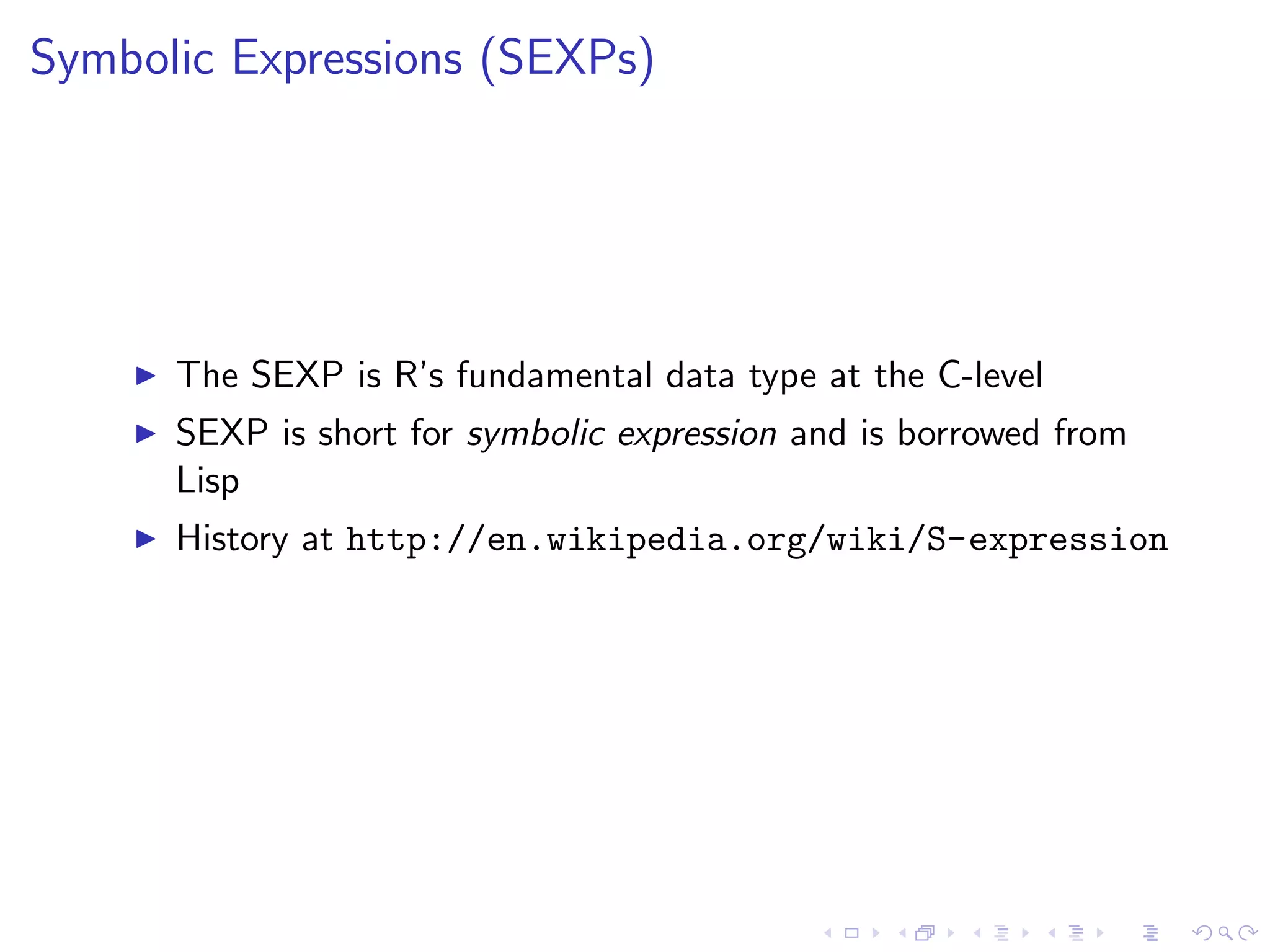
Symbolic Expressions (SEXPs)


      The SEXP is R’s fundamental data type at the C-level
      SEXP is short for symbolic expression and is borrowed from
      Lisp
      History at http://en.wikipedia.org/wiki/S-expression
.Call Start to Finish Demo


   Demo
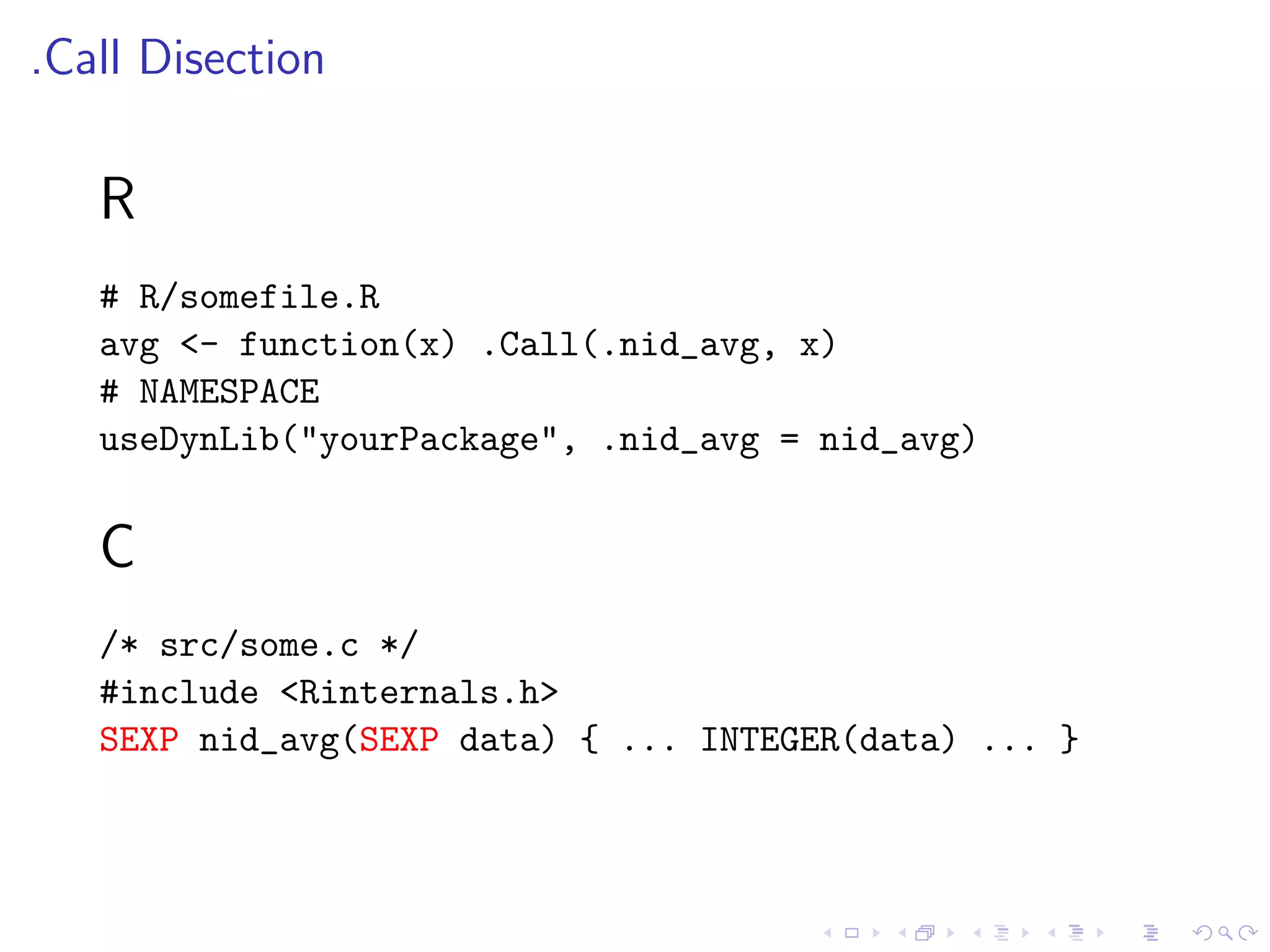
.Call Disection

   R
   # R/somefile.R
   avg <- function(x) .Call(.nid_avg, x)
   # NAMESPACE
   useDynLib("yourPackage", .nid_avg = nid_avg)


   C
   /* src/some.c */
   #include <Rinternals.h>
   SEXP nid_avg(SEXP data) { ... INTEGER(data) ... }
.Call C function


   #include <Rinternals.h>

   SEXP nid_avg(SEXP data)
   {
       SEXP ans;
       double v = _nid_avg(INTEGER(data), Rf_length(data));
       PROTECT(ans = Rf_allocVector(REALSXP, 1));
       REAL(ans)[0] = v;
       UNPROTECT(1);
       return ans;
       /* shortcut: return Rf_ScalarReal(v); */
   }
.Call C function


   #include <Rinternals.h>

   SEXP nid_avg(SEXP data)
   {
       SEXP ans;
       double v = _nid_avg(INTEGER(data), Rf_length(data));
       PROTECT(ans = Rf_allocVector(REALSXP, 1));
       REAL(ans)[0] = v;
       UNPROTECT(1);
       return ans;
       /* shortcut: return Rf_ScalarReal(v); */
   }
.Call C function


   #include <Rinternals.h>

   SEXP nid_avg(SEXP data)
   {
       SEXP ans;
       double v = _nid_avg(INTEGER(data), Rf_length(data));
       PROTECT(ans = Rf_allocVector(REALSXP, 1));
       REAL(ans)[0] = v;
       UNPROTECT(1);
       return ans;
       /* shortcut: return Rf_ScalarReal(v); */
   }
.Call C function


   #include <Rinternals.h>

   SEXP nid_avg(SEXP data)
   {
       SEXP ans;
       double v = _nid_avg(INTEGER(data), Rf_length(data));
       PROTECT(ans = Rf_allocVector(REALSXP, 1));
       REAL(ans)[0] = v;
       UNPROTECT(1);
       return ans;
       /* shortcut: return Rf_ScalarReal(v); */
   }
.Call C function


   #include <Rinternals.h>

   SEXP nid_avg(SEXP data)
   {
       SEXP ans;
       double v = _nid_avg(INTEGER(data), Rf_length(data));
       PROTECT(ans = Rf_allocVector(REALSXP, 1));
       REAL(ans)[0] = v;
       UNPROTECT(1);
       return ans;
       /* shortcut: return Rf_ScalarReal(v); */
   }
.Call C function


   #include <Rinternals.h>

   SEXP nid_avg(SEXP data)
   {
       SEXP ans;
       double v = _nid_avg(INTEGER(data), Rf_length(data));
       PROTECT(ans = Rf_allocVector(REALSXP, 1));
       REAL(ans)[0] = v;
       UNPROTECT(1);
       return ans;
       /* shortcut: return Rf_ScalarReal(v); */
   }
.Call C function


   #include <Rinternals.h>

   SEXP nid_avg(SEXP data)
   {
       SEXP ans;
       double v = _nid_avg(INTEGER(data), Rf_length(data));
       PROTECT(ans = Rf_allocVector(REALSXP, 1));
       REAL(ans)[0] = v;
       UNPROTECT(1);
       return ans;
       /* shortcut: return Rf_ScalarReal(v); */
   }
Function Registration


      In NAMESPACE
      In C via R_CallMethodDef (See
      ShortRead/src/R_init_ShortRead.c for a nice example.
Outline


   The .Call Native Interface

   R types at the C-level

   Memory management in R

   Self-Study Exercises

   Odds and Ends

   Resources
Just one thing to learn


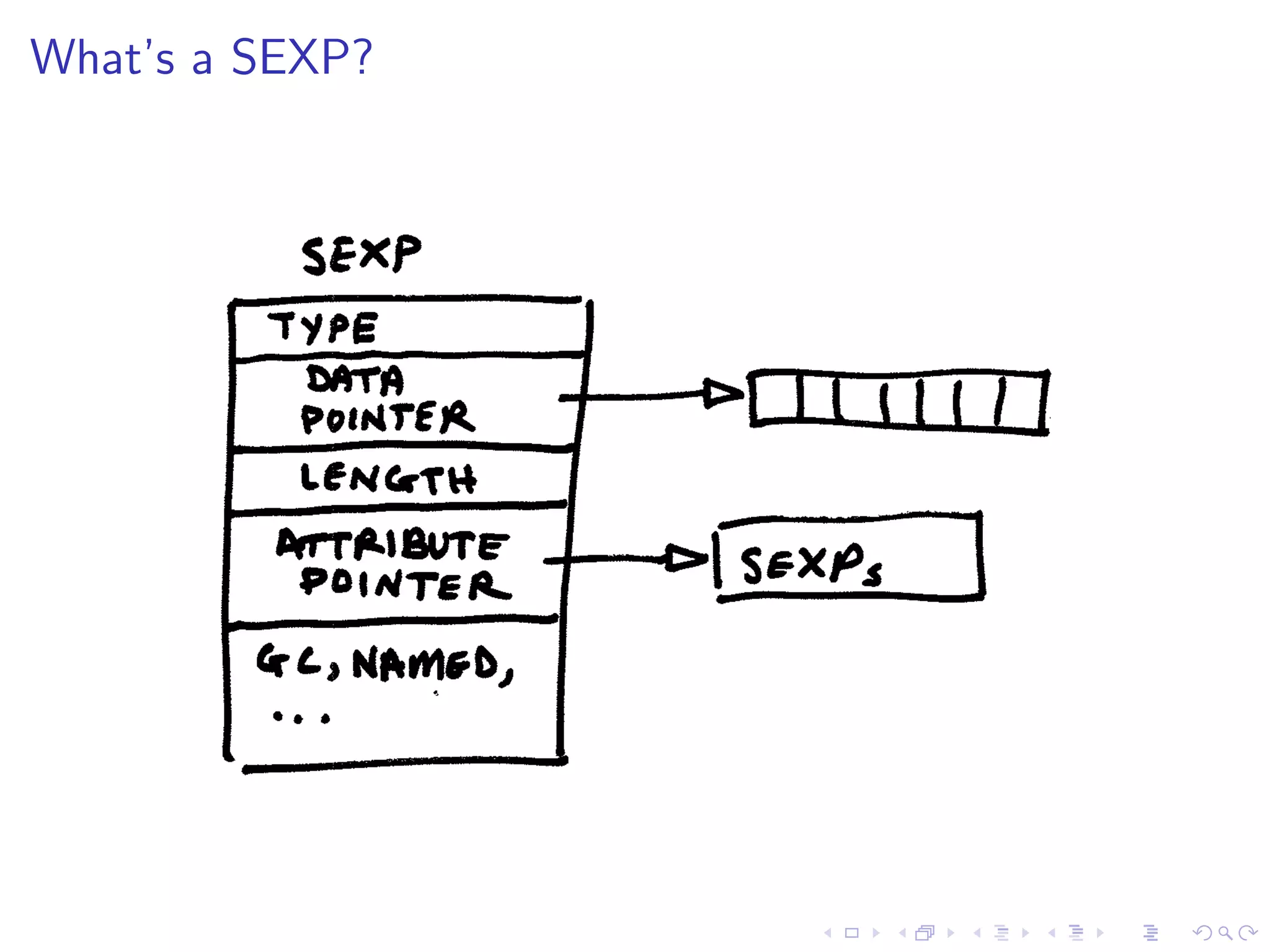
       Everything is a SEXP
       But there are many different types of SEXPs
       INTSXP, REALSXP, STRSXP, LGLSXP, VECSXP, and more.
What’s a SEXP?
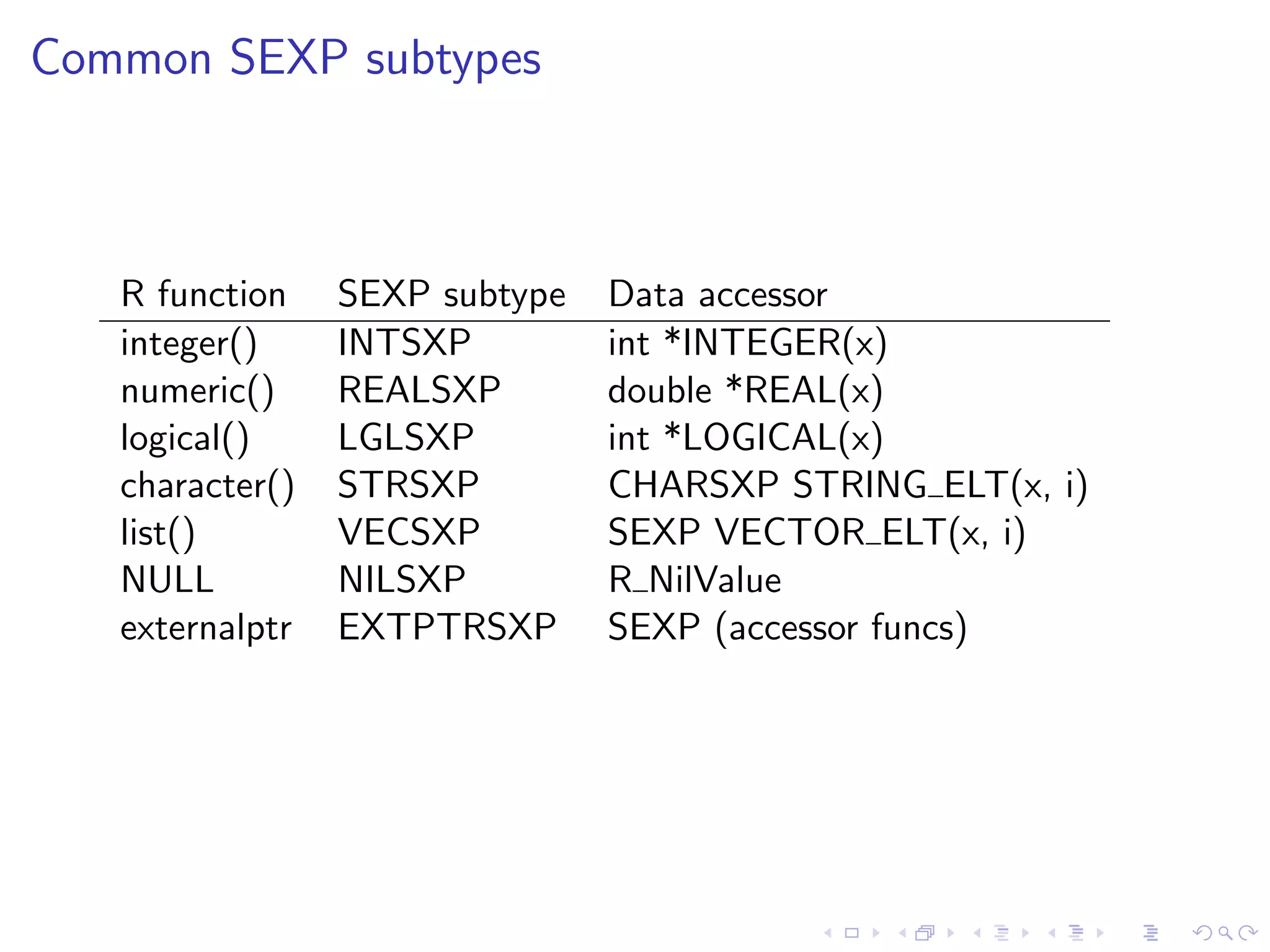
Common SEXP subtypes


   R function    SEXP subtype   Data accessor
   integer()     INTSXP         int *INTEGER(x)
   numeric()     REALSXP        double *REAL(x)
   logical()     LGLSXP         int *LOGICAL(x)
   character()   STRSXP         CHARSXP STRING ELT(x, i)
   list()        VECSXP         SEXP VECTOR ELT(x, i)
   NULL          NILSXP         R NilValue
   externalptr   EXTPTRSXP      SEXP (accessor funcs)
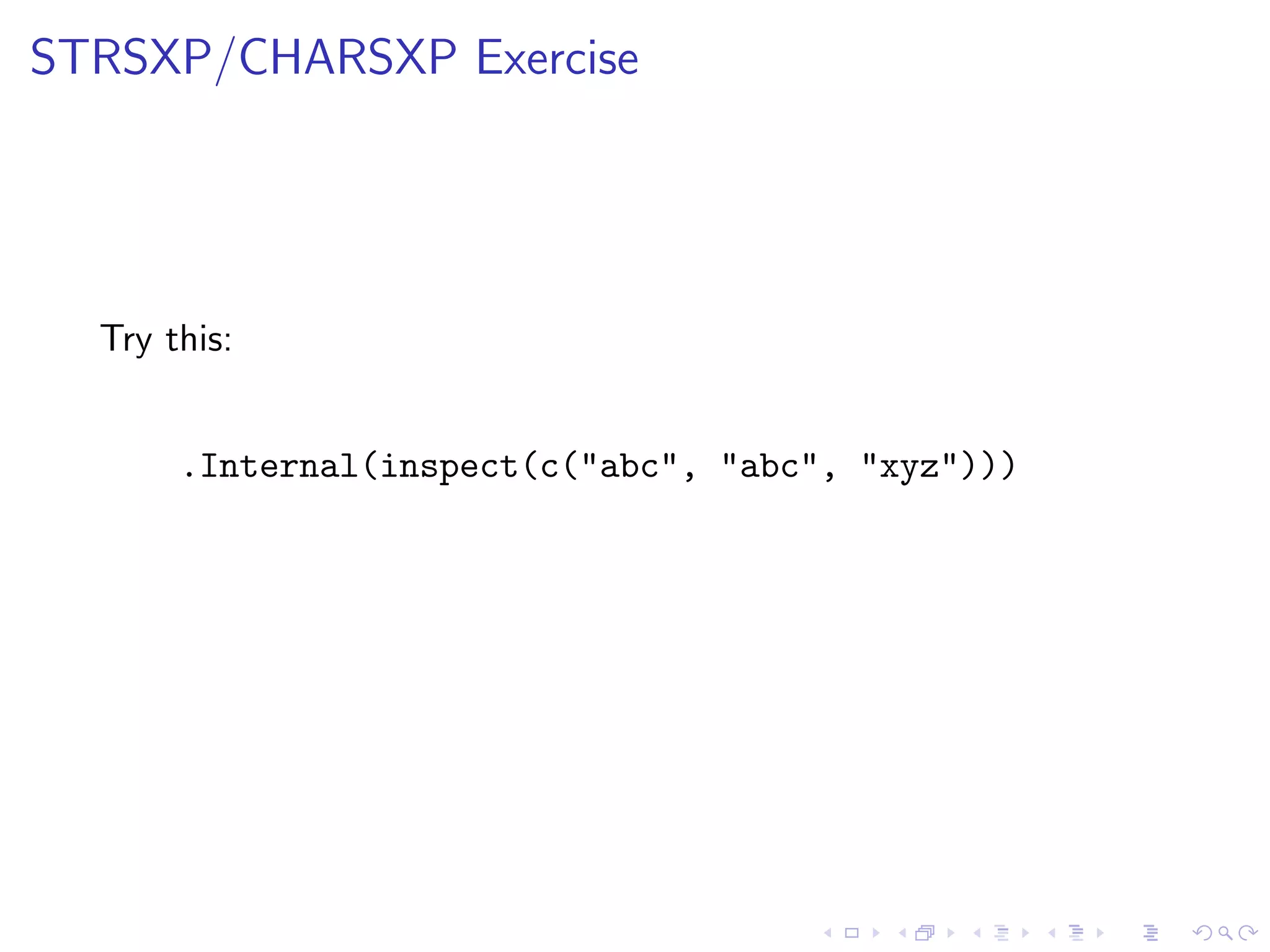
STRSXP/CHARSXP Exercise


  Try this:


       .Internal(inspect(c("abc", "abc", "xyz")))
STRSXP/CHARSXP Exercise


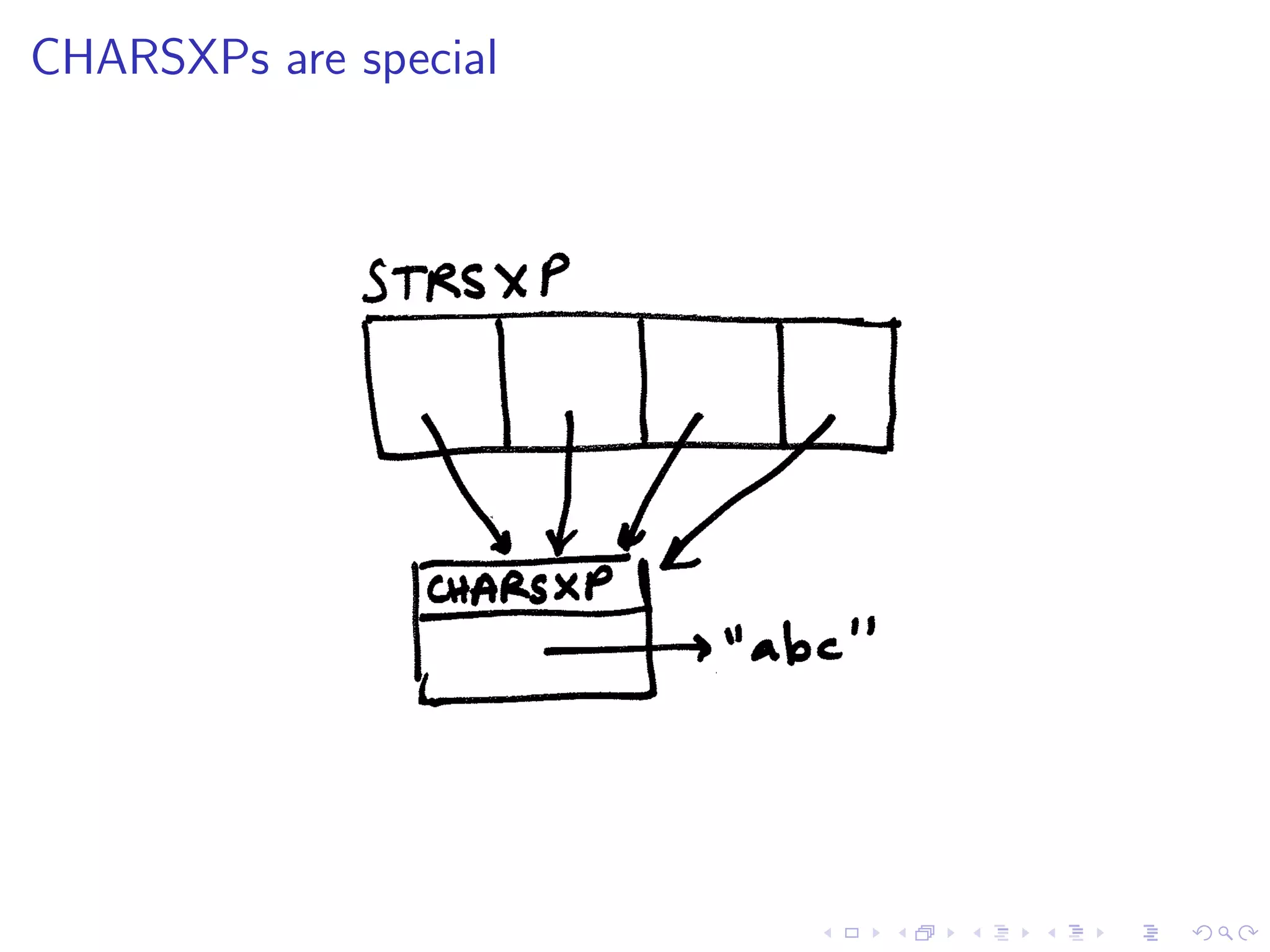
  > .Internal(inspect(c("abc", "abc", "xyz")))

   @101d3f280 16 STRSXP g0c3 []   (len=3, tl=1)
     @101cc6278 09 CHARSXP g0c1   [gp=0x20] "abc"
     @101cc6278 09 CHARSXP g0c1   [gp=0x20] "abc"
     @101cc6308 09 CHARSXP g0c1   [gp=0x20] "xyz"
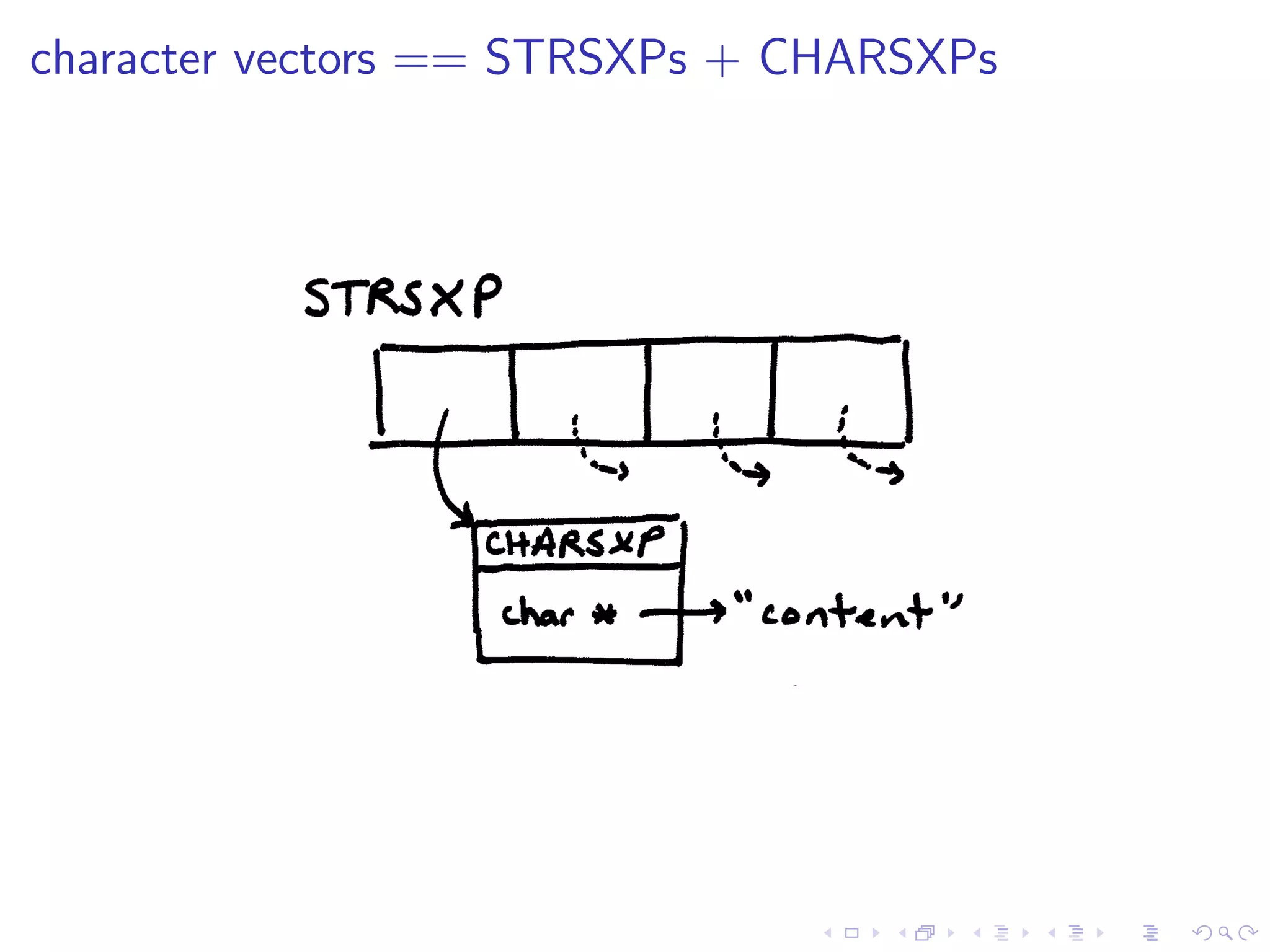
character vectors == STRSXPs + CHARSXPs
CHARSXPs are special
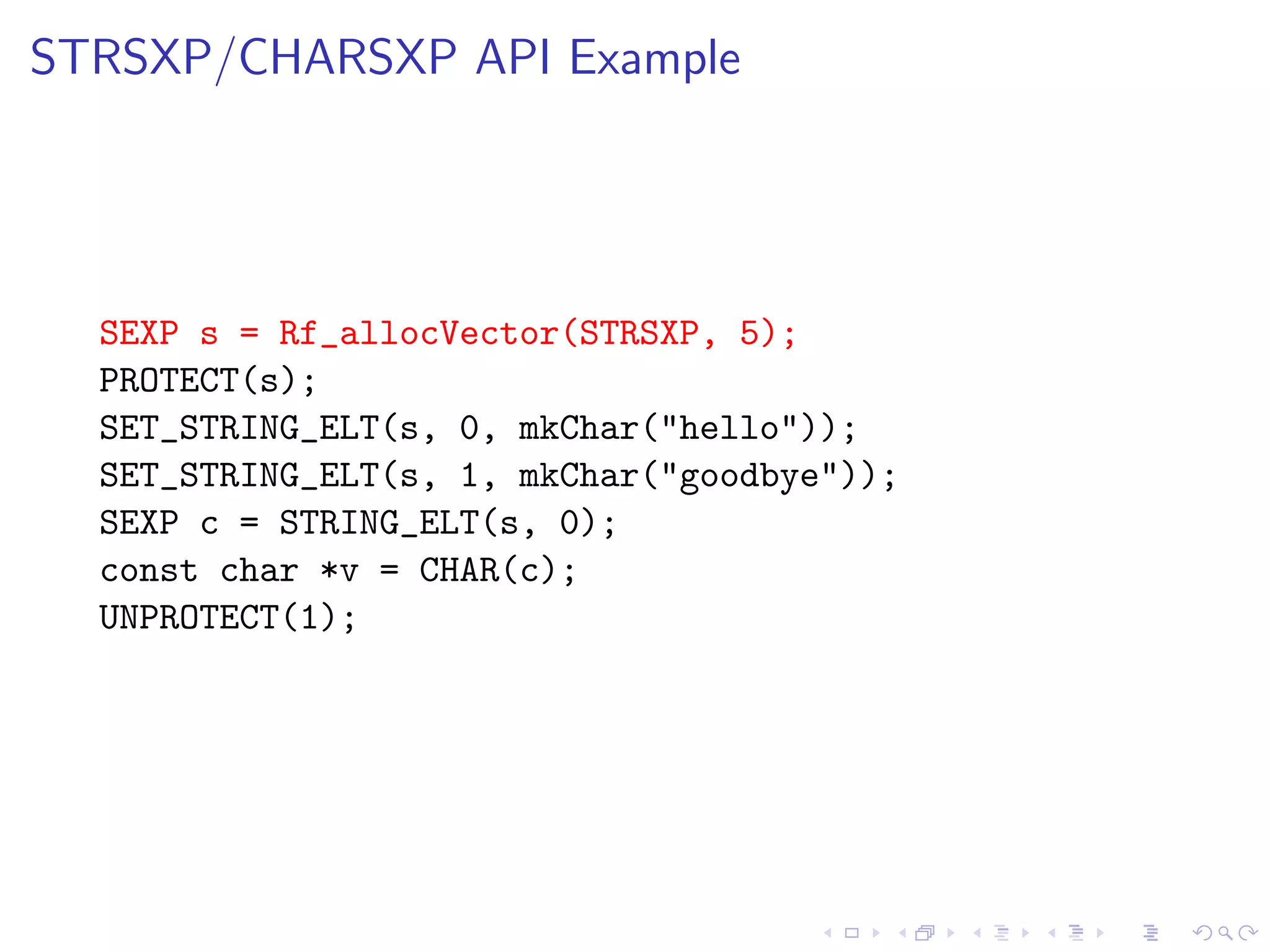
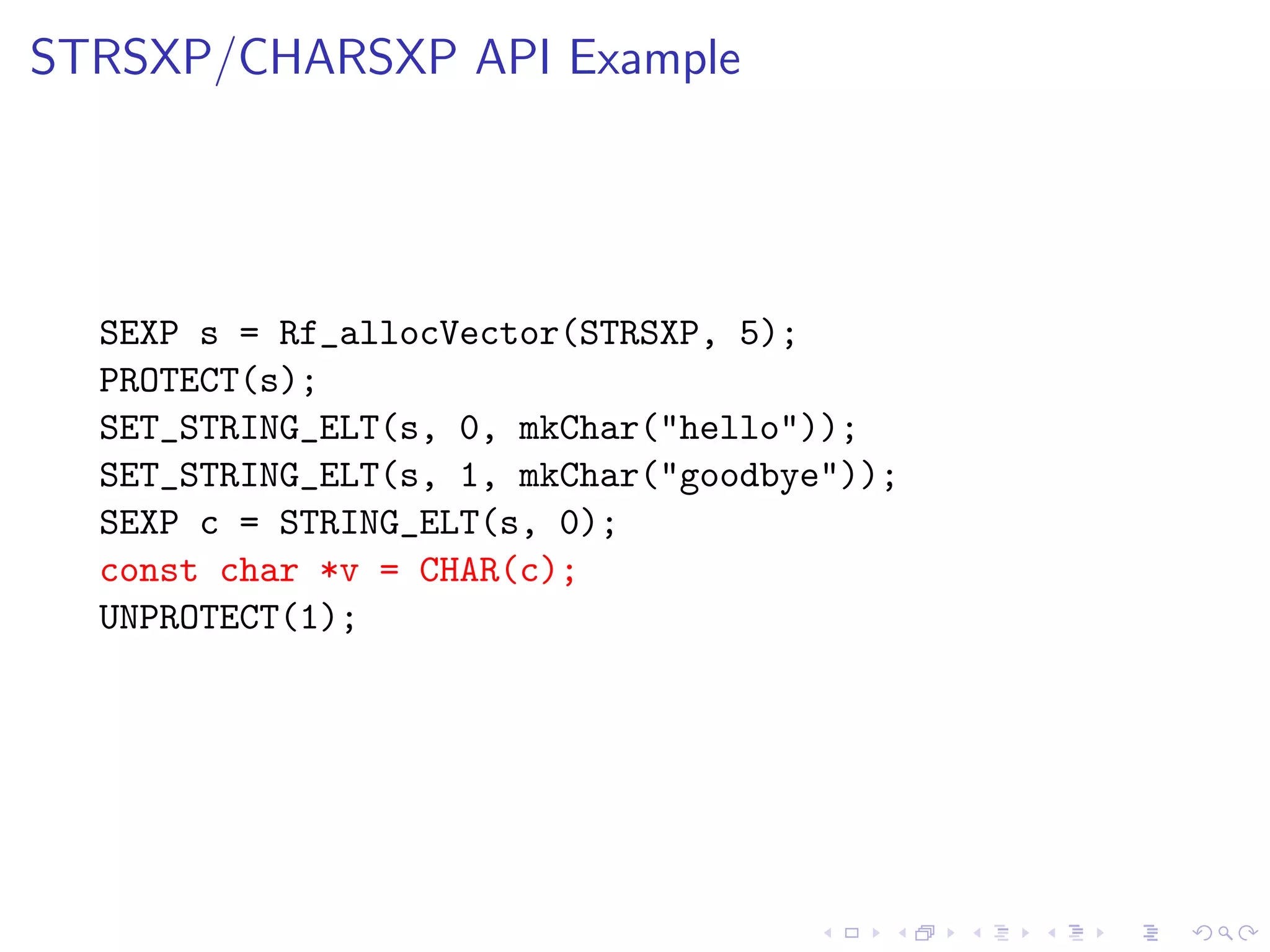
STRSXP/CHARSXP API Example


  SEXP s = Rf_allocVector(STRSXP, 5);
  PROTECT(s);
  SET_STRING_ELT(s, 0, mkChar("hello"));
  SET_STRING_ELT(s, 1, mkChar("goodbye"));
  SEXP c = STRING_ELT(s, 0);
  const char *v = CHAR(c);
  UNPROTECT(1);
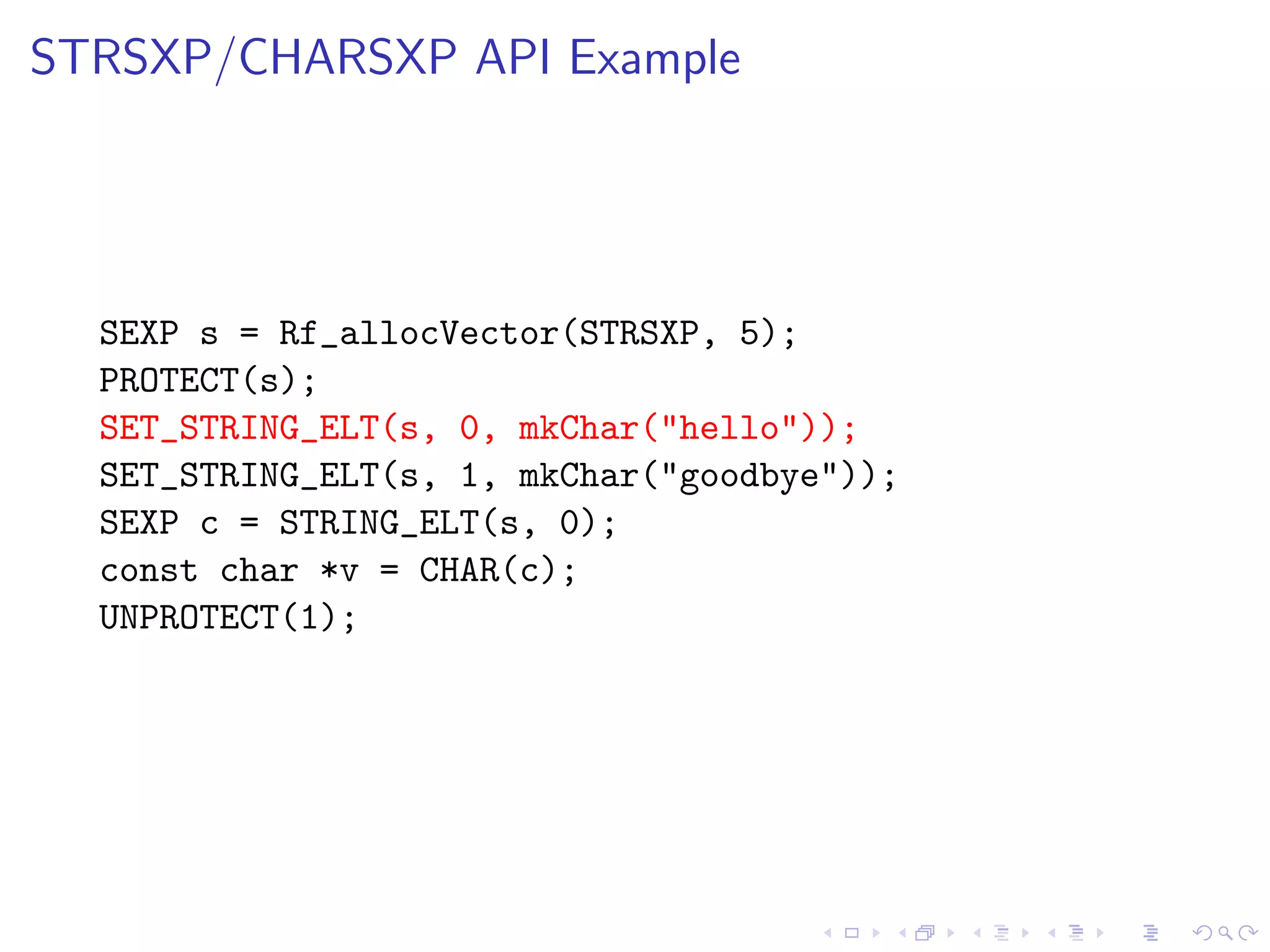
STRSXP/CHARSXP API Example


  SEXP s = Rf_allocVector(STRSXP, 5);
  PROTECT(s);
  SET_STRING_ELT(s, 0, mkChar("hello"));
  SET_STRING_ELT(s, 1, mkChar("goodbye"));
  SEXP c = STRING_ELT(s, 0);
  const char *v = CHAR(c);
  UNPROTECT(1);
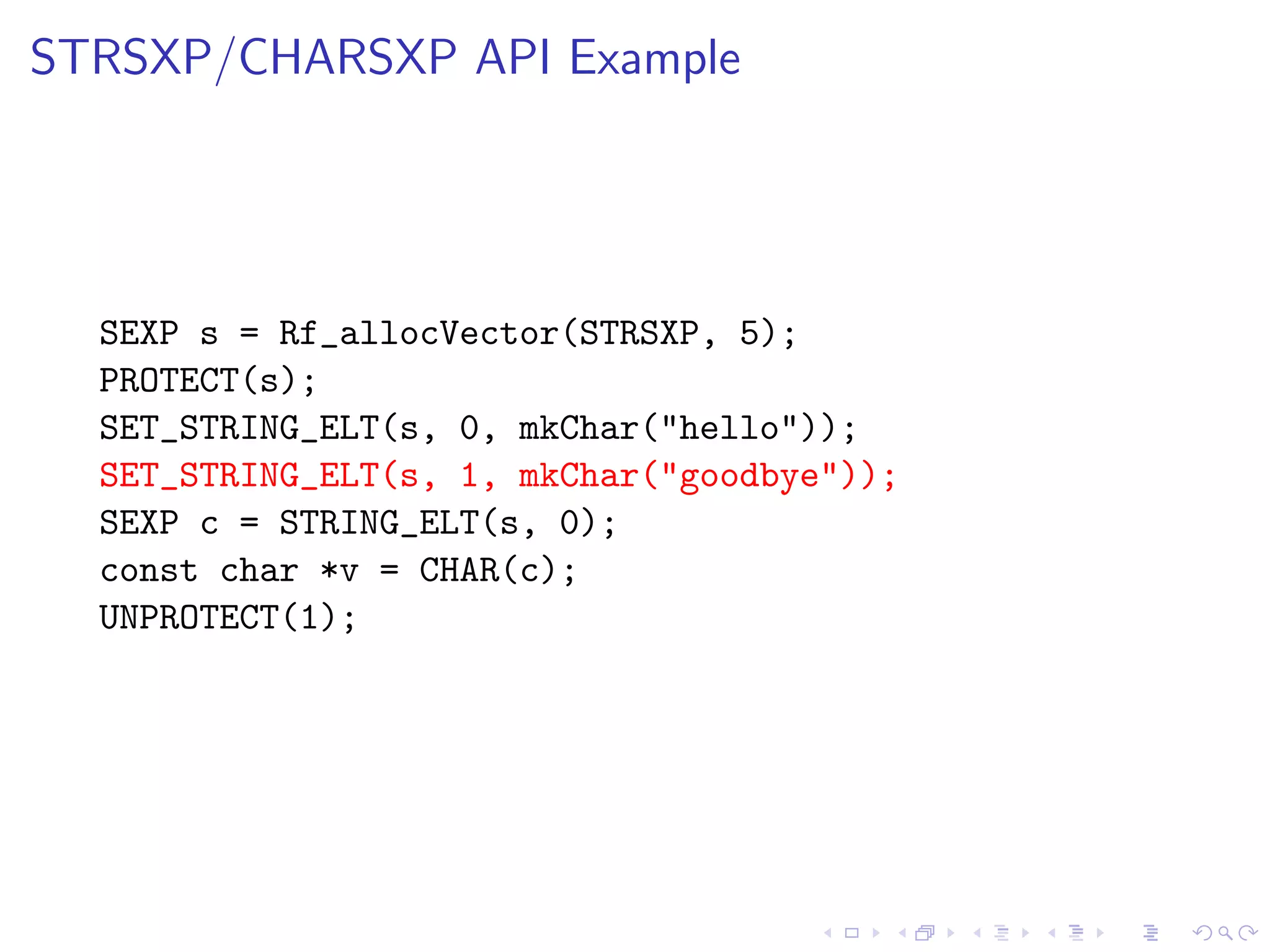
STRSXP/CHARSXP API Example


  SEXP s = Rf_allocVector(STRSXP, 5);
  PROTECT(s);
  SET_STRING_ELT(s, 0, mkChar("hello"));
  SET_STRING_ELT(s, 1, mkChar("goodbye"));
  SEXP c = STRING_ELT(s, 0);
  const char *v = CHAR(c);
  UNPROTECT(1);
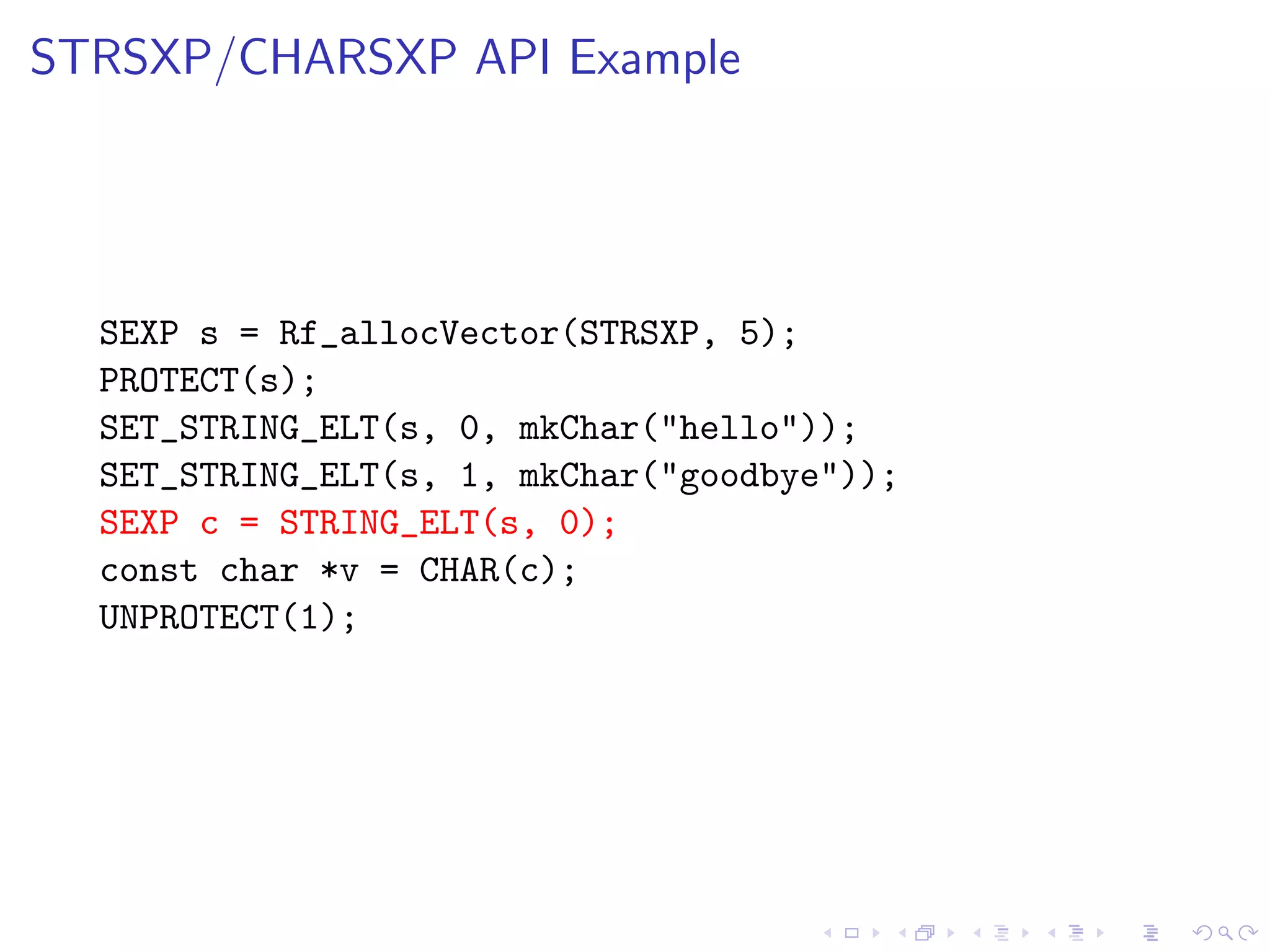
STRSXP/CHARSXP API Example


  SEXP s = Rf_allocVector(STRSXP, 5);
  PROTECT(s);
  SET_STRING_ELT(s, 0, mkChar("hello"));
  SET_STRING_ELT(s, 1, mkChar("goodbye"));
  SEXP c = STRING_ELT(s, 0);
  const char *v = CHAR(c);
  UNPROTECT(1);
STRSXP/CHARSXP API Example


  SEXP s = Rf_allocVector(STRSXP, 5);
  PROTECT(s);
  SET_STRING_ELT(s, 0, mkChar("hello"));
  SET_STRING_ELT(s, 1, mkChar("goodbye"));
  SEXP c = STRING_ELT(s, 0);
  const char *v = CHAR(c);
  UNPROTECT(1);
Outline


   The .Call Native Interface

   R types at the C-level

   Memory management in R

   Self-Study Exercises

   Odds and Ends

   Resources
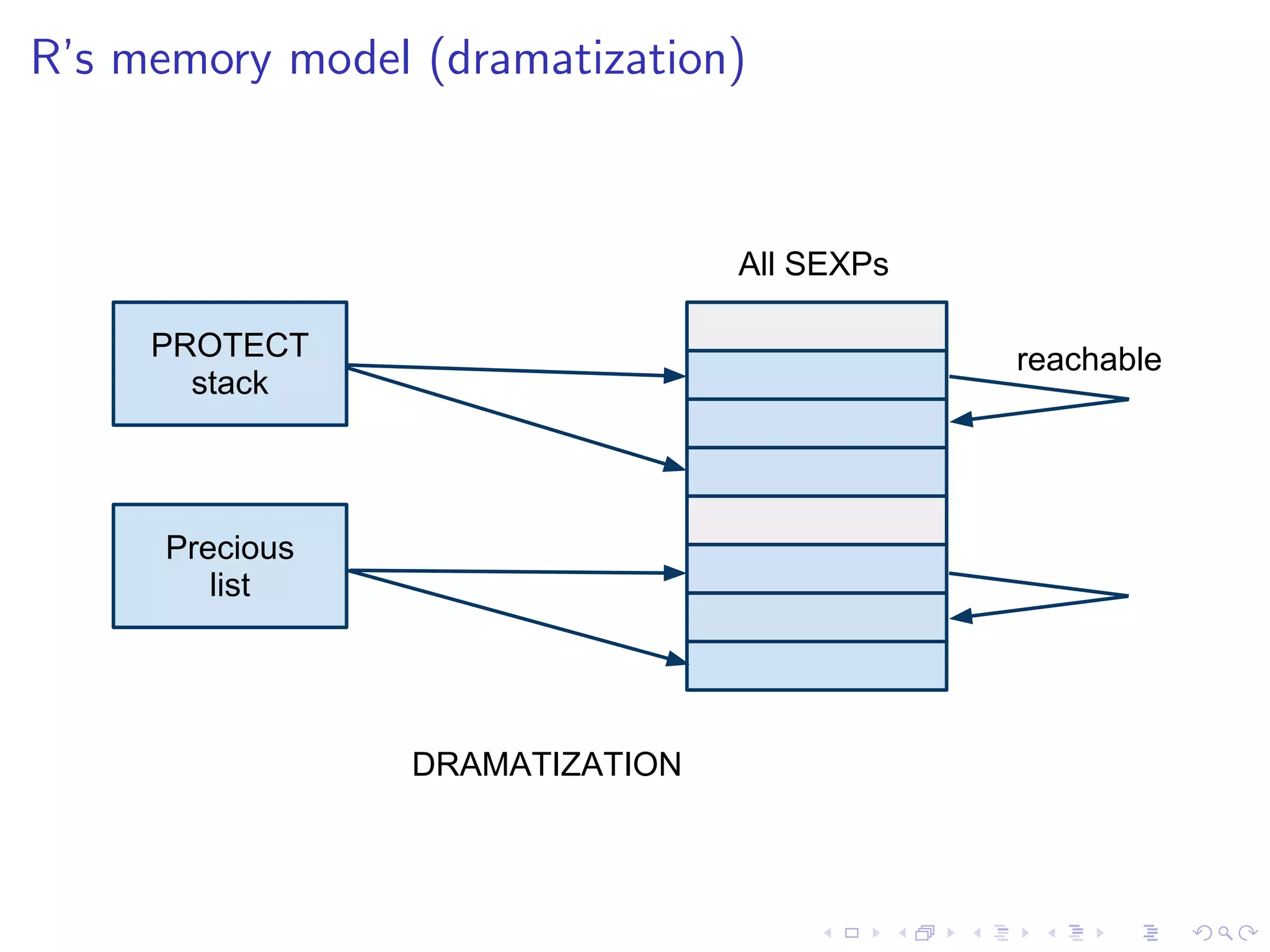
R’s memory model (dramatization)


                                 All SEXPs

     PROTECT                                 reachable
       stack


      Precious
         list


                 DRAMATIZATION
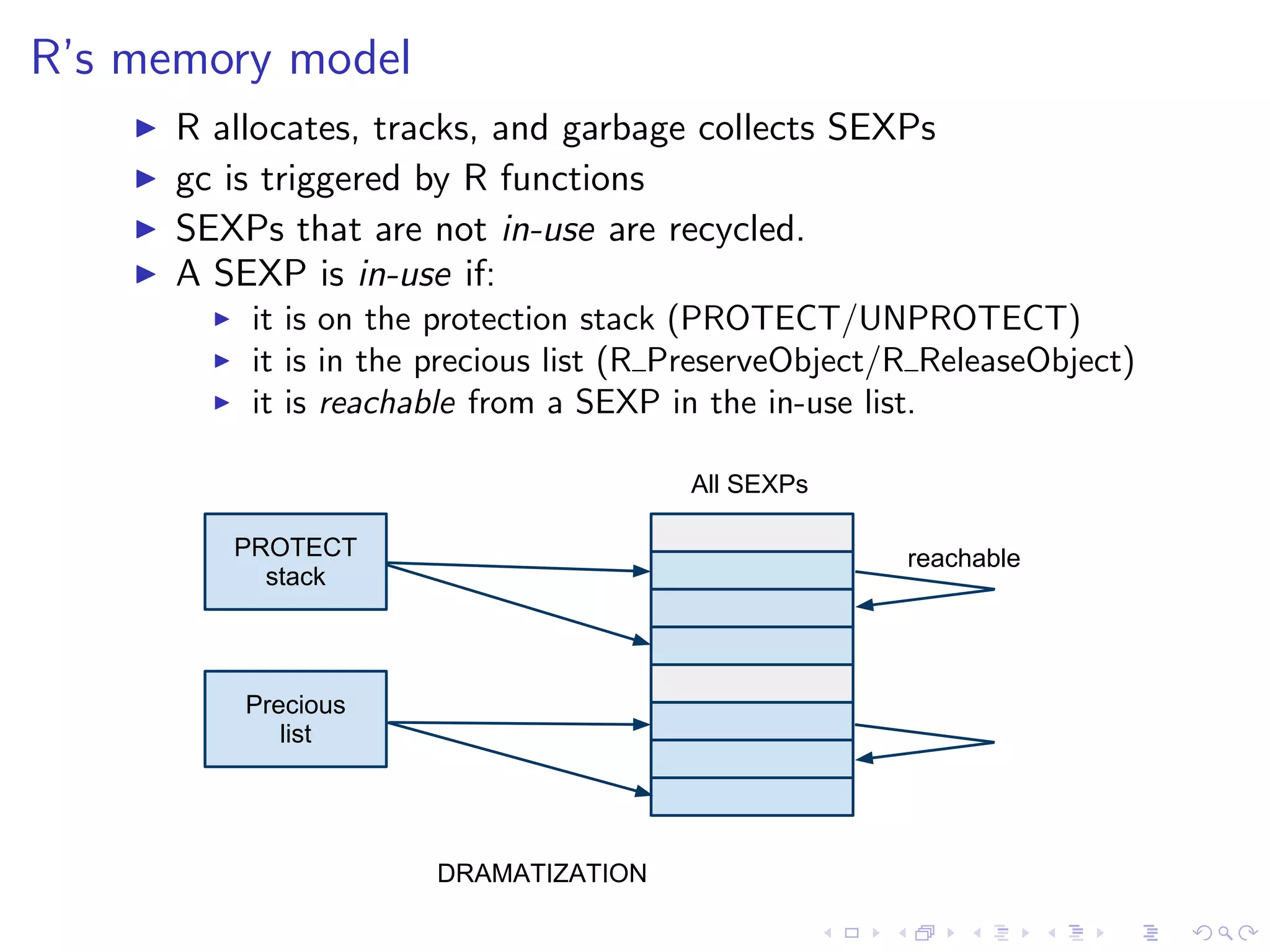
R’s memory model
      R allocates, tracks, and garbage collects SEXPs
      gc is triggered by R functions
      SEXPs that are not in-use are recycled.
      A SEXP is in-use if:
          it is on the protection stack (PROTECT/UNPROTECT)
          it is in the precious list (R PreserveObject/R ReleaseObject)
          it is reachable from a SEXP in the in-use list.

                                        All SEXPs

         PROTECT                                       reachable
           stack


          Precious
             list


                      DRAMATIZATION
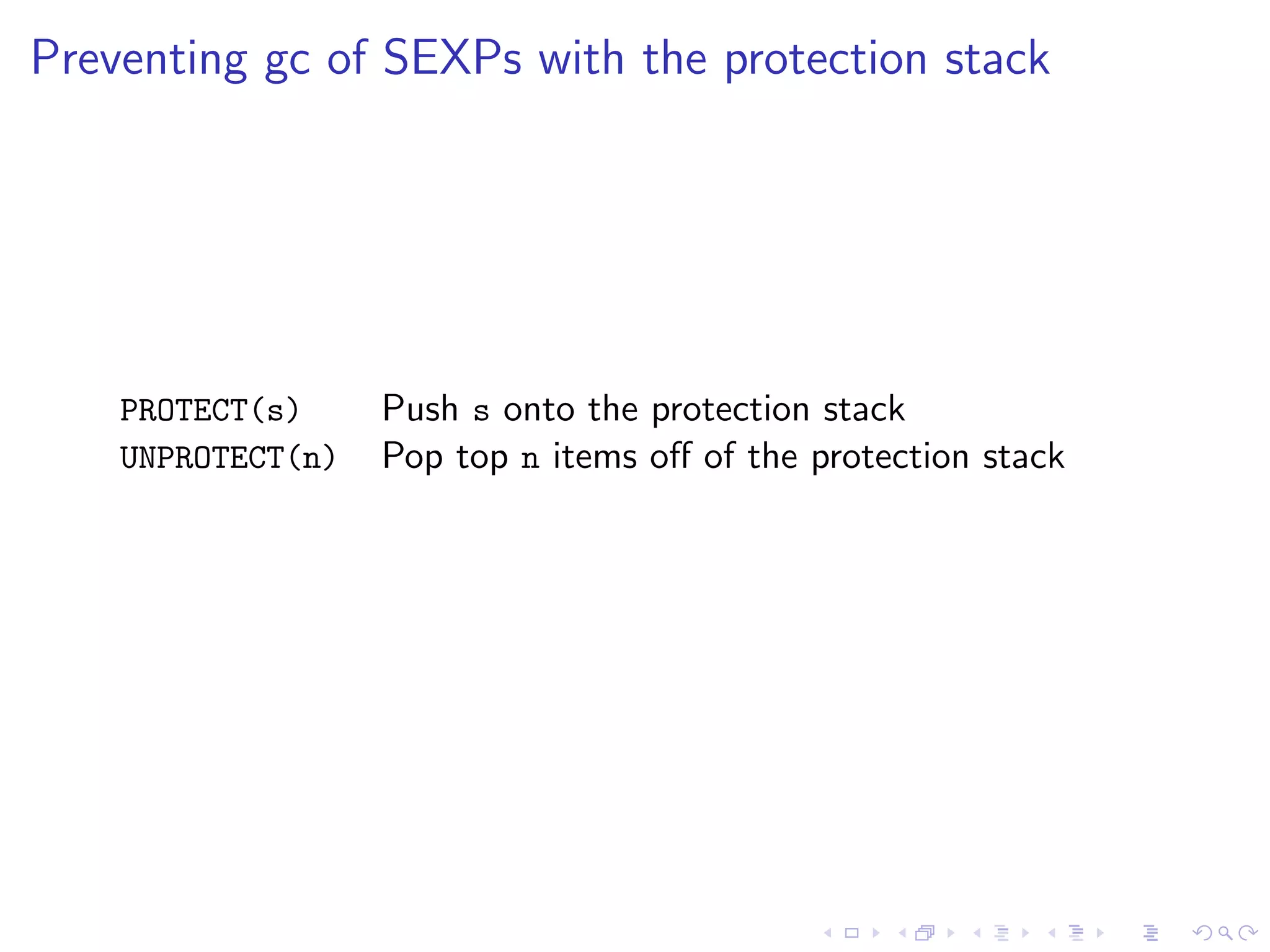
Preventing gc of SEXPs with the protection stack


    PROTECT(s)     Push s onto the protection stack
    UNPROTECT(n)   Pop top n items off of the protection stack
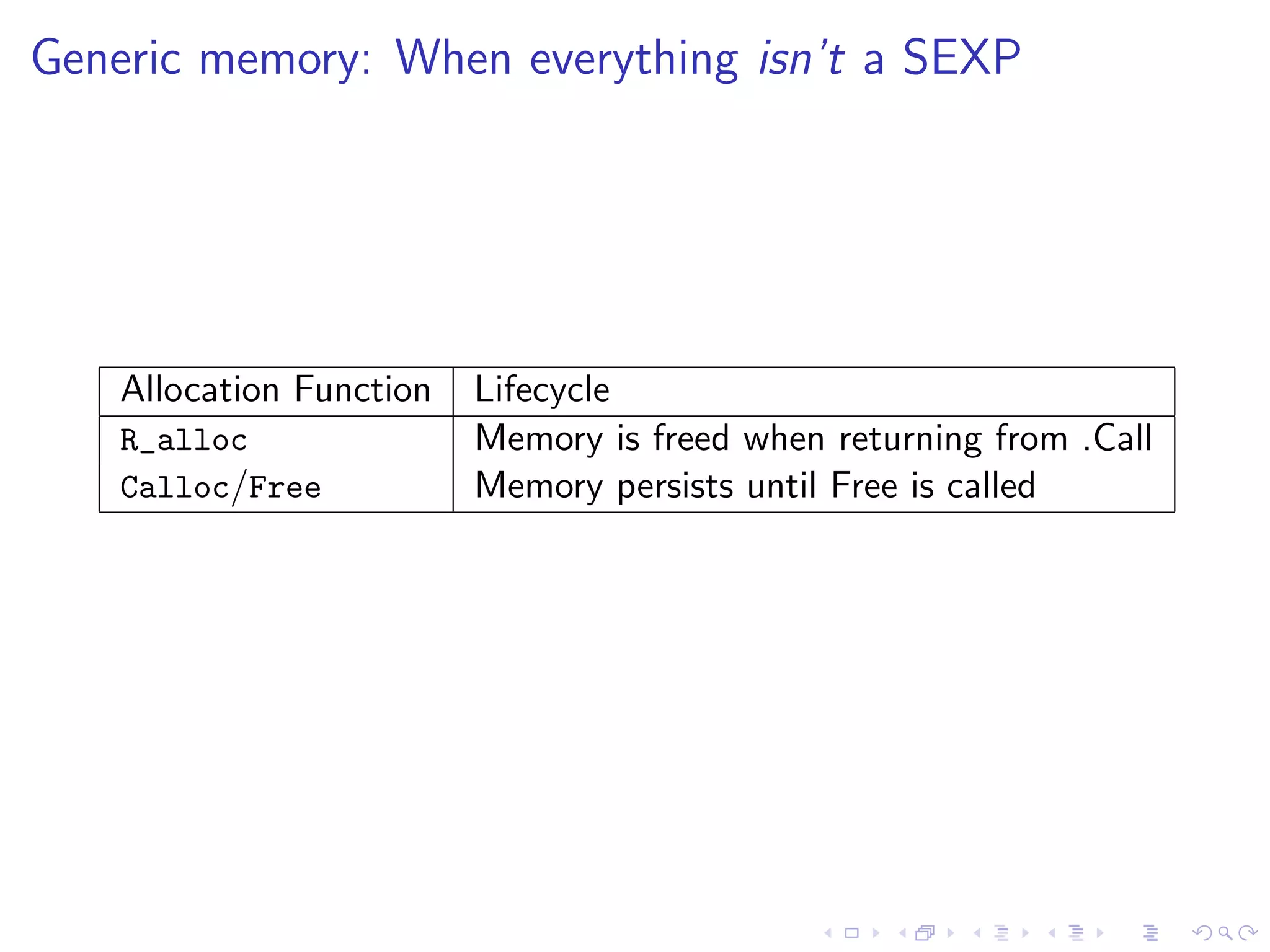
Generic memory: When everything isn’t a SEXP


    Allocation Function   Lifecycle
    R_alloc               Memory is freed when returning from .Call
    Calloc/Free           Memory persists until Free is called
Case Study: C implementation of        which


   Code review of nidemo/src/which.c
Outline


   The .Call Native Interface

   R types at the C-level

   Memory management in R

   Self-Study Exercises

   Odds and Ends

   Resources
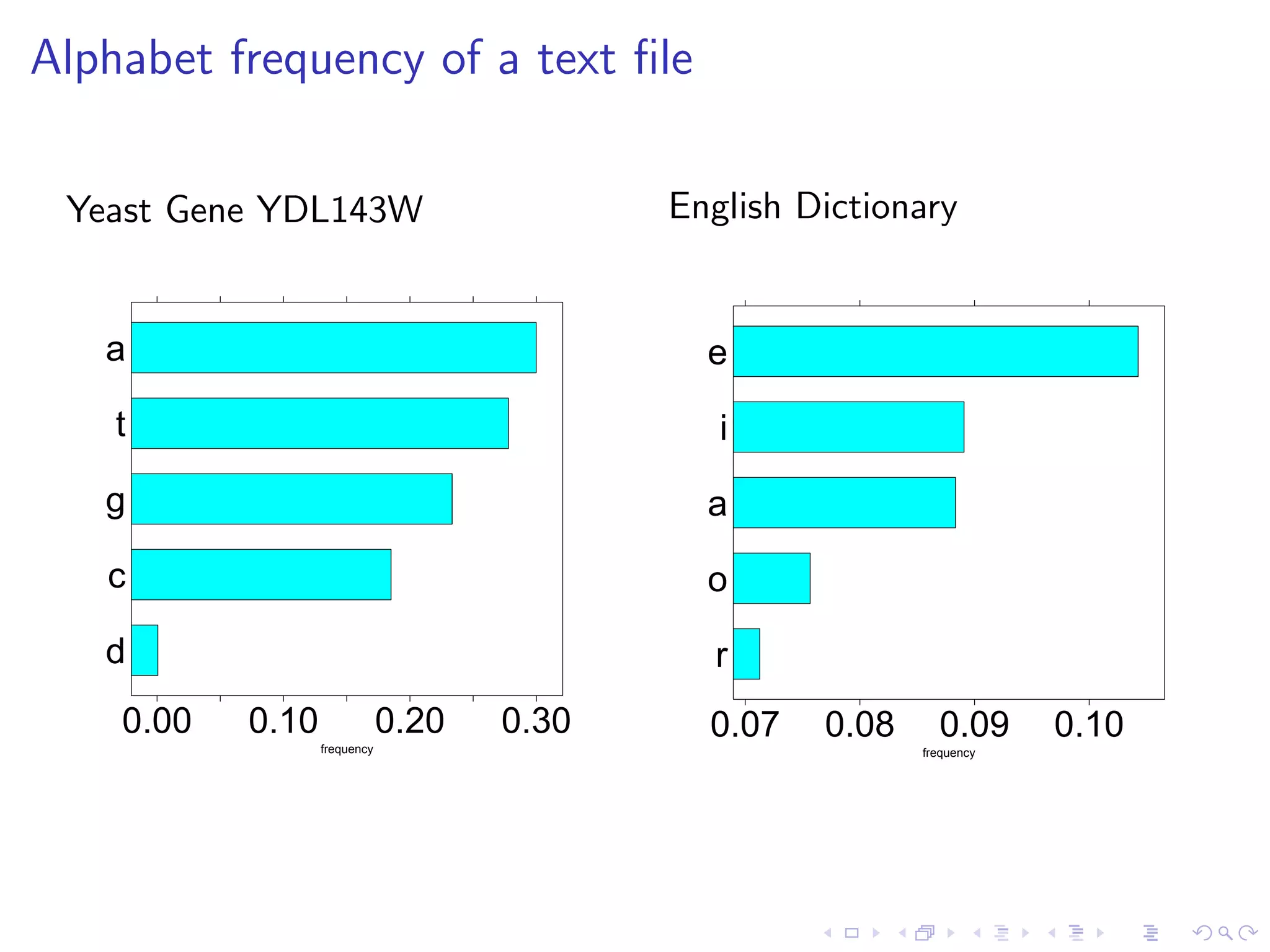
Alphabet frequency of a text file

 Yeast Gene YDL143W                         English Dictionary


   a                                          e
    t                                          i
   g                                          a
   c                                          o
   d                                          r
    0.00   0.10               0.20   0.30     0.07   0.08     0.09      0.10
                  frequency                                 frequency
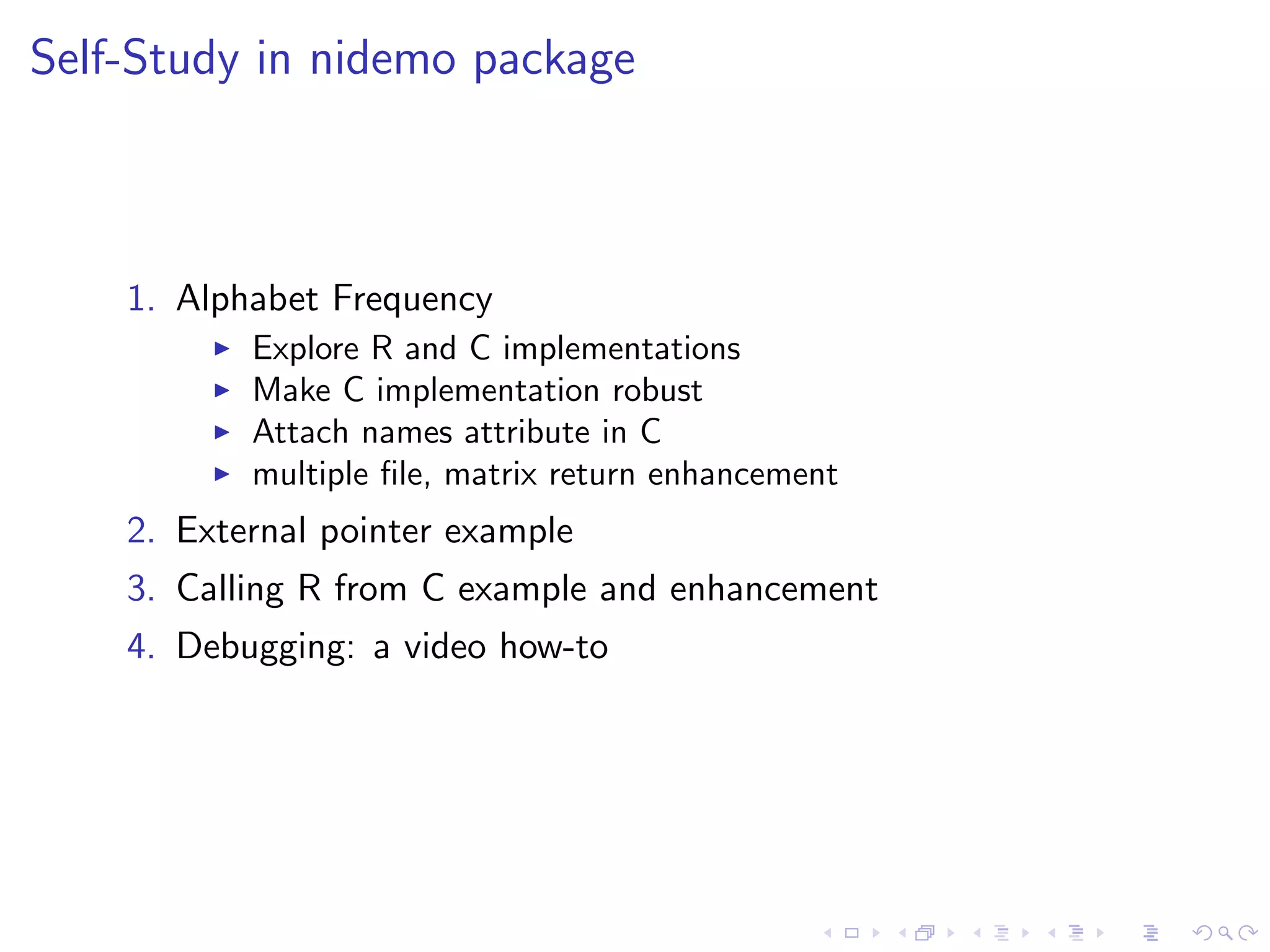
Self-Study in nidemo package


    1. Alphabet Frequency
           Explore R and C implementations
           Make C implementation robust
           Attach names attribute in C
           multiple file, matrix return enhancement
    2. External pointer example
    3. Calling R from C example and enhancement
    4. Debugging: a video how-to
Outline


   The .Call Native Interface

   R types at the C-level

   Memory management in R

   Self-Study Exercises

   Odds and Ends

   Resources
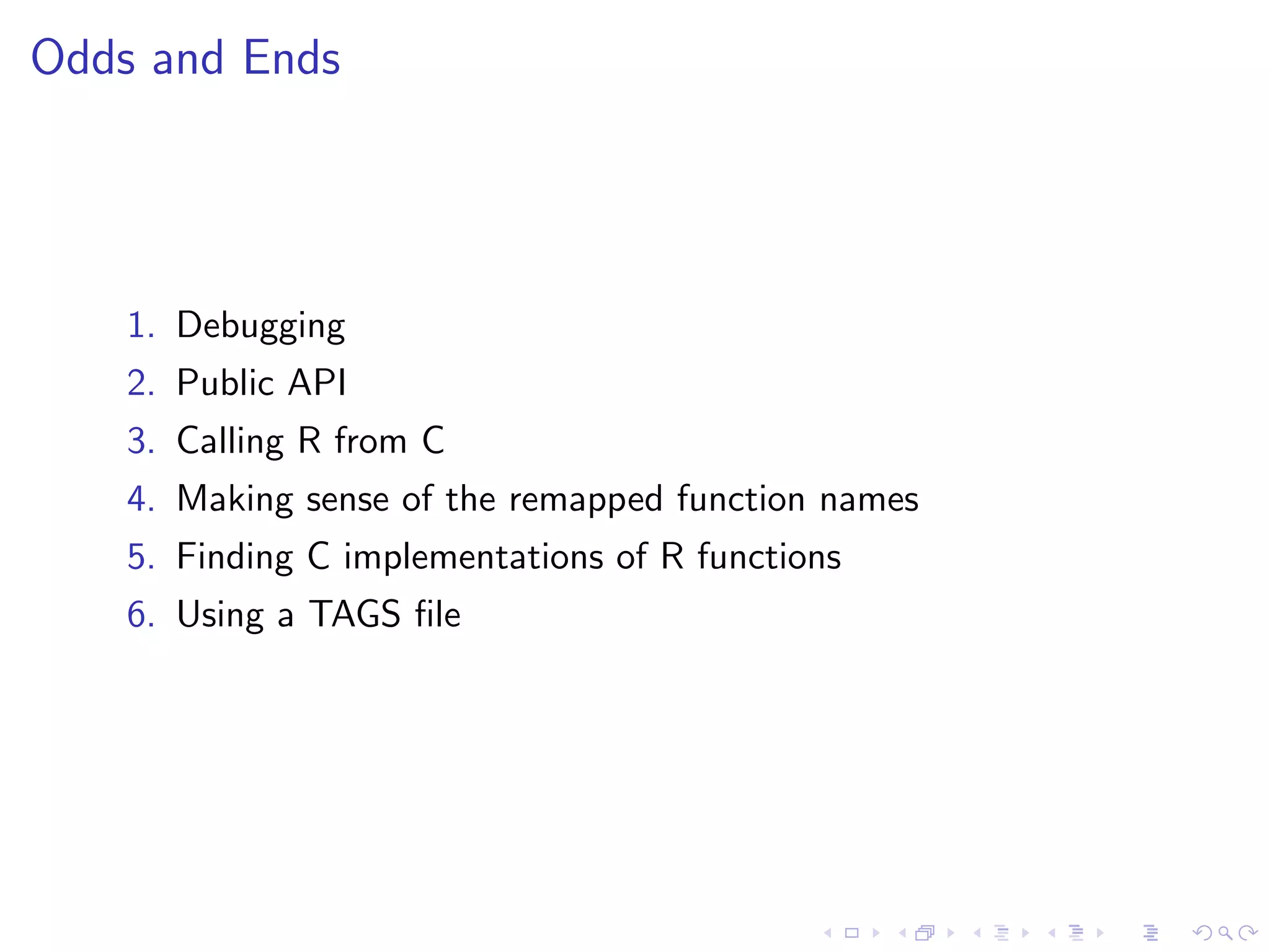
Odds and Ends


    1. Debugging
    2. Public API
    3. Calling R from C
    4. Making sense of the remapped function names
    5. Finding C implementations of R functions
    6. Using a TAGS file
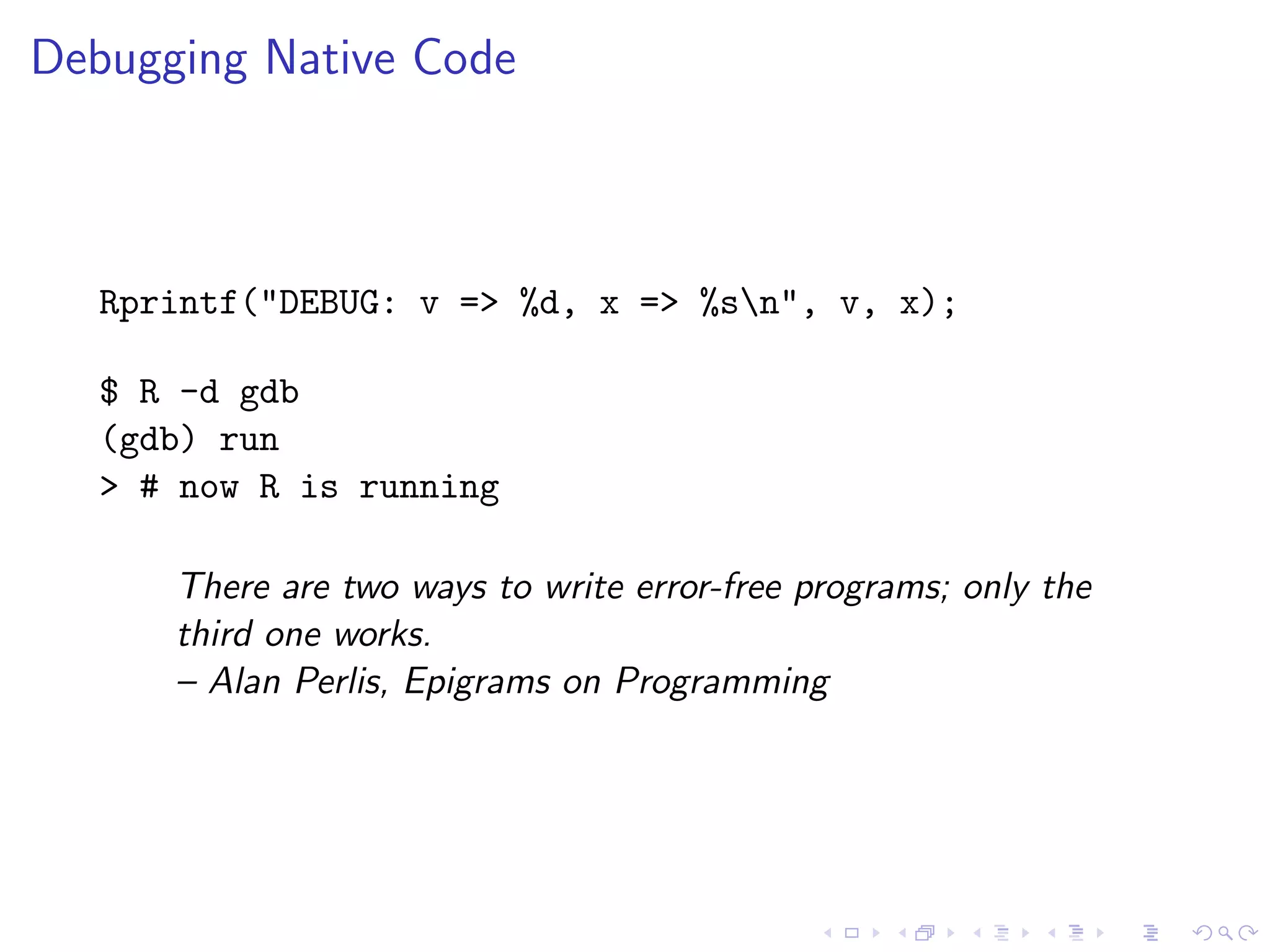
Debugging Native Code


  Rprintf("DEBUG: v => %d, x => %sn", v, x);

  $ R -d gdb
  (gdb) run
  > # now R is running

      There are two ways to write error-free programs; only the
      third one works.
      – Alan Perlis, Epigrams on Programming
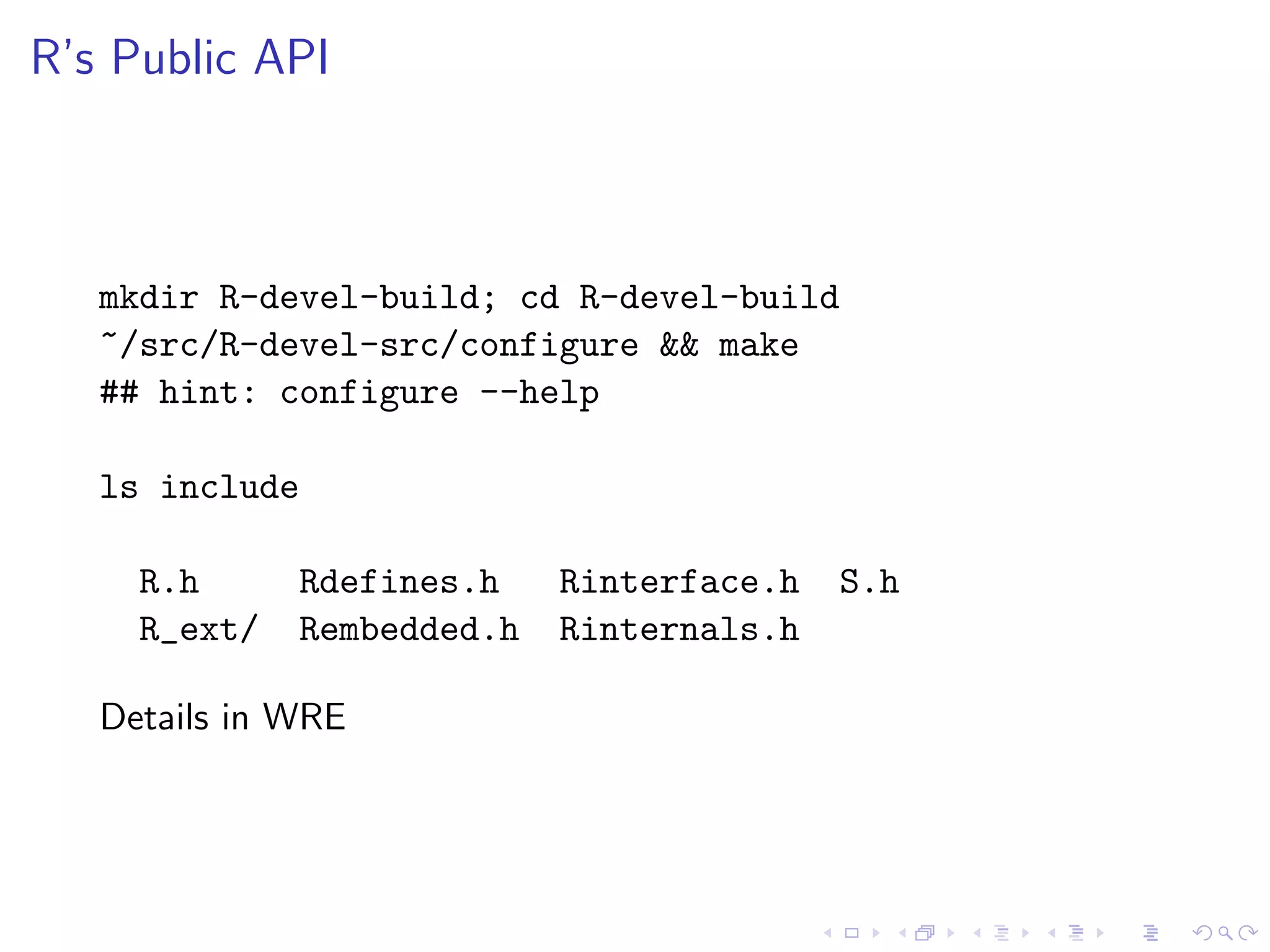
R’s Public API


   mkdir R-devel-build; cd R-devel-build
   ~/src/R-devel-src/configure && make
   ## hint: configure --help

   ls include

     R.h      Rdefines.h    Rinterface.h   S.h
     R_ext/   Rembedded.h   Rinternals.h

   Details in WRE
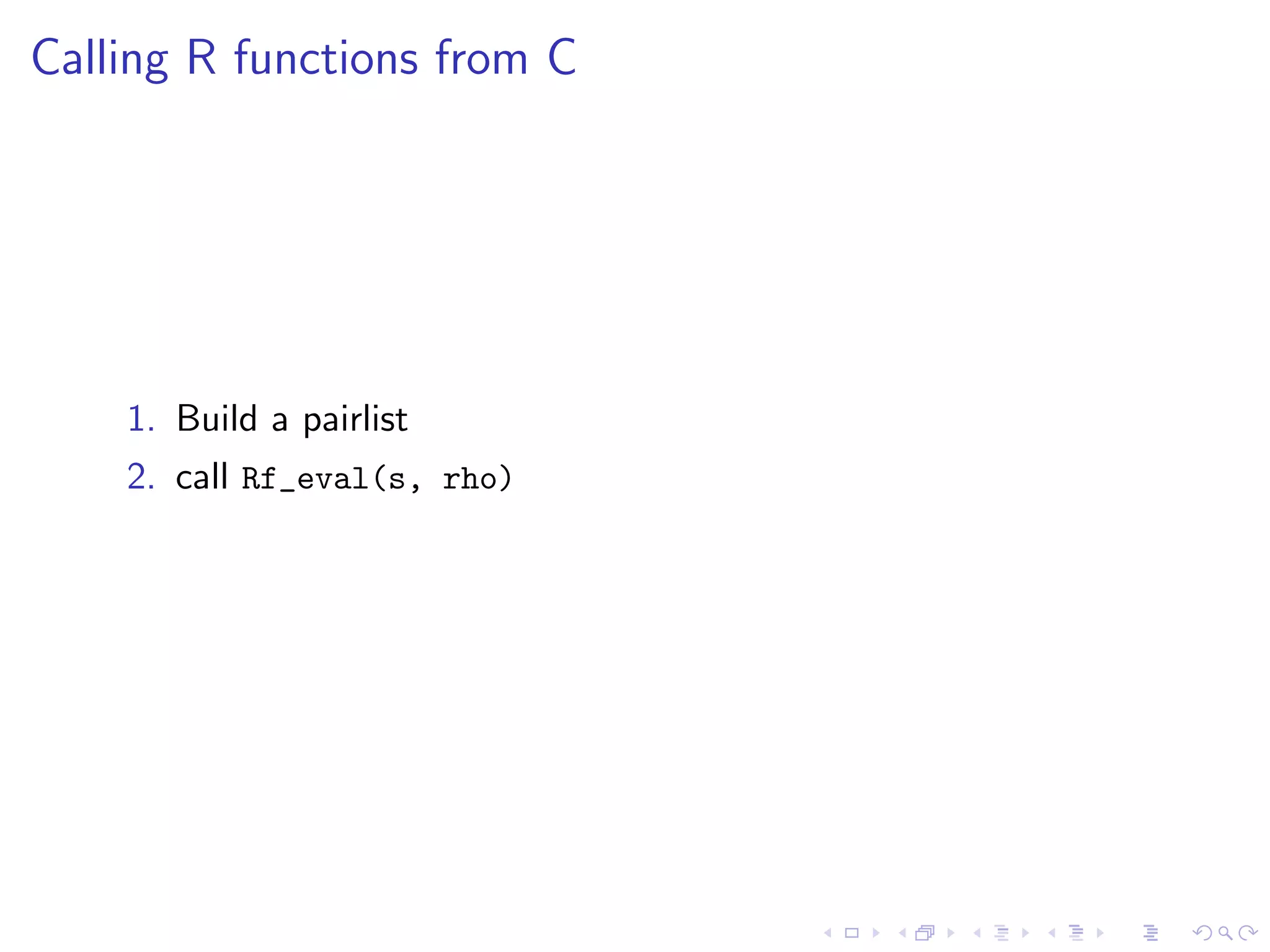
Calling R functions from C


    1. Build a pairlist
    2. call Rf_eval(s, rho)
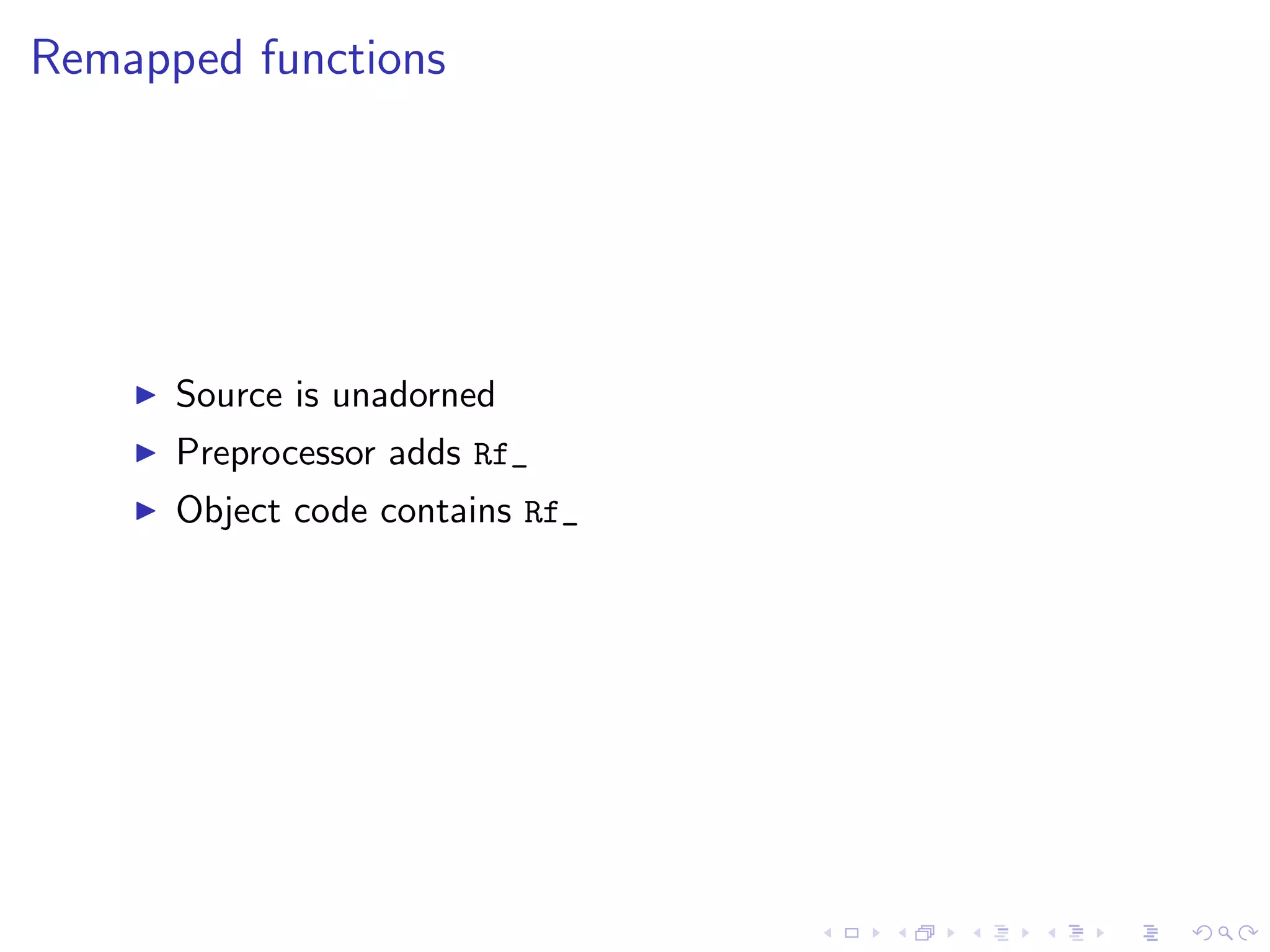
Remapped functions


      Source is unadorned
      Preprocessor adds Rf_
      Object code contains Rf_
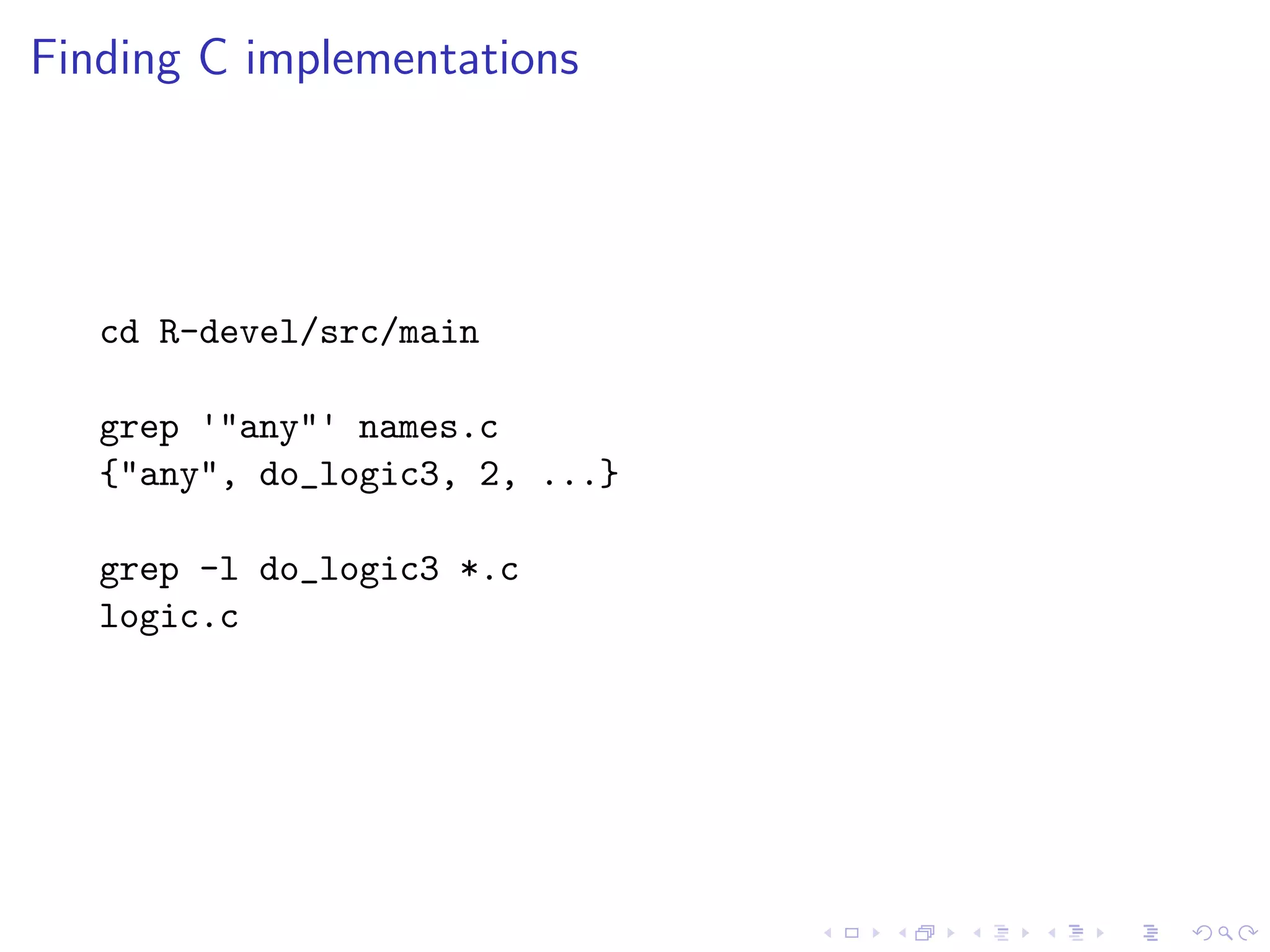
Finding C implementations


   cd R-devel/src/main

   grep '"any"' names.c
   {"any", do_logic3, 2, ...}

   grep -l do_logic3 *.c
   logic.c
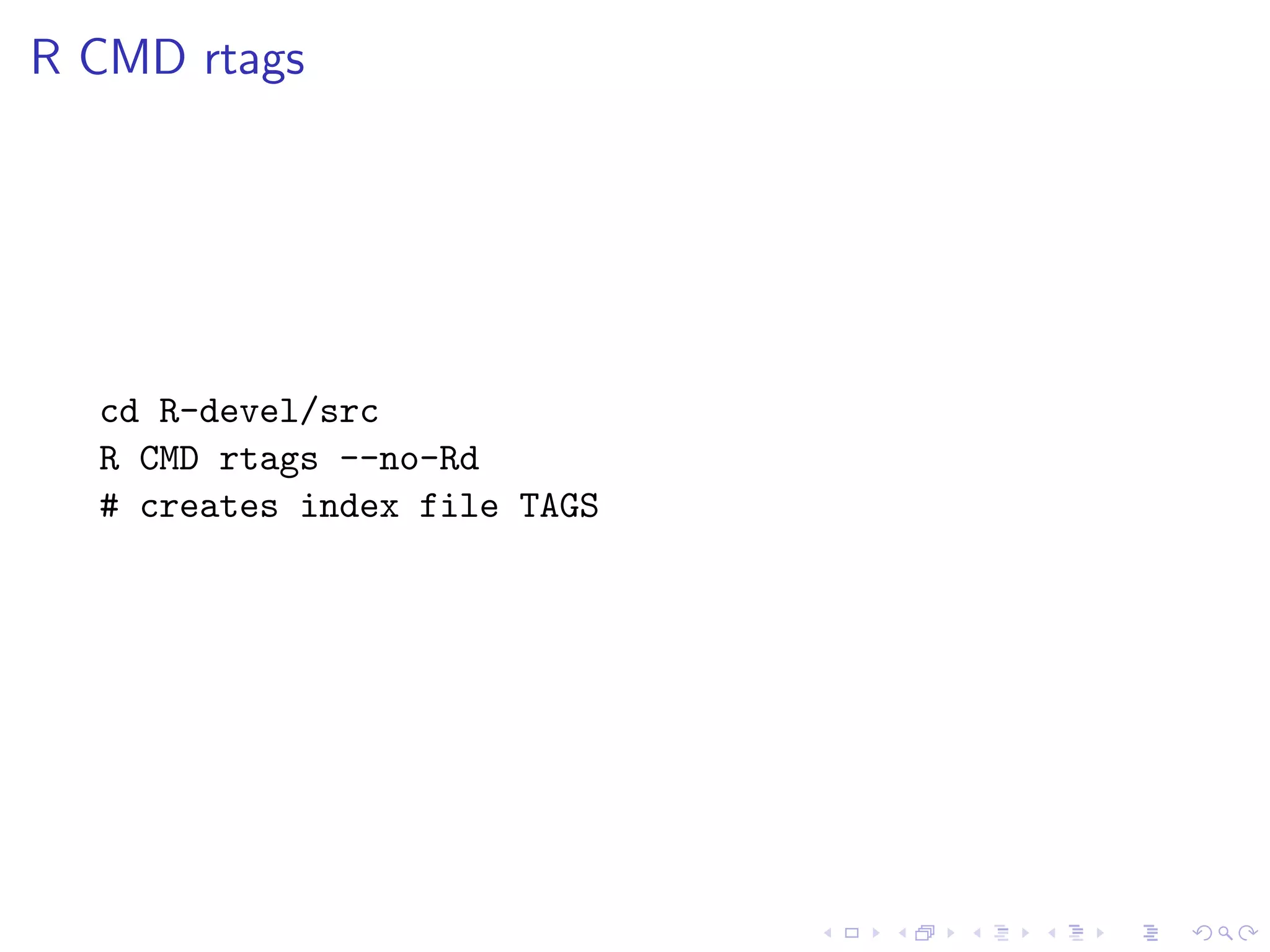
R CMD rtags


  cd R-devel/src
  R CMD rtags --no-Rd
  # creates index file TAGS
Outline


   The .Call Native Interface

   R types at the C-level

   Memory management in R

   Self-Study Exercises

   Odds and Ends

   Resources
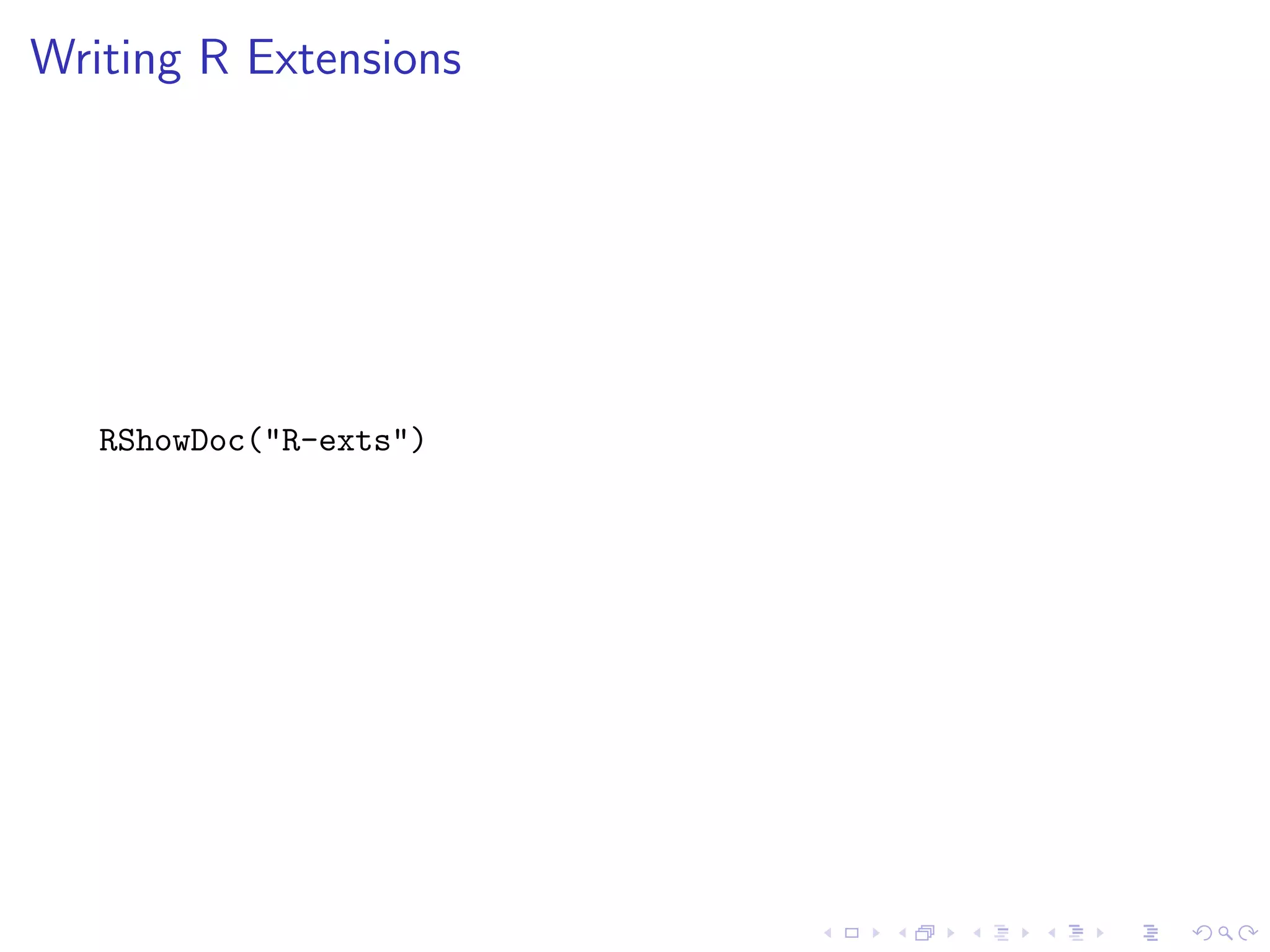
Writing R Extensions


   RShowDoc("R-exts")
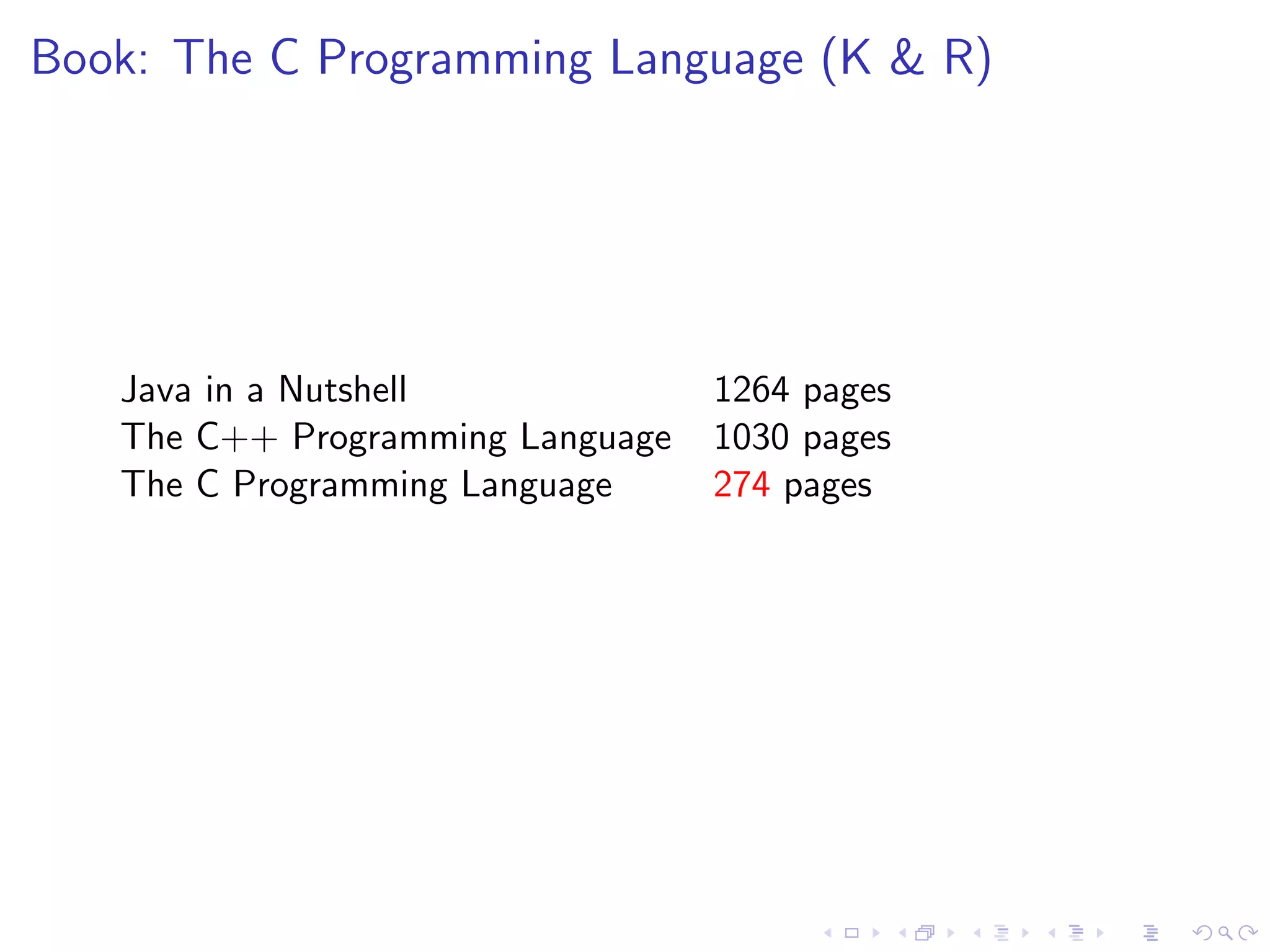
Book: The C Programming Language (K & R)


   Java in a Nutshell             1264 pages
   The C++ Programming Language   1030 pages
   The C Programming Language     274 pages
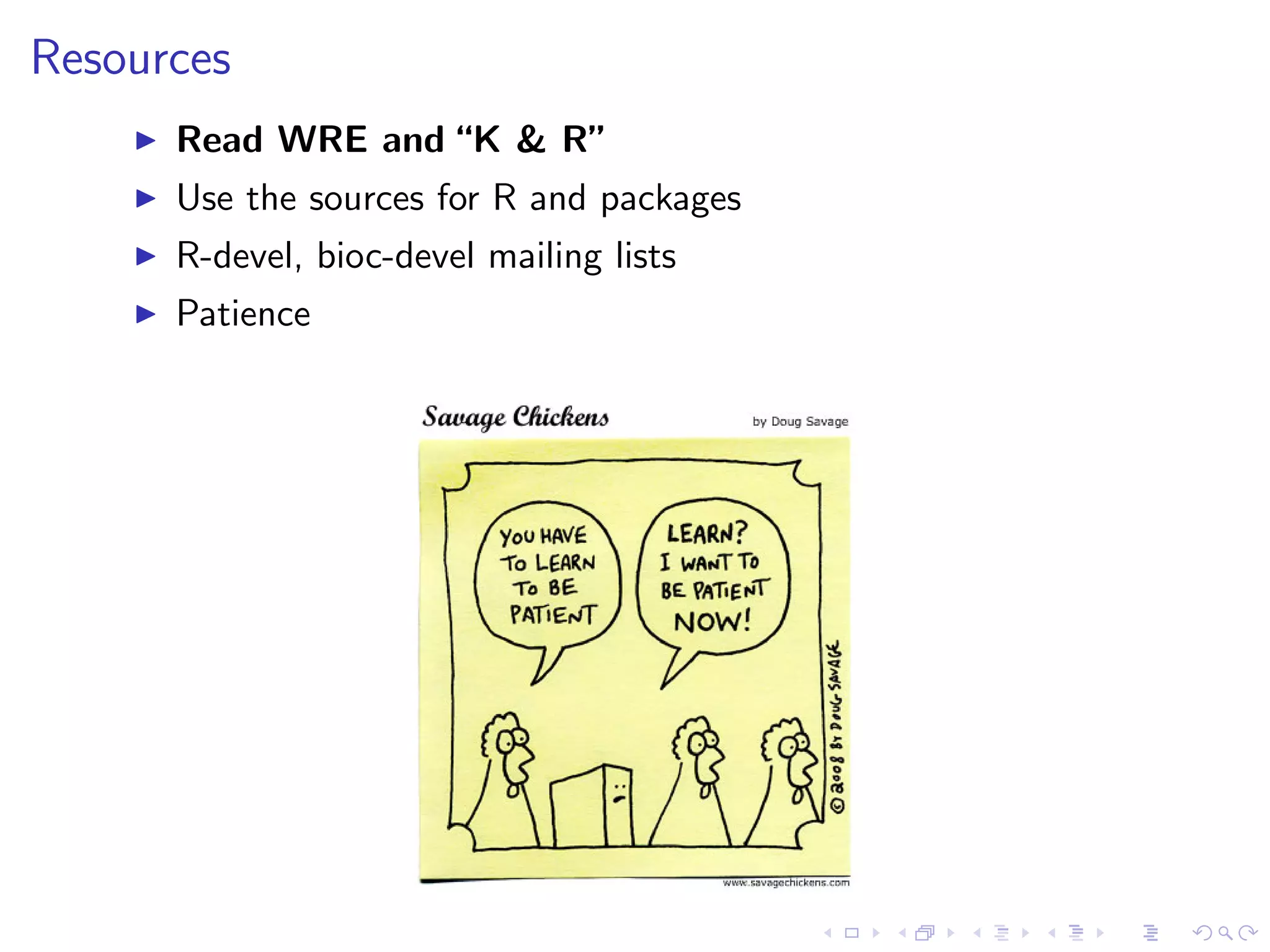
Resources
      Read WRE and “K & R”
      Use the sources for R and packages
      R-devel, bioc-devel mailing lists
      Patience

Native interfaces for R

  • 1.
    Native Interfaces forR Seth Falcon Fred Hutchinson Cancer Research Center 20-21 May, 2010
  • 2.
    Outline The .Call Native Interface R types at the C-level Memory management in R Self-Study Exercises Odds and Ends Resources
  • 3.
    which as implemented in R prior to R-2.11 which <- function(x) { seq_along(x)[x & !is.na(x)] }
  • 4.
    which as implemented in R prior to R-2.11 which <- function(x) { seq_along(x)[x & !is.na(x)] } 1. is.na 2. ! 3. & 4. seq_along 5. [
  • 5.
    which in C 1 SEXP nid_which(SEXP v) { 2 SEXP ans; 3 int i, j = 0, len = Rf_length(v), *buf, *tf; 4 buf = (int *) R_alloc(len, sizeof(int)); 5 tf = LOGICAL(v); 6 for (i = 0; i < len; i++) { 7 if (tf[i] == TRUE) buf[j] = i + 1; j++; 8 } 9 ans = Rf_allocVector(INTSXP, j); 10 memcpy(INTEGER(ans), buf, sizeof(int) * j); 11 return ans; }
  • 6.
    which is now 10x faster system.time(which(v)) R Version System time Elapsed time R-2.10 0.018 0.485 R-2.11 0.001 0.052 v is a logical vector with 10 million elements
  • 7.
    Making use ofexisting code Access algorithms Interface to other systems RBGL RSQLite RCurl netcdf Rsamtools SJava
  • 8.
    Review of C #include <stdio.h> double _nid_avg(int *data, int len) { int i; double ans = 0.0; for (i = 0; i < len; i++) { ans += data[i]; } return ans / len; } main() { int ex_data[5] = {1, 2, 3, 4, 5}; double m = _nid_avg(ex_data, 5); printf("%fn", m); }
  • 9.
  • 10.
    Symbolic Expressions (SEXPs) The SEXP is R’s fundamental data type at the C-level SEXP is short for symbolic expression and is borrowed from Lisp History at http://en.wikipedia.org/wiki/S-expression
  • 11.
    .Call Start toFinish Demo Demo
  • 12.
    .Call Disection R # R/somefile.R avg <- function(x) .Call(.nid_avg, x) # NAMESPACE useDynLib("yourPackage", .nid_avg = nid_avg) C /* src/some.c */ #include <Rinternals.h> SEXP nid_avg(SEXP data) { ... INTEGER(data) ... }
  • 13.
    .Call C function #include <Rinternals.h> SEXP nid_avg(SEXP data) { SEXP ans; double v = _nid_avg(INTEGER(data), Rf_length(data)); PROTECT(ans = Rf_allocVector(REALSXP, 1)); REAL(ans)[0] = v; UNPROTECT(1); return ans; /* shortcut: return Rf_ScalarReal(v); */ }
  • 14.
    .Call C function #include <Rinternals.h> SEXP nid_avg(SEXP data) { SEXP ans; double v = _nid_avg(INTEGER(data), Rf_length(data)); PROTECT(ans = Rf_allocVector(REALSXP, 1)); REAL(ans)[0] = v; UNPROTECT(1); return ans; /* shortcut: return Rf_ScalarReal(v); */ }
  • 15.
    .Call C function #include <Rinternals.h> SEXP nid_avg(SEXP data) { SEXP ans; double v = _nid_avg(INTEGER(data), Rf_length(data)); PROTECT(ans = Rf_allocVector(REALSXP, 1)); REAL(ans)[0] = v; UNPROTECT(1); return ans; /* shortcut: return Rf_ScalarReal(v); */ }
  • 16.
    .Call C function #include <Rinternals.h> SEXP nid_avg(SEXP data) { SEXP ans; double v = _nid_avg(INTEGER(data), Rf_length(data)); PROTECT(ans = Rf_allocVector(REALSXP, 1)); REAL(ans)[0] = v; UNPROTECT(1); return ans; /* shortcut: return Rf_ScalarReal(v); */ }
  • 17.
    .Call C function #include <Rinternals.h> SEXP nid_avg(SEXP data) { SEXP ans; double v = _nid_avg(INTEGER(data), Rf_length(data)); PROTECT(ans = Rf_allocVector(REALSXP, 1)); REAL(ans)[0] = v; UNPROTECT(1); return ans; /* shortcut: return Rf_ScalarReal(v); */ }
  • 18.
    .Call C function #include <Rinternals.h> SEXP nid_avg(SEXP data) { SEXP ans; double v = _nid_avg(INTEGER(data), Rf_length(data)); PROTECT(ans = Rf_allocVector(REALSXP, 1)); REAL(ans)[0] = v; UNPROTECT(1); return ans; /* shortcut: return Rf_ScalarReal(v); */ }
  • 19.
    .Call C function #include <Rinternals.h> SEXP nid_avg(SEXP data) { SEXP ans; double v = _nid_avg(INTEGER(data), Rf_length(data)); PROTECT(ans = Rf_allocVector(REALSXP, 1)); REAL(ans)[0] = v; UNPROTECT(1); return ans; /* shortcut: return Rf_ScalarReal(v); */ }
  • 20.
    Function Registration In NAMESPACE In C via R_CallMethodDef (See ShortRead/src/R_init_ShortRead.c for a nice example.
  • 21.
    Outline The .Call Native Interface R types at the C-level Memory management in R Self-Study Exercises Odds and Ends Resources
  • 22.
    Just one thingto learn Everything is a SEXP But there are many different types of SEXPs INTSXP, REALSXP, STRSXP, LGLSXP, VECSXP, and more.
  • 23.
  • 24.
    Common SEXP subtypes R function SEXP subtype Data accessor integer() INTSXP int *INTEGER(x) numeric() REALSXP double *REAL(x) logical() LGLSXP int *LOGICAL(x) character() STRSXP CHARSXP STRING ELT(x, i) list() VECSXP SEXP VECTOR ELT(x, i) NULL NILSXP R NilValue externalptr EXTPTRSXP SEXP (accessor funcs)
  • 25.
    STRSXP/CHARSXP Exercise Try this: .Internal(inspect(c("abc", "abc", "xyz")))
  • 26.
    STRSXP/CHARSXP Exercise > .Internal(inspect(c("abc", "abc", "xyz"))) @101d3f280 16 STRSXP g0c3 [] (len=3, tl=1) @101cc6278 09 CHARSXP g0c1 [gp=0x20] "abc" @101cc6278 09 CHARSXP g0c1 [gp=0x20] "abc" @101cc6308 09 CHARSXP g0c1 [gp=0x20] "xyz"
  • 27.
    character vectors ==STRSXPs + CHARSXPs
  • 28.
  • 29.
    STRSXP/CHARSXP API Example SEXP s = Rf_allocVector(STRSXP, 5); PROTECT(s); SET_STRING_ELT(s, 0, mkChar("hello")); SET_STRING_ELT(s, 1, mkChar("goodbye")); SEXP c = STRING_ELT(s, 0); const char *v = CHAR(c); UNPROTECT(1);
  • 30.
    STRSXP/CHARSXP API Example SEXP s = Rf_allocVector(STRSXP, 5); PROTECT(s); SET_STRING_ELT(s, 0, mkChar("hello")); SET_STRING_ELT(s, 1, mkChar("goodbye")); SEXP c = STRING_ELT(s, 0); const char *v = CHAR(c); UNPROTECT(1);
  • 31.
    STRSXP/CHARSXP API Example SEXP s = Rf_allocVector(STRSXP, 5); PROTECT(s); SET_STRING_ELT(s, 0, mkChar("hello")); SET_STRING_ELT(s, 1, mkChar("goodbye")); SEXP c = STRING_ELT(s, 0); const char *v = CHAR(c); UNPROTECT(1);
  • 32.
    STRSXP/CHARSXP API Example SEXP s = Rf_allocVector(STRSXP, 5); PROTECT(s); SET_STRING_ELT(s, 0, mkChar("hello")); SET_STRING_ELT(s, 1, mkChar("goodbye")); SEXP c = STRING_ELT(s, 0); const char *v = CHAR(c); UNPROTECT(1);
  • 33.
    STRSXP/CHARSXP API Example SEXP s = Rf_allocVector(STRSXP, 5); PROTECT(s); SET_STRING_ELT(s, 0, mkChar("hello")); SET_STRING_ELT(s, 1, mkChar("goodbye")); SEXP c = STRING_ELT(s, 0); const char *v = CHAR(c); UNPROTECT(1);
  • 34.
    Outline The .Call Native Interface R types at the C-level Memory management in R Self-Study Exercises Odds and Ends Resources
  • 35.
    R’s memory model(dramatization) All SEXPs PROTECT reachable stack Precious list DRAMATIZATION
  • 36.
    R’s memory model R allocates, tracks, and garbage collects SEXPs gc is triggered by R functions SEXPs that are not in-use are recycled. A SEXP is in-use if: it is on the protection stack (PROTECT/UNPROTECT) it is in the precious list (R PreserveObject/R ReleaseObject) it is reachable from a SEXP in the in-use list. All SEXPs PROTECT reachable stack Precious list DRAMATIZATION
  • 37.
    Preventing gc ofSEXPs with the protection stack PROTECT(s) Push s onto the protection stack UNPROTECT(n) Pop top n items off of the protection stack
  • 38.
    Generic memory: Wheneverything isn’t a SEXP Allocation Function Lifecycle R_alloc Memory is freed when returning from .Call Calloc/Free Memory persists until Free is called
  • 39.
    Case Study: Cimplementation of which Code review of nidemo/src/which.c
  • 40.
    Outline The .Call Native Interface R types at the C-level Memory management in R Self-Study Exercises Odds and Ends Resources
  • 41.
    Alphabet frequency ofa text file Yeast Gene YDL143W English Dictionary a e t i g a c o d r 0.00 0.10 0.20 0.30 0.07 0.08 0.09 0.10 frequency frequency
  • 42.
    Self-Study in nidemopackage 1. Alphabet Frequency Explore R and C implementations Make C implementation robust Attach names attribute in C multiple file, matrix return enhancement 2. External pointer example 3. Calling R from C example and enhancement 4. Debugging: a video how-to
  • 43.
    Outline The .Call Native Interface R types at the C-level Memory management in R Self-Study Exercises Odds and Ends Resources
  • 44.
    Odds and Ends 1. Debugging 2. Public API 3. Calling R from C 4. Making sense of the remapped function names 5. Finding C implementations of R functions 6. Using a TAGS file
  • 45.
    Debugging Native Code Rprintf("DEBUG: v => %d, x => %sn", v, x); $ R -d gdb (gdb) run > # now R is running There are two ways to write error-free programs; only the third one works. – Alan Perlis, Epigrams on Programming
  • 46.
    R’s Public API mkdir R-devel-build; cd R-devel-build ~/src/R-devel-src/configure && make ## hint: configure --help ls include R.h Rdefines.h Rinterface.h S.h R_ext/ Rembedded.h Rinternals.h Details in WRE
  • 47.
    Calling R functionsfrom C 1. Build a pairlist 2. call Rf_eval(s, rho)
  • 48.
    Remapped functions Source is unadorned Preprocessor adds Rf_ Object code contains Rf_
  • 49.
    Finding C implementations cd R-devel/src/main grep '"any"' names.c {"any", do_logic3, 2, ...} grep -l do_logic3 *.c logic.c
  • 50.
    R CMD rtags cd R-devel/src R CMD rtags --no-Rd # creates index file TAGS
  • 51.
    Outline The .Call Native Interface R types at the C-level Memory management in R Self-Study Exercises Odds and Ends Resources
  • 52.
    Writing R Extensions RShowDoc("R-exts")
  • 53.
    Book: The CProgramming Language (K & R) Java in a Nutshell 1264 pages The C++ Programming Language 1030 pages The C Programming Language 274 pages
  • 54.
    Resources Read WRE and “K & R” Use the sources for R and packages R-devel, bioc-devel mailing lists Patience