EMELIN LAYNEZ
SHANNON SANKEY
CHRYSTIE SCHULTZ
§113.6. Social Studies, Grade 4.
(b) Knowledge and skills.
   (1) History. The student understands the similarities and
   differences of Native-American groups in Texas and the
   Western Hemisphere before European exploration. The
   student is expected to:
   (A) identify Native-American groups in Texas and the
    Western Hemisphere before European exploration and
    describe the regions in which they lived; and
   (B) compare the ways of life of Native-American groups in
    Texas and the Western Hemisphere before European
    exploration.
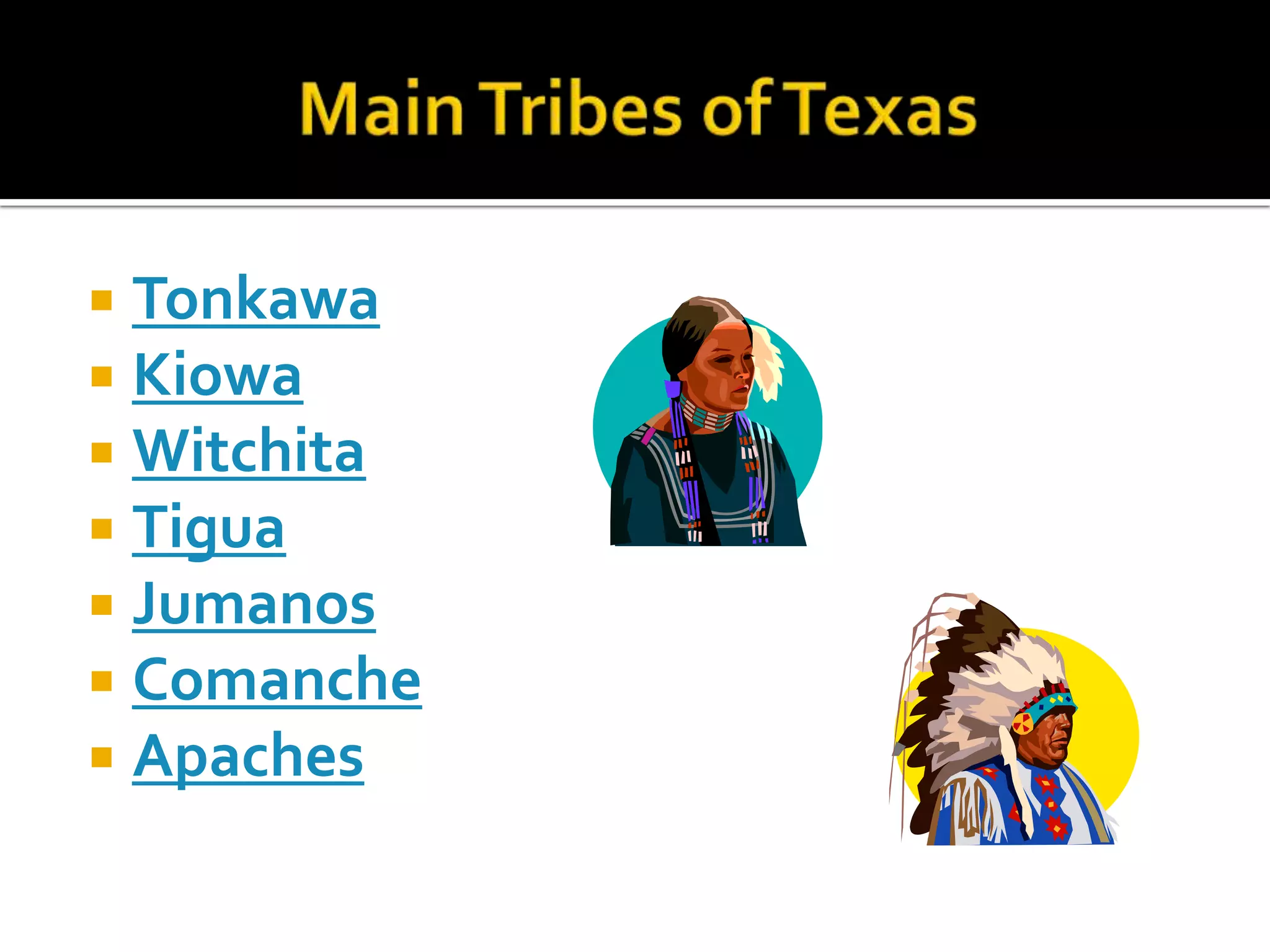
 Tonkawa
 Kiowa
 Witchita
 Tigua
 Jumanos
 Comanche
 Apaches
Shannon Sankey
APPEARANCE                              DWELLINGS

   Men wore breechcloths women          The Tonkawas lived in
    wore short skirts.                    scattered villages in central
   Both wore long earrings, and          Texas.
    necklaces of shells, bones and       Shelters were made of brush
    feathers.                                        FOOD
   Both parted hair in middle, the      Ate just about anything
    men tied beaver fur around            including; spiders, ant eggs,
    their braids.                         worms, lizards, and rotten
            CUSTOMS                       wood.
   Didn’t name their babies until       A special treat was cooked fish
    they were several years old.          that was left out in the open for
   Method of discipline was to           8 days with swarms of insects
    throw water on an offender.           on them.
APPEARANCE                              DWELLINGS
   Darker skin, short, stocky, and      Tepee- Made of buffalo hides
    thick through the chest               sewn together and painted
   Men had short hair on the right       with designs. Placed over a
    side and long on the left.            number of poles to form a
    Women had long hair usually           cone.
    braided.
   Both tattooed and painted
    their bodies.
   Men wore only a breechcloth
    and moccasins, Women wore a                  CUSTOMS
    deerskin dress and moccasins.        The Kiowa woman made the
               Food                       family tepee.
   Buffalo, antelope, jackrabbits,      The men decorated the
    prairie dogs, coyotes and             finished tepees, painting them
    wolves.                               to match a warrior’s shield.
APPEARANCE                              DWELLINGS
   Painted and tattooed much of          Lived in grass huts.
    their visible part of their           Each hut had one circular room
    bodies.                                about fifteen to thirty feet in
   Men and women wore long                diameter.
    hair, either loose or in braids.      Two families lived in one hut.
   Men wore breechcloths and             Smaller huts were used as
    moccasins                              resting, working and storage
   Women wore deerskin skirts             places.
    and moccasins                                  CUSTOMS
               FOOD                       When deciding to marry the
   Corn was their favorite.               suitor left a gift of venison at
   Beans, melons, pumpkins,               the door of a girls home. If the
    tobacco, and squash, wild              parents took the offering the
    berries, nuts, figs and honey.         marriage was granted and the
                                           groom lived with the brides
                                           parents
Emelin Laynez
 They lived in southwest part of
  America.
 This part of America was arid.
   They created houses out of clay that
    looked like apartments and they had
    houses of sticks.
   They also created their own irrigation
    system.
• Their name means “enemy”.
• Their traditional language was
  Atheabaskan language.


More interesting fact
 Lived in the
  Great Plains
 But followed
  the buffalo all
  across Central
  North America
   They depended on the buffalo for their
    survival.
     Food
     Clothing
     Portable housing
     Weapons and tools
   Their from of government was democratic.
      It was a in groups and the each group was
      led by a chief.
     They were also known for how well they
      handled horses.


More information

  Kids stuff
CHRYSTIE SCHULTZ
   Appeared in Spanish records around 1500-
    1700 C.E., then disappeared.
   Nothing remains of their language to tell
    where they came from or where they went.
   In 1700s, the Apache cut off the Jumano trade
    routes, when they advanced south.
   Some may have joined the Apache
   Jumano Indians disappeaed long before
    white settlers arrived.
 THERE WERE TWO JUMANO GROUPS IN TEXAS.
  ONE GROUP FARMED ON THE RIO GRANDE,
  SOUTH OF EL PASO.
 THEY LIVED IN TEPEES AND HAD ADOBE
  HOUSES ALONG THE RIO GRAND.
 CORN                  The horizontal stripes on their
 DRIED SQUASHES         faces made the Jumano easy to
                         recognize as they approached
 BEANS
                         their trading partners.
 MESQUITE BEANS        Through trade, they also
 CLOTH                  supplied Spanish goods and
 TURQUOISE              horses to other tribes.
 UNUSUAL FEATHERS
 PIGMENTS
 SHELLS
 SALT FOR HIDES
 MEAT
 AND OTHER BISON
  PRODUCTS.
 They established the Ysleta del Sur, “little island of
  the south”, which is a suburb of El Paso.
 Rio Grande cut a new channel in 1830, making Ysleta
  del Sur an Island.
 Ysleta del Sur became part of the United States
  under the terms of the 1848 Treaty of Guadalupe
  Hidalgo, which ended the Mexican War.
 The Tigua have been living in the region of Texas for
  over 300 years.
   Today, there is a tribal center at Ysleta has
    shops that sell Tigua crafts, and dancers
    perform.
   Men wear colorful jackets trimmed in calico
    fringe.
   Women wear costumes adopted during the
    Spanish period.
TRIBE       LOCATION                  POPULATION     LANGUAGE FAMILY

TONKAWA     Plains of central and     1690 –1600     Tonkawan
            south central Texas       1990 – 20
KIOWA       TX Panhandle, north of    1905– 1,195    Kiowa-Tanoan
            Amarillo                  1990-- 468
WITCHITA    Along Brazos River near   1818– 800      Caddoan
            present-day Waco, TX      1990-- 87
APACHES     West-central Texas        1690– 500      Athapascan
            plains                    1990-- 7
COMANCHES   Texas Panhandle south     1700– 20,000   Shoshonean
            to western TX             1990– 1,478
TIGUA       Present day El Paso, TX   1630—18,400    Kiowa-Tanoan
                                      1990--761
JUMANOS     Rio Grande Valley from  1582– 10,000     Apache, Spanish, or
            El Paso downstream to   1900– 0          Caddoan
            the Mexican Rio Conchos
What part of Texas
                did the Witchita
                      live?


Near present     Near present       Near present
 day Waco         day Dallas        day Houston
What was the ;main
          source of food,
       shelter , and tools for
       the Comanche tribe?


Deer         Buffalos            Horses
How was the
             population of the
           tribes effected after
          the Europeans came?


              Stayed the
Went Up                            Went down
                same
What was a favored
          treat by the Tonkawa
                  tribe?


           Cooked fish that
Buffalo    was left out for 8    Roasted corn
                 days
In 1900 which
            tribe was
          completely
              gone?

Jumano     Apache        Tigua
   http://www.dummies.com/how-to/content/sat-ii-us-history-
    discovering-early-explorers-of-t.navId-
    323321.html?print=true
   http://www.comanchelanguage.org/Comanche%20History.h
    tm
   Baldridge, Carol. Texas Indians Fact Cards. Berkeley: Toucan
    Valley Publications, 1997.
   Wade, Mary Dodson. Texas Native Peoples (State Studies-
    Texas). Chicago: Heinemann, 2003.

Native Americans Of Texas

  • 1.
  • 2.
    §113.6. Social Studies,Grade 4. (b) Knowledge and skills. (1) History. The student understands the similarities and differences of Native-American groups in Texas and the Western Hemisphere before European exploration. The student is expected to:  (A) identify Native-American groups in Texas and the Western Hemisphere before European exploration and describe the regions in which they lived; and  (B) compare the ways of life of Native-American groups in Texas and the Western Hemisphere before European exploration.
  • 3.
     Tonkawa  Kiowa Witchita  Tigua  Jumanos  Comanche  Apaches
  • 4.
  • 5.
    APPEARANCE DWELLINGS  Men wore breechcloths women  The Tonkawas lived in wore short skirts. scattered villages in central  Both wore long earrings, and Texas. necklaces of shells, bones and  Shelters were made of brush feathers. FOOD  Both parted hair in middle, the  Ate just about anything men tied beaver fur around including; spiders, ant eggs, their braids. worms, lizards, and rotten CUSTOMS wood.  Didn’t name their babies until  A special treat was cooked fish they were several years old. that was left out in the open for  Method of discipline was to 8 days with swarms of insects throw water on an offender. on them.
  • 6.
    APPEARANCE DWELLINGS  Darker skin, short, stocky, and  Tepee- Made of buffalo hides thick through the chest sewn together and painted  Men had short hair on the right with designs. Placed over a side and long on the left. number of poles to form a Women had long hair usually cone. braided.  Both tattooed and painted their bodies.  Men wore only a breechcloth and moccasins, Women wore a CUSTOMS deerskin dress and moccasins.  The Kiowa woman made the Food family tepee.  Buffalo, antelope, jackrabbits,  The men decorated the prairie dogs, coyotes and finished tepees, painting them wolves. to match a warrior’s shield.
  • 7.
    APPEARANCE DWELLINGS  Painted and tattooed much of  Lived in grass huts. their visible part of their  Each hut had one circular room bodies. about fifteen to thirty feet in  Men and women wore long diameter. hair, either loose or in braids.  Two families lived in one hut.  Men wore breechcloths and  Smaller huts were used as moccasins resting, working and storage  Women wore deerskin skirts places. and moccasins CUSTOMS FOOD  When deciding to marry the  Corn was their favorite. suitor left a gift of venison at  Beans, melons, pumpkins, the door of a girls home. If the tobacco, and squash, wild parents took the offering the berries, nuts, figs and honey. marriage was granted and the groom lived with the brides parents
  • 8.
  • 9.
     They livedin southwest part of America.  This part of America was arid.
  • 10.
    They created houses out of clay that looked like apartments and they had houses of sticks.  They also created their own irrigation system.
  • 11.
    • Their namemeans “enemy”. • Their traditional language was Atheabaskan language. More interesting fact
  • 12.
     Lived inthe Great Plains  But followed the buffalo all across Central North America
  • 13.
    They depended on the buffalo for their survival.  Food  Clothing  Portable housing  Weapons and tools
  • 14.
    Their from of government was democratic. It was a in groups and the each group was led by a chief.  They were also known for how well they handled horses. More information Kids stuff
  • 15.
  • 16.
    Appeared in Spanish records around 1500- 1700 C.E., then disappeared.  Nothing remains of their language to tell where they came from or where they went.  In 1700s, the Apache cut off the Jumano trade routes, when they advanced south.  Some may have joined the Apache  Jumano Indians disappeaed long before white settlers arrived.
  • 17.
     THERE WERETWO JUMANO GROUPS IN TEXAS.  ONE GROUP FARMED ON THE RIO GRANDE, SOUTH OF EL PASO.  THEY LIVED IN TEPEES AND HAD ADOBE HOUSES ALONG THE RIO GRAND.
  • 18.
     CORN  The horizontal stripes on their  DRIED SQUASHES faces made the Jumano easy to recognize as they approached  BEANS their trading partners.  MESQUITE BEANS  Through trade, they also  CLOTH supplied Spanish goods and  TURQUOISE horses to other tribes.  UNUSUAL FEATHERS  PIGMENTS  SHELLS  SALT FOR HIDES  MEAT  AND OTHER BISON PRODUCTS.
  • 19.
     They establishedthe Ysleta del Sur, “little island of the south”, which is a suburb of El Paso.  Rio Grande cut a new channel in 1830, making Ysleta del Sur an Island.  Ysleta del Sur became part of the United States under the terms of the 1848 Treaty of Guadalupe Hidalgo, which ended the Mexican War.  The Tigua have been living in the region of Texas for over 300 years.
  • 20.
    Today, there is a tribal center at Ysleta has shops that sell Tigua crafts, and dancers perform.  Men wear colorful jackets trimmed in calico fringe.  Women wear costumes adopted during the Spanish period.
  • 21.
    TRIBE LOCATION POPULATION LANGUAGE FAMILY TONKAWA Plains of central and 1690 –1600 Tonkawan south central Texas 1990 – 20 KIOWA TX Panhandle, north of 1905– 1,195 Kiowa-Tanoan Amarillo 1990-- 468 WITCHITA Along Brazos River near 1818– 800 Caddoan present-day Waco, TX 1990-- 87 APACHES West-central Texas 1690– 500 Athapascan plains 1990-- 7 COMANCHES Texas Panhandle south 1700– 20,000 Shoshonean to western TX 1990– 1,478 TIGUA Present day El Paso, TX 1630—18,400 Kiowa-Tanoan 1990--761 JUMANOS Rio Grande Valley from 1582– 10,000 Apache, Spanish, or El Paso downstream to 1900– 0 Caddoan the Mexican Rio Conchos
  • 23.
    What part ofTexas did the Witchita live? Near present Near present Near present day Waco day Dallas day Houston
  • 24.
    What was the;main source of food, shelter , and tools for the Comanche tribe? Deer Buffalos Horses
  • 25.
    How was the population of the tribes effected after the Europeans came? Stayed the Went Up Went down same
  • 26.
    What was afavored treat by the Tonkawa tribe? Cooked fish that Buffalo was left out for 8 Roasted corn days
  • 27.
    In 1900 which tribe was completely gone? Jumano Apache Tigua
  • 28.
    http://www.dummies.com/how-to/content/sat-ii-us-history- discovering-early-explorers-of-t.navId- 323321.html?print=true  http://www.comanchelanguage.org/Comanche%20History.h tm  Baldridge, Carol. Texas Indians Fact Cards. Berkeley: Toucan Valley Publications, 1997.  Wade, Mary Dodson. Texas Native Peoples (State Studies- Texas). Chicago: Heinemann, 2003.