Running Head: ENG 507 FINAL PROJECT 1
ENG 507: Final Project:
FYC Teaching Unit for Argumentative Infographic
Cori Smith
Arizona State University
Professor Baldonado-Ruiz
May 1, 2020
ENG 507 FINAL PROJECT 2
Introduction:
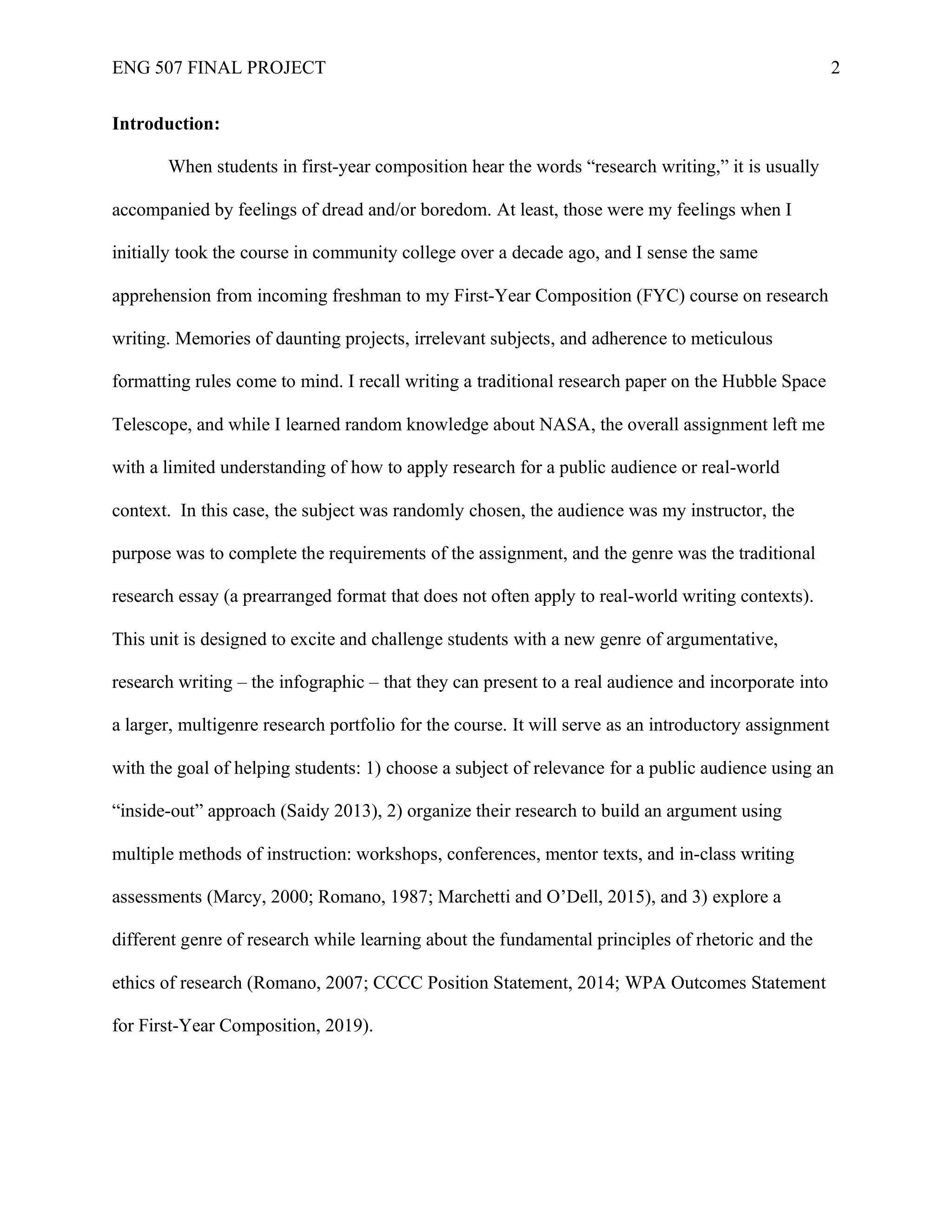
When students in first-year composition hear the words “research writing,” it is usually
accompanied by feelings of dread and/or boredom. At least, those were my feelings when I
initially took the course in community college over a decade ago, and I sense the same
apprehension from incoming freshman to my First-Year Composition (FYC) course on research
writing. Memories of daunting projects, irrelevant subjects, and adherence to meticulous
formatting rules come to mind. I recall writing a traditional research paper on the Hubble Space
Telescope, and while I learned random knowledge about NASA, the overall assignment left me
with a limited understanding of how to apply research for a public audience or real-world
context. In this case, the subject was randomly chosen, the audience was my instructor, the
purpose was to complete the requirements of the assignment, and the genre was the traditional
research essay (a prearranged format that does not often apply to real-world writing contexts).
This unit is designed to excite and challenge students with a new genre of argumentative,
research writing – the infographic – that they can present to a real audience and incorporate into
a larger, multigenre research portfolio for the course. It will serve as an introductory assignment
with the goal of helping students: 1) choose a subject of relevance for a public audience using an
“inside-out” approach (Saidy 2013), 2) organize their research to build an argument using
multiple methods of instruction: workshops, conferences, mentor texts, and in-class writing
assessments (Marcy, 2000; Romano, 1987; Marchetti and O’Dell, 2015), and 3) explore a
different genre of research while learning about the fundamental principles of rhetoric and the
ethics of research (Romano, 2007; CCCC Position Statement, 2014; WPA Outcomes Statement
for First-Year Composition, 2019).
ENG 507 FINAL PROJECT 3
Romano (2007) argues that expository writing (i.e. summaries, essays, traditional
research papers, reports) has been promoted within education to the exclusivity of other
important and creative genres (i.e. images, stories, narratives, poems). This kind of one-way-
method-of-writing is not only disengaging students, but it is also misguiding their understanding
of writing as a “big world mural” with limitless possibilities of writing genres (88). As they
progress in their prospective disciplines of study, future careers, and personal lives, they will use
writing in a plethora of contexts, where they will compose and communicate for multiple
audiences and numerous purposes. In addition to implementing new genres of research writing, I
am inspired by Saidy (2013) and her “inside-out approach” for student writing, where they begin
their writing process by focusing on their own values and experiences. She advocates that “[a]n
inside out approach encourages students to use writing to build on their existing knowledge and
values as they carve out spaces for action in their own communities” (65). The majority of
students at our two-year institution are first in their family to attend college. I find that many of
them are trying to establish themselves and unearth the relevance of higher education. The
emphasis on writing for real audiences (and not simply their instructor) inspires students to write
with greater intention and communication in mind; it also contrasts the narrow, formulaic writing
of secondary education and standardized testing (Saidy, 2013; Wiley 2000). For this assignment,
students will post their infographics to the online college dashboard (available to all students,
faculty, and administration). They can also submit their infographic to the college newsletter for
potential publication.
With these approaches in mind, I will teach and reinforce some of the fundamental
writing objectives of the FYC, such as: the rhetorical nature of writing, writing as an iterative
and complex process, writing and technology, critical thinking (CCCC Position Statement,
ENG 507 FINAL PROJECT 4
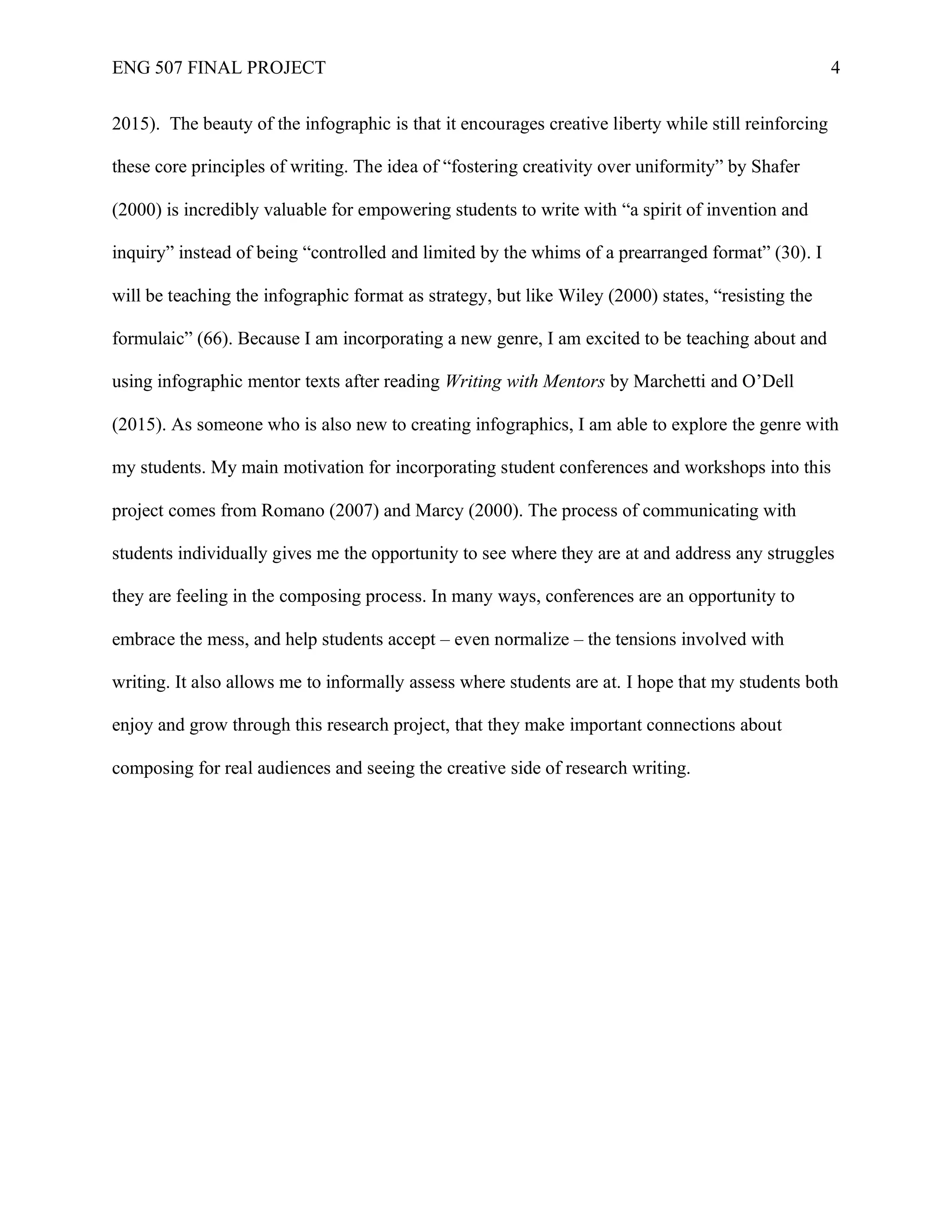
2015). The beauty of the infographic is that it encourages creative liberty while still reinforcing
these core principles of writing. The idea of “fostering creativity over uniformity” by Shafer
(2000) is incredibly valuable for empowering students to write with “a spirit of invention and
inquiry” instead of being “controlled and limited by the whims of a prearranged format” (30). I
will be teaching the infographic format as strategy, but like Wiley (2000) states, “resisting the
formulaic” (66). Because I am incorporating a new genre, I am excited to be teaching about and
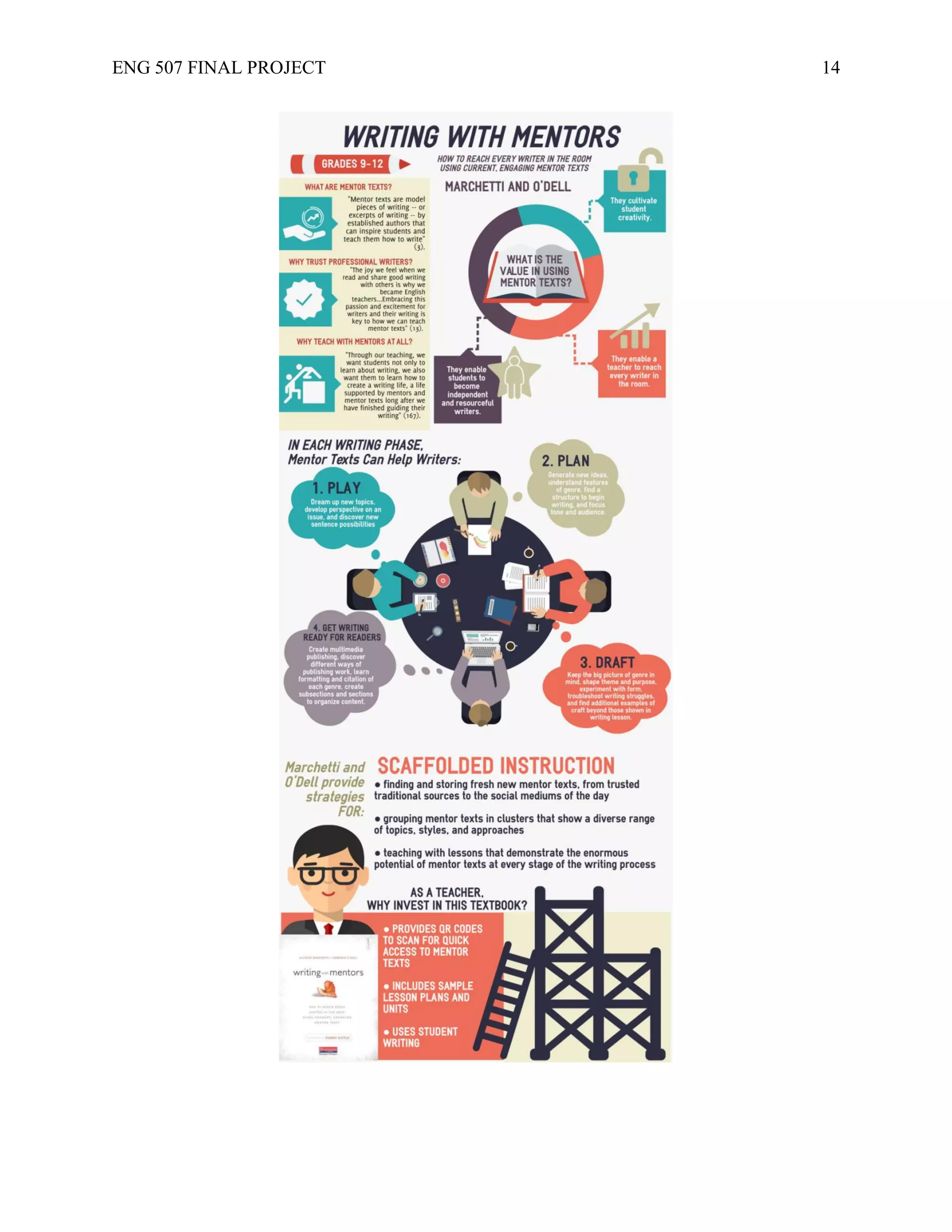
using infographic mentor texts after reading Writing with Mentors by Marchetti and O’Dell
(2015). As someone who is also new to creating infographics, I am able to explore the genre with
my students. My main motivation for incorporating student conferences and workshops into this
project comes from Romano (2007) and Marcy (2000). The process of communicating with
students individually gives me the opportunity to see where they are at and address any struggles
they are feeling in the composing process. In many ways, conferences are an opportunity to
embrace the mess, and help students accept – even normalize – the tensions involved with
writing. It also allows me to informally assess where students are at. I hope that my students both
enjoy and grow through this research project, that they make important connections about
composing for real audiences and seeing the creative side of research writing.
ENG 507 FINAL PROJECT 5
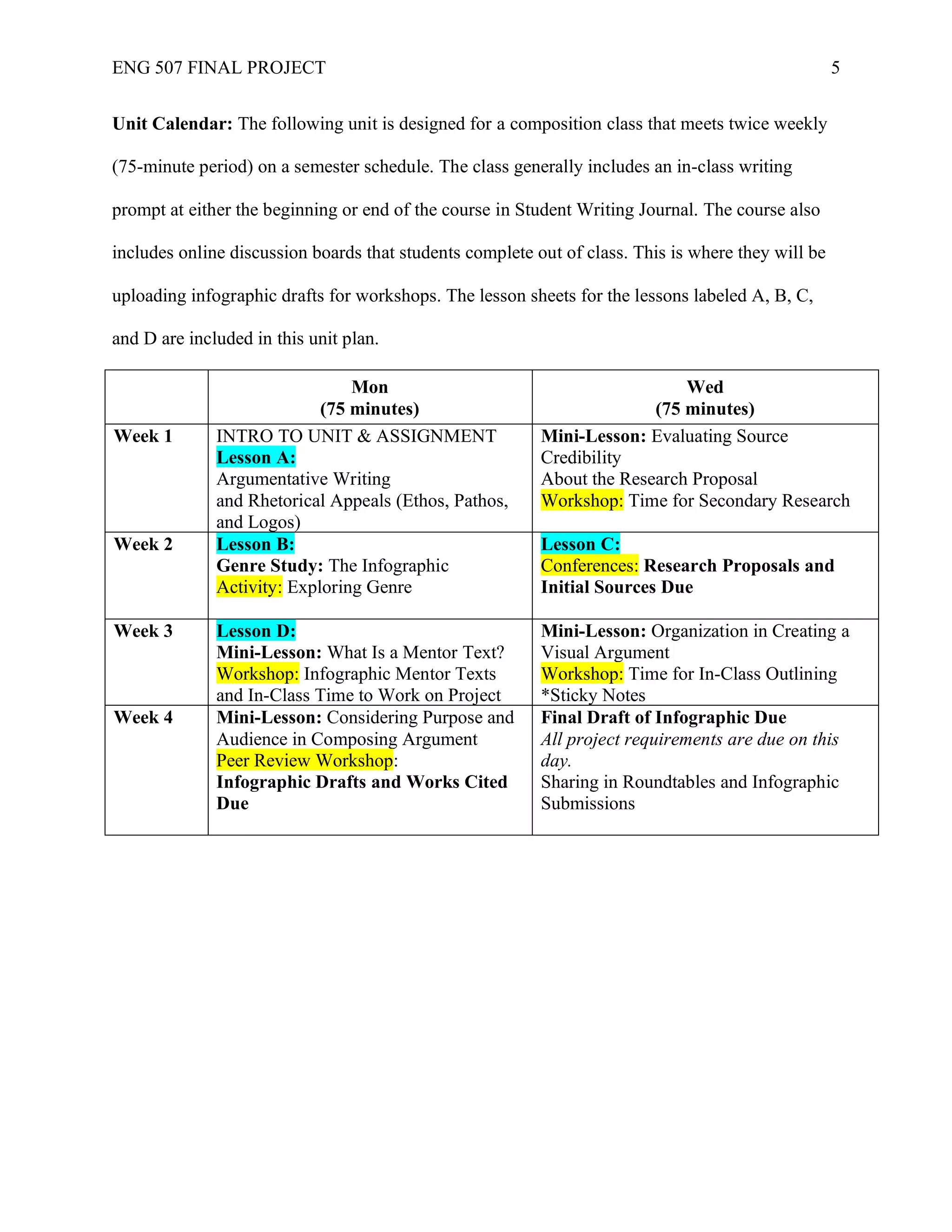
Unit Calendar: The following unit is designed for a composition class that meets twice weekly
(75-minute period) on a semester schedule. The class generally includes an in-class writing
prompt at either the beginning or end of the course in Student Writing Journal. The course also
includes online discussion boards that students complete out of class. This is where they will be
uploading infographic drafts for workshops. The lesson sheets for the lessons labeled A, B, C,
and D are included in this unit plan.
Mon
(75 minutes)
Wed
(75 minutes)
Week 1 INTRO TO UNIT & ASSIGNMENT
Lesson A:
Argumentative Writing
and Rhetorical Appeals (Ethos, Pathos,
and Logos)
Mini-Lesson: Evaluating Source
Credibility
About the Research Proposal
Workshop: Time for Secondary Research
Week 2 Lesson B:
Genre Study: The Infographic
Activity: Exploring Genre
Lesson C:
Conferences: Research Proposals and
Initial Sources Due
Week 3 Lesson D:
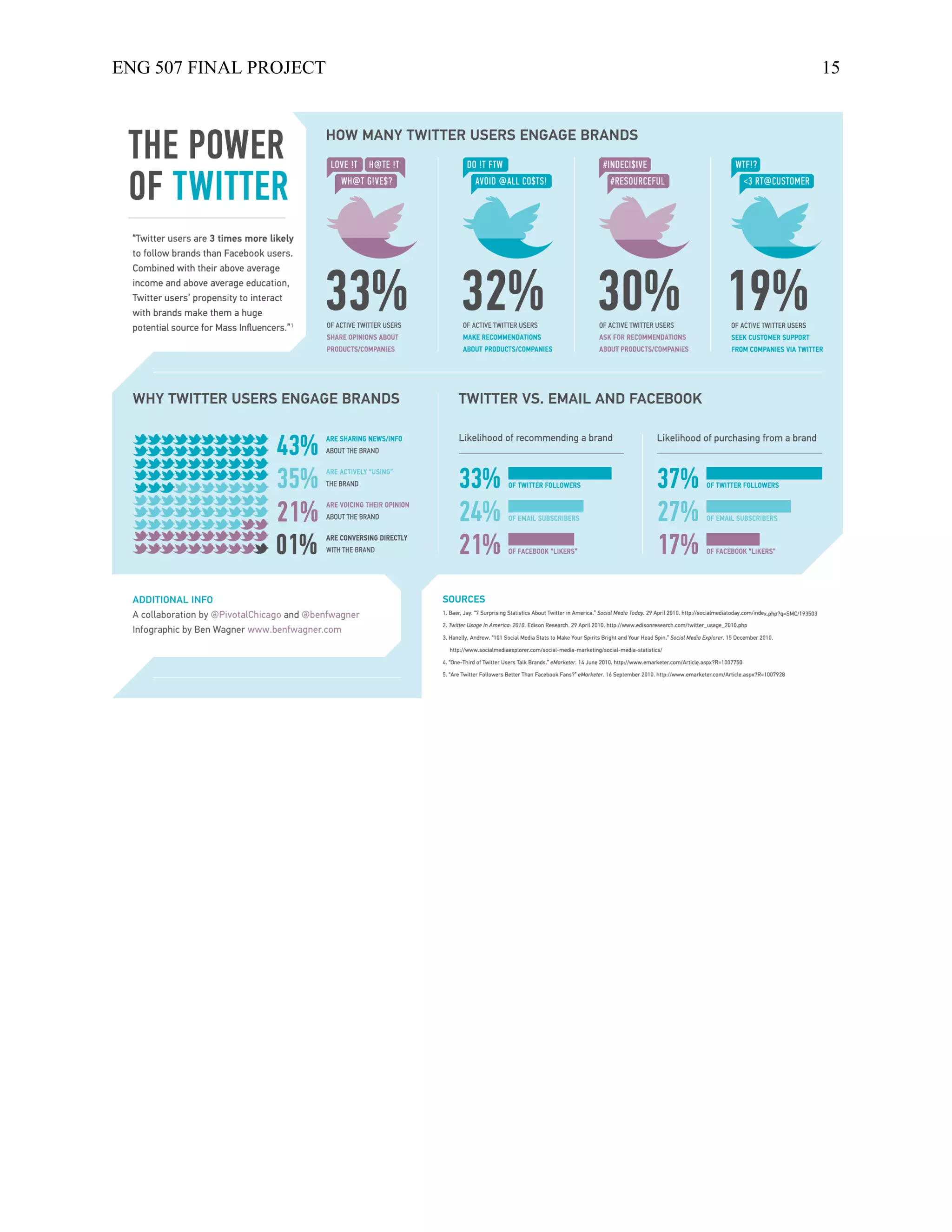
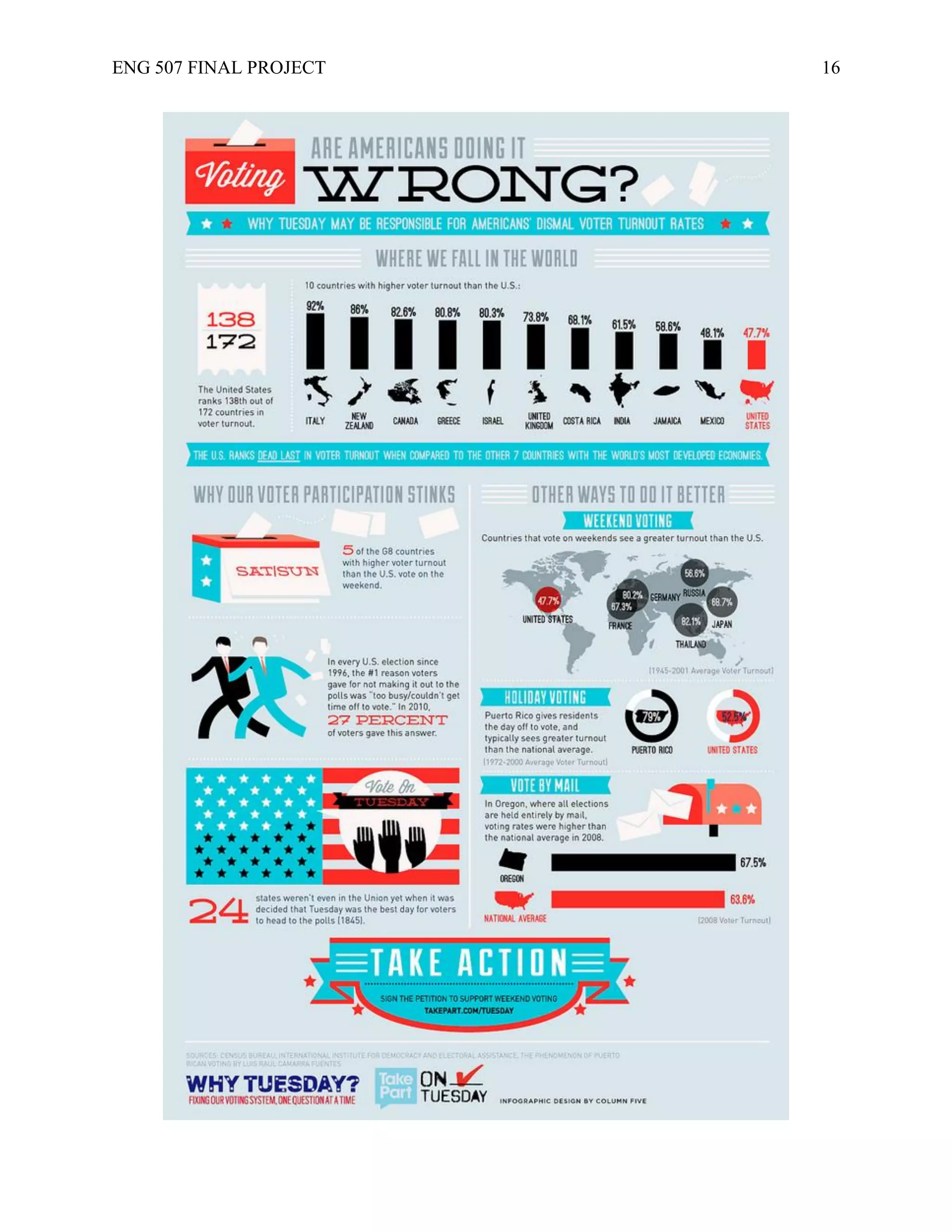
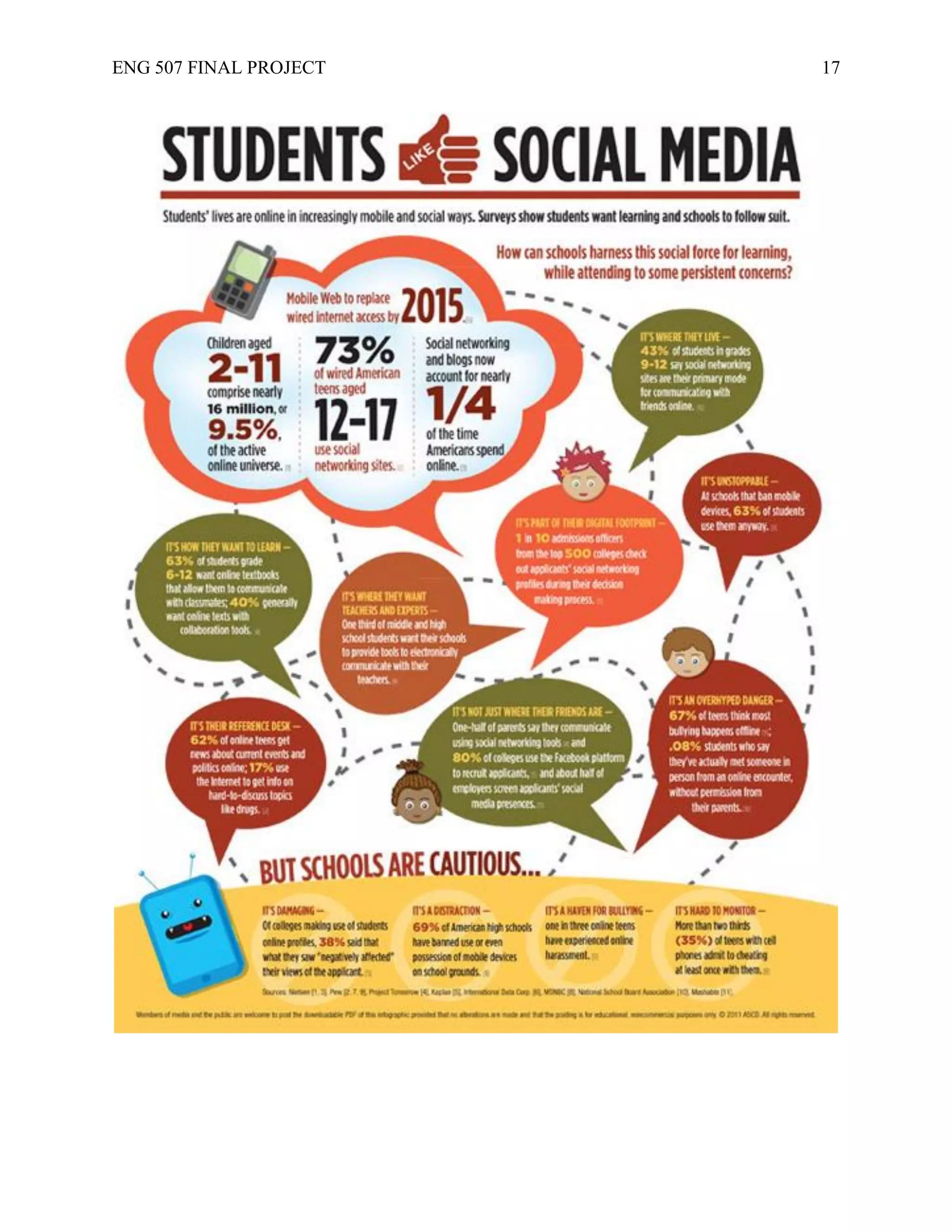
Mini-Lesson: What Is a Mentor Text?
Workshop: Infographic Mentor Texts
and In-Class Time to Work on Project
Mini-Lesson: Organization in Creating a
Visual Argument
Workshop: Time for In-Class Outlining
*Sticky Notes
Week 4 Mini-Lesson: Considering Purpose and
Audience in Composing Argument
Peer Review Workshop:
Infographic Drafts and Works Cited
Due
Final Draft of Infographic Due
All project requirements are due on this
day.
Sharing in Roundtables and Infographic
Submissions
ENG 507 FINAL PROJECT 6
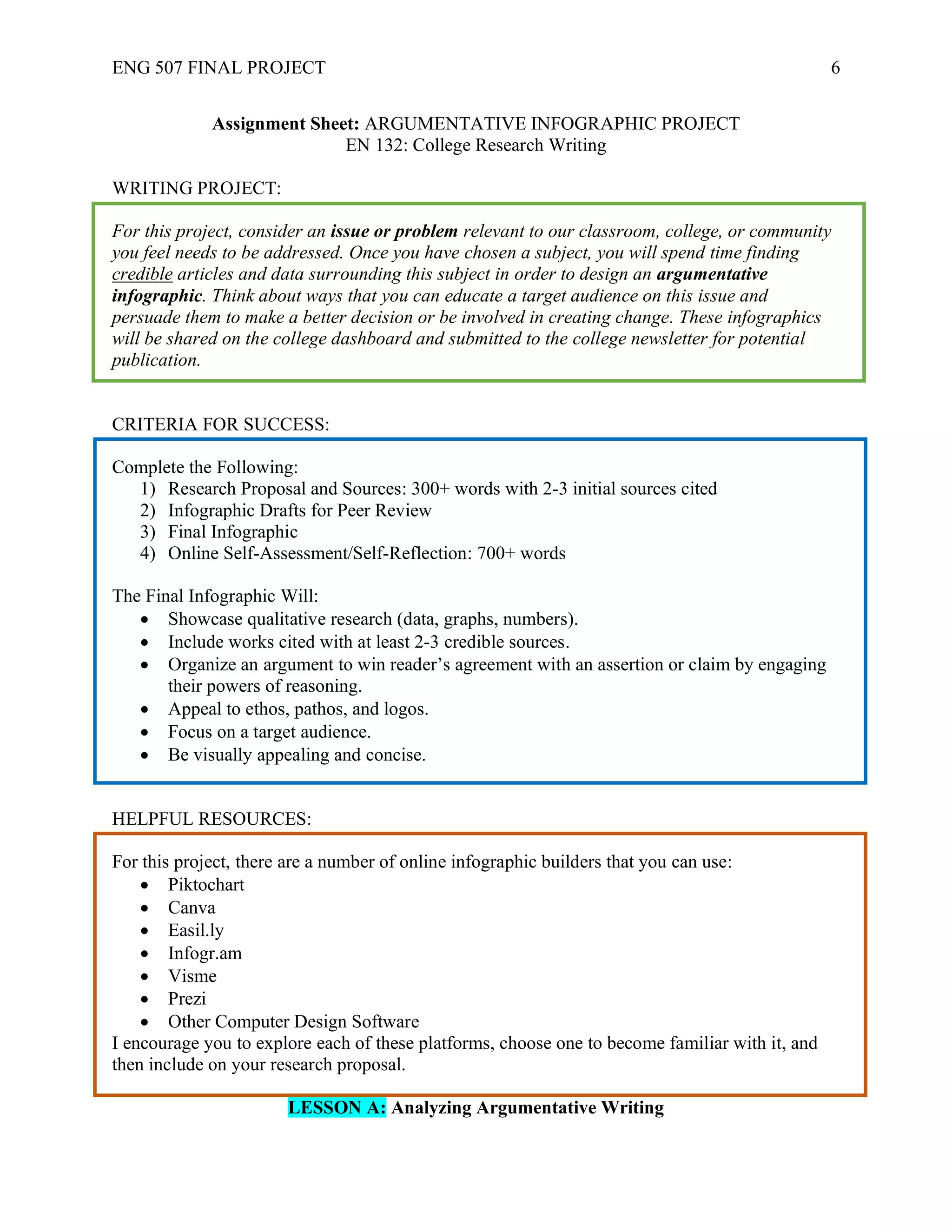
Assignment Sheet: ARGUMENTATIVE INFOGRAPHIC PROJECT
EN 132: College Research Writing
WRITING PROJECT:
For this project, consider an issue or problem relevant to our classroom, college, or community
you feel needs to be addressed. Once you have chosen a subject, you will spend time finding
credible articles and data surrounding this subject in order to design an argumentative
infographic. Think about ways that you can educate a target audience on this issue and
persuade them to make a better decision or be involved in creating change. These infographics
will be shared on the college dashboard and submitted to the college newsletter for potential
publication.
CRITERIA FOR SUCCESS:
Complete the Following:
1) Research Proposal and Sources: 300+ words with 2-3 initial sources cited
2) Infographic Drafts for Peer Review
3) Final Infographic
4) Online Self-Assessment/Self-Reflection: 700+ words
The Final Infographic Will:
• Showcase qualitative research (data, graphs, numbers).
• Include works cited with at least 2-3 credible sources.
• Organize an argument to win reader’s agreement with an assertion or claim by engaging
their powers of reasoning.
• Appeal to ethos, pathos, and logos.
• Focus on a target audience.
• Be visually appealing and concise.
HELPFUL RESOURCES:
For this project, there are a number of online infographic builders that you can use:
• Piktochart
• Canva
• Easil.ly
• Infogr.am
• Visme
• Prezi
• Other Computer Design Software
I encourage you to explore each of these platforms, choose one to become familiar with it, and
then include on your research proposal.
LESSON A: Analyzing Argumentative Writing
ENG 507 FINAL PROJECT 7
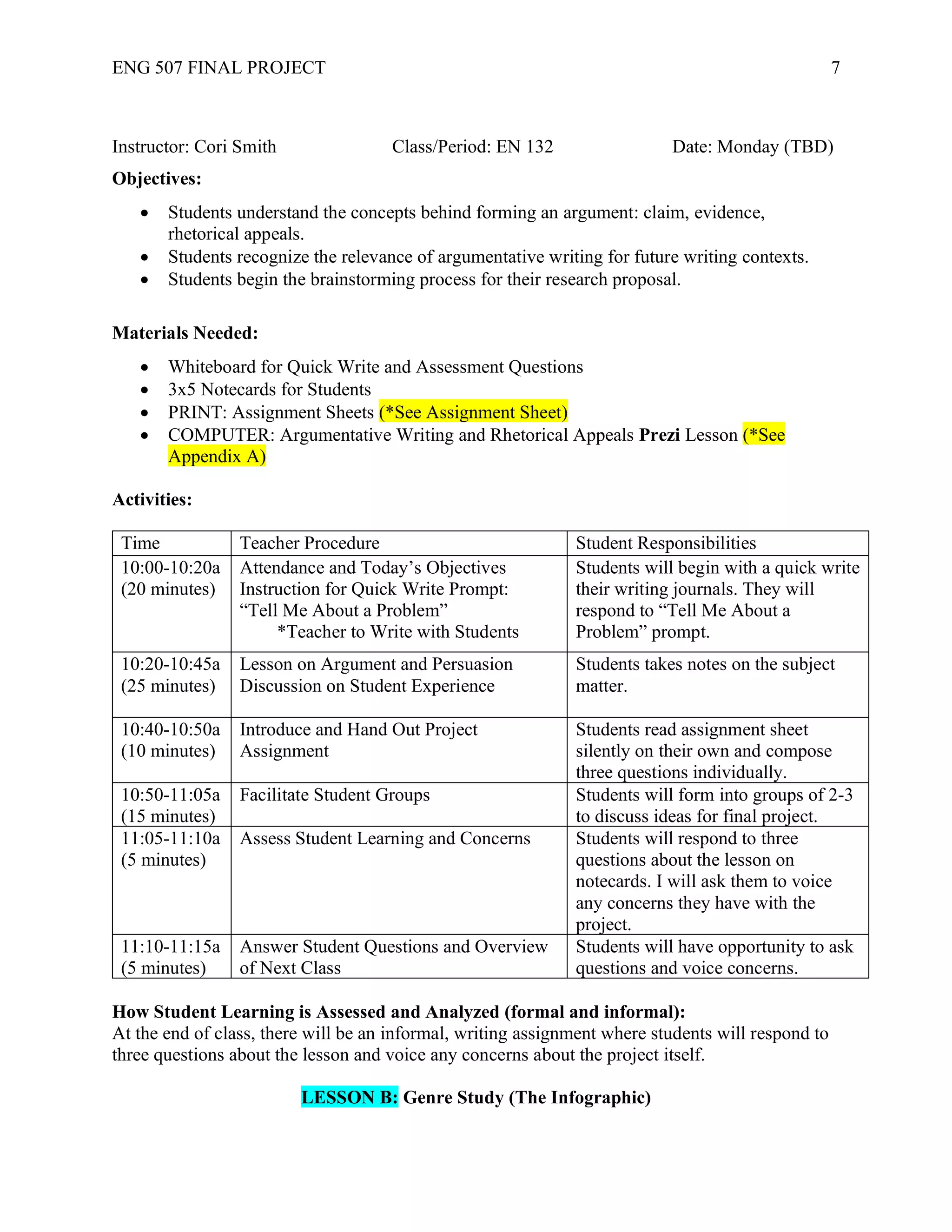
Instructor: Cori Smith Class/Period: EN 132 Date: Monday (TBD)
Objectives:
• Students understand the concepts behind forming an argument: claim, evidence,
rhetorical appeals.
• Students recognize the relevance of argumentative writing for future writing contexts.
• Students begin the brainstorming process for their research proposal.
Materials Needed:
• Whiteboard for Quick Write and Assessment Questions
• 3x5 Notecards for Students
• PRINT: Assignment Sheets (*See Assignment Sheet)
• COMPUTER: Argumentative Writing and Rhetorical Appeals Prezi Lesson (*See
Appendix A)
Activities:
Time Teacher Procedure Student Responsibilities
10:00-10:20a
(20 minutes)
Attendance and Today’s Objectives
Instruction for Quick Write Prompt:
“Tell Me About a Problem”
*Teacher to Write with Students
Students will begin with a quick write
their writing journals. They will
respond to “Tell Me About a
Problem” prompt.
10:20-10:45a
(25 minutes)
Lesson on Argument and Persuasion
Discussion on Student Experience
Students takes notes on the subject
matter.
10:40-10:50a
(10 minutes)
Introduce and Hand Out Project
Assignment
Students read assignment sheet
silently on their own and compose
three questions individually.
10:50-11:05a
(15 minutes)
Facilitate Student Groups Students will form into groups of 2-3
to discuss ideas for final project.
11:05-11:10a
(5 minutes)
Assess Student Learning and Concerns Students will respond to three
questions about the lesson on
notecards. I will ask them to voice
any concerns they have with the
project.
11:10-11:15a
(5 minutes)
Answer Student Questions and Overview
of Next Class
Students will have opportunity to ask
questions and voice concerns.
How Student Learning is Assessed and Analyzed (formal and informal):
At the end of class, there will be an informal, writing assignment where students will respond to
three questions about the lesson and voice any concerns about the project itself.
LESSON B: Genre Study (The Infographic)
ENG 507 FINAL PROJECT 8
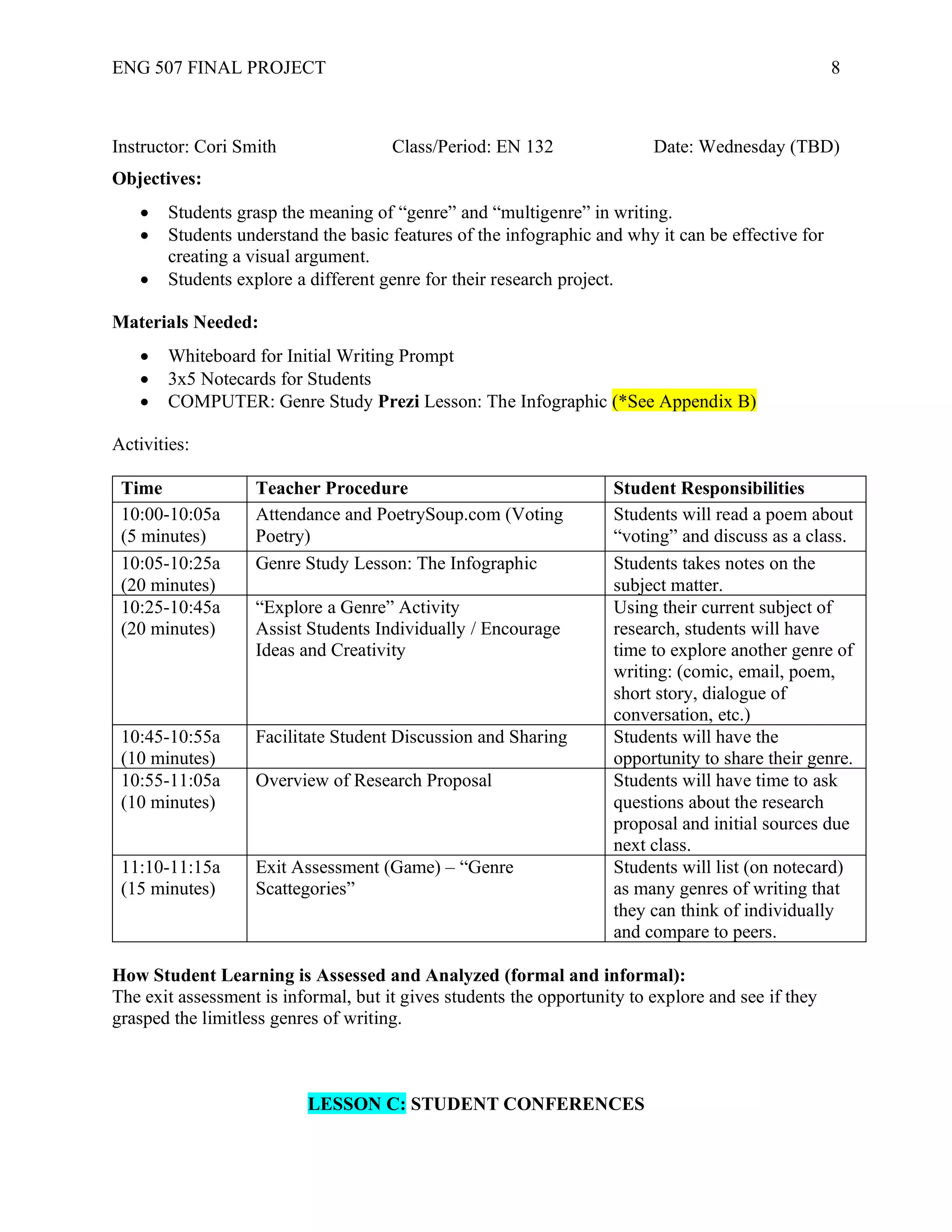
Instructor: Cori Smith Class/Period: EN 132 Date: Wednesday (TBD)
Objectives:
• Students grasp the meaning of “genre” and “multigenre” in writing.
• Students understand the basic features of the infographic and why it can be effective for
creating a visual argument.
• Students explore a different genre for their research project.
Materials Needed:
• Whiteboard for Initial Writing Prompt
• 3x5 Notecards for Students
• COMPUTER: Genre Study Prezi Lesson: The Infographic (*See Appendix B)
Activities:
Time Teacher Procedure Student Responsibilities
10:00-10:05a
(5 minutes)
Attendance and PoetrySoup.com (Voting
Poetry)
Students will read a poem about
“voting” and discuss as a class.
10:05-10:25a
(20 minutes)
Genre Study Lesson: The Infographic Students takes notes on the
subject matter.
10:25-10:45a
(20 minutes)
“Explore a Genre” Activity
Assist Students Individually / Encourage
Ideas and Creativity
Using their current subject of
research, students will have
time to explore another genre of
writing: (comic, email, poem,
short story, dialogue of
conversation, etc.)
10:45-10:55a
(10 minutes)
Facilitate Student Discussion and Sharing Students will have the
opportunity to share their genre.
10:55-11:05a
(10 minutes)
Overview of Research Proposal Students will have time to ask
questions about the research
proposal and initial sources due
next class.
11:10-11:15a
(15 minutes)
Exit Assessment (Game) – “Genre
Scattegories”
Students will list (on notecard)
as many genres of writing that
they can think of individually
and compare to peers.
How Student Learning is Assessed and Analyzed (formal and informal):
The exit assessment is informal, but it gives students the opportunity to explore and see if they
grasped the limitless genres of writing.
LESSON C: STUDENT CONFERENCES
ENG 507 FINAL PROJECT 9
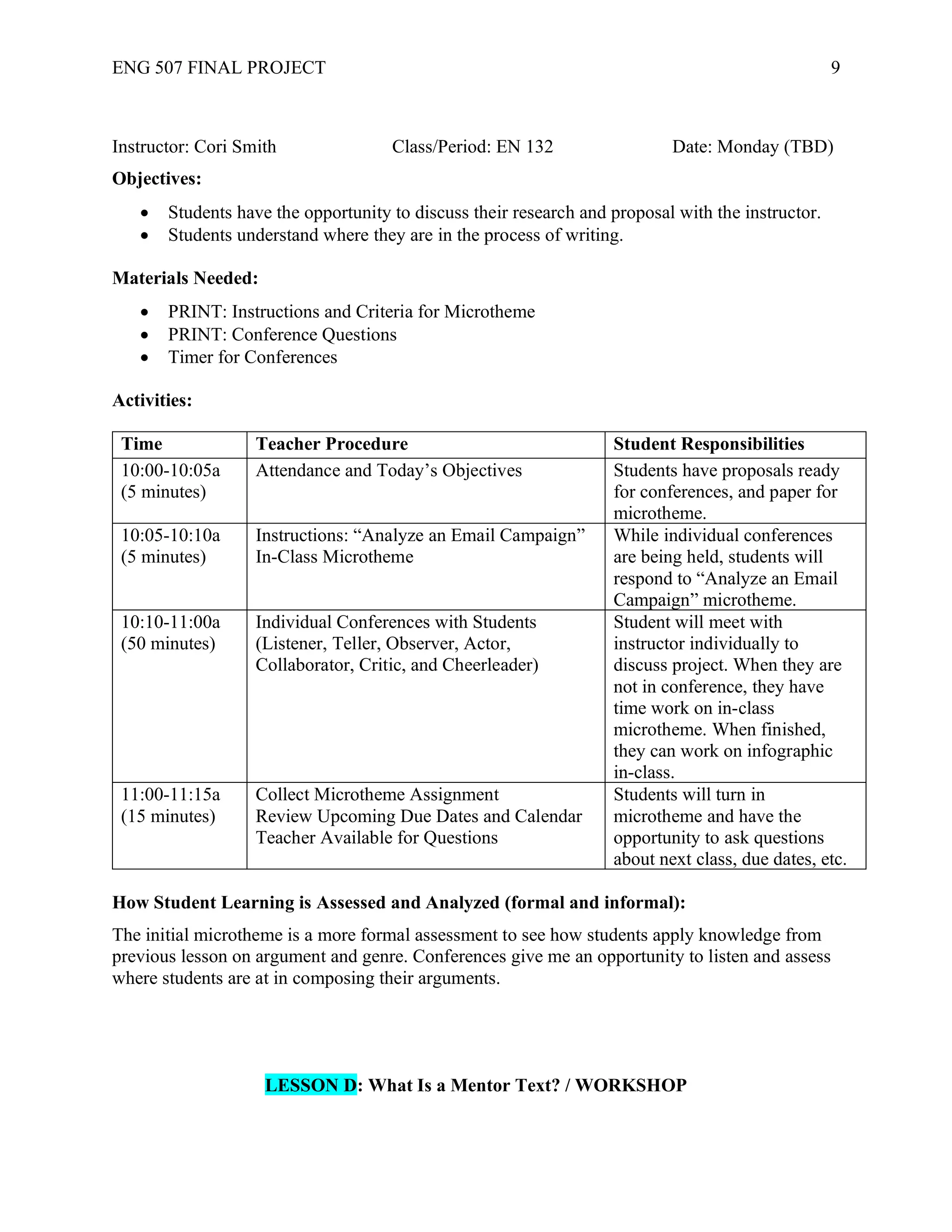
Instructor: Cori Smith Class/Period: EN 132 Date: Monday (TBD)
Objectives:
• Students have the opportunity to discuss their research and proposal with the instructor.
• Students understand where they are in the process of writing.
Materials Needed:
• PRINT: Instructions and Criteria for Microtheme
• PRINT: Conference Questions
• Timer for Conferences
Activities:
Time Teacher Procedure Student Responsibilities
10:00-10:05a
(5 minutes)
Attendance and Today’s Objectives Students have proposals ready
for conferences, and paper for
microtheme.
10:05-10:10a
(5 minutes)
Instructions: “Analyze an Email Campaign”
In-Class Microtheme
While individual conferences
are being held, students will
respond to “Analyze an Email
Campaign” microtheme.
10:10-11:00a
(50 minutes)
Individual Conferences with Students
(Listener, Teller, Observer, Actor,
Collaborator, Critic, and Cheerleader)
Student will meet with
instructor individually to
discuss project. When they are
not in conference, they have
time work on in-class
microtheme. When finished,
they can work on infographic
in-class.
11:00-11:15a
(15 minutes)
Collect Microtheme Assignment
Review Upcoming Due Dates and Calendar
Teacher Available for Questions
Students will turn in
microtheme and have the
opportunity to ask questions
about next class, due dates, etc.
How Student Learning is Assessed and Analyzed (formal and informal):
The initial microtheme is a more formal assessment to see how students apply knowledge from
previous lesson on argument and genre. Conferences give me an opportunity to listen and assess
where students are at in composing their arguments.
LESSON D: What Is a Mentor Text? / WORKSHOP
ENG 507 FINAL PROJECT 10
Instructor: Cori Smith Class/Period: EN 132 Date: Wednesday (TBD)
Objectives:
• Students understand “mentor texts” and why they are helpful tools for scaffolding.
• Students recognize the skill of collecting and analyzing mentor texts (infographics) for
their project.
• Students will have time to analyze mentor texts in a group setting and then work on their
own infographics.
Materials Needed:
• Whiteboard for Initial Writing Prompt
• COMPUTER: YouTube Video – “7 Common Types of Infographics” by Easelly
https://www.youtube.com/watch?v=A6_7zC0mB9w
• COMPUTER: Infographic Mentor Texts (*See Appendix C)
Activities:
Time Teacher Procedure Student Responsibilities
10:00-10:15a
(15 minutes)
Attendance and Interior Monologue Students will be invited to write
from the perspective of
someone who disagrees with
their argument.
10:15-10:25a
(5-10 minutes)
Mini-Lesson on Mentor Texts
YouTube Video on “7 Common Types of
Infographics”
Students can take notes during
this mini-lesson and participate
in discussion.
10:25-11:00a
(35 minutes)
Facilitate Workshop: Sample Mentor Texts Students will have access to
mentor texts on college
dashboard. They will have a
choice of which one they would
like to analyze and model.
11:00-11:15a
(15 minutes)
Class Discussion We will have the opportunity to
discuss mentor texts together.
Students can ask questions and
explore together.
How Student Learning is Assessed and Analyzed (formal and informal):
The workshop style will be open, where students can work individually on their projects in a
group setting. I will be informally assessing where they are at in the design process of their
infographic.
Works Cited
ENG 507 FINAL PROJECT 11
Lindemann, E. (2001). Developing writing assignments. A Rhetoric for Writing Teachers, New
York, Oxford University Press. Canvas PDF.
Marchetti, A. and Rebekah O. (2015). Writing with Mentors. Portsmouth, NH, Heinemann.
CCCC Position Statement. (2015). Principles for the postsecondary teaching of writing.
Conference on College Composition and Communication. Retrieved from
https://cccc.ncte.org/cccc/resources/positions/postsecondarywriting.
Romano, T. (1987). The crucial role of conferencing. Writing What Matters, 2015. Zigzag
Publishing. Canvas PDF.
Romano, T. (2007). The many ways of multigenre. Teaching the Neglected “R”: Rethinking
Writing Instruction in Secondary, Canvas PDF.
Saidy, C. (2013). Working from the inside out: writing for community and democratic
participation When Citizenship Is in Question.” The English Journal, vol. 103, no. 2,
2013, pp. 60–65. JSTOR, www.jstor.org/stable/24484194.
Shafer. G. (2000). Composition for the twenty-first century. English Journal, 90 (1), 29-33.
Taylor, M. (2000). “Nancie Atwell's In the Middle and the ongoing transformation of the writing
workshop.” The English Journal,90 (1), 46-52.
Wiley. M. (2000). The popularity of formulaic writing (and why we need to resist). English
Journal, 90 (1), 61-67.
WPA outcomes statement for first-year composition. (2019). Council of Writing Program
Administrators, Retrieved from
http://wpacouncil.org/aws/CWPA/asset_manager/get_file/350909?ver=2152
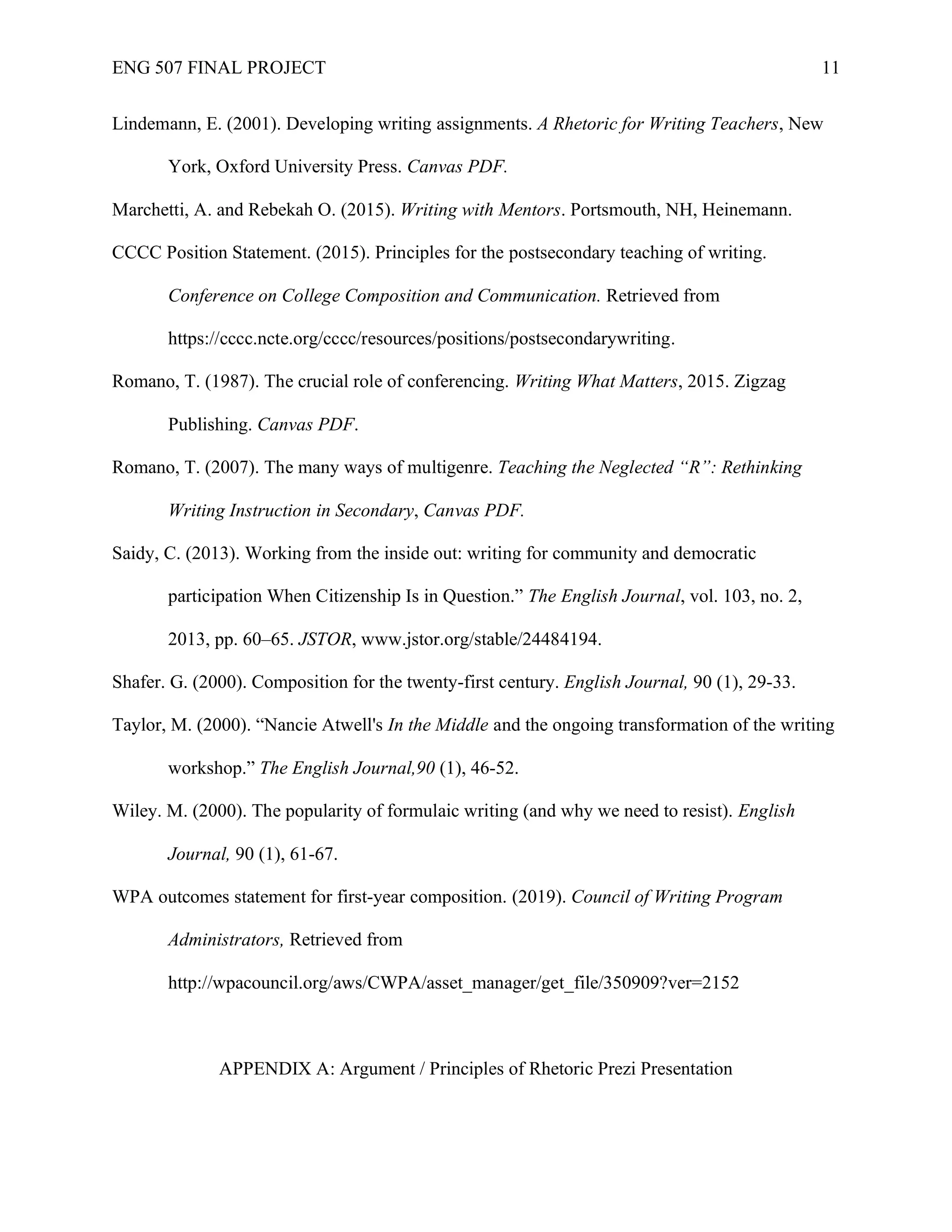
APPENDIX A: Argument / Principles of Rhetoric Prezi Presentation
ENG 507 FINAL PROJECT 12
PREZI LINK: https://prezi.com/view/8hcBx5Wg6QGGpdmxdji3
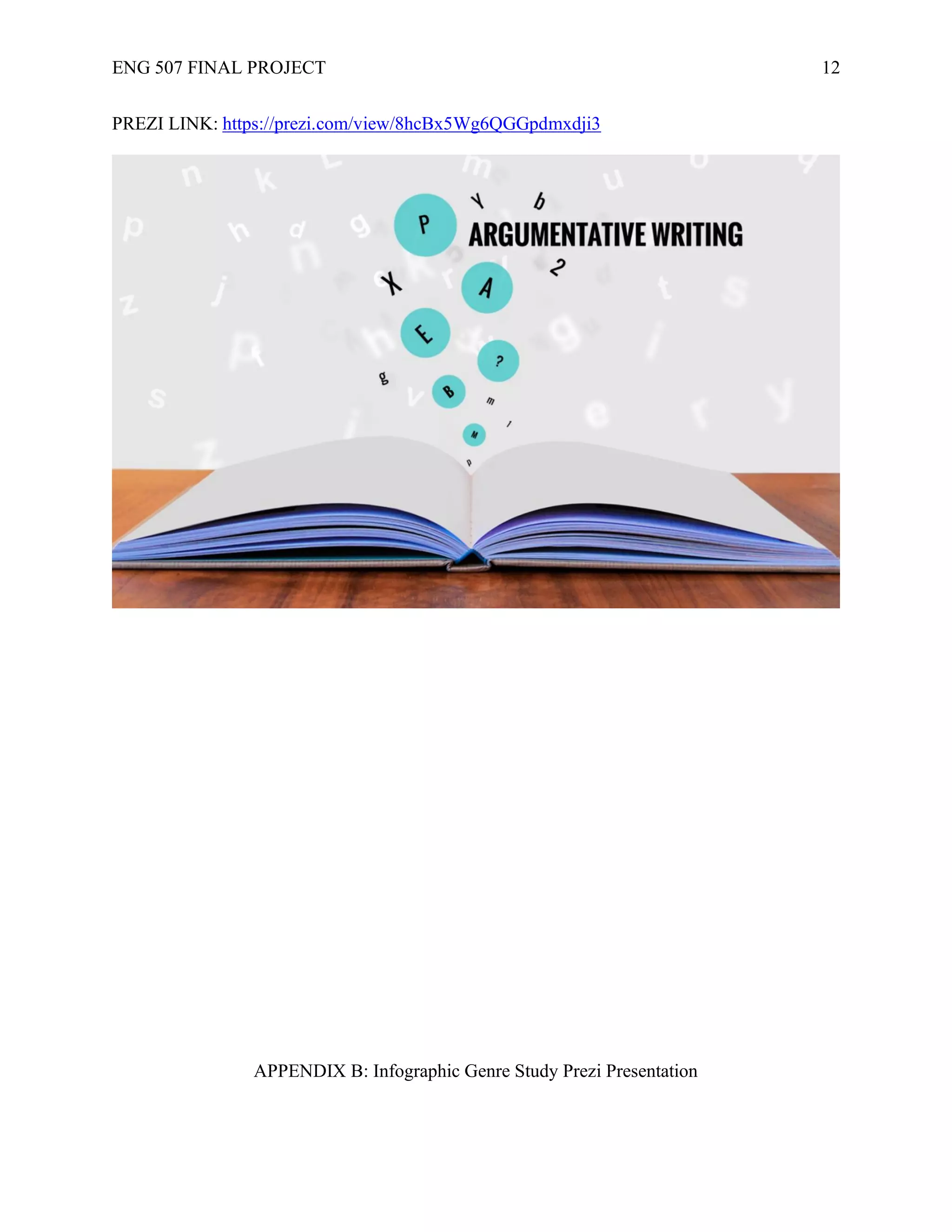
APPENDIX B: Infographic Genre Study Prezi Presentation
ENG 507 FINAL PROJECT 13
PREZI LINK: https://prezi.com/view/9ttuu47L5GlWitTnmR4A/
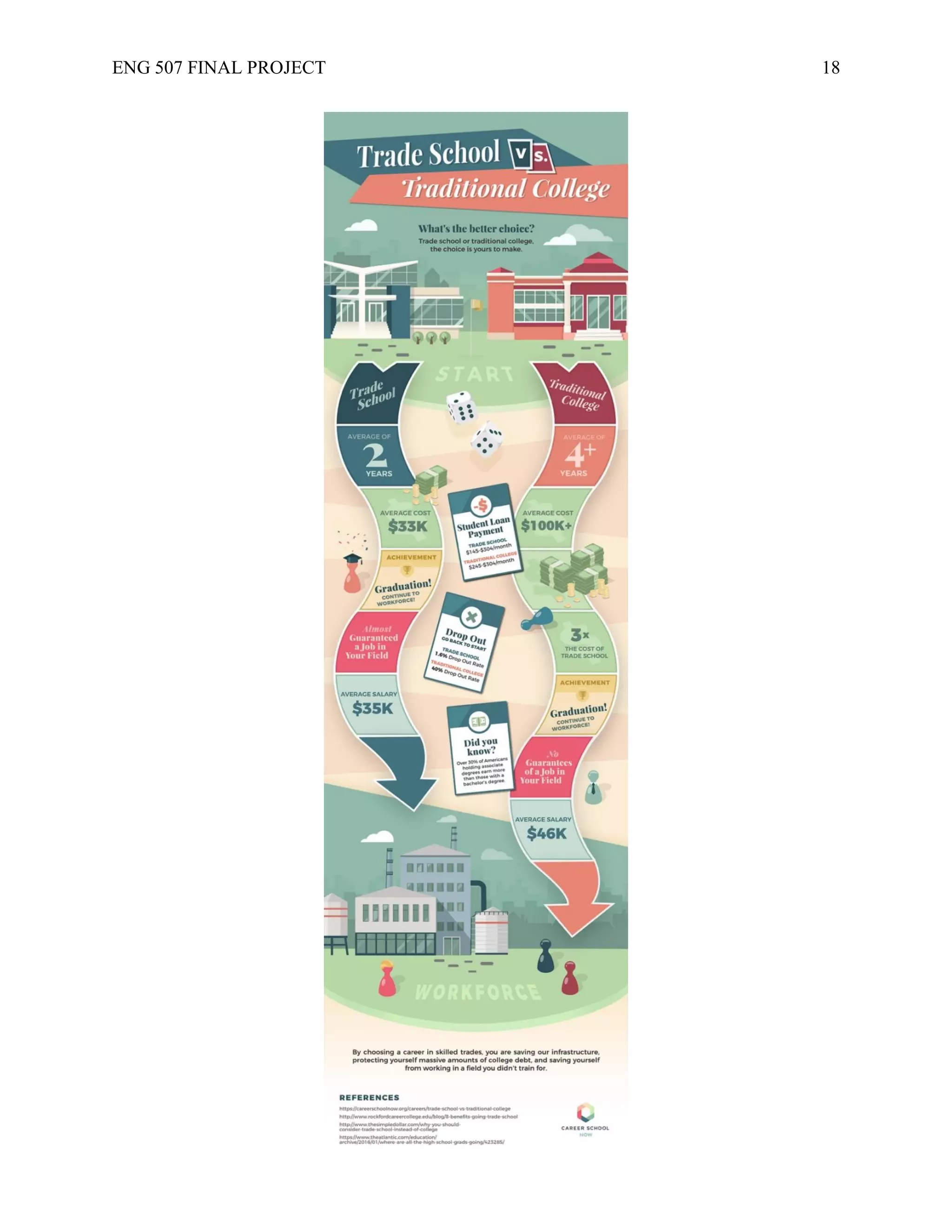
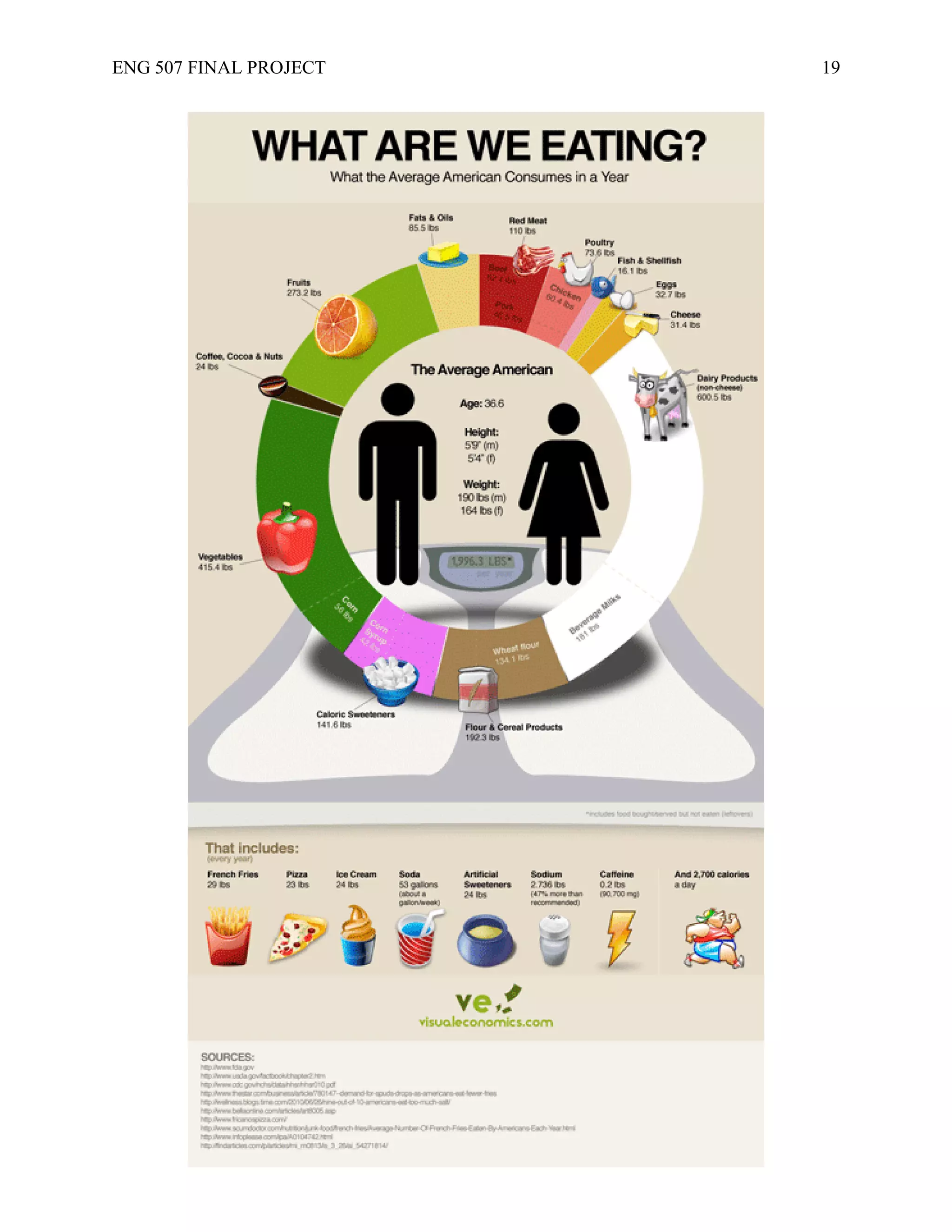
APPENDIX C: Infographic Mentor Texts
ENG 507 FINAL PROJECT 14
ENG 507 FINAL PROJECT 15
ENG 507 FINAL PROJECT 16
ENG 507 FINAL PROJECT 17
ENG 507 FINAL PROJECT 18
ENG 507 FINAL PROJECT 19

ENG 507 Final Draft - Smith.pdf

  • 1.
    Running Head: ENG507 FINAL PROJECT 1 ENG 507: Final Project: FYC Teaching Unit for Argumentative Infographic Cori Smith Arizona State University Professor Baldonado-Ruiz May 1, 2020
  • 2.
    ENG 507 FINALPROJECT 2 Introduction: When students in first-year composition hear the words “research writing,” it is usually accompanied by feelings of dread and/or boredom. At least, those were my feelings when I initially took the course in community college over a decade ago, and I sense the same apprehension from incoming freshman to my First-Year Composition (FYC) course on research writing. Memories of daunting projects, irrelevant subjects, and adherence to meticulous formatting rules come to mind. I recall writing a traditional research paper on the Hubble Space Telescope, and while I learned random knowledge about NASA, the overall assignment left me with a limited understanding of how to apply research for a public audience or real-world context. In this case, the subject was randomly chosen, the audience was my instructor, the purpose was to complete the requirements of the assignment, and the genre was the traditional research essay (a prearranged format that does not often apply to real-world writing contexts). This unit is designed to excite and challenge students with a new genre of argumentative, research writing – the infographic – that they can present to a real audience and incorporate into a larger, multigenre research portfolio for the course. It will serve as an introductory assignment with the goal of helping students: 1) choose a subject of relevance for a public audience using an “inside-out” approach (Saidy 2013), 2) organize their research to build an argument using multiple methods of instruction: workshops, conferences, mentor texts, and in-class writing assessments (Marcy, 2000; Romano, 1987; Marchetti and O’Dell, 2015), and 3) explore a different genre of research while learning about the fundamental principles of rhetoric and the ethics of research (Romano, 2007; CCCC Position Statement, 2014; WPA Outcomes Statement for First-Year Composition, 2019).
  • 3.
    ENG 507 FINALPROJECT 3 Romano (2007) argues that expository writing (i.e. summaries, essays, traditional research papers, reports) has been promoted within education to the exclusivity of other important and creative genres (i.e. images, stories, narratives, poems). This kind of one-way- method-of-writing is not only disengaging students, but it is also misguiding their understanding of writing as a “big world mural” with limitless possibilities of writing genres (88). As they progress in their prospective disciplines of study, future careers, and personal lives, they will use writing in a plethora of contexts, where they will compose and communicate for multiple audiences and numerous purposes. In addition to implementing new genres of research writing, I am inspired by Saidy (2013) and her “inside-out approach” for student writing, where they begin their writing process by focusing on their own values and experiences. She advocates that “[a]n inside out approach encourages students to use writing to build on their existing knowledge and values as they carve out spaces for action in their own communities” (65). The majority of students at our two-year institution are first in their family to attend college. I find that many of them are trying to establish themselves and unearth the relevance of higher education. The emphasis on writing for real audiences (and not simply their instructor) inspires students to write with greater intention and communication in mind; it also contrasts the narrow, formulaic writing of secondary education and standardized testing (Saidy, 2013; Wiley 2000). For this assignment, students will post their infographics to the online college dashboard (available to all students, faculty, and administration). They can also submit their infographic to the college newsletter for potential publication. With these approaches in mind, I will teach and reinforce some of the fundamental writing objectives of the FYC, such as: the rhetorical nature of writing, writing as an iterative and complex process, writing and technology, critical thinking (CCCC Position Statement,
  • 4.
    ENG 507 FINALPROJECT 4 2015). The beauty of the infographic is that it encourages creative liberty while still reinforcing these core principles of writing. The idea of “fostering creativity over uniformity” by Shafer (2000) is incredibly valuable for empowering students to write with “a spirit of invention and inquiry” instead of being “controlled and limited by the whims of a prearranged format” (30). I will be teaching the infographic format as strategy, but like Wiley (2000) states, “resisting the formulaic” (66). Because I am incorporating a new genre, I am excited to be teaching about and using infographic mentor texts after reading Writing with Mentors by Marchetti and O’Dell (2015). As someone who is also new to creating infographics, I am able to explore the genre with my students. My main motivation for incorporating student conferences and workshops into this project comes from Romano (2007) and Marcy (2000). The process of communicating with students individually gives me the opportunity to see where they are at and address any struggles they are feeling in the composing process. In many ways, conferences are an opportunity to embrace the mess, and help students accept – even normalize – the tensions involved with writing. It also allows me to informally assess where students are at. I hope that my students both enjoy and grow through this research project, that they make important connections about composing for real audiences and seeing the creative side of research writing.
  • 5.
    ENG 507 FINALPROJECT 5 Unit Calendar: The following unit is designed for a composition class that meets twice weekly (75-minute period) on a semester schedule. The class generally includes an in-class writing prompt at either the beginning or end of the course in Student Writing Journal. The course also includes online discussion boards that students complete out of class. This is where they will be uploading infographic drafts for workshops. The lesson sheets for the lessons labeled A, B, C, and D are included in this unit plan. Mon (75 minutes) Wed (75 minutes) Week 1 INTRO TO UNIT & ASSIGNMENT Lesson A: Argumentative Writing and Rhetorical Appeals (Ethos, Pathos, and Logos) Mini-Lesson: Evaluating Source Credibility About the Research Proposal Workshop: Time for Secondary Research Week 2 Lesson B: Genre Study: The Infographic Activity: Exploring Genre Lesson C: Conferences: Research Proposals and Initial Sources Due Week 3 Lesson D: Mini-Lesson: What Is a Mentor Text? Workshop: Infographic Mentor Texts and In-Class Time to Work on Project Mini-Lesson: Organization in Creating a Visual Argument Workshop: Time for In-Class Outlining *Sticky Notes Week 4 Mini-Lesson: Considering Purpose and Audience in Composing Argument Peer Review Workshop: Infographic Drafts and Works Cited Due Final Draft of Infographic Due All project requirements are due on this day. Sharing in Roundtables and Infographic Submissions
  • 6.
    ENG 507 FINALPROJECT 6 Assignment Sheet: ARGUMENTATIVE INFOGRAPHIC PROJECT EN 132: College Research Writing WRITING PROJECT: For this project, consider an issue or problem relevant to our classroom, college, or community you feel needs to be addressed. Once you have chosen a subject, you will spend time finding credible articles and data surrounding this subject in order to design an argumentative infographic. Think about ways that you can educate a target audience on this issue and persuade them to make a better decision or be involved in creating change. These infographics will be shared on the college dashboard and submitted to the college newsletter for potential publication. CRITERIA FOR SUCCESS: Complete the Following: 1) Research Proposal and Sources: 300+ words with 2-3 initial sources cited 2) Infographic Drafts for Peer Review 3) Final Infographic 4) Online Self-Assessment/Self-Reflection: 700+ words The Final Infographic Will: • Showcase qualitative research (data, graphs, numbers). • Include works cited with at least 2-3 credible sources. • Organize an argument to win reader’s agreement with an assertion or claim by engaging their powers of reasoning. • Appeal to ethos, pathos, and logos. • Focus on a target audience. • Be visually appealing and concise. HELPFUL RESOURCES: For this project, there are a number of online infographic builders that you can use: • Piktochart • Canva • Easil.ly • Infogr.am • Visme • Prezi • Other Computer Design Software I encourage you to explore each of these platforms, choose one to become familiar with it, and then include on your research proposal. LESSON A: Analyzing Argumentative Writing
  • 7.
    ENG 507 FINALPROJECT 7 Instructor: Cori Smith Class/Period: EN 132 Date: Monday (TBD) Objectives: • Students understand the concepts behind forming an argument: claim, evidence, rhetorical appeals. • Students recognize the relevance of argumentative writing for future writing contexts. • Students begin the brainstorming process for their research proposal. Materials Needed: • Whiteboard for Quick Write and Assessment Questions • 3x5 Notecards for Students • PRINT: Assignment Sheets (*See Assignment Sheet) • COMPUTER: Argumentative Writing and Rhetorical Appeals Prezi Lesson (*See Appendix A) Activities: Time Teacher Procedure Student Responsibilities 10:00-10:20a (20 minutes) Attendance and Today’s Objectives Instruction for Quick Write Prompt: “Tell Me About a Problem” *Teacher to Write with Students Students will begin with a quick write their writing journals. They will respond to “Tell Me About a Problem” prompt. 10:20-10:45a (25 minutes) Lesson on Argument and Persuasion Discussion on Student Experience Students takes notes on the subject matter. 10:40-10:50a (10 minutes) Introduce and Hand Out Project Assignment Students read assignment sheet silently on their own and compose three questions individually. 10:50-11:05a (15 minutes) Facilitate Student Groups Students will form into groups of 2-3 to discuss ideas for final project. 11:05-11:10a (5 minutes) Assess Student Learning and Concerns Students will respond to three questions about the lesson on notecards. I will ask them to voice any concerns they have with the project. 11:10-11:15a (5 minutes) Answer Student Questions and Overview of Next Class Students will have opportunity to ask questions and voice concerns. How Student Learning is Assessed and Analyzed (formal and informal): At the end of class, there will be an informal, writing assignment where students will respond to three questions about the lesson and voice any concerns about the project itself. LESSON B: Genre Study (The Infographic)
  • 8.
    ENG 507 FINALPROJECT 8 Instructor: Cori Smith Class/Period: EN 132 Date: Wednesday (TBD) Objectives: • Students grasp the meaning of “genre” and “multigenre” in writing. • Students understand the basic features of the infographic and why it can be effective for creating a visual argument. • Students explore a different genre for their research project. Materials Needed: • Whiteboard for Initial Writing Prompt • 3x5 Notecards for Students • COMPUTER: Genre Study Prezi Lesson: The Infographic (*See Appendix B) Activities: Time Teacher Procedure Student Responsibilities 10:00-10:05a (5 minutes) Attendance and PoetrySoup.com (Voting Poetry) Students will read a poem about “voting” and discuss as a class. 10:05-10:25a (20 minutes) Genre Study Lesson: The Infographic Students takes notes on the subject matter. 10:25-10:45a (20 minutes) “Explore a Genre” Activity Assist Students Individually / Encourage Ideas and Creativity Using their current subject of research, students will have time to explore another genre of writing: (comic, email, poem, short story, dialogue of conversation, etc.) 10:45-10:55a (10 minutes) Facilitate Student Discussion and Sharing Students will have the opportunity to share their genre. 10:55-11:05a (10 minutes) Overview of Research Proposal Students will have time to ask questions about the research proposal and initial sources due next class. 11:10-11:15a (15 minutes) Exit Assessment (Game) – “Genre Scattegories” Students will list (on notecard) as many genres of writing that they can think of individually and compare to peers. How Student Learning is Assessed and Analyzed (formal and informal): The exit assessment is informal, but it gives students the opportunity to explore and see if they grasped the limitless genres of writing. LESSON C: STUDENT CONFERENCES
  • 9.
    ENG 507 FINALPROJECT 9 Instructor: Cori Smith Class/Period: EN 132 Date: Monday (TBD) Objectives: • Students have the opportunity to discuss their research and proposal with the instructor. • Students understand where they are in the process of writing. Materials Needed: • PRINT: Instructions and Criteria for Microtheme • PRINT: Conference Questions • Timer for Conferences Activities: Time Teacher Procedure Student Responsibilities 10:00-10:05a (5 minutes) Attendance and Today’s Objectives Students have proposals ready for conferences, and paper for microtheme. 10:05-10:10a (5 minutes) Instructions: “Analyze an Email Campaign” In-Class Microtheme While individual conferences are being held, students will respond to “Analyze an Email Campaign” microtheme. 10:10-11:00a (50 minutes) Individual Conferences with Students (Listener, Teller, Observer, Actor, Collaborator, Critic, and Cheerleader) Student will meet with instructor individually to discuss project. When they are not in conference, they have time work on in-class microtheme. When finished, they can work on infographic in-class. 11:00-11:15a (15 minutes) Collect Microtheme Assignment Review Upcoming Due Dates and Calendar Teacher Available for Questions Students will turn in microtheme and have the opportunity to ask questions about next class, due dates, etc. How Student Learning is Assessed and Analyzed (formal and informal): The initial microtheme is a more formal assessment to see how students apply knowledge from previous lesson on argument and genre. Conferences give me an opportunity to listen and assess where students are at in composing their arguments. LESSON D: What Is a Mentor Text? / WORKSHOP
  • 10.
    ENG 507 FINALPROJECT 10 Instructor: Cori Smith Class/Period: EN 132 Date: Wednesday (TBD) Objectives: • Students understand “mentor texts” and why they are helpful tools for scaffolding. • Students recognize the skill of collecting and analyzing mentor texts (infographics) for their project. • Students will have time to analyze mentor texts in a group setting and then work on their own infographics. Materials Needed: • Whiteboard for Initial Writing Prompt • COMPUTER: YouTube Video – “7 Common Types of Infographics” by Easelly https://www.youtube.com/watch?v=A6_7zC0mB9w • COMPUTER: Infographic Mentor Texts (*See Appendix C) Activities: Time Teacher Procedure Student Responsibilities 10:00-10:15a (15 minutes) Attendance and Interior Monologue Students will be invited to write from the perspective of someone who disagrees with their argument. 10:15-10:25a (5-10 minutes) Mini-Lesson on Mentor Texts YouTube Video on “7 Common Types of Infographics” Students can take notes during this mini-lesson and participate in discussion. 10:25-11:00a (35 minutes) Facilitate Workshop: Sample Mentor Texts Students will have access to mentor texts on college dashboard. They will have a choice of which one they would like to analyze and model. 11:00-11:15a (15 minutes) Class Discussion We will have the opportunity to discuss mentor texts together. Students can ask questions and explore together. How Student Learning is Assessed and Analyzed (formal and informal): The workshop style will be open, where students can work individually on their projects in a group setting. I will be informally assessing where they are at in the design process of their infographic. Works Cited
  • 11.
    ENG 507 FINALPROJECT 11 Lindemann, E. (2001). Developing writing assignments. A Rhetoric for Writing Teachers, New York, Oxford University Press. Canvas PDF. Marchetti, A. and Rebekah O. (2015). Writing with Mentors. Portsmouth, NH, Heinemann. CCCC Position Statement. (2015). Principles for the postsecondary teaching of writing. Conference on College Composition and Communication. Retrieved from https://cccc.ncte.org/cccc/resources/positions/postsecondarywriting. Romano, T. (1987). The crucial role of conferencing. Writing What Matters, 2015. Zigzag Publishing. Canvas PDF. Romano, T. (2007). The many ways of multigenre. Teaching the Neglected “R”: Rethinking Writing Instruction in Secondary, Canvas PDF. Saidy, C. (2013). Working from the inside out: writing for community and democratic participation When Citizenship Is in Question.” The English Journal, vol. 103, no. 2, 2013, pp. 60–65. JSTOR, www.jstor.org/stable/24484194. Shafer. G. (2000). Composition for the twenty-first century. English Journal, 90 (1), 29-33. Taylor, M. (2000). “Nancie Atwell's In the Middle and the ongoing transformation of the writing workshop.” The English Journal,90 (1), 46-52. Wiley. M. (2000). The popularity of formulaic writing (and why we need to resist). English Journal, 90 (1), 61-67. WPA outcomes statement for first-year composition. (2019). Council of Writing Program Administrators, Retrieved from http://wpacouncil.org/aws/CWPA/asset_manager/get_file/350909?ver=2152 APPENDIX A: Argument / Principles of Rhetoric Prezi Presentation
  • 12.
    ENG 507 FINALPROJECT 12 PREZI LINK: https://prezi.com/view/8hcBx5Wg6QGGpdmxdji3 APPENDIX B: Infographic Genre Study Prezi Presentation
  • 13.
    ENG 507 FINALPROJECT 13 PREZI LINK: https://prezi.com/view/9ttuu47L5GlWitTnmR4A/ APPENDIX C: Infographic Mentor Texts
  • 14.
    ENG 507 FINALPROJECT 14
  • 15.
    ENG 507 FINALPROJECT 15
  • 16.
    ENG 507 FINALPROJECT 16
  • 17.
    ENG 507 FINALPROJECT 17
  • 18.
    ENG 507 FINALPROJECT 18
  • 19.
    ENG 507 FINALPROJECT 19