Giftedness:


      The Gift that Keeps on Giving
Introduction
   Stable versus unstable personal traits
       e.g. gender versus hair color
   Which is giftedness?
   Often viewed as a childhood attribute
   This reflected by a recent web search
   What are the results of googling … ?
Google results
   “gifted children” →1,440,000 hits
   versus post-childhood:
       “gifted adolescents” → 39,600 hits
           “gifted teenagers” → 1,670 hits
       “gifted adults” → 24,700 hits
       “gifted elderly” → 56 hits
           “gifted senior citizens” → 8 hits
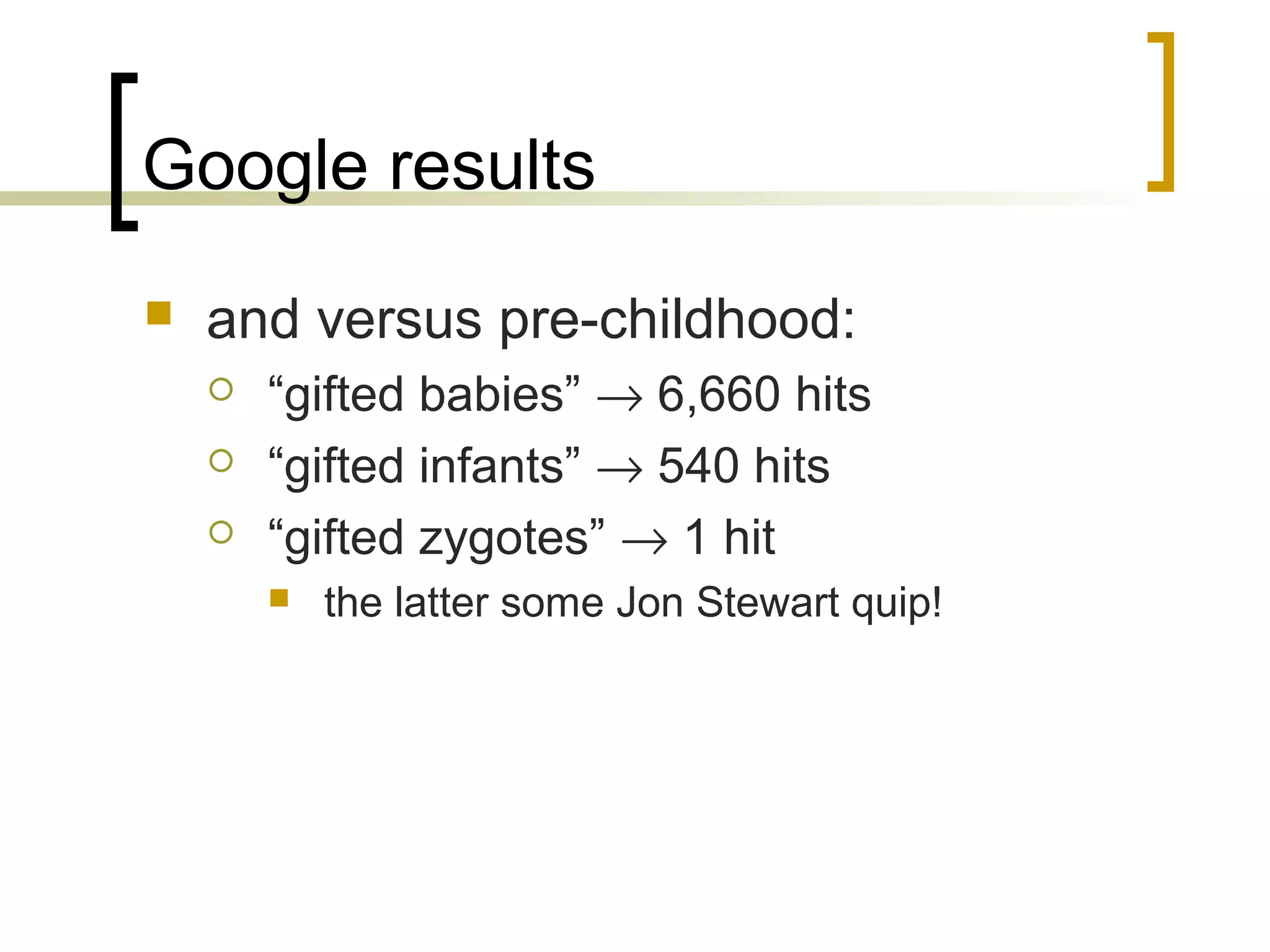
Google results
   and versus pre-childhood:
       “gifted babies” → 6,660 hits
       “gifted infants” → 540 hits
       “gifted zygotes” → 1 hit
           the latter some Jon Stewart quip!
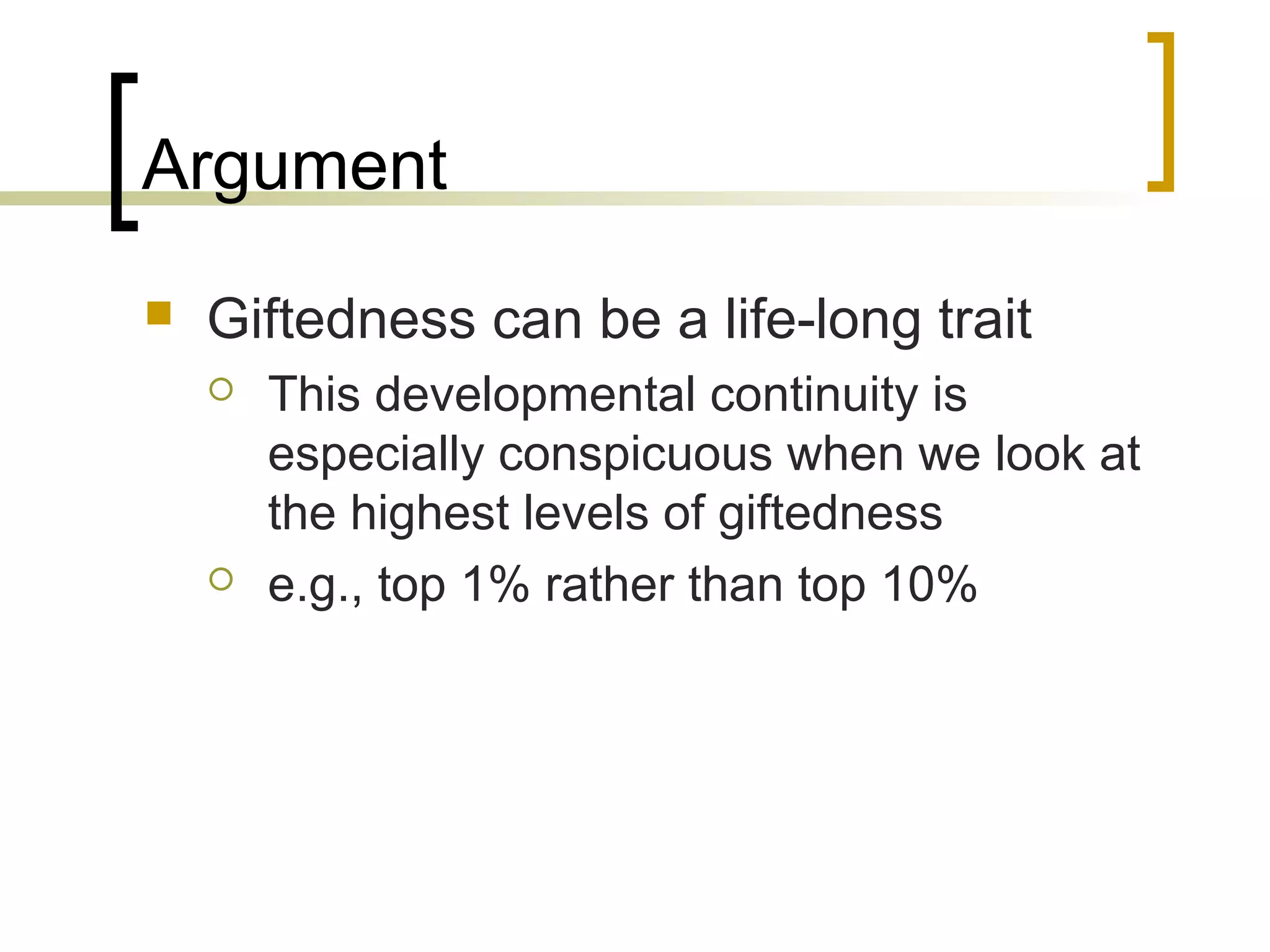
Argument
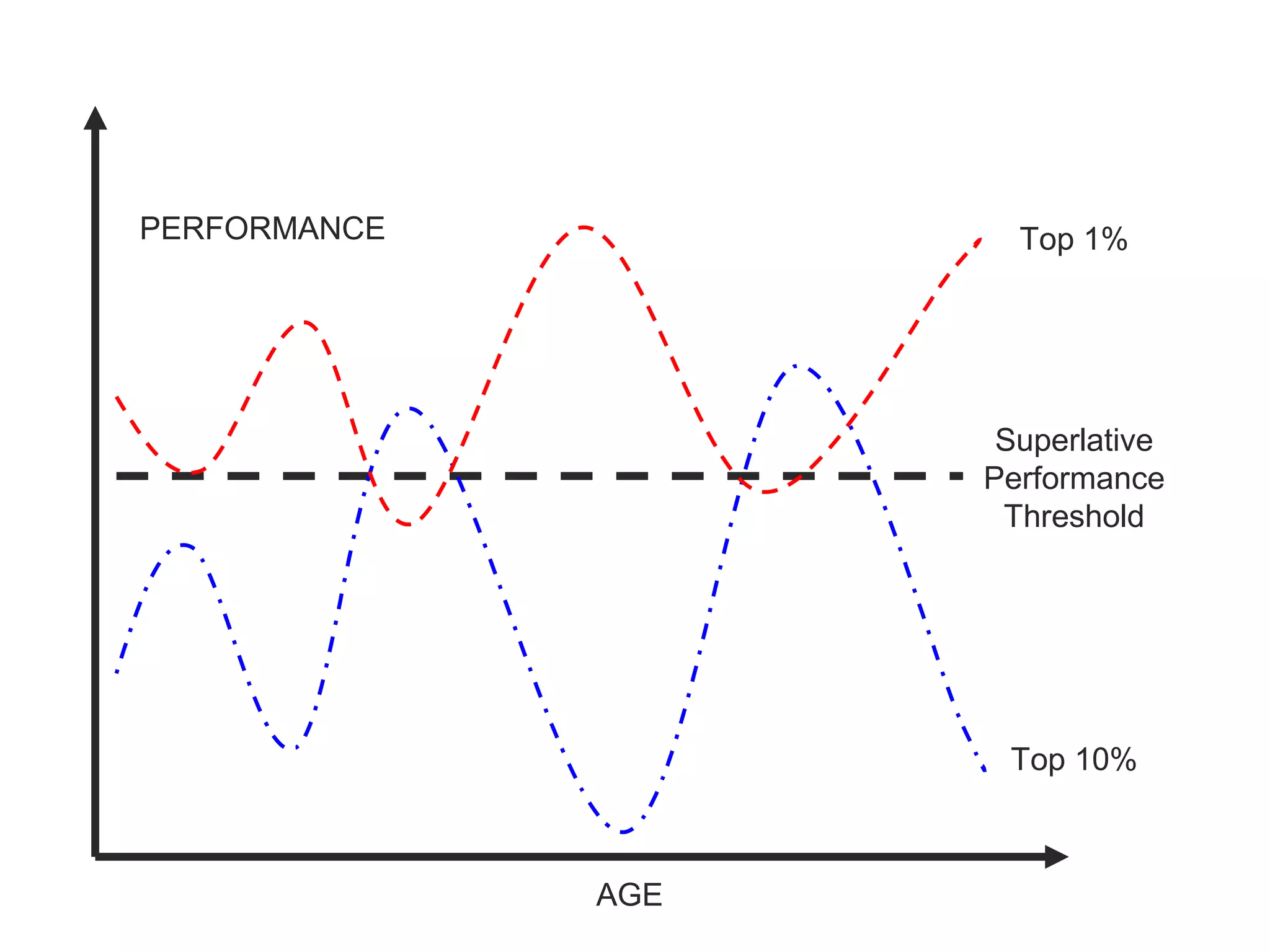
   Giftedness can be a life-long trait
       This developmental continuity is
        especially conspicuous when we look at
        the highest levels of giftedness
       e.g., top 1% rather than top 10%
PERFORMANCE           Top 1%


                     Superlative
                    Performance
                     Threshold


                     Top 10%


              AGE
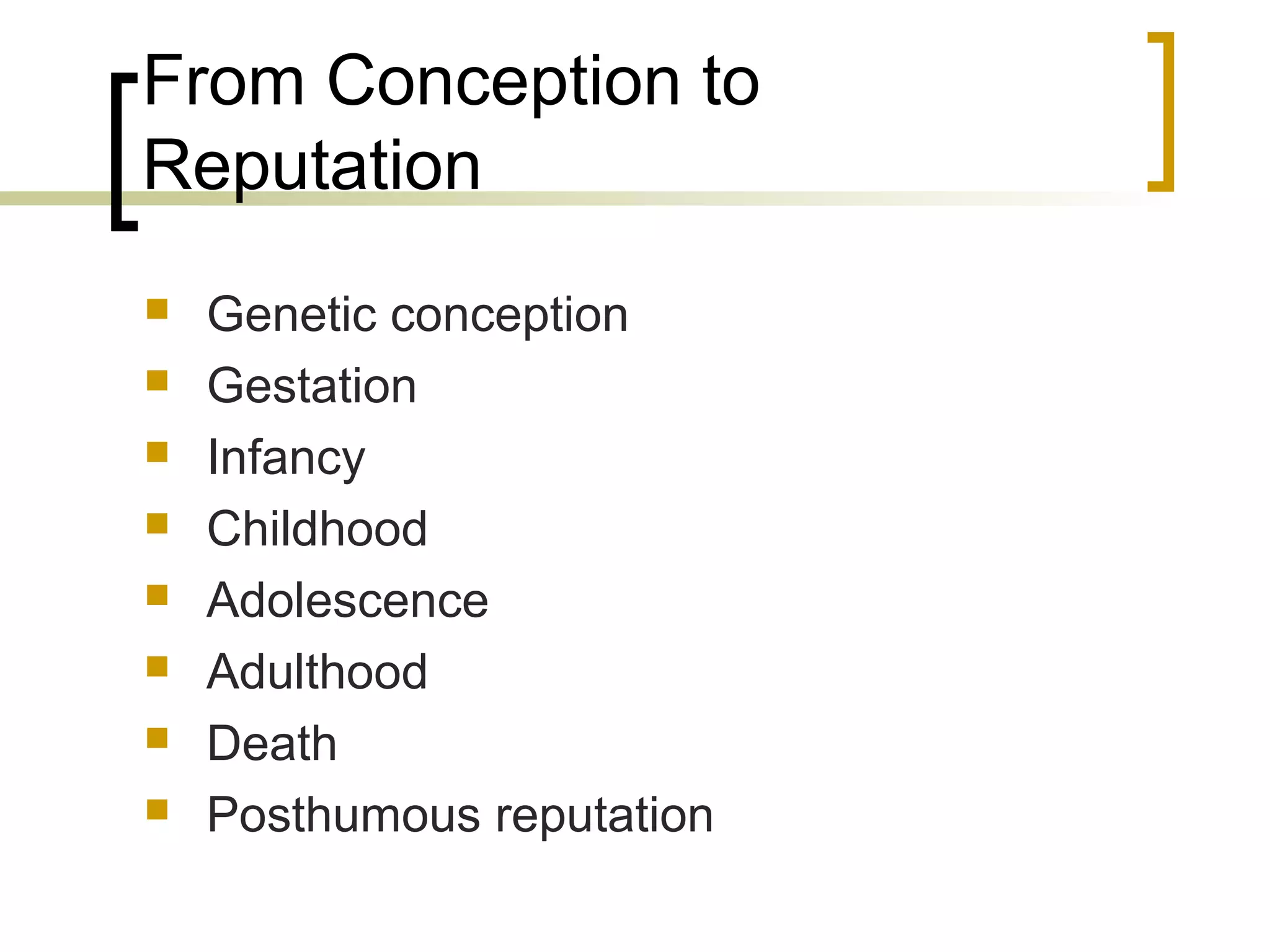
From Conception to
Reputation
   Genetic conception
   Gestation
   Infancy
   Childhood
   Adolescence
   Adulthood
   Death
   Posthumous reputation
Genetic conception
Genetic conception
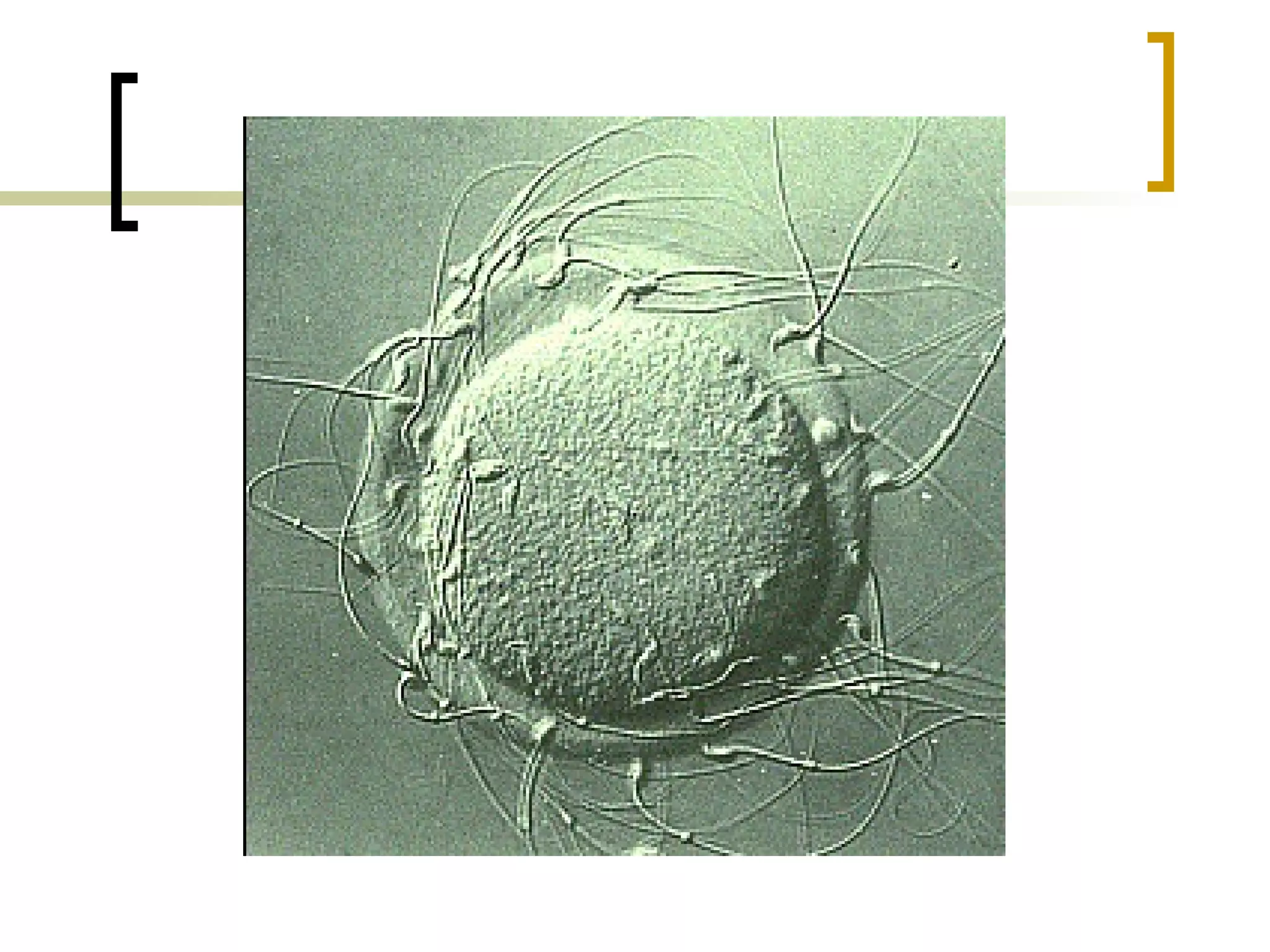
   It all begins with the “gifted zygote”
   Galton’s 1869 Hereditary Genius
   Modern behavioral genetics:
    Giftedness is most likely
       multi-polygenic (many polygenic traits)
       emergenic (multiplicative/configurational)
       epigenetic (unfolds over time)
   In short, a complex, dynamic process
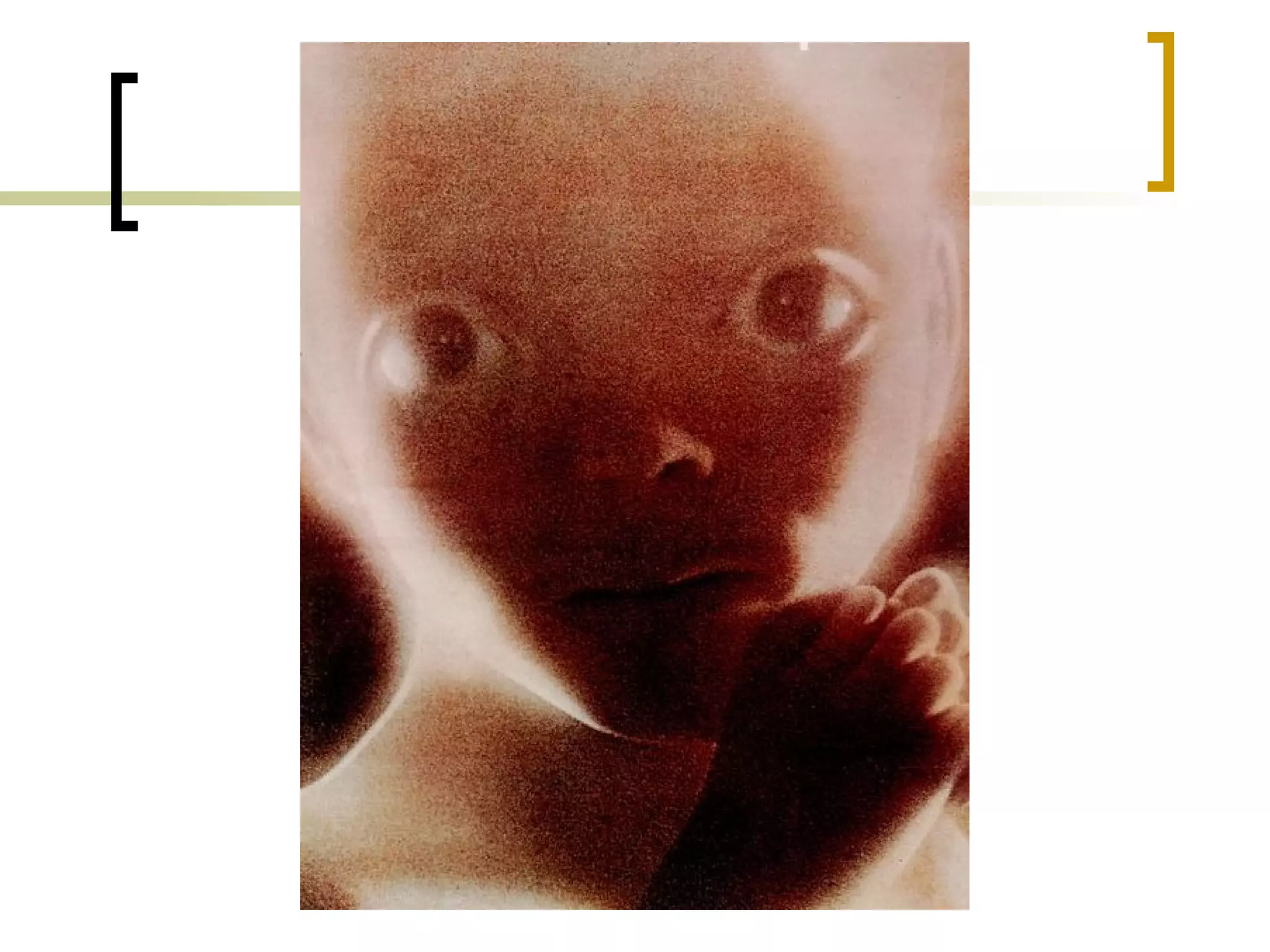
Gestation
Gestation
   Intrauterine environment
   e.g., Geschwind’s theory
       elevated testosterone after 20th week
           right > left posterior hemisphere growth
           giftedness/savantism
               mathematical ability
               artistic/spatial ability
               musical ability
   Simon Baron-Cohen: “extreme male brain”
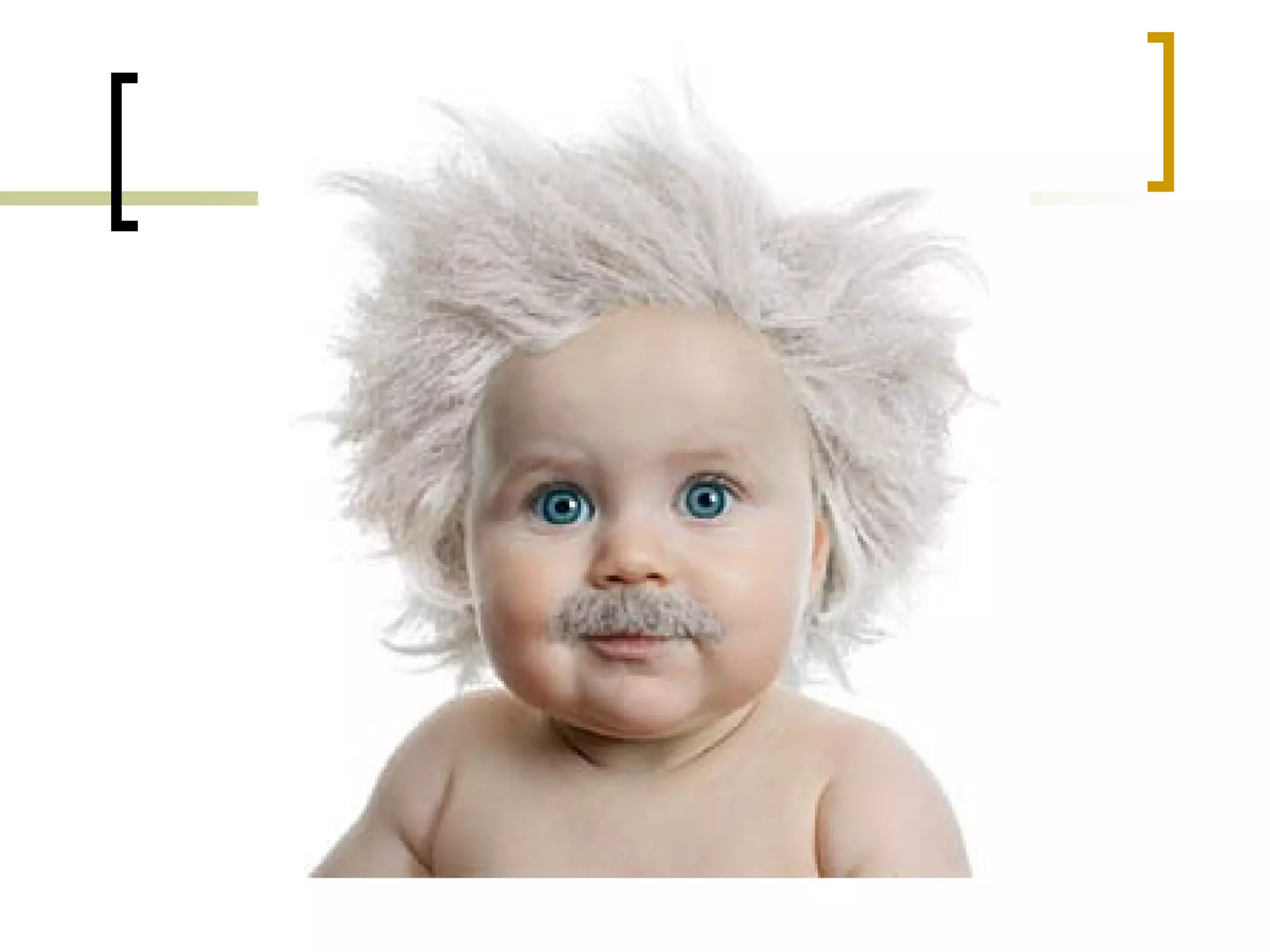
Infancy
Infancy
   The Developmental “Dark Ages”
       Early developmental signposts not
        always indicative of later giftedness
       and may even be counter-indicative (e.g.,
        delayed speech)
   So when do the Dark Ages end?
   What’s the earliest age at which the
    gift begins to manifest itself?
Fagan Test of Infant
Intelligence
   Attention to novelty at 6-12 months predicts
       adult IQ
       academic achievement
   but this assessment concerns general
    intelligence (Spearman’s g)
   What about more domain-specific
    indicators?
Cox (1926) 301 Geniuses
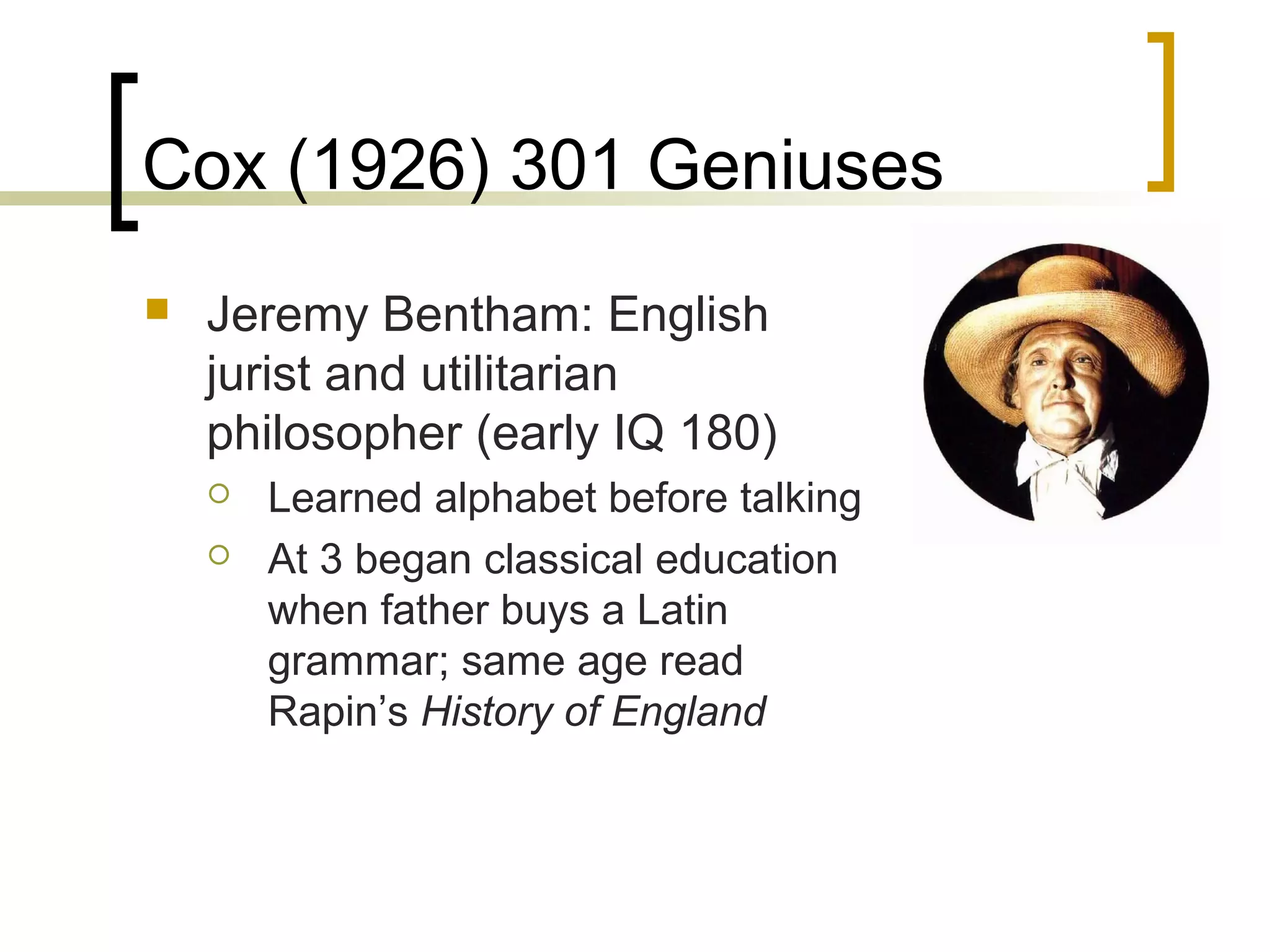
   Jeremy Bentham: English
    jurist and utilitarian
    philosopher (early IQ 180)
       Learned alphabet before talking
       At 3 began classical education
        when father buys a Latin
        grammar; same age read
        Rapin’s History of England
Feldman/Goldsmith
(1986/2000) 6 prodigies
   a child who read music before he was four,
   two children who played winning chess
    before they entered school,
   another who studied abstract algebra in
    grade school,
   a youngster who produced typed scripts of
    original stories and plays before his fifth
    birthday, and
   a child who read, wrote, began learning
    foreign languages, and composed short
    musical pieces before he was out of diapers.
Winner (1996): Gifted Children
   Michael Kearney
       speak at 4 months;
       read at 8 months;
       algebra on own at age 3
   KyLee Hench
       fascinated with letters & numbers at 1.5
       mental arithmetic at 2
       playing math computer games by 3
SMPY (Julian Stanley et al.)
   Terry Tao: Fields Medal recipient
       taught himself to read before 2;
       using portable typewriter before 2.5;
       solved math problems typical of 8-year
        olds by 3.
Childhood
Childhood
   Dark Ages rarely end before ages 2-3,
   and more commonly end at the age of
    a late preschooler or kindergartner
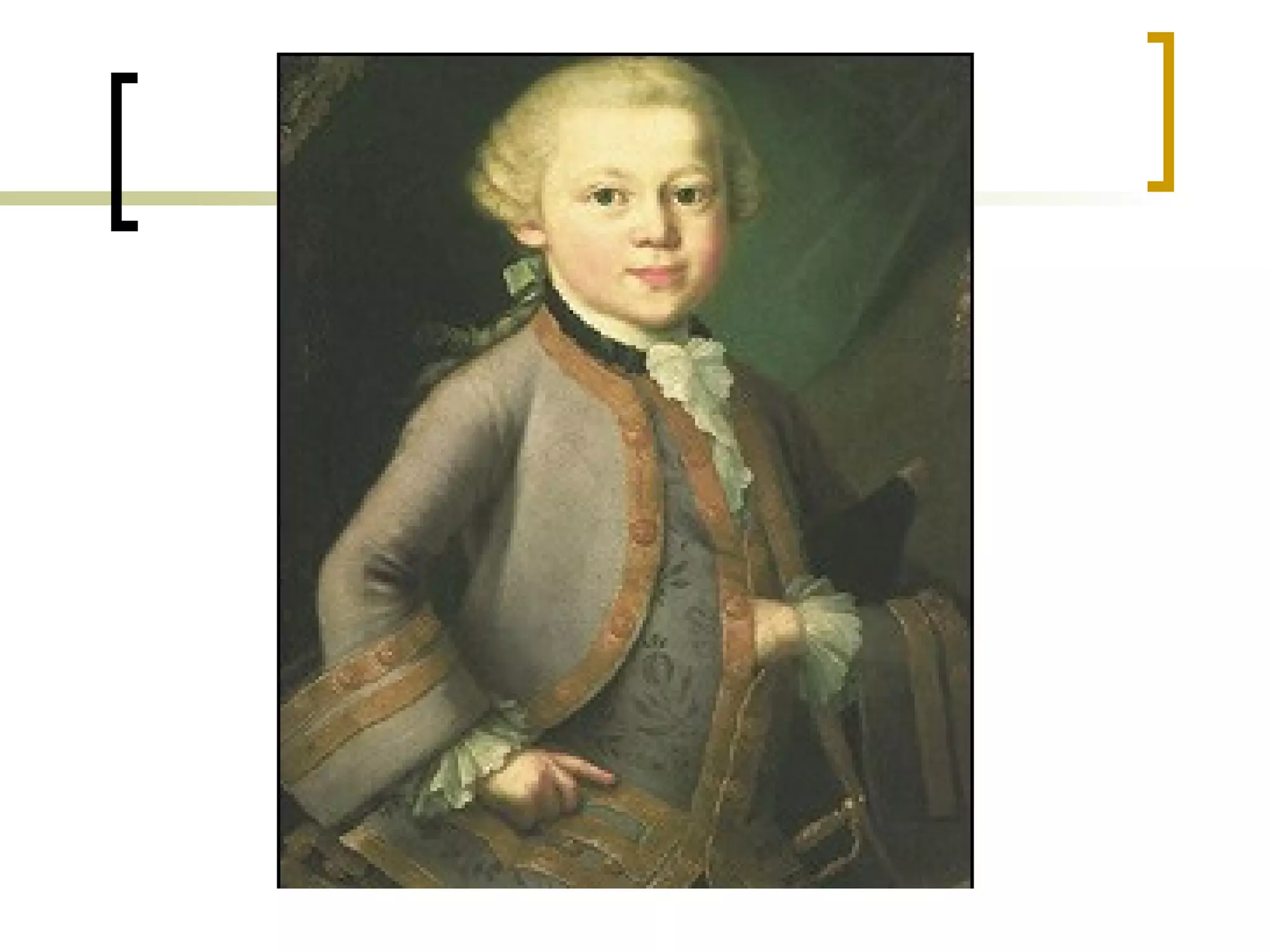
   even Mozart didn’t begin composing
    until 5 (with father’s help)
   and J. S. Mill didn’t write his first book
    (a history of Rome) until 6.5 (juvenilia)
Childhood
   During this age period various
    environmental factors kick in
   including
       Birth order (not prenatal!)
       Traumatic, enriching, and diversifying events
       Domain-specific role models and mentors, and
       Expertise acquisition (10-year rule)
   that affect the type and degree of giftedness
   The “gift” as a nature-nurture collaboration
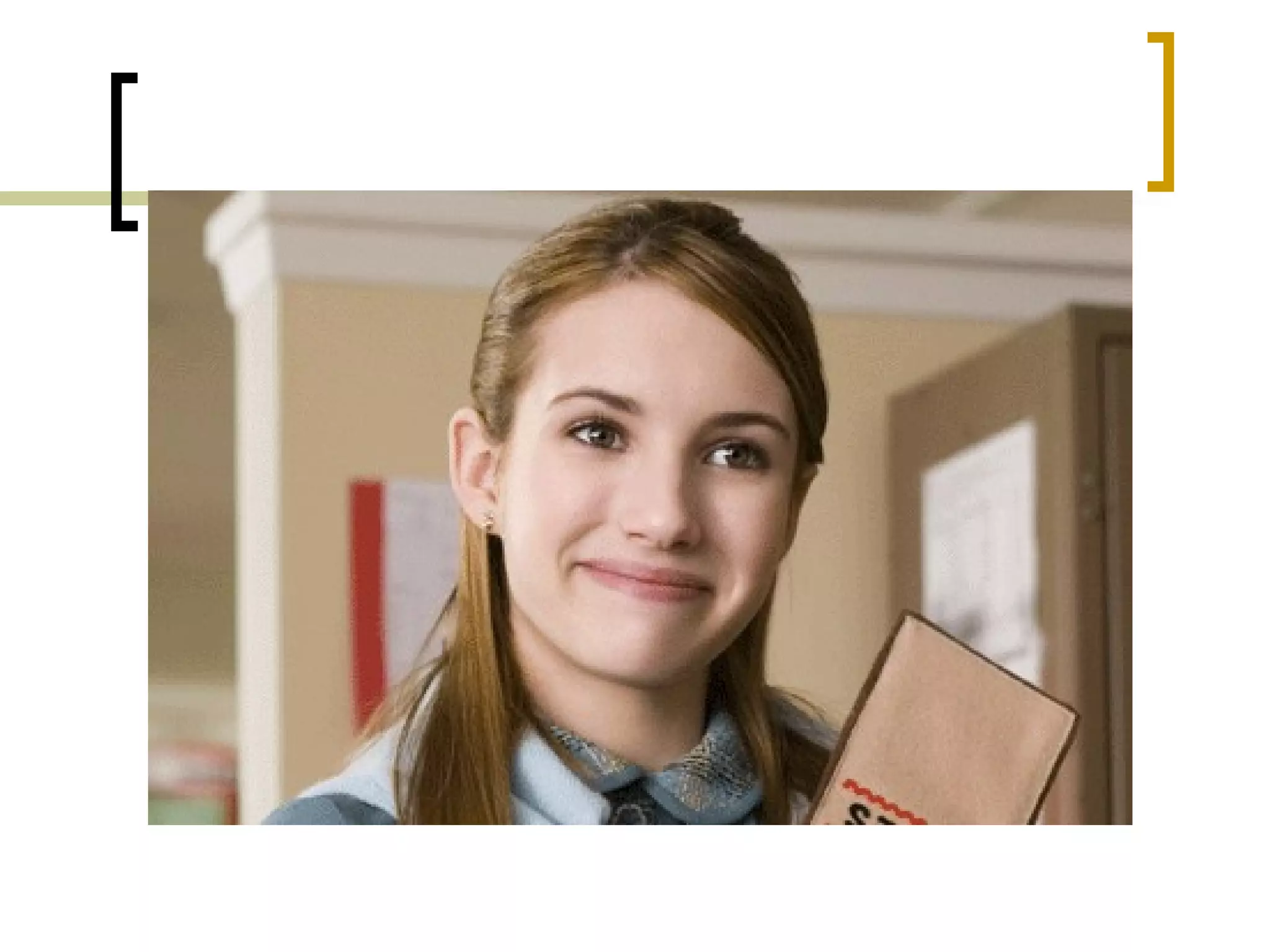
Adolescence
Adolescence
   Although the previously mentioned
    factors continue to nurture growth,
   the gifted youth can also be led astray
    from the path of optimal development:
   Peer groups become especially critical
    during this phase
   e.g., Csikszentmihalyi et al.’s (1993)
    Talented teenagers
Adulthood
Adulthood
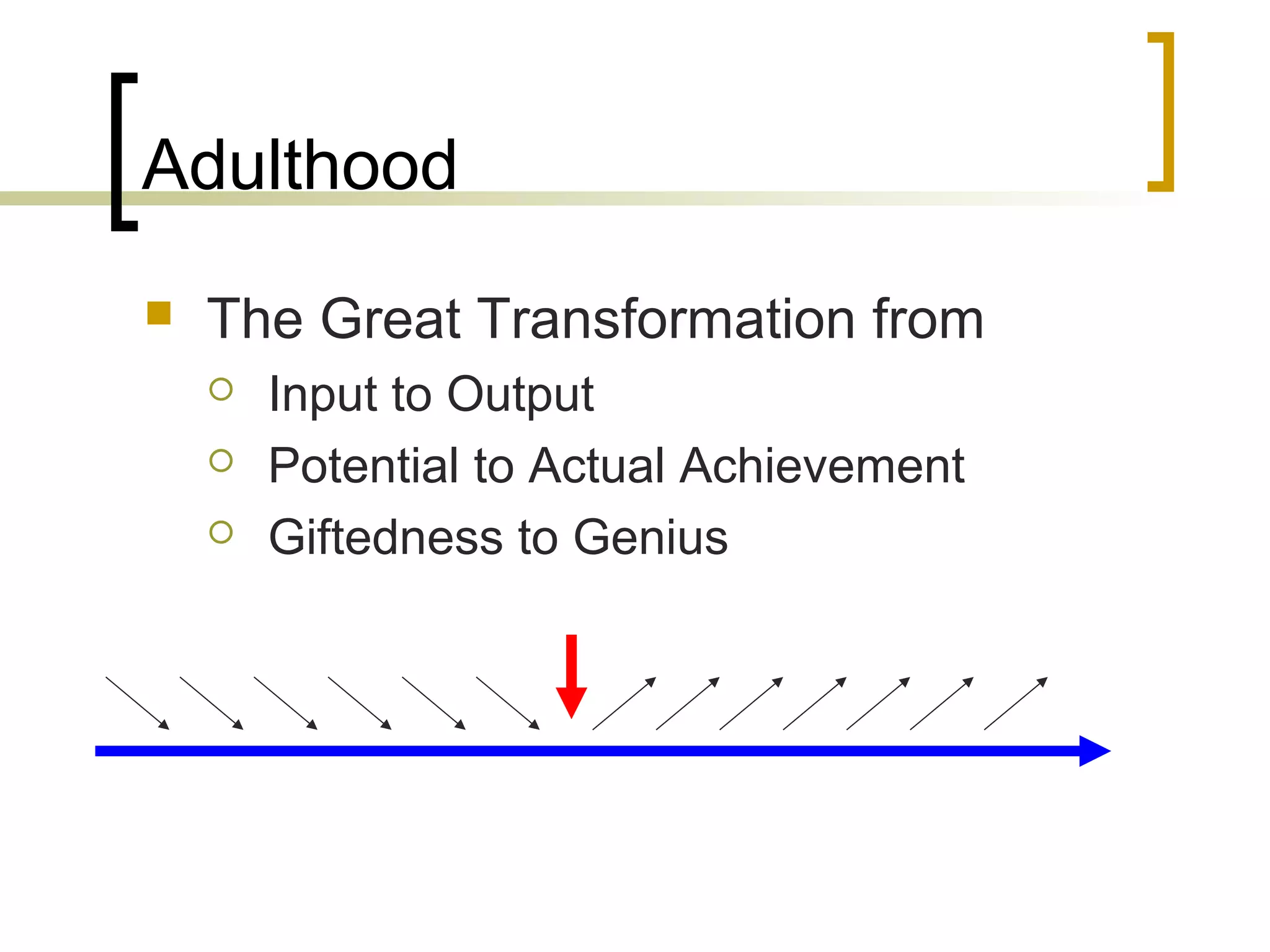
   The Great Transformation from
       Input to Output
       Potential to Actual Achievement
       Giftedness to Genius
Adulthood
   Accelerated career onset
       Abbreviated expertise acquisition (< 10 years)
       Early achievement (viz. 1st “hit” in 20s)
   Exceptional productivity or output (e.g.,
    Napoleon, Edison, Picasso, Mozart)
   High impact (e.g., disciples, honors)
   Long, productive career
   Early- + late-bloomers << long-bloomers
   Hence, last testaments, old-age style shifts,
    swan-songs
Examples
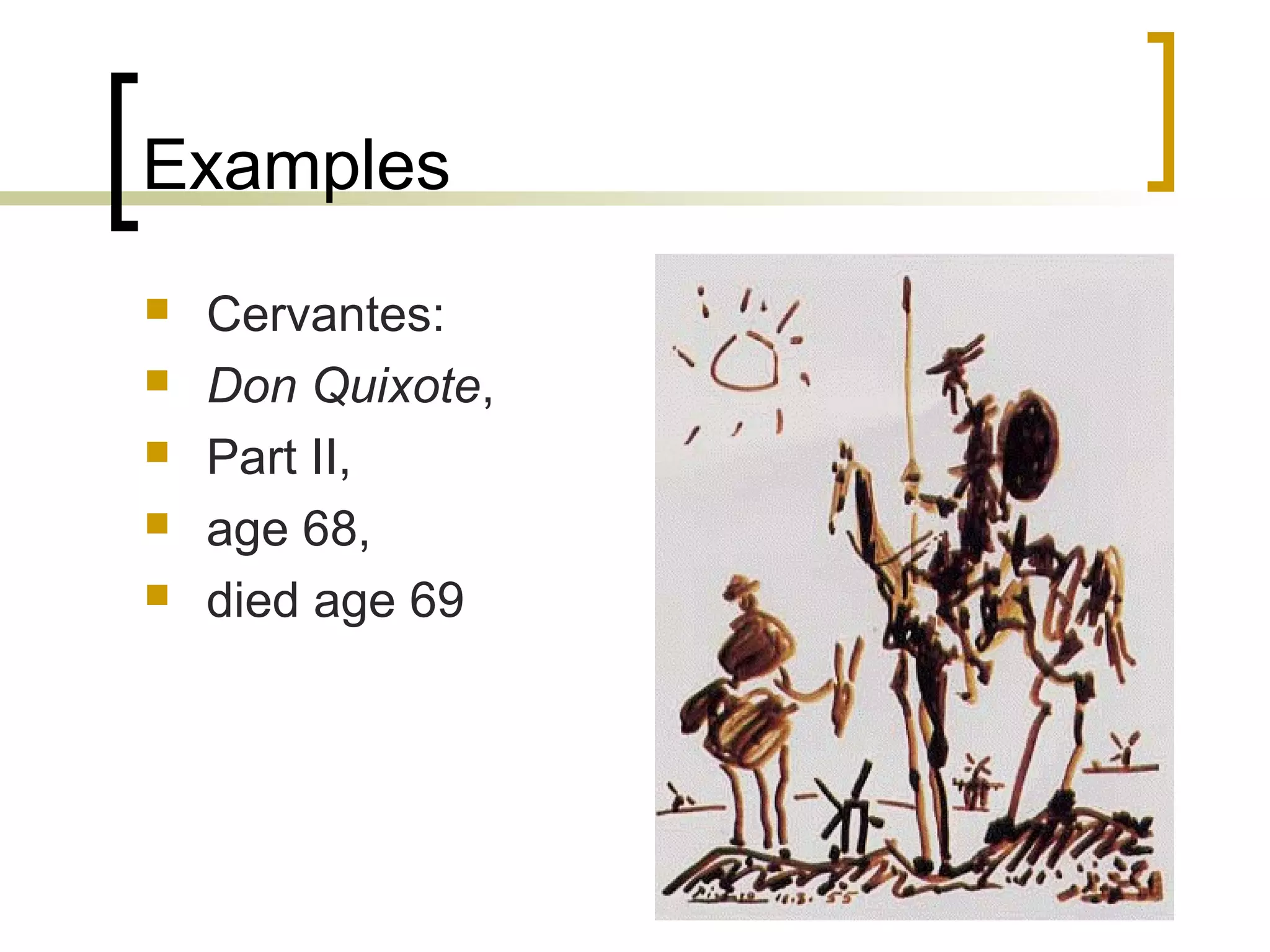
   Cervantes:
   Don Quixote,
   Part II,
   age 68,
   died age 69
Examples
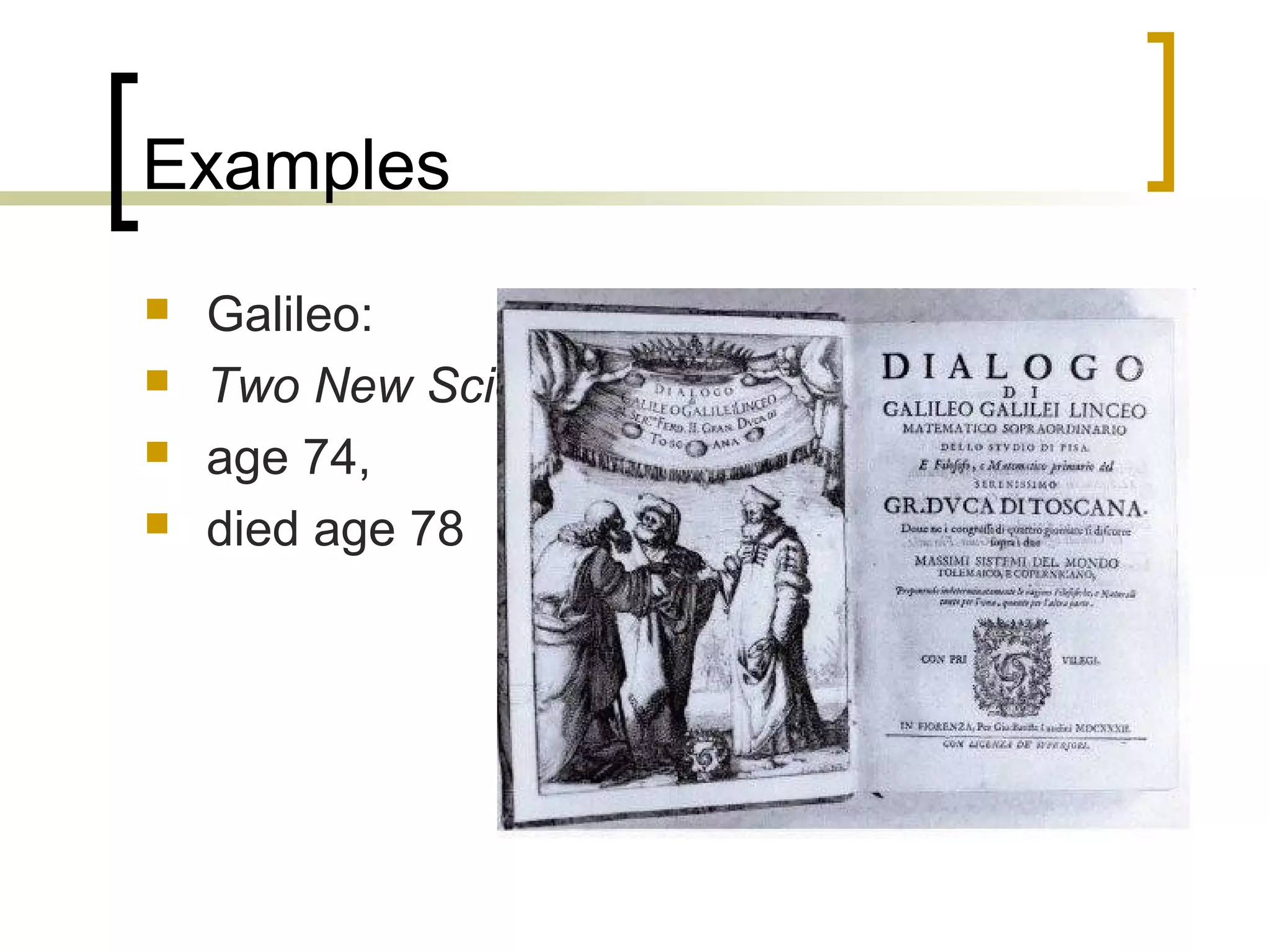
   Galileo:
   Two New Sciences,
   age 74,
   died age 78
Examples
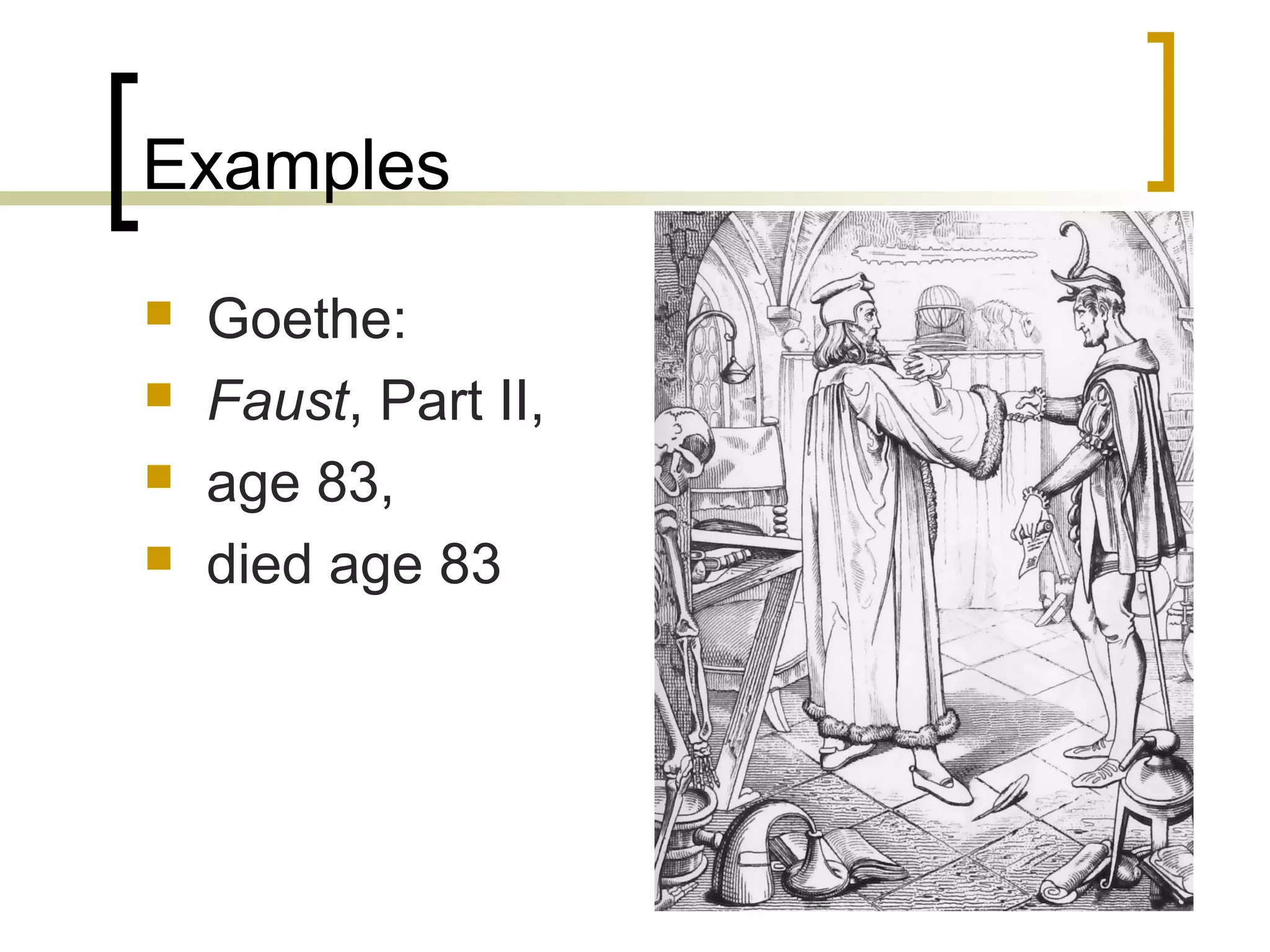
   Goethe:
   Faust, Part II,
   age 83,
   died age 83
Examples
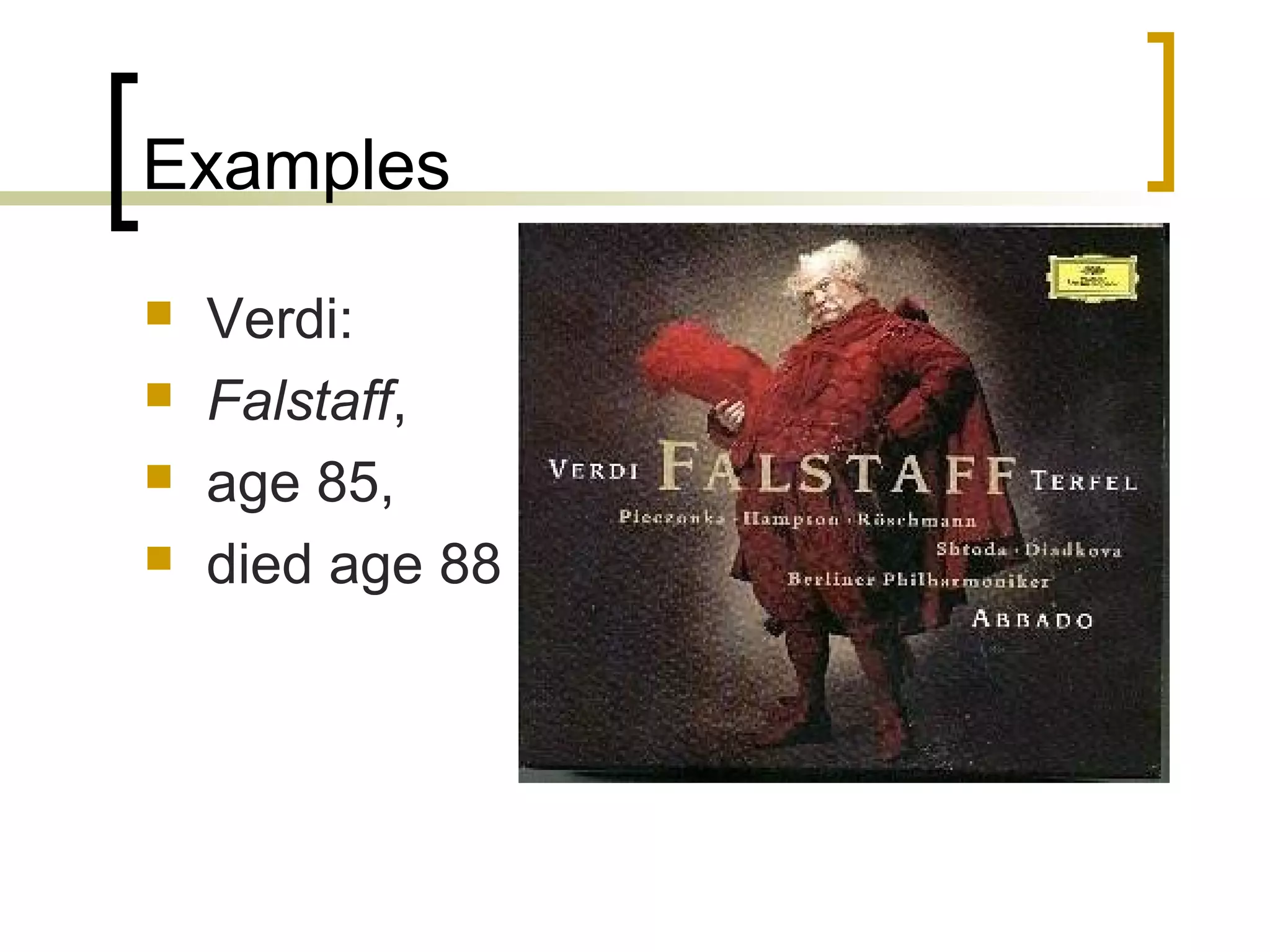
   Verdi:
   Falstaff,
   age 85,
   died age 88
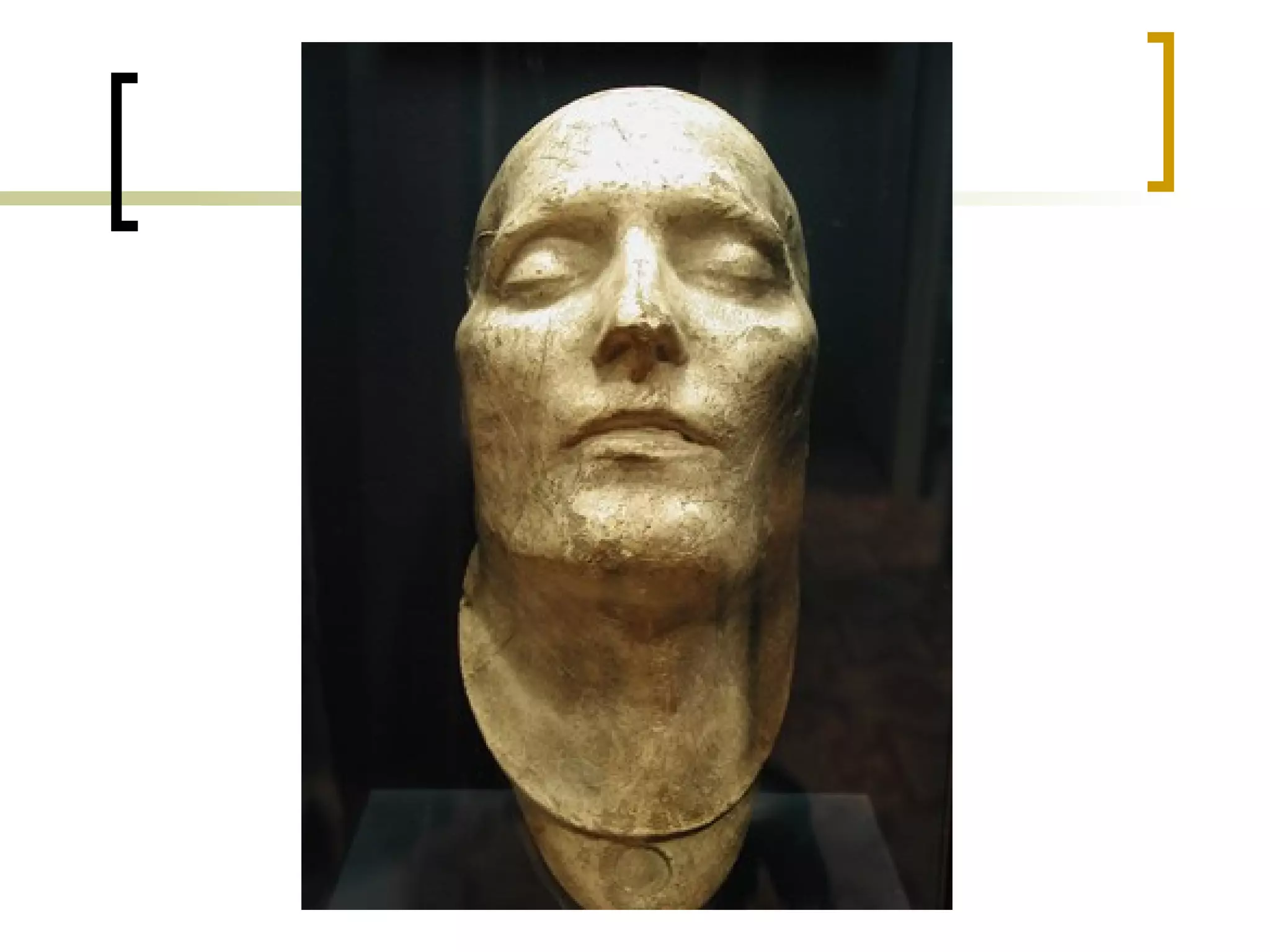
Death
Death
   Life expectancy as contingent on
    achievement domain
   Examples:
       Mathematicians versus Biologists
       Poets versus Novelists
       Military versus Political Leaders
       Revolutionary versus Status Quo
        Politicians
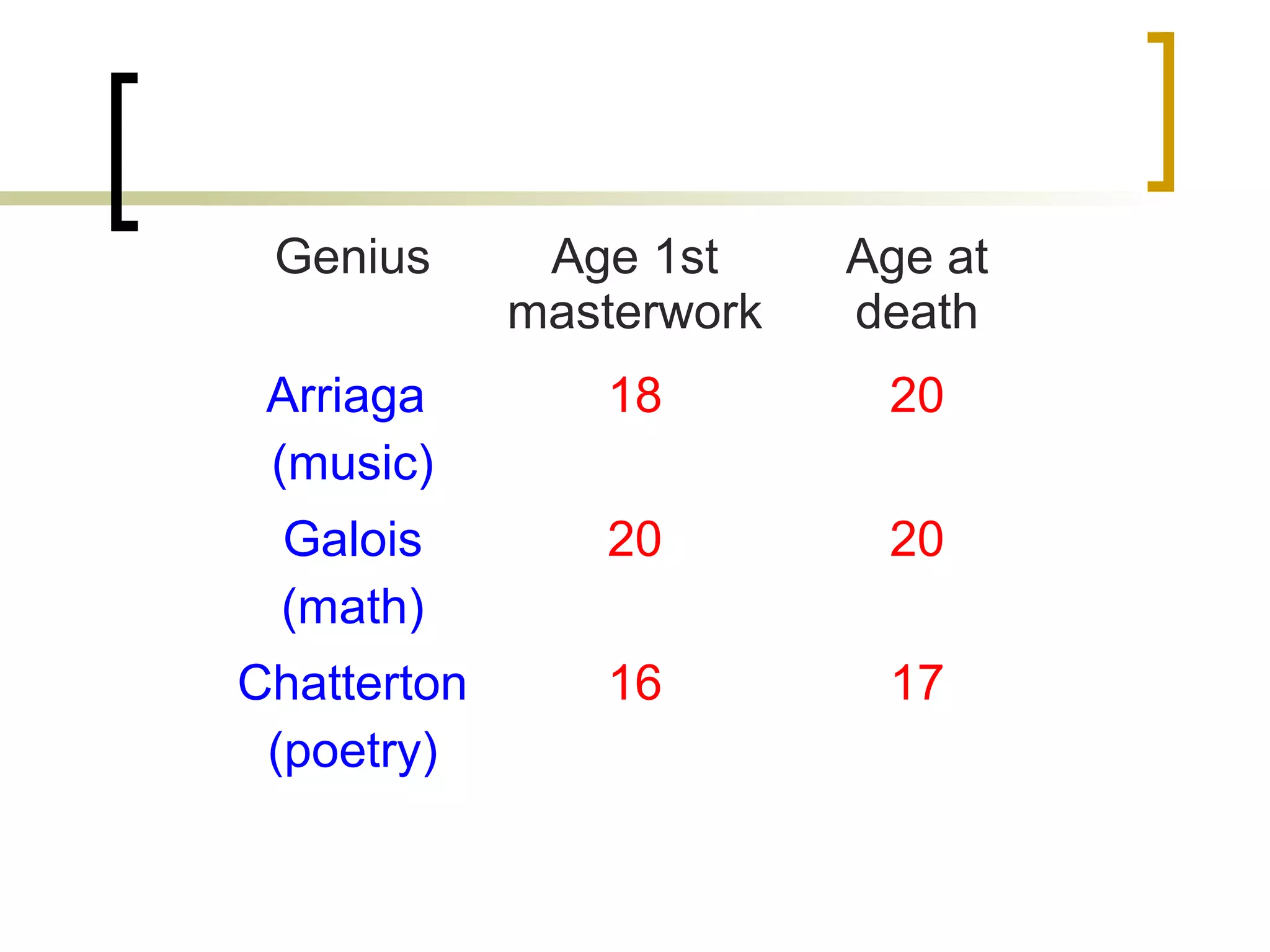
   Precocity negative impact on longevity
Genius       Age 1st     Age at
             masterwork   death
 Arriaga        18         20
 (music)
 Galois         20         20
 (math)
Chatterton      16         17
 (poetry)
Posthumous reputation
   Eventual eminence is a direct function
    of lifetime achievement,
   which is most often defined by the
    quality and quantity of output or impact
   As a result, the highest degrees of
    eminence are consistent across space
    and stable through time
Hence …
   Giftedness can become
   the gift that keeps on giving!
   even longer lasting than …
Nagc Test
Nagc Test

Nagc Test

  • 2.
    Giftedness: The Gift that Keeps on Giving
  • 3.
    Introduction  Stable versus unstable personal traits  e.g. gender versus hair color  Which is giftedness?  Often viewed as a childhood attribute  This reflected by a recent web search  What are the results of googling … ?
  • 4.
    Google results  “gifted children” →1,440,000 hits  versus post-childhood:  “gifted adolescents” → 39,600 hits  “gifted teenagers” → 1,670 hits  “gifted adults” → 24,700 hits  “gifted elderly” → 56 hits  “gifted senior citizens” → 8 hits
  • 5.
    Google results  and versus pre-childhood:  “gifted babies” → 6,660 hits  “gifted infants” → 540 hits  “gifted zygotes” → 1 hit  the latter some Jon Stewart quip!
  • 6.
    Argument  Giftedness can be a life-long trait  This developmental continuity is especially conspicuous when we look at the highest levels of giftedness  e.g., top 1% rather than top 10%
  • 7.
    PERFORMANCE Top 1% Superlative Performance Threshold Top 10% AGE
  • 8.
    From Conception to Reputation  Genetic conception  Gestation  Infancy  Childhood  Adolescence  Adulthood  Death  Posthumous reputation
  • 9.
  • 11.
    Genetic conception  It all begins with the “gifted zygote”  Galton’s 1869 Hereditary Genius  Modern behavioral genetics: Giftedness is most likely  multi-polygenic (many polygenic traits)  emergenic (multiplicative/configurational)  epigenetic (unfolds over time)  In short, a complex, dynamic process
  • 12.
  • 14.
    Gestation  Intrauterine environment  e.g., Geschwind’s theory  elevated testosterone after 20th week  right > left posterior hemisphere growth  giftedness/savantism  mathematical ability  artistic/spatial ability  musical ability  Simon Baron-Cohen: “extreme male brain”
  • 15.
  • 17.
    Infancy  The Developmental “Dark Ages”  Early developmental signposts not always indicative of later giftedness  and may even be counter-indicative (e.g., delayed speech)  So when do the Dark Ages end?  What’s the earliest age at which the gift begins to manifest itself?
  • 18.
    Fagan Test ofInfant Intelligence  Attention to novelty at 6-12 months predicts  adult IQ  academic achievement  but this assessment concerns general intelligence (Spearman’s g)  What about more domain-specific indicators?
  • 19.
    Cox (1926) 301Geniuses  Jeremy Bentham: English jurist and utilitarian philosopher (early IQ 180)  Learned alphabet before talking  At 3 began classical education when father buys a Latin grammar; same age read Rapin’s History of England
  • 20.
    Feldman/Goldsmith (1986/2000) 6 prodigies  a child who read music before he was four,  two children who played winning chess before they entered school,  another who studied abstract algebra in grade school,  a youngster who produced typed scripts of original stories and plays before his fifth birthday, and  a child who read, wrote, began learning foreign languages, and composed short musical pieces before he was out of diapers.
  • 21.
    Winner (1996): GiftedChildren  Michael Kearney  speak at 4 months;  read at 8 months;  algebra on own at age 3  KyLee Hench  fascinated with letters & numbers at 1.5  mental arithmetic at 2  playing math computer games by 3
  • 22.
    SMPY (Julian Stanleyet al.)  Terry Tao: Fields Medal recipient  taught himself to read before 2;  using portable typewriter before 2.5;  solved math problems typical of 8-year olds by 3.
  • 23.
  • 25.
    Childhood  Dark Ages rarely end before ages 2-3,  and more commonly end at the age of a late preschooler or kindergartner  even Mozart didn’t begin composing until 5 (with father’s help)  and J. S. Mill didn’t write his first book (a history of Rome) until 6.5 (juvenilia)
  • 26.
    Childhood  During this age period various environmental factors kick in  including  Birth order (not prenatal!)  Traumatic, enriching, and diversifying events  Domain-specific role models and mentors, and  Expertise acquisition (10-year rule)  that affect the type and degree of giftedness  The “gift” as a nature-nurture collaboration
  • 27.
  • 29.
    Adolescence  Although the previously mentioned factors continue to nurture growth,  the gifted youth can also be led astray from the path of optimal development:  Peer groups become especially critical during this phase  e.g., Csikszentmihalyi et al.’s (1993) Talented teenagers
  • 30.
  • 32.
    Adulthood  The Great Transformation from  Input to Output  Potential to Actual Achievement  Giftedness to Genius
  • 33.
    Adulthood  Accelerated career onset  Abbreviated expertise acquisition (< 10 years)  Early achievement (viz. 1st “hit” in 20s)  Exceptional productivity or output (e.g., Napoleon, Edison, Picasso, Mozart)  High impact (e.g., disciples, honors)  Long, productive career  Early- + late-bloomers << long-bloomers  Hence, last testaments, old-age style shifts, swan-songs
  • 34.
    Examples  Cervantes:  Don Quixote,  Part II,  age 68,  died age 69
  • 35.
    Examples  Galileo:  Two New Sciences,  age 74,  died age 78
  • 36.
    Examples  Goethe:  Faust, Part II,  age 83,  died age 83
  • 37.
    Examples  Verdi:  Falstaff,  age 85,  died age 88
  • 38.
  • 40.
    Death  Life expectancy as contingent on achievement domain  Examples:  Mathematicians versus Biologists  Poets versus Novelists  Military versus Political Leaders  Revolutionary versus Status Quo Politicians  Precocity negative impact on longevity
  • 41.
    Genius Age 1st Age at masterwork death Arriaga 18 20 (music) Galois 20 20 (math) Chatterton 16 17 (poetry)
  • 42.
  • 44.
    Posthumous reputation  Eventual eminence is a direct function of lifetime achievement,  which is most often defined by the quality and quantity of output or impact  As a result, the highest degrees of eminence are consistent across space and stable through time
  • 45.
    Hence …  Giftedness can become  the gift that keeps on giving!  even longer lasting than …