Mass Media & Pop Culture, The Earth’s New Pollutant
What’s The Problem?
Rev’n Up
 Industrial Revolution
 *The Industrial Revolution prompted the start of
mass media, population overgrowth, and pop culture
 The Triple Revolution
Ironically
 People like Rachel Carson began realizing the effects of
The Industrial Revolution and these happened:
 Clean Air Act (1955)
 Clean Water Act (1972)
 EPA Act (1992)
 Environmental Councils started popping up and AEC was
founded in 1967
 *We realized too late that our environment was
changing had exhibited significant damage
Non-Sense
 -The Horizontal Society- Lawrence Friedman discusses
society is horizontal or being heavily influenced by
theses new pressures. Technology has altered our sense
of identity of life.
 Mass media targets you because you not only have an
identity but their brand or product also has an identity
and they want you to realize that your identity is
lacking without theirs.
 Urbanization of Consciousness
Identity
 These new pressures not
only reinforce new ideas but
a new identity. An identity is
not just a sense of who we
are but it’s a lens through
which we see the world.
The Lens
And then there was
 Mass media :
Pop Culture- Visuals- Pop culture is all the values, ideas, symbols,
material goods, processes and understandings that arise from mass media
(Insert meme?) It’s the hype or the buzz. It’s essentially a way or life
Theoretically?
 The class dominant theory- Projecting the view of the
minority as a whole
 The limited effects theory – You choose what you want
to intake
 The culturist theory- People interact with media to
create their own meanings
Pollution is Your Neighbor
 Regardless of how you monitor these messages and
images:
 Pollution affects everyone. It affects the entire earth and
everything within the earth
 Pollution isn’t just a physical thing but can be an attitude
 If pollution was a person lived next to you, and you
interact with pollution on a daily basis, it’s not rocket
science that you will begin to behave like pollution.
Pollution is your neighbor
(cont.)
 Insert VISUAL: If you see an ad on tv and it depicts
someone younger smoking and your young and you
desire acceptance by society, who ends up smoking?
You.
 Who ends up paying for the smoke? Your neighbors, your
lungs, the air, animals
 Mental Pollution Chart
 Exposure
 Acceptance/Rejection
 Put new beliefs into action
 These actions impact your environment
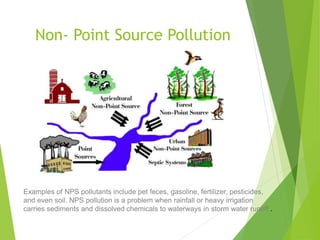
Non- Point Source Pollution
Examples of NPS pollutants include pet feces, gasoline, fertilizer, pesticides,
and even soil. NPS pollution is a problem when rainfall or heavy irrigation
carries sediments and dissolved chemicals to waterways in storm water runoff .
Your Actions on the
Environment
 We are given the liberty to pollute
 We are given messages that say it’s okay to destroy the
earth
 We also are given messages that say it’s not our job, it’s
someone else’s job (recycling centers, curbside, etc)
Environmental Issues in Pop
Culture
 Shark finning – Killing off ecosystems for shark fins.
Airing it on tv, to say it’s acceptable to fin a shark and
throw it back in the water
 The E-Cigarette – We know smoke is bad, and it harms
not only you, people around you and the environment
but we are going to cut down how much you do it and
that makes the ‘mist’ that does enter the environment
okay.
 Family guy- Bit about king of the hill ft. recycling bin
How Pop Culture Affects the
Environment
 -Depletion of Scarce Natural Resources

-Popular culture may demand a large supply of animals for their skins and
cause certain species to become extinct.

-Increased meat consumption through popular culture; It takes twice as much
grain in weight that is fed to an animal to produce half the weight of the
animal in meat for consumption. With malnourishment in some countries, this
is seen as a highly inefficient use of grain.

-Pollution of the Landscape

-Popular culture generates high volumes of waste in forms of solids, liquids,
and gases. Some of the waste can be absorbed of the environment, but high
levels can overwhelm it. The most visible, solids are often discarded and not
recycled and as more and more people follow popular culture, this becomes
an issue.

-More developed countries produce endless supplies to meet demands of
popular culture with the advent of technology that both damages the
environment and controls the damage made. Often times it is cheaper to
damage the environment than to restore it.
How Pop Culture affects the
environment examples
 --Automobiles also are an example of uniformity. Before
the 1970s, automobiles from different countries varied
greatly in size and appearance. After the 1970s, when
Japanese automobiles were sold globally, they won
consumer preference and became the standard in style
of automobiles, which began the uniformity.
-Many popular culture items, ranging from cups from
fast-food chains to CD’s of the latest music artist, end
up being improperly discarded instead of recycled. This
solid waste ends up in landfills, shantytowns, bodies of
water, and so on.
AEC Research shows
 Fewer people don’t recycle or recycle less because of a
feeling of increased effort, it requires more space,
recycling centers too far away, or not enough trash is
generated
Why Recycle
• Saves Resources
• Conserves Landfill Space
• Saves Energy
• Recycled aluminum, for example, takes 95% less energy than new aluminum
from bauxite ore.
• Reduces Pollution
• Less pollution from power plants
• Less pollution from mining and deforestation operations
• Less methane produced from landfills
• Generates Revenue
• Decatur, AL has generated over $200,000 in less than a year
• Reduces Costs
• Georgia estimates is spends $100 million/year to throw away $300 million of
recyclables
• Less material in the dumpster = smaller dumpster and/or fewer pick-ups
• Creates Jobs
• Alabama has nearly 11,000 jobs in the recycling and recycled-content
manufacturing sectors with a reported $6.6 billion in sales
• Despite a decline in manufacturing jobs in North Carolina, recycling jobs have
increased 60% over the past decade
NaBeela Washington's Presentation

NaBeela Washington's Presentation

  • 1.
    Mass Media &Pop Culture, The Earth’s New Pollutant
  • 2.
  • 3.
    Rev’n Up  IndustrialRevolution  *The Industrial Revolution prompted the start of mass media, population overgrowth, and pop culture  The Triple Revolution
  • 4.
    Ironically  People likeRachel Carson began realizing the effects of The Industrial Revolution and these happened:  Clean Air Act (1955)  Clean Water Act (1972)  EPA Act (1992)  Environmental Councils started popping up and AEC was founded in 1967  *We realized too late that our environment was changing had exhibited significant damage
  • 5.
    Non-Sense  -The HorizontalSociety- Lawrence Friedman discusses society is horizontal or being heavily influenced by theses new pressures. Technology has altered our sense of identity of life.  Mass media targets you because you not only have an identity but their brand or product also has an identity and they want you to realize that your identity is lacking without theirs.  Urbanization of Consciousness
  • 6.
    Identity  These newpressures not only reinforce new ideas but a new identity. An identity is not just a sense of who we are but it’s a lens through which we see the world. The Lens
  • 7.
    And then therewas  Mass media : Pop Culture- Visuals- Pop culture is all the values, ideas, symbols, material goods, processes and understandings that arise from mass media (Insert meme?) It’s the hype or the buzz. It’s essentially a way or life
  • 8.
    Theoretically?  The classdominant theory- Projecting the view of the minority as a whole  The limited effects theory – You choose what you want to intake  The culturist theory- People interact with media to create their own meanings
  • 9.
    Pollution is YourNeighbor  Regardless of how you monitor these messages and images:  Pollution affects everyone. It affects the entire earth and everything within the earth  Pollution isn’t just a physical thing but can be an attitude  If pollution was a person lived next to you, and you interact with pollution on a daily basis, it’s not rocket science that you will begin to behave like pollution.
  • 10.
    Pollution is yourneighbor (cont.)  Insert VISUAL: If you see an ad on tv and it depicts someone younger smoking and your young and you desire acceptance by society, who ends up smoking? You.  Who ends up paying for the smoke? Your neighbors, your lungs, the air, animals  Mental Pollution Chart  Exposure  Acceptance/Rejection  Put new beliefs into action  These actions impact your environment
  • 11.
    Non- Point SourcePollution Examples of NPS pollutants include pet feces, gasoline, fertilizer, pesticides, and even soil. NPS pollution is a problem when rainfall or heavy irrigation carries sediments and dissolved chemicals to waterways in storm water runoff .
  • 12.
    Your Actions onthe Environment  We are given the liberty to pollute  We are given messages that say it’s okay to destroy the earth  We also are given messages that say it’s not our job, it’s someone else’s job (recycling centers, curbside, etc)
  • 13.
    Environmental Issues inPop Culture  Shark finning – Killing off ecosystems for shark fins. Airing it on tv, to say it’s acceptable to fin a shark and throw it back in the water  The E-Cigarette – We know smoke is bad, and it harms not only you, people around you and the environment but we are going to cut down how much you do it and that makes the ‘mist’ that does enter the environment okay.  Family guy- Bit about king of the hill ft. recycling bin
  • 14.
    How Pop CultureAffects the Environment  -Depletion of Scarce Natural Resources  -Popular culture may demand a large supply of animals for their skins and cause certain species to become extinct.  -Increased meat consumption through popular culture; It takes twice as much grain in weight that is fed to an animal to produce half the weight of the animal in meat for consumption. With malnourishment in some countries, this is seen as a highly inefficient use of grain.  -Pollution of the Landscape  -Popular culture generates high volumes of waste in forms of solids, liquids, and gases. Some of the waste can be absorbed of the environment, but high levels can overwhelm it. The most visible, solids are often discarded and not recycled and as more and more people follow popular culture, this becomes an issue.  -More developed countries produce endless supplies to meet demands of popular culture with the advent of technology that both damages the environment and controls the damage made. Often times it is cheaper to damage the environment than to restore it.
  • 15.
    How Pop Cultureaffects the environment examples  --Automobiles also are an example of uniformity. Before the 1970s, automobiles from different countries varied greatly in size and appearance. After the 1970s, when Japanese automobiles were sold globally, they won consumer preference and became the standard in style of automobiles, which began the uniformity. -Many popular culture items, ranging from cups from fast-food chains to CD’s of the latest music artist, end up being improperly discarded instead of recycled. This solid waste ends up in landfills, shantytowns, bodies of water, and so on.
  • 16.
    AEC Research shows Fewer people don’t recycle or recycle less because of a feeling of increased effort, it requires more space, recycling centers too far away, or not enough trash is generated
  • 17.
    Why Recycle • SavesResources • Conserves Landfill Space • Saves Energy • Recycled aluminum, for example, takes 95% less energy than new aluminum from bauxite ore. • Reduces Pollution • Less pollution from power plants • Less pollution from mining and deforestation operations • Less methane produced from landfills • Generates Revenue • Decatur, AL has generated over $200,000 in less than a year • Reduces Costs • Georgia estimates is spends $100 million/year to throw away $300 million of recyclables • Less material in the dumpster = smaller dumpster and/or fewer pick-ups • Creates Jobs • Alabama has nearly 11,000 jobs in the recycling and recycled-content manufacturing sectors with a reported $6.6 billion in sales • Despite a decline in manufacturing jobs in North Carolina, recycling jobs have increased 60% over the past decade

Editor's Notes

  • #3 Pop Culture and Mass Media are affecting the ways we value our environment, how we recycle, and how use these attitudes and let them influence our everyday lives. Pollution is not only physical but mental
  • #7 The Lens is our commitment, identification and how we feel or think about what we perceive. We adjust our lenses based on gender, family, and the messages that we sift through on a daily basis. Movies today portray the earth as timeless or never ending or like different issues are contained in that one area when that is not the case.
  • #8 Mass media visuals depicting communication whether written, broadcast, or spoken. Mass Media reaches a larger audience