International Workshop
     on Paolo FARINELLA
            Pisa, 14-16 June 2010


C
A                                             T
P                                             R
T                                             O
U                                             J
R                                             A
E                                             N
D                                             S


        Rudolf Dvorak and Richard Schwarz
                 AstroDynamicsGroup
    Institute for Astronomy, University of Vienna
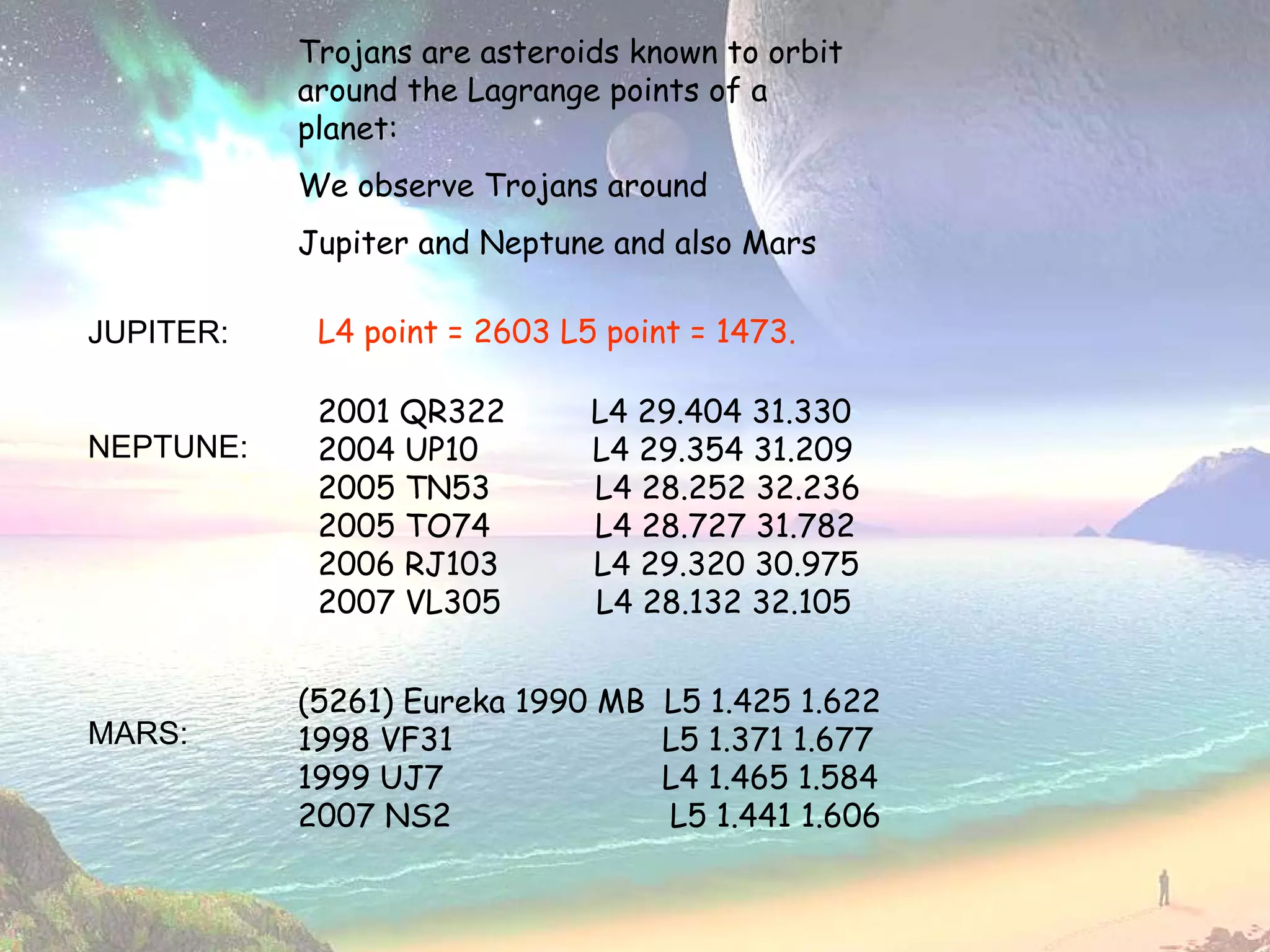
Trojans are asteroids known to orbit
           around the Lagrange points of a
           planet:
           We observe Trojans around
           Jupiter and Neptune and also Mars

JUPITER:    L4 point = 2603 L5 point = 1473.

            2001 QR322        L4 29.404 31.330
NEPTUNE:    2004 UP10         L4 29.354 31.209
            2005 TN53         L4 28.252 32.236
            2005 TO74         L4 28.727 31.782
            2006 RJ103        L4 29.320 30.975
            2007 VL305        L4 28.132 32.105


           (5261) Eureka 1990 MB L5 1.425 1.622
MARS:      1998 VF31             L5 1.371 1.677
           1999 UJ7              L4 1.465 1.584
           2007 NS2              L5 1.441 1.606
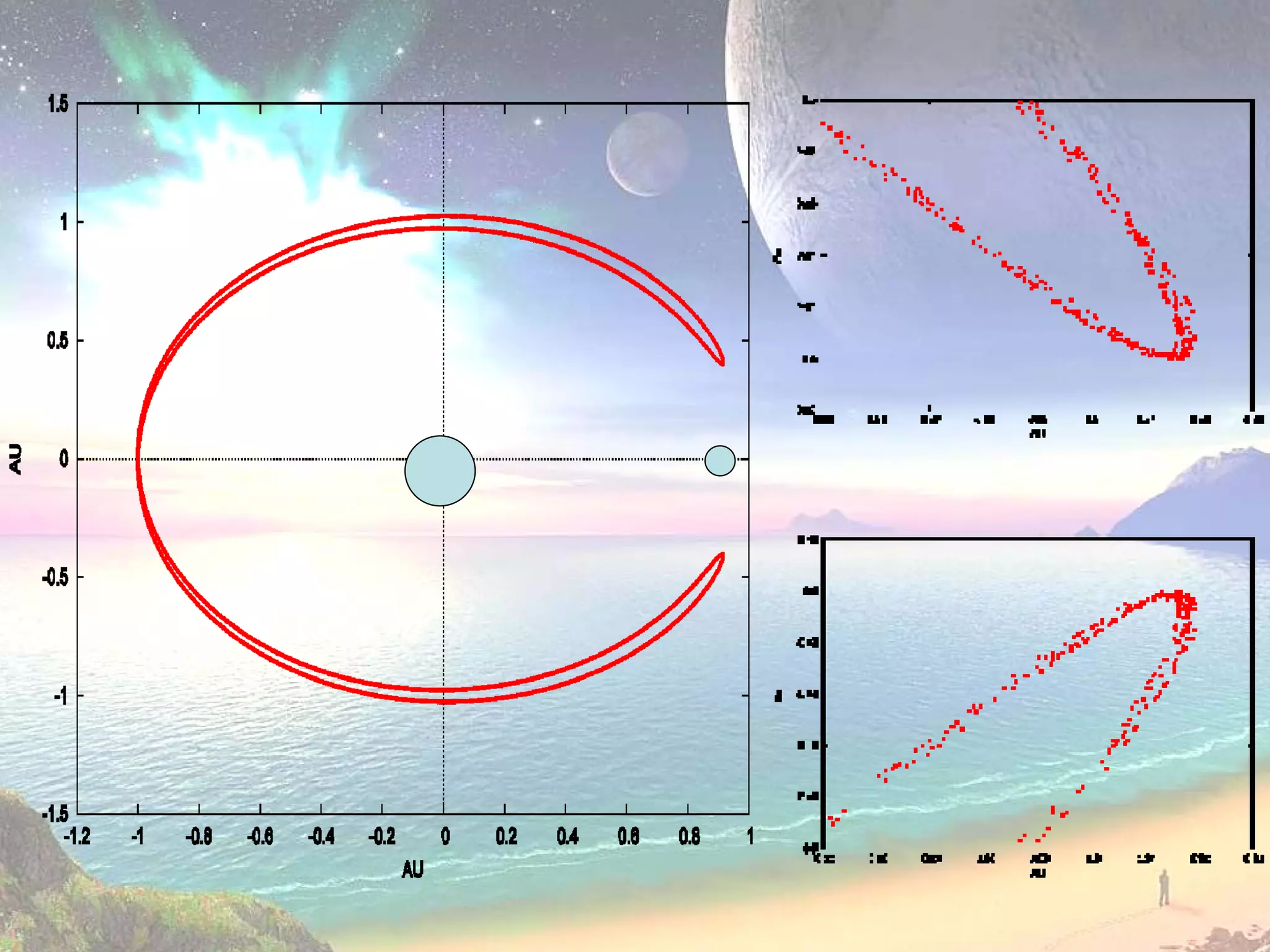
The five Lagrange points SUN + PLANET
x
Eccentricity of the primaries: 0.05, 0.1, 0.2, 0.3
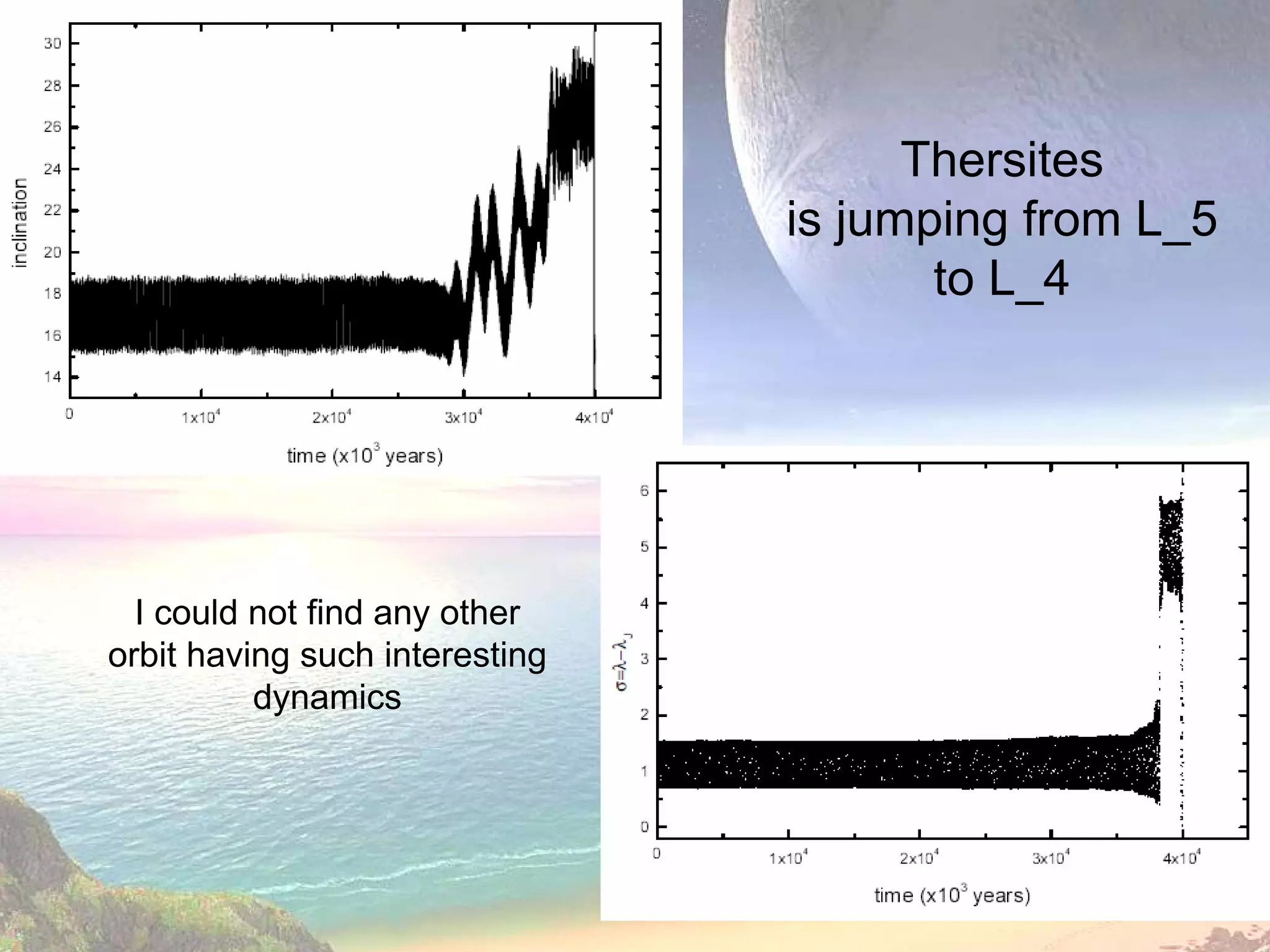
Thersites
                                is jumping from L_5
                                       to L_4


  I could not find any other
orbit having such interesting
          dynamics
Can the terrestrial planets
 Venus, Earth and Mars capture Trojans ?


N-body simulations in the Newtonian dynamical model
Sun, Venus – Saturn + 100 massless asteroids


4 different regions
Regions a (VeTe): 0.72 < a < 0.98
Regions b (TeMa): 1.02 < a < 1.50
Regions c (MaJu1): 1.54 < a < 2.20
Regions d (MaJu2): 2.2 < a < 2.5
Near Earth Asteroids and mainbelt asteroids
      Mercury   Venus   Earth       Mars                                                            Jupiter
200                                                    3:1 8:3


150
                    a           b          c                     d


100                                                          5:2     2:1


                                                                                          1:1
                                               4:1
50
                                    Hungarias                                                   Trojans
                        NEAs                                                        3:2
                ATENs APOLLOs AMORs
                                                                           Hildas


 0
                        1                      2                3            4                  5
                                                     semimajor axis [AU]
N-body simulations in the Newtonian dynamical model
Sun, Venus – Saturn + 100 massless fictitious asteroids


Regions a (VeTe): 0.72 < a < 0.98
For different inclinations 0<i<20 degrees
For some selected orbits for verifications – MeNe
100 fictitious Trojans between Venus and the Earth
100 fictitious asteroids between Venus and Earth for 10^7 years


                   Capture into 1:1 MMR ?
Capture into 1:1 MMR ?


100 fictitious asteroids between Venus and Earth for 10^7 years
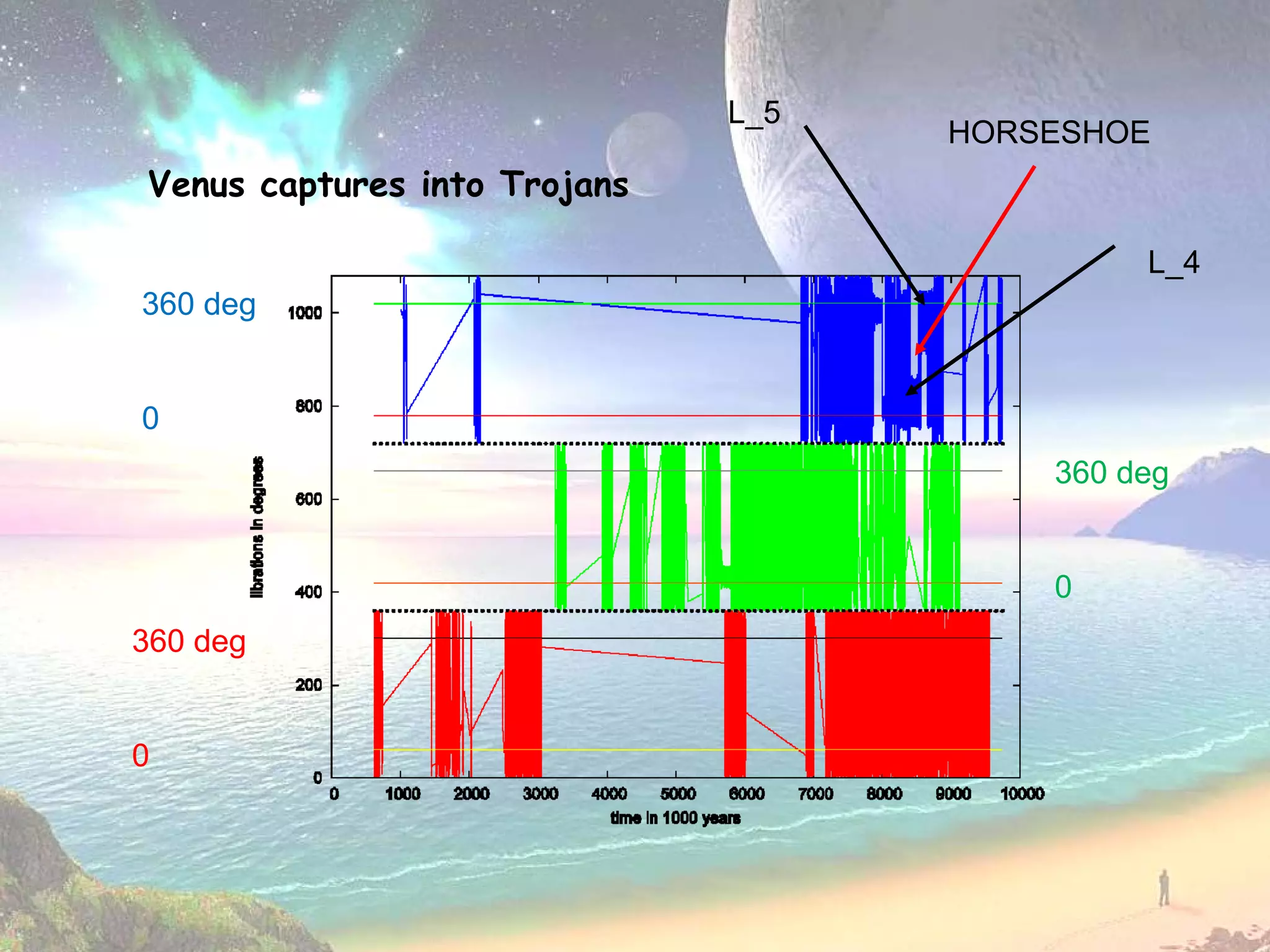
Test for capture into the 1:1 MMR with Venus for the 100 asteroids
L_5
                                    HORSESHOE
Venus captures into Trojans

                                             L_4
360 deg


0
                                        360 deg


                                        0
360 deg


0
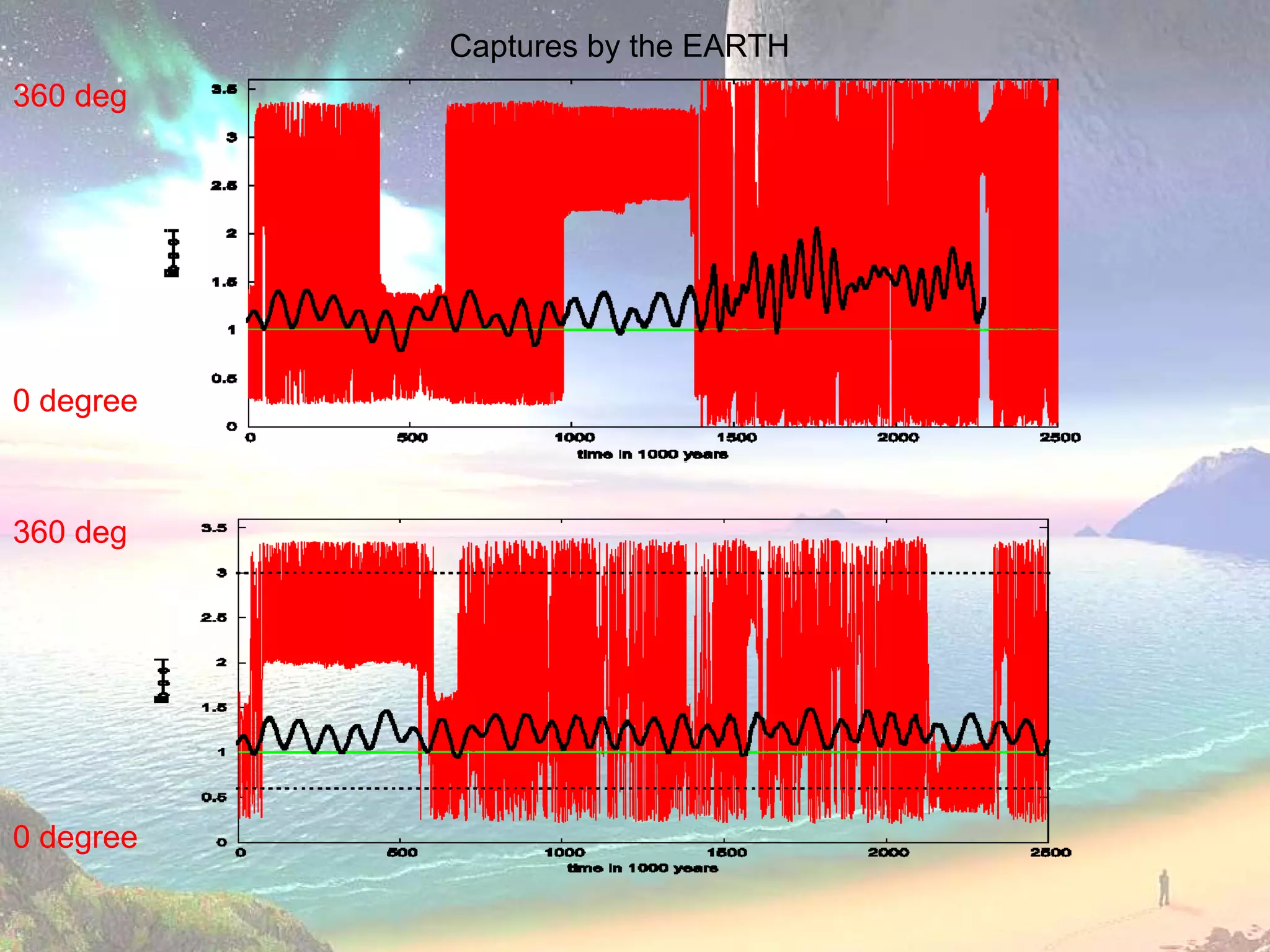
Captures by the EARTH
360 deg


0 degree


360 deg


0 degree
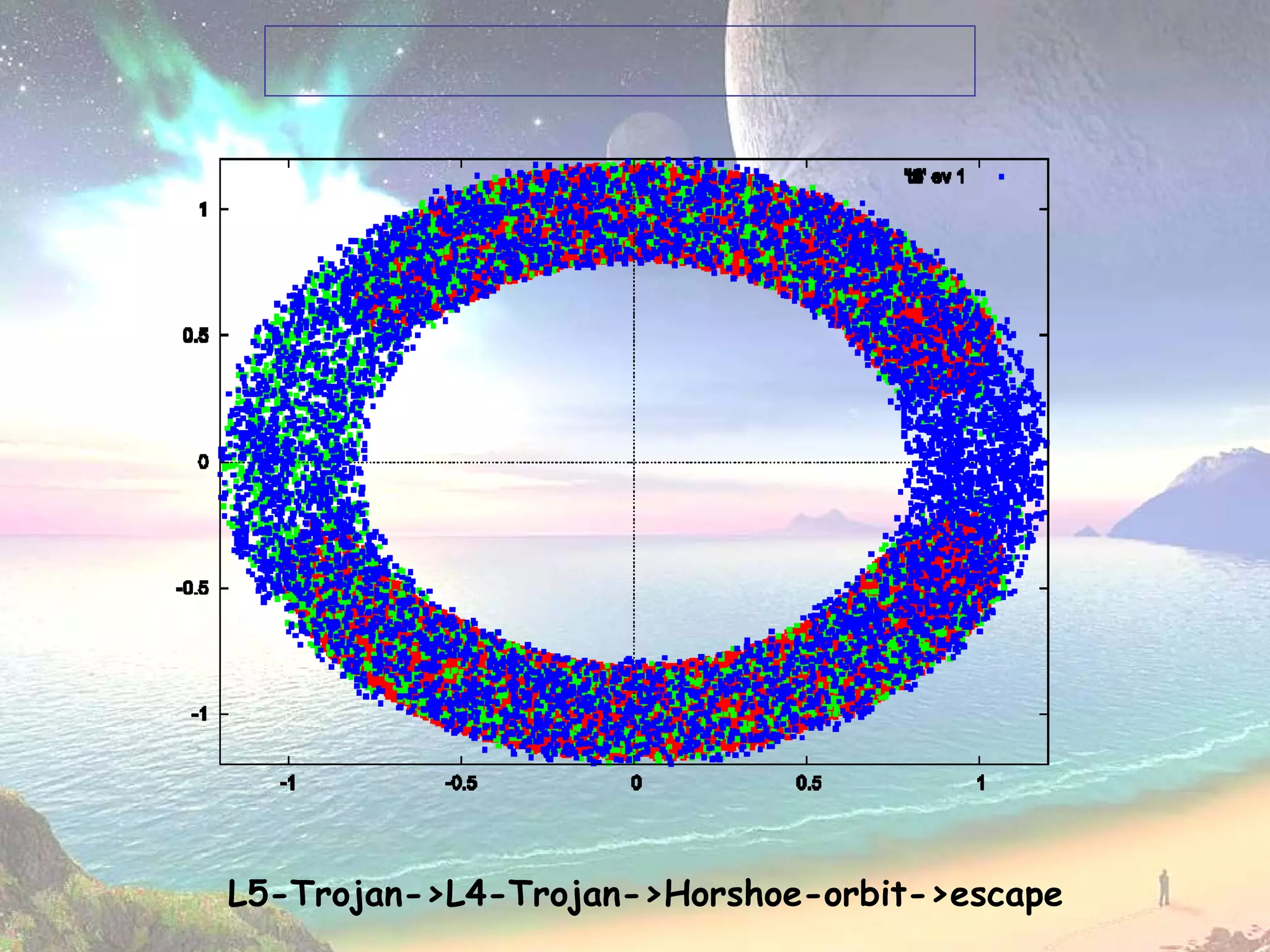
L5-Trojan->L4-Trojan->Horshoe-orbit->escape
Conclusions (Work in progress)

- Captures into the 1:1 MMR for Venus, Earth and Mars
are not rare events

- Captures into Trojan orbits also are possible but not so
often

Jumping orbits are to observe for all terrestrial planets

- For larger inclinations more captures

Results only for region between Venus and Earth

Goal:

statistics about captures for all 4 regions dependant on
inclination and eccentricities

Statistics of jumps and duration of a capture

N.33 dvorak captured-trojans

  • 1.
    International Workshop on Paolo FARINELLA Pisa, 14-16 June 2010 C A T P R T O U J R A E N D S Rudolf Dvorak and Richard Schwarz AstroDynamicsGroup Institute for Astronomy, University of Vienna
  • 2.
    Trojans are asteroidsknown to orbit around the Lagrange points of a planet: We observe Trojans around Jupiter and Neptune and also Mars JUPITER: L4 point = 2603 L5 point = 1473. 2001 QR322 L4 29.404 31.330 NEPTUNE: 2004 UP10 L4 29.354 31.209 2005 TN53 L4 28.252 32.236 2005 TO74 L4 28.727 31.782 2006 RJ103 L4 29.320 30.975 2007 VL305 L4 28.132 32.105 (5261) Eureka 1990 MB L5 1.425 1.622 MARS: 1998 VF31 L5 1.371 1.677 1999 UJ7 L4 1.465 1.584 2007 NS2 L5 1.441 1.606
  • 3.
    The five Lagrangepoints SUN + PLANET
  • 4.
  • 8.
    Eccentricity of theprimaries: 0.05, 0.1, 0.2, 0.3
  • 10.
    Thersites is jumping from L_5 to L_4 I could not find any other orbit having such interesting dynamics
  • 11.
    Can the terrestrialplanets Venus, Earth and Mars capture Trojans ? N-body simulations in the Newtonian dynamical model Sun, Venus – Saturn + 100 massless asteroids 4 different regions Regions a (VeTe): 0.72 < a < 0.98 Regions b (TeMa): 1.02 < a < 1.50 Regions c (MaJu1): 1.54 < a < 2.20 Regions d (MaJu2): 2.2 < a < 2.5
  • 12.
    Near Earth Asteroidsand mainbelt asteroids Mercury Venus Earth Mars Jupiter 200 3:1 8:3 150 a b c d 100 5:2 2:1 1:1 4:1 50 Hungarias Trojans NEAs 3:2 ATENs APOLLOs AMORs Hildas 0 1 2 3 4 5 semimajor axis [AU]
  • 13.
    N-body simulations inthe Newtonian dynamical model Sun, Venus – Saturn + 100 massless fictitious asteroids Regions a (VeTe): 0.72 < a < 0.98 For different inclinations 0<i<20 degrees For some selected orbits for verifications – MeNe
  • 14.
    100 fictitious Trojansbetween Venus and the Earth
  • 15.
    100 fictitious asteroidsbetween Venus and Earth for 10^7 years Capture into 1:1 MMR ?
  • 16.
    Capture into 1:1MMR ? 100 fictitious asteroids between Venus and Earth for 10^7 years
  • 17.
    Test for captureinto the 1:1 MMR with Venus for the 100 asteroids
  • 18.
    L_5 HORSESHOE Venus captures into Trojans L_4 360 deg 0 360 deg 0 360 deg 0
  • 19.
    Captures by theEARTH 360 deg 0 degree 360 deg 0 degree
  • 21.
  • 22.
    Conclusions (Work inprogress) - Captures into the 1:1 MMR for Venus, Earth and Mars are not rare events - Captures into Trojan orbits also are possible but not so often Jumping orbits are to observe for all terrestrial planets - For larger inclinations more captures Results only for region between Venus and Earth Goal: statistics about captures for all 4 regions dependant on inclination and eccentricities Statistics of jumps and duration of a capture