Page | 1
Myths for Optical Outlets
Page | 2
Many myths float around about buying frames and lenses from your local optometrist. Let‘s take
a look at what makes each of these statements a myth – and not a true statement.
MYTH: There’s No Reason to Ask an Optician for Help When
Choosing Frames
Your vision prescription is unique, and not all frames and lenses support all vision prescriptions.
Depending upon your needs, such as bifocals, multifocal, astigmatism, and high myopia, certain
styles and shapes of frames will help you achieve sharper vision. The thickness of your lenses
and the most suitable lens coatings for your lifestyle must also be considered.
Additionally, you want your glasses to look amazing! When you buy online, who will stand by
your side to tell you the best shapes, materials, and colors to flatter your look? When you buy
glasses from our St. Louis optical center, we will make sure you buy glasses that enhance your
appearance.
Do you really want to make these decisions on your own? Our St. Louis optician is experienced
and knowledgeable about which frames and lenses will work best for your vision requirements,
appearance, and daily activities. We stock a wide variety of frames and offer many lens coatings
in our St. Louis collection – and our optician will guide you towards the ideal eyewear.
MYTH: You Don’t Need to Try Glasses On
To put it simply- temples and nose pads need to meet your face at the right angle or they‘ll hurt.
Or if they are too wide, your glasses will constantly slip down your nose. The type of nose pads
and temples varies, and you can‘t know what feels comfortable unless you try them on. In
addition, you need an accurate Pupillary Distance (PD) measurement to order lenses in the right
size. Our optician will make sure that your glasses fit your face and eyes precisely – so when you
walk out of our St. Louis store, you‘ll enjoy wearing your comfy new eyewear!
MYTH: Shopping Online Always Saves You Money
Optometrists and opticians develop a relationship with eyeglass manufacturers that enable
special promotions and savings. When you buy glasses from our local store, we will offer rebates
and discounts on name-brands, which are unavailable from online sites. Therefore, even if the
initial price appears higher on some of the frames in our St. Louis glasses collection, your final
cost will often be significantly less. Also, not all online glasses sites accept insurance. We accept
virtually all medical and vision insurance plans.
MYTH: There’s No Difference in Quality
Many online retailers make their profit by stocking the cheapest Made-in-China frames, and they
only offer basic lens types. In contrast, we only stock premium, designer frames that are
constructed with durable materials and precise engineering. Our optician will also help you
choose the most suitable lenses and lens coatings for your lifestyle, including transition lenses,
polarized, ultra-thin, and scratch-resistant. People can be very rough on their eyewear, and we
want your St. Louis glasses and lenses to last as long as possible!
Page | 3
MYTH: Your Vision Prescription Doesn’t Matter
Some vision conditions are more challenging to correct than other vision conditions. If you have
a very high prescription, astigmatism, or a complex condition, you need an expert to craft your
lenses from high quality materials. Otherwise, you risk wearing glasses that distort the way you
see the world!
Many studies report that over 50% of glasses bought online were fit with incorrectly crafted
lenses that didn‘t match the vision prescription. This leads directly to headaches and/or blurry
vision.
Myth: Wearing eyeglasses makes you dependent on them.
Not true. Your glasses aren‘t changing your eyes. When you feel like you need to wear your
glasses more frequently, you‘re just getting used to your improved vision.
Myth: Wearing the wrong prescription can damage your eyes.
If you wear someone else‘s glasses, it just means that you won‘t see as clearly as you would with
the proper prescription. But it will probably give you a headache and make you dizzy if you wear
the wrong prescription for too long.
Myth: Sunglasses are the best way to protect your eyes from
the sun.
Just because sunglasses have dark shading doesn‘t mean they‘ll keep your eyes safe. UV-
blocking agents help block the sun‘s harmful rays, so even clear prescription lenses with UV-
blocking agents can adequately protect your eyes. When you buy sunglasses, make sure they
have the proper UV protection, not just dark shading.
Myth: Doing eye exercises will keep you from needing glasses.
The quality of your vision depends on the shape of your eyes, the health of your eye tissues and
lots of other factors. While eye exercises may have some benefit, even if you do them, you may
still need glasses or corrective lenses.
Page | 4
Myth: Taking a break from wearing your glasses is good for
your eyes and allows them to rest.
Like we mentioned in Myth #1, wearing glasses doesn‘t make your eyes dependent on them. If
you are prescribed glasses, just use them. They won‘t weaken your vision or cause any eye
problems. If you take a break from wearing them, you‘ll simply strain your eyes and tire them
out faster.
Myth: Wearing poorly-fit glasses will damage your eyes.
Glasses that aren‘t fit perfectly to your face won‘t hurt your vision; they just need to be adjusted
for better comfort and clearer vision. In some cases your prescription is designed specifically for
how your glasses will position on your face. So keep them adjusted properly.
Myth: Eating lots of carrots will make you not need glasses.
It‘s true that carrots contain Vitamin A, which is good for your eyes, but actually dark green
leafy vegetables and fresh fruit are better. They can protect the eyes from cataracts and age-
related macular degeneration, but they can‘t prevent or fix problems like nearsightedness or
farsightedness, which is what glasses are for. Plus, eating too many carrots can cause your skin
to turn yellow. You don‘t want that, do you?
Myth: You don’t look good in eyeglasses.
This myth is one of the saddest lies on the list! Whoever started this rumor just doesn‘t know
style. You don‘t need to look far to find plenty of examples of how glasses add class and
sophistication to someone‘s look.
So, next time you hear someone say they‘re going to eat carrots so that they won‘t need glasses,
or that wearing glasses makes your eyesight worse over time, you can kindly educate them on
the truth. Here at VSP Direct, we‘re all about helping you have healthy eyes and clearer vision.
Head over to our find vision insurance plan page to find the right eye care plan for your needs.
Myth: You won’t save money by shopping online. This is probably one
of the most baseless myths known. By shopping online you can save over 70% off of retail
prices—on brand name glasses—all while shopping from the comfort of your own home; how‘s
that for a myth buster?
Myth: Online glasses compromise on quality. While there are certain
online retailers that sell less-than-quality products, there are plenty of low quality products at
retailers that sell at brick and mortar locations. All you need to do is make sure you do your
research. As online stores cut out the middle man, they get to pass on the savings to you.
Page | 5
Pro tip: It’s pretty easy to spot a low quality online glasses retailer—if a deal is simply too good
to be true, it probably is!
Myth: I won’t be able to choose a frame unless I’m actually in
the store. Wrong again. Did you know that you can get expert advice online? Some online
retailers will offer the services of their stylists that will help you find the perfect frame, and with
tools like Dharma Co‘s free 3D virtual try-on app for the iPhone, you can see how your glasses
will suit your facial structure by simply uploading your picture or using your webcam.
Myth: You won’t be able to know what your glasses will look
like on you without going in the store. With tools like Dharma Co‘s free 3D
virtual try-on app, you can see how your glasses will suit your facial structure by simply
uploading your picture. All you need to know is your PD (pupillary distance), which you will get
when you get your prescription from your optometrist. Plus you can now indulge in our Eyewear
Guru Service and speak to a stylist live to help make the process even easier
Pro tip: Always try the virtual glasses; a certain style might look cool online, but it might not fit
your face shape.
Myth: I can’t shop for certain prescriptions online. This is a myth that
does hold some truth—you just have to do your research when you are looking for your glasses
online. There are some retailers that only have the most general lens type, there are others that
have every type of lens that you could think of—you just have to know where to look.
Your vision will get worse over time by wearing reading glasses
Glasses are simply an aid to improve vision, and they will not cause your eyesight to grow
worse. As we get older, it becomes harder and harder to see up-close. If you begin to need
stronger reading powers as the years go on, don‘t fret. The glasses themselves have not made
your eyes worse!
If you wear glasses, not wearing them will cause your vision to
deteriorate faster
If you wear reading glasses, the side effects of not wearing them could include blurriness and
distortion. Trying to focus without glasses will not make your vision deteriorate faster, though it
could lead to squinting and eyestrain. The primary effects of not wearing your glasses are
temporary and, at most can cause discomfort.
Page | 6
Over-the-counter readers can hurt your eyes
First thing first–using over-the-counter (OTC) reading glasses from a pharmacy or online retailer
(versus readers from your optometrist); will not hurt your eyes. OTC reading glasses contain
magnifying lenses in different powers that work just as well.
Before buying reading glasses from a pharmacy or online retailer, you‘ll want to know the
reading power you need. Not sure? Follow this guide to determine your magnification. Wearing
non-prescription reading glasses that are either too weak or too strong for your eyes could be
bothersome, but it will not cause long-term damage to your vision. For more pros and cons of
buying glasses in-store, online, or at the eye doctor, click here.
Wearing reading glasses makes your eyes stronger
wearing reading glasses makes your vision clearer, but it does not have an impact on your
prescription. Don‘t be confused if you hear reading glasses magnifications referred to as
―strengths‖–this does not mean it‘ll make your eyes stronger over time. Bottom line: You won‘t
cure bad vision by wearing glasses every day.
Sitting too close to the TV is bad for your eyes
This rumor hasn‘t been true since before the ‘60s when television sets emitted mild levels of
radiation. Nowadays, TVs have proper shielding so radiation is no longer an issue. Sitting in
front of the TV for too long could cause you to experience discomfort, like eyestrain, irritation,
or watery or dry eyes. If you find yourself in front of digital devices for extended periods of time,
consider a pair of computer glasses (read more about their benefits here).
Eating carrots is one way to improve eyesight
Eating carrots won‘t help someone with already poor eyesight regain clear vision. But, carrots
are jam-packed with nutrients known to help protect your eyes, such as vitamin A. Vitamin A is
known to play a role in reducing the impact of cataracts and age-related macular degeneration.
If you see fine, you do not need regular eye exams
If you‘ve been cruising through life with 20/20 vision, that‘s great! However, many eye and
vision problems do not have symptoms, so it‘s important to get your eyes checked regularly by
an optometrist to make sure they stay healthy as you age.
When you visit the eye doctor, your optometrist is scanning for much more than just vision
problems. Through many comprehensive eye exams, health conditions such as tumors and
diabetes can be detected before physical symptoms are present.
Reading in dim light will worsen your eyesight
You won‘t go blind from reading in the dark, but it will make it harder to see what you‘re
reading. In low light, your eyes are doing two things: relaxing to collect as much light as possible
Page | 7
and contracting to focus on what you‘re reading. Your eyes can become strained and tired,
resulting in sore, dry, or watery eyes, as well as headaches. While reading in the dark might be
bothersome, these symptoms are temporary and will not cause long-term damage to your
eyesight.
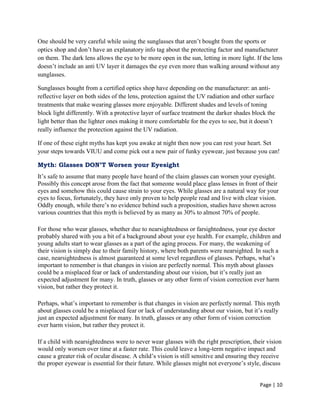
What scary thing is a cylinder and how much carrot does one have to eat to correct the eyesight?
There are a lot of myths going around about wearing glasses that often confuse people. We asked
Anna, our super experienced optometrist at VIUU to help us beat and explain these 8 widespread
myths.
Page | 8
Regular wearing of glasses worsens the eyesight.
Not true. Tools that correct the eyesight don‘t make it worse but on the contrary, glasses are an
instrument especially invented to improve the eyesight. Although sometimes when you get new
prescription glasses it may seem, that you need to wear them more and more it doesn‘t mean that
you are becoming addicted to glasses, but rather that you are getting used to seeing more clearly.
Eye exercises help you get rid of wearing glasses
The fact that eye exercises help you get rid of glasses hasn‘t been scientifically proven yet. The
need to wear prescription glasses depends on the anatomy of the eye, the age of the person and
genetics. For sure the eye exercises let your eyes rest, especially when you are tiring them with
close work, but to change the anatomy of the eye with some exercises isn‘t possible. However
you can still help your eyes. For example when working with a computer, it is very important to
make enough pauses so your eyes could rest, at least 10-15 min after every hour. During this
time you can do different eye exercises to restore the moisture levels and mobility of your eyes.
Eating carrots and blueberries restores your eyesight and helps
to get rid of wearing glasses.
Healthy eating habits influence the whole body, including the eyes, but it doesn‘t help getting rid
of wearing glasses. However, blueberries and carrots are still very beneficial to your eyes.
Blueberries contain vitamins and antioxidants like selenium, zinc and vitamin C that protect the
retina and improve the blood circulation of the eyes avoiding the damages caused by the free
radicals. In addition, blueberries can improve the vision in the dark. Carrots on the other hand
contain a lot of vitamin A that is a vital nutrient to the eyes. Other berries and vegetables are
beneficial too, for example in reducing the macular degeneration.
Reading glasses are only for old people.
This is not true. Reading glasses can also be prescribed to children and young adults.
Farsightedness, also known as hyperopia occurs when the cornea is too flat or the eye is too
short. The light entering the eye can‘t break enough and the focal point appears behind the retina,
not in front as it should. Farsightedness is not a disease but an anatomical peculiarity.
All the children are born with farsightedness but only some stay like this and need reading
glasses as a result. If your kid complains about constant headache, pain or discomfort in the eyes,
doesn‘t want to read, draw or play games that need near sight then you should definitely visit the
eye doctor. We also recommend checking the eyes more thoroughly starting from the age of
three and definitely before starting school for the first time.
Watching TV or computer screen too much can give you
glasses.
Page | 9
This is not true. The bluefish radiation coming from the computer-, TV- and phone screens does
damage our eyes in the long run, but doesn‘t change the shape of the eye lens so you would need
prescription glasses. However you should still reduce the screen time both, because of the
harmful radiation and the danger of dry eye.
Nearsightedness is a disease.
This is not true. Nearsightedness is not a disease but a peculiarity in the construction of the eye.
Myopia, also known as nearsightedness is a visual impairment of the eye in which the light
beams are sharpened in front of the retina. This can be caused by the anomaly in the built of the
cornea, the eye itself or it can also be an anatomic peculiarity. As the eyes are in a constant
development through all childhood the myopia can also progress. The deterioration of the
eyesight starts during the school age and lasts until the age of 20.
Some more reasons for the progression of myopia:
* In poor light conditions a noticeable deterioration in far sight can occur. This is not a disease
but a physical phenomenon.
* Pseudo myopia is a condition where the eyes can‘t focus on long distances anymore. It is
caused by extreme tension in the eyes often caused by too much close work like sitting in the
computer for too long. Normal eyesight will restore after the eyes have gotten some rest.
Cylinder is some special disease.
Astigmatism, also called the refractive error and the ―cylinder‖ for the ordinary people is an
imperfection in the curvature of the cornea. When the normal cornea is evenly round, with
astigmatism it is a bit more stretched on the sides.
Normally astigmatism is inheritable and occurs since birth staying the same all your life, but it
can also change during a long period of time. Astigmatism can also be caused by injuries in the
eye which results in the scarring of the cornea, but also a certain type of eye operations and
diseases.
However, it is not a disease and when a cylinder is discovered you don‘t have to be afraid. All
the optical and contact lenses today allow a correction of the cylinder and it is always written on
your prescription.
Dark lenses protect the eyes against the UV radiation.
It is often misbelieved that the darker the lens, the more it protects the eyes. Unfortunately it is
not true. If we are talking about random sunglasses bought from some supermarket, then usually
these kinds of lenses don‘t include the protective layer against UV radiation.
The protection is given by different chemical processes which attach the protective layer on the
surface of the lens. The tone of the lens can block the light but solely this isn‘t enough.
Page | 10
One should be very careful while using the sunglasses that aren‘t bought from the sports or
optics shop and don‘t have an explanatory info tag about the protecting factor and manufacturer
on them. The dark lens allows the eye to be more open in the sun, letting in more light. If the lens
doesn‘t include an anti UV layer it damages the eye even more than walking around without any
sunglasses.
Sunglasses bought from a certified optics shop have depending on the manufacturer: an anti-
reflective layer on both sides of the lens, protection against the UV radiation and other surface
treatments that make wearing glasses more enjoyable. Different shades and levels of toning
block light differently. With a protective layer of surface treatment the darker shades block the
light better than the lighter ones making it more comfortable for the eyes to see, but it doesn‘t
really influence the protection against the UV radiation.
If one of these eight myths has kept you awake at night then now you can rest your heart. Set
your steps towards VIUU and come pick out a new pair of funky eyewear, just because you can!
Myth: Glasses DON’T Worsen your Eyesight
It‘s safe to assume that many people have heard of the claim glasses can worsen your eyesight.
Possibly this concept arose from the fact that someone would place glass lenses in front of their
eyes and somehow this could cause strain to your eyes. While glasses are a natural way for your
eyes to focus, fortunately, they have only proven to help people read and live with clear vision.
Oddly enough, while there‘s no evidence behind such a proposition, studies have shown across
various countries that this myth is believed by as many as 30% to almost 70% of people.
For those who wear glasses, whether due to nearsightedness or farsightedness, your eye doctor
probably shared with you a bit of a background about your eye health. For example, children and
young adults start to wear glasses as a part of the aging process. For many, the weakening of
their vision is simply due to their family history, where both parents were nearsighted. In such a
case, nearsightedness is almost guaranteed at some level regardless of glasses. Perhaps, what‘s
important to remember is that changes in vision are perfectly normal. This myth about glasses
could be a misplaced fear or lack of understanding about our vision, but it‘s really just an
expected adjustment for many. In truth, glasses or any other form of vision correction ever harm
vision, but rather they protect it.
Perhaps, what‘s important to remember is that changes in vision are perfectly normal. This myth
about glasses could be a misplaced fear or lack of understanding about our vision, but it‘s really
just an expected adjustment for many. In truth, glasses or any other form of vision correction
ever harm vision, but rather they protect it.
If a child with nearsightedness were to never wear glasses with the right prescription, their vision
would only worsen over time at a faster rate. This could leave a long-term negative impact and
cause a greater risk of ocular disease. A child‘s vision is still sensitive and ensuring they receive
the proper eyewear is essential for their future. While glasses might not everyone‘s style, discuss
Page | 11
options with your local optometrist. For some, contact lenses are an amazing alternative that
provides comfort & clarity.
Although there was a misconception decades ago that one should deliberately prescribe a child a
slightly weaker prescription than they really needed it, this too is debunked. Not only do we need
to prescribe children with their exact prescription to ensure that myopia progression does not
worsen too drastically, but this was proven over various studies & trials.
For example, a trial was conducted in Malaysia in 2002 of a group of 94 children with myopia.
Some children wore glasses with the correct prescription and others wore glasses with a slightly
weaker prescription than required. From the age of 9 until 14, their eyesight was measured for
myopia progression. At the end of the trial, researchers discovered that those children with the
weak prescription we‘re gradually getting more myopic as time went on.
While there hasn‘t been any absolute proof of glasses preventing myopia progression, there‘s
enough data to rely on the fact that they clearly don‘t hurt vision at all.
It‘s common knowledge that children who are nearsighted require glasses. Plus, for many of us
at around age 40, we‘ll need to consider progressive lenses or multifocal contacts to deal with
presbyopia. Presbyopia is a condition where one has changes in their farsighted vision, which
makes it difficult to see up close and at a distance. So, there are a lot of people who wear glasses,
and some people wear them for a very long time. We shouldn‘t consider glasses to be a danger to
our vision but a support. There‘s no real causal relationship between glasses and how your eyes
weaken over time. It‘s just another part of life.
One thing is certain: the concept that glasses will worsen your eyesight is a myth. There‘s no
data around that supports it, so glasses are still a great way to correct your vision. Especially
when a child is ready to start school, where their vision needs to be its best, glasses should be
encouraged in a positive environment.
“Sitting Too Close to Your TV or Reading in Dim Lighting/in
the Dark Will Ruin Your Eyes”
There is no evidence that supports eye damage resulting from sitting too close to your TV or
reading in the dark. The pain you‘re feeling after doing so is the result of eyestrain which can
lead to bad headaches, but no damage to your eyes.
“Eating Carrots Will Improve Eyesight”
This is one of the most common eye myths and one that may lead to eating a huge amount of
carrots to no avail.
It‘s true that carrots contain a lot of Vitamin A, which is great for keeping your eyes and body
healthy, but carrots won‘t do anything to improve poor eyesight.
Page | 12
“Wearing Glasses or Contact Will Lead to Dependency and Make
Eyesight Worse”
Not the case! This eye myth draws from wearing glasses and your eyes continuing to get worse
over time, requiring stronger prescriptions. This is just the way vision changes with age, and not
the result of your corrective wear. Hakim Optical are lens experts and able to fit you with proper
and comfortable corrective lenses no matter how much your prescription changes.
“Vision Loss is Not Preventable”
Vision loss is preventable by scheduling regular comprehensive eye exams. You should also be
aware of any sudden onset of blurred vision, eye pain, seeing floaters or flashes of light. See an
optometrist as soon as you can if you notice anything out of the ordinary with your eyesight or
how your eyes feel.
Myth: Myopia develops based on how we use our eyes.
Therefore, we can control whether or not we become
nearsighted.
Fact: Like many conditions, myopia develops due to a combination of genes and environment.
Myth: Reading glasses or other devices such as pinhole glasses
can prevent myopia.
Fact: No credible research shows that pinhole glasses prevents myopia or slows its progression.
For some patients, reading glasses or bifocals can be effective, but this is not true for everyone.
Through a comprehensive examination, your optometrist can identify if you are one of those
people.
Myth: Wearing glasses makes your myopia worse.
Fact: Research shows that wearing glasses to provide clear distance vision does not cause more
myopia. For some people, these lenses do not help their near vision. They should remove their
glasses for near vision, or get a bifocal in their glasses. Your optometrist, who tests both far and
near vision, will advise you if removing your glasses or adding a bifocal is appropriate for
reading and other close work.
Myth: It is better to wear weaker glasses so your eyes have to
work harder.
Fact: This has been proven incorrect.
Myth: Contact lenses can prevent myopia or slow its
progression.
Fact: In the past, success in this area has been minimal. However, more recent research shows
that contact lenses can help slow the progression of nearsightedness in some patients. This is
Page | 13
partially explained by the difference in focus between the center of the retina and the periphery
of the retina. This is new and ongoing research.
DANGEROUS MYTH: Online services offer adequate eye-care
quality and safety
According to a recent article published by the American Optometric Association, there is a
serious question about the quality and safety of prescription eyewear ordered online.
―In a recent study,‖ the Association reported, ―researchers [with the Optical Laboratories
Association and The Vision Council] discovered that nearly half of all glasses (44.8 percent)
ordered online either contained an inaccurate prescription or didn‘t meet safety standards
designed to protect the eyes.‖
This research was very ―real-world‖—based solidly on what people would actually
experience when shopping online. The researchers asked 10 average people to order two pairs of
eyeglasses each, from each of the 10 most popular online optical vendors. Thus, 200 pairs were
ordered, with the frame materials, lens styles, and prescriptions all varying.
Once the orders were received back, the researchers studied the quality of the services. They
closely analyzed lenses—including measurement of sphere power, cylinder power, and axis—
add power (if specified), separation of distance of optical centers, and center thickness.
The results were extremely worrisome.
Several of the eyeglasses were incorrectly and incompetently made, such as offering single
vision when the prescription called for bifocals. Others featured lens treatments—or no lens
treatments—when the prescription called for the opposite.
To make matters worse, nearly 30 percent of the eyeglasses featured at least one lens that failed
to meet the required prescription. And nearly 25 percent of the lenses failed standard impact-
resistance testing, opening the door to a potential major safety problem.
DANGEROUS MYTH: Online services offer comparable over-all
service
The problems we just highlighted reveal the dangers of trusting a very serious thing—your
vision—to ―cookie-cutter, trendy-appearing‖ online optical services. As we just saw, you can‘t
even trust them to ―cut the cookies‖ correctly!
Page | 14
But the problem is deeper than that. It‘s about the distinction between in-person service that puts
you first . . . and online companies for which you‘ll always be a ―faceless number.‖ Highly
trained, flesh-and-blood optometrists and opticians such as those at Optique are personally
vested in serving you with individualized, state-of-the-art solutions for every type of eye problem
or situation you face. As a result, you get vastly more personal time and attention when you trust
your eyes to professionals.
DANGEROUS MYTH: Online services offer “huge savings” over
traditional eye care / eyewear services
As devoted optometrists who care deeply about our patients‘ vision, we are appalled at the
explosion of Internet articles promising ―huge savings‖ for those who shop online. The three
questions everyone who reads these articles should ask are: Do you actually achieve “huge
savings” when you shop for contacts and eyewear online? And if you do achieve some savings,
what are the “hidden costs” of those savings to you?
The truth is, most of the ―Online Eye care is great‖ articles are written by hired writers with
absolutely zero optical expertise or training. And their savings claims are often demonstrably
untrue. How do we know? Because we‘ve conducted our own research on the subject. And the
results were unequivocal—Optique‘s prices can be even lower than those of retailers such as
those in big box stores, and online services such as 1-800-Contacts.
But even if you do achieve savings by using online eyeglasses or contact lens services, the
hidden costs to you can be tremendous. The blunt truth is, most of those services offer you and
your eyesight minimum protection. One of our very deepest concerns about the order-online fad
is contact lens resellers who blatantly break the law, putting people like you and your family at
serious risk for permanent vision loss. We have seen cases in our practice of normal folks who
have permanently lost vision because they purchased contact lenses online.
DANGEROUS MYTH: Ordering eyewear online is as easy as
ordering blue jeans or concert tickets
Anytime you order a very serious product such as eyewear from a website based far away—
rather than from trained professionals in your own backyard—you‘re risking serious reliability
and quality-control problems. Remember the research experiment we mentioned above,
conducted by the American Optometric Association? When participants in the survey ordered a
total of 200 pairs of eyeglasses online—from the Top 10 online sites, mind you—fully 46 of
those pair were never even delivered. That‘s 23 percent.
Would you order a book from Amazon if you believed there were nearly a 1 in 4 chance your
book would have a different ending?
Page | 15
DANGEROUS MYTH: Online services assure a great look and
proper fit
Last year, The Wall Street Journal reported on some of the drawbacks of buying eyewear online.
The highly respected newspaper reported, ―It can be harder to get glasses to fit properly when
buying online, especially for people who need significant optical correction, experts say. As a
result, people with extreme nearsightedness, farsightedness or astigmatism, or those who wear
bifocals, may end up with glasses bought online that doesn‘t fix their vision problem.‖
And what about the ―great frame selection‖ online services boast about? In truth, their selection
is often more limited than those of tradition stores such as Optique—and they often don‘t allow
you to try your frame on before ordering. What if it doesn‘t fit well or is uncomfortable?
On the other hand, Optique‘s collection of eyewear is unparalleled in Nashville—pretty much
assuring you glasses that will look terrific. Each frame is hand-picked for quality, style, and
distinction. We are Nashville‘s exclusive provider of Dita Eyewear, and we also offer an
amazing selection of other frames, including Tom Ford, Ray ban, Gucci, Prada, Giorgio Armani,
Burberry, Silhouette, Kate Spade, and Christian Dior.
The bottom line is this: Your eyesight is too precious to trust to online services that offer you
highly questionable eye care. If you want to feel you are being served by real, flesh-and-blood
professionals who care deeply about your vision, we invite you to contact us at Optique Eye Care
/ Eye Wear.
Sitting too close to the TV will ruin your eyes
Your mom may have warned you that you would ruin your eyes forever if you sat too close to
the television or if you watched too much of it. Unfortunately for mom, that's not true. Watching
televisions, including LCDs and flat screens, can't cause your eyes any physical harm. The same
is true for using the computer too much or watching 3-D movies. Your eyes may feel more tired
if you sit too close to the TV or spend a lot of time working at the computer or watching 3-D
movies, but you can fix that by giving your eyes a rest.
Your vision will get worse if you read in the dark
Reading in dim light may be harder, but it doesn't damage your eyes. Remember that for
centuries people read and worked by candlelight or gas lamps that offered far less light than
electric lighting. Having good light will prevent eye fatigue and make reading easier, though.
Wearing glasses makes your eyes dependent on them
Eyeglasses correct blurry vision. You may want to wear your glasses more often so that you can
see clearly, but your glasses aren't changing your eyes so that they become dependent on your
Page | 16
eyeglasses. You're just getting used to seeing things more clearly. Similarly, wearing glasses
with the wrong prescription won't ruin your eyes. You just won't see as clearly as you would
with the proper prescription.
Only boys are color blind
Color blindness, also known as color deficiency, occurs when you are unable to see colors in a
certain way. Most commonly, color blindness happens when a person cannot distinguish between
certain colors, usually between greens and reds, and occasionally blues. While males are much
more likely to develop color blindness, females can also have the problem.
Sunglasses are the ultimate accessory for summer, both as a fashion statement and a health
necessity. That‘s right— UV protection is key for eye health, so if you thought your sunnies
were just for looks, you‘re wrong. I‘m all for what‘s good for you also being super fashionable,
so pay attention to these five sunglasses myths to make sure you‘re actually protecting your eyes
with the frames you choose. Just in time for National Sunglasses Day on June 27, Dr. Justin
Bazan, optometrist and medical advisor to The Vision Council, filled me in on the facts
regarding sunglass wear and how to protect your eyes because there‘s a lot of misinformation out
there. There‘s also a lot of history behind sunglasses that I had no idea about, and it was
fascinating to learn about what I‘ve been wearing on my face for years, with no real clue behind
the reason why or the origin of them. According to Dr. Bazan, ―Sunglasses became popular as a
fashion accessory in the 1950s. Before then, they were mostly used for the military,‖ he said.
―The first pair of sunglasses, however, dates back to prehistoric times. These glasses did not have
lenses, but were made to act more as ‗visors for the eyes.‖
Page | 17
Myth: All Lenses Protect Your Eyes
"Just because the lenses appear darker, doesn‘t mean they offer better protection! Wearing
sunglasses with dark lenses without adequate UV protection can actually be worse than wearing
no sunglasses at all because they cause the eye‘s pupil to dilate, which then increases retinal
exposure to unfiltered UV light." So how do you know if you‘re actually getting protection or
not? "If you purchase your glasses from a reputable retailer—an optical shop, a department store,
a credible online source, a drug or grocery store—the glasses with UV protection will have a
sticker, tag or label indicating their UV protection. There are rules and regulations in place to
ensure that these glasses are in fact UV-protective." But, if you‘re in love with a set of frames
and don‘t know whether they‘re good for your eyes or not, there‘s good news. "Almost any lens
can be outfitted with a UV-protective lens (either with or without a prescription), so if you find a
pair of frames you love, an eye care provider can probably take that frame and outfit you with
the correct lenses."
Myth: Lens Color Matters
―Lens color is also a matter of preference. In fact, your lenses can be perfectly clear yet provide
complete UVA/UVB protection. Lens color is really a matter of comfort. In bright sun, a darker
lens may offer more comfort, whereas a lighter colored lens may be more appropriate for a
cloudy day. Fashion also plays a part. Rose tinted lenses, yellow lenses and brown lenses have
all had their day as fashion trends. At the end of the day, what matters in terms of healthy eyes, is
the sticker, tag or label that indicates UVA/UVB or broad spectrum UV protection.‖
Myth: You Don’t Need Sunglasses When It’s Cloudy
―It‘s a great idea to have more than one pair of sunglasses so that you can be comfortable in all
weather conditions. When it‘s cloudy outside, dark sunglasses may not be as comfortable as a
lighter tint. It‘s important to remember that the tint of the lens is not the protector—it‘s the UV
treatment that is added to the lens during the manufacturing process.”
Page | 18
Myth: Polarized Lenses Are Better
―Lens treatments, such as polarization, are all beneficial in different ways, and whether they
work better for your lifestyle is really dependent on the activities you are engaging in while
wearing sunglasses. Polarized lenses work to reduce glare and increase contrast, so they are great
for winter sports where the sun reflects off of the snow and ice. They are also great for summer
beach activities, where the glare of the sun coming off the water may be distracting or may
hinder your vision. If you are planning to use your digital device outdoors, however, you may
find that polarized lenses make seeing your smart phone or tablet screen very difficult.‖
Myth: Expensive Sunglasses Are More Effective
―High cost doesn‘t always mean good protection! You don‘t have to pay a premium to get proper
UV protection. But be sure to purchase sunglasses at a reputable dealer—no street vendors,
please!‖ So, make sure your sunnies have UV protection, and celebrate National Sunglasses Day
with safety and style!
Do glasses weaken your eyes?
If you wear glasses, chances are you've wondered from time to time if they're making your
eyesight worse. Not while you're wearing them, but when you take them off.
Pretty much everyone will need glasses at some point in their lives. And when it happens to you,
you'll probably ask yourself the question on the lips of specs wearers everywhere: do glasses
weaken your eyes?
Struggling to focus on printed matter is an unfortunate sign of ageing. Changes to the lens of
the eye as you get older mean you have to move the page further and further away before you
can see properly. It's called presbyopia and it strikes us all, usually by our mid-40s. And most
of us end up having to wear glasses.
If you think your eyesight's got worse since you've started wearing glasses, you're far from
alone. But the truth is many eye conditions, including presbyopia, get worse over time by
themselves, specs or no specs.
In other words, it seems harder to read things without your glasses because it is. But it was
going to happen anyway, and your glasses aren't to blame.
Page | 19
What your specs have done is got you used to seeing more clearly. So when you take them off,
the contrasting blurriness is more noticeable.
Glasses don't change the process of presbyopia or other eye conditions. But take them off, and
your eyes might seem a tad lazy at mustering any remaining focusing power. That's because
the muscles that bend and straighten the lens of your eye haven't worked as hard when your
specs have been doing some of the job.
But your glasses haven't made your vision worse. The real problem isn't weak focusing
muscles; the real problem is your eye's lens has become less flexible so it can't focus as well.
And there's not much you can do about that.
Wearing sunglasses to protect your eyes from UV light might help delay the stiffening of the
lens that causes presbyopia. But the only way to escape it completely is to die young. Not a
great option!
So if you want to see well throughout life, wearing glasses or contact lenses is pretty much
inevitable – and not harmful. You might as well just accept it (and blame your high school
careers adviser for not steering you into the lucrative field of optometry!)
Eye Care Myth:
Eyewear Purchased From Private Doctors Cost More than Highway Outlets
Surveys tell us most people believe purchasing eyewear at a private doctor's office is more
expensive than at the highway chain outlets, yet just the opposite is the truth.
Recently, private doctors have been forming buying groups to enable us to purchase eyewear at a
lower cost than the chains. For example, the buying group we belong to consists of over 9500
doctors nationwide.
In addition, our other overhead (rent, advertising, etc.) is minimal when compared to the chains.
That's why only The Levinson Eye Care Center can make this guarantee.
The Levinson Eye Care Center Guarantee
If within 6 months from purchase date, you find the same frame selling for less at any optical
store within a 25 mile radius, we will gladly refund DOUBLE the difference and issue a $50.00
gift certificate for your next eyewear purchase.
Can glasses make my eyes worse?
Many people require prescription glasses to correct their vision due to long-sightedness
(hyperopia), short-sightedness (myopia) or another eye condition. These glasses are designed
specifically to correct the specific condition, but there is something of a myth around whether
wearing these glasses can actually make it worse. Put simply, this is not true.
Page | 20
The belief is often centered on the idea that wearing glasses might make your eyes lazy once you
remove them, as once you grow accustomed to wearing glasses your eyes may feel
uncomfortable if you take them off. This is because when you are wearing prescription glasses,
the lenses in the frames are working to correct your vision, which means your eye muscles can
relax and work naturally. Once you take them off, the eyes will be required to focus again
without the help of vision correction, making you feel anything from disorientated to dizzy or
sore.
If you find your natural vision (without glasses) is better first thing in the morning than it is at
the end of the day after you've removed your glasses, this has an explanation too. Your morning
eyes may seem better as they are more flexible, meaning they are better at focusing than they are
later in the day. This is a normal occurrence and does not mean that the glasses are responsible
for making your vision worse during the day. Another potential cause behind this myth is that
vision can deteriorate with age.
This is true for people with or without glasses, so even if you do wear glasses your whole life,
then discover that your eyes are not what they used to be, this is likely caused by the ageing
process rather than your spectacles.
Page | 21
https://www.overlandoptical.com/2017/07/16/5-myths-about-buying-glasses-from-your-local-
optometrist/
https://www.vspdirect.com/vision-hub/popular-myths-about-eyeglasses
https://www.dharmaco.com/blogs/vision-beyond-sight/30269569-5-myths-about-shopping-
online-for-eyewear
https://www.readers.com/blog/eye-health/vision-and-glasses-myths/
https://viuu.ee/en/8-myths-about-wearing-glasses/
https://www.prairie.vision/2017/08/20/myth-glasses-dont-worsen-your-eyesight/
https://hakimoptical.ca/eye-myths-debunked/
https://www.aoa.org/patients-and-public/eye-and-vision-problems/glossary-of-eye-and-vision-
conditions/myopia/common-myopia-myths
https://optiquenashville.com/5-dangerous-myths-about-purchasing-eyewear-online-2/
https://www.aao.org/eye-health/tips-prevention/five-vision-myths
https://www.bustle.com/articles/93048-5-sunglasses-myths-for-national-sunglasses-day-because-
they-dont-all-have-uv-protection
http://www.abc.net.au/health/healthyliving/stories/2008/07/01/2243057.htm
http://www.levinsoneyecare.com/eye-care-myth-01.php
https://www.specsavers.com.au/help-and-faqs/can-glasses-make-my-eyes-worse

Myths for optical outlets by Optom.Het Vora

  • 1.
    Page | 1 Mythsfor Optical Outlets
  • 2.
    Page | 2 Manymyths float around about buying frames and lenses from your local optometrist. Let‘s take a look at what makes each of these statements a myth – and not a true statement. MYTH: There’s No Reason to Ask an Optician for Help When Choosing Frames Your vision prescription is unique, and not all frames and lenses support all vision prescriptions. Depending upon your needs, such as bifocals, multifocal, astigmatism, and high myopia, certain styles and shapes of frames will help you achieve sharper vision. The thickness of your lenses and the most suitable lens coatings for your lifestyle must also be considered. Additionally, you want your glasses to look amazing! When you buy online, who will stand by your side to tell you the best shapes, materials, and colors to flatter your look? When you buy glasses from our St. Louis optical center, we will make sure you buy glasses that enhance your appearance. Do you really want to make these decisions on your own? Our St. Louis optician is experienced and knowledgeable about which frames and lenses will work best for your vision requirements, appearance, and daily activities. We stock a wide variety of frames and offer many lens coatings in our St. Louis collection – and our optician will guide you towards the ideal eyewear. MYTH: You Don’t Need to Try Glasses On To put it simply- temples and nose pads need to meet your face at the right angle or they‘ll hurt. Or if they are too wide, your glasses will constantly slip down your nose. The type of nose pads and temples varies, and you can‘t know what feels comfortable unless you try them on. In addition, you need an accurate Pupillary Distance (PD) measurement to order lenses in the right size. Our optician will make sure that your glasses fit your face and eyes precisely – so when you walk out of our St. Louis store, you‘ll enjoy wearing your comfy new eyewear! MYTH: Shopping Online Always Saves You Money Optometrists and opticians develop a relationship with eyeglass manufacturers that enable special promotions and savings. When you buy glasses from our local store, we will offer rebates and discounts on name-brands, which are unavailable from online sites. Therefore, even if the initial price appears higher on some of the frames in our St. Louis glasses collection, your final cost will often be significantly less. Also, not all online glasses sites accept insurance. We accept virtually all medical and vision insurance plans. MYTH: There’s No Difference in Quality Many online retailers make their profit by stocking the cheapest Made-in-China frames, and they only offer basic lens types. In contrast, we only stock premium, designer frames that are constructed with durable materials and precise engineering. Our optician will also help you choose the most suitable lenses and lens coatings for your lifestyle, including transition lenses, polarized, ultra-thin, and scratch-resistant. People can be very rough on their eyewear, and we want your St. Louis glasses and lenses to last as long as possible!
  • 3.
    Page | 3 MYTH:Your Vision Prescription Doesn’t Matter Some vision conditions are more challenging to correct than other vision conditions. If you have a very high prescription, astigmatism, or a complex condition, you need an expert to craft your lenses from high quality materials. Otherwise, you risk wearing glasses that distort the way you see the world! Many studies report that over 50% of glasses bought online were fit with incorrectly crafted lenses that didn‘t match the vision prescription. This leads directly to headaches and/or blurry vision. Myth: Wearing eyeglasses makes you dependent on them. Not true. Your glasses aren‘t changing your eyes. When you feel like you need to wear your glasses more frequently, you‘re just getting used to your improved vision. Myth: Wearing the wrong prescription can damage your eyes. If you wear someone else‘s glasses, it just means that you won‘t see as clearly as you would with the proper prescription. But it will probably give you a headache and make you dizzy if you wear the wrong prescription for too long. Myth: Sunglasses are the best way to protect your eyes from the sun. Just because sunglasses have dark shading doesn‘t mean they‘ll keep your eyes safe. UV- blocking agents help block the sun‘s harmful rays, so even clear prescription lenses with UV- blocking agents can adequately protect your eyes. When you buy sunglasses, make sure they have the proper UV protection, not just dark shading. Myth: Doing eye exercises will keep you from needing glasses. The quality of your vision depends on the shape of your eyes, the health of your eye tissues and lots of other factors. While eye exercises may have some benefit, even if you do them, you may still need glasses or corrective lenses.
  • 4.
    Page | 4 Myth:Taking a break from wearing your glasses is good for your eyes and allows them to rest. Like we mentioned in Myth #1, wearing glasses doesn‘t make your eyes dependent on them. If you are prescribed glasses, just use them. They won‘t weaken your vision or cause any eye problems. If you take a break from wearing them, you‘ll simply strain your eyes and tire them out faster. Myth: Wearing poorly-fit glasses will damage your eyes. Glasses that aren‘t fit perfectly to your face won‘t hurt your vision; they just need to be adjusted for better comfort and clearer vision. In some cases your prescription is designed specifically for how your glasses will position on your face. So keep them adjusted properly. Myth: Eating lots of carrots will make you not need glasses. It‘s true that carrots contain Vitamin A, which is good for your eyes, but actually dark green leafy vegetables and fresh fruit are better. They can protect the eyes from cataracts and age- related macular degeneration, but they can‘t prevent or fix problems like nearsightedness or farsightedness, which is what glasses are for. Plus, eating too many carrots can cause your skin to turn yellow. You don‘t want that, do you? Myth: You don’t look good in eyeglasses. This myth is one of the saddest lies on the list! Whoever started this rumor just doesn‘t know style. You don‘t need to look far to find plenty of examples of how glasses add class and sophistication to someone‘s look. So, next time you hear someone say they‘re going to eat carrots so that they won‘t need glasses, or that wearing glasses makes your eyesight worse over time, you can kindly educate them on the truth. Here at VSP Direct, we‘re all about helping you have healthy eyes and clearer vision. Head over to our find vision insurance plan page to find the right eye care plan for your needs. Myth: You won’t save money by shopping online. This is probably one of the most baseless myths known. By shopping online you can save over 70% off of retail prices—on brand name glasses—all while shopping from the comfort of your own home; how‘s that for a myth buster? Myth: Online glasses compromise on quality. While there are certain online retailers that sell less-than-quality products, there are plenty of low quality products at retailers that sell at brick and mortar locations. All you need to do is make sure you do your research. As online stores cut out the middle man, they get to pass on the savings to you.
  • 5.
    Page | 5 Protip: It’s pretty easy to spot a low quality online glasses retailer—if a deal is simply too good to be true, it probably is! Myth: I won’t be able to choose a frame unless I’m actually in the store. Wrong again. Did you know that you can get expert advice online? Some online retailers will offer the services of their stylists that will help you find the perfect frame, and with tools like Dharma Co‘s free 3D virtual try-on app for the iPhone, you can see how your glasses will suit your facial structure by simply uploading your picture or using your webcam. Myth: You won’t be able to know what your glasses will look like on you without going in the store. With tools like Dharma Co‘s free 3D virtual try-on app, you can see how your glasses will suit your facial structure by simply uploading your picture. All you need to know is your PD (pupillary distance), which you will get when you get your prescription from your optometrist. Plus you can now indulge in our Eyewear Guru Service and speak to a stylist live to help make the process even easier Pro tip: Always try the virtual glasses; a certain style might look cool online, but it might not fit your face shape. Myth: I can’t shop for certain prescriptions online. This is a myth that does hold some truth—you just have to do your research when you are looking for your glasses online. There are some retailers that only have the most general lens type, there are others that have every type of lens that you could think of—you just have to know where to look. Your vision will get worse over time by wearing reading glasses Glasses are simply an aid to improve vision, and they will not cause your eyesight to grow worse. As we get older, it becomes harder and harder to see up-close. If you begin to need stronger reading powers as the years go on, don‘t fret. The glasses themselves have not made your eyes worse! If you wear glasses, not wearing them will cause your vision to deteriorate faster If you wear reading glasses, the side effects of not wearing them could include blurriness and distortion. Trying to focus without glasses will not make your vision deteriorate faster, though it could lead to squinting and eyestrain. The primary effects of not wearing your glasses are temporary and, at most can cause discomfort.
  • 6.
    Page | 6 Over-the-counterreaders can hurt your eyes First thing first–using over-the-counter (OTC) reading glasses from a pharmacy or online retailer (versus readers from your optometrist); will not hurt your eyes. OTC reading glasses contain magnifying lenses in different powers that work just as well. Before buying reading glasses from a pharmacy or online retailer, you‘ll want to know the reading power you need. Not sure? Follow this guide to determine your magnification. Wearing non-prescription reading glasses that are either too weak or too strong for your eyes could be bothersome, but it will not cause long-term damage to your vision. For more pros and cons of buying glasses in-store, online, or at the eye doctor, click here. Wearing reading glasses makes your eyes stronger wearing reading glasses makes your vision clearer, but it does not have an impact on your prescription. Don‘t be confused if you hear reading glasses magnifications referred to as ―strengths‖–this does not mean it‘ll make your eyes stronger over time. Bottom line: You won‘t cure bad vision by wearing glasses every day. Sitting too close to the TV is bad for your eyes This rumor hasn‘t been true since before the ‘60s when television sets emitted mild levels of radiation. Nowadays, TVs have proper shielding so radiation is no longer an issue. Sitting in front of the TV for too long could cause you to experience discomfort, like eyestrain, irritation, or watery or dry eyes. If you find yourself in front of digital devices for extended periods of time, consider a pair of computer glasses (read more about their benefits here). Eating carrots is one way to improve eyesight Eating carrots won‘t help someone with already poor eyesight regain clear vision. But, carrots are jam-packed with nutrients known to help protect your eyes, such as vitamin A. Vitamin A is known to play a role in reducing the impact of cataracts and age-related macular degeneration. If you see fine, you do not need regular eye exams If you‘ve been cruising through life with 20/20 vision, that‘s great! However, many eye and vision problems do not have symptoms, so it‘s important to get your eyes checked regularly by an optometrist to make sure they stay healthy as you age. When you visit the eye doctor, your optometrist is scanning for much more than just vision problems. Through many comprehensive eye exams, health conditions such as tumors and diabetes can be detected before physical symptoms are present. Reading in dim light will worsen your eyesight You won‘t go blind from reading in the dark, but it will make it harder to see what you‘re reading. In low light, your eyes are doing two things: relaxing to collect as much light as possible
  • 7.
    Page | 7 andcontracting to focus on what you‘re reading. Your eyes can become strained and tired, resulting in sore, dry, or watery eyes, as well as headaches. While reading in the dark might be bothersome, these symptoms are temporary and will not cause long-term damage to your eyesight. What scary thing is a cylinder and how much carrot does one have to eat to correct the eyesight? There are a lot of myths going around about wearing glasses that often confuse people. We asked Anna, our super experienced optometrist at VIUU to help us beat and explain these 8 widespread myths.
  • 8.
    Page | 8 Regularwearing of glasses worsens the eyesight. Not true. Tools that correct the eyesight don‘t make it worse but on the contrary, glasses are an instrument especially invented to improve the eyesight. Although sometimes when you get new prescription glasses it may seem, that you need to wear them more and more it doesn‘t mean that you are becoming addicted to glasses, but rather that you are getting used to seeing more clearly. Eye exercises help you get rid of wearing glasses The fact that eye exercises help you get rid of glasses hasn‘t been scientifically proven yet. The need to wear prescription glasses depends on the anatomy of the eye, the age of the person and genetics. For sure the eye exercises let your eyes rest, especially when you are tiring them with close work, but to change the anatomy of the eye with some exercises isn‘t possible. However you can still help your eyes. For example when working with a computer, it is very important to make enough pauses so your eyes could rest, at least 10-15 min after every hour. During this time you can do different eye exercises to restore the moisture levels and mobility of your eyes. Eating carrots and blueberries restores your eyesight and helps to get rid of wearing glasses. Healthy eating habits influence the whole body, including the eyes, but it doesn‘t help getting rid of wearing glasses. However, blueberries and carrots are still very beneficial to your eyes. Blueberries contain vitamins and antioxidants like selenium, zinc and vitamin C that protect the retina and improve the blood circulation of the eyes avoiding the damages caused by the free radicals. In addition, blueberries can improve the vision in the dark. Carrots on the other hand contain a lot of vitamin A that is a vital nutrient to the eyes. Other berries and vegetables are beneficial too, for example in reducing the macular degeneration. Reading glasses are only for old people. This is not true. Reading glasses can also be prescribed to children and young adults. Farsightedness, also known as hyperopia occurs when the cornea is too flat or the eye is too short. The light entering the eye can‘t break enough and the focal point appears behind the retina, not in front as it should. Farsightedness is not a disease but an anatomical peculiarity. All the children are born with farsightedness but only some stay like this and need reading glasses as a result. If your kid complains about constant headache, pain or discomfort in the eyes, doesn‘t want to read, draw or play games that need near sight then you should definitely visit the eye doctor. We also recommend checking the eyes more thoroughly starting from the age of three and definitely before starting school for the first time. Watching TV or computer screen too much can give you glasses.
  • 9.
    Page | 9 Thisis not true. The bluefish radiation coming from the computer-, TV- and phone screens does damage our eyes in the long run, but doesn‘t change the shape of the eye lens so you would need prescription glasses. However you should still reduce the screen time both, because of the harmful radiation and the danger of dry eye. Nearsightedness is a disease. This is not true. Nearsightedness is not a disease but a peculiarity in the construction of the eye. Myopia, also known as nearsightedness is a visual impairment of the eye in which the light beams are sharpened in front of the retina. This can be caused by the anomaly in the built of the cornea, the eye itself or it can also be an anatomic peculiarity. As the eyes are in a constant development through all childhood the myopia can also progress. The deterioration of the eyesight starts during the school age and lasts until the age of 20. Some more reasons for the progression of myopia: * In poor light conditions a noticeable deterioration in far sight can occur. This is not a disease but a physical phenomenon. * Pseudo myopia is a condition where the eyes can‘t focus on long distances anymore. It is caused by extreme tension in the eyes often caused by too much close work like sitting in the computer for too long. Normal eyesight will restore after the eyes have gotten some rest. Cylinder is some special disease. Astigmatism, also called the refractive error and the ―cylinder‖ for the ordinary people is an imperfection in the curvature of the cornea. When the normal cornea is evenly round, with astigmatism it is a bit more stretched on the sides. Normally astigmatism is inheritable and occurs since birth staying the same all your life, but it can also change during a long period of time. Astigmatism can also be caused by injuries in the eye which results in the scarring of the cornea, but also a certain type of eye operations and diseases. However, it is not a disease and when a cylinder is discovered you don‘t have to be afraid. All the optical and contact lenses today allow a correction of the cylinder and it is always written on your prescription. Dark lenses protect the eyes against the UV radiation. It is often misbelieved that the darker the lens, the more it protects the eyes. Unfortunately it is not true. If we are talking about random sunglasses bought from some supermarket, then usually these kinds of lenses don‘t include the protective layer against UV radiation. The protection is given by different chemical processes which attach the protective layer on the surface of the lens. The tone of the lens can block the light but solely this isn‘t enough.
  • 10.
    Page | 10 Oneshould be very careful while using the sunglasses that aren‘t bought from the sports or optics shop and don‘t have an explanatory info tag about the protecting factor and manufacturer on them. The dark lens allows the eye to be more open in the sun, letting in more light. If the lens doesn‘t include an anti UV layer it damages the eye even more than walking around without any sunglasses. Sunglasses bought from a certified optics shop have depending on the manufacturer: an anti- reflective layer on both sides of the lens, protection against the UV radiation and other surface treatments that make wearing glasses more enjoyable. Different shades and levels of toning block light differently. With a protective layer of surface treatment the darker shades block the light better than the lighter ones making it more comfortable for the eyes to see, but it doesn‘t really influence the protection against the UV radiation. If one of these eight myths has kept you awake at night then now you can rest your heart. Set your steps towards VIUU and come pick out a new pair of funky eyewear, just because you can! Myth: Glasses DON’T Worsen your Eyesight It‘s safe to assume that many people have heard of the claim glasses can worsen your eyesight. Possibly this concept arose from the fact that someone would place glass lenses in front of their eyes and somehow this could cause strain to your eyes. While glasses are a natural way for your eyes to focus, fortunately, they have only proven to help people read and live with clear vision. Oddly enough, while there‘s no evidence behind such a proposition, studies have shown across various countries that this myth is believed by as many as 30% to almost 70% of people. For those who wear glasses, whether due to nearsightedness or farsightedness, your eye doctor probably shared with you a bit of a background about your eye health. For example, children and young adults start to wear glasses as a part of the aging process. For many, the weakening of their vision is simply due to their family history, where both parents were nearsighted. In such a case, nearsightedness is almost guaranteed at some level regardless of glasses. Perhaps, what‘s important to remember is that changes in vision are perfectly normal. This myth about glasses could be a misplaced fear or lack of understanding about our vision, but it‘s really just an expected adjustment for many. In truth, glasses or any other form of vision correction ever harm vision, but rather they protect it. Perhaps, what‘s important to remember is that changes in vision are perfectly normal. This myth about glasses could be a misplaced fear or lack of understanding about our vision, but it‘s really just an expected adjustment for many. In truth, glasses or any other form of vision correction ever harm vision, but rather they protect it. If a child with nearsightedness were to never wear glasses with the right prescription, their vision would only worsen over time at a faster rate. This could leave a long-term negative impact and cause a greater risk of ocular disease. A child‘s vision is still sensitive and ensuring they receive the proper eyewear is essential for their future. While glasses might not everyone‘s style, discuss
  • 11.
    Page | 11 optionswith your local optometrist. For some, contact lenses are an amazing alternative that provides comfort & clarity. Although there was a misconception decades ago that one should deliberately prescribe a child a slightly weaker prescription than they really needed it, this too is debunked. Not only do we need to prescribe children with their exact prescription to ensure that myopia progression does not worsen too drastically, but this was proven over various studies & trials. For example, a trial was conducted in Malaysia in 2002 of a group of 94 children with myopia. Some children wore glasses with the correct prescription and others wore glasses with a slightly weaker prescription than required. From the age of 9 until 14, their eyesight was measured for myopia progression. At the end of the trial, researchers discovered that those children with the weak prescription we‘re gradually getting more myopic as time went on. While there hasn‘t been any absolute proof of glasses preventing myopia progression, there‘s enough data to rely on the fact that they clearly don‘t hurt vision at all. It‘s common knowledge that children who are nearsighted require glasses. Plus, for many of us at around age 40, we‘ll need to consider progressive lenses or multifocal contacts to deal with presbyopia. Presbyopia is a condition where one has changes in their farsighted vision, which makes it difficult to see up close and at a distance. So, there are a lot of people who wear glasses, and some people wear them for a very long time. We shouldn‘t consider glasses to be a danger to our vision but a support. There‘s no real causal relationship between glasses and how your eyes weaken over time. It‘s just another part of life. One thing is certain: the concept that glasses will worsen your eyesight is a myth. There‘s no data around that supports it, so glasses are still a great way to correct your vision. Especially when a child is ready to start school, where their vision needs to be its best, glasses should be encouraged in a positive environment. “Sitting Too Close to Your TV or Reading in Dim Lighting/in the Dark Will Ruin Your Eyes” There is no evidence that supports eye damage resulting from sitting too close to your TV or reading in the dark. The pain you‘re feeling after doing so is the result of eyestrain which can lead to bad headaches, but no damage to your eyes. “Eating Carrots Will Improve Eyesight” This is one of the most common eye myths and one that may lead to eating a huge amount of carrots to no avail. It‘s true that carrots contain a lot of Vitamin A, which is great for keeping your eyes and body healthy, but carrots won‘t do anything to improve poor eyesight.
  • 12.
    Page | 12 “WearingGlasses or Contact Will Lead to Dependency and Make Eyesight Worse” Not the case! This eye myth draws from wearing glasses and your eyes continuing to get worse over time, requiring stronger prescriptions. This is just the way vision changes with age, and not the result of your corrective wear. Hakim Optical are lens experts and able to fit you with proper and comfortable corrective lenses no matter how much your prescription changes. “Vision Loss is Not Preventable” Vision loss is preventable by scheduling regular comprehensive eye exams. You should also be aware of any sudden onset of blurred vision, eye pain, seeing floaters or flashes of light. See an optometrist as soon as you can if you notice anything out of the ordinary with your eyesight or how your eyes feel. Myth: Myopia develops based on how we use our eyes. Therefore, we can control whether or not we become nearsighted. Fact: Like many conditions, myopia develops due to a combination of genes and environment. Myth: Reading glasses or other devices such as pinhole glasses can prevent myopia. Fact: No credible research shows that pinhole glasses prevents myopia or slows its progression. For some patients, reading glasses or bifocals can be effective, but this is not true for everyone. Through a comprehensive examination, your optometrist can identify if you are one of those people. Myth: Wearing glasses makes your myopia worse. Fact: Research shows that wearing glasses to provide clear distance vision does not cause more myopia. For some people, these lenses do not help their near vision. They should remove their glasses for near vision, or get a bifocal in their glasses. Your optometrist, who tests both far and near vision, will advise you if removing your glasses or adding a bifocal is appropriate for reading and other close work. Myth: It is better to wear weaker glasses so your eyes have to work harder. Fact: This has been proven incorrect. Myth: Contact lenses can prevent myopia or slow its progression. Fact: In the past, success in this area has been minimal. However, more recent research shows that contact lenses can help slow the progression of nearsightedness in some patients. This is
  • 13.
    Page | 13 partiallyexplained by the difference in focus between the center of the retina and the periphery of the retina. This is new and ongoing research. DANGEROUS MYTH: Online services offer adequate eye-care quality and safety According to a recent article published by the American Optometric Association, there is a serious question about the quality and safety of prescription eyewear ordered online. ―In a recent study,‖ the Association reported, ―researchers [with the Optical Laboratories Association and The Vision Council] discovered that nearly half of all glasses (44.8 percent) ordered online either contained an inaccurate prescription or didn‘t meet safety standards designed to protect the eyes.‖ This research was very ―real-world‖—based solidly on what people would actually experience when shopping online. The researchers asked 10 average people to order two pairs of eyeglasses each, from each of the 10 most popular online optical vendors. Thus, 200 pairs were ordered, with the frame materials, lens styles, and prescriptions all varying. Once the orders were received back, the researchers studied the quality of the services. They closely analyzed lenses—including measurement of sphere power, cylinder power, and axis— add power (if specified), separation of distance of optical centers, and center thickness. The results were extremely worrisome. Several of the eyeglasses were incorrectly and incompetently made, such as offering single vision when the prescription called for bifocals. Others featured lens treatments—or no lens treatments—when the prescription called for the opposite. To make matters worse, nearly 30 percent of the eyeglasses featured at least one lens that failed to meet the required prescription. And nearly 25 percent of the lenses failed standard impact- resistance testing, opening the door to a potential major safety problem. DANGEROUS MYTH: Online services offer comparable over-all service The problems we just highlighted reveal the dangers of trusting a very serious thing—your vision—to ―cookie-cutter, trendy-appearing‖ online optical services. As we just saw, you can‘t even trust them to ―cut the cookies‖ correctly!
  • 14.
    Page | 14 Butthe problem is deeper than that. It‘s about the distinction between in-person service that puts you first . . . and online companies for which you‘ll always be a ―faceless number.‖ Highly trained, flesh-and-blood optometrists and opticians such as those at Optique are personally vested in serving you with individualized, state-of-the-art solutions for every type of eye problem or situation you face. As a result, you get vastly more personal time and attention when you trust your eyes to professionals. DANGEROUS MYTH: Online services offer “huge savings” over traditional eye care / eyewear services As devoted optometrists who care deeply about our patients‘ vision, we are appalled at the explosion of Internet articles promising ―huge savings‖ for those who shop online. The three questions everyone who reads these articles should ask are: Do you actually achieve “huge savings” when you shop for contacts and eyewear online? And if you do achieve some savings, what are the “hidden costs” of those savings to you? The truth is, most of the ―Online Eye care is great‖ articles are written by hired writers with absolutely zero optical expertise or training. And their savings claims are often demonstrably untrue. How do we know? Because we‘ve conducted our own research on the subject. And the results were unequivocal—Optique‘s prices can be even lower than those of retailers such as those in big box stores, and online services such as 1-800-Contacts. But even if you do achieve savings by using online eyeglasses or contact lens services, the hidden costs to you can be tremendous. The blunt truth is, most of those services offer you and your eyesight minimum protection. One of our very deepest concerns about the order-online fad is contact lens resellers who blatantly break the law, putting people like you and your family at serious risk for permanent vision loss. We have seen cases in our practice of normal folks who have permanently lost vision because they purchased contact lenses online. DANGEROUS MYTH: Ordering eyewear online is as easy as ordering blue jeans or concert tickets Anytime you order a very serious product such as eyewear from a website based far away— rather than from trained professionals in your own backyard—you‘re risking serious reliability and quality-control problems. Remember the research experiment we mentioned above, conducted by the American Optometric Association? When participants in the survey ordered a total of 200 pairs of eyeglasses online—from the Top 10 online sites, mind you—fully 46 of those pair were never even delivered. That‘s 23 percent. Would you order a book from Amazon if you believed there were nearly a 1 in 4 chance your book would have a different ending?
  • 15.
    Page | 15 DANGEROUSMYTH: Online services assure a great look and proper fit Last year, The Wall Street Journal reported on some of the drawbacks of buying eyewear online. The highly respected newspaper reported, ―It can be harder to get glasses to fit properly when buying online, especially for people who need significant optical correction, experts say. As a result, people with extreme nearsightedness, farsightedness or astigmatism, or those who wear bifocals, may end up with glasses bought online that doesn‘t fix their vision problem.‖ And what about the ―great frame selection‖ online services boast about? In truth, their selection is often more limited than those of tradition stores such as Optique—and they often don‘t allow you to try your frame on before ordering. What if it doesn‘t fit well or is uncomfortable? On the other hand, Optique‘s collection of eyewear is unparalleled in Nashville—pretty much assuring you glasses that will look terrific. Each frame is hand-picked for quality, style, and distinction. We are Nashville‘s exclusive provider of Dita Eyewear, and we also offer an amazing selection of other frames, including Tom Ford, Ray ban, Gucci, Prada, Giorgio Armani, Burberry, Silhouette, Kate Spade, and Christian Dior. The bottom line is this: Your eyesight is too precious to trust to online services that offer you highly questionable eye care. If you want to feel you are being served by real, flesh-and-blood professionals who care deeply about your vision, we invite you to contact us at Optique Eye Care / Eye Wear. Sitting too close to the TV will ruin your eyes Your mom may have warned you that you would ruin your eyes forever if you sat too close to the television or if you watched too much of it. Unfortunately for mom, that's not true. Watching televisions, including LCDs and flat screens, can't cause your eyes any physical harm. The same is true for using the computer too much or watching 3-D movies. Your eyes may feel more tired if you sit too close to the TV or spend a lot of time working at the computer or watching 3-D movies, but you can fix that by giving your eyes a rest. Your vision will get worse if you read in the dark Reading in dim light may be harder, but it doesn't damage your eyes. Remember that for centuries people read and worked by candlelight or gas lamps that offered far less light than electric lighting. Having good light will prevent eye fatigue and make reading easier, though. Wearing glasses makes your eyes dependent on them Eyeglasses correct blurry vision. You may want to wear your glasses more often so that you can see clearly, but your glasses aren't changing your eyes so that they become dependent on your
  • 16.
    Page | 16 eyeglasses.You're just getting used to seeing things more clearly. Similarly, wearing glasses with the wrong prescription won't ruin your eyes. You just won't see as clearly as you would with the proper prescription. Only boys are color blind Color blindness, also known as color deficiency, occurs when you are unable to see colors in a certain way. Most commonly, color blindness happens when a person cannot distinguish between certain colors, usually between greens and reds, and occasionally blues. While males are much more likely to develop color blindness, females can also have the problem. Sunglasses are the ultimate accessory for summer, both as a fashion statement and a health necessity. That‘s right— UV protection is key for eye health, so if you thought your sunnies were just for looks, you‘re wrong. I‘m all for what‘s good for you also being super fashionable, so pay attention to these five sunglasses myths to make sure you‘re actually protecting your eyes with the frames you choose. Just in time for National Sunglasses Day on June 27, Dr. Justin Bazan, optometrist and medical advisor to The Vision Council, filled me in on the facts regarding sunglass wear and how to protect your eyes because there‘s a lot of misinformation out there. There‘s also a lot of history behind sunglasses that I had no idea about, and it was fascinating to learn about what I‘ve been wearing on my face for years, with no real clue behind the reason why or the origin of them. According to Dr. Bazan, ―Sunglasses became popular as a fashion accessory in the 1950s. Before then, they were mostly used for the military,‖ he said. ―The first pair of sunglasses, however, dates back to prehistoric times. These glasses did not have lenses, but were made to act more as ‗visors for the eyes.‖
  • 17.
    Page | 17 Myth:All Lenses Protect Your Eyes "Just because the lenses appear darker, doesn‘t mean they offer better protection! Wearing sunglasses with dark lenses without adequate UV protection can actually be worse than wearing no sunglasses at all because they cause the eye‘s pupil to dilate, which then increases retinal exposure to unfiltered UV light." So how do you know if you‘re actually getting protection or not? "If you purchase your glasses from a reputable retailer—an optical shop, a department store, a credible online source, a drug or grocery store—the glasses with UV protection will have a sticker, tag or label indicating their UV protection. There are rules and regulations in place to ensure that these glasses are in fact UV-protective." But, if you‘re in love with a set of frames and don‘t know whether they‘re good for your eyes or not, there‘s good news. "Almost any lens can be outfitted with a UV-protective lens (either with or without a prescription), so if you find a pair of frames you love, an eye care provider can probably take that frame and outfit you with the correct lenses." Myth: Lens Color Matters ―Lens color is also a matter of preference. In fact, your lenses can be perfectly clear yet provide complete UVA/UVB protection. Lens color is really a matter of comfort. In bright sun, a darker lens may offer more comfort, whereas a lighter colored lens may be more appropriate for a cloudy day. Fashion also plays a part. Rose tinted lenses, yellow lenses and brown lenses have all had their day as fashion trends. At the end of the day, what matters in terms of healthy eyes, is the sticker, tag or label that indicates UVA/UVB or broad spectrum UV protection.‖ Myth: You Don’t Need Sunglasses When It’s Cloudy ―It‘s a great idea to have more than one pair of sunglasses so that you can be comfortable in all weather conditions. When it‘s cloudy outside, dark sunglasses may not be as comfortable as a lighter tint. It‘s important to remember that the tint of the lens is not the protector—it‘s the UV treatment that is added to the lens during the manufacturing process.”
  • 18.
    Page | 18 Myth:Polarized Lenses Are Better ―Lens treatments, such as polarization, are all beneficial in different ways, and whether they work better for your lifestyle is really dependent on the activities you are engaging in while wearing sunglasses. Polarized lenses work to reduce glare and increase contrast, so they are great for winter sports where the sun reflects off of the snow and ice. They are also great for summer beach activities, where the glare of the sun coming off the water may be distracting or may hinder your vision. If you are planning to use your digital device outdoors, however, you may find that polarized lenses make seeing your smart phone or tablet screen very difficult.‖ Myth: Expensive Sunglasses Are More Effective ―High cost doesn‘t always mean good protection! You don‘t have to pay a premium to get proper UV protection. But be sure to purchase sunglasses at a reputable dealer—no street vendors, please!‖ So, make sure your sunnies have UV protection, and celebrate National Sunglasses Day with safety and style! Do glasses weaken your eyes? If you wear glasses, chances are you've wondered from time to time if they're making your eyesight worse. Not while you're wearing them, but when you take them off. Pretty much everyone will need glasses at some point in their lives. And when it happens to you, you'll probably ask yourself the question on the lips of specs wearers everywhere: do glasses weaken your eyes? Struggling to focus on printed matter is an unfortunate sign of ageing. Changes to the lens of the eye as you get older mean you have to move the page further and further away before you can see properly. It's called presbyopia and it strikes us all, usually by our mid-40s. And most of us end up having to wear glasses. If you think your eyesight's got worse since you've started wearing glasses, you're far from alone. But the truth is many eye conditions, including presbyopia, get worse over time by themselves, specs or no specs. In other words, it seems harder to read things without your glasses because it is. But it was going to happen anyway, and your glasses aren't to blame.
  • 19.
    Page | 19 Whatyour specs have done is got you used to seeing more clearly. So when you take them off, the contrasting blurriness is more noticeable. Glasses don't change the process of presbyopia or other eye conditions. But take them off, and your eyes might seem a tad lazy at mustering any remaining focusing power. That's because the muscles that bend and straighten the lens of your eye haven't worked as hard when your specs have been doing some of the job. But your glasses haven't made your vision worse. The real problem isn't weak focusing muscles; the real problem is your eye's lens has become less flexible so it can't focus as well. And there's not much you can do about that. Wearing sunglasses to protect your eyes from UV light might help delay the stiffening of the lens that causes presbyopia. But the only way to escape it completely is to die young. Not a great option! So if you want to see well throughout life, wearing glasses or contact lenses is pretty much inevitable – and not harmful. You might as well just accept it (and blame your high school careers adviser for not steering you into the lucrative field of optometry!) Eye Care Myth: Eyewear Purchased From Private Doctors Cost More than Highway Outlets Surveys tell us most people believe purchasing eyewear at a private doctor's office is more expensive than at the highway chain outlets, yet just the opposite is the truth. Recently, private doctors have been forming buying groups to enable us to purchase eyewear at a lower cost than the chains. For example, the buying group we belong to consists of over 9500 doctors nationwide. In addition, our other overhead (rent, advertising, etc.) is minimal when compared to the chains. That's why only The Levinson Eye Care Center can make this guarantee. The Levinson Eye Care Center Guarantee If within 6 months from purchase date, you find the same frame selling for less at any optical store within a 25 mile radius, we will gladly refund DOUBLE the difference and issue a $50.00 gift certificate for your next eyewear purchase. Can glasses make my eyes worse? Many people require prescription glasses to correct their vision due to long-sightedness (hyperopia), short-sightedness (myopia) or another eye condition. These glasses are designed specifically to correct the specific condition, but there is something of a myth around whether wearing these glasses can actually make it worse. Put simply, this is not true.
  • 20.
    Page | 20 Thebelief is often centered on the idea that wearing glasses might make your eyes lazy once you remove them, as once you grow accustomed to wearing glasses your eyes may feel uncomfortable if you take them off. This is because when you are wearing prescription glasses, the lenses in the frames are working to correct your vision, which means your eye muscles can relax and work naturally. Once you take them off, the eyes will be required to focus again without the help of vision correction, making you feel anything from disorientated to dizzy or sore. If you find your natural vision (without glasses) is better first thing in the morning than it is at the end of the day after you've removed your glasses, this has an explanation too. Your morning eyes may seem better as they are more flexible, meaning they are better at focusing than they are later in the day. This is a normal occurrence and does not mean that the glasses are responsible for making your vision worse during the day. Another potential cause behind this myth is that vision can deteriorate with age. This is true for people with or without glasses, so even if you do wear glasses your whole life, then discover that your eyes are not what they used to be, this is likely caused by the ageing process rather than your spectacles.
  • 21.
    Page | 21 https://www.overlandoptical.com/2017/07/16/5-myths-about-buying-glasses-from-your-local- optometrist/ https://www.vspdirect.com/vision-hub/popular-myths-about-eyeglasses https://www.dharmaco.com/blogs/vision-beyond-sight/30269569-5-myths-about-shopping- online-for-eyewear https://www.readers.com/blog/eye-health/vision-and-glasses-myths/ https://viuu.ee/en/8-myths-about-wearing-glasses/ https://www.prairie.vision/2017/08/20/myth-glasses-dont-worsen-your-eyesight/ https://hakimoptical.ca/eye-myths-debunked/ https://www.aoa.org/patients-and-public/eye-and-vision-problems/glossary-of-eye-and-vision- conditions/myopia/common-myopia-myths https://optiquenashville.com/5-dangerous-myths-about-purchasing-eyewear-online-2/ https://www.aao.org/eye-health/tips-prevention/five-vision-myths https://www.bustle.com/articles/93048-5-sunglasses-myths-for-national-sunglasses-day-because- they-dont-all-have-uv-protection http://www.abc.net.au/health/healthyliving/stories/2008/07/01/2243057.htm http://www.levinsoneyecare.com/eye-care-myth-01.php https://www.specsavers.com.au/help-and-faqs/can-glasses-make-my-eyes-worse