Myths about Auto
Insurance
CLUETT INSURANCE
Auto insurance is a contract between you and
the insurance company that protects you against financial
loss in the event of an accident or theft. In exchange for your
paying a premium, the insurance company agrees to pay your
losses as outlined in your policy. ... Property – such as damage
to or theft of your car.
1. "No-fault insurance
means it's not my fault!"
No-fault car insurance varies by state,
but usually requires your auto insurance
company to pay medical expenses and
lost wages for injuries due to a car
accident, regardless of who is at
fault."After an accident, no-fault
insurance lets all parties get payment for
their immediate medical needs while
their insurance companies are deciding
amongst themselves which company is
going to pay for the accident," says
Michael Petrarca, an assistant vice
president at Amica Mutual Insurance Co.
in Lincoln, R.I.
Auto insurance companies set rates based
on the safety features of a vehicle and how
much it costs to repair or replace the vehicle
(among other factors about the driver). But
the color of the car doesn't factor into the
premium, says Petrarca."Some makes and
models generate more claims than others,
and they're rated accordingly, but the color
of a vehicle means nothing," he says.
Review Insurance.com's concise explanation
of how auto insurance works.
2. "The color of my car
affects my insurance rate."
3. "My friend borrowed my car, so he's responsible for
damages."
"If you give someone permission to drive your car and that person crashes, it will be your
insurance–not your friend's policy–that covers the damages," says Rebecca Doran, a
senior corporate underwriter with Amica."For a personal auto policy, the insurance is
generally going to follow the car, not the driver. So if I lend a vehicle to my brother, and
he gets in an accident, it would go through my insurance company," she says.However,
if your auto insurance coverage is maxed out, umbrella insurance can be a financial life-
saver.
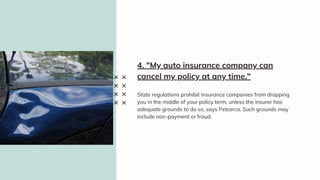
State regulations prohibit insurance companies from dropping
you in the middle of your policy term, unless the insurer has
adequate grounds to do so, says Petrarca. Such grounds may
include non-payment or fraud.
4. "My auto insurance company can
cancel my policy at any time."
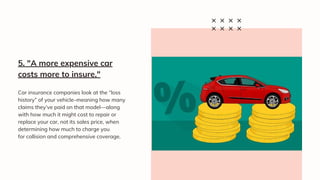
Car insurance companies look at the “loss
history” of your vehicle–meaning how many
claims they’ve paid on that model—along
with how much it might cost to repair or
replace your car, not its sales price, when
determining how much to charge you
for collision and comprehensive coverage.
5. "A more expensive car
costs more to insure."
6. "I got a ticket, so
my car insurance
rates will skyrocket."
A ticket doesn't automatically mean an increase
in rates. In fact, if the ticket was minor and you
have an otherwise clean record, your premium
may not increase. Even if you are cited as being
responsible for a minor accident, it is possible to
get auto insurance with accident
forgiveness built in. If you are buying insurance
for teen drivers, adding accident forgiveness may
be money well-spent.The type of infraction you're
cited for by policy will help determine if your rates
will go up, and if so by how much.
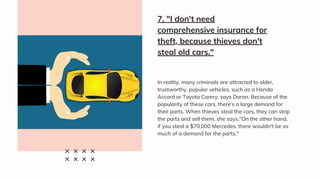
In reality, many criminals are attracted to older,
trustworthy, popular vehicles, such as a Honda
Accord or Toyota Camry, says Doran. Because of the
popularity of these cars, there's a large demand for
their parts. When thieves steal the cars, they can strip
the parts and sell them, she says."On the other hand,
if you steal a $70,000 Mercedes, there wouldn't be as
much of a demand for the parts,"
7. "I don't need
comprehensive insurance for
theft, because thieves don't
steal old cars."
Personal property, such as a laptop or
cell phone, isn't covered under an auto
insurance policy, says Petrarca. Those
items are typically covered by
the personal property insurance from
your home or renters' policy, but a
claim would be subject to a deductible.
8. "The laptop in my car
is covered by my auto
insurance policy."
Whenever you buy a new car, your
insurance company will have to
issue a new policy, regardless of
when you paid for the previous
policy, says Dick Luedke, a
spokesperson for State Farm
Insurance in Bloomington, Ill.
9. "I recently paid my insurance premium, so I won't need a
new policy for my new car."
10. "My personal auto insurance covers both personal and
business use of my car."
If you're hauling supplies or
otherwise performing business
duties in your vehicle, you must
insure your auto for business use,
says Luedke.
THANK YOU

Myths about auto insurance

  • 1.
  • 2.
    Auto insurance is acontract between you and the insurance company that protects you against financial loss in the event of an accident or theft. In exchange for your paying a premium, the insurance company agrees to pay your losses as outlined in your policy. ... Property – such as damage to or theft of your car.
  • 3.
    1. "No-fault insurance meansit's not my fault!" No-fault car insurance varies by state, but usually requires your auto insurance company to pay medical expenses and lost wages for injuries due to a car accident, regardless of who is at fault."After an accident, no-fault insurance lets all parties get payment for their immediate medical needs while their insurance companies are deciding amongst themselves which company is going to pay for the accident," says Michael Petrarca, an assistant vice president at Amica Mutual Insurance Co. in Lincoln, R.I.
  • 4.
    Auto insurance companiesset rates based on the safety features of a vehicle and how much it costs to repair or replace the vehicle (among other factors about the driver). But the color of the car doesn't factor into the premium, says Petrarca."Some makes and models generate more claims than others, and they're rated accordingly, but the color of a vehicle means nothing," he says. Review Insurance.com's concise explanation of how auto insurance works. 2. "The color of my car affects my insurance rate."
  • 5.
    3. "My friendborrowed my car, so he's responsible for damages." "If you give someone permission to drive your car and that person crashes, it will be your insurance–not your friend's policy–that covers the damages," says Rebecca Doran, a senior corporate underwriter with Amica."For a personal auto policy, the insurance is generally going to follow the car, not the driver. So if I lend a vehicle to my brother, and he gets in an accident, it would go through my insurance company," she says.However, if your auto insurance coverage is maxed out, umbrella insurance can be a financial life- saver.
  • 6.
    State regulations prohibitinsurance companies from dropping you in the middle of your policy term, unless the insurer has adequate grounds to do so, says Petrarca. Such grounds may include non-payment or fraud. 4. "My auto insurance company can cancel my policy at any time."
  • 7.
    Car insurance companieslook at the “loss history” of your vehicle–meaning how many claims they’ve paid on that model—along with how much it might cost to repair or replace your car, not its sales price, when determining how much to charge you for collision and comprehensive coverage. 5. "A more expensive car costs more to insure."
  • 8.
    6. "I gota ticket, so my car insurance rates will skyrocket." A ticket doesn't automatically mean an increase in rates. In fact, if the ticket was minor and you have an otherwise clean record, your premium may not increase. Even if you are cited as being responsible for a minor accident, it is possible to get auto insurance with accident forgiveness built in. If you are buying insurance for teen drivers, adding accident forgiveness may be money well-spent.The type of infraction you're cited for by policy will help determine if your rates will go up, and if so by how much.
  • 9.
    In reality, manycriminals are attracted to older, trustworthy, popular vehicles, such as a Honda Accord or Toyota Camry, says Doran. Because of the popularity of these cars, there's a large demand for their parts. When thieves steal the cars, they can strip the parts and sell them, she says."On the other hand, if you steal a $70,000 Mercedes, there wouldn't be as much of a demand for the parts," 7. "I don't need comprehensive insurance for theft, because thieves don't steal old cars."
  • 10.
    Personal property, suchas a laptop or cell phone, isn't covered under an auto insurance policy, says Petrarca. Those items are typically covered by the personal property insurance from your home or renters' policy, but a claim would be subject to a deductible. 8. "The laptop in my car is covered by my auto insurance policy."
  • 11.
    Whenever you buya new car, your insurance company will have to issue a new policy, regardless of when you paid for the previous policy, says Dick Luedke, a spokesperson for State Farm Insurance in Bloomington, Ill. 9. "I recently paid my insurance premium, so I won't need a new policy for my new car."
  • 12.
    10. "My personalauto insurance covers both personal and business use of my car." If you're hauling supplies or otherwise performing business duties in your vehicle, you must insure your auto for business use, says Luedke.
  • 13.