MY SQL(DATABASE SOFTWARE)
MySQL is a relational database management system ( RDBMS ) and which runs a server, providing multi-user access to a number of databases.
MySQL is currently the most popular o pen source  database server in existence.  MY SQL
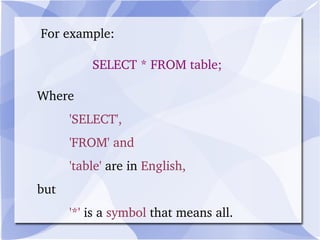
For example: SELECT * FROM table; Where  'SELECT',  'FROM' and  'table'  are in  English,   but  '*'  is a  symbol  that means all.
USES: Many web applications use MySQL as the  database component of a  LAMP  software stack.
Its popularity for use with web applications is  closely tied to the popularity of  PHP , which is  often combined with MySQL.
Several  high-traffic web sites  includes: Flickr,
Facebook,
Wikipedia,
Google,
Nokia and
YouTube  use  MySQL  for data storage and logging of user data.
CREATE  Command - is used to  create  a  database/table.
SELECT  Command - is used to  retrieve  data from  the database.
DELETE  Command - is used to  delete  data from t  the database. . BASIC QUERIES COMMANDS
INSERT  Command - is used to  insert  data into a database.
UPDATE  Command - is used to  update  the data in a table.
DROP  Command - is used to  delete or drop  the database/table.
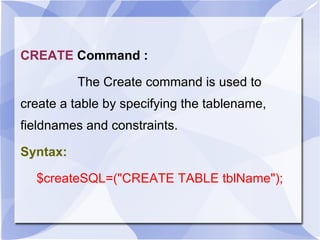
CREATE  Command : The Create command is used to create a table by specifying the tablename, fieldnames and constraints. Syntax: $createSQL=("CREATE TABLE tblName");
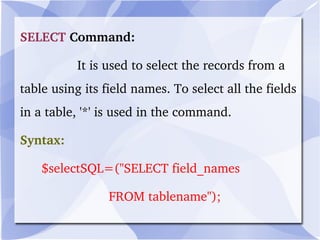
SELECT  Command:   It is used to select the records from a table using its field names. To select all the fields in a table, '*' is used in the command. Syntax: $selectSQL=("SELECT field_names FROM tablename");
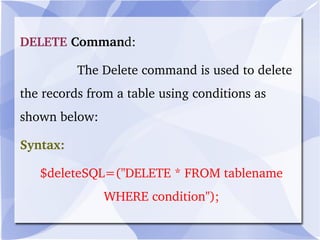
DELETE  Comman d:   The Delete command is used to delete the records from a table using conditions as shown below: Syntax: $deleteSQL=("DELETE * FROM tablename WHERE condition");
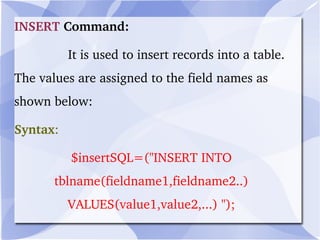
INSERT  Command: It is used to insert records into a table. The values are assigned to the field names as shown below: Syntax : $insertSQL=("INSERT INTO tblname(fieldname1,fieldname2..) VALUES(value1,value2,...) ");
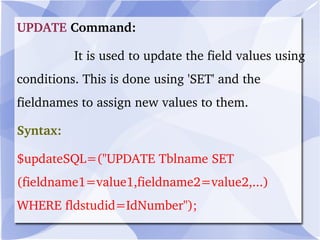
UPDATE  Command: It is used to update the field values using conditions. This is done using 'SET' and the fieldnames to assign new values to them. Syntax: $updateSQL=("UPDATE Tblname SET (fieldname1=value1,fieldname2=value2,...) WHERE fldstudid=IdNumber");
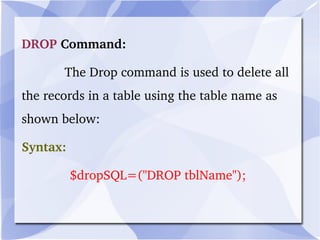
DROP  Command: The Drop command is used to delete all the records in a table using the table name as shown below:  Syntax: $dropSQL=("DROP tblName");
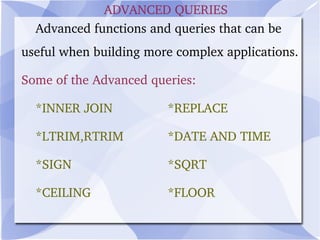
Advanced functions and queries that can be useful when building more complex applications. Some of the Advanced queries: *INNER JOIN   *REPLACE *LTRIM,RTRIM  *DATE AND TIME *SIGN  *SQRT *CEILING  *FLOOR ADVANCED QUERIES
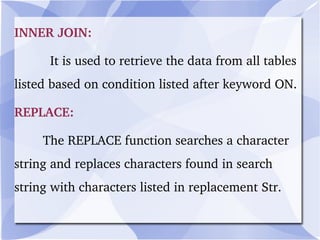
INNER JOIN: It is used to retrieve the data from all tables listed based on condition listed after keyword ON.  REPLACE: The REPLACE function searches a character string and replaces characters found in search string with characters listed in replacement Str.
LTRIM: The LTRIM function removes any leading (left-hand) spaces in a character string. RTRIM: The RTRIM function works like LTRIM, but it removes trailing spaces.
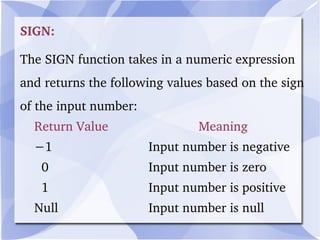
SIGN:   The SIGN function takes in a numeric expression and returns the following values based on the sign of the input number: Return Value   Meaning − 1 Input number is negative   0 Input number is zero   1 Input number is positive Null Input number is null
SQRT :   The  SQRT  function takes in a single numeric expression and returns its square root.  CEILING (CEIL): The  CEILING  function returns the smallest integer that is greater than or equal to the value of the numeric expression provided as an input parameter.
FLOOR:   It returns the integer that is less than or equal to the value of the numeric expression provided as an input parameter.
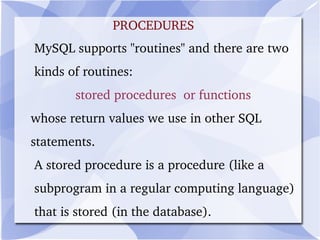
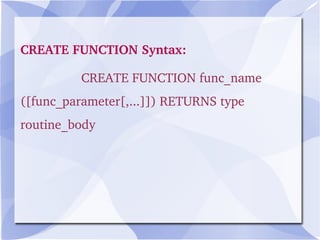
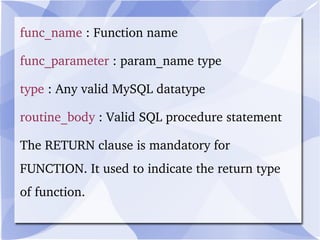
MySQL supports "routines" and there are two  kinds of routines:
stored procedures  or functions
whose return values we use in other SQL  statements.
A stored procedure is a procedure (like a  subprogram in a regular computing language)  that is stored (in the database). PROCEDURES

Mysqlppt

  • 1.
  • 2.
    MySQL is arelational database management system ( RDBMS ) and which runs a server, providing multi-user access to a number of databases.
  • 3.
    MySQL is currentlythe most popular o pen source database server in existence. MY SQL
  • 4.
    For example: SELECT* FROM table; Where 'SELECT', 'FROM' and 'table' are in English, but '*' is a symbol that means all.
  • 5.
    USES: Many webapplications use MySQL as the database component of a LAMP software stack.
  • 6.
    Its popularity foruse with web applications is closely tied to the popularity of PHP , which is often combined with MySQL.
  • 7.
    Several high-trafficweb sites includes: Flickr,
  • 8.
  • 9.
  • 10.
  • 11.
  • 12.
    YouTube use MySQL for data storage and logging of user data.
  • 13.
    CREATE Command- is used to create a database/table.
  • 14.
    SELECT Command- is used to retrieve data from the database.
  • 15.
    DELETE Command- is used to delete data from t the database. . BASIC QUERIES COMMANDS
  • 16.
    INSERT Command- is used to insert data into a database.
  • 17.
    UPDATE Command- is used to update the data in a table.
  • 18.
    DROP Command- is used to delete or drop the database/table.
  • 19.
    CREATE Command: The Create command is used to create a table by specifying the tablename, fieldnames and constraints. Syntax: $createSQL=("CREATE TABLE tblName");
  • 20.
    SELECT Command: It is used to select the records from a table using its field names. To select all the fields in a table, '*' is used in the command. Syntax: $selectSQL=("SELECT field_names FROM tablename");
  • 21.
    DELETE Command: The Delete command is used to delete the records from a table using conditions as shown below: Syntax: $deleteSQL=("DELETE * FROM tablename WHERE condition");
  • 22.
    INSERT Command:It is used to insert records into a table. The values are assigned to the field names as shown below: Syntax : $insertSQL=("INSERT INTO tblname(fieldname1,fieldname2..) VALUES(value1,value2,...) ");
  • 23.
    UPDATE Command:It is used to update the field values using conditions. This is done using 'SET' and the fieldnames to assign new values to them. Syntax: $updateSQL=("UPDATE Tblname SET (fieldname1=value1,fieldname2=value2,...) WHERE fldstudid=IdNumber");
  • 24.
    DROP Command:The Drop command is used to delete all the records in a table using the table name as shown below: Syntax: $dropSQL=("DROP tblName");
  • 25.
    Advanced functions andqueries that can be useful when building more complex applications. Some of the Advanced queries: *INNER JOIN *REPLACE *LTRIM,RTRIM *DATE AND TIME *SIGN *SQRT *CEILING *FLOOR ADVANCED QUERIES
  • 26.
    INNER JOIN: Itis used to retrieve the data from all tables listed based on condition listed after keyword ON. REPLACE: The REPLACE function searches a character string and replaces characters found in search string with characters listed in replacement Str.
  • 27.
    LTRIM: The LTRIMfunction removes any leading (left-hand) spaces in a character string. RTRIM: The RTRIM function works like LTRIM, but it removes trailing spaces.
  • 28.
    SIGN: The SIGN function takes in a numeric expression and returns the following values based on the sign of the input number: Return Value Meaning − 1 Input number is negative 0 Input number is zero 1 Input number is positive Null Input number is null
  • 29.
    SQRT : The SQRT function takes in a single numeric expression and returns its square root. CEILING (CEIL): The CEILING function returns the smallest integer that is greater than or equal to the value of the numeric expression provided as an input parameter.
  • 30.
    FLOOR: It returns the integer that is less than or equal to the value of the numeric expression provided as an input parameter.
  • 31.
    MySQL supports "routines"and there are two kinds of routines:
  • 32.
    stored procedures or functions
  • 33.
    whose return valueswe use in other SQL statements.
  • 34.
    A stored procedureis a procedure (like a subprogram in a regular computing language) that is stored (in the database). PROCEDURES