PRESENTED BY:
MISS.AMRUTA R. SAWANT,
1ST YEAR M.Sc. NURSING,
BOMBAY HOSPITAL COLLEGE
OF NURSING, MUMBAI.
DEFINITION
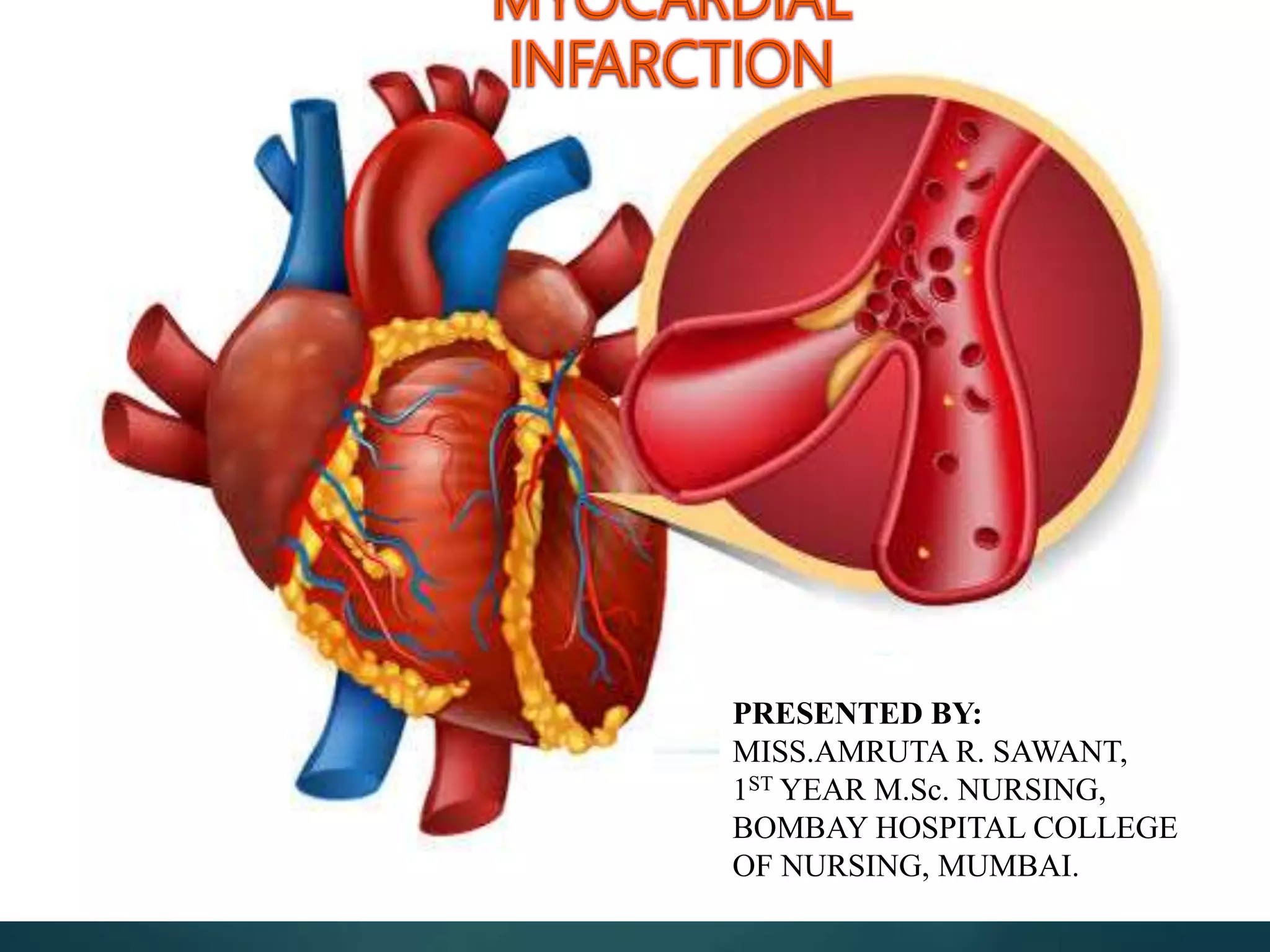
1.A myocardial infraction, also known
as a heart attack, occurs when blood
flow decreases or stops to a part of the
heart, causing damage to the heart
muscle.
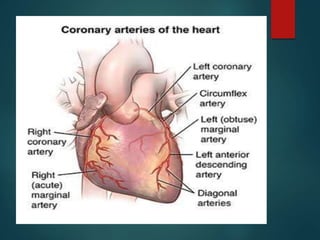
2.Myocardial infraction is caused by an
obstruction in a coronary artery ,
resulting in necrosis(death) to the
tissues supplied by the artery. The
obstruction is usually caused by
atherosclerotic plaque, a thrombus, or
an embolism. The area most commonly
affected is left ventricle.
CONTINUE…
ETIOLOGY
Tobacco smoking
Hypertension
Drug abuse
Obesity
Stress
Alcohol consumption
Diabetes
Hyperlipoproteinnaemia
Family history of Ischemic Heart
Disease
Chronic Kidney Disease
CONTINUE…
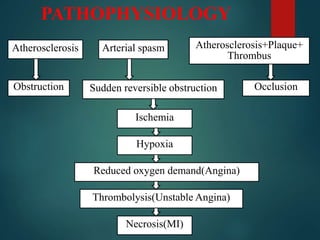
PATHOPHYSIOLOGY
Atherosclerosis Arterial spasm Atherosclerosis+Plaque+
Thrombus
Obstruction Sudden reversible obstruction Occlusion
Ischemia
Hypoxia
Reduced oxygen demand(Angina)
Thrombolysis(Unstable Angina)
Necrosis(MI)
CLINICAL MANIFESTATION
Chest discomfort
Chest pain
Fatigue
Increased sweating
Weakness
Nausea
Vomiting
Headache
Palpitation
Anxiety
Sleeplessness
Hypertension/Hypotension
Arrhythmia
Dyspnea
CONTINUE…
DIAGNOSTIC EVALUATION
12 Lead ECG
2D ECHO
Cardiac Catheterization
Blood Studies
SGOT
Creatinine Phosphokinase
LDH
Trop- T
NURSING MANAGEMENT
1. Counselling and education of
patient
2. Life style measures
3. Smoking cessation
4. Avoid alcohol intake
5. Salt restriction.
PHARMACOLOGICAL
MANAGEMENT
1. Thrombolytic agents
2. Anticoagulants
3. Antiplatelet agents
4. Beta blockers
5. Vasodilators(improve tissue
perfusion)
6.Analgesics(relieve pain)
7.Antidepressants
CONTINUE…
“INFARCTIONS”
I – IV Access
Two IV lines are placed usually to
ensure that access is available for
administering emergency
medications.
MEDICAL MANAGEMENT
N – Narcotic Analgesics
Reduce pain & anxiety, reduce
preload & after load & relaxes
bronchioles to enhance the
oxygenation.
F – Facilities for Defibrillation
Have the crash cart available &
ready.
CONTINUE…
A – Aspirin
Inhibits platelet aggregation.
Treatment should be initiated
immediately & continued for years.
R – Rest
Bed rest promote comfort &
healing.
CONTINUE…
C – Converting enzyme inhibitors
ACE inhibitors lowers the blood
pressure & kidneys excretes sodium
& fluid.
T – Thrombolytics
Administer via IV to dissolve
thrombus in a coronary artery,
allowing blood reperfusion.
CONTINUE…
I – IV beta blockers
IV given during admission. Long
term therapy with beta blockers
decreases the future incidence of
cardiac events.
O – Oxygen
Administer at a modest flow rate.
CONTINUE…
N – Nitrates
To increase cardiac output & reduce
myocardial workload
S – Stool softeners
To prevent straining during
defecation which causes vagal
stimulation & may slow the heart
rate.
CONTINUE…
 Three dysrhythmias that may occur
after an MI are Ventricular
Fibrillation, Bradycardias and
Tachycardias.
 Ventricular Fibrillation is treated by
Defibrillation, Bradycardias is
treated by Atropine and if needed , a
temporary pacer is inserted.
CONTINUE…
 Two Tachycardias that may occur
are Atrial Fibrillation and Ventricular
Tachycardia.
 Atrial Fibrillation is treated with
Digoxin or amiodarone
Hydrochloride.
 Ventricular Tachycardia is treated
with Cordarone, Xylocaine HCL or
Cardioversion.
CONTINUE…
 If Dysarrhythmias continue,
Magnesium may be given.
CONTINUE…
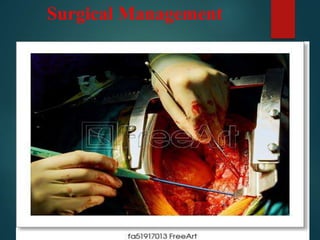
Surgical Management
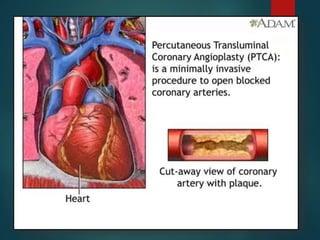
PERCUTANEOUS
TRANSLUMINAL CORONARY
ANGIOPLASTY(PTCA)
PTCA is a minimally invasive
procedure to open up blocked coronary
arteries, allowing blood to circulate
unobstructed to the heart muscle. The
blockages occur because of lipid rich
plaque within the arteries, diminishing
blood flow to the myocardium.
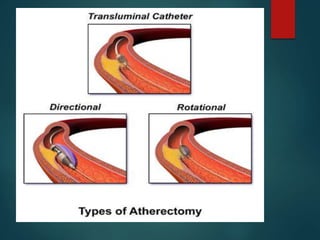
ATHERECTOMY
Atherectomy is a minimally invasive
endovascular surgery technique for
removing atherosclerosis from blood
vessels within the body. It is an
alternative to angioplasty for the
treatment of peripheral artery disease. It
is used to treat narrowing in arteries
caused by peripheral artery disease.
CORONARY ARTERY BYPASS
GRAFT(CABG)
 This is a one way to treat the blocked
or narrowed arteries with a piece of a
healthy blood vessel from elsewhere
in the body.
 A vein from leg or artery from
chest/wrist are used.
 One end of the graft attaches above
the blockage and the other end
below the blockage.
 Blood bypasses the blockage by
going through the new graft to
reach the heart muscles, this is
called coronary artery bypass
surgery.
CONTINUE…
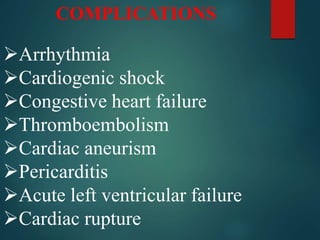
COMPLICATIONS
Arrhythmia
Cardiogenic shock
Congestive heart failure
Thromboembolism
Cardiac aneurism
Pericarditis
Acute left ventricular failure
Cardiac rupture
1.Acute pain related to tissue
ischemia as evidenced by
restlessness, changes in level of
consciousness.
Goal:
Verbalize relief/ control of chest pain
within appropriate time
Nursing Interventions:
i. Monitor & document characteristics
of pain, noting verbal reports,
nonverbal cues(crying, restlessness,
diaphoresis, clutching of chest) &
BP/ heart rate changes.
ii.Obtain full description of pain from
patient including location, intensity,
duration, characteristics & radiation.
iii. Review history of previous angina/
MI pain. Discuss family history if
pertinent.
iv. Instruct patient to report pain
immediately. Provide quite
environment, calm activities & comfort
measures. Approach patient calmly &
confidently.
CONTINUE…
v. Instruct patient to do relaxation
techniques: deep & slow breathing,
distraction behaviors, visualization,
assist as needed.
vi. Check vital signs before & after
narcotic medications.
CONTINUE…
vii. Administer supplemental oxygen by
means of nasal cannula/ face mask, as
indicated.
viii. Administer medications as
indicated.
CONTINUE…
2. Decreased cardiac output related
to damaged heart tissues.
Goal
The client will have increased cardiac
output.
Nursing Interventions:
i. Maintain bed rest with head of bed
elevated 30 degrees until the
condition is stabilized.
ii. Auscultate breath sounds & palpate
pedal pulses every 4 hours, to check the
peripheral circulation.
iii. Administer oxygen by mask/ nasal
cannula.
iv. Start an IV so medications such as
Morphine & antidysarrhytmics can be
administered.
CONTINUE…
v. If beta blockers are administered,
monitor closely for a drop in HR &
blood pressure.
vi. Constantly monitor the client for
dysrhythmias.
vii. Monitor intake & output.
CONTINUE…
ARTICLE published by European
Society of Cardiology
TOPIC: Acute cardiac care
METHOD used: Observational study
STUDY:
Milan, Italy…
Heart attack patients prescribed
antidepressants have lower one year
of survival rates.
The observational study of nearly 9000
patients found that those prescribed
antidepressants at discharge from
hospital after a heart attack had a 66 %
greater risk of mortality one year later
than patients not prescribed the drugs,
although they noted the cause is not
necessarily related directly to the
antidepressants.
CONTINUE…
CONCLUSION: The study showed
that many patients are treated with
antidepressants after a heart attack.
More research is needed to pinpoint
the causes & underlying
pathological mechanisms for the
higher mortality they observed in
this patient group.
ANY
QUESTION
?
MYOCARDIAL INFRACTION.pptx

MYOCARDIAL INFRACTION.pptx

  • 1.
    PRESENTED BY: MISS.AMRUTA R.SAWANT, 1ST YEAR M.Sc. NURSING, BOMBAY HOSPITAL COLLEGE OF NURSING, MUMBAI.
  • 2.
    DEFINITION 1.A myocardial infraction,also known as a heart attack, occurs when blood flow decreases or stops to a part of the heart, causing damage to the heart muscle.
  • 3.
    2.Myocardial infraction iscaused by an obstruction in a coronary artery , resulting in necrosis(death) to the tissues supplied by the artery. The obstruction is usually caused by atherosclerotic plaque, a thrombus, or an embolism. The area most commonly affected is left ventricle. CONTINUE…
  • 4.
  • 5.
    Alcohol consumption Diabetes Hyperlipoproteinnaemia Family historyof Ischemic Heart Disease Chronic Kidney Disease CONTINUE…
  • 6.
    PATHOPHYSIOLOGY Atherosclerosis Arterial spasmAtherosclerosis+Plaque+ Thrombus Obstruction Sudden reversible obstruction Occlusion Ischemia Hypoxia Reduced oxygen demand(Angina) Thrombolysis(Unstable Angina) Necrosis(MI)
  • 7.
    CLINICAL MANIFESTATION Chest discomfort Chestpain Fatigue Increased sweating Weakness Nausea Vomiting
  • 8.
  • 9.
    DIAGNOSTIC EVALUATION 12 LeadECG 2D ECHO Cardiac Catheterization Blood Studies SGOT Creatinine Phosphokinase LDH Trop- T
  • 10.
    NURSING MANAGEMENT 1. Counsellingand education of patient 2. Life style measures 3. Smoking cessation 4. Avoid alcohol intake 5. Salt restriction.
  • 11.
    PHARMACOLOGICAL MANAGEMENT 1. Thrombolytic agents 2.Anticoagulants 3. Antiplatelet agents 4. Beta blockers 5. Vasodilators(improve tissue perfusion)
  • 12.
  • 13.
    “INFARCTIONS” I – IVAccess Two IV lines are placed usually to ensure that access is available for administering emergency medications. MEDICAL MANAGEMENT
  • 14.
    N – NarcoticAnalgesics Reduce pain & anxiety, reduce preload & after load & relaxes bronchioles to enhance the oxygenation. F – Facilities for Defibrillation Have the crash cart available & ready. CONTINUE…
  • 15.
    A – Aspirin Inhibitsplatelet aggregation. Treatment should be initiated immediately & continued for years. R – Rest Bed rest promote comfort & healing. CONTINUE…
  • 16.
    C – Convertingenzyme inhibitors ACE inhibitors lowers the blood pressure & kidneys excretes sodium & fluid. T – Thrombolytics Administer via IV to dissolve thrombus in a coronary artery, allowing blood reperfusion. CONTINUE…
  • 17.
    I – IVbeta blockers IV given during admission. Long term therapy with beta blockers decreases the future incidence of cardiac events. O – Oxygen Administer at a modest flow rate. CONTINUE…
  • 18.
    N – Nitrates Toincrease cardiac output & reduce myocardial workload S – Stool softeners To prevent straining during defecation which causes vagal stimulation & may slow the heart rate. CONTINUE…
  • 19.
     Three dysrhythmiasthat may occur after an MI are Ventricular Fibrillation, Bradycardias and Tachycardias.  Ventricular Fibrillation is treated by Defibrillation, Bradycardias is treated by Atropine and if needed , a temporary pacer is inserted. CONTINUE…
  • 20.
     Two Tachycardiasthat may occur are Atrial Fibrillation and Ventricular Tachycardia.  Atrial Fibrillation is treated with Digoxin or amiodarone Hydrochloride.  Ventricular Tachycardia is treated with Cordarone, Xylocaine HCL or Cardioversion. CONTINUE…
  • 21.
     If Dysarrhythmiascontinue, Magnesium may be given. CONTINUE…
  • 22.
  • 23.
    PERCUTANEOUS TRANSLUMINAL CORONARY ANGIOPLASTY(PTCA) PTCA isa minimally invasive procedure to open up blocked coronary arteries, allowing blood to circulate unobstructed to the heart muscle. The blockages occur because of lipid rich plaque within the arteries, diminishing blood flow to the myocardium.
  • 25.
    ATHERECTOMY Atherectomy is aminimally invasive endovascular surgery technique for removing atherosclerosis from blood vessels within the body. It is an alternative to angioplasty for the treatment of peripheral artery disease. It is used to treat narrowing in arteries caused by peripheral artery disease.
  • 27.
    CORONARY ARTERY BYPASS GRAFT(CABG) This is a one way to treat the blocked or narrowed arteries with a piece of a healthy blood vessel from elsewhere in the body.  A vein from leg or artery from chest/wrist are used.
  • 28.
     One endof the graft attaches above the blockage and the other end below the blockage.  Blood bypasses the blockage by going through the new graft to reach the heart muscles, this is called coronary artery bypass surgery. CONTINUE…
  • 30.
    COMPLICATIONS Arrhythmia Cardiogenic shock Congestive heartfailure Thromboembolism Cardiac aneurism Pericarditis Acute left ventricular failure Cardiac rupture
  • 32.
    1.Acute pain relatedto tissue ischemia as evidenced by restlessness, changes in level of consciousness. Goal: Verbalize relief/ control of chest pain within appropriate time
  • 33.
    Nursing Interventions: i. Monitor& document characteristics of pain, noting verbal reports, nonverbal cues(crying, restlessness, diaphoresis, clutching of chest) & BP/ heart rate changes. ii.Obtain full description of pain from patient including location, intensity, duration, characteristics & radiation.
  • 34.
    iii. Review historyof previous angina/ MI pain. Discuss family history if pertinent. iv. Instruct patient to report pain immediately. Provide quite environment, calm activities & comfort measures. Approach patient calmly & confidently. CONTINUE…
  • 35.
    v. Instruct patientto do relaxation techniques: deep & slow breathing, distraction behaviors, visualization, assist as needed. vi. Check vital signs before & after narcotic medications. CONTINUE…
  • 36.
    vii. Administer supplementaloxygen by means of nasal cannula/ face mask, as indicated. viii. Administer medications as indicated. CONTINUE…
  • 37.
    2. Decreased cardiacoutput related to damaged heart tissues. Goal The client will have increased cardiac output.
  • 38.
    Nursing Interventions: i. Maintainbed rest with head of bed elevated 30 degrees until the condition is stabilized. ii. Auscultate breath sounds & palpate pedal pulses every 4 hours, to check the peripheral circulation.
  • 39.
    iii. Administer oxygenby mask/ nasal cannula. iv. Start an IV so medications such as Morphine & antidysarrhytmics can be administered. CONTINUE…
  • 40.
    v. If betablockers are administered, monitor closely for a drop in HR & blood pressure. vi. Constantly monitor the client for dysrhythmias. vii. Monitor intake & output. CONTINUE…
  • 42.
    ARTICLE published byEuropean Society of Cardiology TOPIC: Acute cardiac care METHOD used: Observational study
  • 43.
    STUDY: Milan, Italy… Heart attackpatients prescribed antidepressants have lower one year of survival rates.
  • 44.
    The observational studyof nearly 9000 patients found that those prescribed antidepressants at discharge from hospital after a heart attack had a 66 % greater risk of mortality one year later than patients not prescribed the drugs, although they noted the cause is not necessarily related directly to the antidepressants. CONTINUE…
  • 45.
    CONCLUSION: The studyshowed that many patients are treated with antidepressants after a heart attack. More research is needed to pinpoint the causes & underlying pathological mechanisms for the higher mortality they observed in this patient group.
  • 46.