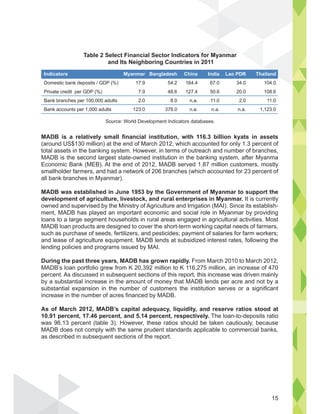
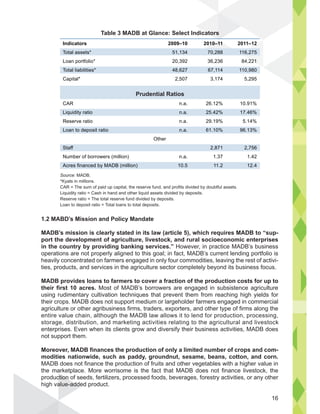
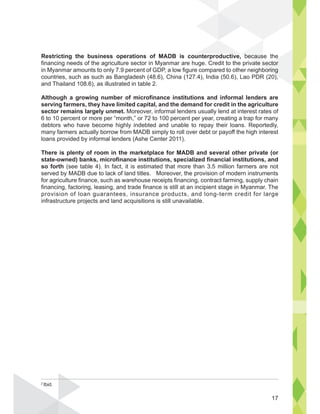
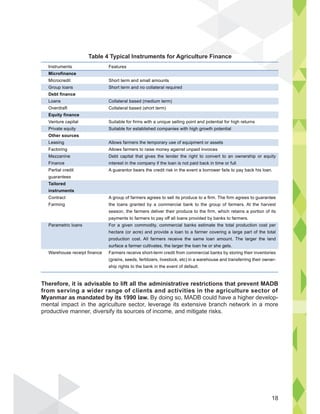
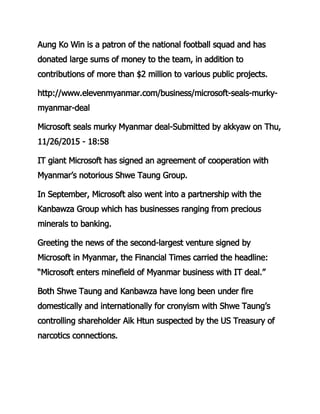
10/16/2017 Asia Green Development Bank - Wikipedia
https://en.wikipedia.org/wiki/Asia_Green_Development_Bank 1/2
Asia Green Development
Bank (AGD)
Native name အာ စိမ်းလန်းမ
ဖွံ့ဖြိုးရေးဘဏ်
Industry Financial
services
Founded July 2, 2010
Headquarters Yangon, Burma
Services Banking
Total assets 366 billion kyat
(US$366 million)
Website www.agdbank
.com (http://ww
w.agdbank.com)
Asia Green Development Bank
Asia Green Development Bank (Burmese: အာ စိမ်းလန်းမဖွံ့ဖြိုးရေးဘဏ် ; abbreviated AGD Bank) is a private
commercial bank in Burma (Myanmar).[1] It was one of 4 private banks to commence operations in August 2010, the
first new financial institutions in the country since the establishment of Innwa Bank in 1997.[2] Its head office is
situated at Yangon, Burma. The bank announced it would become a public company when Yangon Stock Exchange is
formed in 2015.[3] The bank was founded by Tay Za and the Htoo Group of Companies, whose 15% stake was sold to
new shareholders, the most prominent of whom is Kyaw Ne Win, the grandson of Ne Win, the country's former
dictator.[4]
The AGD Bank’s Head Office and first branch was successfully opened on August 6, 2010 in Nay Pyi Taw under the
organization of Htoo Group of Companies. At first, AGD bank is 100% owned and operated by “Htoo Group of
Companies” which is engaged in trading, energy and mining, construction, agriculture, hotel, travel and tourism
business. In February 18, 2013 with a new slogan “We, all Myanmar will develop together”, AGD bank was converted
to Public Company, shares capital stands at 30.0873 billion kyats of 601746 shares in the fiscal year.
AGD Bank has been 70 branches across the country until September 2017. With establish an International Banking
Department, authorized as Dealer and Money Changer Licenses 65 foreign exchange counters services to the general
public.
List of banks
List of banks in Burma
1. The Banker Database (http://www.thebankerdatabase.com/index.cfm/banks/all/?letter=A)
2. Cheesman, Nick; Monique Skidmore; Trevor Wilson (2012). Myanmar's Transition: Openings, Obstacles, and Opportunities. Institute of Southeast Asian Studies.
p. 147.
Brief Info
See also
References
10/16/2017 Asia Green Development Bank - Wikipedia
https://en.wikipedia.org/wiki/Asia_Green_Development_Bank 2/2
3. Aye Thidar Kyaw (28 January 2013). "Asia Green Development Bank planning to go public" (http://www.mmtimes.com/index.php/business/3937-asia-green-dev
elopment-bank-planning-to-go-public.html). Myanmar Times. Retrieved 8 February 2015.
4. Aung Shin; Aye Thida Kyaw (21 July 2014). "Change in owners as U Tay Za said to exit AGD Bank" (http://www.mmtimes.com/index.php/business/11073-chang
e-in-owners-as-u-tay-za-said-to-exit-agd-bank.html). Myanmar Times. Retrieved 8 February 2015.
Retrieved from "https://en.wikipedia.org/w/index.php?title=Asia_Green_Development_Bank&oldid=802638051"
This page was last edited on 27 September 2017, at 13:48.
Text is available under the Creative Commons Attribution-ShareAlike License; additional terms may apply. By using this site, you agree to the Terms of Use and
Privacy Policy. Wikipedia® is a registered trademark of the Wikimedia Foundation, Inc., a non-profit organization.
10/16/2017 Asia Yangon Bank's Branches List | Central Bank of Myanmar
http://www.cbm.gov.mm/content/%E1%80%A1%E1%80%AC%E1%80%9B%E1%80%BD%E1%80%9B%E1%80%94%E1%80%B9%E1%80%80%E1%80%AF%E1%80%94%E1%80%B9%E1%80%98… 1/2
MYANMARENGLISH |
Information
Contact List
News & Announcements
Our CBM - new website
Photo Gallery
Video Gallery
Asia Yangon Bank's Branches List
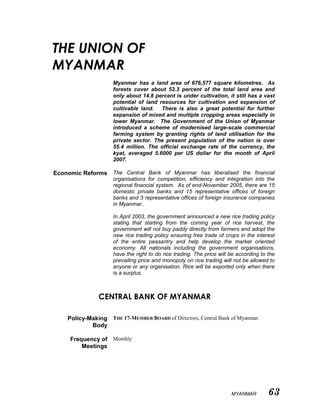
၁. ရံုးခ်ဳပ္ဘဏ္ ခြဲ
အမွတ္ (၃၁၉/၃၂၁)၊ မဟာဗႏၶဳလလမ္း၊ ဗိုလ္ တေထာင္ၿမိဳ႔နယ္ ၊ ရန္ကုန္ၿမိဳ႕
၂. လယ္ ေဝးဘဏ္ ခဲြႀကီး
အမွတ္ (၅/၂၇၂)၊ အမွတ္ (၅)ရပ္ကြက္ ၊
ရန္ကုန္-မႏၱေလးလမ္းမႀကီး၊ လယ္ ေဝးၿမိဳ႕
၃. မႏၱေလးဘဏ္ ခဲြႀကီး
အမွတ္ (၄၃၈)၊(၈၃)လမ္း(၃၄လမ္းx၃၅လမ္း)ၾကား
(ေအာင္နန္းရိပ္သာအေနာက္ )၊ ခ်မ္းေအးသာစံၿမိဳ႕နယ္
၄. ဘုရင့္ေနာင္ဘဏ္ ခဲြႀကီး
အမွတ္ (က-၁၂၉)၊ ကံ့ ေကာ္ လမ္းနွင့္ခတၱာလမ္းေထာင့္၊
အမွတ္ (၁)ရပ္ကြက္ ၊ မရမ္းကုန္းၿမိဳ႕နယ္ ၊ (ဘုရင့္ေနာင္ပဲြရံုဝန္း)
၅. ေတာင္ငူဘဏ္ ခဲြႀကီး
အမွတ္ (၂၂၄)၊ (၇)လမ္း၊ (၁၆)ရပ္ကြက္ ၊ ေတာင္ငူၿမိဳ႕
၆. မံုရြာဘဏ္ ခဲြႀကီး
အမွတ္ (၆/၂၅)၊ ဗိုလ္ ခ်ဳပ္လမ္း၊ နယ္ ေျမ(၆)၊
ေအးသာယာရပ္ကြက္ ၊ မံုရြာၿမိဳ႕
၇. မေကြးဘဏ္ ခဲြႀကီး
အမွတ္ (၄၁၂)၊ျပည္ ေတာ္ သာလမ္း နွင့္သုခိတာလမ္းေထာင့္၊
ရန္မ်ိဳးေအာင္ရပ္ကြက္ ၊ မေကြးၿမိဳ႕
၈. ပုသိမ္ဘဏ္ ခဲြႀကီး
အမွတ္ (၂၃)၊ ကုန္သည္ လမ္းနွင့္ဥမၼာဒႏၱီလမ္းေထာင့္၊
ရကအ(၄) နယ္ ေျမ၊ ပုသိမ္ၿမိဳ႕
Search
Capital Market
Issuance of Government Treasury Bonds
Relationship between Myanmar and
SEACEN
Foreign Exchange Regulation Act
Issuing Foreign Exchange Dealer
Licenses
Non-Bank Money Changers
Criteria for Offshore Loan
Monetary and Financial Cooperation
with ASEAN and ASEAN+3 Countries
Quarterly Financial Statistics Bulletin
Date : 16th Oct 2017
1362.0 / USD
More
Source : forex.cbm.gov.mm
Deposit Auction
Interest Rate(%)
Central Bank Rate 10% pa
Minimum Bank Deposit Rate 8%pa
Maximum Bank Lending
Rate
13%pa
Economic Indicators (%)
GDP Growth 5.90 %
HOME | NEWS | CONTACT US
The Republic of the Union of Myanmar
Central Bank of Myanmar
About CBM Monetary Policy Payment System Financial Institutions Bank Notes and Coins Laws & Regulation Government Securities
Annual Reports
10/16/2017 Asia Yangon Bank's Branches List | Central Bank of Myanmar
http://www.cbm.gov.mm/content/%E1%80%A1%E1%80%AC%E1%80%9B%E1%80%BD%E1%80%9B%E1%80%94%E1%80%B9%E1%80%80%E1%80%AF%E1%80%94%E1%80%B9%E1%80%98… 2/2
၉. ျပည္ ဘဏ္ ခဲြႀကီး
အမွတ္ (၂၁၃)၊ လမ္းရွည္ လမ္း၊ ေရႊကူရပ္ကြက္ ၊ ျပည္ ၿမိဳ႕
၁၀. မင္းဘူးဘဏ္ ခဲြႀကီး
အမွတ္ (၁၄၄၅)၊ မင္းဘူး-စကုလမ္းမႀကီး၊ တမာတန္းရပ္ကြက္ ၊
မင္းဘူးၿမိဳ႕
Latest News
Activities of Interbank Foreign Exchange Market for 16.10.2017
Auction Result for 16.10.2017
Activities of Interbank Foreign Exchange Market for 13.10.2017
Auction Result for 13.10.2017
Activities of Interbank Foreign Exchange Market for 12.10.2017
1 2 3 4 5 6 7 8 9 … next › last »
Annual Rate of Inflation 4.91 %
Year on Year Inflation 2.30 %
Source : Ministry of Planning and
Finance
Interbank Market Rates
Copyright © 2015 Central Bank of Myanmar. All rights reserved. Related Websites | Contact Us | Sitemap
10/16/2017 Ayeyarwady Bank - Wikipedia
https://en.wikipedia.org/wiki/Ayeyarwady_Bank 1/2
AYA Bank
AYA Bank
Native name ဧရာဝတီဘဏ်
Type Private
Founded 2010
Founder Zaw Zaw
Headquarters Yangon, Myanmar
Number of
locations
225 branches (August
2017)
Key people Zaw Zaw
(Group Chairman)
Myint Zaw (Managing
Director)
Products Financial services
Number of
employees
8300[1] (2017)
Website www.ayabank.com (htt
p://www.ayabank.co
m)
Ayeyarwady Bank
Ayeyarwady Bank Ltd. (Burmese: ဧရာဝတီဘဏ် ; AYA Bank) is a private bank in Myanmar. AYA Bank
was established on 2 July 2010 with the permission of the Central Bank of Myanmar. The AYA Bank's head
office is located in the Rowe Building Kyauktada Township of Yangon.
AYA Bank had 225 branches as of August 2017. Ayeyarwady Bank offers retail and commercial banking
products and services.
Ayeyarwady Bank received its banking license from the Central Bank of Myanmar on 2 July 2010 and began
operations on 11 August 2010. The bank is authorized to operate as an investment or development bank for
the domestic market and the approved banking activities include:
Borrowing or raising of money
Lending or advancing of money either secured or unsecured
Receiving securities or valuables for safe custody
Collecting and transmitting money and securities
Cash management system
Internet banking
Provision of international banking services including international remittance, payment and trade
services
Mobile Banking
1. "The Myanmar Times Bank Survey 2014" (http://www.mmtimes.com/index.php/special-features/194-y
our-money-2014/11033-bank-survey-2014.html?start=2). Myanmar Times. 15 July 2014. Retrieved
8 February 2015.
Retrieved from "https://en.wikipedia.org/w/index.php?title=Ayeyarwady_Bank&oldid=805370571"
History
References
10/16/2017 Ayeyarwady Bank - Wikipedia
https://en.wikipedia.org/wiki/Ayeyarwady_Bank 2/2
This page was last edited on 14 October 2017, at 22:50.
Text is available under the Creative Commons Attribution-ShareAlike License; additional terms may apply. By using this
site, you agree to the Terms of Use and Privacy Policy. Wikipedia® is a registered trademark of the Wikimedia
Foundation, Inc., a non-profit organization.
Ayeyarwady Bank
10/16/2017 Central Bank of Myanmar - Wikipedia
https://en.wikipedia.org/wiki/Central_Bank_of_Myanmar 1/5
Central Bank of Myanmar
မြန်မာနိုင်ငံတော် ဗဟိုဘဏ်
Seal
Headquarters
Headquarters Naypyidaw
Established 3 April 1948 (as
Union Bank of
Burma)
Governor Kyaw Kyaw
Maung[1]
Central bank of Myanmar
(Burma)
Currency Myanmar kyat
MMK (ISO
4217)
Preceded by Union Bank of
Burma
People’s Bank
Central Bank of Myanmar
The Central Bank of Myanmar (Burmese: ြမန်မာ ိင်ငံေတာ်ဗဟိဘဏ်; MLCTS: myan
ma naing ngam taw ba ho bhan IPA: [mjəmà nàinŋàndɔ̀ bəhòʊbàn]; abbreviated
CBM) is the central bank of Myanmar (formerly Burma).
Contents
1 Organisation
2 History
3 Role
4 Members
5 See also
6 References
6.1 Footnotes
Organisation
Its headquarter located in Naypyidaw, and it has branches in Yangon and
Mandalay. The Governor is Kyaw Kyaw Maung and three Vice Governors are Set
Aung, Khin Saw Oo and Soe Min. The Central Bank of Myanmar became an
Coordinates: 19.7915°N 96.1441°E
10/16/2017 Central Bank of Myanmar - Wikipedia
https://en.wikipedia.org/wiki/Central_Bank_of_Myanmar 2/5
of Union Bank
of Burma
Website www.cbm.gov
.mm (http://ww
w.cbm.gov.mm)
autonomous and independent regulatory body by the Central Bank of Myanmar
Law which was enacted by the Myanmar Parliament in 2013.
History
The Central Bank of Myanmar was founded as "the Union Bank of Burma" on 3rd April 1948 by the Act of Union
Bank of Burma 1947 and took over the functions of the Rangoon branches of the Reserve Bank of India.[2]The
Union Bank of Burma was opened at the corner of Merchant Road and Sule Pagoda Road and had a sole right of
currency issue.
Role
CBM has liberalised the financial organisations for competition, efficiency and integration into the regional
financial system. As of the end of December 2007, there are 15 domestic private banks and 13 representative
offices of foreign banks and three representative offices of foreign insurance companies in Myanmar. According to
the changes in the economic requirements of the country, the Central Bank rate has been increased from 10
percent to 12 percent since 1 April 2006.
Agricultural liberalisation speeded up after the elimination of the government procurement system of the main
agricultural crops such as rice, pulses, sugarcane, cotton, etc., in 2003–04. The state also reduced the subsidised
agricultural inputs, especially fertiliser. With an intention to enhance private participation in trade of agricultural
products and inputs, the government is now encouraging export of crops which are in surplus in domestic
markets or grown on fallow or waste land, giving opportunities to farmer and private producers.
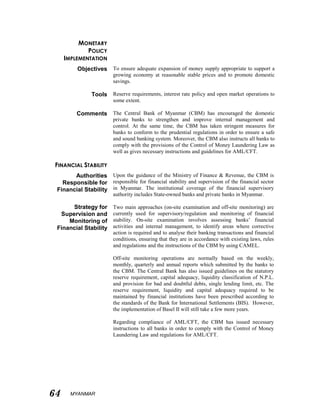
Upon the guidance of the Ministry of Finance & Revenue, the CBM is responsible for financial stability and
supervision of the financial sector in Myanmar. The institutional coverage of the financial supervisory authority
includes state-owned banks and private banks in Myanmar. Two main approaches (on-site examination and off-
site monitoring) are currently used for supervision, regulation and monitoring of financial stability.
10/16/2017 Central Bank of Myanmar - Wikipedia
https://en.wikipedia.org/wiki/Central_Bank_of_Myanmar 3/5
On-site examination involves assessing banks’ financial activities and internal management, to identify areas
where corrective action is required and to analyse their banking transactions and financial conditions, ensuring
that they are in accordance with existing laws, rules and regulations and the instructions of the CBM by using
CAMEL. Off-site monitoring operations are normally based on the weekly, monthly, quarterly and annual reports
which are submitted by the banks to the CBM.
The Central Bank has also issued guidelines on the statutory reserve requirement, capital adequacy, liquidity,
classification of N.P.L. and provision for bad and doubtful debts, single lending limit, etc. The reserve
requirement, liquidity and capital adequacy required to be maintained by financial institutions have been
prescribed according to the standards of the Bank for International Settlements (BIS). However, the
implementation of Basel II will still take a few more years.
Members
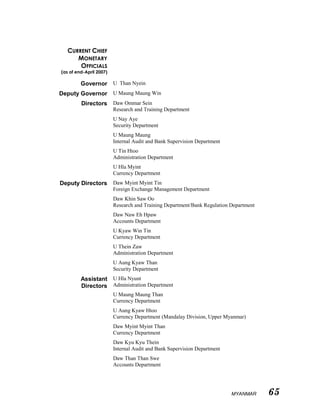
As of end of July 2016, its current members are as follows:
Governor
Kyaw Kyaw Maung[3]
Deputy Governors
Set Aung[4]
Khin Saw Oo
Soe Min
Director Generals
Myint Myint Kyi (Governor's Office)
Aung Aung (Administration and Human Resource Development Department)
May Malar Maung Gyi (Monetary Policy Affairs and Banking Regulation Department)
Thida Myo Aung (Financial Institutions Supervision Department)
10/16/2017 Central Bank of Myanmar - Wikipedia
https://en.wikipedia.org/wiki/Central_Bank_of_Myanmar 4/5
Than Than Swe (Accounts Department)
Win Thaw (Foreign Exchange Management Department)
See also
Myanmar kyat
General:
List of banks in Burma
Economy of Burma
References
"The Union of Myanmar" (https://web.archive.org/web/20070929022831/http://www.seacen.org/bankwatch/
myanmar.pdf) (PDF). South East Asian Central Banks Research and Training Centre. 2005. pp. 45–49.
Archived from the original (http://www.seacen.org/bankwatch/myanmar.pdf) (PDF) on 29 September 2007.
Retrieved 2 July 2006.
Footnotes
1. Aye Thidar Kyaw (29 July 2013). "Old hand on new board" (http://www.mmtimes.com/index.php/business/7
587-old-hand-on-new-board.html). The Myanmar Times. Retrieved 31 July 2013.
2. "Central Bank of Myanmar" (http://www.cbm.gov.mm/). www.cbm.gov.mm. Retrieved 2017-07-16.
3. "List of Governors of the Central Bank of Myanmar | Central Bank of Myanmar" (http://www.cbm.gov.mm/co
ntent/list-governors-central-bank-myanmar-0). www.cbm.gov.mm. Retrieved 2016-09-20.
4. "News from SEACEN Member Banks" (http://www.mongolbank.mn/documents/moneypolicy/seacen_newslett
er/2011-4.pdf) (PDF). National Bank of Mongolia. Retrieved 15 June 2012.
10/16/2017 Central Bank of Myanmar - Wikipedia
https://en.wikipedia.org/wiki/Central_Bank_of_Myanmar 5/5
/ p ) ( ) g
Retrieved from "https://en.wikipedia.org/w/index.php?title=Central_Bank_of_Myanmar&oldid=790790132"
This page was last edited on 16 July 2017, at 02:33.
Text is available under the Creative Commons Attribution-ShareAlike License; additional terms may apply. By
using this site, you agree to the Terms of Use and Privacy Policy. Wikipedia® is a registered trademark of
the Wikimedia Foundation, Inc., a non-profit organization.
10/16/2017 (20) Construction And Housing Development Bank - About
https://www.facebook.com/pg/CHDB.Bank/about/?ref=page_internal 1/2
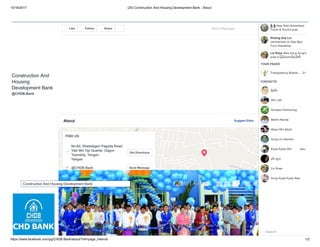
Construction And
Housing
Development Bank
@CHDB.Bank
About Suggest Edits
HOURS
Closes in 60 minutes 9:30AM - 3:00PM
BUSINESS INFO
Opened on January 11, 2014
Mission
No.60, Shwedagon Pagoda Road,
Yaw Min Gyi Quarter, Dagon
Township, Yangon.
Yangon
@CHDB.Bank
Call +95 9 771 049627
FIND US
Get Directions
Send Message
Send MessageLike Follow Share
ခ်ိဳခ်ိဳlikes Solo Adventisso
Travel & Tours's post.
Khaing Soe Lin
commented on Zaw Myo
Tun's friendship.
Liz Rose likes Aung Aung's
post in ျပည္ ေထာင္စုပါတီ-
YOUR PAGES
CONTACTS
9+Transparency Busine…
ရဲေဇာ္
Win Latt
Sompan Panmoung
Martin Nanda
Wazo Win Myint
Aung Lin Haoneo
48mKyaw Kyaw Win
မင္း ရသ
Liz Rose
Aung Kyaw Kyaw Alax
Search
Myo Home 20+
20
Construction And Housing Development Bank
10/16/2017 (20) Construction And Housing Development Bank - About
https://www.facebook.com/pg/CHDB.Bank/about/?ref=page_internal 2/2
Construction And
Housing
Development Bank
@CHDB.Bank
Home
About
Photos
Reviews
Videos
Posts
Community
Events
Create a Page
About Create Ad Create Page Developers Careers Privacy Cookies Terms Help
Facebook © 2017
English (US) မြန် မာဘာသာ ภาษาไทย 日本語 中文(简体) Tiếng Việt Français (France) Deutsch Русский Español Português (Brasil)
Finance Company · Investment Bank
To realize the potential for financial resources towards the
development of construction urban and housing sector and to
enable the citizens to afford housing b... See More
ADDITIONAL CONTACT INFO
mkt.chdb@gmail.com
http://www.chdb.com.mm
MORE INFO
About
အိမ္ရာပိုင္ရန္ေမွ် ာ္ မွန္းလို႔ စုေဆာင္းေငြေၾကးတိုးပြားဖို႔ CHDB တြင္ စုၾက
စို႕
Products
Housing Savings Account
Housing Mortgage Loan
Ad Choices
Send MessageLike Follow Share
ခ်ိဳခ်ိဳlikes Solo Adventisso
Travel & Tours's post.
Khaing Soe Lin
commented on Zaw Myo
Tun's friendship.
Liz Rose likes Aung Aung's
post in ျပည္ ေထာင္စုပါတီ-
YOUR PAGES
CONTACTS
9+Transparency Busine…
ရဲေဇာ္
Win Latt
Sompan Panmoung
Martin Nanda
Wazo Win Myint
Aung Lin Haoneo
48mKyaw Kyaw Win
မင္း ရသ
Liz Rose
Aung Kyaw Kyaw Alax
Search
10/16/2017 Co-operative Bank Ltd - Wikipedia
https://en.wikipedia.org/wiki/Co-operative_Bank_Ltd 1/2
CB Bank
Type Public
Industry Banking
Founded August 21, 1992
Headquarters Yangon, Myanmar
Number of
locations
183 branches
(2016)[1]
Key people Khin Maung Aye
(Chairman)
Kyaw Lynn
(Executive Vice
Chairman & CEO)
Products Financial services
Number of
employees
7000 (2016)
Website www.cbbank.com
.mm (http://www.c
bbank.com.mm)
Co-operative Bank Ltd
Co-operative Bank Ltd. (CB Bank) (Burmese: သမဝါယမဘဏ် လီမိတက် ) is one of the largest private banks in
Myanmar. The CB Bank was established on 21 August 1992 with the permission of the Central Bank of
Myanmar. The CB Bank's head office is located in the Botahtaung township area of Yangon. CB Bank has 183
local branches which offers a range of banking services in consumer banking and business banking. CB Bank
launched the first ATM in Myanmar on 1 November 2011. The bank named the ATM service as EASI Banking.
The bank has the largest network of ATM (525) and Foreign Exchange Counters (73) in Myanmar.[2][3][4][5]
1. "CB Bank: Branches Location" (http://www.cbbank.com.mm/aboutus/aboutus_network_branches.aspx).
www.cbbank.com.mm. Retrieved 16 June 2017.
2. "C B Bank - About Us" (http://www.cbbank.com.mm/about.php?l=e). Cbbankmm.com. Retrieved
2012-01-28.
3. "GRG Helps Myanmar Public to Have ATM Again After 8 Year of Waiting" (http://www.grgbanking.com/en/
show_news.asp?id=1699&type_id=21). Grgbanking.com. 2011-11-01. Retrieved 2012-01-28.
4. 4-traders (2011-11-01). "GRG Banking Equipment Co., Ltd. : GRG Helps Myanmar Public to Have ATM
Again After 8 Year .." (http://www.4-traders.com/GRG-BANKING-EQUIPMENT-CO-6499814/news/GRG-BA
NKING-EQUIPMENT-CO-LTD-GRG-Helps-Myanmar-Public-to-Have-ATM-Again-After-8-Year-13884878/). 4-
Traders. Retrieved 2012-01-28.
5. "ATMs find favour with users" (http://www.mmtimes.com/2011/business/602/biz60202.html).
Mmtimes.com. Retrieved 2012-01-28.
Official website (http://www.cbbank.com.mm/)
Retrieved from "https://en.wikipedia.org/w/index.php?title=Co-operative_Bank_Ltd&oldid=793968293"
This page was last edited on 5 August 2017, at 00:35.
References
External links
10/16/2017 DSC_0211 copy | First Private Bank
http://www.firstprivatebank.com.mm/en/about.html/dsc_0211-copy 1/3
DSC_0211 copy
Published September 5, 2017 at 4288 × 2848 (http://www.firstprivatebank.com.mm/wp-content/uploads/2014/09/DSC_0211-copy.jpg) in About First Private Bank
(http://www.firstprivatebank.com.mm/en/about.html).
← Previous (http://www.firstprivatebank.com.mm/wp-content/uploads/2015/10/asdfasdf.jpg)
First Private Bank (http://www. rstprivatebank.com.mm/en/)
The most trusted bank in Myanmar
ျမန္မာ (http://www.firstprivatebank.com.mm/about.html/dsc_0211-copy) English (http://www.firstprivatebank.com.mm/en/about.html/dsc_0211-copy)
Search ..
News :
About Frist Private Bank (http://www.fpbbankmyanmar.com/about.html)
10/16/2017 DSC_0211 copy | First Private Bank
http://www.firstprivatebank.com.mm/en/about.html/dsc_0211-copy 2/3
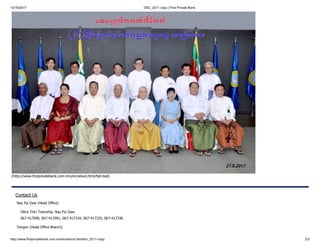
(http://www.firstprivatebank.com.mm/en/about.html/fpb-bod)
Contact Us
Nay Pyi Daw (Head Office)
Ottra Thiri Township, Nay Pyi Daw.
067-417090, 067-417091, 067-417334, 067-417335, 067-417336
Yangon (Head Office Branch)
10/16/2017 DSC_0211 copy | First Private Bank
http://www.firstprivatebank.com.mm/en/about.html/dsc_0211-copy 3/3
#619/621, corner of Merchant road and Bo Soon Pat street, Pabedan Township, Yangon.
01-246786, 01-251748, 01-251749, 01-251750, 01-388502, 01-242320, 01-250148, 01-252408, 01-376452, 01-378268, 01-378269, 01-375615
Like us on Facebook!
1 friend likes this
First Private Bank
8,167 likes
Like Page Contact Us
Copyright © 2014 | All rights reserved by First Private Bank Limited (/)
Web Development (http://www.myanmarwebdesigner.com/) by Web Designer (http://www.myanmarwebdesigner.com/myanmar-index.html)
10/16/2017 Economy of Myanmar - Wikipedia
https://en.wikipedia.org/wiki/Economy_of_Myanmar 1/21
Economy of Myanmar
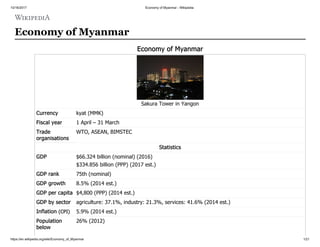
Sakura Tower in Yangon
Currency kyat (MMK)
Fiscal year 1 April – 31 March
Trade
organisations
WTO, ASEAN, BIMSTEC
Statistics
GDP $66.324 billion (nominal) (2016)
$334.856 billion (PPP) (2017 est.)
GDP rank 75th (nominal)
GDP growth 8.5% (2014 est.)
GDP per capita $4,800 (PPP) (2014 est.)
GDP by sector agriculture: 37.1%, industry: 21.3%, services: 41.6% (2014 est.)
Inflation (CPI) 5.9% (2014 est.)
Population
below
26% (2012)
Economy of Myanmar
10/16/2017 Economy of Myanmar - Wikipedia
https://en.wikipedia.org/wiki/Economy_of_Myanmar 2/21
poverty line
Labour force 32.53 million (2011 est.)
Labour force
by occupation
agriculture: 70%, industry: 7%, services: 23% (2001)
Unemployment 37% (2012)
Main industries agricultural processing; wood and wood products; copper, tin, tungsten, iron; cement,
construction materials; pharmaceuticals; fertiliser; petroleum and natural gas; garments, jade
and gems
Ease-of-doing-
business rank
170th (2017)[1]
External
Exports $10.49 billion (2016 est.)
note: official export figures are grossly underestimated due to the value of timber, gems,
narcotics, rice, and other products smuggled to Thailand, China, and Bangladesh
Export goods natural gas, wood products, pulses, beans, fish, rice, clothing, jade and gems
Main export
partners
China 37.7%
Thailand 25.6%
India 7.7%
Japan 6.2% (2015 est.)[2]
Imports $13.96 billion (2016 est.)
note: import figures are grossly underestimated due to the value of consumer goods, diesel
fuel, and other products smuggled in from Thailand, China, Malaysia, and India
Import goods fabric, petroleum products, plastics, fertiliser, machinery, transport equipment, cement,
construction materials, crude oil; food products, edible oil
Main import
partners
China 42.2%
10/16/2017 Economy of Myanmar - Wikipedia
https://en.wikipedia.org/wiki/Economy_of_Myanmar 3/21
Thailand 18.5%
Singapore 11%
Japan 4.8%
(2015 est.)[3]
Public finances
Public debt $11 billion (2012)[4]
Revenues $2.016 billion
Expenses $4.272 billion (2011 est.)
Economic aid recipient: $127 million (2001 est.)
Foreign
reserves
$8 billion (as of January 2013)[5]
Main data source:
CIA World Fact Book (https://www.cia.gov/library/publications/resources/the-world-factbook/geos/bm.html)
All values, unless otherwise stated, are in US dollars.
Myanmar (also known as Burma) is an emerging economy with a nominal GDP of $66.324 billion dollars in 2016 and an estimated purchasing power adjusted
GDP of $334.85 billion dollars in 2016.
1 History
1.1 Classical era
1.2 British Burma (1885–1948)
1.3 Post-independence (1948-)
1.4 Military rule (1988–2011)
1.5 Economic liberalisation (2011–present)
2 Still unresolved internal problems
Contents
10/16/2017 Economy of Myanmar - Wikipedia
https://en.wikipedia.org/wiki/Economy_of_Myanmar 4/21
3 Industries
3.1 Garment production
3.2 Illegal drug trade
3.3 Oil and gas
3.4 Gemstones
3.5 Tourism
4 External trade
5 Macro-economic trends
5.1 Foreign investment
5.2 Foreign aid
6 Other statistics
7 External References
8 Footnotes
9 Further reading
10 External links
Historically, Burma was the main trade route between India and China since 100 BC. The Mon Kingdom of lower Burma served as important trading centre in the
Bay of Bengal.
According to Michael Adas, Ian Brown, and other economic historians of Burma, Burma's pre-colonial economy in Burma was essentially a subsistence economy,
with the majority of the population involved in rice production and other forms of agriculture.[6] Burma also lacked a formal monetary system until the reign of
King Mindon Min in the middle 19th century.[6]
History
Classical era
10/16/2017 Economy of Myanmar - Wikipedia
https://en.wikipedia.org/wiki/Economy_of_Myanmar 5/21
All land was technically owned by the Burmese monarch.[7] Exports, along with oil wells, gem mining and teak production were controlled by the monarch.[7]
Burma was vitally involved in the Indian Ocean trade.[6] Logged teak was a prized export that was used in European shipbuilding, because of its durability, and
became the focal point of the Burmese export trade from the 1700s to the 1800s.[8]
After Burma was conquered by the British, it became the wealthiest country in Southeast Asia, after the Philippines. It was also once the world's largest exporter of
rice. During British administration, Burma supplied oil through the Burmah Oil Company. This supplying market received a setback through the great depression
in the 1930s. Burma suffered, like other countries in this region, from the decline in the total level of global trade.[9] Burma also had a wealth of natural and labour
resources. It produced 75% of the world's teak and had a highly literate population.[7] The country was believed to be on the fast track to development.
After a parliamentary government was formed in 1948, Prime Minister U Nu embarked upon a policy of nationalisation. He attempted to make Burma a welfare
state by adopting central planning measures. The government also tried to implement a poorly thought out Eight-Year plan. By the 1950s, rice exports had fallen by
two thirds and mineral exports by over 96%. Plans were partly financed by printing money, which led to inflation.[10]The 1962 coup d'état, was followed by an
economic scheme called the Burmese Way to Socialism, a plan to nationalise all industries, with the exception of agriculture. The catastrophic program turned
Burma into one of the world's most impoverished countries.[11][12] Burma's admittance to least developed country status by the United Nations in 1987
highlighted its economic bankruptcy.[13]
After 1988, the regime retreated from totalitarian socialism. It permitted modest expansion of the private sector, allowed some foreign investment, and received
much needed foreign exchange.[14] The economy is rated in 2009 as the least free in Asia (tied with North Korea).[15] All fundamental market institutions are
suppressed.[15][16] Private enterprises are often co-owned or indirectly owned by state. The corruption watchdog organisation Transparency International in its
2007 Corruption Perceptions Index released on 26 September 2007 ranked Burma the most corrupt country in the world, tied with Somalia.[17]
The national currency is the kyat. Burma currently has a dual exchange rate system similar to Cuba.[18] The market rate was around two hundred times below the
government-set rate in 2006.[16] In 2011, the Burmese government enlisted the aid of International Monetary Fund to evaluate options to reform the current
exchange rate system, to stabilise the domestic foreign exchange trading market and creates economic distortions.[19] The dual exchange rate system allows for the
government and state-owned enterprises to divert funds and revenues, but also gives the government more control over the local economy and temporarily subdue
inflation.[20][21]
Inflation averaged 30.1% between 2005 and 2007.[15] Inflation is a serious problem for the economy. In April 2007, the National League for Democracy organised
a two-day workshop on the economy. The workshop concluded that skyrocketing inflation was impeding economic growth. "Basic commodity prices have increased
from 30% to 60% since the military regime promoted a salary increase for government workers in April 2006," said Soe Win, the moderator of the workshop.
British Burma (1885–1948)
Post-independence (1948-)
Military rule (1988–2011)
10/16/2017 Economy of Myanmar - Wikipedia
https://en.wikipedia.org/wiki/Economy_of_Myanmar 6/21
"Inflation is also correlated with corruption." Myint Thein, an NLD spokesperson, added: "Inflation is the critical source of the current economic crisis."[22]
In recent years, both China and India have attempted to strengthen ties with the government for economic benefit. Many nations, including the United States and
Canada, and the European Union, have imposed investment and trade sanctions on Burma. The United States banned all imports from Burma, though this
restriction was since lifted.[16] Foreign investment comes primarily from People's Republic of China, Singapore, South Korea, India, and Thailand.[23]
In 2011, when new President Thein Sein's government came to power, Burma embarked on a major policy of reforms including anti-corruption, currency exchange
rate, foreign investment laws and taxation. Foreign investments increased from US$300 million in 2009-10 to a US$20 billion in 2010-11 by about 6567%.[24]
Large inflow of capital results in stronger Burmese currency, kyat by about 25%. In response, the government relaxed import restrictions and abolished export
taxes. Despite current currency problems, Burmese economy is expected to grow by about 8.8% in 2011.[25] After the completion of 58-billion dollar Dawei deep
seaport, Burma is expected be at the hub of trade connecting Southeast Asia and the South China Sea, via the Andaman Sea, to the Indian Ocean receiving goods
from countries in the Middle East, Europe and Africa, and spurring growth in the ASEAN region.[26][27]
In 2012, the Asian Development Bank formally began re-engaging with the country, to finance infrastructure and development projects in the country.[28] The
$512 million loan is the first issued by the ADB to Myanmar in 30 years and will target banking services, ultimately leading to other major investments in road,
energy, irrigation and education projects.[29]
In March 2012, a draft foreign investment law emerged, the first in more than 2 decades. This law oversees unprecedented liberalisation of the economy. It for
example stipulates that foreigners no longer require a local partner to start a business in the country, and are able to legally lease land.[30] The draft law also
stipulates that Burmese citizens must constitute at least 25% of the firm's skilled workforce, and with subsequent training, up to 50-75%.[30]
On 28 January 2013, the government of Myanmar announced deals with international lenders to cancel or refinance nearly $6 billion of its debt, almost 60 per
cent of what it owes to foreign lenders. Japan wrote off US$3 Billion, nations in the group of Paris Club wrote off US$2.2 Billion and Norway wrote off US$534
Million. [31]
Myanmar's inward foreign direct investment has steadily increased since its reform. The country approved US$4.4 billion worth of investment projects between
January and November 2014. [32]
According to one report released on 30 May 2013, by the McKinsey Global Institute, Burma's future looks bright, with its economy expected to quadruple by 2030
if it invests in more high-tech industries.[33] This however does assume that other factors (such as drug trade, the continuing war of the government with specific
ethnic groups, ...) do not interfere.
As of October 2017, less than 10% of Myanmar‘s population has a bank account.[34]
Economic liberalisation (2011–present)
Still unresolved internal problems
10/16/2017 Economy of Myanmar - Wikipedia
https://en.wikipedia.org/wiki/Economy_of_Myanmar 7/21
In a first ever countrywide study the Myanmar government found that 37 per cent of the nation’s population are unemployed and an average of 26 per cent live in
poverty. [35]
The current state of the Burmese economy has also had a significant impact on the demographics of Burma, as economic hardship results in extreme delays of
marriage and family building. The average age of marriage in Burma is 27.5 for men, 26.4 for women, almost unparalleled in the region, with the exception of
developed countries like Singapore.[36][37]
Burma also has a low fertility rate, of 2.07 children per woman (2010), especially as compared to other Southeast Asian countries of similar economic standing, like
Cambodia (3.18) and Laos (4.41), representing a significant decline from 4.7 in 1983, despite the absence of a national population policy.[38] This is at least partly
attributed to the economic strain that additional children place on the family income, and has resulted in the prevalence of illegal abortions in the country, as well
as use of other forms of birth control.[39]
The 2012 foreign investment law draft, included a proposal to transform the Myanmar Investment Commission from a government-appointed body into an
independent board. This could bring greater transparency to the process of issuing investment licenses, according to the proposed reforms drafted by experts and
senior officials.[40] However, even with this draft, it will still remain a question on whether corruption in the government can be addressed (links have been shown
between certain key individuals inside the government and the drug trade, as well as many industries that use forced labour -for example the mining industry-).[41]
Many regions (such as the Golden Triangle) remain off-limits for foreigners, and in some of these regions, the government is still at war with certain ethnic
groups.[41][42]
The major agricultural produce is rice which covers about 60% of the country's total cultivated land area. Rice accounts for 97% of total food grain production by
weight. Through collaboration with the International Rice Research Institute (IRRI), 52 modern rice varieties were released in the country between 1966 and 1997,
helping increase national rice production to 14 million tons in 1987 and to 19 million tons in 1996. By 1988, modern varieties were planted on half of the country's
rice fields, including 98% of the irrigated areas.[43] In 2011, Myanmar's total milled rice production accounted for 10.26 million tons, an increase from the 1.8 per
cent back in 2010.[44]
In northern Burma opium, bans have ended a century old tradition of growing poppy. Between 20,000 and 30,000 ex-poppyfarmers left the Kokang region as a
result of the ban in 2002.[45] People from the Wa region, where the ban was implemented in 2005, fled to areas where growing opium is still possible. Other ex-
poppyfarmers are being relocated to areas near rubber plantations. These are often mono-plantations from Chinese investors.
Rubber plantations are being promoted in areas of high elevation like Mong Mao. Sugar plantations are grown in the lowlands such as Mong Pawk District.[45]
The lack of an educated workforce skilled in modern technology contributes to the growing problems of the economy.[46]
Industries
10/16/2017 Economy of Myanmar - Wikipedia
https://en.wikipedia.org/wiki/Economy_of_Myanmar 8/21
Today, the country lacks adequate infrastructure. Goods travel primarily across the Thai border (where most illegal drugs are exported) and along the Ayeyarwady
River. Railroads are old and rudimentary, with few repairs since their construction in the late nineteenth century.[47] Highways are normally unpaved, except in
the major cities.[47] Energy shortages are common throughout the country including in Yangon. More than 45 million of the country's population is without
electricity, with 70 per cent of people living in rural areas.[48]
Burma is also the world's second largest producer of opium, accounting for 8% of entire world production and is a major source of illegal drugs, including
amphetamines.[49] Other industries include agricultural goods, textiles, wood products, construction materials, gems, metals, oil and natural gas.
The private sector dominates in agriculture, light industry, and transport activities, while the military government controls energy, heavy industry, and rice trade.
The garment industry is a major job creator in the Yangon area, with around 200,000 workers employed in total in mid-2015.[50] The Myanmar Government has
introduced minimum wage of MMR 3,600 (US$2.80) per day for the garment workers from 1 September 2015.[51]
The Myanmar garments sector has seen significant influx of foreign direct investment, if measured by the number of entries rather than their value. In March 2012,
six of Thailand's largest garment manufacturers announced that they would move production to Burma, principally to the Yangon area, citing lower labour
costs.[52] In mid-2015, about 55% of officially registered garment firms in Myanmar were known to be fully or partly foreign-owned, with about 25% of the foreign
firms from China and 17% from Hong Kong.[53] Foreign-linked firms supply almost all garment exports, and these have risen rapidly in recent years, especially
since EU sanctions were lifted in 2012.[54]
Burma (Myanmar) is the largest producer of methamphetamines in the world, with the majority of ya ba found in Thailand produced in Burma, particularly in the
Golden Triangle and Northeastern Shan State, which borders Thailand, Laos and China.[55] Burmese-produced Ya ba is typically trafficked to Thailand via Laos,
before being transported through the northeastern Thai region of Isan.[56]
In 2010, Burma trafficked 1 billion tablets to neighbouring Thailand.[55] In 2009, Chinese authorities seized over 40 million tablets that had been illegally
trafficked from Burma.[57] Ethnic militias and rebel groups (in particular the United Wa State Army) are responsible for much of this production; however, the
Burmese military units are believed to be heavily involved in the trafficking of the drugs.[55]
Burma is also the 2nd largest supplier of opium (following Afghanistan) in the world, with 95% of opium grown in Shan State.[58][59] Illegal narcotics have
generated $1 to $2 billion USD in exports annually, with estimates of 40% of the country's foreign exchange coming from drugs.[55][60] Efforts to eradicate opium
cultivation have pushed many ethnic rebel groups, including the United Wa State Army and the Kokang to diversify into methamphetamine production.
Garment production
Illegal drug trade
10/16/2017 Economy of Myanmar - Wikipedia
https://en.wikipedia.org/wiki/Economy_of_Myanmar 9/21
Prior to the 1980s, heroin was typically transported from Burma to Thailand,
before being trafficked by sea to Hong Kong, which was and still remains the
major transit point at which heroin enters the international market. Now, drug
trafficking has circumvented to southern China (from Yunnan, Guizhou,
Guangxi, Guangdong) because of a growing market for drugs in China, before
reaching Hong Kong.[61]
The prominence of major drug traffickers have allowed them to penetrate other
sectors of the Burmese economy, including the banking, airline, hotel and
infrastructure industries.[62] Their investment in infrastructure have allowed
them to make more profits, facilitate drug trafficking and money
laundering.[63]
Myanma Oil and Gas Enterprise (MOGE) is a national oil and gas company
of Burma. The company is a sole operator of oil and gas exploration and production, as well as domestic gas
transmission through a 1,900-kilometre (1,200 mi) onshore pipeline grid.[64][65]
The Yadana Project is a project to exploit the Yadana gas field in the Andaman Sea and to carry natural gas to
Thailand through Myanmar.
Sino-Burma pipelines refers to planned oil and natural gas pipelines linking the Burma's deep-water port of
Kyaukphyu (Sittwe) in the Bay of Bengal with Kunming in Yunnan province, China.
The Norwegian company Seadrill owned by John Fredriksen is involved in offshore oildrilling, expected to give
the Burmese Military Junta oil and oil export revenues.
Myanmar exported $3.5 billion worth of gas, mostly to Thailand in the fiscal year up to March 2012.[66]
Initiation to bid on oil exploration licenses for 18 of Myanmar’s onshore oil blocks has been released on 18
January 2013.[66]
The Union of Myanmar's rulers depend on sales of precious stones such as sapphires, pearls and jade to fund their regime. Rubies are the biggest earner; 90% of
the world's rubies come from the country, whose red stones are prized for their purity and hue. Thailand buys the majority of the country's gems. Burma's "Valley
of Rubies", the mountainous Mogok area, 200 km (120 mi) north of Mandalay, is noted for its rare pigeon's blood rubies and blue sapphires.[67]
A world map of the world's primary opium or heroin producers. The Golden
Triangle region, which Burma is part of, is pinpointed in this map.
Oil and gas
A private petrol station in the Inle
lake region, Myanmar
Gemstones
10/16/2017 Economy of Myanmar - Wikipedia
https://en.wikipedia.org/wiki/Economy_of_Myanmar 10/21
In 2007, following the crackdown on pro-democracy protests in Myanmar, human rights organisations, gem dealers, and US First Lady Laura Bush called for a
boycott of a Myanmar gem auction held twice yearly, arguing that the sale of the stones profits the dictatorial regime in that country.[68] Debbie Stothard of the
Alternative ASEAN Network on Burma stated that mining operators used drugs on employees to improve productivity, with needles shared, raising the risk of HIV
infection: "These rubies are red with the blood of young people." Brian Leber (41-year-old jeweller who founded The Jewellers' Burma Relief Project) stated that:
"For the time being, Burmese gems should not be something to be proud of. They should be an object of revulsion. It's the only country where one obtains really top
quality rubies, but I stopped dealing in them. I don't want to be part of a nation's misery. If someone asks for a ruby now I show them a nice pink sapphire."[69]
Richard W. Hughes, author of Ruby and Sapphire, a Bangkok-based gemologist who has made many trips to Burma makes the point that for every ruby sold
through the junta, another gem that supports subsistence mining is smuggled over the Thai border.[70] Burma's gemstone industry is a cornerstone of the Burmese
economy with exports topping $1 billion.[71]
The permits for new gem mines in Mogoke, Mineshu and Nanyar state will be issued by the ministry according to a statement issued by the ministry on 11
February. While many sanctions placed on the former regime were eased or lifted in 2012, the US has left restrictions on importing rubies and jade from Myanmar
intact. According to recent amendments to the new Myanmar foreign investment law, there is no longer a minimum capital requirement for investments, except in
mining ventures, which require substantial proof of capital and must be documented through a domestic bank. Another important clarification in the investment
law is the dropping of foreign ownership restrictions in joint ventures, except in restricted sectors, such as mining, where FDI will be capped at 80 per cent. [72]
Since 1992, the government has encouraged tourism. Until 2008, fewer than 750,000 tourists entered the country annually,[73] but there has been substantial
growth over the past years. In 2012, 1.06 million tourists visited the country,[74] and 1.8 million are expected to visit by the end of 2013.
Tourism is thus a growing sector of the economy of Burma. Burma has diverse and varied tourist attractions and is served internationally by numerous airlines via
direct flights. Domestic and foreign airlines also operate flights within the country. Cruise ships also dock at Yangon. Overland entry with a border pass is
permitted at several border checkpoints. The government requires a valid passport with an entry visa for all tourists and business people. As of May 2010, foreign
business visitors from any country can apply for a visa on arrival when passing through Yangon and Mandalay international airports without having to make any
prior arrangements with travel agencies.[75] Both the tourist visa and business visa are valid for 28 days, renewable for an additional 14 days for tourism and 3
months for business. Seeing Burma through a personal tour guide is popular. Travelers can hire guides through travel agencies.
[76] Aung San Suu Kyi has requested that international tourists not visit Burma. The junta's forced labour programmes were focused around tourist destinations
which have been heavily criticised for their human rights records. Even disregarding the obviously governmental fees, Burma’s Minister of Hotels and Tourism
Major-General Saw Lwin recently admitted that the government receives a significant percentage of the income of private sector tourism services. Not to mention
the fact that only a very small minority of impoverished ordinary people in Burma ever see any money with any relation to tourism.[77]
Before 2012, much of the country was completely off-limits to tourists, and the military very tightly controlled interactions between foreigners and the people of
Burma. Locals were not allowed to discuss politics with foreigners, under penalty of imprisonment, and in 2001, the Myanmar Tourism Promotion Board issued an
order for local officials to protect tourists and limit "unnecessary contact" between foreigners and ordinary Burmese people. Since 2012, Burma has opened up to
Tourism
10/16/2017 Economy of Myanmar - Wikipedia
https://en.wikipedia.org/wiki/Economy_of_Myanmar 11/21
more tourism and foreign capital, synonymous with the country's transition to democracy.[78]
2006-2007 Financial Year Trade volume (in US$000,000)
Sr. No. Description
2006–2007 Budget Trade Volume 2006–2007 Real Trade Volume
Export Import Trade Volume Export Import Trade Volume
1 Normal Trade 4233.60 2468.40 6702.00 4585.47 2491.33 7076.80
2 Border Trade 814.00 466.00 1280.00 647.21 445.40 1092.61
Total 5047.60 2934.40 7982.00 5232.68 2936.73 8169.41
External trade
Burmese exports in 2006
10/16/2017 Economy of Myanmar - Wikipedia
https://en.wikipedia.org/wiki/Economy_of_Myanmar 12/21
Total Trade Value for Financial year 2006-2007 to Financial year 2009-2010
No Financial Year Export Value Import Value Trade Value (US$, 000,000)
1 2006–2007 5222.92 2928.39 8151.31
2 2007–2008 6413.29 3346.64 9759.93
3 2008–2009 6792.85 4563.16 11356.01
4 2009–2010 7568.62 4186.28 11754.90
This is a chart of trend of gross domestic product of Burma at market prices estimated (http://www.econstats.com/IMF/IFS_Mya1_99B__.htm#Year) by the
International Monetary Fund and EconStats with figures in millions of Myanma kyats.
Year Gross Domestic Product US dollar exchange[79] Inflation index (2000=100)
1965 7,627
1970 10,437
1975 23,477
1980 38,608
1985 55,988
1990 151,941
1995 604,728
Though foreign investment has been encouraged, it has so far met with only moderate success. This is because foreign investors have been adversely affected by the
junta government policies and because of international pressure to boycott the junta government. The United States has placed trade sanctions on Burma. The
European Union has placed embargoes on arms, non-humanitarian aid, visa bans on military regime leaders, and limited investment bans. Both the European
Macro-economic trends
Foreign investment
10/16/2017 Economy of Myanmar - Wikipedia
https://en.wikipedia.org/wiki/Economy_of_Myanmar 13/21
Union and the US have placed sanctions on grounds of human rights violations in the country. Many nations in Asia, particularly India, Thailand and China have
actively traded with Burma. However, on 22 April the EU suspended economic and political sanctions against Burma.[80]
The public sector enterprises remain highly inefficient and also privatisation efforts have stalled. The estimates of Burmese foreign trade are highly ambiguous
because of the great volume of black market trading. A major ongoing problem is the failure to achieve monetary and fiscal stability. Due to this, Burma remains a
poor country with no improvement of living standards for the majority of the population over the past decade. The main causes for continued sluggish growth are
poor government planning, internal unrest, minimal foreign investment and the large trade deficit. One of the recent government initiatives is to utilise Burma's
large natural gas deposits. Currently, Burma has attracted investment from Thai, Malaysian, Filipino, Russian, Australian, Indian, and Singaporean companies.[81]
Trade with the US amounted to $243.56 million as of February 2013, accounting for 15 projects and just 0.58 per cent of the total, according to government
statistics.[82]
The Economist special report on Burma points to increased economic activity resulting from Burma's political transformation and influx of foreign direct
investment from Asian neighbours.[83] Near the Mingaladon Industrial Park, for example, Japanese-owned factories have risen from the "debris" caused by
"decades of sanctions and economic mismanagement."[83] Japanese Prime Minister Shinzo Abe has identified Burma as economically attractive market that will
help stimulate the Japanese economy.[83] Among its various enterprises, Japan is helping build the Thilawa Port, which is part of the Thilawa Special Economic
Zone, and helping fix the electricity supply in Yangon.[83]
Japan isn’t the largest investor in Myanmar. "Thailand, for instance, the second biggest investor in Myanmar after China, is forging ahead with a bigger version of
Thilawa at Dawei, on Myanmar’s Tenasserim Coast. . . Thai rulers have for centuries been toying with the idea of building a canal across the Kra Isthmus, linking
the Gulf of Thailand directly to the Andaman Sea and the Indian Ocean to avoid the journey round peninsular Malaysia through the Strait of Malacca."[83]
Dawei would give Thailand that connection. China, by far the biggest investor in Burma, has focused on constructing oil and gas pipelines that "crisscross the
country, starting from a new terminus at Kyaukphyu, just below Sittwe, up to Mandalay and on to the Chinese border town of Ruili and then Kunming, the capital
of Yunnan province."[83] This would prevent China from "having to funnel oil from Africa and the Middle East through the bottleneck around Singapore."[83]
According to the CIA World Factbook,[84]
Burma, a resource-rich country, suffers from pervasive government controls, inefficient economic policies, and rural poverty. The junta took steps in the
early 1990s to liberalize the economy after decades of failure under the "Burmese Way to Socialism," but those efforts stalled, and some of the
liberalization measures were rescinded. Burma does not have monetary or fiscal stability, so the economy suffers from serious macroeconomic
imbalances - including inflation, multiple official exchange rates that overvalue the Burmese kyat, and a distorted interest rate regime. Most overseas
development assistance ceased after the junta began to suppress the democracy movement in 1988 and subsequently refused to honor the results of the
1990 legislative elections. In response to the government of Burma's attack in May 2003 on Aung San Suu Kyi and her convoy, the US imposed new
economic sanctions against Burma - including a ban on imports of Burmese products and a ban on provision of financial services by US persons. A poor
investment climate further slowed the inflow of foreign exchange. The most productive sectors will continue to be in extractive industries, especially oil
and gas, mining, and timber. Other areas, such as manufacturing and services, are struggling with inadequate infrastructure, unpredictable
10/16/2017 Economy of Myanmar - Wikipedia
https://en.wikipedia.org/wiki/Economy_of_Myanmar 14/21
import/export policies, deteriorating health and education systems, and corruption. A major banking crisis in 2003 shuttered the country's 20 private
banks and disrupted the economy. As of December 2005, the largest private banks operate under tight restrictions limiting the private sector's access to
formal credit. Official statistics are inaccurate. Published statistics on foreign trade are greatly understated because of the size of the black market and
unofficial border trade - often estimated to be as large as the official economy. Burma's trade with Thailand, China, and India is rising. Though the
Burmese government has good economic relations with its neighbors, better investment and business climates and an improved political situation are
needed to promote foreign investment, exports, and tourism.
Financing Geothermal projects in Myanmar use an estimated break even power cost of 5.3-8.6 U.S cents/kWh or in Myanmar Kyat 53-86K per kWh. This pegs a
non-fluctuating $1=1000K, which is a main concern for power project funding. The main drawback with depreciation pressures, in the current FX market. Between
June 2012 and October 2015, the Myanmar Kyat depreciated by approximately 35%, from 850 down to 1300 against the US Dollar. Local businesses with foreign
denominated loans from abroad suddenly found themselves rushing for a strategy to mitigate currency risks. Myanmar’s current lack of available currency hedging
solutions presents a real challenge for Geothermal project financing.[85]
The level of international aid to Burma ranks amongst the lowest in the world (and the lowest in the Southeast Asian region)[86]—Burma receives the $4 per capita
in development assistance, as compared to the average of $42.30 per capita.[87][88]
In April 2007, the US Government Accountability Office (GAO) identified the financial and other restrictions that the military government places on international
humanitarian assistance in the Southeast Asian country. The GAO report, entitled "Assistance Programs Constrained in Burma," outlines the specific efforts of the
Burmese government to hinder the humanitarian work of international organisations, including by restricting the free movement of international staff within the
country. The report notes that the regime has tightened its control over assistance work since former Prime Minister Khin Nyunt was purged in October 2004.
Furthermore, the reports states that the military government passed guidelines in February 2006, which formalised Burma's restrictive policies. According to the
report, the guidelines require that programs run by humanitarian groups "enhance and safeguard the national interest" and that international organisations co-
ordinate with state agents and select their Burmese staff from government-prepared lists of individuals. United Nations officials have declared these restrictions
unacceptable.
The shameful behavior of Burma's military regime in tying the hand of humanitarian organizations is laid out in these pages for all to see, and it must
come to an end," said U.S. Representative Tom Lantos (D-CA). "In eastern Burma, where the military regime has burned or otherwise destroyed over
3,000 villages, humanitarian relief has been decimated. At least one million people have fled their homes and many are simply being left to die in the
jungle."
Foreign aid
10/16/2017 Economy of Myanmar - Wikipedia
https://en.wikipedia.org/wiki/Economy_of_Myanmar 15/21
US Representative Ileana Ros-Lehtinen (R-FL) said that the report "underscores the need for democratic change in Burma, whose military regime arbitrarily
arrests, tortures, rapes and executes its own people, ruthlessly persecutes ethnic minorities, and bizarrely builds itself a new capital city while failing to address the
increasingly urgent challenges of refugee flows, illicit narcotics and human trafficking, and the spread of HIV/AIDS and other communicable diseases." [89]
Electricity - production: 5.961 billion kWh (2006 est.)
Electricity - consumption: 4.298 billion kWh (2006 est.)
Electricity - exports: 0 kWh (2007)
Electricity - imports: 0 kWh (2007)
Agriculture - products: rice, pulses, beans, sesame, groundnuts, sugarcane; hardwood; fish and fish products
Currency: 1 kyat (K) = 100 pyas
Exchange rates: kyats per US dollar - 1,205 (2008 est.), 1,296 (2007), 1,280 (2006), 5.82 (2005), 5.7459 (2004), 6.0764 (2003) note: unofficial exchange rates
ranged in 2004 from 815 kyat/US dollar to nearly 970 kyat/US dollar, and by year end 2005, the unofficial exchange rate was 1,075 kyat/US dollar; data shown for
2003-05 are official exchange rates
Foreign Direct Investment In the first nine months of 2012-2013, Myanmar has received investment of USD 794 million. China has biggest of investment
commitments for this fiscal.[90]
Foreign Trade Total foreign trade for 2012 was recorded to USD 13.3 billion. It was 27% of Myanmar's GDP.[90]
Google Earth Map of oil and gas infrastructure in Myanmar (http://www.oilandgasinfrastructure.com/home/oilandgasasia/myanmar)
1. "Ease of Doing Business in Myanmar" (http://www.doingbusiness.org/data/exploreeconomies/myanmar). Doingbusiness.org. Retrieved 2017-01-23.
2. "Export Partners of Burma (Myanmar)" (https://www.cia.gov/library/publications/the-world-factbook/fields/2050.html#bm). CIA World Factbook. 2012.
Retrieved 23 July 2013.
3. "Import Partners of Burma (Myanmar)" (https://www.cia.gov/library/publications/the-world-factbook/fields/2061.html#bm). CIA World Factbook. 2012.
Retrieved 23 July 2013.
Other statistics
External References
Footnotes
10/16/2017 Economy of Myanmar - Wikipedia
https://en.wikipedia.org/wiki/Economy_of_Myanmar 16/21
4. "Burma reveals international debt" (http://www.mizzima.com/business/6533-burma-reveals-international-debt.html). Mizzima News. 3 February 2012.
Retrieved 19 February 2012.
5. "Upbeat forecast for Myanmar’s economy assumes price stability, low inflation" (http://elevenmyanmar.com/business/2295-upbeat-forecast-for-myanmar-s-e
conomy-assumes-price-stability-low-inflation). Eleven Myanmar. 31 January 2013. Retrieved 13 October 2013.
6. Taylor, Robert H. (2009). The State in Myanmar. NUS Press. pp. 38–40. ISBN 978-9971-69-466-1.
7. Steinberg, David I. (2001). Burma, the state of Myanmar. Georgetown University Press. pp. 125–127. ISBN 978-0-87840-893-1.
8. Goodman, Michael K. (2010). Consuming space: placing consumption in perspective. Ashgate Publishing, Ltd. p. 241. ISBN 978-0-7546-7229-6.
9. Baten, Jörg (2016). A History of the Global Economy. From 1500 to the Present. Cambridge University Press. pp. 331–332. ISBN 9781107507180.
10. Watkins, Thayer. "Political and Economic History of Myanmar (Burma) Economics" (http://www2.sjsu.edu/faculty/watkins/burma.htm). San José State
University. Retrieved 8 July 2006.
11. Tallentire, Mark (28 September 2007). "The Burma road to ruin" (https://www.theguardian.com/world/2007/sep/28/burma.uk). London: The Guardian.
Retrieved 1 May 2010.
12. Kate Woodsome. "'Burmese Way to Socialism' Drives Country into Poverty" (https://archive.is/20121208220245/http://www.voanews.com/english/archive/2
007-10/2007-10-04-voa10.cfm?CFID=117290760&CFTOKEN=64840153&jsessionid=6630167e8fd1b43b9eef18506362225e1f2d). Archived from the original
(http://www.voanews.com/english/archive/2007-10/2007-10-04-voa10.cfm?CFID=117290760&CFTOKEN=64840153&jsessionid=6630167e8fd1b43b9eef185
06362225e1f2d) on 2012-12-08.
13. "List of Least Developed Countries" (https://web.archive.org/web/20131026045553/http://www.un.org/special-rep/ohrlls/ldc/list.htm). UN-OHRLLS. 2005.
Archived from the original (https://www.un.org/special-rep/ohrlls/ldc/list.htm) on 26 October 2013.
14. Stephen Codrington (2005). Planet geography. Solid Star Press. p. 559. ISBN 0-9579819-3-7.
15. "Index of Economic Freedom: Burma" (http://www.heritage.org/index/country/Burma). 2009.
16. Sean Turnell (29 March 2006). "Burma’s Economic Prospects - Testimony before the Senate Foreign Relations Subcommittee on East Asian and Pacific
Affairs" (https://web.archive.org/web/20100106125904/http://foreign.senate.gov/testimony/2006/TurnellTestimony060329.pdf) (PDF). Archived from the
original (http://foreign.senate.gov/testimony/2006/TurnellTestimony060329.pdf) (PDF) on 6 January 2010. Retrieved 22 January 2010.
17. 2007 CPI http://www.transparency.org/policy_research/surveys_indices/cpi/2007
18. Sean Turnell (2 May 2008). "The rape of Burma: where did the wealth go?" (http://search.japantimes.co.jp/cgi-bin/eo20080502a1.html). The Japan Times.
19. Feng Yingqiu (1 August 2011). "Myanmar starts to deal with official forex rate" (http://news.xinhuanet.com/english2010/business/2011-08/01/c_131022439.
htm). Xinhua. Retrieved 8 August 2011.
20. McCartan, Brian (20 August 2008). "Myanmar exchange scam fleeces UN" (http://www.atimes.com/atimes/Southeast_Asia/JH20Ae01.html). Asia Times.
Retrieved 8 August 2011.
21. "Myanmar Considers Foreign-Exchange Overhaul" (https://www.wsj.com/articles/SB10001424053111904007304576493940226278686). Wall Street Journal.
8 August 2011. Retrieved 8 August 2011.
22. "High Inflation Impeding Burma's Economy, Says NLD" (http://www.irrawaddy.org/article.php?art_id=7064). The Irrawaddy. 30 April 2007. Retrieved
30 April 2007.
23. Fullbrook, David (4 November 2004). "So long US, hello China, India" (http://www.atimes.com/atimes/Southeast_Asia/FK04Ae03.html). Asia Times.
Retrieved 14 July 2006.
10/16/2017 Economy of Myanmar - Wikipedia
https://en.wikipedia.org/wiki/Economy_of_Myanmar 17/21
24. Joseph Allchin (20 September 2011). "Taste of democracy sends Burma's fragile economy into freefall" (https://www.independent.co.uk/news/world/asia/tas
te-of-democracy-sends-burmas-fragile-economy-into-freefall-2357511.html). The Independent. Retrieved 25 September 2011.
25. JOSEPH ALLCHINJOSEPH (23 September 2011). "Burma tells IMF of economic optimism" (http://www.dvb.no/news/burma-tells-imf-of-economic-optimism/1
7803). DVD. Retrieved 25 September 2011.
26. CHATRUDEE THEPARAT (28 August 2011). "Big-shift-to-dawei-predicted" (http://www.bangkokpost.com/news/local/206376/big-shift-to-dawei-predicted).
Bangkok Post. Retrieved 27 August 2011.
27. Thein Linn (15–21 November 2010). "Dawei deep-sea port, SEZ gets green light" (http://www.mmtimes.com/2010/business/549/biz54901.htmlmmtimes).
Myanmar times. Retrieved 25 September 2011.
28. Yap, Karl Lester M. (1 March 2012). "ADB Preparing First Myanmar Projects in 25 Years as Thein Opens" (https://www.bloomberg.com/news/2012-03-01/ad
b-preparing-first-myanmar-projects-in-25-years-as-thein-opens.html). Bloomberg. Retrieved 15 March 2012.
29. "ADB ends 30-year hiatus in Myanmar" (http://investvine.com/adb-ends-30-year-hiatus-in-myanmar/). Investvine.com. 28 January 2013. Retrieved
8 February 2013.
30. Aung Hla Htun (16 March 2012). "Exclusive: Myanmar drafts new foreign investment rules" (https://www.reuters.com/article/2012/03/16/us-myanmar-invest
ment-idUSBRE82F0IY20120316). Reuters. Retrieved 17 March 2012.
31. "Myanmar clears 60% of foreign debt" (http://investvine.com/myanmar-clears-60-of-foreign-debt/). Investvine.com. 29 January 2013. Retrieved 29 January
2013.
32. "Myanmar FDI Expected to Jump 70%" (http://www.investasian.com/2015/01/07/myanmar-fdi-expected-jump-70/). InvestAsian.com. 7 January 2015.
Retrieved 7 February 2015.
33. Calderon, Justin (30 May 2013). "Myanmar’s economy to quadruple by 2030" (http://investvine.com/myanmars-economy-to-quadruple-by-2030/). Inside
Investor. Retrieved 30 May 2013.
34. "In dirt-poor Myanmar, smartphones are transforming finance" (https://www.economist.com/news/finance-and-economics/21730199-rudimentary-financial-s
ervices-are-offer-places-roads-do-not-reach). The Economist. 12 October 2017.
35. "37% jobless in Myanmar, study finds" (http://investvine.com/37-jobless-in-myanmar-study-finds/). Investvine.com. 26 January 2013. Retrieved 27 January
2013.
36. Myat Mon (2008). "The Economic Position of Women in Burma". Asian Studies Review. Wiley. 24 (2): 243–255. doi:10.1111/1467-8403.00076 (https://doi.or
g/10.1111%2F1467-8403.00076).
37. https://www.un.org/esa/population/publications/worldmarriage/worldmarriagepatterns2000.pdf
38. Jones, Gavin W. (2007). "Delayed Marriage and Very Low Fertility in Pacific Asia" (http://dahuang.dhxy.info/population/Delayed_Marriage_Fertility09.pdf)
(PDF). Population and Development Review. The Population Council, Inc. 33 (33): 453–478. doi:10.1111/j.1728-4457.2007.00180.x (https://doi.org/10.111
1%2Fj.1728-4457.2007.00180.x).
39. Ba-Thike, Katherine (1997). "Abortion: A Public Health Problem in Myanmar". Reproductive Health Matters. Reproductive Health Matters. 5 (9): 94–100.
JSTOR 3775140 (https://www.jstor.org/stable/3775140). doi:10.1016/s0968-8080(97)90010-0 (https://doi.org/10.1016%2Fs0968-8080%2897%2990010-
0).
40. "Myanmar to reform investment body" (http://investvine.com/myanmar-to-reform-investment-body/). Investvine.com. 5 February 2013. Retrieved
11 February 2013.
41. Burma: Rubies and Religion documentary by Java Films (http://www.javafilms.fr/spip.php?article1795)
10/16/2017 Economy of Myanmar - Wikipedia
https://en.wikipedia.org/wiki/Economy_of_Myanmar 18/21
42. Vice documentary on TNLA (https://news.vice.com/article/on-patrol-with-myanmar-rebels-fighting-both-the-army-and-drug-addiction)
43. "Myanmar and IRRI" (https://web.archive.org/web/20050907011925/http://www.irri.org/media/facts/pdfs/myanmar.pdf) (PDF). Archived from the original
(http://www.irri.org/media/facts/pdfs/myanmar.pdf) (PDF) on 7 September 2005. (21.2 KB), Facts About Cooperation, International Rice Research Institute.
Retrieved on 25 September 2007.
44. Calderon, Justin (21 June 2013). "Myanmar rice exports could double by 2020" (http://investvine.com/myanmar-rice-exports-could-double-by-2020/). Inside
Investor. Retrieved 21 June 2013.
45. "Drugs and Democracy - From Golden Triangle to Rubber Belt?" (http://www.tni.org/briefing/golden-triangle-rubber-belt). Retrieved 3 March 2015.
46. Brown, Ian (2005). A Colonial Economy In Crisis. Routledge. ISBN 0-415-30580-2.
47. "Challenges to Democratization in Burma" (https://web.archive.org/web/20060723083624/http://www.idea.int/asia_pacific/burma/upload/chap3.pdf) (PDF).
International IDEA. November 2001. Archived from the original (http://www.idea.int/asia_pacific/burma/upload/chap3.pdf) (PDF) on 23 July 2006. Retrieved
12 July 2006.
48. Calderon, Justin (6 June 2013). "Energy: Myanmar’s greatest challenge" (http://investvine.com/energy-myanmars-greatest-challenge/). Inside Investor.
Retrieved 6 June 2013.
49. "Myanmar Country Profile" (http://www.unodc.org/pdf/myanmar/myanmar_country_profile_2005.pdf) (PDF). Office on Drugs and Crime. United Nations.
December 2005. pp. 5–6. Retrieved 9 July 2006.
50. Gelb, S., Calabrese, L. and Tang. X. (2017). Foreign direct investment and economic transformation in Myanmar (http://set.odi.org/foreign-direct-investment
-economic-transformation-myanmar/). London: Supporting Economic Transformation programme
51. "Myanmar garment factories reduce more workers" (http://banglaapparel.com/en/news/2015-09-09_13:29:01:0.527359001441783741.en.html).
BanglaApparel.com. 9 September 2015. Retrieved 9 September 2015.
52. Pratruangkrai, Petchanet (17 March 2012). "Six top garment makers fleeing to low-wage Burma" (http://www.nationmultimedia.com/business/Six-top-garme
nt-makers-fleeing-to-low-wage-Burma-30178149.html). The Nation. Retrieved 17 March 2012.
53. Gelb, S., Calabrese, L. and Tang. X. (2017). Foreign direct investment and economic transformation in Myanmar (http://set.odi.org/foreign-direct-investment
-economic-transformation-myanmar/). London: Supporting Economic Transformation programme
54. Gelb, S., Calabrese, L. and Tang. X. (2017). Foreign direct investment and economic transformation in Myanmar (http://set.odi.org/foreign-direct-investment
-economic-transformation-myanmar/). London: Supporting Economic Transformation programme
55. Thornton, Phil (12 February 2012). "Myanmar's rising drug trade" (http://www.bangkokpost.com/news/investigation/279434/myanmar-reforms-mask-meteor
ic-rise-in-drug-trade). Bangkok Post. Retrieved 19 February 2012.
56. McCartan, Brian (13 July 2010). "Holes in Thailand's drug fences" (http://www.atimes.com/atimes/Southeast_Asia/LG13Ae01.html). Asia Times. Retrieved
19 February 2012.
57. Macan-Markar, Marwaan (4 January 2011). "Myanmar's drug 'exports' to China test ties" (http://www.atimes.com/atimes/Southeast_Asia/MA04Ae01.html).
Asia Times. Retrieved 19 February 2012.
58. "MYANMAR: Producing drugs for the region, fuelling addiction at home" (http://www.irinnews.org/report.aspx?reportid=89622). IRIN. UN Office for the
Coordination of Humanitarian Affairs. 25 June 2010. Retrieved 19 February 2012.
59. Kurlantzick, Joshua (16 February 2012). "Myanmar’s Drug Problem" (http://blogs.cfr.org/asia/2012/02/16/myanmars-drug-problem/). Asia Unbound. Council
on Foreign Relations. Retrieved 19 February 2012.
10/16/2017 Economy of Myanmar - Wikipedia
https://en.wikipedia.org/wiki/Economy_of_Myanmar 19/21
60. Sun Wyler, Liana (21 August 2008). "Burma and Transnational Crime" (https://fas.org/sgp/crs/row/RL34225.pdf) (PDF). CRS Report for Congress.
Congressional Research Service.
61. Chin, Ko-lin; Sheldon X. Zhang (April 2007). "The Chinese Connection: Cross-border Drug Trafficking between Myanmar and China" (https://www.ncjrs.gov/p
dffiles1/nij/grants/218254.pdf) (PDF). U.S. Department of Justice: 98.
62. Chin, Ko-lin (2009). The Golden Triangle: inside Southeast Asia's drug trade. Cornell University Press. pp. 239–240. ISBN 978-0-8014-7521-4.
63. Lyman, Michael D.; Gary W. Potter (14 October 2010). Drugs in Society: Causes, Concepts and Control. Elsevier. ISBN 978-1-4377-4450-7.
64. "Oil and Gas in Myanmar" (https://web.archive.org/web/20031212060349/http://burma.total.com/en/contexte/p_1_2.htm). Total S.A. Archived from the
original (http://burma.total.com/en/contexte/p_1_2.htm) on 12 December 2003. Retrieved 20 January 2009.
65. Ye Lwin (21 July 2008). "Oil and gas ranks second largest FDI at $3.24 billion" (https://web.archive.org/web/20100104083636/http://mmtimes.com/feature/
energy08/eng002.htm). The Myanmar Times. Archived from the original (http://www.mmtimes.com/feature/energy08/eng002.htm) on 4 January 2010.
Retrieved 20 January 2009.
66. "Myanmar opens bids for 18 oil blocks" (http://investvine.com/myanmar-opens-bids-for-18-oil-blocks/). Investvine.com. 23 January 2013. Retrieved
24 January 2013.
67. Gems of Burma and their Environmental Impact (http://www.uvm.edu/envnr/gemecology/index.html) Archived (https://web.archive.org/web/201005260000
00/http://www.uvm.edu/envnr/gemecology/index.html) 26 May 2010 at the Wayback Machine.
68. CBC - Gem dealers push to ban Burmese rubies after bloody crackdown (http://www.cbc.ca/consumer/story/2007/11/19/rubies.html)
69. Reuters, Move over, blood diamonds (http://features.us.reuters.com/cover/news/MAN51776.html)
70. Richard Hughes. "Burma Embargo & the Gem Trade" (http://www.ruby-sapphire.com/burma-embargo2.htm). Retrieved 3 March 2015.
71. "Myanmar’s Jade Millionaires Fuel Property Surge: Southeast Asia" (http://www.thejakartaglobe.com/business/myanmars-jade-millionaires-fuel-property-surg
e-southeast-asia/548164). The Jakarta Globe. Retrieved 3 March 2015.
72. "Mining block permits issued in Myanmar" (http://investvine.com/mining-block-permits-issued-in-myanmar/). Investvine.com. 20 February 2013. Retrieved
20 February 2013.
73. Henderson, Joan C. "The Politics of Tourism in Myanmar" (http://www.multilingual-matters.net/cit/006/0097/cit0060097.pdf) (PDF). Nanyang Technological
University. Retrieved 17 October 2008.
74. Myanmar tourism statistics, http://www.myanmartourism.org/tourismstatistics.htm
75. {http://www.mmtimes.com/2010/news/522/news01.html}
76. Henderson, Joan C. "The Politics of Tourism in Myanmar" (http://www.channelviewpublications.net/cit/006/0097/cit0060097.pdf) (PDF). Nanyang
Technological University. Retrieved 8 July 2006.
77. "Tayzathuria" (https://web.archive.org/web/20110430235921/http://www.tayzathuria.org.uk/bd/2006/12/24/re.htm). Archived from the original (http://ww
w.tayzathuria.org.uk/bd/2006/12/24/re.htm) on 30 April 2011. Retrieved 3 March 2015.
78. The Tourism Campaign - Campaigns - The Burma Campaign UK (http://www.burmacampaign.org.uk/action_holiday.html) Archived (https://web.archive.org/
web/20090429173300/http://www.burmacampaign.org.uk/action_holiday.html) 29 April 2009 at the Wayback Machine.
79. [1] (http://www.myanmartradenet.com) - MIRT. Team, "Exchange rate between the United States dollar and Myats, 1913 -1999", 2002.
80. Calderon, Justin (24 April 2013). "End of EU sanctions augurs Myanmar rush" (http://investvine.com/end-of-eu-sanctions-augurs-myanmar-rush/). Inside
Investor. Retrieved 29 April 2013.
81. http://www.financialexpress-bd.com/index3.asp?cnd=12/15/2006&section_id=24&newsid=46742&spcl=no
10/16/2017 Economy of Myanmar - Wikipedia
https://en.wikipedia.org/wiki/Economy_of_Myanmar 20/21
Myanmar Business Today; Print Edition, 5 November 2015. Geothermal Energy in Myanmar, Securing Electricity for Eastern Border Development (http://ww
w.oilseedcrops.org/wp-content/uploads/2015/11/Geothermal-Energy-in-Myanmar-Securing-Electricity-for-Eastern-Border-Development-David-DuByne.pdf),
by David DuByne & Hishamuddin Koh
Myanmar Business Today; Print Edition, 19 June 2014. Myanmar’s Institutional Infrastructure Constraints and How to Fill the Gaps (http://www.oilseedcrops.
org/wp-content/uploads/2014/06/Myanmars-Institutional-Infrastructure-Constraints-and-how-to-fill-the-Gaps-Myanmar-Business-Today-June-19_2014.pdf),
by David DuByne & Hishamuddin Koh
Myanmar Business Today; Print Edition, 27 February 2014. A Roadmap to Building Myanmar into the Food Basket of Asia (http://www.oilseedcrops.org/wp-c
ontent/uploads/2014/03/Myanmar-Business-Today-Feb-27-March-5-2014-Edition-A-Roadmap-to-Building-Myanmar-into-the-Food-Basket-of-Asia_David-DuBy
ne-.pdf), by David DuByne & Hishamuddin Koh
Taipei American Chamber of Commerce; Topics Magazine, Analysis, November 2012. Myanmar: Southeast Asia's Last Frontier for Investment (http://www.a
mcham.com.tw/topics-archive/topics-archive-2012/vol-42-no-10/3721-analysis), by David DuByne
Taiwan ASEAN Studies Center; ASEAN Outlook Magazine, May 2013. Myanmar’s Overlooked Industry Opportunities and Investment Climate (http://www.oils
eedcrops.org/wp-content/uploads/2013/06/ASEAN-Outlook-Magazine-June-2013-David-DuByne-Myanmars-Overlooked-Industry-Opportunities-and-Investme
nt-Climate-.pdf), by David DuByne
82. Calderon, Justin (29 April 2013). "US to boost Myanmar trade, investment" (http://investvine.com/us-looks-to-boost-myanmar-trade-investment/). Inside
Investor. Retrieved 29 April 2013.
83. "Geopolitical consequences: Rite of passage" (https://www.economist.com/news/special-report/21578174-opening-up-myanmar-could-transform-rest-asia-rit
e-passage). The Economist. 25 May 2013. Retrieved 31 May 2013.
84. "The World Factbook" (https://www.cia.gov/library/publications/the-world-factbook/geos/bm.html#Econ). Retrieved 3 March 2015.
85. DuByne, David (November 2015), "How Myanmar can Hedge Foreign Loans for Geothermal Projects to Mitigate Kyat Devaluation Risks" (http://www.oilseedc
rops.org/wp-content/uploads/2015/11/How-Myanmar-can-Hedge-Foreign-Loans-for-Geothermal-Projects-to-Mitigate-Devaluation-Risks_David-DuByne-1.pdf)
(PDF), OilSeedCrops.org
86. Wade, Francis (2 March 2011). "UK to become top donor to Burma" (http://www.dvb.no/news/uk-to-become-top-donor-to-burma/14523). Democratic Voice
of Burma. Retrieved 8 August 2011.
87. "Burma" (http://www.refintl.org/where-we-work/asia/burma). Refugees International. Retrieved 8 August 2011.
88. "Australia's aid to Burma—Frequently Asked Questions (FAQs)" (http://www.ausaid.gov.au/country/burma/faq-burma.cfm). AusAid. Government of Australia.
30 June 2011. Retrieved 8 August 2011.
89. "Myanmar's rulers implement increasingly restrictive regulations for aid-giving agencies". International Herald Tribune. 19 April 2007.
90. "Latest FDI in Myanmar close to $800m" (http://investvine.com/latest-fdi-in-myanmar-close-to-800m/). Investvine.com. 12 February 2013. Retrieved
17 March 2013.
Further reading
10/16/2017 Economy of Myanmar - Wikipedia
https://en.wikipedia.org/wiki/Economy_of_Myanmar 21/21
Myanmar Ministry of Commerce (MMC) News, information, journals, magazines related to Burmese business and commerce (http://www.commerce.gov.m
m/)
Myanmar-US Chamber of Commerce [2] (http://www.mmuscc.org/index.html)
Union of Myanmar Federation of Chambers of Commerce and Industry (UMFCCI) [3] (http://www.umfcci.com.mm/)
World Bank Summary Trade Statistics Myanmar (http://wits.worldbank.org/CountryProfile/Country/MMR/Year/2010/Summary)
Retrieved from "https://en.wikipedia.org/w/index.php?title=Economy_of_Myanmar&oldid=805139544"
This page was last edited on 13 October 2017, at 09:34.
Text is available under the Creative Commons Attribution-ShareAlike License; additional terms may apply. By using this site, you agree to the Terms of Use and
Privacy Policy. Wikipedia® is a registered trademark of the Wikimedia Foundation, Inc., a non-profit organization.
External links
10/16/2017 Home • Abank
http://www.abank.com.mm/en/ 1/3
 
What Products
ခ ယအပ ငစ ရင
နအလက စ ရင လကက န င ပ တင အတ ခစ ခင ပ သည
More Info
Savings Deposit Account
Account can be opened with a minimum
More Info
Enter your Keywords … MYANMAR
10/16/2017 Home • Abank
http://www.abank.com.mm/en/ 2/3
Education Deposit Account
Account can be opened with a minimum
M I f
Join us on Facebook
5 friends like this
Abank
about 2 weeks ago
သီတင္းကၽြတ္ ခ်ိန္ခါ မဂၤလာအခါသမယတြင္
က် န္းမာ ခ်မ္းသာၾကပါေစေၾကာင္း A-Bank
မိသားစုမွ ဆုမြန္ေကာင္းမ်ား ပိုသအပ္ပါသည္
Abank
23,409 likes
Like Page Contact Us
Pathein : Head O ce
No (33), Corner of Mahabandula Road & Myainghaymar Street, No (3) Ward, Pathein. Ayeyarwaddy Region, Myanmar.
Phone
(+95-42) 234 74, 213 18, 213 19, 213 20
Fax
(+95-42) 234 73
10/16/2017 Home • Abank
http://www.abank.com.mm/en/ 3/3
Yangon O ce
No.531, Room No.(103),1st Floor,Yetakhon Tower,Corner Of Lower Kyee Myin Daing Road and Pann Hlaing Street,Kyee Myin Daing Township,
Yangon.
Phone
(+951) 508 103, 508 184, 508 185 , 508 186
Fax
(+951) 508 087
Interest Calculator
Type Fixed Deposit Interest Rate
Months 1
Amount Enter MMK Amount
CALCULATE
Our Products
Savings Deposit Account
Education Deposit Account
Special Deposit Account
Fixed Deposit Account
Call Deposit Account
Current Account
Our Products
Bank Guarantee
Safe Deposit
Internal Remittance
Gift Cheque
Payment Order
10/16/2017 Innwa Bank - Wikipedia
https://en.wikipedia.org/wiki/Innwa_Bank 1/1
Innwa Bank Limited
Native name အင် းဝဘဏ် လီမိတက်
Type Private
Industry Bank
Founded November 28, 1997
Founder Myanmar Economic
Corporation
Headquarters Kyauktada Township,
Yangon, Myanmar
(Burma)
Total assets 260 billion kyat[1]
(US$2.60 million) (2012-
13)
Website www.ablmm.com (htt
p://www.ablmm.com)
Innwa Bank
Innwa Bank Limited (Burmese: အင် းဝဘဏ် လီမိတက် ) is a private commercial bank in Burma (Myanmar).
Innwa Bank was founded by the Myanmar Economic Corporation (MEC) in 1997, a major conglomerate
owned by serving and retired military officers of the Tatmadaw, affiliated with the Myanmar Ministry of
Defence.[1][2] The bank serves as a financial vehicle for MEC's subsidiaries and affiliates.[2] Innwa Bank is
wholly owned by MEC, which is in turn, owned by the government.[3] Military authorities control the
bank's management.[3]
1. "The Myanmar Times Bank Survey 2014" (http://www.mmtimes.com/index.php/special-features/194-
your-money-2014/11033-bank-survey-2014.html?start=2). Myanmar Times. 15 July 2014. Retrieved
8 February 2015.
2. Turnell, Sean (2009). Fiery Dragons: Banks, Moneylenders and Microfinance in Burma. NIAS Press.
p. 266. ISBN 9788776940409.
3. Fujita, Kōichi; Fumiharu Mieno; Ikuko Okamoto (2009). The Economic Transition in Myanmar After
1988: Market Economy Versus State Control. NUS Press. p. 136. ISBN 9789971694616.
Retrieved from "https://en.wikipedia.org/w/index.php?title=Innwa_Bank&oldid=677336835"
This page was last edited on 22 August 2015, at 15:48.
Text is available under the Creative Commons Attribution-ShareAlike License; additional terms may apply. By using this site, you agree to the Terms of Use and
Privacy Policy. Wikipedia® is a registered trademark of the Wikimedia Foundation, Inc., a non-profit organization.
References
10/16/2017 Innwa Bank Limited
https://www.ablmm.com/ 1/4
(index.html)
Branches
ျမန္မာႏိုင္ငံအတြင္းတြင္ အင္းဝဘဏ္ မ် ားအား
ေအာက္ ေဖာ္ ျပပါေနရာမ် ားတြင္
ဖြင့္လွစ္ထားရွိပါသည္ ။
Read More (All_branch.Html)


ႏိုင္ငံတဝန္းအားထားရန္ ျမန္မာ့ အင္းဝဘဏ္
DEMAND DEPOSITDEMAND DEPOSIT
SALARY FOR MILITARY OFFICERS
REMITTANCE ELECTRONIC BANKING
LOANS AND ADVANCES
INTERNATIONAL BANKING
10/16/2017 Innwa Bank Limited
https://www.ablmm.com/ 2/4
ATM Service
ျမန္မာႏိုင္ငံအတြင္းတြင္ အင္းဝဘဏ္ ATM
စက္ မ် ားအားေဖာ္ ျပပါေနရာမ် ားတြင္တပ္ဆင္ထား
ၿပီး ထုတ္ ယူသံုးဆြဲႏိုင္မည္ ျဖစ္ပါသည္ ။
Read More (Atm.Html)
Mail Service
တပ္မေတာ္ အရာရွိလစာႏွင့္ ပတ္ သက္ ၍ သိလိုသည္ မ် ားအား ccf.complain@gmail.com သို႔ mail ပို႔၍ ေမးျမန္းႏိုင္ပါသည္ ။
Read More (Mail_service.Html)

Question & Answer (FAQ)
အင္းဝဘဏ္ ေငြစုစာအုပ္ အသစ္လုပ္လွ် င္
လိုအပ္မည့္ အရာမ် ား၊ အင္းဝဘဏ္ ဝန္ေဆာင္မႈ
မ် ား၊ လုပ္ထံုးလုပ္နည္ း စည္ းကမ္းမ် ား။
Read More (Faq.Html)

10/16/2017 Innwa Bank Limited
https://www.ablmm.com/ 3/4
About Innwa Bank
Bank Establishing The Innwa Bank Limited is established as an Investment Bank (or) Developing Bank since from 28 November 1997 by the approval of
Myanmar Central Bank’s License No- MaBaPa/P – 20(5) (97) dated with 15.5.1997. Bank’s Company Registration The people republic of Myanmar’s National
Project & Ministry of Development allow to established as a limited non public company limited, Announcement No- (6/98) dated with 8 June 1998 by using legal
permission for the special company of 1950. As per Meeting Agreement of the people republic of Myanmar’s government on the (41/2008) times meeting held at
4.12.2008, National Project & Ministry of Business Development published Register No. 1221/2008-2009 (date - 22.12.2008).
Online Balance Checking အင္းဝဘဏ္ လီမီတက္ (ရန္ကုန္ဘဏ္ ခြဲ)တြင္ စာရင္းဖြင့္လွစ္ထားေသာ Customer မ် ားအေနျဖင့္ မိမိတို႕၏ စာရင္းလက္ က် န္မ် ားကို Online မွတဆင့္
လက္ ကိုင္တယ္ လီဖုန္း၊ ကြန္ပ် ဴတာမ် ားျဖင့္ ေနရာမေရြး၊ အခ်ိန္မေရြး စစ္ေဆးၾကည့္ ရႈႏိုင္ၿပီ ျဖစ္ပါသည္ ။ အျခားဘဏ္ ခြဲမ် ားအတြက္ လည္ း ဆက္ လက္ ေဆာင္ရြက္ သြားမည္ ျဖစ္ပါသ
ည္ ။
10/16/2017 Innwa Bank Limited
https://www.ablmm.com/ 4/4
INNWA BANK
Company Inc.
ATM Machine
9 Miles Start Mart
BaHtoo, Southern Shan
BaYintNaung
ThanDaungGyi
READ MORE ()
Changers
Naypyitaw
Chanayethasan
Kyauktada
10/16/2017 Kanbawza Bank - Wikipedia
https://en.wikipedia.org/wiki/Kanbawza_Bank 1/2
Kanbawza Bank
Type Private
Industry Banking
Founded 1994
Headquarters Yangon,
Myanmar
Key people Aung Ko Win
(Chairman)
Products Financial
Services
Number of Over 18,000
Kanbawza Bank
Kanbawza Bank (Burmese: ကမ္ဘောဇဘဏ် ; abbreviated as KBZ Bank) is a private commercial bank in Myanmar. The
bank was established on 1 July 1994 in Taunggyi, Shan State. KBZ bank is part of the KBZ Group conglomerate (founded by
Aung Ko Win aka Saya Kyaung).
In February 2010, the bank bought an 80% share in Myanmar Airways International, Myanmar's international airline.[1]
On 1 April 2011, the bank launched Air KBZ, one of four privately owned domestic airlines in Myanmar, with plans to
expand to international flights in the near future.[2]
1. Moe, Wai (2010-02-03). "Western-sanctioned Kanbawza Bank Buys Airline" (http://www.irrawaddy.org/article.php?art
_id=17734). The Irrawaddy. Retrieved 2010-09-14.
2. Zaw Win Than (28 March 2011). "Kanbawza to launch domestic airline on April 1" (http://www.mmtimes.com/2011/n
ews/568/news56805.html). Myanmar Times. Retrieved 25 March 2012.
Kanbawza Bank Limited (KBZ) (http://www.kbzbank.com) Official site
Retrieved from "https://en.wikipedia.org/w/index.php?title=Kanbawza_Bank&oldid=802615307"
This page was last edited on 27 September 2017, at 09:32.
Text is available under the Creative Commons Attribution-ShareAlike License; additional terms may apply. By using this
site, you agree to the Terms of Use and Privacy Policy. Wikipedia® is a registered trademark of the Wikimedia Foundation,
Inc., a non-profit organization.
References
External links
10/16/2017 Kanbawza Bank - Wikipedia
https://en.wikipedia.org/wiki/Kanbawza_Bank 2/2
employees
Website www
.kbzbank
.com (http://
www.kbzban
k.com)
10/16/2017 List of banks in Myanmar - Wikipedia
https://en.wikipedia.org/wiki/List_of_banks_in_Myanmar 1/3
List of banks in Myanmar
This is a list of Burmese banks.
1 Central bank
2 State-run banks
3 Semi-government banks
4 Private banks
5 See also
6 References
7 External links
Central Bank of Myanmar
1. Myanma Economic Bank
2. Myanma Foreign Trade Bank
3. Myanma Investment and Commercial Bank
4. Myanma Agricultural Development Bank
Contents
Central bank
State-run banks
10/16/2017 List of banks in Myanmar - Wikipedia
https://en.wikipedia.org/wiki/List_of_banks_in_Myanmar 2/3
1. Myawaddy Bank Ltd
2. Small & Medium Industrial Development Bank Ltd
3. Myanmar Citizens Bank Ltd
4. Global Treasure Bank (former Myanmar Livestock and Fisheries Development Bank Ltd)[1]
5. Yangon City Bank Ltd
6. Innwa Bank Ltd
7. Yadanabon Bank Ltd
8. Rural Development Bank Ltd
9. Naypyitaw Sibin Bank
10. Construction and Housing Development Bank[2]
1. Kanbawza Banks Ltd
2. Co-operative Bank Ltd
3. First Private Bank Ltd
4. Yoma Bank Ltd
5. Asia Green Development Bank Ltd
6. Ayeyarwady Bank Ltd
7. United Amara Bank Ltd
8. Myanma Apex Bank Ltd
9. Myanmar Oriental Bank Ltd
10. Tun Foundation Bank Ltd
11. Asia-Yangon Bank Ltd
12. Shwe Rural and Urban Development Bank
13. Ayeyarwaddy Farmers Development Bank
14. Myanmar Microfinance Bank Limited
Semi-government banks
Private banks
10/16/2017 List of banks in Myanmar - Wikipedia
https://en.wikipedia.org/wiki/List_of_banks_in_Myanmar 3/3
Central Bank of Myanmar
1. "ဘဏ် သမိုင် းကြောင် း" (http://treasurebankmm.com/index.php/profile). Global Treasure Bank. Retrieved 12 November 2014.
2. Myanma Alin Daily. 53-281 (13 July 2014): Page 3 Column 1 http://issuu.com/myanmarnewspaper/docs/13.july_.14_mal/0. Retrieved 18 July 2014. Missing
or empty |title= (help)
Retrieved from "https://en.wikipedia.org/w/index.php?title=List_of_banks_in_Myanmar&oldid=787909592"
This page was last edited on 28 June 2017, at 09:08.
Text is available under the Creative Commons Attribution-ShareAlike License; additional terms may apply. By using this site, you agree to the Terms of Use and
Privacy Policy. Wikipedia® is a registered trademark of the Wikimedia Foundation, Inc., a non-profit organization.
See also
References
External links
10/16/2017 MAB - Personal, Business, International & Mobile Banking Services in Myanmar
https://www.mabbank.com/ 1/6
(/personal-banking-page)
(https://www.mabbank.com)
CALL CENTER (+95) 1 8610612
(https://www.mabbank.com/mm/) (https://www.mabbank.com/)CHOOSE YOUR BANKING  LOGIN  
()
()
()
()
()
10/16/2017 MAB - Personal, Business, International & Mobile Banking Services in Myanmar
https://www.mabbank.com/ 2/6
The bank offers loans to personal
businesses which are in need of additional
funds. When applying for loans, personal
businesses must offer xed asset collateral.
(https://www.mabbank.com/overdraft-loan/)
OVERDRAFT & LOAN
For international banking, we provide
foreign trade nance as well as worldwide
payment services including Western Union
and telegraphic transfer service.
(https://www.mabbank.com/international-banking-page/)
INTERNATIONAL BANKING
MAB Savings account is opened to
encourage the people to save money and
collect their savings. It enables the
depositor to earn income by way of saving
bank interest.
(https://www.mabbank.com/savings-account/)
MAB SAVINGS
CARD SERVICES
()
()
()
()
()
10/16/2017 MAB - Personal, Business, International & Mobile Banking Services in Myanmar
https://www.mabbank.com/ 3/6
The MAB’s Multi-Currency World Travel Card is a MAB-
branded VISA Prepaid card that allows you to purchase
goods and services.
 DETAIL (HTTPS://WWW.MABBANK.COM/CARD-
SERVICE/VISA-CARD/)
VISA CARD
(HTTPS://WWW.MABBANK.COM/CARD-
SERVICE/VISA-CARD/)
The MAB Travel MasterCard is a MAB-branded Travel
MasterCard that allows you to purchase goods and
services.
 DETAIL (HTTPS://WWW.MABBANK.COM/CARD-
SERVICE/MASTER-CARD/)
MASTERCARD
(HTTPS://WWW.MABBANK.COM/CARD-
SERVICE/MASTER-CARD/)
MAB’s MPU card allows you to purchase goods and
services via POS as well as cash withdrawals at ATMs
locally.
 DETAIL (HTTPS://WWW.MABBANK.COM/CARD-
SERVICE/MPU-CARD/)
MPU CARD
(HTTPS://WWW.MABBANK.COM/CARD-
SERVICE/MPU-CARD/)
(https://www.mabbank.com/card-
service/visa-card/)
(https://www.mabbank.com/card-
service/master-card/)
(https://www.mabbank.com/card-
service/mpu-card/)
VIEW ALL (/PROMOTION/)
Promotion Privileges
()
()
()
()
()
10/16/2017 MAB - Personal, Business, International & Mobile Banking Services in Myanmar
https://www.mabbank.com/ 4/6
(https://www.mabbank.com/promotion/cashback/)
For every USD $100 spent using our MAB Visa Prepaid
card overseas, domestic, online or ATM withdrawal, you
sta
 DETAIL
(HTTPS://WWW.MABBANK.COM/PROMOTION/CASHBACK/)
(https://www.mabbank.com/promotion/promotion-in-sedona/)
Sedona Hotel Lobby Lounge D’Cuisine, Du Fu and Orzo
and MAB MPU Card, Visa Prepaid Card, Master Prepaid
Card a
 DETAIL
(HTTPS://WWW.MABBANK.COM/PROMOTION/PROMOTION-
IN-SEDONA/)
(https://www.mabbank.com/promotion/exclusive-deal-for-
visa-cardholders/)
MAB Visa Card holders users from Qatar Airways’
business and economy class tickets purchased through
the tips
 DETAIL
(HTTPS://WWW.MABBANK.COM/PROMOTION/EXCLUSIVE-
DEAL-FOR-VISA-CARDHOLDERS/)
FOREIGN EXCHANGE
Currency Buy Sell
USD 1351 1354
EUR 1588 1610
SGD 995 1003
THB 39.5 41
MYR 313 320
Effective on 16/10/2017
VIEW ALL (/CATEGORY/NEWS/)LATEST NEWS
()
()
()
()
()
10/16/2017 MAB - Personal, Business, International & Mobile Banking Services in Myanmar
https://www.mabbank.com/ 5/6
 DETAIL (HTTPS://WWW.MABBANK.COM/MAB-BANK-OPENS-93RD-BRANCH-
THIRIMINGALARZAY/)
 DETAIL (HTTPS://WWW.MABBANK.COM/MAB-BANK-OPENS-94THBRANCH-TARMWE/)
MAB Bank opens 93rd Branch at Thirimingalarzay (https://www.mabbank.com/mab-
bank-opens-93rd-branch-thirimingalarzay/)
Myanma Apex Bank is opening 93rd bank branch at Thirimingalarzay.
The Thirimingalarzay Branch held a grand opening at 9 a. m. Friday July 18, 2017.
MAB Bank opens 94th Branch at Tarmwe (https://www.mabbank.com/mab-bank-opens-
94thbranch-tarmwe/)
Myanma Apex Bank is opening 94th bank branch at Tarmwe Township.
The Tarmwe-KyarKyakThit Branch held a grand opening at 10 a. m. Friday July 18, 2017.
(https://www.mabbank.com/mab-bank-opens-93rd-branch-thirimingalarzay/)
(https://www.mabbank.com/mab-bank-opens-94thbranch-tarmwe/)
()
()
()
()
()
10/16/2017 MAB - Personal, Business, International & Mobile Banking Services in Myanmar
https://www.mabbank.com/ 6/6
(category/csr-activities)
 MORE
(CATEGORY/CSR-
ACTIVITIES)
CSR
ACTIVITIES
()
()
()
()
()
10/16/2017 MCB Bank – The Citizens' Choice
http://www.mcb.com.mm/ 1/8
MYANMAR CITIZENS BANK
တစ်ခါဆက် ဆံ ~ ရာသက် ပန်
10/16/2017 MCB Bank – The Citizens' Choice
http://www.mcb.com.mm/ 2/8
Contact Us
Home
Personal Banking
Accounts and Deposit
Cards
International Remittance
Domestic Transfer
Bill Payment
Corporate Banking
Loan
Hire Purchase
Remittances
Domestic Transfer
Bill Payment
International Banking
Mobile Banking
10/16/2017 MCB Bank – The Citizens' Choice
http://www.mcb.com.mm/ 3/8
Notices
Branches
About Us
Contact Us
Search
Promotion
Jubliee Special Rates
အကောင်းဆုံး အတိး န်းဖြင့် Jubilee Fixed Deposit Account ကို မြန်မာနိုင်ငံသားများဘဏ် လီမိတတ် ၏ (၂၅) စ်ပြည့် အထိမ်းအမတ် အဖြစ် ဇူလိုင်လ (၁၀) ရက် (၂၀၁၇) ခ စ်မ
စက် တင်ဘာလ (၃၀) ရက် (၂၀၁၇) ခ စ်အထိ မြန်မာနိုင်ငံ တဝမ်းလံး ိ မြန်မာနိုင်ငံသားများဘဏ် ခွဲများ အားလုံးတွင် ဖွင့်လစ်နိုင်ပါသည် ။
>>
Jubilee Special Rates
Existing Customers
(Renewal / New deposits)
New Customers
12 months 10.25% 10.15%
9 months 10.00% 9.90%
6 months 9.75% 9.65%
10/16/2017 MCB Bank – The Citizens' Choice
http://www.mcb.com.mm/ 4/8
3 months 9.35% 9.25%
1 month 9.10% 9.00%
Foreign Exchange
Currency Buy Sell
USD 1351 1370
EUR 1596 1622
SGD 1000 1017
MYR 320 325
Last updated: 16- 10 - 2017
663 Mobile Money
Scan the following QR code
Or
Type 663 Mobile Money at Play Store,
You can download freely the 663 service Application.
Download 663 Android App
>>
Documents
Disclosure Documents
June 2017 GM Invitation Notics
2017 AGM Report part (1)
2017 AGM Report part (2)
10/16/2017 MCB Bank – The Citizens' Choice
http://www.mcb.com.mm/ 5/8
2017 AGM Report part (3)
2017 AGM Report part (4)
ဆက် ဖတ် ရန်
International Banking Services
ဆက် ဖတ် ရန်
နိုင်ငံခြားငွေစာရင်းဋ္ဌာနလုပ်ငန်း
ယ် ရောင်းဝယ် ပေးခြင်း
ပို့ကုန်ဌာနလုပ်ငန်းများ
နိုင်ငံခြားငွေစာရင်းဋ္ဌာနလုပ်ငန်း
ပြောင်းပေးခြင်း
လုပ်ငန်းများ
Loan
Request
Helping to fulfill your dreams. View more
Online Transactions
Secure Information View more
Fees and charges
We offer the lowest rates. View more
Financial Services
Best Credits View more
10/16/2017 MCB Bank – The Citizens' Choice
http://www.mcb.com.mm/ 6/8
Currency Converter
Loan Calculator
From
US Dollar (USD) US Dollar (USD)
To
Myanmar Kyat (MMK) Myanmar Kyat (MMK)
Value request 2000 Convert
Loan Amount (MMK) 2000000 Period in Months 12 Interest Rate (%) 8 Calculate
Our Services
Accounts and Deposit
Cards
Loan
Hire Purchase
Domestic Transfer
Bill Payment
Contact us
support@mcb.com
+95 9 333 333 333
Yangon
MCB BANK တစ်ခါဆက် ဆံ ~ ရာသက် ပန်
Quick Links
10/16/2017 MCB Bank – The Citizens' Choice
http://www.mcb.com.mm/ 7/8
Promotion
ATMs & Branches
Exchange Rates
Notices
Informations
663 Mobile Money
Domestic Transfer
Bill Payment
Branches
Newsletter
Please enter your e-mail and subscribe to our newsletter.
Email Address Go!
Follow MCB
Facebook
Twitter
Linkedin
HOME
CAREERS
ABOUT US
CONTACT
© 2017 MCB All Rights Reserved.
×
Converter
10/16/2017 MCB Bank – The Citizens' Choice
http://www.mcb.com.mm/ 8/8
1 USD = 1.3987 SGD
(The exchange rates used are indicative only and subject to change without notice)
Close
×
Loan Calculator
Loan Amount (MMK) : 2,000,000
Period in Months : 12 Months
Interest Rate : 8%
Your Monthly Installment : 180,000
Close
To Top
10/16/2017 MOB BANK
http://mobmyanmar.com/home/index.php 1/1
DEPOSIT
REMITTANCE
UESS
LOAN
INTERNATIONAL BANKING
MOB CARD
ONLINE BILL
MONEY TRANSFER WU
MONEY CHANGERS
TRUSTEE
Deprecated: mysql_connect(): The mysql
extension is deprecated and will be removed
in the future: use mysqli or PDO instead in
/home/content/78/11173178/html/home/exc
on line 30
Updated : 2017-10-12 10:26:16
ျမန္မာစံေတာ္ ခ် ိန္ | CBM Rate
Today MOB Exchange Rate
UNIT BUY SELL
USD 1351 1356
EUR 1590 1604
SGD 994 1003
MOB Changer မ် ား၏ႏႈန္းထားမ် ာသာျဖစ္ပါသည္ ။
ႏႈန္းထားမ် ား အခ် ိန္ႏွင့္အမွ် ေျပာင္းလဲႏုိင္ပါသည္ ။
Press Release
ဘဏ္ ခြဲအသစ္မ်�...
Western Union celebrates
first annive...
<<< Detail News >>>
www.mobmyanmar.com
Your First Choice Bank
Home About M.O.B Bank Corporate Information Branches Contact Us Job Form
10/16/2017 Myanma Apex Bank - Wikipedia
https://en.wikipedia.org/wiki/Myanma_Apex_Bank 1/2
Myanma Apex Bank
(MAB)
Native name မြန်မာ့
ေ ဆောင်
ဘဏ်
Type Private
Industry Bank
Founded July 2, 2010
Founder Chit Khine
Headquarters Ottarathiri
Township,
Nay Pyi Taw,
Myanmar
(Burma)
Total assets 529 billion
kyat[1] (2012-
13)
Owner Chit Khine
Website www
.mabbank
Myanma Apex Bank
Myanma Apex Bank (Burmese: ြမန်မာ့ေ ဆောင် ဘဏ် ; abbreviated MAB) is a private commercial bank in Burma
(Myanmar). It was one of 4 private banks to commence operations in August 2010, the first new financial institutions in
the country since the establishment of Innwa Bank in 1997.[2]
The bank is owned by Chit Khaing, a prominent Burmese billionaire and owner of Eden Group, who is subject to European
Union, British and American economic sanctions.[3][4][5]
1. "The Myanmar Times Bank Survey 2014" (http://www.mmtimes.com/index.php/special-features/194-your-money-20
14/11033-bank-survey-2014.html?start=2). Myanmar Times. 15 July 2014. Retrieved 8 February 2015.
2. Cheesman, Nick; Monique Skidmore; Trevor Wilson (2012). Myanmar's Transition: Openings, Obstacles, and
Opportunities. Institute of Southeast Asian Studies. p. 147.
3. "Burma Relaxes Banking Regulations" (http://www2.irrawaddy.org/article.php?art_id=18716&Submit=Submit). The
Irrawaddy. 14 June 2010. Retrieved 29 October 2012.
4. "Commission Regulation (EU) No 411/2010" (http://eur-lex.europa.eu/Notice.do?val=515859:cs&lang=en&list=5190
37:cs,515955:cs,515859:cs,515853:cs,515865:cs,512803:cs,511833:cs,505919:cs,505818:cs,499657:cs,&pos=3&pa
ge=1&nbl=116&pgs=10&hwords=Myanmar~&checktexte=checkbox&visu=). European Commission. 10 May 2010.
Retrieved 29 October 2012.
5. "Burma/Myanmar COMMISSION REGULATION (EC) NO 385/2008" (http://www.hm-treasury.gov.uk/d/fin_sanc_bur
ma020508.pdf) (PDF). Financial Sanctions Notification. HM Treasury. 2 May 2008. Retrieved 29 October 2012.
Retrieved from "https://en.wikipedia.org/w/index.php?title=Myanma_Apex_Bank&oldid=754545044"
This page was last edited on 13 December 2016, at 06:41.
Text is available under the Creative Commons Attribution-ShareAlike License; additional terms may apply. By using this
site, you agree to the Terms of Use and Privacy Policy. Wikipedia® is a registered trademark of the Wikimedia
Foundation, Inc., a non-profit organization.
References
10/16/2017 Myanma Apex Bank - Wikipedia
https://en.wikipedia.org/wiki/Myanma_Apex_Bank 2/2
.com (http://
www.mabban
k.com)
10/16/2017 Myanma Economic Bank - Wikipedia
https://en.wikipedia.org/wiki/Myanma_Economic_Bank 1/2
Myanma Economic
Bank
Native name မြန်မာ့
စီးပွားရေးဘဏ်
Formerly
called
Burma
Economic
Bank
Industry Banking
Founded April 2, 1976
in Rangoon,
Burma
Headquarters No. 26, Thiri
Kyaw Swa
Street,
Naypyidaw,
Myanmar
Website meb.gov.mm
(http://meb.
gov.mm)
Myanma Economic Bank
Myanma Economic Bank (Burmese: မြန် မာ့ စီးပွားရေးဘဏ် ; abbreviated MEB) is a commercial public bank in Myanmar
(Burma).
Burma Economic Bank was established as subsidiary of the State Commercial Bank (SCB) on 2 April 1976, under the
Bank Act of 1975. The law reversed a 1967 law (The People's Bank of the Union of Burma Act of 1967), by splitting the
People's Bank into four separate state-owned banks, namely the Union of Burma Bank (UBB), the Burma Economic
Bank (BEB), the Burma Foreign Trade Bank (BFTB) and the Burma Agricultural Bank (BAB).[1] In 1963, all banks were
nationalized as a result of the Burmese Way to Socialism.[1] The Burmese government had previously consolidated all of
these nationalized banks under the People's Bank of the Union of Burma.[1] At its establishment, The Burma Economic
Bank was formed to serve as the primary deposit-taking and general banking institution.[2]
In 1989, the Myanma Investment and Commercial Bank (MICB) was separated from MEB to provide specialized
corporate and investment banking services.[2] In 1993, the Myanma Small Loans Enterprise (MSLE) was separated from
MEB.[2] MEB, along with 4 other Burmese banks, were authorized to deal in foreign banking in March 2004.[3]
In December 2013, Daiwa Securities Group and Japan Exchange Group announced that it had entered into a joint
venture agreement with Myanma Economic Bank to establish the Yangon Stock Exchange.[4]
1. "Myanma Economic Bank" (http://www.mof.gov.mm/en/content/myanma-economic-bank). Ministry of Finance and
Revenue. Retrieved 1 July 2015.
2. Turnell, Sean. "Profiles of Burma’s Banks" (http://www.businessandeconomics.mq.edu.au/our_departments/Econo
mics/Econ_docs/bew/2006/2006_Profiles_of_Burmas_Banks.pdf) (PDF). Macquarie University. Retrieved 1 July
2015.
3. "Background History of Central Bank of Myanmar" (http://www.cbm.gov.mm/content/background-history-central-b
ank-myanmar-0). Central Bank of Myanmar. 2010. Retrieved 1 July 2015.
4. Martin, Alexander; Shibani Mahtani (24 December 2014). "Japan Companies to Help Set Up Myanmar’s First Stock Exchange" (https://www.wsj.com/articles/ja
pan-companies-agree-to-help-establish-myanmars-first-stock-exchange-1419331355). Wall Street Journal. Retrieved 1 July 2015.
History
References
10/16/2017 Myanma Economic Bank - Wikipedia
https://en.wikipedia.org/wiki/Myanma_Economic_Bank 2/2
Retrieved from "https://en.wikipedia.org/w/index.php?title=Myanma_Economic_Bank&oldid=769555212"
This page was last edited on 10 March 2017, at 08:13.
Text is available under the Creative Commons Attribution-ShareAlike License; additional terms may apply. By using this site, you agree to the Terms of Use and
Privacy Policy. Wikipedia® is a registered trademark of the Wikimedia Foundation, Inc., a non-profit organization.
10/16/2017 Myanma Foreign Trade Bank - Wikipedia
https://en.wikipedia.org/wiki/Myanma_Foreign_Trade_Bank 1/2
Myanma Foreign Trade
Bank
Native name မြန်မာ့ နိုင် ငံခြား
ကန်သွယ်မ
ဘဏ်
Industry Banking
Founded July 4, 1990
Headquarters No. 80-86,
Mahabandoola
Garden
Street,
Kyauktada
Township,
Yangon,
Myanmar
Website www.mmftb
Myanma Foreign Trade Bank
The Myanma Foreign Trade Bank (Burmese: ြမန်မာ့ ိင်ငံြခားကန်သွယ်မဘဏ် ; abbreviated MFTB) is a state-owned
bank specializing in foreign banking.[1] Its provides trade finance and foreign exchange-related banking to the
government, state enterprises, and the international community residing in Myanmar.[2] MFTB also manages Burma's
official foreign currency reserves.[2] Until recent economic reforms, MFTB had a monopoly on foreign exchange and
customer base.[2]
The bank was established under the Financial Institutions of Myanmar Law of 1990.[1]
1. "Myanma Foreign Trade Bank" (http://www.mof.gov.mm/en/content/myanma-foreign-trade-bank-0). Ministry of
Finance and Revenue. 2015. Retrieved 1 July 2015.
2. Nehru, Vikram (April 2015). "Developing Myanmar’s Finance Sector to Support Rapid, Inclusive, and Sustainable
Economic Growth" (http://www.adb.org/sites/default/files/publication/158497/ewp-430.pdf) (PDF). Asian
Development Bank. Retrieved 1 July 2015.
Retrieved from "https://en.wikipedia.org/w/index.php?title=Myanma_Foreign_Trade_Bank&oldid=677336853"
This page was last edited on 22 August 2015, at 15:48.
Text is available under the Creative Commons Attribution-ShareAlike License; additional terms may apply. By using this
site, you agree to the Terms of Use and Privacy Policy. Wikipedia® is a registered trademark of the Wikimedia
Foundation, Inc., a non-profit organization.
References
10/16/2017 Myanma Foreign Trade Bank - Wikipedia
https://en.wikipedia.org/wiki/Myanma_Foreign_Trade_Bank 2/2
.com (http://
www.mmftb.c
om)
10/16/2017 Myanma Investment and Commercial Bank - Wikipedia
https://en.wikipedia.org/wiki/Myanma_Investment_and_Commercial_Bank 1/1
Myanma Investment and
Commercial Bank
Native name ြမန်မာ့ရင်း ီးြမ ပ် ံမ င့်
ကူးသန်းရောင် းဝယ် ရေး
ဘဏ်
Industry Banking
Founded July 4, 1990
Headquarters No. 170-176, Bo
Aung Kyaw Street,
Botataung
Township, Yangon,
Myanmar
Website www.micb.gov.mm
(http://www.micb.g
ov.mm)
Myanma Investment and Commercial Bank
The Myanma Investment and Commercial Bank (Burmese: ြမန်မာ့ရင်း ီးြမ ပ် ံမ င့် ကူးသန် းရောင် းဝယ် ရေးဘဏ် ;
abbreviated MICB) is a state-owned bank.[1] MICB has branches mainly in Yangon and Mandalay and focuses
primarily on business and domestic currency-denominated loans for commercial, investment, and development
activities.[2] MFTB also manages Burma's official foreign currency reserves.[2] MICB also acts as a banking
intermediary for foreign investment activities.[2]
The bank was established under the Financial Institutions of Myanmar Law of 1990, which separated the bank
from Myanma Economic Bank.[1]
1. "Myanma Foreign Trade Bank" (http://www.mof.gov.mm/en/content/myanma-foreign-trade-bank-0).
Ministry of Finance and Revenue. 2015. Retrieved 1 July 2015.
2. Nehru, Vikram (April 2015). "Developing Myanmar’s Finance Sector to Support Rapid, Inclusive, and
Sustainable Economic Growth" (http://www.adb.org/sites/default/files/publication/158497/ewp-430.pdf)
(PDF). Asian Development Bank. Retrieved 1 July 2015.
Retrieved from "https://en.wikipedia.org/w/index.php?
title=Myanma_Investment_and_Commercial_Bank&oldid=677336859"
This page was last edited on 22 August 2015, at 15:48.
Text is available under the Creative Commons Attribution-ShareAlike License; additional terms may apply. By
using this site, you agree to the Terms of Use and Privacy Policy. Wikipedia® is a registered trademark of the
Wikimedia Foundation, Inc., a non-profit organization.
References
Initial Assessment and Restructuring Options
MYANMAR
AGRICULTURAL
DEVELOPMENT BANK:
© 2014 The World Bank
World Bank Office, Bangkok
30th Floor, Siam Tower
989 Rama I Road, Pathumwan
Bangkok 10330, Thailand
Tel. (66) 2 686-8300
www.worldbank.org/th
The findings, interpretations, and conclusions expressed herein are those of the author(s)
and do not necessarily reflect the views of the International Bank for Reconstruction and
Development / the World Bank and its affiliated organizations, or those of the executive
directors of the World Bank or the governments they represent.
The World Bank does not guarantee the accuracy of the data included in this work. The
boundaries, colors, denominations, and other information shown on any map in this work do
not imply any judgment on the part of the World Bank concerning the legal status of any terri-
tory or the endorsement or acceptance of such boundaries.
Rights and Permissions
The material in this publication is copyrighted. Copying and/or transmitting portions or all of
this work without permission may be a violation of applicable law. The International Bank for
Reconstruction and Development / the World Bank encourages dissemination of its work
and will normally grant permission promptly to reproduce the work.
For permission to photocopy or reprint any part of this work, please send a request with
complete information to the Copyright Clearance Center, Inc., 222 Rosewood Drive, Dan-
vers, MA 01923, USA, telephone 978-750-8400, fax 978-750-4470, www.copyright.com.
All other queries on rights and licenses, including subsidiary rights, should be addressed to
the Office of the Publisher, The World Bank, 1818 H Street NW, Washington, DC 20433,
USA, fax 202-522-2422, e-mail: pubrights@worldbank.org.
The authors of this report, Jose De Luna-Martinez and Ratchada Anantavrasilpa, can be
contacted by email at: Jdelunamartinez@worldbank.org and Ratchada@worldbank.org,
respectively.
Cover Photo: Burmese Women Planting Rice by Eleven Media Group
Preface
Executive Summary
1.Diagnostic of MADB
1.1 Overview of the Agriculture Sector and the Role of MADB
1.2 MABD’s Mission and Policy Mandate
1.3 Lending Operations
Seasonal Crop Production Loan (SCPL) and Term Loan (TL)
Breakdown of the Loan Portfolio
Loan Guarantees
Loan Amount per Farmer
1.4 Credit Policies
1.5 Pricing and Funding
1.6 Risk Management
1.7 Corporate Governance
Board
Internal Control System
External Audit System
1.8 Operations
1.9 Legal, Regulatory, and Supervisory Regime
1.10 Accounting and Financial Reporting
Human Resources
2.Options for the Transformation of MADB
2.1 Strengthening MADB in the Short Term
2.2 Issues to Consider for MADB’s Long-Term Transformation
3.Lessons from International Experience
3.1 Bank for Agriculture and Agricultural Cooperatives
3.2 Bank Rakyat Indonesia
3.3 Financiera Rural of Mexico
4.Conclusions
References
5
7
13
13
16
19
19
20
21
21
22
23
26
27
28
28
29
29
30
30
31
34
34
37
40
40
42
43
45
46
Table of Contents
fer
3
13
20
14
15
16
18
19
20
22
24
32
35
13
20
Figures
Figure 1 Composition of Myanmar’s GDP by Sector
Figure 2 Breakdown of Loan Portfolio for the Agricultural Year 2011–12
Tables
Table 1 Indicators of Agricultural Incomes in Myanmar and Select Countries
Table 2 Select Financial Sector Indicators for Myanmar
Table 3 MADB at Glance: Select Indicators
Table 4 Typical Instruments for Agriculture Finance
Table 5 Type of Loans Offered by MADB
Table 6 Loan Disbursement Period and Loan Collection Period
Table 7 Loan Size per Acre for Seasonal Crop Production Loan
Table 8 Annual Interest Rates and Margin of MADB
Table 9 SWOT Analysis for MADB
Table 10 Overview of the Proposed Short-Term Strengthening of MADB
4
At the invitation of the Ministry of Agriculture and Irrigation of Myanmar, a World Bank (WB)
team comprising José De Luna-Martínez (Financial Systems Global Practice) and Ratchada
Anantavrasilpa (East Asia Financial Sector Department) conducted a mission in Myanmar in
2013. The mission’s main objective was to prepare a diagnostic report of the Myanma
Agricultural Development Bank (MADB), the largest financial institution serving the
agriculture and rural sector of Myanmar, and formulate a series of proposals to strengthen
it. The team met with the senior management members of MADB who kindly provided data,
annual reports, and other internal guidelines and policies of MADB. They also arranged a
visit to select branches in rural areas.
The team presents this document as an initial assessment of MADB. The report aims to
provide the basis for dialogue between authorities, domestic stakeholders, and the donor
community in Myanmar about the challenges faced by MADB and potential options to reform
it.
Once more data and information on the agriculture and rural sectors in Myanmar become
available, a second report will be prepared. The new report will take into account the results
of the stakeholders’ consultations on MADB. Moreover, it will sharpen some of the
recommendations by aligning them to Myanmar’s long-term vision and strategies to
modernize the agriculture, rural, and financial sectors, which are currently in the formulation
process.
This initial report was generously funded by the Livelihoods and Food Security Trust Fund
(LIFT), a multidonor fund established in Myanmar in 2009. The donors to LIFT are Australia,
Denmark, the European Union, France, the Netherlands, New Zealand, Sweden, Switzerland,
the United Kingdom, and the United States of America.
The team is grateful to the senior management members of MADB who enthusiastically
engaged in productive discussions and shared their valuable insights. The team also
received valuable comments and suggestions from a group of technical experts from the
World Bank, including Paavo Eliste, James Seward, Steven Jaffee, and Sergiy Zorya, as
well as experts from LIFT, including Barclay O’Brien (former LIFT) and Myint Kyaw.
The team expresses its gratitude to Ulrich Zachau (World Bank Country Director for South
East Asia), Tunc Uyanik (World Bank Director, EASFP), Kanthan Shankar (World Bank
Country Manager for Myanmar), Julia M. Fraser, Hormoz Aghdaey, Constantine Chikosi,
Nang Htay Htay for their valuable guidance and support. The team received excellent
logistical support from Piathida Poonprasit.
Preface
5
ASEAN
CAR
CBM
GDP
GM
HR
IAS
IFRS
ISA
IT
LIFT
MADB
MAI
MD
MEB
MOF
SCPL
SMEs
TL
WB
Association of Southeast Asian Nations
capital adequacy ratio
Central Bank of Myanmar
gross domestic product
general manager
human resources
International Accounting Standards
International Financial Reporting Standards
International Standards of Auditing
information technology
Livelihoods and Food Security Trust Fund
Myanma Agricultural Development Bank
Ministry of Agriculture and Irrigation
managing director
Myanma Economic Bank
Ministry of Finance
seasonal crop production loan
small and medium enterprises
term loan
World Bank
List of Acronyms
6
Myanmar is an agricultural country. It is estimated that the agriculture sector represents
between 35 to 40 percent of gross domestic product (GDP) and that up to 70 percent of the
labor force (of 32.5 million) is directly or indirectly engaged in agricultural activities or
depend on agriculture for their income. Moreover, it is estimated that agriculture products
generate between 25 and 30 percent of total export earnings. Given agriculture’s important
contribution to the economy, the modernization of the agriculture sector is a top priority in the
economic and social development agenda of the Government of Myanmar.
Looking forward, Myanmar’s agricultural potential is enormous given the country’s rich natu-
ral resources and favorable geographical location. Myanmar’s diverse topography, climates,
water resources, and eco-systems offer farmers and investors the opportunity to produce a
wide range of cereals, pulses, horticultural products, fruits, livestock, and fish. Because of its
strategic location between the two enormous regional markets of India and China, and easy
access to buoyant markets in the Association of Southeast Asian Nations (ASEAN),
Myanmar’s agriculture sector is well positioned to grow, develop a dynamic agribusiness
industry, and provide people with the opportunity to improve their living standards.
Among the government institutions supporting the agriculture sector, the Myanma Agricul-
ture Development Bank (MADB) plays an important role. MADB was established in June
1953 by the Government of Myanmar to support the development of agriculture, livestock,
and rural enterprises in Myanmar. MADB is currently the largest financial institution serving
the rural areas and financing agriculture activities. At the end of 2012, MADB served 1.87
million customers, mostly farmers, and had a network of 206 branches (which accounted for
23 percent of all banks’ branches in Myanmar). Since its creation, MADB has played an
important economic and social role by providing loans to a large segment of low-income
households engaged in agricultural activities.
Despite the existing limitations in its information technology (IT), infrastructure, and opera-
tions platform, every year MADB disburses a large volume of short-term loans to farmers
both during the monsoon and the winter agricultural seasons. Moreover, despite the inher-
ent risks of the agriculture activities and lack of financial instruments to mitigate risks in its
loan portfolio, MADB has historically had a strong track-record in loan recovery thanks to the
various mechanisms it has put in place with local authorities to exert pressure on delinquent
borrowers.
Notwithstanding its past success, MADB is in need of a profound reform to ensure that the
institution is able to contribute to the modernization of the agriculture sector in a meaningful
manner. Currently, MADB faces various weaknesses, such as the following:
farmers)
in the agriculture value chains
Executive Summary
s
7
Lack of diversification of MADB’s portfolio: Despite the high volume of loans disbursed
by MADB every year, MADB’s loan portfolio is heavily concentrated on a single type of client
(farmers) and one commodity (rice). MADB finances only up to 10 acres per farmer. Most
farmers financed by MADB are engaged in subsistence agriculture and use rudimentary
cultivation techniques that prevent them from reaching high yields for their crops. MADB
does not finance large farmers engaged in commercial agriculture or other agribusiness
firms. Furthermore, MADB does not serve traders, exporters, transport firms, warehouses,
equipment sellers, and other type of firms along the agricultural value chains.
MADB finances the production of a limited number of crops and commodities nationwide,
including paddy, groundnut, sesame, beans, cotton, and corn. In fact, 88 percent of MADB’s
loan portfolio is concentrated in paddy farmers. MADB does not finance the production of
fruits and vegetables with a higher added value. More worrisome is the fact that MADB does
not finance livestock, fish, the production of processed food or beverages, seeds, fertilizers,
or any other high value-added products.
Limited range of financial products: Most loans granted by MADB are designed to sup-
port the working capital needs of the customers it serves by covering a fraction of the
production cost. However, if MADB decided to expand business focus, it would have to offer
a wider range of financial instruments and services to its clients, including: savings products,
new types of investment loans, factoring, trade finance, warehouse receipt finance, leasing,
letters of credit, loan guarantees, and so forth, which are already allowed under the MADB
law but not yet implemented.
Risk management: The capability of MADB to measure, manage, and mitigate risks as
other agriculture banks in other parts of the world do is limited. To start with, MADB’s interest
rates on loans and deposits are not set by MADB itself but by the Ministry of Agriculture and
Irrigation (MAI) with no consideration to the risk profile of borrowers. Currently, the annual
interest rate for loans is 8.5 percent, which is a subsidized rate (the market interest rate is
12 percent). Moreover, the total volume of credit to be disbursed by MADB each year is also
set by MAI. MADB does not conduct any analysis nor does it take any measures to mitigate
its risk exposure by commodity or region.
Although MADB has put in place an effective system for quick loan disbursement, in practice
MADB carries out no credit analysis on existing or prospective borrowers. Loans are
approved automatically after proper documentation has been reviewed by village credit
committees, which are composed of representatives of local authorities, MAI staff, and farmers’
representatives. MADB staff does not participate in the credit committees at village level,
funding through the state-owned Myanma Economic Bank (MEB)
management
8
review of loan applications, and does not take part in the appraisal and credit
decision-making process.
Most loans granted by MADB are not collateralized. Farmers are required to join a group of
5 to 10 farmers to collectively guarantee each individual loan. Agriculture insurance products
are not available yet in the marketplace. Thus, MADB’s entire loan portfolio remains
exposed to the occurrence of natural disasters, plagues, and commodity price fluctuations,
which may severely affect the ability of borrowers to repay.
Unsustainable funding model: Funding is a major challenge faced by MADB. Although the
business operations of MADB have remained profitable thanks to the ability to access funds
at subsidized interest rates from the state-owned Myanma Economic Bank (MEB) and
collect loans in full through pressure from local authorities on delinquent borrowers, MADB
would not be able to remain financially sustainable without the access to cheap funding.
MEB raises deposits from the public at 8 percent per year, but it lends to MADB at 4 percent.
The ultimate cost of this funding scheme is borne not by MEB but by taxpayers, because the
Government ultimately needs to compensate MEB for the subsidies it passes on to MADB.
Thus, in the long term, MADB’s access to subsidized credit from the Government or MEB is
not a sustainable scheme and poses a growing fiscal burden.
Inadequate regulation and supervision: Even though MADB is established as a develop-
ment bank, it is not licensed as a full-fledged bank. MADB is functionally and legally an arm
of MAI. As a result, MADB is not regulated and supervised by the central bank as the other
state-owned or private commercial banks are. Moreover, the prudential standards—on
capital, loan classification and provisioning, accounting rules, liquidity, risk management,
and so on— applicable to other commercial banks or financial institutions are not applied to
MADB. MAI and the Auditor General Office of the Union are responsible for supervising the
operations of MADB and auditing. In practice, however, both institutions lack the capability
to assess the risks and potential vulnerabilities faced by MADB.
Weak corporate governance: The corporate governance of MADB is weak and far from
the standards followed by the banking industry. MADB’s internal control system is
rudimentary and there is no audit committee. The internal audit function reports directly to
the bank’s management team, not to the board. The entire board is composed of
government officials from MAI with no independent members. “Fit and proper” requirements
for board members or senior management do not exist. Board meetings are few and far
between and management is subject to strict administrative controls by MAI. Accountability
of management and board members is limited. Transparency and information disclosure are
extremely limited as well. MADB has not published its annual report for many years. MADB’s
accounts are not audited by a third party, and MADB’s financial statements are not prepared
according to international standards.
Information technology and operations: MADB operates with a rudimentary IT and
physical infrastructure. Communication between headquarters and branches takes place
through the post offices or fax machines due to the lack of an internal communication
platform. Most files are not digitalized; they are kept physically in the branches with the risk
of damage or loss. Reporting processes for management and clients is slow due to the
absence of information technology. Cash management is also rudimentary with potential risk of loss.
al and c t
of
mag
ce of in
9
Overall, MADB is in need of major investments in IT and physical infrastructure to be able to
perform as a modern full-fledged bank.
To address the weaknesses and challenges of MADB, this report proposes various actions.
In the short term, authorities should focus their efforts on ensuring that MADB is able to
operate in a sound manner. MADB needs to become financially self-sustainable and able to
operate in the agriculture sector without crowding out other financial intermediaries willing to
serve the same segments of the market of MADB. To achieve that, MADB must be given the
power to set and modify as necessary its interest rates on its deposit and lending products,
reflecting the real cost of funding and risk profile of borrowers.
It could be argued that smallholder farmers would not be able to pay higher interest rates. In
practice, however, MADB’s current annual interest rate on loans (8.5 percent) is
substantially lower than the annual interest rates charged by informal lenders (72 percent to
120 percent) operating in rural areas. In addition, before 2012 MADB charged higher
interest rates, in the range of 13 to 18 percent per year. A gradual return to the 2011 interest
rate levels, accompanied by an improvement in the quality of services, is desirable.
In addition, the following short-term actions are proposed:
re to be a
s
i l i f t t
Under section 10 of its law, MADB is required to transfer 75 percent of its profits
to the Government, leaving almost no resources to fund the much-needed
modernization of MADB.
its dependence on subsidized funds from MEB, and using its ability to borrow from
other (local or foreign) institutions at market interest rates.
accountability. In particular, MADB must publish its annual report and be audited
every year by a third party.
classification and provisioning, liquidity, and so on) applicable to the rest of the
banking system.
and accountability to be able to steer the institution.
framework that promotes and rewards high performance and ensures high levels
of customer satisfaction.
process.
suggest
appropriate measures to the board and senior management.
platforms.
10
Finally, MADB’s capital base of K 1 billion needs to be raised substantially to fund its own
modernization and expansion.
For the long term, authorities will have to decide what type of institution MADB should be.
There are at least three possible scenarios. Under the first one, MADB could maintain its
focus on smallholder farmers while improving its funding structure and addressing
operational deficiencies. Under the second scenario, MADB could be transformed into a
microfinance-type institution, such as Bank Rakyat Indonesia, allowing it to serve more
clients in the agriculture and rural sectors while addressing its weaknesses in funding and
operations. The third option proposes to gradually transform MADB from a simple loan
disbursement agency into a financially self-sustainable development finance institution able
to support the modernization of the agriculture sector through a wide range of financial and
advisory services.
Certainly, these options are not the only ones feasible for MADB, and authorities could
explore new options for strengthening this institution. Policy makers should discuss what
type of financial institution they need to reach the Government’s objectives in the agriculture
and rural sectors, taking into account the institutional context of Myanmar and valuable
lessons and sound practices adopted from similar institutions in other parts of the world.
When thinking about the future of MADB, many issues should be considered: What role will
private financial intermediaries be expected to play in the agriculture finance market in the
future? To what extent and how fast will the Government liberalize the financial system?
What are the key obstacles facing agriculture finance markets (e.g., bankruptcy regime, land
ownership issues, creditors’ rights, credit bureau, use of movable assets as collateral, and
so on)? Which agriculture activities and subsectors have the most promising outlook in
Myanmar? Who will finance the much-needed infrastructure for the agriculture sector (e.g.,
irrigation systems, rural roads, warehouses, sanitation centers, laboratories, ports, and so
forth)? Who will provide the capital needed by MADB to grow (e.g., government, private
sector, foreign investors, international finance institutions, or others)?
Most of the challenges faced by policy makers in Myanmar have also been faced by other
policy makers around the world at different points in time. In fact, the World Bank has
assisted countries in various regions of the world to reform their state-owned financial
institutions. The report presents three successful cases of reform of large agriculture banks
owned by the state, which could be useful references for Myanmar: Bank for Agriculture and
Agricultural Cooperatives (BAAC) of Thailand, Bank Rakyat Indonesia, and Financiera
Rural of Mexico.
The reform pattern followed by each of these three institutions is not uniform. Nonetheless,
given the initial circumstances and problems that they faced, the reform outcomes are
positive and have contributed to turning insolvent institutions into profitable banks with the
capability to serve the agriculture sector on a sustainable basis and contribute to improving
the living standards of farmers and raise the competitiveness of their agricultural
sub-sectors.
Building a successful state-owned agriculture bank is not an easy task. Historically, several
agriculture banks around the world have failed due to poor corporate governance, inadequate
risk management capability, unsustainable business models, capture by their own clientele,
fund its
ouuld be.
its
substantiall
anag
11
or undue political interference in their lending decisions. Therefore, authorities should
ensure that MADB is transformed into a sound, well-administered, and financially sustainable
institution, able to withstand undue political interference and able to operate with the highest
standards of corporate governance and transparency.
horities s
susta
i
nable
ighest
Th f th
12
1.1 Overview of the Agriculture Sector and the Role of MADB
Agriculture is the largest economic sector in Myanmar.1
The agricultural sector, includ-
ing livestock and fisheries, is estimated to contribute between 30 and 40 percent to gross
domestic product (GDP) (figure 1). In terms of employment, approximately 70 percent of the
labor force (of 32.5 million) is reportedly engaged in agriculture or dependent to a significant
extent on agriculture for its income. The agriculture sector also accounts for 25 to 30 percent
of total exports by value. Pulses, rice, rubber, and fisheries constitute the main agricultural
export commodities of Myanmar.
Paddy dominates the agriculture sector, accounting for around 60 percent of the net
sown area and around 80 percent of the total value of sector production (Vokes and Goletti
2013). Other key crops include pulses, oilseeds, and rubber. The country also produces,
sugar, maize, a wide range of fruit and vegetables, palm oil, and coffee. Livestock currently
is a relatively small sector of agriculture, contributing only 7.5 percent of total agricultural
GDP.
Farmers generally grow lower value crops such as paddy, pulses, and oilseeds on
relatively large surfaces, while high-value horticulture and fruit crops take place on much
smaller plots. Paddy, pulse, and oilseed farmers cultivate an average of 4.0 to 5.0 acres per
holding. In contrast, onions, garlic, and potato fields average about 1.5 acres each, while vegetables
and cut flowers are grown on plots ranging between 0.6 and 0.7 acres in size (USAID 2013).
1
Availability and reliability of data and statistics is still a concern in Myanmar. See Vokes and Goletti (2013).
Figure 1 Composition of Myanmar’s GDP by Sector
Source: Presentation to WB team by Central Bank of Myanmar.
bility and re
Year
2009/10
2008/9
2007/8
2006/7
2005/6
2004/5
0 20 40 60 80 100
Agriculture
Livestock and Fishery
Manufacturing and Processing
Transportation
Trade
13
1. Diagnostic of MADB
The agriculture sector is undercapitalized, reflecting decades of insufficient levels of
investment, including in basic infrastructure such as roads, warehouses, electricity,
irrigation systems, research, sanitation centers, and extension services, among other basic
infrastructure, resulting in low productivity in the sector and low rural incomes. It is estimated
that agriculture annual income per worker in Myanmar was only US$194 in 2012 compared
to US$6,680 dollars in Malaysia and US$706 in Thailand (table 1).
Agriculture finance remains underdeveloped due, in part, to the small size of the
banking system. The banking system of Myanmar is composed of 4 state-owned banks
with a network of 547 branches, 19 domestic private banks with a network of 347 branches,
1 private-owned finance company, and 16 foreign bank representative offices. In 2012,
domestic bank deposits and private credit accounted for only 17.9 and 7.9 percent of GDP,
respectively, according to data from the Central Bank of Myanmar (2013). Myanmar has 2
bank branches per 100,000 adults and 123 bank accounts per 1,000 adults. In all these
indicators, Myanmar lags behind its neighboring countries, as shown in table 2.
Table 1 Indicators of Agricultural Incomes in Myanmar and Select Countries
cient leve
elect
f
ricity,
basic
d
Source: Estimates from USAID (2013).
Country Agriculture income per
agriculture worker ($ per year)
Malaysia
Philippines
Indonesia
Thailand
Bangladesh
Cambodia
Vietnam
Myanmar
$6,680
$1,119
$730
$706
$507
$434
$367
$194
14
MADB is a relatively small financial institution, with 116.3 billion kyats in assets
(around US$130 million) at the end of March 2012, which accounted for only 1.3 percent of
total assets in the banking system. However, in terms of outreach and number of branches,
MADB is the second largest state-owned institution in the banking system, after Myanma
Economic Bank (MEB). At the end of 2012, MADB served 1.87 million customers, mostly
smallholder farmers, and had a network of 206 branches (which accounted for 23 percent of
all bank branches in Myanmar).
MADB was established in June 1953 by the Government of Myanmar to support the
development of agriculture, livestock, and rural enterprises in Myanmar. It is currently
owned and supervised by the Ministry of Agriculture and Irrigation (MAI). Since its establish-
ment, MADB has played an important economic and social role in Myanmar by providing
loans to a large segment households in rural areas engaged in agricultural activities. Most
MADB loan products are designed to cover the short-term working capital needs of farmers,
such as purchase of seeds, fertilizers, and pesticides; payment of salaries for farm workers;
and lease of agriculture equipment. MADB lends at subsidized interest rates, following the
lending policies and programs issued by MAI.
During the past three years, MADB has grown rapidly. From March 2010 to March 2012,
MADB’s loan portfolio grew from K 20,392 million to K 116,275 million, an increase of 470
percent. As discussed in subsequent sections of this report, this increase was driven mainly
by a substantial increase in the amount of money that MADB lends per acre and not by a
substantial expansion in the number of customers the institution serves or a significant
increase in the number of acres financed by MADB.
As of March 2012, MADB’s capital adequacy, liquidity, and reserve ratios stood at
10.91 percent, 17.46 percent, and 5.14 percent, respectively. The loan-to-deposits ratio
was 96.13 percent (table 3). However, these ratios should be taken cautiously, because
MADB does not comply with the same prudent standards applicable to commercial banks,
as described in subsequent sections of the report.
Table 2 Select Financial Sector Indicators for Myanmar
and Its Neighboring Countries in 2011
Source: World Development Indicators databases.
Indicators
Domestic bank deposits / GDP (%)
Private credit per GDP (%)
Bank branches per 100,000 adults
Bank accounts per 1,000 adults
Myanmar
17.9
7.9
2.0
123.0
Bangladesh
54.2
48.6
8.0
378.0
Lao PDR
34.0
20.0
2.0
n.a.
Thailand
104.0
108.6
11.0
1,123.0
China
164.4
127.4
n.a.
n.a.
India
67.0
50.6
11.0
n.a.
15
1.2 MABD’s Mission and Policy Mandate
MADB’s mission is clearly stated in its law (article 5), which requires MADB to “sup-
port the development of agriculture, livestock, and rural socioeconomic enterprises
in the country by providing banking services.” However, in practice MADB’s business
operations are not properly aligned to this goal; in fact, MADB’s current lending portfolio is
heavily concentrated on farmers engaged in only four commodities, leaving the rest of activi-
ties, products, and services in the agriculture sector completely beyond its business focus.
MADB provides loans to farmers to cover a fraction of the production costs for up to
their first 10 acres. Most of MADB’s borrowers are engaged in subsistence agriculture
using rudimentary cultivation techniques that prevent them from reaching high yields for
their crops. MADB does not support medium or largeholder farmers engaged in commercial
agriculture or other agribusiness firms, traders, exporters, and other type of firms along the
entire value chain, although the MADB law allows it to lend for production, processing,
storage, distribution, and marketing activities relating to the agricultural and livestock
enterprises. Even when its clients grow and diversify their business activities, MADB does
not support them.
Moreover, MADB finances the production of only a limited number of crops and com-
modities nationwide, such as paddy, groundnut, sesame, beans, cotton, and corn.
MADB does not finance the production of fruits and other vegetables with a higher value in
the marketplace. More worrisome is the fact that MADB does not finance livestock, the
production of seeds, fertilizers, processed foods, beverages, forestry activities, or any other
high value-added product.
ction o
alue-adde
Table 3 MADB at Glance: Select Indicators
Source: MADB.
*Kyats in millions.
CAR = The sum of paid up capital, the reserve fund, and profits divided by doubtful assets.
Liquidity ratio = Cash in hand and other liquid assets divided by deposits.
Reserve ratio = The total reserve fund divided by deposits.
Loan to deposit ratio = Total loans to total deposits.
Indicators
Total assets*
Loan portfolio*
Total liabilities*
Capital*
CAR
Liquidity ratio
Reserve ratio
Loan to deposit ratio
Other
Staff
Number of borrowers (million)
Acres financed by MADB (million)
n.a.
n.a.
n.a.
n.a.
n.a.
10.5
26.12%
25.42%
29.19%
61.10%
2,871
1.37
11.2
10.91%
17.46%
5.14%
96.13%
2,756
1.42
12.4
2009–10
51,134
20,392
48,627
2,507
2010–11
70,288
36,236
67,114
3,174
2011–12
116,275
84,221
110,980
5,295
Prudential Ratios
16
Restricting the business operations of MADB is counterproductive, because the
financing needs of the agriculture sector in Myanmar are huge. Credit to the private sector
in Myanmar amounts to only 7.9 percent of GDP, a low figure compared to other neighboring
countries, such as such as Bangladesh (48.6), China (127.4), India (50.6), Lao PDR (20),
and Thailand 108.6), as illustrated in table 2.
Although a growing number of microfinance institutions and informal lenders are
serving farmers, they have limited capital, and the demand for credit in the agriculture
sector remains largely unmet. Moreover, informal lenders usually lend at interest rates of
6 to 10 percent or more per “month,” or 72 to 100 percent per year, creating a trap for many
debtors who have become highly indebted and unable to repay their loans. Reportedly,
many farmers actually borrow from MADB simply to roll over debt or payoff the high interest
loans provided by informal lenders (Ashe Center 2011).
There is plenty of room in the marketplace for MADB and several other private (or
state-owned) banks, microfinance institutions, specialized financial institutions, and
so forth (see table 4). In fact, it is estimated that more than 3.5 million farmers are not
served by MADB due to lack of land titles. Moreover, the provision of modern instruments
for agriculture finance, such as warehouse receipts financing, contract farming, supply chain
financing, factoring, leasing, and trade finance is still at an incipient stage in Myanmar. The
provision of loan guarantees, insurance products, and long-term credit for large
infrastructure projects and land acquisitions is still unavailable.
becaus
ate s
e
sector
boring
)
2
Ibid.
17
Therefore, it is advisable to lift all the administrative restrictions that prevent MADB
from serving a wider range of clients and activities in the agriculture sector of
Myanmar as mandated by its 1990 law. By doing so, MADB could have a higher develop-
mental impact in the agriculture sector, leverage its extensive branch network in a more
productive manner, diversify its sources of income, and mitigate risks.
Table 4 Typical Instruments for Agriculture Finance
Instruments
Microfinance
Microcredit
Group loans
Debt finance
Loans
Overdraft
Equity finance
Venture capital
Private equity
Other sources
Leasing
Factoring
Mezzanine
Finance
Partial credit
guarantees
Tailored
instruments
Contract
Farming
Parametric loans
Warehouse receipt finance
Features
Short term and small amounts
Short term and no collateral required
Collateral based (medium term)
Collateral based (short term)
Suitable for firms with a unique selling point and potential for high returns
Suitable for established companies with high growth potential
Allows farmers the temporary use of equipment or assets
Allows farmers to raise money against unpaid invoices
Debt capital that gives the lender the right to convert to an ownership or equity
interest in the company if the loan is not paid back in time or full
A guarantor bears the credit risk in the event a borrower fails to pay back his loan.
A group of farmers agrees to sell its produce to a firm. The firm agrees to guarantee
the loans granted by a commercial bank to the group of farmers. At the harvest
season, the farmers deliver their produce to the firm, which retains a portion of its
payments to farmers to pay off all loans provided by banks to farmers.
For a given commodity, commercial banks estimate the total production cost per
hectare (or acre) and provide a loan to a farmer covering a large part of the total
production cost. All farmers receive the same loan amount. The larger the land
surface a farmer cultivates, the larger the loan he or she gets.
Farmers receive short-term credit from commercial banks by storing their inventories
(grains, seeds, fertilizers, livestock, etc) in a warehouse and transferring their owner-
ship rights to the bank in the event of default.
18
Seasonal Crop Production Loan (SCPL) and Term Loan (TL)
The SCPL is designed to cover the working capital needs of smallholder farmers at
the beginning of the agriculture season. Loans are divided into three categories:
monsoon, winter, and premonsoon loans, with the first being the most important type of loan
for MADB. Loan maturity is up to one year and full repayment is expected at harvest time.
The loan amount varies according to the number of acres owned or leased by the farmer
and the intended crop. (See table 6 for all loan types.)
TLs are classified in three subgroups: Short-term loan, farm machinery loan, and
special project loan. Most TLs are collateralized. The short-term loan is provided to finance
sugarcane plantations, tea processing, and solar salt production. The farm machinery loan
is the only type of loan that requires compulsory savings by the farmer. This type of loan is
granted for the purchase of machinery for agricultural purposes and is given with a
three-year maturity period. The repayment is divided into three installments, with an option
to repay with the compulsory deposit at the end of each year. The last subgroup is the
special project loan, which is a loan granted by MADB to finance rubber plantations under
the Government’s border area development projects.
l pro
overnmen
1.3 Lending Operations
Loans are the main financial product offered by MADB to its clients. MADB offers two
types of loans to its customers nationwide: the seasonal crop production loan and the term
loan, which account for 98 percent and 2 percent of total outstanding loans in 2012,
respectively. See table 5.
S1 Monsoon loan (less than 1 year)
(a) Paddy
(b) Groundnut
(c) Sesame
(d) Beans
(e) Long staple cotton
(f) Corn
S2 Winter loan (less than 1 year)
(a) Paddy
(b) Groundnut
(c) Sesame
(d) Beans
(e) Long staple cotton
(f) Corn
(g) Mustard
S3 Premonsoon loan (less than 1 year)
(a) Paddy
(b) Long staple cotton
T1 Short-term Loan (1-3 years)
(a) Solar salt production
(b) Sugarcane plantation
(c) Tea processing
(d) Coffee plantation
(e) Citronella grass
T2 Farm machinery loan (more than 3 years)
T3 Special project loan (more than 3 years)
Seasonal crop production loan Term loan
Table 5 Type of Loans Offered by MADB
Source: MADB.
19
Breakdown of the Loan Portfolio
Monsoon loans dominate the lending portfolio. As illustrated in figure 2, the monsoon
subtype of loan accounted for 85 percent of the total MADB’s lending portfolio in 2012,
followed by the winter season loan (11 percent). The remaining part of the loan portfolio is
composed of term loans in their different modalities.
Figure 2 Breakdown of Loan Portfolio for the Agricultural Year 2011–12
S1 Monsoon loan
S2 Winter loan
S3 Premonsoon loan
T1 Short-term loan
(a) Solar salt production
(b) Sugarcane plantation
(c) Tea processing
(d) Coffee plantation
(e) Citronella grass
T2 Farm machinery loan
T3 Special project loan
May–August
September–January
January–February
October–December
January–February
April–June
----
June–July
Anytime
Anytime
December–March (following year)
February–June (following year)
December (same year)
August next year
February next year
March next year
------
May next year
3-year loan
Not available
Type of loan Loan disbursement period Loan collection period
Table 6 Loan Disbursement Period and Loan Collection Period
Source: MADB.
Source: MADB and mission team’s calculation.
T1 (c) Tea
Processing 0%
T1 (b) Sugarcane Plantation 3%
T2 Farm Machinery Loan 0%
T3 Pre-monsoon Loan 0%
S1 Monsoon
Loan 85%
S2 Winter Loan
11%
T Term Loan
4%
20
One commodity dominates SCPLs. In terms of commodities, paddy (88 percent), beans
(5 percent), and sesame (3 percent) are the top three crops financed by MADB under the
SCPL in the agricultural year 2011–12. The average loan amount per borrower is kyat
195,000 (equivalent to US$230).
Loan Guarantees
Most of MADB’s loans (99.9 percent) require a joint guarantee of borrowers instead of
collateral. Individual farmers must join a group of 5 to 10 members and collectively
guarantee each individual loan. MADB grants loans to farmers only in townships with full
repayment history. As a result of this strict requirement, up to now MADB has reported a high
loan quality.
Despite the effectiveness of group guarantees and the historical high repayment ratio
reported by MADB, MADB should treat these loans as unsecured loans and adopt
more stringent standards on capital and provisioning. MADB may face serious financial
difficulties due to its undiversified loan portfolio especially in the event of a widespread
weather-related problem affecting the crops being financed. This means that MADB should
maintain a higher capital adequacy ratio and accumulate more provisions to be able to deal
with unexpected losses, whenever and wherever they arise.
Machinery loans require collateral. Under the farm machinery loan, which accounted for
only 0.02 percent of total loans, the machinery is taken as collateral, and in addition and a
compulsory savings of 40 percent is required for machines sold by the Government and 50
percent for machines sold by the private companies. Tea-processing and coffee plantation
loans are guaranteed by the Government under its special projects.
Loan Amount per Farmer
The size of the land that a farmer has the right to use for agricultural activities deter-
mines the loan amount granted by MADB to each farmer. Each farmer can get a loan for
a maximum of 10 acres. Every year, MAI estimates the total production cost for each type of
crop and the percentage of it that MADB will finance (usually less than 40 percent of the total
production cost). For the agricultural year 2013–14, MAI mandated MADB to significantly
increase its individual loan amount from K 50,000 to K 100,000 per acre for paddy and sugar
cane, and from K 10,000 to K 20,000 per acre for other crops such as sesame and peanut.
The current loan amounts used by MADB do not cover the total cost of farming. For
low-quality rice, for example, the production cost is estimated at around K 200,000 per acre
and K 400,000 for high-quality rice such as Pearl Thwe rice. The labor contribution from
family members is excluded from the aforementioned costs.
ercent), b
undeer the
s kyat
ti dd (88
21
The significant increase in the loan size per acre explains the rapid increase in the loan
portfolio of MADB in the past years. As shown in table 7, the loan amount per acre for paddy
production increased from K 10,000 in agriculture year 2009–10 to K 40,000 in year 2011–12,
an increase of 300 percent. During the same period, the total number of acres financed by
MADB increased only by 18 percent as there was a loan cap of 10 acres per farmer.
1.4 Credit Policies
Credit policies at MADB are weak and far from international best practices. To begin
with, MADB is not fully involved in the credit decision-making process. MADB delegates the
credit decision to the loan screening committees at the village level. Each village has its own
committee. Each branch of MADB covers several villages in that particular township and
manages several such committees, each of which is composed of the head of village, the
representative from the Land Record Department, the representative from the Department
of Agriculture, the representative from the Industrial Crop Department, and the representa-
tive from the farmers. There is no representative from MADB in these committees.
To apply for a loan, farmers have to submit a loan application to the loan screening
committee at the village level for approval. MADB requires farmers to have a good credit
history, to join a group of 5-10 farmers to mutually guarantee their loans, and to submit the
Farmer Registration Book issued by the village authorities. The book is required to verify the
farmer’s right over the land leased from the Government year by year; it could not be used
as a guarantee. However, a new farm law was recently passed by the parliament under
which farmers will be issued ownership certificates, which could be transferred and thus
pledged as collateral. Issuing certificates is under way, and MADB will need to adapt its
lending terms and conditions to these new circumstances.
3
See an article on Asia News Network for more on this, May 9, 2013,
http://www.asianewsnet.net/Myanmar-seeks-US-aid-for-agri-loans-46486.html.
Table 7 Loan Size per Acre for Seasonal Crop Production Loan
1994-1996
1996-2002
2002-2006
2006-2009
2009-2010
2010-2011
2011-2012
2012-2013
2013-2014
400
1,000
5,000
8,000
10,000
20,000
40,000
(summer crop) 50,000/80,000
100,000
70-300
200-2,500
1,000-3,000
3,000-4,000
6,000
10,000
10,000
10,000
20,000
Agricultural season Paddy / sugar cane (kyat / acre) Other crops (kyat / acre)
Source: MADB.
22
Once the application is submitted to the loan screening committee at the village level,
the committee reviews and approves all loan applications that meet the conditions.
MADB’s branch managers sign off the loan application after the committee’s approval.
MADB staff is not allowed to travel to the villages for loan operations; farmers must come to
the bank in town to take out and to repay loans, incurring in considerable travel related
costs. Loan screening committees also help to ensure that farmers pay off their loans on due
dates. They exert pressure on delinquent borrowers with the argument that if a single
borrower fails to repay its loan, the entire village will not be able to borrow from MADB in the
next season.
Since the committee takes on the credit decision and monitoring process, MADB
virtually performs only an agent role by acting as a money distribution channel for the
Government. In the event of default, all members in the group are liable for repayment. If
the group cannot repay, MADB has to bear the resulting losses. The branch manager at the
township level is held responsible for following up with the delinquent borrowers and
guarantors.
At the end, MADB is responsible for the loss even though MADB is not involved in the
credit decision-making process. Clearly, this is not a healthy arrangement for the banking
business. MADB must be fully involved in the credit decision-making process and the loan
officers must be held accountable for their decisions.
1.5 Pricing and Funding
Interest rates for MADB’s lending and deposit products are set by MAI with no consid-
eration to the risk profile of borrowers, the need for MADB to reach profitability, or
other prevailing conditions in the marketplace. In recent years, the Government of
Myanmar has aimed at supporting smallholder farmers by providing loans through MADB at
subsidized interest rates. As shown in table 8, in 2012 the lending interest rate dramatically
dropped from 13.0 to 8.5 percent per year, while the interest rate for retail deposits remained
unchanged at 8.0 percent. As a result, the interest rate margin for MADB has narrowed
drastically. While in 2011 the interest rate margin was 5.0 percent, in 2012 it was only 0.5
percent. The current margin is clearly insufficient to cover operating expenses and absorb
losses and it is also the major reason why MADB has stopped savings mobilization in spite
of its specific objectives under section 6 of its law. In fact, historically MADB used to mobilize
and accumulate a large base of compulsory and voluntary savings. But in 2011 up to 90
percent of retail deposits were returned on concerns at the parliament about difficulties with
withdrawals, which practically wiped out the sizable capital base and liquidity of MADB.
e village
ondit
l,
ions.
roval.
to
23
MADB depends on MEB funding. To deal with the drastic decline in the interest margin
and avoid the bankruptcy of MADB, the Government has mandated the MEB, the largest
state-owned commercial bank in Myanmar and one with very high liquidity, to provide
subsidized funding to MADB. Thus, the MEB places a wholesale deposit with MADB at
the rate of 4.0 percent so that MADB can lend at 8.5 percent which is far below market
rate (market interest rate for loans in Myanmar is 12.0 to 13.0 percent) and thus could
achieve an interest margin of 4.5 percent.
The subsidized funding provided by the Government through MEB has allowed
MADB to remain afloat and continue its business expansion. Moreover, MADB’s
sources of funding have been changing rapidly in favor of the cheap funding provided by
the Government through MEB. In 2013, it was expected that practically all funding to
MADB would come from MEB.
The current funding model, however, is unsustainable for all parties involved.
MEB raises deposits at the rate of 8 percent, but lends to MADB at 4 percent per year.
Ultimately, to minimize losses, MEB needs to be compensated by the Government for
the annual losses it incurs in this scheme. As a result, the ultimate cost of this funding
scheme is being absorbed by taxpayers. See box 1 for more on this.
Table 8 Annual Interest Rates and Margin of MADB
April–December 1998
January–March 1999
April 1999–March 2000
April 2000–March 2006
April 2006–August 2011
September–December 2011
January–March 2012
March 2012–2013
12.0%
12.0%
10.0%
9.0%
12.0%
10.0%
8.0%
8.0%
9.0%
6.0%
7.0%
6.0%
5.0%
5.0%
5.0%
0.5%
21.0%
18.0%
17.0%
15.0%
17.0%
15.0%
13.0%
8.5%
Period Loan interest rate Interest marginRetail deposit
interest rate
Source: MADB and mission team’s calculation.
24
The practice of providing subsidized lending to smallholder farmers should end
soon. This practice cannot be the basis for MADB’s future growth. Such subsidies
create long-term market distortions, hook farmers in cheap loans, and prevent any com-
mercial financial institutions from ever entering the market.
As shown in table 8, MADB had previously been borrowing from MEB at higher
interest rates and operated on a commercial rate for many years up to 2011. MADB
should borrow from other financial institutions on market terms, and perhaps in the
future also be able to raise money in the capital markets and even from outside the
country as allowed by its law in section 20 (e). Like other agricultural banks in the region,
MADB could also raise savings deposits from its clients as a source of capital. To do so,
MADB must be allowed to lend to its clients at market interest rates, pricing its lending
products according to the risk profile of borrowers or activities to be financed.
A transition from the current subsidized interest rates to future market-based interest
rates should be done on a gradual basis to ensure that the provision of financial services
to low-income farmers is not disrupted. Even at market rates, the loans provided by
MADB would be by far much cheaper than the loans currently provided by informal lend-
ers, which impose annualized interest rates of 72 to 120 percent to borrowers in rural
areas, causing a serious problem in terms of indebtedness for many of them.
Because of its status as a state-owned institution, MADB’s total liabilities are fully
guaranteed by the Government of Myanmar. In other words, the Government is
expected to honor MADB’s borrowings from financial institutions and other domestic
and foreign creditors in the event of default.
In 2012, the operations of MADB posed a contingent liability to the Government in
an amount equivalent to 0.1 percent of Myanmar’s GDP. However, because MADB’s
lending to farmers is predominantly granted on a short-term basis (six months or
less), MADB’s borrowing needs from MEB and other creditors are actually higher
than its outstanding liabilities at the end of each fiscal year. In 2012, the contingent
liabilities of MADB, calculated on the basis of its accrued total borrowings during the
fiscal year, would have reached 0.2 percent of Myanmar’s GDP. Both ratios are
small, which reflect the small size of MADB’s balance sheet.
Also, every year the Government of Myanmar must compensate MEB for lending to
MADB at the subsidized interest rate of 4.0 percent per year, when MEB pays
depositors 8.5 percent per year. In 2012, it is estimated that the Government spent
approximately K 10 billion in compensations to MEB.
Although MADB’s does not seem to pose a significant fiscal problem for Myanmar
at this time, in the future this situation can change, as MADB’s lending operations
continue to grow, unless MADB’s funding model is replaced with a financially sus-
tainable one.
ully
ca
Box 1. Fiscal Burden of MADB’s Operations
25
1.6 Risk Management
Currently, MADB has no written guidelines on risk management. It is recommended
that MADB establish a risk management strategy in line with international principles
to support its business growth. This risk management practice can ensure sustainable
profitability and minimize adverse effects in the course of business difficulties. This risk
management framework should cover all relevant risks related to MADB’s business
operations, such as credit, interest rate, liquidity, and operation risks.
The biggest risk faced by MADB is credit risk, namely the possibility that a farmer
defaults on the loan agreement. Such a default may be caused by the client’s deliberate
intention not to honor the loan agreement due to political and/or other instigations or simply
by the clients’ inability to repay because of financial encumbrances caused by natural
disasters or volatility of commodity prices, among other factors.
So far, credit risk has been contained by MADB’s ability to exert pressure on
delinquent borrowers through local authorities. Despite MADB’s strong pressure on
borrowers to repay, MADB’s loan portfolio remains heavily at risk. MADB’s loan portfolio is
undiversified and uncollateralized. Loans are homogenous in nature, because they are
concentrated on a few commodities. Even though MADB tries to diversify the loan book by
crop type, there is high possibility of significant volatility in the bank’s loan book due to high
levels of covariant risk, especially in the case of natural disaster. In 2012, 99.9 percent of
MADB’s loans are short-term seasonal crop production without any collateral, only joint
personal guarantees, which in a systemic event—plague, drought, or other weather
event—will not likely be honored by farmers. Only 0.02 percent of the loan portfolio, namely
loans for farm machinery, is partially protected, by at least 40 percent compulsory savings.
MADB has strict rules and grants loans only to farmers with full repayment history.
The MADB requires joint guarantee in a group of 5 to 10 borrowers and farmer registration
book. The newly passed farm law will give farmers certificates of ownership of their farms,
which are transferable and MADB, like all other banks, will be able to take these certificates
as collateral.
MADB also needs to substantially increase its capital and create more reserves to
meet the growing demand and be able to absorb losses whenever they arise. Looking
forward, MADB should also take actions to estimate the probability of default in the different
segments of its loan portfolio. Moreover, MADB could develop insurance products for
farmers, set limits to its exposure to borrowers likely to default, and diversify its lending
portfolio by serving new types of clients and financing a wider range of commodities and
activities in the agriculture sector.
Market risks may arise from changes in interest rates, exchange rates, securities
prices, and unstable commodities prices. These changes affect the bank’s present and
future income. In the case of MADB, the interest rate is the only prominent market risk that
MADB may face at the current level of operation.
ended
s
26
The MADB so far does not have any exchange rate risk since its business is based on
local currency. In terms of sources of fund, both retail deposit and wholesale deposit from
MEB are denominated in kyat currency. The bank has never borrowed from overseas for its
banking operation, although it is allowed to do so. In term of the use of funds, the MADB
offers only kyat currency loans to farmers.
MADB does not have a clear legal framework to access liquidity in extraordinary
circumstances. Liquidity risk is defined as the risk caused by the MADB’s inability to meet
its obligations when they come due. This may be because of an inability to convert assets
into cash or to obtain sufficient funds to meet cash needs at appropriate costs within a
limited time frame. Due to a change in funding strategy, the MADB has shifted its funding
from retail deposits to wholesale deposit from MEB. As a result, MADB has less pressure
from retail depositors. However, in the unlikely event that MEB calls back its short-term
wholesale deposit, MADB would face significant difficulty in recalling thousands of small
loans from individual farmers before harvest time. Moreover, MADB cannot automatically
rely on MAI for financial support, nor can MADB go to the CBM as lender of last resort,
because MADB is technically not a supervised bank.
Finally, MADB faces significant operational risks. The bank’s documentation is in
paper-based format, which is prone to loss, fire, termites, humidity, and so forth. The bank
lacks a functioning IT system. These factors may result in unexpected losses to MADB.
Therefore, it is recommended that MADB address this matter in the near term.
1.7 Corporate Governance
In practice, MADB serves as an instrument of MAI to reach a wide range of economic
and social goals. MAI dictates the strategic direction of MADB, determines and adjusts
interest rates at its own discretion, establishes lending programs, sets the annual growth
rates for the bank, and so forth. Under this system, MADB’s managers have, in
practice, limited operational autonomy.
As the owner of MADB, the Government through MAI has the right to control and
provide the strategic direction that the bank should follow. However, a certain degree
of operational autonomy is needed to allow senior management to run the institution in an
efficient manner and ensure its solvency. Managers do not have sufficient operational
autonomy. Managers of MADB have no capability to mitigate the credit exposure of their
institution to risky sectors and borrowers, as they must comply every year with the ambitious
targets set by MAI in terms of volume of credit and number of borrowers receiving credit.
Three managing directors (MDs) of MADB were selected and replaced by the central
Government during the past three years. The MD of MADB is ranked equivalent to a
director general position in the central Government. Dating back to 1996, all MDs were
retired military officials without any banking business exposure. The general manager (GM)
who manages and controls the bank is internally promoted within the bank. The current GM,
ss is base
posi
n
from
for its
B
27
who is also a retired military official, was an assistant general manager in MADB for twenty
years. The GM is supported by three deputy general managers and seven assistant general
managers some of whom, now retired, were also retired military officials. They are
responsible for the main aspects of the banking business, including bank operations,
lending operations, accounting functions, and administrative areas. The middle management
is responsible for the daily work of MADB.
Board
According to MADB’s law section 12 (b), the board of MADB is composed of nine
members, all of them appointed by the Government:
The board of MADB is composed only of government representatives and has no
independent members.
the mandates provided by senior officials in the Government or the institutions they
represent, leaving no room to disagree with their decisions, even if they negatively impact
the soundness of MADB. The current composition of the board consists of the agriculture
Department, all of them under the Ministry of Agriculture. The board is supposed to be
independent of management, but like all boards it inevitably effects management, and the
introducing independent members and establishing strict fit and proper criteria for all board
members.
Internal Control System
MADB has set up a simple internal control system.
bank’s management. The audit departments report to the their respective deputy GM, GM,
divisions, states, districts and townships and then reports all findings to the board of
directors through the bank’s senior management team. There is no audit committee to
oversee the audit function in MADB. This structure results in a weak internal control system.
ADB for tw
ant ge
y
neral
y are
s
l i MA
28
MADB should have an appointed audit committee consisting of independent
members. This committee should be independent of the management of the bank and
responsible for (1) reviewing the bank’s financial reports to ensure that they are reliable and
adhere to generally accepted accounting principles; (2) reviewing the internal control
systems and risk management systems of the bank; (3) overseeing the internal audit
function of the bank, which includes ensuring that the function is adequately staffed, has a
plan of operations, and maintains its independence of management; and (4) reviewing
regulatory compliance, which includes ensuring that the bank complies with all relevant laws
and regulations, including conflicts of interest.
External Audit System
MADB has never been audited by the central bank. MADB, like other state-owned
enterprises, is audited by the Auditor General Office, which is responsible for financial and
compliance audit for all state enterprises. The Auditor General Office does not have to
comply with International Standards on Auditing (ISA). The Central Bank of Myanmar
(CBM) has never audited the MADB. In order to gain trust from the public and improve
transparency, it is important that the MADB be audited in accordance with the ISA by a quali-
fied external auditor. The external auditor should express his or her opinion on the bank’s
financial situation. It is recommended that MADB adopt the key principles of International
Accounting Standards (IAS) and International Financial Reporting Standards (IFRS) and
also be audited under the ISA.
MADB discloses little information to the public. For many years MADB has not
published its annual report. A simple annual report is produced every year and submitted to
the central bank and MAI. MADB does not have a website. Going forward, MADB should
disclose more information to the public. As a state-owned institution, MADB is accountable
to the people, and it is expected that beginning from this fiscal year its audited annual report
will go to the parliament for public scrutiny.
Another major weakness is related to the lack of a monitoring and evaluation framework
to enable the Government, in particular MAI, to assess the performance of MADB and the
social and economic impact of its lending operations. Such a framework is needed to assess
on a periodic basis the performance of MADB and its contribution to the development of
Myanmar’s agriculture sector.
1.8 Operations
MADB’s operational infrastructure is rudimentary. All documents in the MADB system,
including loan documents and customer’s information, such as signature record and identity
card, are paper based and thus in danger to loss or damage (e.g., by fire, termites, and so
forth). The record-keeping system is outdated and inefficient. There is no electronic loan
tracking system. The data processing is fully manual and not able to produce information in real
ndepen
ban
l
k and
le and
ol
i ti f i
29
time. With the current database system, it is difficult for management to fully utilize its own
information system for bank operations, internal management purposes, and planning.
As a result of its lack of IT infrastructure, the bank has a limited management
information system. All internal reporting has to be performed on simple spreadsheets and
shared between offices by fax and telephone. This comes at the cost of reliability, timeliness,
and accuracy of the data. In term of customers’ reporting, the bank should provide written
documents/invoices to notify customers of their debt burden, including payment deadlines,
outstanding debt, interest, and other charges. However, with the current operational system
it is difficult for MADB to manage customers’ accounts and notify customers of their debt
burden. With the existing system, it is hard for the bank’s management to perform its
business functions and manage risks. It is urgent that the bank upgrade its IT infrastructure.
Since there is no Treasury Department in the MADB headquarters, branches have to
manage their own cash inflows and outflows. Some branches install safe deposit boxes
at the nearby police station. The cash flow of MADB is heavily dependent on MEB’s cash
flow position. So far, adequate communication and coordination between both institutions
has helped to resolve the liquidity needs of MADB’s branches. However, in the long run, as
MADB continues to grow, it should upgrade its cash management policies and practices and
diversify its sources of funding.
1.9 Legal, Regulatory, and Supervisory Regime
Even though MADB is established as a development bank, it is not licensed as a
full-fledged commercial bank under the financial institutions law and operates under
its own law. MADB was transferred from the Ministry of Finance to the MAI in 1996. As a
result, MADB is not regulated and supervised by the central bank as are the other
state-owned or private commercial banks, although the addendum to its law stipulates that
it must submit to inspections by the central bank. Moreover, the prudential standards—on
capital, reserve ratios, loan classification and provisioning, accounting rules, liquidity, risk
management, and so forth— applicable to other commercial banks or financial institutions
are not strictly applied to MADB. MAI and the Auditor General’s Office are responsible for
supervising the operations of MADB. In practice, however, both institutions lack the
technical capability to assess the financial risks and potential vulnerabilities faced by MADB
in a comprehensive manner.
1.10 Accounting and Financial Reporting
MADB is not in compliance with the International Accounting Standards. MADB, like
other banks, follows bank practice and the double entry bookkeeping system and closes its
books daily. However, its financial statements do not indicate which accounting standards
were used for their preparation. It is clear that the MADB’s financial statements do not strictly
comply with the IAS. Even though compliance with the IAS is voluntary, many countries encourage their
utilize its
nning
nt
t t f ll
30
state-owned enterprises to adopt the IAS in their regular accounting practices in order to
encourage transparency and accountability.
In their current form and contents, the financial statements of MADB do not provide
sufficient information to management, owners, or analysts. It is hard to identify the risk
areas in the bank business. As a result, the existing financial statements of MADB are of
limited value from both a management and financial perspective. It is recommended that
MADB adopt key principles of the IAS practices, especially for revenue recognition,
borrowing cost calculation, assets’ impairment, and provisioning.
Similarly, the current annual financial report of MADB provides marginal information
on capital fund, loan portfolio, income, expenditures, prudential ratios, and observance
of anti-money laundering requirements. In terms of financial data, the report provides
itemized figures of MADB balance sheet account, income statement, and cash flow
statement. The audited accounts of the MADB do not contain the level of detail that would
be required to meet the IFRS.
Human Resources
As of April, 2013, there were 2,688 staff members working in MADB Bank, comprising
254 officers and 2,434 administrative staff members. The officers hold a bachelor degree.
The administrative staff must have a high school degree as minimum requirement but most
of them are bachelor degree holders. On average, an officer and 10 administrative staff run
a branch.
MADB needs to put in place a comprehensive human resources framework to be able
to attract, retain, motivate, train, and develop their staff. Currently, MADB follows the HR
policies established by the central Government in terms of staff recruitment, compensation,
and promotion. Going forward, MADB will require more autonomy to develop its own HR
policies that are commensurate to its business needs.
ces in ord
de
ti ti
31
MADB faces huge challenges and opportunities. As discussed in the previous section,
MADB is facing enormous challenges, and a serious effort is required to ensure that the
institution is able to fulfill its development role on a sustainable basis. At the same time, there
are enormous opportunities in the agriculture sector, because the demand for credit is huge.
Loans are required not only by existing MADB clients, which would prefer MADB to finance
a larger percentage of their production costs, but also by the other 3.5 million smallholder
farmers who so far have not received financing from MADB due to the lack of ownership
certificates.
Myanmar’s agricultural potential is enormous given the country’s resource
endowments and favorable geographic location. As water availability becomes scarce in
various part of the world, and particularly in neighboring China and India, Myanmar’s water
resources offer a significant agricultural competitive advantage. In addition, the country’s
diverse topography and eco-systems enable farmers to produce a wide range of cereals,
pulses, horticulture, fruits, livestock, and fish. Given its strategic location between
two enormous regional markets—India and China—and easy access to buoyant markets in
ASEAN, Myanmar’s agriculture sector is well positioned to grow.
Table 9 SWOT Analysis for MADB
Strengths
agricultural sector in Myanmar.
the country.
ment channel.
holder farmers and rice production.
from the Government through MEB.
corporate governance.
infrastructure.
department of MAI.
economic sector.
sector.
in agriculture finance.
banking functions.
and might find it difficult to accept a market rate
system in the future.
vision may discourage transformation of MADB.
Weaknesses
Opportunities Threats
32
Moreover, loans and financial services are required by practically all other partici-
pants along the entire value chain: seed producers, fertilize companies, processing firms,
transportation and equipment, traders, exporters, retailers, and so forth. Furthermore, the
demand for credit in other subsectors, such as forestry, fishing, and livestock, is unmet. In
terms of infrastructure, the need to finance new roads, warehouses, silos, markets,
laboratories, dams, power plants, and so forth will exist for many years.
But MADB also faces various threats. Managing the inherent risks of agriculture—namely
weather, pests, and volatility of prices—may prove difficult in the absence of a domestic
financial system able to provide participants with risk mitigation tools. MADB’s overall risk
portfolio remains at risk. Moreover, problems with electricity supply and the lack of modern
payment and settlement systems in Myanmar may limit MADB’s ability to modernize its
banking functions.
Farmers are used to subsidized credit from MADB and might find it difficult to accept
a market rate system in the future. Nonetheless a market interest rate system is absolutely
needed to achieve sustainability of MADB. Instead of a single interest rate, MADB could
adopt multiple interest rates for its lending operations to better reflect the different risk
profiles of borrowers, the commodities being financed, the sectoral risks, the proposed used
of the loan, and the overall profitability of the investment project.
other pa
sing firms,
e, the
n
33
that, MADB must be given the power to set and modify as necessary the interest
rates on its deposit and lending products. Moreover, MADB’s very small capital base
of K 1 billion must be substantially raised to at least K 30 billion and it must be allowed
to retain a major part of its profits to fund its own modernization and expansion.
MADB needs to be able to operate in the agriculture sector without crowding out
other financial intermediaries. In particular, MADB should not prevent other banks
and microfinance institutions from serving its market. MADB lending products such
as heavily subsidized interest rates should not make it impossible for any private
institution to compete with it. MADB should encourage and facilitate the participation
of other formal intermediaries.
MADB should operate with the highest standards of transparency, integrity and
accountability and be regulated and supervised with the same standards applicable
to the rest of the banking system.
MADB must establish a strong risk management function able to identify, quantify,
monitor, and recommend actions to mitigate risks.
MADB must invest in the modernization of its IT platform and operations.
MADB must invest significant resources in staff development and training.
Table 10 presents the proposed actions to reform and strengthen MADB in a period of three
years.
34
2.1 Strengthening MADB in the Short Term
Building a successful state-owned agriculture bank is not an easy task. First, the agriculture
activities entail various risks such as weather, plagues, and price volatility, among others.
Second, around the world, there have been plenty of state-owned agriculture banks unable
to fulfill their policy mandates. Many agriculture banks have become vulnerable to undue
political interference in their lending decisions, causing them to generate enormous
numbers of nonperforming loans. Moreover, many banks have been simply captured by
their own clientele demanding subsidized loans or debt forgiveness. In various cases,
state-owned agriculture banks are unable to survive without the financial support of the
Government (World Bank 2013).
MADB should avoid following that path. Instead, it is important that authorities transform
MADB into a stronger institution, following the sound practices adopted by successful agriculture
banks that are well administered, able to withstand undue political interference, financially
strong and self-sustainable, and able to fulfill their development mandate. To achieve that,
several actions are recommended.
profits to finance its business operations without any government assistance. To achieve
2.Options for the Transformation
of MADB
35
Table10OverviewoftheProposedShort-TermStrengtheningofMADB
Currentsituation
(February2014)
Highdependenceongovernment
fundingthroughMEB
Widemandatecombiningsocial
andeconomicobjectives
Regulationandsupervision
conductedbyMAI
Boardwithlimitedresponsibilities
Lackofindependentdirectors
Nothirdpartyaudit
Simple
None
Lackofcompliancewith
internationalaccountingand
auditingstandards
Mostlythroughretailoperations
andsocialorganizations
Delegationofcreditdecisionsto
localauthorities
Nonexistent
Rudimentaryinfrastructure
Limited
Dependenttogovernment’s
subsidy
Smallholderfarmers
NoHRframeworkforstaff
development
Introductionofmarketinterestratesfor
mostlendingproducts,gradualreduction
ofgovernmentsubsidies,andexpansion
ofnewsourcesoffunding
Broadapplicationofmandatefocusedon
agriculturesector
Progressivetransferofregulationand
supervisionresponsibilitiestothecentral
bank
Gradualtransferofresponsibilitiesfrom
MAItoboardandseniormanagement
Atleast30%independentdirectors
Auditbyindependentfirm
Establishnecessaryinternalcontrol
system
Publicationofannualreportandaudited
financialstatements
PartialcompliancewithIAS,ISA,and
IFRS
Startwholesalelendingthrough
microfinanceinstitutions
MADBassumesfullauthorityof
decision-makingprocess
Newunitreportingtoboardwithabilityto
setnewriskframeworkforthewhole
institution
Modernizationplan
Newperformancetargets
Partiallysubsidizedbygovernment
Smallholderfarmersandothertypesof
firmsasmandatedbyitslaw
ReviewofexistingHRframework,
policies,training,compensation,etc.
Self-sustainableinstitutionwithfull
autonomytodetermineinterestratesand
accumulateprofits
NogovernmentsubsidiestoMADB
MADBmayraisefundsdirectlyfromlocal
markets
Broadmandatefocusedonagriculture
sectorandencouragingofotherprivate
intermediariestodevelop
Fullcompliancewiththesameprudential
andsupervisorystandardsapplicableto
privatebanks
Empowermentofseniormanagementand
newaccountabilityframework
Atleast50%independentdirectors
Auditbyindependentfirm
Strongandindependentinternalcontrol
system
Fullandtimelydisclosureofaudited
financialstatements
FullcompliancewithIAS,ISA,andIFRS.
MADBabletolendthroughbothretailand
wholesaleoperations
Creditcommitteeoverseesallcredit
policiesandoperations
Riskmanagementcommitteeoverseesall
riskmanagementpoliciesandoperations
Implementationofmodernizationplan
Comprehensiveperformanceframework
Independentandsustainable
Anytypeofprivatesectorclientinthe
agriculturevaluechain
ImplementationofaHRdevelopmentplan
High
Medium
High
High
Medium
High
Medium
High
High
Low
High
High
High
Medium
High
Medium
Medium
MAIandMOF
MAI
MAI,MOF,CBM
MAI
MAI
MAIandMOF
MADB
MAIandMADB
MAIandMADB
MAIandMADB
MAIandMADB
MADB
MADB
MAI,MOFand
MADB
MAIandMOF
MAI
MADBandMAI
Funding
MADPpolicy
mandate
Regulationand
supervision
Corporate
governance
Internalcontrol
system
Information
disclosure
Lending
operations
Creditpolicies
Risk
management
ITandoperations
Performanceand
monitoring
Profitability
Mainclients
Staff
Actionsintransitionperiod
(1to18months)
Finalstage(months19to36)PriorityResponsibility
To achieve the Government’s objectives in the agriculture sector, what are the total
investments needed in the next five years (e.g., in dams, irrigation infrastructure,
energy plants, warehouses, new roads, silos, ports, wholesale markets, sanitation
centers, laboratories, agriculture research institutes, and so forth)? Where are the
required investments expected to come from and who will finance them (e.g., private
sector, government, international finance institutions, MADB, or others)?
Given the fiscal constraints faced by the Government, how many resources can the
Government devote from the budget for the modernization of the agriculture sector in
the upcoming years? How many resources will be specifically devoted to carry out
new investments?
What is the total number of farmers in Myanmar and what percentage of them are
subsistence farmers, smallholder farmers but with commercially viable activities,
medium sized firms, and large farmers?
How many farmers in each of the previous categories do not have access to finance
from licensed financial institutions (including savings, deposits, loans, guarantees,
insurance, and other financial products)?
Inevitably, MADB will require substantial financial resources to upgrade its operation
infrastructure, set higher capital and provisioning levels, ensure compliance with the same
prudential standards applicable to other banks, and invest in staff training and development.
Given the existing fiscal limitations in Myanmar, authorities will probably need to consider
new sources of funds that are compatible with the Government’s objectives in the agriculture
sector.
2.2 Issues to Consider for MADB’s Long-Term Transformation
In the long term, authorities will have to assess and decide on what type of institution
MADB should be. Should MADB play a more active role in the much-needed modernization
of the agriculture sector of Myanmar? Should MADB remain as a bank only for smallholder
farmers, or should it broaden its business activities to support other participants in the
agriculture sector? Should MADB be just a financial institution or should it become a
development agency with broader tools (e.g., advisory services) to support the agriculture
sector?
A broad spectrum of issues needs to be carefully considered by authorities. Providing
detailed proposals for the long-term restructuring of MADB is not the goal of this report. That
can happen only through a process of extensive consultations among authorities and other
stakeholders. Nonetheless, to lay the ground for future discussions and consultations, this
report outlines several questions and issues that need to be carefully analyzed by policy
makers and other stakeholders in Myanmar, including the following:
Agriculture Financing Needs
e its ope
the same
ment.
er
36
What is the total number of formal and informal SMEs operating in the agriculture
sector that require access to finance?
Are there specialized institutions already serving the agriculture market (leasing,
factoring, insurance companies)?
Will the agriculture finance market be open to new domestic and foreign investors?
Business Environment
Are there any restrictions in laws that prevent other private financial institutions in
Myanmar from serving smallholder farmers (e.g., interest rates floors and caps,
administrative barriers to serve agriculture firms, licenses, and so forth)?
Are there any administrative barriers that prevent MADB from serving new segments
of the market, such as medium-sized SMEs, processors, traders, retail companies,
and so on?
Are creditors’ rights properly addressed in the existing legal framework? Is there a
proper bankruptcy law with an agile judicial system?
Are there any land ownership issues that prevent expansion of rural finance in Myanmar
(e.g., execution of collateral, availability of land titles, cost and speed to transfer land
ownership, and so forth)?
Is there a credit bureau in Myanmar with sufficient and reliable information about
farmers?
Can movable assets (agricultural equipment, grains, livestock, fertilizers, and so
forth) be pledged as collateral in Myanmar?
Mandate of MADB
Should MADB remain focused only on smallholder farmers or should it broaden its
business operations to cover the rest of the market in the agriculture sector? Which
new market segments should be covered by MADB? Who will cover the other
remaining segments of the market?
What are the specific value chains in the agriculture sector that the Government is
planning to actively support in the future?
Is it appropriate to prevent MADB from financing agriculture-related activities such as
livestock, fisheries, or forestry?
Is it appropriate to prevent MADB from providing export finance? Is this the role of
another state-owned institution?
Is there potential for merger between MADB and other state-owned financial
institutions with similar mandates?
e agric ure
Is th
institutio
37
Should MADB be allowed to raise deposits as in the past? If so, should the
Government guarantee deposits at MADB? If so, what should be the limit?
Other than deposits, what other sources of funding should MADB have?
Does MADB need long-term sources of funding to provide long-term credit? Should
MADB be allowed to issue bonds or get credit from other domestic (and international
banks)?
How should MADB lend in the future (e.g., retail lending, wholesale lending, or a
combination of both approaches)?
Should MADB be allowed to lend only to households and private sector firms? Or,
should it also be allowed to lend to other state-owned enterprises and government
agencies? If so, what is the maximum percentage of its loan portfolio that could be
allowed for lending to state-owned enterprises and government?
What other financial services should MADB offer to its clients: payments, treasury,
cash management, insurance, leasing, factoring, trade finance, export finance, loan
guarantees, and fiduciary services, among others?
Are extension services needed to enhance the projects financed by MADB? If so,
who could offer them?
Should MADB offer extension services to its clients?
Is the number of existing MADB branches sufficient to accomplish its new mandate?
Would more branches be needed? If so, where?
What are the insurance products currently available for farmers? Who offers them?
What is the coverage? What types of risks are covered? Is this a market for MADB?
Once MADB starts to adopt IAS, what is the expected impact on its capital?
What is the amount of new capital needed by MADB, including the resources
to increase the loan portfolio and fund new investments in the modernization
of the bank (IT, operations, staff training, and so forth)? Where is the new
capital going to come from (government, international financial institutions,
donors, private sector, or others)?
Would partial privatization of MADB be desirable in order to increase the
capital of the institution?
Would the temporary use of experienced international managers working
under performance contracts and accountable to the Government of Myanmar
be an option for the transformation of MADB?
Should MADB be rated annually by an internationally recognized agency?
Business Model
Other
d the
Should
38
Most of the challenges faced by policy makers in Myanmar have also been faced by
other policy makers around the world at different times. In fact, the World Bank has
assisted countries in various regions of the world to reform their state-owned financial
institutions. There is an array of valuable international experience from countries in Central
and Eastern Europe, Latin America, and Asia that have undertaken the task of reforming
and strengthening their large state-owned agriculture banks with success.
MADB should benefit from existing international experience and draw useful lessons
from other countries. This section presents three successful cases of reform of large
agriculture banks owned by the state, which could be useful references for Myanmar:
The reform patterns are not uniform and certainly these institutions could still find
areas for improvement and do better. Nonetheless, given the initial circumstances and
problems that the banks faced, the reform outcomes are positive and have contributed to
turning insolvent institutions into profitable banks with the capability to serve the agriculture sector on a
sustainable basis and contribute to improving the living standards of farmers and raising the
competitiveness of their agricultural subsectors.
3.1 Bank for Agriculture and Agricultural Cooperatives
BAAC was established in 1966 by the Thai Government. BAAC’s original policy mandate
was to provide agricultural credit to farm households. During almost four decades, BAAC
has gone through a process of transformation from being a specialized agricultural lending
institution to becoming a diversified rural bank. There were four major phases of reform:
groups
donor funds and consolidating operations by substantially reducing loan channeling
through cooperatives
rates, through savings mobilization, improved loan recovery, and increased staff
productivity
into nonagricultural lending
3.Lessons from
International Experience
40
BAAC has achieved impressive results in terms of outreach and institutional viability.
In 2013, BAAC served a total of 7.27 million farm households or 95 percent of total farm
households in Thailand. BAAC has now a total of 19,922 officers and staff in 77 provincial
offices and 1,118 branches throughout Thailand. BAAC’s reform has been guided by two,
sometimes conflicting, objectives: outreach to all farm households as its political mandate
and financial viability in the bank’s own interest. Important elements in the reform process
have been the following:
Retail credit to individual farmers dominates the loan portfolio. BAAC delivers its
total loan portfolio, with the rest coming from wholesale credit to farmer institutions,
consisting of agricultural cooperatives and farmer associations.
In addition, BAAC provides personal accident insurance, health insurance, funeral
aid, and services to help Thai Muslims undertake their Hajj pilgrimage to Mecca.
BAAC now goes beyond savings and loans to reach sustainable development. A concept of
credit plus technical assistance has been implemented by BAAC to promote value addition
activities with knowledge dissemination.
As of February 2013, BAAC had recorded total assets of 1.18 trillion baht or US$39
billion with loans outstanding of 949 billion baht or US$31 billion. The growth of BAAC
assets is due mainly to growth of lending as a result of greater improvement of access to
low rate of 5.78 percent.
Previously, BAAC relied substantially on government budget, overseas borrowings,
and forced savings from commercial banks as sources of funds. Later, BAAC started
BAAC funds accounting for 84 percent of the total.
3.2 Bank Rakyat Indonesia
BRI used to operate with enormous subsidies from the Government of Indonesia.
Until 1983, interest rates in Indonesia were regulated, the financial sector was dominated by
state banks, and BRI was the main provider of agricultural credit through a network of sub-
district units, heavily subsidized. When oil prices dropped and GDP fell, the Government
offered the bank two options: close or reform. In 1983, interest rates were fully deregulated,
and BRI was placed under new management, which decided to commercialize the 3,600
rural outlets of hitherto subsidized credit into self-sustaining profit centers.
New products were introduced. With technical assistance from the Harvard Institute for
International Development, the bank crafted two new commercial products. One was a scheme
of voluntary savings that could be withdrawn at any time with a lottery component,
SIMPEDES, which proved to be immensely attractive and at the same time served as an
instrument of resource mobilization at the village level. The other one was a nontargeted
credit scheme, KUPEDES, open to all and for any purpose, the only credit product offered
by the units. Its features included simple procedures, short maturities, regular monthly
installments (mainly from nonagricultural income), flexible collateral requirements and
collateral-free microloans, incentives for timely repayment, repeat loans contingent
upon successful repayment of previous loans, and market rates of interest amounting to 2
percent flat per month (equal to an effective rate of 44% per year - 11% for timely repayment
= 33% p.a.) to cover all costs and risks.
BRI has a large outreach and strong financial performance. As of December 2012, BRI
served 42 million customers through 9,052 outlets that are connected in real time and
59,241 e-channel networks (ATMs, kiosks, and so forth). In 2012, the bank reported a
capital adequacy ratio of almost 17 percent and return on assets of 38 percent. For more
than six years, BRI has successfully maintained its position as the bank with the biggest
profit and holds second position in terms of assets within the nation’s banking
industry (Bank Rakyat 2012).
nesia.
by
41
There are various factors that have contributed to the success of BRI, including the
following:
3.3 Financiera Rural of Mexico
A new agriculture bank was created in 2002. At the end of 2002, Mexico decided to close
and liquidate the old agriculture bank Banrural due to its huge number of nonperforming
loans (40 percent), growing losses, capture by its own clientele, and failed attempts to
recapitalize and turn around the institution (Meade 2002). To replace Banrural, the
Government established a new agriculture bank called Financiera Rural with the technical
assistance and financial support of the World Bank. This new institution was established
with a completely different set of features in the world of agriculture finance, including the
following:
includinsuccess of BRI
In the aftermath of the Asian financial crisis, the Government of Indonesia gave BRI
sufficient autonomy to restructure itself.
In 2003, BRI went public and has continued its commitment toward the MSME. The
Government of the Republic of Indonesia is the majority shareholder of BRI with a
56.75 percent share, while the general public holds the remaining 43.25 percent.
The bank also made major investments in corporate governance, adopting high
standards for board and management selection and performance and raising its
standards on information disclosure, internal controls, and accountability.
Huge investments in information systems and risk management have enabled the
bank to get real-time information from all branches and outlets and thus properly
identify and mitigate risks.
A wide range of financial products tailored to its clients’ needs was introduced.
Major investments were made in staff development and training, as well as competi-
tive remuneration.
The bank’s board and management were required by law to preserve the capital of
the new bank. Thus, board members and senior managers had to reprice all lending
products to achieve profitability, discontinue nonprofitable activities, and fully adopt
commercial principles for the bank’s operations.
The bank was banned from taking deposits and borrowing from other financial institu-
tions. As a result, all lending had to be funded by the bank’s own capital.
Law prevented the Government from ever capitalizing the bank again. In the event of
failure, no fiscal resources would be used to bail out the bank.
The mandate of the institution was revised to focus it only on the rural sector and
agriculture activities.
The institution was placed under the regulation and supervision of the Banking and
Securities Commission with no exception to rules and regulations given its status as
state-owned financial institution.
42
In addition, the senior management of FR undertook various measures to ensure the
success of the bank, such as the following:
Since its establishment 11 years ago, FR has remained a profitable institution with a
growing ability to serve the market and crowd in other private financial sector
intermediaries. The institution operates as a retail financial institution as well as a whole
lender to microfinance institutions. As of December 2013, FR had a lending portfolio of
US$1.3 billion and a nonperforming loan ratio of 4 percent. It served more than 200,000
farmers in practically all agriculture value chains and supported through its wholesale
lending operations more than 300 private sector nonbank financial intermediaries.
Even though there are differences among the business models adopted by the three
institutions, there are also common some similarities in their restructuring efforts.
A first common element is that all three institutions maintain autonomy from government. At
different times, they have been able to withstand political pressure and even say no to
government. BRI even became a partially privatized institution. A second element is that
they all adopted strong corporate governance practices based on high standards on
information disclosure and accountability of board and management. BRI and FR made use
of private sector managers to turn around the institutions. Finally, a third important element
in the success of these institutions has been the emphasis on risk management. All three
institutions invested heavily in IT infrastructure to be able to capture, measure risks, and
calibrate their interest rates in accordance to the risk profile of borrowers. Thus, a combination
of managerial autonomy, professionalized management, sound disclosure practices, and
strong risk management capability have been key ingredients in the success of these three
agriculture banks. These ingredients should be present in MADB’s transformation plans.
to ensur e
Recruitment of experienced managers from the private sector
Major investments in risk management, enabling the institution to quantify risks by
subsector, activity, region, size of firm, ownership structure, and so on and price
lending products according to the risk profile of individual clients
Adoption of conservative appraisal criteria for collateral and maximum loan to value
ratios of 80 percent
Strict loan exposure limits by client, sector, region, and commodities
Prohibition to lend to other state-owned enterprises or local governments—only
private sector SMEs and individual farmers can be served by FR
Use of innovative financial instruments to reach out to customers in rural areas
Mandatory use of insurance products for borrowers, whenever available
Huge investments in market intelligence, including production costs per commodity,
price fluctuations, yields per hectare, consumer demand, and so forth
43
The modernization of the agriculture sector is a critical element for poverty alleviation
and shared prosperity in Myanmar. It is estimated that the agriculture sector represents
between 35 to 40 percent of GDP and that up to 70 percent of the labor force (of 32.5 million)
is directly or indirectly engaged in agriculture activities or depend significantly on agriculture
for their income. Moreover, it is estimated that agriculture products generate between 25 to
30 percent of total export earnings.
Among the government institutions supporting the agriculture sector, the Myanma
Agriculture Development Bank plays a key role. MADB is the largest provider of credit to
rural households engaged in agricultural activities. However, MADB needs to be deeply
restructured. The way in which it currently operates is no longer sustainable; it poses a
growing fiscal burden due to its access to subsidized funding and the practice of granting
loans at subsidized interest rates. Its subsidized loans distort the market by discouraging
private formal lenders from entering into the rural credit markets.
The agriculture sector remains largely underserved by MADB. MADB is excessively
concentrated on the financing of rice farmers, leaving the financing of other crops and
products with a high added value outside its business scope. Moreover, MADB is not financing
other participants in the value chain, such as food processors, traders, retail companies,
seed companies, and so forth. Firms in related activities, such as forestry, fish, and
livestock, are not targeted by MADB.
Several weaknesses of MADB have been identified in the report in the areas of funding,
pricing of lending products, risk management, corporate governance, operations, IT
infrastructure, regulation and supervision, and HR. Addressing those weaknesses should
become a priority for authorities of Myanmar.
Looking forward, MADB is expected to play an important role in the much needed
modernization of the agriculture sector of Myanmar. Following successful international
examples, MADB could be transformed from a simple loan disbursement agency into a
full-fledged bank able to provide a wide range of financial services to the rural population on
a financially sustainable basis without crowding out other financial intermediaries.
However, building a successful state-owned agriculture bank is not an easy task.
Historically, several agriculture banks around the world have failed due to poor corporate
governance, inadequate risk management capability, unsustainable business models,
capture by their own clientele, or undue political interference in their lending decisions.
Therefore, authorities should ensure that MADB is transformed into a sound,
well-administered, and financially sustainable institution, able to withstand undue political
interference and able to operate with the highest standards of corporate governance and
transparency.
on
44
4. Conclusions
Ash Center for Democratic Governance and Innovation. 2011. Myanmar Agriculture in 2011:
Old Problems and New Challenges. Cambridge, MA: Harvard University.
Bank for Agriculture and Agricultural Cooperatives. 2012. Annual Report 2012. Bangkok,
http://www.baac.or.th/baac_en/.
Bank Rakyat Indonesia. 2012. Annual Report 2012. Jakarta, http://media.corporate-
ir.net/media_files/IROL/14/148820/AR_BRI_Englis_2012.pdf.
Central Bank of Myanmar. 2013. Annual Report 2011–2012. Naypyidaw.
Financiera Rural. 2014. “Statistical and Financial Information.” Mexico City. Information
available at: www.financierarural.gob.mx
Meade, Jose Antonio. 2002. “Financiera Rural. A New Finance Model.” Presentation at the
World Bank, PowerPoint, Washington, DC,
http://info.worldbank.org/etools/docs/library/205664/Meade_FinancieraRural.ppt.
MOAI (Ministry of Agriculture and Irrigation). n.d. Naypyidaw,
http://www.moai.gov.mm/index.php/agro-industry.html
Seibel, Hans Dieter. 2007. Reforming Agriculture Development Banks. University of Cologne.
USAID (US Agency for International Development). 2013. Strategic Choices for the Future of
Agriculture in Burma: A Summary Paper. Washington, DC.
Vokes, Richard, and Francesco Goletti. 2013. Agriculture and Rural Development in Myanmar:
Policy Issues and Challenges. Kensington, MD: Agrifood Consulting International.
World Bank. 2013. Global Financial Development Report: Rethinking the Role of Government
in Finance. Washington, DC.
11:
45
References
30th Floor, Siam Tower,
989 Rama I Road, Pathumwan
Bangkok 10330 Thailand
Tel: 662 686-8300
Fax: 662 686-8301
Internet: www.worldbank.org/th
E-mail: thailand@worldbank.org
THE WORLD BANK OFFICE, BANGKOK
et: ww
: thailand
10/16/2017 Home
http://www.myanmarbanksassociation.org/index.php/2-mba 1/11
************* ျမန္မာႏိုင္ငံဘဏ္ မ် ားအသင္း၊ အသင္း၀င္ဘဏ္ မ် ားအားလံုး Call Deposit အတိုးႏႈန္းႏွင့္ပတ္ သက္ ၍ လိုက္ နာေဆာင္ရြက္ ႏိုင္ရန္အတြက္ (၂၂-၉-၂၀၁၇) ရက္ စြဲျဖင့္ ေ
Search...
Home (/)
About Us (/index.php/about-us)
Member Banks (/index.php/member-banks)
Sub Committee
Upcoming Events (/index.php/upcoming-events)
Media Gallery (/index.php/media-gallery)
Contact Us (/index.php/contact-us)
10/16/2017 Home
http://www.myanmarbanksassociation.org/index.php/2-mba 2/11
(/index.php/about-us/member-lists)
U Khin Maung Aye
President
10/16/2017 Home
http://www.myanmarbanksassociation.org/index.php/2-mba 3/11
Map data ©2017
View larger map
Myanmar Banks Association
Establishment
Myanmar Banks Association was established on 1-4-1999 under the Notification No. 37/99 and 38/99 issued by the Ministry of Finance & Revenue and the resolution of the Trade Council meeting No.4/99 held on
Apirl 1st 1999.
Location
Myanmar Banks Association is located at No.(2) Sibin New Road Yankin Township between the Central Bank of Myanmar and the Yankin Center shopping mall.
Objectives
a. To support the policy guidelines laid down and implemented by the State for the development of agricultural, industrial and trade sectors.
10/16/2017 Home
http://www.myanmarbanksassociation.org/index.php/2-mba 4/11
Read & Download Shwe Pyi Tan Jounal (/index.php/2015-10-15-16-07-39/2015-10-18-15-25-40/shwe-pyi-tan-journal/downloads)
b. To cooperate and co-ordinate among Banks within the policy framework for further preservation of the internal and external value of Myanmar Kyat.
c. To take a leading role in the promotion of cooperation and cohesiveness among banks.
d. To nurture the public habit of relying on banks and using banking services.
Read More
(/index.php/about-
us)
Establishment
Myanmar Banks Association was established on 1-4-1999 under the Notification No. 37/99 and 38/99 issued by the Ministry of Finance & Revenue and the resolution of the Trade Council meeting No.4/99 held on
April 1st 1999.
Location
Myanmar Banks Association is located at No.(2) Sibin New Road Yankin Township between the Central Bank of Myanmar and the Yankin Center shopping mall.
Objectives
The objectives are:
a. To support the policy guidelines laid down and implemented by the State for the development of agricultural, industrial and trade sectors.
b. To cooperate and co-ordinate among Banks within the policy framework for further preservation of the internal and external value of Myanmar Kyat.
c. To take a leading role in the promotion of cooperation and cohesiveness among banks.
d. To nurture the public habit of relying on banks and using banking services.
10/16/2017 Home
http://www.myanmarbanksassociation.org/index.php/2-mba 5/11
Organization
Myanmar Banks Association organized with the Ministers of National Planning and Economic Development Ministry, Fiance and Revenue Ministry and Home Ministry as patrons. The Governor of Central Bank of
Myanmar, the Managing Directors of Myanma Economic Bank, Myanma Investment and Commercial Bank and Myanma Foreign Trade Bank are Board of Directors from State sector and 19 private banks totaling 23
Board of Directors.
Mission
To operate a training school, education, research and library, ASEAN and foreign relation activities apart from the chairman and secretary's office work such as administration, finance, etc...
Head Office Address
(http://tunfoundationbankmyanmar.com)
ထြန္းေဖာင္ေဒးရွင္းဘဏ္ လီမိတက္ (Tun Foundation Bank Ltd) (http://tunfoundationbankmyanmar.com)
No.230, Corner of Maha Bandoola Road and Bo Myat Tun Street,
Botataung Township, Yangon.
Ph : +95 1 9000879, +95 1 9000880
Email : contact@tunfoundationbankmyanmar.com (mailto:contact@tunfoundationbankmyanmar.com)
(http://tunfoundationbankmyanmar.com)Web : http://tunfoundationbankmyanmar.com (http://tunfoundationbankmyanmar.com)
(http://firstprivatebank.com.mm)
ပထမပုဂၢလိကဘဏ္ လီမိတက္ (First Private Bank Ltd) (http://firstprivatebank.com.mm)
No. 619/621, Corner of Merchant Road and Bo Soon Pat Street, Pabedan Township, Yangon.
Ph : +95 1 246786, 251748, 251749
Web : http://firstprivatebank.com.mm (http://firstprivatebank.com.mm)
(http://yomabank.com.mm)
ရိုးမဘဏ္ (Yoma Bank Ltd) (http://yomabank.com.mm)
6th Flr, 380, Bogyoke Aung San Rd, F.M.I Centre, Pabedan, Yangon.
Ph : +959 796372298
Email : info@yomabank.com.mm (mailto:info@yomabank.com.mm)
Web : http://yomabank.com.mm (http://yomabank.com.mm)
(http://www.kbzbank.com)
ကေမာၻဇဘဏ္ လီမိတက္ (Kanbawza Bank Ltd) (http://www.kbzbank.com)
615/1, Pyay Road, Kamayut Township, Yangon.
Ph : +951 2306185
Web : http://www.kbzbank.com (http://www.kbzbank.com)
10/16/2017 Home
http://www.myanmarbanksassociation.org/index.php/2-mba 6/11
(http://cbbank.com.mm/)
သမ၀ါယမဘဏ္ လီမိတက္ (CB Bank Ltd) (http://cbbank.com.mm/)
No. 334/336, Strand Rd, Latha Township,Yangon.
Ph:+951 372646
Web : http://cbbank.com.mm/ (http://www.cbbank.com.mm)
ျမ၀တီဘဏ္ လီမိတက္ (Myawaddy Bank Ltd)
No.151, Cor. Of Bogoke Aung San St and Wadann St, Lanmadaw Township, Yangon.
Ph : 951 2301367, 2301368, 2301452, 2301378
Fax : 951 2301395, 2301450, 2301402
Email : mwdbankygn@mptmail.net.mm (mailto:mwdbankygn@mptmail.net.mm)
(http://treasurebankmm.com)
ကမာၻ႕ရတနာဘဏ္ လီမိတက္ (Global Treasure Bank Ltd) (http://treasurebankmm.com)
No.653/699, Corner of Merchant St and Shwebonthar St, Pabedan Township, Yangon
Ph : 951 389490, 380098
Fax : 951 373688
Email : ho@treasurebankmm.com (mailto:ho@treasurebankmm.com)
Web : http://treasurebankmm.com (http://treasurebankmm.com)
(http://mobbankmm.com)
ျမန္မာအေရွ႕တိုင္းဘဏ္ လီမိတက္ (MOB Bank Ltd) (http://mobbankmm.com)
No. 166/168, Pansodan St, Kyauktada Township, Yangon.
Ph : +951 246594, 246595, 246596
Email : info@mobmyanmar.com (mailto:info@mobmyanmar.com)
Web : http://mobbankmm.com (http://mobbankmm.com)
(http://ayabank.com)
ဧရာ၀တီဘဏ္ လီမိတက္ (AYA Bank Ltd) (http://ayabank.com)
No. 416, Mahabandoola Road, Kyauktada Township, Yangon.
Ph: +951-370500
Fax:
Email : info@ay.com.mm (mailto:info@ay.com.mm)
Web :http://ayabank.com (http://ayabank.com)
(http://www.agdbank.com/)
အာရွစိမ္းလန္းမႈဖြံံ႕ၿဖိဳးေရးဘဏ္ (Asia Green Development Bank) (http://www.agdbank.com/)
No.519, Pyay Road, Kamaryut Towhship, Yangon.
Ph: 95-1 523912, 523903, 23 99 111, 23 23 99 222
Web : http://www.agdbank.com/ (http://www.agdbank.com/)
10/16/2017 Home
http://www.myanmarbanksassociation.org/index.php/2-mba 7/11
ရန္ကုန္ၿမိဳ႕ေတာ္ ဘဏ္ လီမိတက္ (Yangon City Bank Ltd)
New Building, 12-18, Sibin Rd, Kyauktada, Yangon.
Phone: +95 1 243588
Fax: +95 1 289231
(http://mabbank.com)
ျမန္မာ့ ေရွ႕ေဆာင္ဘဏ္ လီမိတက္ (Myanma Apex Bank Ltd) (http://mabbank.com)
No.207, Thein Phyu Road (Middle Block), Botahtaung Township, Yangon.
Ph: +951 398811-19
Fax: +951 398820
Email: international.banking@mabbank.com (mailto:international.banking@mabbank.com)
Web : http://mabbank.com (http://mabbank.com)
ရတနာပံုဘဏ္ လီမိတက္ (Yadanarbon Bank )
2nd Floor, Mingalar Market, Between (72 X 73) St and(30 X 31) St, Between 84th & 85th St, Mandalay.
Ph: +95 2 23577
အာရွရန္ကုန္ဘဏ္ လီမိတက္
319/321 Maha Bandoola St, Botataung Township, Yangon
Ph: +95 1 245825
Fax: +95 1 245865
(http://www.mmftb.com/)
ျမန္မာ့ ႏိုင္ငံျခားကုန္သြယ္ မႈဘဏ္ (Myanma Foreign Trade Bank) (ဘ႑ာေရး၀န္ႀကီးဌာန)
(http://www.mmftb.com/)
No. (80-86), Mahabandoola Park St, Yangon.
E-mail: MFTB.HOYGN@mptmail.net.mm (mailto:MFTB.HOYGN@mptmail.net.mm)
Ph: +951-380614, 380616
Fax : +951-254586, 380614
Web : http://www.mmftb.com/ (http://www.mmftb.com/)
ေဆာက္ လုပ္ေရးႏွင့္အိမ္ရာဖြံ႕ၿဖိဳးေရးဘဏ္ (Construction and Housing Development Bank Ltd)
No. 60, Shwedagon Pagoda Road, Dagon Township, Yangon.
Ph : +95 1 371856
10/16/2017 Home
http://www.myanmarbanksassociation.org/index.php/2-mba 8/11
(mailto:smidb.ccenter@gmail.com)
အေသးစားႏွင့္အလတ္ စားစက္ မႈလုပ္ငန္းဖြံ႕ၿဖိဳးေရးဘဏ္ လီမိတက္ (Small & Medium Industrial Development
Bank Ltd) (http://smidb.com.mm)
No. 102/04, Pansodan Street, Yangon.
Ph : +95 1 01-391281
Email : smidb.ccenter@gmail.com (mailto:smidb.ccenter@gmail.com), smidb.ict@gmail.com (mailto:smidb.ict@gmail.com)
Web : http://smidb.com.mm (http://smidb.com.mm)
ေရႊ ေက် းလက္ ႏွင့္ၿမိဳ႕ျပဖြံ႕ၿဖိဳးေရးဘဏ္ လီမိတက္ (Shwe Rural and Urban Development Bank Ltd)
No.420, Merchant Road, Botataung Township, Yangon.
(http://mmbbank.com.mm)
ျမန္မာအေသးစားေငြေရးေၾကးေရးဘဏ္ (Myanmar Microfinance Bank Ltd) (http://mmbbank.com.mm)
No.31, Corner of Pyay Road & Mahar Myaing Street, Kyun Taw Road (Middle) Ward, Sanchaung Township, Yangon.
Ph: 01-2306286, 2306287, 2306288, 2306289, 2306290
Fax: 01-2306291, 2306292, 539360
Email :
Web : http://mmbbank.com.mm (http://mmbbank.com.mm)
ေနျပည္ ေတာ္ စည္ ပင္ဘဏ္ (Naypyitaw Sibin Bank Limited)
No. A 09, Thiri Kyawswa Street, Thiri Yadanar Market, Zabuthiri Township, Naypyitaw.
Ph : 067 422574, 42575, 422576
Fax : 067422583
Email : nsbzbuho@gmail.com (mailto:nsbzbuho@gmail.com)
(http://unitedamarabank.com)
ယူႏိုက္ တက္ အမရဘဏ္ လီမိတက္ (United Amara Bank Ltd) (http://unitedamarabank.com)
No. 520(A/4), Kabar Aye Pagoda Road,Bahan Township, Yangon.
Ph: 01-8603009~8603018
Email : prd@unitedamarabank.com (mailto:prd@unitedamarabank.com)
Fax: 01- 8603241, 546014, 552558
Web : http://unitedamarabank.com (http://unitedamarabank.com)
(http:/www.mcb.com.mm)
ျမန္မာႏိုင္ငံသားမ် ားဘဏ္ လီမိတက္ (Myanmar Citizen Bank Ltd) (http://www.mcb.com.mm)
No-383/Mahabandoola Road,Kyuktada Township, Yangon
Web : http://www.mcb.com.mm (http://www.mcb.com.mm)
(http://www.facebook.com/shwepyitanjournal/)
10/16/2017 Home
http://www.myanmarbanksassociation.org/index.php/2-mba 9/11
(http://rdbankmm.com/)
ေက် းလက္ ဖြံ႕ၿဖိဳးေရးဘဏ္ လီမိတက္ (Rural Development Bank) (http://rdbankmm.com/)
Bank Block (2), Myat Pan Thazin Street, Thiri Yadanar Shopping Complex, Zabuthiri Township, Naypyitaw.
Ph : (+95) 067-421941
Email : honpt@rbbankmm.com (mailto:honpt@rbbankmm.com)
Web : http://rdbankmm.com/ (http://rdbankmm.com/)
(http://ablmm.com)
အင္း၀ဘဏ္ လီမိတက္ (Innwa Bank Ltd) (http://ablmm.com)
No.(554/556), Corner of Merchant Road & 35 street, Kyauktada township, Yangon.
Ph : 951 256254
Email : ccf.complain@gmail.com (mailto:ccf.complain@gmail.com)
Web : http://ablmm.com (http://ablmm.com)
(http://www.shwebank.com)
ေရႊဘဏ္ ( ေရႊ ေက် းလက္ ႏွင့္ၿမိဳ႕ျပဖြံ႕ၿဖိဳးေ (http://www.shwebank.com)ရးဘဏ္ လီမိတက္ )
Shwe BanK(Shwe Rural and Urban Development Bank Ltd) (http://www.shwebank.com)
No.66-76, Corner of Merchant Road and Pansodan Street, Kyauktada Township,
Yangon.
Ph: +951 2306977
Fax: +951 371834
Email : info@shwebank.com (mailto:info@shwebank.com)
Web : http://shwebank.com (http://shwebank.com)
(http://abank.com.mm)
Ayeyarwaddy Farmers Development Bank (http://abank.com.mm)
PATHEIN : HEAD OFFICE
No,33,Corner of Maharbandula Road and Myainghaymar Street, No.(3) Ward,Pathein.
Ph : (+95-42)23474, 231318, 21319, 21320
Fax : (+95-42) 23473
Yangon : OFFICE
No,531, Room No. (103), 1 st Floor,Yetakhon Tower, Corner of Lower Kyee Myint Daing Road and Pann Hlaing Street, Kyimyintdaing
Township, Yangon.
Ph : +951-508103, 508184, , 508185, 508186
Fax : +951-508087
Web : http://abank.com.mm (http://abank.com.mm)
10/16/2017 Home
http://www.myanmarbanksassociation.org/index.php/2-mba 10/11
1 U Thein Tun
Chairman
Tun Foundation Bank Ltd.
Patron
2 U Khin Maung Aye
Chairman
Myanmar Microfinance Bank Ltd.
President
3 Dr. Sein Maung
Chairman
First Private Bank Ltd.
Vice-President (1)
4 U Yu Lwin
Managing Director
Myawaddy Bank Ltd.
Vice-President (2)
5 U Kyaw Lynn
Executive Vice Chairman & CEO
Co-operated Bank Ltd.
General Secretary
6 U Than Zaw
Executive Director
Ayar Bank Ltd.
Associate General Secretary (1)
7 U Than Win Swe
Executive Officer
United Amara Bank Ltd.
Associate General Secretary (2)
8 Daw Kyi Kyi Than
Managing Director
Myanmar Oriental Bank Ltd.
Treasurer
9 U Aung Kyaw Myo
Managing Director
Kanbawza Bank Ltd.
Associate Treasurer
10 U Zaw Win
Deputy Managing Director
Global Treasure Bank Ltd.
Auditor (1)
11 U Kyaw Than
Executive Director
Yangon City Bank Ltd
Auditor (2) )
10/16/2017 Home
http://www.myanmarbanksassociation.org/index.php/2-mba 11/11
Subcategories
Upcoming Events (/index.php/upcoming-events)
Page 1 of 3
Start Prev 1 2 (/index.php/2-mba?start=4) 3 (/index.php/2-mba?start=8) Next (/index.php/2-mba?start=4) End (/index.php/2-mba?start=8)
ေနာက္ ဆုံးရသတင္းမ်ား
ျမန္မာႏိုင္ငံဘဏ္ မ် ားအသင္း၊ အသင္း၀င္ဘဏ္ မ် ားအားလံုး Call Deposit အတိုးႏႈန္းႏွင့္ပတ္ သက္ ၍ လိုက္ နာေဆာင္ရြက္ ႏိုင္ရန္အတြက္ (၂၂-၉-၂၀၁၇) ရက္ စြဲျဖင့္ ေအာက္ ပါအတိုင္းထုတ္ ျပန္လုိက္ ပါသည္ ။ (/index.php/upcoming-events/93-
call-deposit)
ေရၾကည္ ရာျမက္ ႏုရာရွာေဖြျခင္း (/index.php/upcoming-events/92-2017-09-25-15-34-17)
လူေမြးျခင္းဆိုသည္ (/index.php/upcoming-events/91-2017-09-25-15-32-22)
ကေမာၻဇအနာဂတ္ အလင္းတန္းျမန္မာေဖာင္ေဒးရွင္းက ပခုကၠဴျမိဳ႕နယ္ အတြက္ ေရသယ္ ယာဥ္အသစ္တစ္စီးေပးအပ္လွဴဒါန္း (/index.php/upcoming-events/90-2017-09-25-15-31-25)
10/16/2017 Myanmar Microfinance Bank Limited
http://www.mmbbank.com.mm/default.aspx 1/2
MYANMAR MICROFINANCE BANK
ျမန္မာအေသးစားေငြေရးေၾကးေရးဘဏ္
Savings
Savings Deposit (8.25%
Interest rate)
Current
Current Account
Minor Deposit
The parents (the blood
related parents) may
act...
Call Deposit
Daily interest calculation
Fixed Deposit
9% for one month
deposit...
Loans
Overdraft / Demand /
Deposit Loan / Hire
Purchase
News
Performance Bank Guarantee
MMB Bank has been giving Performance Bank Guarantee service since 11
November 2016. More
CreatedDate: 8/11/2017 3:22:02 PM
Myanmar Microfinance Bank (Mahar Myaing Branch)
The MMB Bank would like to inform you that the 9th Branch of MMB, Mahar
Myaing Branch was opened on 12.3.2015 (Thursday) at Sanchaung Township,
Yangon and More
CreatedDate: 3/17/2015 11:37:07 AM
Myanmar Microfinance Bank (Phone Gyi Street Branch)
Motto
MMB FOR ALL
Mission
To become first ever top
ranking Microfinance Bank in
Myanmar through reliance of
Myanmar Citizens.
Vision
To develop Microfinance
Industry and to help Myanmar
People.
Strategy
To satisfactorily fulfill the
needs of customers with
correctness, accuracy,
eagerness, and diligence.
Loans Calculator
Click here to user Loans
Calculator
Home Services News Job Vacancy Contact Us About Us
10/16/2017 Myanmar Microfinance Bank Limited
http://www.mmbbank.com.mm/default.aspx 2/2
Gift Cheques
Gift Cheques
Local Remittance
Local Remittance
The MMB Bank would like to inform you that the 8th Branch of MMB, Phone Gyi
Street Branch was opened on 8.1.2015 (Thursday) at Lanmadaw Township,
Yangon and More
CreatedDate: 2/19/2015 10:48:13 AM
Myanmar Microfinance Bank (Pansodan Branch)
The MMB Bank would like to inform you that the 7th Branch of MMB, Pansodan
Branch was opened on 28.8.2014 (Thursday) at Kyauktada Township, Yangon and
More
CreatedDate: 2/19/2015 10:32:30 AM
powered by MMB (IT)
MYANMAR 63
THE UNION OF
MYANMAR
Myanmar has a land area of 676,577 square kilometres. As
forests cover about 52.3 percent of the total land area and
only about 14.8 percent is under cultivation, it still has a vast
potential of land resources for cultivation and expansion of
cultivable land. There is also a great potential for further
expansion of mixed and multiple cropping areas especially in
lower Myanmar. The Government of the Union of Myanmar
introduced a scheme of modernised large-scale commercial
farming system by granting rights of land utilisation for the
private sector. The present population of the nation is over
55.4 million. The official exchange rate of the currency, the
kyat, averaged 5.6000 per US dollar for the month of April
2007.
Economic Reforms The Central Bank of Myanmar has liberalised the financial
organisations for competition, efficiency and integration into the
regional financial system. As of end-November 2005, there are 15
domestic private banks and 15 representative offices of foreign
banks and 3 representative offices of foreign insurance companies
in Myanmar.
In April 2003, the government announced a new rice trading policy
stating that starting from the coming year of rice harvest, the
government will not buy paddy directly from farmers and adopt the
new rice trading policy ensuring free trade of crops in the interest
of the entire peasantry and help develop the market oriented
economy. All nationals including the government organisations,
have the right to do rice trading. The price will be according to the
prevailing price and monopoly on rice trading will not be allowed to
anyone or any organisation. Rice will be exported only when there
is a surplus.
CENTRAL BANK OF MYANMAR
Policy-Making
Body
THE 17-MEMBER BOARD of Directors, Central Bank of Myanmar.
Frequency of
Meetings
Monthly
MYANMAR64
MONETARY
POLICY
IMPLEMENTATION
Objectives To ensure adequate expansion of money supply appropriate to support a
growing economy at reasonable stable prices and to promote domestic
savings.
Tools Reserve requirements, interest rate policy and open market operations to
some extent.
Comments The Central Bank of Myanmar (CBM) has encouraged the domestic
private banks to strengthen and improve internal management and
control. At the same time, the CBM has taken stringent measures for
banks to conform to the prudential regulations in order to ensure a safe
and sound banking system. Moreover, the CBM also instructs all banks to
comply with the provisions of the Control of Money Laundering Law as
well as gives necessary instructions and guidelines for AML/CFT.
FINANCIAL STABILITY
Authorities
Responsible for
Financial Stability
Strategy for
Supervision and
Monitoring of
Financial Stability
Upon the guidance of the Ministry of Finance & Revenue, the CBM is
responsible for financial stability and supervision of the financial sector
in Myanmar. The institutional coverage of the financial supervisory
authority includes State-owned banks and private banks in Myanmar.
Two main approaches (on-site examination and off-site monitoring) are
currently used for supervisory/regulation and monitoring of financial
stability. On-site examination involves assessing banks’ financial
activities and internal management, to identify areas where corrective
action is required and to analyse their banking transactions and financial
conditions, ensuring that they are in accordance with existing laws, rules
and regulations and the instructions of the CBM by using CAMEL.
Off-site monitoring operations are normally based on the weekly,
monthly, quarterly and annual reports which submitted by the banks to
the CBM. The Central Bank has also issued guidelines on the statutory
reserve requirement, capital adequacy, liquidity classification of N.P.L.
and provision for bad and doubtful debts, single lending limit, etc. The
reserve requirement, liquidity and capital adequacy required to be
maintained by financial institutions have been prescribed according to
the standards of the Bank for International Settlements (BIS). However,
the implementation of Basel II will still take a few more years.
Regarding compliance of AML/CFT, the CBM has issued necessary
instructions to all banks in order to comply with the Control of Money
Laundering Law and regulations for AML/CFT.
MYANMAR 65
CURRENT CHIEF
MONETARY
OFFICIALS
(as of end-April 2007)
Governor U Than Nyein
Deputy Governor U Maung Maung Win
Directors Daw Ommar Sein
Research and Training Department
U Nay Aye
Security Department
U Maung Maung
Internal Audit and Bank Supervision Department
U Tin Htoo
Administration Department
U Hla Myint
Currency Department
Deputy Directors Daw Myint Myint Tin
Foreign Exchange Management Department
Daw Khin Saw Oo
Research and Training Department/Bank Regulation Department
Daw Naw Eh Hpaw
Accounts Department
U Kyaw Win Tin
Currency Department
U Thein Zaw
Administration Department
U Aung Kyaw Than
Security Department
Assistant
Directors
U Hla Nyunt
Administration Department
U Maung Maung Than
Currency Department
U Aung Kyaw Htoo
Currency Department (Mandalay Division, Upper Myanmar)
Daw Myint Myint Than
Currency Department
Daw Kyu Kyu Thein
Internal Audit and Bank Supervision Department
Daw Than Than Swe
Accounts Department
MYANMAR66
Assistant
Directors
Daw Khin Cho Cho
Research and Training Department
Daw Thida Myo Aung
Foreign Exchange Management Department
Daw May Malar Maung Gyi
Research and Training Department
U Myo Min
Security Department
MINISTRY OF FINANCE AND REVENUE
Minister
Deputy Minister
Maj-Gen Hla Tun
Colonel Hla Thein Swe
Address: Central Bank of Myanmar, 26(A) Settmu Road, Yankin Township, Yangon, MYANMAR
Telephone: (951) 543-522 ; Facsimile: (951) 543-621/543-677 ; Telex: 21213 UBBANK BM
10/16/2017 Board of Directors List
https://www.mwdbank.com/about-mwd-en/board-of-directors-list.html 1/2

မလ (/)
မဝတဘဏအ က င 
အပ င
ခ င
ငလ
ATM Card ဝန ဆ ငမ
အနလင ဝန ဆ ငမ
ငငခ ဘဏလပငန ဝန ဆ ငမ
အခ ဝန ဆ ငမမ 
YOUR LANGUAGE   (/home-en.html?lang=en) (/home-mm.html?lang=en)
You are here:   Home (/) / About MWD (/about-mwd-en.html) / Board of Directors List
ဒ ကတ အဖဝငစ ရင (BOARD OF DIRECTORS LIST)
  အမည ရ ထ
၁။ ဒတယဗလခ ပက ဆန ဦ ဥက
၂။ ဗလခ ပ ခင မ ငသန ဒ-ဥက
၃။ ဦ ဘထန ဒ ကတ
၄။ ဦ သန ထန ဒ ကတ
၅။ ဦ သန ဝင ဒ ကတ
၆။ ဦ က မင Independent Director

(https://www.mwdbank.com/)
Search... 

Home About MWD Deposit Lending Remittance Card Payment E-Banking Service Other Services
Contact Us (/contact-us-en.html)
10/16/2017 Board of Directors List
https://www.mwdbank.com/about-mwd-en/board-of-directors-list.html 2/2
Web Developer: Myanmars.NET, Yangon, Myanmar (http://www.myanmars.net). Copyright © 2017. mwdbank.com.

10/16/2017 Organization Chart
https://www.mwdbank.com/about-mwd-en/organization-chart.html 1/3

မလ (/)
မဝတဘဏအ က င 
အပ င
ခ င
ငလ
ATM Card ဝန ဆ ငမ
အနလင ဝန ဆ ငမ
ငငခ ဘဏလပငန ဝန ဆ ငမ
အခ ဝန ဆ ငမမ 
YOUR LANGUAGE   (/home-en.html?lang=en) (/home-mm.html?lang=en)
You are here:   Home (/) / About MWD (/about-mwd-en.html) / Organization Chart
ORGANIZATION CHART (ဖစည ပ)
Organization Chart as at (31-3-2017)
 

(https://www.mwdbank.com/)
Search... 

Home About MWD Deposit Lending Remittance Card Payment E-Banking Service Other Services
Contact Us (/contact-us-en.html)
10/16/2017 Organization Chart
https://www.mwdbank.com/about-mwd-en/organization-chart.html 2/3
 
Contact Us
Address : No(151), 8 Quarter, the corner of Bogyoke Aung San Street & War Dan Street, Lanmadaw Township, Yangon.
Ph : (+95) (01) 2301367, 23011452, 2301378, 2301401, 2301410
Fax : (+95) (01) 2301395, 2301450, 23001402, 2301422, 2301423
Personal Banking
 Deposit Products (/deposit-products-en.html)
 Lending Products (/lending-products-en.html)

10/16/2017 Organization Chart
https://www.mwdbank.com/about-mwd-en/organization-chart.html 3/3
 Remittance (/remittance-en.html)
 Card Payment (/card-payment.html)
 Others Services (/others-services.html)
Corporate Banking
 Trade Services
 Cash Management
 Fund Transfers
 FX Services
 Corporate
Web Developer: Myanmars.NET, Yangon, Myanmar (http://www.myanmars.net). Copyright © 2017. mwdbank.com.

10/16/2017 NAY PYI TAW SIBIN BANK LIMITED. :: OpenCorporates
https://opencorporates.com/companies/mm/4701-2012-2013 1/5
We're hiring developers! Apply here
The Open Database Of The Corporate World
Company name or number Search
Companies Officers
Log in/Sign up
NAY PYI TAW SIBIN BANK LIMITED.
Company Number
4701-2012-2013
Native Company Number
4701/2012-2013
Incorporation Date
4 February 2013 (over 4 years ago)
Expiry Date
3 February 2018
Jurisdiction
Myanmar
Registered Address
Nay Pyi Taw Development Committee;, Zabu thiri, NAYPYITAW
Myanmar
10/16/2017 NAY PYI TAW SIBIN BANK LIMITED. :: OpenCorporates
https://opencorporates.com/companies/mm/4701-2012-2013 2/5
Alternative Names
နေပြည် တော် စည် ပင်ဘဏ် လီမိတက် (alternative legal name in MY)
Business Classification Text
Bank
Directors / Officers
Aye Ko Ko, director
Khin Myat Lay, director
MYO MYINT MAUNG, director
Maung Maung San, director
Min Min Zaw, director
Min Min Zaw (Represented By Nay Pyi Taw Development Commitee)), director
Myo Aung, director
Myo Tin, director
Registry Page
http://www.dica.gov.mm/en/company/nay...
Source Myanamar Directorate of Investment and Company Administration, http://www.dica.gov.mm/en, 11
Jul 2017
Add data (website, address, etc)
Explore company network
10/16/2017 NAY PYI TAW SIBIN BANK LIMITED. :: OpenCorporates
https://opencorporates.com/companies/mm/4701-2012-2013 3/5
Company network
Not yet available for this company. Click to find out more
Corporate Grouping User Contributed
None known. Add one now?
See all corporate groupings
Shares issued alpha
Shareholder Number Of Shares Voting Percentage
U Than Kyaw Htoo 10 n/a historic details
U Aung Kyaw Nyein 10 n/a historic details
U Win Htay 10 n/a historic details
U Min Min Zaw 10 n/a historic details
U Than Oo 10 n/a historic details
See all (24 records)
* While we strive to keep this information correct and up-to-date, it is not the primary source, and the
company registry (see source, above) should always be referred to for definitive information
Data on this page last changed July 12 2017
Problem/question about this data? Click here
Open Data
Get this info as json, xml, rdf
10/16/2017 News & Events – Shwe Bank
https://shwebank.com/news-events-2/ 1/3
HOME > NEWS & EVENTSNEWS & EVENTS
မနမ ပညအ ငလ ပ ပ ငပ သည
(https://shwebank.com/blog-post/you-can-money-transfer-
across-burma/)
ရဘဏ၏ ဘဏခမ မ အ ကပ ခ တဆကထ သည ဘဏမ သ ငလ ပ ပ ခင င ငလလကခ
ခင မ က လယက မနဆနစ ဖင ပ လပ ငပဖစပ သည။ *CB Bank* *Myanmar Apex Bank*
*Global Treasure Bank* *Aya Bank* *AGD...
Read More (https://shwebank.com/blog-post/you-can-money-transfer-across-
burma/)
May 3, 2017
Shwe Bank ၏ POS (Point of Sale) Machineအ က င အ
သတင က င ပ ခင (https://shwebank.com/blog-post/shwe-
bank-of-pos-point-of-sale-machine-is-the-good-news-abou/)
လက မင တ၏ Hotel ၊ Gold&Jewellery ဆင၊ Travel and Tour Company ၊ Hospitals ၊ Spas ၊
Supermarkets ၊ စ သ ကဆင ၊ အဝတအထညဆင စသညတ...
Read More (https://shwebank.com/blog-post/shwe-bank-of-pos-point-of-sale-
machine-is-the-good-news-abou/)
May 3, 2017
(https://shwebank com/blog post/you can money transfer across burma/) (https://shwebank com/blog post/shwe bank of pos point of sale machineis the good news abou/)
10/16/2017 News & Events – Shwe Bank
https://shwebank.com/news-events-2/ 2/3
ရဘဏ မ လ (၇၉လမ ) ဘဏခ ဖငလစပအခမ အန
(https://shwebank.com/blog-post/shwebank-mandalay-79-
streed-branch-opening-ceremony/)
ရဘဏ၏ မ လ ဘဏခဖစ သ (၇၉)လမ ဘဏခက ယ န (၂၃၊၂၊၂၀၁၇) ရက န မနက
(၁၀)န ရတင စညက သကမ ကစ ဖငလစခပ သည။ ဘဏဖငလစပသ မ လ တင ဒသက
ဝနက ခ ပ ဒ ကတ ဦ ဇ မင မ င၊ မနမ ငင တ ဗဟဘဏ ဒတယဥကဌ ဦ စ မင ၊ မ လ
မ တ ဝန ဒ ကတ ဦ ရလင၊ မ လ ပစ ကနသညစကပငမ ၏...
Read More (https://shwebank.com/blog-post/shwebank-mandalay-79-streed-
branch-opening-ceremony/)
May 3, 2017
၂၄ န ရ ဆကသယ ငပ သည (https://shwebank.com/blog-
post/you-can-contact-24-hours/)
May 3, 2017
Call Deposit and Special Deposit (https://shwebank.com/blog-
post/call-deposit-and-special-deposit/)
May 3, 2017
(https://shwebank com/blog post/shwebank mandalay 79 streed branchopening ceremony/)
(https://shwebank com/blog post/you can contact 24 hours/) (https://shwebank com/blog post/call deposit and special deposit/)
10/16/2017 News & Events – Shwe Bank
https://shwebank.com/news-events-2/ 3/3
ရဘဏ၏ ATM Debit Card မ အ ရဘဏ၏ ATM မ င MPU အမတအသ ပ မညသညစက
တငမဆ သ စ ငပ သည။ သ စရ တင အဆငမ ပမမ ရပ က အ ကပ ဖန နပ တမ သ ဆက
သယ မ မန ငပ သည။ 01 230 6910 01...
Read More (https://shwebank.com/blog-post/you-can-contact-24-hours/)
လက မင တ၏ တနဖ ရလ သ င က မ က (Call Deposit ) နစ အတ ( 4%) င (Special
Deposit) နစ အတ (8.50%) ဟ၍အတ န (၂) မ ပ ထ ပ သည။ ထအတ န မ ထမ စသက
ရ Account က ရ ခ ယ၍ သ လည က င ၊ (၂)မ စလ က သ လည က င ရ ခ ယ၍ လ က
မင ၏ င က မ က တ ပ အ င...
Read More (https://shwebank.com/blog-post/call-deposit-and-special-
deposit/)
ငစဘဏအပ ငစ ရင (Saving Deposit)
(https://shwebank.com/blog-post/savings-bank-accounts-
saving-deposit/)
လက မင တ၏ တနဖ ရသည င က မ က ယကညစတခ ရ သ " ရဘဏ"တင အပ စ ဆ င ၍
မငမ သညအတ န မ က ခစ ငပ သည။ ငစဘဏအပ ငစ ရင (Saving Deposit) -Saving
Deposit အ ကနဦ က ပ င (၁၀၀၀) ဖင တစဦ ခ င ဖစ စ၊ စဦ ငအထက တဖက၍ ဖစ စ စတင
ဖငလစ ငပ သည။...
Read More (https://shwebank.com/blog-post/savings-bank-accounts-saving-
deposit/)
May 3, 2017
1 2 (HTTPS://SHWEBANK.COM/NEWS-EVENTS-2/PAGE/2/) NEXT » (HTTPS://SHWEBANK.COM/NEWS-EVENTS-2/PAGE/2/)
(https://shwebank com/blog post/savings bank accounts saving deposit/)
EXCHANGE RATE
USD - BUY 1288 / SELL 1294
10/16/2017 Private Banking Directory: Yadanabon Bank Ltd < Mandalay Banks
http://www.privatebanking.com/directory/asia-myanmar-mandalay/banks/yadanabon-bank-ltd 1/2
Search entity Search person
en ru jp Login
Home News Library Newsletters Event Calendar Advertise About Contact FAQ
Finance Lounge LOGIN HERE! Add privatebanking.com as a search provider to your browser
Advanced Search
Private Banking & Wealth Management search tool
Home Asia Myanmar Mandalay Banks Yadanabon Bank Ltd
Back
This is an inactive listing and the
information provided on this
page is not complete
Activate Listing
What is this?
Review Avg.
Reviews: 0
Contact Page
Write Review
Contact Information
Yadanabon Bank Ltd
Asia Myanmar Mandalay
Address: 2nd Floor, Mingalar Market, Between 72 X 73 St & 30 X 31 St, Between 84th & 85th St,
Mandalay, Myanmar
Phone: +95 2 23577
You can request contact emails for this listing
Bank Contact Myanmar Bank Email AddressAds by Google
Banking In Myanmar
What Investors Need to Know
CONTACT US • • • • • •
The information contained herein is of a general nature and is not intended to address the circumstances of any particular individual or entity.
Although we endeavour to provide accurate and timely information, there can be no guarantee that such information is accurate as of the date
it is received or that it will continue to be accurate in the future. No one should act upon such information without appropriate professional
advice after a thorough examination of the particular situation.
© 2013 Ipsos. All rights reserved. Contains Ipsos’ Confidential and Proprietary information and may not be disclosed or reproduced without the
prior written consent of Ipsos.
www.ipsosconsulting.com
contents
Myanmar banking potential for growth and investment
What this research note covers
The early years - humble beginning in the banking
system
Myanmar’s banking sector during the last 30 years
Myanmar’s banking system - 2012
Myanmar banking sector October 2013 & beyond
Foreign banks in Myanmar
Appendix: Contact details of banks in Myanmar
3
3
3
3
4
5
6
8
Kyaw Swa Lynn
Consultant, Thailand and Myanmar
myanmar.bc@ipsos.com
November 2013
RESEARCH AND CONSULTING FROM IPSOS BUSINESS CONSULTING
A leader in fact-based consulting, Ipsos is trusted by top businesses, government sectors and institutions worldwide. We support domestic and
internationalbusinessesusing our fact-based analysis, as theyendeavourto Build, Competeand Grow in emergingand developedmarkets globally.
Having opened our first office in 1994 in Hong Kong, Ipsos Business Consulting is immensely proud of its unique Asian heritage. Over the years we
have steadily expanded across the Asia-Pacific into Europe and the US, and recently opened our first office in Africa. We have grown from being an
Asia-Pacific market intelligencecompany into being an integralpart of Ipsos’ global network, with a presencein 85 countriesaround the world.
Ipsos Business Consulting continues to support clients by providing practical advice based firmly in the realities of the market place. With more than
two decadesexperiencewe offer clientsthe best geographical coverageand solid experienceacross the region.
For more information, contact consulting.bc@ipsos.com
consulting.bc@ipsos.com IPSOS BUSINESS CONSULTING Banking in Myanmar 3
Myanmar banking potential for growth and
investment
Myanmar and the financial institutions within the country have been in the global spotlight recently due to sweeping political and
economic reforms. As the economy gradually re-engages the world, Myanmar’s banking sector is one of the prime areas that needs to
be modernised to facilitate the flow of international commerce both domestically and internationally.
What this research note covers
This paper provides a brief background of the Myanmar Banking System in order give a rudimentary understanding of the financial
system in place and forthcoming developments
The early years of international banking in
Myanmar
International banks are no strangers to Myanmar’s financial and business sectors with many foreign banks having their roots in
Myanmar since the British colonial era. Standard Chartered Bank first opened in Myanmar in 1862 and left during the nationalisation
process during the 1960s.1
Myanmar’s banking sector during the last 30
years
During the socialist era, the only banks to operate within Myanmar were government operated financial institutions. During the 1990s
Myanmar begun to see a change, with the country shifting to a market orientated economy locally owned private banks began to
emerge.
In 2002-2003, the Myanmar banking system endured a major crisis based on the collapse of many shaky private pyramid financing
schemes that offered higher returns than the government fixed bank interest rates of 10%.
Lack of trust in the then government’s reassurances and a lack of clear direction from the central bank resulted in bank runs which
brought the banking system to its knees. Privately owned banks had to use drastic measures to ensure sustainability during this time
period such as limiting withdrawals to certain amount per week and recalling loans. These actions caused a domino effect on both
businesses and the economy within Myanmar’s financial sectors.
Before the crisis, these private banks were operating quite efficiently with a combined 500 billion baht in reserves, a mandated reserve
requirement of 20% from the central bank and only allowed to lend loans that were backed by collateral, and then only up to 40% of
the value.2
1Source:Min Thuya/Mizzima
2Source:The Economist(March 2003)
consulting.bc@ipsos.com IPSOS BUSINESS CONSULTING Banking in Myanmar 4
With the closure of leading private banks at that time such as Asia Wealth Bank, Myanmar May Flower Bank, and Myanmar Universal
Bank, the banking system in the country has seen a complete makeover. After extensive government audits into transparency and
money laundering, the end results effected the re-positioning of power for private banks in Myanmar which is still evident to this day.
Myanmar’s banking sector total assets were estimated at $ 9.38 Billion USD at the end of the 2011/2012 financial year, which was an
increase of 37.4% from the previous year.3
Myanmar’s banking system - 2012
With new reforms there have been several milestone achieved in the Myanmar banking sector over the previous and current banking
years, the results are as follows:
Micro-finance services are also increasing with Cambodia Bank Acleda gaining a license to operate micro-finance services in Myanmar
in 2013.In September, Cambodia Bank Acleda stated that it was profiting in Myanmar with the number of clients being four times
greater than initial predictions. Acleda now has approximately $ 252,000 USD in outstanding loans spread over 2,782 active borrowing
customers.4 The demand for micro-finance loans is estimated to be $ 1 billion USD by the World Bank.5
Figure 1: Myanmar Government Banking System
3Source:NewCrossroadsAsia (May 2013)/CentralBank of Myanmar
4Source:PhnompenhPost (September 2013)
5Micro-Finance in Myanmar Sector Assessment(January 2013)/The World Bank
2012- The central bank implemented a managed float of the Myanmar Kyat which unified the official and black market
exchange rates.
2012- ATMs are becoming widespread in key cities such as Yangon & Mandalay.
2012/13- International card services such as Visa,MasterCard, and Union Pay started offering ATM services partnering with local
banks.
2012- Point-Of-Sale (POS) terminals introduced by major card services.
consulting.bc@ipsos.com IPSOS BUSINESS CONSULTING Banking in Myanmar 5
Myanmar banking sector October 2013 &
beyond
In October 2013, the newly restructured Myanmar central bank has been granted autonomy to control banking financial institutions.
However, the micro-finance institutions are to remain under the control of the Ministry of Finance. Myanmar’s new Financial
Institutions Law, being drawn up with the assistance of the World Bank, is expected to be completed soon which will cover the stock
exchange (capital market) that is scheduled to come online in 2015.6
List of Private Banks in Myanmar7
1. Kanbawza Bank – 109 Branches
2. Myanmar Livestock and Fishery Development Bank – 60 Branches
3. Yoma Bank – 50 Branches
4. Cooperative Bank – 43 Branches
5. Ayeyarwaddy Bank -37 Branches
6. Innwa Bank -33 Branches
7. Asia Green Development Bank – 28 Branches
8. Myawaddy Bank – 27 Branches
9. First Private Bank – 21 Branches
10. Myanmar Apex Bank – 24 Branches
11. Myanmar Oriental Bank – 20 Branches
12. United Amara Bank – 16 Branches
13. Tun Foundation Bank – 14 Branches
14. Small and Medium Industrial Development Bank – 11 Branches
15. Myanmar Citizens Bank – 9 Branches
16. Asia Yangon Bank – 5 Branches
17. Yadanabon Bank – 2 Branches
18. Yangon City Bank – 2 Branches
19. Rural Development Bank – 2 Branches
20. Nay Pyi Taw Sibin Bank – 1 Branch
The Myanmar government has announced that it will not be issuing any new licenses for private domestic banks except for those
working on a joint venture basis with the government.
Privately owned banks in Myanmar have brought services such as ATMs, hire purchase agreements, foreign exchange services, and
international card services to the people over the past several years.
6Source:ElevenMedia (October 2013)
7Source:Thura NewsViews (August). Thura Swiss.
consulting.bc@ipsos.com IPSOS BUSINESS CONSULTING Banking in Myanmar 6
Photo: A citizen in Yangon using ATM services.
Source:Ipsos Business Consulting.(All rights reserved)
Foreign banks in Myanmar
With the Myanmar economy continuing to see improved success financially, more than 30 foreign banks have opened up
representative offices in Yangon. Under the current laws, foreign banks are not yet allowed to offer any banking services, but instead
offer advisory and business matching services to foreign companies investing in Myanmar.
The good news, though, is that the laws are expected to be revised soon, starting with allowing joint venture banking operations with
local banks before allowing wholly owned and operated branches.
consulting.bc@ipsos.com IPSOS BUSINESS CONSULTING Banking in Myanmar 7
Photo: Siam Commercial Bank representative office in Yangon.
Source: Ipsos Business Consulting. (All rights reserved)
Photo: Private money changer in Yangon.
Source:Ipsos Business Consulting.(All rights reserved)
consulting.bc@ipsos.com IPSOS BUSINESS CONSULTING Banking in Myanmar 8
Appendix: Contact details of banks in Myanmar
Asia Green Development Bank
No. 519, Pyay Road, Kamaryut Township, Yangon
(+95) 1-523902
www.agdbank.com
Asia YangonBank
319/321 Maha Bandoola Street, Botahtaung Township, Yangon
(+95) 1-245825
Ayeyarwaddy Bank
No.1 Ywama Curve, Ba Yint Naung Road, Block (2), Hlaing Township, Yangon
(+95) 1-531067
www.ayabank.com
Cooperative Bank
No.334/336 Corner of 23 Street and Strand Road, Latha Township, Yangon
(+95) 1-371848
www.cbbankmm.com
First Private Bank
619/621 Merchant Road, Pabedan Township, Yangon
(+95) 1-251748
www.fpbbank-myanmar.com
Innwa Bank
554/556 Merchant Road, Pabedan Township, Yangon
(+95) 1-391132
Kanbawza Bank
No. (615/1), Pyay Road, Kamaryut Township, Yangon
(+95) 1-538075, 538076, 538078, 538079, 538080
www.kbzbank.com
Myanmar Apex Bank
207 Thein Phyu Road, Middle block, Botahtaung Township, Yangon
(+95) 1- 398801 to 7
www.mabbank.com
Myanmar Citizens Bank
Ba YintNaung, Yangon No (Nya-52/A),YuZaNa Rd, BayintNaung market, Mayangone Township, Yangon
(+95) 1-683325
www.mcb.com.mm
Myanmar Livestock and Fishery Development Bank
654/666 Merchant Road, Pabedan Township, Yangon
(+95) 1-249620 to 4
consulting.bc@ipsos.com IPSOS BUSINESS CONSULTING Banking in Myanmar 9
Appendix: Contact details of banks in Myanmar
(Cont’d)
Myanmar Oriental Bank
No. 166-168, Pansodan Street, Kyauktada Township, Yangon
(+95) 1-246594
www.mobbankmm.com
Myawaddy Bank
24/26 Sule Pagoda Road, Kyauktada Township, Yangon
(+95) 1-256057
Small and Medium Industrial Development Bank
No. (46), U Htun Nyein Street, Kabaraye Pagoda Road, Between Inya Lake Hotel Street & Kan Yeik Thar Street, Mayangone Township,
Yangon
(+95) 1-665541
www.smidb.com.mm
Tun Foundation Bank
165/167 Bo Aung Kyaw Street, Kyauktada Township, Yangon
(+95) 1-380245
United Amara Bank
No. 520(A/4), Kabar Aye Pagoda Road, Bahan Township, Yangon
(+95) 1-8603009
www.unitedamarabank.com
Yadanabon Bank
No-58(A) 26 Bayintnaung Street Between 84*85 Street, Aung Myay Tharzan Township, Mandalay
(+95) 2- 23577
YangonCity Bank
Set Yon Rd. Mingalar Market, Mingalar Taung Nyunt Township, Yangon
(+95) 1- 296927
Yoma Bank
Set Yon Rd. Mingalar Market, Mingalar Taung Nyunt Township, Yangon
(+95) 1-296927
FOR MORE INFORMATION ON IPSOS BUSINESS CONSULTING, PLEASE VISIT OUR GLOBAL WEBSITE www.ipsosconsulting.com
consulting.bc@ipsos.com
Your Ipsos Contacts
AUSTRALIA
PERTH
Ground Floor, 338 Barker Road
Subiaco, WA, 6008
Australia
australia.bc@ipsos.com
Telephone61 (8) 9321 5415
SYDNEY
Level13, 168 Walker Street
North Sydney2060
NSW, Australia
australia.bc@ipsos.com
Telephone61 (2) 9900 5100
GREATER CHINA
BEIJING
12th Floor, UnionPlaza
No. 20 Chao Wai Avenue
ChaoyangDistrict, 100020
Beijing,China
china.bc@ipsos.com
Telephone86 (10) 5219 8899
SHANGHAI
31/F WestgateMall
1038 West NanjingRoad 200041
Shanghai,China
china.bc@ipsos.com
Telephone86 (21) 2231 9988
HONG KONG
22/F LeightonCentre
No 77 LeightonRoad
CausewayBay
Hong Kong
hongkong.bc@ipsos.com
Telephone852 3766 2288
INDIA
MUMBAI
5th, 6th and 7th Floor, Boston House
SurenRoad, Andheri(East) 400-093
Mumbai, India
india.bc@ipsos.com
Telephone91 (22) 6620 8000
NEW DELHI
C-1 First Floor
Green Park Extension
110 016
New Delhi,India
india.bc@ipsos.com
Telephone91 (11) 4618 3000
INDONESIA
Graha Arda, 3rd Floor
Jl. H.R. Rasuna Said Kav B-6, 12910
Kuningan
Jakarta, Indonesia
indonesia.bc@ipsos.com
Telephone62 (21) 527 7701
JAPAN
Hulic Kamiyacho Building
4-3-13, Toranomon
Minato-ku, 105-0001
Tokyo, Japan
japan.bc@ipsos.com
Telephone81 (3) 6867 8001
KENYA
Acorn House
97 James Gichuru Road, Lavington
P.O. Box 68230
00200 City Square
Nairobi, Kenya
kenya.bc@ipsos.com
Telephone254 (20) 386 2721-33
MALAYSIA
18th Floor, Menara IGB
No. 2 The Boulevard
Mid Valley City
Lingkaran SyedPutra, 59200
Kuala Lumpur, Malaysia
malaysia.bc@ipsos.com
Telephone6 (03) 2282 2244
PHILIPPINES
1401-B, One CorporateCentre
Julia Vargas cor. Meralco Ave
Ortigas Center,Pasig City, 1605
Metro Manila, Philippines
philippines.bc@ipsos.com
Telephone63 (2) 633 3997
SINGAPORE
11 Lorong3 Toa Payoh
Block B #03-26/27/28
Jackson Square,S319579
Singapore
singapore.bc@ipsos.com
Telephone65 6333 1511
SOUTH KOREA
12th Floor, Korea Economic
Daily Building,463 Cheongpa-Ro
Jung-Gu 100-791
Seoul, SouthKorea
korea.bc@ipsos.com
Telephone82 (2) 6464 5100
THAILAND
21st and 22nd Floor, Asia CentreBuilding
173 SathornRoad South
Khwaeng Tungmahamek
Khet Sathorn10120
Bangkok, Thailand
thailand.bc@ipsos.com
Telephone66 (2) 697 0100
TURKEY
Centrum Is Merkezi AydinevlerNo:3
34854 Kuçukyali 3
Istanbul, Turkey
turkey.bc@ipsos.com
Telephone90 (216) 587 1111
UAE
4th Floor, Office No 403
Al Thuraya Tower 1
P.O. Box 500611
Dubai Media City, UAE
uae.bc@ipsos.com
Telephone971 (4) 4408 980
UK
MinervaHouse
5 MontagueClose
SE1 9AY
London,UnitedKingdom
uk.bc@ipsos.com
Telephone44 (20) 3059 5000
USA
31 Milk Street
Suite1100
Boston, MA 02109
UnitedStates of America
us.bc@ipsos.com
Telephone1 (617) 526 0000
VIETNAM
Level9A, Nam A Bank Tower
201-203 CMT8 Street,Ward 4
District 3
HCMC, Vietnam
vietnam.bc@ipsos.com
Telephone84 (8) 3832 982
10/16/2017 Rural Development Bank | Myanmar
http://www.rdbankmm.com/ 1/2
ေက ်းလက္ ဖြံ႕ၿဖိဳးေရးဘဏ္ လီမိတက္
Rural Development Bank
Welcome to Rural Development Bank. Our website is under construction and please feel free to use the following contact details to get in touch with our branch in Naypyitaw and
Yangon.
Head Office Naypyitaw Branch Yangon Branch
Contact person name: Daw Khin San Win
General Manager
U Tin Win
General Manager
U Khin Maung Cho
General Manager
Contact person phone: (+95) 067-421941 (+95) 067-421096 (+95) 01-202259
10/16/2017 Rural Development Bank | Myanmar
http://www.rdbankmm.com/ 2/2
Head Office Naypyitaw Branch Yangon Branch
Administration Department: (+95) 067-421379 (+95) 067-421379 (+95) 01-202787
Account Department: (+95) 067-421266 (+95) 067-421053/ 421940/ 421513 (+95) 01-203718/ 203697
Loan Department: (+95) 067-421094 (+95) 01-203584
International Banking
Department:
(+95) 067-421266,422550,422551,422551 Ex-110 (+95) 01-393490
Card Department: (+95) 67-421266,422550,422551,422551 Ex-107 (+95) 01-203584
Email:
Address: Bank Block (2), Myat Pan Thazin Street, Thiri Yadanar Shopping Complex, Zabuthiri
Township, Naypyitaw.
No (84), Maharbandula Street, 3/4 Quarter, Puzuntaung
Township, Yangon.
© Rural Development Bank Limited, Myanmar
Holding Web Page (http://www.netscriper.com/language/mm/re/web-design/) by NetScriper (http://www.netscriper.com/language/mm/)
10/16/2017 SMID Bank
http://smidb.com.mm/page/about-smid/3 1/6
10/16/2017 SMID Bank
http://smidb.com.mm/page/about-smid/3 2/6
Retail Banking (/banking/retail-banking/4)
Credit Facilities (/banking/credit-facilities/11)
Cash & Non-Cash Services (/banking/cash-and-non-cash-services/5)
Remittance Services (/banking/remittance-services/16)
Business Banking
(/page/services/7)
LATEST NEWS
အ သ စ ငအလတစ စကမလပငန ဖ ဖ ရ ဘဏ (SMIDB) မ ငင တ အစ ရဝနထမ မ အ အဆင ပ စရနအတက Staff Loan ခ ငမ စတင
ခ ပ နပ သည။ (/list/news/8)
10/16/2017 SMID Bank
http://smidb.com.mm/page/about-smid/3 3/6
အ သ စ င အလတစ စကမလပငန ဖ ဖ ရ ဘဏ၏ အ ကမ (၂၀) မ က စပတလည အစည အ၀း က ရနကန မ (MCC) ခန မတင ၂၀၁၅ ခ စ၊
ဇနလ (၂၈)ရက န တင အ င မငစ က င ပ ပ စ ခသည။ (/list/news/8)
အ သ စ ငအလတစ စကမလပငန ဖ ဖ ရ ဘဏ၏ (၂၁) ကမ မ က စပတလညအစည အ၀းက ရနကန မ (Novotel Hotel) ၌ ၂၀၁၆ ခ စ၊
ဇလငလ (၁၆) ရက န တင အ င မငစ က င ပ ပ စ ခသည။ (/list/news/8)
SMID BANK
Profile of SMIDB
Full Name : Small & Medium Industrial Development Bank Limited
Abbreviated Name : SMIDB
Regulator : The Central Bank of Myanmar
Business Registration : Ma Va Ba/P-14(1) 96
Date of Establishment : February 15, 1996
Banking Experiences : 20 years
Type of Company : Public Limited Company
Chairman of the BOD : (1) H.E U Maung Myint
(2) Dr. Than Tun
Owner : All Shares are owned by Private Individual shareholders
Owner’s Equity : MMK 33,905 Million
External Auditor : U Hla Tun Audit Firm
Number of ATM : 7
Number of branches : 14
10/16/2017 SMID Bank
http://smidb.com.mm/page/about-smid/3 4/6
Number of employees : 479
Number of Shareholders : 869
Money Changer Counter : 9
Contact No. : (95-1) 657602 - 3, Fax : (95-1) 391449, 657 604
Mailing Address : smidb.ib@gmail.com
smidb.ccenter@gmail.com
Website : http://www.smidb.com.mm
Address : No.102/104, Pansodan Road, Kyauktada Township, Yangon.
: No. 46, U Tun Nyein Street, (10) Quarter, Mayangone Township, Yangon.
Correspondent Banks : 1) United Overseas Bank (UOB) (Singapore)
2) United Bank of India (UBI) (India)
3) Overseas Chinese Banking Cooperation (OCBC) (Singapore)
4) Maybank (Malaysia)
5) Bank of Ayudhya Public Company Ltd. (Thailand) (Krungsri Bank)
Motto : Satisfaction
Stability
Safety
Vision : To become a leading bank in SME financing
Mission To support SME financially
To extend technical support
To provide good customer service
Products & Services :
Retail Banking
Saving Deposit
Fixed Deposit
Current Account
Credit Facilities
Commercial Loan focus on SMEs
SME Policy Loan
Hire Purchase
Cash & Non-cash Services
ATM, Debit Card
Gift Cheque
PO
Money Changer Counter (MCC)
Remittance Services
လ ခ စတခ မနကန မနဆန SMIDB Bank
(/Default.aspx)
10/16/2017 SMID Bank
http://smidb.com.mm/page/about-smid/3 5/6
Local & Overseas (Xpress Money)
International Banking : Deposit, Inward & Outward Remittance, T/T via SWIFT
Introduction of SMIDB
Incorporated as a public limited company under the auspices of the Ministry of Industry, the Small & Medium Industrial Development Bank (SMIDB) started its
operations on February 15, 1996. The main objective of establishing the bank was to provide financial assistance to small & medium industries (SMI) in the
country and thereby to support the government’s economic policy.
As the only bank in the country focused on SME, the bank endeavors to finance particularly the production sector. With the coordinated initiative of the Ministries
of Industry and Finance, the bank has had the privilege of a credit line from the state-owned Myanmar Economic Bank (MEB). The bank offers subsidized SME
loans with very reasonable interest rates to its customers to support the development goals of creating job opportunities and poverty alleviation.
SMEs are the backbone of the economy and play a vital role for the development of the country. However, SMEs themselves have major challenges such as lack of
access to finance, market information, modern technology, technical assistance and others. Therefore, SMIDB considers that financial support is merely a single
dimension for SME development and needs to extend technical assistance.
In Myanmar, GIZ, which supports the German Government in achieving its objectives in the field of international cooperation for sustainable development, is
implementing the projects to extend technical assistance in the following sectors:
1) Financial Sector Development (FSD)
2) Private Sector Development (PSD)
3) Vocational Training Development (VTD)
With the support of the German Government, GIZ has proposed to local banks to cooperate in technical assistance. SMIDB had been selected as one of the pilot
banks and GIZ and those banks signed an MoU in January 2014. The term is from April 2014 to September 2015. According to the MoU, a long term international
technical expert resides at SMIDB supported by short term experts. Observing banking practices, meeting with customers, introduction of new institutional settings
and various trainings to understand good international banking practices are being implemented by those experts.
On the other hand, SMIDB is a Financial Institution and works very closely with its customers from the private sector. Additionally, SMIDB always tries to offer
good services to its customers and understands that capacity building significantly contributes to the development of every sector. For these reasons, SMIDB plans
to conduct training courses to its valued customers to share the know-how recently acquired from GIZ. Through its cooperation with GIZ and its customers,
SMIDB would like to pave the way for win-win solutions for all parties involved.
SMIDB feels committed to the responsible finance concept. As such, the bank
- selects its borrowers in a transparent credit selection process
- makes adequate assessment of clients’ repayment capabilities,
- measures social performance and
- provides respective trainings to its customers and staff members.
10/16/2017 SMID Bank
http://smidb.com.mm/page/about-smid/3 6/6
© 2014 SMID BANK All Rights Reserved. 2014-2015 | designed by Creative Web Studio.
Contact Us
No. (298), The corner of Anawyahtar Road
and Wardan Road,(2nd Ward), Lamadaw
Township, Yangon.
(+95)1 2302387 (HO), 2302343
contact@smidb.com.mm
Carrer
Will announce later!!
Facebook
10/16/2017 Tun Foundation Bank - Wikipedia
https://en.wikipedia.org/wiki/Tun_Foundation_Bank 1/3
Tun Foundation Bank (TFB)
Type Private
Industry Banking
Founded 1994
Headquarters Myanmar
Key people Thein Tun, Chairman
Products Financial Services
Website www
.tunfoundationbankmyanmar
.com (http://www.tunfounda
tionbankmyanmar.com)
Tun Foundation Bank
The Tun Foundation Bank (Burmese: ထွန်းေဖာင်ေဒး င် းဘဏ် ) is a privately owned bank in
Myanmar that was established on 8 June 1994.[1] All the profits from this bank go into scholarships
for children from poor families.[2]
1 Operations
2 Awards
2.1 Best painting competition
2.2 Literary awards
3 References
4 External links
As of 2000 the bank was run by Thein Tun, Chairman of MGS Group of Companies. It is involved in social, educational and health projects. In 2000 the bank had
recently opened new branches in Bayintnaung and Mandalay.[3] In 2011 Myanmar's financial authorities introduced an online banking network system in six banks,
one being the Tun Foundation Bank.[4]
Coordinates: 16.776328°N 96.164373°E
Contents
Operations
Awards
Best painting competition
10/16/2017 Tun Foundation Bank - Wikipedia
https://en.wikipedia.org/wiki/Tun_Foundation_Bank 2/3
The Tun Foundation Bank has been holding its Best Painting of the Year awards since 2007 to encourage local artists.[5] The Myanmar Traditional Artists and
Artisans Association arranges for the judging committee for the contest. Judges from ASEAN countries and from China have been included, ensuring that quality is in
line with international standards.[6]
On 18 December 2008 the awards were announced at a ceremony at the Myanmar Bankers Association headquarters in Yankin township in Yangon. Ni Po Oo
received the first prize of K3 million for his painting Simeekhwat Aka (Candle dance).[7] The Exhibition and Competition for the Best Paintings of the Year 2010 was
held at Myanmar Banker's Association Building on 11–15 December 2010. 250 artists competed and 300 paintings were selected. These were displayed at Gallery 65
from 18–31 December 2010, where they could be viewed and purchased.[8] In October 2011 it was reported that the bank was looking for location for an art gallery to
house works discovered from the Best Painting of the Year competition.[6]
The bank established the Tun Foundation literary awards in 2006 to promote development of Myanmar literature. The scrutinizing committee gives awards for seven
books, seven manuscripts and two books in English. Winners for books in 2006 included Khin Khin Htoo (history genre), Moe Moe Taraw San (biography), Junior
Win (children literature), Win Maung (culture) Dr Soe Lwin (health), Dr Toe Hla (ancient treaties) and Maung Wun Tha (reference book).[9] The awards complement
the government's National Literature Award and Sarpay Beikman Manuscript Awards and the privately sponsored Sayawun Tin Shwe Award, Pakokku U Ohn Pe
literary award and Thuta Swesone literary award.[10]
On 2 April 2011 the fifth Tun Foundation Literary Award ceremony (2010) was held at the Myanmar Banks Association building. Attendees included the Minister for
Information and for Culture U Kyaw Hsan and Chief Minister of Yangon Region U Myint Swe. U Hla Myaing (Ko Hsaung) won the Tun Foundation life-time literary
award and Tun Oo Tin won the literary award for his book The biography of a diplomat.[11]
1. "Private Banks" (http://www.cbm.gov.mm/index.php?option=com_content&view=article&id=19&Itemid=19&lang=en). Central Bank of Myanmar. Retrieved
2012-02-20.
2. Narayanan Ganesan, Kyaw Yin Hlaing, ed. (2007). Myanmar: state, society, and ethnicity (https://books.google.com/books?id=rRQa0RuucF8C&pg=PA164&lpg
=PA164). Institute of Southeast Asian Studies. ISBN 981-230-434-7.
3. "Burmese Tycoons Part II" (http://www2.irrawaddy.org/print_article.php?art_id=1924). the Irrawaddy. July 2000.
4. "Asia Green Development Bank launches e-banking" (http://www.myanmar-business.org/2011/07/asia-green-development-bank-launches-e.html). Myanmar
Business Network. July 31, 2011. Retrieved 2012-02-20.
5. Yadana Htun (December 21–27, 2009). "Men shine in Tun Foundation art prize" (http://www.mmtimes.com/no502/n004.htm). Myanmar Times. Retrieved
2012-02-20.
6. Nyein Ei Ei Htwe (October 17–23, 2011). "Tun Foundation seeks venue for art gallery" (http://www.mmtimes.com/2011/timeout/597/timeout59702.html).
Myanmar Times. Retrieved 2012-02-20.
7. Yadana Htun. "Artist Ni Po Oo wins Tun Foundation Art prize" (http://www.mmtimes.com/no450/t001.htm). Myanmar Times. Retrieved 2012-02-20.
Literary awards
References
10/16/2017 Tun Foundation Bank - Wikipedia
https://en.wikipedia.org/wiki/Tun_Foundation_Bank 3/3
Official Facebook Page (http://www.facebook.com/tunfoundationbanks)
Retrieved from "https://en.wikipedia.org/w/index.php?title=Tun_Foundation_Bank&oldid=801033655"
This page was last edited on 17 September 2017, at 07:51.
Text is available under the Creative Commons Attribution-ShareAlike License; additional terms may apply. By using this site, you agree to the Terms of Use and
Privacy Policy. Wikipedia® is a registered trademark of the Wikimedia Foundation, Inc., a non-profit organization.
8. "Tun Foundation Painting Exhibition and Competition" (http://www.yadanapura.com/media/news.php?new=local&nid=290). Yadanapura. 9 Dec 2010.
Retrieved 2012-02-20.
9. "Literary awards of tun foundation announced" (http://www.gobagan.com/news/show_event/246). New Light of Myanmar. 2007-12-31. Retrieved 2012-02-20.
10. "Myanmar strives for press media development in new gov't era" (http://news.xinhuanet.com/english2010/business/2011-09/01/c_131092379_3.htm). Xinhua.
2011-09-01. Retrieved 2012-02-20.
11. "Fifth Tun Foundation Literary Award ceremony (2010) held" (http://missions.itu.int/~myanmar/11nlm/apr/n110403.htm). New Age of Myanmar. 3 April 2011.
Retrieved 2012-02-20.
External links
10/16/2017 Union of Myanmar Economic Holdings - Wikipedia
https://en.wikipedia.org/wiki/Union_of_Myanmar_Economic_Holdings 1/3
Myanma Economic
Holdings Limited
Native name ျမန္မာ့
စီးပွားရေး ဦးပိုင်
လီမိတက်
Industry Conglomerate
Founded February 1990
Founder Ministry of
Defence
(Burma)
Headquarters Yangon,
Myanmar
Owner Burmese
military
personnel
(60%)
Directorate of
Defence
Procurement
(40%)
Subsidiaries Myawaddy
Bank
Myawaddy
Tours &
Travel
Union of Myanmar Economic Holdings
The Union of Myanmar Economic Holdings Limited (Burmese: ပြည် ထောင် စု မြန် မာနိုင် ငံ စီးပွားရေး ဦးပိုင် လီမိတက် ;
also called Myanma Economic Holding and abbreviated UMEHL or UMEH) is one of two major conglomerates
run by the Burmese military (through the Ministry of Defence), the other being the Myanmar Economic Corporation
(MEC).[1] In May 2012, when the United States suspended sanctions against Burma (Myanmar), sanctions against
UMEHL were kept in place, because of its affiliation to the Burmese Tatmadaw.[2]
UMEHL also operates Myawaddy Bank and the Burmese military's pension fund.[3] The headquarters are located on
Maha Bandula Road in Yangon's Botataung Township.[4]
UMEHL was established in February 1990 under the Special Companies Act as the economic arm of the Burmese
military, during a period of privatisation and transition from a socialist command economy, with an initial capital of
$1.6 billion USD.[5][6] UMEHL was established to generate profits from light industry and the trade of commercial
goods.[7]
In the 2000s, several state-run enterprises including sugar factories were transferred under the control of UMEHL
and MEH.[8] By 2007, UMEHC wholly owns seventy-seven firms, nine subsidiaries and seven affiliated companies. Its
shares are available to military units, active duty and retired military and veterans' groups, returning a 30% profit
since 1995.[9]
The UMEHL conglomerate is jointly owned by two military departments; 40% of shares are owned by the Directorate
of Defence Procurement while 60% of shares are owned by active and veteran defence personnel, including high-
ranking military officials of the former ruling military junta, the State Peace and Development Council (SPDC) and
veterans organisations. UMEHL is exempt from commercial and profit taxes.[10]
In 2010, UMEHL opened Ruby Mart, a 50,000-square-foot (4,600 m2) 5-storey shopping complex in Yangon's
Kyauktada Township, in a building that once housed the Ministry of Commerce's Myanmar Agricultural Produce
Trading.[11]
UMEHL is one of 18 Burmese firms involved in the development of the 50,000 acres (20,000 ha) Thilawa Special
Economic Zone near Yangon.[12]
History
10/16/2017 Union of Myanmar Economic Holdings - Wikipedia
https://en.wikipedia.org/wiki/Union_of_Myanmar_Economic_Holdings 2/3
Myawaddy
Enterprises
Group
Pyininbin
Industrial Park
The conglomerate has also been involved in lucrative partnerships with drug lords.[13]
UMEHL has a monopoly on the country's gems sector and also has a significant portfolio in various industries
including banking, tourism, real estate, transportation, and metals.[14] With its affiliation to the Burmese military,
which directly ruled the country for almost 50 years, UMEHL has exclusive access to secure preferential contracts
with foreign firms.[8] Most FDI in Burma is done through joint ventures with UMEHL.[15]
Among its subsidiaries include:[10][11]
Bandula Transportation
Parami Bus
Myawaddy Trading
Five Stars Ship Company
Myawaddy Bank
Virginia Tobacco Company Limited
Myawaddy Tours & Travel
Myawaddy Enterprises Group
Pyininbin Industrial Park (in North Yangon's suburbs)
UMEH Textile
Jade mines (in Kachin State)
Ruby and sapphire mines (in Shan State)
UMEHL has a 45% share in Myanmar Brewery Limited (MBL), which manufactures Tiger Beer, Myanmar Beer, ABC Stout and Anchor Beer. Myanmar Brewery
Limited is a joint venture between UMEHL and Japan's Kirin Company, which bought the 55% stake of Fraser and Neave Ltd in 2015. Prior to the acquisition,
UMEHL was involved in a controversial attempt to acquire a majority stake in Myanmar Brewery, which controls over 2/3 of the country's beer market.[16]
1. McCartan, Brian (28 February 2012). "Myanmar military in the money" (http://www.atimes.com/atimes/Southeast_Asia/NB28Ae02.html). Asia Times.
Retrieved 30 September 2012.
Economic interests
References
10/16/2017 Union of Myanmar Economic Holdings - Wikipedia
https://en.wikipedia.org/wiki/Union_of_Myanmar_Economic_Holdings 3/3
Retrieved from "https://en.wikipedia.org/w/index.php?title=Union_of_Myanmar_Economic_Holdings&oldid=776533248"
This page was last edited on 21 April 2017, at 16:01.
Text is available under the Creative Commons Attribution-ShareAlike License; additional terms may apply. By using this site, you agree to the Terms of Use and
Privacy Policy. Wikipedia® is a registered trademark of the Wikimedia Foundation, Inc., a non-profit organization.
2. Brady, Brendan (7 September 2012). "Boom Days In Burma" (http://www.thedailybeast.com/newsweek/2012/09/16/boom-days-in-burma.html). Newsweek.
Retrieved 30 September 2012.
3. Min Zin (August 2003). "Waiting for an Industrial Revolution" (http://www2.irrawaddy.org/article.php?art_id=3049&page=3). The Irrawaddy. Retrieved
30 September 2012.
4. "UNION OF MYANMAR ECONOMIC HOLDINGS LIMITED" (https://www.epls.gov/epls/search.do?debar_recid=157119&status=current&vindex=0&xref=true).
Excluded Parties List System. U.S. Government. Retrieved 30 September 2012.
5. Zin Linn (2 June 2012). "Burma and the international development aid and FDI" (http://asiantribune.com/news/2012/06/01/burma-and-international-develop
ment-aid-and-fdi). Asia Tribune. Retrieved 30 September 2012.
6. Myat Thein (2004). Economic Development of Myanmar. Institute of Southeast Asian Studies. ISBN 9789812302113.
7. "Myanmar: The Politics of Economic Reform" (http://www.crisisgroup.org/~/media/Files/asia/south-east-asia/burma-myanmar/231-myanmar-the-politics-of-e
conomic-reform.pdf) (PDF). Asia Report N° 231. International Crisis Group. 27 July 2012.
8. Fujita, Kōichi; Fumiharu Mieno; Ikuko Okamoto (2009). The Economic Transition in Myanmar After 1988: Market Economy Versus State Control. NUS Press.
ISBN 9789971694616.
9. David I. Steinburg. Burma/Myanmar: What Everyone Needs to Know. Oxford University Press. pp. 164–165. ISBN 978-0-19-998167-0.
10. Singh, Ravi Shekhar Narain (2005). Asian Strategic And Military Perspective. Lancer Publishers. p. 209. ISBN 9788170622451.
11. "Junta-controlled firm opens shopping centre in Rangoon" (http://www.mizzima.com/business/4432-junta-controlled-firm-opens-shopping-centre-in-rangoon.
html). Mizzima. 11 October 2010. Retrieved 3 October 2012.
12. "500 foreign, local firms get land permits" (http://elevenmyanmar.com/business/822-500-foreign-local-firms-get-land-permits). Weekly Eleven. 30 September
2012. Retrieved 3 October 2012.
13. Burma: Prospects for a Democratic Future. Brookings Institution Press. 1998. ISBN 9780815775812.
14. Callahan, Mary P. (2005). Making Enemies: War And State Building in Burma. Cornell University Press. ISBN 9780801472671.
15. Tin Maung Maung Than (2007). State Dominance in Myanmar: The Political Economy of Industrialization. Institute of Southeast Asian Studies.
ISBN 9789812303714.
16. Sean Gleeson (August 7, 2015). "Time Called on Myanmar Beer Battle as Military Conglomerate Agrees to Buyout Terms" (http://www.irrawaddy.com/busine
ss/time-called-on-myanmar-beer-battle-as-military-conglomerate-agrees-to-buyout-terms.html). The Irrawaddy. Retrieved March 7, 2016.
10/16/2017 United Amara Bank - Wikipedia
https://en.wikipedia.org/wiki/United_Amara_Bank 1/2
United Amara Bank (UAB)
Native name ယူနိုက် တက် အမရဘဏ်
Type Private
Industry Bank
Founded 2010
Headquarters Bahan Township,
Yangon, Myanmar
(Burma)
Key people Nay Aung (Chairman)
Than Win Swe (CEO)
Total assets 385 billion kyat[1]
(US$340 million) (2013-
14)
Owner IGE Group of
United Amara Bank
United Amara Bank (Burmese: ယူနိုက် တက် အမရဘဏ် ; abbreviated UAB) is a private commercial bank in
Burma (Myanmar). It was one of 4 private banks to commence operations in August 2010, the first new
financial institutions in the country since the establishment of Innwa Bank in 1997.[2]
The bank is majority owned by Ne Aung, the son of Aung Thaung, who has been blacklisted by the United
States Treasury on 31 October 2014[3] for his membership in the country's ruling military junta, the State
Peace and Development Council and his attempts to undermine Burma's economic and political
reforms.[4][5]
1. "The Myanmar Times Bank Survey 2014" (http://www.mmtimes.com/index.php/special-features/194-y
our-money-2014/11033-bank-survey-2014.html?start=2). Myanmar Times. 15 July 2014. Retrieved
8 February 2015.
2. Cheesman, Nick; Monique Skidmore; Trevor Wilson (2012). Myanmar's Transition: Openings,
Obstacles, and Opportunities. Institute of Southeast Asian Studies. p. 147.
3. Aye Thida Kyaw (8 December 2014). "Ghosts of 2003 crisis haunt banks" (http://www.mmtimes.com/i
ndex.php/business/12446-ghosts-of-2003-crisis-haunt-banks.html). Myanmar Times. Retrieved
8 February 2015.
4. Aye Thida Kyaw (10 November 2014). "United Amara frets bank run as owner’s father blacklisted" (htt
p://www.mmtimes.com/index.php/business/12214-united-amara-frets-bank-run-as-owner-s-father-bla
cklisted.html). Myanmar Times. Retrieved 8 February 2015.
5. Thiha Ko Ko (5 November 2014). "NOV Blacklisted MP ‘not linked to United Amara Bank,’ only son" (ht
tp://www.mizzima.com/business/property/item/14466-blacklisted-mp-not-linked-to-united-amara-bank
-only-son/14466-blacklisted-mp-not-linked-to-united-amara-bank-only-son). Mizzima. Retrieved
8 February 2015.
Retrieved from "https://en.wikipedia.org/w/index.php?title=United_Amara_Bank&oldid=741487607"
This page was last edited on 27 September 2016, at 20:25.
References
10/16/2017 United Amara Bank - Wikipedia
https://en.wikipedia.org/wiki/United_Amara_Bank 2/2
Companies
Website www.unitedamarabank
.com (http://www.unite
damarabank.com)
Text is available under the Creative Commons Attribution-ShareAlike License; additional terms may apply.
By using this site, you agree to the Terms of Use and Privacy Policy. Wikipedia® is a registered trademark
of the Wikimedia Foundation, Inc., a non-profit organization.
10/16/2017 Yangon City Bank
https://myanmarpaymentunion.com/index.php/en/about-us/88-bank/173-yangon-city 1/3
Search ... 
(https://myanmarpaymentunion.com/)
Yangon City Bank
http://yangonlife.com.mm/en/dircectory/Yangon-City-Bank (http://yangonlife.com.mm/en/dircectory/Yangon-City-Bank)
NEWS & EVENTS
28 August 2017 - 257Views 24 July 2017 - 171Views

10/16/2017 Yangon City Bank
https://myanmarpaymentunion.com/index.php/en/about-us/88-bank/173-yangon-city 2/3
MPU~JJ EXPRESS တ၏
PRODUCTS SHOW EVENT
(/INDEX.PHP/NEWS-
EVENTS/ACTIVITIES/192-MPU-
JJ-EXPRESS-PRODUCTS-
SHOW-EVENT)
Read more (/index.php/news-
events/activities/192-mpu-jj-express-products-
show-event)
(/index.php/news-events/activities/192-mpu-jj-
express-products-show-event)
ပညသလတ တ ဘဏမ င
င ရ က ရ က မတ ဥကဌ
အဖ၀ငမ င တဆခင ။
(/INDEX.PHP/NEWS-
EVENTS/ACTIVITIES/190-2017-
07-24-06-45-55)
Read more (/index.php/news-
events/activities/190-2017-07-24-06-45-55)
(/index.php/news-events/activities/190-2017-
07-24-06-45-55)
မနမ ငင တ ဗဟဘဏမ ခငပ ခ ကဖင MPU အဖ၀င ဘဏမ မ MPU Credit Card ၀န ဆ ငမက ပညသမ သ ၀န ဆ ငမ ပ လ ကရပ သည။
ပညတင အခနဦ စ ဌ နမ အခန ငမ က MPU e-commerce မတဆင MPU Card မ အသ ပ ပ ပ ခ င ပဖစပ သည။
(http://www.mabbank.com/) (/) (http://www.unitedamarabank.com/) (http://www.mwdbank.com/) (http://www.chdb.com.mm/) (http://www.rdbankmm.com/) (http://www.tuncomm
10/16/2017 Yangon City Bank
https://myanmarpaymentunion.com/index.php/en/about-us/88-bank/173-yangon-city 3/3
prev next
ADVERTISING
CONTACT US
(/index.php/advertising/187-mpu-2)
10/16/2017 Yoma Bank - Wikipedia
https://en.wikipedia.org/wiki/Yoma_Bank 1/4
Yoma Bank Limited
The Responsible Bank.
Type Private
Industry Banking
Financial
services
Founded May 1993
Founder Serge Pun
Headquarters Yangon,
Myanmar
Key people Serge Pun
(Chairman &
CEO)
Hal Bosher
(Special Advisor)
Products Retail banking
Corporate
Yoma Bank
Yoma Bank Limited (Burmese: ရိုးမဘဏ် ; Chinese: 祐瑪銀行; pinyin: Yòumǎ Yínháng) is one of Myanmar's largest
commercial banks. It is the 4th-biggest bank in Myanmar.[3] The bank is led by Canadian Hal Bosher and has 80
branches across the country.[3]
1 Foundation and first years
2 Banking crisis
3 Full operations
4 See also
5 References
Yoma Bank was founded in May 1993[4] by entrepreneur Serge Pun of the First Myanmar Investment Company (FMI).
After receiving a full commercial banking license, Yoma Bank opened its first branch in August 1993.[5] Since
1996,Yoma Bank expanded and has become one of the largest private banks in Myanmar.[6] In 1999 Yoma was
Myanmar’s first bank with a computerized accounting system and to use wireless communication to connect to all of its
branches via satellite.[7] In 2001 Yoma Bank provided 41 branches in 24 cities.[8]
After the Myanmar banking crisis in 2003, Yoma Bank’s license was limited,[9] stopping the bank from accepting
deposits or issuing loans. Yoma Bank focused on fee-based services such as remittances.[6]
Contents
Foundation and first years
Banking crisis
Full operations
10/16/2017 Yoma Bank - Wikipedia
https://en.wikipedia.org/wiki/Yoma_Bank 2/4
banking
Foreign
currency
accounts
Foreign
exchange
services
Total assets MMK 506
billion[1]
Number of
employees
> 2300
(2014)[2]
Website yomabank.com
(http://www.y
omabank.com)
In August 2012, the Central Bank of Myanmar reinstated Yoma Bank with a full banking license.[1] Yoma Bank
Chairman Pun stated the goal for the future development of the bank is "to be of international standard [yet a] local
bank.”[6] To accomplish this, Yoma Bank began employing foreign managers and returning Burmese from abroad[10]
and focusing its service on small and medium-sized enterprises (SMEs).[11] The International Finance Corporation
(IFC), member of the World Bank Group, announced in May 2014 the long term plan to promote the Yoma Bank in its
SME lending program with a loan of over $30 million.[12]
In August 2014 Yoma Bank employed more than 2,200 employees in 51 branches.[1] After signing the contract with the
IFC, the bank received the first $5 million for its SME program in September 2014. Additionally the IFC agreed to
assist Yoma Bank with installing a new core banking system and improving the bank's risk management and corporate
governance.[13]
In November 2014 Yoma Bank and the telecommunications firm, Telenor Myanmar announced their cooperation to
provide mobile banking to Myanmar.[14] The aim of the cooperation is to provide the non banked access to financial
services.[15]
For the transformation of their core banking system, Yoma Bank decided in March 2015, to utilize "FusionBanking
Essence" software from the British provider Misys.[16]
Because of Yoma Bank’s access to SMEs and international banking standards, the German development agency GIZ
selected Yoma Bank in May 2015 as a partner for its program to promote SMEs in Myanmar.[17]
Economy of Myanmar
Kanbawza Bank Ltd
Myanmar May Flower Bank
List of banks in Myanmar
2003 Myanmar banking crisis
1. "Myanmar’s Financial Sector" (https://www.giz.de/en/downloads/giz2015-en-myanmar-financial-sector.pdf) (PDF). Deutsche Gesellschaft für Internationale
Zusammenarbeit (GIZ). February 2015. Retrieved 21 September 2015.
Yoma Bank, Yangon
See also
References
10/16/2017 Yoma Bank - Wikipedia
https://en.wikipedia.org/wiki/Yoma_Bank 3/4
Retrieved from "https://en.wikipedia.org/w/index.php?title=Yoma_Bank&oldid=805140755"
2. "IFC and Yoma Bank Ink Deal to Expand Financing for Small and Medium Enterprises in Myanmar" (http://ifcext.ifc.org/ifcext/pressroom/IFCPressRoom.nsf/0/
DA68A4369A7ED58185257D55002561CE?opendocument). International Finance Corporation – World Bank Group. 16 September 2014. Retrieved 29 August
2015.
3. "In dirt-poor Myanmar, smartphones are transforming finance" (https://www.economist.com/news/finance-and-economics/21730199-rudimentary-financial-ser
vices-are-offer-places-roads-do-not-reach). The Economist. 12 October 2017.
4. "History" (http://yomabank.com/history.php). Yoma Bank. Retrieved 21 September 2015.
5. "Yoma Bank Ltd." (https://web.archive.org/web/20120312220230/http://www.spa-myanmar.com/index.php?option=com_content&view=article&id=7&Itemid
=66). Serge Pun & Associates. Archived from the original (http://www.spa-myanmar.com/index.php?option=com_content&view=article&id=7&Itemid=66) on
March 12, 2012. Retrieved 21 September 2015.
6. Jeremy Mullins and Myo Lwin (15 July 2014). "Profiles: A look at two private banks" (http://www.mmtimes.com/index.php/special-features/194-your-money-20
14/11030-profiles-a-look-at-two-private-banks.html). Myanmar Times. Retrieved 21 September 2015.
7. Elliott Holley (17 March 2015). "Yoma Bank Myanmar revamps core banking system" (http://www.bankingtech.com/285261/yoma-bank-myanmar-revamps-cor
e-banking-system/). Banking Technology. Retrieved 21 September 2015.
8. "Yoma Bank Ltd." (https://web.archive.org/web/20120312220230/http://www.spa-myanmar.com/index.php?option=com_content&view=article&id=7&Itemid
=66). Serge Pun & Associates. Archived from the original (http://www.spa-myanmar.com/index.php?option=com_content&view=article&id=7&Itemid=66) on
March 12, 2012. Retrieved 21 September 2015.
9. Turnell, Sean (2009). Fiery dragons: banks, moneylenders and microfinance in Myanmar. NIAS Press. p. 312. ISBN 978-87-7694-040-9.
10. Simon Montlake (28 August 2013). "Golden Return: Serge Pun Constructs A Real-Estate Empire In Myanmar" (https://www.forbes.com/sites/simonmontlake/2
013/08/28/golden-return-serge-pun-constructs-a-real-estate-empire-in-myanmar/). Forbes. Retrieved 21 September 2015.
11. Htin Lin Aung (18 December 2014). "Yoma Bank helps SMEs with loans" (http://archive-3.mizzima.com/business/investment/item/16008-yoma-bank-helps-sme
s-with-loans/16008-yoma-bank-helps-smes-with-loans). Mizzima. Retrieved 21 September 2015.
12. Paul Vrieze (20 May 2014). "Campaign Group Criticizes World Bank Subsidiary for Funding Hotel, Real Estate in Myanmar" (http://www.irrawaddy.org/busines
s/campaign-group-criticizes-world-bank-subsidiary-funding-hotel-real-estate-burma.html). The Irrawaddy. Retrieved 21 September 2015.
13. Jeremy Mullins and Nyan Lynn Aung (22 September 2014). "Yoma receives IFC loan" (http://www.mmtimes.com/index.php/business/11726-yoma-receives-ifc-
loan.html). Myanmar Times. Retrieved 21 September 2015.
14. James Barton (25 November 2014). "Telenor readying mobile money with Yoma in Myanmar" (http://www.developingtelecoms.com/tech/end-user-services/mo
bile-financial-services/5589-telenor-readying-mobile-money-with-yoma-in-myanmar.html). Developing Telecoms. Retrieved 21 September 2015.
15. Jeremy Mullins and Aye Thida Kyaw (24 November 2014). "‘Stay tuned’ for mobile banking services from Yoma and Telenor, say CEOs" (http://www.mmtimes.
com/index.php/business/12338-stay-tuned-for-mobile-banking-services-from-yoma-and-telenor-say-ceos.html). Myanmar Times. Retrieved 21 September
2015.
16. Thiha (1 April 2015). "Yoma Bank Selects Misys for Banking Transformation" (http://consult-myanmar.com/2015/04/01/yoma-bank-selects-misys-for-banking-t
ransformation/). Consult-Myanmar. Retrieved 21 September 2015.
17. Zayar Nyein (30 May 2015). "GIZ selects SME banks in Myanmar" (http://www.dealstreetasia.com/stories/giz-selects-sme-banks-in-myanmar-7168/).
Dealstreetasia. Retrieved 21 September 2015.
10/16/2017 Yoma Bank - Wikipedia
https://en.wikipedia.org/wiki/Yoma_Bank 4/4
This page was last edited on 13 October 2017, at 09:50.
Text is available under the Creative Commons Attribution-ShareAlike License; additional terms may apply. By using this site, you agree to the Terms of Use and
Privacy Policy. Wikipedia® is a registered trademark of the Wikimedia Foundation, Inc., a non-profit organization.
10/11/2017 A Family Of Entrepreneurs Has Built KBZ Into a Finance Powerhouse In Myanmar
https://www.forbes.com/sites/forbesasia/2017/10/04/a-family-of-entrepreneurs-has-built-kbz-into-a-finance-powerhouse-in-myanmar/#2db16e1c55cb 1/9
 Business #ForeignAffairs
OCT 4, 2017 @ 08:40 PM 3,544 
/ /
A Family Of Entrepreneurs Has Built KBZ Into a Finance
Powerhouse In Myanmar
Forbes Asia
Special Reports FULL BIO
Opinions expressed by Forbes Contributors are their own.
Ron Gluckman, Contributor
This story appears in the October 2017 issue of Forbes Asia. Subscribe
When a husband-and-wife team took over KBZ Bank in remote northern Myanmar in 1996, it had all the
trappings of a mom-and-pop operation. She was a local schoolteacher. He also had been a teacher, then he
switched to tutoring before going into trading and mining. Today two of their daughters help run things,
and it's still entirely owned by the family.
10/11/2017 A Family Of Entrepreneurs Has Built KBZ Into a Finance Powerhouse In Myanmar
https://www.forbes.com/sites/forbesasia/2017/10/04/a-family-of-entrepreneurs-has-built-kbz-into-a-finance-powerhouse-in-myanmar/#2db16e1c55cb 2/9
But looks can be deceiving. Aung Ko Win and wife Nan Than Htwe have built KBZ into by far the biggest
bank and one of the largest companies in the country. KBZ Group boasts two airlines, Air KBZ and
Myanmar Airways International, and holds stakes in the agriculture, real estate and tourism industries. The
Adam Dean For Forbes
In the spotlight: sisters Nang Lang Kham and Marlene Nang Kham Noung. [+]
10/11/2017 A Family Of Entrepreneurs Has Built KBZ Into a Finance Powerhouse In Myanmar
https://www.forbes.com/sites/forbesasia/2017/10/04/a-family-of-entrepreneurs-has-built-kbz-into-a-finance-powerhouse-in-myanmar/#2db16e1c55cb 3/9
two sent the daughters overseas for management degrees and this year brought in a professional chief
executive. They may raise money in a stock market listing to invest in new businesses at home and abroad.
Myanmar aspires to be Asia's next tiger economy, and to get there it's counting on companies such as KBZ
to upgrade its skills and become internationally competitive. "We don't want to be the best bank in
Myanmar," says second daughter Marlene Nang Kham Noung. "We want to be among the best in the
world."
KBZ claims 40% of the country's bank deposits, and its deposits have exploded since the country opened up,
growing at an average annual rate of 43% since 2012. Last year it became the first Myanmar bank to open
offices in Thailand, Malaysia and Singapore, neighboring markets that are not only important for doing
cross-border business but also for collecting remittances from millions of overseas workers. In March, KBZ
announced a landmark deal with Sumitomo Mitsui Banking Corp. to expedite fund transfers in the U.S. A
deal like that would have been unimaginable a few years ago, when strict U.S. sanctions against Myanmar
were still in effect.
A majority-owned unit also controls roughly a third of the country's insurance market, and the annual
growth in the premiums it collects tops 40%. It's the local front-runner in other financial services, too, such
as credit cards. Across the empire, analysts praise KBZ's planning, management and smart investments.
"They are definitely one of the most important companies in Myanmar," says a consultant in Yangon. "They
are ahead of the curve on everything: human resources, recruiting, transparency and business practices.
Others talk, but KBZ is really working to be the best."
The bank employs almost 20,000 people and notes that it's the country's biggest taxpayer: It paid nearly
$25 million last year. Even so, the bank represents less than a fourth of KBZ's 80,000 workers. Privately
held, the company doesn't disclose figures for revenue and profits.
Long groomed for the spotlight, Marlene, 26, and sister Nang Lang Kham, 29, are both executive directors
of KBZ Group and deputy CEOs of KBZ Bank. They're regarded as two of the brightest lights in a wave of
10/11/2017 A Family Of Entrepreneurs Has Built KBZ Into a Finance Powerhouse In Myanmar
https://www.forbes.com/sites/forbesasia/2017/10/04/a-family-of-entrepreneurs-has-built-kbz-into-a-finance-powerhouse-in-myanmar/#2db16e1c55cb 4/9
young Myanmar business leaders. Nang is in demand as a conference speaker, with foreign executives keen
for insights into the country's business reboot. Marlene seems to be the deep thinker; she originally planned
a career in the foreign service.
The pair exudes a bubbly, infectious energy. The upbeat impression is heightened by a tour of a KBZ office.
With an incubator lab and walls sporting signs with bright, inspirational messages, it could be the home of a
tech startup. The sisters buzz about investments in high-speed internet to connect the bank's branches and
about creative digital-advertising campaigns targeting customers on mobile phones. They mention a tie-in
with Viber, a popular voice-and-messaging service that uses the internet. The conversations seem ordinary,
except that this is a country where cellphones and the internet were outlawed until not long ago.
In May, KBZ won praise for hiring an American banker, Mike DeNoma, as chief executive. He has extensive
experience around Asia, including serving as CEO of Taiwan's Chinatrust Commercial Bank and expanding
it to ten countries. "This is an amazing time for Myanmar," he says. "Where else in the world can you find a
country where 30% of the people have electricity, 20% have a bank account, but 90% have smartphones?"
He says KBZ will continue to modernize. "Within six months, you'll see a lot, like anywhere-anytime
banking."
10/11/2017 A Family Of Entrepreneurs Has Built KBZ Into a Finance Powerhouse In Myanmar
https://www.forbes.com/sites/forbesasia/2017/10/04/a-family-of-entrepreneurs-has-built-kbz-into-a-finance-powerhouse-in-myanmar/#2db16e1c55cb 5/9
KBZ has managed to avoid being tainted by the corruption that's plagued Myanmar for decades (and by the
current Rohingya refugee crisis). International organizations put the bank through meticulous vetting
before signing on as a partner on various projects, and these groups heap praise on KBZ. "In terms of
business operations they grade very high," says a senior official with a large international financier. "They
“They genuinely care about investing in the country”: Aung Ko Win and wife Nan Than Htwe; their third daughter, Tracy[+]
10/11/2017 A Family Of Entrepreneurs Has Built KBZ Into a Finance Powerhouse In Myanmar
https://www.forbes.com/sites/forbesasia/2017/10/04/a-family-of-entrepreneurs-has-built-kbz-into-a-finance-powerhouse-in-myanmar/#2db16e1c55cb 6/9
can be aggressive, but they don't just chase wealth. They genuinely care about investing in the country, and
its future, by supporting its upcoming entrepreneurs."
KBZ has focused on its human-resources department, working to make sure it treats employees well. It's
also spending money on corporate social responsibility. Its Brighter Future Myanmar Foundation has
financed water projects in the parents' home Shan State, independent advocacy films and the Yangon Photo
Festival, controversial for highlighting uncensored photojournalism. In 2014, KBZ was ranked No. 1 for
transparency by the Myanmar Centre for Responsible Business.
One of KBZ's first businesses was mining for rubies in Shan State. Mining in Myanmar is a murky industry
marked by smuggling and payoffs to generals, and a report by London-based Global Witness in 2015
outlined the corruption. The group says KBZ was one of the only companies to cooperate with research for
the expos?. The mine is still operational, according to a KBZ spokeswoman, but the focus is now on
reforestation and modernization. "We are committed to responsible mining," she says. The KBZ website
notes: "We are committed to meeting international norms and standards in all our business operations. We
have zero-tolerance policies for bribery or facilitation payments."
Some of Nan's fellow teachers formed Kanbawza Bank in 1994 as a sort of credit union in the Shan State
capital of Taunggyi. (KBZ is short for Kanbawza, a Pali word for the Shan region.) Aung's trading and
mining business prospered , and two years later, he bought the banking operation. Aung (now 55) moved
KBZ and his family to Yangon in the late 1990s, when there were only 4 branches. Now there are 485, and
KBZ expects to reach 500 by the end of the year.
The family lived in the headquarters building--customers bustled in the branch at street level with offices
above, while home was the top floor. "Nang always wanted to work in the bank," says Marlene. "But now we
both are really involved." Adds Nang: "Banking is exciting, really one of the last frontiers here. We grew up
in the bank. Even as kids, we were always there, greeting customers. We always felt a part of it."
10/11/2017 A Family Of Entrepreneurs Has Built KBZ Into a Finance Powerhouse In Myanmar
https://www.forbes.com/sites/forbesasia/2017/10/04/a-family-of-entrepreneurs-has-built-kbz-into-a-finance-powerhouse-in-myanmar/#2db16e1c55cb 7/9
Like many children of the elite in Myanmar, Nang and Marlene were sent to school overseas. Nang studied
business administration and management at the National University of Singapore, then earned a master's
degree in management at the University of Sydney. Marlene spent four years at Georgetown University's
School of Foreign Service in Qatar before getting a master's degree in innovation, entrepreneurship and
management from Imperial College Business School in London. (The youngest sister, Tracy Nang Mo Hom,
21, is training to be a doctor.)
The sisters praise their parents' acumen in building the business. Their mother, 60, the vice chairman, is
described as the ultimate bean counter and has the final say on all financing. "Dad is very progressive,"
notes Nang. "He knows more about Facebook than us, and he's not on Facebook!" Instead, she says, he
spends lots of time in Myanmar's original information highway--tea shops. "He goes and listens to
everyone."
The first candidate for a listing among the company's many businesses might be insurance, the sisters
acknowledge. But the options are numerous, and KBZ holds many cards. "Our dad is the strategist," says
Nang. "In any business you have to have a plan. Even when we were very young, they had a plan."
10/11/2017 ြမန်မာ ိင်ငံ၌ ဘ ာေရးလပ်ငန်း ကီး တခ တည်ေဆာက်ေနသည့် KBZ မိသားစ
https://burma.irrawaddy.com/article/2017/10/10/144045.html 1/9
10 October 2017ဧရ§ဝတ©
¬ဆ§င±°ပ¦°
¶မန±မ§Ð¨ªင±င®၌ ဘÔ§¬ရ°လªပ±ငန±°¹က©° တခª တည±¬ဆ§က±¬နသည¯± KBZ
မ¨သ§°စª
10/11/2017 ြမန်မာ ိင်ငံ၌ ဘ ာေရးလပ်ငန်း ကီး တခ တည်ေဆာက်ေနသည့် KBZ မိသားစ
https://burma.irrawaddy.com/article/2017/10/10/144045.html 2/9
၁၉၉၆ ခªÐ´စ±ခနÚ±ဆ©က ¶မန±မ§¶ပည±¬¶မ§က±ပ¨ªင±°၌ ဇန©°¬မ§င±Ð´®Ð´စ±ဦ°က က¬မž§ဇဘဏ±က¨ª စတင±တည± ¬ထ§င±ခ­¯စα ဖခင± дင¯± မ¨ခင±¶ဖစ±သ«သ§ ဦ°စ©°လªပ±က¨ªင±ခ­¯
¶ခင±°¶ဖစ±သည±။၁၉၉၆ ခªÐ´စ±ခနÚ±ဆ©က ¶မန±မ§¶ပည±¬¶မ§က±ပ¨ªင±°၌ ဇန©°¬မ§င±Ð´®Ð´စ±ဦ°က က¬မž§ဇဘဏ±က¨ª စတင±တည± ¬ထ§င±ခ­¯စα ဖခင± дင¯± မ¨ခင±¶ဖစ±သ«သ§
ဦ°စ©°လªပ±က¨ªင±ခ­¯¶ခင±°¶ဖစ±သည±။
ထ¨ªစαက ဇန©°¶ဖစ±သ«မ´§ ယင±°¬ဒသမ´ ¬က²§င±°ဆရ§မတဦ°¶ဖစ±¸ပ©°၊ ခင±ပ³န±°သည±မ´§လည±° ကªန±သ³ယ± ¬ရ°Ð´င¯± ¬က²§က±မ²က± သတ– Ë ရ´§¬ဖ³¬ရ°လªပ±ငန±° မ
လªပ±က¨ªင±မ©အထ¨ စ§သင±သည¯± အလªပ±က¨ªသ§ လªပ±က¨ªင±ခ­¯သည±။ ယ¬နÚမ´§¬တ§¯ ဇန©°¬မ§င±Ð´® дစ±ဦ°သ§မက သမ©°Ð´စ±¬ယ§က±ပ¦ မ¨ဘစ©°ပ³§°¬ရ°က¨ª ဝင±¬ရ§က±
လªပ± က¨ªင±¬န·က¸ပ©¶ဖစ±ရ§ ၎င±°တ¨ªÚလªပ±ငန±°အ§°လª®°က¨ª သ«တ¨ªÚ မ¨သ§°စªက လª®°လª®°လ²§°လ²§° ပ¨ªင±ဆ¨ªင±¬န¬တ§¯၏။
သ¨ªÚ¬သ§± ထ¨ªအ¶ခင±°အရ§မ²§°သည± မ²က±လ´ည¯±¶ပလ¨ªက±သက­¯သ¨ªÚရ´¨၏။ ယ¬နÚ၌မ« ဦ°¬အ§င±က¨ªဝင±°Ð´င¯± ဇန©° ¬ဒµနန±°သန±°¬ထ³° တ¨ªÚသည± က¬မž§ဇ (KBZ) က¨ª
အ¹က©°ဆª®°ဘဏ±အ¶ဖစ± တည±¬ထ§င±Ð¨ªင±ခ­¯¸ပ© ¶ဖစ±¸ပ©° ဤတ¨ªင±°¶ပည±တ³င± အ¹က©°မ§°ဆª®°¬သ§ ကªမ›ဏ©မ²§°ထ­မ´§ တခªအ¶ဖစ± ရပ±တည±Ð¨ªင±လ²က±ရ´¨သည±။
KBZ လªပ±ငန±°စªက Air KBZ дင¯± Myanmar Airways International ဟ«၍ ¬လ¬·က§င±°လ¨ªင±° дစ±လ¨ªင±°က¨ª တ¨ª°ခ²­Ùလªပ±က¨ªင± Шªင±ခ­¯¸ပ©° စ¨ªက±ပ²¨Ë°¬ရ°၊ အ¨မ±¶ခ®¬¶မ
дင¯± ခရ©°သ³§°လªပ±ငန±°တ¨ªÚပ¦ ပ¦ဝင±သည±။
သမ©°Ð´စ±¬ယ§က±က¨ª Шªင±င®¶ခ§°ပ¨ªÚ၍ စ©မ®ခနÚ±ခ³­ဘ§သ§ရပ±သင±ယ«¬စက§ ယခªÐ´စ±တ³င±က½မ±°က²င¯±အဆင¯± အမʬဆ§င±အရ§ရ´¨ အ¶ဖစ± တ§ဝန±ယ«¬စသည±။ ၎င±°
မ¨သ§°စªသည± ¶ပည±တ³င±°¶ပည±ပရ´¨ သ«တ¨ªÚ၏ စ©°ပ³§°¬ရ° လªပ±ငန±°သစ±မ²§°တ³င± ရင±°Ð´©°¶မÉပ±Ð´®ရန± အတ³က± စ¬တ§¯¬ဈ°က³က±ရ´¨ ¬င³¬·က°မ²§°က¨ª ¶မÉင¯±တင±¬က§င±°¶မÉင¯±
တင±Ð¨ªင±လ¨မ¯±မည±¶ဖစ±သည±။
¶မန±မ§Ð¨ªင±င®သည± အ§ရ´တ³င± ¬န§က±ထပ±တ¨ª°လ§မည¯± က²§°တ¬က§င±အ¶ဖစ±သ¨ªÚ အÑ«°အမ«°¬ရ§က±ခ²င± ¬နသည±¶ဖစ±ရ§ ¶ပည± တ³င±°ရ´¨ KBZ က­¯သ¨ªÚလªပ±ငန±°မ²¨Ë°က
Шªင±င®တက§Ð´င¯± ရင±¬ပ¦င±တန±° ¸ပ¨Ëင±ဆ¨ªင±Ð¨ªင± သည¯± အဆင¯±သ¨ªÚ ¶မÉင¯±တင±Ð¨ªင±ရန±လ¨ªသည±။
“က²မတ¨ªÚက ¶မန±မ§Ð¨ªင±င®မ´§ပ­ အ¬က§င±°ဆª®°ဘဏ±¶ဖစ±ခ²င±တ§ မဟªတ±ပ¦ဘ«°။ ကမž§မ´§ပ¦ အ¬က§င±°ဆª®° ¶ဖစ±ခ²င±တ§ပ¦” ဟª ဒªတ¨ယသမ©°¶ဖစ±သ« ¬ဒµနန±°ခမ±°
¬န§င¯±က ¬¶ပ§·က§°သည±။
KBZ ဇန©°¬မ§င±Ð´®Ð´င¯± သမ©°မ²§° / Forbes
10/11/2017 ြမန်မာ ိင်ငံ၌ ဘ ာေရးလပ်ငန်း ကီး တခ တည်ေဆာက်ေနသည့် KBZ မိသားစ
https://burma.irrawaddy.com/article/2017/10/10/144045.html 3/9
KBZ သည± တ¨ªင±°¶ပည±၏ ဘဏ±အပ±¬င³ ၄၀ ရ§ခ¨ªင±ÐÊန±°က¨ª လက±ခ®ထ§°ရ´¨¸ပ©° ယင±°ပမ§ဏသည± တ¨ªင±°¶ပည±ပ³င¯±လင±°လ§စα ကတည±°က ရရ´¨လ§¶ခင±°¶ဖစ±¸ပ©°
၂၀၁၂ ခªÐ´စ±မ´စတင±၍ дစ±စαပ²မ±°မÀ ၄၃ ရ§ခ¨ªင±ÐÊန±° တ¨ª°တက±လ²က±ရ´¨ပ¦သည±။
¸ပ©°ခ­¯သည¯±Ð´စ±က ထ¨ªင±°၊ မ¬လ°ရ´§°Ð´င¯± စင±က§ပ«တ¨ªÚတ³င± ¶မန±မ§Ð¨ªင±င®မ´ လ§¬ရ§က±ဖ³င¯±လ´စ±သည¯± ပထမဆª®°ဘဏ±အ¶ဖစ± KBZ က ဖ³င¯±လ´စ±Ð¨ªင±¶ခင±°¬·က§င¯±
အ¨မ±န©°ခ²င±°Ð¨ªင±င®မ²§° ¬ဈ°က³က±တ³င± နယ±စပ±ကªန±သ³ယ±¬ရ°အတ³က± အ¬ရ°ပ¦Ñª®မကဘ­ ¶ပည±ပ ¬ရ§က± ¶မန±မ§အလªပ±သမ§°ထ®မ´ ¬င³လ¼­မÊမ²§°က¨ªပ¦ စªစည±°Ð¨ªင±ခ­¯¸ပ©
¶ဖစ±သည±။
¸ပ©°ခ­¯သည¯±မတ±လတ³င± ဆ«မ©တ¨ªမ¨ª မစ±ဇ«ရ© ဘဏ±¬က§±ပ¨ª¬ရ°ရ´င±°Ð´င¯± အ¬ရ°ပ¦သည¯± သ¬ဘ§တ«ည©ခ²က± ရရ´¨ခ­¯¸ပ©°၊ အ¬မရ¨ကန± ¶ပည±¬ထ§င±စªတ³င± ဘÔ§¬ရ°
ဆ¨ªင±ရ§ အဆ©°အတ§°မရ´¨ ပ«°¬ပ¦င±°လªပ±က¨ªင±Ð¨ªင±¸ပ©° ¶ဖစ±¬·က§င±° KBZ က¬·ကည§သည±။
ယင±°သ¨ªÚ ¬·ကည§Ð¨ªင±¶ခင±°မ´§ အ¬မရ¨ကန±က ¶မန±မ§က¨ª ပ¨တ±ဆ¨ªÚဒဏ±ခတ±မÊမ²§° ¶ပËလªပ±ထ§°¶ခင±°မ´ ¬¶ဖ¬လ²§¯¬ပ°¸ပ©°သည¯± ¬န§က±ပ¨ªင±° ယခင±ကစ¨တ±က«°အ¨ပ±မက±
တစ±ခª အ¬က§င±အထည±¬ပµလ§¶ခင±°ဟª ဆ¨ªÐ¨ªင±သည±။
အမ²§°စªပ¨ªင±ဆ¨ªင±မÊတခªက တ¨ªင±°¶ပည±၏ တတ¨ယ¬¶မ§က± အ¹က©°ဆª®°အ§မခ®¬ဈ°က³က±က¨ªလည±° အ·ကမ±°ဖ²င±°အ§°¶ဖင¯± ထ¨န±° ခ²Ëပ±Ð¨ªင±¸ပ©¶ဖစ±¸ပ©°၊ ၄၀ ရ§ခ¨ªင±ÐÊန±°
¶ဖင¯± ထ¨ပ±တန±°မ´ရ´¨က§ ပရ©မ©ယ® дစ±စαတ¨ª°တက±လ²က±ရ´¨ပ¦သည±။
KBZ သည± အ¬¿က°ဝယ±ကတ± (Credit Card)က­¯သ¨ªÚ အ¶ခ§°ဘÔ§¬ရ° ဝန±¬ဆ§င±မÊမ²§°တ³င±လည±° ¶ပည±တ³င±°၌ ထ¨ပ±တန±° မ´ ဦ°¬ဆ§င±¬နသည±။ အက­ခတ±
သမ§°မ²§°က KBZ ၏ အစ©အစαမ²§°၊ စ©မ®ခနÚ±ခ³­မ²§°၊ ရင±°Ð´©°¶မÉËပ±Ð´®မ²§°Ð´င¯± ပတ±သက±¸ပ©° ခ²©°က²Ì°·ကသည±။
“သ«တ¨ªÚဟ§ ¶မန±မ§¶ပည±မ´§ အ¬ရ°¹က©°ဆª®°ကªမ›ဏ©တစ±ခªပ­ ¶ဖစ±ပ¦တယ±။ လ«Úအရင±°အ¶မစ±၊ အလªပ±အက¨ªင± ရရ´¨¬ရ°၊ ပ³င¯±လင±°¶မင± သ§မÊန­Ú စ©°ပ³§°လက±¬တ³Ù
နယ±ပယ± စတ§¬တ³မ´§ ¬ရ´Ù¬ရ§က±ပ¦တယ±။ တနည±°အ§°¶ဖင¯±ဆ¨ªရရင± KBZ ဟ§ အ¬က§င±°ဆª®°¶ဖစ± ¬အ§င± တကယ¯±က¨ªလªပ±Ð¨ªင±ပ¦တယ±” ဟª ရန±ကªန±¸မ¨ËÙမ´
အတ¨ªင±ပင±ခ®တစ±ဦ°က မ´တ±ခ²က±ခ²သည±။
၎င±°ဘဏ±သည± ဝန±ထမ±°¬ပ¦င±° дစ±¬သ§င±°¬က²§±က¨ª အလªပ±¬ပ°ထ§°Ð¨ªင±¸ပ©° တ¨ªင±°¶ပည±က¨ª အ¹က©°မ§°ဆª®° အခ³န±ထမ±°သ« အ¶ဖစ±လည±° အသ¨အမ´တ±¶ပ˶ခင±°ခ®ရ
သည±။ ¸ပ©°ခ­¯သည¯±Ð´စ±က အ¬မရ¨ကန±¬ဒµလ§ ၂၅ သန±°န©°ပ¦° အခ³န±ထမ±°¬ဆ§င±ခ­¯သည±။
KBZ လªပ±ငန±°စª၏ ဝန±ထမ±°¬ပ¦င±° ရ´စ±¬သ§င±°အနက± ဘဏ±ဝန±ထမ±°မ²§°က ¬လ°ခ²¨Ë°တစ±ခ²¨Ë°မÀရ´¨¸ပ©°၊ အတ³င±°စည±°အ§°¶ဖင¯± ကªမ›ဏ©သည± အခ³န±¬တ§±Ð´င¯±
အ¶မတ±တ¨ªÚ၏ အခ²က±အလက±က¨န±°ဂဏန±°မ²§°က¨ª ထªတ±¬ဖ§±¶ခင±°မရ´¨¬ပ။
10/11/2017 ြမန်မာ ိင်ငံ၌ ဘ ာေရးလပ်ငန်း ကီး တခ တည်ေဆာက်ေနသည့် KBZ မိသားစ
https://burma.irrawaddy.com/article/2017/10/10/144045.html 4/9
¬ဒµမ§လင±° နန±°ခမ±°¬န§င¯±မ´§ ၂၆ အရ³ယ±ရ´¨¸ပ©¶ဖစ±¸ပ©°၊ အမ¶ဖစ±သ« ¬ဒµနန±°လ¨ªင±ခမ±°မ´§ အသက± ၂၉дစ±ရ´¨က§ дစ±ဦ°လª®°မ´§ က¬မž§ဇ ဘဏ±အªပ±စª (KBZ)၏
အမʬဆ§င± ဒ¦Ñ¨ªက±တ§မ²§°အ¶ဖစ± တ§ဝန±ယ«ထ§°သလ¨ª က¬မž§ဇဘဏ± လ©မ¨တက±၏ ဒªတ¨ယ အမʬဆ§င± အရ§ရ´¨ခ²Ëပ±မ²§°အ¶ဖစ±လည±° ¶ဖစ±သည±။
သ«တ¨ªÚက¨ª ¶မန±မ§ လ«ငယ±စ©°ပ³§°¬ရ°¬ခ¦င±°¬ဆ§င±မ²§°လØင±°လª®°တခª၏ ·ကယ±ပ³င¯±Ð´စ±ပ³င¯±အ¶ဖစ± မ´တ±ယ«·ကသည±။
နန±°လ¨ªင±ခမ±°သည± တ¨ªင±°¶ပည±စ©°ပ³§°¬ရ° ¶ပန±လည±ဦ°¬မ§¯¬စရန± စ³မ±°¬ဆ§င±မÊအပ¨ªင±° ¬¶ပ§·က§°¬ပ°ရန± Шªင±င®¶ခ§°မ´ စ©°ပ³§°¬ရ° လ«ငယ±ည©လ§ခ®တက±¬ရ§က±ဖ¨ªÚ
ဖ¨တ±·က§°¶ခင±°ခ®ရသည±။ မ§လင±°သည± ¬လ°¬လ°နက±နက± စα°စ§°တတ±သ«တဦ°က­¯သ¨ªÚ သ³င±¶ပင±လက‡ဏ§ရ´¨¸ပ©° Шªင±င®¶ခ§°ဝန±¬ဆ§င±မÊမ²§°တ³င± တက±လမ±°ရ´¨သ«
အ¶ဖစ± ¬မÀ§±မ´န±°ထ§°သည±။
KBZ ဘဏ±တ³င± အမʬဆ§င±အရ§ရ´¨မ²§°အ¶ဖစ±တ§ဝန±ယ«ထ§°သည¯± သမ©°Ð´စ±ဦ°
10/11/2017 ြမန်မာ ိင်ငံ၌ ဘ ာေရးလပ်ငန်း ကီး တခ တည်ေဆာက်ေနသည့် KBZ မိသားစ
https://burma.irrawaddy.com/article/2017/10/10/144045.html 5/9
10/11/2017 ြမန်မာ ိင်ငံ၌ ဘ ာေရးလပ်ငန်း ကီး တခ တည်ေဆာက်ေနသည့် KBZ မိသားစ
https://burma.irrawaddy.com/article/2017/10/10/144045.html 6/9
သ«တ¨ªÚ ည©အစ±မдစ±ဦ°၏ ဂªဏ±သတင±°မ´§ ¬မ¼°ပ²®¬န¸ပ©°၊ KBZ Ѫ®°သ¨ªÚ အလည±တ¬ခ¦က±သ³§°¶ခင±°¶ဖင¯± တစª®တခª¬သ§ ယª®·ကည± စ¨တ±ခ²မÊအဟªန±က¨ª ¶မင¯±တက±လ§¬စ
သလ¨ª ခ®စ§°ရသည±။
အမ¨¬¶မက¨ª ¶ပန±လည±အက²¨Ë°¶ပËမည¯± သ§°¬က§င±°သမ©°မ³န±မ²§° ¬မ³°ဖ³§°¬ပ°ရန± ဥခ³®မ´¬ဖ§က±ထ³က±ရန± Ѫန±°ကန±¬ပ°သည¯± ခ³န±အ§°က¨ªလည±° ရရ´¨လ¨ªက±သည±။
¬တ§က±ပသည¯±အန§ဂတ±မ²§°က¨ª ¶မင±ရသည±။
ည©မдစ±¬ယ§က±သည± ¶မန±ÐÊန±°¶မင¯± အင±တ§နက±က³န±ရက±က¨ª သª®°စ³­လ²က± ဘဏ±ခ³­အသ©°သ©°Ð´င¯± ခ²¨တ±ဆက±က§ မ¨ªဘ¨ªင±°လ± ဖªန±°သª®°စ³­သ« ¬ဖ§က±သည±မ²§°က¨ª
ပစ±မ´တ±ထ§°သည¯± ဒ©ဂ²စ±တယ±မ§°ကက±တင±°က¨ªလည±° ဖန±တ©°¬န·ကသည±။
လ«¹က¨Ëက±မ²§°သည¯± Viber ဆက±သ³ယ±မÊမ´လည±° အသ®Ð´င¯±သတင±°အခ²က±အလက±တ¨ªမ²§°က¨ª ¶ဖနÚ±¬ဝ ¬န·ကသည±၊ ဤ တ¨ªင±°¶ပည±သည± ဆ­လ±ဖªန±°မ²§°¶ဖင¯± အင±
တ§နက±သª®°စ³­¶ခင±°က¨ª မ·က§¬သ°မ© အခ²¨န±အထ¨ ကနÚ±သတ±ခ­¯¬သ§±¶င§°လည±° အင±တ§နက±လ¨ªင±°မ¨¬သ§ ဖªန±°¬ပµမ´ စက§°¬¶ပ§ဆ¨ª¶ခင±° မ²§°က¬တ§¯ Ѩª°ရ´င±°¬န
ဆ­ရ´¨သည±။
KBZ သည± ၎င±°ဝန±ထမ±°မ²§° ¬က§င±°¬က§င±°မ³န±မ³န± အလªပ±လªပ±Ð¨ªင±ရန± ရည±ရ³ယ±လ²က± လ«သ§°အရင±° အ¶မစ± (HR) ဌ§နက¨ª အထ«°အ§Ñª®စ¨ªက±သည±။ ထ¨ªÚအ¶ပင±
လ«မÊက«ည©¬ရ°က¨စ‹မ²§°အတ³က±လည±° ¬င³¬·က° ကªန±က²ခ®သည±။
သ«တ¨ªÚ တည±¬ထ§င±ထ§°သည¯± အန§ဂတ±အလင±°တန±°¬ဖ§င±¬ဒ°ရ´င±°သည± ရ´မ±°¶ပည±နယ±တ³င± ¬ရရရ´¨¬ရ° စ©မ®က¨န±°မ²§°၊ သဘ§၀ ¬ဘ°အЖရ§ယ±က²¬ရ§က±သည¯±
¬ဒသမ²§°တ³င± က«ည©¶ခင±°¶ဖစ±လည±°¬က§င±°၊ က²န±°မ§¬ရ°¬စ§င¯±¬ရ´§က±မÊ အပ¨ªင±° တ³င±လည±°¬က§င±°၊ ရန±ကªန±ဓ§တ±ပª®ပ³­¬တ§±တ³င± လ³တ±လပ±သည¯± လʮ٬ဆ§±¬ရ°
Forbes 
10/11/2017 ြမန်မာ ိင်ငံ၌ ဘ ာေရးလပ်ငန်း ကီး တခ တည်ေဆာက်ေနသည့် KBZ မိသားစ
https://burma.irrawaddy.com/article/2017/10/10/144045.html 7/9
ဇ§တ±က§° မ²§°၊ ဆင±ဆ§မ­¯သတင±° ဓ§တ±ပª® ပည§ ¬ရ´Ùတန±°တင±¶ခင±°အတ³က± ¬ဆ³°¬Ð³°¶ခင±°စသည¯±လÊပ±ရ´§°မÊမ²§° အတ³က± ဘÔ§¬ရ°ဆ¨ªင±ရ§ တ§ဝန±ယ«ထ§°
သည±။
၂၀၁၄ ခªÐ´စ±တ³င± KBZ သည± တ§ဝန±သ¨လªပ±ငန±°မ²§°အတ³က± ¶မန±မ§စင±တ§(Myanmar Centre for Responsible Business)၏ န®ပ¦တ± ၁ အဆင¯± သတ±မ´တ±
¶ခင±°ခ®ရသည±။
က¬မž§ဇ၏ ပထမဆª®°လªပ±က¨ªင±¬သ§ လªပ±ငန±°တစ±ခªမ´§ ရ´မ±°¶ပည±နယ±တ³င± ပတ– ¶မ§°တ«°¬ဖ§±¬ရ° လªပ±ငန±°¶ဖစ±သည±။ ¶မန±မ§ Шªင±င®တ³င± ¬က²§က±မ²က±ရတန§
တ«°¬ဖ§±¬ရ°သည± စစ±ဗ¨ªလ±ခ²Ëပ±¹က©°မ²§°က လ«မသ¨သ«မသ¨ လªပ±က¨ªင±¸ပ©° ခ¨ª°ထªတ±¬န¬သ§ လªပ±ငန±°¶ဖစ±¬·က§င±° အက²င¯±ပ²က±¶ခစ§°မÊအ¶ဖစ± လန±ဒန±အ¬¶ခစ¨ªက±
ကမž§တလ¼§°¬စ§င¯±·ကည¯±¬ရ°အဖ³­Ù၏ ၂၀၁၅ ခªÐ´စ± အစ©ရင±ခ®စ§က ¬ဖ§±¶ပသည±။
၎င±°အဖ³­Ùကပင± KBZ သည± မ¨မ¨တ¨ªÚ သª¬တသနစစ±တမ±°အတ³က± ဖ³င¯±ခ²¶ပရ­¸ပ©° ပ«°¬ပ¦င±°¬ဆ§င±ရ³က±ရ´¨ သည¯± တခªတည±°¬သ§ ကªမ›ဏ©¶ဖစ±¬·က§င±° ဆက±လက±
¬ဖ§±¶ပသည±။ ¬က²§က±မ²က±တ«°¬ဖ§±¬ရ°မ´§ လက±ရ´¨လªပ±က¨ªင±¬နဆ­¶ဖစ±¬·က§င±°၊ သ¨ªÚ¬သ§± သစ±¬တ§¶ပန±လည±ပ²¨Ë°¬ထ§င±¬ရ°Ð´င¯± ¬ခတ±မ©နည±°စနစ± သª®°စ³­¬ရ°
ဘက± အ§Ñª®စ¨ªက±¬န¬·က§င±° က¬မž§ဇမ´ ¬¶ပ§¬ရ°ဆ¨ªခ³င¯±ရ´¨ သ«အမ²¨Ë°သမ©°တစ±ဦ°က ¬¶ပ§·က§°သည±။
“က²မတ¨ªÚက¨ª တ«°¬ဖ§±¬ရ° လªပ±ငန±°လªပ±ခ­¯အတ³က± တ§ဝန±ရ´¨တယ±လ¨ªÚ ¬¶ပ§ဆ¨ª¶ခင±°ခ®ရပ¦တယ±” ဟª သ«မက ¬¶ပ§·က§°သည±။
က¬မž§ဇ၏ အင±တ§နက±စ§မ²က±Ð´§တ³င±လည±° “ က½န±¬တ§±တ¨ªÚရ­Ùလªပ±ငန±°အ§°လª®°န­Úပတ±သက±¸ပ©° Шªင±င®တက§စ®ÐÊန±°Ð´င¯± အဆင¯±သတ±မ´တ±ခ²က±
အစည±°အ¬ဝ°တက±ဖ¨ªÚ ¬ခµယ«¶ခင±°ခ®ရပ¦တယ±။ က½န±¬တ§±တ¨ªÚမ´§ လ§ဘ±¬ပ°လ§ဘ±ယ«မÊ၊ ဒ¦မ´မဟªတ± ညÉ¨ÐØင±°¬·က°¬ပ°တ§မ²¨Ë° လª®°ဝလက±မခ®ဖ¨ªÚ မ«ဝ¦ဒခ²ထ§°ပ¦
တယ±” ဟª ¬ရ°သ§°ထ§°သည±။
၎င±°¬က²§င±°ဆရ§မ¨သ§°စªသည± က¬မž§ဇဘဏ±လ©မ¨တက±က¨ª ၁၉၉၄ ခªÐ´စ±တ³င± ရ´မ±°¶ပည±နယ±¸မ¨ËÙ¬တ§± ¬တ§င±¹က©°တ³င± ¬င³¬ခ²°လªပ±ငန±°ပª®စ®မ²¨Ë°¶ဖင¯± စတင±
တည±¬ထ§င±ခ­¯¸ပ©°၊ KBZ ဆ¨ªသည±မ´§ ရ´မ±°¶ပည±နယ± ဟ«¬သ§ ပ¦ဠ¨စက§°လª®° က¬မž§ဇ က¨ª အတ¨ª¬က§က±¬ခµ¬ဝµ¶ခင±°¶ဖစ±သည±။
¬အ§င±ကªန±သ³ယ±¬ရ°Ð´င¯±¬က²§က±မ²က±တ«°¬ဖ§±¬ရ°လªပ±ငန±°အတ³င±° တ¨ª°တက±¬¶ပ§င±°လ­ခ­¯¸ပ©° ဘဏ± လªပ±ငန±°က¨ªပ¦ လªပ± က¨ªင±Ð¨ªင±ခ­¯သည±။ အသက± ၅၅ дစ±
အရ³ယ±ရ´¨¸ပ©¶ဖစ±သည¯± ဦ°¬အ§င±က¨ªဝင±°သည± သ«Úလªပ±ငန±°က¨ª KBZ ဟªအမည±တပ±¸ပ©°¬န§က± ၁၉၉၀ ¶ပည¯±လ³န±Ð´စ±မ²§°အကªန±ပ¨ªင±°တ³င± ရန±ကªန±သ¨ªÚ မ¨သ§°စª
¬¶ပ§င±°¬ရ¼Ùခ­¯ခ²¨န±ဝယ± ဘဏ±ခ³­¬ပ¦င±° ၄ ခªသ§ရ´¨¬သ°သည±။ ယ¬နÚတ³င± ဘဏ±ခ³­¬ပ¦င±° ၄၈၅ ဘဏ±ရ´¨လ§ခ­¯¸ပ©° ယခªÐ´စ±¬Ð´§င±°ပ¨ªင±°တ³င± ဘဏ±ခ³­ ၅၀၀ အထ¨ KBZ
က ¬မÀ§±မ´န±°ထ§°သည±။
၎င±°မ¨သ§°စªသည± ဘဏ±Ð´င¯±ဆက±သ³ယ±¬ဆ§င±ရ³က±သ«မ²§° ပ²§°ပန±°ခတ±မ²§°¶ပ§°¬နသည¯±ဘဏ± Ѫ®°ခ²Ëပ± အ¬ဆ§က±အဦ အ¬ပµဆª®°ထပ±တ³င± ¬နထ¨ªင±·ကသည±။
“နန±°ကဘဏ±မ´§ပ­ အ¸မ­တမ±° အလªပ±လªပ±ခ²င± ¬နမ¨တ§။ အခª¬တ§¯ က²မတ¨ªÚ ည©မ дစ±¬ယ§က±စလª®° ဒ©လªပ±ငန±°ထ­ ဝင±လªပ±¬ပ°¬န¸ပ©¬လ” ဟª နန±°က ¬¶ပ§
10/11/2017 ြမန်မာ ိင်ငံ၌ ဘ ာေရးလပ်ငန်း ကီး တခ တည်ေဆာက်ေနသည့် KBZ မိသားစ
https://burma.irrawaddy.com/article/2017/10/10/144045.html 8/9
¶ပသည±။
“ဘဏ±လªပ±ငန±°ဆ¨ªတ§ စ¨တ±လÊပ±ရ´§°စရ§ပ¦။ တကယ¯±က¨ª ¬န§က±ဆª®°စည±°တစ±ခªပ¦ပ­။ က²မတ¨ªÚ ဘဏ±မ´§ပ­ ¹က©°¶ပင±°·ကတ§ပ¦။ က¬လ°ဘဝတªန±°က က²မတ¨ªÚ
ဘဏ±ထ­မ´§ပ­ ¬န¸ပ©° Customer ¬တ³က¨ª ÐÊတ±ဆက±ခ­¯·ကပ¦တယ±။ အ­ဒ©ကတည±°က တစ¨တ± တပ¨ªင±° ထ¨¬တ³Ùခ­¯ရတယ±¬ပ¦¯” ဟª နန±°က ¶ဖည¯±စ³က± ¬¶ပ§
·က§°သည±။
¶မန±မ§Ð¨ªင±င® လ«ကª®တန±အသ¨ªင±°အဝ¨ªင±°မ´ က¬လ°မ²§°က­¯သ¨ªÚပင± နန±°Ð´င¯± မ§လင±°တ¨ªÚက¨ª Шªင±င®ရပ±¶ခ§°သ¨ªÚ ပ¨ªÚလ¼တ±၍ ပည§သင±¬စ သည±။ နန±°သည± စ©°ပ³§°¬ရ°စ©မ®
ခနÚ±ခ³­မÊдင¯± အªပ±ခ²Ëပ±¬ရ°ပည§က¨ª စင±က§ပ«အမ²¨Ë°သ§°တက†သ¨ªလ±တ³င± ဆည±°ပ«°ခ­¯ရ¸ပ©° စ©မ®ခနÚ±ခ³­ မÊ မဟ§ဘ³­Ùက¨ª ဆစ±ဒန©တက†သ¨ªလ±တ³င± ဆက±တက±ခ­¯ရသည±။
တဖန± မ§လင±°သည± လန±ဒန±ရ´¨ Imperial College စ©°ပ³§°¬ရ°ပည§¬က²§င±°တ³င± စ³နÚ±ဦ°တ©ထ³င±Ð´င¯± စ©မ®ခနÚ±ခ³­မÊမဟ§ဘ³­Ùမရမ© က§တ§Ð¨ªင±င®ရ´¨ ¬ဂ²§¯ခ²±¬တ§င±°
တက†သ¨ªလ±၏ Шªင±င®¶ခ§°ဝန±¬ဆ§င±မÊတ³င± ¬လ°Ð´စ±တက±ခ­¯ရ¬သ°သည±။ (အငယ±ဆª®° ည©မ¶ဖစ± သ« ထ¬ရစ©နန±°မ¨ªဟ³မ±သည± အသက± ၂၁ дစ±သ§ရ´¨¬သ°¸ပ©°
¬ဒ¦က±တ§¶ဖစ±ရန± ¬က²§င±°တက±¬နဆ­¶ဖစ±သည±) ည©မдစ±¬ယ§က±က စ©°ပ³§°¬ရ°လªပ±ငန±°တ³င± မ¨ဘမ²§°၏ အ¶မင±စ«°ရ´မÊအ¬ပµ ထပ±မ®¶မÉင¯±တင±¬ပ°သည±။
KBZ ဒªတ¨ယဥက†Ó¶ဖစ±သ« အသက± ၆၀ အရ³ယ±ရ´¨ မ¨ခင±¹က©°ထ®မ´လည±° ဘÔ§¬ရ°Ð´င¯±ပတ±သက±သမÀ ¬န§က±ဆª®°ဆª®°¶ဖတ± ခ²က±စက§°က¨ª ·က§°ရ¬လ¯ရ´¨သည±။
“¬ဖ¬ဖက အင±မတန±မ´ ¬ခတ±မ©တ§။ သ« က¨ªယ±တ¨ªင± Facebook မသª®°¬ပမယ¯± Facebook အ¬·က§င±° က²မတ¨ªÚထက± ပ¨ªသ¨တယ±” ဟª နန±°က မ´တ±ခ²က±ခ²သည±။
သ«သည± ¶မန±မ§¶ပည±သတင±°¬တ³န­Ú လက±ဖက±ရည±ဆ¨ªင±မ´§ပ­ အခ²¨န±ကªန±ဆª®°¬လ¯ရ´¨¬·က§င±° သ«မက ဆက±လက±¬¶ပ§¶ပသည±။ “သ«ကလ«¬ပ¦င±°စª®န­Ú¬ပ¦င±°¸ပ©°
သတင±°စက§°¬တ³ န§°¬ထ§င±¬လ¯ရ´¨တယ±” ဟªဆ¨ªသည±။
အ§မခ®လªပ±ငန±°Ð´င¯± ပတ±သက±¸ပ©° သ«မတ¨ªÚကªမ›ဏ©က ပထမဆª®°စ§ရင±°ဝင±¶ဖစ±ခ­¯သည±။ သ¨ªÚ¬သ§± ¬ရ³°ခ²ယ±စရ§က မ²§°¶ပ§°¸ပ©° KBZ က ကတ±¶ပ§°¬ပ¦င±°မ²§°စ³§
က¨ª က¨ªင±ထ§°သည±။ “က²မတ¨ªÚ¬ဖ¬ဖက မဟ§ဗ²Ìဟ§ခ²မ´တ±သ«ပ¦။ ဘယ±လªပ±ငန±°မ´§မဆ¨ª က²မတ¨ªÚမ´§ အစ©အစαရ´¨¸ပ©°သ§°¶ဖစ±ပ¦တယ±။ က²မတ¨ªÚ ငယ±ငယ±တªန±°
က¬တ§င± ¬ဖ¬ဖတ¨ªÚ¬မ¬မတ¨ªÚဆ©မ´§ အစ©အစαတခª ရ´¨ခ­¯တ§ပ¦” ဟª နန±°က ¬¶ပ§¶ပသည±။
(အ¬မရ¨ကန±အ¬¶ခစ¨ªက± စ©°ပ³§°¬ရ° မဂˆဇင±° Forbes ၌ ¬ဖ§±¶ပထ§°သည¯± Ron Gluckman ၏ A Family Of Entrepreneurs Has Built KBZ Into a
Finance Powerhouse In Myanmar က¨ª ဘ§သ§¶ပန±ဆ¨ªသည±။)
Topics: KBZ
ဧရ§ဝတ©
10/11/2017 Who We Are | KBZ Group of Companies
http://www.kbzgroup.com.mm/who_we_are.html 1/6
Who We Are
Home » Who We Are
Home Our Pledge About Us Who We Are Corporate Structure CSR News Report
Brighter Future Myanmar Foundation Contact
Our Board of Directors for the KBZ Group of Companies is made up of
the following members:
Aung Ko Win
Chairman, KBZ Group of Companies
BSc in Chemistry, University of Mandalay
Entrepreneur and Founder, KBZ Group of Companies
Chairman, Kanbawza Bank
10/11/2017 Who We Are | KBZ Group of Companies
http://www.kbzgroup.com.mm/who_we_are.html 2/6
Chairman Emeritus: Myanmar Jades, Gems & Jewelry Entrepreneurs;
Republic of The Union of Myanmar Federation of Chambers of Commerce &
Industry (UMFCCI); Myanmar Football Federation; Myanmar Anti-Narcotics
Association; Border Area Development Association, Myanmar
Recipient, State Excellence Award (2013, 2014, 2015) from the President of
Myanmar for contributions to Myanmar
Recipient, Special Honorary State Excellence Award 2014 and 2015 for the
largest contribution to the Myanmar State Tax & Revenue Department and
for community donations.
Nan Than Htwe
Deputy Chairman, KBZ Group of Companies
Bachelor of Education, University of Yangon
Co-founder and Vice-Chairman, KBZ Group of Companies
Vice-Chairman, KBZ Bank
Trained as a teacher, Nan Than Htwe has a strong background in maths, and physics
10/11/2017 Who We Are | KBZ Group of Companies
http://www.kbzgroup.com.mm/who_we_are.html 3/6
She was recently awarded a rst grade outstanding award for
contributions to social activities including education and health.
Nang Lang
Kham
Director, KBZ
Group of
Companies
Nang
graduated from
National
University of
Singapore with
a Bachelor
degree in
Business
Administration
Nang joined the KBZ Group of Companies as an Executive Director
Nang’s main role is in the aviation and nancial businesses of the KBZ
Group
Her responsibilities include the followings:
A member of KBZ Aviation Committee that is responsible for vertical integration in aviation industry and communicating with
potential partners/ investors; oversees Air Kanbawza (Air KBZ), Sky Wings Catering and Mai Hsoong Travel
Director of KBZ Bank; overseeing multiple projects under Retail Banking, Multichannel Banking, Card Business and Marketing
Department
10/11/2017 Who We Are | KBZ Group of Companies
http://www.kbzgroup.com.mm/who_we_are.html 4/6
Key player in the establishment of KBZ Group Of ce; identifying strengths and weaknesses across the group and initiating
transformation
Nang strongly believes in philanthropy and corporate social responsibility
She is the Co-Founder and Chairman of the Brighter Future Myanmar and is involved in youth development, health and education
development and disaster relief in Myanmar
She has also introduced a Green Movement program in Air KBZ to create environmental awareness among the local community
Nang Kham Noung (Marlene)
Director, KBZ Group of Companies
Marlene holds a BSFS International Economics degree from Georgetown
University’s Edmund A
Walsh School of Foreign Service in Qatar, where she was the recipient of
a Qatar Foundation/Hamad Bin Khalifa Student Scholarship for the years
2010-2013
Marlene joined the KBZ Group of Companies as an Executive Director
and is responsible for Banking, Insurance, Group investments and Group
transformation
Marlene is a passionate believer in nancial inclusion efforts for all
Myanmar and has started a not-for-pro t Micro nance institution under
Brighter Future Foundation
10/11/2017 Who We Are | KBZ Group of Companies
http://www.kbzgroup.com.mm/who_we_are.html 5/6
Company Pro le
The Kanbawza (KBZ) Group of Companies was founded by Aung Ko Win in 1994 and now has more than 80,000 employees. Its
core principle is centred on strengthening Myanmar and its people. As it has its roots in a family business, the family’s core
values are integrated in the corporate values. It is recognized to be the leading philanthropic organization in Myanmar and has
been awarded for its CSR initiatives.
Contact
Nang Mo Hom
Executive Director of KBZ Group
Executive Director of KBZ Bank
Member of the Brighter Future Myanmar
Founder of rural medical clinics and sanitation project
Member of Myanmar National Badminton Team
Studying medicine at New York University
10/11/2017 Who We Are | KBZ Group of Companies
http://www.kbzgroup.com.mm/who_we_are.html 6/6
Senior General Manager
International Relations Department
Unit 611, Strand Square, No. 53, Corner of Merchant Road and Bo Soon Pat Street,
Pabedan Township, Yangon,
Myanmar.
Tel: (+951) 01-230 7002
Fax: (+951) 01-230 7003
Email: info@kbzgroup.com.mm
Developed By Bagan Innovation Technology
https://www.forbes.com/sites/forbesasia/2017/10/04/a-family-of-
entrepreneurs-has-built-kbz-into-a-finance-powerhouse-in-
myanmar/#2db16e1c55cb
A Family Of Entrepreneurs Has Built KBZ Into a Finance
Powerhouse In Myanmar
https://burma.irrawaddy.com/article/2017/10/10/144045.html
ျ္မန္မမနိုနုငံ၌ ဘမာေ နရိလနုမနန္းႀန၌ီးိ၌ီုနာေ မ္းနာေမာု္န၌KBZ
္နာမနစိ
“ာူီနိ႔ဟမ၌ျ္မန္မျလုန္္မ၌ာာေ န္းႀန ိငန္းိ္ုမႀီစနးိလု၌ျ စနလစီပနတ၌ရူ
ရူ ာ ုနနာျ္စန္၌ာရိလနာ္းနိုန၌ ္နာေ န္၌လု္နရုနနျ္ုန၌ာမ္္မု ၌စႀနလမန
စႀနလမနရ္းနာေီ မပနလပန၌စီမာေီ္္မ၌ာေ ္ ာေ မ္းနလစီပုနနာမနျ
U Aung Ko Win – KBZ chairman
Kanbawza Group of Companies, one of the country’s largest
conglomerates, includes KBZ Bank, which is said to have the
country’s largest branch network, with 250 branches. In its 2015
survey on corporate transparency, the Myanmar Centre for
Responsible Business ranked the Kanbawza Group 3rd (after
Serge Pun and Associates and the Max Myanmar Group of
Companies), down from 1st in 2014. The KBZ Group was active in
helping with the supply and distribution of aid and relief supplies to
flood affected areas in July and August.
Aung Ko Win (aka)-Sayar Kyaung
Kambawza Bank-http://www.kbzbank.asia/,
Myanmar Billion Group,Nila Yoma Co. Ltd, East,Yoma Co. Ltd,
Agent for London Cigarettes in Shan and Kayah States,
Owner of Kanbawza United Professional Soccer
Club,www.kbzfc.com
Close to Vice Senior General Maung Aye; One of the few
businessmen who get special permits for business ventures in
Burma; Owns an 80% share of the country’s national
airline,Myanmar Airways International (MAI), since February 2010.
“Brothers in corruption: Maldives and Burma” (DVB
http://www.dvb.no/analysis/brothers-in-corruption-maldivesand-
burma/14568)
“Burma’s national airline sold to private bank”, Mizzima,February 4,
2010,http://www.myanmathadin.com/news/business/1093-
burmasnational-airline-sold-to-private-bank.html
“Tycoon Turf”, The Irrawaddy, September
2005,http://www.irrawaddy.org/article.php?art_id=5010&page=7
“Burma ‘privatises’ its skies”, DVB, February 1,
2011,http://www.dvb.no/news/burma-privatises-its-skies/13995
http://www.ide.go.jp/library/English/Publish/Download/Brc/pdf/13
_07.pdf
Aung Ko Win-Kanbawza Bank
Aung Ko Win is the president of Kanbawza Bank, one of the largest
private banks in Burma.
He also heads several other successful enterprises, including
Myanmar Billion Group Co Ltd, Nilar Yoma Co Ltd, Kanbawza
Hospital in Taunggyi and Shwegonedaing Specialist Client in
Rangoon.
Nilar Yoma Co Ltd operates gold and gem mines in Mong Hsu in
Shan State. Aung Ko Win also has a stake in a cement factory in
Pimpet in southern Shan State.
Aung Ko Win, sometimes known as “Saya kyaung,” once taught
the daughter of Vice Snr-Gen Maung Aye and is still believed to be
close to the junta’s second most powerful general.
His decision to move to Taunggyi in Shan State earlier this year
fuelled speculation that Maung Aye’s influence was on the wane.
In July, Aung Ko Win and his managing director, Zaw Win Naing,
came under investigation for suspected money transfer
irregularities.
Aung Ko Win is a patron of the national football squad and has
donated large sums of money to the team, in addition to
contributions of more than $2 million to various public projects.
http://www.elevenmyanmar.com/business/microsoft-seals-murky-
myanmar-deal
Microsoft seals murky Myanmar deal-Submitted by akkyaw on Thu,
11/26/2015 - 18:58
IT giant Microsoft has signed an agreement of cooperation with
Myanmar’s notorious Shwe Taung Group.
In September, Microsoft also went into a partnership with the
Kanbawza Group which has businesses ranging from precious
minerals to banking.
Greeting the news of the second-largest venture signed by
Microsoft in Myanmar, the Financial Times carried the headline:
“Microsoft enters minefield of Myanmar business with IT deal.”
Both Shwe Taung and Kanbawza have long been under fire
domestically and internationally for cronyism with Shwe Taung’s
controlling shareholder Aik Htun suspected by the US Treasury of
narcotics connections.
Likewise, Aung Ko Win, Kanbawza chairman, has faced EU trade
sanctions for his connections with the military junta, which were
retracted in 2011 when the quasi-civilian government took charge.
Both Aik Htun and Aung Ko Win denied the charges.
Other American companies like Coca-Cola and Caterpillar have also
made murky deals in Myanmar.
The Microsoft deal is being seen as the first of many foreign
partnerships made in the wake of Aung San Suu Kyi and her
National League for Democracy’s landslide victory on November 8.
UAung Ko Win & Wife Nan Than htwe –Daughter Nang Lang Kham and Marlene Nang
Kham Noung
https://www.linkedin.com/in/nanglk
Nang Lang Kham
https://www.linkedin.com/in/nang-kham-noung-
a8b0b084?trk=pub-pbmap
Marlene Nang Kham Noung
https://www.linkedin.com/in/nang-mo-hom-b04b3a99/
Tracy Nang Mo Hom
2nd degree connection2nd
Student at New York University
National University Hospital
New York University
Myanmar
https://www.forbes.com/sites/forbesasia/2017/10/04/a-family-of-
entrepreneurs-has-built-kbz-into-a-finance-powerhouse-in-
myanmar/#5288906455cb
https://wikileaks.org/plusd/cables/08RANGOON896_a.html
Kambawza Bank, owned by Aung Ko Win. Aung Ko Win is the owner
of several jade and gem mines in Mong Hsu and Phakhant. During
a meeting with Aung Ko Win, he told us he remains close to Vice
Senior General Maung Aye (who was previously Regional Commander
in Taunggyi, where Aung Ko Win resides) and received the mining
concessions from Maung Aye (details to be reported septel).
Mike DeNoma, Daw Nang Lang Kham, Daw Nang Kham Noung and U Aung Kyaw Myo. (Supplied)
https://www.irrawaddy.com/business/kbz-appoints-new-ceo.html
KBZ Appoints New CEO
By THE IRRAWADDY 11 May 2017 RANGOON — Burma’s largest private bank, KBZ, has hired a banking
expert to act as a special advisor to the bank’s chairman U Aung Ko Win. The announcement from KBZ
on Thursday said special advisor Mike DeNoma was also appointed chief executive officer of the bank
while the KBZ heiresses executive directors Daw Nang Lang Kham and Daw Nang Kham Noung had been
promoted to deputy CEOs along with senior managing director U Aung Kyaw Myo.
Prior to joining the bank, the American banking expert held senior executive roles across the globe,
managing operations across North America, Asia, Africa, Europe and the Middle East with Chinatrust
Commercial Bank, Standard Chartered and Citibank. U Aung Ko Win said Mr. DeNoma’s high-level and
wide-ranging experience was a strong asset to the bank, combining domestic and international banking
expertise with the highest levels of customer service and innovation. “We also particularly value the
experience Mr. DeNoma brings from having worked with another family-owned bank, through which he
has shown a track record of driving growth and success, while retaining strong family principles,” he
said. Mike DeNoma, Daw Nang Lang Kham, Daw Nang Kham Noung and U Aung Kyaw Myo. (Supplied)
10/11/2017 KBZ Appoints New CEO https://www.irrawaddy.com/business/kbz-appoints-new-ceo.html
4/9 Founded in 1994, KBZ is a privately-owned bank and now has nearly 500 branches across the
country.
10/11/2017 An image makeover for Myanmar Inc
http://www.reuters.com/article/uk-myanmar-cronies-image/an-image-makeover-for-myanmar-inc-idUSLNE83B01G20120412 10/47
Tay Za sings as he celebrates his Yangon United FC winning the Myanmar National League cup at Traders
hotel in Yangon October 4, 2011. REUTERS/Stringer
Suu Kyi’s spokesman, Nyan Win, declined to comment on her relationship with Zaw Zaw or other well-
connected tycoons.
GEM-STUDDED RECLUSE
While Zaw Zaw reshapes his empire in the hope of forging post-sanctions deals with multinationals, other top
cronies seem intertwined with the junta that enriched them.
KBZ Group controls two airlines, the country’s largest private bank, and lucrative jade and gem mining
concessions. Its chairman is Aung Ko Win, a former schoolteacher whose connections with General Maung
Aye, 74, formerly the junta’s second-in-command, first showered him with riches.
They also won him a place on the EU sanctions list, along with his wife, Nan Than Htwe, and Nang Lang
Kham, one of three daughters being groomed to take over the business. The family are “very shy, very
religious, very good-hearted,” says Nyo Myint, a KBZ Group consultant.
Aung Ko Win steers clear of the media, although in January the chairman - wearing a trilby hat, Ray Bans and
a diamond-studded gold watch - was spotted aboard an Air KBZ flight by Reuters staff on assignment in
Myanmar. An attempt to interview him was cut short by the pilot, who emerged from the cockpit to shoo a
reporter away.
10/11/2017 An image makeover for Myanmar Inc
http://www.reuters.com/article/uk-myanmar-cronies-image/an-image-makeover-for-myanmar-inc-idUSLNE83B01G20120412 11/47
But his daughter Nang Lang Kham and consultant Nyo Myint agreed to meet at KBZ Bank’s headquarters in
Yangon.
Aung Ko Win is closely associated with the former junta. Photos of him inspecting chunks of jade with retired
dictator General Than Shwe adorn the bank’s walls.
Aung Ko Win struck it rich at ruby and sapphire mines in the early 1990s in a region of Shan State where Gen.
Maung Aye was a commander. “My dad was an entrepreneur,” says Nang Lang Kham.
But during a 2008 meeting with U.S. diplomats, Aung Ko Win admitted Maung Aye gave him jade and gem
mining concessions, and that he remained close to the general.
That intimacy appeared to help his KBZ Bank fend off the rival Co-operative Bank in a 2010 dispute over the
ownership of Myanmar International Airways. Ultimately, KBZ Bank secured 80 percent of the airline. Co-
operative endured a run by depositors who feared their bank might not survive a conflict with a powerful
crony.
But influence cuts both ways. The following year, amid rumours of Maung Aye’s ouster, KBZ itself suffered
mass withdrawals by “anxious depositors concerned that the star of Aung Ko Win was also on the wane,”
wrote economist Sean Turnell, a Myanmar banking expert at Macquarie University in Sydney.
KBZ Bank has since become Myanmar’s largest private bank, although the sector remains tainted by
allegations of money-laundering and ties to drug traffickers. Myanmar is the world’s second-largest producer
of opium after Afghanistan and a leading supplier of methamphetamine.
NORTH KOREA REVEALED A dedicated interactive section on the country, its people and the missile program
An image makeover for Myanmar Inc
Special Report: In Kim Jong Un's summer
palace, fun meets guns
10/11/2017 An image makeover for Myanmar Inc
http://www.reuters.com/article/uk-myanmar-cronies-image/an-image-makeover-for-myanmar-inc-idUSLNE83B01G20120412 12/47
Slideshow (4 Images)
A Financial Action Task Force of U.S. and Japanese officials concluded after a 2006 visit to Myanmar that KBZ
Bank was “weak in promoting a culture of AML (anti-money laundering) compliance,” says a U.S. diplomatic
cable.
KBZ Bank denies those allegations. In a statement,
it said it “participates enthusiastically in anti-
money laundering activities.”
The Task Force also noted that brisk trade in gold,
gems and jade “provided ample opportunities for
abuse.”
Gem and jade remain KBZ Group’s primary cash
cow. Every few months, Myanmar holds gem
emporiums at which KBZ racks up sales of between
$40 million to $50 million, according to a company
document seen by Reuters. This figure excludes
one-off sales. In 2011, a Chinese buyer snapped up a $44 million chunk of imperial jade.
U.S. investment restrictions are unlikely to be lifted soon on gems, timber and some other resource-related
industries, even if Washington relaxes sanctions, said a U.S. official in Washington, as they are “regressive
sectors” in ethnic minority areas known for human-rights abuses.
10/11/2017 An image makeover for Myanmar Inc
http://www.reuters.com/article/uk-myanmar-cronies-image/an-image-makeover-for-myanmar-inc-idUSLNE83B01G20120412 13/47
One part of Aung Ko Win’s empire is struggling. In 2010, he launched a domestic airline called Air KBZ. One
of its three aircraft crashed at Thandwe airport in February. No injuries were reported among the 51
passengers, who included foreigners bound for Ngapali, Myanmar’s best-known beach.
Air KBZ’s chairman is the tycoon’s daughter, Nang Lang Kham. “I still have a lot to learn from my father,” she
says. “We are trying to modernise our banking business and restructure our organisation as well.”
CRONIES REBORN?
Not every tycoon is a crony. Michael Moe Myint was identified in a 2009 U.S. embassy cable as “one of
Burma’s most successful businessmen, and perhaps the most legitimate.”
His 23-year-old Myint & Associates is Myanmar’s biggest contract oil and gas services provider, with annual
revenues this year of about $12 million. He also runs a $40 million oil and gas exploration and production
company.
A former commercial pilot, Moe Myint, 59, studied and worked briefly in the United States before returning
to Myanmar in 1989 to emulate his late father, a geologist who advised Shell.
“You just don’t do it,” he says of cronyism, “though sometimes it is very hard.”
In the late 1970s, he planned flights for General Ne Win, whose 1962 coup began Myanmar’s dark years of
army rule. He worked closely with a Ne Win protégé, Khin Nyunt, who would become the much-feared chief
10/11/2017 Aung Ko Win – Minivan News – Archive
https://minivannewsarchive.com/tag/aung-ko-win 1/11
Tag: Aung Ko Win
Yameen implicated in STO blackmarket oil trade
with Burmese junta, alleges The Week
Singaporean police are reportedly investigating former President Maumoon Abdul Gayoom’s half brother Abdulla
Yameen for alleged involvement in an international money laundering racket thought to be worth up to US$800
million – if accurate, a staggering 80 percent of the Maldives’ annual GDP.
Yameen is an MP and leader of the People’s Alliance (PA) party, which in coalition with the opposition Dhivehi
Rayyithunge Party (DRP), of which Gayoom is the ‘honorary leader’, together maintain a parliamentary majority in
the Maldives.
The allegation is central to an explosive piece in India’s The Week magazine by Sumon K Chakrabarti, Chief National
Correspondent of CNN-IBN, who describes Yameen as “the kingpin” of a scheme to buy subsidised oil through the
10/11/2017 Aung Ko Win – Minivan News – Archive
https://minivannewsarchive.com/tag/aung-ko-win 2/11
State Trading Organisation’s branch in Singapore and sell it on through an entity called ‘Mocom Trading’ to the
Burmese military junta, at a black market premium.
“The Maldives receives subsidised oil from OPEC nations, thanks to its 100 percent Sunni Muslim population. The
Gayooms bought oil, saying it was for the Maldives, and sold it to Myanmar on the international black market. As
Myanmar is facing international sanctions, the junta secretly sold the Burmese and ‘Maldivian’ oil to certain Asian
countries, including a wannabe superpower,” alleged Chakrabarti, who is writing a book on Gayoom’s
administration and the democracy movement that led to its fall.
“Sources in the Singapore Police said their investigation has confirmed ‘shipping fraud through the diversion of
chartered vessels where oil cargo intended for the Maldives was sold on the black market creating a super profit for
many years,’” the report added.
Referencing an unnamed Maldivian cabinet Minister, The Week states that: “what is becoming clear is that oil
tankers regularly left Singapore for the Maldives, but never arrived here.”
The article draws heavily on an investigation report by international accountancy firm Grant Thorton,
commissioned by the Maldives government in March 2010, which obtained three hard drives containing financial
information detailing transactions from 2002 to 2008. No digital data was available before 2002, and the paper trail
“was hazy”.
According to The Week, Grant Thorton’s report identifies Myanmar businessman and head of the Kanbawza Bank
and Kanbawza Football Club, Aung Ko Win, as the middleman acting between the Maldivian connection and Vice-
Senior General Maung Aye, the second highest-ranking member of the Burmese junta – one of the world’s most
oppressive regimes, perhaps exceeded only by North Korea.
Also allegedly implicated in the Grant Thorton report are Brigader-General Lun Thi, the junta’s Minister of Energy,
Aung Thaung, the Burmese Minister of industry, “and his son, Major Pye Aung, who is married to Aye’s daughter,
Nander Aye.”
10/11/2017 Aung Ko Win – Minivan News – Archive
https://minivannewsarchive.com/tag/aung-ko-win 3/11
Minivan News – Archive
FIRST FOR INDEPENDENT NEWS IN THE MALDIVES
“Another Burmese business couple, Tun Myint Naing (aka ‘Steven Law’) and his wife, were linked to the Gayooms,”
alleged The Week.
According to a 2000 report on the Golden Triangle Opium trade by Hong Kong-based regional security analysis firm,
Asia Pacific Media Services, “in 1996 Steven Law was refused a visa to the USA on suspicion of involvement in
narcotics trafficking”, and several companies linked to him were blacklisted because of his suspected involvement
in his father’s drug empire.
His father, Lo Hsing Han, also known as Law Sit Han, is named in the report as a notorious ‘Golden Triangle’ heroin
baron turned businessman, with financial ties to Singapore. He was also responsible responsible for arranging a
lavish wedding in 2006 for the daughter of Burmese dictator Than Shwe.
“Lo Hsing-han and his family set up the Asia World Company… involved in import-export business, bus transport,
housing and hotel construction, a supermarket chain, and Rangoon’s port development,” APMS wrote.
According to The Week report, “Yameen was allegedly aided by Ahmed Muneez, former Managing Director of STO
Singapore, and by Mohamed Hussain Maniku, former MD, STO. Maniku was MD from 1993 to 2008, and currently
serves as the Maldives’ Ambassador to Washington.
The operation
According to The Week article, the engine of the operation was the Singaporean branch of the government-owned
State Trading Organisation (STO), of which Yameen was the board chairman until 2005.
Fuel was purchased by STO Singapore from companies including Shell Eastern Petroleum Pvt Ltd, Singapore
Petroleum company and Petronas, and sold mostly to the STO (for Maldivian consumption) and Myanmar, “except
in 2002, when the bulk of the revenue came from Malaysia.”
The “first red flag” appeared in an audit report on the STO by KPMG, one of the four major international auditing
firms which took over the STO’s audits in 2004 from Price WaterhouseCoopers.
10/11/2017 Aung Ko Win – Minivan News – Archive
https://minivannewsarchive.com/tag/aung-ko-win 4/11
The firm noted: “A company incorporated in Singapore by the name of Mocom Trading Pte Ltd in 2004 has not been
discluded under Note No. 30 to the Financial Statements. There was no evidence available with regard to approval
of the incorporation. Further, we are unable to establish the volume and the nature of the company with the
group.”
In a subsequent report, KMPG noted: “The name of the company has been struck off on 20th April 2006.”
Investigators learned that Mocom Trading was set up in February 2004 as a joint venture between STO Singapore
and a Malaysian company called ‘Mocom Corporation Sdn Bhd’, with the purpose of selling oil to Myanmar and an
authorised capital of US$1 million.
According to The Week, the company had four shareholders: Kamal Bin Rashid, a Burmese national, two
Maldivians: Fathimath Ashan and Sana Mansoor, and a Malaysian man named Raja Abdul Rashid Bin Raja
Badiozaman. Badiozaman was the Chief of Intelligence for the Malaysian armed forces for seven years and a 34
year veteran of the military, prior to his retirement in 1995 at the rank of Lieutenant General.
As well as the four shareholders, former Managing Director of STO Singapore Ahmed Muneez served as director.
The Week reported that Muneez informed investigators that Mocom Corportation was one of four companies with a
tender to sell oil to the Burmese junta, alongside Daewoo, Petrocom Energy and Hyandai.
Under the contract, wrote The Week, “STO Singapore was to supply Mocom Trading with diesel. But since Mocom
Corporation held the original contact, the company was entitled to commission of nearly 40 percent of the profits.”
That commission was to be deposited in an United Overseas Bank account in Singapore, “a US dollar account held
solely by Rashid. So, the books would show that the commission was being paid to Mocom, but Rashid would pocket
it.”
In a second example cited by The Week, investigators discovered that “STO Singapore and Mocom Trading
duplicated sales invoices to Myanmar. The invoices showed the number of barrels delivered and the unit price.
10/11/2017 Aung Ko Win – Minivan News – Archive
https://minivannewsarchive.com/tag/aung-ko-win 5/11
Gayoom's half-brother and PA
leader Abdulla Yameen
Both sets of invoices were identical, except for the price per barrel. The unit price on the STO Singapore invoices
was US$5 more than the unit price of the Mocom Trading invoice. This was done to confuse auditors.”
As a result, “the sum total of all Mocom Trading invoices to Myanmar Petrochemical Enterprises was US$45,751,423,
while the sum total of the invoices raised by STO Singapore was US$51,423,523 – a difference of US$5,672,100.”
Furthermore, “investigators found instances where bills of lading (indicating receipt of consignment) were
unsigned by the ship’s master.”
Money from the Maldives
Despite his officially stepping down from the STO in 2005, The Week referenced
the report as saying that debit notes in Singapore “show payments made on
account of Yameen in 2007 and 2008.”
Citing the report directly, The Week wrote: “The debit notes were created as a
result of receiving funds from Mr Yameen deposited at the STO head office,
which were then transferred to STO Singapore’s bank accounts. This
corresponded with a document received from STO head office confirming the
payments were deposited by Yameen into STO’s bank accounts via cheque.
The Week claimed that Yameen was aided by Muneez on the STO Singapore side, and by Mohamed Hussain Maniku,
former STO managing director, on the Maldivian end until 2008.
“In conversation with Mr Muneez, this was to provide monies for the living expenses of his [Yameen’s] son and
daughter, both studying in Singapore. Their living expenses were distributed by Mr Muneez,” the Grant Thorton
report stated, according to The Week.
In an interview with Minivan News, Yameen confirmed that he had used the STO’s accounts to send money to his
children in Singapore, “and I have all the receipts.”
10/11/2017 Aung Ko Win – Minivan News – Archive
https://minivannewsarchive.com/tag/aung-ko-win 6/11
He described the then STO head in Singapore as “a personal friend”, and said “I always paid the STO in advance. It
was a legitimate way of avoiding foreign exchange [fees]. The STO was not lending me money.”
He denied sending money following his departure from the organisation: “After I left, I did not do it. In fact I did not
do it 3 to4 years before leaving the STO. I used telegraphic transfer.”
Yameen described the wider allegations contained in The Week article as “absolute rubbish”, and denied being
under investigation by the Singaporean police saying that he had friends in Singapore who would have informed
him if that were the case.
The article, he said, was part of a smear campaign orchestrated by current President of the Maldives Mohamed
Nasheed, a freelance writer and the dismissed Auditor General “now in London”, who he claimed had hired the
audit team – “they spent two weeks in the STO in Singapore conducting an investigation.”
Yameen said he did not have a hand in any of the STO’s operations in Singapore, and that if Muneez was managing
director at the time of any alleged wrong-doing, “any allegations should carry his name.”
He denied any knowledge or affiliation with Steven Law or Lo Hsing Han, and said that as for Mocom Trading, “if
that company is registered, Maniku would know about it.”
Asked to confirm whether the STO Singapore had been supplying fuel to Myanmar during his time as chair of the
board, “it could have been – Myanmar, Vietnam, the STO is an entrepreneurial trade organisation. It trades
[commodities like] oil, cement, sugar, rice to places in need. It’s perfectly legitimate. “
Asked whether it was appropriate to trade goods to a country ostracised by the international community, Yameen
observed that the trading had “nothing to do with the moral high-ground, at least at that time. Even even now the
STO buys from one country and sells to those in need.”
Asked why the President would hire a freelance writer to smear his reputation after the local council elections,
“that’s because Nasheed would like to hold me in captivity.”
10/11/2017 Aung Ko Win – Minivan News – Archive
https://minivannewsarchive.com/tag/aung-ko-win 7/11
The only way Nasheed could exert political control, Yameen claimed, “was to resort to this kind of political
blackmail”.
“Unfortunately he has not been able to do that with me. I was a perfectly clean minister while in Gayoom’s cabinet.
They have nothing on me.”
Last time around
No love is lost between Yameen and the present Maldivian administration, which detained him and Jumhoree Party
(JP) leader Gasim Ibrahim in early July 2010 on accusations of bribery and, according to the police charge sheet,
“attempting to topple the government illegally.”
President Nasheed’s cabinet had resigned en masse the week prior, in protest against what they claimed were the
“scorched earth politics” of the opposition-majority parliament, leaving only President Mohamed Nasheed and Vice
President Mohamed Waheed Hassan in charge of the country. The move circumvented regulations blocking the
arrest of MPs while no-confidence motions were pending against sitting ministers.
Several days later, audio recordings of conversations between several MPs, including Yameen and Gasim, were
leaked to the media. The recordings carried implications of vote-buying within parliament, suggestions of
collaboration with the officials in the Anti-Corruption Commission (ACC), and details of a plan to derail the progress
of a taxation bill.
Yameen defended the conversation at the time as “not to borrow money to bribe MPs… [rather] As friends, we
might help each other.”
The issue quickly became one of invasion of privacy, and the Human Rights Commission of the Maldives (HRCM)
issued a statement to that effect.
Unable to get an arrest warrant extension for the pair through the Maldivian courts, the government quickly found
itself facing international criticism and diplomatic urging to “stick to the rule of law”, after Yameen was detained by
10/11/2017 Aung Ko Win – Minivan News – Archive
https://minivannewsarchive.com/tag/aung-ko-win 8/11
the military on the Presidential Retreat of Aarah purportedly “for his own protection.”
While in custody, Yameen told local media he did not wish to be detained in ‘protective’ custody. The military
refused to present him before the court on a court order, raising more international eyebrows.
Later in July, the President’s Press Secretary Mohamed Zuhair told Minivan News that the government had felt
obliged to take action after six MDP MPs came forward with statements alleging Yameen and Gasim had attempted
to bribe them to vote against the government.
The opposition PA-DRP coalition already has a small voting majority, with the addition of supportive independent
MPs. However, certain votes require a two-thirds majority of the 77 member chamber – such as a no-confidence
motion to impeach the president.
Zuhair told Minivan News at the time that given the severity of the allegations against them, neither could be
considered prisoners of conscience.
“I cannot describe these people as political leaders – they are accused of high crimes and plots against the state,”
Zuhair said.
“These MPs are two individuals of high net worth – tycoons with vested interests,” he explained. “In pursuing their
business interests they became enormously rich during the previous regime, and now they are trying to use their
ill-gotten gains to bribe members in the Majlis [parliament] and judiciary to keep themselves in power and above
the fray.”
“They were up to all sorts of dark and evil schemes,” Zuhair alleged. “There were plans afoot to topple the
government illegally before the interim period was over.”
Yameen was also one of many former and serving Ministers on an audit hit-list issued by Auditor General Ibrahim
Naeem, prior to his dismissal on March 29, 2010.
10/11/2017 Aung Ko Win – Minivan News – Archive
https://minivannewsarchive.com/tag/aung-ko-win 9/11
Naeem, who was appointed by former President Gayoom, had produced a damning report detailing the previous
government’s spending habits. These, according to an article on the report published in the New York Times,
included an estimated “US$9.5 million spent buying and delivering a luxury yacht from Germany for the president,
$17 million on renovations of the presidential palace and family houses,a saltwater swimming pool, badminton
court, gymnasium, 11 speed boats and 55 cars, including the country’s only Mercedes-Benz.”
“And the list goes on, from Loro Piana suits and trousers to watches and hefty bills for medical services in Singapore
for ‘important people and their families. There was a US$70,000 trip to Dubai by the first lady in 2007, a US$20,000
bill for a member of the family of the former president to stay a week at the Grand Hyatt in Singapore. On one
occasion, diapers were sent to the islands by airfreight from Britain for Mr Gayoom’s grandson,” wrote the NYT,
citing Naeem’s report.
The Maldives government had “begun the paper chase”, the NYT report claimed, “but it lacks the resources to
unravel a complex trail that it assumes runs through the British Channel Islands, Singapore and Malaysia.”
On March 24, Naeem sent a list of current and former government ministers to the Prosecutor General, requesting
they be prosecuted for failure to declare their assets, citing Article 138 of the Constitution requiring every member
of the Cabinet to “annually submit to the Auditor General a statement of all property and monies owned by him,
business interests and all assets and liabilities.”
He then held a press conference: “A lot of the government’s money was taken through corrupt [means] and saved in
the banks of England, Switzerland, Singapore and Malaysia,” Naeem said, during his first press appearance in eight
months.
Five days later he was dismissed by the opposition-majority parliament on allegations of corruption by the Anti-
Corruption Commission (ACC), for purportedly using the government’s money to buy a tie and visit Thulhaidhu in
Baa Atoll. The motion to dismiss Naeem was put forward by the parliamentary finance committee, chaired by
Deputy Speaker and member of Yameen’s PA party Ahmed Nazim, who the previous week had pleaded not guilty to
ACC charges of conspiracy to defraud the former ministry of atolls development while he was Managing Director of
Namira Engineering and Trading Pvt Ltd.
10/11/2017 Aung Ko Win – Minivan News – Archive
https://minivannewsarchive.com/tag/aung-ko-win 10/11
Proudly powered by WordPress
The parliament has yet to approve a replacement auditor general.
Representatives of the former government have steadfastly denied the existence of stolen funds. Gayoom’s assistant
and former chief government spokesperson Mohamed Hussain ‘Mundhu’ Shareef told Minivan News in December
2009 that ”there is no evidence to link Gayoom to corruption”, and urged accusers “to show us the evidence.”
“If you have the details make them public, instead of repeating allegations,” he said at the time. “[Gayoom] has said,
‘go ahead and take a look, and if you find anything make it public.’”
Shareef had not responded to Minivan News at the time of going to press.
Online link to The Week article
Download The Week article (~25mb)
Download leaked Grant-Thorton Draft Report
February 12, 2011 JJ Robinson Politics, Society & Culture Aung Ko Win, Aung Thaung, burma,
corruption, gayoom, Golden Triangle, Grant Thorton, junta, Law Sit Han, Lun Thi, maldives, maldives news, myanmar,
people's alliance, Pye Aung, state trading organisation, Steven Law, STO, the week, Tun Myint Naing, yameen
128 Comments
Likes (0) Dislikes (0)
   

10/11/2017 Aung Ko Win - Wikipedia
https://en.wikipedia.org/wiki/Aung_Ko_Win 1/2
Aung Ko Win
Native name အောင် ကိုဝင် း
Born Burma
Nationality Burmese
Other names Saya Kyaung
Occupation Businessman
Spouse(s) Nang Than
Htwe
Children Nang Lang
Kham
Nang Kham
Noung
Nang Mo Hom
Relatives Zaw Win
Naing
(nephew)
Aung Ko Win
Aung Ko Win (Burmese: အောင်ကိုဝင်း; also known as Saya Kyaung) is a Burmese
businessman and former schoolteacher. He owns Kanbawza Group of Companies
(KBZ), including Kanbawza Bank, Myanmar Billion Group, Nilayoma Co. Limited,
East Yoma Co. Limited and agent for London Cigarettes in Shan and Kayah
States, and Kanbawza FC.[1]
He is married to Nang Than Htwe,[2] the niece of Win Myint, a former State
Peace and Development Council official.[1] He has 3 daughters, Nang Lang Kham
(b. 1988), Nang Kham Noung (b. 1991), and Nang Mo Hom (b. 1996).[2][3] His
wife serves as Deputy Chairman of KBZ, while his three daughters serve as
directors within the company.[4]
He has close connections to General Maung Aye, the second in command of the
former military junta, the State Peace and Development Council (SPDC)[1] While
Maung Aye was a commander in jade-mining region of Shan State, Maung Aye
offered Aung Ko Win jade and gem mining concessions.[5]
References
1. Aung Min; Toshihiro Kudo (2014). "Business Conglomerates in the Context of Myanmar's Economic
Reform" (http://www.ide.go.jp/English/Publish/Download/Brc/pdf/13_07.pdf) (PDF). Myanmar'sIntegration with Global Economy: Outlook and Opportunities. Bangkok Research Report. Retrieved 11 July
2015.
2. "Commission Regulation (EU) No 411/2010 of 10 May 2010 amending Council Regulation (EC) No
194/2008 renewing and strengthening the restrictive measures in respect of Burma/Myanmar" (http://eur
-lex.europa.eu/legal-content/EN/ALL/?uri=uriserv:OJ.L_.2010.118.01.0010.01.ENG). Official Journal of theEuropean Union. European Commission. 10 May 2010. Retrieved 15 July 2015.
10/11/2017 Aung Ko Win - Wikipedia
https://en.wikipedia.org/wiki/Aung_Ko_Win 2/2
3. "Banking (Foreign Exchange) Regulations 1959 - Direction Relating to Foreign Currency Transactions and
to Burma (18/10/2007)" (https://www.comlaw.gov.au/Details/F2007L04115). Commonwealth of Australia.
18 Oct 2007. Retrieved 15 July 2015.
4. "Our Board of Directors" (https://web.archive.org/web/20150716080757/http://www.kbzgroup.com.mm/
who_we_are). KBZ Group. Archived from the original (http://www.kbzgroup.com.mm/who_we_are) on 16
July 2015. Retrieved 15 July 2015.
5. Szep, Jason (13 April 2012). "Special Report: An image makeover for Myanmar Inc" (https://www.reuters.
com/article/2012/04/13/us-myanmar-cronies-image-idUSBRE83B0YU20120413). Reuters. Retrieved
15 July 2015.
Retrieved from "https://en.wikipedia.org/w/index.php?title=Aung_Ko_Win&oldid=802458313"
This page was last edited on 26 September 2017, at 07:47.
Text is available under the Creative Commons Attribution-ShareAlike License; additional terms may apply.
By using this site, you agree to the Terms of Use and Privacy Policy. Wikipedia® is a registered trademark
of the Wikimedia Foundation, Inc., a non-profit organization.
leasing a rice mill and engaging in the agricultural sector. Later, the company profited
from the teak extraction and timber business and enjoyed close ties with the top ruling
junta. Over the next decade, the Htoo Group morphed into a conglomerate with several
new business ventures. In 2004 it launched Air Bagan, the first private airline in
Myanmar. It also rolled out branded luxury hotels and began leasing heavy machinery.
Of the 14 subsidiaries, the Htoo Group's well-known companies and firms include AGD
Bank, Air Bagan, Elite-Tech Co., Ayer Shwe Wah, Aureum Palace Hotels and Resorts,
Htoo Trading, and Htoo Wood Products Ltd. etc. The group owns 17 hotels across
Myanmar. The annual income of the Htoo Group of Companies is USD 500 million
according to U Tay Za and according to a Forbes article, thus making the Htoo Group of
Companies Myanmar's largest conglomerate. Future projects will concentrate in the
trading, tourism, construction/real-estate development, and airline sectors. U Tay Za has
recently started to rebrand himself as a good ethical business tycoon and has been trying
to shed off his image of being regarded as Myanmar's “top crony”. Several subsidiaries
of the Htoo Group of Companies, together with U Tay Za and his family members, are
still on the sanctions list of the US Department of the Treasury citing U Tay Za and the
Htoo Group as being actively involved in the arms trade business during the former
military regime. Recently, the group has moved and diversified into an insurance
business, become a private fuel pumping station operator, and is involved in tourism
and hotels etc. The group was granted one of the earliest licenses to import fuel directly
as part of the SPDC's efforts to privatize the fuel industry. The Htoo Group of
Companies has recently acquired a development project near downtown Yangon to
construct a number of properties including a four-star hotel, an apartment complex, shop
houses, and a shopping mall, on a 21.9 acre site. Air Bagan, with 12 aircraft, is one of
the best performing local airlines in Myanmar, but has branding perception problems by
Myanmar’s public. As a result, Htoo has launched another new airline known as Asian
Wings Airways with 4 aircraft. Htoo owns two airbus aircraft for domestic and overseas
routes (Chaing Mai and Buddha Gaya). All Nippon Airways announced in 2013 that it
would purchase a 49% stake in Asian Wings Airways for around 3 billion Japanese yen,
the first foreign investment in a Myanmar-based airline since democratization. The Htoo
Group's main strategic focus is on the trading, construction and real estate, airlines,
banking, and tourism sectors.
3.2 The Kanbawza Group of Companies
The Kanbawza Group is also a well-known local conglomerate. U Aung Ko Win, also
known as Saya Kyaung, is Chairman of the Kanbawza Group. He was a school teacher
144
who rose to wealth via strong connections with Gen. Maung Aye, former Vice chairman
of the State Peace and Development Council (SPDC). U Aung Ko Win started in
business with support from the military leaders during the 1990s, when he struck it rich
by gaining access to rich sapphire and ruby mines. His ties with the top ruling junta
were strengthened by his marriage to Daw Nan Than Htwe, the niece of former
Secretary 3 of the junta, Lt. Gen. Win Myint. He is also engaged in the agriculture
business and served as the President of the Myanmar Billion Group, Nilayoma Co., Ltd.,
East Yoma Co., Ltd., and the Kanbawza Hospital in Taunggyi, Shan State. He is also
the agent for London Cigarettes for the Shan and Kayah States. The Kanbawza Group
was chosen for the Best Corporate Governance award for 2013 by the World Finance
Magazine, which is the first time in the history of Myanmar’s companies. The group
includes various businesses such as construction, garments, insurance, banking, oil,
communications, cement, aviation, and mining. There are altogether 11 subsidiaries and
the major subsidiaries of the KBZ Group include Air KBZ, Myanmar Airways
International, the Kanbawza Bank, and IKBZ insurance. The Kanbawza Bank, which is
the flagship subsidiary of the Kanbawza Group, is the number one income tax payer for
2012-2013. U Min Htut, Director-General of the Ministry of Finance and Revenue, said
the Kanbawza Bank earned over 10 billion Kyat (US$10 million) last fiscal year with
tax levied at 25 percent on net profits (DVB, 2013). U Aung Ko Win's Kanbawza
Group's main business segment is undoubtedly banking and finance. He founded the
Kanbawza Bank Limited (KBZ Bank), now the largest private bank with over 130
branches in Myanmar. It was also one of the first private commercial banks in Myanmar
founded in Taunggyi, Shan State. At that time, it was one of five major private
commercial banks in Myanmar (Myanmar Universal Bank, Yoma Bank, Myanmar May
Flower Bank, and the Asia Wealth Bank are the others). It won the “Best Commercial
Bank in Myanmar” and “Best Banking Group in Myanmar” awards for 2013. The
Kanbawza Bank declared US$10 million in total net profits in 2012-2013 (DVB, 2013).
Moving to the airline industry, on 1 April 2011, the bank launched Air KBZ, one of the
four privately owned domestic airlines in Myanmar, with plans to expand to
international flights in the near future. Air KBZ has a fleet six of 6 aircraft with 1 on
order, and flies to 14 destinations locally. The Kanbawza Group also holds stakes in
another airlines, MAI. In 2010, the then government of Myanmar sold an 80% stake in
MAI to Kanbawza Bank Ltd. and 20% is retained by the state-owned domestic carrier,
Myanmar Airways. It has currently a fleet size of 7 aircraft flying to 12 destinations
locally and abroad. Kanbawza also has fuel pumping stations operating across major
145
cities in Myanmar. The Kanbawza Group also owns IKBZ Insurance Co. Ltd. The
Kanbawza Group's main strategic focus is in the banking, finance, and airline sectors.
3.3 The Max Myanmar Group of Companies
The Max Myanmar Group was first founded in the early 1990s by U Zaw Zaw. U Zaw
Zaw is one of the well-known Myanmar business tycoons/cronies in the country and
Chairman of the Max Myanmar Group of Companies, a major conglomerate with
interests in the timber, gems, construction, mechanical engineering, transportation, hotel
and tourism, rubber plantations, and banking industries. He also serves as the Chairman
of the Myanmar Football Federation. He is also an AFC Exco Member and the
Chairman of AFC Organizing Committee for Youth Competition. The Max Myanmar
Group of Companies was originally established as Max Myanmar Co., Ltd. in 1993 and
now, the company has expanded into a conglomerate with 9 subsidiary firms. It started
operation by importing buses from Japan, simultaneously with the import of generators
and earth-moving equipment and machinery. Through an aggressive growth strategy,
the company expanded steadily and diversified into other business sectors and industries.
In 2010, the ruling junta oversaw a rush of privatizations before handing power to a
nominally civilian government. Max Myanmar acquired 12 gas stations, part of the land
for the coming Novotel hotel, and a banking license for the Ayeyawaddy Bank, putting
U Zaw Zaw in good position to capitalize on the ensuing opening of Myanmar's
economy. Recently, U Zaw Zaw, without success, tried to bypass US sanctions by
involvement in a process known as a reverse takeover of a Singapore company called
the Aussino Group Ltd. The process, known as a reverse takeover or reverse merger, in
which a private company (Max Group of Companies) merges with a publicly traded
shell (Aussino Group Ltd. of Singapore) to gain access to capital markets. Aussino
would buy U Zaw Zaw's Max Strategic Investments Pte. Ltd.—a holding company set
up to run the conglomerate's gas-station operations—by issuing 70 million Singapore
dollars, or roughly US$55 million in new shares to the Max Myanmar Group of
Companies. Eventually, this plan was rejected by the Singapore Stock Exchange. Max
Myanmar Co., Ltd. is principally engaged in the business of trading, mainly in the
supply of private and commercial vehicles and heavy machinery. The company is the
sole distributor in Myanmar for the Japanese brand of “Airman” generators. In the
construction sector, the company is participating in the Yangon Nay Pyi Taw
Expressway construction project and the government’s ministry buildings in Nay Pyi
Taw. Max was awarded almost all the construction projects for the stadia and
gymnasiums for the 2013 South East Asia Games. In hotel and tourism, the group has a
146
10/11/2017 Home - KBZ Bank
https://www.kbzbank.com/en/ 1/6
Personal
(https://www.kbzbank.com/en)
Business
(https://www.kbzbank.com/en/other-
services-business/escrow-account/)
(https://www.kbzbank.com/en)
PERSONAL
(HTTPS://WWW.KBZBANK.COM/EN)
BUSINESS
(HTTPS://WWW.KBZBANK.COM/EN/OTHER-
SERVICES-
BUSINESS/ESCROW-
ACCOUNT/)
EXCHANGE RATES     10/10/2017
USD BUY 1349 SELL 1350
SGD BUY 991 SELL 998
EUR BUY 1584 SELL 1589
THB BUY 39 SELL 40.5
(https://www.kbzbank.com/en)
Get Info
CONTACT
& SUPPORT
(HTTPS://WWW.KBZBANK.COM/EN/CONTACT-
US/)
FIND A
BRANCH
(HTTPS://WWW.KBZBANK.COM/EN/WAYS-
TO-
BANK/BRANCH/)
ONLINE
BANKING
(HTTPS://IBANKING.KBZBANK.COM/B001/LOGIN.JSP)
               
Search …
10/11/2017 Home - KBZ Bank
https://www.kbzbank.com/en/ 2/6
Accounts  Loans  Card  Remittance  Other Services  Ways to Bank 
About Us 
Accounts  Loans  Cards  Remittance  More 
10/11/2017 Home - KBZ Bank
https://www.kbzbank.com/en/ 3/6
Invest in their future
8.25%
interest
with a KBZ savings accounts
Find out how much KBZ could
help you save for the future
Find out more »
(https://www.kbzbank.com/en/accounts/saving-
deposit-account/)
10/11/2017 Home - KBZ Bank
https://www.kbzbank.com/en/ 4/6
I want to save
Make sure you have some put aside for a rainy day with our savings accounts
Find out more » (https://www.kbzbank.com/en/view-all-accounts/)
I want to borrow
Whether it is to buy a house or for your business, let KBZ help you get it
Find out more » (https://www.kbzbank.com/loans/)
I want to invest
Whether it is for your business or your children, let KBZ help you invest your money wisely
Find out more » (https://www.kbzbank.com/en/accounts/childrens-saving-account/)
I want to bank online
Bank online with KBZ for faster and easier money transfers no matter where in the world you are
Find out more » (https://ibanking.kbzbank.com/B001/channel.jsp)
You might also be interested in
10/11/2017 Home - KBZ Bank
https://www.kbzbank.com/en/ 5/6
(https://www.kbzbank.com/en/kbz-bank-yoma-bank-take-leap-forward-first-historic-repurchase-agreement-repo-myanmar/)
NEWS | KBZ Bank and Yoma Bank take a leap forward with the first historic repurchase agreement (Repo)
in Myanmar (https://www.kbzbank.com/en/kbz-bank-yoma-bank-take-leap-forward-first-historic-
repurchase-agreement-repo-myanmar/)
A repurchase agreement (repo) is a form of short-term borrowing for a dealer in government
Get More Detail » (https://www.kbzbank.com/en/kbz-bank-yoma-bank-take-leap-forward-first-historic-repurchase-agreement-repo-myanmar/)
10/11/2017 Home - KBZ Bank
https://www.kbzbank.com/en/ 6/6
(https://www.kbzbank.com/en/myanmars-largest-privately-owned-bank-kbz-bank-appointsmikedenoma-special-advisor-chairman-ceo/)
NEWS | Myanmar’s largest privately-owned bank, KBZ Bank, appoints Mike DeNoma as Special Advisor to
the Chairman (https://www.kbzbank.com/en/myanmars-largest-privately-owned-bank-kbz-bank-
appointsmikedenoma-special-advisor-chairman-ceo/)
Mr. DeNoma to be supported by newly appointed Deputy CEOs of KBZ Bank Aung Kyaw Myo, Nang Lang
10/11/2017 Kanbawza Bank - Wikipedia
https://en.wikipedia.org/wiki/Kanbawza_Bank 1/2
Kanbawza Bank
Type Private
Industry Banking
Founded 1994
Headquarters Yangon,
Myanmar
Key people Aung Ko Win
(Chairman)
Products Financial
Services
Number of
employees
Over 18,000
Kanbawza Bank
Kanbawza Bank (Burmese: ကမ္ဘောဇဘဏ် ; abbreviated as KBZ Bank) is a private
commercial bank in Myanmar. The bank was established on 1 July 1994 in Taunggyi,
Shan State. KBZ bank is part of the KBZ Group conglomerate (founded by Aung Ko
Win aka Saya Kyaung).
In February 2010, the bank bought an 80% share in Myanmar Airways International,
Myanmar's international airline.[1] On 1 April 2011, the bank launched Air KBZ, one of
four privately owned domestic airlines in Myanmar, with plans to expand to
international flights in the near future.[2]
References
1. Moe, Wai (2010-02-03). "Western-sanctioned Kanbawza Bank Buys Airline" (htt
p://www.irrawaddy.org/article.php?art_id=17734). The Irrawaddy. Retrieved
2010-09-14.
2. Zaw Win Than (28 March 2011). "Kanbawza to launch domestic airline on April
1" (http://www.mmtimes.com/2011/news/568/news56805.html). MyanmarTimes. Retrieved 25 March 2012.
External links
Kanbawza Bank Limited (KBZ) (http://www.kbzbank.com) Official site
Retrieved from "https://en.wikipedia.org/w/index.php?
title=Kanbawza_Bank&oldid=802615307"
10/11/2017 Kanbawza Bank - Wikipedia
https://en.wikipedia.org/wiki/Kanbawza_Bank 2/2
Website www
.kbzbank
.com (http://
www.kbzban
k.com)
This page was last edited on 27 September 2017, at 09:32.
Text is available under the Creative Commons Attribution-ShareAlike License;
additional terms may apply. By using this site, you agree to the Terms of Use
and Privacy Policy. Wikipedia® is a registered trademark of the Wikimedia
Foundation, Inc., a non-profit organization.
10/11/2017 KBZ responds to Global Witness report | The Myanmar Times
https://www.mmtimes.com/business/17288-kbz-responds-to-global-witness-report.html 3/11
1. Home
2. » Business
3. » KBZ responds to Global Witness report
KBZ responds to Global Witness report
Aye Thidar Kyaw 30 Oct 2015
10/11/2017 KBZ responds to Global Witness report | The Myanmar Times
https://www.mmtimes.com/business/17288-kbz-responds-to-global-witness-report.html 4/11
Kanbawza Group started out in the jade industry and has since grown to become a conglomerate, with a number of businesses including the
country’s largest bank by deposits.(Kaung Htet/The Myanmar Times)
KBZ responds to Global Witness report
In light of a report published last week on Myanmar’s jade trade, officials from Kanbawza (KBZ) Group say their reputation is unlikely to
be tarnished.
The research, by non-profit Global Witness, claims that the illicit jade industry was worth up to US$31 billion last year alone, and is controlled
by networks of military officials and politically influential business tycoons, while local people face unabating conflict and poverty.
10/11/2017 KBZ responds to Global Witness report | The Myanmar Times
https://www.mmtimes.com/business/17288-kbz-responds-to-global-witness-report.html 5/11
It claims KBZ chair U Aung Ko Win has close ties with the Ever Winner network of companies, one of the biggest players in the industry with a
total of 12 mining firms.
Senior managing director U Nyo Myint of KBZ Group told The Myanmar Times that jade mining is the company’s first business and a “prime
and legal source of income for the other businesses in the conglomerate”.
“This is not a secret, since from the beginning we publicised where our business comes from,” he said, adding that the company has tried its
best to comply with international standards of transparency, including cooperating with the Extractive Industries Transparency Initiative and
paying regular taxes.
Global Witness met with KBZ during its year-long investigation into the sector, and was satisfied with the company’s cooperation, he said.
“We regard the report as being for the good of the country. KBZ will continue to collaborate with Global Witness to upgrade the standard of
the mining industry in Myanmar,” he added.
All of KBZ’s jade and gem products are sold through emporiums organised by the government, he said, adding that the company pays tax on
every sale.
Senior managing director U Than Cho of KBZ Bank confirmed that the company’s roots are in the jade trade.
It has since grown into a conglomerate with interests in insurance, agriculture, aviation, real estate and trade. Its bank has become the
largest domestic private bank with the most branches in the country, he said. According to U Nyo Myint, nearly 40 percent of nationwide
deposits are held in KBZ Bank.
Global Witness points out in its report that KBZ’s bank is now around three times larger than its nearest private sector rival. “What is it doing
that its competitors are not? Does jade provide part of the answer and, if so, where and whom is it coming from,” it said.
The company has won a range of awards both internationally and in Myanmar, topping the Ministry of Finance’s list of top taxpayers as well
as a survey of leading Myanmar companies’ transparency levels by the Myanmar Centre for Responsible Business, said Global Witness.
“While the company’s commitment to greater transparency is laudable, its relationship with the jade business remains opaque,” it said.
A government senior official told local media that officials have no plan to investigate the findings of the report. However, a Central Bank of
Myanmar official said authorities will closely monitor the impact of the report on confidence in KBZ Bank, as it is the largest bank by deposits
10/11/2017 Top Myanmar Bank May Sell Stake to Foreign Firm, If Law Allows - Bloomberg
https://www.bloomberg.com/news/articles/2017-03-12/top-myanmar-bank-may-sell-stake-to-foreign-firm-if-law-allows 1/3
➞
➞
Bank needs capital in order to expand in under-banked country
Myanmar considers changes to law allowing foreign ownership
Myanmar’s largest privately-owned bank by assets says it’s willing to sell a stake to a foreign lender, pending a change in the
country’s law, as it gears up to expand its operations in one of Asia’s most under-banked nations.
“In any emerging market, capital is important,” said Nang Kham Noung, an executive director of KBZ Bank
<https://www.bloomberg.com/quote/1044892D:MY> . “For us, we are open to foreign partnership. However that’s subject to the central
bank and the regulation,” she said in an interview last week in Yangon.
Myanmar is considering changes to the companies law that would allow foreign investors to acquire stakes of up to 35 percent in local
firms, a government official said <https://www.bloomberg.com/news/articles/2017-02-14/suu-kyi-pushes-for-myanmar-investment-as-
rohingya-crisis-deepens> last month. Existing laws don’t allow foreign investors to hold stakes in local banks, according to KBZ Bank.
Like many companies in Myanmar, the bank needs foreign capital to keep pace with rising demand in Myanmar’s rapidly expanding
economy, which grew by 8.1 percent last year.
By
March 13, 2017, 4:00 AM GMT+7
TopMyanmarBankMaySellStaketoForeignFirm,IfLawAllows
ChanyapornChanjaroen
10/11/2017 Top Myanmar Bank May Sell Stake to Foreign Firm, If Law Allows - Bloomberg
https://www.bloomberg.com/news/articles/2017-03-12/top-myanmar-bank-may-sell-stake-to-foreign-firm-if-law-allows 2/3
KBZ Bank, founded in 1994, aims to more than double the number of its branches to 1,000 by 2020, as well as grow mobile financial
services to reach people in rural areas, Nang Kham Noung said. It may consider an initial public offering, she said.
Myanmar’s banking system is “immature” and regulation remains rudimentary, said Nam Soon Liew, managing partner for ASEAN
financial services at the consultancy EY in Singapore. “Myanmar banks need to make sure that their businesses, operations and risk
management are more robust, that they have stronger balance sheets, stronger management control, product platforms and
accounting systems," he added.
About 77 percent of the population has no access to banking, according to consultancy Roland Berger.
GroupInterests
KBZ Bank is part of the KBZ Group, which was founded by Nang Kham Noung’s father Aung Ko Win. The business empire includes
gems and jade mining and trading, aviation, insurance and construction, according to the group’s website
<http://www.kbzgroup.com.mm/who_we_are.html> . Aung Ko Win, his wife and three daughters sit on the group’s board, the website
shows. Unlike several other local companies, KBZ wasn’t subject to international sanctions under the former military government,
the bank said.
“We are working towards international standards in corporate governance” and plan to include more independent directors on KBZ
Bank’s board, Nang Kham Noung said. She declined to give details of the current composition of the board.
10/11/2017 Top Myanmar Bank May Sell Stake to Foreign Firm, If Law Allows - Bloomberg
https://www.bloomberg.com/news/articles/2017-03-12/top-myanmar-bank-may-sell-stake-to-foreign-firm-if-law-allows 3/3
Terms of Service Trademarks Privacy Policy
©2017 Bloomberg L.P. All Rights Reserved
Careers Made in NYC Advertise Ad Choices Website Feedback Help
KBZ Bank’s assets grew at a compound annual rate of 44 percent between 2012 and 2016, and now stand at $8 billion, according to the
bank. It has 17,889 employees. The bank is recruiting more staff, targeting Myanmar nationals who have lived abroad as well as
foreigners, Nang Kham Noung said.
10/11/2017 KBZ Bank | LinkedIn
https://www.linkedin.com/company/kbz-bank 1/3
KBZ Bank
Banking
10,001+ employees
See jobs4,150 followers Follow
Home
KBZ Bank employees
Keep up with KBZ Bank
Stay up to date with
company news
Discover new job
opportunities
See how you're connected
to employees
Join LinkedIn to get the latest news, insights, and opportunities from over 3 million companies. It's free! Join LinkedIn
  

Website
http://www.kbzbank.com
Industry
Banking
Type
Privately Held
Headquarters Company Size Founded
KBZ Bank, established in 1994, is the largest privately owned bank in Myanmar and the first to have
expanded internationally, with representative offices in Singapore, Thailand and Malaysia.
With 18,000 staff, more than 480 branches nationwide and 40% market share of both retail and
commercial banking, KBZ is leading the way for Myanmar’s rapidly developing financial services industry
through an approach that understands the unique context of the country’s economy as it transitions
towards a digital future.
As Myanmar’s economy expands and opens up, KBZ sees an exciting opportunity to work with further
international investors, providing a critical bridge to Myanmar’s fast-growing cities, entrepreneurs and
local communities.
Specialties
Retail Banking, Wholesale Banking
Nang Lang Kham
Executive Director
See how you're connected
Sign in Join now
10/11/2017 KBZ Bank | LinkedIn
https://www.linkedin.com/company/kbz-bank 2/3
Visit the careers page for PTT Global Chemical!
MYO AUNG, explore relevant opportunities
with PTT Global Chemical
Follow
Ad
People Also Viewed
Recent Updates
No.(615/1), Pyay Road Kamaryut
Township Yangon, Yangon
Myanmar
10,001+ employees 1994
forbes.com
Like Comment Share 5 days ago
KBZ Bank Myanmar aspires to be Asia's next tiger economy, and to get there it's counting on companies
such as KBZ to upgrade its skills and become internationally competitive. "We don't want to be the best
bank in Myanmar," says second daughter Marlene Nang Kham Noung. "We want to be among the best in
the world." #Myanmar #KBZBank #KBZGroup
A Family Of Entrepreneurs Has Built KBZ Into a Finance
Powerhouse In Myanmar
Mom and Dad are in charge, but keep an eye on
their twenty something daughters.
KBZ Bank A HUGE congratulations to our Champion CEO Mr. Mike De Noma, for completing the
incredible challenge of the 'Tahoe 200 Endurance Run’ within 99 hours!' Tahoe 200 is a grueling high
altitude race of 205.5 miles (that's 8 marathons...yes 8 marathons in a row - the equivalent to running
from Yangon to Naypyidaw!!). Running for a total of 5 days, Mike raised awareness for kids born with HIV
in Myanmar. These kids are bubbly and fun just like any other children but just need a better home to live
in. The funds raised will help give them new dormitory at the NLD National AIDS which is in vital need of
repair. In this centre there are 55 children who currently receive care and housing at this centre. Aged
between 3 months - 17 years, they are housed at the centre as their parents are sadly no longer able to
take care of them. Mike has been running one race every year for the last eleven years to raise money
for at-risk children around the world. This year, he has raised more than US$11,000 for the kids in
Myanmar and intends to raise more. His vicarious adventure of strength and sheer determination has
been awe inspiring to all of the KBZ Bank staff and our communities.
10/11/2017 KBZ Bank | LinkedIn
https://www.linkedin.com/company/kbz-bank 3/3
Ads You May Be Interested In
Relocate to Singapore
Hired.com will find you tech job
opportunities in Singapore - Try it
today!
Do you transact well?
Free 30-day guest access to our
private global curriculum.
Sign up Help Center About Careers Advertising Talent Solutions Sales Solutions Small Business Mobile SlideShare Online Learning
Directories Members Jobs Pulse Topics Companies Groups Universities Titles ProFinderLinkedIn Influencers Search Jobs
© 2017 User Agreement Privacy Policy Community Guidelines Cookie Policy Copyright Policy Unsubscribe
Like Comment Share 26 days ago
Language

MYANMAR BANKS COLLECTION

  • 1.
    10/16/2017 Asia GreenDevelopment Bank - Wikipedia https://en.wikipedia.org/wiki/Asia_Green_Development_Bank 1/2 Asia Green Development Bank (AGD) Native name အာ စိမ်းလန်းမ ဖွံ့ဖြိုးရေးဘဏ် Industry Financial services Founded July 2, 2010 Headquarters Yangon, Burma Services Banking Total assets 366 billion kyat (US$366 million) Website www.agdbank .com (http://ww w.agdbank.com) Asia Green Development Bank Asia Green Development Bank (Burmese: အာ စိမ်းလန်းမဖွံ့ဖြိုးရေးဘဏ် ; abbreviated AGD Bank) is a private commercial bank in Burma (Myanmar).[1] It was one of 4 private banks to commence operations in August 2010, the first new financial institutions in the country since the establishment of Innwa Bank in 1997.[2] Its head office is situated at Yangon, Burma. The bank announced it would become a public company when Yangon Stock Exchange is formed in 2015.[3] The bank was founded by Tay Za and the Htoo Group of Companies, whose 15% stake was sold to new shareholders, the most prominent of whom is Kyaw Ne Win, the grandson of Ne Win, the country's former dictator.[4] The AGD Bank’s Head Office and first branch was successfully opened on August 6, 2010 in Nay Pyi Taw under the organization of Htoo Group of Companies. At first, AGD bank is 100% owned and operated by “Htoo Group of Companies” which is engaged in trading, energy and mining, construction, agriculture, hotel, travel and tourism business. In February 18, 2013 with a new slogan “We, all Myanmar will develop together”, AGD bank was converted to Public Company, shares capital stands at 30.0873 billion kyats of 601746 shares in the fiscal year. AGD Bank has been 70 branches across the country until September 2017. With establish an International Banking Department, authorized as Dealer and Money Changer Licenses 65 foreign exchange counters services to the general public. List of banks List of banks in Burma 1. The Banker Database (http://www.thebankerdatabase.com/index.cfm/banks/all/?letter=A) 2. Cheesman, Nick; Monique Skidmore; Trevor Wilson (2012). Myanmar's Transition: Openings, Obstacles, and Opportunities. Institute of Southeast Asian Studies. p. 147. Brief Info See also References
  • 2.
    10/16/2017 Asia GreenDevelopment Bank - Wikipedia https://en.wikipedia.org/wiki/Asia_Green_Development_Bank 2/2 3. Aye Thidar Kyaw (28 January 2013). "Asia Green Development Bank planning to go public" (http://www.mmtimes.com/index.php/business/3937-asia-green-dev elopment-bank-planning-to-go-public.html). Myanmar Times. Retrieved 8 February 2015. 4. Aung Shin; Aye Thida Kyaw (21 July 2014). "Change in owners as U Tay Za said to exit AGD Bank" (http://www.mmtimes.com/index.php/business/11073-chang e-in-owners-as-u-tay-za-said-to-exit-agd-bank.html). Myanmar Times. Retrieved 8 February 2015. Retrieved from "https://en.wikipedia.org/w/index.php?title=Asia_Green_Development_Bank&oldid=802638051" This page was last edited on 27 September 2017, at 13:48. Text is available under the Creative Commons Attribution-ShareAlike License; additional terms may apply. By using this site, you agree to the Terms of Use and Privacy Policy. Wikipedia® is a registered trademark of the Wikimedia Foundation, Inc., a non-profit organization.
  • 3.
    10/16/2017 Asia YangonBank's Branches List | Central Bank of Myanmar http://www.cbm.gov.mm/content/%E1%80%A1%E1%80%AC%E1%80%9B%E1%80%BD%E1%80%9B%E1%80%94%E1%80%B9%E1%80%80%E1%80%AF%E1%80%94%E1%80%B9%E1%80%98… 1/2 MYANMARENGLISH | Information Contact List News & Announcements Our CBM - new website Photo Gallery Video Gallery Asia Yangon Bank's Branches List ၁. ရံုးခ်ဳပ္ဘဏ္ ခြဲ အမွတ္ (၃၁၉/၃၂၁)၊ မဟာဗႏၶဳလလမ္း၊ ဗိုလ္ တေထာင္ၿမိဳ႔နယ္ ၊ ရန္ကုန္ၿမိဳ႕ ၂. လယ္ ေဝးဘဏ္ ခဲြႀကီး အမွတ္ (၅/၂၇၂)၊ အမွတ္ (၅)ရပ္ကြက္ ၊ ရန္ကုန္-မႏၱေလးလမ္းမႀကီး၊ လယ္ ေဝးၿမိဳ႕ ၃. မႏၱေလးဘဏ္ ခဲြႀကီး အမွတ္ (၄၃၈)၊(၈၃)လမ္း(၃၄လမ္းx၃၅လမ္း)ၾကား (ေအာင္နန္းရိပ္သာအေနာက္ )၊ ခ်မ္းေအးသာစံၿမိဳ႕နယ္ ၄. ဘုရင့္ေနာင္ဘဏ္ ခဲြႀကီး အမွတ္ (က-၁၂၉)၊ ကံ့ ေကာ္ လမ္းနွင့္ခတၱာလမ္းေထာင့္၊ အမွတ္ (၁)ရပ္ကြက္ ၊ မရမ္းကုန္းၿမိဳ႕နယ္ ၊ (ဘုရင့္ေနာင္ပဲြရံုဝန္း) ၅. ေတာင္ငူဘဏ္ ခဲြႀကီး အမွတ္ (၂၂၄)၊ (၇)လမ္း၊ (၁၆)ရပ္ကြက္ ၊ ေတာင္ငူၿမိဳ႕ ၆. မံုရြာဘဏ္ ခဲြႀကီး အမွတ္ (၆/၂၅)၊ ဗိုလ္ ခ်ဳပ္လမ္း၊ နယ္ ေျမ(၆)၊ ေအးသာယာရပ္ကြက္ ၊ မံုရြာၿမိဳ႕ ၇. မေကြးဘဏ္ ခဲြႀကီး အမွတ္ (၄၁၂)၊ျပည္ ေတာ္ သာလမ္း နွင့္သုခိတာလမ္းေထာင့္၊ ရန္မ်ိဳးေအာင္ရပ္ကြက္ ၊ မေကြးၿမိဳ႕ ၈. ပုသိမ္ဘဏ္ ခဲြႀကီး အမွတ္ (၂၃)၊ ကုန္သည္ လမ္းနွင့္ဥမၼာဒႏၱီလမ္းေထာင့္၊ ရကအ(၄) နယ္ ေျမ၊ ပုသိမ္ၿမိဳ႕ Search Capital Market Issuance of Government Treasury Bonds Relationship between Myanmar and SEACEN Foreign Exchange Regulation Act Issuing Foreign Exchange Dealer Licenses Non-Bank Money Changers Criteria for Offshore Loan Monetary and Financial Cooperation with ASEAN and ASEAN+3 Countries Quarterly Financial Statistics Bulletin Date : 16th Oct 2017 1362.0 / USD More Source : forex.cbm.gov.mm Deposit Auction Interest Rate(%) Central Bank Rate 10% pa Minimum Bank Deposit Rate 8%pa Maximum Bank Lending Rate 13%pa Economic Indicators (%) GDP Growth 5.90 % HOME | NEWS | CONTACT US The Republic of the Union of Myanmar Central Bank of Myanmar About CBM Monetary Policy Payment System Financial Institutions Bank Notes and Coins Laws & Regulation Government Securities Annual Reports
  • 4.
    10/16/2017 Asia YangonBank's Branches List | Central Bank of Myanmar http://www.cbm.gov.mm/content/%E1%80%A1%E1%80%AC%E1%80%9B%E1%80%BD%E1%80%9B%E1%80%94%E1%80%B9%E1%80%80%E1%80%AF%E1%80%94%E1%80%B9%E1%80%98… 2/2 ၉. ျပည္ ဘဏ္ ခဲြႀကီး အမွတ္ (၂၁၃)၊ လမ္းရွည္ လမ္း၊ ေရႊကူရပ္ကြက္ ၊ ျပည္ ၿမိဳ႕ ၁၀. မင္းဘူးဘဏ္ ခဲြႀကီး အမွတ္ (၁၄၄၅)၊ မင္းဘူး-စကုလမ္းမႀကီး၊ တမာတန္းရပ္ကြက္ ၊ မင္းဘူးၿမိဳ႕ Latest News Activities of Interbank Foreign Exchange Market for 16.10.2017 Auction Result for 16.10.2017 Activities of Interbank Foreign Exchange Market for 13.10.2017 Auction Result for 13.10.2017 Activities of Interbank Foreign Exchange Market for 12.10.2017 1 2 3 4 5 6 7 8 9 … next › last » Annual Rate of Inflation 4.91 % Year on Year Inflation 2.30 % Source : Ministry of Planning and Finance Interbank Market Rates Copyright © 2015 Central Bank of Myanmar. All rights reserved. Related Websites | Contact Us | Sitemap
  • 5.
    10/16/2017 Ayeyarwady Bank- Wikipedia https://en.wikipedia.org/wiki/Ayeyarwady_Bank 1/2 AYA Bank AYA Bank Native name ဧရာဝတီဘဏ် Type Private Founded 2010 Founder Zaw Zaw Headquarters Yangon, Myanmar Number of locations 225 branches (August 2017) Key people Zaw Zaw (Group Chairman) Myint Zaw (Managing Director) Products Financial services Number of employees 8300[1] (2017) Website www.ayabank.com (htt p://www.ayabank.co m) Ayeyarwady Bank Ayeyarwady Bank Ltd. (Burmese: ဧရာဝတီဘဏ် ; AYA Bank) is a private bank in Myanmar. AYA Bank was established on 2 July 2010 with the permission of the Central Bank of Myanmar. The AYA Bank's head office is located in the Rowe Building Kyauktada Township of Yangon. AYA Bank had 225 branches as of August 2017. Ayeyarwady Bank offers retail and commercial banking products and services. Ayeyarwady Bank received its banking license from the Central Bank of Myanmar on 2 July 2010 and began operations on 11 August 2010. The bank is authorized to operate as an investment or development bank for the domestic market and the approved banking activities include: Borrowing or raising of money Lending or advancing of money either secured or unsecured Receiving securities or valuables for safe custody Collecting and transmitting money and securities Cash management system Internet banking Provision of international banking services including international remittance, payment and trade services Mobile Banking 1. "The Myanmar Times Bank Survey 2014" (http://www.mmtimes.com/index.php/special-features/194-y our-money-2014/11033-bank-survey-2014.html?start=2). Myanmar Times. 15 July 2014. Retrieved 8 February 2015. Retrieved from "https://en.wikipedia.org/w/index.php?title=Ayeyarwady_Bank&oldid=805370571" History References
  • 6.
    10/16/2017 Ayeyarwady Bank- Wikipedia https://en.wikipedia.org/wiki/Ayeyarwady_Bank 2/2 This page was last edited on 14 October 2017, at 22:50. Text is available under the Creative Commons Attribution-ShareAlike License; additional terms may apply. By using this site, you agree to the Terms of Use and Privacy Policy. Wikipedia® is a registered trademark of the Wikimedia Foundation, Inc., a non-profit organization. Ayeyarwady Bank
  • 7.
    10/16/2017 Central Bankof Myanmar - Wikipedia https://en.wikipedia.org/wiki/Central_Bank_of_Myanmar 1/5 Central Bank of Myanmar မြန်မာနိုင်ငံတော် ဗဟိုဘဏ် Seal Headquarters Headquarters Naypyidaw Established 3 April 1948 (as Union Bank of Burma) Governor Kyaw Kyaw Maung[1] Central bank of Myanmar (Burma) Currency Myanmar kyat MMK (ISO 4217) Preceded by Union Bank of Burma People’s Bank Central Bank of Myanmar The Central Bank of Myanmar (Burmese: ြမန်မာ ိင်ငံေတာ်ဗဟိဘဏ်; MLCTS: myan ma naing ngam taw ba ho bhan IPA: [mjəmà nàinŋàndɔ̀ bəhòʊbàn]; abbreviated CBM) is the central bank of Myanmar (formerly Burma). Contents 1 Organisation 2 History 3 Role 4 Members 5 See also 6 References 6.1 Footnotes Organisation Its headquarter located in Naypyidaw, and it has branches in Yangon and Mandalay. The Governor is Kyaw Kyaw Maung and three Vice Governors are Set Aung, Khin Saw Oo and Soe Min. The Central Bank of Myanmar became an Coordinates: 19.7915°N 96.1441°E
  • 8.
    10/16/2017 Central Bankof Myanmar - Wikipedia https://en.wikipedia.org/wiki/Central_Bank_of_Myanmar 2/5 of Union Bank of Burma Website www.cbm.gov .mm (http://ww w.cbm.gov.mm) autonomous and independent regulatory body by the Central Bank of Myanmar Law which was enacted by the Myanmar Parliament in 2013. History The Central Bank of Myanmar was founded as "the Union Bank of Burma" on 3rd April 1948 by the Act of Union Bank of Burma 1947 and took over the functions of the Rangoon branches of the Reserve Bank of India.[2]The Union Bank of Burma was opened at the corner of Merchant Road and Sule Pagoda Road and had a sole right of currency issue. Role CBM has liberalised the financial organisations for competition, efficiency and integration into the regional financial system. As of the end of December 2007, there are 15 domestic private banks and 13 representative offices of foreign banks and three representative offices of foreign insurance companies in Myanmar. According to the changes in the economic requirements of the country, the Central Bank rate has been increased from 10 percent to 12 percent since 1 April 2006. Agricultural liberalisation speeded up after the elimination of the government procurement system of the main agricultural crops such as rice, pulses, sugarcane, cotton, etc., in 2003–04. The state also reduced the subsidised agricultural inputs, especially fertiliser. With an intention to enhance private participation in trade of agricultural products and inputs, the government is now encouraging export of crops which are in surplus in domestic markets or grown on fallow or waste land, giving opportunities to farmer and private producers. Upon the guidance of the Ministry of Finance & Revenue, the CBM is responsible for financial stability and supervision of the financial sector in Myanmar. The institutional coverage of the financial supervisory authority includes state-owned banks and private banks in Myanmar. Two main approaches (on-site examination and off- site monitoring) are currently used for supervision, regulation and monitoring of financial stability.
  • 9.
    10/16/2017 Central Bankof Myanmar - Wikipedia https://en.wikipedia.org/wiki/Central_Bank_of_Myanmar 3/5 On-site examination involves assessing banks’ financial activities and internal management, to identify areas where corrective action is required and to analyse their banking transactions and financial conditions, ensuring that they are in accordance with existing laws, rules and regulations and the instructions of the CBM by using CAMEL. Off-site monitoring operations are normally based on the weekly, monthly, quarterly and annual reports which are submitted by the banks to the CBM. The Central Bank has also issued guidelines on the statutory reserve requirement, capital adequacy, liquidity, classification of N.P.L. and provision for bad and doubtful debts, single lending limit, etc. The reserve requirement, liquidity and capital adequacy required to be maintained by financial institutions have been prescribed according to the standards of the Bank for International Settlements (BIS). However, the implementation of Basel II will still take a few more years. Members As of end of July 2016, its current members are as follows: Governor Kyaw Kyaw Maung[3] Deputy Governors Set Aung[4] Khin Saw Oo Soe Min Director Generals Myint Myint Kyi (Governor's Office) Aung Aung (Administration and Human Resource Development Department) May Malar Maung Gyi (Monetary Policy Affairs and Banking Regulation Department) Thida Myo Aung (Financial Institutions Supervision Department)
  • 10.
    10/16/2017 Central Bankof Myanmar - Wikipedia https://en.wikipedia.org/wiki/Central_Bank_of_Myanmar 4/5 Than Than Swe (Accounts Department) Win Thaw (Foreign Exchange Management Department) See also Myanmar kyat General: List of banks in Burma Economy of Burma References "The Union of Myanmar" (https://web.archive.org/web/20070929022831/http://www.seacen.org/bankwatch/ myanmar.pdf) (PDF). South East Asian Central Banks Research and Training Centre. 2005. pp. 45–49. Archived from the original (http://www.seacen.org/bankwatch/myanmar.pdf) (PDF) on 29 September 2007. Retrieved 2 July 2006. Footnotes 1. Aye Thidar Kyaw (29 July 2013). "Old hand on new board" (http://www.mmtimes.com/index.php/business/7 587-old-hand-on-new-board.html). The Myanmar Times. Retrieved 31 July 2013. 2. "Central Bank of Myanmar" (http://www.cbm.gov.mm/). www.cbm.gov.mm. Retrieved 2017-07-16. 3. "List of Governors of the Central Bank of Myanmar | Central Bank of Myanmar" (http://www.cbm.gov.mm/co ntent/list-governors-central-bank-myanmar-0). www.cbm.gov.mm. Retrieved 2016-09-20. 4. "News from SEACEN Member Banks" (http://www.mongolbank.mn/documents/moneypolicy/seacen_newslett er/2011-4.pdf) (PDF). National Bank of Mongolia. Retrieved 15 June 2012.
  • 11.
    10/16/2017 Central Bankof Myanmar - Wikipedia https://en.wikipedia.org/wiki/Central_Bank_of_Myanmar 5/5 / p ) ( ) g Retrieved from "https://en.wikipedia.org/w/index.php?title=Central_Bank_of_Myanmar&oldid=790790132" This page was last edited on 16 July 2017, at 02:33. Text is available under the Creative Commons Attribution-ShareAlike License; additional terms may apply. By using this site, you agree to the Terms of Use and Privacy Policy. Wikipedia® is a registered trademark of the Wikimedia Foundation, Inc., a non-profit organization.
  • 12.
    10/16/2017 (20) ConstructionAnd Housing Development Bank - About https://www.facebook.com/pg/CHDB.Bank/about/?ref=page_internal 1/2 Construction And Housing Development Bank @CHDB.Bank About Suggest Edits HOURS Closes in 60 minutes 9:30AM - 3:00PM BUSINESS INFO Opened on January 11, 2014 Mission No.60, Shwedagon Pagoda Road, Yaw Min Gyi Quarter, Dagon Township, Yangon. Yangon @CHDB.Bank Call +95 9 771 049627 FIND US Get Directions Send Message Send MessageLike Follow Share ခ်ိဳခ်ိဳlikes Solo Adventisso Travel & Tours's post. Khaing Soe Lin commented on Zaw Myo Tun's friendship. Liz Rose likes Aung Aung's post in ျပည္ ေထာင္စုပါတီ- YOUR PAGES CONTACTS 9+Transparency Busine… ရဲေဇာ္ Win Latt Sompan Panmoung Martin Nanda Wazo Win Myint Aung Lin Haoneo 48mKyaw Kyaw Win မင္း ရသ Liz Rose Aung Kyaw Kyaw Alax Search Myo Home 20+ 20 Construction And Housing Development Bank
  • 13.
    10/16/2017 (20) ConstructionAnd Housing Development Bank - About https://www.facebook.com/pg/CHDB.Bank/about/?ref=page_internal 2/2 Construction And Housing Development Bank @CHDB.Bank Home About Photos Reviews Videos Posts Community Events Create a Page About Create Ad Create Page Developers Careers Privacy Cookies Terms Help Facebook © 2017 English (US) မြန် မာဘာသာ ภาษาไทย 日本語 中文(简体) Tiếng Việt Français (France) Deutsch Русский Español Português (Brasil) Finance Company · Investment Bank To realize the potential for financial resources towards the development of construction urban and housing sector and to enable the citizens to afford housing b... See More ADDITIONAL CONTACT INFO mkt.chdb@gmail.com http://www.chdb.com.mm MORE INFO About အိမ္ရာပိုင္ရန္ေမွ် ာ္ မွန္းလို႔ စုေဆာင္းေငြေၾကးတိုးပြားဖို႔ CHDB တြင္ စုၾက စို႕ Products Housing Savings Account Housing Mortgage Loan Ad Choices Send MessageLike Follow Share ခ်ိဳခ်ိဳlikes Solo Adventisso Travel & Tours's post. Khaing Soe Lin commented on Zaw Myo Tun's friendship. Liz Rose likes Aung Aung's post in ျပည္ ေထာင္စုပါတီ- YOUR PAGES CONTACTS 9+Transparency Busine… ရဲေဇာ္ Win Latt Sompan Panmoung Martin Nanda Wazo Win Myint Aung Lin Haoneo 48mKyaw Kyaw Win မင္း ရသ Liz Rose Aung Kyaw Kyaw Alax Search
  • 14.
    10/16/2017 Co-operative BankLtd - Wikipedia https://en.wikipedia.org/wiki/Co-operative_Bank_Ltd 1/2 CB Bank Type Public Industry Banking Founded August 21, 1992 Headquarters Yangon, Myanmar Number of locations 183 branches (2016)[1] Key people Khin Maung Aye (Chairman) Kyaw Lynn (Executive Vice Chairman & CEO) Products Financial services Number of employees 7000 (2016) Website www.cbbank.com .mm (http://www.c bbank.com.mm) Co-operative Bank Ltd Co-operative Bank Ltd. (CB Bank) (Burmese: သမဝါယမဘဏ် လီမိတက် ) is one of the largest private banks in Myanmar. The CB Bank was established on 21 August 1992 with the permission of the Central Bank of Myanmar. The CB Bank's head office is located in the Botahtaung township area of Yangon. CB Bank has 183 local branches which offers a range of banking services in consumer banking and business banking. CB Bank launched the first ATM in Myanmar on 1 November 2011. The bank named the ATM service as EASI Banking. The bank has the largest network of ATM (525) and Foreign Exchange Counters (73) in Myanmar.[2][3][4][5] 1. "CB Bank: Branches Location" (http://www.cbbank.com.mm/aboutus/aboutus_network_branches.aspx). www.cbbank.com.mm. Retrieved 16 June 2017. 2. "C B Bank - About Us" (http://www.cbbank.com.mm/about.php?l=e). Cbbankmm.com. Retrieved 2012-01-28. 3. "GRG Helps Myanmar Public to Have ATM Again After 8 Year of Waiting" (http://www.grgbanking.com/en/ show_news.asp?id=1699&type_id=21). Grgbanking.com. 2011-11-01. Retrieved 2012-01-28. 4. 4-traders (2011-11-01). "GRG Banking Equipment Co., Ltd. : GRG Helps Myanmar Public to Have ATM Again After 8 Year .." (http://www.4-traders.com/GRG-BANKING-EQUIPMENT-CO-6499814/news/GRG-BA NKING-EQUIPMENT-CO-LTD-GRG-Helps-Myanmar-Public-to-Have-ATM-Again-After-8-Year-13884878/). 4- Traders. Retrieved 2012-01-28. 5. "ATMs find favour with users" (http://www.mmtimes.com/2011/business/602/biz60202.html). Mmtimes.com. Retrieved 2012-01-28. Official website (http://www.cbbank.com.mm/) Retrieved from "https://en.wikipedia.org/w/index.php?title=Co-operative_Bank_Ltd&oldid=793968293" This page was last edited on 5 August 2017, at 00:35. References External links
  • 15.
    10/16/2017 DSC_0211 copy| First Private Bank http://www.firstprivatebank.com.mm/en/about.html/dsc_0211-copy 1/3 DSC_0211 copy Published September 5, 2017 at 4288 × 2848 (http://www.firstprivatebank.com.mm/wp-content/uploads/2014/09/DSC_0211-copy.jpg) in About First Private Bank (http://www.firstprivatebank.com.mm/en/about.html). ← Previous (http://www.firstprivatebank.com.mm/wp-content/uploads/2015/10/asdfasdf.jpg) First Private Bank (http://www. rstprivatebank.com.mm/en/) The most trusted bank in Myanmar ျမန္မာ (http://www.firstprivatebank.com.mm/about.html/dsc_0211-copy) English (http://www.firstprivatebank.com.mm/en/about.html/dsc_0211-copy) Search .. News : About Frist Private Bank (http://www.fpbbankmyanmar.com/about.html)
  • 16.
    10/16/2017 DSC_0211 copy| First Private Bank http://www.firstprivatebank.com.mm/en/about.html/dsc_0211-copy 2/3 (http://www.firstprivatebank.com.mm/en/about.html/fpb-bod) Contact Us Nay Pyi Daw (Head Office) Ottra Thiri Township, Nay Pyi Daw. 067-417090, 067-417091, 067-417334, 067-417335, 067-417336 Yangon (Head Office Branch)
  • 17.
    10/16/2017 DSC_0211 copy| First Private Bank http://www.firstprivatebank.com.mm/en/about.html/dsc_0211-copy 3/3 #619/621, corner of Merchant road and Bo Soon Pat street, Pabedan Township, Yangon. 01-246786, 01-251748, 01-251749, 01-251750, 01-388502, 01-242320, 01-250148, 01-252408, 01-376452, 01-378268, 01-378269, 01-375615 Like us on Facebook! 1 friend likes this First Private Bank 8,167 likes Like Page Contact Us Copyright © 2014 | All rights reserved by First Private Bank Limited (/) Web Development (http://www.myanmarwebdesigner.com/) by Web Designer (http://www.myanmarwebdesigner.com/myanmar-index.html)
  • 18.
    10/16/2017 Economy ofMyanmar - Wikipedia https://en.wikipedia.org/wiki/Economy_of_Myanmar 1/21 Economy of Myanmar Sakura Tower in Yangon Currency kyat (MMK) Fiscal year 1 April – 31 March Trade organisations WTO, ASEAN, BIMSTEC Statistics GDP $66.324 billion (nominal) (2016) $334.856 billion (PPP) (2017 est.) GDP rank 75th (nominal) GDP growth 8.5% (2014 est.) GDP per capita $4,800 (PPP) (2014 est.) GDP by sector agriculture: 37.1%, industry: 21.3%, services: 41.6% (2014 est.) Inflation (CPI) 5.9% (2014 est.) Population below 26% (2012) Economy of Myanmar
  • 19.
    10/16/2017 Economy ofMyanmar - Wikipedia https://en.wikipedia.org/wiki/Economy_of_Myanmar 2/21 poverty line Labour force 32.53 million (2011 est.) Labour force by occupation agriculture: 70%, industry: 7%, services: 23% (2001) Unemployment 37% (2012) Main industries agricultural processing; wood and wood products; copper, tin, tungsten, iron; cement, construction materials; pharmaceuticals; fertiliser; petroleum and natural gas; garments, jade and gems Ease-of-doing- business rank 170th (2017)[1] External Exports $10.49 billion (2016 est.) note: official export figures are grossly underestimated due to the value of timber, gems, narcotics, rice, and other products smuggled to Thailand, China, and Bangladesh Export goods natural gas, wood products, pulses, beans, fish, rice, clothing, jade and gems Main export partners China 37.7% Thailand 25.6% India 7.7% Japan 6.2% (2015 est.)[2] Imports $13.96 billion (2016 est.) note: import figures are grossly underestimated due to the value of consumer goods, diesel fuel, and other products smuggled in from Thailand, China, Malaysia, and India Import goods fabric, petroleum products, plastics, fertiliser, machinery, transport equipment, cement, construction materials, crude oil; food products, edible oil Main import partners China 42.2%
  • 20.
    10/16/2017 Economy ofMyanmar - Wikipedia https://en.wikipedia.org/wiki/Economy_of_Myanmar 3/21 Thailand 18.5% Singapore 11% Japan 4.8% (2015 est.)[3] Public finances Public debt $11 billion (2012)[4] Revenues $2.016 billion Expenses $4.272 billion (2011 est.) Economic aid recipient: $127 million (2001 est.) Foreign reserves $8 billion (as of January 2013)[5] Main data source: CIA World Fact Book (https://www.cia.gov/library/publications/resources/the-world-factbook/geos/bm.html) All values, unless otherwise stated, are in US dollars. Myanmar (also known as Burma) is an emerging economy with a nominal GDP of $66.324 billion dollars in 2016 and an estimated purchasing power adjusted GDP of $334.85 billion dollars in 2016. 1 History 1.1 Classical era 1.2 British Burma (1885–1948) 1.3 Post-independence (1948-) 1.4 Military rule (1988–2011) 1.5 Economic liberalisation (2011–present) 2 Still unresolved internal problems Contents
  • 21.
    10/16/2017 Economy ofMyanmar - Wikipedia https://en.wikipedia.org/wiki/Economy_of_Myanmar 4/21 3 Industries 3.1 Garment production 3.2 Illegal drug trade 3.3 Oil and gas 3.4 Gemstones 3.5 Tourism 4 External trade 5 Macro-economic trends 5.1 Foreign investment 5.2 Foreign aid 6 Other statistics 7 External References 8 Footnotes 9 Further reading 10 External links Historically, Burma was the main trade route between India and China since 100 BC. The Mon Kingdom of lower Burma served as important trading centre in the Bay of Bengal. According to Michael Adas, Ian Brown, and other economic historians of Burma, Burma's pre-colonial economy in Burma was essentially a subsistence economy, with the majority of the population involved in rice production and other forms of agriculture.[6] Burma also lacked a formal monetary system until the reign of King Mindon Min in the middle 19th century.[6] History Classical era
  • 22.
    10/16/2017 Economy ofMyanmar - Wikipedia https://en.wikipedia.org/wiki/Economy_of_Myanmar 5/21 All land was technically owned by the Burmese monarch.[7] Exports, along with oil wells, gem mining and teak production were controlled by the monarch.[7] Burma was vitally involved in the Indian Ocean trade.[6] Logged teak was a prized export that was used in European shipbuilding, because of its durability, and became the focal point of the Burmese export trade from the 1700s to the 1800s.[8] After Burma was conquered by the British, it became the wealthiest country in Southeast Asia, after the Philippines. It was also once the world's largest exporter of rice. During British administration, Burma supplied oil through the Burmah Oil Company. This supplying market received a setback through the great depression in the 1930s. Burma suffered, like other countries in this region, from the decline in the total level of global trade.[9] Burma also had a wealth of natural and labour resources. It produced 75% of the world's teak and had a highly literate population.[7] The country was believed to be on the fast track to development. After a parliamentary government was formed in 1948, Prime Minister U Nu embarked upon a policy of nationalisation. He attempted to make Burma a welfare state by adopting central planning measures. The government also tried to implement a poorly thought out Eight-Year plan. By the 1950s, rice exports had fallen by two thirds and mineral exports by over 96%. Plans were partly financed by printing money, which led to inflation.[10]The 1962 coup d'état, was followed by an economic scheme called the Burmese Way to Socialism, a plan to nationalise all industries, with the exception of agriculture. The catastrophic program turned Burma into one of the world's most impoverished countries.[11][12] Burma's admittance to least developed country status by the United Nations in 1987 highlighted its economic bankruptcy.[13] After 1988, the regime retreated from totalitarian socialism. It permitted modest expansion of the private sector, allowed some foreign investment, and received much needed foreign exchange.[14] The economy is rated in 2009 as the least free in Asia (tied with North Korea).[15] All fundamental market institutions are suppressed.[15][16] Private enterprises are often co-owned or indirectly owned by state. The corruption watchdog organisation Transparency International in its 2007 Corruption Perceptions Index released on 26 September 2007 ranked Burma the most corrupt country in the world, tied with Somalia.[17] The national currency is the kyat. Burma currently has a dual exchange rate system similar to Cuba.[18] The market rate was around two hundred times below the government-set rate in 2006.[16] In 2011, the Burmese government enlisted the aid of International Monetary Fund to evaluate options to reform the current exchange rate system, to stabilise the domestic foreign exchange trading market and creates economic distortions.[19] The dual exchange rate system allows for the government and state-owned enterprises to divert funds and revenues, but also gives the government more control over the local economy and temporarily subdue inflation.[20][21] Inflation averaged 30.1% between 2005 and 2007.[15] Inflation is a serious problem for the economy. In April 2007, the National League for Democracy organised a two-day workshop on the economy. The workshop concluded that skyrocketing inflation was impeding economic growth. "Basic commodity prices have increased from 30% to 60% since the military regime promoted a salary increase for government workers in April 2006," said Soe Win, the moderator of the workshop. British Burma (1885–1948) Post-independence (1948-) Military rule (1988–2011)
  • 23.
    10/16/2017 Economy ofMyanmar - Wikipedia https://en.wikipedia.org/wiki/Economy_of_Myanmar 6/21 "Inflation is also correlated with corruption." Myint Thein, an NLD spokesperson, added: "Inflation is the critical source of the current economic crisis."[22] In recent years, both China and India have attempted to strengthen ties with the government for economic benefit. Many nations, including the United States and Canada, and the European Union, have imposed investment and trade sanctions on Burma. The United States banned all imports from Burma, though this restriction was since lifted.[16] Foreign investment comes primarily from People's Republic of China, Singapore, South Korea, India, and Thailand.[23] In 2011, when new President Thein Sein's government came to power, Burma embarked on a major policy of reforms including anti-corruption, currency exchange rate, foreign investment laws and taxation. Foreign investments increased from US$300 million in 2009-10 to a US$20 billion in 2010-11 by about 6567%.[24] Large inflow of capital results in stronger Burmese currency, kyat by about 25%. In response, the government relaxed import restrictions and abolished export taxes. Despite current currency problems, Burmese economy is expected to grow by about 8.8% in 2011.[25] After the completion of 58-billion dollar Dawei deep seaport, Burma is expected be at the hub of trade connecting Southeast Asia and the South China Sea, via the Andaman Sea, to the Indian Ocean receiving goods from countries in the Middle East, Europe and Africa, and spurring growth in the ASEAN region.[26][27] In 2012, the Asian Development Bank formally began re-engaging with the country, to finance infrastructure and development projects in the country.[28] The $512 million loan is the first issued by the ADB to Myanmar in 30 years and will target banking services, ultimately leading to other major investments in road, energy, irrigation and education projects.[29] In March 2012, a draft foreign investment law emerged, the first in more than 2 decades. This law oversees unprecedented liberalisation of the economy. It for example stipulates that foreigners no longer require a local partner to start a business in the country, and are able to legally lease land.[30] The draft law also stipulates that Burmese citizens must constitute at least 25% of the firm's skilled workforce, and with subsequent training, up to 50-75%.[30] On 28 January 2013, the government of Myanmar announced deals with international lenders to cancel or refinance nearly $6 billion of its debt, almost 60 per cent of what it owes to foreign lenders. Japan wrote off US$3 Billion, nations in the group of Paris Club wrote off US$2.2 Billion and Norway wrote off US$534 Million. [31] Myanmar's inward foreign direct investment has steadily increased since its reform. The country approved US$4.4 billion worth of investment projects between January and November 2014. [32] According to one report released on 30 May 2013, by the McKinsey Global Institute, Burma's future looks bright, with its economy expected to quadruple by 2030 if it invests in more high-tech industries.[33] This however does assume that other factors (such as drug trade, the continuing war of the government with specific ethnic groups, ...) do not interfere. As of October 2017, less than 10% of Myanmar‘s population has a bank account.[34] Economic liberalisation (2011–present) Still unresolved internal problems
  • 24.
    10/16/2017 Economy ofMyanmar - Wikipedia https://en.wikipedia.org/wiki/Economy_of_Myanmar 7/21 In a first ever countrywide study the Myanmar government found that 37 per cent of the nation’s population are unemployed and an average of 26 per cent live in poverty. [35] The current state of the Burmese economy has also had a significant impact on the demographics of Burma, as economic hardship results in extreme delays of marriage and family building. The average age of marriage in Burma is 27.5 for men, 26.4 for women, almost unparalleled in the region, with the exception of developed countries like Singapore.[36][37] Burma also has a low fertility rate, of 2.07 children per woman (2010), especially as compared to other Southeast Asian countries of similar economic standing, like Cambodia (3.18) and Laos (4.41), representing a significant decline from 4.7 in 1983, despite the absence of a national population policy.[38] This is at least partly attributed to the economic strain that additional children place on the family income, and has resulted in the prevalence of illegal abortions in the country, as well as use of other forms of birth control.[39] The 2012 foreign investment law draft, included a proposal to transform the Myanmar Investment Commission from a government-appointed body into an independent board. This could bring greater transparency to the process of issuing investment licenses, according to the proposed reforms drafted by experts and senior officials.[40] However, even with this draft, it will still remain a question on whether corruption in the government can be addressed (links have been shown between certain key individuals inside the government and the drug trade, as well as many industries that use forced labour -for example the mining industry-).[41] Many regions (such as the Golden Triangle) remain off-limits for foreigners, and in some of these regions, the government is still at war with certain ethnic groups.[41][42] The major agricultural produce is rice which covers about 60% of the country's total cultivated land area. Rice accounts for 97% of total food grain production by weight. Through collaboration with the International Rice Research Institute (IRRI), 52 modern rice varieties were released in the country between 1966 and 1997, helping increase national rice production to 14 million tons in 1987 and to 19 million tons in 1996. By 1988, modern varieties were planted on half of the country's rice fields, including 98% of the irrigated areas.[43] In 2011, Myanmar's total milled rice production accounted for 10.26 million tons, an increase from the 1.8 per cent back in 2010.[44] In northern Burma opium, bans have ended a century old tradition of growing poppy. Between 20,000 and 30,000 ex-poppyfarmers left the Kokang region as a result of the ban in 2002.[45] People from the Wa region, where the ban was implemented in 2005, fled to areas where growing opium is still possible. Other ex- poppyfarmers are being relocated to areas near rubber plantations. These are often mono-plantations from Chinese investors. Rubber plantations are being promoted in areas of high elevation like Mong Mao. Sugar plantations are grown in the lowlands such as Mong Pawk District.[45] The lack of an educated workforce skilled in modern technology contributes to the growing problems of the economy.[46] Industries
  • 25.
    10/16/2017 Economy ofMyanmar - Wikipedia https://en.wikipedia.org/wiki/Economy_of_Myanmar 8/21 Today, the country lacks adequate infrastructure. Goods travel primarily across the Thai border (where most illegal drugs are exported) and along the Ayeyarwady River. Railroads are old and rudimentary, with few repairs since their construction in the late nineteenth century.[47] Highways are normally unpaved, except in the major cities.[47] Energy shortages are common throughout the country including in Yangon. More than 45 million of the country's population is without electricity, with 70 per cent of people living in rural areas.[48] Burma is also the world's second largest producer of opium, accounting for 8% of entire world production and is a major source of illegal drugs, including amphetamines.[49] Other industries include agricultural goods, textiles, wood products, construction materials, gems, metals, oil and natural gas. The private sector dominates in agriculture, light industry, and transport activities, while the military government controls energy, heavy industry, and rice trade. The garment industry is a major job creator in the Yangon area, with around 200,000 workers employed in total in mid-2015.[50] The Myanmar Government has introduced minimum wage of MMR 3,600 (US$2.80) per day for the garment workers from 1 September 2015.[51] The Myanmar garments sector has seen significant influx of foreign direct investment, if measured by the number of entries rather than their value. In March 2012, six of Thailand's largest garment manufacturers announced that they would move production to Burma, principally to the Yangon area, citing lower labour costs.[52] In mid-2015, about 55% of officially registered garment firms in Myanmar were known to be fully or partly foreign-owned, with about 25% of the foreign firms from China and 17% from Hong Kong.[53] Foreign-linked firms supply almost all garment exports, and these have risen rapidly in recent years, especially since EU sanctions were lifted in 2012.[54] Burma (Myanmar) is the largest producer of methamphetamines in the world, with the majority of ya ba found in Thailand produced in Burma, particularly in the Golden Triangle and Northeastern Shan State, which borders Thailand, Laos and China.[55] Burmese-produced Ya ba is typically trafficked to Thailand via Laos, before being transported through the northeastern Thai region of Isan.[56] In 2010, Burma trafficked 1 billion tablets to neighbouring Thailand.[55] In 2009, Chinese authorities seized over 40 million tablets that had been illegally trafficked from Burma.[57] Ethnic militias and rebel groups (in particular the United Wa State Army) are responsible for much of this production; however, the Burmese military units are believed to be heavily involved in the trafficking of the drugs.[55] Burma is also the 2nd largest supplier of opium (following Afghanistan) in the world, with 95% of opium grown in Shan State.[58][59] Illegal narcotics have generated $1 to $2 billion USD in exports annually, with estimates of 40% of the country's foreign exchange coming from drugs.[55][60] Efforts to eradicate opium cultivation have pushed many ethnic rebel groups, including the United Wa State Army and the Kokang to diversify into methamphetamine production. Garment production Illegal drug trade
  • 26.
    10/16/2017 Economy ofMyanmar - Wikipedia https://en.wikipedia.org/wiki/Economy_of_Myanmar 9/21 Prior to the 1980s, heroin was typically transported from Burma to Thailand, before being trafficked by sea to Hong Kong, which was and still remains the major transit point at which heroin enters the international market. Now, drug trafficking has circumvented to southern China (from Yunnan, Guizhou, Guangxi, Guangdong) because of a growing market for drugs in China, before reaching Hong Kong.[61] The prominence of major drug traffickers have allowed them to penetrate other sectors of the Burmese economy, including the banking, airline, hotel and infrastructure industries.[62] Their investment in infrastructure have allowed them to make more profits, facilitate drug trafficking and money laundering.[63] Myanma Oil and Gas Enterprise (MOGE) is a national oil and gas company of Burma. The company is a sole operator of oil and gas exploration and production, as well as domestic gas transmission through a 1,900-kilometre (1,200 mi) onshore pipeline grid.[64][65] The Yadana Project is a project to exploit the Yadana gas field in the Andaman Sea and to carry natural gas to Thailand through Myanmar. Sino-Burma pipelines refers to planned oil and natural gas pipelines linking the Burma's deep-water port of Kyaukphyu (Sittwe) in the Bay of Bengal with Kunming in Yunnan province, China. The Norwegian company Seadrill owned by John Fredriksen is involved in offshore oildrilling, expected to give the Burmese Military Junta oil and oil export revenues. Myanmar exported $3.5 billion worth of gas, mostly to Thailand in the fiscal year up to March 2012.[66] Initiation to bid on oil exploration licenses for 18 of Myanmar’s onshore oil blocks has been released on 18 January 2013.[66] The Union of Myanmar's rulers depend on sales of precious stones such as sapphires, pearls and jade to fund their regime. Rubies are the biggest earner; 90% of the world's rubies come from the country, whose red stones are prized for their purity and hue. Thailand buys the majority of the country's gems. Burma's "Valley of Rubies", the mountainous Mogok area, 200 km (120 mi) north of Mandalay, is noted for its rare pigeon's blood rubies and blue sapphires.[67] A world map of the world's primary opium or heroin producers. The Golden Triangle region, which Burma is part of, is pinpointed in this map. Oil and gas A private petrol station in the Inle lake region, Myanmar Gemstones
  • 27.
    10/16/2017 Economy ofMyanmar - Wikipedia https://en.wikipedia.org/wiki/Economy_of_Myanmar 10/21 In 2007, following the crackdown on pro-democracy protests in Myanmar, human rights organisations, gem dealers, and US First Lady Laura Bush called for a boycott of a Myanmar gem auction held twice yearly, arguing that the sale of the stones profits the dictatorial regime in that country.[68] Debbie Stothard of the Alternative ASEAN Network on Burma stated that mining operators used drugs on employees to improve productivity, with needles shared, raising the risk of HIV infection: "These rubies are red with the blood of young people." Brian Leber (41-year-old jeweller who founded The Jewellers' Burma Relief Project) stated that: "For the time being, Burmese gems should not be something to be proud of. They should be an object of revulsion. It's the only country where one obtains really top quality rubies, but I stopped dealing in them. I don't want to be part of a nation's misery. If someone asks for a ruby now I show them a nice pink sapphire."[69] Richard W. Hughes, author of Ruby and Sapphire, a Bangkok-based gemologist who has made many trips to Burma makes the point that for every ruby sold through the junta, another gem that supports subsistence mining is smuggled over the Thai border.[70] Burma's gemstone industry is a cornerstone of the Burmese economy with exports topping $1 billion.[71] The permits for new gem mines in Mogoke, Mineshu and Nanyar state will be issued by the ministry according to a statement issued by the ministry on 11 February. While many sanctions placed on the former regime were eased or lifted in 2012, the US has left restrictions on importing rubies and jade from Myanmar intact. According to recent amendments to the new Myanmar foreign investment law, there is no longer a minimum capital requirement for investments, except in mining ventures, which require substantial proof of capital and must be documented through a domestic bank. Another important clarification in the investment law is the dropping of foreign ownership restrictions in joint ventures, except in restricted sectors, such as mining, where FDI will be capped at 80 per cent. [72] Since 1992, the government has encouraged tourism. Until 2008, fewer than 750,000 tourists entered the country annually,[73] but there has been substantial growth over the past years. In 2012, 1.06 million tourists visited the country,[74] and 1.8 million are expected to visit by the end of 2013. Tourism is thus a growing sector of the economy of Burma. Burma has diverse and varied tourist attractions and is served internationally by numerous airlines via direct flights. Domestic and foreign airlines also operate flights within the country. Cruise ships also dock at Yangon. Overland entry with a border pass is permitted at several border checkpoints. The government requires a valid passport with an entry visa for all tourists and business people. As of May 2010, foreign business visitors from any country can apply for a visa on arrival when passing through Yangon and Mandalay international airports without having to make any prior arrangements with travel agencies.[75] Both the tourist visa and business visa are valid for 28 days, renewable for an additional 14 days for tourism and 3 months for business. Seeing Burma through a personal tour guide is popular. Travelers can hire guides through travel agencies. [76] Aung San Suu Kyi has requested that international tourists not visit Burma. The junta's forced labour programmes were focused around tourist destinations which have been heavily criticised for their human rights records. Even disregarding the obviously governmental fees, Burma’s Minister of Hotels and Tourism Major-General Saw Lwin recently admitted that the government receives a significant percentage of the income of private sector tourism services. Not to mention the fact that only a very small minority of impoverished ordinary people in Burma ever see any money with any relation to tourism.[77] Before 2012, much of the country was completely off-limits to tourists, and the military very tightly controlled interactions between foreigners and the people of Burma. Locals were not allowed to discuss politics with foreigners, under penalty of imprisonment, and in 2001, the Myanmar Tourism Promotion Board issued an order for local officials to protect tourists and limit "unnecessary contact" between foreigners and ordinary Burmese people. Since 2012, Burma has opened up to Tourism
  • 28.
    10/16/2017 Economy ofMyanmar - Wikipedia https://en.wikipedia.org/wiki/Economy_of_Myanmar 11/21 more tourism and foreign capital, synonymous with the country's transition to democracy.[78] 2006-2007 Financial Year Trade volume (in US$000,000) Sr. No. Description 2006–2007 Budget Trade Volume 2006–2007 Real Trade Volume Export Import Trade Volume Export Import Trade Volume 1 Normal Trade 4233.60 2468.40 6702.00 4585.47 2491.33 7076.80 2 Border Trade 814.00 466.00 1280.00 647.21 445.40 1092.61 Total 5047.60 2934.40 7982.00 5232.68 2936.73 8169.41 External trade Burmese exports in 2006
  • 29.
    10/16/2017 Economy ofMyanmar - Wikipedia https://en.wikipedia.org/wiki/Economy_of_Myanmar 12/21 Total Trade Value for Financial year 2006-2007 to Financial year 2009-2010 No Financial Year Export Value Import Value Trade Value (US$, 000,000) 1 2006–2007 5222.92 2928.39 8151.31 2 2007–2008 6413.29 3346.64 9759.93 3 2008–2009 6792.85 4563.16 11356.01 4 2009–2010 7568.62 4186.28 11754.90 This is a chart of trend of gross domestic product of Burma at market prices estimated (http://www.econstats.com/IMF/IFS_Mya1_99B__.htm#Year) by the International Monetary Fund and EconStats with figures in millions of Myanma kyats. Year Gross Domestic Product US dollar exchange[79] Inflation index (2000=100) 1965 7,627 1970 10,437 1975 23,477 1980 38,608 1985 55,988 1990 151,941 1995 604,728 Though foreign investment has been encouraged, it has so far met with only moderate success. This is because foreign investors have been adversely affected by the junta government policies and because of international pressure to boycott the junta government. The United States has placed trade sanctions on Burma. The European Union has placed embargoes on arms, non-humanitarian aid, visa bans on military regime leaders, and limited investment bans. Both the European Macro-economic trends Foreign investment
  • 30.
    10/16/2017 Economy ofMyanmar - Wikipedia https://en.wikipedia.org/wiki/Economy_of_Myanmar 13/21 Union and the US have placed sanctions on grounds of human rights violations in the country. Many nations in Asia, particularly India, Thailand and China have actively traded with Burma. However, on 22 April the EU suspended economic and political sanctions against Burma.[80] The public sector enterprises remain highly inefficient and also privatisation efforts have stalled. The estimates of Burmese foreign trade are highly ambiguous because of the great volume of black market trading. A major ongoing problem is the failure to achieve monetary and fiscal stability. Due to this, Burma remains a poor country with no improvement of living standards for the majority of the population over the past decade. The main causes for continued sluggish growth are poor government planning, internal unrest, minimal foreign investment and the large trade deficit. One of the recent government initiatives is to utilise Burma's large natural gas deposits. Currently, Burma has attracted investment from Thai, Malaysian, Filipino, Russian, Australian, Indian, and Singaporean companies.[81] Trade with the US amounted to $243.56 million as of February 2013, accounting for 15 projects and just 0.58 per cent of the total, according to government statistics.[82] The Economist special report on Burma points to increased economic activity resulting from Burma's political transformation and influx of foreign direct investment from Asian neighbours.[83] Near the Mingaladon Industrial Park, for example, Japanese-owned factories have risen from the "debris" caused by "decades of sanctions and economic mismanagement."[83] Japanese Prime Minister Shinzo Abe has identified Burma as economically attractive market that will help stimulate the Japanese economy.[83] Among its various enterprises, Japan is helping build the Thilawa Port, which is part of the Thilawa Special Economic Zone, and helping fix the electricity supply in Yangon.[83] Japan isn’t the largest investor in Myanmar. "Thailand, for instance, the second biggest investor in Myanmar after China, is forging ahead with a bigger version of Thilawa at Dawei, on Myanmar’s Tenasserim Coast. . . Thai rulers have for centuries been toying with the idea of building a canal across the Kra Isthmus, linking the Gulf of Thailand directly to the Andaman Sea and the Indian Ocean to avoid the journey round peninsular Malaysia through the Strait of Malacca."[83] Dawei would give Thailand that connection. China, by far the biggest investor in Burma, has focused on constructing oil and gas pipelines that "crisscross the country, starting from a new terminus at Kyaukphyu, just below Sittwe, up to Mandalay and on to the Chinese border town of Ruili and then Kunming, the capital of Yunnan province."[83] This would prevent China from "having to funnel oil from Africa and the Middle East through the bottleneck around Singapore."[83] According to the CIA World Factbook,[84] Burma, a resource-rich country, suffers from pervasive government controls, inefficient economic policies, and rural poverty. The junta took steps in the early 1990s to liberalize the economy after decades of failure under the "Burmese Way to Socialism," but those efforts stalled, and some of the liberalization measures were rescinded. Burma does not have monetary or fiscal stability, so the economy suffers from serious macroeconomic imbalances - including inflation, multiple official exchange rates that overvalue the Burmese kyat, and a distorted interest rate regime. Most overseas development assistance ceased after the junta began to suppress the democracy movement in 1988 and subsequently refused to honor the results of the 1990 legislative elections. In response to the government of Burma's attack in May 2003 on Aung San Suu Kyi and her convoy, the US imposed new economic sanctions against Burma - including a ban on imports of Burmese products and a ban on provision of financial services by US persons. A poor investment climate further slowed the inflow of foreign exchange. The most productive sectors will continue to be in extractive industries, especially oil and gas, mining, and timber. Other areas, such as manufacturing and services, are struggling with inadequate infrastructure, unpredictable
  • 31.
    10/16/2017 Economy ofMyanmar - Wikipedia https://en.wikipedia.org/wiki/Economy_of_Myanmar 14/21 import/export policies, deteriorating health and education systems, and corruption. A major banking crisis in 2003 shuttered the country's 20 private banks and disrupted the economy. As of December 2005, the largest private banks operate under tight restrictions limiting the private sector's access to formal credit. Official statistics are inaccurate. Published statistics on foreign trade are greatly understated because of the size of the black market and unofficial border trade - often estimated to be as large as the official economy. Burma's trade with Thailand, China, and India is rising. Though the Burmese government has good economic relations with its neighbors, better investment and business climates and an improved political situation are needed to promote foreign investment, exports, and tourism. Financing Geothermal projects in Myanmar use an estimated break even power cost of 5.3-8.6 U.S cents/kWh or in Myanmar Kyat 53-86K per kWh. This pegs a non-fluctuating $1=1000K, which is a main concern for power project funding. The main drawback with depreciation pressures, in the current FX market. Between June 2012 and October 2015, the Myanmar Kyat depreciated by approximately 35%, from 850 down to 1300 against the US Dollar. Local businesses with foreign denominated loans from abroad suddenly found themselves rushing for a strategy to mitigate currency risks. Myanmar’s current lack of available currency hedging solutions presents a real challenge for Geothermal project financing.[85] The level of international aid to Burma ranks amongst the lowest in the world (and the lowest in the Southeast Asian region)[86]—Burma receives the $4 per capita in development assistance, as compared to the average of $42.30 per capita.[87][88] In April 2007, the US Government Accountability Office (GAO) identified the financial and other restrictions that the military government places on international humanitarian assistance in the Southeast Asian country. The GAO report, entitled "Assistance Programs Constrained in Burma," outlines the specific efforts of the Burmese government to hinder the humanitarian work of international organisations, including by restricting the free movement of international staff within the country. The report notes that the regime has tightened its control over assistance work since former Prime Minister Khin Nyunt was purged in October 2004. Furthermore, the reports states that the military government passed guidelines in February 2006, which formalised Burma's restrictive policies. According to the report, the guidelines require that programs run by humanitarian groups "enhance and safeguard the national interest" and that international organisations co- ordinate with state agents and select their Burmese staff from government-prepared lists of individuals. United Nations officials have declared these restrictions unacceptable. The shameful behavior of Burma's military regime in tying the hand of humanitarian organizations is laid out in these pages for all to see, and it must come to an end," said U.S. Representative Tom Lantos (D-CA). "In eastern Burma, where the military regime has burned or otherwise destroyed over 3,000 villages, humanitarian relief has been decimated. At least one million people have fled their homes and many are simply being left to die in the jungle." Foreign aid
  • 32.
    10/16/2017 Economy ofMyanmar - Wikipedia https://en.wikipedia.org/wiki/Economy_of_Myanmar 15/21 US Representative Ileana Ros-Lehtinen (R-FL) said that the report "underscores the need for democratic change in Burma, whose military regime arbitrarily arrests, tortures, rapes and executes its own people, ruthlessly persecutes ethnic minorities, and bizarrely builds itself a new capital city while failing to address the increasingly urgent challenges of refugee flows, illicit narcotics and human trafficking, and the spread of HIV/AIDS and other communicable diseases." [89] Electricity - production: 5.961 billion kWh (2006 est.) Electricity - consumption: 4.298 billion kWh (2006 est.) Electricity - exports: 0 kWh (2007) Electricity - imports: 0 kWh (2007) Agriculture - products: rice, pulses, beans, sesame, groundnuts, sugarcane; hardwood; fish and fish products Currency: 1 kyat (K) = 100 pyas Exchange rates: kyats per US dollar - 1,205 (2008 est.), 1,296 (2007), 1,280 (2006), 5.82 (2005), 5.7459 (2004), 6.0764 (2003) note: unofficial exchange rates ranged in 2004 from 815 kyat/US dollar to nearly 970 kyat/US dollar, and by year end 2005, the unofficial exchange rate was 1,075 kyat/US dollar; data shown for 2003-05 are official exchange rates Foreign Direct Investment In the first nine months of 2012-2013, Myanmar has received investment of USD 794 million. China has biggest of investment commitments for this fiscal.[90] Foreign Trade Total foreign trade for 2012 was recorded to USD 13.3 billion. It was 27% of Myanmar's GDP.[90] Google Earth Map of oil and gas infrastructure in Myanmar (http://www.oilandgasinfrastructure.com/home/oilandgasasia/myanmar) 1. "Ease of Doing Business in Myanmar" (http://www.doingbusiness.org/data/exploreeconomies/myanmar). Doingbusiness.org. Retrieved 2017-01-23. 2. "Export Partners of Burma (Myanmar)" (https://www.cia.gov/library/publications/the-world-factbook/fields/2050.html#bm). CIA World Factbook. 2012. Retrieved 23 July 2013. 3. "Import Partners of Burma (Myanmar)" (https://www.cia.gov/library/publications/the-world-factbook/fields/2061.html#bm). CIA World Factbook. 2012. Retrieved 23 July 2013. Other statistics External References Footnotes
  • 33.
    10/16/2017 Economy ofMyanmar - Wikipedia https://en.wikipedia.org/wiki/Economy_of_Myanmar 16/21 4. "Burma reveals international debt" (http://www.mizzima.com/business/6533-burma-reveals-international-debt.html). Mizzima News. 3 February 2012. Retrieved 19 February 2012. 5. "Upbeat forecast for Myanmar’s economy assumes price stability, low inflation" (http://elevenmyanmar.com/business/2295-upbeat-forecast-for-myanmar-s-e conomy-assumes-price-stability-low-inflation). Eleven Myanmar. 31 January 2013. Retrieved 13 October 2013. 6. Taylor, Robert H. (2009). The State in Myanmar. NUS Press. pp. 38–40. ISBN 978-9971-69-466-1. 7. Steinberg, David I. (2001). Burma, the state of Myanmar. Georgetown University Press. pp. 125–127. ISBN 978-0-87840-893-1. 8. Goodman, Michael K. (2010). Consuming space: placing consumption in perspective. Ashgate Publishing, Ltd. p. 241. ISBN 978-0-7546-7229-6. 9. Baten, Jörg (2016). A History of the Global Economy. From 1500 to the Present. Cambridge University Press. pp. 331–332. ISBN 9781107507180. 10. Watkins, Thayer. "Political and Economic History of Myanmar (Burma) Economics" (http://www2.sjsu.edu/faculty/watkins/burma.htm). San José State University. Retrieved 8 July 2006. 11. Tallentire, Mark (28 September 2007). "The Burma road to ruin" (https://www.theguardian.com/world/2007/sep/28/burma.uk). London: The Guardian. Retrieved 1 May 2010. 12. Kate Woodsome. "'Burmese Way to Socialism' Drives Country into Poverty" (https://archive.is/20121208220245/http://www.voanews.com/english/archive/2 007-10/2007-10-04-voa10.cfm?CFID=117290760&CFTOKEN=64840153&jsessionid=6630167e8fd1b43b9eef18506362225e1f2d). Archived from the original (http://www.voanews.com/english/archive/2007-10/2007-10-04-voa10.cfm?CFID=117290760&CFTOKEN=64840153&jsessionid=6630167e8fd1b43b9eef185 06362225e1f2d) on 2012-12-08. 13. "List of Least Developed Countries" (https://web.archive.org/web/20131026045553/http://www.un.org/special-rep/ohrlls/ldc/list.htm). UN-OHRLLS. 2005. Archived from the original (https://www.un.org/special-rep/ohrlls/ldc/list.htm) on 26 October 2013. 14. Stephen Codrington (2005). Planet geography. Solid Star Press. p. 559. ISBN 0-9579819-3-7. 15. "Index of Economic Freedom: Burma" (http://www.heritage.org/index/country/Burma). 2009. 16. Sean Turnell (29 March 2006). "Burma’s Economic Prospects - Testimony before the Senate Foreign Relations Subcommittee on East Asian and Pacific Affairs" (https://web.archive.org/web/20100106125904/http://foreign.senate.gov/testimony/2006/TurnellTestimony060329.pdf) (PDF). Archived from the original (http://foreign.senate.gov/testimony/2006/TurnellTestimony060329.pdf) (PDF) on 6 January 2010. Retrieved 22 January 2010. 17. 2007 CPI http://www.transparency.org/policy_research/surveys_indices/cpi/2007 18. Sean Turnell (2 May 2008). "The rape of Burma: where did the wealth go?" (http://search.japantimes.co.jp/cgi-bin/eo20080502a1.html). The Japan Times. 19. Feng Yingqiu (1 August 2011). "Myanmar starts to deal with official forex rate" (http://news.xinhuanet.com/english2010/business/2011-08/01/c_131022439. htm). Xinhua. Retrieved 8 August 2011. 20. McCartan, Brian (20 August 2008). "Myanmar exchange scam fleeces UN" (http://www.atimes.com/atimes/Southeast_Asia/JH20Ae01.html). Asia Times. Retrieved 8 August 2011. 21. "Myanmar Considers Foreign-Exchange Overhaul" (https://www.wsj.com/articles/SB10001424053111904007304576493940226278686). Wall Street Journal. 8 August 2011. Retrieved 8 August 2011. 22. "High Inflation Impeding Burma's Economy, Says NLD" (http://www.irrawaddy.org/article.php?art_id=7064). The Irrawaddy. 30 April 2007. Retrieved 30 April 2007. 23. Fullbrook, David (4 November 2004). "So long US, hello China, India" (http://www.atimes.com/atimes/Southeast_Asia/FK04Ae03.html). Asia Times. Retrieved 14 July 2006.
  • 34.
    10/16/2017 Economy ofMyanmar - Wikipedia https://en.wikipedia.org/wiki/Economy_of_Myanmar 17/21 24. Joseph Allchin (20 September 2011). "Taste of democracy sends Burma's fragile economy into freefall" (https://www.independent.co.uk/news/world/asia/tas te-of-democracy-sends-burmas-fragile-economy-into-freefall-2357511.html). The Independent. Retrieved 25 September 2011. 25. JOSEPH ALLCHINJOSEPH (23 September 2011). "Burma tells IMF of economic optimism" (http://www.dvb.no/news/burma-tells-imf-of-economic-optimism/1 7803). DVD. Retrieved 25 September 2011. 26. CHATRUDEE THEPARAT (28 August 2011). "Big-shift-to-dawei-predicted" (http://www.bangkokpost.com/news/local/206376/big-shift-to-dawei-predicted). Bangkok Post. Retrieved 27 August 2011. 27. Thein Linn (15–21 November 2010). "Dawei deep-sea port, SEZ gets green light" (http://www.mmtimes.com/2010/business/549/biz54901.htmlmmtimes). Myanmar times. Retrieved 25 September 2011. 28. Yap, Karl Lester M. (1 March 2012). "ADB Preparing First Myanmar Projects in 25 Years as Thein Opens" (https://www.bloomberg.com/news/2012-03-01/ad b-preparing-first-myanmar-projects-in-25-years-as-thein-opens.html). Bloomberg. Retrieved 15 March 2012. 29. "ADB ends 30-year hiatus in Myanmar" (http://investvine.com/adb-ends-30-year-hiatus-in-myanmar/). Investvine.com. 28 January 2013. Retrieved 8 February 2013. 30. Aung Hla Htun (16 March 2012). "Exclusive: Myanmar drafts new foreign investment rules" (https://www.reuters.com/article/2012/03/16/us-myanmar-invest ment-idUSBRE82F0IY20120316). Reuters. Retrieved 17 March 2012. 31. "Myanmar clears 60% of foreign debt" (http://investvine.com/myanmar-clears-60-of-foreign-debt/). Investvine.com. 29 January 2013. Retrieved 29 January 2013. 32. "Myanmar FDI Expected to Jump 70%" (http://www.investasian.com/2015/01/07/myanmar-fdi-expected-jump-70/). InvestAsian.com. 7 January 2015. Retrieved 7 February 2015. 33. Calderon, Justin (30 May 2013). "Myanmar’s economy to quadruple by 2030" (http://investvine.com/myanmars-economy-to-quadruple-by-2030/). Inside Investor. Retrieved 30 May 2013. 34. "In dirt-poor Myanmar, smartphones are transforming finance" (https://www.economist.com/news/finance-and-economics/21730199-rudimentary-financial-s ervices-are-offer-places-roads-do-not-reach). The Economist. 12 October 2017. 35. "37% jobless in Myanmar, study finds" (http://investvine.com/37-jobless-in-myanmar-study-finds/). Investvine.com. 26 January 2013. Retrieved 27 January 2013. 36. Myat Mon (2008). "The Economic Position of Women in Burma". Asian Studies Review. Wiley. 24 (2): 243–255. doi:10.1111/1467-8403.00076 (https://doi.or g/10.1111%2F1467-8403.00076). 37. https://www.un.org/esa/population/publications/worldmarriage/worldmarriagepatterns2000.pdf 38. Jones, Gavin W. (2007). "Delayed Marriage and Very Low Fertility in Pacific Asia" (http://dahuang.dhxy.info/population/Delayed_Marriage_Fertility09.pdf) (PDF). Population and Development Review. The Population Council, Inc. 33 (33): 453–478. doi:10.1111/j.1728-4457.2007.00180.x (https://doi.org/10.111 1%2Fj.1728-4457.2007.00180.x). 39. Ba-Thike, Katherine (1997). "Abortion: A Public Health Problem in Myanmar". Reproductive Health Matters. Reproductive Health Matters. 5 (9): 94–100. JSTOR 3775140 (https://www.jstor.org/stable/3775140). doi:10.1016/s0968-8080(97)90010-0 (https://doi.org/10.1016%2Fs0968-8080%2897%2990010- 0). 40. "Myanmar to reform investment body" (http://investvine.com/myanmar-to-reform-investment-body/). Investvine.com. 5 February 2013. Retrieved 11 February 2013. 41. Burma: Rubies and Religion documentary by Java Films (http://www.javafilms.fr/spip.php?article1795)
  • 35.
    10/16/2017 Economy ofMyanmar - Wikipedia https://en.wikipedia.org/wiki/Economy_of_Myanmar 18/21 42. Vice documentary on TNLA (https://news.vice.com/article/on-patrol-with-myanmar-rebels-fighting-both-the-army-and-drug-addiction) 43. "Myanmar and IRRI" (https://web.archive.org/web/20050907011925/http://www.irri.org/media/facts/pdfs/myanmar.pdf) (PDF). Archived from the original (http://www.irri.org/media/facts/pdfs/myanmar.pdf) (PDF) on 7 September 2005. (21.2 KB), Facts About Cooperation, International Rice Research Institute. Retrieved on 25 September 2007. 44. Calderon, Justin (21 June 2013). "Myanmar rice exports could double by 2020" (http://investvine.com/myanmar-rice-exports-could-double-by-2020/). Inside Investor. Retrieved 21 June 2013. 45. "Drugs and Democracy - From Golden Triangle to Rubber Belt?" (http://www.tni.org/briefing/golden-triangle-rubber-belt). Retrieved 3 March 2015. 46. Brown, Ian (2005). A Colonial Economy In Crisis. Routledge. ISBN 0-415-30580-2. 47. "Challenges to Democratization in Burma" (https://web.archive.org/web/20060723083624/http://www.idea.int/asia_pacific/burma/upload/chap3.pdf) (PDF). International IDEA. November 2001. Archived from the original (http://www.idea.int/asia_pacific/burma/upload/chap3.pdf) (PDF) on 23 July 2006. Retrieved 12 July 2006. 48. Calderon, Justin (6 June 2013). "Energy: Myanmar’s greatest challenge" (http://investvine.com/energy-myanmars-greatest-challenge/). Inside Investor. Retrieved 6 June 2013. 49. "Myanmar Country Profile" (http://www.unodc.org/pdf/myanmar/myanmar_country_profile_2005.pdf) (PDF). Office on Drugs and Crime. United Nations. December 2005. pp. 5–6. Retrieved 9 July 2006. 50. Gelb, S., Calabrese, L. and Tang. X. (2017). Foreign direct investment and economic transformation in Myanmar (http://set.odi.org/foreign-direct-investment -economic-transformation-myanmar/). London: Supporting Economic Transformation programme 51. "Myanmar garment factories reduce more workers" (http://banglaapparel.com/en/news/2015-09-09_13:29:01:0.527359001441783741.en.html). BanglaApparel.com. 9 September 2015. Retrieved 9 September 2015. 52. Pratruangkrai, Petchanet (17 March 2012). "Six top garment makers fleeing to low-wage Burma" (http://www.nationmultimedia.com/business/Six-top-garme nt-makers-fleeing-to-low-wage-Burma-30178149.html). The Nation. Retrieved 17 March 2012. 53. Gelb, S., Calabrese, L. and Tang. X. (2017). Foreign direct investment and economic transformation in Myanmar (http://set.odi.org/foreign-direct-investment -economic-transformation-myanmar/). London: Supporting Economic Transformation programme 54. Gelb, S., Calabrese, L. and Tang. X. (2017). Foreign direct investment and economic transformation in Myanmar (http://set.odi.org/foreign-direct-investment -economic-transformation-myanmar/). London: Supporting Economic Transformation programme 55. Thornton, Phil (12 February 2012). "Myanmar's rising drug trade" (http://www.bangkokpost.com/news/investigation/279434/myanmar-reforms-mask-meteor ic-rise-in-drug-trade). Bangkok Post. Retrieved 19 February 2012. 56. McCartan, Brian (13 July 2010). "Holes in Thailand's drug fences" (http://www.atimes.com/atimes/Southeast_Asia/LG13Ae01.html). Asia Times. Retrieved 19 February 2012. 57. Macan-Markar, Marwaan (4 January 2011). "Myanmar's drug 'exports' to China test ties" (http://www.atimes.com/atimes/Southeast_Asia/MA04Ae01.html). Asia Times. Retrieved 19 February 2012. 58. "MYANMAR: Producing drugs for the region, fuelling addiction at home" (http://www.irinnews.org/report.aspx?reportid=89622). IRIN. UN Office for the Coordination of Humanitarian Affairs. 25 June 2010. Retrieved 19 February 2012. 59. Kurlantzick, Joshua (16 February 2012). "Myanmar’s Drug Problem" (http://blogs.cfr.org/asia/2012/02/16/myanmars-drug-problem/). Asia Unbound. Council on Foreign Relations. Retrieved 19 February 2012.
  • 36.
    10/16/2017 Economy ofMyanmar - Wikipedia https://en.wikipedia.org/wiki/Economy_of_Myanmar 19/21 60. Sun Wyler, Liana (21 August 2008). "Burma and Transnational Crime" (https://fas.org/sgp/crs/row/RL34225.pdf) (PDF). CRS Report for Congress. Congressional Research Service. 61. Chin, Ko-lin; Sheldon X. Zhang (April 2007). "The Chinese Connection: Cross-border Drug Trafficking between Myanmar and China" (https://www.ncjrs.gov/p dffiles1/nij/grants/218254.pdf) (PDF). U.S. Department of Justice: 98. 62. Chin, Ko-lin (2009). The Golden Triangle: inside Southeast Asia's drug trade. Cornell University Press. pp. 239–240. ISBN 978-0-8014-7521-4. 63. Lyman, Michael D.; Gary W. Potter (14 October 2010). Drugs in Society: Causes, Concepts and Control. Elsevier. ISBN 978-1-4377-4450-7. 64. "Oil and Gas in Myanmar" (https://web.archive.org/web/20031212060349/http://burma.total.com/en/contexte/p_1_2.htm). Total S.A. Archived from the original (http://burma.total.com/en/contexte/p_1_2.htm) on 12 December 2003. Retrieved 20 January 2009. 65. Ye Lwin (21 July 2008). "Oil and gas ranks second largest FDI at $3.24 billion" (https://web.archive.org/web/20100104083636/http://mmtimes.com/feature/ energy08/eng002.htm). The Myanmar Times. Archived from the original (http://www.mmtimes.com/feature/energy08/eng002.htm) on 4 January 2010. Retrieved 20 January 2009. 66. "Myanmar opens bids for 18 oil blocks" (http://investvine.com/myanmar-opens-bids-for-18-oil-blocks/). Investvine.com. 23 January 2013. Retrieved 24 January 2013. 67. Gems of Burma and their Environmental Impact (http://www.uvm.edu/envnr/gemecology/index.html) Archived (https://web.archive.org/web/201005260000 00/http://www.uvm.edu/envnr/gemecology/index.html) 26 May 2010 at the Wayback Machine. 68. CBC - Gem dealers push to ban Burmese rubies after bloody crackdown (http://www.cbc.ca/consumer/story/2007/11/19/rubies.html) 69. Reuters, Move over, blood diamonds (http://features.us.reuters.com/cover/news/MAN51776.html) 70. Richard Hughes. "Burma Embargo & the Gem Trade" (http://www.ruby-sapphire.com/burma-embargo2.htm). Retrieved 3 March 2015. 71. "Myanmar’s Jade Millionaires Fuel Property Surge: Southeast Asia" (http://www.thejakartaglobe.com/business/myanmars-jade-millionaires-fuel-property-surg e-southeast-asia/548164). The Jakarta Globe. Retrieved 3 March 2015. 72. "Mining block permits issued in Myanmar" (http://investvine.com/mining-block-permits-issued-in-myanmar/). Investvine.com. 20 February 2013. Retrieved 20 February 2013. 73. Henderson, Joan C. "The Politics of Tourism in Myanmar" (http://www.multilingual-matters.net/cit/006/0097/cit0060097.pdf) (PDF). Nanyang Technological University. Retrieved 17 October 2008. 74. Myanmar tourism statistics, http://www.myanmartourism.org/tourismstatistics.htm 75. {http://www.mmtimes.com/2010/news/522/news01.html} 76. Henderson, Joan C. "The Politics of Tourism in Myanmar" (http://www.channelviewpublications.net/cit/006/0097/cit0060097.pdf) (PDF). Nanyang Technological University. Retrieved 8 July 2006. 77. "Tayzathuria" (https://web.archive.org/web/20110430235921/http://www.tayzathuria.org.uk/bd/2006/12/24/re.htm). Archived from the original (http://ww w.tayzathuria.org.uk/bd/2006/12/24/re.htm) on 30 April 2011. Retrieved 3 March 2015. 78. The Tourism Campaign - Campaigns - The Burma Campaign UK (http://www.burmacampaign.org.uk/action_holiday.html) Archived (https://web.archive.org/ web/20090429173300/http://www.burmacampaign.org.uk/action_holiday.html) 29 April 2009 at the Wayback Machine. 79. [1] (http://www.myanmartradenet.com) - MIRT. Team, "Exchange rate between the United States dollar and Myats, 1913 -1999", 2002. 80. Calderon, Justin (24 April 2013). "End of EU sanctions augurs Myanmar rush" (http://investvine.com/end-of-eu-sanctions-augurs-myanmar-rush/). Inside Investor. Retrieved 29 April 2013. 81. http://www.financialexpress-bd.com/index3.asp?cnd=12/15/2006&section_id=24&newsid=46742&spcl=no
  • 37.
    10/16/2017 Economy ofMyanmar - Wikipedia https://en.wikipedia.org/wiki/Economy_of_Myanmar 20/21 Myanmar Business Today; Print Edition, 5 November 2015. Geothermal Energy in Myanmar, Securing Electricity for Eastern Border Development (http://ww w.oilseedcrops.org/wp-content/uploads/2015/11/Geothermal-Energy-in-Myanmar-Securing-Electricity-for-Eastern-Border-Development-David-DuByne.pdf), by David DuByne & Hishamuddin Koh Myanmar Business Today; Print Edition, 19 June 2014. Myanmar’s Institutional Infrastructure Constraints and How to Fill the Gaps (http://www.oilseedcrops. org/wp-content/uploads/2014/06/Myanmars-Institutional-Infrastructure-Constraints-and-how-to-fill-the-Gaps-Myanmar-Business-Today-June-19_2014.pdf), by David DuByne & Hishamuddin Koh Myanmar Business Today; Print Edition, 27 February 2014. A Roadmap to Building Myanmar into the Food Basket of Asia (http://www.oilseedcrops.org/wp-c ontent/uploads/2014/03/Myanmar-Business-Today-Feb-27-March-5-2014-Edition-A-Roadmap-to-Building-Myanmar-into-the-Food-Basket-of-Asia_David-DuBy ne-.pdf), by David DuByne & Hishamuddin Koh Taipei American Chamber of Commerce; Topics Magazine, Analysis, November 2012. Myanmar: Southeast Asia's Last Frontier for Investment (http://www.a mcham.com.tw/topics-archive/topics-archive-2012/vol-42-no-10/3721-analysis), by David DuByne Taiwan ASEAN Studies Center; ASEAN Outlook Magazine, May 2013. Myanmar’s Overlooked Industry Opportunities and Investment Climate (http://www.oils eedcrops.org/wp-content/uploads/2013/06/ASEAN-Outlook-Magazine-June-2013-David-DuByne-Myanmars-Overlooked-Industry-Opportunities-and-Investme nt-Climate-.pdf), by David DuByne 82. Calderon, Justin (29 April 2013). "US to boost Myanmar trade, investment" (http://investvine.com/us-looks-to-boost-myanmar-trade-investment/). Inside Investor. Retrieved 29 April 2013. 83. "Geopolitical consequences: Rite of passage" (https://www.economist.com/news/special-report/21578174-opening-up-myanmar-could-transform-rest-asia-rit e-passage). The Economist. 25 May 2013. Retrieved 31 May 2013. 84. "The World Factbook" (https://www.cia.gov/library/publications/the-world-factbook/geos/bm.html#Econ). Retrieved 3 March 2015. 85. DuByne, David (November 2015), "How Myanmar can Hedge Foreign Loans for Geothermal Projects to Mitigate Kyat Devaluation Risks" (http://www.oilseedc rops.org/wp-content/uploads/2015/11/How-Myanmar-can-Hedge-Foreign-Loans-for-Geothermal-Projects-to-Mitigate-Devaluation-Risks_David-DuByne-1.pdf) (PDF), OilSeedCrops.org 86. Wade, Francis (2 March 2011). "UK to become top donor to Burma" (http://www.dvb.no/news/uk-to-become-top-donor-to-burma/14523). Democratic Voice of Burma. Retrieved 8 August 2011. 87. "Burma" (http://www.refintl.org/where-we-work/asia/burma). Refugees International. Retrieved 8 August 2011. 88. "Australia's aid to Burma—Frequently Asked Questions (FAQs)" (http://www.ausaid.gov.au/country/burma/faq-burma.cfm). AusAid. Government of Australia. 30 June 2011. Retrieved 8 August 2011. 89. "Myanmar's rulers implement increasingly restrictive regulations for aid-giving agencies". International Herald Tribune. 19 April 2007. 90. "Latest FDI in Myanmar close to $800m" (http://investvine.com/latest-fdi-in-myanmar-close-to-800m/). Investvine.com. 12 February 2013. Retrieved 17 March 2013. Further reading
  • 38.
    10/16/2017 Economy ofMyanmar - Wikipedia https://en.wikipedia.org/wiki/Economy_of_Myanmar 21/21 Myanmar Ministry of Commerce (MMC) News, information, journals, magazines related to Burmese business and commerce (http://www.commerce.gov.m m/) Myanmar-US Chamber of Commerce [2] (http://www.mmuscc.org/index.html) Union of Myanmar Federation of Chambers of Commerce and Industry (UMFCCI) [3] (http://www.umfcci.com.mm/) World Bank Summary Trade Statistics Myanmar (http://wits.worldbank.org/CountryProfile/Country/MMR/Year/2010/Summary) Retrieved from "https://en.wikipedia.org/w/index.php?title=Economy_of_Myanmar&oldid=805139544" This page was last edited on 13 October 2017, at 09:34. Text is available under the Creative Commons Attribution-ShareAlike License; additional terms may apply. By using this site, you agree to the Terms of Use and Privacy Policy. Wikipedia® is a registered trademark of the Wikimedia Foundation, Inc., a non-profit organization. External links
  • 39.
    10/16/2017 Home •Abank http://www.abank.com.mm/en/ 1/3   What Products ခ ယအပ ငစ ရင နအလက စ ရင လကက န င ပ တင အတ ခစ ခင ပ သည More Info Savings Deposit Account Account can be opened with a minimum More Info Enter your Keywords … MYANMAR
  • 40.
    10/16/2017 Home •Abank http://www.abank.com.mm/en/ 2/3 Education Deposit Account Account can be opened with a minimum M I f Join us on Facebook 5 friends like this Abank about 2 weeks ago သီတင္းကၽြတ္ ခ်ိန္ခါ မဂၤလာအခါသမယတြင္ က် န္းမာ ခ်မ္းသာၾကပါေစေၾကာင္း A-Bank မိသားစုမွ ဆုမြန္ေကာင္းမ်ား ပိုသအပ္ပါသည္ Abank 23,409 likes Like Page Contact Us Pathein : Head O ce No (33), Corner of Mahabandula Road & Myainghaymar Street, No (3) Ward, Pathein. Ayeyarwaddy Region, Myanmar. Phone (+95-42) 234 74, 213 18, 213 19, 213 20 Fax (+95-42) 234 73
  • 41.
    10/16/2017 Home •Abank http://www.abank.com.mm/en/ 3/3 Yangon O ce No.531, Room No.(103),1st Floor,Yetakhon Tower,Corner Of Lower Kyee Myin Daing Road and Pann Hlaing Street,Kyee Myin Daing Township, Yangon. Phone (+951) 508 103, 508 184, 508 185 , 508 186 Fax (+951) 508 087 Interest Calculator Type Fixed Deposit Interest Rate Months 1 Amount Enter MMK Amount CALCULATE Our Products Savings Deposit Account Education Deposit Account Special Deposit Account Fixed Deposit Account Call Deposit Account Current Account Our Products Bank Guarantee Safe Deposit Internal Remittance Gift Cheque Payment Order
  • 42.
    10/16/2017 Innwa Bank- Wikipedia https://en.wikipedia.org/wiki/Innwa_Bank 1/1 Innwa Bank Limited Native name အင် းဝဘဏ် လီမိတက် Type Private Industry Bank Founded November 28, 1997 Founder Myanmar Economic Corporation Headquarters Kyauktada Township, Yangon, Myanmar (Burma) Total assets 260 billion kyat[1] (US$2.60 million) (2012- 13) Website www.ablmm.com (htt p://www.ablmm.com) Innwa Bank Innwa Bank Limited (Burmese: အင် းဝဘဏ် လီမိတက် ) is a private commercial bank in Burma (Myanmar). Innwa Bank was founded by the Myanmar Economic Corporation (MEC) in 1997, a major conglomerate owned by serving and retired military officers of the Tatmadaw, affiliated with the Myanmar Ministry of Defence.[1][2] The bank serves as a financial vehicle for MEC's subsidiaries and affiliates.[2] Innwa Bank is wholly owned by MEC, which is in turn, owned by the government.[3] Military authorities control the bank's management.[3] 1. "The Myanmar Times Bank Survey 2014" (http://www.mmtimes.com/index.php/special-features/194- your-money-2014/11033-bank-survey-2014.html?start=2). Myanmar Times. 15 July 2014. Retrieved 8 February 2015. 2. Turnell, Sean (2009). Fiery Dragons: Banks, Moneylenders and Microfinance in Burma. NIAS Press. p. 266. ISBN 9788776940409. 3. Fujita, Kōichi; Fumiharu Mieno; Ikuko Okamoto (2009). The Economic Transition in Myanmar After 1988: Market Economy Versus State Control. NUS Press. p. 136. ISBN 9789971694616. Retrieved from "https://en.wikipedia.org/w/index.php?title=Innwa_Bank&oldid=677336835" This page was last edited on 22 August 2015, at 15:48. Text is available under the Creative Commons Attribution-ShareAlike License; additional terms may apply. By using this site, you agree to the Terms of Use and Privacy Policy. Wikipedia® is a registered trademark of the Wikimedia Foundation, Inc., a non-profit organization. References
  • 43.
    10/16/2017 Innwa BankLimited https://www.ablmm.com/ 1/4 (index.html) Branches ျမန္မာႏိုင္ငံအတြင္းတြင္ အင္းဝဘဏ္ မ် ားအား ေအာက္ ေဖာ္ ျပပါေနရာမ် ားတြင္ ဖြင့္လွစ္ထားရွိပါသည္ ။ Read More (All_branch.Html)   ႏိုင္ငံတဝန္းအားထားရန္ ျမန္မာ့ အင္းဝဘဏ္ DEMAND DEPOSITDEMAND DEPOSIT SALARY FOR MILITARY OFFICERS REMITTANCE ELECTRONIC BANKING LOANS AND ADVANCES INTERNATIONAL BANKING
  • 44.
    10/16/2017 Innwa BankLimited https://www.ablmm.com/ 2/4 ATM Service ျမန္မာႏိုင္ငံအတြင္းတြင္ အင္းဝဘဏ္ ATM စက္ မ် ားအားေဖာ္ ျပပါေနရာမ် ားတြင္တပ္ဆင္ထား ၿပီး ထုတ္ ယူသံုးဆြဲႏိုင္မည္ ျဖစ္ပါသည္ ။ Read More (Atm.Html) Mail Service တပ္မေတာ္ အရာရွိလစာႏွင့္ ပတ္ သက္ ၍ သိလိုသည္ မ် ားအား ccf.complain@gmail.com သို႔ mail ပို႔၍ ေမးျမန္းႏိုင္ပါသည္ ။ Read More (Mail_service.Html)  Question & Answer (FAQ) အင္းဝဘဏ္ ေငြစုစာအုပ္ အသစ္လုပ္လွ် င္ လိုအပ္မည့္ အရာမ် ား၊ အင္းဝဘဏ္ ဝန္ေဆာင္မႈ မ် ား၊ လုပ္ထံုးလုပ္နည္ း စည္ းကမ္းမ် ား။ Read More (Faq.Html) 
  • 45.
    10/16/2017 Innwa BankLimited https://www.ablmm.com/ 3/4 About Innwa Bank Bank Establishing The Innwa Bank Limited is established as an Investment Bank (or) Developing Bank since from 28 November 1997 by the approval of Myanmar Central Bank’s License No- MaBaPa/P – 20(5) (97) dated with 15.5.1997. Bank’s Company Registration The people republic of Myanmar’s National Project & Ministry of Development allow to established as a limited non public company limited, Announcement No- (6/98) dated with 8 June 1998 by using legal permission for the special company of 1950. As per Meeting Agreement of the people republic of Myanmar’s government on the (41/2008) times meeting held at 4.12.2008, National Project & Ministry of Business Development published Register No. 1221/2008-2009 (date - 22.12.2008). Online Balance Checking အင္းဝဘဏ္ လီမီတက္ (ရန္ကုန္ဘဏ္ ခြဲ)တြင္ စာရင္းဖြင့္လွစ္ထားေသာ Customer မ် ားအေနျဖင့္ မိမိတို႕၏ စာရင္းလက္ က် န္မ် ားကို Online မွတဆင့္ လက္ ကိုင္တယ္ လီဖုန္း၊ ကြန္ပ် ဴတာမ် ားျဖင့္ ေနရာမေရြး၊ အခ်ိန္မေရြး စစ္ေဆးၾကည့္ ရႈႏိုင္ၿပီ ျဖစ္ပါသည္ ။ အျခားဘဏ္ ခြဲမ် ားအတြက္ လည္ း ဆက္ လက္ ေဆာင္ရြက္ သြားမည္ ျဖစ္ပါသ ည္ ။
  • 46.
    10/16/2017 Innwa BankLimited https://www.ablmm.com/ 4/4 INNWA BANK Company Inc. ATM Machine 9 Miles Start Mart BaHtoo, Southern Shan BaYintNaung ThanDaungGyi READ MORE () Changers Naypyitaw Chanayethasan Kyauktada
  • 47.
    10/16/2017 Kanbawza Bank- Wikipedia https://en.wikipedia.org/wiki/Kanbawza_Bank 1/2 Kanbawza Bank Type Private Industry Banking Founded 1994 Headquarters Yangon, Myanmar Key people Aung Ko Win (Chairman) Products Financial Services Number of Over 18,000 Kanbawza Bank Kanbawza Bank (Burmese: ကမ္ဘောဇဘဏ် ; abbreviated as KBZ Bank) is a private commercial bank in Myanmar. The bank was established on 1 July 1994 in Taunggyi, Shan State. KBZ bank is part of the KBZ Group conglomerate (founded by Aung Ko Win aka Saya Kyaung). In February 2010, the bank bought an 80% share in Myanmar Airways International, Myanmar's international airline.[1] On 1 April 2011, the bank launched Air KBZ, one of four privately owned domestic airlines in Myanmar, with plans to expand to international flights in the near future.[2] 1. Moe, Wai (2010-02-03). "Western-sanctioned Kanbawza Bank Buys Airline" (http://www.irrawaddy.org/article.php?art _id=17734). The Irrawaddy. Retrieved 2010-09-14. 2. Zaw Win Than (28 March 2011). "Kanbawza to launch domestic airline on April 1" (http://www.mmtimes.com/2011/n ews/568/news56805.html). Myanmar Times. Retrieved 25 March 2012. Kanbawza Bank Limited (KBZ) (http://www.kbzbank.com) Official site Retrieved from "https://en.wikipedia.org/w/index.php?title=Kanbawza_Bank&oldid=802615307" This page was last edited on 27 September 2017, at 09:32. Text is available under the Creative Commons Attribution-ShareAlike License; additional terms may apply. By using this site, you agree to the Terms of Use and Privacy Policy. Wikipedia® is a registered trademark of the Wikimedia Foundation, Inc., a non-profit organization. References External links
  • 48.
    10/16/2017 Kanbawza Bank- Wikipedia https://en.wikipedia.org/wiki/Kanbawza_Bank 2/2 employees Website www .kbzbank .com (http:// www.kbzban k.com)
  • 49.
    10/16/2017 List ofbanks in Myanmar - Wikipedia https://en.wikipedia.org/wiki/List_of_banks_in_Myanmar 1/3 List of banks in Myanmar This is a list of Burmese banks. 1 Central bank 2 State-run banks 3 Semi-government banks 4 Private banks 5 See also 6 References 7 External links Central Bank of Myanmar 1. Myanma Economic Bank 2. Myanma Foreign Trade Bank 3. Myanma Investment and Commercial Bank 4. Myanma Agricultural Development Bank Contents Central bank State-run banks
  • 50.
    10/16/2017 List ofbanks in Myanmar - Wikipedia https://en.wikipedia.org/wiki/List_of_banks_in_Myanmar 2/3 1. Myawaddy Bank Ltd 2. Small & Medium Industrial Development Bank Ltd 3. Myanmar Citizens Bank Ltd 4. Global Treasure Bank (former Myanmar Livestock and Fisheries Development Bank Ltd)[1] 5. Yangon City Bank Ltd 6. Innwa Bank Ltd 7. Yadanabon Bank Ltd 8. Rural Development Bank Ltd 9. Naypyitaw Sibin Bank 10. Construction and Housing Development Bank[2] 1. Kanbawza Banks Ltd 2. Co-operative Bank Ltd 3. First Private Bank Ltd 4. Yoma Bank Ltd 5. Asia Green Development Bank Ltd 6. Ayeyarwady Bank Ltd 7. United Amara Bank Ltd 8. Myanma Apex Bank Ltd 9. Myanmar Oriental Bank Ltd 10. Tun Foundation Bank Ltd 11. Asia-Yangon Bank Ltd 12. Shwe Rural and Urban Development Bank 13. Ayeyarwaddy Farmers Development Bank 14. Myanmar Microfinance Bank Limited Semi-government banks Private banks
  • 51.
    10/16/2017 List ofbanks in Myanmar - Wikipedia https://en.wikipedia.org/wiki/List_of_banks_in_Myanmar 3/3 Central Bank of Myanmar 1. "ဘဏ် သမိုင် းကြောင် း" (http://treasurebankmm.com/index.php/profile). Global Treasure Bank. Retrieved 12 November 2014. 2. Myanma Alin Daily. 53-281 (13 July 2014): Page 3 Column 1 http://issuu.com/myanmarnewspaper/docs/13.july_.14_mal/0. Retrieved 18 July 2014. Missing or empty |title= (help) Retrieved from "https://en.wikipedia.org/w/index.php?title=List_of_banks_in_Myanmar&oldid=787909592" This page was last edited on 28 June 2017, at 09:08. Text is available under the Creative Commons Attribution-ShareAlike License; additional terms may apply. By using this site, you agree to the Terms of Use and Privacy Policy. Wikipedia® is a registered trademark of the Wikimedia Foundation, Inc., a non-profit organization. See also References External links
  • 52.
    10/16/2017 MAB -Personal, Business, International & Mobile Banking Services in Myanmar https://www.mabbank.com/ 1/6 (/personal-banking-page) (https://www.mabbank.com) CALL CENTER (+95) 1 8610612 (https://www.mabbank.com/mm/) (https://www.mabbank.com/)CHOOSE YOUR BANKING  LOGIN   () () () () ()
  • 53.
    10/16/2017 MAB -Personal, Business, International & Mobile Banking Services in Myanmar https://www.mabbank.com/ 2/6 The bank offers loans to personal businesses which are in need of additional funds. When applying for loans, personal businesses must offer xed asset collateral. (https://www.mabbank.com/overdraft-loan/) OVERDRAFT & LOAN For international banking, we provide foreign trade nance as well as worldwide payment services including Western Union and telegraphic transfer service. (https://www.mabbank.com/international-banking-page/) INTERNATIONAL BANKING MAB Savings account is opened to encourage the people to save money and collect their savings. It enables the depositor to earn income by way of saving bank interest. (https://www.mabbank.com/savings-account/) MAB SAVINGS CARD SERVICES () () () () ()
  • 54.
    10/16/2017 MAB -Personal, Business, International & Mobile Banking Services in Myanmar https://www.mabbank.com/ 3/6 The MAB’s Multi-Currency World Travel Card is a MAB- branded VISA Prepaid card that allows you to purchase goods and services.  DETAIL (HTTPS://WWW.MABBANK.COM/CARD- SERVICE/VISA-CARD/) VISA CARD (HTTPS://WWW.MABBANK.COM/CARD- SERVICE/VISA-CARD/) The MAB Travel MasterCard is a MAB-branded Travel MasterCard that allows you to purchase goods and services.  DETAIL (HTTPS://WWW.MABBANK.COM/CARD- SERVICE/MASTER-CARD/) MASTERCARD (HTTPS://WWW.MABBANK.COM/CARD- SERVICE/MASTER-CARD/) MAB’s MPU card allows you to purchase goods and services via POS as well as cash withdrawals at ATMs locally.  DETAIL (HTTPS://WWW.MABBANK.COM/CARD- SERVICE/MPU-CARD/) MPU CARD (HTTPS://WWW.MABBANK.COM/CARD- SERVICE/MPU-CARD/) (https://www.mabbank.com/card- service/visa-card/) (https://www.mabbank.com/card- service/master-card/) (https://www.mabbank.com/card- service/mpu-card/) VIEW ALL (/PROMOTION/) Promotion Privileges () () () () ()
  • 55.
    10/16/2017 MAB -Personal, Business, International & Mobile Banking Services in Myanmar https://www.mabbank.com/ 4/6 (https://www.mabbank.com/promotion/cashback/) For every USD $100 spent using our MAB Visa Prepaid card overseas, domestic, online or ATM withdrawal, you sta  DETAIL (HTTPS://WWW.MABBANK.COM/PROMOTION/CASHBACK/) (https://www.mabbank.com/promotion/promotion-in-sedona/) Sedona Hotel Lobby Lounge D’Cuisine, Du Fu and Orzo and MAB MPU Card, Visa Prepaid Card, Master Prepaid Card a  DETAIL (HTTPS://WWW.MABBANK.COM/PROMOTION/PROMOTION- IN-SEDONA/) (https://www.mabbank.com/promotion/exclusive-deal-for- visa-cardholders/) MAB Visa Card holders users from Qatar Airways’ business and economy class tickets purchased through the tips  DETAIL (HTTPS://WWW.MABBANK.COM/PROMOTION/EXCLUSIVE- DEAL-FOR-VISA-CARDHOLDERS/) FOREIGN EXCHANGE Currency Buy Sell USD 1351 1354 EUR 1588 1610 SGD 995 1003 THB 39.5 41 MYR 313 320 Effective on 16/10/2017 VIEW ALL (/CATEGORY/NEWS/)LATEST NEWS () () () () ()
  • 56.
    10/16/2017 MAB -Personal, Business, International & Mobile Banking Services in Myanmar https://www.mabbank.com/ 5/6  DETAIL (HTTPS://WWW.MABBANK.COM/MAB-BANK-OPENS-93RD-BRANCH- THIRIMINGALARZAY/)  DETAIL (HTTPS://WWW.MABBANK.COM/MAB-BANK-OPENS-94THBRANCH-TARMWE/) MAB Bank opens 93rd Branch at Thirimingalarzay (https://www.mabbank.com/mab- bank-opens-93rd-branch-thirimingalarzay/) Myanma Apex Bank is opening 93rd bank branch at Thirimingalarzay. The Thirimingalarzay Branch held a grand opening at 9 a. m. Friday July 18, 2017. MAB Bank opens 94th Branch at Tarmwe (https://www.mabbank.com/mab-bank-opens- 94thbranch-tarmwe/) Myanma Apex Bank is opening 94th bank branch at Tarmwe Township. The Tarmwe-KyarKyakThit Branch held a grand opening at 10 a. m. Friday July 18, 2017. (https://www.mabbank.com/mab-bank-opens-93rd-branch-thirimingalarzay/) (https://www.mabbank.com/mab-bank-opens-94thbranch-tarmwe/) () () () () ()
  • 57.
    10/16/2017 MAB -Personal, Business, International & Mobile Banking Services in Myanmar https://www.mabbank.com/ 6/6 (category/csr-activities)  MORE (CATEGORY/CSR- ACTIVITIES) CSR ACTIVITIES () () () () ()
  • 58.
    10/16/2017 MCB Bank– The Citizens' Choice http://www.mcb.com.mm/ 1/8 MYANMAR CITIZENS BANK တစ်ခါဆက် ဆံ ~ ရာသက် ပန်
  • 59.
    10/16/2017 MCB Bank– The Citizens' Choice http://www.mcb.com.mm/ 2/8 Contact Us Home Personal Banking Accounts and Deposit Cards International Remittance Domestic Transfer Bill Payment Corporate Banking Loan Hire Purchase Remittances Domestic Transfer Bill Payment International Banking Mobile Banking
  • 60.
    10/16/2017 MCB Bank– The Citizens' Choice http://www.mcb.com.mm/ 3/8 Notices Branches About Us Contact Us Search Promotion Jubliee Special Rates အကောင်းဆုံး အတိး န်းဖြင့် Jubilee Fixed Deposit Account ကို မြန်မာနိုင်ငံသားများဘဏ် လီမိတတ် ၏ (၂၅) စ်ပြည့် အထိမ်းအမတ် အဖြစ် ဇူလိုင်လ (၁၀) ရက် (၂၀၁၇) ခ စ်မ စက် တင်ဘာလ (၃၀) ရက် (၂၀၁၇) ခ စ်အထိ မြန်မာနိုင်ငံ တဝမ်းလံး ိ မြန်မာနိုင်ငံသားများဘဏ် ခွဲများ အားလုံးတွင် ဖွင့်လစ်နိုင်ပါသည် ။ >> Jubilee Special Rates Existing Customers (Renewal / New deposits) New Customers 12 months 10.25% 10.15% 9 months 10.00% 9.90% 6 months 9.75% 9.65%
  • 61.
    10/16/2017 MCB Bank– The Citizens' Choice http://www.mcb.com.mm/ 4/8 3 months 9.35% 9.25% 1 month 9.10% 9.00% Foreign Exchange Currency Buy Sell USD 1351 1370 EUR 1596 1622 SGD 1000 1017 MYR 320 325 Last updated: 16- 10 - 2017 663 Mobile Money Scan the following QR code Or Type 663 Mobile Money at Play Store, You can download freely the 663 service Application. Download 663 Android App >> Documents Disclosure Documents June 2017 GM Invitation Notics 2017 AGM Report part (1) 2017 AGM Report part (2)
  • 62.
    10/16/2017 MCB Bank– The Citizens' Choice http://www.mcb.com.mm/ 5/8 2017 AGM Report part (3) 2017 AGM Report part (4) ဆက် ဖတ် ရန် International Banking Services ဆက် ဖတ် ရန် နိုင်ငံခြားငွေစာရင်းဋ္ဌာနလုပ်ငန်း ယ် ရောင်းဝယ် ပေးခြင်း ပို့ကုန်ဌာနလုပ်ငန်းများ နိုင်ငံခြားငွေစာရင်းဋ္ဌာနလုပ်ငန်း ပြောင်းပေးခြင်း လုပ်ငန်းများ Loan Request Helping to fulfill your dreams. View more Online Transactions Secure Information View more Fees and charges We offer the lowest rates. View more Financial Services Best Credits View more
  • 63.
    10/16/2017 MCB Bank– The Citizens' Choice http://www.mcb.com.mm/ 6/8 Currency Converter Loan Calculator From US Dollar (USD) US Dollar (USD) To Myanmar Kyat (MMK) Myanmar Kyat (MMK) Value request 2000 Convert Loan Amount (MMK) 2000000 Period in Months 12 Interest Rate (%) 8 Calculate Our Services Accounts and Deposit Cards Loan Hire Purchase Domestic Transfer Bill Payment Contact us support@mcb.com +95 9 333 333 333 Yangon MCB BANK တစ်ခါဆက် ဆံ ~ ရာသက် ပန် Quick Links
  • 64.
    10/16/2017 MCB Bank– The Citizens' Choice http://www.mcb.com.mm/ 7/8 Promotion ATMs & Branches Exchange Rates Notices Informations 663 Mobile Money Domestic Transfer Bill Payment Branches Newsletter Please enter your e-mail and subscribe to our newsletter. Email Address Go! Follow MCB Facebook Twitter Linkedin HOME CAREERS ABOUT US CONTACT © 2017 MCB All Rights Reserved. × Converter
  • 65.
    10/16/2017 MCB Bank– The Citizens' Choice http://www.mcb.com.mm/ 8/8 1 USD = 1.3987 SGD (The exchange rates used are indicative only and subject to change without notice) Close × Loan Calculator Loan Amount (MMK) : 2,000,000 Period in Months : 12 Months Interest Rate : 8% Your Monthly Installment : 180,000 Close To Top
  • 66.
    10/16/2017 MOB BANK http://mobmyanmar.com/home/index.php1/1 DEPOSIT REMITTANCE UESS LOAN INTERNATIONAL BANKING MOB CARD ONLINE BILL MONEY TRANSFER WU MONEY CHANGERS TRUSTEE Deprecated: mysql_connect(): The mysql extension is deprecated and will be removed in the future: use mysqli or PDO instead in /home/content/78/11173178/html/home/exc on line 30 Updated : 2017-10-12 10:26:16 ျမန္မာစံေတာ္ ခ် ိန္ | CBM Rate Today MOB Exchange Rate UNIT BUY SELL USD 1351 1356 EUR 1590 1604 SGD 994 1003 MOB Changer မ် ား၏ႏႈန္းထားမ် ာသာျဖစ္ပါသည္ ။ ႏႈန္းထားမ် ား အခ် ိန္ႏွင့္အမွ် ေျပာင္းလဲႏုိင္ပါသည္ ။ Press Release ဘဏ္ ခြဲအသစ္မ်�... Western Union celebrates first annive... <<< Detail News >>> www.mobmyanmar.com Your First Choice Bank Home About M.O.B Bank Corporate Information Branches Contact Us Job Form
  • 67.
    10/16/2017 Myanma ApexBank - Wikipedia https://en.wikipedia.org/wiki/Myanma_Apex_Bank 1/2 Myanma Apex Bank (MAB) Native name မြန်မာ့ ေ ဆောင် ဘဏ် Type Private Industry Bank Founded July 2, 2010 Founder Chit Khine Headquarters Ottarathiri Township, Nay Pyi Taw, Myanmar (Burma) Total assets 529 billion kyat[1] (2012- 13) Owner Chit Khine Website www .mabbank Myanma Apex Bank Myanma Apex Bank (Burmese: ြမန်မာ့ေ ဆောင် ဘဏ် ; abbreviated MAB) is a private commercial bank in Burma (Myanmar). It was one of 4 private banks to commence operations in August 2010, the first new financial institutions in the country since the establishment of Innwa Bank in 1997.[2] The bank is owned by Chit Khaing, a prominent Burmese billionaire and owner of Eden Group, who is subject to European Union, British and American economic sanctions.[3][4][5] 1. "The Myanmar Times Bank Survey 2014" (http://www.mmtimes.com/index.php/special-features/194-your-money-20 14/11033-bank-survey-2014.html?start=2). Myanmar Times. 15 July 2014. Retrieved 8 February 2015. 2. Cheesman, Nick; Monique Skidmore; Trevor Wilson (2012). Myanmar's Transition: Openings, Obstacles, and Opportunities. Institute of Southeast Asian Studies. p. 147. 3. "Burma Relaxes Banking Regulations" (http://www2.irrawaddy.org/article.php?art_id=18716&Submit=Submit). The Irrawaddy. 14 June 2010. Retrieved 29 October 2012. 4. "Commission Regulation (EU) No 411/2010" (http://eur-lex.europa.eu/Notice.do?val=515859:cs&lang=en&list=5190 37:cs,515955:cs,515859:cs,515853:cs,515865:cs,512803:cs,511833:cs,505919:cs,505818:cs,499657:cs,&pos=3&pa ge=1&nbl=116&pgs=10&hwords=Myanmar~&checktexte=checkbox&visu=). European Commission. 10 May 2010. Retrieved 29 October 2012. 5. "Burma/Myanmar COMMISSION REGULATION (EC) NO 385/2008" (http://www.hm-treasury.gov.uk/d/fin_sanc_bur ma020508.pdf) (PDF). Financial Sanctions Notification. HM Treasury. 2 May 2008. Retrieved 29 October 2012. Retrieved from "https://en.wikipedia.org/w/index.php?title=Myanma_Apex_Bank&oldid=754545044" This page was last edited on 13 December 2016, at 06:41. Text is available under the Creative Commons Attribution-ShareAlike License; additional terms may apply. By using this site, you agree to the Terms of Use and Privacy Policy. Wikipedia® is a registered trademark of the Wikimedia Foundation, Inc., a non-profit organization. References
  • 68.
    10/16/2017 Myanma ApexBank - Wikipedia https://en.wikipedia.org/wiki/Myanma_Apex_Bank 2/2 .com (http:// www.mabban k.com)
  • 69.
    10/16/2017 Myanma EconomicBank - Wikipedia https://en.wikipedia.org/wiki/Myanma_Economic_Bank 1/2 Myanma Economic Bank Native name မြန်မာ့ စီးပွားရေးဘဏ် Formerly called Burma Economic Bank Industry Banking Founded April 2, 1976 in Rangoon, Burma Headquarters No. 26, Thiri Kyaw Swa Street, Naypyidaw, Myanmar Website meb.gov.mm (http://meb. gov.mm) Myanma Economic Bank Myanma Economic Bank (Burmese: မြန် မာ့ စီးပွားရေးဘဏ် ; abbreviated MEB) is a commercial public bank in Myanmar (Burma). Burma Economic Bank was established as subsidiary of the State Commercial Bank (SCB) on 2 April 1976, under the Bank Act of 1975. The law reversed a 1967 law (The People's Bank of the Union of Burma Act of 1967), by splitting the People's Bank into four separate state-owned banks, namely the Union of Burma Bank (UBB), the Burma Economic Bank (BEB), the Burma Foreign Trade Bank (BFTB) and the Burma Agricultural Bank (BAB).[1] In 1963, all banks were nationalized as a result of the Burmese Way to Socialism.[1] The Burmese government had previously consolidated all of these nationalized banks under the People's Bank of the Union of Burma.[1] At its establishment, The Burma Economic Bank was formed to serve as the primary deposit-taking and general banking institution.[2] In 1989, the Myanma Investment and Commercial Bank (MICB) was separated from MEB to provide specialized corporate and investment banking services.[2] In 1993, the Myanma Small Loans Enterprise (MSLE) was separated from MEB.[2] MEB, along with 4 other Burmese banks, were authorized to deal in foreign banking in March 2004.[3] In December 2013, Daiwa Securities Group and Japan Exchange Group announced that it had entered into a joint venture agreement with Myanma Economic Bank to establish the Yangon Stock Exchange.[4] 1. "Myanma Economic Bank" (http://www.mof.gov.mm/en/content/myanma-economic-bank). Ministry of Finance and Revenue. Retrieved 1 July 2015. 2. Turnell, Sean. "Profiles of Burma’s Banks" (http://www.businessandeconomics.mq.edu.au/our_departments/Econo mics/Econ_docs/bew/2006/2006_Profiles_of_Burmas_Banks.pdf) (PDF). Macquarie University. Retrieved 1 July 2015. 3. "Background History of Central Bank of Myanmar" (http://www.cbm.gov.mm/content/background-history-central-b ank-myanmar-0). Central Bank of Myanmar. 2010. Retrieved 1 July 2015. 4. Martin, Alexander; Shibani Mahtani (24 December 2014). "Japan Companies to Help Set Up Myanmar’s First Stock Exchange" (https://www.wsj.com/articles/ja pan-companies-agree-to-help-establish-myanmars-first-stock-exchange-1419331355). Wall Street Journal. Retrieved 1 July 2015. History References
  • 70.
    10/16/2017 Myanma EconomicBank - Wikipedia https://en.wikipedia.org/wiki/Myanma_Economic_Bank 2/2 Retrieved from "https://en.wikipedia.org/w/index.php?title=Myanma_Economic_Bank&oldid=769555212" This page was last edited on 10 March 2017, at 08:13. Text is available under the Creative Commons Attribution-ShareAlike License; additional terms may apply. By using this site, you agree to the Terms of Use and Privacy Policy. Wikipedia® is a registered trademark of the Wikimedia Foundation, Inc., a non-profit organization.
  • 71.
    10/16/2017 Myanma ForeignTrade Bank - Wikipedia https://en.wikipedia.org/wiki/Myanma_Foreign_Trade_Bank 1/2 Myanma Foreign Trade Bank Native name မြန်မာ့ နိုင် ငံခြား ကန်သွယ်မ ဘဏ် Industry Banking Founded July 4, 1990 Headquarters No. 80-86, Mahabandoola Garden Street, Kyauktada Township, Yangon, Myanmar Website www.mmftb Myanma Foreign Trade Bank The Myanma Foreign Trade Bank (Burmese: ြမန်မာ့ ိင်ငံြခားကန်သွယ်မဘဏ် ; abbreviated MFTB) is a state-owned bank specializing in foreign banking.[1] Its provides trade finance and foreign exchange-related banking to the government, state enterprises, and the international community residing in Myanmar.[2] MFTB also manages Burma's official foreign currency reserves.[2] Until recent economic reforms, MFTB had a monopoly on foreign exchange and customer base.[2] The bank was established under the Financial Institutions of Myanmar Law of 1990.[1] 1. "Myanma Foreign Trade Bank" (http://www.mof.gov.mm/en/content/myanma-foreign-trade-bank-0). Ministry of Finance and Revenue. 2015. Retrieved 1 July 2015. 2. Nehru, Vikram (April 2015). "Developing Myanmar’s Finance Sector to Support Rapid, Inclusive, and Sustainable Economic Growth" (http://www.adb.org/sites/default/files/publication/158497/ewp-430.pdf) (PDF). Asian Development Bank. Retrieved 1 July 2015. Retrieved from "https://en.wikipedia.org/w/index.php?title=Myanma_Foreign_Trade_Bank&oldid=677336853" This page was last edited on 22 August 2015, at 15:48. Text is available under the Creative Commons Attribution-ShareAlike License; additional terms may apply. By using this site, you agree to the Terms of Use and Privacy Policy. Wikipedia® is a registered trademark of the Wikimedia Foundation, Inc., a non-profit organization. References
  • 72.
    10/16/2017 Myanma ForeignTrade Bank - Wikipedia https://en.wikipedia.org/wiki/Myanma_Foreign_Trade_Bank 2/2 .com (http:// www.mmftb.c om)
  • 73.
    10/16/2017 Myanma Investmentand Commercial Bank - Wikipedia https://en.wikipedia.org/wiki/Myanma_Investment_and_Commercial_Bank 1/1 Myanma Investment and Commercial Bank Native name ြမန်မာ့ရင်း ီးြမ ပ် ံမ င့် ကူးသန်းရောင် းဝယ် ရေး ဘဏ် Industry Banking Founded July 4, 1990 Headquarters No. 170-176, Bo Aung Kyaw Street, Botataung Township, Yangon, Myanmar Website www.micb.gov.mm (http://www.micb.g ov.mm) Myanma Investment and Commercial Bank The Myanma Investment and Commercial Bank (Burmese: ြမန်မာ့ရင်း ီးြမ ပ် ံမ င့် ကူးသန် းရောင် းဝယ် ရေးဘဏ် ; abbreviated MICB) is a state-owned bank.[1] MICB has branches mainly in Yangon and Mandalay and focuses primarily on business and domestic currency-denominated loans for commercial, investment, and development activities.[2] MFTB also manages Burma's official foreign currency reserves.[2] MICB also acts as a banking intermediary for foreign investment activities.[2] The bank was established under the Financial Institutions of Myanmar Law of 1990, which separated the bank from Myanma Economic Bank.[1] 1. "Myanma Foreign Trade Bank" (http://www.mof.gov.mm/en/content/myanma-foreign-trade-bank-0). Ministry of Finance and Revenue. 2015. Retrieved 1 July 2015. 2. Nehru, Vikram (April 2015). "Developing Myanmar’s Finance Sector to Support Rapid, Inclusive, and Sustainable Economic Growth" (http://www.adb.org/sites/default/files/publication/158497/ewp-430.pdf) (PDF). Asian Development Bank. Retrieved 1 July 2015. Retrieved from "https://en.wikipedia.org/w/index.php? title=Myanma_Investment_and_Commercial_Bank&oldid=677336859" This page was last edited on 22 August 2015, at 15:48. Text is available under the Creative Commons Attribution-ShareAlike License; additional terms may apply. By using this site, you agree to the Terms of Use and Privacy Policy. Wikipedia® is a registered trademark of the Wikimedia Foundation, Inc., a non-profit organization. References
  • 74.
    Initial Assessment andRestructuring Options MYANMAR AGRICULTURAL DEVELOPMENT BANK:
  • 75.
    © 2014 TheWorld Bank World Bank Office, Bangkok 30th Floor, Siam Tower 989 Rama I Road, Pathumwan Bangkok 10330, Thailand Tel. (66) 2 686-8300 www.worldbank.org/th The findings, interpretations, and conclusions expressed herein are those of the author(s) and do not necessarily reflect the views of the International Bank for Reconstruction and Development / the World Bank and its affiliated organizations, or those of the executive directors of the World Bank or the governments they represent. The World Bank does not guarantee the accuracy of the data included in this work. The boundaries, colors, denominations, and other information shown on any map in this work do not imply any judgment on the part of the World Bank concerning the legal status of any terri- tory or the endorsement or acceptance of such boundaries. Rights and Permissions The material in this publication is copyrighted. Copying and/or transmitting portions or all of this work without permission may be a violation of applicable law. The International Bank for Reconstruction and Development / the World Bank encourages dissemination of its work and will normally grant permission promptly to reproduce the work. For permission to photocopy or reprint any part of this work, please send a request with complete information to the Copyright Clearance Center, Inc., 222 Rosewood Drive, Dan- vers, MA 01923, USA, telephone 978-750-8400, fax 978-750-4470, www.copyright.com. All other queries on rights and licenses, including subsidiary rights, should be addressed to the Office of the Publisher, The World Bank, 1818 H Street NW, Washington, DC 20433, USA, fax 202-522-2422, e-mail: pubrights@worldbank.org. The authors of this report, Jose De Luna-Martinez and Ratchada Anantavrasilpa, can be contacted by email at: Jdelunamartinez@worldbank.org and Ratchada@worldbank.org, respectively. Cover Photo: Burmese Women Planting Rice by Eleven Media Group
  • 76.
    Preface Executive Summary 1.Diagnostic ofMADB 1.1 Overview of the Agriculture Sector and the Role of MADB 1.2 MABD’s Mission and Policy Mandate 1.3 Lending Operations Seasonal Crop Production Loan (SCPL) and Term Loan (TL) Breakdown of the Loan Portfolio Loan Guarantees Loan Amount per Farmer 1.4 Credit Policies 1.5 Pricing and Funding 1.6 Risk Management 1.7 Corporate Governance Board Internal Control System External Audit System 1.8 Operations 1.9 Legal, Regulatory, and Supervisory Regime 1.10 Accounting and Financial Reporting Human Resources 2.Options for the Transformation of MADB 2.1 Strengthening MADB in the Short Term 2.2 Issues to Consider for MADB’s Long-Term Transformation 3.Lessons from International Experience 3.1 Bank for Agriculture and Agricultural Cooperatives 3.2 Bank Rakyat Indonesia 3.3 Financiera Rural of Mexico 4.Conclusions References 5 7 13 13 16 19 19 20 21 21 22 23 26 27 28 28 29 29 30 30 31 34 34 37 40 40 42 43 45 46 Table of Contents fer 3
  • 77.
    13 20 14 15 16 18 19 20 22 24 32 35 13 20 Figures Figure 1 Compositionof Myanmar’s GDP by Sector Figure 2 Breakdown of Loan Portfolio for the Agricultural Year 2011–12 Tables Table 1 Indicators of Agricultural Incomes in Myanmar and Select Countries Table 2 Select Financial Sector Indicators for Myanmar Table 3 MADB at Glance: Select Indicators Table 4 Typical Instruments for Agriculture Finance Table 5 Type of Loans Offered by MADB Table 6 Loan Disbursement Period and Loan Collection Period Table 7 Loan Size per Acre for Seasonal Crop Production Loan Table 8 Annual Interest Rates and Margin of MADB Table 9 SWOT Analysis for MADB Table 10 Overview of the Proposed Short-Term Strengthening of MADB 4
  • 78.
    At the invitationof the Ministry of Agriculture and Irrigation of Myanmar, a World Bank (WB) team comprising José De Luna-Martínez (Financial Systems Global Practice) and Ratchada Anantavrasilpa (East Asia Financial Sector Department) conducted a mission in Myanmar in 2013. The mission’s main objective was to prepare a diagnostic report of the Myanma Agricultural Development Bank (MADB), the largest financial institution serving the agriculture and rural sector of Myanmar, and formulate a series of proposals to strengthen it. The team met with the senior management members of MADB who kindly provided data, annual reports, and other internal guidelines and policies of MADB. They also arranged a visit to select branches in rural areas. The team presents this document as an initial assessment of MADB. The report aims to provide the basis for dialogue between authorities, domestic stakeholders, and the donor community in Myanmar about the challenges faced by MADB and potential options to reform it. Once more data and information on the agriculture and rural sectors in Myanmar become available, a second report will be prepared. The new report will take into account the results of the stakeholders’ consultations on MADB. Moreover, it will sharpen some of the recommendations by aligning them to Myanmar’s long-term vision and strategies to modernize the agriculture, rural, and financial sectors, which are currently in the formulation process. This initial report was generously funded by the Livelihoods and Food Security Trust Fund (LIFT), a multidonor fund established in Myanmar in 2009. The donors to LIFT are Australia, Denmark, the European Union, France, the Netherlands, New Zealand, Sweden, Switzerland, the United Kingdom, and the United States of America. The team is grateful to the senior management members of MADB who enthusiastically engaged in productive discussions and shared their valuable insights. The team also received valuable comments and suggestions from a group of technical experts from the World Bank, including Paavo Eliste, James Seward, Steven Jaffee, and Sergiy Zorya, as well as experts from LIFT, including Barclay O’Brien (former LIFT) and Myint Kyaw. The team expresses its gratitude to Ulrich Zachau (World Bank Country Director for South East Asia), Tunc Uyanik (World Bank Director, EASFP), Kanthan Shankar (World Bank Country Manager for Myanmar), Julia M. Fraser, Hormoz Aghdaey, Constantine Chikosi, Nang Htay Htay for their valuable guidance and support. The team received excellent logistical support from Piathida Poonprasit. Preface 5
  • 79.
    ASEAN CAR CBM GDP GM HR IAS IFRS ISA IT LIFT MADB MAI MD MEB MOF SCPL SMEs TL WB Association of SoutheastAsian Nations capital adequacy ratio Central Bank of Myanmar gross domestic product general manager human resources International Accounting Standards International Financial Reporting Standards International Standards of Auditing information technology Livelihoods and Food Security Trust Fund Myanma Agricultural Development Bank Ministry of Agriculture and Irrigation managing director Myanma Economic Bank Ministry of Finance seasonal crop production loan small and medium enterprises term loan World Bank List of Acronyms 6
  • 80.
    Myanmar is anagricultural country. It is estimated that the agriculture sector represents between 35 to 40 percent of gross domestic product (GDP) and that up to 70 percent of the labor force (of 32.5 million) is directly or indirectly engaged in agricultural activities or depend on agriculture for their income. Moreover, it is estimated that agriculture products generate between 25 and 30 percent of total export earnings. Given agriculture’s important contribution to the economy, the modernization of the agriculture sector is a top priority in the economic and social development agenda of the Government of Myanmar. Looking forward, Myanmar’s agricultural potential is enormous given the country’s rich natu- ral resources and favorable geographical location. Myanmar’s diverse topography, climates, water resources, and eco-systems offer farmers and investors the opportunity to produce a wide range of cereals, pulses, horticultural products, fruits, livestock, and fish. Because of its strategic location between the two enormous regional markets of India and China, and easy access to buoyant markets in the Association of Southeast Asian Nations (ASEAN), Myanmar’s agriculture sector is well positioned to grow, develop a dynamic agribusiness industry, and provide people with the opportunity to improve their living standards. Among the government institutions supporting the agriculture sector, the Myanma Agricul- ture Development Bank (MADB) plays an important role. MADB was established in June 1953 by the Government of Myanmar to support the development of agriculture, livestock, and rural enterprises in Myanmar. MADB is currently the largest financial institution serving the rural areas and financing agriculture activities. At the end of 2012, MADB served 1.87 million customers, mostly farmers, and had a network of 206 branches (which accounted for 23 percent of all banks’ branches in Myanmar). Since its creation, MADB has played an important economic and social role by providing loans to a large segment of low-income households engaged in agricultural activities. Despite the existing limitations in its information technology (IT), infrastructure, and opera- tions platform, every year MADB disburses a large volume of short-term loans to farmers both during the monsoon and the winter agricultural seasons. Moreover, despite the inher- ent risks of the agriculture activities and lack of financial instruments to mitigate risks in its loan portfolio, MADB has historically had a strong track-record in loan recovery thanks to the various mechanisms it has put in place with local authorities to exert pressure on delinquent borrowers. Notwithstanding its past success, MADB is in need of a profound reform to ensure that the institution is able to contribute to the modernization of the agriculture sector in a meaningful manner. Currently, MADB faces various weaknesses, such as the following: farmers) in the agriculture value chains Executive Summary s 7
  • 81.
    Lack of diversificationof MADB’s portfolio: Despite the high volume of loans disbursed by MADB every year, MADB’s loan portfolio is heavily concentrated on a single type of client (farmers) and one commodity (rice). MADB finances only up to 10 acres per farmer. Most farmers financed by MADB are engaged in subsistence agriculture and use rudimentary cultivation techniques that prevent them from reaching high yields for their crops. MADB does not finance large farmers engaged in commercial agriculture or other agribusiness firms. Furthermore, MADB does not serve traders, exporters, transport firms, warehouses, equipment sellers, and other type of firms along the agricultural value chains. MADB finances the production of a limited number of crops and commodities nationwide, including paddy, groundnut, sesame, beans, cotton, and corn. In fact, 88 percent of MADB’s loan portfolio is concentrated in paddy farmers. MADB does not finance the production of fruits and vegetables with a higher added value. More worrisome is the fact that MADB does not finance livestock, fish, the production of processed food or beverages, seeds, fertilizers, or any other high value-added products. Limited range of financial products: Most loans granted by MADB are designed to sup- port the working capital needs of the customers it serves by covering a fraction of the production cost. However, if MADB decided to expand business focus, it would have to offer a wider range of financial instruments and services to its clients, including: savings products, new types of investment loans, factoring, trade finance, warehouse receipt finance, leasing, letters of credit, loan guarantees, and so forth, which are already allowed under the MADB law but not yet implemented. Risk management: The capability of MADB to measure, manage, and mitigate risks as other agriculture banks in other parts of the world do is limited. To start with, MADB’s interest rates on loans and deposits are not set by MADB itself but by the Ministry of Agriculture and Irrigation (MAI) with no consideration to the risk profile of borrowers. Currently, the annual interest rate for loans is 8.5 percent, which is a subsidized rate (the market interest rate is 12 percent). Moreover, the total volume of credit to be disbursed by MADB each year is also set by MAI. MADB does not conduct any analysis nor does it take any measures to mitigate its risk exposure by commodity or region. Although MADB has put in place an effective system for quick loan disbursement, in practice MADB carries out no credit analysis on existing or prospective borrowers. Loans are approved automatically after proper documentation has been reviewed by village credit committees, which are composed of representatives of local authorities, MAI staff, and farmers’ representatives. MADB staff does not participate in the credit committees at village level, funding through the state-owned Myanma Economic Bank (MEB) management 8
  • 82.
    review of loanapplications, and does not take part in the appraisal and credit decision-making process. Most loans granted by MADB are not collateralized. Farmers are required to join a group of 5 to 10 farmers to collectively guarantee each individual loan. Agriculture insurance products are not available yet in the marketplace. Thus, MADB’s entire loan portfolio remains exposed to the occurrence of natural disasters, plagues, and commodity price fluctuations, which may severely affect the ability of borrowers to repay. Unsustainable funding model: Funding is a major challenge faced by MADB. Although the business operations of MADB have remained profitable thanks to the ability to access funds at subsidized interest rates from the state-owned Myanma Economic Bank (MEB) and collect loans in full through pressure from local authorities on delinquent borrowers, MADB would not be able to remain financially sustainable without the access to cheap funding. MEB raises deposits from the public at 8 percent per year, but it lends to MADB at 4 percent. The ultimate cost of this funding scheme is borne not by MEB but by taxpayers, because the Government ultimately needs to compensate MEB for the subsidies it passes on to MADB. Thus, in the long term, MADB’s access to subsidized credit from the Government or MEB is not a sustainable scheme and poses a growing fiscal burden. Inadequate regulation and supervision: Even though MADB is established as a develop- ment bank, it is not licensed as a full-fledged bank. MADB is functionally and legally an arm of MAI. As a result, MADB is not regulated and supervised by the central bank as the other state-owned or private commercial banks are. Moreover, the prudential standards—on capital, loan classification and provisioning, accounting rules, liquidity, risk management, and so on— applicable to other commercial banks or financial institutions are not applied to MADB. MAI and the Auditor General Office of the Union are responsible for supervising the operations of MADB and auditing. In practice, however, both institutions lack the capability to assess the risks and potential vulnerabilities faced by MADB. Weak corporate governance: The corporate governance of MADB is weak and far from the standards followed by the banking industry. MADB’s internal control system is rudimentary and there is no audit committee. The internal audit function reports directly to the bank’s management team, not to the board. The entire board is composed of government officials from MAI with no independent members. “Fit and proper” requirements for board members or senior management do not exist. Board meetings are few and far between and management is subject to strict administrative controls by MAI. Accountability of management and board members is limited. Transparency and information disclosure are extremely limited as well. MADB has not published its annual report for many years. MADB’s accounts are not audited by a third party, and MADB’s financial statements are not prepared according to international standards. Information technology and operations: MADB operates with a rudimentary IT and physical infrastructure. Communication between headquarters and branches takes place through the post offices or fax machines due to the lack of an internal communication platform. Most files are not digitalized; they are kept physically in the branches with the risk of damage or loss. Reporting processes for management and clients is slow due to the absence of information technology. Cash management is also rudimentary with potential risk of loss. al and c t of mag ce of in 9
  • 83.
    Overall, MADB isin need of major investments in IT and physical infrastructure to be able to perform as a modern full-fledged bank. To address the weaknesses and challenges of MADB, this report proposes various actions. In the short term, authorities should focus their efforts on ensuring that MADB is able to operate in a sound manner. MADB needs to become financially self-sustainable and able to operate in the agriculture sector without crowding out other financial intermediaries willing to serve the same segments of the market of MADB. To achieve that, MADB must be given the power to set and modify as necessary its interest rates on its deposit and lending products, reflecting the real cost of funding and risk profile of borrowers. It could be argued that smallholder farmers would not be able to pay higher interest rates. In practice, however, MADB’s current annual interest rate on loans (8.5 percent) is substantially lower than the annual interest rates charged by informal lenders (72 percent to 120 percent) operating in rural areas. In addition, before 2012 MADB charged higher interest rates, in the range of 13 to 18 percent per year. A gradual return to the 2011 interest rate levels, accompanied by an improvement in the quality of services, is desirable. In addition, the following short-term actions are proposed: re to be a s i l i f t t Under section 10 of its law, MADB is required to transfer 75 percent of its profits to the Government, leaving almost no resources to fund the much-needed modernization of MADB. its dependence on subsidized funds from MEB, and using its ability to borrow from other (local or foreign) institutions at market interest rates. accountability. In particular, MADB must publish its annual report and be audited every year by a third party. classification and provisioning, liquidity, and so on) applicable to the rest of the banking system. and accountability to be able to steer the institution. framework that promotes and rewards high performance and ensures high levels of customer satisfaction. process. suggest appropriate measures to the board and senior management. platforms. 10
  • 84.
    Finally, MADB’s capitalbase of K 1 billion needs to be raised substantially to fund its own modernization and expansion. For the long term, authorities will have to decide what type of institution MADB should be. There are at least three possible scenarios. Under the first one, MADB could maintain its focus on smallholder farmers while improving its funding structure and addressing operational deficiencies. Under the second scenario, MADB could be transformed into a microfinance-type institution, such as Bank Rakyat Indonesia, allowing it to serve more clients in the agriculture and rural sectors while addressing its weaknesses in funding and operations. The third option proposes to gradually transform MADB from a simple loan disbursement agency into a financially self-sustainable development finance institution able to support the modernization of the agriculture sector through a wide range of financial and advisory services. Certainly, these options are not the only ones feasible for MADB, and authorities could explore new options for strengthening this institution. Policy makers should discuss what type of financial institution they need to reach the Government’s objectives in the agriculture and rural sectors, taking into account the institutional context of Myanmar and valuable lessons and sound practices adopted from similar institutions in other parts of the world. When thinking about the future of MADB, many issues should be considered: What role will private financial intermediaries be expected to play in the agriculture finance market in the future? To what extent and how fast will the Government liberalize the financial system? What are the key obstacles facing agriculture finance markets (e.g., bankruptcy regime, land ownership issues, creditors’ rights, credit bureau, use of movable assets as collateral, and so on)? Which agriculture activities and subsectors have the most promising outlook in Myanmar? Who will finance the much-needed infrastructure for the agriculture sector (e.g., irrigation systems, rural roads, warehouses, sanitation centers, laboratories, ports, and so forth)? Who will provide the capital needed by MADB to grow (e.g., government, private sector, foreign investors, international finance institutions, or others)? Most of the challenges faced by policy makers in Myanmar have also been faced by other policy makers around the world at different points in time. In fact, the World Bank has assisted countries in various regions of the world to reform their state-owned financial institutions. The report presents three successful cases of reform of large agriculture banks owned by the state, which could be useful references for Myanmar: Bank for Agriculture and Agricultural Cooperatives (BAAC) of Thailand, Bank Rakyat Indonesia, and Financiera Rural of Mexico. The reform pattern followed by each of these three institutions is not uniform. Nonetheless, given the initial circumstances and problems that they faced, the reform outcomes are positive and have contributed to turning insolvent institutions into profitable banks with the capability to serve the agriculture sector on a sustainable basis and contribute to improving the living standards of farmers and raise the competitiveness of their agricultural sub-sectors. Building a successful state-owned agriculture bank is not an easy task. Historically, several agriculture banks around the world have failed due to poor corporate governance, inadequate risk management capability, unsustainable business models, capture by their own clientele, fund its ouuld be. its substantiall anag 11
  • 85.
    or undue politicalinterference in their lending decisions. Therefore, authorities should ensure that MADB is transformed into a sound, well-administered, and financially sustainable institution, able to withstand undue political interference and able to operate with the highest standards of corporate governance and transparency. horities s susta i nable ighest Th f th 12
  • 86.
    1.1 Overview ofthe Agriculture Sector and the Role of MADB Agriculture is the largest economic sector in Myanmar.1 The agricultural sector, includ- ing livestock and fisheries, is estimated to contribute between 30 and 40 percent to gross domestic product (GDP) (figure 1). In terms of employment, approximately 70 percent of the labor force (of 32.5 million) is reportedly engaged in agriculture or dependent to a significant extent on agriculture for its income. The agriculture sector also accounts for 25 to 30 percent of total exports by value. Pulses, rice, rubber, and fisheries constitute the main agricultural export commodities of Myanmar. Paddy dominates the agriculture sector, accounting for around 60 percent of the net sown area and around 80 percent of the total value of sector production (Vokes and Goletti 2013). Other key crops include pulses, oilseeds, and rubber. The country also produces, sugar, maize, a wide range of fruit and vegetables, palm oil, and coffee. Livestock currently is a relatively small sector of agriculture, contributing only 7.5 percent of total agricultural GDP. Farmers generally grow lower value crops such as paddy, pulses, and oilseeds on relatively large surfaces, while high-value horticulture and fruit crops take place on much smaller plots. Paddy, pulse, and oilseed farmers cultivate an average of 4.0 to 5.0 acres per holding. In contrast, onions, garlic, and potato fields average about 1.5 acres each, while vegetables and cut flowers are grown on plots ranging between 0.6 and 0.7 acres in size (USAID 2013). 1 Availability and reliability of data and statistics is still a concern in Myanmar. See Vokes and Goletti (2013). Figure 1 Composition of Myanmar’s GDP by Sector Source: Presentation to WB team by Central Bank of Myanmar. bility and re Year 2009/10 2008/9 2007/8 2006/7 2005/6 2004/5 0 20 40 60 80 100 Agriculture Livestock and Fishery Manufacturing and Processing Transportation Trade 13 1. Diagnostic of MADB
  • 87.
    The agriculture sectoris undercapitalized, reflecting decades of insufficient levels of investment, including in basic infrastructure such as roads, warehouses, electricity, irrigation systems, research, sanitation centers, and extension services, among other basic infrastructure, resulting in low productivity in the sector and low rural incomes. It is estimated that agriculture annual income per worker in Myanmar was only US$194 in 2012 compared to US$6,680 dollars in Malaysia and US$706 in Thailand (table 1). Agriculture finance remains underdeveloped due, in part, to the small size of the banking system. The banking system of Myanmar is composed of 4 state-owned banks with a network of 547 branches, 19 domestic private banks with a network of 347 branches, 1 private-owned finance company, and 16 foreign bank representative offices. In 2012, domestic bank deposits and private credit accounted for only 17.9 and 7.9 percent of GDP, respectively, according to data from the Central Bank of Myanmar (2013). Myanmar has 2 bank branches per 100,000 adults and 123 bank accounts per 1,000 adults. In all these indicators, Myanmar lags behind its neighboring countries, as shown in table 2. Table 1 Indicators of Agricultural Incomes in Myanmar and Select Countries cient leve elect f ricity, basic d Source: Estimates from USAID (2013). Country Agriculture income per agriculture worker ($ per year) Malaysia Philippines Indonesia Thailand Bangladesh Cambodia Vietnam Myanmar $6,680 $1,119 $730 $706 $507 $434 $367 $194 14
  • 88.
    MADB is arelatively small financial institution, with 116.3 billion kyats in assets (around US$130 million) at the end of March 2012, which accounted for only 1.3 percent of total assets in the banking system. However, in terms of outreach and number of branches, MADB is the second largest state-owned institution in the banking system, after Myanma Economic Bank (MEB). At the end of 2012, MADB served 1.87 million customers, mostly smallholder farmers, and had a network of 206 branches (which accounted for 23 percent of all bank branches in Myanmar). MADB was established in June 1953 by the Government of Myanmar to support the development of agriculture, livestock, and rural enterprises in Myanmar. It is currently owned and supervised by the Ministry of Agriculture and Irrigation (MAI). Since its establish- ment, MADB has played an important economic and social role in Myanmar by providing loans to a large segment households in rural areas engaged in agricultural activities. Most MADB loan products are designed to cover the short-term working capital needs of farmers, such as purchase of seeds, fertilizers, and pesticides; payment of salaries for farm workers; and lease of agriculture equipment. MADB lends at subsidized interest rates, following the lending policies and programs issued by MAI. During the past three years, MADB has grown rapidly. From March 2010 to March 2012, MADB’s loan portfolio grew from K 20,392 million to K 116,275 million, an increase of 470 percent. As discussed in subsequent sections of this report, this increase was driven mainly by a substantial increase in the amount of money that MADB lends per acre and not by a substantial expansion in the number of customers the institution serves or a significant increase in the number of acres financed by MADB. As of March 2012, MADB’s capital adequacy, liquidity, and reserve ratios stood at 10.91 percent, 17.46 percent, and 5.14 percent, respectively. The loan-to-deposits ratio was 96.13 percent (table 3). However, these ratios should be taken cautiously, because MADB does not comply with the same prudent standards applicable to commercial banks, as described in subsequent sections of the report. Table 2 Select Financial Sector Indicators for Myanmar and Its Neighboring Countries in 2011 Source: World Development Indicators databases. Indicators Domestic bank deposits / GDP (%) Private credit per GDP (%) Bank branches per 100,000 adults Bank accounts per 1,000 adults Myanmar 17.9 7.9 2.0 123.0 Bangladesh 54.2 48.6 8.0 378.0 Lao PDR 34.0 20.0 2.0 n.a. Thailand 104.0 108.6 11.0 1,123.0 China 164.4 127.4 n.a. n.a. India 67.0 50.6 11.0 n.a. 15
  • 89.
    1.2 MABD’s Missionand Policy Mandate MADB’s mission is clearly stated in its law (article 5), which requires MADB to “sup- port the development of agriculture, livestock, and rural socioeconomic enterprises in the country by providing banking services.” However, in practice MADB’s business operations are not properly aligned to this goal; in fact, MADB’s current lending portfolio is heavily concentrated on farmers engaged in only four commodities, leaving the rest of activi- ties, products, and services in the agriculture sector completely beyond its business focus. MADB provides loans to farmers to cover a fraction of the production costs for up to their first 10 acres. Most of MADB’s borrowers are engaged in subsistence agriculture using rudimentary cultivation techniques that prevent them from reaching high yields for their crops. MADB does not support medium or largeholder farmers engaged in commercial agriculture or other agribusiness firms, traders, exporters, and other type of firms along the entire value chain, although the MADB law allows it to lend for production, processing, storage, distribution, and marketing activities relating to the agricultural and livestock enterprises. Even when its clients grow and diversify their business activities, MADB does not support them. Moreover, MADB finances the production of only a limited number of crops and com- modities nationwide, such as paddy, groundnut, sesame, beans, cotton, and corn. MADB does not finance the production of fruits and other vegetables with a higher value in the marketplace. More worrisome is the fact that MADB does not finance livestock, the production of seeds, fertilizers, processed foods, beverages, forestry activities, or any other high value-added product. ction o alue-adde Table 3 MADB at Glance: Select Indicators Source: MADB. *Kyats in millions. CAR = The sum of paid up capital, the reserve fund, and profits divided by doubtful assets. Liquidity ratio = Cash in hand and other liquid assets divided by deposits. Reserve ratio = The total reserve fund divided by deposits. Loan to deposit ratio = Total loans to total deposits. Indicators Total assets* Loan portfolio* Total liabilities* Capital* CAR Liquidity ratio Reserve ratio Loan to deposit ratio Other Staff Number of borrowers (million) Acres financed by MADB (million) n.a. n.a. n.a. n.a. n.a. 10.5 26.12% 25.42% 29.19% 61.10% 2,871 1.37 11.2 10.91% 17.46% 5.14% 96.13% 2,756 1.42 12.4 2009–10 51,134 20,392 48,627 2,507 2010–11 70,288 36,236 67,114 3,174 2011–12 116,275 84,221 110,980 5,295 Prudential Ratios 16
  • 90.
    Restricting the businessoperations of MADB is counterproductive, because the financing needs of the agriculture sector in Myanmar are huge. Credit to the private sector in Myanmar amounts to only 7.9 percent of GDP, a low figure compared to other neighboring countries, such as such as Bangladesh (48.6), China (127.4), India (50.6), Lao PDR (20), and Thailand 108.6), as illustrated in table 2. Although a growing number of microfinance institutions and informal lenders are serving farmers, they have limited capital, and the demand for credit in the agriculture sector remains largely unmet. Moreover, informal lenders usually lend at interest rates of 6 to 10 percent or more per “month,” or 72 to 100 percent per year, creating a trap for many debtors who have become highly indebted and unable to repay their loans. Reportedly, many farmers actually borrow from MADB simply to roll over debt or payoff the high interest loans provided by informal lenders (Ashe Center 2011). There is plenty of room in the marketplace for MADB and several other private (or state-owned) banks, microfinance institutions, specialized financial institutions, and so forth (see table 4). In fact, it is estimated that more than 3.5 million farmers are not served by MADB due to lack of land titles. Moreover, the provision of modern instruments for agriculture finance, such as warehouse receipts financing, contract farming, supply chain financing, factoring, leasing, and trade finance is still at an incipient stage in Myanmar. The provision of loan guarantees, insurance products, and long-term credit for large infrastructure projects and land acquisitions is still unavailable. becaus ate s e sector boring ) 2 Ibid. 17
  • 91.
    Therefore, it isadvisable to lift all the administrative restrictions that prevent MADB from serving a wider range of clients and activities in the agriculture sector of Myanmar as mandated by its 1990 law. By doing so, MADB could have a higher develop- mental impact in the agriculture sector, leverage its extensive branch network in a more productive manner, diversify its sources of income, and mitigate risks. Table 4 Typical Instruments for Agriculture Finance Instruments Microfinance Microcredit Group loans Debt finance Loans Overdraft Equity finance Venture capital Private equity Other sources Leasing Factoring Mezzanine Finance Partial credit guarantees Tailored instruments Contract Farming Parametric loans Warehouse receipt finance Features Short term and small amounts Short term and no collateral required Collateral based (medium term) Collateral based (short term) Suitable for firms with a unique selling point and potential for high returns Suitable for established companies with high growth potential Allows farmers the temporary use of equipment or assets Allows farmers to raise money against unpaid invoices Debt capital that gives the lender the right to convert to an ownership or equity interest in the company if the loan is not paid back in time or full A guarantor bears the credit risk in the event a borrower fails to pay back his loan. A group of farmers agrees to sell its produce to a firm. The firm agrees to guarantee the loans granted by a commercial bank to the group of farmers. At the harvest season, the farmers deliver their produce to the firm, which retains a portion of its payments to farmers to pay off all loans provided by banks to farmers. For a given commodity, commercial banks estimate the total production cost per hectare (or acre) and provide a loan to a farmer covering a large part of the total production cost. All farmers receive the same loan amount. The larger the land surface a farmer cultivates, the larger the loan he or she gets. Farmers receive short-term credit from commercial banks by storing their inventories (grains, seeds, fertilizers, livestock, etc) in a warehouse and transferring their owner- ship rights to the bank in the event of default. 18
  • 92.
    Seasonal Crop ProductionLoan (SCPL) and Term Loan (TL) The SCPL is designed to cover the working capital needs of smallholder farmers at the beginning of the agriculture season. Loans are divided into three categories: monsoon, winter, and premonsoon loans, with the first being the most important type of loan for MADB. Loan maturity is up to one year and full repayment is expected at harvest time. The loan amount varies according to the number of acres owned or leased by the farmer and the intended crop. (See table 6 for all loan types.) TLs are classified in three subgroups: Short-term loan, farm machinery loan, and special project loan. Most TLs are collateralized. The short-term loan is provided to finance sugarcane plantations, tea processing, and solar salt production. The farm machinery loan is the only type of loan that requires compulsory savings by the farmer. This type of loan is granted for the purchase of machinery for agricultural purposes and is given with a three-year maturity period. The repayment is divided into three installments, with an option to repay with the compulsory deposit at the end of each year. The last subgroup is the special project loan, which is a loan granted by MADB to finance rubber plantations under the Government’s border area development projects. l pro overnmen 1.3 Lending Operations Loans are the main financial product offered by MADB to its clients. MADB offers two types of loans to its customers nationwide: the seasonal crop production loan and the term loan, which account for 98 percent and 2 percent of total outstanding loans in 2012, respectively. See table 5. S1 Monsoon loan (less than 1 year) (a) Paddy (b) Groundnut (c) Sesame (d) Beans (e) Long staple cotton (f) Corn S2 Winter loan (less than 1 year) (a) Paddy (b) Groundnut (c) Sesame (d) Beans (e) Long staple cotton (f) Corn (g) Mustard S3 Premonsoon loan (less than 1 year) (a) Paddy (b) Long staple cotton T1 Short-term Loan (1-3 years) (a) Solar salt production (b) Sugarcane plantation (c) Tea processing (d) Coffee plantation (e) Citronella grass T2 Farm machinery loan (more than 3 years) T3 Special project loan (more than 3 years) Seasonal crop production loan Term loan Table 5 Type of Loans Offered by MADB Source: MADB. 19
  • 93.
    Breakdown of theLoan Portfolio Monsoon loans dominate the lending portfolio. As illustrated in figure 2, the monsoon subtype of loan accounted for 85 percent of the total MADB’s lending portfolio in 2012, followed by the winter season loan (11 percent). The remaining part of the loan portfolio is composed of term loans in their different modalities. Figure 2 Breakdown of Loan Portfolio for the Agricultural Year 2011–12 S1 Monsoon loan S2 Winter loan S3 Premonsoon loan T1 Short-term loan (a) Solar salt production (b) Sugarcane plantation (c) Tea processing (d) Coffee plantation (e) Citronella grass T2 Farm machinery loan T3 Special project loan May–August September–January January–February October–December January–February April–June ---- June–July Anytime Anytime December–March (following year) February–June (following year) December (same year) August next year February next year March next year ------ May next year 3-year loan Not available Type of loan Loan disbursement period Loan collection period Table 6 Loan Disbursement Period and Loan Collection Period Source: MADB. Source: MADB and mission team’s calculation. T1 (c) Tea Processing 0% T1 (b) Sugarcane Plantation 3% T2 Farm Machinery Loan 0% T3 Pre-monsoon Loan 0% S1 Monsoon Loan 85% S2 Winter Loan 11% T Term Loan 4% 20
  • 94.
    One commodity dominatesSCPLs. In terms of commodities, paddy (88 percent), beans (5 percent), and sesame (3 percent) are the top three crops financed by MADB under the SCPL in the agricultural year 2011–12. The average loan amount per borrower is kyat 195,000 (equivalent to US$230). Loan Guarantees Most of MADB’s loans (99.9 percent) require a joint guarantee of borrowers instead of collateral. Individual farmers must join a group of 5 to 10 members and collectively guarantee each individual loan. MADB grants loans to farmers only in townships with full repayment history. As a result of this strict requirement, up to now MADB has reported a high loan quality. Despite the effectiveness of group guarantees and the historical high repayment ratio reported by MADB, MADB should treat these loans as unsecured loans and adopt more stringent standards on capital and provisioning. MADB may face serious financial difficulties due to its undiversified loan portfolio especially in the event of a widespread weather-related problem affecting the crops being financed. This means that MADB should maintain a higher capital adequacy ratio and accumulate more provisions to be able to deal with unexpected losses, whenever and wherever they arise. Machinery loans require collateral. Under the farm machinery loan, which accounted for only 0.02 percent of total loans, the machinery is taken as collateral, and in addition and a compulsory savings of 40 percent is required for machines sold by the Government and 50 percent for machines sold by the private companies. Tea-processing and coffee plantation loans are guaranteed by the Government under its special projects. Loan Amount per Farmer The size of the land that a farmer has the right to use for agricultural activities deter- mines the loan amount granted by MADB to each farmer. Each farmer can get a loan for a maximum of 10 acres. Every year, MAI estimates the total production cost for each type of crop and the percentage of it that MADB will finance (usually less than 40 percent of the total production cost). For the agricultural year 2013–14, MAI mandated MADB to significantly increase its individual loan amount from K 50,000 to K 100,000 per acre for paddy and sugar cane, and from K 10,000 to K 20,000 per acre for other crops such as sesame and peanut. The current loan amounts used by MADB do not cover the total cost of farming. For low-quality rice, for example, the production cost is estimated at around K 200,000 per acre and K 400,000 for high-quality rice such as Pearl Thwe rice. The labor contribution from family members is excluded from the aforementioned costs. ercent), b undeer the s kyat ti dd (88 21
  • 95.
    The significant increasein the loan size per acre explains the rapid increase in the loan portfolio of MADB in the past years. As shown in table 7, the loan amount per acre for paddy production increased from K 10,000 in agriculture year 2009–10 to K 40,000 in year 2011–12, an increase of 300 percent. During the same period, the total number of acres financed by MADB increased only by 18 percent as there was a loan cap of 10 acres per farmer. 1.4 Credit Policies Credit policies at MADB are weak and far from international best practices. To begin with, MADB is not fully involved in the credit decision-making process. MADB delegates the credit decision to the loan screening committees at the village level. Each village has its own committee. Each branch of MADB covers several villages in that particular township and manages several such committees, each of which is composed of the head of village, the representative from the Land Record Department, the representative from the Department of Agriculture, the representative from the Industrial Crop Department, and the representa- tive from the farmers. There is no representative from MADB in these committees. To apply for a loan, farmers have to submit a loan application to the loan screening committee at the village level for approval. MADB requires farmers to have a good credit history, to join a group of 5-10 farmers to mutually guarantee their loans, and to submit the Farmer Registration Book issued by the village authorities. The book is required to verify the farmer’s right over the land leased from the Government year by year; it could not be used as a guarantee. However, a new farm law was recently passed by the parliament under which farmers will be issued ownership certificates, which could be transferred and thus pledged as collateral. Issuing certificates is under way, and MADB will need to adapt its lending terms and conditions to these new circumstances. 3 See an article on Asia News Network for more on this, May 9, 2013, http://www.asianewsnet.net/Myanmar-seeks-US-aid-for-agri-loans-46486.html. Table 7 Loan Size per Acre for Seasonal Crop Production Loan 1994-1996 1996-2002 2002-2006 2006-2009 2009-2010 2010-2011 2011-2012 2012-2013 2013-2014 400 1,000 5,000 8,000 10,000 20,000 40,000 (summer crop) 50,000/80,000 100,000 70-300 200-2,500 1,000-3,000 3,000-4,000 6,000 10,000 10,000 10,000 20,000 Agricultural season Paddy / sugar cane (kyat / acre) Other crops (kyat / acre) Source: MADB. 22
  • 96.
    Once the applicationis submitted to the loan screening committee at the village level, the committee reviews and approves all loan applications that meet the conditions. MADB’s branch managers sign off the loan application after the committee’s approval. MADB staff is not allowed to travel to the villages for loan operations; farmers must come to the bank in town to take out and to repay loans, incurring in considerable travel related costs. Loan screening committees also help to ensure that farmers pay off their loans on due dates. They exert pressure on delinquent borrowers with the argument that if a single borrower fails to repay its loan, the entire village will not be able to borrow from MADB in the next season. Since the committee takes on the credit decision and monitoring process, MADB virtually performs only an agent role by acting as a money distribution channel for the Government. In the event of default, all members in the group are liable for repayment. If the group cannot repay, MADB has to bear the resulting losses. The branch manager at the township level is held responsible for following up with the delinquent borrowers and guarantors. At the end, MADB is responsible for the loss even though MADB is not involved in the credit decision-making process. Clearly, this is not a healthy arrangement for the banking business. MADB must be fully involved in the credit decision-making process and the loan officers must be held accountable for their decisions. 1.5 Pricing and Funding Interest rates for MADB’s lending and deposit products are set by MAI with no consid- eration to the risk profile of borrowers, the need for MADB to reach profitability, or other prevailing conditions in the marketplace. In recent years, the Government of Myanmar has aimed at supporting smallholder farmers by providing loans through MADB at subsidized interest rates. As shown in table 8, in 2012 the lending interest rate dramatically dropped from 13.0 to 8.5 percent per year, while the interest rate for retail deposits remained unchanged at 8.0 percent. As a result, the interest rate margin for MADB has narrowed drastically. While in 2011 the interest rate margin was 5.0 percent, in 2012 it was only 0.5 percent. The current margin is clearly insufficient to cover operating expenses and absorb losses and it is also the major reason why MADB has stopped savings mobilization in spite of its specific objectives under section 6 of its law. In fact, historically MADB used to mobilize and accumulate a large base of compulsory and voluntary savings. But in 2011 up to 90 percent of retail deposits were returned on concerns at the parliament about difficulties with withdrawals, which practically wiped out the sizable capital base and liquidity of MADB. e village ondit l, ions. roval. to 23
  • 97.
    MADB depends onMEB funding. To deal with the drastic decline in the interest margin and avoid the bankruptcy of MADB, the Government has mandated the MEB, the largest state-owned commercial bank in Myanmar and one with very high liquidity, to provide subsidized funding to MADB. Thus, the MEB places a wholesale deposit with MADB at the rate of 4.0 percent so that MADB can lend at 8.5 percent which is far below market rate (market interest rate for loans in Myanmar is 12.0 to 13.0 percent) and thus could achieve an interest margin of 4.5 percent. The subsidized funding provided by the Government through MEB has allowed MADB to remain afloat and continue its business expansion. Moreover, MADB’s sources of funding have been changing rapidly in favor of the cheap funding provided by the Government through MEB. In 2013, it was expected that practically all funding to MADB would come from MEB. The current funding model, however, is unsustainable for all parties involved. MEB raises deposits at the rate of 8 percent, but lends to MADB at 4 percent per year. Ultimately, to minimize losses, MEB needs to be compensated by the Government for the annual losses it incurs in this scheme. As a result, the ultimate cost of this funding scheme is being absorbed by taxpayers. See box 1 for more on this. Table 8 Annual Interest Rates and Margin of MADB April–December 1998 January–March 1999 April 1999–March 2000 April 2000–March 2006 April 2006–August 2011 September–December 2011 January–March 2012 March 2012–2013 12.0% 12.0% 10.0% 9.0% 12.0% 10.0% 8.0% 8.0% 9.0% 6.0% 7.0% 6.0% 5.0% 5.0% 5.0% 0.5% 21.0% 18.0% 17.0% 15.0% 17.0% 15.0% 13.0% 8.5% Period Loan interest rate Interest marginRetail deposit interest rate Source: MADB and mission team’s calculation. 24
  • 98.
    The practice ofproviding subsidized lending to smallholder farmers should end soon. This practice cannot be the basis for MADB’s future growth. Such subsidies create long-term market distortions, hook farmers in cheap loans, and prevent any com- mercial financial institutions from ever entering the market. As shown in table 8, MADB had previously been borrowing from MEB at higher interest rates and operated on a commercial rate for many years up to 2011. MADB should borrow from other financial institutions on market terms, and perhaps in the future also be able to raise money in the capital markets and even from outside the country as allowed by its law in section 20 (e). Like other agricultural banks in the region, MADB could also raise savings deposits from its clients as a source of capital. To do so, MADB must be allowed to lend to its clients at market interest rates, pricing its lending products according to the risk profile of borrowers or activities to be financed. A transition from the current subsidized interest rates to future market-based interest rates should be done on a gradual basis to ensure that the provision of financial services to low-income farmers is not disrupted. Even at market rates, the loans provided by MADB would be by far much cheaper than the loans currently provided by informal lend- ers, which impose annualized interest rates of 72 to 120 percent to borrowers in rural areas, causing a serious problem in terms of indebtedness for many of them. Because of its status as a state-owned institution, MADB’s total liabilities are fully guaranteed by the Government of Myanmar. In other words, the Government is expected to honor MADB’s borrowings from financial institutions and other domestic and foreign creditors in the event of default. In 2012, the operations of MADB posed a contingent liability to the Government in an amount equivalent to 0.1 percent of Myanmar’s GDP. However, because MADB’s lending to farmers is predominantly granted on a short-term basis (six months or less), MADB’s borrowing needs from MEB and other creditors are actually higher than its outstanding liabilities at the end of each fiscal year. In 2012, the contingent liabilities of MADB, calculated on the basis of its accrued total borrowings during the fiscal year, would have reached 0.2 percent of Myanmar’s GDP. Both ratios are small, which reflect the small size of MADB’s balance sheet. Also, every year the Government of Myanmar must compensate MEB for lending to MADB at the subsidized interest rate of 4.0 percent per year, when MEB pays depositors 8.5 percent per year. In 2012, it is estimated that the Government spent approximately K 10 billion in compensations to MEB. Although MADB’s does not seem to pose a significant fiscal problem for Myanmar at this time, in the future this situation can change, as MADB’s lending operations continue to grow, unless MADB’s funding model is replaced with a financially sus- tainable one. ully ca Box 1. Fiscal Burden of MADB’s Operations 25
  • 99.
    1.6 Risk Management Currently,MADB has no written guidelines on risk management. It is recommended that MADB establish a risk management strategy in line with international principles to support its business growth. This risk management practice can ensure sustainable profitability and minimize adverse effects in the course of business difficulties. This risk management framework should cover all relevant risks related to MADB’s business operations, such as credit, interest rate, liquidity, and operation risks. The biggest risk faced by MADB is credit risk, namely the possibility that a farmer defaults on the loan agreement. Such a default may be caused by the client’s deliberate intention not to honor the loan agreement due to political and/or other instigations or simply by the clients’ inability to repay because of financial encumbrances caused by natural disasters or volatility of commodity prices, among other factors. So far, credit risk has been contained by MADB’s ability to exert pressure on delinquent borrowers through local authorities. Despite MADB’s strong pressure on borrowers to repay, MADB’s loan portfolio remains heavily at risk. MADB’s loan portfolio is undiversified and uncollateralized. Loans are homogenous in nature, because they are concentrated on a few commodities. Even though MADB tries to diversify the loan book by crop type, there is high possibility of significant volatility in the bank’s loan book due to high levels of covariant risk, especially in the case of natural disaster. In 2012, 99.9 percent of MADB’s loans are short-term seasonal crop production without any collateral, only joint personal guarantees, which in a systemic event—plague, drought, or other weather event—will not likely be honored by farmers. Only 0.02 percent of the loan portfolio, namely loans for farm machinery, is partially protected, by at least 40 percent compulsory savings. MADB has strict rules and grants loans only to farmers with full repayment history. The MADB requires joint guarantee in a group of 5 to 10 borrowers and farmer registration book. The newly passed farm law will give farmers certificates of ownership of their farms, which are transferable and MADB, like all other banks, will be able to take these certificates as collateral. MADB also needs to substantially increase its capital and create more reserves to meet the growing demand and be able to absorb losses whenever they arise. Looking forward, MADB should also take actions to estimate the probability of default in the different segments of its loan portfolio. Moreover, MADB could develop insurance products for farmers, set limits to its exposure to borrowers likely to default, and diversify its lending portfolio by serving new types of clients and financing a wider range of commodities and activities in the agriculture sector. Market risks may arise from changes in interest rates, exchange rates, securities prices, and unstable commodities prices. These changes affect the bank’s present and future income. In the case of MADB, the interest rate is the only prominent market risk that MADB may face at the current level of operation. ended s 26
  • 100.
    The MADB sofar does not have any exchange rate risk since its business is based on local currency. In terms of sources of fund, both retail deposit and wholesale deposit from MEB are denominated in kyat currency. The bank has never borrowed from overseas for its banking operation, although it is allowed to do so. In term of the use of funds, the MADB offers only kyat currency loans to farmers. MADB does not have a clear legal framework to access liquidity in extraordinary circumstances. Liquidity risk is defined as the risk caused by the MADB’s inability to meet its obligations when they come due. This may be because of an inability to convert assets into cash or to obtain sufficient funds to meet cash needs at appropriate costs within a limited time frame. Due to a change in funding strategy, the MADB has shifted its funding from retail deposits to wholesale deposit from MEB. As a result, MADB has less pressure from retail depositors. However, in the unlikely event that MEB calls back its short-term wholesale deposit, MADB would face significant difficulty in recalling thousands of small loans from individual farmers before harvest time. Moreover, MADB cannot automatically rely on MAI for financial support, nor can MADB go to the CBM as lender of last resort, because MADB is technically not a supervised bank. Finally, MADB faces significant operational risks. The bank’s documentation is in paper-based format, which is prone to loss, fire, termites, humidity, and so forth. The bank lacks a functioning IT system. These factors may result in unexpected losses to MADB. Therefore, it is recommended that MADB address this matter in the near term. 1.7 Corporate Governance In practice, MADB serves as an instrument of MAI to reach a wide range of economic and social goals. MAI dictates the strategic direction of MADB, determines and adjusts interest rates at its own discretion, establishes lending programs, sets the annual growth rates for the bank, and so forth. Under this system, MADB’s managers have, in practice, limited operational autonomy. As the owner of MADB, the Government through MAI has the right to control and provide the strategic direction that the bank should follow. However, a certain degree of operational autonomy is needed to allow senior management to run the institution in an efficient manner and ensure its solvency. Managers do not have sufficient operational autonomy. Managers of MADB have no capability to mitigate the credit exposure of their institution to risky sectors and borrowers, as they must comply every year with the ambitious targets set by MAI in terms of volume of credit and number of borrowers receiving credit. Three managing directors (MDs) of MADB were selected and replaced by the central Government during the past three years. The MD of MADB is ranked equivalent to a director general position in the central Government. Dating back to 1996, all MDs were retired military officials without any banking business exposure. The general manager (GM) who manages and controls the bank is internally promoted within the bank. The current GM, ss is base posi n from for its B 27
  • 101.
    who is alsoa retired military official, was an assistant general manager in MADB for twenty years. The GM is supported by three deputy general managers and seven assistant general managers some of whom, now retired, were also retired military officials. They are responsible for the main aspects of the banking business, including bank operations, lending operations, accounting functions, and administrative areas. The middle management is responsible for the daily work of MADB. Board According to MADB’s law section 12 (b), the board of MADB is composed of nine members, all of them appointed by the Government: The board of MADB is composed only of government representatives and has no independent members. the mandates provided by senior officials in the Government or the institutions they represent, leaving no room to disagree with their decisions, even if they negatively impact the soundness of MADB. The current composition of the board consists of the agriculture Department, all of them under the Ministry of Agriculture. The board is supposed to be independent of management, but like all boards it inevitably effects management, and the introducing independent members and establishing strict fit and proper criteria for all board members. Internal Control System MADB has set up a simple internal control system. bank’s management. The audit departments report to the their respective deputy GM, GM, divisions, states, districts and townships and then reports all findings to the board of directors through the bank’s senior management team. There is no audit committee to oversee the audit function in MADB. This structure results in a weak internal control system. ADB for tw ant ge y neral y are s l i MA 28
  • 102.
    MADB should havean appointed audit committee consisting of independent members. This committee should be independent of the management of the bank and responsible for (1) reviewing the bank’s financial reports to ensure that they are reliable and adhere to generally accepted accounting principles; (2) reviewing the internal control systems and risk management systems of the bank; (3) overseeing the internal audit function of the bank, which includes ensuring that the function is adequately staffed, has a plan of operations, and maintains its independence of management; and (4) reviewing regulatory compliance, which includes ensuring that the bank complies with all relevant laws and regulations, including conflicts of interest. External Audit System MADB has never been audited by the central bank. MADB, like other state-owned enterprises, is audited by the Auditor General Office, which is responsible for financial and compliance audit for all state enterprises. The Auditor General Office does not have to comply with International Standards on Auditing (ISA). The Central Bank of Myanmar (CBM) has never audited the MADB. In order to gain trust from the public and improve transparency, it is important that the MADB be audited in accordance with the ISA by a quali- fied external auditor. The external auditor should express his or her opinion on the bank’s financial situation. It is recommended that MADB adopt the key principles of International Accounting Standards (IAS) and International Financial Reporting Standards (IFRS) and also be audited under the ISA. MADB discloses little information to the public. For many years MADB has not published its annual report. A simple annual report is produced every year and submitted to the central bank and MAI. MADB does not have a website. Going forward, MADB should disclose more information to the public. As a state-owned institution, MADB is accountable to the people, and it is expected that beginning from this fiscal year its audited annual report will go to the parliament for public scrutiny. Another major weakness is related to the lack of a monitoring and evaluation framework to enable the Government, in particular MAI, to assess the performance of MADB and the social and economic impact of its lending operations. Such a framework is needed to assess on a periodic basis the performance of MADB and its contribution to the development of Myanmar’s agriculture sector. 1.8 Operations MADB’s operational infrastructure is rudimentary. All documents in the MADB system, including loan documents and customer’s information, such as signature record and identity card, are paper based and thus in danger to loss or damage (e.g., by fire, termites, and so forth). The record-keeping system is outdated and inefficient. There is no electronic loan tracking system. The data processing is fully manual and not able to produce information in real ndepen ban l k and le and ol i ti f i 29
  • 103.
    time. With thecurrent database system, it is difficult for management to fully utilize its own information system for bank operations, internal management purposes, and planning. As a result of its lack of IT infrastructure, the bank has a limited management information system. All internal reporting has to be performed on simple spreadsheets and shared between offices by fax and telephone. This comes at the cost of reliability, timeliness, and accuracy of the data. In term of customers’ reporting, the bank should provide written documents/invoices to notify customers of their debt burden, including payment deadlines, outstanding debt, interest, and other charges. However, with the current operational system it is difficult for MADB to manage customers’ accounts and notify customers of their debt burden. With the existing system, it is hard for the bank’s management to perform its business functions and manage risks. It is urgent that the bank upgrade its IT infrastructure. Since there is no Treasury Department in the MADB headquarters, branches have to manage their own cash inflows and outflows. Some branches install safe deposit boxes at the nearby police station. The cash flow of MADB is heavily dependent on MEB’s cash flow position. So far, adequate communication and coordination between both institutions has helped to resolve the liquidity needs of MADB’s branches. However, in the long run, as MADB continues to grow, it should upgrade its cash management policies and practices and diversify its sources of funding. 1.9 Legal, Regulatory, and Supervisory Regime Even though MADB is established as a development bank, it is not licensed as a full-fledged commercial bank under the financial institutions law and operates under its own law. MADB was transferred from the Ministry of Finance to the MAI in 1996. As a result, MADB is not regulated and supervised by the central bank as are the other state-owned or private commercial banks, although the addendum to its law stipulates that it must submit to inspections by the central bank. Moreover, the prudential standards—on capital, reserve ratios, loan classification and provisioning, accounting rules, liquidity, risk management, and so forth— applicable to other commercial banks or financial institutions are not strictly applied to MADB. MAI and the Auditor General’s Office are responsible for supervising the operations of MADB. In practice, however, both institutions lack the technical capability to assess the financial risks and potential vulnerabilities faced by MADB in a comprehensive manner. 1.10 Accounting and Financial Reporting MADB is not in compliance with the International Accounting Standards. MADB, like other banks, follows bank practice and the double entry bookkeeping system and closes its books daily. However, its financial statements do not indicate which accounting standards were used for their preparation. It is clear that the MADB’s financial statements do not strictly comply with the IAS. Even though compliance with the IAS is voluntary, many countries encourage their utilize its nning nt t t f ll 30
  • 104.
    state-owned enterprises toadopt the IAS in their regular accounting practices in order to encourage transparency and accountability. In their current form and contents, the financial statements of MADB do not provide sufficient information to management, owners, or analysts. It is hard to identify the risk areas in the bank business. As a result, the existing financial statements of MADB are of limited value from both a management and financial perspective. It is recommended that MADB adopt key principles of the IAS practices, especially for revenue recognition, borrowing cost calculation, assets’ impairment, and provisioning. Similarly, the current annual financial report of MADB provides marginal information on capital fund, loan portfolio, income, expenditures, prudential ratios, and observance of anti-money laundering requirements. In terms of financial data, the report provides itemized figures of MADB balance sheet account, income statement, and cash flow statement. The audited accounts of the MADB do not contain the level of detail that would be required to meet the IFRS. Human Resources As of April, 2013, there were 2,688 staff members working in MADB Bank, comprising 254 officers and 2,434 administrative staff members. The officers hold a bachelor degree. The administrative staff must have a high school degree as minimum requirement but most of them are bachelor degree holders. On average, an officer and 10 administrative staff run a branch. MADB needs to put in place a comprehensive human resources framework to be able to attract, retain, motivate, train, and develop their staff. Currently, MADB follows the HR policies established by the central Government in terms of staff recruitment, compensation, and promotion. Going forward, MADB will require more autonomy to develop its own HR policies that are commensurate to its business needs. ces in ord de ti ti 31
  • 105.
    MADB faces hugechallenges and opportunities. As discussed in the previous section, MADB is facing enormous challenges, and a serious effort is required to ensure that the institution is able to fulfill its development role on a sustainable basis. At the same time, there are enormous opportunities in the agriculture sector, because the demand for credit is huge. Loans are required not only by existing MADB clients, which would prefer MADB to finance a larger percentage of their production costs, but also by the other 3.5 million smallholder farmers who so far have not received financing from MADB due to the lack of ownership certificates. Myanmar’s agricultural potential is enormous given the country’s resource endowments and favorable geographic location. As water availability becomes scarce in various part of the world, and particularly in neighboring China and India, Myanmar’s water resources offer a significant agricultural competitive advantage. In addition, the country’s diverse topography and eco-systems enable farmers to produce a wide range of cereals, pulses, horticulture, fruits, livestock, and fish. Given its strategic location between two enormous regional markets—India and China—and easy access to buoyant markets in ASEAN, Myanmar’s agriculture sector is well positioned to grow. Table 9 SWOT Analysis for MADB Strengths agricultural sector in Myanmar. the country. ment channel. holder farmers and rice production. from the Government through MEB. corporate governance. infrastructure. department of MAI. economic sector. sector. in agriculture finance. banking functions. and might find it difficult to accept a market rate system in the future. vision may discourage transformation of MADB. Weaknesses Opportunities Threats 32
  • 106.
    Moreover, loans andfinancial services are required by practically all other partici- pants along the entire value chain: seed producers, fertilize companies, processing firms, transportation and equipment, traders, exporters, retailers, and so forth. Furthermore, the demand for credit in other subsectors, such as forestry, fishing, and livestock, is unmet. In terms of infrastructure, the need to finance new roads, warehouses, silos, markets, laboratories, dams, power plants, and so forth will exist for many years. But MADB also faces various threats. Managing the inherent risks of agriculture—namely weather, pests, and volatility of prices—may prove difficult in the absence of a domestic financial system able to provide participants with risk mitigation tools. MADB’s overall risk portfolio remains at risk. Moreover, problems with electricity supply and the lack of modern payment and settlement systems in Myanmar may limit MADB’s ability to modernize its banking functions. Farmers are used to subsidized credit from MADB and might find it difficult to accept a market rate system in the future. Nonetheless a market interest rate system is absolutely needed to achieve sustainability of MADB. Instead of a single interest rate, MADB could adopt multiple interest rates for its lending operations to better reflect the different risk profiles of borrowers, the commodities being financed, the sectoral risks, the proposed used of the loan, and the overall profitability of the investment project. other pa sing firms, e, the n 33
  • 107.
    that, MADB mustbe given the power to set and modify as necessary the interest rates on its deposit and lending products. Moreover, MADB’s very small capital base of K 1 billion must be substantially raised to at least K 30 billion and it must be allowed to retain a major part of its profits to fund its own modernization and expansion. MADB needs to be able to operate in the agriculture sector without crowding out other financial intermediaries. In particular, MADB should not prevent other banks and microfinance institutions from serving its market. MADB lending products such as heavily subsidized interest rates should not make it impossible for any private institution to compete with it. MADB should encourage and facilitate the participation of other formal intermediaries. MADB should operate with the highest standards of transparency, integrity and accountability and be regulated and supervised with the same standards applicable to the rest of the banking system. MADB must establish a strong risk management function able to identify, quantify, monitor, and recommend actions to mitigate risks. MADB must invest in the modernization of its IT platform and operations. MADB must invest significant resources in staff development and training. Table 10 presents the proposed actions to reform and strengthen MADB in a period of three years. 34 2.1 Strengthening MADB in the Short Term Building a successful state-owned agriculture bank is not an easy task. First, the agriculture activities entail various risks such as weather, plagues, and price volatility, among others. Second, around the world, there have been plenty of state-owned agriculture banks unable to fulfill their policy mandates. Many agriculture banks have become vulnerable to undue political interference in their lending decisions, causing them to generate enormous numbers of nonperforming loans. Moreover, many banks have been simply captured by their own clientele demanding subsidized loans or debt forgiveness. In various cases, state-owned agriculture banks are unable to survive without the financial support of the Government (World Bank 2013). MADB should avoid following that path. Instead, it is important that authorities transform MADB into a stronger institution, following the sound practices adopted by successful agriculture banks that are well administered, able to withstand undue political interference, financially strong and self-sustainable, and able to fulfill their development mandate. To achieve that, several actions are recommended. profits to finance its business operations without any government assistance. To achieve 2.Options for the Transformation of MADB
  • 108.
    35 Table10OverviewoftheProposedShort-TermStrengtheningofMADB Currentsituation (February2014) Highdependenceongovernment fundingthroughMEB Widemandatecombiningsocial andeconomicobjectives Regulationandsupervision conductedbyMAI Boardwithlimitedresponsibilities Lackofindependentdirectors Nothirdpartyaudit Simple None Lackofcompliancewith internationalaccountingand auditingstandards Mostlythroughretailoperations andsocialorganizations Delegationofcreditdecisionsto localauthorities Nonexistent Rudimentaryinfrastructure Limited Dependenttogovernment’s subsidy Smallholderfarmers NoHRframeworkforstaff development Introductionofmarketinterestratesfor mostlendingproducts,gradualreduction ofgovernmentsubsidies,andexpansion ofnewsourcesoffunding Broadapplicationofmandatefocusedon agriculturesector Progressivetransferofregulationand supervisionresponsibilitiestothecentral bank Gradualtransferofresponsibilitiesfrom MAItoboardandseniormanagement Atleast30%independentdirectors Auditbyindependentfirm Establishnecessaryinternalcontrol system Publicationofannualreportandaudited financialstatements PartialcompliancewithIAS,ISA,and IFRS Startwholesalelendingthrough microfinanceinstitutions MADBassumesfullauthorityof decision-makingprocess Newunitreportingtoboardwithabilityto setnewriskframeworkforthewhole institution Modernizationplan Newperformancetargets Partiallysubsidizedbygovernment Smallholderfarmersandothertypesof firmsasmandatedbyitslaw ReviewofexistingHRframework, policies,training,compensation,etc. Self-sustainableinstitutionwithfull autonomytodetermineinterestratesand accumulateprofits NogovernmentsubsidiestoMADB MADBmayraisefundsdirectlyfromlocal markets Broadmandatefocusedonagriculture sectorandencouragingofotherprivate intermediariestodevelop Fullcompliancewiththesameprudential andsupervisorystandardsapplicableto privatebanks Empowermentofseniormanagementand newaccountabilityframework Atleast50%independentdirectors Auditbyindependentfirm Strongandindependentinternalcontrol system Fullandtimelydisclosureofaudited financialstatements FullcompliancewithIAS,ISA,andIFRS. MADBabletolendthroughbothretailand wholesaleoperations Creditcommitteeoverseesallcredit policiesandoperations Riskmanagementcommitteeoverseesall riskmanagementpoliciesandoperations Implementationofmodernizationplan Comprehensiveperformanceframework Independentandsustainable Anytypeofprivatesectorclientinthe agriculturevaluechain ImplementationofaHRdevelopmentplan High Medium High High Medium High Medium High High Low High High High Medium High Medium Medium MAIandMOF MAI MAI,MOF,CBM MAI MAI MAIandMOF MADB MAIandMADB MAIandMADB MAIandMADB MAIandMADB MADB MADB MAI,MOFand MADB MAIandMOF MAI MADBandMAI Funding MADPpolicy mandate Regulationand supervision Corporate governance Internalcontrol system Information disclosure Lending operations Creditpolicies Risk management ITandoperations Performanceand monitoring Profitability Mainclients Staff Actionsintransitionperiod (1to18months) Finalstage(months19to36)PriorityResponsibility
  • 109.
    To achieve theGovernment’s objectives in the agriculture sector, what are the total investments needed in the next five years (e.g., in dams, irrigation infrastructure, energy plants, warehouses, new roads, silos, ports, wholesale markets, sanitation centers, laboratories, agriculture research institutes, and so forth)? Where are the required investments expected to come from and who will finance them (e.g., private sector, government, international finance institutions, MADB, or others)? Given the fiscal constraints faced by the Government, how many resources can the Government devote from the budget for the modernization of the agriculture sector in the upcoming years? How many resources will be specifically devoted to carry out new investments? What is the total number of farmers in Myanmar and what percentage of them are subsistence farmers, smallholder farmers but with commercially viable activities, medium sized firms, and large farmers? How many farmers in each of the previous categories do not have access to finance from licensed financial institutions (including savings, deposits, loans, guarantees, insurance, and other financial products)? Inevitably, MADB will require substantial financial resources to upgrade its operation infrastructure, set higher capital and provisioning levels, ensure compliance with the same prudential standards applicable to other banks, and invest in staff training and development. Given the existing fiscal limitations in Myanmar, authorities will probably need to consider new sources of funds that are compatible with the Government’s objectives in the agriculture sector. 2.2 Issues to Consider for MADB’s Long-Term Transformation In the long term, authorities will have to assess and decide on what type of institution MADB should be. Should MADB play a more active role in the much-needed modernization of the agriculture sector of Myanmar? Should MADB remain as a bank only for smallholder farmers, or should it broaden its business activities to support other participants in the agriculture sector? Should MADB be just a financial institution or should it become a development agency with broader tools (e.g., advisory services) to support the agriculture sector? A broad spectrum of issues needs to be carefully considered by authorities. Providing detailed proposals for the long-term restructuring of MADB is not the goal of this report. That can happen only through a process of extensive consultations among authorities and other stakeholders. Nonetheless, to lay the ground for future discussions and consultations, this report outlines several questions and issues that need to be carefully analyzed by policy makers and other stakeholders in Myanmar, including the following: Agriculture Financing Needs e its ope the same ment. er 36
  • 110.
    What is thetotal number of formal and informal SMEs operating in the agriculture sector that require access to finance? Are there specialized institutions already serving the agriculture market (leasing, factoring, insurance companies)? Will the agriculture finance market be open to new domestic and foreign investors? Business Environment Are there any restrictions in laws that prevent other private financial institutions in Myanmar from serving smallholder farmers (e.g., interest rates floors and caps, administrative barriers to serve agriculture firms, licenses, and so forth)? Are there any administrative barriers that prevent MADB from serving new segments of the market, such as medium-sized SMEs, processors, traders, retail companies, and so on? Are creditors’ rights properly addressed in the existing legal framework? Is there a proper bankruptcy law with an agile judicial system? Are there any land ownership issues that prevent expansion of rural finance in Myanmar (e.g., execution of collateral, availability of land titles, cost and speed to transfer land ownership, and so forth)? Is there a credit bureau in Myanmar with sufficient and reliable information about farmers? Can movable assets (agricultural equipment, grains, livestock, fertilizers, and so forth) be pledged as collateral in Myanmar? Mandate of MADB Should MADB remain focused only on smallholder farmers or should it broaden its business operations to cover the rest of the market in the agriculture sector? Which new market segments should be covered by MADB? Who will cover the other remaining segments of the market? What are the specific value chains in the agriculture sector that the Government is planning to actively support in the future? Is it appropriate to prevent MADB from financing agriculture-related activities such as livestock, fisheries, or forestry? Is it appropriate to prevent MADB from providing export finance? Is this the role of another state-owned institution? Is there potential for merger between MADB and other state-owned financial institutions with similar mandates? e agric ure Is th institutio 37
  • 111.
    Should MADB beallowed to raise deposits as in the past? If so, should the Government guarantee deposits at MADB? If so, what should be the limit? Other than deposits, what other sources of funding should MADB have? Does MADB need long-term sources of funding to provide long-term credit? Should MADB be allowed to issue bonds or get credit from other domestic (and international banks)? How should MADB lend in the future (e.g., retail lending, wholesale lending, or a combination of both approaches)? Should MADB be allowed to lend only to households and private sector firms? Or, should it also be allowed to lend to other state-owned enterprises and government agencies? If so, what is the maximum percentage of its loan portfolio that could be allowed for lending to state-owned enterprises and government? What other financial services should MADB offer to its clients: payments, treasury, cash management, insurance, leasing, factoring, trade finance, export finance, loan guarantees, and fiduciary services, among others? Are extension services needed to enhance the projects financed by MADB? If so, who could offer them? Should MADB offer extension services to its clients? Is the number of existing MADB branches sufficient to accomplish its new mandate? Would more branches be needed? If so, where? What are the insurance products currently available for farmers? Who offers them? What is the coverage? What types of risks are covered? Is this a market for MADB? Once MADB starts to adopt IAS, what is the expected impact on its capital? What is the amount of new capital needed by MADB, including the resources to increase the loan portfolio and fund new investments in the modernization of the bank (IT, operations, staff training, and so forth)? Where is the new capital going to come from (government, international financial institutions, donors, private sector, or others)? Would partial privatization of MADB be desirable in order to increase the capital of the institution? Would the temporary use of experienced international managers working under performance contracts and accountable to the Government of Myanmar be an option for the transformation of MADB? Should MADB be rated annually by an internationally recognized agency? Business Model Other d the Should 38
  • 112.
    Most of thechallenges faced by policy makers in Myanmar have also been faced by other policy makers around the world at different times. In fact, the World Bank has assisted countries in various regions of the world to reform their state-owned financial institutions. There is an array of valuable international experience from countries in Central and Eastern Europe, Latin America, and Asia that have undertaken the task of reforming and strengthening their large state-owned agriculture banks with success. MADB should benefit from existing international experience and draw useful lessons from other countries. This section presents three successful cases of reform of large agriculture banks owned by the state, which could be useful references for Myanmar: The reform patterns are not uniform and certainly these institutions could still find areas for improvement and do better. Nonetheless, given the initial circumstances and problems that the banks faced, the reform outcomes are positive and have contributed to turning insolvent institutions into profitable banks with the capability to serve the agriculture sector on a sustainable basis and contribute to improving the living standards of farmers and raising the competitiveness of their agricultural subsectors. 3.1 Bank for Agriculture and Agricultural Cooperatives BAAC was established in 1966 by the Thai Government. BAAC’s original policy mandate was to provide agricultural credit to farm households. During almost four decades, BAAC has gone through a process of transformation from being a specialized agricultural lending institution to becoming a diversified rural bank. There were four major phases of reform: groups donor funds and consolidating operations by substantially reducing loan channeling through cooperatives rates, through savings mobilization, improved loan recovery, and increased staff productivity into nonagricultural lending 3.Lessons from International Experience
  • 113.
    40 BAAC has achievedimpressive results in terms of outreach and institutional viability. In 2013, BAAC served a total of 7.27 million farm households or 95 percent of total farm households in Thailand. BAAC has now a total of 19,922 officers and staff in 77 provincial offices and 1,118 branches throughout Thailand. BAAC’s reform has been guided by two, sometimes conflicting, objectives: outreach to all farm households as its political mandate and financial viability in the bank’s own interest. Important elements in the reform process have been the following: Retail credit to individual farmers dominates the loan portfolio. BAAC delivers its total loan portfolio, with the rest coming from wholesale credit to farmer institutions, consisting of agricultural cooperatives and farmer associations. In addition, BAAC provides personal accident insurance, health insurance, funeral aid, and services to help Thai Muslims undertake their Hajj pilgrimage to Mecca. BAAC now goes beyond savings and loans to reach sustainable development. A concept of credit plus technical assistance has been implemented by BAAC to promote value addition activities with knowledge dissemination. As of February 2013, BAAC had recorded total assets of 1.18 trillion baht or US$39 billion with loans outstanding of 949 billion baht or US$31 billion. The growth of BAAC assets is due mainly to growth of lending as a result of greater improvement of access to low rate of 5.78 percent. Previously, BAAC relied substantially on government budget, overseas borrowings, and forced savings from commercial banks as sources of funds. Later, BAAC started BAAC funds accounting for 84 percent of the total.
  • 114.
    3.2 Bank RakyatIndonesia BRI used to operate with enormous subsidies from the Government of Indonesia. Until 1983, interest rates in Indonesia were regulated, the financial sector was dominated by state banks, and BRI was the main provider of agricultural credit through a network of sub- district units, heavily subsidized. When oil prices dropped and GDP fell, the Government offered the bank two options: close or reform. In 1983, interest rates were fully deregulated, and BRI was placed under new management, which decided to commercialize the 3,600 rural outlets of hitherto subsidized credit into self-sustaining profit centers. New products were introduced. With technical assistance from the Harvard Institute for International Development, the bank crafted two new commercial products. One was a scheme of voluntary savings that could be withdrawn at any time with a lottery component, SIMPEDES, which proved to be immensely attractive and at the same time served as an instrument of resource mobilization at the village level. The other one was a nontargeted credit scheme, KUPEDES, open to all and for any purpose, the only credit product offered by the units. Its features included simple procedures, short maturities, regular monthly installments (mainly from nonagricultural income), flexible collateral requirements and collateral-free microloans, incentives for timely repayment, repeat loans contingent upon successful repayment of previous loans, and market rates of interest amounting to 2 percent flat per month (equal to an effective rate of 44% per year - 11% for timely repayment = 33% p.a.) to cover all costs and risks. BRI has a large outreach and strong financial performance. As of December 2012, BRI served 42 million customers through 9,052 outlets that are connected in real time and 59,241 e-channel networks (ATMs, kiosks, and so forth). In 2012, the bank reported a capital adequacy ratio of almost 17 percent and return on assets of 38 percent. For more than six years, BRI has successfully maintained its position as the bank with the biggest profit and holds second position in terms of assets within the nation’s banking industry (Bank Rakyat 2012). nesia. by 41
  • 115.
    There are variousfactors that have contributed to the success of BRI, including the following: 3.3 Financiera Rural of Mexico A new agriculture bank was created in 2002. At the end of 2002, Mexico decided to close and liquidate the old agriculture bank Banrural due to its huge number of nonperforming loans (40 percent), growing losses, capture by its own clientele, and failed attempts to recapitalize and turn around the institution (Meade 2002). To replace Banrural, the Government established a new agriculture bank called Financiera Rural with the technical assistance and financial support of the World Bank. This new institution was established with a completely different set of features in the world of agriculture finance, including the following: includinsuccess of BRI In the aftermath of the Asian financial crisis, the Government of Indonesia gave BRI sufficient autonomy to restructure itself. In 2003, BRI went public and has continued its commitment toward the MSME. The Government of the Republic of Indonesia is the majority shareholder of BRI with a 56.75 percent share, while the general public holds the remaining 43.25 percent. The bank also made major investments in corporate governance, adopting high standards for board and management selection and performance and raising its standards on information disclosure, internal controls, and accountability. Huge investments in information systems and risk management have enabled the bank to get real-time information from all branches and outlets and thus properly identify and mitigate risks. A wide range of financial products tailored to its clients’ needs was introduced. Major investments were made in staff development and training, as well as competi- tive remuneration. The bank’s board and management were required by law to preserve the capital of the new bank. Thus, board members and senior managers had to reprice all lending products to achieve profitability, discontinue nonprofitable activities, and fully adopt commercial principles for the bank’s operations. The bank was banned from taking deposits and borrowing from other financial institu- tions. As a result, all lending had to be funded by the bank’s own capital. Law prevented the Government from ever capitalizing the bank again. In the event of failure, no fiscal resources would be used to bail out the bank. The mandate of the institution was revised to focus it only on the rural sector and agriculture activities. The institution was placed under the regulation and supervision of the Banking and Securities Commission with no exception to rules and regulations given its status as state-owned financial institution. 42
  • 116.
    In addition, thesenior management of FR undertook various measures to ensure the success of the bank, such as the following: Since its establishment 11 years ago, FR has remained a profitable institution with a growing ability to serve the market and crowd in other private financial sector intermediaries. The institution operates as a retail financial institution as well as a whole lender to microfinance institutions. As of December 2013, FR had a lending portfolio of US$1.3 billion and a nonperforming loan ratio of 4 percent. It served more than 200,000 farmers in practically all agriculture value chains and supported through its wholesale lending operations more than 300 private sector nonbank financial intermediaries. Even though there are differences among the business models adopted by the three institutions, there are also common some similarities in their restructuring efforts. A first common element is that all three institutions maintain autonomy from government. At different times, they have been able to withstand political pressure and even say no to government. BRI even became a partially privatized institution. A second element is that they all adopted strong corporate governance practices based on high standards on information disclosure and accountability of board and management. BRI and FR made use of private sector managers to turn around the institutions. Finally, a third important element in the success of these institutions has been the emphasis on risk management. All three institutions invested heavily in IT infrastructure to be able to capture, measure risks, and calibrate their interest rates in accordance to the risk profile of borrowers. Thus, a combination of managerial autonomy, professionalized management, sound disclosure practices, and strong risk management capability have been key ingredients in the success of these three agriculture banks. These ingredients should be present in MADB’s transformation plans. to ensur e Recruitment of experienced managers from the private sector Major investments in risk management, enabling the institution to quantify risks by subsector, activity, region, size of firm, ownership structure, and so on and price lending products according to the risk profile of individual clients Adoption of conservative appraisal criteria for collateral and maximum loan to value ratios of 80 percent Strict loan exposure limits by client, sector, region, and commodities Prohibition to lend to other state-owned enterprises or local governments—only private sector SMEs and individual farmers can be served by FR Use of innovative financial instruments to reach out to customers in rural areas Mandatory use of insurance products for borrowers, whenever available Huge investments in market intelligence, including production costs per commodity, price fluctuations, yields per hectare, consumer demand, and so forth 43
  • 117.
    The modernization ofthe agriculture sector is a critical element for poverty alleviation and shared prosperity in Myanmar. It is estimated that the agriculture sector represents between 35 to 40 percent of GDP and that up to 70 percent of the labor force (of 32.5 million) is directly or indirectly engaged in agriculture activities or depend significantly on agriculture for their income. Moreover, it is estimated that agriculture products generate between 25 to 30 percent of total export earnings. Among the government institutions supporting the agriculture sector, the Myanma Agriculture Development Bank plays a key role. MADB is the largest provider of credit to rural households engaged in agricultural activities. However, MADB needs to be deeply restructured. The way in which it currently operates is no longer sustainable; it poses a growing fiscal burden due to its access to subsidized funding and the practice of granting loans at subsidized interest rates. Its subsidized loans distort the market by discouraging private formal lenders from entering into the rural credit markets. The agriculture sector remains largely underserved by MADB. MADB is excessively concentrated on the financing of rice farmers, leaving the financing of other crops and products with a high added value outside its business scope. Moreover, MADB is not financing other participants in the value chain, such as food processors, traders, retail companies, seed companies, and so forth. Firms in related activities, such as forestry, fish, and livestock, are not targeted by MADB. Several weaknesses of MADB have been identified in the report in the areas of funding, pricing of lending products, risk management, corporate governance, operations, IT infrastructure, regulation and supervision, and HR. Addressing those weaknesses should become a priority for authorities of Myanmar. Looking forward, MADB is expected to play an important role in the much needed modernization of the agriculture sector of Myanmar. Following successful international examples, MADB could be transformed from a simple loan disbursement agency into a full-fledged bank able to provide a wide range of financial services to the rural population on a financially sustainable basis without crowding out other financial intermediaries. However, building a successful state-owned agriculture bank is not an easy task. Historically, several agriculture banks around the world have failed due to poor corporate governance, inadequate risk management capability, unsustainable business models, capture by their own clientele, or undue political interference in their lending decisions. Therefore, authorities should ensure that MADB is transformed into a sound, well-administered, and financially sustainable institution, able to withstand undue political interference and able to operate with the highest standards of corporate governance and transparency. on 44 4. Conclusions
  • 118.
    Ash Center forDemocratic Governance and Innovation. 2011. Myanmar Agriculture in 2011: Old Problems and New Challenges. Cambridge, MA: Harvard University. Bank for Agriculture and Agricultural Cooperatives. 2012. Annual Report 2012. Bangkok, http://www.baac.or.th/baac_en/. Bank Rakyat Indonesia. 2012. Annual Report 2012. Jakarta, http://media.corporate- ir.net/media_files/IROL/14/148820/AR_BRI_Englis_2012.pdf. Central Bank of Myanmar. 2013. Annual Report 2011–2012. Naypyidaw. Financiera Rural. 2014. “Statistical and Financial Information.” Mexico City. Information available at: www.financierarural.gob.mx Meade, Jose Antonio. 2002. “Financiera Rural. A New Finance Model.” Presentation at the World Bank, PowerPoint, Washington, DC, http://info.worldbank.org/etools/docs/library/205664/Meade_FinancieraRural.ppt. MOAI (Ministry of Agriculture and Irrigation). n.d. Naypyidaw, http://www.moai.gov.mm/index.php/agro-industry.html Seibel, Hans Dieter. 2007. Reforming Agriculture Development Banks. University of Cologne. USAID (US Agency for International Development). 2013. Strategic Choices for the Future of Agriculture in Burma: A Summary Paper. Washington, DC. Vokes, Richard, and Francesco Goletti. 2013. Agriculture and Rural Development in Myanmar: Policy Issues and Challenges. Kensington, MD: Agrifood Consulting International. World Bank. 2013. Global Financial Development Report: Rethinking the Role of Government in Finance. Washington, DC. 11: 45 References
  • 119.
    30th Floor, SiamTower, 989 Rama I Road, Pathumwan Bangkok 10330 Thailand Tel: 662 686-8300 Fax: 662 686-8301 Internet: www.worldbank.org/th E-mail: thailand@worldbank.org THE WORLD BANK OFFICE, BANGKOK et: ww : thailand
  • 120.
    10/16/2017 Home http://www.myanmarbanksassociation.org/index.php/2-mba 1/11 *************ျမန္မာႏိုင္ငံဘဏ္ မ် ားအသင္း၊ အသင္း၀င္ဘဏ္ မ် ားအားလံုး Call Deposit အတိုးႏႈန္းႏွင့္ပတ္ သက္ ၍ လိုက္ နာေဆာင္ရြက္ ႏိုင္ရန္အတြက္ (၂၂-၉-၂၀၁၇) ရက္ စြဲျဖင့္ ေ Search... Home (/) About Us (/index.php/about-us) Member Banks (/index.php/member-banks) Sub Committee Upcoming Events (/index.php/upcoming-events) Media Gallery (/index.php/media-gallery) Contact Us (/index.php/contact-us)
  • 121.
  • 122.
    10/16/2017 Home http://www.myanmarbanksassociation.org/index.php/2-mba 3/11 Mapdata ©2017 View larger map Myanmar Banks Association Establishment Myanmar Banks Association was established on 1-4-1999 under the Notification No. 37/99 and 38/99 issued by the Ministry of Finance & Revenue and the resolution of the Trade Council meeting No.4/99 held on Apirl 1st 1999. Location Myanmar Banks Association is located at No.(2) Sibin New Road Yankin Township between the Central Bank of Myanmar and the Yankin Center shopping mall. Objectives a. To support the policy guidelines laid down and implemented by the State for the development of agricultural, industrial and trade sectors.
  • 123.
    10/16/2017 Home http://www.myanmarbanksassociation.org/index.php/2-mba 4/11 Read& Download Shwe Pyi Tan Jounal (/index.php/2015-10-15-16-07-39/2015-10-18-15-25-40/shwe-pyi-tan-journal/downloads) b. To cooperate and co-ordinate among Banks within the policy framework for further preservation of the internal and external value of Myanmar Kyat. c. To take a leading role in the promotion of cooperation and cohesiveness among banks. d. To nurture the public habit of relying on banks and using banking services. Read More (/index.php/about- us) Establishment Myanmar Banks Association was established on 1-4-1999 under the Notification No. 37/99 and 38/99 issued by the Ministry of Finance & Revenue and the resolution of the Trade Council meeting No.4/99 held on April 1st 1999. Location Myanmar Banks Association is located at No.(2) Sibin New Road Yankin Township between the Central Bank of Myanmar and the Yankin Center shopping mall. Objectives The objectives are: a. To support the policy guidelines laid down and implemented by the State for the development of agricultural, industrial and trade sectors. b. To cooperate and co-ordinate among Banks within the policy framework for further preservation of the internal and external value of Myanmar Kyat. c. To take a leading role in the promotion of cooperation and cohesiveness among banks. d. To nurture the public habit of relying on banks and using banking services.
  • 124.
    10/16/2017 Home http://www.myanmarbanksassociation.org/index.php/2-mba 5/11 Organization MyanmarBanks Association organized with the Ministers of National Planning and Economic Development Ministry, Fiance and Revenue Ministry and Home Ministry as patrons. The Governor of Central Bank of Myanmar, the Managing Directors of Myanma Economic Bank, Myanma Investment and Commercial Bank and Myanma Foreign Trade Bank are Board of Directors from State sector and 19 private banks totaling 23 Board of Directors. Mission To operate a training school, education, research and library, ASEAN and foreign relation activities apart from the chairman and secretary's office work such as administration, finance, etc... Head Office Address (http://tunfoundationbankmyanmar.com) ထြန္းေဖာင္ေဒးရွင္းဘဏ္ လီမိတက္ (Tun Foundation Bank Ltd) (http://tunfoundationbankmyanmar.com) No.230, Corner of Maha Bandoola Road and Bo Myat Tun Street, Botataung Township, Yangon. Ph : +95 1 9000879, +95 1 9000880 Email : contact@tunfoundationbankmyanmar.com (mailto:contact@tunfoundationbankmyanmar.com) (http://tunfoundationbankmyanmar.com)Web : http://tunfoundationbankmyanmar.com (http://tunfoundationbankmyanmar.com) (http://firstprivatebank.com.mm) ပထမပုဂၢလိကဘဏ္ လီမိတက္ (First Private Bank Ltd) (http://firstprivatebank.com.mm) No. 619/621, Corner of Merchant Road and Bo Soon Pat Street, Pabedan Township, Yangon. Ph : +95 1 246786, 251748, 251749 Web : http://firstprivatebank.com.mm (http://firstprivatebank.com.mm) (http://yomabank.com.mm) ရိုးမဘဏ္ (Yoma Bank Ltd) (http://yomabank.com.mm) 6th Flr, 380, Bogyoke Aung San Rd, F.M.I Centre, Pabedan, Yangon. Ph : +959 796372298 Email : info@yomabank.com.mm (mailto:info@yomabank.com.mm) Web : http://yomabank.com.mm (http://yomabank.com.mm) (http://www.kbzbank.com) ကေမာၻဇဘဏ္ လီမိတက္ (Kanbawza Bank Ltd) (http://www.kbzbank.com) 615/1, Pyay Road, Kamayut Township, Yangon. Ph : +951 2306185 Web : http://www.kbzbank.com (http://www.kbzbank.com)
  • 125.
    10/16/2017 Home http://www.myanmarbanksassociation.org/index.php/2-mba 6/11 (http://cbbank.com.mm/) သမ၀ါယမဘဏ္လီမိတက္ (CB Bank Ltd) (http://cbbank.com.mm/) No. 334/336, Strand Rd, Latha Township,Yangon. Ph:+951 372646 Web : http://cbbank.com.mm/ (http://www.cbbank.com.mm) ျမ၀တီဘဏ္ လီမိတက္ (Myawaddy Bank Ltd) No.151, Cor. Of Bogoke Aung San St and Wadann St, Lanmadaw Township, Yangon. Ph : 951 2301367, 2301368, 2301452, 2301378 Fax : 951 2301395, 2301450, 2301402 Email : mwdbankygn@mptmail.net.mm (mailto:mwdbankygn@mptmail.net.mm) (http://treasurebankmm.com) ကမာၻ႕ရတနာဘဏ္ လီမိတက္ (Global Treasure Bank Ltd) (http://treasurebankmm.com) No.653/699, Corner of Merchant St and Shwebonthar St, Pabedan Township, Yangon Ph : 951 389490, 380098 Fax : 951 373688 Email : ho@treasurebankmm.com (mailto:ho@treasurebankmm.com) Web : http://treasurebankmm.com (http://treasurebankmm.com) (http://mobbankmm.com) ျမန္မာအေရွ႕တိုင္းဘဏ္ လီမိတက္ (MOB Bank Ltd) (http://mobbankmm.com) No. 166/168, Pansodan St, Kyauktada Township, Yangon. Ph : +951 246594, 246595, 246596 Email : info@mobmyanmar.com (mailto:info@mobmyanmar.com) Web : http://mobbankmm.com (http://mobbankmm.com) (http://ayabank.com) ဧရာ၀တီဘဏ္ လီမိတက္ (AYA Bank Ltd) (http://ayabank.com) No. 416, Mahabandoola Road, Kyauktada Township, Yangon. Ph: +951-370500 Fax: Email : info@ay.com.mm (mailto:info@ay.com.mm) Web :http://ayabank.com (http://ayabank.com) (http://www.agdbank.com/) အာရွစိမ္းလန္းမႈဖြံံ႕ၿဖိဳးေရးဘဏ္ (Asia Green Development Bank) (http://www.agdbank.com/) No.519, Pyay Road, Kamaryut Towhship, Yangon. Ph: 95-1 523912, 523903, 23 99 111, 23 23 99 222 Web : http://www.agdbank.com/ (http://www.agdbank.com/)
  • 126.
    10/16/2017 Home http://www.myanmarbanksassociation.org/index.php/2-mba 7/11 ရန္ကုန္ၿမိဳ႕ေတာ္ဘဏ္ လီမိတက္ (Yangon City Bank Ltd) New Building, 12-18, Sibin Rd, Kyauktada, Yangon. Phone: +95 1 243588 Fax: +95 1 289231 (http://mabbank.com) ျမန္မာ့ ေရွ႕ေဆာင္ဘဏ္ လီမိတက္ (Myanma Apex Bank Ltd) (http://mabbank.com) No.207, Thein Phyu Road (Middle Block), Botahtaung Township, Yangon. Ph: +951 398811-19 Fax: +951 398820 Email: international.banking@mabbank.com (mailto:international.banking@mabbank.com) Web : http://mabbank.com (http://mabbank.com) ရတနာပံုဘဏ္ လီမိတက္ (Yadanarbon Bank ) 2nd Floor, Mingalar Market, Between (72 X 73) St and(30 X 31) St, Between 84th & 85th St, Mandalay. Ph: +95 2 23577 အာရွရန္ကုန္ဘဏ္ လီမိတက္ 319/321 Maha Bandoola St, Botataung Township, Yangon Ph: +95 1 245825 Fax: +95 1 245865 (http://www.mmftb.com/) ျမန္မာ့ ႏိုင္ငံျခားကုန္သြယ္ မႈဘဏ္ (Myanma Foreign Trade Bank) (ဘ႑ာေရး၀န္ႀကီးဌာန) (http://www.mmftb.com/) No. (80-86), Mahabandoola Park St, Yangon. E-mail: MFTB.HOYGN@mptmail.net.mm (mailto:MFTB.HOYGN@mptmail.net.mm) Ph: +951-380614, 380616 Fax : +951-254586, 380614 Web : http://www.mmftb.com/ (http://www.mmftb.com/) ေဆာက္ လုပ္ေရးႏွင့္အိမ္ရာဖြံ႕ၿဖိဳးေရးဘဏ္ (Construction and Housing Development Bank Ltd) No. 60, Shwedagon Pagoda Road, Dagon Township, Yangon. Ph : +95 1 371856
  • 127.
    10/16/2017 Home http://www.myanmarbanksassociation.org/index.php/2-mba 8/11 (mailto:smidb.ccenter@gmail.com) အေသးစားႏွင့္အလတ္စားစက္ မႈလုပ္ငန္းဖြံ႕ၿဖိဳးေရးဘဏ္ လီမိတက္ (Small & Medium Industrial Development Bank Ltd) (http://smidb.com.mm) No. 102/04, Pansodan Street, Yangon. Ph : +95 1 01-391281 Email : smidb.ccenter@gmail.com (mailto:smidb.ccenter@gmail.com), smidb.ict@gmail.com (mailto:smidb.ict@gmail.com) Web : http://smidb.com.mm (http://smidb.com.mm) ေရႊ ေက် းလက္ ႏွင့္ၿမိဳ႕ျပဖြံ႕ၿဖိဳးေရးဘဏ္ လီမိတက္ (Shwe Rural and Urban Development Bank Ltd) No.420, Merchant Road, Botataung Township, Yangon. (http://mmbbank.com.mm) ျမန္မာအေသးစားေငြေရးေၾကးေရးဘဏ္ (Myanmar Microfinance Bank Ltd) (http://mmbbank.com.mm) No.31, Corner of Pyay Road & Mahar Myaing Street, Kyun Taw Road (Middle) Ward, Sanchaung Township, Yangon. Ph: 01-2306286, 2306287, 2306288, 2306289, 2306290 Fax: 01-2306291, 2306292, 539360 Email : Web : http://mmbbank.com.mm (http://mmbbank.com.mm) ေနျပည္ ေတာ္ စည္ ပင္ဘဏ္ (Naypyitaw Sibin Bank Limited) No. A 09, Thiri Kyawswa Street, Thiri Yadanar Market, Zabuthiri Township, Naypyitaw. Ph : 067 422574, 42575, 422576 Fax : 067422583 Email : nsbzbuho@gmail.com (mailto:nsbzbuho@gmail.com) (http://unitedamarabank.com) ယူႏိုက္ တက္ အမရဘဏ္ လီမိတက္ (United Amara Bank Ltd) (http://unitedamarabank.com) No. 520(A/4), Kabar Aye Pagoda Road,Bahan Township, Yangon. Ph: 01-8603009~8603018 Email : prd@unitedamarabank.com (mailto:prd@unitedamarabank.com) Fax: 01- 8603241, 546014, 552558 Web : http://unitedamarabank.com (http://unitedamarabank.com) (http:/www.mcb.com.mm) ျမန္မာႏိုင္ငံသားမ် ားဘဏ္ လီမိတက္ (Myanmar Citizen Bank Ltd) (http://www.mcb.com.mm) No-383/Mahabandoola Road,Kyuktada Township, Yangon Web : http://www.mcb.com.mm (http://www.mcb.com.mm) (http://www.facebook.com/shwepyitanjournal/)
  • 128.
    10/16/2017 Home http://www.myanmarbanksassociation.org/index.php/2-mba 9/11 (http://rdbankmm.com/) ေက်းလက္ ဖြံ႕ၿဖိဳးေရးဘဏ္ လီမိတက္ (Rural Development Bank) (http://rdbankmm.com/) Bank Block (2), Myat Pan Thazin Street, Thiri Yadanar Shopping Complex, Zabuthiri Township, Naypyitaw. Ph : (+95) 067-421941 Email : honpt@rbbankmm.com (mailto:honpt@rbbankmm.com) Web : http://rdbankmm.com/ (http://rdbankmm.com/) (http://ablmm.com) အင္း၀ဘဏ္ လီမိတက္ (Innwa Bank Ltd) (http://ablmm.com) No.(554/556), Corner of Merchant Road & 35 street, Kyauktada township, Yangon. Ph : 951 256254 Email : ccf.complain@gmail.com (mailto:ccf.complain@gmail.com) Web : http://ablmm.com (http://ablmm.com) (http://www.shwebank.com) ေရႊဘဏ္ ( ေရႊ ေက် းလက္ ႏွင့္ၿမိဳ႕ျပဖြံ႕ၿဖိဳးေ (http://www.shwebank.com)ရးဘဏ္ လီမိတက္ ) Shwe BanK(Shwe Rural and Urban Development Bank Ltd) (http://www.shwebank.com) No.66-76, Corner of Merchant Road and Pansodan Street, Kyauktada Township, Yangon. Ph: +951 2306977 Fax: +951 371834 Email : info@shwebank.com (mailto:info@shwebank.com) Web : http://shwebank.com (http://shwebank.com) (http://abank.com.mm) Ayeyarwaddy Farmers Development Bank (http://abank.com.mm) PATHEIN : HEAD OFFICE No,33,Corner of Maharbandula Road and Myainghaymar Street, No.(3) Ward,Pathein. Ph : (+95-42)23474, 231318, 21319, 21320 Fax : (+95-42) 23473 Yangon : OFFICE No,531, Room No. (103), 1 st Floor,Yetakhon Tower, Corner of Lower Kyee Myint Daing Road and Pann Hlaing Street, Kyimyintdaing Township, Yangon. Ph : +951-508103, 508184, , 508185, 508186 Fax : +951-508087 Web : http://abank.com.mm (http://abank.com.mm)
  • 129.
    10/16/2017 Home http://www.myanmarbanksassociation.org/index.php/2-mba 10/11 1U Thein Tun Chairman Tun Foundation Bank Ltd. Patron 2 U Khin Maung Aye Chairman Myanmar Microfinance Bank Ltd. President 3 Dr. Sein Maung Chairman First Private Bank Ltd. Vice-President (1) 4 U Yu Lwin Managing Director Myawaddy Bank Ltd. Vice-President (2) 5 U Kyaw Lynn Executive Vice Chairman & CEO Co-operated Bank Ltd. General Secretary 6 U Than Zaw Executive Director Ayar Bank Ltd. Associate General Secretary (1) 7 U Than Win Swe Executive Officer United Amara Bank Ltd. Associate General Secretary (2) 8 Daw Kyi Kyi Than Managing Director Myanmar Oriental Bank Ltd. Treasurer 9 U Aung Kyaw Myo Managing Director Kanbawza Bank Ltd. Associate Treasurer 10 U Zaw Win Deputy Managing Director Global Treasure Bank Ltd. Auditor (1) 11 U Kyaw Than Executive Director Yangon City Bank Ltd Auditor (2) )
  • 130.
    10/16/2017 Home http://www.myanmarbanksassociation.org/index.php/2-mba 11/11 Subcategories UpcomingEvents (/index.php/upcoming-events) Page 1 of 3 Start Prev 1 2 (/index.php/2-mba?start=4) 3 (/index.php/2-mba?start=8) Next (/index.php/2-mba?start=4) End (/index.php/2-mba?start=8) ေနာက္ ဆုံးရသတင္းမ်ား ျမန္မာႏိုင္ငံဘဏ္ မ် ားအသင္း၊ အသင္း၀င္ဘဏ္ မ် ားအားလံုး Call Deposit အတိုးႏႈန္းႏွင့္ပတ္ သက္ ၍ လိုက္ နာေဆာင္ရြက္ ႏိုင္ရန္အတြက္ (၂၂-၉-၂၀၁၇) ရက္ စြဲျဖင့္ ေအာက္ ပါအတိုင္းထုတ္ ျပန္လုိက္ ပါသည္ ။ (/index.php/upcoming-events/93- call-deposit) ေရၾကည္ ရာျမက္ ႏုရာရွာေဖြျခင္း (/index.php/upcoming-events/92-2017-09-25-15-34-17) လူေမြးျခင္းဆိုသည္ (/index.php/upcoming-events/91-2017-09-25-15-32-22) ကေမာၻဇအနာဂတ္ အလင္းတန္းျမန္မာေဖာင္ေဒးရွင္းက ပခုကၠဴျမိဳ႕နယ္ အတြက္ ေရသယ္ ယာဥ္အသစ္တစ္စီးေပးအပ္လွဴဒါန္း (/index.php/upcoming-events/90-2017-09-25-15-31-25)
  • 131.
    10/16/2017 Myanmar MicrofinanceBank Limited http://www.mmbbank.com.mm/default.aspx 1/2 MYANMAR MICROFINANCE BANK ျမန္မာအေသးစားေငြေရးေၾကးေရးဘဏ္ Savings Savings Deposit (8.25% Interest rate) Current Current Account Minor Deposit The parents (the blood related parents) may act... Call Deposit Daily interest calculation Fixed Deposit 9% for one month deposit... Loans Overdraft / Demand / Deposit Loan / Hire Purchase News Performance Bank Guarantee MMB Bank has been giving Performance Bank Guarantee service since 11 November 2016. More CreatedDate: 8/11/2017 3:22:02 PM Myanmar Microfinance Bank (Mahar Myaing Branch) The MMB Bank would like to inform you that the 9th Branch of MMB, Mahar Myaing Branch was opened on 12.3.2015 (Thursday) at Sanchaung Township, Yangon and More CreatedDate: 3/17/2015 11:37:07 AM Myanmar Microfinance Bank (Phone Gyi Street Branch) Motto MMB FOR ALL Mission To become first ever top ranking Microfinance Bank in Myanmar through reliance of Myanmar Citizens. Vision To develop Microfinance Industry and to help Myanmar People. Strategy To satisfactorily fulfill the needs of customers with correctness, accuracy, eagerness, and diligence. Loans Calculator Click here to user Loans Calculator Home Services News Job Vacancy Contact Us About Us
  • 132.
    10/16/2017 Myanmar MicrofinanceBank Limited http://www.mmbbank.com.mm/default.aspx 2/2 Gift Cheques Gift Cheques Local Remittance Local Remittance The MMB Bank would like to inform you that the 8th Branch of MMB, Phone Gyi Street Branch was opened on 8.1.2015 (Thursday) at Lanmadaw Township, Yangon and More CreatedDate: 2/19/2015 10:48:13 AM Myanmar Microfinance Bank (Pansodan Branch) The MMB Bank would like to inform you that the 7th Branch of MMB, Pansodan Branch was opened on 28.8.2014 (Thursday) at Kyauktada Township, Yangon and More CreatedDate: 2/19/2015 10:32:30 AM powered by MMB (IT)
  • 133.
    MYANMAR 63 THE UNIONOF MYANMAR Myanmar has a land area of 676,577 square kilometres. As forests cover about 52.3 percent of the total land area and only about 14.8 percent is under cultivation, it still has a vast potential of land resources for cultivation and expansion of cultivable land. There is also a great potential for further expansion of mixed and multiple cropping areas especially in lower Myanmar. The Government of the Union of Myanmar introduced a scheme of modernised large-scale commercial farming system by granting rights of land utilisation for the private sector. The present population of the nation is over 55.4 million. The official exchange rate of the currency, the kyat, averaged 5.6000 per US dollar for the month of April 2007. Economic Reforms The Central Bank of Myanmar has liberalised the financial organisations for competition, efficiency and integration into the regional financial system. As of end-November 2005, there are 15 domestic private banks and 15 representative offices of foreign banks and 3 representative offices of foreign insurance companies in Myanmar. In April 2003, the government announced a new rice trading policy stating that starting from the coming year of rice harvest, the government will not buy paddy directly from farmers and adopt the new rice trading policy ensuring free trade of crops in the interest of the entire peasantry and help develop the market oriented economy. All nationals including the government organisations, have the right to do rice trading. The price will be according to the prevailing price and monopoly on rice trading will not be allowed to anyone or any organisation. Rice will be exported only when there is a surplus. CENTRAL BANK OF MYANMAR Policy-Making Body THE 17-MEMBER BOARD of Directors, Central Bank of Myanmar. Frequency of Meetings Monthly
  • 134.
    MYANMAR64 MONETARY POLICY IMPLEMENTATION Objectives To ensureadequate expansion of money supply appropriate to support a growing economy at reasonable stable prices and to promote domestic savings. Tools Reserve requirements, interest rate policy and open market operations to some extent. Comments The Central Bank of Myanmar (CBM) has encouraged the domestic private banks to strengthen and improve internal management and control. At the same time, the CBM has taken stringent measures for banks to conform to the prudential regulations in order to ensure a safe and sound banking system. Moreover, the CBM also instructs all banks to comply with the provisions of the Control of Money Laundering Law as well as gives necessary instructions and guidelines for AML/CFT. FINANCIAL STABILITY Authorities Responsible for Financial Stability Strategy for Supervision and Monitoring of Financial Stability Upon the guidance of the Ministry of Finance & Revenue, the CBM is responsible for financial stability and supervision of the financial sector in Myanmar. The institutional coverage of the financial supervisory authority includes State-owned banks and private banks in Myanmar. Two main approaches (on-site examination and off-site monitoring) are currently used for supervisory/regulation and monitoring of financial stability. On-site examination involves assessing banks’ financial activities and internal management, to identify areas where corrective action is required and to analyse their banking transactions and financial conditions, ensuring that they are in accordance with existing laws, rules and regulations and the instructions of the CBM by using CAMEL. Off-site monitoring operations are normally based on the weekly, monthly, quarterly and annual reports which submitted by the banks to the CBM. The Central Bank has also issued guidelines on the statutory reserve requirement, capital adequacy, liquidity classification of N.P.L. and provision for bad and doubtful debts, single lending limit, etc. The reserve requirement, liquidity and capital adequacy required to be maintained by financial institutions have been prescribed according to the standards of the Bank for International Settlements (BIS). However, the implementation of Basel II will still take a few more years. Regarding compliance of AML/CFT, the CBM has issued necessary instructions to all banks in order to comply with the Control of Money Laundering Law and regulations for AML/CFT.
  • 135.
    MYANMAR 65 CURRENT CHIEF MONETARY OFFICIALS (asof end-April 2007) Governor U Than Nyein Deputy Governor U Maung Maung Win Directors Daw Ommar Sein Research and Training Department U Nay Aye Security Department U Maung Maung Internal Audit and Bank Supervision Department U Tin Htoo Administration Department U Hla Myint Currency Department Deputy Directors Daw Myint Myint Tin Foreign Exchange Management Department Daw Khin Saw Oo Research and Training Department/Bank Regulation Department Daw Naw Eh Hpaw Accounts Department U Kyaw Win Tin Currency Department U Thein Zaw Administration Department U Aung Kyaw Than Security Department Assistant Directors U Hla Nyunt Administration Department U Maung Maung Than Currency Department U Aung Kyaw Htoo Currency Department (Mandalay Division, Upper Myanmar) Daw Myint Myint Than Currency Department Daw Kyu Kyu Thein Internal Audit and Bank Supervision Department Daw Than Than Swe Accounts Department
  • 136.
    MYANMAR66 Assistant Directors Daw Khin ChoCho Research and Training Department Daw Thida Myo Aung Foreign Exchange Management Department Daw May Malar Maung Gyi Research and Training Department U Myo Min Security Department MINISTRY OF FINANCE AND REVENUE Minister Deputy Minister Maj-Gen Hla Tun Colonel Hla Thein Swe Address: Central Bank of Myanmar, 26(A) Settmu Road, Yankin Township, Yangon, MYANMAR Telephone: (951) 543-522 ; Facsimile: (951) 543-621/543-677 ; Telex: 21213 UBBANK BM
  • 137.
    10/16/2017 Board ofDirectors List https://www.mwdbank.com/about-mwd-en/board-of-directors-list.html 1/2  မလ (/) မဝတဘဏအ က င  အပ င ခ င ငလ ATM Card ဝန ဆ ငမ အနလင ဝန ဆ ငမ ငငခ ဘဏလပငန ဝန ဆ ငမ အခ ဝန ဆ ငမမ  YOUR LANGUAGE   (/home-en.html?lang=en) (/home-mm.html?lang=en) You are here:   Home (/) / About MWD (/about-mwd-en.html) / Board of Directors List ဒ ကတ အဖဝငစ ရင (BOARD OF DIRECTORS LIST)   အမည ရ ထ ၁။ ဒတယဗလခ ပက ဆန ဦ ဥက ၂။ ဗလခ ပ ခင မ ငသန ဒ-ဥက ၃။ ဦ ဘထန ဒ ကတ ၄။ ဦ သန ထန ဒ ကတ ၅။ ဦ သန ဝင ဒ ကတ ၆။ ဦ က မင Independent Director  (https://www.mwdbank.com/) Search...   Home About MWD Deposit Lending Remittance Card Payment E-Banking Service Other Services Contact Us (/contact-us-en.html)
  • 138.
    10/16/2017 Board ofDirectors List https://www.mwdbank.com/about-mwd-en/board-of-directors-list.html 2/2 Web Developer: Myanmars.NET, Yangon, Myanmar (http://www.myanmars.net). Copyright © 2017. mwdbank.com. 
  • 139.
    10/16/2017 Organization Chart https://www.mwdbank.com/about-mwd-en/organization-chart.html1/3  မလ (/) မဝတဘဏအ က င  အပ င ခ င ငလ ATM Card ဝန ဆ ငမ အနလင ဝန ဆ ငမ ငငခ ဘဏလပငန ဝန ဆ ငမ အခ ဝန ဆ ငမမ  YOUR LANGUAGE   (/home-en.html?lang=en) (/home-mm.html?lang=en) You are here:   Home (/) / About MWD (/about-mwd-en.html) / Organization Chart ORGANIZATION CHART (ဖစည ပ) Organization Chart as at (31-3-2017)    (https://www.mwdbank.com/) Search...   Home About MWD Deposit Lending Remittance Card Payment E-Banking Service Other Services Contact Us (/contact-us-en.html)
  • 140.
    10/16/2017 Organization Chart https://www.mwdbank.com/about-mwd-en/organization-chart.html2/3   Contact Us Address : No(151), 8 Quarter, the corner of Bogyoke Aung San Street & War Dan Street, Lanmadaw Township, Yangon. Ph : (+95) (01) 2301367, 23011452, 2301378, 2301401, 2301410 Fax : (+95) (01) 2301395, 2301450, 23001402, 2301422, 2301423 Personal Banking  Deposit Products (/deposit-products-en.html)  Lending Products (/lending-products-en.html) 
  • 141.
    10/16/2017 Organization Chart https://www.mwdbank.com/about-mwd-en/organization-chart.html3/3  Remittance (/remittance-en.html)  Card Payment (/card-payment.html)  Others Services (/others-services.html) Corporate Banking  Trade Services  Cash Management  Fund Transfers  FX Services  Corporate Web Developer: Myanmars.NET, Yangon, Myanmar (http://www.myanmars.net). Copyright © 2017. mwdbank.com. 
  • 142.
    10/16/2017 NAY PYITAW SIBIN BANK LIMITED. :: OpenCorporates https://opencorporates.com/companies/mm/4701-2012-2013 1/5 We're hiring developers! Apply here The Open Database Of The Corporate World Company name or number Search Companies Officers Log in/Sign up NAY PYI TAW SIBIN BANK LIMITED. Company Number 4701-2012-2013 Native Company Number 4701/2012-2013 Incorporation Date 4 February 2013 (over 4 years ago) Expiry Date 3 February 2018 Jurisdiction Myanmar Registered Address Nay Pyi Taw Development Committee;, Zabu thiri, NAYPYITAW Myanmar
  • 143.
    10/16/2017 NAY PYITAW SIBIN BANK LIMITED. :: OpenCorporates https://opencorporates.com/companies/mm/4701-2012-2013 2/5 Alternative Names နေပြည် တော် စည် ပင်ဘဏ် လီမိတက် (alternative legal name in MY) Business Classification Text Bank Directors / Officers Aye Ko Ko, director Khin Myat Lay, director MYO MYINT MAUNG, director Maung Maung San, director Min Min Zaw, director Min Min Zaw (Represented By Nay Pyi Taw Development Commitee)), director Myo Aung, director Myo Tin, director Registry Page http://www.dica.gov.mm/en/company/nay... Source Myanamar Directorate of Investment and Company Administration, http://www.dica.gov.mm/en, 11 Jul 2017 Add data (website, address, etc) Explore company network
  • 144.
    10/16/2017 NAY PYITAW SIBIN BANK LIMITED. :: OpenCorporates https://opencorporates.com/companies/mm/4701-2012-2013 3/5 Company network Not yet available for this company. Click to find out more Corporate Grouping User Contributed None known. Add one now? See all corporate groupings Shares issued alpha Shareholder Number Of Shares Voting Percentage U Than Kyaw Htoo 10 n/a historic details U Aung Kyaw Nyein 10 n/a historic details U Win Htay 10 n/a historic details U Min Min Zaw 10 n/a historic details U Than Oo 10 n/a historic details See all (24 records) * While we strive to keep this information correct and up-to-date, it is not the primary source, and the company registry (see source, above) should always be referred to for definitive information Data on this page last changed July 12 2017 Problem/question about this data? Click here Open Data Get this info as json, xml, rdf
  • 145.
    10/16/2017 News &Events – Shwe Bank https://shwebank.com/news-events-2/ 1/3 HOME > NEWS & EVENTSNEWS & EVENTS မနမ ပညအ ငလ ပ ပ ငပ သည (https://shwebank.com/blog-post/you-can-money-transfer- across-burma/) ရဘဏ၏ ဘဏခမ မ အ ကပ ခ တဆကထ သည ဘဏမ သ ငလ ပ ပ ခင င ငလလကခ ခင မ က လယက မနဆနစ ဖင ပ လပ ငပဖစပ သည။ *CB Bank* *Myanmar Apex Bank* *Global Treasure Bank* *Aya Bank* *AGD... Read More (https://shwebank.com/blog-post/you-can-money-transfer-across- burma/) May 3, 2017 Shwe Bank ၏ POS (Point of Sale) Machineအ က င အ သတင က င ပ ခင (https://shwebank.com/blog-post/shwe- bank-of-pos-point-of-sale-machine-is-the-good-news-abou/) လက မင တ၏ Hotel ၊ Gold&Jewellery ဆင၊ Travel and Tour Company ၊ Hospitals ၊ Spas ၊ Supermarkets ၊ စ သ ကဆင ၊ အဝတအထညဆင စသညတ... Read More (https://shwebank.com/blog-post/shwe-bank-of-pos-point-of-sale- machine-is-the-good-news-abou/) May 3, 2017 (https://shwebank com/blog post/you can money transfer across burma/) (https://shwebank com/blog post/shwe bank of pos point of sale machineis the good news abou/)
  • 146.
    10/16/2017 News &Events – Shwe Bank https://shwebank.com/news-events-2/ 2/3 ရဘဏ မ လ (၇၉လမ ) ဘဏခ ဖငလစပအခမ အန (https://shwebank.com/blog-post/shwebank-mandalay-79- streed-branch-opening-ceremony/) ရဘဏ၏ မ လ ဘဏခဖစ သ (၇၉)လမ ဘဏခက ယ န (၂၃၊၂၊၂၀၁၇) ရက န မနက (၁၀)န ရတင စညက သကမ ကစ ဖငလစခပ သည။ ဘဏဖငလစပသ မ လ တင ဒသက ဝနက ခ ပ ဒ ကတ ဦ ဇ မင မ င၊ မနမ ငင တ ဗဟဘဏ ဒတယဥကဌ ဦ စ မင ၊ မ လ မ တ ဝန ဒ ကတ ဦ ရလင၊ မ လ ပစ ကနသညစကပငမ ၏... Read More (https://shwebank.com/blog-post/shwebank-mandalay-79-streed- branch-opening-ceremony/) May 3, 2017 ၂၄ န ရ ဆကသယ ငပ သည (https://shwebank.com/blog- post/you-can-contact-24-hours/) May 3, 2017 Call Deposit and Special Deposit (https://shwebank.com/blog- post/call-deposit-and-special-deposit/) May 3, 2017 (https://shwebank com/blog post/shwebank mandalay 79 streed branchopening ceremony/) (https://shwebank com/blog post/you can contact 24 hours/) (https://shwebank com/blog post/call deposit and special deposit/)
  • 147.
    10/16/2017 News &Events – Shwe Bank https://shwebank.com/news-events-2/ 3/3 ရဘဏ၏ ATM Debit Card မ အ ရဘဏ၏ ATM မ င MPU အမတအသ ပ မညသညစက တငမဆ သ စ ငပ သည။ သ စရ တင အဆငမ ပမမ ရပ က အ ကပ ဖန နပ တမ သ ဆက သယ မ မန ငပ သည။ 01 230 6910 01... Read More (https://shwebank.com/blog-post/you-can-contact-24-hours/) လက မင တ၏ တနဖ ရလ သ င က မ က (Call Deposit ) နစ အတ ( 4%) င (Special Deposit) နစ အတ (8.50%) ဟ၍အတ န (၂) မ ပ ထ ပ သည။ ထအတ န မ ထမ စသက ရ Account က ရ ခ ယ၍ သ လည က င ၊ (၂)မ စလ က သ လည က င ရ ခ ယ၍ လ က မင ၏ င က မ က တ ပ အ င... Read More (https://shwebank.com/blog-post/call-deposit-and-special- deposit/) ငစဘဏအပ ငစ ရင (Saving Deposit) (https://shwebank.com/blog-post/savings-bank-accounts- saving-deposit/) လက မင တ၏ တနဖ ရသည င က မ က ယကညစတခ ရ သ " ရဘဏ"တင အပ စ ဆ င ၍ မငမ သညအတ န မ က ခစ ငပ သည။ ငစဘဏအပ ငစ ရင (Saving Deposit) -Saving Deposit အ ကနဦ က ပ င (၁၀၀၀) ဖင တစဦ ခ င ဖစ စ၊ စဦ ငအထက တဖက၍ ဖစ စ စတင ဖငလစ ငပ သည။... Read More (https://shwebank.com/blog-post/savings-bank-accounts-saving- deposit/) May 3, 2017 1 2 (HTTPS://SHWEBANK.COM/NEWS-EVENTS-2/PAGE/2/) NEXT » (HTTPS://SHWEBANK.COM/NEWS-EVENTS-2/PAGE/2/) (https://shwebank com/blog post/savings bank accounts saving deposit/) EXCHANGE RATE USD - BUY 1288 / SELL 1294
  • 148.
    10/16/2017 Private BankingDirectory: Yadanabon Bank Ltd < Mandalay Banks http://www.privatebanking.com/directory/asia-myanmar-mandalay/banks/yadanabon-bank-ltd 1/2 Search entity Search person en ru jp Login Home News Library Newsletters Event Calendar Advertise About Contact FAQ Finance Lounge LOGIN HERE! Add privatebanking.com as a search provider to your browser Advanced Search Private Banking & Wealth Management search tool Home Asia Myanmar Mandalay Banks Yadanabon Bank Ltd Back This is an inactive listing and the information provided on this page is not complete Activate Listing What is this? Review Avg. Reviews: 0 Contact Page Write Review Contact Information Yadanabon Bank Ltd Asia Myanmar Mandalay Address: 2nd Floor, Mingalar Market, Between 72 X 73 St & 30 X 31 St, Between 84th & 85th St, Mandalay, Myanmar Phone: +95 2 23577 You can request contact emails for this listing Bank Contact Myanmar Bank Email AddressAds by Google
  • 149.
    Banking In Myanmar WhatInvestors Need to Know
  • 150.
    CONTACT US •• • • • • The information contained herein is of a general nature and is not intended to address the circumstances of any particular individual or entity. Although we endeavour to provide accurate and timely information, there can be no guarantee that such information is accurate as of the date it is received or that it will continue to be accurate in the future. No one should act upon such information without appropriate professional advice after a thorough examination of the particular situation. © 2013 Ipsos. All rights reserved. Contains Ipsos’ Confidential and Proprietary information and may not be disclosed or reproduced without the prior written consent of Ipsos. www.ipsosconsulting.com contents Myanmar banking potential for growth and investment What this research note covers The early years - humble beginning in the banking system Myanmar’s banking sector during the last 30 years Myanmar’s banking system - 2012 Myanmar banking sector October 2013 & beyond Foreign banks in Myanmar Appendix: Contact details of banks in Myanmar 3 3 3 3 4 5 6 8 Kyaw Swa Lynn Consultant, Thailand and Myanmar myanmar.bc@ipsos.com November 2013 RESEARCH AND CONSULTING FROM IPSOS BUSINESS CONSULTING A leader in fact-based consulting, Ipsos is trusted by top businesses, government sectors and institutions worldwide. We support domestic and internationalbusinessesusing our fact-based analysis, as theyendeavourto Build, Competeand Grow in emergingand developedmarkets globally. Having opened our first office in 1994 in Hong Kong, Ipsos Business Consulting is immensely proud of its unique Asian heritage. Over the years we have steadily expanded across the Asia-Pacific into Europe and the US, and recently opened our first office in Africa. We have grown from being an Asia-Pacific market intelligencecompany into being an integralpart of Ipsos’ global network, with a presencein 85 countriesaround the world. Ipsos Business Consulting continues to support clients by providing practical advice based firmly in the realities of the market place. With more than two decadesexperiencewe offer clientsthe best geographical coverageand solid experienceacross the region. For more information, contact consulting.bc@ipsos.com
  • 151.
    consulting.bc@ipsos.com IPSOS BUSINESSCONSULTING Banking in Myanmar 3 Myanmar banking potential for growth and investment Myanmar and the financial institutions within the country have been in the global spotlight recently due to sweeping political and economic reforms. As the economy gradually re-engages the world, Myanmar’s banking sector is one of the prime areas that needs to be modernised to facilitate the flow of international commerce both domestically and internationally. What this research note covers This paper provides a brief background of the Myanmar Banking System in order give a rudimentary understanding of the financial system in place and forthcoming developments The early years of international banking in Myanmar International banks are no strangers to Myanmar’s financial and business sectors with many foreign banks having their roots in Myanmar since the British colonial era. Standard Chartered Bank first opened in Myanmar in 1862 and left during the nationalisation process during the 1960s.1 Myanmar’s banking sector during the last 30 years During the socialist era, the only banks to operate within Myanmar were government operated financial institutions. During the 1990s Myanmar begun to see a change, with the country shifting to a market orientated economy locally owned private banks began to emerge. In 2002-2003, the Myanmar banking system endured a major crisis based on the collapse of many shaky private pyramid financing schemes that offered higher returns than the government fixed bank interest rates of 10%. Lack of trust in the then government’s reassurances and a lack of clear direction from the central bank resulted in bank runs which brought the banking system to its knees. Privately owned banks had to use drastic measures to ensure sustainability during this time period such as limiting withdrawals to certain amount per week and recalling loans. These actions caused a domino effect on both businesses and the economy within Myanmar’s financial sectors. Before the crisis, these private banks were operating quite efficiently with a combined 500 billion baht in reserves, a mandated reserve requirement of 20% from the central bank and only allowed to lend loans that were backed by collateral, and then only up to 40% of the value.2 1Source:Min Thuya/Mizzima 2Source:The Economist(March 2003)
  • 152.
    consulting.bc@ipsos.com IPSOS BUSINESSCONSULTING Banking in Myanmar 4 With the closure of leading private banks at that time such as Asia Wealth Bank, Myanmar May Flower Bank, and Myanmar Universal Bank, the banking system in the country has seen a complete makeover. After extensive government audits into transparency and money laundering, the end results effected the re-positioning of power for private banks in Myanmar which is still evident to this day. Myanmar’s banking sector total assets were estimated at $ 9.38 Billion USD at the end of the 2011/2012 financial year, which was an increase of 37.4% from the previous year.3 Myanmar’s banking system - 2012 With new reforms there have been several milestone achieved in the Myanmar banking sector over the previous and current banking years, the results are as follows: Micro-finance services are also increasing with Cambodia Bank Acleda gaining a license to operate micro-finance services in Myanmar in 2013.In September, Cambodia Bank Acleda stated that it was profiting in Myanmar with the number of clients being four times greater than initial predictions. Acleda now has approximately $ 252,000 USD in outstanding loans spread over 2,782 active borrowing customers.4 The demand for micro-finance loans is estimated to be $ 1 billion USD by the World Bank.5 Figure 1: Myanmar Government Banking System 3Source:NewCrossroadsAsia (May 2013)/CentralBank of Myanmar 4Source:PhnompenhPost (September 2013) 5Micro-Finance in Myanmar Sector Assessment(January 2013)/The World Bank 2012- The central bank implemented a managed float of the Myanmar Kyat which unified the official and black market exchange rates. 2012- ATMs are becoming widespread in key cities such as Yangon & Mandalay. 2012/13- International card services such as Visa,MasterCard, and Union Pay started offering ATM services partnering with local banks. 2012- Point-Of-Sale (POS) terminals introduced by major card services.
  • 153.
    consulting.bc@ipsos.com IPSOS BUSINESSCONSULTING Banking in Myanmar 5 Myanmar banking sector October 2013 & beyond In October 2013, the newly restructured Myanmar central bank has been granted autonomy to control banking financial institutions. However, the micro-finance institutions are to remain under the control of the Ministry of Finance. Myanmar’s new Financial Institutions Law, being drawn up with the assistance of the World Bank, is expected to be completed soon which will cover the stock exchange (capital market) that is scheduled to come online in 2015.6 List of Private Banks in Myanmar7 1. Kanbawza Bank – 109 Branches 2. Myanmar Livestock and Fishery Development Bank – 60 Branches 3. Yoma Bank – 50 Branches 4. Cooperative Bank – 43 Branches 5. Ayeyarwaddy Bank -37 Branches 6. Innwa Bank -33 Branches 7. Asia Green Development Bank – 28 Branches 8. Myawaddy Bank – 27 Branches 9. First Private Bank – 21 Branches 10. Myanmar Apex Bank – 24 Branches 11. Myanmar Oriental Bank – 20 Branches 12. United Amara Bank – 16 Branches 13. Tun Foundation Bank – 14 Branches 14. Small and Medium Industrial Development Bank – 11 Branches 15. Myanmar Citizens Bank – 9 Branches 16. Asia Yangon Bank – 5 Branches 17. Yadanabon Bank – 2 Branches 18. Yangon City Bank – 2 Branches 19. Rural Development Bank – 2 Branches 20. Nay Pyi Taw Sibin Bank – 1 Branch The Myanmar government has announced that it will not be issuing any new licenses for private domestic banks except for those working on a joint venture basis with the government. Privately owned banks in Myanmar have brought services such as ATMs, hire purchase agreements, foreign exchange services, and international card services to the people over the past several years. 6Source:ElevenMedia (October 2013) 7Source:Thura NewsViews (August). Thura Swiss.
  • 154.
    consulting.bc@ipsos.com IPSOS BUSINESSCONSULTING Banking in Myanmar 6 Photo: A citizen in Yangon using ATM services. Source:Ipsos Business Consulting.(All rights reserved) Foreign banks in Myanmar With the Myanmar economy continuing to see improved success financially, more than 30 foreign banks have opened up representative offices in Yangon. Under the current laws, foreign banks are not yet allowed to offer any banking services, but instead offer advisory and business matching services to foreign companies investing in Myanmar. The good news, though, is that the laws are expected to be revised soon, starting with allowing joint venture banking operations with local banks before allowing wholly owned and operated branches.
  • 155.
    consulting.bc@ipsos.com IPSOS BUSINESSCONSULTING Banking in Myanmar 7 Photo: Siam Commercial Bank representative office in Yangon. Source: Ipsos Business Consulting. (All rights reserved) Photo: Private money changer in Yangon. Source:Ipsos Business Consulting.(All rights reserved)
  • 156.
    consulting.bc@ipsos.com IPSOS BUSINESSCONSULTING Banking in Myanmar 8 Appendix: Contact details of banks in Myanmar Asia Green Development Bank No. 519, Pyay Road, Kamaryut Township, Yangon (+95) 1-523902 www.agdbank.com Asia YangonBank 319/321 Maha Bandoola Street, Botahtaung Township, Yangon (+95) 1-245825 Ayeyarwaddy Bank No.1 Ywama Curve, Ba Yint Naung Road, Block (2), Hlaing Township, Yangon (+95) 1-531067 www.ayabank.com Cooperative Bank No.334/336 Corner of 23 Street and Strand Road, Latha Township, Yangon (+95) 1-371848 www.cbbankmm.com First Private Bank 619/621 Merchant Road, Pabedan Township, Yangon (+95) 1-251748 www.fpbbank-myanmar.com Innwa Bank 554/556 Merchant Road, Pabedan Township, Yangon (+95) 1-391132 Kanbawza Bank No. (615/1), Pyay Road, Kamaryut Township, Yangon (+95) 1-538075, 538076, 538078, 538079, 538080 www.kbzbank.com Myanmar Apex Bank 207 Thein Phyu Road, Middle block, Botahtaung Township, Yangon (+95) 1- 398801 to 7 www.mabbank.com Myanmar Citizens Bank Ba YintNaung, Yangon No (Nya-52/A),YuZaNa Rd, BayintNaung market, Mayangone Township, Yangon (+95) 1-683325 www.mcb.com.mm Myanmar Livestock and Fishery Development Bank 654/666 Merchant Road, Pabedan Township, Yangon (+95) 1-249620 to 4
  • 157.
    consulting.bc@ipsos.com IPSOS BUSINESSCONSULTING Banking in Myanmar 9 Appendix: Contact details of banks in Myanmar (Cont’d) Myanmar Oriental Bank No. 166-168, Pansodan Street, Kyauktada Township, Yangon (+95) 1-246594 www.mobbankmm.com Myawaddy Bank 24/26 Sule Pagoda Road, Kyauktada Township, Yangon (+95) 1-256057 Small and Medium Industrial Development Bank No. (46), U Htun Nyein Street, Kabaraye Pagoda Road, Between Inya Lake Hotel Street & Kan Yeik Thar Street, Mayangone Township, Yangon (+95) 1-665541 www.smidb.com.mm Tun Foundation Bank 165/167 Bo Aung Kyaw Street, Kyauktada Township, Yangon (+95) 1-380245 United Amara Bank No. 520(A/4), Kabar Aye Pagoda Road, Bahan Township, Yangon (+95) 1-8603009 www.unitedamarabank.com Yadanabon Bank No-58(A) 26 Bayintnaung Street Between 84*85 Street, Aung Myay Tharzan Township, Mandalay (+95) 2- 23577 YangonCity Bank Set Yon Rd. Mingalar Market, Mingalar Taung Nyunt Township, Yangon (+95) 1- 296927 Yoma Bank Set Yon Rd. Mingalar Market, Mingalar Taung Nyunt Township, Yangon (+95) 1-296927
  • 158.
    FOR MORE INFORMATIONON IPSOS BUSINESS CONSULTING, PLEASE VISIT OUR GLOBAL WEBSITE www.ipsosconsulting.com consulting.bc@ipsos.com Your Ipsos Contacts AUSTRALIA PERTH Ground Floor, 338 Barker Road Subiaco, WA, 6008 Australia australia.bc@ipsos.com Telephone61 (8) 9321 5415 SYDNEY Level13, 168 Walker Street North Sydney2060 NSW, Australia australia.bc@ipsos.com Telephone61 (2) 9900 5100 GREATER CHINA BEIJING 12th Floor, UnionPlaza No. 20 Chao Wai Avenue ChaoyangDistrict, 100020 Beijing,China china.bc@ipsos.com Telephone86 (10) 5219 8899 SHANGHAI 31/F WestgateMall 1038 West NanjingRoad 200041 Shanghai,China china.bc@ipsos.com Telephone86 (21) 2231 9988 HONG KONG 22/F LeightonCentre No 77 LeightonRoad CausewayBay Hong Kong hongkong.bc@ipsos.com Telephone852 3766 2288 INDIA MUMBAI 5th, 6th and 7th Floor, Boston House SurenRoad, Andheri(East) 400-093 Mumbai, India india.bc@ipsos.com Telephone91 (22) 6620 8000 NEW DELHI C-1 First Floor Green Park Extension 110 016 New Delhi,India india.bc@ipsos.com Telephone91 (11) 4618 3000 INDONESIA Graha Arda, 3rd Floor Jl. H.R. Rasuna Said Kav B-6, 12910 Kuningan Jakarta, Indonesia indonesia.bc@ipsos.com Telephone62 (21) 527 7701 JAPAN Hulic Kamiyacho Building 4-3-13, Toranomon Minato-ku, 105-0001 Tokyo, Japan japan.bc@ipsos.com Telephone81 (3) 6867 8001 KENYA Acorn House 97 James Gichuru Road, Lavington P.O. Box 68230 00200 City Square Nairobi, Kenya kenya.bc@ipsos.com Telephone254 (20) 386 2721-33 MALAYSIA 18th Floor, Menara IGB No. 2 The Boulevard Mid Valley City Lingkaran SyedPutra, 59200 Kuala Lumpur, Malaysia malaysia.bc@ipsos.com Telephone6 (03) 2282 2244 PHILIPPINES 1401-B, One CorporateCentre Julia Vargas cor. Meralco Ave Ortigas Center,Pasig City, 1605 Metro Manila, Philippines philippines.bc@ipsos.com Telephone63 (2) 633 3997 SINGAPORE 11 Lorong3 Toa Payoh Block B #03-26/27/28 Jackson Square,S319579 Singapore singapore.bc@ipsos.com Telephone65 6333 1511 SOUTH KOREA 12th Floor, Korea Economic Daily Building,463 Cheongpa-Ro Jung-Gu 100-791 Seoul, SouthKorea korea.bc@ipsos.com Telephone82 (2) 6464 5100 THAILAND 21st and 22nd Floor, Asia CentreBuilding 173 SathornRoad South Khwaeng Tungmahamek Khet Sathorn10120 Bangkok, Thailand thailand.bc@ipsos.com Telephone66 (2) 697 0100 TURKEY Centrum Is Merkezi AydinevlerNo:3 34854 Kuçukyali 3 Istanbul, Turkey turkey.bc@ipsos.com Telephone90 (216) 587 1111 UAE 4th Floor, Office No 403 Al Thuraya Tower 1 P.O. Box 500611 Dubai Media City, UAE uae.bc@ipsos.com Telephone971 (4) 4408 980 UK MinervaHouse 5 MontagueClose SE1 9AY London,UnitedKingdom uk.bc@ipsos.com Telephone44 (20) 3059 5000 USA 31 Milk Street Suite1100 Boston, MA 02109 UnitedStates of America us.bc@ipsos.com Telephone1 (617) 526 0000 VIETNAM Level9A, Nam A Bank Tower 201-203 CMT8 Street,Ward 4 District 3 HCMC, Vietnam vietnam.bc@ipsos.com Telephone84 (8) 3832 982
  • 159.
    10/16/2017 Rural DevelopmentBank | Myanmar http://www.rdbankmm.com/ 1/2 ေက ်းလက္ ဖြံ႕ၿဖိဳးေရးဘဏ္ လီမိတက္ Rural Development Bank Welcome to Rural Development Bank. Our website is under construction and please feel free to use the following contact details to get in touch with our branch in Naypyitaw and Yangon. Head Office Naypyitaw Branch Yangon Branch Contact person name: Daw Khin San Win General Manager U Tin Win General Manager U Khin Maung Cho General Manager Contact person phone: (+95) 067-421941 (+95) 067-421096 (+95) 01-202259
  • 160.
    10/16/2017 Rural DevelopmentBank | Myanmar http://www.rdbankmm.com/ 2/2 Head Office Naypyitaw Branch Yangon Branch Administration Department: (+95) 067-421379 (+95) 067-421379 (+95) 01-202787 Account Department: (+95) 067-421266 (+95) 067-421053/ 421940/ 421513 (+95) 01-203718/ 203697 Loan Department: (+95) 067-421094 (+95) 01-203584 International Banking Department: (+95) 067-421266,422550,422551,422551 Ex-110 (+95) 01-393490 Card Department: (+95) 67-421266,422550,422551,422551 Ex-107 (+95) 01-203584 Email: Address: Bank Block (2), Myat Pan Thazin Street, Thiri Yadanar Shopping Complex, Zabuthiri Township, Naypyitaw. No (84), Maharbandula Street, 3/4 Quarter, Puzuntaung Township, Yangon. © Rural Development Bank Limited, Myanmar Holding Web Page (http://www.netscriper.com/language/mm/re/web-design/) by NetScriper (http://www.netscriper.com/language/mm/)
  • 161.
  • 162.
    10/16/2017 SMID Bank http://smidb.com.mm/page/about-smid/32/6 Retail Banking (/banking/retail-banking/4) Credit Facilities (/banking/credit-facilities/11) Cash & Non-Cash Services (/banking/cash-and-non-cash-services/5) Remittance Services (/banking/remittance-services/16) Business Banking (/page/services/7) LATEST NEWS အ သ စ ငအလတစ စကမလပငန ဖ ဖ ရ ဘဏ (SMIDB) မ ငင တ အစ ရဝနထမ မ အ အဆင ပ စရနအတက Staff Loan ခ ငမ စတင ခ ပ နပ သည။ (/list/news/8)
  • 163.
    10/16/2017 SMID Bank http://smidb.com.mm/page/about-smid/33/6 အ သ စ င အလတစ စကမလပငန ဖ ဖ ရ ဘဏ၏ အ ကမ (၂၀) မ က စပတလည အစည အ၀း က ရနကန မ (MCC) ခန မတင ၂၀၁၅ ခ စ၊ ဇနလ (၂၈)ရက န တင အ င မငစ က င ပ ပ စ ခသည။ (/list/news/8) အ သ စ ငအလတစ စကမလပငန ဖ ဖ ရ ဘဏ၏ (၂၁) ကမ မ က စပတလညအစည အ၀းက ရနကန မ (Novotel Hotel) ၌ ၂၀၁၆ ခ စ၊ ဇလငလ (၁၆) ရက န တင အ င မငစ က င ပ ပ စ ခသည။ (/list/news/8) SMID BANK Profile of SMIDB Full Name : Small & Medium Industrial Development Bank Limited Abbreviated Name : SMIDB Regulator : The Central Bank of Myanmar Business Registration : Ma Va Ba/P-14(1) 96 Date of Establishment : February 15, 1996 Banking Experiences : 20 years Type of Company : Public Limited Company Chairman of the BOD : (1) H.E U Maung Myint (2) Dr. Than Tun Owner : All Shares are owned by Private Individual shareholders Owner’s Equity : MMK 33,905 Million External Auditor : U Hla Tun Audit Firm Number of ATM : 7 Number of branches : 14
  • 164.
    10/16/2017 SMID Bank http://smidb.com.mm/page/about-smid/34/6 Number of employees : 479 Number of Shareholders : 869 Money Changer Counter : 9 Contact No. : (95-1) 657602 - 3, Fax : (95-1) 391449, 657 604 Mailing Address : smidb.ib@gmail.com smidb.ccenter@gmail.com Website : http://www.smidb.com.mm Address : No.102/104, Pansodan Road, Kyauktada Township, Yangon. : No. 46, U Tun Nyein Street, (10) Quarter, Mayangone Township, Yangon. Correspondent Banks : 1) United Overseas Bank (UOB) (Singapore) 2) United Bank of India (UBI) (India) 3) Overseas Chinese Banking Cooperation (OCBC) (Singapore) 4) Maybank (Malaysia) 5) Bank of Ayudhya Public Company Ltd. (Thailand) (Krungsri Bank) Motto : Satisfaction Stability Safety Vision : To become a leading bank in SME financing Mission To support SME financially To extend technical support To provide good customer service Products & Services : Retail Banking Saving Deposit Fixed Deposit Current Account Credit Facilities Commercial Loan focus on SMEs SME Policy Loan Hire Purchase Cash & Non-cash Services ATM, Debit Card Gift Cheque PO Money Changer Counter (MCC) Remittance Services လ ခ စတခ မနကန မနဆန SMIDB Bank (/Default.aspx)
  • 165.
    10/16/2017 SMID Bank http://smidb.com.mm/page/about-smid/35/6 Local & Overseas (Xpress Money) International Banking : Deposit, Inward & Outward Remittance, T/T via SWIFT Introduction of SMIDB Incorporated as a public limited company under the auspices of the Ministry of Industry, the Small & Medium Industrial Development Bank (SMIDB) started its operations on February 15, 1996. The main objective of establishing the bank was to provide financial assistance to small & medium industries (SMI) in the country and thereby to support the government’s economic policy. As the only bank in the country focused on SME, the bank endeavors to finance particularly the production sector. With the coordinated initiative of the Ministries of Industry and Finance, the bank has had the privilege of a credit line from the state-owned Myanmar Economic Bank (MEB). The bank offers subsidized SME loans with very reasonable interest rates to its customers to support the development goals of creating job opportunities and poverty alleviation. SMEs are the backbone of the economy and play a vital role for the development of the country. However, SMEs themselves have major challenges such as lack of access to finance, market information, modern technology, technical assistance and others. Therefore, SMIDB considers that financial support is merely a single dimension for SME development and needs to extend technical assistance. In Myanmar, GIZ, which supports the German Government in achieving its objectives in the field of international cooperation for sustainable development, is implementing the projects to extend technical assistance in the following sectors: 1) Financial Sector Development (FSD) 2) Private Sector Development (PSD) 3) Vocational Training Development (VTD) With the support of the German Government, GIZ has proposed to local banks to cooperate in technical assistance. SMIDB had been selected as one of the pilot banks and GIZ and those banks signed an MoU in January 2014. The term is from April 2014 to September 2015. According to the MoU, a long term international technical expert resides at SMIDB supported by short term experts. Observing banking practices, meeting with customers, introduction of new institutional settings and various trainings to understand good international banking practices are being implemented by those experts. On the other hand, SMIDB is a Financial Institution and works very closely with its customers from the private sector. Additionally, SMIDB always tries to offer good services to its customers and understands that capacity building significantly contributes to the development of every sector. For these reasons, SMIDB plans to conduct training courses to its valued customers to share the know-how recently acquired from GIZ. Through its cooperation with GIZ and its customers, SMIDB would like to pave the way for win-win solutions for all parties involved. SMIDB feels committed to the responsible finance concept. As such, the bank - selects its borrowers in a transparent credit selection process - makes adequate assessment of clients’ repayment capabilities, - measures social performance and - provides respective trainings to its customers and staff members.
  • 166.
    10/16/2017 SMID Bank http://smidb.com.mm/page/about-smid/36/6 © 2014 SMID BANK All Rights Reserved. 2014-2015 | designed by Creative Web Studio. Contact Us No. (298), The corner of Anawyahtar Road and Wardan Road,(2nd Ward), Lamadaw Township, Yangon. (+95)1 2302387 (HO), 2302343 contact@smidb.com.mm Carrer Will announce later!! Facebook
  • 167.
    10/16/2017 Tun FoundationBank - Wikipedia https://en.wikipedia.org/wiki/Tun_Foundation_Bank 1/3 Tun Foundation Bank (TFB) Type Private Industry Banking Founded 1994 Headquarters Myanmar Key people Thein Tun, Chairman Products Financial Services Website www .tunfoundationbankmyanmar .com (http://www.tunfounda tionbankmyanmar.com) Tun Foundation Bank The Tun Foundation Bank (Burmese: ထွန်းေဖာင်ေဒး င် းဘဏ် ) is a privately owned bank in Myanmar that was established on 8 June 1994.[1] All the profits from this bank go into scholarships for children from poor families.[2] 1 Operations 2 Awards 2.1 Best painting competition 2.2 Literary awards 3 References 4 External links As of 2000 the bank was run by Thein Tun, Chairman of MGS Group of Companies. It is involved in social, educational and health projects. In 2000 the bank had recently opened new branches in Bayintnaung and Mandalay.[3] In 2011 Myanmar's financial authorities introduced an online banking network system in six banks, one being the Tun Foundation Bank.[4] Coordinates: 16.776328°N 96.164373°E Contents Operations Awards Best painting competition
  • 168.
    10/16/2017 Tun FoundationBank - Wikipedia https://en.wikipedia.org/wiki/Tun_Foundation_Bank 2/3 The Tun Foundation Bank has been holding its Best Painting of the Year awards since 2007 to encourage local artists.[5] The Myanmar Traditional Artists and Artisans Association arranges for the judging committee for the contest. Judges from ASEAN countries and from China have been included, ensuring that quality is in line with international standards.[6] On 18 December 2008 the awards were announced at a ceremony at the Myanmar Bankers Association headquarters in Yankin township in Yangon. Ni Po Oo received the first prize of K3 million for his painting Simeekhwat Aka (Candle dance).[7] The Exhibition and Competition for the Best Paintings of the Year 2010 was held at Myanmar Banker's Association Building on 11–15 December 2010. 250 artists competed and 300 paintings were selected. These were displayed at Gallery 65 from 18–31 December 2010, where they could be viewed and purchased.[8] In October 2011 it was reported that the bank was looking for location for an art gallery to house works discovered from the Best Painting of the Year competition.[6] The bank established the Tun Foundation literary awards in 2006 to promote development of Myanmar literature. The scrutinizing committee gives awards for seven books, seven manuscripts and two books in English. Winners for books in 2006 included Khin Khin Htoo (history genre), Moe Moe Taraw San (biography), Junior Win (children literature), Win Maung (culture) Dr Soe Lwin (health), Dr Toe Hla (ancient treaties) and Maung Wun Tha (reference book).[9] The awards complement the government's National Literature Award and Sarpay Beikman Manuscript Awards and the privately sponsored Sayawun Tin Shwe Award, Pakokku U Ohn Pe literary award and Thuta Swesone literary award.[10] On 2 April 2011 the fifth Tun Foundation Literary Award ceremony (2010) was held at the Myanmar Banks Association building. Attendees included the Minister for Information and for Culture U Kyaw Hsan and Chief Minister of Yangon Region U Myint Swe. U Hla Myaing (Ko Hsaung) won the Tun Foundation life-time literary award and Tun Oo Tin won the literary award for his book The biography of a diplomat.[11] 1. "Private Banks" (http://www.cbm.gov.mm/index.php?option=com_content&view=article&id=19&Itemid=19&lang=en). Central Bank of Myanmar. Retrieved 2012-02-20. 2. Narayanan Ganesan, Kyaw Yin Hlaing, ed. (2007). Myanmar: state, society, and ethnicity (https://books.google.com/books?id=rRQa0RuucF8C&pg=PA164&lpg =PA164). Institute of Southeast Asian Studies. ISBN 981-230-434-7. 3. "Burmese Tycoons Part II" (http://www2.irrawaddy.org/print_article.php?art_id=1924). the Irrawaddy. July 2000. 4. "Asia Green Development Bank launches e-banking" (http://www.myanmar-business.org/2011/07/asia-green-development-bank-launches-e.html). Myanmar Business Network. July 31, 2011. Retrieved 2012-02-20. 5. Yadana Htun (December 21–27, 2009). "Men shine in Tun Foundation art prize" (http://www.mmtimes.com/no502/n004.htm). Myanmar Times. Retrieved 2012-02-20. 6. Nyein Ei Ei Htwe (October 17–23, 2011). "Tun Foundation seeks venue for art gallery" (http://www.mmtimes.com/2011/timeout/597/timeout59702.html). Myanmar Times. Retrieved 2012-02-20. 7. Yadana Htun. "Artist Ni Po Oo wins Tun Foundation Art prize" (http://www.mmtimes.com/no450/t001.htm). Myanmar Times. Retrieved 2012-02-20. Literary awards References
  • 169.
    10/16/2017 Tun FoundationBank - Wikipedia https://en.wikipedia.org/wiki/Tun_Foundation_Bank 3/3 Official Facebook Page (http://www.facebook.com/tunfoundationbanks) Retrieved from "https://en.wikipedia.org/w/index.php?title=Tun_Foundation_Bank&oldid=801033655" This page was last edited on 17 September 2017, at 07:51. Text is available under the Creative Commons Attribution-ShareAlike License; additional terms may apply. By using this site, you agree to the Terms of Use and Privacy Policy. Wikipedia® is a registered trademark of the Wikimedia Foundation, Inc., a non-profit organization. 8. "Tun Foundation Painting Exhibition and Competition" (http://www.yadanapura.com/media/news.php?new=local&nid=290). Yadanapura. 9 Dec 2010. Retrieved 2012-02-20. 9. "Literary awards of tun foundation announced" (http://www.gobagan.com/news/show_event/246). New Light of Myanmar. 2007-12-31. Retrieved 2012-02-20. 10. "Myanmar strives for press media development in new gov't era" (http://news.xinhuanet.com/english2010/business/2011-09/01/c_131092379_3.htm). Xinhua. 2011-09-01. Retrieved 2012-02-20. 11. "Fifth Tun Foundation Literary Award ceremony (2010) held" (http://missions.itu.int/~myanmar/11nlm/apr/n110403.htm). New Age of Myanmar. 3 April 2011. Retrieved 2012-02-20. External links
  • 170.
    10/16/2017 Union ofMyanmar Economic Holdings - Wikipedia https://en.wikipedia.org/wiki/Union_of_Myanmar_Economic_Holdings 1/3 Myanma Economic Holdings Limited Native name ျမန္မာ့ စီးပွားရေး ဦးပိုင် လီမိတက် Industry Conglomerate Founded February 1990 Founder Ministry of Defence (Burma) Headquarters Yangon, Myanmar Owner Burmese military personnel (60%) Directorate of Defence Procurement (40%) Subsidiaries Myawaddy Bank Myawaddy Tours & Travel Union of Myanmar Economic Holdings The Union of Myanmar Economic Holdings Limited (Burmese: ပြည် ထောင် စု မြန် မာနိုင် ငံ စီးပွားရေး ဦးပိုင် လီမိတက် ; also called Myanma Economic Holding and abbreviated UMEHL or UMEH) is one of two major conglomerates run by the Burmese military (through the Ministry of Defence), the other being the Myanmar Economic Corporation (MEC).[1] In May 2012, when the United States suspended sanctions against Burma (Myanmar), sanctions against UMEHL were kept in place, because of its affiliation to the Burmese Tatmadaw.[2] UMEHL also operates Myawaddy Bank and the Burmese military's pension fund.[3] The headquarters are located on Maha Bandula Road in Yangon's Botataung Township.[4] UMEHL was established in February 1990 under the Special Companies Act as the economic arm of the Burmese military, during a period of privatisation and transition from a socialist command economy, with an initial capital of $1.6 billion USD.[5][6] UMEHL was established to generate profits from light industry and the trade of commercial goods.[7] In the 2000s, several state-run enterprises including sugar factories were transferred under the control of UMEHL and MEH.[8] By 2007, UMEHC wholly owns seventy-seven firms, nine subsidiaries and seven affiliated companies. Its shares are available to military units, active duty and retired military and veterans' groups, returning a 30% profit since 1995.[9] The UMEHL conglomerate is jointly owned by two military departments; 40% of shares are owned by the Directorate of Defence Procurement while 60% of shares are owned by active and veteran defence personnel, including high- ranking military officials of the former ruling military junta, the State Peace and Development Council (SPDC) and veterans organisations. UMEHL is exempt from commercial and profit taxes.[10] In 2010, UMEHL opened Ruby Mart, a 50,000-square-foot (4,600 m2) 5-storey shopping complex in Yangon's Kyauktada Township, in a building that once housed the Ministry of Commerce's Myanmar Agricultural Produce Trading.[11] UMEHL is one of 18 Burmese firms involved in the development of the 50,000 acres (20,000 ha) Thilawa Special Economic Zone near Yangon.[12] History
  • 171.
    10/16/2017 Union ofMyanmar Economic Holdings - Wikipedia https://en.wikipedia.org/wiki/Union_of_Myanmar_Economic_Holdings 2/3 Myawaddy Enterprises Group Pyininbin Industrial Park The conglomerate has also been involved in lucrative partnerships with drug lords.[13] UMEHL has a monopoly on the country's gems sector and also has a significant portfolio in various industries including banking, tourism, real estate, transportation, and metals.[14] With its affiliation to the Burmese military, which directly ruled the country for almost 50 years, UMEHL has exclusive access to secure preferential contracts with foreign firms.[8] Most FDI in Burma is done through joint ventures with UMEHL.[15] Among its subsidiaries include:[10][11] Bandula Transportation Parami Bus Myawaddy Trading Five Stars Ship Company Myawaddy Bank Virginia Tobacco Company Limited Myawaddy Tours & Travel Myawaddy Enterprises Group Pyininbin Industrial Park (in North Yangon's suburbs) UMEH Textile Jade mines (in Kachin State) Ruby and sapphire mines (in Shan State) UMEHL has a 45% share in Myanmar Brewery Limited (MBL), which manufactures Tiger Beer, Myanmar Beer, ABC Stout and Anchor Beer. Myanmar Brewery Limited is a joint venture between UMEHL and Japan's Kirin Company, which bought the 55% stake of Fraser and Neave Ltd in 2015. Prior to the acquisition, UMEHL was involved in a controversial attempt to acquire a majority stake in Myanmar Brewery, which controls over 2/3 of the country's beer market.[16] 1. McCartan, Brian (28 February 2012). "Myanmar military in the money" (http://www.atimes.com/atimes/Southeast_Asia/NB28Ae02.html). Asia Times. Retrieved 30 September 2012. Economic interests References
  • 172.
    10/16/2017 Union ofMyanmar Economic Holdings - Wikipedia https://en.wikipedia.org/wiki/Union_of_Myanmar_Economic_Holdings 3/3 Retrieved from "https://en.wikipedia.org/w/index.php?title=Union_of_Myanmar_Economic_Holdings&oldid=776533248" This page was last edited on 21 April 2017, at 16:01. Text is available under the Creative Commons Attribution-ShareAlike License; additional terms may apply. By using this site, you agree to the Terms of Use and Privacy Policy. Wikipedia® is a registered trademark of the Wikimedia Foundation, Inc., a non-profit organization. 2. Brady, Brendan (7 September 2012). "Boom Days In Burma" (http://www.thedailybeast.com/newsweek/2012/09/16/boom-days-in-burma.html). Newsweek. Retrieved 30 September 2012. 3. Min Zin (August 2003). "Waiting for an Industrial Revolution" (http://www2.irrawaddy.org/article.php?art_id=3049&page=3). The Irrawaddy. Retrieved 30 September 2012. 4. "UNION OF MYANMAR ECONOMIC HOLDINGS LIMITED" (https://www.epls.gov/epls/search.do?debar_recid=157119&status=current&vindex=0&xref=true). Excluded Parties List System. U.S. Government. Retrieved 30 September 2012. 5. Zin Linn (2 June 2012). "Burma and the international development aid and FDI" (http://asiantribune.com/news/2012/06/01/burma-and-international-develop ment-aid-and-fdi). Asia Tribune. Retrieved 30 September 2012. 6. Myat Thein (2004). Economic Development of Myanmar. Institute of Southeast Asian Studies. ISBN 9789812302113. 7. "Myanmar: The Politics of Economic Reform" (http://www.crisisgroup.org/~/media/Files/asia/south-east-asia/burma-myanmar/231-myanmar-the-politics-of-e conomic-reform.pdf) (PDF). Asia Report N° 231. International Crisis Group. 27 July 2012. 8. Fujita, Kōichi; Fumiharu Mieno; Ikuko Okamoto (2009). The Economic Transition in Myanmar After 1988: Market Economy Versus State Control. NUS Press. ISBN 9789971694616. 9. David I. Steinburg. Burma/Myanmar: What Everyone Needs to Know. Oxford University Press. pp. 164–165. ISBN 978-0-19-998167-0. 10. Singh, Ravi Shekhar Narain (2005). Asian Strategic And Military Perspective. Lancer Publishers. p. 209. ISBN 9788170622451. 11. "Junta-controlled firm opens shopping centre in Rangoon" (http://www.mizzima.com/business/4432-junta-controlled-firm-opens-shopping-centre-in-rangoon. html). Mizzima. 11 October 2010. Retrieved 3 October 2012. 12. "500 foreign, local firms get land permits" (http://elevenmyanmar.com/business/822-500-foreign-local-firms-get-land-permits). Weekly Eleven. 30 September 2012. Retrieved 3 October 2012. 13. Burma: Prospects for a Democratic Future. Brookings Institution Press. 1998. ISBN 9780815775812. 14. Callahan, Mary P. (2005). Making Enemies: War And State Building in Burma. Cornell University Press. ISBN 9780801472671. 15. Tin Maung Maung Than (2007). State Dominance in Myanmar: The Political Economy of Industrialization. Institute of Southeast Asian Studies. ISBN 9789812303714. 16. Sean Gleeson (August 7, 2015). "Time Called on Myanmar Beer Battle as Military Conglomerate Agrees to Buyout Terms" (http://www.irrawaddy.com/busine ss/time-called-on-myanmar-beer-battle-as-military-conglomerate-agrees-to-buyout-terms.html). The Irrawaddy. Retrieved March 7, 2016.
  • 173.
    10/16/2017 United AmaraBank - Wikipedia https://en.wikipedia.org/wiki/United_Amara_Bank 1/2 United Amara Bank (UAB) Native name ယူနိုက် တက် အမရဘဏ် Type Private Industry Bank Founded 2010 Headquarters Bahan Township, Yangon, Myanmar (Burma) Key people Nay Aung (Chairman) Than Win Swe (CEO) Total assets 385 billion kyat[1] (US$340 million) (2013- 14) Owner IGE Group of United Amara Bank United Amara Bank (Burmese: ယူနိုက် တက် အမရဘဏ် ; abbreviated UAB) is a private commercial bank in Burma (Myanmar). It was one of 4 private banks to commence operations in August 2010, the first new financial institutions in the country since the establishment of Innwa Bank in 1997.[2] The bank is majority owned by Ne Aung, the son of Aung Thaung, who has been blacklisted by the United States Treasury on 31 October 2014[3] for his membership in the country's ruling military junta, the State Peace and Development Council and his attempts to undermine Burma's economic and political reforms.[4][5] 1. "The Myanmar Times Bank Survey 2014" (http://www.mmtimes.com/index.php/special-features/194-y our-money-2014/11033-bank-survey-2014.html?start=2). Myanmar Times. 15 July 2014. Retrieved 8 February 2015. 2. Cheesman, Nick; Monique Skidmore; Trevor Wilson (2012). Myanmar's Transition: Openings, Obstacles, and Opportunities. Institute of Southeast Asian Studies. p. 147. 3. Aye Thida Kyaw (8 December 2014). "Ghosts of 2003 crisis haunt banks" (http://www.mmtimes.com/i ndex.php/business/12446-ghosts-of-2003-crisis-haunt-banks.html). Myanmar Times. Retrieved 8 February 2015. 4. Aye Thida Kyaw (10 November 2014). "United Amara frets bank run as owner’s father blacklisted" (htt p://www.mmtimes.com/index.php/business/12214-united-amara-frets-bank-run-as-owner-s-father-bla cklisted.html). Myanmar Times. Retrieved 8 February 2015. 5. Thiha Ko Ko (5 November 2014). "NOV Blacklisted MP ‘not linked to United Amara Bank,’ only son" (ht tp://www.mizzima.com/business/property/item/14466-blacklisted-mp-not-linked-to-united-amara-bank -only-son/14466-blacklisted-mp-not-linked-to-united-amara-bank-only-son). Mizzima. Retrieved 8 February 2015. Retrieved from "https://en.wikipedia.org/w/index.php?title=United_Amara_Bank&oldid=741487607" This page was last edited on 27 September 2016, at 20:25. References
  • 174.
    10/16/2017 United AmaraBank - Wikipedia https://en.wikipedia.org/wiki/United_Amara_Bank 2/2 Companies Website www.unitedamarabank .com (http://www.unite damarabank.com) Text is available under the Creative Commons Attribution-ShareAlike License; additional terms may apply. By using this site, you agree to the Terms of Use and Privacy Policy. Wikipedia® is a registered trademark of the Wikimedia Foundation, Inc., a non-profit organization.
  • 175.
    10/16/2017 Yangon CityBank https://myanmarpaymentunion.com/index.php/en/about-us/88-bank/173-yangon-city 1/3 Search ...  (https://myanmarpaymentunion.com/) Yangon City Bank http://yangonlife.com.mm/en/dircectory/Yangon-City-Bank (http://yangonlife.com.mm/en/dircectory/Yangon-City-Bank) NEWS & EVENTS 28 August 2017 - 257Views 24 July 2017 - 171Views 
  • 176.
    10/16/2017 Yangon CityBank https://myanmarpaymentunion.com/index.php/en/about-us/88-bank/173-yangon-city 2/3 MPU~JJ EXPRESS တ၏ PRODUCTS SHOW EVENT (/INDEX.PHP/NEWS- EVENTS/ACTIVITIES/192-MPU- JJ-EXPRESS-PRODUCTS- SHOW-EVENT) Read more (/index.php/news- events/activities/192-mpu-jj-express-products- show-event) (/index.php/news-events/activities/192-mpu-jj- express-products-show-event) ပညသလတ တ ဘဏမ င င ရ က ရ က မတ ဥကဌ အဖ၀ငမ င တဆခင ။ (/INDEX.PHP/NEWS- EVENTS/ACTIVITIES/190-2017- 07-24-06-45-55) Read more (/index.php/news- events/activities/190-2017-07-24-06-45-55) (/index.php/news-events/activities/190-2017- 07-24-06-45-55) မနမ ငင တ ဗဟဘဏမ ခငပ ခ ကဖင MPU အဖ၀င ဘဏမ မ MPU Credit Card ၀န ဆ ငမက ပညသမ သ ၀န ဆ ငမ ပ လ ကရပ သည။ ပညတင အခနဦ စ ဌ နမ အခန ငမ က MPU e-commerce မတဆင MPU Card မ အသ ပ ပ ပ ခ င ပဖစပ သည။ (http://www.mabbank.com/) (/) (http://www.unitedamarabank.com/) (http://www.mwdbank.com/) (http://www.chdb.com.mm/) (http://www.rdbankmm.com/) (http://www.tuncomm
  • 177.
    10/16/2017 Yangon CityBank https://myanmarpaymentunion.com/index.php/en/about-us/88-bank/173-yangon-city 3/3 prev next ADVERTISING CONTACT US (/index.php/advertising/187-mpu-2)
  • 178.
    10/16/2017 Yoma Bank- Wikipedia https://en.wikipedia.org/wiki/Yoma_Bank 1/4 Yoma Bank Limited The Responsible Bank. Type Private Industry Banking Financial services Founded May 1993 Founder Serge Pun Headquarters Yangon, Myanmar Key people Serge Pun (Chairman & CEO) Hal Bosher (Special Advisor) Products Retail banking Corporate Yoma Bank Yoma Bank Limited (Burmese: ရိုးမဘဏ် ; Chinese: 祐瑪銀行; pinyin: Yòumǎ Yínháng) is one of Myanmar's largest commercial banks. It is the 4th-biggest bank in Myanmar.[3] The bank is led by Canadian Hal Bosher and has 80 branches across the country.[3] 1 Foundation and first years 2 Banking crisis 3 Full operations 4 See also 5 References Yoma Bank was founded in May 1993[4] by entrepreneur Serge Pun of the First Myanmar Investment Company (FMI). After receiving a full commercial banking license, Yoma Bank opened its first branch in August 1993.[5] Since 1996,Yoma Bank expanded and has become one of the largest private banks in Myanmar.[6] In 1999 Yoma was Myanmar’s first bank with a computerized accounting system and to use wireless communication to connect to all of its branches via satellite.[7] In 2001 Yoma Bank provided 41 branches in 24 cities.[8] After the Myanmar banking crisis in 2003, Yoma Bank’s license was limited,[9] stopping the bank from accepting deposits or issuing loans. Yoma Bank focused on fee-based services such as remittances.[6] Contents Foundation and first years Banking crisis Full operations
  • 179.
    10/16/2017 Yoma Bank- Wikipedia https://en.wikipedia.org/wiki/Yoma_Bank 2/4 banking Foreign currency accounts Foreign exchange services Total assets MMK 506 billion[1] Number of employees > 2300 (2014)[2] Website yomabank.com (http://www.y omabank.com) In August 2012, the Central Bank of Myanmar reinstated Yoma Bank with a full banking license.[1] Yoma Bank Chairman Pun stated the goal for the future development of the bank is "to be of international standard [yet a] local bank.”[6] To accomplish this, Yoma Bank began employing foreign managers and returning Burmese from abroad[10] and focusing its service on small and medium-sized enterprises (SMEs).[11] The International Finance Corporation (IFC), member of the World Bank Group, announced in May 2014 the long term plan to promote the Yoma Bank in its SME lending program with a loan of over $30 million.[12] In August 2014 Yoma Bank employed more than 2,200 employees in 51 branches.[1] After signing the contract with the IFC, the bank received the first $5 million for its SME program in September 2014. Additionally the IFC agreed to assist Yoma Bank with installing a new core banking system and improving the bank's risk management and corporate governance.[13] In November 2014 Yoma Bank and the telecommunications firm, Telenor Myanmar announced their cooperation to provide mobile banking to Myanmar.[14] The aim of the cooperation is to provide the non banked access to financial services.[15] For the transformation of their core banking system, Yoma Bank decided in March 2015, to utilize "FusionBanking Essence" software from the British provider Misys.[16] Because of Yoma Bank’s access to SMEs and international banking standards, the German development agency GIZ selected Yoma Bank in May 2015 as a partner for its program to promote SMEs in Myanmar.[17] Economy of Myanmar Kanbawza Bank Ltd Myanmar May Flower Bank List of banks in Myanmar 2003 Myanmar banking crisis 1. "Myanmar’s Financial Sector" (https://www.giz.de/en/downloads/giz2015-en-myanmar-financial-sector.pdf) (PDF). Deutsche Gesellschaft für Internationale Zusammenarbeit (GIZ). February 2015. Retrieved 21 September 2015. Yoma Bank, Yangon See also References
  • 180.
    10/16/2017 Yoma Bank- Wikipedia https://en.wikipedia.org/wiki/Yoma_Bank 3/4 Retrieved from "https://en.wikipedia.org/w/index.php?title=Yoma_Bank&oldid=805140755" 2. "IFC and Yoma Bank Ink Deal to Expand Financing for Small and Medium Enterprises in Myanmar" (http://ifcext.ifc.org/ifcext/pressroom/IFCPressRoom.nsf/0/ DA68A4369A7ED58185257D55002561CE?opendocument). International Finance Corporation – World Bank Group. 16 September 2014. Retrieved 29 August 2015. 3. "In dirt-poor Myanmar, smartphones are transforming finance" (https://www.economist.com/news/finance-and-economics/21730199-rudimentary-financial-ser vices-are-offer-places-roads-do-not-reach). The Economist. 12 October 2017. 4. "History" (http://yomabank.com/history.php). Yoma Bank. Retrieved 21 September 2015. 5. "Yoma Bank Ltd." (https://web.archive.org/web/20120312220230/http://www.spa-myanmar.com/index.php?option=com_content&view=article&id=7&Itemid =66). Serge Pun & Associates. Archived from the original (http://www.spa-myanmar.com/index.php?option=com_content&view=article&id=7&Itemid=66) on March 12, 2012. Retrieved 21 September 2015. 6. Jeremy Mullins and Myo Lwin (15 July 2014). "Profiles: A look at two private banks" (http://www.mmtimes.com/index.php/special-features/194-your-money-20 14/11030-profiles-a-look-at-two-private-banks.html). Myanmar Times. Retrieved 21 September 2015. 7. Elliott Holley (17 March 2015). "Yoma Bank Myanmar revamps core banking system" (http://www.bankingtech.com/285261/yoma-bank-myanmar-revamps-cor e-banking-system/). Banking Technology. Retrieved 21 September 2015. 8. "Yoma Bank Ltd." (https://web.archive.org/web/20120312220230/http://www.spa-myanmar.com/index.php?option=com_content&view=article&id=7&Itemid =66). Serge Pun & Associates. Archived from the original (http://www.spa-myanmar.com/index.php?option=com_content&view=article&id=7&Itemid=66) on March 12, 2012. Retrieved 21 September 2015. 9. Turnell, Sean (2009). Fiery dragons: banks, moneylenders and microfinance in Myanmar. NIAS Press. p. 312. ISBN 978-87-7694-040-9. 10. Simon Montlake (28 August 2013). "Golden Return: Serge Pun Constructs A Real-Estate Empire In Myanmar" (https://www.forbes.com/sites/simonmontlake/2 013/08/28/golden-return-serge-pun-constructs-a-real-estate-empire-in-myanmar/). Forbes. Retrieved 21 September 2015. 11. Htin Lin Aung (18 December 2014). "Yoma Bank helps SMEs with loans" (http://archive-3.mizzima.com/business/investment/item/16008-yoma-bank-helps-sme s-with-loans/16008-yoma-bank-helps-smes-with-loans). Mizzima. Retrieved 21 September 2015. 12. Paul Vrieze (20 May 2014). "Campaign Group Criticizes World Bank Subsidiary for Funding Hotel, Real Estate in Myanmar" (http://www.irrawaddy.org/busines s/campaign-group-criticizes-world-bank-subsidiary-funding-hotel-real-estate-burma.html). The Irrawaddy. Retrieved 21 September 2015. 13. Jeremy Mullins and Nyan Lynn Aung (22 September 2014). "Yoma receives IFC loan" (http://www.mmtimes.com/index.php/business/11726-yoma-receives-ifc- loan.html). Myanmar Times. Retrieved 21 September 2015. 14. James Barton (25 November 2014). "Telenor readying mobile money with Yoma in Myanmar" (http://www.developingtelecoms.com/tech/end-user-services/mo bile-financial-services/5589-telenor-readying-mobile-money-with-yoma-in-myanmar.html). Developing Telecoms. Retrieved 21 September 2015. 15. Jeremy Mullins and Aye Thida Kyaw (24 November 2014). "‘Stay tuned’ for mobile banking services from Yoma and Telenor, say CEOs" (http://www.mmtimes. com/index.php/business/12338-stay-tuned-for-mobile-banking-services-from-yoma-and-telenor-say-ceos.html). Myanmar Times. Retrieved 21 September 2015. 16. Thiha (1 April 2015). "Yoma Bank Selects Misys for Banking Transformation" (http://consult-myanmar.com/2015/04/01/yoma-bank-selects-misys-for-banking-t ransformation/). Consult-Myanmar. Retrieved 21 September 2015. 17. Zayar Nyein (30 May 2015). "GIZ selects SME banks in Myanmar" (http://www.dealstreetasia.com/stories/giz-selects-sme-banks-in-myanmar-7168/). Dealstreetasia. Retrieved 21 September 2015.
  • 181.
    10/16/2017 Yoma Bank- Wikipedia https://en.wikipedia.org/wiki/Yoma_Bank 4/4 This page was last edited on 13 October 2017, at 09:50. Text is available under the Creative Commons Attribution-ShareAlike License; additional terms may apply. By using this site, you agree to the Terms of Use and Privacy Policy. Wikipedia® is a registered trademark of the Wikimedia Foundation, Inc., a non-profit organization.
  • 182.
    10/11/2017 A FamilyOf Entrepreneurs Has Built KBZ Into a Finance Powerhouse In Myanmar https://www.forbes.com/sites/forbesasia/2017/10/04/a-family-of-entrepreneurs-has-built-kbz-into-a-finance-powerhouse-in-myanmar/#2db16e1c55cb 1/9  Business #ForeignAffairs OCT 4, 2017 @ 08:40 PM 3,544  / / A Family Of Entrepreneurs Has Built KBZ Into a Finance Powerhouse In Myanmar Forbes Asia Special Reports FULL BIO Opinions expressed by Forbes Contributors are their own. Ron Gluckman, Contributor This story appears in the October 2017 issue of Forbes Asia. Subscribe When a husband-and-wife team took over KBZ Bank in remote northern Myanmar in 1996, it had all the trappings of a mom-and-pop operation. She was a local schoolteacher. He also had been a teacher, then he switched to tutoring before going into trading and mining. Today two of their daughters help run things, and it's still entirely owned by the family.
  • 183.
    10/11/2017 A FamilyOf Entrepreneurs Has Built KBZ Into a Finance Powerhouse In Myanmar https://www.forbes.com/sites/forbesasia/2017/10/04/a-family-of-entrepreneurs-has-built-kbz-into-a-finance-powerhouse-in-myanmar/#2db16e1c55cb 2/9 But looks can be deceiving. Aung Ko Win and wife Nan Than Htwe have built KBZ into by far the biggest bank and one of the largest companies in the country. KBZ Group boasts two airlines, Air KBZ and Myanmar Airways International, and holds stakes in the agriculture, real estate and tourism industries. The Adam Dean For Forbes In the spotlight: sisters Nang Lang Kham and Marlene Nang Kham Noung. [+]
  • 184.
    10/11/2017 A FamilyOf Entrepreneurs Has Built KBZ Into a Finance Powerhouse In Myanmar https://www.forbes.com/sites/forbesasia/2017/10/04/a-family-of-entrepreneurs-has-built-kbz-into-a-finance-powerhouse-in-myanmar/#2db16e1c55cb 3/9 two sent the daughters overseas for management degrees and this year brought in a professional chief executive. They may raise money in a stock market listing to invest in new businesses at home and abroad. Myanmar aspires to be Asia's next tiger economy, and to get there it's counting on companies such as KBZ to upgrade its skills and become internationally competitive. "We don't want to be the best bank in Myanmar," says second daughter Marlene Nang Kham Noung. "We want to be among the best in the world." KBZ claims 40% of the country's bank deposits, and its deposits have exploded since the country opened up, growing at an average annual rate of 43% since 2012. Last year it became the first Myanmar bank to open offices in Thailand, Malaysia and Singapore, neighboring markets that are not only important for doing cross-border business but also for collecting remittances from millions of overseas workers. In March, KBZ announced a landmark deal with Sumitomo Mitsui Banking Corp. to expedite fund transfers in the U.S. A deal like that would have been unimaginable a few years ago, when strict U.S. sanctions against Myanmar were still in effect. A majority-owned unit also controls roughly a third of the country's insurance market, and the annual growth in the premiums it collects tops 40%. It's the local front-runner in other financial services, too, such as credit cards. Across the empire, analysts praise KBZ's planning, management and smart investments. "They are definitely one of the most important companies in Myanmar," says a consultant in Yangon. "They are ahead of the curve on everything: human resources, recruiting, transparency and business practices. Others talk, but KBZ is really working to be the best." The bank employs almost 20,000 people and notes that it's the country's biggest taxpayer: It paid nearly $25 million last year. Even so, the bank represents less than a fourth of KBZ's 80,000 workers. Privately held, the company doesn't disclose figures for revenue and profits. Long groomed for the spotlight, Marlene, 26, and sister Nang Lang Kham, 29, are both executive directors of KBZ Group and deputy CEOs of KBZ Bank. They're regarded as two of the brightest lights in a wave of
  • 185.
    10/11/2017 A FamilyOf Entrepreneurs Has Built KBZ Into a Finance Powerhouse In Myanmar https://www.forbes.com/sites/forbesasia/2017/10/04/a-family-of-entrepreneurs-has-built-kbz-into-a-finance-powerhouse-in-myanmar/#2db16e1c55cb 4/9 young Myanmar business leaders. Nang is in demand as a conference speaker, with foreign executives keen for insights into the country's business reboot. Marlene seems to be the deep thinker; she originally planned a career in the foreign service. The pair exudes a bubbly, infectious energy. The upbeat impression is heightened by a tour of a KBZ office. With an incubator lab and walls sporting signs with bright, inspirational messages, it could be the home of a tech startup. The sisters buzz about investments in high-speed internet to connect the bank's branches and about creative digital-advertising campaigns targeting customers on mobile phones. They mention a tie-in with Viber, a popular voice-and-messaging service that uses the internet. The conversations seem ordinary, except that this is a country where cellphones and the internet were outlawed until not long ago. In May, KBZ won praise for hiring an American banker, Mike DeNoma, as chief executive. He has extensive experience around Asia, including serving as CEO of Taiwan's Chinatrust Commercial Bank and expanding it to ten countries. "This is an amazing time for Myanmar," he says. "Where else in the world can you find a country where 30% of the people have electricity, 20% have a bank account, but 90% have smartphones?" He says KBZ will continue to modernize. "Within six months, you'll see a lot, like anywhere-anytime banking."
  • 186.
    10/11/2017 A FamilyOf Entrepreneurs Has Built KBZ Into a Finance Powerhouse In Myanmar https://www.forbes.com/sites/forbesasia/2017/10/04/a-family-of-entrepreneurs-has-built-kbz-into-a-finance-powerhouse-in-myanmar/#2db16e1c55cb 5/9 KBZ has managed to avoid being tainted by the corruption that's plagued Myanmar for decades (and by the current Rohingya refugee crisis). International organizations put the bank through meticulous vetting before signing on as a partner on various projects, and these groups heap praise on KBZ. "In terms of business operations they grade very high," says a senior official with a large international financier. "They “They genuinely care about investing in the country”: Aung Ko Win and wife Nan Than Htwe; their third daughter, Tracy[+]
  • 187.
    10/11/2017 A FamilyOf Entrepreneurs Has Built KBZ Into a Finance Powerhouse In Myanmar https://www.forbes.com/sites/forbesasia/2017/10/04/a-family-of-entrepreneurs-has-built-kbz-into-a-finance-powerhouse-in-myanmar/#2db16e1c55cb 6/9 can be aggressive, but they don't just chase wealth. They genuinely care about investing in the country, and its future, by supporting its upcoming entrepreneurs." KBZ has focused on its human-resources department, working to make sure it treats employees well. It's also spending money on corporate social responsibility. Its Brighter Future Myanmar Foundation has financed water projects in the parents' home Shan State, independent advocacy films and the Yangon Photo Festival, controversial for highlighting uncensored photojournalism. In 2014, KBZ was ranked No. 1 for transparency by the Myanmar Centre for Responsible Business. One of KBZ's first businesses was mining for rubies in Shan State. Mining in Myanmar is a murky industry marked by smuggling and payoffs to generals, and a report by London-based Global Witness in 2015 outlined the corruption. The group says KBZ was one of the only companies to cooperate with research for the expos?. The mine is still operational, according to a KBZ spokeswoman, but the focus is now on reforestation and modernization. "We are committed to responsible mining," she says. The KBZ website notes: "We are committed to meeting international norms and standards in all our business operations. We have zero-tolerance policies for bribery or facilitation payments." Some of Nan's fellow teachers formed Kanbawza Bank in 1994 as a sort of credit union in the Shan State capital of Taunggyi. (KBZ is short for Kanbawza, a Pali word for the Shan region.) Aung's trading and mining business prospered , and two years later, he bought the banking operation. Aung (now 55) moved KBZ and his family to Yangon in the late 1990s, when there were only 4 branches. Now there are 485, and KBZ expects to reach 500 by the end of the year. The family lived in the headquarters building--customers bustled in the branch at street level with offices above, while home was the top floor. "Nang always wanted to work in the bank," says Marlene. "But now we both are really involved." Adds Nang: "Banking is exciting, really one of the last frontiers here. We grew up in the bank. Even as kids, we were always there, greeting customers. We always felt a part of it."
  • 188.
    10/11/2017 A FamilyOf Entrepreneurs Has Built KBZ Into a Finance Powerhouse In Myanmar https://www.forbes.com/sites/forbesasia/2017/10/04/a-family-of-entrepreneurs-has-built-kbz-into-a-finance-powerhouse-in-myanmar/#2db16e1c55cb 7/9 Like many children of the elite in Myanmar, Nang and Marlene were sent to school overseas. Nang studied business administration and management at the National University of Singapore, then earned a master's degree in management at the University of Sydney. Marlene spent four years at Georgetown University's School of Foreign Service in Qatar before getting a master's degree in innovation, entrepreneurship and management from Imperial College Business School in London. (The youngest sister, Tracy Nang Mo Hom, 21, is training to be a doctor.) The sisters praise their parents' acumen in building the business. Their mother, 60, the vice chairman, is described as the ultimate bean counter and has the final say on all financing. "Dad is very progressive," notes Nang. "He knows more about Facebook than us, and he's not on Facebook!" Instead, she says, he spends lots of time in Myanmar's original information highway--tea shops. "He goes and listens to everyone." The first candidate for a listing among the company's many businesses might be insurance, the sisters acknowledge. But the options are numerous, and KBZ holds many cards. "Our dad is the strategist," says Nang. "In any business you have to have a plan. Even when we were very young, they had a plan."
  • 189.
    10/11/2017 ြမန်မာ ိင်ငံ၌ဘ ာေရးလပ်ငန်း ကီး တခ တည်ေဆာက်ေနသည့် KBZ မိသားစ https://burma.irrawaddy.com/article/2017/10/10/144045.html 1/9 10 October 2017ဧရ§ဝတ© ¬ဆ§င±°ပ¦° ¶မန±မ§Ð¨ªင±င®၌ ဘÔ§¬ရ°လªပ±ငန±°¹က©° တခª တည±¬ဆ§က±¬နသည¯± KBZ မ¨သ§°စª
  • 190.
    10/11/2017 ြမန်မာ ိင်ငံ၌ဘ ာေရးလပ်ငန်း ကီး တခ တည်ေဆာက်ေနသည့် KBZ မိသားစ https://burma.irrawaddy.com/article/2017/10/10/144045.html 2/9 ၁၉၉၆ ခªÐ´စ±ခနÚ±ဆ©က ¶မန±မ§¶ပည±¬¶မ§က±ပ¨ªင±°၌ ဇန©°¬မ§င±Ð´®Ð´စ±ဦ°က က¬မž§ဇဘဏ±က¨ª စတင±တည± ¬ထ§င±ခ­¯စα ဖခင± дင¯± မ¨ခင±¶ဖစ±သ«သ§ ဦ°စ©°လªပ±က¨ªင±ခ­¯ ¶ခင±°¶ဖစ±သည±။၁၉၉၆ ခªÐ´စ±ခနÚ±ဆ©က ¶မန±မ§¶ပည±¬¶မ§က±ပ¨ªင±°၌ ဇန©°¬မ§င±Ð´®Ð´စ±ဦ°က က¬မž§ဇဘဏ±က¨ª စတင±တည± ¬ထ§င±ခ­¯စα ဖခင± дင¯± မ¨ခင±¶ဖစ±သ«သ§ ဦ°စ©°လªပ±က¨ªင±ခ­¯¶ခင±°¶ဖစ±သည±။ ထ¨ªစαက ဇန©°¶ဖစ±သ«မ´§ ယင±°¬ဒသမ´ ¬က²§င±°ဆရ§မတဦ°¶ဖစ±¸ပ©°၊ ခင±ပ³န±°သည±မ´§လည±° ကªန±သ³ယ± ¬ရ°Ð´င¯± ¬က²§က±မ²က± သတ– Ë ရ´§¬ဖ³¬ရ°လªပ±ငန±° မ လªပ±က¨ªင±မ©အထ¨ စ§သင±သည¯± အလªပ±က¨ªသ§ လªပ±က¨ªင±ခ­¯သည±။ ယ¬နÚမ´§¬တ§¯ ဇန©°¬မ§င±Ð´® дစ±ဦ°သ§မက သမ©°Ð´စ±¬ယ§က±ပ¦ မ¨ဘစ©°ပ³§°¬ရ°က¨ª ဝင±¬ရ§က± လªပ± က¨ªင±¬န·က¸ပ©¶ဖစ±ရ§ ၎င±°တ¨ªÚလªပ±ငန±°အ§°လª®°က¨ª သ«တ¨ªÚ မ¨သ§°စªက လª®°လª®°လ²§°လ²§° ပ¨ªင±ဆ¨ªင±¬န¬တ§¯၏။ သ¨ªÚ¬သ§± ထ¨ªအ¶ခင±°အရ§မ²§°သည± မ²က±လ´ည¯±¶ပလ¨ªက±သက­¯သ¨ªÚရ´¨၏။ ယ¬နÚ၌မ« ဦ°¬အ§င±က¨ªဝင±°Ð´င¯± ဇန©° ¬ဒµနန±°သန±°¬ထ³° တ¨ªÚသည± က¬မž§ဇ (KBZ) က¨ª အ¹က©°ဆª®°ဘဏ±အ¶ဖစ± တည±¬ထ§င±Ð¨ªင±ခ­¯¸ပ© ¶ဖစ±¸ပ©° ဤတ¨ªင±°¶ပည±တ³င± အ¹က©°မ§°ဆª®°¬သ§ ကªမ›ဏ©မ²§°ထ­မ´§ တခªအ¶ဖစ± ရပ±တည±Ð¨ªင±လ²က±ရ´¨သည±။ KBZ လªပ±ငန±°စªက Air KBZ дင¯± Myanmar Airways International ဟ«၍ ¬လ¬·က§င±°လ¨ªင±° дစ±လ¨ªင±°က¨ª တ¨ª°ခ²­Ùလªပ±က¨ªင± Шªင±ခ­¯¸ပ©° စ¨ªက±ပ²¨Ë°¬ရ°၊ အ¨မ±¶ခ®¬¶မ дင¯± ခရ©°သ³§°လªပ±ငန±°တ¨ªÚပ¦ ပ¦ဝင±သည±။ သမ©°Ð´စ±¬ယ§က±က¨ª Шªင±င®¶ခ§°ပ¨ªÚ၍ စ©မ®ခနÚ±ခ³­ဘ§သ§ရပ±သင±ယ«¬စက§ ယခªÐ´စ±တ³င±က½မ±°က²င¯±အဆင¯± အမʬဆ§င±အရ§ရ´¨ အ¶ဖစ± တ§ဝန±ယ«¬စသည±။ ၎င±° မ¨သ§°စªသည± ¶ပည±တ³င±°¶ပည±ပရ´¨ သ«တ¨ªÚ၏ စ©°ပ³§°¬ရ° လªပ±ငန±°သစ±မ²§°တ³င± ရင±°Ð´©°¶မÉပ±Ð´®ရန± အတ³က± စ¬တ§¯¬ဈ°က³က±ရ´¨ ¬င³¬·က°မ²§°က¨ª ¶မÉင¯±တင±¬က§င±°¶မÉင¯± တင±Ð¨ªင±လ¨မ¯±မည±¶ဖစ±သည±။ ¶မန±မ§Ð¨ªင±င®သည± အ§ရ´တ³င± ¬န§က±ထပ±တ¨ª°လ§မည¯± က²§°တ¬က§င±အ¶ဖစ±သ¨ªÚ အÑ«°အမ«°¬ရ§က±ခ²င± ¬နသည±¶ဖစ±ရ§ ¶ပည± တ³င±°ရ´¨ KBZ က­¯သ¨ªÚလªပ±ငန±°မ²¨Ë°က Шªင±င®တက§Ð´င¯± ရင±¬ပ¦င±တန±° ¸ပ¨Ëင±ဆ¨ªင±Ð¨ªင± သည¯± အဆင¯±သ¨ªÚ ¶မÉင¯±တင±Ð¨ªင±ရန±လ¨ªသည±။ “က²မတ¨ªÚက ¶မန±မ§Ð¨ªင±င®မ´§ပ­ အ¬က§င±°ဆª®°ဘဏ±¶ဖစ±ခ²င±တ§ မဟªတ±ပ¦ဘ«°။ ကမž§မ´§ပ¦ အ¬က§င±°ဆª®° ¶ဖစ±ခ²င±တ§ပ¦” ဟª ဒªတ¨ယသမ©°¶ဖစ±သ« ¬ဒµနန±°ခမ±° ¬န§င¯±က ¬¶ပ§·က§°သည±။ KBZ ဇန©°¬မ§င±Ð´®Ð´င¯± သမ©°မ²§° / Forbes
  • 191.
    10/11/2017 ြမန်မာ ိင်ငံ၌ဘ ာေရးလပ်ငန်း ကီး တခ တည်ေဆာက်ေနသည့် KBZ မိသားစ https://burma.irrawaddy.com/article/2017/10/10/144045.html 3/9 KBZ သည± တ¨ªင±°¶ပည±၏ ဘဏ±အပ±¬င³ ၄၀ ရ§ခ¨ªင±ÐÊန±°က¨ª လက±ခ®ထ§°ရ´¨¸ပ©° ယင±°ပမ§ဏသည± တ¨ªင±°¶ပည±ပ³င¯±လင±°လ§စα ကတည±°က ရရ´¨လ§¶ခင±°¶ဖစ±¸ပ©° ၂၀၁၂ ခªÐ´စ±မ´စတင±၍ дစ±စαပ²မ±°မÀ ၄၃ ရ§ခ¨ªင±ÐÊန±° တ¨ª°တက±လ²က±ရ´¨ပ¦သည±။ ¸ပ©°ခ­¯သည¯±Ð´စ±က ထ¨ªင±°၊ မ¬လ°ရ´§°Ð´င¯± စင±က§ပ«တ¨ªÚတ³င± ¶မန±မ§Ð¨ªင±င®မ´ လ§¬ရ§က±ဖ³င¯±လ´စ±သည¯± ပထမဆª®°ဘဏ±အ¶ဖစ± KBZ က ဖ³င¯±လ´စ±Ð¨ªင±¶ခင±°¬·က§င¯± အ¨မ±န©°ခ²င±°Ð¨ªင±င®မ²§° ¬ဈ°က³က±တ³င± နယ±စပ±ကªန±သ³ယ±¬ရ°အတ³က± အ¬ရ°ပ¦Ñª®မကဘ­ ¶ပည±ပ ¬ရ§က± ¶မန±မ§အလªပ±သမ§°ထ®မ´ ¬င³လ¼­မÊမ²§°က¨ªပ¦ စªစည±°Ð¨ªင±ခ­¯¸ပ© ¶ဖစ±သည±။ ¸ပ©°ခ­¯သည¯±မတ±လတ³င± ဆ«မ©တ¨ªမ¨ª မစ±ဇ«ရ© ဘဏ±¬က§±ပ¨ª¬ရ°ရ´င±°Ð´င¯± အ¬ရ°ပ¦သည¯± သ¬ဘ§တ«ည©ခ²က± ရရ´¨ခ­¯¸ပ©°၊ အ¬မရ¨ကန± ¶ပည±¬ထ§င±စªတ³င± ဘÔ§¬ရ° ဆ¨ªင±ရ§ အဆ©°အတ§°မရ´¨ ပ«°¬ပ¦င±°လªပ±က¨ªင±Ð¨ªင±¸ပ©° ¶ဖစ±¬·က§င±° KBZ က¬·ကည§သည±။ ယင±°သ¨ªÚ ¬·ကည§Ð¨ªင±¶ခင±°မ´§ အ¬မရ¨ကန±က ¶မန±မ§က¨ª ပ¨တ±ဆ¨ªÚဒဏ±ခတ±မÊမ²§° ¶ပËလªပ±ထ§°¶ခင±°မ´ ¬¶ဖ¬လ²§¯¬ပ°¸ပ©°သည¯± ¬န§က±ပ¨ªင±° ယခင±ကစ¨တ±က«°အ¨ပ±မက± တစ±ခª အ¬က§င±အထည±¬ပµလ§¶ခင±°ဟª ဆ¨ªÐ¨ªင±သည±။ အမ²§°စªပ¨ªင±ဆ¨ªင±မÊတခªက တ¨ªင±°¶ပည±၏ တတ¨ယ¬¶မ§က± အ¹က©°ဆª®°အ§မခ®¬ဈ°က³က±က¨ªလည±° အ·ကမ±°ဖ²င±°အ§°¶ဖင¯± ထ¨န±° ခ²Ëပ±Ð¨ªင±¸ပ©¶ဖစ±¸ပ©°၊ ၄၀ ရ§ခ¨ªင±ÐÊန±° ¶ဖင¯± ထ¨ပ±တန±°မ´ရ´¨က§ ပရ©မ©ယ® дစ±စαတ¨ª°တက±လ²က±ရ´¨ပ¦သည±။ KBZ သည± အ¬¿က°ဝယ±ကတ± (Credit Card)က­¯သ¨ªÚ အ¶ခ§°ဘÔ§¬ရ° ဝန±¬ဆ§င±မÊမ²§°တ³င±လည±° ¶ပည±တ³င±°၌ ထ¨ပ±တန±° မ´ ဦ°¬ဆ§င±¬နသည±။ အက­ခတ± သမ§°မ²§°က KBZ ၏ အစ©အစαမ²§°၊ စ©မ®ခနÚ±ခ³­မ²§°၊ ရင±°Ð´©°¶မÉËပ±Ð´®မ²§°Ð´င¯± ပတ±သက±¸ပ©° ခ²©°က²Ì°·ကသည±။ “သ«တ¨ªÚဟ§ ¶မန±မ§¶ပည±မ´§ အ¬ရ°¹က©°ဆª®°ကªမ›ဏ©တစ±ခªပ­ ¶ဖစ±ပ¦တယ±။ လ«Úအရင±°အ¶မစ±၊ အလªပ±အက¨ªင± ရရ´¨¬ရ°၊ ပ³င¯±လင±°¶မင± သ§မÊန­Ú စ©°ပ³§°လက±¬တ³Ù နယ±ပယ± စတ§¬တ³မ´§ ¬ရ´Ù¬ရ§က±ပ¦တယ±။ တနည±°အ§°¶ဖင¯±ဆ¨ªရရင± KBZ ဟ§ အ¬က§င±°ဆª®°¶ဖစ± ¬အ§င± တကယ¯±က¨ªလªပ±Ð¨ªင±ပ¦တယ±” ဟª ရန±ကªန±¸မ¨ËÙမ´ အတ¨ªင±ပင±ခ®တစ±ဦ°က မ´တ±ခ²က±ခ²သည±။ ၎င±°ဘဏ±သည± ဝန±ထမ±°¬ပ¦င±° дစ±¬သ§င±°¬က²§±က¨ª အလªပ±¬ပ°ထ§°Ð¨ªင±¸ပ©° တ¨ªင±°¶ပည±က¨ª အ¹က©°မ§°ဆª®° အခ³န±ထမ±°သ« အ¶ဖစ±လည±° အသ¨အမ´တ±¶ပ˶ခင±°ခ®ရ သည±။ ¸ပ©°ခ­¯သည¯±Ð´စ±က အ¬မရ¨ကန±¬ဒµလ§ ၂၅ သန±°န©°ပ¦° အခ³န±ထမ±°¬ဆ§င±ခ­¯သည±။ KBZ လªပ±ငန±°စª၏ ဝန±ထမ±°¬ပ¦င±° ရ´စ±¬သ§င±°အနက± ဘဏ±ဝန±ထမ±°မ²§°က ¬လ°ခ²¨Ë°တစ±ခ²¨Ë°မÀရ´¨¸ပ©°၊ အတ³င±°စည±°အ§°¶ဖင¯± ကªမ›ဏ©သည± အခ³န±¬တ§±Ð´င¯± အ¶မတ±တ¨ªÚ၏ အခ²က±အလက±က¨န±°ဂဏန±°မ²§°က¨ª ထªတ±¬ဖ§±¶ခင±°မရ´¨¬ပ။
  • 192.
    10/11/2017 ြမန်မာ ိင်ငံ၌ဘ ာေရးလပ်ငန်း ကီး တခ တည်ေဆာက်ေနသည့် KBZ မိသားစ https://burma.irrawaddy.com/article/2017/10/10/144045.html 4/9 ¬ဒµမ§လင±° နန±°ခမ±°¬န§င¯±မ´§ ၂၆ အရ³ယ±ရ´¨¸ပ©¶ဖစ±¸ပ©°၊ အမ¶ဖစ±သ« ¬ဒµနန±°လ¨ªင±ခမ±°မ´§ အသက± ၂၉дစ±ရ´¨က§ дစ±ဦ°လª®°မ´§ က¬မž§ဇ ဘဏ±အªပ±စª (KBZ)၏ အမʬဆ§င± ဒ¦Ñ¨ªက±တ§မ²§°အ¶ဖစ± တ§ဝန±ယ«ထ§°သလ¨ª က¬မž§ဇဘဏ± လ©မ¨တက±၏ ဒªတ¨ယ အမʬဆ§င± အရ§ရ´¨ခ²Ëပ±မ²§°အ¶ဖစ±လည±° ¶ဖစ±သည±။ သ«တ¨ªÚက¨ª ¶မန±မ§ လ«ငယ±စ©°ပ³§°¬ရ°¬ခ¦င±°¬ဆ§င±မ²§°လØင±°လª®°တခª၏ ·ကယ±ပ³င¯±Ð´စ±ပ³င¯±အ¶ဖစ± မ´တ±ယ«·ကသည±။ နန±°လ¨ªင±ခမ±°သည± တ¨ªင±°¶ပည±စ©°ပ³§°¬ရ° ¶ပန±လည±ဦ°¬မ§¯¬စရန± စ³မ±°¬ဆ§င±မÊအပ¨ªင±° ¬¶ပ§·က§°¬ပ°ရန± Шªင±င®¶ခ§°မ´ စ©°ပ³§°¬ရ° လ«ငယ±ည©လ§ခ®တက±¬ရ§က±ဖ¨ªÚ ဖ¨တ±·က§°¶ခင±°ခ®ရသည±။ မ§လင±°သည± ¬လ°¬လ°နက±နက± စα°စ§°တတ±သ«တဦ°က­¯သ¨ªÚ သ³င±¶ပင±လက‡ဏ§ရ´¨¸ပ©° Шªင±င®¶ခ§°ဝန±¬ဆ§င±မÊမ²§°တ³င± တက±လမ±°ရ´¨သ« အ¶ဖစ± ¬မÀ§±မ´န±°ထ§°သည±။ KBZ ဘဏ±တ³င± အမʬဆ§င±အရ§ရ´¨မ²§°အ¶ဖစ±တ§ဝန±ယ«ထ§°သည¯± သမ©°Ð´စ±ဦ°
  • 193.
    10/11/2017 ြမန်မာ ိင်ငံ၌ဘ ာေရးလပ်ငန်း ကီး တခ တည်ေဆာက်ေနသည့် KBZ မိသားစ https://burma.irrawaddy.com/article/2017/10/10/144045.html 5/9
  • 194.
    10/11/2017 ြမန်မာ ိင်ငံ၌ဘ ာေရးလပ်ငန်း ကီး တခ တည်ေဆာက်ေနသည့် KBZ မိသားစ https://burma.irrawaddy.com/article/2017/10/10/144045.html 6/9 သ«တ¨ªÚ ည©အစ±မдစ±ဦ°၏ ဂªဏ±သတင±°မ´§ ¬မ¼°ပ²®¬န¸ပ©°၊ KBZ Ѫ®°သ¨ªÚ အလည±တ¬ခ¦က±သ³§°¶ခင±°¶ဖင¯± တစª®တခª¬သ§ ယª®·ကည± စ¨တ±ခ²မÊအဟªန±က¨ª ¶မင¯±တက±လ§¬စ သလ¨ª ခ®စ§°ရသည±။ အမ¨¬¶မက¨ª ¶ပန±လည±အက²¨Ë°¶ပËမည¯± သ§°¬က§င±°သမ©°မ³န±မ²§° ¬မ³°ဖ³§°¬ပ°ရန± ဥခ³®မ´¬ဖ§က±ထ³က±ရန± Ѫန±°ကန±¬ပ°သည¯± ခ³န±အ§°က¨ªလည±° ရရ´¨လ¨ªက±သည±။ ¬တ§က±ပသည¯±အန§ဂတ±မ²§°က¨ª ¶မင±ရသည±။ ည©မдစ±¬ယ§က±သည± ¶မန±ÐÊန±°¶မင¯± အင±တ§နက±က³န±ရက±က¨ª သª®°စ³­လ²က± ဘဏ±ခ³­အသ©°သ©°Ð´င¯± ခ²¨တ±ဆက±က§ မ¨ªဘ¨ªင±°လ± ဖªန±°သª®°စ³­သ« ¬ဖ§က±သည±မ²§°က¨ª ပစ±မ´တ±ထ§°သည¯± ဒ©ဂ²စ±တယ±မ§°ကက±တင±°က¨ªလည±° ဖန±တ©°¬န·ကသည±။ လ«¹က¨Ëက±မ²§°သည¯± Viber ဆက±သ³ယ±မÊမ´လည±° အသ®Ð´င¯±သတင±°အခ²က±အလက±တ¨ªမ²§°က¨ª ¶ဖနÚ±¬ဝ ¬န·ကသည±၊ ဤ တ¨ªင±°¶ပည±သည± ဆ­လ±ဖªန±°မ²§°¶ဖင¯± အင± တ§နက±သª®°စ³­¶ခင±°က¨ª မ·က§¬သ°မ© အခ²¨န±အထ¨ ကနÚ±သတ±ခ­¯¬သ§±¶င§°လည±° အင±တ§နက±လ¨ªင±°မ¨¬သ§ ဖªန±°¬ပµမ´ စက§°¬¶ပ§ဆ¨ª¶ခင±° မ²§°က¬တ§¯ Ѩª°ရ´င±°¬န ဆ­ရ´¨သည±။ KBZ သည± ၎င±°ဝန±ထမ±°မ²§° ¬က§င±°¬က§င±°မ³န±မ³န± အလªပ±လªပ±Ð¨ªင±ရန± ရည±ရ³ယ±လ²က± လ«သ§°အရင±° အ¶မစ± (HR) ဌ§နက¨ª အထ«°အ§Ñª®စ¨ªက±သည±။ ထ¨ªÚအ¶ပင± လ«မÊက«ည©¬ရ°က¨စ‹မ²§°အတ³က±လည±° ¬င³¬·က° ကªန±က²ခ®သည±။ သ«တ¨ªÚ တည±¬ထ§င±ထ§°သည¯± အန§ဂတ±အလင±°တန±°¬ဖ§င±¬ဒ°ရ´င±°သည± ရ´မ±°¶ပည±နယ±တ³င± ¬ရရရ´¨¬ရ° စ©မ®က¨န±°မ²§°၊ သဘ§၀ ¬ဘ°အЖရ§ယ±က²¬ရ§က±သည¯± ¬ဒသမ²§°တ³င± က«ည©¶ခင±°¶ဖစ±လည±°¬က§င±°၊ က²န±°မ§¬ရ°¬စ§င¯±¬ရ´§က±မÊ အပ¨ªင±° တ³င±လည±°¬က§င±°၊ ရန±ကªန±ဓ§တ±ပª®ပ³­¬တ§±တ³င± လ³တ±လပ±သည¯± လʮ٬ဆ§±¬ရ° Forbes 
  • 195.
    10/11/2017 ြမန်မာ ိင်ငံ၌ဘ ာေရးလပ်ငန်း ကီး တခ တည်ေဆာက်ေနသည့် KBZ မိသားစ https://burma.irrawaddy.com/article/2017/10/10/144045.html 7/9 ဇ§တ±က§° မ²§°၊ ဆင±ဆ§မ­¯သတင±° ဓ§တ±ပª® ပည§ ¬ရ´Ùတန±°တင±¶ခင±°အတ³က± ¬ဆ³°¬Ð³°¶ခင±°စသည¯±လÊပ±ရ´§°မÊမ²§° အတ³က± ဘÔ§¬ရ°ဆ¨ªင±ရ§ တ§ဝန±ယ«ထ§° သည±။ ၂၀၁၄ ခªÐ´စ±တ³င± KBZ သည± တ§ဝန±သ¨လªပ±ငန±°မ²§°အတ³က± ¶မန±မ§စင±တ§(Myanmar Centre for Responsible Business)၏ န®ပ¦တ± ၁ အဆင¯± သတ±မ´တ± ¶ခင±°ခ®ရသည±။ က¬မž§ဇ၏ ပထမဆª®°လªပ±က¨ªင±¬သ§ လªပ±ငန±°တစ±ခªမ´§ ရ´မ±°¶ပည±နယ±တ³င± ပတ– ¶မ§°တ«°¬ဖ§±¬ရ° လªပ±ငန±°¶ဖစ±သည±။ ¶မန±မ§ Шªင±င®တ³င± ¬က²§က±မ²က±ရတန§ တ«°¬ဖ§±¬ရ°သည± စစ±ဗ¨ªလ±ခ²Ëပ±¹က©°မ²§°က လ«မသ¨သ«မသ¨ လªပ±က¨ªင±¸ပ©° ခ¨ª°ထªတ±¬န¬သ§ လªပ±ငန±°¶ဖစ±¬·က§င±° အက²င¯±ပ²က±¶ခစ§°မÊအ¶ဖစ± လန±ဒန±အ¬¶ခစ¨ªက± ကမž§တလ¼§°¬စ§င¯±·ကည¯±¬ရ°အဖ³­Ù၏ ၂၀၁၅ ခªÐ´စ± အစ©ရင±ခ®စ§က ¬ဖ§±¶ပသည±။ ၎င±°အဖ³­Ùကပင± KBZ သည± မ¨မ¨တ¨ªÚ သª¬တသနစစ±တမ±°အတ³က± ဖ³င¯±ခ²¶ပရ­¸ပ©° ပ«°¬ပ¦င±°¬ဆ§င±ရ³က±ရ´¨ သည¯± တခªတည±°¬သ§ ကªမ›ဏ©¶ဖစ±¬·က§င±° ဆက±လက± ¬ဖ§±¶ပသည±။ ¬က²§က±မ²က±တ«°¬ဖ§±¬ရ°မ´§ လက±ရ´¨လªပ±က¨ªင±¬နဆ­¶ဖစ±¬·က§င±°၊ သ¨ªÚ¬သ§± သစ±¬တ§¶ပန±လည±ပ²¨Ë°¬ထ§င±¬ရ°Ð´င¯± ¬ခတ±မ©နည±°စနစ± သª®°စ³­¬ရ° ဘက± အ§Ñª®စ¨ªက±¬န¬·က§င±° က¬မž§ဇမ´ ¬¶ပ§¬ရ°ဆ¨ªခ³င¯±ရ´¨ သ«အမ²¨Ë°သမ©°တစ±ဦ°က ¬¶ပ§·က§°သည±။ “က²မတ¨ªÚက¨ª တ«°¬ဖ§±¬ရ° လªပ±ငန±°လªပ±ခ­¯အတ³က± တ§ဝန±ရ´¨တယ±လ¨ªÚ ¬¶ပ§ဆ¨ª¶ခင±°ခ®ရပ¦တယ±” ဟª သ«မက ¬¶ပ§·က§°သည±။ က¬မž§ဇ၏ အင±တ§နက±စ§မ²က±Ð´§တ³င±လည±° “ က½န±¬တ§±တ¨ªÚရ­Ùလªပ±ငန±°အ§°လª®°န­Úပတ±သက±¸ပ©° Шªင±င®တက§စ®ÐÊန±°Ð´င¯± အဆင¯±သတ±မ´တ±ခ²က± အစည±°အ¬ဝ°တက±ဖ¨ªÚ ¬ခµယ«¶ခင±°ခ®ရပ¦တယ±။ က½န±¬တ§±တ¨ªÚမ´§ လ§ဘ±¬ပ°လ§ဘ±ယ«မÊ၊ ဒ¦မ´မဟªတ± ညÉ¨ÐØင±°¬·က°¬ပ°တ§မ²¨Ë° လª®°ဝလက±မခ®ဖ¨ªÚ မ«ဝ¦ဒခ²ထ§°ပ¦ တယ±” ဟª ¬ရ°သ§°ထ§°သည±။ ၎င±°¬က²§င±°ဆရ§မ¨သ§°စªသည± က¬မž§ဇဘဏ±လ©မ¨တက±က¨ª ၁၉၉၄ ခªÐ´စ±တ³င± ရ´မ±°¶ပည±နယ±¸မ¨ËÙ¬တ§± ¬တ§င±¹က©°တ³င± ¬င³¬ခ²°လªပ±ငန±°ပª®စ®မ²¨Ë°¶ဖင¯± စတင± တည±¬ထ§င±ခ­¯¸ပ©°၊ KBZ ဆ¨ªသည±မ´§ ရ´မ±°¶ပည±နယ± ဟ«¬သ§ ပ¦ဠ¨စက§°လª®° က¬မž§ဇ က¨ª အတ¨ª¬က§က±¬ခµ¬ဝµ¶ခင±°¶ဖစ±သည±။ ¬အ§င±ကªန±သ³ယ±¬ရ°Ð´င¯±¬က²§က±မ²က±တ«°¬ဖ§±¬ရ°လªပ±ငန±°အတ³င±° တ¨ª°တက±¬¶ပ§င±°လ­ခ­¯¸ပ©° ဘဏ± လªပ±ငန±°က¨ªပ¦ လªပ± က¨ªင±Ð¨ªင±ခ­¯သည±။ အသက± ၅၅ дစ± အရ³ယ±ရ´¨¸ပ©¶ဖစ±သည¯± ဦ°¬အ§င±က¨ªဝင±°သည± သ«Úလªပ±ငန±°က¨ª KBZ ဟªအမည±တပ±¸ပ©°¬န§က± ၁၉၉၀ ¶ပည¯±လ³န±Ð´စ±မ²§°အကªန±ပ¨ªင±°တ³င± ရန±ကªန±သ¨ªÚ မ¨သ§°စª ¬¶ပ§င±°¬ရ¼Ùခ­¯ခ²¨န±ဝယ± ဘဏ±ခ³­¬ပ¦င±° ၄ ခªသ§ရ´¨¬သ°သည±။ ယ¬နÚတ³င± ဘဏ±ခ³­¬ပ¦င±° ၄၈၅ ဘဏ±ရ´¨လ§ခ­¯¸ပ©° ယခªÐ´စ±¬Ð´§င±°ပ¨ªင±°တ³င± ဘဏ±ခ³­ ၅၀၀ အထ¨ KBZ က ¬မÀ§±မ´န±°ထ§°သည±။ ၎င±°မ¨သ§°စªသည± ဘဏ±Ð´င¯±ဆက±သ³ယ±¬ဆ§င±ရ³က±သ«မ²§° ပ²§°ပန±°ခတ±မ²§°¶ပ§°¬နသည¯±ဘဏ± Ѫ®°ခ²Ëပ± အ¬ဆ§က±အဦ အ¬ပµဆª®°ထပ±တ³င± ¬နထ¨ªင±·ကသည±။ “နန±°ကဘဏ±မ´§ပ­ အ¸မ­တမ±° အလªပ±လªပ±ခ²င± ¬နမ¨တ§။ အခª¬တ§¯ က²မတ¨ªÚ ည©မ дစ±¬ယ§က±စလª®° ဒ©လªပ±ငန±°ထ­ ဝင±လªပ±¬ပ°¬န¸ပ©¬လ” ဟª နန±°က ¬¶ပ§
  • 196.
    10/11/2017 ြမန်မာ ိင်ငံ၌ဘ ာေရးလပ်ငန်း ကီး တခ တည်ေဆာက်ေနသည့် KBZ မိသားစ https://burma.irrawaddy.com/article/2017/10/10/144045.html 8/9 ¶ပသည±။ “ဘဏ±လªပ±ငန±°ဆ¨ªတ§ စ¨တ±လÊပ±ရ´§°စရ§ပ¦။ တကယ¯±က¨ª ¬န§က±ဆª®°စည±°တစ±ခªပ¦ပ­။ က²မတ¨ªÚ ဘဏ±မ´§ပ­ ¹က©°¶ပင±°·ကတ§ပ¦။ က¬လ°ဘဝတªန±°က က²မတ¨ªÚ ဘဏ±ထ­မ´§ပ­ ¬န¸ပ©° Customer ¬တ³က¨ª ÐÊတ±ဆက±ခ­¯·ကပ¦တယ±။ အ­ဒ©ကတည±°က တစ¨တ± တပ¨ªင±° ထ¨¬တ³Ùခ­¯ရတယ±¬ပ¦¯” ဟª နန±°က ¶ဖည¯±စ³က± ¬¶ပ§ ·က§°သည±။ ¶မန±မ§Ð¨ªင±င® လ«ကª®တန±အသ¨ªင±°အဝ¨ªင±°မ´ က¬လ°မ²§°က­¯သ¨ªÚပင± နန±°Ð´င¯± မ§လင±°တ¨ªÚက¨ª Шªင±င®ရပ±¶ခ§°သ¨ªÚ ပ¨ªÚလ¼တ±၍ ပည§သင±¬စ သည±။ နန±°သည± စ©°ပ³§°¬ရ°စ©မ® ခနÚ±ခ³­မÊдင¯± အªပ±ခ²Ëပ±¬ရ°ပည§က¨ª စင±က§ပ«အမ²¨Ë°သ§°တက†သ¨ªလ±တ³င± ဆည±°ပ«°ခ­¯ရ¸ပ©° စ©မ®ခနÚ±ခ³­ မÊ မဟ§ဘ³­Ùက¨ª ဆစ±ဒန©တက†သ¨ªလ±တ³င± ဆက±တက±ခ­¯ရသည±။ တဖန± မ§လင±°သည± လန±ဒန±ရ´¨ Imperial College စ©°ပ³§°¬ရ°ပည§¬က²§င±°တ³င± စ³နÚ±ဦ°တ©ထ³င±Ð´င¯± စ©မ®ခနÚ±ခ³­မÊမဟ§ဘ³­Ùမရမ© က§တ§Ð¨ªင±င®ရ´¨ ¬ဂ²§¯ခ²±¬တ§င±° တက†သ¨ªလ±၏ Шªင±င®¶ခ§°ဝန±¬ဆ§င±မÊတ³င± ¬လ°Ð´စ±တက±ခ­¯ရ¬သ°သည±။ (အငယ±ဆª®° ည©မ¶ဖစ± သ« ထ¬ရစ©နန±°မ¨ªဟ³မ±သည± အသက± ၂၁ дစ±သ§ရ´¨¬သ°¸ပ©° ¬ဒ¦က±တ§¶ဖစ±ရန± ¬က²§င±°တက±¬နဆ­¶ဖစ±သည±) ည©မдစ±¬ယ§က±က စ©°ပ³§°¬ရ°လªပ±ငန±°တ³င± မ¨ဘမ²§°၏ အ¶မင±စ«°ရ´မÊအ¬ပµ ထပ±မ®¶မÉင¯±တင±¬ပ°သည±။ KBZ ဒªတ¨ယဥက†Ó¶ဖစ±သ« အသက± ၆၀ အရ³ယ±ရ´¨ မ¨ခင±¹က©°ထ®မ´လည±° ဘÔ§¬ရ°Ð´င¯±ပတ±သက±သမÀ ¬န§က±ဆª®°ဆª®°¶ဖတ± ခ²က±စက§°က¨ª ·က§°ရ¬လ¯ရ´¨သည±။ “¬ဖ¬ဖက အင±မတန±မ´ ¬ခတ±မ©တ§။ သ« က¨ªယ±တ¨ªင± Facebook မသª®°¬ပမယ¯± Facebook အ¬·က§င±° က²မတ¨ªÚထက± ပ¨ªသ¨တယ±” ဟª နန±°က မ´တ±ခ²က±ခ²သည±။ သ«သည± ¶မန±မ§¶ပည±သတင±°¬တ³န­Ú လက±ဖက±ရည±ဆ¨ªင±မ´§ပ­ အခ²¨န±ကªန±ဆª®°¬လ¯ရ´¨¬·က§င±° သ«မက ဆက±လက±¬¶ပ§¶ပသည±။ “သ«ကလ«¬ပ¦င±°စª®န­Ú¬ပ¦င±°¸ပ©° သတင±°စက§°¬တ³ န§°¬ထ§င±¬လ¯ရ´¨တယ±” ဟªဆ¨ªသည±။ အ§မခ®လªပ±ငန±°Ð´င¯± ပတ±သက±¸ပ©° သ«မတ¨ªÚကªမ›ဏ©က ပထမဆª®°စ§ရင±°ဝင±¶ဖစ±ခ­¯သည±။ သ¨ªÚ¬သ§± ¬ရ³°ခ²ယ±စရ§က မ²§°¶ပ§°¸ပ©° KBZ က ကတ±¶ပ§°¬ပ¦င±°မ²§°စ³§ က¨ª က¨ªင±ထ§°သည±။ “က²မတ¨ªÚ¬ဖ¬ဖက မဟ§ဗ²Ìဟ§ခ²မ´တ±သ«ပ¦။ ဘယ±လªပ±ငန±°မ´§မဆ¨ª က²မတ¨ªÚမ´§ အစ©အစαရ´¨¸ပ©°သ§°¶ဖစ±ပ¦တယ±။ က²မတ¨ªÚ ငယ±ငယ±တªန±° က¬တ§င± ¬ဖ¬ဖတ¨ªÚ¬မ¬မတ¨ªÚဆ©မ´§ အစ©အစαတခª ရ´¨ခ­¯တ§ပ¦” ဟª နန±°က ¬¶ပ§¶ပသည±။ (အ¬မရ¨ကန±အ¬¶ခစ¨ªက± စ©°ပ³§°¬ရ° မဂˆဇင±° Forbes ၌ ¬ဖ§±¶ပထ§°သည¯± Ron Gluckman ၏ A Family Of Entrepreneurs Has Built KBZ Into a Finance Powerhouse In Myanmar က¨ª ဘ§သ§¶ပန±ဆ¨ªသည±။) Topics: KBZ ဧရ§ဝတ©
  • 197.
    10/11/2017 Who WeAre | KBZ Group of Companies http://www.kbzgroup.com.mm/who_we_are.html 1/6 Who We Are Home » Who We Are Home Our Pledge About Us Who We Are Corporate Structure CSR News Report Brighter Future Myanmar Foundation Contact Our Board of Directors for the KBZ Group of Companies is made up of the following members: Aung Ko Win Chairman, KBZ Group of Companies BSc in Chemistry, University of Mandalay Entrepreneur and Founder, KBZ Group of Companies Chairman, Kanbawza Bank
  • 198.
    10/11/2017 Who WeAre | KBZ Group of Companies http://www.kbzgroup.com.mm/who_we_are.html 2/6 Chairman Emeritus: Myanmar Jades, Gems & Jewelry Entrepreneurs; Republic of The Union of Myanmar Federation of Chambers of Commerce & Industry (UMFCCI); Myanmar Football Federation; Myanmar Anti-Narcotics Association; Border Area Development Association, Myanmar Recipient, State Excellence Award (2013, 2014, 2015) from the President of Myanmar for contributions to Myanmar Recipient, Special Honorary State Excellence Award 2014 and 2015 for the largest contribution to the Myanmar State Tax & Revenue Department and for community donations. Nan Than Htwe Deputy Chairman, KBZ Group of Companies Bachelor of Education, University of Yangon Co-founder and Vice-Chairman, KBZ Group of Companies Vice-Chairman, KBZ Bank Trained as a teacher, Nan Than Htwe has a strong background in maths, and physics
  • 199.
    10/11/2017 Who WeAre | KBZ Group of Companies http://www.kbzgroup.com.mm/who_we_are.html 3/6 She was recently awarded a rst grade outstanding award for contributions to social activities including education and health. Nang Lang Kham Director, KBZ Group of Companies Nang graduated from National University of Singapore with a Bachelor degree in Business Administration Nang joined the KBZ Group of Companies as an Executive Director Nang’s main role is in the aviation and nancial businesses of the KBZ Group Her responsibilities include the followings: A member of KBZ Aviation Committee that is responsible for vertical integration in aviation industry and communicating with potential partners/ investors; oversees Air Kanbawza (Air KBZ), Sky Wings Catering and Mai Hsoong Travel Director of KBZ Bank; overseeing multiple projects under Retail Banking, Multichannel Banking, Card Business and Marketing Department
  • 200.
    10/11/2017 Who WeAre | KBZ Group of Companies http://www.kbzgroup.com.mm/who_we_are.html 4/6 Key player in the establishment of KBZ Group Of ce; identifying strengths and weaknesses across the group and initiating transformation Nang strongly believes in philanthropy and corporate social responsibility She is the Co-Founder and Chairman of the Brighter Future Myanmar and is involved in youth development, health and education development and disaster relief in Myanmar She has also introduced a Green Movement program in Air KBZ to create environmental awareness among the local community Nang Kham Noung (Marlene) Director, KBZ Group of Companies Marlene holds a BSFS International Economics degree from Georgetown University’s Edmund A Walsh School of Foreign Service in Qatar, where she was the recipient of a Qatar Foundation/Hamad Bin Khalifa Student Scholarship for the years 2010-2013 Marlene joined the KBZ Group of Companies as an Executive Director and is responsible for Banking, Insurance, Group investments and Group transformation Marlene is a passionate believer in nancial inclusion efforts for all Myanmar and has started a not-for-pro t Micro nance institution under Brighter Future Foundation
  • 201.
    10/11/2017 Who WeAre | KBZ Group of Companies http://www.kbzgroup.com.mm/who_we_are.html 5/6 Company Pro le The Kanbawza (KBZ) Group of Companies was founded by Aung Ko Win in 1994 and now has more than 80,000 employees. Its core principle is centred on strengthening Myanmar and its people. As it has its roots in a family business, the family’s core values are integrated in the corporate values. It is recognized to be the leading philanthropic organization in Myanmar and has been awarded for its CSR initiatives. Contact Nang Mo Hom Executive Director of KBZ Group Executive Director of KBZ Bank Member of the Brighter Future Myanmar Founder of rural medical clinics and sanitation project Member of Myanmar National Badminton Team Studying medicine at New York University
  • 202.
    10/11/2017 Who WeAre | KBZ Group of Companies http://www.kbzgroup.com.mm/who_we_are.html 6/6 Senior General Manager International Relations Department Unit 611, Strand Square, No. 53, Corner of Merchant Road and Bo Soon Pat Street, Pabedan Township, Yangon, Myanmar. Tel: (+951) 01-230 7002 Fax: (+951) 01-230 7003 Email: info@kbzgroup.com.mm Developed By Bagan Innovation Technology
  • 203.
    https://www.forbes.com/sites/forbesasia/2017/10/04/a-family-of- entrepreneurs-has-built-kbz-into-a-finance-powerhouse-in- myanmar/#2db16e1c55cb A Family OfEntrepreneurs Has Built KBZ Into a Finance Powerhouse In Myanmar https://burma.irrawaddy.com/article/2017/10/10/144045.html ျ္မန္မမနိုနုငံ၌ ဘမာေ နရိလနုမနန္းႀန၌ီးိ၌ီုနာေ မ္းနာေမာု္န၌KBZ ္နာမနစိ “ာူီနိ႔ဟမ၌ျ္မန္မျလုန္္မ၌ာာေ န္းႀန ိငန္းိ္ုမႀီစနးိလု၌ျ စနလစီပနတ၌ရူ ရူ ာ ုနနာျ္စန္၌ာရိလနာ္းနိုန၌ ္နာေ န္၌လု္နရုနနျ္ုန၌ာမ္္မု ၌စႀနလမန စႀနလမနရ္းနာေီ မပနလပန၌စီမာေီ္္မ၌ာေ ္ ာေ မ္းနလစီပုနနာမနျ U Aung Ko Win – KBZ chairman Kanbawza Group of Companies, one of the country’s largest conglomerates, includes KBZ Bank, which is said to have the country’s largest branch network, with 250 branches. In its 2015 survey on corporate transparency, the Myanmar Centre for Responsible Business ranked the Kanbawza Group 3rd (after Serge Pun and Associates and the Max Myanmar Group of Companies), down from 1st in 2014. The KBZ Group was active in helping with the supply and distribution of aid and relief supplies to flood affected areas in July and August.
  • 204.
    Aung Ko Win(aka)-Sayar Kyaung Kambawza Bank-http://www.kbzbank.asia/, Myanmar Billion Group,Nila Yoma Co. Ltd, East,Yoma Co. Ltd, Agent for London Cigarettes in Shan and Kayah States, Owner of Kanbawza United Professional Soccer Club,www.kbzfc.com Close to Vice Senior General Maung Aye; One of the few businessmen who get special permits for business ventures in Burma; Owns an 80% share of the country’s national airline,Myanmar Airways International (MAI), since February 2010. “Brothers in corruption: Maldives and Burma” (DVB http://www.dvb.no/analysis/brothers-in-corruption-maldivesand- burma/14568) “Burma’s national airline sold to private bank”, Mizzima,February 4, 2010,http://www.myanmathadin.com/news/business/1093- burmasnational-airline-sold-to-private-bank.html “Tycoon Turf”, The Irrawaddy, September 2005,http://www.irrawaddy.org/article.php?art_id=5010&page=7 “Burma ‘privatises’ its skies”, DVB, February 1, 2011,http://www.dvb.no/news/burma-privatises-its-skies/13995
  • 205.
    http://www.ide.go.jp/library/English/Publish/Download/Brc/pdf/13 _07.pdf Aung Ko Win-KanbawzaBank Aung Ko Win is the president of Kanbawza Bank, one of the largest private banks in Burma. He also heads several other successful enterprises, including Myanmar Billion Group Co Ltd, Nilar Yoma Co Ltd, Kanbawza Hospital in Taunggyi and Shwegonedaing Specialist Client in Rangoon. Nilar Yoma Co Ltd operates gold and gem mines in Mong Hsu in Shan State. Aung Ko Win also has a stake in a cement factory in Pimpet in southern Shan State. Aung Ko Win, sometimes known as “Saya kyaung,” once taught the daughter of Vice Snr-Gen Maung Aye and is still believed to be close to the junta’s second most powerful general. His decision to move to Taunggyi in Shan State earlier this year fuelled speculation that Maung Aye’s influence was on the wane. In July, Aung Ko Win and his managing director, Zaw Win Naing, came under investigation for suspected money transfer irregularities.
  • 206.
    Aung Ko Winis a patron of the national football squad and has donated large sums of money to the team, in addition to contributions of more than $2 million to various public projects. http://www.elevenmyanmar.com/business/microsoft-seals-murky- myanmar-deal Microsoft seals murky Myanmar deal-Submitted by akkyaw on Thu, 11/26/2015 - 18:58 IT giant Microsoft has signed an agreement of cooperation with Myanmar’s notorious Shwe Taung Group. In September, Microsoft also went into a partnership with the Kanbawza Group which has businesses ranging from precious minerals to banking. Greeting the news of the second-largest venture signed by Microsoft in Myanmar, the Financial Times carried the headline: “Microsoft enters minefield of Myanmar business with IT deal.” Both Shwe Taung and Kanbawza have long been under fire domestically and internationally for cronyism with Shwe Taung’s controlling shareholder Aik Htun suspected by the US Treasury of narcotics connections.
  • 207.
    Likewise, Aung KoWin, Kanbawza chairman, has faced EU trade sanctions for his connections with the military junta, which were retracted in 2011 when the quasi-civilian government took charge. Both Aik Htun and Aung Ko Win denied the charges. Other American companies like Coca-Cola and Caterpillar have also made murky deals in Myanmar. The Microsoft deal is being seen as the first of many foreign partnerships made in the wake of Aung San Suu Kyi and her National League for Democracy’s landslide victory on November 8. UAung Ko Win & Wife Nan Than htwe –Daughter Nang Lang Kham and Marlene Nang Kham Noung https://www.linkedin.com/in/nanglk
  • 208.
    Nang Lang Kham https://www.linkedin.com/in/nang-kham-noung- a8b0b084?trk=pub-pbmap MarleneNang Kham Noung https://www.linkedin.com/in/nang-mo-hom-b04b3a99/
  • 209.
    Tracy Nang MoHom 2nd degree connection2nd Student at New York University National University Hospital New York University Myanmar
  • 210.
    https://www.forbes.com/sites/forbesasia/2017/10/04/a-family-of- entrepreneurs-has-built-kbz-into-a-finance-powerhouse-in- myanmar/#5288906455cb https://wikileaks.org/plusd/cables/08RANGOON896_a.html Kambawza Bank, ownedby Aung Ko Win. Aung Ko Win is the owner of several jade and gem mines in Mong Hsu and Phakhant. During a meeting with Aung Ko Win, he told us he remains close to Vice Senior General Maung Aye (who was previously Regional Commander in Taunggyi, where Aung Ko Win resides) and received the mining concessions from Maung Aye (details to be reported septel).
  • 211.
    Mike DeNoma, DawNang Lang Kham, Daw Nang Kham Noung and U Aung Kyaw Myo. (Supplied) https://www.irrawaddy.com/business/kbz-appoints-new-ceo.html KBZ Appoints New CEO By THE IRRAWADDY 11 May 2017 RANGOON — Burma’s largest private bank, KBZ, has hired a banking expert to act as a special advisor to the bank’s chairman U Aung Ko Win. The announcement from KBZ on Thursday said special advisor Mike DeNoma was also appointed chief executive officer of the bank while the KBZ heiresses executive directors Daw Nang Lang Kham and Daw Nang Kham Noung had been promoted to deputy CEOs along with senior managing director U Aung Kyaw Myo. Prior to joining the bank, the American banking expert held senior executive roles across the globe, managing operations across North America, Asia, Africa, Europe and the Middle East with Chinatrust Commercial Bank, Standard Chartered and Citibank. U Aung Ko Win said Mr. DeNoma’s high-level and wide-ranging experience was a strong asset to the bank, combining domestic and international banking expertise with the highest levels of customer service and innovation. “We also particularly value the experience Mr. DeNoma brings from having worked with another family-owned bank, through which he has shown a track record of driving growth and success, while retaining strong family principles,” he said. Mike DeNoma, Daw Nang Lang Kham, Daw Nang Kham Noung and U Aung Kyaw Myo. (Supplied) 10/11/2017 KBZ Appoints New CEO https://www.irrawaddy.com/business/kbz-appoints-new-ceo.html 4/9 Founded in 1994, KBZ is a privately-owned bank and now has nearly 500 branches across the country.
  • 213.
    10/11/2017 An imagemakeover for Myanmar Inc http://www.reuters.com/article/uk-myanmar-cronies-image/an-image-makeover-for-myanmar-inc-idUSLNE83B01G20120412 10/47 Tay Za sings as he celebrates his Yangon United FC winning the Myanmar National League cup at Traders hotel in Yangon October 4, 2011. REUTERS/Stringer Suu Kyi’s spokesman, Nyan Win, declined to comment on her relationship with Zaw Zaw or other well- connected tycoons. GEM-STUDDED RECLUSE While Zaw Zaw reshapes his empire in the hope of forging post-sanctions deals with multinationals, other top cronies seem intertwined with the junta that enriched them. KBZ Group controls two airlines, the country’s largest private bank, and lucrative jade and gem mining concessions. Its chairman is Aung Ko Win, a former schoolteacher whose connections with General Maung Aye, 74, formerly the junta’s second-in-command, first showered him with riches. They also won him a place on the EU sanctions list, along with his wife, Nan Than Htwe, and Nang Lang Kham, one of three daughters being groomed to take over the business. The family are “very shy, very religious, very good-hearted,” says Nyo Myint, a KBZ Group consultant. Aung Ko Win steers clear of the media, although in January the chairman - wearing a trilby hat, Ray Bans and a diamond-studded gold watch - was spotted aboard an Air KBZ flight by Reuters staff on assignment in Myanmar. An attempt to interview him was cut short by the pilot, who emerged from the cockpit to shoo a reporter away.
  • 214.
    10/11/2017 An imagemakeover for Myanmar Inc http://www.reuters.com/article/uk-myanmar-cronies-image/an-image-makeover-for-myanmar-inc-idUSLNE83B01G20120412 11/47 But his daughter Nang Lang Kham and consultant Nyo Myint agreed to meet at KBZ Bank’s headquarters in Yangon. Aung Ko Win is closely associated with the former junta. Photos of him inspecting chunks of jade with retired dictator General Than Shwe adorn the bank’s walls. Aung Ko Win struck it rich at ruby and sapphire mines in the early 1990s in a region of Shan State where Gen. Maung Aye was a commander. “My dad was an entrepreneur,” says Nang Lang Kham. But during a 2008 meeting with U.S. diplomats, Aung Ko Win admitted Maung Aye gave him jade and gem mining concessions, and that he remained close to the general. That intimacy appeared to help his KBZ Bank fend off the rival Co-operative Bank in a 2010 dispute over the ownership of Myanmar International Airways. Ultimately, KBZ Bank secured 80 percent of the airline. Co- operative endured a run by depositors who feared their bank might not survive a conflict with a powerful crony. But influence cuts both ways. The following year, amid rumours of Maung Aye’s ouster, KBZ itself suffered mass withdrawals by “anxious depositors concerned that the star of Aung Ko Win was also on the wane,” wrote economist Sean Turnell, a Myanmar banking expert at Macquarie University in Sydney. KBZ Bank has since become Myanmar’s largest private bank, although the sector remains tainted by allegations of money-laundering and ties to drug traffickers. Myanmar is the world’s second-largest producer of opium after Afghanistan and a leading supplier of methamphetamine. NORTH KOREA REVEALED A dedicated interactive section on the country, its people and the missile program An image makeover for Myanmar Inc Special Report: In Kim Jong Un's summer palace, fun meets guns
  • 215.
    10/11/2017 An imagemakeover for Myanmar Inc http://www.reuters.com/article/uk-myanmar-cronies-image/an-image-makeover-for-myanmar-inc-idUSLNE83B01G20120412 12/47 Slideshow (4 Images) A Financial Action Task Force of U.S. and Japanese officials concluded after a 2006 visit to Myanmar that KBZ Bank was “weak in promoting a culture of AML (anti-money laundering) compliance,” says a U.S. diplomatic cable. KBZ Bank denies those allegations. In a statement, it said it “participates enthusiastically in anti- money laundering activities.” The Task Force also noted that brisk trade in gold, gems and jade “provided ample opportunities for abuse.” Gem and jade remain KBZ Group’s primary cash cow. Every few months, Myanmar holds gem emporiums at which KBZ racks up sales of between $40 million to $50 million, according to a company document seen by Reuters. This figure excludes one-off sales. In 2011, a Chinese buyer snapped up a $44 million chunk of imperial jade. U.S. investment restrictions are unlikely to be lifted soon on gems, timber and some other resource-related industries, even if Washington relaxes sanctions, said a U.S. official in Washington, as they are “regressive sectors” in ethnic minority areas known for human-rights abuses.
  • 216.
    10/11/2017 An imagemakeover for Myanmar Inc http://www.reuters.com/article/uk-myanmar-cronies-image/an-image-makeover-for-myanmar-inc-idUSLNE83B01G20120412 13/47 One part of Aung Ko Win’s empire is struggling. In 2010, he launched a domestic airline called Air KBZ. One of its three aircraft crashed at Thandwe airport in February. No injuries were reported among the 51 passengers, who included foreigners bound for Ngapali, Myanmar’s best-known beach. Air KBZ’s chairman is the tycoon’s daughter, Nang Lang Kham. “I still have a lot to learn from my father,” she says. “We are trying to modernise our banking business and restructure our organisation as well.” CRONIES REBORN? Not every tycoon is a crony. Michael Moe Myint was identified in a 2009 U.S. embassy cable as “one of Burma’s most successful businessmen, and perhaps the most legitimate.” His 23-year-old Myint & Associates is Myanmar’s biggest contract oil and gas services provider, with annual revenues this year of about $12 million. He also runs a $40 million oil and gas exploration and production company. A former commercial pilot, Moe Myint, 59, studied and worked briefly in the United States before returning to Myanmar in 1989 to emulate his late father, a geologist who advised Shell. “You just don’t do it,” he says of cronyism, “though sometimes it is very hard.” In the late 1970s, he planned flights for General Ne Win, whose 1962 coup began Myanmar’s dark years of army rule. He worked closely with a Ne Win protégé, Khin Nyunt, who would become the much-feared chief
  • 217.
    10/11/2017 Aung KoWin – Minivan News – Archive https://minivannewsarchive.com/tag/aung-ko-win 1/11 Tag: Aung Ko Win Yameen implicated in STO blackmarket oil trade with Burmese junta, alleges The Week Singaporean police are reportedly investigating former President Maumoon Abdul Gayoom’s half brother Abdulla Yameen for alleged involvement in an international money laundering racket thought to be worth up to US$800 million – if accurate, a staggering 80 percent of the Maldives’ annual GDP. Yameen is an MP and leader of the People’s Alliance (PA) party, which in coalition with the opposition Dhivehi Rayyithunge Party (DRP), of which Gayoom is the ‘honorary leader’, together maintain a parliamentary majority in the Maldives. The allegation is central to an explosive piece in India’s The Week magazine by Sumon K Chakrabarti, Chief National Correspondent of CNN-IBN, who describes Yameen as “the kingpin” of a scheme to buy subsidised oil through the
  • 218.
    10/11/2017 Aung KoWin – Minivan News – Archive https://minivannewsarchive.com/tag/aung-ko-win 2/11 State Trading Organisation’s branch in Singapore and sell it on through an entity called ‘Mocom Trading’ to the Burmese military junta, at a black market premium. “The Maldives receives subsidised oil from OPEC nations, thanks to its 100 percent Sunni Muslim population. The Gayooms bought oil, saying it was for the Maldives, and sold it to Myanmar on the international black market. As Myanmar is facing international sanctions, the junta secretly sold the Burmese and ‘Maldivian’ oil to certain Asian countries, including a wannabe superpower,” alleged Chakrabarti, who is writing a book on Gayoom’s administration and the democracy movement that led to its fall. “Sources in the Singapore Police said their investigation has confirmed ‘shipping fraud through the diversion of chartered vessels where oil cargo intended for the Maldives was sold on the black market creating a super profit for many years,’” the report added. Referencing an unnamed Maldivian cabinet Minister, The Week states that: “what is becoming clear is that oil tankers regularly left Singapore for the Maldives, but never arrived here.” The article draws heavily on an investigation report by international accountancy firm Grant Thorton, commissioned by the Maldives government in March 2010, which obtained three hard drives containing financial information detailing transactions from 2002 to 2008. No digital data was available before 2002, and the paper trail “was hazy”. According to The Week, Grant Thorton’s report identifies Myanmar businessman and head of the Kanbawza Bank and Kanbawza Football Club, Aung Ko Win, as the middleman acting between the Maldivian connection and Vice- Senior General Maung Aye, the second highest-ranking member of the Burmese junta – one of the world’s most oppressive regimes, perhaps exceeded only by North Korea. Also allegedly implicated in the Grant Thorton report are Brigader-General Lun Thi, the junta’s Minister of Energy, Aung Thaung, the Burmese Minister of industry, “and his son, Major Pye Aung, who is married to Aye’s daughter, Nander Aye.”
  • 219.
    10/11/2017 Aung KoWin – Minivan News – Archive https://minivannewsarchive.com/tag/aung-ko-win 3/11 Minivan News – Archive FIRST FOR INDEPENDENT NEWS IN THE MALDIVES “Another Burmese business couple, Tun Myint Naing (aka ‘Steven Law’) and his wife, were linked to the Gayooms,” alleged The Week. According to a 2000 report on the Golden Triangle Opium trade by Hong Kong-based regional security analysis firm, Asia Pacific Media Services, “in 1996 Steven Law was refused a visa to the USA on suspicion of involvement in narcotics trafficking”, and several companies linked to him were blacklisted because of his suspected involvement in his father’s drug empire. His father, Lo Hsing Han, also known as Law Sit Han, is named in the report as a notorious ‘Golden Triangle’ heroin baron turned businessman, with financial ties to Singapore. He was also responsible responsible for arranging a lavish wedding in 2006 for the daughter of Burmese dictator Than Shwe. “Lo Hsing-han and his family set up the Asia World Company… involved in import-export business, bus transport, housing and hotel construction, a supermarket chain, and Rangoon’s port development,” APMS wrote. According to The Week report, “Yameen was allegedly aided by Ahmed Muneez, former Managing Director of STO Singapore, and by Mohamed Hussain Maniku, former MD, STO. Maniku was MD from 1993 to 2008, and currently serves as the Maldives’ Ambassador to Washington. The operation According to The Week article, the engine of the operation was the Singaporean branch of the government-owned State Trading Organisation (STO), of which Yameen was the board chairman until 2005. Fuel was purchased by STO Singapore from companies including Shell Eastern Petroleum Pvt Ltd, Singapore Petroleum company and Petronas, and sold mostly to the STO (for Maldivian consumption) and Myanmar, “except in 2002, when the bulk of the revenue came from Malaysia.” The “first red flag” appeared in an audit report on the STO by KPMG, one of the four major international auditing firms which took over the STO’s audits in 2004 from Price WaterhouseCoopers.
  • 220.
    10/11/2017 Aung KoWin – Minivan News – Archive https://minivannewsarchive.com/tag/aung-ko-win 4/11 The firm noted: “A company incorporated in Singapore by the name of Mocom Trading Pte Ltd in 2004 has not been discluded under Note No. 30 to the Financial Statements. There was no evidence available with regard to approval of the incorporation. Further, we are unable to establish the volume and the nature of the company with the group.” In a subsequent report, KMPG noted: “The name of the company has been struck off on 20th April 2006.” Investigators learned that Mocom Trading was set up in February 2004 as a joint venture between STO Singapore and a Malaysian company called ‘Mocom Corporation Sdn Bhd’, with the purpose of selling oil to Myanmar and an authorised capital of US$1 million. According to The Week, the company had four shareholders: Kamal Bin Rashid, a Burmese national, two Maldivians: Fathimath Ashan and Sana Mansoor, and a Malaysian man named Raja Abdul Rashid Bin Raja Badiozaman. Badiozaman was the Chief of Intelligence for the Malaysian armed forces for seven years and a 34 year veteran of the military, prior to his retirement in 1995 at the rank of Lieutenant General. As well as the four shareholders, former Managing Director of STO Singapore Ahmed Muneez served as director. The Week reported that Muneez informed investigators that Mocom Corportation was one of four companies with a tender to sell oil to the Burmese junta, alongside Daewoo, Petrocom Energy and Hyandai. Under the contract, wrote The Week, “STO Singapore was to supply Mocom Trading with diesel. But since Mocom Corporation held the original contact, the company was entitled to commission of nearly 40 percent of the profits.” That commission was to be deposited in an United Overseas Bank account in Singapore, “a US dollar account held solely by Rashid. So, the books would show that the commission was being paid to Mocom, but Rashid would pocket it.” In a second example cited by The Week, investigators discovered that “STO Singapore and Mocom Trading duplicated sales invoices to Myanmar. The invoices showed the number of barrels delivered and the unit price.
  • 221.
    10/11/2017 Aung KoWin – Minivan News – Archive https://minivannewsarchive.com/tag/aung-ko-win 5/11 Gayoom's half-brother and PA leader Abdulla Yameen Both sets of invoices were identical, except for the price per barrel. The unit price on the STO Singapore invoices was US$5 more than the unit price of the Mocom Trading invoice. This was done to confuse auditors.” As a result, “the sum total of all Mocom Trading invoices to Myanmar Petrochemical Enterprises was US$45,751,423, while the sum total of the invoices raised by STO Singapore was US$51,423,523 – a difference of US$5,672,100.” Furthermore, “investigators found instances where bills of lading (indicating receipt of consignment) were unsigned by the ship’s master.” Money from the Maldives Despite his officially stepping down from the STO in 2005, The Week referenced the report as saying that debit notes in Singapore “show payments made on account of Yameen in 2007 and 2008.” Citing the report directly, The Week wrote: “The debit notes were created as a result of receiving funds from Mr Yameen deposited at the STO head office, which were then transferred to STO Singapore’s bank accounts. This corresponded with a document received from STO head office confirming the payments were deposited by Yameen into STO’s bank accounts via cheque. The Week claimed that Yameen was aided by Muneez on the STO Singapore side, and by Mohamed Hussain Maniku, former STO managing director, on the Maldivian end until 2008. “In conversation with Mr Muneez, this was to provide monies for the living expenses of his [Yameen’s] son and daughter, both studying in Singapore. Their living expenses were distributed by Mr Muneez,” the Grant Thorton report stated, according to The Week. In an interview with Minivan News, Yameen confirmed that he had used the STO’s accounts to send money to his children in Singapore, “and I have all the receipts.”
  • 222.
    10/11/2017 Aung KoWin – Minivan News – Archive https://minivannewsarchive.com/tag/aung-ko-win 6/11 He described the then STO head in Singapore as “a personal friend”, and said “I always paid the STO in advance. It was a legitimate way of avoiding foreign exchange [fees]. The STO was not lending me money.” He denied sending money following his departure from the organisation: “After I left, I did not do it. In fact I did not do it 3 to4 years before leaving the STO. I used telegraphic transfer.” Yameen described the wider allegations contained in The Week article as “absolute rubbish”, and denied being under investigation by the Singaporean police saying that he had friends in Singapore who would have informed him if that were the case. The article, he said, was part of a smear campaign orchestrated by current President of the Maldives Mohamed Nasheed, a freelance writer and the dismissed Auditor General “now in London”, who he claimed had hired the audit team – “they spent two weeks in the STO in Singapore conducting an investigation.” Yameen said he did not have a hand in any of the STO’s operations in Singapore, and that if Muneez was managing director at the time of any alleged wrong-doing, “any allegations should carry his name.” He denied any knowledge or affiliation with Steven Law or Lo Hsing Han, and said that as for Mocom Trading, “if that company is registered, Maniku would know about it.” Asked to confirm whether the STO Singapore had been supplying fuel to Myanmar during his time as chair of the board, “it could have been – Myanmar, Vietnam, the STO is an entrepreneurial trade organisation. It trades [commodities like] oil, cement, sugar, rice to places in need. It’s perfectly legitimate. “ Asked whether it was appropriate to trade goods to a country ostracised by the international community, Yameen observed that the trading had “nothing to do with the moral high-ground, at least at that time. Even even now the STO buys from one country and sells to those in need.” Asked why the President would hire a freelance writer to smear his reputation after the local council elections, “that’s because Nasheed would like to hold me in captivity.”
  • 223.
    10/11/2017 Aung KoWin – Minivan News – Archive https://minivannewsarchive.com/tag/aung-ko-win 7/11 The only way Nasheed could exert political control, Yameen claimed, “was to resort to this kind of political blackmail”. “Unfortunately he has not been able to do that with me. I was a perfectly clean minister while in Gayoom’s cabinet. They have nothing on me.” Last time around No love is lost between Yameen and the present Maldivian administration, which detained him and Jumhoree Party (JP) leader Gasim Ibrahim in early July 2010 on accusations of bribery and, according to the police charge sheet, “attempting to topple the government illegally.” President Nasheed’s cabinet had resigned en masse the week prior, in protest against what they claimed were the “scorched earth politics” of the opposition-majority parliament, leaving only President Mohamed Nasheed and Vice President Mohamed Waheed Hassan in charge of the country. The move circumvented regulations blocking the arrest of MPs while no-confidence motions were pending against sitting ministers. Several days later, audio recordings of conversations between several MPs, including Yameen and Gasim, were leaked to the media. The recordings carried implications of vote-buying within parliament, suggestions of collaboration with the officials in the Anti-Corruption Commission (ACC), and details of a plan to derail the progress of a taxation bill. Yameen defended the conversation at the time as “not to borrow money to bribe MPs… [rather] As friends, we might help each other.” The issue quickly became one of invasion of privacy, and the Human Rights Commission of the Maldives (HRCM) issued a statement to that effect. Unable to get an arrest warrant extension for the pair through the Maldivian courts, the government quickly found itself facing international criticism and diplomatic urging to “stick to the rule of law”, after Yameen was detained by
  • 224.
    10/11/2017 Aung KoWin – Minivan News – Archive https://minivannewsarchive.com/tag/aung-ko-win 8/11 the military on the Presidential Retreat of Aarah purportedly “for his own protection.” While in custody, Yameen told local media he did not wish to be detained in ‘protective’ custody. The military refused to present him before the court on a court order, raising more international eyebrows. Later in July, the President’s Press Secretary Mohamed Zuhair told Minivan News that the government had felt obliged to take action after six MDP MPs came forward with statements alleging Yameen and Gasim had attempted to bribe them to vote against the government. The opposition PA-DRP coalition already has a small voting majority, with the addition of supportive independent MPs. However, certain votes require a two-thirds majority of the 77 member chamber – such as a no-confidence motion to impeach the president. Zuhair told Minivan News at the time that given the severity of the allegations against them, neither could be considered prisoners of conscience. “I cannot describe these people as political leaders – they are accused of high crimes and plots against the state,” Zuhair said. “These MPs are two individuals of high net worth – tycoons with vested interests,” he explained. “In pursuing their business interests they became enormously rich during the previous regime, and now they are trying to use their ill-gotten gains to bribe members in the Majlis [parliament] and judiciary to keep themselves in power and above the fray.” “They were up to all sorts of dark and evil schemes,” Zuhair alleged. “There were plans afoot to topple the government illegally before the interim period was over.” Yameen was also one of many former and serving Ministers on an audit hit-list issued by Auditor General Ibrahim Naeem, prior to his dismissal on March 29, 2010.
  • 225.
    10/11/2017 Aung KoWin – Minivan News – Archive https://minivannewsarchive.com/tag/aung-ko-win 9/11 Naeem, who was appointed by former President Gayoom, had produced a damning report detailing the previous government’s spending habits. These, according to an article on the report published in the New York Times, included an estimated “US$9.5 million spent buying and delivering a luxury yacht from Germany for the president, $17 million on renovations of the presidential palace and family houses,a saltwater swimming pool, badminton court, gymnasium, 11 speed boats and 55 cars, including the country’s only Mercedes-Benz.” “And the list goes on, from Loro Piana suits and trousers to watches and hefty bills for medical services in Singapore for ‘important people and their families. There was a US$70,000 trip to Dubai by the first lady in 2007, a US$20,000 bill for a member of the family of the former president to stay a week at the Grand Hyatt in Singapore. On one occasion, diapers were sent to the islands by airfreight from Britain for Mr Gayoom’s grandson,” wrote the NYT, citing Naeem’s report. The Maldives government had “begun the paper chase”, the NYT report claimed, “but it lacks the resources to unravel a complex trail that it assumes runs through the British Channel Islands, Singapore and Malaysia.” On March 24, Naeem sent a list of current and former government ministers to the Prosecutor General, requesting they be prosecuted for failure to declare their assets, citing Article 138 of the Constitution requiring every member of the Cabinet to “annually submit to the Auditor General a statement of all property and monies owned by him, business interests and all assets and liabilities.” He then held a press conference: “A lot of the government’s money was taken through corrupt [means] and saved in the banks of England, Switzerland, Singapore and Malaysia,” Naeem said, during his first press appearance in eight months. Five days later he was dismissed by the opposition-majority parliament on allegations of corruption by the Anti- Corruption Commission (ACC), for purportedly using the government’s money to buy a tie and visit Thulhaidhu in Baa Atoll. The motion to dismiss Naeem was put forward by the parliamentary finance committee, chaired by Deputy Speaker and member of Yameen’s PA party Ahmed Nazim, who the previous week had pleaded not guilty to ACC charges of conspiracy to defraud the former ministry of atolls development while he was Managing Director of Namira Engineering and Trading Pvt Ltd.
  • 226.
    10/11/2017 Aung KoWin – Minivan News – Archive https://minivannewsarchive.com/tag/aung-ko-win 10/11 Proudly powered by WordPress The parliament has yet to approve a replacement auditor general. Representatives of the former government have steadfastly denied the existence of stolen funds. Gayoom’s assistant and former chief government spokesperson Mohamed Hussain ‘Mundhu’ Shareef told Minivan News in December 2009 that ”there is no evidence to link Gayoom to corruption”, and urged accusers “to show us the evidence.” “If you have the details make them public, instead of repeating allegations,” he said at the time. “[Gayoom] has said, ‘go ahead and take a look, and if you find anything make it public.’” Shareef had not responded to Minivan News at the time of going to press. Online link to The Week article Download The Week article (~25mb) Download leaked Grant-Thorton Draft Report February 12, 2011 JJ Robinson Politics, Society & Culture Aung Ko Win, Aung Thaung, burma, corruption, gayoom, Golden Triangle, Grant Thorton, junta, Law Sit Han, Lun Thi, maldives, maldives news, myanmar, people's alliance, Pye Aung, state trading organisation, Steven Law, STO, the week, Tun Myint Naing, yameen 128 Comments Likes (0) Dislikes (0)     
  • 227.
    10/11/2017 Aung KoWin - Wikipedia https://en.wikipedia.org/wiki/Aung_Ko_Win 1/2 Aung Ko Win Native name အောင် ကိုဝင် း Born Burma Nationality Burmese Other names Saya Kyaung Occupation Businessman Spouse(s) Nang Than Htwe Children Nang Lang Kham Nang Kham Noung Nang Mo Hom Relatives Zaw Win Naing (nephew) Aung Ko Win Aung Ko Win (Burmese: အောင်ကိုဝင်း; also known as Saya Kyaung) is a Burmese businessman and former schoolteacher. He owns Kanbawza Group of Companies (KBZ), including Kanbawza Bank, Myanmar Billion Group, Nilayoma Co. Limited, East Yoma Co. Limited and agent for London Cigarettes in Shan and Kayah States, and Kanbawza FC.[1] He is married to Nang Than Htwe,[2] the niece of Win Myint, a former State Peace and Development Council official.[1] He has 3 daughters, Nang Lang Kham (b. 1988), Nang Kham Noung (b. 1991), and Nang Mo Hom (b. 1996).[2][3] His wife serves as Deputy Chairman of KBZ, while his three daughters serve as directors within the company.[4] He has close connections to General Maung Aye, the second in command of the former military junta, the State Peace and Development Council (SPDC)[1] While Maung Aye was a commander in jade-mining region of Shan State, Maung Aye offered Aung Ko Win jade and gem mining concessions.[5] References 1. Aung Min; Toshihiro Kudo (2014). "Business Conglomerates in the Context of Myanmar's Economic Reform" (http://www.ide.go.jp/English/Publish/Download/Brc/pdf/13_07.pdf) (PDF). Myanmar'sIntegration with Global Economy: Outlook and Opportunities. Bangkok Research Report. Retrieved 11 July 2015. 2. "Commission Regulation (EU) No 411/2010 of 10 May 2010 amending Council Regulation (EC) No 194/2008 renewing and strengthening the restrictive measures in respect of Burma/Myanmar" (http://eur -lex.europa.eu/legal-content/EN/ALL/?uri=uriserv:OJ.L_.2010.118.01.0010.01.ENG). Official Journal of theEuropean Union. European Commission. 10 May 2010. Retrieved 15 July 2015.
  • 228.
    10/11/2017 Aung KoWin - Wikipedia https://en.wikipedia.org/wiki/Aung_Ko_Win 2/2 3. "Banking (Foreign Exchange) Regulations 1959 - Direction Relating to Foreign Currency Transactions and to Burma (18/10/2007)" (https://www.comlaw.gov.au/Details/F2007L04115). Commonwealth of Australia. 18 Oct 2007. Retrieved 15 July 2015. 4. "Our Board of Directors" (https://web.archive.org/web/20150716080757/http://www.kbzgroup.com.mm/ who_we_are). KBZ Group. Archived from the original (http://www.kbzgroup.com.mm/who_we_are) on 16 July 2015. Retrieved 15 July 2015. 5. Szep, Jason (13 April 2012). "Special Report: An image makeover for Myanmar Inc" (https://www.reuters. com/article/2012/04/13/us-myanmar-cronies-image-idUSBRE83B0YU20120413). Reuters. Retrieved 15 July 2015. Retrieved from "https://en.wikipedia.org/w/index.php?title=Aung_Ko_Win&oldid=802458313" This page was last edited on 26 September 2017, at 07:47. Text is available under the Creative Commons Attribution-ShareAlike License; additional terms may apply. By using this site, you agree to the Terms of Use and Privacy Policy. Wikipedia® is a registered trademark of the Wikimedia Foundation, Inc., a non-profit organization.
  • 229.
    leasing a ricemill and engaging in the agricultural sector. Later, the company profited from the teak extraction and timber business and enjoyed close ties with the top ruling junta. Over the next decade, the Htoo Group morphed into a conglomerate with several new business ventures. In 2004 it launched Air Bagan, the first private airline in Myanmar. It also rolled out branded luxury hotels and began leasing heavy machinery. Of the 14 subsidiaries, the Htoo Group's well-known companies and firms include AGD Bank, Air Bagan, Elite-Tech Co., Ayer Shwe Wah, Aureum Palace Hotels and Resorts, Htoo Trading, and Htoo Wood Products Ltd. etc. The group owns 17 hotels across Myanmar. The annual income of the Htoo Group of Companies is USD 500 million according to U Tay Za and according to a Forbes article, thus making the Htoo Group of Companies Myanmar's largest conglomerate. Future projects will concentrate in the trading, tourism, construction/real-estate development, and airline sectors. U Tay Za has recently started to rebrand himself as a good ethical business tycoon and has been trying to shed off his image of being regarded as Myanmar's “top crony”. Several subsidiaries of the Htoo Group of Companies, together with U Tay Za and his family members, are still on the sanctions list of the US Department of the Treasury citing U Tay Za and the Htoo Group as being actively involved in the arms trade business during the former military regime. Recently, the group has moved and diversified into an insurance business, become a private fuel pumping station operator, and is involved in tourism and hotels etc. The group was granted one of the earliest licenses to import fuel directly as part of the SPDC's efforts to privatize the fuel industry. The Htoo Group of Companies has recently acquired a development project near downtown Yangon to construct a number of properties including a four-star hotel, an apartment complex, shop houses, and a shopping mall, on a 21.9 acre site. Air Bagan, with 12 aircraft, is one of the best performing local airlines in Myanmar, but has branding perception problems by Myanmar’s public. As a result, Htoo has launched another new airline known as Asian Wings Airways with 4 aircraft. Htoo owns two airbus aircraft for domestic and overseas routes (Chaing Mai and Buddha Gaya). All Nippon Airways announced in 2013 that it would purchase a 49% stake in Asian Wings Airways for around 3 billion Japanese yen, the first foreign investment in a Myanmar-based airline since democratization. The Htoo Group's main strategic focus is on the trading, construction and real estate, airlines, banking, and tourism sectors. 3.2 The Kanbawza Group of Companies The Kanbawza Group is also a well-known local conglomerate. U Aung Ko Win, also known as Saya Kyaung, is Chairman of the Kanbawza Group. He was a school teacher 144
  • 230.
    who rose towealth via strong connections with Gen. Maung Aye, former Vice chairman of the State Peace and Development Council (SPDC). U Aung Ko Win started in business with support from the military leaders during the 1990s, when he struck it rich by gaining access to rich sapphire and ruby mines. His ties with the top ruling junta were strengthened by his marriage to Daw Nan Than Htwe, the niece of former Secretary 3 of the junta, Lt. Gen. Win Myint. He is also engaged in the agriculture business and served as the President of the Myanmar Billion Group, Nilayoma Co., Ltd., East Yoma Co., Ltd., and the Kanbawza Hospital in Taunggyi, Shan State. He is also the agent for London Cigarettes for the Shan and Kayah States. The Kanbawza Group was chosen for the Best Corporate Governance award for 2013 by the World Finance Magazine, which is the first time in the history of Myanmar’s companies. The group includes various businesses such as construction, garments, insurance, banking, oil, communications, cement, aviation, and mining. There are altogether 11 subsidiaries and the major subsidiaries of the KBZ Group include Air KBZ, Myanmar Airways International, the Kanbawza Bank, and IKBZ insurance. The Kanbawza Bank, which is the flagship subsidiary of the Kanbawza Group, is the number one income tax payer for 2012-2013. U Min Htut, Director-General of the Ministry of Finance and Revenue, said the Kanbawza Bank earned over 10 billion Kyat (US$10 million) last fiscal year with tax levied at 25 percent on net profits (DVB, 2013). U Aung Ko Win's Kanbawza Group's main business segment is undoubtedly banking and finance. He founded the Kanbawza Bank Limited (KBZ Bank), now the largest private bank with over 130 branches in Myanmar. It was also one of the first private commercial banks in Myanmar founded in Taunggyi, Shan State. At that time, it was one of five major private commercial banks in Myanmar (Myanmar Universal Bank, Yoma Bank, Myanmar May Flower Bank, and the Asia Wealth Bank are the others). It won the “Best Commercial Bank in Myanmar” and “Best Banking Group in Myanmar” awards for 2013. The Kanbawza Bank declared US$10 million in total net profits in 2012-2013 (DVB, 2013). Moving to the airline industry, on 1 April 2011, the bank launched Air KBZ, one of the four privately owned domestic airlines in Myanmar, with plans to expand to international flights in the near future. Air KBZ has a fleet six of 6 aircraft with 1 on order, and flies to 14 destinations locally. The Kanbawza Group also holds stakes in another airlines, MAI. In 2010, the then government of Myanmar sold an 80% stake in MAI to Kanbawza Bank Ltd. and 20% is retained by the state-owned domestic carrier, Myanmar Airways. It has currently a fleet size of 7 aircraft flying to 12 destinations locally and abroad. Kanbawza also has fuel pumping stations operating across major 145
  • 231.
    cities in Myanmar.The Kanbawza Group also owns IKBZ Insurance Co. Ltd. The Kanbawza Group's main strategic focus is in the banking, finance, and airline sectors. 3.3 The Max Myanmar Group of Companies The Max Myanmar Group was first founded in the early 1990s by U Zaw Zaw. U Zaw Zaw is one of the well-known Myanmar business tycoons/cronies in the country and Chairman of the Max Myanmar Group of Companies, a major conglomerate with interests in the timber, gems, construction, mechanical engineering, transportation, hotel and tourism, rubber plantations, and banking industries. He also serves as the Chairman of the Myanmar Football Federation. He is also an AFC Exco Member and the Chairman of AFC Organizing Committee for Youth Competition. The Max Myanmar Group of Companies was originally established as Max Myanmar Co., Ltd. in 1993 and now, the company has expanded into a conglomerate with 9 subsidiary firms. It started operation by importing buses from Japan, simultaneously with the import of generators and earth-moving equipment and machinery. Through an aggressive growth strategy, the company expanded steadily and diversified into other business sectors and industries. In 2010, the ruling junta oversaw a rush of privatizations before handing power to a nominally civilian government. Max Myanmar acquired 12 gas stations, part of the land for the coming Novotel hotel, and a banking license for the Ayeyawaddy Bank, putting U Zaw Zaw in good position to capitalize on the ensuing opening of Myanmar's economy. Recently, U Zaw Zaw, without success, tried to bypass US sanctions by involvement in a process known as a reverse takeover of a Singapore company called the Aussino Group Ltd. The process, known as a reverse takeover or reverse merger, in which a private company (Max Group of Companies) merges with a publicly traded shell (Aussino Group Ltd. of Singapore) to gain access to capital markets. Aussino would buy U Zaw Zaw's Max Strategic Investments Pte. Ltd.—a holding company set up to run the conglomerate's gas-station operations—by issuing 70 million Singapore dollars, or roughly US$55 million in new shares to the Max Myanmar Group of Companies. Eventually, this plan was rejected by the Singapore Stock Exchange. Max Myanmar Co., Ltd. is principally engaged in the business of trading, mainly in the supply of private and commercial vehicles and heavy machinery. The company is the sole distributor in Myanmar for the Japanese brand of “Airman” generators. In the construction sector, the company is participating in the Yangon Nay Pyi Taw Expressway construction project and the government’s ministry buildings in Nay Pyi Taw. Max was awarded almost all the construction projects for the stadia and gymnasiums for the 2013 South East Asia Games. In hotel and tourism, the group has a 146
  • 232.
    10/11/2017 Home -KBZ Bank https://www.kbzbank.com/en/ 1/6 Personal (https://www.kbzbank.com/en) Business (https://www.kbzbank.com/en/other- services-business/escrow-account/) (https://www.kbzbank.com/en) PERSONAL (HTTPS://WWW.KBZBANK.COM/EN) BUSINESS (HTTPS://WWW.KBZBANK.COM/EN/OTHER- SERVICES- BUSINESS/ESCROW- ACCOUNT/) EXCHANGE RATES     10/10/2017 USD BUY 1349 SELL 1350 SGD BUY 991 SELL 998 EUR BUY 1584 SELL 1589 THB BUY 39 SELL 40.5 (https://www.kbzbank.com/en) Get Info CONTACT & SUPPORT (HTTPS://WWW.KBZBANK.COM/EN/CONTACT- US/) FIND A BRANCH (HTTPS://WWW.KBZBANK.COM/EN/WAYS- TO- BANK/BRANCH/) ONLINE BANKING (HTTPS://IBANKING.KBZBANK.COM/B001/LOGIN.JSP)                 Search …
  • 233.
    10/11/2017 Home -KBZ Bank https://www.kbzbank.com/en/ 2/6 Accounts  Loans  Card  Remittance  Other Services  Ways to Bank  About Us  Accounts  Loans  Cards  Remittance  More 
  • 234.
    10/11/2017 Home -KBZ Bank https://www.kbzbank.com/en/ 3/6 Invest in their future 8.25% interest with a KBZ savings accounts Find out how much KBZ could help you save for the future Find out more » (https://www.kbzbank.com/en/accounts/saving- deposit-account/)
  • 235.
    10/11/2017 Home -KBZ Bank https://www.kbzbank.com/en/ 4/6 I want to save Make sure you have some put aside for a rainy day with our savings accounts Find out more » (https://www.kbzbank.com/en/view-all-accounts/) I want to borrow Whether it is to buy a house or for your business, let KBZ help you get it Find out more » (https://www.kbzbank.com/loans/) I want to invest Whether it is for your business or your children, let KBZ help you invest your money wisely Find out more » (https://www.kbzbank.com/en/accounts/childrens-saving-account/) I want to bank online Bank online with KBZ for faster and easier money transfers no matter where in the world you are Find out more » (https://ibanking.kbzbank.com/B001/channel.jsp) You might also be interested in
  • 236.
    10/11/2017 Home -KBZ Bank https://www.kbzbank.com/en/ 5/6 (https://www.kbzbank.com/en/kbz-bank-yoma-bank-take-leap-forward-first-historic-repurchase-agreement-repo-myanmar/) NEWS | KBZ Bank and Yoma Bank take a leap forward with the first historic repurchase agreement (Repo) in Myanmar (https://www.kbzbank.com/en/kbz-bank-yoma-bank-take-leap-forward-first-historic- repurchase-agreement-repo-myanmar/) A repurchase agreement (repo) is a form of short-term borrowing for a dealer in government Get More Detail » (https://www.kbzbank.com/en/kbz-bank-yoma-bank-take-leap-forward-first-historic-repurchase-agreement-repo-myanmar/)
  • 237.
    10/11/2017 Home -KBZ Bank https://www.kbzbank.com/en/ 6/6 (https://www.kbzbank.com/en/myanmars-largest-privately-owned-bank-kbz-bank-appointsmikedenoma-special-advisor-chairman-ceo/) NEWS | Myanmar’s largest privately-owned bank, KBZ Bank, appoints Mike DeNoma as Special Advisor to the Chairman (https://www.kbzbank.com/en/myanmars-largest-privately-owned-bank-kbz-bank- appointsmikedenoma-special-advisor-chairman-ceo/) Mr. DeNoma to be supported by newly appointed Deputy CEOs of KBZ Bank Aung Kyaw Myo, Nang Lang
  • 238.
    10/11/2017 Kanbawza Bank- Wikipedia https://en.wikipedia.org/wiki/Kanbawza_Bank 1/2 Kanbawza Bank Type Private Industry Banking Founded 1994 Headquarters Yangon, Myanmar Key people Aung Ko Win (Chairman) Products Financial Services Number of employees Over 18,000 Kanbawza Bank Kanbawza Bank (Burmese: ကမ္ဘောဇဘဏ် ; abbreviated as KBZ Bank) is a private commercial bank in Myanmar. The bank was established on 1 July 1994 in Taunggyi, Shan State. KBZ bank is part of the KBZ Group conglomerate (founded by Aung Ko Win aka Saya Kyaung). In February 2010, the bank bought an 80% share in Myanmar Airways International, Myanmar's international airline.[1] On 1 April 2011, the bank launched Air KBZ, one of four privately owned domestic airlines in Myanmar, with plans to expand to international flights in the near future.[2] References 1. Moe, Wai (2010-02-03). "Western-sanctioned Kanbawza Bank Buys Airline" (htt p://www.irrawaddy.org/article.php?art_id=17734). The Irrawaddy. Retrieved 2010-09-14. 2. Zaw Win Than (28 March 2011). "Kanbawza to launch domestic airline on April 1" (http://www.mmtimes.com/2011/news/568/news56805.html). MyanmarTimes. Retrieved 25 March 2012. External links Kanbawza Bank Limited (KBZ) (http://www.kbzbank.com) Official site Retrieved from "https://en.wikipedia.org/w/index.php? title=Kanbawza_Bank&oldid=802615307"
  • 239.
    10/11/2017 Kanbawza Bank- Wikipedia https://en.wikipedia.org/wiki/Kanbawza_Bank 2/2 Website www .kbzbank .com (http:// www.kbzban k.com) This page was last edited on 27 September 2017, at 09:32. Text is available under the Creative Commons Attribution-ShareAlike License; additional terms may apply. By using this site, you agree to the Terms of Use and Privacy Policy. Wikipedia® is a registered trademark of the Wikimedia Foundation, Inc., a non-profit organization.
  • 240.
    10/11/2017 KBZ respondsto Global Witness report | The Myanmar Times https://www.mmtimes.com/business/17288-kbz-responds-to-global-witness-report.html 3/11 1. Home 2. » Business 3. » KBZ responds to Global Witness report KBZ responds to Global Witness report KBZ responds to Global Witness report Aye Thidar Kyaw 30 Oct 2015
  • 241.
    10/11/2017 KBZ respondsto Global Witness report | The Myanmar Times https://www.mmtimes.com/business/17288-kbz-responds-to-global-witness-report.html 4/11 Kanbawza Group started out in the jade industry and has since grown to become a conglomerate, with a number of businesses including the country’s largest bank by deposits.(Kaung Htet/The Myanmar Times) KBZ responds to Global Witness report In light of a report published last week on Myanmar’s jade trade, officials from Kanbawza (KBZ) Group say their reputation is unlikely to be tarnished. The research, by non-profit Global Witness, claims that the illicit jade industry was worth up to US$31 billion last year alone, and is controlled by networks of military officials and politically influential business tycoons, while local people face unabating conflict and poverty.
  • 242.
    10/11/2017 KBZ respondsto Global Witness report | The Myanmar Times https://www.mmtimes.com/business/17288-kbz-responds-to-global-witness-report.html 5/11 It claims KBZ chair U Aung Ko Win has close ties with the Ever Winner network of companies, one of the biggest players in the industry with a total of 12 mining firms. Senior managing director U Nyo Myint of KBZ Group told The Myanmar Times that jade mining is the company’s first business and a “prime and legal source of income for the other businesses in the conglomerate”. “This is not a secret, since from the beginning we publicised where our business comes from,” he said, adding that the company has tried its best to comply with international standards of transparency, including cooperating with the Extractive Industries Transparency Initiative and paying regular taxes. Global Witness met with KBZ during its year-long investigation into the sector, and was satisfied with the company’s cooperation, he said. “We regard the report as being for the good of the country. KBZ will continue to collaborate with Global Witness to upgrade the standard of the mining industry in Myanmar,” he added. All of KBZ’s jade and gem products are sold through emporiums organised by the government, he said, adding that the company pays tax on every sale. Senior managing director U Than Cho of KBZ Bank confirmed that the company’s roots are in the jade trade. It has since grown into a conglomerate with interests in insurance, agriculture, aviation, real estate and trade. Its bank has become the largest domestic private bank with the most branches in the country, he said. According to U Nyo Myint, nearly 40 percent of nationwide deposits are held in KBZ Bank. Global Witness points out in its report that KBZ’s bank is now around three times larger than its nearest private sector rival. “What is it doing that its competitors are not? Does jade provide part of the answer and, if so, where and whom is it coming from,” it said. The company has won a range of awards both internationally and in Myanmar, topping the Ministry of Finance’s list of top taxpayers as well as a survey of leading Myanmar companies’ transparency levels by the Myanmar Centre for Responsible Business, said Global Witness. “While the company’s commitment to greater transparency is laudable, its relationship with the jade business remains opaque,” it said. A government senior official told local media that officials have no plan to investigate the findings of the report. However, a Central Bank of Myanmar official said authorities will closely monitor the impact of the report on confidence in KBZ Bank, as it is the largest bank by deposits
  • 243.
    10/11/2017 Top MyanmarBank May Sell Stake to Foreign Firm, If Law Allows - Bloomberg https://www.bloomberg.com/news/articles/2017-03-12/top-myanmar-bank-may-sell-stake-to-foreign-firm-if-law-allows 1/3 ➞ ➞ Bank needs capital in order to expand in under-banked country Myanmar considers changes to law allowing foreign ownership Myanmar’s largest privately-owned bank by assets says it’s willing to sell a stake to a foreign lender, pending a change in the country’s law, as it gears up to expand its operations in one of Asia’s most under-banked nations. “In any emerging market, capital is important,” said Nang Kham Noung, an executive director of KBZ Bank <https://www.bloomberg.com/quote/1044892D:MY> . “For us, we are open to foreign partnership. However that’s subject to the central bank and the regulation,” she said in an interview last week in Yangon. Myanmar is considering changes to the companies law that would allow foreign investors to acquire stakes of up to 35 percent in local firms, a government official said <https://www.bloomberg.com/news/articles/2017-02-14/suu-kyi-pushes-for-myanmar-investment-as- rohingya-crisis-deepens> last month. Existing laws don’t allow foreign investors to hold stakes in local banks, according to KBZ Bank. Like many companies in Myanmar, the bank needs foreign capital to keep pace with rising demand in Myanmar’s rapidly expanding economy, which grew by 8.1 percent last year. By March 13, 2017, 4:00 AM GMT+7 TopMyanmarBankMaySellStaketoForeignFirm,IfLawAllows ChanyapornChanjaroen
  • 244.
    10/11/2017 Top MyanmarBank May Sell Stake to Foreign Firm, If Law Allows - Bloomberg https://www.bloomberg.com/news/articles/2017-03-12/top-myanmar-bank-may-sell-stake-to-foreign-firm-if-law-allows 2/3 KBZ Bank, founded in 1994, aims to more than double the number of its branches to 1,000 by 2020, as well as grow mobile financial services to reach people in rural areas, Nang Kham Noung said. It may consider an initial public offering, she said. Myanmar’s banking system is “immature” and regulation remains rudimentary, said Nam Soon Liew, managing partner for ASEAN financial services at the consultancy EY in Singapore. “Myanmar banks need to make sure that their businesses, operations and risk management are more robust, that they have stronger balance sheets, stronger management control, product platforms and accounting systems," he added. About 77 percent of the population has no access to banking, according to consultancy Roland Berger. GroupInterests KBZ Bank is part of the KBZ Group, which was founded by Nang Kham Noung’s father Aung Ko Win. The business empire includes gems and jade mining and trading, aviation, insurance and construction, according to the group’s website <http://www.kbzgroup.com.mm/who_we_are.html> . Aung Ko Win, his wife and three daughters sit on the group’s board, the website shows. Unlike several other local companies, KBZ wasn’t subject to international sanctions under the former military government, the bank said. “We are working towards international standards in corporate governance” and plan to include more independent directors on KBZ Bank’s board, Nang Kham Noung said. She declined to give details of the current composition of the board.
  • 245.
    10/11/2017 Top MyanmarBank May Sell Stake to Foreign Firm, If Law Allows - Bloomberg https://www.bloomberg.com/news/articles/2017-03-12/top-myanmar-bank-may-sell-stake-to-foreign-firm-if-law-allows 3/3 Terms of Service Trademarks Privacy Policy ©2017 Bloomberg L.P. All Rights Reserved Careers Made in NYC Advertise Ad Choices Website Feedback Help KBZ Bank’s assets grew at a compound annual rate of 44 percent between 2012 and 2016, and now stand at $8 billion, according to the bank. It has 17,889 employees. The bank is recruiting more staff, targeting Myanmar nationals who have lived abroad as well as foreigners, Nang Kham Noung said.
  • 246.
    10/11/2017 KBZ Bank| LinkedIn https://www.linkedin.com/company/kbz-bank 1/3 KBZ Bank Banking 10,001+ employees See jobs4,150 followers Follow Home KBZ Bank employees Keep up with KBZ Bank Stay up to date with company news Discover new job opportunities See how you're connected to employees Join LinkedIn to get the latest news, insights, and opportunities from over 3 million companies. It's free! Join LinkedIn     Website http://www.kbzbank.com Industry Banking Type Privately Held Headquarters Company Size Founded KBZ Bank, established in 1994, is the largest privately owned bank in Myanmar and the first to have expanded internationally, with representative offices in Singapore, Thailand and Malaysia. With 18,000 staff, more than 480 branches nationwide and 40% market share of both retail and commercial banking, KBZ is leading the way for Myanmar’s rapidly developing financial services industry through an approach that understands the unique context of the country’s economy as it transitions towards a digital future. As Myanmar’s economy expands and opens up, KBZ sees an exciting opportunity to work with further international investors, providing a critical bridge to Myanmar’s fast-growing cities, entrepreneurs and local communities. Specialties Retail Banking, Wholesale Banking Nang Lang Kham Executive Director See how you're connected Sign in Join now
  • 247.
    10/11/2017 KBZ Bank| LinkedIn https://www.linkedin.com/company/kbz-bank 2/3 Visit the careers page for PTT Global Chemical! MYO AUNG, explore relevant opportunities with PTT Global Chemical Follow Ad People Also Viewed Recent Updates No.(615/1), Pyay Road Kamaryut Township Yangon, Yangon Myanmar 10,001+ employees 1994 forbes.com Like Comment Share 5 days ago KBZ Bank Myanmar aspires to be Asia's next tiger economy, and to get there it's counting on companies such as KBZ to upgrade its skills and become internationally competitive. "We don't want to be the best bank in Myanmar," says second daughter Marlene Nang Kham Noung. "We want to be among the best in the world." #Myanmar #KBZBank #KBZGroup A Family Of Entrepreneurs Has Built KBZ Into a Finance Powerhouse In Myanmar Mom and Dad are in charge, but keep an eye on their twenty something daughters. KBZ Bank A HUGE congratulations to our Champion CEO Mr. Mike De Noma, for completing the incredible challenge of the 'Tahoe 200 Endurance Run’ within 99 hours!' Tahoe 200 is a grueling high altitude race of 205.5 miles (that's 8 marathons...yes 8 marathons in a row - the equivalent to running from Yangon to Naypyidaw!!). Running for a total of 5 days, Mike raised awareness for kids born with HIV in Myanmar. These kids are bubbly and fun just like any other children but just need a better home to live in. The funds raised will help give them new dormitory at the NLD National AIDS which is in vital need of repair. In this centre there are 55 children who currently receive care and housing at this centre. Aged between 3 months - 17 years, they are housed at the centre as their parents are sadly no longer able to take care of them. Mike has been running one race every year for the last eleven years to raise money for at-risk children around the world. This year, he has raised more than US$11,000 for the kids in Myanmar and intends to raise more. His vicarious adventure of strength and sheer determination has been awe inspiring to all of the KBZ Bank staff and our communities.
  • 248.
    10/11/2017 KBZ Bank| LinkedIn https://www.linkedin.com/company/kbz-bank 3/3 Ads You May Be Interested In Relocate to Singapore Hired.com will find you tech job opportunities in Singapore - Try it today! Do you transact well? Free 30-day guest access to our private global curriculum. Sign up Help Center About Careers Advertising Talent Solutions Sales Solutions Small Business Mobile SlideShare Online Learning Directories Members Jobs Pulse Topics Companies Groups Universities Titles ProFinderLinkedIn Influencers Search Jobs © 2017 User Agreement Privacy Policy Community Guidelines Cookie Policy Copyright Policy Unsubscribe Like Comment Share 26 days ago Language