AA
Project PresentationProject Presentation
onon
“Mutual Funds at HDFC”
Project Guide:
Mrs. Vandana Samba
Presented By:
Ahmed Fasiuddin Khan
VIDYA DAYINI COLLEGE OF IT & MANAGEMENT
Flow of the Presentation
www.DigiSalesWeb.com
IntroductionIntroduction
Mutual Funds are professionally managed pool
of money from a group of investors.
According to SEBI – Mutual Fund is defined as – “ A
fund established in the form of a trust to raise money’s
through the sale of units to the public or a section of
the public under one or more schemes for investing in
securities ,including money market instruments.”
www.DigiSalesWeb.com
Need for the study
• Analyze various schemes to highlight the diversified
investment that Mutual Fund offers to its investors.
• Through this study one can understand how to invest in
Mutual Funds and turn the raw investment into ripen fruits.
oBJeCtIVes of the study
• To understand the recent functioning and trends of Mutual
Funds.
• To give investor an idea on Mutual Funds and its working in
the market.
• To study and analyze Open-Ended Balanced growth
schemes of mutual funds and to compare and Rank each of
them.
• To study the types of mutual funds and seek associated with
it.
sCoPe of the study
The study covers the basic meaning , concept , structure
and the organization of the Mutual Funds. The study is restricted to
explain only the returns provided by Mutual Funds from various
schemes.
LIMItAtIoNs of the study
• Mutual Funds of only five organizations are taken into
account for analyzing their performance
• This study on Mutual Funds is restricted to Open-Ended
Balanced Schemes only.
•The data taken into account for analysis is very general.
Confidential data is ignored as it is highly sensitive. As a result the
information presented in the research report is limited.
RESEARCH METHODOLOGY
The exploratory research is used as investigation and is
mainly concerned with determining the trends and returns in
Mutual Funds and Bank returns.
DATA COLLECTION
Data is collected from external sources which include
information from published material of SEBI and some of the
information is collected online.
TOOLS USED FOR ANALYSIS
• Tabulation
• Bar chart
• Pie chart
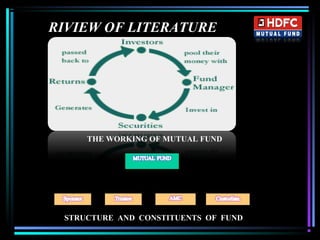
RIVIEW OF LITERATURE
THE WORKING OF MUTUAL FUND
STRUCTURE AND CONSTITUENTS OF FUND
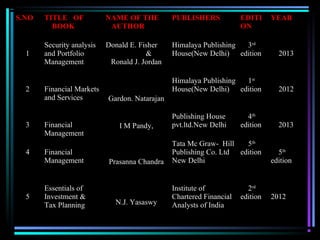
S.NO TITLE OF
BOOK
NAME OF THE
AUTHOR
PUBLISHERS EDITI
ON
YEAR
1
Security analysis
and Portfolio
Management
Donald E. Fisher
&
Ronald J. Jordan
Himalaya Publishing
House(New Delhi)
3rd
edition 2013
2 Financial Markets
and Services Gardon. Natarajan
Himalaya Publishing
House(New Delhi)
1st
edition 2012
3 Financial
Management
I M Pandy,
Publishing House
pvt.ltd.New Delhi
4th
edition 2013
4 Financial
Management Prasanna Chandra
Tata Mc Graw- Hill
Publishing Co. Ltd
New Delhi
5th
edition 5th
edition
5
Essentials of
Investment &
Tax Planning N.J. Yasaswy
Institute of
Chartered Financial
Analysts of India
2rd
edition 2012
COMPANY PROFILE
The Housing Development Finance Corporation
Limited (HDFC) was incorporated in August 1994 in the
name of 'HDFC Bank Limited', with its registered office in
Mumbai, India. HDFC Bank commenced operations as
Scheduled Commercial Bank in January 1995.
HDFC Bank was the first bank in India to launch
an International Debit Card in association with VISA
(VISA Electron) and issues the MasterCard Maestro debit
card as well.
DATA ANALYSIS &
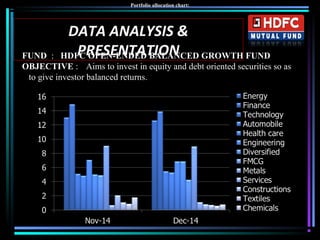
PRESENTATIONFUND : HDFC OPEN-ENDED BALANCED GROWTH FUND
OBJECTIVE : Aims to invest in equity and debt oriented securities so as
to give investor balanced returns.
Portfolio allocation chart:
73.58
12.16
16.68
0
CHART SHOWING ASSET ALLOCATION OF HDFC
BALANCED FUND
EQUI
TY
SECTOR WISE CHART (HDFC )
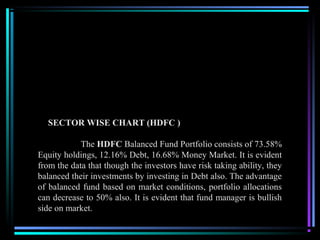
The HDFC Balanced Fund Portfolio consists of 73.58%
Equity holdings, 12.16% Debt, 16.68% Money Market. It is evident
from the data that though the investors have risk taking ability, they
balanced their investments by investing in Debt also. The advantage
of balanced fund based on market conditions, portfolio allocations
can decrease to 50% also. It is evident that fund manager is bullish
side on market.
DATE 1st
NOV
2013
 
1st
JULY
2014
1ST
OCT
2014
1ST
JAN
2014
1ST
NOV
2014
1ST
JULY
2014
1ST
OCT
2014
1ST
JAN
2015
1ST
NOV
2015
NAV 44.094
6
 
60.79 68.87 75.35 76.67 78.60 86.70 86.17 82.67
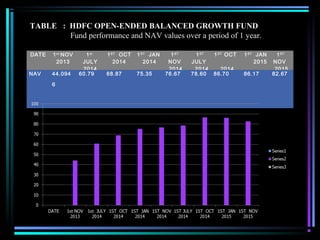
TABLE : HDFC OPEN-ENDED BALANCED GROWTH FUND
Fund performance and NAV values over a period of 1 year.
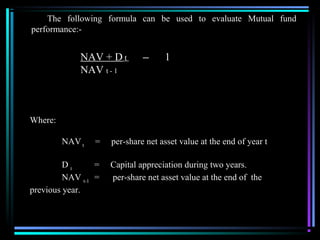
The following formula can be used to evaluate Mutual fund
performance:-
Where:
NAV t
= per-share net asset value at the end of year t
D t
= Capital appreciation during two years.
NAV t-1
= per-share net asset value at the end of the
previous year.
NAV + D t ─ 1
NAV t - 1
 
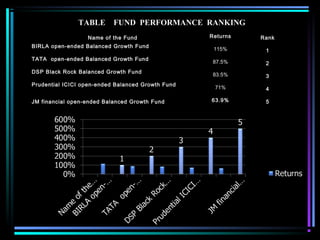
Name of the Fund Returns
 
Rank
BIRLA open-ended Balanced Growth Fund
115%
 
1
TATA open-ended Balanced Growth Fund
87.5%
 
2
DSP Black Rock Balanced Growth Fund
83.5%
 
3
Prudential ICICI open-ended Balanced Growth Fund
71%
 
4
 
JM financial open-ended Balanced Growth Fund 63.9%
 
5
TABLE FUND PERFORMANCE RANKING
FINDINGS, SUGGESTION
AND
CONCLUSION
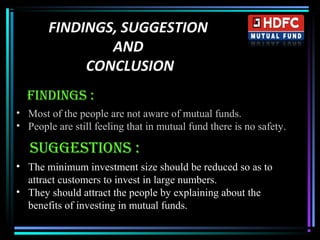
Findings :
• Most of the people are not aware of mutual funds.
• People are still feeling that in mutual fund there is no safety.
sUggEsTiOns :
• The minimum investment size should be reduced so as to
attract customers to invest in large numbers.
• They should attract the people by explaining about the
benefits of investing in mutual funds.
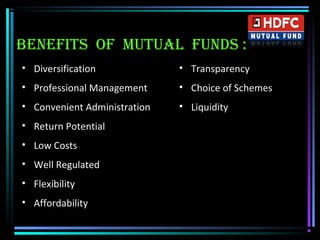
• Diversification
• Professional Management
• Convenient Administration
• Return Potential
• Low Costs
• Well Regulated
• Flexibility
• Affordability
• Transparency
• Choice of Schemes
• Liquidity
BENEFITS OF MUTUAL FUNDS :
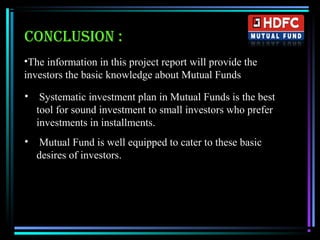
CONCLUSION :
•The information in this project report will provide the
investors the basic knowledge about Mutual Funds
• Systematic investment plan in Mutual Funds is the best
tool for sound investment to small investors who prefer
investments in installments.
• Mutual Fund is well equipped to cater to these basic
desires of investors.
BIBLIOGRAPHY
www.DigiSalesWeb.com
Digital Marketing and Quality Web E-Commerce
Services and Solutions for your Business

Mutual Funds in HDFC - www.digisalesweb.com

  • 1.
    AA Project PresentationProject Presentation onon “MutualFunds at HDFC” Project Guide: Mrs. Vandana Samba Presented By: Ahmed Fasiuddin Khan VIDYA DAYINI COLLEGE OF IT & MANAGEMENT
  • 2.
    Flow of thePresentation www.DigiSalesWeb.com
  • 3.
    IntroductionIntroduction Mutual Funds areprofessionally managed pool of money from a group of investors. According to SEBI – Mutual Fund is defined as – “ A fund established in the form of a trust to raise money’s through the sale of units to the public or a section of the public under one or more schemes for investing in securities ,including money market instruments.” www.DigiSalesWeb.com
  • 4.
    Need for thestudy • Analyze various schemes to highlight the diversified investment that Mutual Fund offers to its investors. • Through this study one can understand how to invest in Mutual Funds and turn the raw investment into ripen fruits. oBJeCtIVes of the study • To understand the recent functioning and trends of Mutual Funds. • To give investor an idea on Mutual Funds and its working in the market. • To study and analyze Open-Ended Balanced growth schemes of mutual funds and to compare and Rank each of them. • To study the types of mutual funds and seek associated with it.
  • 5.
    sCoPe of thestudy The study covers the basic meaning , concept , structure and the organization of the Mutual Funds. The study is restricted to explain only the returns provided by Mutual Funds from various schemes. LIMItAtIoNs of the study • Mutual Funds of only five organizations are taken into account for analyzing their performance • This study on Mutual Funds is restricted to Open-Ended Balanced Schemes only. •The data taken into account for analysis is very general. Confidential data is ignored as it is highly sensitive. As a result the information presented in the research report is limited.
  • 6.
    RESEARCH METHODOLOGY The exploratoryresearch is used as investigation and is mainly concerned with determining the trends and returns in Mutual Funds and Bank returns. DATA COLLECTION Data is collected from external sources which include information from published material of SEBI and some of the information is collected online. TOOLS USED FOR ANALYSIS • Tabulation • Bar chart • Pie chart
  • 7.
    RIVIEW OF LITERATURE THEWORKING OF MUTUAL FUND STRUCTURE AND CONSTITUENTS OF FUND
  • 8.
    S.NO TITLE OF BOOK NAMEOF THE AUTHOR PUBLISHERS EDITI ON YEAR 1 Security analysis and Portfolio Management Donald E. Fisher & Ronald J. Jordan Himalaya Publishing House(New Delhi) 3rd edition 2013 2 Financial Markets and Services Gardon. Natarajan Himalaya Publishing House(New Delhi) 1st edition 2012 3 Financial Management I M Pandy, Publishing House pvt.ltd.New Delhi 4th edition 2013 4 Financial Management Prasanna Chandra Tata Mc Graw- Hill Publishing Co. Ltd New Delhi 5th edition 5th edition 5 Essentials of Investment & Tax Planning N.J. Yasaswy Institute of Chartered Financial Analysts of India 2rd edition 2012
  • 9.
    COMPANY PROFILE The HousingDevelopment Finance Corporation Limited (HDFC) was incorporated in August 1994 in the name of 'HDFC Bank Limited', with its registered office in Mumbai, India. HDFC Bank commenced operations as Scheduled Commercial Bank in January 1995. HDFC Bank was the first bank in India to launch an International Debit Card in association with VISA (VISA Electron) and issues the MasterCard Maestro debit card as well.
  • 10.
    DATA ANALYSIS & PRESENTATIONFUND: HDFC OPEN-ENDED BALANCED GROWTH FUND OBJECTIVE : Aims to invest in equity and debt oriented securities so as to give investor balanced returns. Portfolio allocation chart:
  • 11.
    73.58 12.16 16.68 0 CHART SHOWING ASSETALLOCATION OF HDFC BALANCED FUND EQUI TY SECTOR WISE CHART (HDFC ) The HDFC Balanced Fund Portfolio consists of 73.58% Equity holdings, 12.16% Debt, 16.68% Money Market. It is evident from the data that though the investors have risk taking ability, they balanced their investments by investing in Debt also. The advantage of balanced fund based on market conditions, portfolio allocations can decrease to 50% also. It is evident that fund manager is bullish side on market.
  • 12.
    DATE 1st NOV 2013   1st JULY 2014 1ST OCT 2014 1ST JAN 2014 1ST NOV 2014 1ST JULY 2014 1ST OCT 2014 1ST JAN 2015 1ST NOV 2015 NAV 44.094 6   60.7968.87 75.35 76.67 78.60 86.70 86.17 82.67 TABLE : HDFC OPEN-ENDED BALANCED GROWTH FUND Fund performance and NAV values over a period of 1 year.
  • 13.
    The following formulacan be used to evaluate Mutual fund performance:- Where: NAV t = per-share net asset value at the end of year t D t = Capital appreciation during two years. NAV t-1 = per-share net asset value at the end of the previous year. NAV + D t ─ 1 NAV t - 1
  • 14.
      Name of theFund Returns   Rank BIRLA open-ended Balanced Growth Fund 115%   1 TATA open-ended Balanced Growth Fund 87.5%   2 DSP Black Rock Balanced Growth Fund 83.5%   3 Prudential ICICI open-ended Balanced Growth Fund 71%   4   JM financial open-ended Balanced Growth Fund 63.9%   5 TABLE FUND PERFORMANCE RANKING
  • 15.
    FINDINGS, SUGGESTION AND CONCLUSION Findings : •Most of the people are not aware of mutual funds. • People are still feeling that in mutual fund there is no safety. sUggEsTiOns : • The minimum investment size should be reduced so as to attract customers to invest in large numbers. • They should attract the people by explaining about the benefits of investing in mutual funds.
  • 16.
    • Diversification • ProfessionalManagement • Convenient Administration • Return Potential • Low Costs • Well Regulated • Flexibility • Affordability • Transparency • Choice of Schemes • Liquidity BENEFITS OF MUTUAL FUNDS :
  • 17.
    CONCLUSION : •The informationin this project report will provide the investors the basic knowledge about Mutual Funds • Systematic investment plan in Mutual Funds is the best tool for sound investment to small investors who prefer investments in installments. • Mutual Fund is well equipped to cater to these basic desires of investors.
  • 18.
  • 19.
    www.DigiSalesWeb.com Digital Marketing andQuality Web E-Commerce Services and Solutions for your Business