(NU) - Americans can listen
to the radio viaAM/FM, Internet,
satellite, or cable TV. The music
is the same, but payments to the
artists are not. Internet radio pays
musicians a small amount, but
AM/FM radio pays them nothing.
Most experts agree that this
policy doesn’t fit the digital era,
and many musicians say that
it hurts performers and will con-
tinue to adversely affect the
music industry.
“When many of us think of
the song, ‘Respect,’ we think of
Aretha Franklin,” notes David
Byrne of the Talking Heads.
“Many people are shocked to learn
that Aretha never made a penny
from all the radio broadcasts of her
performance. Many musicians re-
ceive little compensation or strug-
gle to pay bills despite having
widely-aired recordings.”
Musician Sheryl Crow adds,
“DionneWarwickdoesnotgetpaid
for her beautiful recordings when
they are played on the radio. She
had to file for bankruptcy.”
Artists’ advocates, such as
MusicFIRST, point out that
AM/FM radio earns billions of
dollars a year selling ads to lis-
teners while musicians struggle
to make ends meet.
Agrowing number of top stars
including Rosanne Cash, Elvis
Costello, Cyndi Lauper, Imogen
Heap, Common, Elton John, and
R.E.M., are taking the fight to
Washington. Several of these
artists helped launch the Fair
Play, Fair PayAct, bipartisan leg-
islation that would pay musicians
the same royalties no matter what
kind of radio uses their work.
The National Association of
Broadcasters claims that the Fair
Play, Fair Pay Act is unnecessary,
because artists are paid by the ra-
dio in “promotional value” or “ex-
posure.” But many artists disagree.
Grammy-winning artist Rosanne
Cash says, “Exposure is something
you die of,” and musicians deserve
fair pay for their work.
Top U.S. Copyright official
Maria Pallante also questions the
decades-old justification for not
compensating artists. “As con-
sumer preferences shift away from
music ownership, the potential for
sales is becoming less relevant,
and the promotional value of ra-
dio less apparent,” she says.
Many artists believe the Fair
Play, Fair PayAct can and should
become law.
“I support the Fair Play, Fair
PayAct because I love music and
I think all musicians should be
paid,” says singer Cyndi Lauper.
“Every democratic country in
the world pays musicians for ra-
dio play,” says Cake’s John Mc-
Crea. “We think the United States
is a good enough country to do
that as well.”
To learn more, please visit
www.musicfirstcoalition.org.
Musicians Fighting BackAgainst Big
Radio for Performance Royalties
MUSIC
NewsUSA
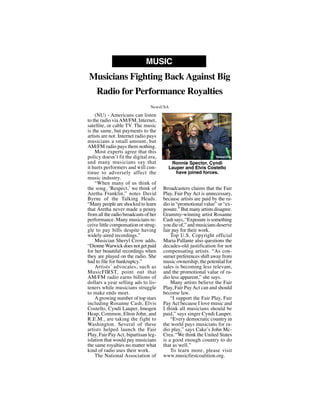
Ronnie Spector, Cyndi
Lauper and Elvis Costello
have joined forces.
NewsUSA

MusicFIRST

  • 1.
    (NU) - Americanscan listen to the radio viaAM/FM, Internet, satellite, or cable TV. The music is the same, but payments to the artists are not. Internet radio pays musicians a small amount, but AM/FM radio pays them nothing. Most experts agree that this policy doesn’t fit the digital era, and many musicians say that it hurts performers and will con- tinue to adversely affect the music industry. “When many of us think of the song, ‘Respect,’ we think of Aretha Franklin,” notes David Byrne of the Talking Heads. “Many people are shocked to learn that Aretha never made a penny from all the radio broadcasts of her performance. Many musicians re- ceive little compensation or strug- gle to pay bills despite having widely-aired recordings.” Musician Sheryl Crow adds, “DionneWarwickdoesnotgetpaid for her beautiful recordings when they are played on the radio. She had to file for bankruptcy.” Artists’ advocates, such as MusicFIRST, point out that AM/FM radio earns billions of dollars a year selling ads to lis- teners while musicians struggle to make ends meet. Agrowing number of top stars including Rosanne Cash, Elvis Costello, Cyndi Lauper, Imogen Heap, Common, Elton John, and R.E.M., are taking the fight to Washington. Several of these artists helped launch the Fair Play, Fair PayAct, bipartisan leg- islation that would pay musicians the same royalties no matter what kind of radio uses their work. The National Association of Broadcasters claims that the Fair Play, Fair Pay Act is unnecessary, because artists are paid by the ra- dio in “promotional value” or “ex- posure.” But many artists disagree. Grammy-winning artist Rosanne Cash says, “Exposure is something you die of,” and musicians deserve fair pay for their work. Top U.S. Copyright official Maria Pallante also questions the decades-old justification for not compensating artists. “As con- sumer preferences shift away from music ownership, the potential for sales is becoming less relevant, and the promotional value of ra- dio less apparent,” she says. Many artists believe the Fair Play, Fair PayAct can and should become law. “I support the Fair Play, Fair PayAct because I love music and I think all musicians should be paid,” says singer Cyndi Lauper. “Every democratic country in the world pays musicians for ra- dio play,” says Cake’s John Mc- Crea. “We think the United States is a good enough country to do that as well.” To learn more, please visit www.musicfirstcoalition.org. Musicians Fighting BackAgainst Big Radio for Performance Royalties MUSIC NewsUSA Ronnie Spector, Cyndi Lauper and Elvis Costello have joined forces. NewsUSA