Lesson 2:
Folk Song
Harana
Polka
Kumintang
Kundiman
Folk Song - it expresses the
people’s everyday activities,
customs, and beliefs which are
put together as music.
Example:
Santa Clara – the patroness of
Obando, Bulacan
Si Pilimon - Cebuano folk song.
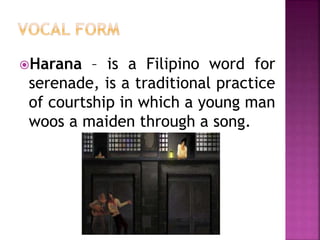
Harana – is a Filipino word for
serenade, is a traditional practice
of courtship in which a young man
woos a maiden through a song.
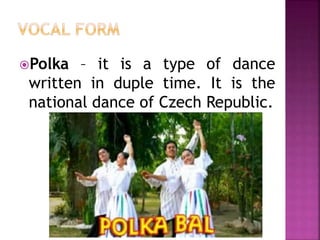
Polka – it is a type of dance
written in duple time. It is the
national dance of Czech Republic.
Philippine folk song and dances formed
by polka:
“Leron-Leron Sinta,” “Magtanim ay ‘Di
Biro,” “Pamulenawen,” and
“Sitsiritsit”.
Other names of Polka:
 Polkabal – in Atimonan, Quezon
 Polka Salsa – in Calapan, Oriental
Mindoro
Kumintang – is the war son
that became famous for the
Batangeńos.
It is a kundiman that gave
inspiration among the Filipinos
who were involved in the
continuing fight for freedom.
Jocelyn Baliwag – a revolutionary
of Bulacan also known as
“Kundiman ng Himagsikan.”
Was most popular during the
Revolution of 1896.
This song was not only dedicated
to Josefa Tiongson y Lara “Pepita”
but also to the beloved
motherland, the Philippines.
Constancio de Guzman
(November 11 to August 16,
1982) – a music composer,
used this song form in 1928
when he set into music
Huseng Batute’s Patriotic
poem “Bayan Ko.”
Kundiman – is a traditional
Filipino song that expresses the
lofty sentiment of love and
even heroism, in a passionate
but melancholic mood.
It is said to be a contraction of
kung himdi man which means
“though I am not worthy.”
Example: Kundiman ni Rizal by
Dr. Jose Rizal.
Francisco Santiago (January
29, 1889 – September 28, 1947)
– is known as the “Father of
Kundiman Art Song” and was
the first to use folk songs in
complete classical sonata form.
music-7-part-2.pptx

music-7-part-2.pptx

  • 1.
  • 3.
  • 4.
    Folk Song -it expresses the people’s everyday activities, customs, and beliefs which are put together as music. Example: Santa Clara – the patroness of Obando, Bulacan Si Pilimon - Cebuano folk song.
  • 5.
    Harana – isa Filipino word for serenade, is a traditional practice of courtship in which a young man woos a maiden through a song.
  • 6.
    Polka – itis a type of dance written in duple time. It is the national dance of Czech Republic.
  • 7.
    Philippine folk songand dances formed by polka: “Leron-Leron Sinta,” “Magtanim ay ‘Di Biro,” “Pamulenawen,” and “Sitsiritsit”. Other names of Polka:  Polkabal – in Atimonan, Quezon  Polka Salsa – in Calapan, Oriental Mindoro
  • 8.
    Kumintang – isthe war son that became famous for the Batangeńos. It is a kundiman that gave inspiration among the Filipinos who were involved in the continuing fight for freedom.
  • 9.
    Jocelyn Baliwag –a revolutionary of Bulacan also known as “Kundiman ng Himagsikan.” Was most popular during the Revolution of 1896. This song was not only dedicated to Josefa Tiongson y Lara “Pepita” but also to the beloved motherland, the Philippines.
  • 10.
    Constancio de Guzman (November11 to August 16, 1982) – a music composer, used this song form in 1928 when he set into music Huseng Batute’s Patriotic poem “Bayan Ko.”
  • 11.
    Kundiman – isa traditional Filipino song that expresses the lofty sentiment of love and even heroism, in a passionate but melancholic mood. It is said to be a contraction of kung himdi man which means “though I am not worthy.”
  • 12.
    Example: Kundiman niRizal by Dr. Jose Rizal. Francisco Santiago (January 29, 1889 – September 28, 1947) – is known as the “Father of Kundiman Art Song” and was the first to use folk songs in complete classical sonata form.