THECODESAND
CONVENTIONSOFA
MUSICVIDEO
Anastasija Nesic
01/definition
02/technical elements
03/why are they important
04/examples of codes and
conventions
05/different music videos
06/camera angles
07/camera movements
08/editing
09/sound
10/mis-en-scene
11/conclusion
CONTENTS
DEFINITION
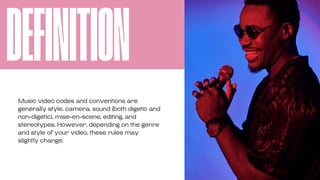
Music video codes and conventions are
generally style, camera, sound (both digetic and
non-digetic), mise-en-scene, editing, and
stereotypes. However, depending on the genre
and style of your video, these rules may
slightly change.
TECHNIQUE
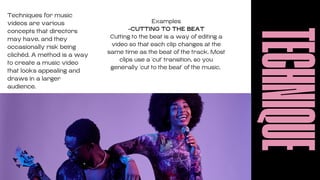
Techniques for music
videos are various
concepts that directors
may have, and they
occasionally risk being
clichéd. A method is a way
to create a music video
that looks appealing and
draws in a larger
audience.
Examples
-CUTTING TO THE BEAT
Cutting to the beat is a way of editing a
video so that each clip changes at the
same time as the beat of the track. Most
clips use a 'cut' transition, so you
generally 'cut to the beat' of the music.
CONTINUED
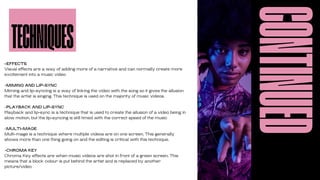
-EFFECTS
Visual effects are a way of adding more of a narrative and can normally create more
excitement into a music video
-MIMING AND LIP-SYNC
Miming and lip-syncing is a way of linking the video with the song so it gives the allusion
that the artist is singing. This technique is used on the majority of music videos.
-PLAYBACK AND LIP-SYNC
Playback and lip-sync is a technique that is used to create the allusion of a video being in
slow motion, but the lip-syncing is still timed with the correct speed of the music
-MULTI-MAGE
Multi-mage is a technique where multiple videos are on one screen. This generally
shows more than one thing going on and the editing is critical with this technique.
-CHROMA KEY
Chroma Key effects are when music videos are shot in front of a green screen. This
means that a block colour is put behind the artist and is replaced by another
picture/video
TECHNIQUES
WHY
DO
WE
NEEED
CODES
AND
CONVENTIONS?
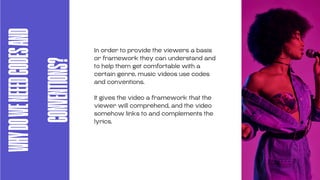
In order to provide the viewers a basis
or framework they can understand and
to help them get comfortable with a
certain genre, music videos use codes
and conventions.
It gives the video a framework that the
viewer will comprehend, and the video
somehow links to and complements the
lyrics.
EXAMPLES
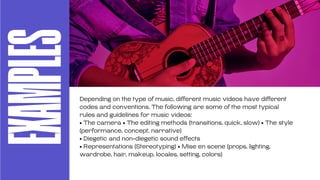
Depending on the type of music, different music videos have different
codes and conventions. The following are some of the most typical
rules and guidelines for music videos:
• The camera • The editing methods (transitions, quick, slow) • The style
(performance, concept, narrative)
• Diegetic and non-diegetic sound effects
• Representations (Stereotyping) • Mise en scene (props, lighting,
wardrobe, hair, makeup, locales, setting, colors)
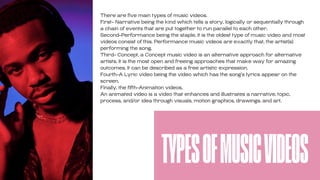
TYPESOFMUSICVIDEOS
There are five main types of music videos.
First- Narrative being the kind which tells a story, logically or sequentially through
a chain of events that are put together to run parallel to each other.
Second-Performance being the staple, it is the oldest type of music video and most
videos consist of this. Performance music videos are exactly that, the artist(s)
performing the song.
Third- Concept, a Concept music video is an alternative approach for alternative
artists. It is the most open and freeing approaches that make way for amazing
outcomes. It can be described as a free artistic expression.
Fourth-A Lyric video being the video which has the song’s lyrics appear on the
screen.
Finally, the fifth-Animation videos,
An animated video is a video that enhances and illustrates a narrative, topic,
process, and/or idea through visuals, motion graphics, drawings, and art.
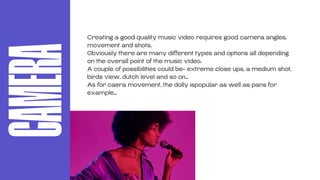
CAMERA Creating a good quality music video requires good camera angles,
movement and shots.
Obviously there are many different types and options all depending
on the overall point of the music video.
A couple of possibilities could be- extreme close ups, a medium shot,
birds view, dutch level and so on…
As for caera movement, the dolly ispopular as well as pans for
example…
E,S,M
The last thing left to cover would have to be everything
else that makes a music video what it is. That would be
editing, sound and mise-en-scene.
Editing is putting all the footage together and makeing
the shots look the best they can. There are differrent
techiques that contribute makeing the video what it is in
editing. An example of this could be a green screen or
the brigthness of the final product.
As for sound there are two types- diagetic and non-
diagetic. Sound can be edited to create different effects
and variations to the vocals apparent
by the artists.
Mise-en-scene would make up for the
Lighting, Props,Costume,Hair and Makeup,Location and
color (- specific colours representing certain moods
and atmosphere)
CONCLUSION
Overall, the music video looks professional thanks to the mise en
scene, camera motions, angles, shots, and sounds. The
performance, concept, and narrative forms of music videos, as well
as the various genres, all have their own unique rules, conventions,
and representations.

Music video codes and conventions. .pdf

  • 1.
  • 2.
    01/definition 02/technical elements 03/why arethey important 04/examples of codes and conventions 05/different music videos 06/camera angles 07/camera movements 08/editing 09/sound 10/mis-en-scene 11/conclusion CONTENTS
  • 3.
    DEFINITION Music video codesand conventions are generally style, camera, sound (both digetic and non-digetic), mise-en-scene, editing, and stereotypes. However, depending on the genre and style of your video, these rules may slightly change.
  • 4.
    TECHNIQUE Techniques for music videosare various concepts that directors may have, and they occasionally risk being clichéd. A method is a way to create a music video that looks appealing and draws in a larger audience. Examples -CUTTING TO THE BEAT Cutting to the beat is a way of editing a video so that each clip changes at the same time as the beat of the track. Most clips use a 'cut' transition, so you generally 'cut to the beat' of the music.
  • 5.
    CONTINUED -EFFECTS Visual effects area way of adding more of a narrative and can normally create more excitement into a music video -MIMING AND LIP-SYNC Miming and lip-syncing is a way of linking the video with the song so it gives the allusion that the artist is singing. This technique is used on the majority of music videos. -PLAYBACK AND LIP-SYNC Playback and lip-sync is a technique that is used to create the allusion of a video being in slow motion, but the lip-syncing is still timed with the correct speed of the music -MULTI-MAGE Multi-mage is a technique where multiple videos are on one screen. This generally shows more than one thing going on and the editing is critical with this technique. -CHROMA KEY Chroma Key effects are when music videos are shot in front of a green screen. This means that a block colour is put behind the artist and is replaced by another picture/video TECHNIQUES
  • 6.
    WHY DO WE NEEED CODES AND CONVENTIONS? In order toprovide the viewers a basis or framework they can understand and to help them get comfortable with a certain genre, music videos use codes and conventions. It gives the video a framework that the viewer will comprehend, and the video somehow links to and complements the lyrics.
  • 7.
    EXAMPLES Depending on thetype of music, different music videos have different codes and conventions. The following are some of the most typical rules and guidelines for music videos: • The camera • The editing methods (transitions, quick, slow) • The style (performance, concept, narrative) • Diegetic and non-diegetic sound effects • Representations (Stereotyping) • Mise en scene (props, lighting, wardrobe, hair, makeup, locales, setting, colors)
  • 8.
    TYPESOFMUSICVIDEOS There are fivemain types of music videos. First- Narrative being the kind which tells a story, logically or sequentially through a chain of events that are put together to run parallel to each other. Second-Performance being the staple, it is the oldest type of music video and most videos consist of this. Performance music videos are exactly that, the artist(s) performing the song. Third- Concept, a Concept music video is an alternative approach for alternative artists. It is the most open and freeing approaches that make way for amazing outcomes. It can be described as a free artistic expression. Fourth-A Lyric video being the video which has the song’s lyrics appear on the screen. Finally, the fifth-Animation videos, An animated video is a video that enhances and illustrates a narrative, topic, process, and/or idea through visuals, motion graphics, drawings, and art.
  • 9.
    CAMERA Creating agood quality music video requires good camera angles, movement and shots. Obviously there are many different types and options all depending on the overall point of the music video. A couple of possibilities could be- extreme close ups, a medium shot, birds view, dutch level and so on… As for caera movement, the dolly ispopular as well as pans for example…
  • 10.
    E,S,M The last thingleft to cover would have to be everything else that makes a music video what it is. That would be editing, sound and mise-en-scene. Editing is putting all the footage together and makeing the shots look the best they can. There are differrent techiques that contribute makeing the video what it is in editing. An example of this could be a green screen or the brigthness of the final product. As for sound there are two types- diagetic and non- diagetic. Sound can be edited to create different effects and variations to the vocals apparent by the artists. Mise-en-scene would make up for the Lighting, Props,Costume,Hair and Makeup,Location and color (- specific colours representing certain moods and atmosphere)
  • 11.
    CONCLUSION Overall, the musicvideo looks professional thanks to the mise en scene, camera motions, angles, shots, and sounds. The performance, concept, and narrative forms of music videos, as well as the various genres, all have their own unique rules, conventions, and representations.