Music Video Analysis
Patrick Smith
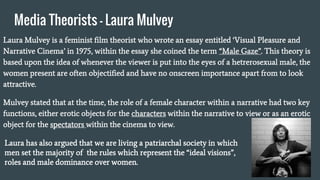
Media Theorists - Laura Mulvey
Laura Mulvey is a feminist film theorist who wrote an essay entitled ‘Visual Pleasure and
Narrative Cinema’ in 1975, within the essay she coined the term “Male Gaze”. This theory is
based upon the idea of whenever the viewer is put into the eyes of a hetrerosexual male, the
women present are often objectified and have no onscreen importance apart from to look
attractive.
Mulvey stated that at the time, the role of a female character within a narrative had two key
functions, either erotic objects for the characters within the narrative to view or as an erotic
object for the spectators within the cinema to view.
Laura has also argued that we are living a patriarchal society in which
men set the majority of the rules which represent the “ideal visions”,
roles and male dominance over women.
Media Theorists - Trevor Millum
Trevor Millum came up with a theory based around how magazines often depict men, he
uses five key concepts to explain this;
-) Seductive - Often seen when the models are depicted with their eyes not fully open (slightly closed) with a confident
expression and maybe a slight smile.
-) Carefree - Normally linked to being active and living a healthy lifestyle.
-) Practical - Sometimes seen with a concentrated look (eyes focussed on something) and with their mouth closed but
not tightly closed.
-) Comic - When the actor or model is seen being funny and is laughing which is often exaggerated to give the
impression that what they are laughing about is extremely funny.
-) Catalogue - This is when the model has their eyes wide open with a big smile.
This is done to either make the male demographic want to be like the model or to act as ‘eye candy’ for the female
demographic.
- Champagne Supernova
One of the music videos that I will be analysing is Champagne Supernova by Oasis which was released during the
height of Brit-pop’s popularity (95). I chose this video as it is very relevant to my own music video as both Oasis and
Pulp (the band I am using for my music video project) shared the same Britpop space during in the 90s.
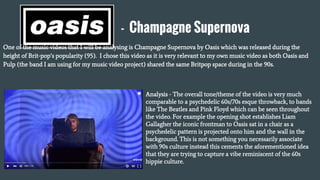
Analysis - The overall tone/theme of the video is very much
comparable to a psychedelic 60s/70s esque throwback, to bands
like The Beatles and Pink Floyd which can be seen throughout
the video. For example the opening shot establishes Liam
Gallagher the iconic frontman to Oasis sat in a chair as a
psychedelic pattern is projected onto him and the wall in the
background. This is not something you necessarily associate
with 90s culture instead this cements the aforementioned idea
that they are trying to capture a vibe reminiscent of the 60s
hippie culture.
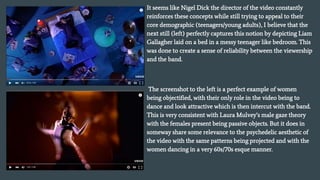
It seems like Nigel Dick the director of the video constantly
reinforces these concepts while still trying to appeal to their
core demographic (teenagers/young adults), I believe that the
next still (left) perfectly captures this notion by depicting Liam
Gallagher laid on a bed in a messy teenager like bedroom. This
was done to create a sense of reliability between the viewership
and the band.
The screenshot to the left is a perfect example of women
being objectified, with their only role in the video being to
dance and look attractive which is then intercut with the band.
This is very consistent with Laura Mulvey’s male gaze theory
with the females present being passive objects. But it does in
someway share some relevance to the psychedelic aesthetic of
the video with the same patterns being projected and with the
women dancing in a very 60s/70s esque manner.
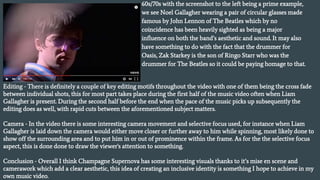
60s/70s with the screenshot to the left being a prime example,
we see Noel Gallagher wearing a pair of circular glasses made
famous by John Lennon of The Beatles which by no
coincidence has been heavily sighted as being a major
influence on both the band’s aesthetic and sound. It may also
have something to do with the fact that the drummer for
Oasis, Zak Starkey is the son of Ringo Starr who was the
drummer for The Beatles so it could be paying homage to that.
Editing - There is definitely a couple of key editing motifs throughout the video with one of them being the cross fade
between individual shots, this for most part takes place during the first half of the music video often when Liam
Gallagher is present. During the second half before the end when the pace of the music picks up subsequently the
editing does as well, with rapid cuts between the aforementioned subject matters.
Camera - In the video there is some interesting camera movement and selective focus used, for instance when Liam
Gallagher is laid down the camera would either move closer or further away to him while spinning, most likely done to
show off the surrounding area and to put him in or out of prominence within the frame. As for the the selective focus
aspect, this is done done to draw the viewer's attention to something.
Conclusion - Overall I think Champagne Supernova has some interesting visuals thanks to it’s mise en scene and
camerawork which add a clear aesthetic, this idea of creating an inclusive identity is something I hope to achieve in my
own music video.
- Parklife
The next video that I will be analysing is Blur’s Parklife which like the previous music video it was released during the
Britpop resurgence of the 1990s. Again because this video shares the same genre as Pulp, so I hope to be able to maybe
observe some conventions that I could use in my own music video.
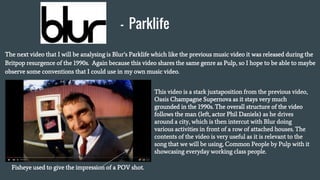
This video is a stark juxtaposition from the previous video,
Oasis Champagne Supernova as it stays very much
grounded in the 1990s. The overall structure of the video
follows the man (left, actor Phil Daniels) as he drives
around a city, which is then intercut with Blur doing
various activities in front of a row of attached houses. The
contents of the video is very useful as it is relevant to the
song that we will be using, Common People by Pulp with it
showcasing everyday working class people.
Fisheye used to give the impression of a POV shot.
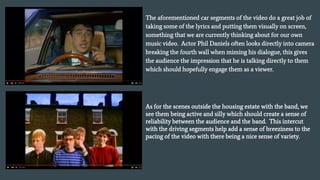
The aforementioned car segments of the video do a great job of
taking some of the lyrics and putting them visually on screen,
something that we are currently thinking about for our own
music video. Actor Phil Daniels often looks directly into camera
breaking the fourth wall when miming his dialogue, this gives
the audience the impression that he is talking directly to them
which should hopefully engage them as a viewer.
As for the scenes outside the housing estate with the band, we
see them being active and silly which should create a sense of
reliability between the audience and the band. This intercut
with the driving segments help add a sense of breeziness to the
pacing of the video with there being a nice sense of variety.
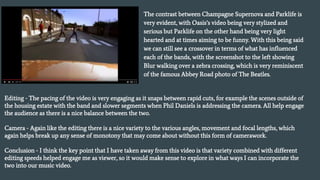
The contrast between Champagne Supernova and Parklife is
very evident, with Oasis’s video being very stylized and
serious but Parklife on the other hand being very light
hearted and at times aiming to be funny. With this being said
we can still see a crossover in terms of what has influenced
each of the bands, with the screenshot to the left showing
Blur walking over a zebra crossing, which is very reminiscent
of the famous Abbey Road photo of The Beatles.
Editing - The pacing of the video is very engaging as it snaps between rapid cuts, for example the scenes outside of
the housing estate with the band and slower segments when Phil Daniels is addressing the camera. All help engage
the audience as there is a nice balance between the two.
Camera - Again like the editing there is a nice variety to the various angles, movement and focal lengths, which
again helps break up any sense of monotony that may come about without this form of camerawork.
Conclusion - I think the key point that I have taken away from this video is that variety combined with different
editing speeds helped engage me as viewer, so it would make sense to explore in what ways I can incorporate the
two into our music video.
- Babies
The third music video that I will be looking into should be very valuable to my research as it features Pulp the band
that I will be using for my own video. And again like the previous videos the song is of the Britpop genre and was
released during the 90s, so with this all being said hopefully after analysing these videos I will have a better
understanding of what made a good msuic video or even a bad music video that does not stand the test of time.
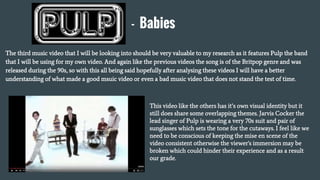
This video like the others has it’s own visual identity but it
still does share some overlapping themes. Jarvis Cocker the
lead singer of Pulp is wearing a very 70s suit and pair of
sunglasses which sets the tone for the cutaways. I feel like we
need to be conscious of keeping the mise en scene of the
video consistent otherwise the viewer's immersion may be
broken which could hinder their experience and as a result
our grade.
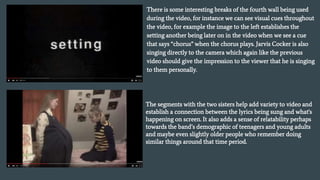
There is some interesting breaks of the fourth wall being used
during the video, for instance we can see visual cues throughout
the video, for example the image to the left establishes the
setting another being later on in the video when we see a cue
that says “chorus” when the chorus plays. Jarvis Cocker is also
singing directly to the camera which again like the previous
video should give the impression to the viewer that he is singing
to them personally.
The segments with the two sisters help add variety to video and
establish a connection between the lyrics being sung and what's
happening on screen. It also adds a sense of relatability perhaps
towards the band’s demographic of teenagers and young adults
and maybe even slightly older people who remember doing
similar things around that time period.
Editing - The editing structure used in the video is very comparable to the structure in ‘Parklife’ with it cutting between
the band playing and a more narrative driven segment which references the song’s lyrics. The difference being that
‘Babies’ is slower in pace to match the song’s rhythm.
Camera - Up until the climax of the song the camera remains fairly static between each of the sequences, I believe this
is done to match the rhythm of the song as when it hits the chorus the pace increases and so does the camera
movement.
Conclusion - Babies is a perfect example of the two segment music video structure, with it switching between both a
narrative strand that is loosely based on the lyrics of the song and a performance by the band. A structure that we are
currently thinking about using.
Overall conclusion - After analysing and commenting on music videos by Oasis, Blur and Pulp respectively I have come
across a few key aspects from each of them that could prove to be invaluable for our own upcoming music video
project, those being, a nice sense of visual variety, matching editing speeds in line with the song's rhythm and a two
segment structure which should help keep the content focussed. I also think by shooting the video in 4:3 aspect ratio it
would help ground the video in 90s which is when our band’s song (Common People by Pulp) was released and add an
aesthetic identity to the final product.

Music Video Analysis

  • 1.
  • 2.
    Media Theorists -Laura Mulvey Laura Mulvey is a feminist film theorist who wrote an essay entitled ‘Visual Pleasure and Narrative Cinema’ in 1975, within the essay she coined the term “Male Gaze”. This theory is based upon the idea of whenever the viewer is put into the eyes of a hetrerosexual male, the women present are often objectified and have no onscreen importance apart from to look attractive. Mulvey stated that at the time, the role of a female character within a narrative had two key functions, either erotic objects for the characters within the narrative to view or as an erotic object for the spectators within the cinema to view. Laura has also argued that we are living a patriarchal society in which men set the majority of the rules which represent the “ideal visions”, roles and male dominance over women.
  • 3.
    Media Theorists -Trevor Millum Trevor Millum came up with a theory based around how magazines often depict men, he uses five key concepts to explain this; -) Seductive - Often seen when the models are depicted with their eyes not fully open (slightly closed) with a confident expression and maybe a slight smile. -) Carefree - Normally linked to being active and living a healthy lifestyle. -) Practical - Sometimes seen with a concentrated look (eyes focussed on something) and with their mouth closed but not tightly closed. -) Comic - When the actor or model is seen being funny and is laughing which is often exaggerated to give the impression that what they are laughing about is extremely funny. -) Catalogue - This is when the model has their eyes wide open with a big smile. This is done to either make the male demographic want to be like the model or to act as ‘eye candy’ for the female demographic.
  • 4.
    - Champagne Supernova Oneof the music videos that I will be analysing is Champagne Supernova by Oasis which was released during the height of Brit-pop’s popularity (95). I chose this video as it is very relevant to my own music video as both Oasis and Pulp (the band I am using for my music video project) shared the same Britpop space during in the 90s. Analysis - The overall tone/theme of the video is very much comparable to a psychedelic 60s/70s esque throwback, to bands like The Beatles and Pink Floyd which can be seen throughout the video. For example the opening shot establishes Liam Gallagher the iconic frontman to Oasis sat in a chair as a psychedelic pattern is projected onto him and the wall in the background. This is not something you necessarily associate with 90s culture instead this cements the aforementioned idea that they are trying to capture a vibe reminiscent of the 60s hippie culture.
  • 5.
    It seems likeNigel Dick the director of the video constantly reinforces these concepts while still trying to appeal to their core demographic (teenagers/young adults), I believe that the next still (left) perfectly captures this notion by depicting Liam Gallagher laid on a bed in a messy teenager like bedroom. This was done to create a sense of reliability between the viewership and the band. The screenshot to the left is a perfect example of women being objectified, with their only role in the video being to dance and look attractive which is then intercut with the band. This is very consistent with Laura Mulvey’s male gaze theory with the females present being passive objects. But it does in someway share some relevance to the psychedelic aesthetic of the video with the same patterns being projected and with the women dancing in a very 60s/70s esque manner.
  • 6.
    60s/70s with thescreenshot to the left being a prime example, we see Noel Gallagher wearing a pair of circular glasses made famous by John Lennon of The Beatles which by no coincidence has been heavily sighted as being a major influence on both the band’s aesthetic and sound. It may also have something to do with the fact that the drummer for Oasis, Zak Starkey is the son of Ringo Starr who was the drummer for The Beatles so it could be paying homage to that. Editing - There is definitely a couple of key editing motifs throughout the video with one of them being the cross fade between individual shots, this for most part takes place during the first half of the music video often when Liam Gallagher is present. During the second half before the end when the pace of the music picks up subsequently the editing does as well, with rapid cuts between the aforementioned subject matters. Camera - In the video there is some interesting camera movement and selective focus used, for instance when Liam Gallagher is laid down the camera would either move closer or further away to him while spinning, most likely done to show off the surrounding area and to put him in or out of prominence within the frame. As for the the selective focus aspect, this is done done to draw the viewer's attention to something. Conclusion - Overall I think Champagne Supernova has some interesting visuals thanks to it’s mise en scene and camerawork which add a clear aesthetic, this idea of creating an inclusive identity is something I hope to achieve in my own music video.
  • 7.
    - Parklife The nextvideo that I will be analysing is Blur’s Parklife which like the previous music video it was released during the Britpop resurgence of the 1990s. Again because this video shares the same genre as Pulp, so I hope to be able to maybe observe some conventions that I could use in my own music video. This video is a stark juxtaposition from the previous video, Oasis Champagne Supernova as it stays very much grounded in the 1990s. The overall structure of the video follows the man (left, actor Phil Daniels) as he drives around a city, which is then intercut with Blur doing various activities in front of a row of attached houses. The contents of the video is very useful as it is relevant to the song that we will be using, Common People by Pulp with it showcasing everyday working class people. Fisheye used to give the impression of a POV shot.
  • 8.
    The aforementioned carsegments of the video do a great job of taking some of the lyrics and putting them visually on screen, something that we are currently thinking about for our own music video. Actor Phil Daniels often looks directly into camera breaking the fourth wall when miming his dialogue, this gives the audience the impression that he is talking directly to them which should hopefully engage them as a viewer. As for the scenes outside the housing estate with the band, we see them being active and silly which should create a sense of reliability between the audience and the band. This intercut with the driving segments help add a sense of breeziness to the pacing of the video with there being a nice sense of variety.
  • 9.
    The contrast betweenChampagne Supernova and Parklife is very evident, with Oasis’s video being very stylized and serious but Parklife on the other hand being very light hearted and at times aiming to be funny. With this being said we can still see a crossover in terms of what has influenced each of the bands, with the screenshot to the left showing Blur walking over a zebra crossing, which is very reminiscent of the famous Abbey Road photo of The Beatles. Editing - The pacing of the video is very engaging as it snaps between rapid cuts, for example the scenes outside of the housing estate with the band and slower segments when Phil Daniels is addressing the camera. All help engage the audience as there is a nice balance between the two. Camera - Again like the editing there is a nice variety to the various angles, movement and focal lengths, which again helps break up any sense of monotony that may come about without this form of camerawork. Conclusion - I think the key point that I have taken away from this video is that variety combined with different editing speeds helped engage me as viewer, so it would make sense to explore in what ways I can incorporate the two into our music video.
  • 10.
    - Babies The thirdmusic video that I will be looking into should be very valuable to my research as it features Pulp the band that I will be using for my own video. And again like the previous videos the song is of the Britpop genre and was released during the 90s, so with this all being said hopefully after analysing these videos I will have a better understanding of what made a good msuic video or even a bad music video that does not stand the test of time. This video like the others has it’s own visual identity but it still does share some overlapping themes. Jarvis Cocker the lead singer of Pulp is wearing a very 70s suit and pair of sunglasses which sets the tone for the cutaways. I feel like we need to be conscious of keeping the mise en scene of the video consistent otherwise the viewer's immersion may be broken which could hinder their experience and as a result our grade.
  • 11.
    There is someinteresting breaks of the fourth wall being used during the video, for instance we can see visual cues throughout the video, for example the image to the left establishes the setting another being later on in the video when we see a cue that says “chorus” when the chorus plays. Jarvis Cocker is also singing directly to the camera which again like the previous video should give the impression to the viewer that he is singing to them personally. The segments with the two sisters help add variety to video and establish a connection between the lyrics being sung and what's happening on screen. It also adds a sense of relatability perhaps towards the band’s demographic of teenagers and young adults and maybe even slightly older people who remember doing similar things around that time period.
  • 12.
    Editing - Theediting structure used in the video is very comparable to the structure in ‘Parklife’ with it cutting between the band playing and a more narrative driven segment which references the song’s lyrics. The difference being that ‘Babies’ is slower in pace to match the song’s rhythm. Camera - Up until the climax of the song the camera remains fairly static between each of the sequences, I believe this is done to match the rhythm of the song as when it hits the chorus the pace increases and so does the camera movement. Conclusion - Babies is a perfect example of the two segment music video structure, with it switching between both a narrative strand that is loosely based on the lyrics of the song and a performance by the band. A structure that we are currently thinking about using. Overall conclusion - After analysing and commenting on music videos by Oasis, Blur and Pulp respectively I have come across a few key aspects from each of them that could prove to be invaluable for our own upcoming music video project, those being, a nice sense of visual variety, matching editing speeds in line with the song's rhythm and a two segment structure which should help keep the content focussed. I also think by shooting the video in 4:3 aspect ratio it would help ground the video in 90s which is when our band’s song (Common People by Pulp) was released and add an aesthetic identity to the final product.