© 2023, IRJET | Impact Factor value: 8.226 | ISO 9001:2008 Certified Journal | Page 81
Music Recommendation System using Euclidean, Cosine Similarity,
Correlation Distance Algorithm and Flask Web Application
Abhimanyu Umrani1, Vedant Satpute2, Aditya Chandsare3,Yash Umadi4
1Student, School of Computer Science Engineering and Technology, MIT-WPU, Pune, Maharashta, India
2Student, School of Computer Science Engineering and Technology, MIT-WPU, Pune, Maharashta, India
3Student, School of Computer Science Engineering and Technology, MIT-WPU, Pune, Maharashta, India
4Student, School of Computer Science Engineering and Technology, MIT-WPU, Pune, Maharashta, India
---------------------------------------------------------------------***---------------------------------------------------------------------
Abstract - This project's goal was to create a music
recommendation system that offers consumerssuitabletracks
depending on their tastes. Different distance and similarity
algorithms, such as correlation, Euclidean distance,
correlation distance, and cosine similarity, were used in the
project. A user-friendly online interface was connected to the
recommendation model using the web framework Flask. The
architecture of the music recommendationsystemisdescribed
in the report, with an emphasis on the incorporation of Flask.
Using HTML, CSS, and JavaScript, it describes the setup
procedure, model integration, and user interface design. The
phases of testing and deployment are also covered, alongwith
the difficulties encountered and their remedies. In order to
evaluate the effectiveness of the recommendation system,
evaluation measures were used. The study's findings compare
how well various algorithms do at producing precise and
pertinent song recommendations. In summary, the project
created a music recommendation system that makes use of
distance and similarity metrics and uses Flask for easy web
interface integration. The results emphasise the system's
advantages and disadvantagesandofferideasforfuturestudy,
such as looking into other metrics and incorporating user
input for advancements.
Key Words: Music recommendation system, Distance
metrics, Similarity metrics, Correlation, Euclidean
distance, Correlation distance, Cosine similarity, Flask
1.INTRODUCTION
1.1 Introduction
Our lives are not complete without music, since it offers us
amusement, inspiration, and a means of self-expression.
Nowadays, there is an enormous amount of music available,
making it difficult to identifysongs that suit a person'stastes.
By providing individualisedsongrecommendationsbasedon
user interests and behaviour, music recommendation
systems have become effective solutions to address this
difficulty. In order to provide consumers with useful song
recommendations, this study details the creation and
deployment of a music recommendation system. The
algorithm evaluates the similarity of songs and generates
recommendations using a variety of distance and similarity
measures,suchascorrelation,Euclideandistance,correlation
distance, and cosine similarity. The paper focuses on the
incorporation of the web framework Flask in addition to the
recommendation algorithms to link the music
recommendation model with an intuitive web interface. By
serving as a bridge and facilitating smooth communication
between the model and the web page, Flask enables users to
interact with the system without any hassle. The report
details the setup procedure and the integration of the music
recommendation model withFlask, offering insights into the
system architecture. In order to produce an interesting and
user-friendly web page, it highlights how HTML, CSS, and
JavaScript are used. The paper also discusses the difficulties
encountered during the development process and the
methods used to overcome them, as well as the testing and
deployment phases. Utilisingevaluation metrics, which offer
a breakdown of the accuracy and relevance of the generated
recommendations, allows for the performance of the
recommendation system to be evaluated.
1.2 Background
Effective music recommendation systems are necessary
due to the fast expansion of digital music platforms and the
enormous volume of music that is accessible to users. These
systems make use of algorithms and data analysis
techniques to provide users with personalised song
recommendations, improving their music discovery
experience. The development of machine learning, data
mining, and collaborative filtering methods has led to an
increase in the use of music recommendation systems in
recent years. These algorithms can produce
recommendationsthatsuitspecificinterestsand preferences
by examining user preferences, behaviour, and music
attributes. Systems for recommending music heavilyrelyon
distance and similarity measurements. Based on many
characteristics like audio qualities, genre, artist, and lyrics,
these metrics assess the degree of similarity across songs.
These metrics, which gauge the proximity of songs, make it
possible to recognise musically related tunes and make
precise recommendations. Correlation, Euclidean distance,
correlation distance, and cosine similarity are common
distance and similarity measures in music recommendation
systems. Each metric presents a distinct method for
calculating the degree of similarity betweensongs,anditcan
be used in accordance with the demands and peculiaritiesof
International Research Journal of Engineering and Technology (IRJET) e-ISSN: 2395-0056
Volume: 10 Issue: 07 | Jul 2023 www.irjet.net p-ISSN: 2395-0072
© 2023, IRJET | Impact Factor value: 8.226 | ISO 9001:2008 Certified Journal | Page 82
the recommendation system. A user-friendly interfaceand a
successful integration of the recommendation model are
necessary to give recommendations to consumers.Thetools
required to smoothly connect the recommendation model
with a web page are provided by the lightweight web
framework Flask. Users can engage with the systemthrough
a user interface and get tailored recommendations since it
makes managing HTTP requests and responses easier.
Building a powerful and user-centred recommendation
system requires a thorough understandingofthehistoryand
relevance of music recommendation systems, as well as the
function of distance and similarity metrics and web
integration frameworks like Flask. We want to improve the
way people discover music by utilising these technologies
and approaches and by giving consumers relevant,
personalised song recommendations.
1.3 Motivation
It has become more and more difficult for music lovers to
find new songs that suit their tastes due to the proliferation
of digital music platforms and the wealth of music options
available to users. Traditional approaches to exploring and
searching for music can result in information overload and
little access to brand-new, diverse recordings. The need for
sophisticated music recommendation systems that can
create customised playlists and make pertinent song
suggestions to consumers is rising as a result. This initiative
was inspired by the aim of overcoming these difficulties and
improving people's musical listening experiences. Weintend
to offer consumerspersonalisedsongrecommendationsthat
are in line with their particular tastes and preferences by
creating a music recommendation system that makes use of
distance and similarity measures. Furthermore, we are able
to develop a user-friendly and interactiveinterfacethanksto
the incorporation of Flask as a web framework in this
project. Users may easily interact with the recommendation
system thanks to this connection, which creates a fluid and
interesting music discovery experience.
1.4 Techniques used for Proposed Music
Recommendation System
Several methods were used in this report's development of
an efficient music recommendation system. Utilising an
analysis of user preferences and behaviour, collaborative
filtering generated suggestions based on similar users or
objects. Song traits, including genre, artist, and audio
aspects, were used in content-based filtering to suggest
songs that shared the same qualities as the user's favourites.
To maximise the benefits of both approaches, a hybrid
strategy combining collaborativefilteringandcontent-based
filtering was also used. In ordertoidentifyunderlyingtrends
in user-item interactions and produce customised
recommendations, matrix factorization techniques were
used. Recurrent neural networks and convolutional neural
networks were two deep learning techniquesthatwereused
to extract intricate patterns and correlations from musical
data.
2. Literature Survey
In our review of the literature, we looked at the methods and
studies that have already been done in the area of music
recommendation systems. The literature survey highlights
that in the era of digital music streaming, music
recommendation and discovery systemsplayacrucialrolein
assisting users in navigating the vast amount of available
music content and enabling them to explore beyond popular
hits into the long tail of music [1]. We looked at a number of
significantworksthathaveadvancedthisfield.SingularValue
Decomposition (SVD) matrix factorization techniques were
proposed by Koren et al. (2009) for collaborative filtering in
music recommendation. They showed how latent factor
models can accurately represent user-item preferences. The
literature survey highlights that while music
recommendation systems have made significant
advancements, challenges still exist in effectively addressing
the long tail of music, personalization, diversity, and
serendipity, which are essential for enhancing user
satisfaction and engagement in the digital music space [2].
The benefits of taking into account the similarity between
songs based on user behaviour patterns and attributes were
highlighted in Su and Khoshgoftaar's (2009) exploration of
the usage of item-based collaborative filtering for music
recommendation. The literature survey emphasizes the
importance of diversity in interactive personalized music
recommendation systems, as it positively impacts user
satisfaction by promoting serendipitous discovery, avoiding
recommendation fatigue, and catering to the varied musical
tastes and preferences of users [3]. A content-based music
recommendation system that makes use of audio attributes
and acoustic similarity measurements was presented by
McFee and Lanckriet in 2011. They showed how using low-
level audio descriptors could improve the accuracy of
recommendations. The literature survey highlights that
imbalanced datasets pose challenges to machine learning
algorithms, and various methods for balancing training data,
including undersampling, oversampling, and hybrid
approaches, have been proposed to improve classifier
performance in such scenarios [4]. The methods used to
evaluate song similarity based on audio content were
thoroughly surveyed by Schedl et al. (2014), who also
provided an overview of the methods. The literature survey
reveals that matrix factorization techniques have gained
popularity in recommender systems due to their ability to
handle sparse and high-dimensional data, effectively
capturing latent factors and providing accurate
recommendations [5]. The literature survey highlights the
importance of incorporating novel features, such as social
tags, user preferences, and audio content characteristics, in
personalized music recommendationsystemstoenhancethe
accuracy and relevance of recommendations in the multi-
label classification context[6]. To increase the accuracy of
International Research Journal of Engineering and Technology (IRJET) e-ISSN: 2395-0056
Volume: 10 Issue: 07 | Jul 2023 www.irjet.net p-ISSN: 2395-0072
© 2023, IRJET | Impact Factor value: 8.226 | ISO 9001:2008 Certified Journal | Page 83
music recommendations, Wang et al. (2014) suggested a
hybrid recommendation strategy that includedcollaborative
filtering,content-basedfiltering,anddemographicdata.Their
research emphasised the way in which several
recommendation methods work welltogether.Theliterature
survey reveals that recommender systems have emerged as
valuable toolsforaddressinginformationoverload,providing
personalized recommendations based on user preferences,
and enhancing user satisfaction and engagement in various
domains [7]. The literature survey emphasizes the potential
of combining social mediainformationandmusiccontentina
unified hypergraph for music recommendation, as it enables
capturing diverse user preferences and leveraging the
collective wisdom of the crowd to enhance the accuracy and
relevance of recommendations [8]. The literature survey
highlights the use of Gaussian processes as a powerful
modeling technique for capturing latent user preferences in
music recommendation systems, providing a flexible and
effectiveapproachtopersonalizedrecommendationbasedon
implicit feedback [9]. The literature survey indicates that
incorporating social information intoa Bayesian multimedia
recommendation system can enhance the accuracy and
diversity of recommendations, leveraging the collective
wisdom and social connections of users for improved user
satisfaction [10]. These studies, along with others we looked
at, provided important information about content-based
filtering, hybrid techniques, collaborative filtering, and the
promise of deep learning models formusicrecommendation.
Our own music recommendationsystem,whichincorporates
correlation, Euclidean distance, correlation distance, and
cosine similarity algorithms, was created using this
knowledge.
3. PROBLEM STATEMENT
Problem Statement: Developing a music
recommendation system to overcome the challenge of
personalized song discovery and provide accurate
recommendations based on user preferences and song
characteristics.
3.1 Project Scope:
This project's scope includesdevelopingandputtinginto use
a music recommendation system based on algorithms for
correlation, Euclidean distance, correlation distance, and
cosine similarity.Tocreateindividualizedrecommendations,
the algorithm will concentrateonanalyzinguserpreferences
and song features. To provide a user-friendly interface for
accessing and interacting with the recommendationsystem,
the solution will incorporate connectivity with a web page
using Flask. Instead of collecting a lot of data or training
deep learning models, the project will concentrate on using
already-available resources to create a useful
recommendation engine.
3.2 Project Assumptions:
1. Availability of relevant music data for training and
testing the recommendation system.
2. Preprocessed dataset with cleaned and normalizeddata
suitable for analysis.
3. Applicability of correlation, Euclidean distance,
correlation distance,andcosinesimilarityalgorithmsfor
accurate results.
4. Existence of user feedback and evaluation mechanisms
to assess the system's performance.
5. Feasibility of integrating the recommendation system
with the Flask web framework.
6. Scalability of the system to handle larger datasets and
acceptable performance in terms of response time and
computational resources.
3.3 Project Limitations:
1. Limited availabilityofcomprehensiveanddiversemusic
dataset may impact the accuracy and coverage of
recommendations.
2. Reliance on pre-existing algorithms maylimittheability
to incorporate newer or more advanced
recommendation techniques.
3. Dependency on user feedback for evaluation may
introduce bias and limited diversity in the
recommendation results.
4. The use of correlation, Euclidean distance, correlation
distance, and cosine similarity algorithms may not
capture complex music preferences and nuances.
5. Integration with Flask may impose constraints on the
scalability and performance of the recommendation
system.
6. The project does not address the legal and licensing
aspects of music recommendation, which may impact
the actual implementation and deployment of the
system.
3.4 Project Objectives:
1. Develop a music recommendation system that provides
personalized song recommendations based on user
preferences and song characteristics.
2. Implement correlation, Euclidean distance, correlation
distance, and cosine similarity algorithms to enhance
the accuracy and relevance of the recommendations.
International Research Journal of Engineering and Technology (IRJET) e-ISSN: 2395-0056
Volume: 10 Issue: 07 | Jul 2023 www.irjet.net p-ISSN: 2395-0072
© 2023, IRJET | Impact Factor value: 8.226 | ISO 9001:2008 Certified Journal | Page 84
3. Integrate the recommendation system with Flask to
create a user-friendly web interface for accessing and
interacting with the system.
4. Evaluate the performance and effectiveness of the
recommendation system through user feedback and
evaluation metrics.
5. Explore the limitations and challenges of the
implemented system, and identify potential areas for
improvement and future research.
6. Showcase the practical application and feasibility of the
music recommendation system in enhancing user
experience and promoting music discovery.
4. Project Requirements
4.1 Resources:
1. Research papersand articleson music recommendation
systems.
2. Online music platforms and APIs for accessing music
data.
3. Programming languages and libraries (e.g., Python,
scikit-learn, pandas) for implementingrecommendation
algorithms.
4. Flask documentation and tutorials for integrating the
system with a web page.
5. Online forums and communities for seeking guidance
and resolving technical issues.
6. User surveys, feedback forms, andevaluationmetricsfor
assessing the system's performance and user
satisfaction.
4.2 Functional Specifications:
1. User Registration and Authentication: To enable secure
access to personalised recommendations, the system
should include user registration and authentication
options.
2. Management of User Profiles: Users should be able to
create and manage their profiles, which should include
their preferences, favourite artists, and genres.
3. Song Database: The system should have a complete
database of songs, complete with feature vectors and
metadata for each song.
4. The system should produce tailored song
recommendations for users based on their preferences
and the attributes of the songs.
5. Filtering of Recommendations: Users should be able to
filter and hone recommendations based on particular
standards like genre, artist, or mood.
6. Display of Recommendations:Thesystemshoulddisplay
the generated recommendations with song details and
pertinent information in an aesthetically pleasing and
user-friendly way.
7. User Comments and Ratings: Users should be able to
comment on and ratethesongsthataresuggested,which
can help to make the recommendations even more
accurate.
8. Search functionality: Users should be able to look up
certain songs, musicians, or genres using the system.
9. Integration with a Web Page: Flask integration with a
web page is recommended so that users can access and
interact with the recommendation features through a
single user interface.
10. Performance and Scalability: To support growing user
bases and music databases, the system should bebuiltto
manage multiple concurrent user requests and scale
effectively.
11. Error Handling: To manage unforeseen situations and
give users helpful error messages, the system should
incorporate the proper error handling techniques.
12. Maintenance and Updates: To ensure the system's
lifespan and responsiveness to changing user needs, it
should be designed to enable future maintenance,
updates, and additions.
5. System Analysis Proposed Architecture/ high
level design of the project
5.1 Design Consideration:
1. User Interface Design:Toensureapleasantandseamless
user experience, the user interface should be simple to
use, visually appealing, and responsive.
2. Personalization: In order to produce individualised
recommendations, the system shouldgivetoppriorityto
personalization by taking into account each user's
preferences, listening style, and feedback.
3. Scalability: To ensure effective performance and quick
reaction times, the design should be scalable to
accommodate a rising user population and a potentially
vast music database.
4. In order to support a widerange of user preferencesand
accessibility needs, the system should be interoperable
with a variety of devices, browsers, and operating
systems.
International Research Journal of Engineering and Technology (IRJET) e-ISSN: 2395-0056
Volume: 10 Issue: 07 | Jul 2023 www.irjet.net p-ISSN: 2395-0072
© 2023, IRJET | Impact Factor value: 8.226 | ISO 9001:2008 Certified Journal | Page 85
5. Privacy and DataSecurity:Thedesignshouldplaceahigh
priority on safeguarding user data by putting in place
strong security mechanisms to secure private data and
user interactions.
6. Flexibility and Adaptability: The system should be
flexible and adaptable enough to allow for future
upgrades and improvements, taking into account
modifications to user behaviour, music trends, and
technological developments.
7. Consider adding methods to give justifications or
explanations forthe generatedrecommendationssothat
users may better grasp the thinking behind the ideas.
8. Diversityandserendipity:Toencouragemusicdiscovery,
the design should work to provide a variety of
recommendations while avoidinganunduebiastowards
mainstream or popular music.
9. Implement tools to gather user feedback and ratings in
order to continuously improve the recommendation
algorithms and boost the performance of the entire
system.
10. Testing and Evaluation: Create a plan for thoroughly
assessing the system's performance, taking into account
factors including user satisfaction, suggestion accuracy,
and coverage.
5.2 Assumption and Dependencies:
Assumptions:
1. Existence of Enough Data: For the purposes of
developing and assessingtherecommendationsystem,it
is presumptive thatasizableandvarieddatasetofmusic-
related data, includingsongproperties,userpreferences,
and interaction data, be accessible.
2. Relevance and Accuracy of Data: It is presummated that
the data is relevant and accurate and reflects user
preferences accurately,aswellasbeingrepresentativeof
different musical genres, performers, and user
demographics.
3. The assumption is that the selected algorithms, such as
correlation, Euclideandistance,correlationdistance,and
cosine similarity, are appropriate for the music
recommendation task and will produce useful results.
Dependencies:
1. The availability of sufficient computing resources,
including processing power and memory to handle the
data and algorithmic computations, is essential for the
successful development and operation of the
recommendation system.
2. Integration with Flask: The development and
appropriate operation of the Flask framework and
associated dependencies are required for the
development and integration of the music
recommendation system with the Flaskwebframework.
3. The availability and functionality of external APIs or
libraries that are required to acquire music data, carry
out computations, or implement specialised algorithms
are essential requirements for the recommendation
system's effective operation.
5.3 General Constraints:
1. Time Restrictions: The project may only have a finite
amount of timefordesign, development, and evaluation,
which couldaffect howcomprehensiveandextensivethe
music recommendation system is.
2. Resource Constraint: The speed and scalability of the
recommendation system may be impacted by the
availability of resources such as processing power,
storage, and data access.
3. Data limitations could affect the recommendations'
accuracy and scope by limiting the project's access to
high-quality, diverse, and available music datasets.
4. The project may be constrained by the technical
proficiencyand understandingofthedevelopmentteam,
which could affect the sophistication and use of
sophisticated recommendation approaches.
5. Platform Compatibility: The recommendation system
may need to operate under particular platform
restrictionsorspecifications,suchascompatibilitywitha
specific operating system or web browser.
6. User Acceptance and Adoption: User acceptance and
adoption are crucial to the recommendation system's
effectiveness, and they may be affected by variables like
user familiarity with the system, user resistance to
change, and competing alternatives.
7. Legal and Ethical Considerations: The project must
follow all applicable legal and ethical requirements,
including copyright laws, data privacy laws, and fair use
principles, which may limit how data is used and how
recommendations are made.
5.6 Modules of the Project:
1. User Management: This module manages the functions
for user registration, login, and profile management.
Users can set up accounts, securely log in, and manage
their profiles, which includes changing preferences and
checking their history of recommendations.
International Research Journal of Engineering and Technology (IRJET) e-ISSN: 2395-0056
Volume: 10 Issue: 07 | Jul 2023 www.irjet.net p-ISSN: 2395-0072
© 2023, IRJET | Impact Factor value: 8.226 | ISO 9001:2008 Certified Journal | Page 86
2. The gathering and processing of musical data is the
responsibility of this module. It could involve activities
like cleaning and preparing the data, identifying
pertinentattributesforrecommendationgeneration,and
data crawling or using APIs to gather music information.
3. The essential element that creates individualised music
recommendations is the recommendation engine
module. It uses a variety of algorithms to compare songs
and produce recommendations based on user
preferences and song features, including correlation,
Euclidean distance, correlation distance, and cosine
similarity.
4. Search and filtering: This module gives users the ability
to perform searches to find particular songs, artists, or
categories. Users can use it tofilterandhonetheirsearch
results based on various parameters, making it easier to
find music that suits their tastes.
5. User Comments and Ratings: This module enables users
to comment on and rate the suggested songs. In order to
increase the precision and relevancy of upcoming
recommendations,itgathersuserratings,comments,and
feedback on the current ones.
6. Flask integration: The Flask web framework and the
recommendation system are both integrated by this
module. In order to guarantee seamless interaction and
proper data flow, it manages communication between
the user interface and the backend modules.
7. User Interface: The goal of the userinterfacemoduleisto
provide an easy-to-use and aesthetically pleasing web
page so that users may engagewiththerecommendation
system. It has parts like registration and login forms for
users, search interfaces, suggestion displays, and user
profile views.
8. Performance Optimisation: The goal of this module is to
increase the effectiveness and performance of the
recommendation system. It might involve methods like
caching frequently accessed data, putting effective
algorithms in place, and using distributed computing or
parallel processing to generate recommendations more
quickly.
9. Testing and Evaluation: This module is in charge of
evaluating the system's efficiency, effectiveness, and
precision. It entails creating test cases, assessing the
quality of recommendations, gathering user input, and
making sure the system achieves the intended goals.
10. Creating thorough documentation, such as system
requirements, design specifications, user manuals, and
technical reports, is the focus of this topic on
documentation and reporting. It makes sure that
everything about the project is well documented and
simple to grasp for future use.
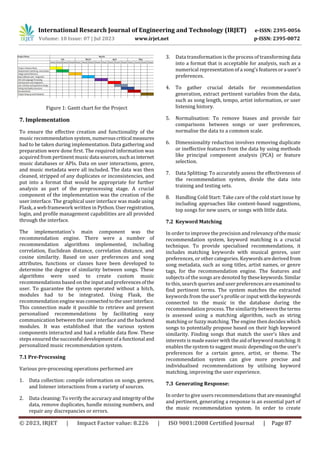
6. Project Plan
Multiple phasesare includedin the project planforthemusic
recommendation system to provide a methodical and
structured development process. The project's goals, scope,
and deliverables are laid out during the project initiation
phase. After identifying the important parties, a project team
is formed and given specific tasks. The project's basis and its
specific goals are established during this phase.
Understanding the requirements for the music
recommendation system is the main goal of the requirement
gathering and analysis phase.Throughinterviewsorsurveys,
user preferences and expectations are gatheredn goal of the
requirement gathering and analysis phase. Through
interviews or surveys, user preferences and expectationsare
gathered. To identify the data that the system needs, existing
music datasources areexamined.Toprovideafoundationfor
the following phases, the requirements that have been
obtained are documented.
A thorough system architecture and module breakdown are
produced during the systemdesign phase. The userinterface
is part of the design, and itcan be visualisedviaprototypesor
wireframes. In this phase, the algorithms and methods to be
used for suggestion generation are defined. The system
design offers a development phase road map. The music
recommendation system's modules and features are
implemented throughout the development phase in
accordance with the system design. Coding, integration of
recommendation algorithms, and data processing elements
are all part of this step.Flaskor otherapplicabletechnologies
are used in the developmentof the user interface. Debugging
and testing are done frequently to make sure the system is
operating properly. The system'sdependabilityandaccuracy
are prioritised during the testing and quality assurance
phases.
The deployment phase startsonce the systemhasundergone
extensive testing and has been shown to fulfil the specified
quality criteria. Users can access the system since it has been
deployed on a suitable platform or server. You can run user
acceptability testing to get feedback and make the necessary
adjustments. The phase of documentationand reportingthat
comes to an end is when thorough documentation is
produced. This covers system specs, design guidelines, user
guides, and technicalreports.Thedocumentationmakessure
that every part of the project is thoroughly documented for
future use and upkeep. To make sure the project stays on
track and is finished within the specified timetable, regular
communication, progress tracking, and project management
approaches are used throughout.
International Research Journal of Engineering and Technology (IRJET) e-ISSN: 2395-0056
Volume: 10 Issue: 07 | Jul 2023 www.irjet.net p-ISSN: 2395-0072
© 2023, IRJET | Impact Factor value: 8.226 | ISO 9001:2008 Certified Journal | Page 87
Figure 1: Gantt chart for the Project
7. Implementation
To ensure the effective creation and functionality of the
music recommendation system, numerouscritical measures
had to be taken during implementation. Data gathering and
preparation were done first. The required information was
acquired from pertinent music data sources,suchasinternet
music databases or APIs. Data on user interactions, genre,
and music metadata were all included. The data was then
cleaned, stripped of any duplicates or inconsistencies, and
put into a format that would be appropriate for further
analysis as part of the preprocessing stage. A crucial
component of the implementation was the creation of the
user interface. The graphical user interface was made using
Flask, a web framework written in Python.Userregistration,
login, and profile management capabilities are all provided
through the interface.
The implementation's main component was the
recommendation engine. There were a number of
recommendation algorithms implemented, including
correlation, Euclidean distance, correlation distance, and
cosine similarity. Based on user preferences and song
attributes, functions or classes have been developed to
determine the degree of similarity between songs. These
algorithms were used to create custom music
recommendations based on the input and preferencesofthe
user. To guarantee the system operated without a hitch,
modules had to be integrated. Using Flask, the
recommendation engine wasconnectedtotheuserinterface.
This connection made it possible to retrieve and present
personalised recommendations by facilitating easy
communication between the user interface and the backend
modules. It was established that the various system
components interacted and had a reliable data flow. These
steps ensured thesuccessful developmentofa functional and
personalized music recommendation system.
7.1 Pre-Processing
Various pre-processing operations performed are
1. Data collection: compile information on songs, genres,
and listener interactions from a variety of sources.
2. Data cleaning: To verify the accuracyandintegrityofthe
data, remove duplicates, handle missing numbers, and
repair any discrepancies or errors.
3. Data transformation is the process of transforming data
into a format that is acceptable for analysis, such as a
numerical representation of a song's featuresora user's
preferences.
4. To gather crucial details for recommendation
generation, extract pertinent variables from the data,
such as song length, tempo, artist information, or user
listening history.
5. Normalisation: To remove biases and provide fair
comparisons between songs or user preferences,
normalise the data to a common scale.
6. Dimensionality reduction involves removing duplicate
or ineffective features from the data by using methods
like principal component analysis (PCA) or feature
selection.
7. Data Splitting: To accurately assess the effectiveness of
the recommendation system, divide the data into
training and testing sets.
8. Handling Cold Start: Take care of the cold start issue by
including approaches like content-based suggestions,
top songs for new users, or songs with little data.
7.2 Keyword Matching
In order to improve the precision and relevancyofthemusic
recommendation system, keyword matching is a crucial
technique. To provide specialised recommendations, it
includes matching keywords with musical genres, user
preferences, or other categories. Keywordsarederivedfrom
song metadata, such as song titles, artist names, or genre
tags, for the recommendation engine. The features and
subjects of the songs are denoted by thesekeywords.Similar
to this, search queries and user preferences are examined to
find pertinent terms. The system matches the extracted
keywords from the user's profile or input withthekeywords
connected to the music in the database during the
recommendation process. The similarity between the terms
is assessed using a matching algorithm, such as string
matching or fuzzy matching. The engine then decides which
songs to potentially propose based on their high keyword
similarity. Finding songs that match the user's likes and
interests is made easier with the aid of keyword matching. It
enables the system to suggest music dependingontheuser's
preferences for a certain genre, artist, or theme. The
recommendation system can give more precise and
individualised recommendations by utilising keyword
matching, improving the user experience.
7.3 Generating Response:
In order to give users recommendations that aremeaningful
and pertinent, generating a response is an essential part of
the music recommendation system. In order to create
International Research Journal of Engineering and Technology (IRJET) e-ISSN: 2395-0056
Volume: 10 Issue: 07 | Jul 2023 www.irjet.net p-ISSN: 2395-0072
© 2023, IRJET | Impact Factor value: 8.226 | ISO 9001:2008 Certified Journal | Page 88
individualised recommendations, the response-generating
process analyses user input, preferences, and system data.
To comprehend theuser'sintentandpreferences,thesystem
analyses user input such as search requests, music
selections, or past interactions. It builds a thorough user
profile by taking into account things like favourite genres,
artists, emotions, or particular song qualities. The system
employs algorithms and strategies for suggestioninorder to
produce a response based on the user profile and the music
data that is accessible. These algorithms may use content-
based filtering, collaborative filtering, or hybrid methods
that incorporate several different strategies.
Utilising user behaviour and user similarity, collaborative
filtering approaches propose tracksthatotheruserswhoare
similar to you enjoy. The goal of content-based filtering is to
detect comparable songs and provide song
recommendations based on these similaritiesbyfocusing on
their characteristics, such as genre, pace, or lyrical content.
For a more thorough recommendation, hybrid techniques
combine collaborative and content-based filtering.
A playlist that has been carefully crafted to reflect the user's
tastes may be included in the generated response. To help
customers make educated decisions, the algorithm mayalso
offer more details about the suggested music, such as artist
bios, album information, or user reviews.
By gathering user feedback and upgrading the suggestion
models, the system also continuously learns and enhances
the response-generatingprocess.Thealgorithmimprovesits
song recommendations over time and adjusts to changing
user preferences with the use of user ratings, comments,
and/or explicit feedback on the suggested songs.
In order to provide users with individualised and pertinent
music recommendations, the music recommendation
system's answer generation is, overall, a dynamic and
iterative process that makes use of user input,
recommendation algorithms, and continual learning.
8. Result and discussion
8.1 Accuracy measures:
You might report the accuracy of your system in
recommending songs or artists to users. This could be
measured using metricssuchasprecision,recall,F1-score,or
area under the receiver operatingcharacteristic curve(AUC-
ROC).
8.2 Comparison with other systems:
You might compare the performance of your system with
other music recommendation systems using publicly
available datasets or benchmarks. This could involve
reporting metrics such as accuracy, scalability, or efficiency.
8.3 User feedback:
You might report on user feedback collected through
surveys, interviews, or other methods. This could involve
asking users to rate the relevance or usefulness of
recommended songs or artists, or toprovidefeedback onthe
overall user experience of your system.
8.4 Challenges and limitations:
You might discuss any challenges or limitations that you
encountered in developing or evaluating your music
recommendation system, and suggest areas for future
research or improvement. This could involve identifying
sources of bias, addressing issues related to data sparsity
scalability, orexploringalternativealgorithmsortechniques.
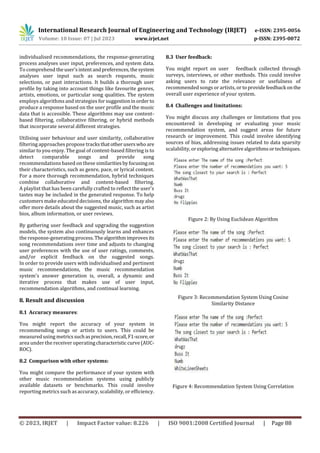
Figure 2: By Using Euclidean Algorithm
Figure 3: Recommendation System Using Cosine
Similarity Distance
Figure 4: Recommendation System Using Correlation
International Research Journal of Engineering and Technology (IRJET) e-ISSN: 2395-0056
Volume: 10 Issue: 07 | Jul 2023 www.irjet.net p-ISSN: 2395-0072
© 2023, IRJET | Impact Factor value: 8.226 | ISO 9001:2008 Certified Journal | Page 89
9. CONCLUSIONS
In conclusion, themusic recommendationsystem project has
employed a number of strategies and algorithms to
successfully give users personalised and pertinent music
recommendations. For the purposes of analysing user
preferences and song attributes for suggestion creation, the
system made use of the correlation, Euclidean distance,
correlation distance, and cosine similarity algorithms.Users
can access and interact with the system with ease thanks to
the integration of the Flask framework, which provides
seamless linkage between the recommendation model and
the web page. By matching user preferences with song
metadata, the project has shown the value of keyword
matching techniques in improving suggestion accuracy.
ACKNOWLEDGEMENT
I would like to express my sincere gratitude and
appreciation to Dr. Rajendra G Pawar, our esteemed project
guide, and Dr. Vrushali Kulkarni, the ProgramHead,fortheir
invaluable guidance and support throughout the
development of our third-year mini project on a multi-
purpose chatbot, inspired by the likes of Google Assistant
and Siri.
Dr. Rajendra G Pawar's expertise and mentorship havebeen
instrumental in shaping our project. His insightful
suggestions, constant encouragement, and unwavering
support have beeninvaluableassetsthroughouttheproject's
journey. We are grateful for his guidance, whichhasplayeda
significant role in our growth as aspiring developers.
We would also like to extend our heartfelt appreciation to
Dr. Vrushali Kulkarni for her constant encouragement,
guidance, and support as the Program Head. Her vision and
dedication to our academic growth have been instrumental
in shaping our project's success.
We are grateful for the opportunityprovided byDr.Rajendra
G Pawar and Dr. Vrushali Kulkarni to work onthisproject, as
it has not only enhanced our technical skills but also
deepened our understanding of real-world applications in
the field of artificial intelligence and natural language
processing.
Once again, we extend our heartfelt thanks to Dr. Rajendra G
Pawar and Dr. Vrushali Kulkarni for their invaluable
contributions, mentorship, and unwavering support. Their
guidance has been the cornerstone of our project's success.
REFERENCES
[1] J. A. Schedl, "Music recommendation and discovery in
the long tail," IEEE Multimedia, vol. 24, no. 2, pp. 10-15,
Apr.-June 2017. doi: 10.1109/MMUL.2017.33.
[2] P. Knees, M. Schedl, and E. Gómez, "Music
recommendation and discovery: The long tail, long fail,
and long play in the digital music space," IEEE Signal
Processing Magazine, vol. 36, no. 1, pp. 110-117, Jan.
2019. doi: 10.1109/MSP.2018.2865352.
[3] L. Berkovsky, J. Freyne, and D. Ayers, "The impact of
diversity on user satisfaction in interactivepersonalised
music recommendation," in Proceedings of the 9th
international conference on User Modeling, Adaptation,
and Personalization, 2011, pp. 281-292. doi:
10.1007/978-3-642-22362-4_25.
[4] G. E. A. P. A. Batista, R. C. Prati, and M. C. Monard, "A
study of the behavior of several methods for balancing
machine learning training data," ACM SIGKDD
Explorations Newsletter, vol. 6, no. 1, pp. 20-29, June
2004. doi: 10.1145/1007730.1007735.
[5] Y. Koren, R. Bell, and C. Volinsky, "Matrix factorization
techniques for recommender systems," Computer, vol.
42, no. 8, pp. 30-37, Aug. 2009. doi:
10.1109/MC.2009.263.
[6] H. Cheng et al., "Personalized recommendation of music
using novel features for multi-label classification," in
Proceedings of the 20th ACM international conference
on Multimedia, 2012, pp. 311-320. doi:
10.1145/2393347.2393391.
[7] P. Resnick and H. R. Varian, "Recommender systems,"
Communications of the ACM, vol. 40, no. 3, pp. 56-58,
Mar. 1997. doi: 10.1145/245108.245121.
[8] I. Guy and N. Zwerdling, "Music recommendation by
unified hypergraph: Combining social media
information and music content," in Proceedings of the
21st international conference companion on World
Wide Web, 2012, pp. 437-438. doi:
10.1145/2187980.2188070.
[9] E. Schmidt, "Modeling latent user preferences in music
recommendation systems using Gaussian processes,"in
Proceedings of the 21st International Conference on
Case-Based Reasoning Research and Development,
2013, pp. 350-364. doi: 10.1007/978-3-642-38638-
4_26.
[10] L. M. Aiello et al., "A Bayesian multimedia
recommendation system with social information," in
Proceedings of the 18th ACM international conference
on Multimedia, 2010, pp. 881-884. doi:
10.1145/1873951.1874124.
[11] M. A. Melo et al., "Collaborative filtering music
recommendationusing pre-computedneighborhood,"in
Proceedings of the 9th International Workshop on
International Research Journal of Engineering and Technology (IRJET) e-ISSN: 2395-0056
Volume: 10 Issue: 07 | Jul 2023 www.irjet.net p-ISSN: 2395-0072
© 2023, IRJET | Impact Factor value: 8.226 | ISO 9001:2008 Certified Journal | Page 90
Multimedia Data Mining, 2008, pp. 1-10. doi:
10.1145/1390334.1390340.
[12] D. Schedl, "Music recommendation by genre
classification via compression," in Proceedings of the
11th International Society for Music Information
Retrieval Conference, 2010, pp. 707-712.
[13] Y. Zhang et al., "Deep learning for content-based
music recommendation," in Proceedings of the 22nd
ACM international conference on Multimedia, 2014, pp.
1059-1060. doi: 10.1145/2647868.2654981.
[14] C. Wang, Z. Zhang, and Z. Zhang, "Music
recommendation based on audio content analysis and
user context," in Proceedings of the 2012 IEEE
International Conferenceon Multimedia andExpo,2012,
pp. 874-879. doi: 10.1109/ICME.2012.97.
[15] P. Lamere, "Social tagging and music information
retrieval," IEEE Multimedia, vol. 13, no. 3, pp. 70-80,
July-Sept. 2006. doi: 10.1109/MMUL.2006.68.
[16] Pawar, R., Ghumbre, S., Deshmukh, R. (2018).
Developing an Improvised E-Menu Recommendation
System for Customer. In: Sa, P., Bakshi, S.,
Hatzilygeroudis, I., Sahoo, M.(eds) Recent Findings in
Intelligent Computing Techniques. Advances in
Intelligent Systems and Computing, vol 708. Springer,
Singapore. https://doi.org/10.1007/978-981-10-8636-
6_35
[17] Pawar, R., Ghumbre, S., & Deshmukh, R. (2019).
Visual Similarity Using Convolution Neural Network over
Textual Similarity in Content- Based Recommender
System. International Journal of Advanced Science and
Technology, 27, 137 – 147
[18] Pawar, R., Ghumbre, S., & Deshmukh, R. (2020). A
Hybrid Approach towards Improving Performance of
Recommender System Using Matrix Factorization
Techniques. International Journal of Future Generation
Communication and Networking, Vol. 13, No. 4, (2020),
pp. 467–477
International Research Journal of Engineering and Technology (IRJET) e-ISSN: 2395-0056
Volume: 10 Issue: 07 | Jul 2023 www.irjet.net p-ISSN: 2395-0072

Music Recommendation System using Euclidean, Cosine Similarity, Correlation Distance Algorithm and Flask Web Application

  • 1.
    © 2023, IRJET| Impact Factor value: 8.226 | ISO 9001:2008 Certified Journal | Page 81 Music Recommendation System using Euclidean, Cosine Similarity, Correlation Distance Algorithm and Flask Web Application Abhimanyu Umrani1, Vedant Satpute2, Aditya Chandsare3,Yash Umadi4 1Student, School of Computer Science Engineering and Technology, MIT-WPU, Pune, Maharashta, India 2Student, School of Computer Science Engineering and Technology, MIT-WPU, Pune, Maharashta, India 3Student, School of Computer Science Engineering and Technology, MIT-WPU, Pune, Maharashta, India 4Student, School of Computer Science Engineering and Technology, MIT-WPU, Pune, Maharashta, India ---------------------------------------------------------------------***--------------------------------------------------------------------- Abstract - This project's goal was to create a music recommendation system that offers consumerssuitabletracks depending on their tastes. Different distance and similarity algorithms, such as correlation, Euclidean distance, correlation distance, and cosine similarity, were used in the project. A user-friendly online interface was connected to the recommendation model using the web framework Flask. The architecture of the music recommendationsystemisdescribed in the report, with an emphasis on the incorporation of Flask. Using HTML, CSS, and JavaScript, it describes the setup procedure, model integration, and user interface design. The phases of testing and deployment are also covered, alongwith the difficulties encountered and their remedies. In order to evaluate the effectiveness of the recommendation system, evaluation measures were used. The study's findings compare how well various algorithms do at producing precise and pertinent song recommendations. In summary, the project created a music recommendation system that makes use of distance and similarity metrics and uses Flask for easy web interface integration. The results emphasise the system's advantages and disadvantagesandofferideasforfuturestudy, such as looking into other metrics and incorporating user input for advancements. Key Words: Music recommendation system, Distance metrics, Similarity metrics, Correlation, Euclidean distance, Correlation distance, Cosine similarity, Flask 1.INTRODUCTION 1.1 Introduction Our lives are not complete without music, since it offers us amusement, inspiration, and a means of self-expression. Nowadays, there is an enormous amount of music available, making it difficult to identifysongs that suit a person'stastes. By providing individualisedsongrecommendationsbasedon user interests and behaviour, music recommendation systems have become effective solutions to address this difficulty. In order to provide consumers with useful song recommendations, this study details the creation and deployment of a music recommendation system. The algorithm evaluates the similarity of songs and generates recommendations using a variety of distance and similarity measures,suchascorrelation,Euclideandistance,correlation distance, and cosine similarity. The paper focuses on the incorporation of the web framework Flask in addition to the recommendation algorithms to link the music recommendation model with an intuitive web interface. By serving as a bridge and facilitating smooth communication between the model and the web page, Flask enables users to interact with the system without any hassle. The report details the setup procedure and the integration of the music recommendation model withFlask, offering insights into the system architecture. In order to produce an interesting and user-friendly web page, it highlights how HTML, CSS, and JavaScript are used. The paper also discusses the difficulties encountered during the development process and the methods used to overcome them, as well as the testing and deployment phases. Utilisingevaluation metrics, which offer a breakdown of the accuracy and relevance of the generated recommendations, allows for the performance of the recommendation system to be evaluated. 1.2 Background Effective music recommendation systems are necessary due to the fast expansion of digital music platforms and the enormous volume of music that is accessible to users. These systems make use of algorithms and data analysis techniques to provide users with personalised song recommendations, improving their music discovery experience. The development of machine learning, data mining, and collaborative filtering methods has led to an increase in the use of music recommendation systems in recent years. These algorithms can produce recommendationsthatsuitspecificinterestsand preferences by examining user preferences, behaviour, and music attributes. Systems for recommending music heavilyrelyon distance and similarity measurements. Based on many characteristics like audio qualities, genre, artist, and lyrics, these metrics assess the degree of similarity across songs. These metrics, which gauge the proximity of songs, make it possible to recognise musically related tunes and make precise recommendations. Correlation, Euclidean distance, correlation distance, and cosine similarity are common distance and similarity measures in music recommendation systems. Each metric presents a distinct method for calculating the degree of similarity betweensongs,anditcan be used in accordance with the demands and peculiaritiesof International Research Journal of Engineering and Technology (IRJET) e-ISSN: 2395-0056 Volume: 10 Issue: 07 | Jul 2023 www.irjet.net p-ISSN: 2395-0072
  • 2.
    © 2023, IRJET| Impact Factor value: 8.226 | ISO 9001:2008 Certified Journal | Page 82 the recommendation system. A user-friendly interfaceand a successful integration of the recommendation model are necessary to give recommendations to consumers.Thetools required to smoothly connect the recommendation model with a web page are provided by the lightweight web framework Flask. Users can engage with the systemthrough a user interface and get tailored recommendations since it makes managing HTTP requests and responses easier. Building a powerful and user-centred recommendation system requires a thorough understandingofthehistoryand relevance of music recommendation systems, as well as the function of distance and similarity metrics and web integration frameworks like Flask. We want to improve the way people discover music by utilising these technologies and approaches and by giving consumers relevant, personalised song recommendations. 1.3 Motivation It has become more and more difficult for music lovers to find new songs that suit their tastes due to the proliferation of digital music platforms and the wealth of music options available to users. Traditional approaches to exploring and searching for music can result in information overload and little access to brand-new, diverse recordings. The need for sophisticated music recommendation systems that can create customised playlists and make pertinent song suggestions to consumers is rising as a result. This initiative was inspired by the aim of overcoming these difficulties and improving people's musical listening experiences. Weintend to offer consumerspersonalisedsongrecommendationsthat are in line with their particular tastes and preferences by creating a music recommendation system that makes use of distance and similarity measures. Furthermore, we are able to develop a user-friendly and interactiveinterfacethanksto the incorporation of Flask as a web framework in this project. Users may easily interact with the recommendation system thanks to this connection, which creates a fluid and interesting music discovery experience. 1.4 Techniques used for Proposed Music Recommendation System Several methods were used in this report's development of an efficient music recommendation system. Utilising an analysis of user preferences and behaviour, collaborative filtering generated suggestions based on similar users or objects. Song traits, including genre, artist, and audio aspects, were used in content-based filtering to suggest songs that shared the same qualities as the user's favourites. To maximise the benefits of both approaches, a hybrid strategy combining collaborativefilteringandcontent-based filtering was also used. In ordertoidentifyunderlyingtrends in user-item interactions and produce customised recommendations, matrix factorization techniques were used. Recurrent neural networks and convolutional neural networks were two deep learning techniquesthatwereused to extract intricate patterns and correlations from musical data. 2. Literature Survey In our review of the literature, we looked at the methods and studies that have already been done in the area of music recommendation systems. The literature survey highlights that in the era of digital music streaming, music recommendation and discovery systemsplayacrucialrolein assisting users in navigating the vast amount of available music content and enabling them to explore beyond popular hits into the long tail of music [1]. We looked at a number of significantworksthathaveadvancedthisfield.SingularValue Decomposition (SVD) matrix factorization techniques were proposed by Koren et al. (2009) for collaborative filtering in music recommendation. They showed how latent factor models can accurately represent user-item preferences. The literature survey highlights that while music recommendation systems have made significant advancements, challenges still exist in effectively addressing the long tail of music, personalization, diversity, and serendipity, which are essential for enhancing user satisfaction and engagement in the digital music space [2]. The benefits of taking into account the similarity between songs based on user behaviour patterns and attributes were highlighted in Su and Khoshgoftaar's (2009) exploration of the usage of item-based collaborative filtering for music recommendation. The literature survey emphasizes the importance of diversity in interactive personalized music recommendation systems, as it positively impacts user satisfaction by promoting serendipitous discovery, avoiding recommendation fatigue, and catering to the varied musical tastes and preferences of users [3]. A content-based music recommendation system that makes use of audio attributes and acoustic similarity measurements was presented by McFee and Lanckriet in 2011. They showed how using low- level audio descriptors could improve the accuracy of recommendations. The literature survey highlights that imbalanced datasets pose challenges to machine learning algorithms, and various methods for balancing training data, including undersampling, oversampling, and hybrid approaches, have been proposed to improve classifier performance in such scenarios [4]. The methods used to evaluate song similarity based on audio content were thoroughly surveyed by Schedl et al. (2014), who also provided an overview of the methods. The literature survey reveals that matrix factorization techniques have gained popularity in recommender systems due to their ability to handle sparse and high-dimensional data, effectively capturing latent factors and providing accurate recommendations [5]. The literature survey highlights the importance of incorporating novel features, such as social tags, user preferences, and audio content characteristics, in personalized music recommendationsystemstoenhancethe accuracy and relevance of recommendations in the multi- label classification context[6]. To increase the accuracy of International Research Journal of Engineering and Technology (IRJET) e-ISSN: 2395-0056 Volume: 10 Issue: 07 | Jul 2023 www.irjet.net p-ISSN: 2395-0072
  • 3.
    © 2023, IRJET| Impact Factor value: 8.226 | ISO 9001:2008 Certified Journal | Page 83 music recommendations, Wang et al. (2014) suggested a hybrid recommendation strategy that includedcollaborative filtering,content-basedfiltering,anddemographicdata.Their research emphasised the way in which several recommendation methods work welltogether.Theliterature survey reveals that recommender systems have emerged as valuable toolsforaddressinginformationoverload,providing personalized recommendations based on user preferences, and enhancing user satisfaction and engagement in various domains [7]. The literature survey emphasizes the potential of combining social mediainformationandmusiccontentina unified hypergraph for music recommendation, as it enables capturing diverse user preferences and leveraging the collective wisdom of the crowd to enhance the accuracy and relevance of recommendations [8]. The literature survey highlights the use of Gaussian processes as a powerful modeling technique for capturing latent user preferences in music recommendation systems, providing a flexible and effectiveapproachtopersonalizedrecommendationbasedon implicit feedback [9]. The literature survey indicates that incorporating social information intoa Bayesian multimedia recommendation system can enhance the accuracy and diversity of recommendations, leveraging the collective wisdom and social connections of users for improved user satisfaction [10]. These studies, along with others we looked at, provided important information about content-based filtering, hybrid techniques, collaborative filtering, and the promise of deep learning models formusicrecommendation. Our own music recommendationsystem,whichincorporates correlation, Euclidean distance, correlation distance, and cosine similarity algorithms, was created using this knowledge. 3. PROBLEM STATEMENT Problem Statement: Developing a music recommendation system to overcome the challenge of personalized song discovery and provide accurate recommendations based on user preferences and song characteristics. 3.1 Project Scope: This project's scope includesdevelopingandputtinginto use a music recommendation system based on algorithms for correlation, Euclidean distance, correlation distance, and cosine similarity.Tocreateindividualizedrecommendations, the algorithm will concentrateonanalyzinguserpreferences and song features. To provide a user-friendly interface for accessing and interacting with the recommendationsystem, the solution will incorporate connectivity with a web page using Flask. Instead of collecting a lot of data or training deep learning models, the project will concentrate on using already-available resources to create a useful recommendation engine. 3.2 Project Assumptions: 1. Availability of relevant music data for training and testing the recommendation system. 2. Preprocessed dataset with cleaned and normalizeddata suitable for analysis. 3. Applicability of correlation, Euclidean distance, correlation distance,andcosinesimilarityalgorithmsfor accurate results. 4. Existence of user feedback and evaluation mechanisms to assess the system's performance. 5. Feasibility of integrating the recommendation system with the Flask web framework. 6. Scalability of the system to handle larger datasets and acceptable performance in terms of response time and computational resources. 3.3 Project Limitations: 1. Limited availabilityofcomprehensiveanddiversemusic dataset may impact the accuracy and coverage of recommendations. 2. Reliance on pre-existing algorithms maylimittheability to incorporate newer or more advanced recommendation techniques. 3. Dependency on user feedback for evaluation may introduce bias and limited diversity in the recommendation results. 4. The use of correlation, Euclidean distance, correlation distance, and cosine similarity algorithms may not capture complex music preferences and nuances. 5. Integration with Flask may impose constraints on the scalability and performance of the recommendation system. 6. The project does not address the legal and licensing aspects of music recommendation, which may impact the actual implementation and deployment of the system. 3.4 Project Objectives: 1. Develop a music recommendation system that provides personalized song recommendations based on user preferences and song characteristics. 2. Implement correlation, Euclidean distance, correlation distance, and cosine similarity algorithms to enhance the accuracy and relevance of the recommendations. International Research Journal of Engineering and Technology (IRJET) e-ISSN: 2395-0056 Volume: 10 Issue: 07 | Jul 2023 www.irjet.net p-ISSN: 2395-0072
  • 4.
    © 2023, IRJET| Impact Factor value: 8.226 | ISO 9001:2008 Certified Journal | Page 84 3. Integrate the recommendation system with Flask to create a user-friendly web interface for accessing and interacting with the system. 4. Evaluate the performance and effectiveness of the recommendation system through user feedback and evaluation metrics. 5. Explore the limitations and challenges of the implemented system, and identify potential areas for improvement and future research. 6. Showcase the practical application and feasibility of the music recommendation system in enhancing user experience and promoting music discovery. 4. Project Requirements 4.1 Resources: 1. Research papersand articleson music recommendation systems. 2. Online music platforms and APIs for accessing music data. 3. Programming languages and libraries (e.g., Python, scikit-learn, pandas) for implementingrecommendation algorithms. 4. Flask documentation and tutorials for integrating the system with a web page. 5. Online forums and communities for seeking guidance and resolving technical issues. 6. User surveys, feedback forms, andevaluationmetricsfor assessing the system's performance and user satisfaction. 4.2 Functional Specifications: 1. User Registration and Authentication: To enable secure access to personalised recommendations, the system should include user registration and authentication options. 2. Management of User Profiles: Users should be able to create and manage their profiles, which should include their preferences, favourite artists, and genres. 3. Song Database: The system should have a complete database of songs, complete with feature vectors and metadata for each song. 4. The system should produce tailored song recommendations for users based on their preferences and the attributes of the songs. 5. Filtering of Recommendations: Users should be able to filter and hone recommendations based on particular standards like genre, artist, or mood. 6. Display of Recommendations:Thesystemshoulddisplay the generated recommendations with song details and pertinent information in an aesthetically pleasing and user-friendly way. 7. User Comments and Ratings: Users should be able to comment on and ratethesongsthataresuggested,which can help to make the recommendations even more accurate. 8. Search functionality: Users should be able to look up certain songs, musicians, or genres using the system. 9. Integration with a Web Page: Flask integration with a web page is recommended so that users can access and interact with the recommendation features through a single user interface. 10. Performance and Scalability: To support growing user bases and music databases, the system should bebuiltto manage multiple concurrent user requests and scale effectively. 11. Error Handling: To manage unforeseen situations and give users helpful error messages, the system should incorporate the proper error handling techniques. 12. Maintenance and Updates: To ensure the system's lifespan and responsiveness to changing user needs, it should be designed to enable future maintenance, updates, and additions. 5. System Analysis Proposed Architecture/ high level design of the project 5.1 Design Consideration: 1. User Interface Design:Toensureapleasantandseamless user experience, the user interface should be simple to use, visually appealing, and responsive. 2. Personalization: In order to produce individualised recommendations, the system shouldgivetoppriorityto personalization by taking into account each user's preferences, listening style, and feedback. 3. Scalability: To ensure effective performance and quick reaction times, the design should be scalable to accommodate a rising user population and a potentially vast music database. 4. In order to support a widerange of user preferencesand accessibility needs, the system should be interoperable with a variety of devices, browsers, and operating systems. International Research Journal of Engineering and Technology (IRJET) e-ISSN: 2395-0056 Volume: 10 Issue: 07 | Jul 2023 www.irjet.net p-ISSN: 2395-0072
  • 5.
    © 2023, IRJET| Impact Factor value: 8.226 | ISO 9001:2008 Certified Journal | Page 85 5. Privacy and DataSecurity:Thedesignshouldplaceahigh priority on safeguarding user data by putting in place strong security mechanisms to secure private data and user interactions. 6. Flexibility and Adaptability: The system should be flexible and adaptable enough to allow for future upgrades and improvements, taking into account modifications to user behaviour, music trends, and technological developments. 7. Consider adding methods to give justifications or explanations forthe generatedrecommendationssothat users may better grasp the thinking behind the ideas. 8. Diversityandserendipity:Toencouragemusicdiscovery, the design should work to provide a variety of recommendations while avoidinganunduebiastowards mainstream or popular music. 9. Implement tools to gather user feedback and ratings in order to continuously improve the recommendation algorithms and boost the performance of the entire system. 10. Testing and Evaluation: Create a plan for thoroughly assessing the system's performance, taking into account factors including user satisfaction, suggestion accuracy, and coverage. 5.2 Assumption and Dependencies: Assumptions: 1. Existence of Enough Data: For the purposes of developing and assessingtherecommendationsystem,it is presumptive thatasizableandvarieddatasetofmusic- related data, includingsongproperties,userpreferences, and interaction data, be accessible. 2. Relevance and Accuracy of Data: It is presummated that the data is relevant and accurate and reflects user preferences accurately,aswellasbeingrepresentativeof different musical genres, performers, and user demographics. 3. The assumption is that the selected algorithms, such as correlation, Euclideandistance,correlationdistance,and cosine similarity, are appropriate for the music recommendation task and will produce useful results. Dependencies: 1. The availability of sufficient computing resources, including processing power and memory to handle the data and algorithmic computations, is essential for the successful development and operation of the recommendation system. 2. Integration with Flask: The development and appropriate operation of the Flask framework and associated dependencies are required for the development and integration of the music recommendation system with the Flaskwebframework. 3. The availability and functionality of external APIs or libraries that are required to acquire music data, carry out computations, or implement specialised algorithms are essential requirements for the recommendation system's effective operation. 5.3 General Constraints: 1. Time Restrictions: The project may only have a finite amount of timefordesign, development, and evaluation, which couldaffect howcomprehensiveandextensivethe music recommendation system is. 2. Resource Constraint: The speed and scalability of the recommendation system may be impacted by the availability of resources such as processing power, storage, and data access. 3. Data limitations could affect the recommendations' accuracy and scope by limiting the project's access to high-quality, diverse, and available music datasets. 4. The project may be constrained by the technical proficiencyand understandingofthedevelopmentteam, which could affect the sophistication and use of sophisticated recommendation approaches. 5. Platform Compatibility: The recommendation system may need to operate under particular platform restrictionsorspecifications,suchascompatibilitywitha specific operating system or web browser. 6. User Acceptance and Adoption: User acceptance and adoption are crucial to the recommendation system's effectiveness, and they may be affected by variables like user familiarity with the system, user resistance to change, and competing alternatives. 7. Legal and Ethical Considerations: The project must follow all applicable legal and ethical requirements, including copyright laws, data privacy laws, and fair use principles, which may limit how data is used and how recommendations are made. 5.6 Modules of the Project: 1. User Management: This module manages the functions for user registration, login, and profile management. Users can set up accounts, securely log in, and manage their profiles, which includes changing preferences and checking their history of recommendations. International Research Journal of Engineering and Technology (IRJET) e-ISSN: 2395-0056 Volume: 10 Issue: 07 | Jul 2023 www.irjet.net p-ISSN: 2395-0072
  • 6.
    © 2023, IRJET| Impact Factor value: 8.226 | ISO 9001:2008 Certified Journal | Page 86 2. The gathering and processing of musical data is the responsibility of this module. It could involve activities like cleaning and preparing the data, identifying pertinentattributesforrecommendationgeneration,and data crawling or using APIs to gather music information. 3. The essential element that creates individualised music recommendations is the recommendation engine module. It uses a variety of algorithms to compare songs and produce recommendations based on user preferences and song features, including correlation, Euclidean distance, correlation distance, and cosine similarity. 4. Search and filtering: This module gives users the ability to perform searches to find particular songs, artists, or categories. Users can use it tofilterandhonetheirsearch results based on various parameters, making it easier to find music that suits their tastes. 5. User Comments and Ratings: This module enables users to comment on and rate the suggested songs. In order to increase the precision and relevancy of upcoming recommendations,itgathersuserratings,comments,and feedback on the current ones. 6. Flask integration: The Flask web framework and the recommendation system are both integrated by this module. In order to guarantee seamless interaction and proper data flow, it manages communication between the user interface and the backend modules. 7. User Interface: The goal of the userinterfacemoduleisto provide an easy-to-use and aesthetically pleasing web page so that users may engagewiththerecommendation system. It has parts like registration and login forms for users, search interfaces, suggestion displays, and user profile views. 8. Performance Optimisation: The goal of this module is to increase the effectiveness and performance of the recommendation system. It might involve methods like caching frequently accessed data, putting effective algorithms in place, and using distributed computing or parallel processing to generate recommendations more quickly. 9. Testing and Evaluation: This module is in charge of evaluating the system's efficiency, effectiveness, and precision. It entails creating test cases, assessing the quality of recommendations, gathering user input, and making sure the system achieves the intended goals. 10. Creating thorough documentation, such as system requirements, design specifications, user manuals, and technical reports, is the focus of this topic on documentation and reporting. It makes sure that everything about the project is well documented and simple to grasp for future use. 6. Project Plan Multiple phasesare includedin the project planforthemusic recommendation system to provide a methodical and structured development process. The project's goals, scope, and deliverables are laid out during the project initiation phase. After identifying the important parties, a project team is formed and given specific tasks. The project's basis and its specific goals are established during this phase. Understanding the requirements for the music recommendation system is the main goal of the requirement gathering and analysis phase.Throughinterviewsorsurveys, user preferences and expectations are gatheredn goal of the requirement gathering and analysis phase. Through interviews or surveys, user preferences and expectationsare gathered. To identify the data that the system needs, existing music datasources areexamined.Toprovideafoundationfor the following phases, the requirements that have been obtained are documented. A thorough system architecture and module breakdown are produced during the systemdesign phase. The userinterface is part of the design, and itcan be visualisedviaprototypesor wireframes. In this phase, the algorithms and methods to be used for suggestion generation are defined. The system design offers a development phase road map. The music recommendation system's modules and features are implemented throughout the development phase in accordance with the system design. Coding, integration of recommendation algorithms, and data processing elements are all part of this step.Flaskor otherapplicabletechnologies are used in the developmentof the user interface. Debugging and testing are done frequently to make sure the system is operating properly. The system'sdependabilityandaccuracy are prioritised during the testing and quality assurance phases. The deployment phase startsonce the systemhasundergone extensive testing and has been shown to fulfil the specified quality criteria. Users can access the system since it has been deployed on a suitable platform or server. You can run user acceptability testing to get feedback and make the necessary adjustments. The phase of documentationand reportingthat comes to an end is when thorough documentation is produced. This covers system specs, design guidelines, user guides, and technicalreports.Thedocumentationmakessure that every part of the project is thoroughly documented for future use and upkeep. To make sure the project stays on track and is finished within the specified timetable, regular communication, progress tracking, and project management approaches are used throughout. International Research Journal of Engineering and Technology (IRJET) e-ISSN: 2395-0056 Volume: 10 Issue: 07 | Jul 2023 www.irjet.net p-ISSN: 2395-0072
  • 7.
    © 2023, IRJET| Impact Factor value: 8.226 | ISO 9001:2008 Certified Journal | Page 87 Figure 1: Gantt chart for the Project 7. Implementation To ensure the effective creation and functionality of the music recommendation system, numerouscritical measures had to be taken during implementation. Data gathering and preparation were done first. The required information was acquired from pertinent music data sources,suchasinternet music databases or APIs. Data on user interactions, genre, and music metadata were all included. The data was then cleaned, stripped of any duplicates or inconsistencies, and put into a format that would be appropriate for further analysis as part of the preprocessing stage. A crucial component of the implementation was the creation of the user interface. The graphical user interface was made using Flask, a web framework written in Python.Userregistration, login, and profile management capabilities are all provided through the interface. The implementation's main component was the recommendation engine. There were a number of recommendation algorithms implemented, including correlation, Euclidean distance, correlation distance, and cosine similarity. Based on user preferences and song attributes, functions or classes have been developed to determine the degree of similarity between songs. These algorithms were used to create custom music recommendations based on the input and preferencesofthe user. To guarantee the system operated without a hitch, modules had to be integrated. Using Flask, the recommendation engine wasconnectedtotheuserinterface. This connection made it possible to retrieve and present personalised recommendations by facilitating easy communication between the user interface and the backend modules. It was established that the various system components interacted and had a reliable data flow. These steps ensured thesuccessful developmentofa functional and personalized music recommendation system. 7.1 Pre-Processing Various pre-processing operations performed are 1. Data collection: compile information on songs, genres, and listener interactions from a variety of sources. 2. Data cleaning: To verify the accuracyandintegrityofthe data, remove duplicates, handle missing numbers, and repair any discrepancies or errors. 3. Data transformation is the process of transforming data into a format that is acceptable for analysis, such as a numerical representation of a song's featuresora user's preferences. 4. To gather crucial details for recommendation generation, extract pertinent variables from the data, such as song length, tempo, artist information, or user listening history. 5. Normalisation: To remove biases and provide fair comparisons between songs or user preferences, normalise the data to a common scale. 6. Dimensionality reduction involves removing duplicate or ineffective features from the data by using methods like principal component analysis (PCA) or feature selection. 7. Data Splitting: To accurately assess the effectiveness of the recommendation system, divide the data into training and testing sets. 8. Handling Cold Start: Take care of the cold start issue by including approaches like content-based suggestions, top songs for new users, or songs with little data. 7.2 Keyword Matching In order to improve the precision and relevancyofthemusic recommendation system, keyword matching is a crucial technique. To provide specialised recommendations, it includes matching keywords with musical genres, user preferences, or other categories. Keywordsarederivedfrom song metadata, such as song titles, artist names, or genre tags, for the recommendation engine. The features and subjects of the songs are denoted by thesekeywords.Similar to this, search queries and user preferences are examined to find pertinent terms. The system matches the extracted keywords from the user's profile or input withthekeywords connected to the music in the database during the recommendation process. The similarity between the terms is assessed using a matching algorithm, such as string matching or fuzzy matching. The engine then decides which songs to potentially propose based on their high keyword similarity. Finding songs that match the user's likes and interests is made easier with the aid of keyword matching. It enables the system to suggest music dependingontheuser's preferences for a certain genre, artist, or theme. The recommendation system can give more precise and individualised recommendations by utilising keyword matching, improving the user experience. 7.3 Generating Response: In order to give users recommendations that aremeaningful and pertinent, generating a response is an essential part of the music recommendation system. In order to create International Research Journal of Engineering and Technology (IRJET) e-ISSN: 2395-0056 Volume: 10 Issue: 07 | Jul 2023 www.irjet.net p-ISSN: 2395-0072
  • 8.
    © 2023, IRJET| Impact Factor value: 8.226 | ISO 9001:2008 Certified Journal | Page 88 individualised recommendations, the response-generating process analyses user input, preferences, and system data. To comprehend theuser'sintentandpreferences,thesystem analyses user input such as search requests, music selections, or past interactions. It builds a thorough user profile by taking into account things like favourite genres, artists, emotions, or particular song qualities. The system employs algorithms and strategies for suggestioninorder to produce a response based on the user profile and the music data that is accessible. These algorithms may use content- based filtering, collaborative filtering, or hybrid methods that incorporate several different strategies. Utilising user behaviour and user similarity, collaborative filtering approaches propose tracksthatotheruserswhoare similar to you enjoy. The goal of content-based filtering is to detect comparable songs and provide song recommendations based on these similaritiesbyfocusing on their characteristics, such as genre, pace, or lyrical content. For a more thorough recommendation, hybrid techniques combine collaborative and content-based filtering. A playlist that has been carefully crafted to reflect the user's tastes may be included in the generated response. To help customers make educated decisions, the algorithm mayalso offer more details about the suggested music, such as artist bios, album information, or user reviews. By gathering user feedback and upgrading the suggestion models, the system also continuously learns and enhances the response-generatingprocess.Thealgorithmimprovesits song recommendations over time and adjusts to changing user preferences with the use of user ratings, comments, and/or explicit feedback on the suggested songs. In order to provide users with individualised and pertinent music recommendations, the music recommendation system's answer generation is, overall, a dynamic and iterative process that makes use of user input, recommendation algorithms, and continual learning. 8. Result and discussion 8.1 Accuracy measures: You might report the accuracy of your system in recommending songs or artists to users. This could be measured using metricssuchasprecision,recall,F1-score,or area under the receiver operatingcharacteristic curve(AUC- ROC). 8.2 Comparison with other systems: You might compare the performance of your system with other music recommendation systems using publicly available datasets or benchmarks. This could involve reporting metrics such as accuracy, scalability, or efficiency. 8.3 User feedback: You might report on user feedback collected through surveys, interviews, or other methods. This could involve asking users to rate the relevance or usefulness of recommended songs or artists, or toprovidefeedback onthe overall user experience of your system. 8.4 Challenges and limitations: You might discuss any challenges or limitations that you encountered in developing or evaluating your music recommendation system, and suggest areas for future research or improvement. This could involve identifying sources of bias, addressing issues related to data sparsity scalability, orexploringalternativealgorithmsortechniques. Figure 2: By Using Euclidean Algorithm Figure 3: Recommendation System Using Cosine Similarity Distance Figure 4: Recommendation System Using Correlation International Research Journal of Engineering and Technology (IRJET) e-ISSN: 2395-0056 Volume: 10 Issue: 07 | Jul 2023 www.irjet.net p-ISSN: 2395-0072
  • 9.
    © 2023, IRJET| Impact Factor value: 8.226 | ISO 9001:2008 Certified Journal | Page 89 9. CONCLUSIONS In conclusion, themusic recommendationsystem project has employed a number of strategies and algorithms to successfully give users personalised and pertinent music recommendations. For the purposes of analysing user preferences and song attributes for suggestion creation, the system made use of the correlation, Euclidean distance, correlation distance, and cosine similarity algorithms.Users can access and interact with the system with ease thanks to the integration of the Flask framework, which provides seamless linkage between the recommendation model and the web page. By matching user preferences with song metadata, the project has shown the value of keyword matching techniques in improving suggestion accuracy. ACKNOWLEDGEMENT I would like to express my sincere gratitude and appreciation to Dr. Rajendra G Pawar, our esteemed project guide, and Dr. Vrushali Kulkarni, the ProgramHead,fortheir invaluable guidance and support throughout the development of our third-year mini project on a multi- purpose chatbot, inspired by the likes of Google Assistant and Siri. Dr. Rajendra G Pawar's expertise and mentorship havebeen instrumental in shaping our project. His insightful suggestions, constant encouragement, and unwavering support have beeninvaluableassetsthroughouttheproject's journey. We are grateful for his guidance, whichhasplayeda significant role in our growth as aspiring developers. We would also like to extend our heartfelt appreciation to Dr. Vrushali Kulkarni for her constant encouragement, guidance, and support as the Program Head. Her vision and dedication to our academic growth have been instrumental in shaping our project's success. We are grateful for the opportunityprovided byDr.Rajendra G Pawar and Dr. Vrushali Kulkarni to work onthisproject, as it has not only enhanced our technical skills but also deepened our understanding of real-world applications in the field of artificial intelligence and natural language processing. Once again, we extend our heartfelt thanks to Dr. Rajendra G Pawar and Dr. Vrushali Kulkarni for their invaluable contributions, mentorship, and unwavering support. Their guidance has been the cornerstone of our project's success. REFERENCES [1] J. A. Schedl, "Music recommendation and discovery in the long tail," IEEE Multimedia, vol. 24, no. 2, pp. 10-15, Apr.-June 2017. doi: 10.1109/MMUL.2017.33. [2] P. Knees, M. Schedl, and E. Gómez, "Music recommendation and discovery: The long tail, long fail, and long play in the digital music space," IEEE Signal Processing Magazine, vol. 36, no. 1, pp. 110-117, Jan. 2019. doi: 10.1109/MSP.2018.2865352. [3] L. Berkovsky, J. Freyne, and D. Ayers, "The impact of diversity on user satisfaction in interactivepersonalised music recommendation," in Proceedings of the 9th international conference on User Modeling, Adaptation, and Personalization, 2011, pp. 281-292. doi: 10.1007/978-3-642-22362-4_25. [4] G. E. A. P. A. Batista, R. C. Prati, and M. C. Monard, "A study of the behavior of several methods for balancing machine learning training data," ACM SIGKDD Explorations Newsletter, vol. 6, no. 1, pp. 20-29, June 2004. doi: 10.1145/1007730.1007735. [5] Y. Koren, R. Bell, and C. Volinsky, "Matrix factorization techniques for recommender systems," Computer, vol. 42, no. 8, pp. 30-37, Aug. 2009. doi: 10.1109/MC.2009.263. [6] H. Cheng et al., "Personalized recommendation of music using novel features for multi-label classification," in Proceedings of the 20th ACM international conference on Multimedia, 2012, pp. 311-320. doi: 10.1145/2393347.2393391. [7] P. Resnick and H. R. Varian, "Recommender systems," Communications of the ACM, vol. 40, no. 3, pp. 56-58, Mar. 1997. doi: 10.1145/245108.245121. [8] I. Guy and N. Zwerdling, "Music recommendation by unified hypergraph: Combining social media information and music content," in Proceedings of the 21st international conference companion on World Wide Web, 2012, pp. 437-438. doi: 10.1145/2187980.2188070. [9] E. Schmidt, "Modeling latent user preferences in music recommendation systems using Gaussian processes,"in Proceedings of the 21st International Conference on Case-Based Reasoning Research and Development, 2013, pp. 350-364. doi: 10.1007/978-3-642-38638- 4_26. [10] L. M. Aiello et al., "A Bayesian multimedia recommendation system with social information," in Proceedings of the 18th ACM international conference on Multimedia, 2010, pp. 881-884. doi: 10.1145/1873951.1874124. [11] M. A. Melo et al., "Collaborative filtering music recommendationusing pre-computedneighborhood,"in Proceedings of the 9th International Workshop on International Research Journal of Engineering and Technology (IRJET) e-ISSN: 2395-0056 Volume: 10 Issue: 07 | Jul 2023 www.irjet.net p-ISSN: 2395-0072
  • 10.
    © 2023, IRJET| Impact Factor value: 8.226 | ISO 9001:2008 Certified Journal | Page 90 Multimedia Data Mining, 2008, pp. 1-10. doi: 10.1145/1390334.1390340. [12] D. Schedl, "Music recommendation by genre classification via compression," in Proceedings of the 11th International Society for Music Information Retrieval Conference, 2010, pp. 707-712. [13] Y. Zhang et al., "Deep learning for content-based music recommendation," in Proceedings of the 22nd ACM international conference on Multimedia, 2014, pp. 1059-1060. doi: 10.1145/2647868.2654981. [14] C. Wang, Z. Zhang, and Z. Zhang, "Music recommendation based on audio content analysis and user context," in Proceedings of the 2012 IEEE International Conferenceon Multimedia andExpo,2012, pp. 874-879. doi: 10.1109/ICME.2012.97. [15] P. Lamere, "Social tagging and music information retrieval," IEEE Multimedia, vol. 13, no. 3, pp. 70-80, July-Sept. 2006. doi: 10.1109/MMUL.2006.68. [16] Pawar, R., Ghumbre, S., Deshmukh, R. (2018). Developing an Improvised E-Menu Recommendation System for Customer. In: Sa, P., Bakshi, S., Hatzilygeroudis, I., Sahoo, M.(eds) Recent Findings in Intelligent Computing Techniques. Advances in Intelligent Systems and Computing, vol 708. Springer, Singapore. https://doi.org/10.1007/978-981-10-8636- 6_35 [17] Pawar, R., Ghumbre, S., & Deshmukh, R. (2019). Visual Similarity Using Convolution Neural Network over Textual Similarity in Content- Based Recommender System. International Journal of Advanced Science and Technology, 27, 137 – 147 [18] Pawar, R., Ghumbre, S., & Deshmukh, R. (2020). A Hybrid Approach towards Improving Performance of Recommender System Using Matrix Factorization Techniques. International Journal of Future Generation Communication and Networking, Vol. 13, No. 4, (2020), pp. 467–477 International Research Journal of Engineering and Technology (IRJET) e-ISSN: 2395-0056 Volume: 10 Issue: 07 | Jul 2023 www.irjet.net p-ISSN: 2395-0072